Introduction
Ramalina s. lat. is a cosmopolitan genus with 150–170 taxa (Serusiaux et al. Reference Serusiaux, van den Boom and Ertz2010). It is characterized by a fruticose thallus, almost exclusively with usnic acid, angular to flattened branches without a central cord and hyaline 1-septate ascospores, features that separate the genus from similar lichens in Alectoria, Evernia, and Usnea. Ramalina pollinaria (Westr.) Ach. is one of the earliest described species in the genus (Westring Reference Westring1795, as Lichen pollinarius). As with other species from this early period, the typification of the name poses problems. Howe (Reference Howe1913) supposed that the type was from Sweden, but noted that the location of Westring material was unknown. Krog & James (Reference Krog and James1977) designated a neotype based on a sheet containing 11 specimens, four of them (from Sweden) originally described as R. pollinaria var. humilis Ach., five (from Switzerland) as R. pollinaria var. elatior, and two (from France) identified as R. pollinaria, the designated neotype for R. pollinaria being H-ACH 1831D.
Ramalina pollinaria in its current definition is widespread in Eurasia and North America but has also been reported from South America, Australia, New Zealand and Africa (Galloway Reference Galloway2007; GBIF, 2016). However, the reports from South America and Australia are incorrect and correspond to taxa now known as Ramalina chilena (Nyl.) Kashiw. (Kashiwadani Reference Kashiwadani1990) and R. unilateralis F. Wilson (Stevens Reference Stevens1987), respectively; reports from Africa need to be verified. Ramalina pollinaria has a rather broad ecological niche, although it is nowhere particularly abundant, growing within a wide elevation range and on various substrata including bark and wood of different phorophytes, as well as various rock types (Wirth et al. Reference Wirth, Hauck and Schultz2013). The species is characterized by an erect, shrubby thallus with narrow, solid, much branched lobes bearing laminal or terminal, or more rarely marginal, irregular soralia that may extend onto the lower side of the lobes (Brodo et al. Reference Brodo, Sharnoff and Sharnoff2001; Andreev et al. Reference Andreev, Dobrysh, Golubkova, Himelbrant, Kataeva, Kotlov, Makarova, Titov, Tolpysheva and Urbanavichene2008; Smith et al. Reference Smith, Aptroot, Coppins, Fletcher, Gilbert, James and Wolseley2009). It is, however, rather polymorphic and can sometimes only be distinguished from similar taxa, such as R. farinacea, R. intermedia or R. obtusata, by the presence of evernic acid as the major medullary substance (R. farinacea contains protocetraric, hypoprotocetraric or norstictic/salazinic acid; R. intermedia contains sekikaic acid; R. obtusata contains obtusatic and evernic acids). Obtusatic acid has been reported for R. pollinaria (Brodo et al. Reference Brodo, Sharnoff and Sharnoff2001) but was not confirmed during the present study, nor were evernic acid-deficient specimens as reported from Great Britain (Smith et al. Reference Smith, Aptroot, Coppins, Fletcher, Gilbert, James and Wolseley2009).
The morphological plasticity found in R. pollinaria is apparent in the numerous infraspecific categories that have been described. Index Fungorum (2016) lists 36 basionym names of forms and varieties of R. pollinaria; none of these is formally used today and almost all have been subsumed into synonymy, with many not even belonging in R. pollinaria s. lat., which supports the notion that generally these names did not reflect natural entities to begin with. A revision of about half of these names, including all that were at some point elevated to species level, is included in the present study.
The ITS barcoding locus has been recommended for Fungi (Schoch et al. Reference Schoch, Seifert, Huhndorf, Robert, Spouge, Levesque, Chen, Bolchacova, Voigt and Crous2012) and has been successfully employed in several studies of species delimitation and population genetics in the genus Ramalina (Groner & LaGreca Reference Groner and LaGreca1997; LaGreca Reference LaGreca1999; Stocker-Wörgötter et al. Reference Stocker-Wörgötter, Elix and Grube2004; Ohmura et al. Reference Ohmura, Moon and Kashiwadani2008; Sérusiaux et al. Reference Serusiaux, van den Boom and Ertz2010; Francisco de Oliveira et al. Reference Francisco de Oliveira, Timsina and Piercey-Normore2012; Timsina et al. Reference Timsina, Stocker-Wörgötter and Piercey-Normore2012; Del Campo et al. Reference Del Campo, Catalá, Gimeno, Del Hoyo, Martínez-Alberola, Casano, Grube and Barreno2013; Hayward et al. Reference Hayward, Blanchon and Lumbsch2014). Thus, while some workers such as Kashiwadani & Moon (Reference Kashiwadani and Moon2002) accept R. pollinaria in a broad sense, phylogenetic studies on North American representatives using ITS (Timsina et al. Reference Timsina, Stocker-Wörgötter and Piercey-Normore2012) suggest that this is a polyphyletic entity. Ohmura et al. (Reference Ohmura, Moon and Kashiwadani2008), after revision of the three phenotypically similar species R. pollinaria, R. yasudae and R. sekika, confirmed the status of the last two taxa as separate from R. pollinaria in East Asia, and they are actually not closely related to R. pollinaria. We therefore also employ the ITS fungal barcoding marker in the present study, combined with a broad assessment across the entire genus.
As part of a PhD research project on the epiphytic lichen diversity of Armenia by the first author, the phylogeny of selected species of Ramalina was studied, including R. pollinaria and allied taxa. Here, we present the results for the R. pollinaria complex in a broad phylogenetic framework, including samples from across the Northern Hemisphere, which led to the recognition of two new species in North America and Europe. We also reassess the status of historical names variously placed in synonymy with R. pollinaria or treated as infraspecific taxa under that species, and provide four new typifications for critical names.
Material and Methods
Taxon sampling
Among 58 specimens morphologically and chemically identified as Ramalina pollinaria, 33 were successfully sequenced and treated in this study. Of the specimens sequenced, 17 were collected by the first author in Armenia and Sweden. The 16 additional specimens sequenced, as well as further specimens not sequenced, were borrowed from the New York Botanical Garden Herbarium (NY), the National Herbarium of Canada, Canadian Museum of Nature (CAN), the Herbarium of the Urals Federal University (UFU), the Lichen Herbarium of the Università degli Studi di Trieste (hb. Nimis, TSB), the University of Manitoba Cryptogamic Herbarium (WIN), and the herbarium of Senckenberg Museum für Naturkunde Görlitz (GLM).
Morphological studies and thin-layer chromatography
Morphological characters and features of the specimens were observed with a Wild M3A stereomicroscope (Heerbrugg, Switzerland) and a Zeiss Axioskop compound microscope (Jena, Germany). Lichen substances were examined with thin-layer chromatography (TLC) using solvents A, B' and C (Orange et al. Reference Orange, James and White2010).
Molecular techniques
New sequences of the nuclear internal transcribed spacer (ITS) region were generated using the NucleoSpin Plant II kit (Macherey Nagel) for extraction and Extract-N-Amp Plant PCR Kit (Sigma-Aldrich) for extraction and amplification according to the manufacturer’s instructions, with minor modifications regarding the amount of extraction buffer (20 μl) and dilution buffer (20 μl) per sample. Dilutions of 1:5 of genomic DNA were added to the PCR mix solution. For amplification of fungal ITS rDNA, ITS1-forward and ITS4-reverse primers were used (White et al. Reference White, Bruns, Lee and Taylor1990; Gardes & Bruns Reference Gardes and Bruns1993). PCR cycling was performed with the following protocol: initial denaturation for 5 min at 95°C; 35 cycles of 95°C for 45s, 54°C for 1 min and 72°C for 1 min, with final elongation at 72°C for 5 min. PCR products were visualized by 1·5% agarose gel electrophoresis and cleaned with ExoSAP-IT PCR Product Cleanup (Affymetrix). The sequences were generated by Macrogen (Amsterdam, The Netherlands).
Alignment and phylogenetic analysis
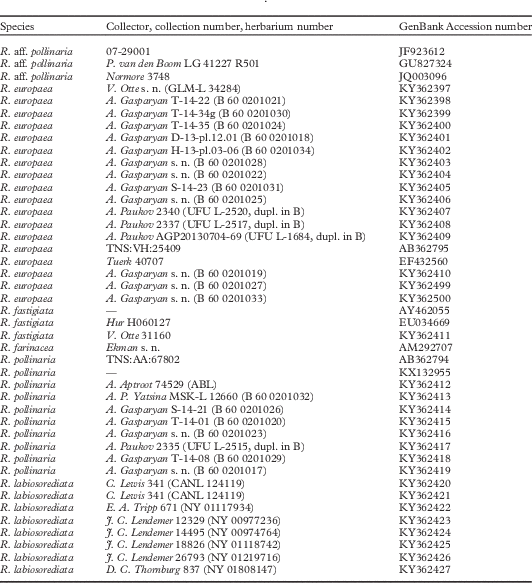
To delimit the study group, we first assembled a full data set from GenBank, including the newly generated sequences, of all available ITS sequences of Ramalina including Niebla, which in some studies has been shown to be nested within Ramalina. Cliostomum griffithii was used as the outgroup. A supported clade including the target group was then selected for subsequent analysis, using three sequences of R. fastigiata as an outgroup. In addition to the 33 newly generated sequences and the three outgroup sequences, 10 sequences were added from GenBank (Table 1), including eight from Europe, one from China and one from Canada, out of four identified as R. pollinaria in the study by Timsina et al. (Reference Timsina, Stocker-Wörgötter and Piercey-Normore2012). Both data sets were first aligned with MAFFT (Katoh & Standley Reference Katoh and Standley2013) and then manually adjusted where necessary. Phylogenetic reconstruction was performed under the maximum likelihood (ML) criterion in RAxML 8.2.0. (Stamatakis Reference Stamatakis2014) using the GTR-Gamma model and 1000 pseudoreplicates for non-parametric bootstrapping.
Ramalina species, collectors and collection numbers (if available), herbarium numbers and GenBank Accession numbers of the ITS sequences used in this study

Results and Discussion
Phylogeny
The broad-scale phylogeny shows the target clade with good support clustering as unsupported sister to a clade containing sequences mostly labelled as Ramalina fastigiata (see Supplementary Material Fig. S1, available online). Six sequences labelled R. pollinaria from GenBank cluster outside this clade and apparently represent misidentifications or conceptual problems, namely JN084055 from China clustering with R. sinensis s. lat., EU034670 from Hungary clustering with R. fastigiata, JF923602 from China clustering with R. intermedia, and three sequences (JQ003097, JQ003098, JQ003099) from Canada forming a separate clade as unsupported sister to R. culbersoniorum (see Supplementary Material Fig. S1, available online). These sequences are not considered further here as they are far outside the target clade. The three samples from North America in particular require further study as they obviously represent an undescribed taxon morphologically and chemically similar, but unrelated, to R. pollinaria.
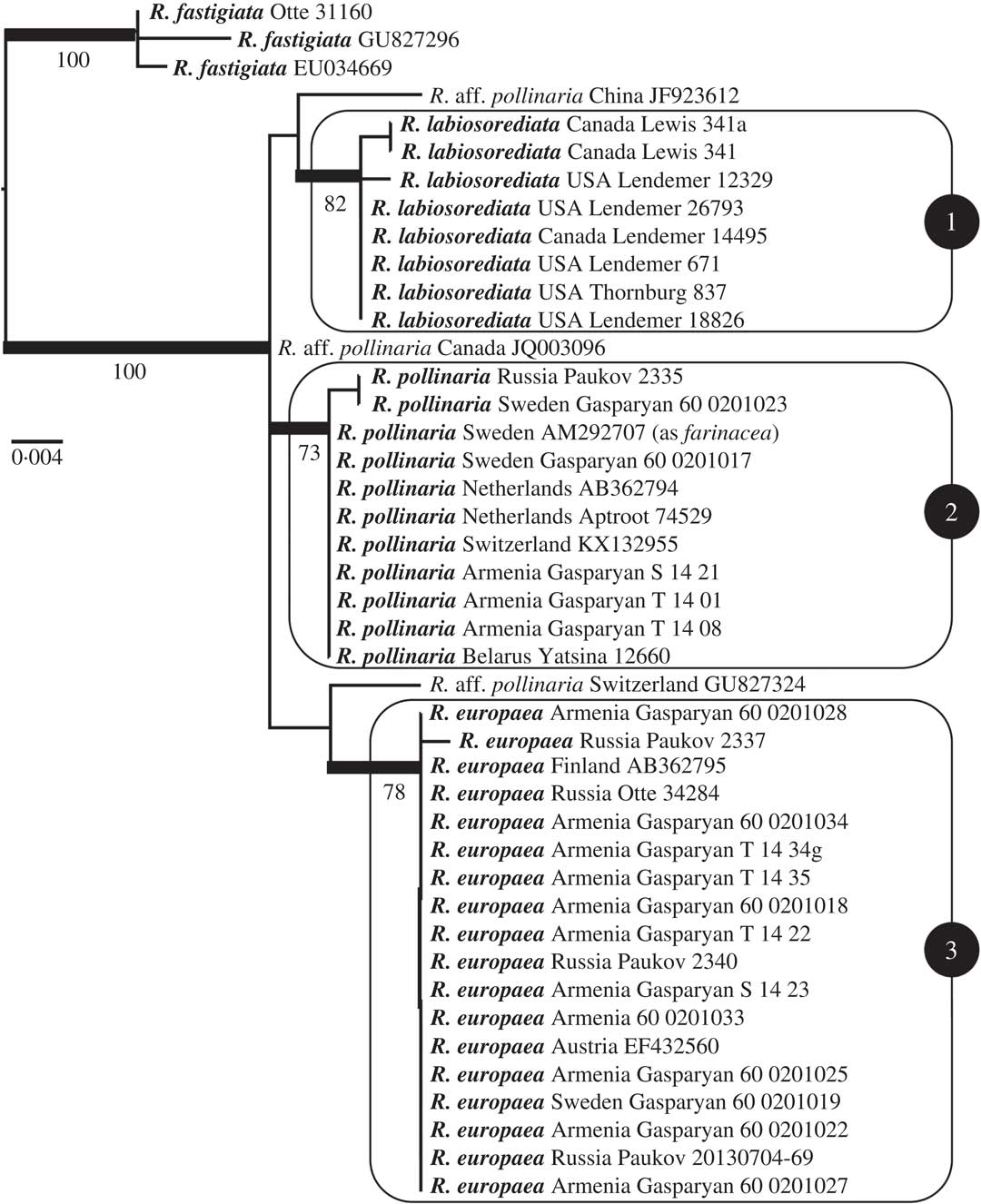
The R. pollinaria clade shows three large, supported ingroup clades and three orphaned singleton sequences (Fig. 1). All specimens within this clade have the same chemistry, namely usnic and evernic acids. Ingroup clade 1 contains all specimens from North America (Canada and the USA) except the singleton sequence JQ003096, whereas the other two ingroup clades (2 and 3) include specimens from Europe, the Caucasus and Russia (Eurasia); the remaining two singleton sequences originate from China (JF923612) and Switzerland (GU827324). A display of the variable positions in the ITS alignment shows that ingroup clades 1 and 2 are separated by seven fully diagnostic positions, ingroup clades 1 and 3 by eight, and ingroup clades 2 and 3 by seven fully diagnostic positions (see Supplementary Material Fig. S2, available online). In contrast, one or two positions are variable within each clade, resulting in a large barcoding gap as suggested by the long stem branches. The singleton sequence from China (JF923612) is an unsupported sister of clade 1, differing in six diagnostic positions. The singleton sequence from Switzerland (GU827324) is an unsupported sister of clade 3, with seven diagnostic differences. The singleton sequence from Canada (JQ003096) is found in an unresolved basal position in the R. pollinaria clade. This sequence is very short and lacks the entire, diagnostic ITS2 region whereas the ITS1 region contains three ambiguous base calls in diagnostic positions; it has one difference with clade 1 and no difference with clade 2 within the covered region.
Maximum likelihood phylogenetic tree of the Ramlina pollinaria complex inferred from ITS. Branches with bootstrap values ≥70% are thickened and support values are given below the branch. Specimens not in bold are only tentatively identified.
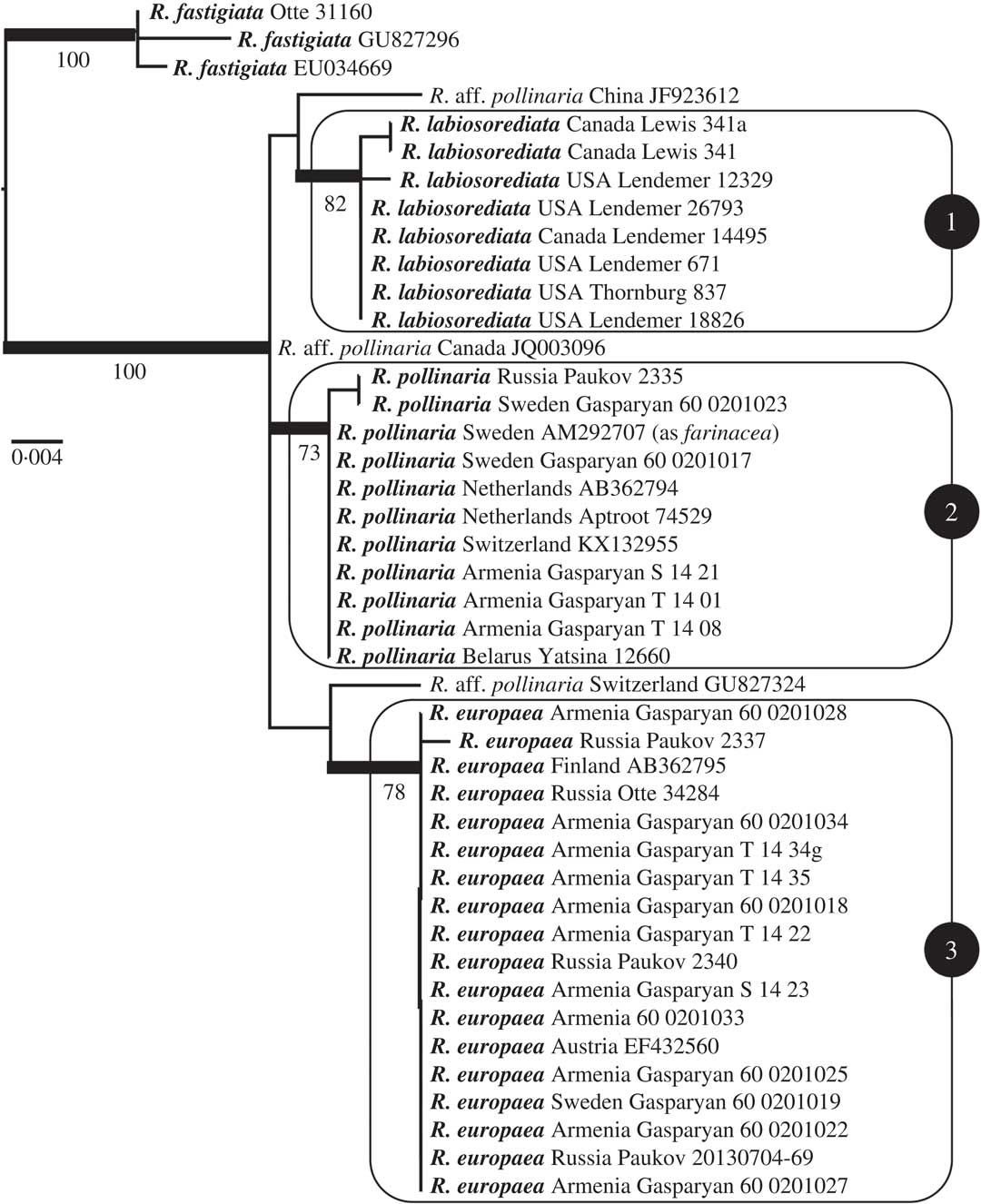
The three larger ingroup clades correlate with morphological features: clade 1 from North America forms predominantly terminal soralia which originate from the underside and may become irregularly labriform and rather large. In contrast, the two Eurasian clades form smaller, subterminal to marginal-laminal soralia on the upper side of the lobes but partially continuing onto the underside marginally; in clade 3, the soralia start out as small, granular, punctiform soralia subterminally on the lobe surface, with the additional presence of numerous small, subterminal, thin branchlets, whereas in clade 2, the soralia are generally marginal and terminal and more elongate and farinose from the beginning, without additional small branchlets present. We conclude that the three clades represent three different taxa, with clade 2 in agreement with the newly selected neotype of R. pollinaria (see below); no species-level names are available for the other two clades and these are formally described and discussed below, as R. labiosorediata (clade 1) and R. europaea (clade 3).
Two of the three singleton sequences, namely those from China and Switzerland, could represent additional species based on the observed base differences, but more molecularly congruent specimens are needed to confirm this hypothesis. The possible existence of an additional species of this complex in Europe would be particularly intriguing, although the lectotype material of R. humilis from Sweden (see below) already suggests the existence of further taxa within the R. pollinaria complex in Europe. The singleton sequence from Canada cannot be assessed currently due to the quality issues observed; it could either represent R. pollinaria s. str., then being the only confirmed specimen of that species in North America, or R. labiosorediata. We were able to examine the specimen and, although it is not well developed, it agrees in morphology with R. labiosorediata; this would be consistent with its geographical origin.
Our results underline how well the ITS barcoding locus works for species delimitation within Ramalina, as well as it providing by far the largest data set available in terms of taxonomic and geographical range and sampling density. We have therefore not attempted to add further loci in this particular case, since the species introduced here are well resolved and supported and we are unaware of instances where a well-resolved ITS phylogeny at the species level would be contradicted by other markers. However, there are other cases within Ramalina that show a more complex pattern or limited resolution based on ITS, such as R. farinacea, and additional loci will be necessary in such cases.
Taxonomy
Ramalina europaea Gasparyan, Sipman & Lücking sp. nov.
MycoBank No.: MB 819386
Differing from Ramalina pollinaria in the small, punctiform, often terminal soralia starting out on small, spine-like branchlets.
Type: Sweden, Södermanland, Lerbo parish, 1·7 km NE of Lerbo church, 600 m SW Dagöholm, the Natura 2000 habitat Dagöholmsbackarna, W of the road, wooded meadow with very old Quercus robur, on Quercus robur, 30 m, 58°59·120'N, 16°27·254'E, grazed, 7 May 2015, A. Gasparyan s. n. (B 60 0201019—holotype).
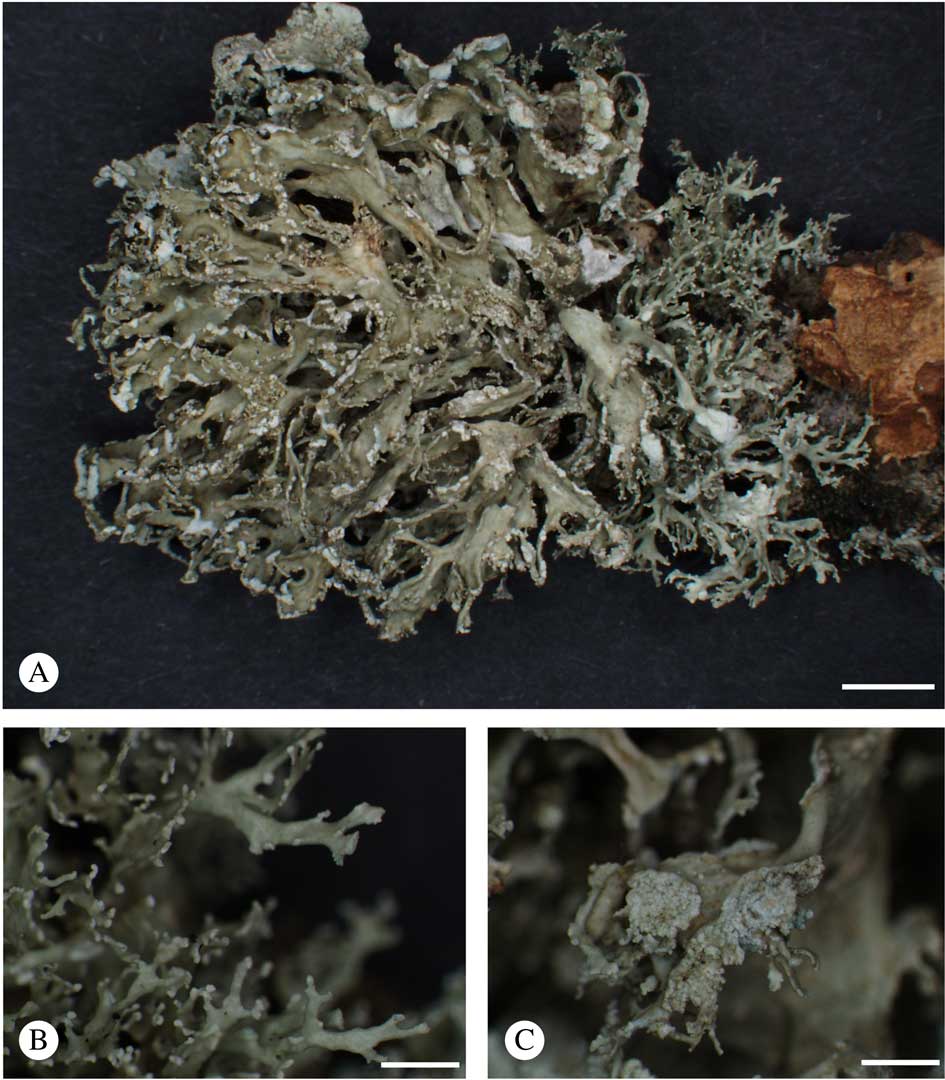
(Fig. 2)
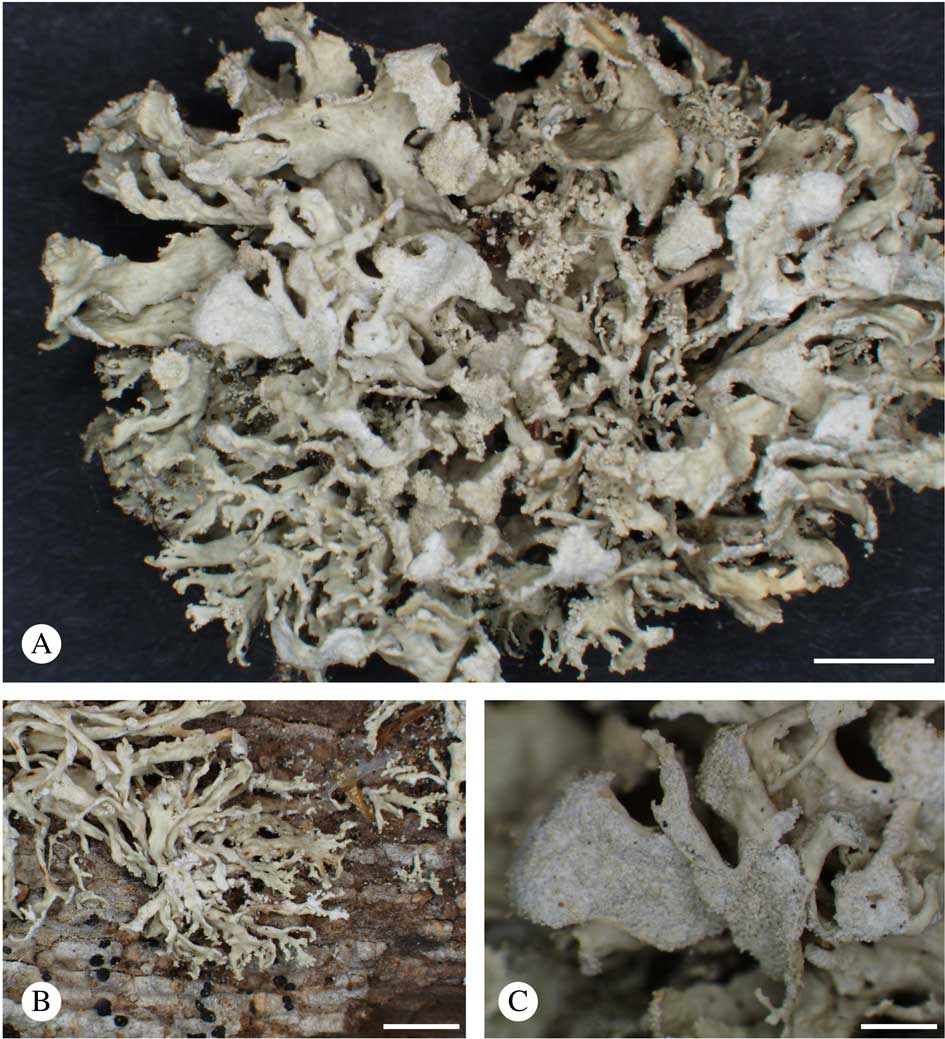
Ramalina europaea. A, thallus, Gasparyan H-13-pl.03-06 (B 60 0201033); B, spine-like branchlets with small, punctiform soralia, Gasparyan H-13-pl.03-06 (B 60 0201033); C, granular soredia, Gasparyan s. n. (B 60 0201025). Scales: A=4 mm; B & C=1 mm. In colour online.
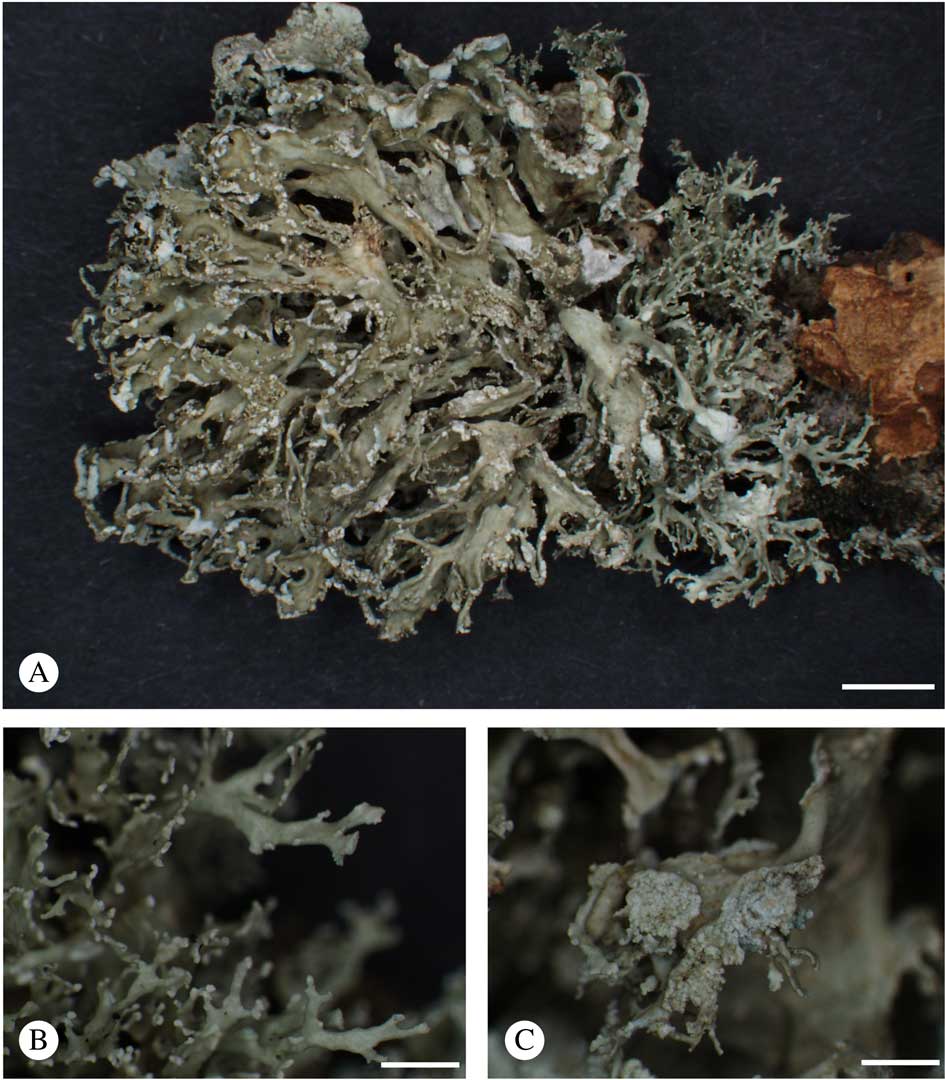
Thallus corticolous or saxicolous, fruticose, pale green to green; branches erect to subpendulous, c. 1(–3) cm long, flattened, solid, up to 3 mm wide, several times dichotomously to palmately branched, often developing numerous tiny, irregular, sometimes spine-like proliferations with punctiform soralia on the top. Soralia lateral and terminal, in mature thalli terminal often on widened, somewhat vaulted lobes, but never becoming large and labriform; soredia granular, 50–70 μm diam., easily abraded and leaving a bare, whitish surface of the soralia.
Apothecia very rare, 1–3 mm wide; hymenium c. 40 μm thick; asci c. 35–40×12 μm, clavate, Bacidia-type; ascospores (10–)12–14(–15)×4·0–4·5(–5·0)μm (20 healthy-looking spores measured), straight or slightly curved.
Chemistry. Medulla and soralia C−, K−, KC−, Pd−, UV−; TLC: usnic and evernic acids.
Etymology. The epithet refers to the wide European (to Eurasian) distribution of the species.
Distribution and ecology. The new species was found in broadleaved and mixed forests. It grows on various rocky substrata (limestone, granite rocks) and various phorophytes (Fagus spp., Carpinus spp.). Currently it is known from Armenia, Austria, Finland, Russia (European part and North Caucasus) and Sweden, where it seems to be more common than R. pollinaria s. str.
Notes. This newly recognized species is phylogenetically distinct from Ramalina pollinaria s. str. and since both have a broadly overlapping, widely European to Eurasian distribution, they cannot be considered infraspecific lineages of a single species and hence are recognized separately here at the species level. Well-developed specimens show the morphological differences rather clearly, with R. europaea forming small, spine-like branchlets near the lobe tips on which the soralia start out as punctiform, granular structures, whereas in R. pollinaria the soralia are more irregular, larger and farinose from the beginning; older soralia are rather similar. Young or old or depauperate specimens might be difficult to identify with certainty.
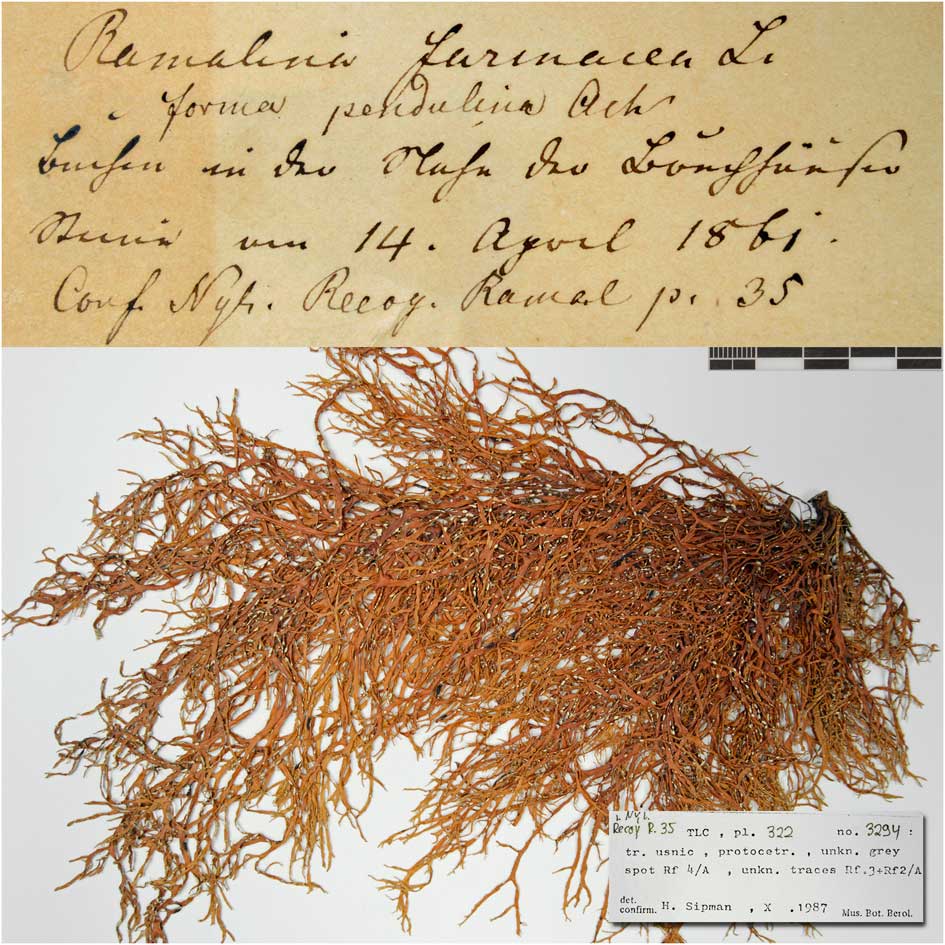
We studied a number of historical names previously placed in synonymy with R. pollinaria s. lat. or considered infraspecific taxa within the latter, to check whether a name was available for the two new species introduced here, particularly R. europaea. While some of the names were found to be conspecific with R. pollinaria s. str. (see below), others had already been placed in synonymy with other, unrelated species (see Supplementary Material Table S1, available online). The status of several infraspecific names remains uncertain (see Supplementary Material Table S1), but these have no priority at the species rank. The only remaining species-level name with uncertain status and potentially predating R. europaea is Lichen squarrosus Pers. (1795). This name was variously treated as a synonym of R. pollinaria s. lat. (Acharius Reference Acharius1810) and R. polymorpha (Lilj.) Ach. (Zahlbruckner Reference Zahlbruckner1930) and it would actually threaten the name R. pollinaria if synonymous, as it seems to have been published prior to L. pollinarius Westr. in the same year. It has been overlooked that the name Lobaria squarrosa, usually attributed to Hoffmann (Reference Hoffmann1796) and treated as a taxon different from Lichen squarrosus (Zahlbruckner Reference Zahlbruckner1930), is a homotypic combination based on the latter and must be cited as Lobaria squarrosa (Pers.) Hoffm. Likewise, the correct author citations for the names Physcia squarrosa and Ramalina squarrosa are P. squarrosa (Pers.) DC. and R. squarrosa (Pers.) Oxner. Persoon (Reference Persoon1795) did not cite any material for Lichen squarrosus, and there is no material in L (M. Brand, pers. comm. 23 November 2016), but from the protologue it is clear that the taxon was collected in Germany in the Solling forest (Lower Saxony) on the bark of beech trees (Fagus sylvatica). The description and ecology suggest that the name Lichen squarrosus refers to what is now known as R. farinacea (L.) Ach.; therefore, in order to stabilize nomenclature we neotypify the name Lichen squarrosus with a well-developed, historical specimen collected in 1861 on beech in North Rhine-Westphalia, not far from the Solling, deposited in B (Fig. 3): Lichen squarrosus Pers., Annalen der Botanick 14: 35 (Reference Persoon1795); Lobaria squarrosa (Pers.) Hoffm., Deutschlands Flora 2: 139 (Reference Hoffmann1796); Physcia squarrosa (Pers.) DC. in Lamarck & de Candolle, Flore Française, Edn. 3 (Paris) 2: 398 (1805); Ramalina squarrosa (Pers.) Oxner, Akademija Nauk Ukrainskoi RSR Institut Botaniki: 283 (1937); type: Germany, North Rhine-Westphalia, ‘Buchen in der Nähe der Bruchhauser Steinen’, 14 April 1861, Lahm s. n. (B60 0059371—neotype, designated here; MycoBank No. MBT374159). This neotypification makes Lichen squarrosus a synonym of R. farinacea.
Neotype of Lichen squarrosus Pers. (= Ramalina farinacea) in B (Berlin). Scales: large divisions=1 cm; small divisions=1 mm. In colour online.

Additional specimens examined. Armenia: Kotayk Prov.: Aghavnadzor, mixed forest, on bark of deciduous tree, 1708 m, 40°34'22''N, 044°41'48''E, 2013, A. Gasparyan H-13-pl.03-06 (B 60 0201033); ibid. (B 60 0201034); Artavaz, mixed forest, on stone, 1767 m, 40°36·80''N, 044°34·11'E, 5 vii 2015, A. Gasparyan s. n. (B60 0201022); ibid., (B 60 0201025). Lori Prov.: Jiliza forestry, road to the village of Jiliza, coniferous stand in deciduous forest, on bark of Pinus sp., 1687 m, 41°10'81''N, 044°38'27''E, 2014, A. Gasparyan T-14-34g (B60 0201030); ibid., mixed forest, on bark of deciduous tree, 1688 m, 41°10'56''N, 044°37'85''E, 2014, A. Gasparyan T-14-35 (B 60 0201024). Syunik Prov.: Shikahogh State Reserve, deciduous forest, on Quercus sp., 1700 m, 39°00·77''N, 046°30·62''E, 2014, A. Gasparyan S-14-23 (B 60 0201031). Tavush Prov.: Dilijan National Park, 1218 m, 40°43'49''N, 044°58'26''E, 2013, A. Gasparyan D-13-pl.12.01 (B 60 0201018); Koghb, Noyemberyan forestry, old beech forest, on Fagus orientalis, 1117 m, 41°07·585'N, 044°54·662'E, 26 vii 2015, A. Gasparyan s. n. (B60 0201027); ibid., (B60 0201028); ibid., old beech forest, on Fagus orientalis, 1091 m, 41°08'11''N, 044°55'46''E, 2014, A. Gasparyan T-14-22 (B 60 0201021).—Russia: Republic of Adygeja: Maikopskij Rajon, unterhalb der Poljana Firsowa in Richtung Tal des Mal, Sachrai., on Carpinus sp., 1270 m, 44°05'27''N, 040°24'33''E, 6 viii 2012, V. Otte s. n. (GLM-L 34284). Chelyabinsk Region: vicinity of Miass town, Ilmenskiy State Reserve, 1·6 km NW from Miasovo biological station, granite rocks under pine forest canopy, on granite rocks, 309 m, 55°08'14·7''N, 60°13·977'E, 2013, A. Paukov 2337 (UFU L-2517); Ashinskiy District, c. 3 km to 314° (NW) from Biyanka Village, mixed forest with Picea abies, Populus tremula, Tilia and Quercus sp., on Tilia cordata, 432 m, 55°12'00·9''N, 57°37'42·5''E, 2013, A. Paukov AGP20130704-69 (UFU L-1684). Sverdlovsk Region: Shalinskiy district, vicinity of Staroutkinsk settlement, “Reka Chusovaya” Natural Park, Vinokurennyi kamen’ rock, limestone outcrops on left bank of Chusovaya River, on limestone, 55°08'14·7''N, 60°13·977'E, 2012, A. Paukov 2340 (UFU L-2520).
Ramalina labiosorediata Gasparyan, Sipman & Lücking sp. nov.
MycoBank No.: MB 819387
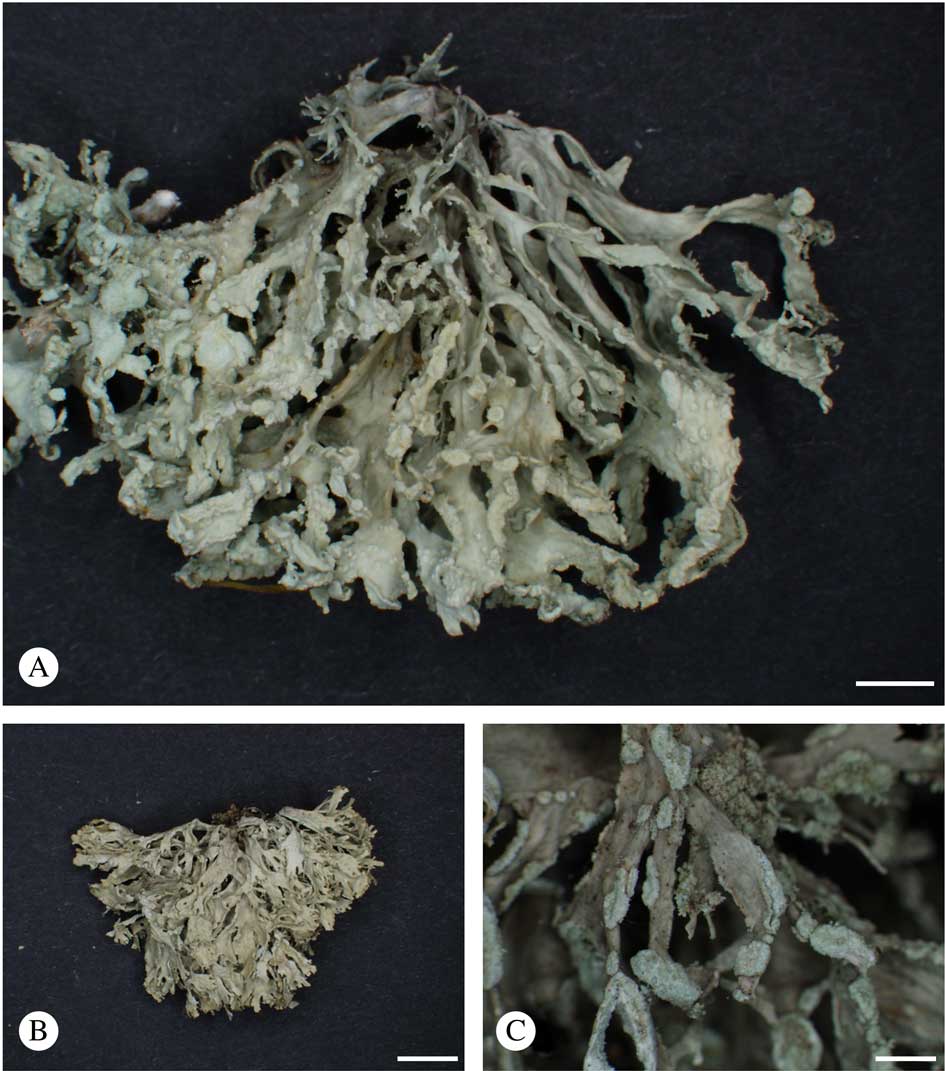
Differing from Ramalina pollinaria and R. europaea in the almost exclusively terminal soralia formed on the tips of normal lobes, originating from the underside and becoming irregularly labriform.
Type: USA, Arizona, Coconino County, 10 miles S of Flagstaff in Kelly Canyon just upstream from junction with Pumphouse Wash, on shaded sandstone face, 35°03·533'N, 111°42·995'W, 6345 ft, 3 October 2012, David C. Thornburg 837 (NY 01808147, holotype).
(Fig. 4)
Ramalina labiosorediata. A, thallus, Lendemer 14495 (NY 00974764); B, thallus, Tripp 671 (NY 01117934); C, labriform soralia formed on the tips of lobes, originating from the underside, Lendemer 14495 (NY 00974764). Scales: A & B=4 mm; C=1 mm. In colour online.
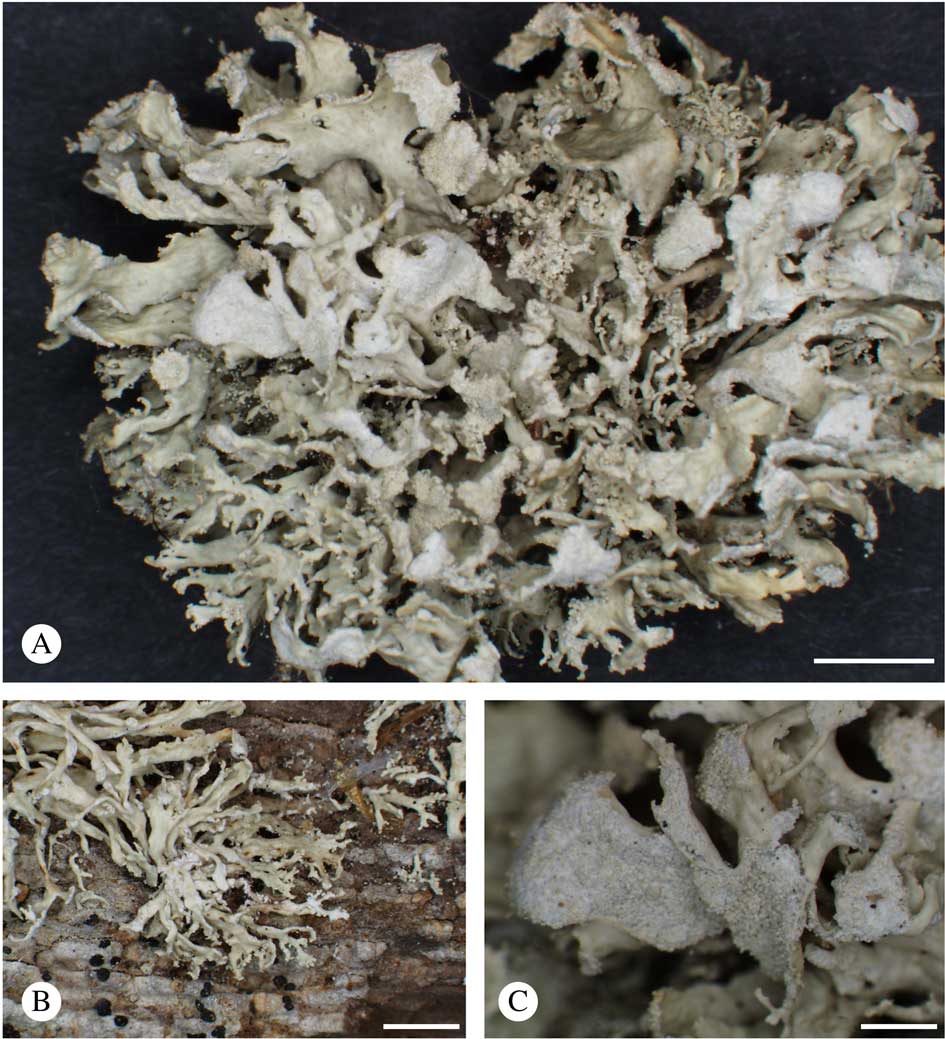
Thallus corticolous or saxicolous, fruticose, pale green to green; branches erect to ascending, more rarely subpendulous, c. 1(–3) cm long, flattened, solid, up to 1(–2) mm wide, a few times dichotomously to palmately branched, with age often apically widened and producing terminal, lip-shaped, 1 mm to over 5 mm wide soralia, in addition to apical, irregular or granular, terete, spine-like proliferations producing granules in punctiform apical soralia. Soralia elongate to rounded, lateral and terminal, there often lip-shaped; soredia granular, 50–70(–90)μm diam.
Apothecia not seen.
Chemistry. Medulla and soralia C−, K−, KC−, Pd−, UV−; TLC: usnic and evernic acids.
Etymology. The epithet is partially derived from the Latin word ‘labium’ and refers to the eventually lip-shaped soralia.
Distribution and ecology. The new species was found in North America (Canada and the USA) where it seems widespread. It grows in deciduous, coniferous and mixed forests, on various phorophytes (Acer saccharum, Liriodendron sp., Nyssa sp., Thuja sp.), and also on rocky substrata.
Notes. In a previous study of North American Ramalina, R. pollinaria was already suggested to be polyphyletic (Timsina et al. Reference Timsina, Stocker-Wörgötter and Piercey-Normore2012), forming two unrelated clades, with one sequence (JQ003096) clustering with European specimens and the other three (JQ003097, JQ003098, JQ003099) close to the western North American R. menziesii. We therefore initially expected the North American clade now separated from R. pollinaria s. str. to correspond to the separate clade identified in the previous study. However, three of the four specimens studied by Timsina et al. (Reference Timsina, Stocker-Wörgötter and Piercey-Normore2012) are phylogenetically unrelated to the R. pollinaria clade; in our large-scale phylogeny, these three sequences clustered close to another North American species, R. culbersoniorum (see Supplementary Material Fig. S1, available online), although they are morphologically and chemically fairly similar to R. pollinaria. Only one specimen, Normore 3748 (JQ003096), belongs to the R. pollinaria clade and it morphologically resembles R. labiosorediata; however, its ITS sequence is too short (216 base pairs) and it has quality issues that prevent it from being included in that species with certainty (see above).
The morphological differences between Ramalina labiosorediata with its terminal, labriform soralia originating from the underside and R. pollinaria s. str. with predominantly laminal to marginal, elongate soralia are clearly visible in the material studied and sequenced, even in somewhat depauperate specimens. In treatments of R. pollinaria for North America, such as Brodo et al. (Reference Brodo, Sharnoff and Sharnoff2001), the terminal, labriform soralia were mentioned or illustrated as a diagnostic feature for the taxon, without recognizing that the soralia are differently shaped in European material of R. pollinaria. At this point, we presume that R. pollinaria s. str. is not present in North America. Confirmation of this was not attempted here because it would require re-examination of a large amount of material. The CNALH portal (2016) alone has well over 600 specimens identified under that name from Canada and the USA.
No historical name was found based on material that would be conspecific with Ramalina labiosorediata.
Additional specimens examined (*=not sequenced). Canada: Ontario: Prince Edward County, Sandbanks provincial park, mature deciduous forest along lake shore, on Acer saccharum, 76 m, 43°53'30·79''N, 077°16'49·59''W, 2009, C. Lewis 341 (CANL 124119); Bruce County, Fathom Five National Marine Park, Flowerpot Island, Flowerpot Loop Trail, Thuja-dominated forest cover, Silurian dolomite, with extensive outcrops and costal bluffs, on Thuja and on cliffs, c. 180 m, 45°18'14''N, 081°36'43''W, 2008, J. C. Lendemer 14495 (NY 00974764); *York County, Nashville, on elm tree, E side, near base, 4 iv 1959, R. F. Cain s. n. (NY 01544870).—USA: North Carolina: Haywood County, Great Smoky Mountains National Park, E slopes above (E of) Caldwell Fork, along E portions of Boogerman Loop Trail, mixed rich cove forest and old growth homesteads with Acer saccharum, Tsuga canadensis, Liriodendron and Hamamelis grading to upland Carya, Quercus montana, mature Liriodendron forest with Rhododendron understorey, on Acer saccharum, 3000–3600 ft, 35°36'20''N, 083°05·50'W to 35°37'30''N, 083°05·30'W, 2009, J. C. Lendemer 18826 & E. Tripp (NY 01118742); *Haywood County, Great Smoky Mountains National Park, Double Gap trail between Double Gap and Caldwell Fork, rich hardwoods (Prunus, Betula, Aesculus, Acer, Carya) with large trees, grading to acid Tsuga (large dead trees) - Rhododendron forest, on hardwood, 35°34'19''N, 83°06'03''W to 35°35'36''N, 83°07'03''W, 2011, Erin A. Tripp 2017 with James Lendemer, Naveed Davoodian, Zev Reuter, Andrei Moroz (NY 1685380). Pennsylvania: Wayne County, Lacawa Sanctuary, Wallenpaupack Ledges, N shore of Lake Wallenpaupack, Paupack Township, massive sandstone ledges with maple (Acer) - hickory (Carya) - oak (Quercus) forest, on rock, overhang, 1300–1450 ft, 41°23'N, 075°17'W, 2008. J. C. Lendemer 12329 (NY 00977236). Tennessee: Blount County, Great Smoky Mountains National Park, Gregory Bald Trail, Parsons, Branch Rd to Sheep Pen Gap (4mi), acid uplands (Pinus, Quercus, Kalmia) and occasional rich cove forest (Liriodendron, Quercus, Halesia) with sparse old growth, on old Liriodendron, 2776–4616 ft, 35°31'11''N, 083°52'28''W to 35°32'34''N, 083°53'36''W, 2010, J. C. Lendemer 26793 & A. Moroz, E. Tripp (NY 01219716); Cocke County, Great Smoky Mountains National Park, Gabes Mountain Trail, 0–2mi E of jct with Maddron Bald Trail, acidic Tsuga, Oxydendrum, Quercus montana, Acer saccharum and Nyssa forest with Rhododendron understorey, on Nyssa, 2400–3200 ft, 35°45'10''N, 083°16'30''W to 35°44'50''N, 083°14'50''W, 2009, E. A. Tripp 671 & J. C. Lendemer (NY 01117934); *Sevier County, Brushyx Mt. trail, buckeye bark, 4500 ft, 29 iii 1936, S. A. Cain s. n. (NY 02375823).
Ramalina pollinaria (Westr.) Ach.
MycoBank No.: MB 356436
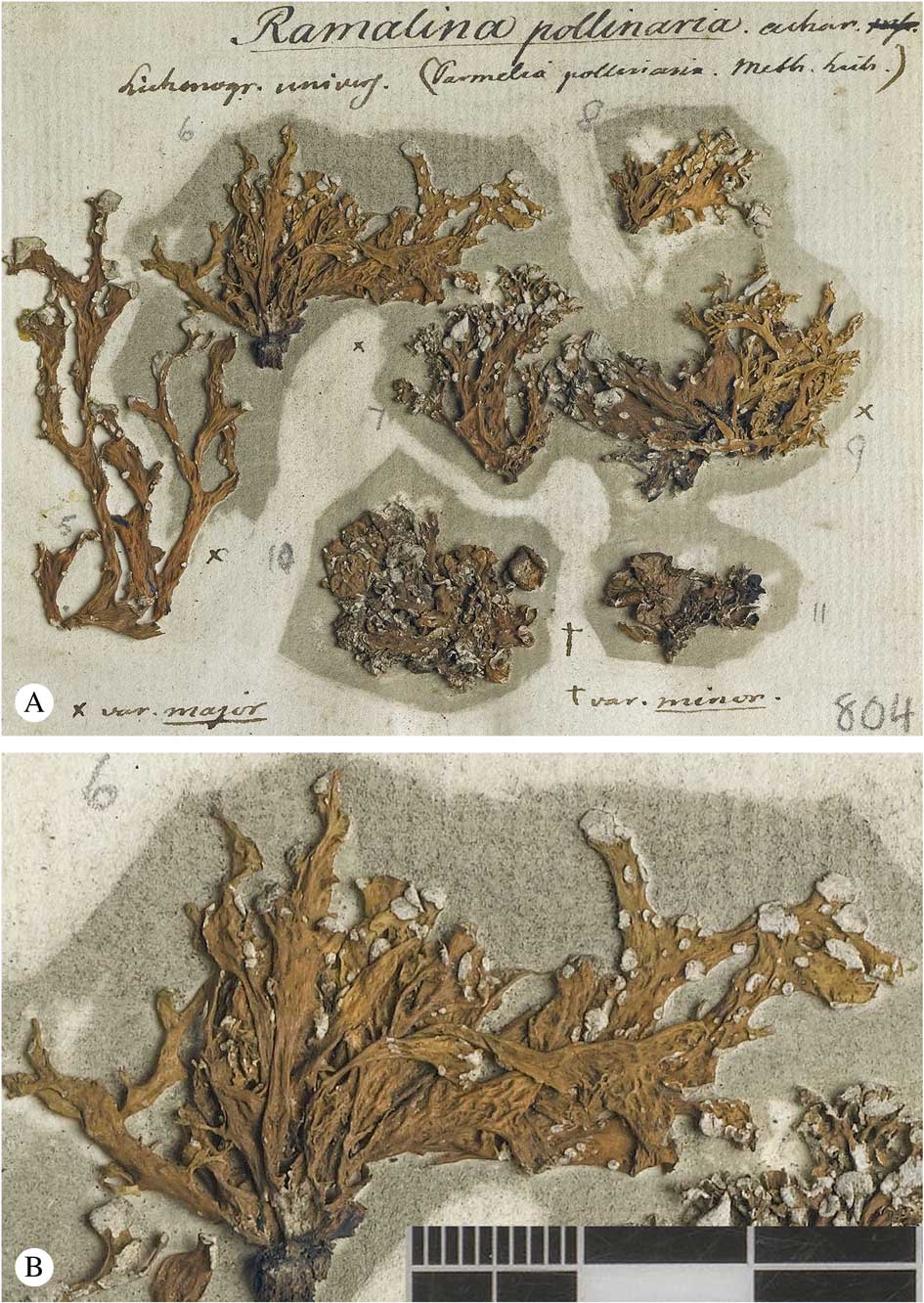
Acharius, Lichenographia Universalis: 608 (Reference Acharius1810); Lichen pollinarius Westring, Kongliga Svenska Vetenskaps-Akademiens Handlingar 16: 56 (Reference Westring1795); type (Fig. 6): Sweden, unknown locality, unknown date and collector but collected prior to 1810, no. 6 (BM 001107258—neotype!, designated here; MycoBank No. MBT374161); Sweden, Lerbo parish, the Natura 2000 habitat Dagöholmsbackarna, on Quercus robur, 7 May 2015, Gasparyan s. n. (B 60 0201017—epitype!, designated here; MycoBank No. MB T374163; ITS barcode sequence: KY362419).
Ramalina pollinaria f. elatior Ach., Lichenographia Universalis: 608 (1810); R. elatior (Ach.) Röhl., Deutschlands Flora (Frankfurt) 3(2): 140 (1813); type (Fig. 7): Sweden, unknown locality, unknown date and collector but collected prior to 1810 (H-ACH 1831E=H 9 502 934—lectotype!, designated here; MycoBank No. MBT374160).
Ramalina farinacea var. bolcana A. Massal., Memorie Lichenographiche: 67 (1853); R. farinacea f. bolcana (A. Massal.) Zahlbr., Catalogus Lichenum Universalis 6: 468 (Reference Zahlbruckner1930); type: Italy (not seen, fide Nimis Reference Nimis2016).
Ramalina fennica Räsänen, Ann. Acad. Sci. Fenn., Ser. A, 34(4): 27 (1931); type: Russia, 13 May 1923, Räsänen s. n. (H 9 500 246—holotype!).
Ramalina pollinaria var. sortavalensis Räsänen, Ann. Bot. Soc. Zool.-Bot. Fenn. ‘Vanamo’ 12(1): 40 (1939); type: Russia, 14 May 1923, Räsänen s. n. (H 9 500 274—holotype!).
Ramalina pollinaria. A, thallus, Gasparyan s. n. (B 60 0201023); B, thallus, Yatsina MSK-L 12660 (B 60 0201032); C, irregular elongate soralia, Gasparyan S-14-21 (B 60 0201026). Scales: A & B=4 mm; C=2 mm. In colour online.

New neotype of Lichen pollinarius Westr. (= Ramalina pollinaria) in BM. A, entire set of specimens from sheet no. 804; B, neotype specimen no. 6. Scales: large divisions=1 cm; small divisions=1 mm. Image reproduced from the Global Plants project with the permission of Holger Thüs. In colour online.

Lectotype of Ramalina pollinaria var. elatior Ach. (= Ramalina pollinaria) in H. A, entire set of specimens of var. elatior from sheet no. 1831; B, lectotype specimen E. Scales: large divisions=1 cm; small divisions=1 mm. Image reproduced from the Global Plants project with the permission of Soili Stenroos. In colour online.
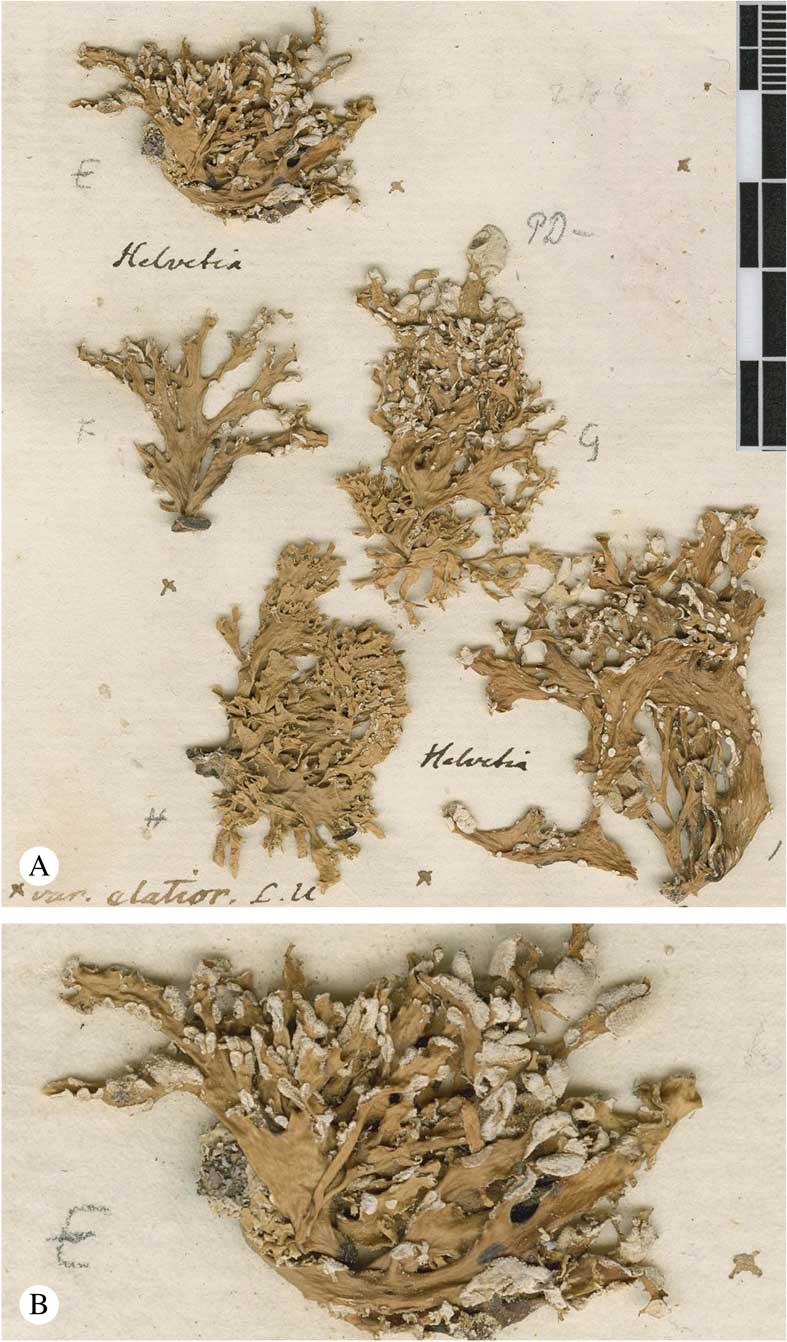
Thallus corticolous, fruticose, pale green to green; branches subpendulous, c. 1–5 cm long, flattened, solid, a few times or more densely dichotomously to palmately branched, the tips up to 2(–3) mm wide, rarely with spine-like proliferations. Soralia elongate, marginal to subterminal, spreading over the underside, becoming more roundish, more crowded terminally, small soralia may develop laminally; soredia farinose to subgranular, 30–50 μm diam.
Apothecia not seen in the sequenced specimens.
Chemistry. Medulla and soralia C−, K−, KC−, Pd−, UV−; TLC: usnic and evernic acids.
Distribution and ecology. Specimens fitting this refined concept of the species were seen from Armenia, Belarus, the Netherlands, Russia and Sweden. The species grows on various phorophytes (Acer platanoides, Carpinus betulus, Fagus orientalis, Quercus robur, Tilia cordata, Robinia sp.).
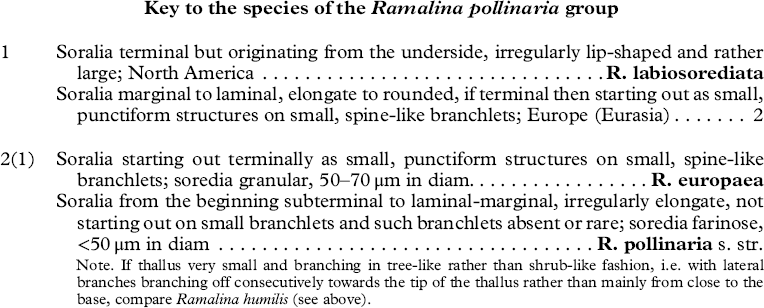
Notes. Differences between Ramalina pollinaria and the two newly described species are discussed under the previous two species entries and are outlined in the key below. The previously separated, somewhat related species, R. yasudae and R. sekika, form separate, distinct, monophyletic clades out of the R. pollinaria clade (see Supplementary Material Fig. S1, available online) and differ from R. pollinaria in the larger size of the soredia (100–150 μm diam.), their distribution (R. yasudae and R. sekika are known from eastern Asia) and in the case of R. sekika also in the chemistry (usnic, salazinic and sekikaic acids) (Ohmura et al. Reference Ohmura, Moon and Kashiwadani2008; Kataeva Reference Kataeva2014).
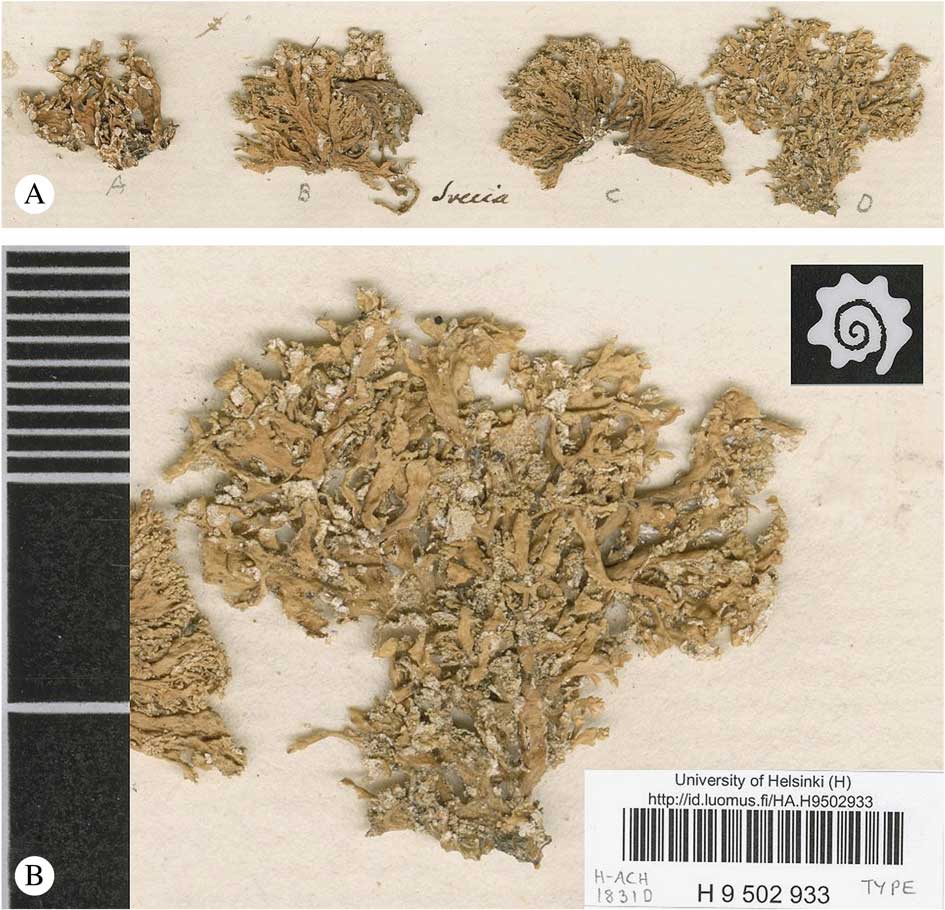
The association of Ramalina pollinaria s. str. with the clade identified here under that name was assessed by comparison with the sheet containing the original neotype of R. pollinaria selected by Krog & James (Reference Krog and James1977). That specimen (H-ACH 1831D) forms part of the material which served as a base for R. pollinaria var. humilis Ach., whereas according to Acharius (Reference Acharius1810) and subsequent authors, typical R. pollinaria corresponds more to var. elatior Ach. Acharius (Reference Acharius1810) divided R. pollinaria into the two varieties, var. elatior and var. humilis, and technically one of them would correspond to the autonym, var. pollinaria [ICN 26.1]. However, since the epithet pollinarius had been established 15 years earlier and by a different author (Westring Reference Westring1795), the autonym should be established based on that epithet; the two varieties var. elatior and var. humilis are best considered separate, valid varieties since at the time of their description (Acharius Reference Acharius1810) no type material had been established for any of these names [ICN 26.2, Ex. 4]. There are two sheets of material studied by Acharius on which he based his concept of R. pollinaria, namely the aforementioned H-ACH 1831(A–K) and also BM 001107258(5–11), the latter given by Acharius to the Linnean Society in London in 1808. While the H-ACH sheet reflects Acharius’s (Reference Acharius1810) concept of dividing the species into var. elatior and var. humilis, the BM sheet, which also bears the number ‘804’, was apparently assembled earlier, as Acharius likewise divided the species into two varieties but used unpublished names (var. ‘major’ and var. ‘minor’). The specimen 1831D from the H-ACH sheet, selected as neotype for R. pollinaria by Krog & James (Reference Krog and James1977), is morphologically the most aberrant material due to its unique, tree-like branching pattern and it corresponds to another specimen illustrated by Dillenius (Reference Dillenius1741: plate XXI, fig. 56A) that Acharius (Reference Acharius1810) had also included in var. humilis. All remaining specimens on the H-ACH sheet and all specimens on the BM sheet except nos. 10 and 11 (which belong to R. baltica Lettau) represent R. pollinaria s. str., both in historical and modern treatments and in our revised phylogenetic concept. Since the neotype selected for R. pollinaria by Krog & James (Reference Krog and James1977) does not correspond to either the historical or the modern concept of R. pollinaria (≡ f. pollinaria, var. pollinaria), it is superseded here by a new neotype [ICN. 9.14, 9.19b, 9.19c] from the BM sheet (Fig. 6), as the H-ACH sheet covers material from which the lectotypes of var. elatior and var. humilis should be selected. The lectotype of the former is indicated above (Fig. 7); the lectotype of var. humilis is designated here as identical to the former neotype of R. pollinaria (Krog & James Reference Krog and James1977), specimen 1831D (Fig. 8): R. pollinaria var. humilis Ach., Lichenographia Universalis: 609 (1810); R. humilis (Ach.) Röhl., Deutschlands Flora (Frankfurt) 3(2): 140 (1813); Sweden, unknown locality, unknown date and collector but collected prior to 1810 (H-ACH 1831D=H 9 502 933—lectotype!, designated here; MycoBank MBT374162). This lectotypification is made since this specimen represents an aberrant morphology resembling the illustration in Dillenius (Reference Dillenius1741) to which Acharius (Reference Acharius1810) refers, and it might represent a yet unrecognized taxon for which the name R. humilis is then available.
Lectotype of Ramalina pollinaria var. humilis Ach. (= Ramalina humilis) in H. A, entire set of specimens of var. humilis from sheet no. 1831; B, lectotype specimen D (this specimen had previously been designated as neotype of R. pollinaria). Scales: large divisions=1 cm; small divisions=1 mm. Image reproduced from the Global Plants project with the permission of Soili Stenroos. In colour online.

As outlined above, several synonyms and numerous infraspecific names have been established for Ramalina pollinaria which are potentially available for new species distinguished within this complex. We revised all names available at the species level and many of the infraspecific names. Of the latter, about half could be studied and only three belong in the R. pollinaria clade (see Supplementary Material Table S1, available online), all being synonyms of R. pollinaria s. str. and different to R. europaea, namely R. pollinaria f. elatior Ach., R. pollinaria var. bolcana (A. Massal.) Zahlbr., and R. pollinaria var. sortavalensis Räsänen (see above). Surprisingly, 14 of the 17 names studied (82%) are synonyms of or represent other species (see Supplementary Material Table S1), which underlines the notion that these historical, infraspecific names are not generally based on a sound biological understanding of species and infraspecies level taxonomy. We therefore follow the philosophy that such historical, infraspecific names should not receive attention and should be subsumed in synonymy whenever possible, except where their infraspecific status is based on biological reasoning, for instance when it was established for a morphologically distinct, geographically restricted population. An example would be R. pollinaria f. chilena Nyl., subsequently recognized as a separate species, R. chilena (Nyl.) Kashiw.
An additional name that was partially based on material originally identified as R. pollinaria is R. fallax Motyka (1960; the paratype from Sweden is Malme’s Lichenes Suecici Exsiccati 578). The holotype material of that name was later synonymized with R. farinacea by Krog & James (Reference Krog and James1977) as it agrees morphologically and contains protocetraric acid. The names R. maciformis (Delise) Bory and R. evernioides Nyl. have sometimes been discussed as possibly conspecific with R. pollinaria; however, both are now considered synonymous under R. maciformis which is a distinct species differing from R. pollinaria in its morphology, chemistry (bourgeanic and salazinic or norstictic acid) and ecology, being a Mediterranean species (Krog & Østhagen Reference Krog and Østhagen1980).
Additional specimens examined. Armenia: Syunik Prov.: Shikahogh State Reserve, mixed deciduous forest, on bark of deciduous tree, 1454 m, 39°01·20'N, 046°30·81'E, 2014, A. Gasparyan S-14-21 [B 60 0201026]; road to the city of Berd, mixed forest, on bark of deciduous tree, 1382 m, 40°52'65''N, 045°16'27''E, 2014, A. Gasparyan T-14-01 [B 60 0201020]. Tavush Prov.: Dilijan National Park, road to Lake Gosh, deciduous forest, on Fagus orientalis, 1423 m, 40°43·26'N, 045°00·88'E, 2014, A. Gasparyan T-14-08 [B 60 0201029].—Belarus: Minsk Prov.: Cherevenskiy District, Rovanichi, in the park, on Acer platanoides, 53°53'05·1''N, 28°36'34·6''E, 2013, A. P. Yatsina MSK-L 12660 [B 60 0201032].—Russia: Bashkortostan: Beloretskiy District, Revet’, 250 m, Tilia stand along small brook, on Tilia cordata, 54°12'90·7''N, 57°34'32·0''E, 2015, A. Paukov 2335 [UFU L-2515].—Sweden: Södermanland: Stora Malm parish, Stora Malm churchyard with scattered old deciduous trees, on deciduous tree bark, 40 m, 58°58·062'N, 16°21·658'E, 7 v 2015, A. Gasparyan s. n. [B 60 0201023]; Lerbo parish, 1·7 km NE Lerbo church, 600 m SW Dagöholm, the Natura 2000 habitat Dagöholmsbackarna, W of the road, grazed wooded meadow with very old Quercus robur, on Quercus robur, 30 m, 58°59·120'N, 16°27·254'E, 7 v 2015, A. Gasparyan s. n. [B 60 0201017].—The Netherlands: Utrecht Prov.: Amersfoort, Bergkwartier, on Robinia bark in park, 52°09'N, 05°21'E, 2016, A. Aptroot 74529 [ABL].
The authors are grateful to Dr James Lendemer (USA), Dr Irwin Brodo (Canada), Prof. Pier Luigi Nimis (Italy), Dr Alexander Paukov (Russia), Dr Volker Otte (Germany), Dr Andre Aptroot (The Netherlands) and Prof. Michele D. Piercey-Normore (Canada) for providing specimens. The first author would like to express his gratitude to the Ministry of Nature Protection for permission to collect and export the specimens from Armenia. AG also acknowledges financial support from the DAAD (German Academic Exchange Service) and the project “Developing Tools for Conserving the Plant Diversity of the Transcaucasus” financed by the Volkswagen Foundation. The first author is also grateful to his supervisor Prof. Thomas Borsch for his supporting guidance as well as to Ms. Julia Pfitzner (BGBM) for assistance in the laboratory. Drs Soili Stenroos and Holger Thüs are thanked for their permission to use Global Plants type images.
Supplementary Material
For supplementary material accompanying this paper visit https://doi.org/10.1017/S0024282917000226