




No CrossRef data available.
Continuities in depression from adolescence to young adulthood: Contrasting ecological influences
Published online by Cambridge University Press: 01 December 2004
Abstract
The prevalence, recurrence, and incidence of depression in adolescence and young adulthood are substantial for both males and females. In this study, we examined social setting variables that influence depression in males and females from adolescence to young adulthood. Rather than focusing on single ecological factors, we examined multiple settings including families, peers, and neighborhoods using longitudinal data from 372 families living in a large eastern urban area. We found that variables related to depression differed for males and females depending on the developmental period being examined. Family and peer variables in adolescence were significantly related to change in depression during the transition to adulthood for males, whereas family and neighborhood variables were marginally significant for females. Family and neighborhood variables in adulthood were significantly related to change in depression for females, and peer variables were significant for both males and females. Overall, contextual variables in adolescence had a more significant impact on change in depression for males, whereas contemporary variables in young adulthood had a more significant impact on change in depression for females.The authors acknowledge the assistance of Frank Furstenberg for the collection of this data with funds from the John D. and Catherine T. MacArthur Foundation's Network on Successful Adolescence in High Risk Environments. The authors also acknowledge partial support for the writing of this article from a National Institute of Mental Health Behavioral Science Research Center Grant awarded to the second author.
Information
- Type
- Research Article
- Information
- Copyright
- © 2004 Cambridge University Press
Both continuity and discontinuity characterize the transition from adolescence to adulthood. Changes occur in ecological settings as the adolescent moves from living with the family of origin towards the financial independence and the establishment of a new family during adulthood, but there may be consistencies as well, as individuals maintain the same quality of relationship with their parents. Personality and mental health characteristics also may be stable or fluctuate as individuals enter more stressful or stress-free contexts. Among these continuities and discontinuities is the course of symptoms of depression.
The incidence and prevalence of depression varies during development with lifetime rates estimated to be as high as 10–25% (Hankin, Abramson, Moffitt, Silva, McGee, & Angell, 1998; Lewinsohn, Hops, Roberts, Seeley, & Andrews, 1993; Reinherz, Giaconia, Pakiz, Silverman, Frost, & Lefkowitz, 1993). From the early teens to the mid-20s, depression increases in a roughly linear fashion (Kessler, Avenevoli, & Merikangas, 2001). For example, the National Comorbidity Survey (Kessler & Walters, 1998) estimated the lifetime prevalence of DSM-III-R major depression among adolescents in the age range of 15–16 years to be 14.6%, with an additional 8.1% with a lifetime history of DSM-III-R minor depression. The lifetime prevalence of DSM-III-R major depression among young adults in the age range of 21–22 years was estimated to be 21.2%, with an additional 10.3% with a lifetime history of DSM-III-R minor depression. Considering that this change represents a 45% increase in prevalence of major depression, understanding the factors related to this increase is an important societal concern.
Recent longitudinal studies suggest that depression in childhood and adolescence often persists into adulthood, and may predict more severe illness in adult life (Harrington, Fudge, Rutter, Pickles, & Hill, 1990; Lewinsohn, Rohde, Klein, & Seeley, 1999; Rao, Ryan, Birmaher, Dahl, Williamson, Kaufman, Rao, & Nelson, 1995; Rao, Hammen, & Daley, 1999; Reinherz, Giaconia, Hauf, Wasserman, & Silverman, 1999; Weissman, Wolk, Goldstein, Moreau, Adams, Greenwald, Klier, Ryan, Dahl, & Wickramaratne, 1999). For example, Lewinsohn et al. (1999) found that adolescent major depression was associated with an odds ratio of 3.2 compared with control subjects in predicting young adult depression. Other studies report that 60% of the depressed adolescent subjects, compared with 30% of the control subjects, had one or more episode of major depressive disorder in adulthood (Harrington et al., 1990; Weissman et al., 1999).
Despite the increasing prevalence of, and substantial continuity in, depression from adolescence to young adulthood, little is known about the factors affecting onset and recurrence during this important transition. Yet, for most people, this time period represents a major transition of considerable change and significance (Arnett, 2000). Individuals make life decisions that greatly impact their long-term adjustment. For example, many people obtain educational training, make occupational decisions, get married, and start a family. Depression during this critical juncture may compromise one's ability to choose the appropriate developmental path, resulting in considerable divergence between the trajectories of nondepressed and depressed young adults (Rao et al., 1995; Rao, Hammen, & Daley, 1999). For instance, Reinherz et al. (1999) found that men and women who were depressed during the transition to young adulthood demonstrated significant psychosocial impairments in early adulthood, including poor overall functioning, interpersonal and behavioral problems, low self-esteem, and suicidality. Major depression during the transition to young adulthood was also associated with poorer functioning in early adulthood, whether or not the depression was still fully active. Clearly, examining the short- and long-term factors associated with depression from adolescence to adulthood is necessary for understanding its course and impact.
Ecological Influences: Families, Peers, and Neighborhoods
A number of childhood adversities have been found to predict depression in adolescents and young adults. Many of these studies have focused on family demographic and social risk factors such as lower socioeconomic status (SES), larger family size, younger parental age, and marital disruption and remarriage (e.g., Rao et al., 1995, Reinherz et al., 1993, 1999). Studies have demonstrated that exposure to significant stressors in the family (parental death, family violence, parent psychopathology, or alcoholism) increases the likelihood of depression in young adulthood (Hammen, Henry, & Daley, 2000; Reinherz et al., 1999). Early indicators of family dysfunction, such as family conflict and rejection, are also associated with increased risk of depression in adolescents and young adults (Hammen et al., 2000; Reinherz et al., 1993, 1999).
With a few exceptions (e.g., Barber & Olsen, 1997; Seidman, Chesir–Teran, Friedman, Yoshikawa, Allen, & Roberts, 1999), most studies examining the causes and correlates of depression have focused on single environmental factors or an amalgamation of items from many social contexts converted into a single life event stress index (Monroe & Hadjiyannakis, 2002). However, current efforts to understanding human development have required increasing attention to multiple determinants including the peer group, school, and neighborhood (Cook, Herman, Phillips, & Settersten, 2002). The search for direct single causal pathways from antecedents to consequences has been rewarded with only small proportions of variance explained in the general case, and where more potent relations have been found they have been restricted to highly specific situations. An ecological model (Bronfenbrenner, 1979) offers an alternative framework in which behavior is interpreted as affected by multiple influences at various removes (Sameroff, Gutman, & Peck, 2003).
In recognition of the importance of peers and neighborhoods on adolescent development, a number of studies have recently examined the influence of these contexts on depression. Most studies have demonstrated an inverse association between peer social support and depression in diverse demographic samples of adolescents (for a review, see Hartup, 1996). Yet, there is some question whether peer support contributes to changes in depression across time. For instance, several studies found that the inverse association between peer support and depression disappeared after controlling for initial levels of depression (Hirsch & DuBois, 1992; Keefe & Berndt, 1996; McFarlane, Bellissimo, & Norman, 1995). Gender differences have also been noted. For example, peer support protected girls but not boys from increases in depression (Slavin & Rainer, 1990; Windle, 1992). However, there is less information regarding the association between peer values and depression. In a notable exception, Seidman and colleagues (1999) created clusters using a number of peer variables including support, involvement, hassles, values, and acceptance. They found that adolescents with involved, supportive peers experienced less depression regardless of the orientation of their peer network. Therefore, peer engagement appeared to protect adolescents from depression even when the peer network was antisocial. However, the need for peer engagement was stronger for females than males. Females were also more likely to perceive their friends as engaged but antisocial, whereas males were least likely. This suggests that there may be gender differences in the effects of peer values on depression in adolescence.
Although fewer studies have examined the effects of neighborhoods, evidence suggests that perceptions of neighborhood problems are associated with depression in adolescents. In several studies, adolescents' perceptions of their neighborhood as violent and dangerous were found to have negative consequences on their mental health (Aneshensel & Sucoff, 1996; Elze, Stiffman, & Dore, 1999; Hadley–Ives, Stiffman, Elze, Johnson, & Dore, 2000; Stevenson, 1998). Research has also demonstrated the positive impact of social capital resources in buffering negative life experiences in urban neighborhoods (Sampson, 1992; Sampson & Groves, 1989). In addition to quantity of resources, neighborhoods may have effects through collective action. Sampson, Raudenbush, and Earls (1997) found that disorganization in high-poverty neighborhoods operates through a reduced sense of shared efficacy or coherence among the area's inhabitants. A study of urban African American adolescents noted some interesting gender differences. Stevenson (1998) found that girls who perceived higher levels of social capital in their neighborhoods had less depression compared to boys whose depression did not benefit from higher levels of neighborhood social capital.
These studies contribute to our understanding of the separate effects of different ecological contexts on depression in adolescence and young adulthood, but we still need more information regarding how multiple, simultaneous influences affect the development of depression. Research on protective factors has been directed at finding interactions between setting variables such that positive factors in one would offset negative factors in another (Luthar, 2003); however, for the most part, these factors have been found to have additive rather than interactive effects. Cook et al. (2002) found across peer, school, family, and neighborhood variables that there were additive effects within as well as between ecological settings, but there were no interactive effects.
Gender Differences in Depression During Young Adulthood
Females are particularly vulnerable to depression in adolescence and throughout adulthood (Angold & Rutter, 1992; Giaconia, Reinherz, Silverman, Pakiz, Frost, & Cohen, 1994; Weissman & Klerman, 1985). A few longitudinal studies have documented the continuity of depression from adolescence to adulthood in young women (Daley, Hammen, & Rao, 2000; Hammen et al., 2000; Rao, Daley, & Hammen, 2000; Rao et al., 1999). Evidence indicates that risk for recurrence of early depressive episodes is substantial during the transition to young adulthood, and depression during this period can have detrimental effects (Rao et al., 1999). For example, young women with major depression during the transition were found to have more negative functional outcomes in both intimate romantic relationships and in school than nondepressed women (Rao et al., 1999).
Although females experience more depression than males, depression has been found to increase from high school to college for both sexes (Alfeld–Liro & Sigelman, 1998). Early predictors of depression, however, may differ between men and women. For example, Reinherz and colleagues (1999) found that neonatal and childhood health problems predicted later depression in men, whereas family constellation, parental death, and poor academic achievement at age 9 were predictors for women. In light of these documented gender differences, it is important to identify the gender pathways of depression from adolescence to adulthood (Cicchetti & Toth, 1995; Reinherz et al., 1999).
The Philadelphia Study
The Philadelphia Family Management Study was part of a broad research effort sponsored by the MacArthur Foundation to examine successful adolescent development in high-risk settings (Jessor, 1993). All of the participating studies were designed to be longitudinal and include a qualitative and quantitative component (Cook et al., 2002; Elder & Conger, 2000; Furstenberg, Cook, Eccles, Elder, & Sameroff, 1999; Gutman, Sameroff, & Eccles, 2002). The studies employed similar research designs and shared measures. The common aim of the research program was to discover pathways that link neighborhoods, families, and the developmental course of adolescents.
The Philadelphia Family Management Study was designed to investigate the processes involved in successful adolescent development among families living in varying social contexts. It included a survey of nearly 500 families with young adolescents. After the initial wave of the survey was completed, a second wave of survey data was collected 8 years later as the adolescents were making the transition to young adulthood (Crosnoe, Mistry, & Elder, 2002; Kmec & Furstenberg, 2002).
Furstenberg et al. (1999) report the results of the first wave of data collection. Their book examined the interactive effects of family and neighborhood characteristics on adolescents' mental health. Despite an expectation that parents in more disadvantaged neighborhoods would need to engage in different childrearing behavior to produce competent adolescents, the authors found that the same parenting variables predicted a variety of competencies independent of neighborhood characteristics. The authors found that parent characteristics (i.e., efficacy and mental health) and family processes (i.e., support for autonomy and discipline effectiveness) were related to parents' reports of their adolescents' mental health. There was no relation, however, between neighborhood characteristics and measures of adolescent mental health.
In another study using the adolescent data, Gutman, McLoyd, and Toyokawa (in press) found that positive and negative parenting behaviors mediated the relation between parents' psychological adjustment and adolescents' positive and negative adjustment for African American boys and girls. The psychological adjustment of target individuals using the young adult data has yet to be examined.
Research Questions
In this study, we examined the ecological variables that influence depression in males and females from adolescence to young adulthood. Although many studies examining continuities in depression from adolescence to young adulthood have focused exclusively on females (e.g., Hammen et al., 2000; Rao et al., 1999), evidence indicates that depression increases from adolescence to young adulthood for both sexes (Kessler & Walters, 1998). Predictors of depression in young adulthood may also differ for males and females (Reinherz et al., 1999). For these reasons, it is important to examine the factors associated with depression and its continuity from adolescence to young adulthood for both males and females.
Studies that consider single predictors can overstate the importance of family, peers, or neighborhoods if variables from other ecological settings are not included in the same analysis. Rather than focusing on single ecological variables, we examined positive and negative characteristics of multiple contexts including family, peer, and neighborhood variables. Our measures of family functioning were a close parent–youth relationship, the degree to which parents allowed autonomous behavior to their offspring, and the effectiveness of parental discipline. For peers, we focused on the degree that friends had prosocial or antisocial values. In terms of the neighborhood, we examined both neighborhood cohesiveness and neighborhood problems. Neighborhood cohesiveness assessed the level of neighborhood support and closeness, whereas neighborhood problems measured neighborhood risk.
In our study we were concerned with the continuity and discontinuity of depression from adolescence to early adulthood for males and females. We examined (a) how contemporaneous adolescent variables relate to depression during adolescence, (b) how prior adolescent variables predict change in depression from adolescence to young adulthood, (c) how contemporaneous adult variables predict change in depression from adolescence to young adulthood when controlling for prior variables, and (d) the gender differences among these associations.
Method
Participants and sampling
The sample for this study included 372 parents and target youth who participated in the first (1991) and second (1998–1999) waves of the Philadelphia Family Management study (Furstenberg et al., 1999). Sixty percent of the families were African American, 33% were White, and 7% were Puerto Rican. Of the parents, 60% were married or living with a partner and 40% were not married and living alone. For the adolescents, 55% were females, and 45% were males. Ninety percent of the target adolescents were between the ages of 12 and 15 years at Wave 1 and between the ages of 19 and 22 years at Wave 2.
Sampling and procedures
The study selected neighborhoods from four inner city areas of Philadelphia where poverty rates vary from 10% to more than 40%. The sampling frame excluded families from middle-class and upper middle-class areas of the city as well as the most impoverished areas. Although the resulting, primarily poor and working class, sample contained a higher percentage of African Americans than the city of Philadelphia as a whole, it also contained a higher percentage of poor Whites, and was representative of the neighborhoods sampled. This strategy permitted the separation of race and socioeconomic issues such that, after controlling for socioeconomic status (SES), few racial differences were found in youth competence (Furstenberg et al., 1999). In the four catchment areas, census tracts were identified. Using a reverse telephone directory, an enumeration was made by phone of all households with listed telephone numbers. These households were then called to identify those with a youth between 11 and 14 years of age. This yielded 805 potentially eligible families. A 10% sample of the families with no telephones or unlisted numbers were randomly drawn and screened in person by interviewers. Among these, 61 eligible households were identified, and 47 were successfully interviewed. In 1991, 489 parents with a target youth between 11 and 15 years of age were interviewed.
Parents and target youth were recontacted in 1998–1999 (Kmec & Furstenberg, 2002). Of the original 489 adolescents, 372 participated in the second wave of data collection (a response rate of 76%). We compared the families who participated in the second wave of data collection to those who dropped out after the first wave. There were no significant differences in the age of target adolescent, marital status, parent–youth relationship, parental discipline effectiveness, parent–youth autonomy, and youth depression. However, of those participants who remained in the study and those who did not, there were significant differences between the gender, F (1, 461) = 6.48, p < .05; ethnicity, F (1, 446) = 6.69, p < .01; SES, F (1, 453) = 18.35, p < .01; negative peers, F (1, 482) = 6.29, p < .05; positive peers, F (1, 482) = 6.98, p < .01; and neighborhood problems, F (1, 478) = 4.61, p < .05. More male adolescents and African Americans did not participate in the second wave of data collection compared to female adolescents and Whites. Families who dropped out of the study also had lower SES than families who remained in the study. Target youth who dropped out of the study reported having more negative peers and less positive peers than youth who remained in the study. Interestingly, families who dropped out after the first wave of data collection reported significantly fewer neighborhood problems than those families who remained in the study.
Procedure
In 1991 all of the families were sent a letter describing the objective of the study, requesting their participation, and offering compensation for their participation in the study. In each family, the primary caregiver, usually the mother, and a target youth were interviewed by trained interviewers in their home separately. Both were also given a self-administered questionnaire to complete while the interviewer was at the house. The interview and self-administered questionnaire consisted of items assessing parent perceptions of the neighborhood, parent management strategies, family relationships and environment, and parent and youth adjustment. In 1998–1999, the primary caregiver and target youth were reinterviewed separately by telephone. Many of the key measures were repeated although the original Wave 1 face to face interviews were shortened to fit the time constraints of the Wave 2 phone conversations. The scales were updated to be developmentally appropriate for the now older participants. For these reasons a number of Wave 1 family and neighborhood scales were not collected at Wave 2.
Measures
Assessments were directed at family, peer, and neighborhood variables and are more fully described in Furstenberg et al. (1999).
Family variables
Three scales were used during Wave 1 to capture the emotional and control aspects of family interactions. The emotional tone of the relationship was assessed with a family closeness measure and the control aspect with measures of discipline and autonomy. During the young adult Wave 2 assessment, the two control-oriented scales were dropped because they were not developmentally appropriate.
Positive parent–youth relationship (Waves 1 and 2)
Target youth reported on a single item that assessed how close they feel to their parents. Responses were on a scale of 1 (almost never) to 4 (almost always).
Discipline effectiveness (Wave 1)
Primary caregivers reported on three items about whether it is more trouble than it is worth to ask your child to help you, feel child's behavior gets worse if you punish him/her, and have difficulty controlling your child. Internal reliability was .69. Responses were on a scale of 1 (often) to 3 (almost never).
Parent–youth autonomy (Wave 1)
Primary caregivers reported on two items including how often do you ask your ask your child what he/she thinks before deciding on family matters and making decisions that affect him/her. The internal reliability was .81. Responses were on a scale of 1 (almost never) to 5 (almost always).
Peer variables
Peer variables were adapted from scales used in the National Youth Survey (Elliott, Huizinga, & Menard, 1989).
Positive peers (Waves 1 and 2)
At Wave 1 target youth reported on the proportion of friends they spend time with that engage in positive behaviors, such as doing well in school and participating in volunteer work using five items. For Wave 2, two items were deleted to shorten the scale. The internal reliability was .73 and .57 for Waves 1 and 2, respectively. Responses were on a scale of 1 (none of them) to 5 (all of them).
Negative peers (Waves 1 and 2)
Target youth reported on the proportion of friends they spend time with that engage in negative behaviors such as using marijuana and stealing something worth more than $50. There were 14 items in Wave 1 and a subset of six of these items included in Wave 2. The internal reliability was .85 and .71 for Waves 1 and 2, respectively. Responses were on a scale of 1 (none of them) to 5 (all of them).
Neighborhood variables
Positive aspects of neighborhoods were assessed with a cohesiveness scale, and negative aspects with a problems scale.
Neighborhood cohesiveness (Wave 1)
For the cohesiveness scale (Sampson et al. 1997), primary caregivers reported on six items including “do your neighbors have similar views about how to raise children,” and “can you count on neighbors to let you know about opportunities for kids?” Responses were on a scale of 1 (strongly disagree) to 5 (strongly agree). Internal reliability was .77.
Neighborhood problems (Waves 1 and 2)
The neighborhood problems scale was adapted from the National Youth Survey (Elliott et al., 1989). Primary caregivers reported on 23 items for Wave 1 and target youth reported on a representative 7-item subset for Wave 2. Neighborhood problems included assault and muggings, drug use or drug dealing in open, police not caring about problems, and vandalism. Primary caregivers and target youth indicated their responses on a scale of 1 (not a problem) to 3 (a big problem). The internal reliability was .93 and .80 for Waves 1 and 2, respectively.
Mental health variable
Youth depressive symptoms (Waves 1 and 2)
Youth reported on nine items assessing how often in the past couple of months they felt symptoms such as, hopelessness, loneliness, and unhappiness (1 = almost never, 5 = almost always). The internal reliability for depressive symptoms was .87 and .90 for Waves 1 and 2, respectively.
Results
Differences between adolescent and young adult variables
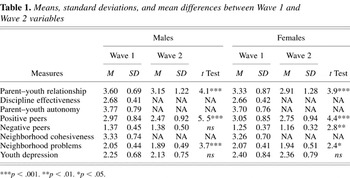
Table 1 presents the means, standard deviations, and the mean differences between Wave 1 and Wave 2 variables for the males and females, separately. As shown in Table 1, there were statistically significant differences between Wave 1 and Wave 2 parent–youth relationship, positive peers, and neighborhood problems for both males and females. Males and females reported less closeness with their parents, less positive peers, and less neighborhood problems at Wave 2 compared to Wave 1. Females also reported less negative peers at Wave 2 than Wave 1. However, there were no significant differences in depression from Wave 1 to Wave 2 for males and females.
Means, standard deviations, and mean differences between Wave 1 and Wave 2 variables

Gender differences within each wave indicated that females had higher depression scores at Wave 1, F (1, 371) = 4.01, p < .05, and Wave 2, F (1, 371) = 7.42, p < .01, compared to males. Females had a greater proportion of their friends engaged in positive behaviors at Wave 2 F (1, 371) = 7.77, p < .01, and a smaller proportion engaged in negative behaviors at Wave 1, F (1, 371) = 10.09, p < .01, and Wave 2, F (1, 371) = 22.99, p < .01, compared to males. Interestingly, males reported better relationships with their parents at Wave 1, F (1, 371) = 4.90, p < .05, compared to females.
Effects of ecological variables on depression
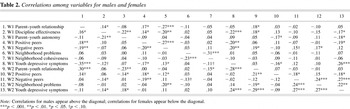
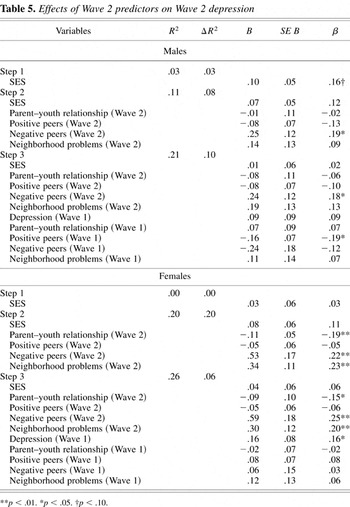
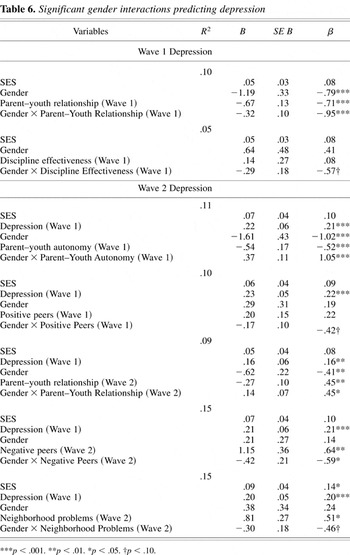
To examine the effects of ecological variables on depression, several analytic strategies were used. First, correlational analyses were performed for males and females, separately. Table 2 presents the intercorrelations among the variables for males above the diagonal and for females below the diagonal. Second, hierarchical regression analyses were performed to examine the effects of family, peer, and neighborhood factors on depression (see Tables 3, 4, and 5). In these analyses, SES was entered first as a control variable. Adolescent age, marital status, and ethnicity were also examined, but were not included in the analyses reported here as they had no significant effects on the outcome. Last, regression analyses were used to examine interactions between gender and ecological variables (see Table 6). In these analyses, SES was included as a control variable. Wave 1 depression was also included as a control variable when examining depression at Wave 2.
Correlations among variables for males and females

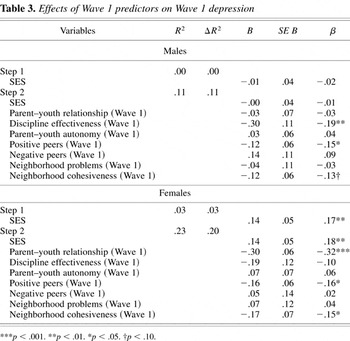
Effects of Wave 1 predictors on Wave 1 depression

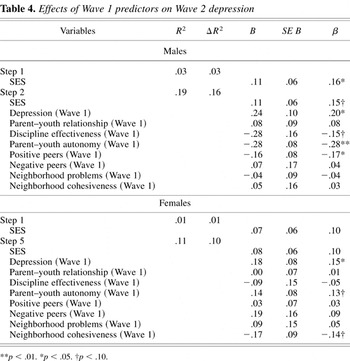
Effects of Wave 1 predictors on Wave 2 depression

Effects of Wave 2 predictors on Wave 2 depression

Significant gender interactions predicting depression

Effects of adolescent variables on adolescent depression
Males
Wave 1 family and peer, but not neighborhood, variables were correlated with Wave 1 depression (see Table 2). More discipline effectiveness, more positive peers, and less negative peers were related to less depression at Wave 1. In the hierarchical regression, family, peer, and neighborhood (albeit marginally) variables contributed to depression at Wave 1 (see Table 3). More parent discipline effectiveness and more positive peers were significantly related to fewer depressive symptoms. More neighborhood cohesiveness was marginally related to fewer depressive symptoms. Overall, variables accounted for 11% of the variation in Wave 1 depression.
Females
As shown in Table 2, a better parent–youth relationship, more positive peers, and less negative peers were significantly correlated with less depression at Wave 1. For the hierarchical regression, there were also significant contributions to Wave 1 depression from family, peer, and neighborhood variables (see Table 3). A better parent–youth relationship, more positive peers, and more neighborhood cohesiveness were significantly related to fewer depressive symptoms. Overall, the model accounted for 23% of the variation in Wave 1 depression.
Gender interactions
There was a significant interaction between gender and parent–youth relationship (see Table 6). Less closeness with parents was related to more depression for females, but not for males. There was also a marginally significant relation between gender and parent discipline effectiveness (see Table 6). More parent discipline effectiveness had a stronger negative effect on the depression of males compared to females.
Effects of adolescent variables on young adult depression
Males
As shown in Table 2, more discipline effectiveness, more parent–youth autonomy, and more positive peers at Wave 1 were significantly correlated with less depression at Wave 2. The hierarchical regression revealed that family and peer variables were also related to changes in depression from Wave 1 to Wave 2 (see Table 4). More parent–youth autonomy and more positive peers were significantly related to less negative changes in depression from Waves 1 to 2. More discipline effectiveness was marginally related to less negative changes in depression from Waves 1 to 2. Overall, variables accounted for 19% of the variation in Wave 2 depression.
Females
More discipline effectiveness and less parent–youth autonomy at Wave 1 were significantly correlated with less depression at Wave 2 (see Table 2). In the hierarchical regression, however, none of the family, peer, or neighborhood variables had a significant effect on changes in depression from Wave 1 to Wave 2 (see Table 4). However, less parent–youth autonomy and more neighborhood cohesiveness were marginally related to less negative changes in depression from Waves 1 to 2. Overall, variables accounted for 11% of the variation in Wave 2 depression.
Gender interactions
There was a significant interaction between gender and parent– youth autonomy (see Table 6). For males, having more autonomy in adolescence was related to less depression in adulthood. However, the reverse was true for females. Having more autonomy in adolescence was related to more adult depression. As shown in Table 6, there was also a marginally significant interaction between gender and positive peers. Males who had more positive peers in adolescence experienced less depression in adulthood. However, having positive peers had no effect on the depression of adult females.
Effects of young adult variables on young adult depression
Males
Wave 2 peer and neighborhood but not family variables were significantly correlated with Wave 2 depression. More positive peers, less negative peers, and fewer neighborhood problems were related to less depressive symptoms at Wave 2 (see Table 2). In the hierarchical regression, however, only peers had a significant effect (see Table 5). More negative peers at Wave 2 were significantly related to more depressive symptoms at Wave 2. Wave 2 negative peers predicted change in depression from Waves 1 to 2 even after controlling for Wave 1 predictors. Overall, variables accounted for 21% of the variation in Wave 2 depression.
Females
As shown in Table 2, Wave 2 family, peer, and neighborhood variables were significantly correlated with Wave 2 depression with the exception of positive peers. A better parent–youth relationship, less negative peers, and fewer neighborhood problems were significantly correlated with less depression at Wave 2. There were also significant effects of family, peer, and neighborhood variables in the hierarchical regression. More positive parent–youth relationships, less negative peers, and fewer neighborhood problems at Wave 2 were significantly related to fewer depressive symptoms at Wave 2 (see Table 5). Wave 2 parent–youth relationships, negative peers, and neighborhood problems predicted change in depression from Waves 1 to 2 when controlling for Wave 1 predictors. Overall, variables accounted for 26% of the variation in Wave 2 depression.
Gender interactions
As shown in Table 6, there was a significant interaction between gender and parent–youth relationship. For adult females, having a more positive current relationship with their parents was significantly related to less depression. However, there was no significant effect of a positive current relationship with parents on the depression of adult males. There was also a significant interaction between gender and negative peers and a marginally significant interaction between gender and neighborhood problems (see Table 6). Negative peers and neighborhood problems in adulthood had a stronger negative effect on the depression of females compared to males.
Discussion
Depression is a major problem for developing youth and adults. Understanding its determinants has been the impetus for many studies of family, peer, and neighborhood effects, but few investigations have explored these contexts simultaneously. From an ecological perspective it would be important to examine the relative contribution of developmental settings to depressive feelings especially if one is seeking avenues for prevention. Moreover, because of the different rates of depression in males and females, it is vital to determine how these setting variables interact with gender. Our study examined the continuities in depression from adolescence to young adulthood for both males and females. We found that variables related to depression differed for males and females depending on the developmental period being examined.
Family
What happened in the family impacted offspring depression, but different aspects of parental behavior were salient at the two time periods and for males and females. For females we found that contemporary family relationships were important. The closer they felt to their family the less depressed they were during both adolescence and adulthood, but family closeness during adolescence did not predict depression across the transition to adulthood. There is a large literature about the greater importance of relationships for females that seems to be reflected in our data. In contrast, male depression was not influenced by our family closeness variable.
For males, behavioral control was the most salient family domain, but the effects of the discipline effectiveness and autonomy variables were different. Discipline effectiveness was most salient during adolescence, whereas more autonomy was a better predictor of less depression during the transition to young adulthood. When parents felt they were in effective control, their male adolescents reported less concurrent depression. It is important to note that we were not assessing how much control they exerted, but their feelings about it. Parents with many rules and those with few rules could have gotten the same score on this variable. How much control parents exerted was reflected more in the autonomy variable that assessed the extent to which the youth shared in decision making in adolescence. This variable was not related to male depression during adolescence but did predict less depression during young adulthood. It may be that greater autonomy during adolescence may be a preparation for the decision making of young adulthood. Male adolescents who have more experience in helping make decisions in the home seem to feel better about themselves during adulthood. Why this effect is restricted to males is not clear, but might be related to the age of our sample. During young adulthood females may be more dependent on the family than males, as reflected in our closeness variable, without the necessity for much adult decision making. This might also help to explain the paradoxical result that more autonomy for girls during adolescence was related to more depression in adulthood in both the regression analysis and the zero-order correlations. Too much early autonomy might conflict with a greater desire or need for family connectedness during the transition to young adulthood on the part of females, but not of males. Indeed, greater autonomy in adolescence was significantly related to less closeness with parents in adulthood for females, but not for males. However, autonomy during adolescence may prove to be beneficial for women during their later twenties when they are involved in more independent living.
Peers
The effects of peers on developmental psychopathology has been most studied in relation to aggression, but the literature on peer influences on depression has been growing. In our review of these studies we found that the emphasis was primarily on measures of peer support rather than peer values. As Seidman et al. (1999) noted, before their study of adolescents the relation of peer values to depression had not been investigated. In this study we examined whether the values of the peer group influenced depression during adolescence and young adulthood. We found that they did with different impacts from association with peers that had more positive or more negative values. First we must note that having friends with positive values of good jobs and good education does not preclude having friends with negative values of risky behavior and delinquency, and they may be the same individuals. The negative correlation between peers with positive and negative values is only moderate. In our data the two peer variables had different salience for different developmental periods and for different genders. Having more positive peers was related to less depression during adolescence, and having more negative peers was related to more depression during young adulthood for both males and females. For males positive peers during adolescence was also related to less depression during adulthood.
Our results are different from those of Seidman et al. (1999), in that we found that peer values in adolescence are important correlates of adolescent depression. However, because we did not measure peer support and Seidman et al. did not measure positive peer values, we do not know whether peer support was a more or less important influence on depression than peer values. Seidman et al. suggested that peer values may be less important for females, as they may be more likely to have highly engaged peers than males. Yet, having peers who engage in positive activities in adolescence may help protect males from becoming involved in the antisocial activities and behaviors that are typically associated with their age group and gender that may lead to greater depression in adulthood.
Negative peers in adulthood were related to both contemporaneous and increased depression in adulthood for both males and females. Previous research indicates that antisocial activities such as substance abuse may predict major depression in adulthood (Rao et al., 2000). Our study expands these findings by suggesting that association with antisocial peers may also lead to increased depression during the transition to adulthood. During early adolescence there is generally a low level of antisocial behavior that increases until late adolescence and then decreases rapidly during adulthood (Elliott et al., 1989). For the Philadelphia sample, Furstenberg et al. (1999) report that the average adolescent engaged in slightly more than one problem behavior. However, by late adolescence delinquent youth are engaged in more serious and more kinds of problem behavior (Jessor & Jessor, 1977). Our data reflect this developmental trend in that associating with antisocial peers had much more serious consequences for negative emotional state in young adulthood than in early adolescence.
Neighborhoods
We assessed both the social and physical aspects of neighborhoods with our cohesiveness and problem scales. Neighborhood cohesiveness had its major impact in adolescence, with a significant effect on adolescent depression for females and a marginally significant one for males. The effect for females extended into early adulthood, with neighborhood cohesiveness in adolescence marginally related to reduced depression in young adulthood. Although these separate gender analyses suggest that females may benefit from high levels of neighborhood social capital more than do males (Stevenson, 1998), we found no gender interactions in the effects of neighborhood cohesiveness on depression in adolescence or during the transition to young adulthood.
Neighborhood problems did not have an impact on depression until early adulthood. These problems may have been mitigated by the protection that the family provides during early adolescence, but this safety becomes less salient as the youth advance in social maturity. Neighborhood problems were related to both contemporaneous depression as well as increased depression in adulthood for females but not for males. Females may feel more vulnerable to potential dangers in their neighborhood. Therefore, it is not surprising that neighborhood problems may influence the depression of adult females but not adult males.
Transition from adolescence into adulthood
Our study of depression is innovative in three domains: developmental, social, and personal. Developmentally, it examined the transition from adolescence to early adulthood. Socially, it used an ecological model to study the unique and combined effects of family, peer, and neighborhood contexts. Personally, it investigated the influence of social settings on each gender.
In a relatively large, urban group of individuals, representative of the neighborhoods sampled, depression had a moderate stability from adolescence into early adulthood. Yet the increases and decreases in negative feelings offered the opportunity to examine correlates of change in depression across this developmental transition. We found that social settings were (a) correlated with level of depression during both periods, (b) related to change in depression from one period to another, and (c) patterned differently in their effects for males and females.
The influence of peer groups changed across the transition but had relatively consistent effects on both males and females. During early adolescence when levels of problem behaviors were low, positive peers had a greater influence on depression, but as the youth aged association with negative peers became the dominant predictor of young adult negative emotional state.
The influence of family and neighborhood variables also changed across the transition but also differed in their influence on males and females. Among the family variables both contemporary and longitudinal influences differed by gender. Control was more salient for males during adolescence and predictive of later depression, whereas for females contemporary relationships were most important during each developmental period but not predictive across the transition. Neighborhoods primarily affected female depression, with coherence being more influential during adolescence and problems being more influential during young adulthood.
These results are important for underscoring the need for developmental approaches in understanding mental health problems. Using a dimensional rather than diagnostic approach to the study of depression we found substantial discontinuities between our two time periods. Moreover, by assessing a number of ecological domains we were able to explain substantial parts amounts of variance in these changes, especially for females. Using developmental knowledge we were able to offer hypotheses about the changing importance of family, peer, and neighborhood factors across time in the depressed feelings of both genders. The complex picture that emerges is that interventions to reduce depression must be sensitive, not only to individual factors, but to multiple dimensions of the social environments for both males and females.
Limitations and Conclusions
There were several limitations to our study that should be considered. First, sample attrition was not random. Predictably, it was more difficult to locate and reinterview lower than higher SES families. To adjust for this bias, we controlled for SES in the regression analyses. Second, our methodology changed from the adolescent to the young adult assessment. During adolescence the information was collected through face to face interviews and self-report instruments. During adulthood all measures were collected through a phone interview, and many of them shortened. In general, the adulthood variables had the same scale reliability as the adolescent ones despite their reduced set of items. Except for the neighborhood and parent–youth autonomy measures, that were self-administered during adolescence, the scale items were collected via interviews at the two assessment points. There is some question whether respondents are more honest filling out questionnaires than being interviewed in person or over the phone. However, phone interviews have been found to be effective methods for collecting sensitive clinical material (Schulenberg, Maggs, Dielman, Leech, Kloska, Shope, & Laetz, 1999; Tausig & Freeman, 1988). In general, because survey research methodology requires as few as possible questions being asked about a large number of areas of functioning for large numbers of respondents, shorter scales need to be used with potentially lower reliability than in studies where a single construct is the center of attention. Third, our study was not exhaustive, and there are many ecological factors associated with depression, such as family dysfunction (Hammen et al., 2000; Reinherz et al., 1993, 1999) school characteristics, discrimination, and economic distress, that were not included in our study. Clearly, the more such variables are added to the predictors, the greater proportion of variance in outcome would be explained. Finally, despite our consideration of depression across time, longitudinal studies of this type cannot rival experiments in terms of causal inference. For example, a reasonable argument could be made that increased depression in adulthood may contribute to, rather than be the result of, association with antisocial peers.
In conclusion, our study combined analyses of family, peer, and neighborhood effects on depression to provide a complex picture of the transition from adolescence to young adulthood. Research with a singular focus on one predictive variable or even multiple variables within one ecological setting may give a distorted view of the determinants of depression in both adolescence and young adulthood. In our study, simultaneous analysis of multiple settings provides a more balanced view of the many contributors to depression as well as suggests potential targets for preventive intervention programs.
References
REFERENCES
Alfeld–Liro, C., &
Sigelman, C. K.
(1998).
Sex differences in self-concept and symptoms of depression during
the transition to college.
Journal of Youth & Adolescence
27,
219–244.Google Scholar
Aneshensel, C. S., &
Sucoff, C. A.
(1996).
The neighborhood context of adolescent mental health.
Journal of Health & Social Behavior
37,
293–310.Google Scholar
Angold, A., &
Rutter, M.
(1992).
Effects of age and pubertal status on depression in a large
clinical sample.
Developmental Psychopathology
4,
5–28.Google Scholar
Arnett, J. J.
(2000).
Emerging adulthood: A theory of development from late teen through
the twenties.
American Psychologist
55,
469–480.Google Scholar
Barber, B. K., &
Olsen, J. A.
(1997).
Socialization in context: Connection, regulation, and autonomy in
the family, school, and neighborhood, and with peers.
Journal of Adolescent Research
12,
287–315.Google Scholar
Bronfenbrenner, U.
(1979).
The ecology of human development: Experiments by nature and by
design.
Cambridge, MA:
Harvard University Press.
Cicchetti, D., &
Toth, S. L.
(1995).
Developmental psychopathology and disorders of affect. In
D. Cicchetti &
D. J. Cohen (Eds.),
Developmental psychopathology: Vol. 2. Risk, disorder, and
adaptation (pp.
369–420).
New York:
Wiley.
Cook, T. D.,
Herman, M. R.,
Phillips, M., &
Settersten, R. A.
(2002).
Some ways in which neighborhoods, nuclear families, friendship
groups, and schools jointly affect changes in early adolescent
development.
Child Development
73,
1283–1309.Google Scholar
Crosnoe, R.,
Mistry, R. S., &
Elder, G. H.
(2002).
Economic disadvantage, family dynamics, and adolescent enrollment
in higher education.
Journal of Marriage and Family
64,
690–702.Google Scholar
Daley, S. E.,
Hammen, C., &
Rao, U.
(2000).
Predictors of first onset and recurrence of major depression in
young women during the 5 years following high school graduation.
Journal of Abnormal Psychology
109,
525–533.Google Scholar
Elder, G. H., &
Conger, R. D.
(2000).
Children of the land: Adversity and success in rural America.
Chicago:
University of Chicago Press.
Elliott, D. S.,
Huizinga, D., &
Menard, S.
(1989).
Multiple problem youth: Delinquency, substance use, and mental
health problems. In
Research in criminology.
New York:
Springer Verlag.
Elze, D. E.,
Stiffman, A. R., &
Dore, P.
(1999).
The association between types of violence exposure and youths'
mental health problems.
International Journal of Adolescent Medicine & Health
11,
221–255.Google Scholar
Furstenberg, F.,
Cook, T.,
Eccles, J.,
Elder, G., &
Sameroff, A.
(1999).
Managing to make it: Urban families and adolescent success.
Chicago:
University of Chicago Press.
Giaconia, R. M.,
Reinherz, H. Z.,
Silverman, A. B.,
Pakiz, B.,
Frost, A. K., &
Cohen, E.
(1994).
Ages of onset of psychiatric disorders in a community population of
older adolescents.
Journal of the American Academy of Child and Adolescent Psychiatry
33,
706–717.Google Scholar
Gutman, L. M.,
McLoyd, V. C., &
Toyokawa, T.
(in press).
Financial strain, neighborhood stress, parenting behaviors, and
adolescent adjustment in urban African-American families.
Journal of Research on Adolescence.
Gutman, L. M.,
Sameroff, A. S., &
Eccles, J. S.
(2002).
The academic achievement of African-American students during early
adolescence: An examination of multiple risk, promotive, and protective
factors.
American Journal of Community Psychology
39,
367–399.Google Scholar
Hadley–Ives, E.,
Stiffman, A. R.,
Elze, D.,
Johnson, S. D., &
Dore, P.
(2000).
Measuring neighborhood and school environments: Perceptual and
aggregate approaches.
Journal of Human Behavior in the Social Environment
3,
1–28.Google Scholar
Hammen, C.,
Henry, R., &
Daley, S. H.
(2000).
Depression and sensitization to stressors among young women as a
function of childhood adversity.
Journal of Consulting & Clinical Psychology
68,
782–787.Google Scholar
Hankin, B. L.,
Abramson, L. Y.,
Moffitt, T. E.,
Silva, P. A.,
McGee, R., &
Angell, K. E.
(1998).
Development of depression from pre-adolescence to young adulthood:
Emerging gender differences in a 10-year longitudinal study.
Journal of Abnormal Psychology
107,
128–140.Google Scholar
Harrington, R. C.,
Fudge, H.,
Rutter, M. L.,
Pickles, A., &
Hill, J.
(1990).
Adult outcomes of childhood and adolescent depression.
Archival General Psychiatry
47,
465–473.Google Scholar
Hartup, W. W.
(1996).
The company they keep: Friendships and their developmental
significance.
Child Development
67,
1–13.Google Scholar
Hirsch, B. J., &
DuBois, D. L.
(1992).
The relation of peer social support and psychological
symptomatology during the transition of junior high school: A two-year
longitudinal analysis.
American Journal of Community Psychology
20,
333–347.Google Scholar
Jessor, R.
(1993).
Successful adolescent development among youth in high-risk
settings.
American Psychologist
48,
117–126.Google Scholar
Jessor, R., &
Jessor, S.L.
(1977).
Problem behavior and psychological development: A longitudinal
study of youth.
San Diego, CA:
Academic Press.
Keefe, K., &
Berndt, T. J.
(1996).
Relations of friendship quality to self-esteem in early
adolescence.
Journal of Early Adolescence
16,
110–129.Google Scholar
Kessler, R. C.,
Avenevoli, S., &
Merikangas, K. R.
(2001).
Mood disorders in children and adolescents: An epidemiologic
perspective.
Biological Psychiatry
49,
1002–1014.Google Scholar
Kessler, R. C., &
Walters, E. E.
(1998).
Epidemiology of DSM-III-R major depression and minor
depression among adolescents and young adults in the National
Comorbidity Survey.
Depression and Anxiety
7,
3–14.Google Scholar
Kmec, J. A., &
Furstenberg, F.
(2002).
Racial and gender differences in the transition to adulthood: A
longitudinal study of Philadelphia youth. In
R. A. Settersten &
T. J. Owens (Eds.),
Advances in life course research: Vol. 7. New frontiers in
socialization (pp.
435–470).
New York:
JAI Press.
Lewinsohn, P. M.,
Hops, H.,
Roberts, R. E.,
Seeley, J. R., &
Andrews, J. A.
(1993).
Adolescent psychopathology: I. Prevalence and incidence of
depression and other DSM-III-R disorders in high school
students.
Journal of Abnormal Psychology
102,
133–144.Google Scholar
Lewinsohn, P. M.,
Rohde, P.,
Klein, D. N., &
Seeley, J. R.
(1999).
Natural course of adolescent major depressive disorder, I:
Continuity into young adulthood.
Journal of the American Academy of Child and Adolescent Psychiatry
38,
56–63.Google Scholar
Luthar, S. S.
(2003).
Adaptation among youth facing multiple risks: Prospective research
finding.
New York:
Cambridge University Press.
McFarlane, A. H.,
Bellissimo, A., &
Norman, G. R.
(1995).
The role of family and peers in social self-efficacy: Links to
depression in adolescence.
American Journal of Orthopsychiatry
65,
402–410.Google Scholar
Monroe, S. M., &
Hadjiyannakis, K.
(2002).
The social environment and depression: Focusing on severe life
stress. In
I. H. Gotlib &
C. L. Hammen (Eds.),
Handbook of depression.
New York:
Guilford Press.
Rao, U.,
Daley, S. H., &
Hammen, C.
(2000).
Relationship between depression and substance use disorders in
adolescent women during the transition to adulthood.
Journal of the American Academy of Child and Adolescent Psychiatry
39,
215–222.Google Scholar
Rao, U.,
Hammen, C., &
Daley, S. H.
(1999).
Continuity of depression during the transition to adulthood.
Journal of the American Academy of Child and Adolescent Psychiatry
38,
908–915.Google Scholar
Rao, U.,
Ryan, N. D.,
Birmaher, D.,
Dahl, R. E.,
Williamson, D. E.,
Kaufman, J.,
Rao, R., &
Nelson, B.
(1995).
Unipolar depression in adolescents: Clinical outcome in adulthood.
Journal of the American Academy of Child and Adolescent Psychiatry
34,
566–577.Google Scholar
Reinherz, H. Z.,
Giaconia, R. M.,
Hauf, A. M. C.,
Wasserman, M. S., &
Silverman, A. B.
(1999).
Major depression in the transition to young adulthood risk and
impairments.
Journal of Abnormal Psychology
108,
500–510.Google Scholar
Reinherz, H. Z.,
Giaconia, R. M.,
Pakiz, B.,
Silverman, A. B.,
Frost, A. K., &
Lefkowitz, E. S.
(1993).
Psychosocial risks for major depression in late adolescence: A
longitudinal community study.
Journal of the American Academy of Child and Adolescent Psychiatry
32,
1155–1163.Google Scholar
Sameroff, A.,
Gutman, L. M., &
Peck, S. C.
(2003).
Resilience and vulnerability: Adaptation in the context of
childhood. In
S. S. Luthar (Ed.),
Adaptation among youth facing multiple risks: Prospective research
findings (pp.
364–391).
New York:
Cambridge University Press.
Sampson, R. J.
(1992).
Family management and child development: Insights from social
disorganization theory. In
J. McCord (Ed.),
Facts, frameworks, and forecasts.
New Brunswick, NJ:
Transaction Publishing.
Sampson, R. J., &
Groves, W. B.
(1989).
Community structure and crime: Testing social-disorganization
theory.
American Journal of Sociology
94,
774–802.Google Scholar
Sampson, R. J.,
Raudenbush, S. W., &
Earls, F.
(1997).
Neighborhoods and violent crime: A multilevel study of collective
efficacy.
Science
277,
918–924.Google Scholar
Schulenberg, J.,
Maggs, J. L.,
Dielman, T. E.,
Leech, S. L.,
Kloska, D. D.,
Shope, J. T., &
Laetz, V. B.
(1999).
On peer influences to get drunk: A panel study of young
adolescents.
Merrill–Palmer Quarterly
45,
108–142.Google Scholar
Seidman, E.,
Chesir–Teran, D.,
Friedman, J. L.,
Yoshikawa, H.,
Allen, L., &
Roberts, A.
(1999).
The risk and protective functions of perceived family and peer
microsystems among urban adolescents in poverty.
American Journal of Community Psychology
27,
211–237.Google Scholar
Slavin, L. A., &
Rainer, K. L.
(1990).
Gender differences in emotional support and depressive symptoms
among adolescents: A prospective analysis.
American Journal of Community Psychology
18,
407–421.Google Scholar
Stevenson, H. C.
(1998).
Raising safe villages: Cultural–ecological factors that
influence the emotional adjustment of adolescents.
Journal of Black Psychology
24,
44–59.Google Scholar
Tausig, J. E., &
Freeman, E. W.
(1988).
The next best thing to being there: Conducting the Clinical
Research Interview by telephone.
American Journal of Orthopsychiatry
58,
418–427.Google Scholar
Weissman, M. M., &
Klerman, G. L.
(1985).
Gender and depression.
Trends in Neuroscience
8,
416–420.Google Scholar
Weissman, M. M.,
Wolk, S.,
Goldstein, R.,
Moreau, D.,
Adams, P.,
Greenwald, S.,
Klier, C.,
Ryan, N. D.,
Dahl, R. E., &
Wickramaratne, P.
(1999).
Depressed adolescents grown up.
Journal of the American Medical Association
281,
1707–1713.Google Scholar
Windle, M.
(1992).
A longitudinal study of stress buffering for adolescent problem
behaviors.
Developmental Psychology
28,
522–530.Google Scholar
Means, standard deviations, and mean differences between Wave 1 and Wave 2 variables
Correlations among variables for males and females
Effects of Wave 1 predictors on Wave 1 depression
Effects of Wave 1 predictors on Wave 2 depression
Effects of Wave 2 predictors on Wave 2 depression
Significant gender interactions predicting depression
 You have
Access
- 62
- Cited by