


Introduction
Since the Improving Access to Psychological Therapies (IAPT) programme was launched in 2007, regional services have been developed to offer evidence-based psychological therapies to clients experiencing common mental health difficulties. Despite huge national investment and training programmes, many services have struggled to keep up with demand. With finite resources and demands from areas of need left vulnerable from stretched community services, it is especially important that IAPT services deliver the most effective and efficient possible service for their clients.
Non-attendance of appointments in the NHS has been estimated to cost £360 million per year (Stone et al. Reference Stone, Palmer, Saxby and Devaraj1999). In mental health services, non-attendance rates for initial sessions tend to be high – ranging from 16% to 67% (Hampton-Robb et al. Reference Hampton-Robb, Qualls and Compton2003).
The IAPT national audit, reviewing data from 32 ‘wave one’ sites (Gyani et al. Reference Gyani, Shafran, Layard and Clark2011) showed that overall recovery rates for those patients who attended at least two sessions approached the national target of 50%. However, this calculation did not include those patients who did not engage with the service, including 10500 of 32382 patients who had no evidence of more than one contact with an IAPT site. Although likely to include many individuals who were signposted elsewhere, this is comparable with the findings of Richards & Borglin (Reference Richards and Borglin2011) in their 2-year prospective cohort study, that 47% of referrals to an IAPT service either did not attend, or attended only their assessment session. Gyani and colleagues observed a considerable amount of variability in how services performed and how they were organized, and suggested that lessons may be learned by investigating the relationships between service organization and outcome, although did not describe the impact of initial sessions on engagement.
A number of factors have been associated with non-attendance at initial session including individual factors such as age and socio-economic status (Sharp & Hamilton, Reference Sharp and Hamilton2001) and service factors, such as longer waiting times (Gallucci et al. Reference Gallucci, Swartz and Hackerman2005). Murphy and colleagues (Reference Murphy, Mansell, Craven, Menary and McEvoy2013) showed that within a step 2 IAPT service, a psychological factor (expectations around the outcome of talking to a therapist) was associated with increased initial attendance. It is likely that the decision to attend an appointment is affected by an interaction of a range of factors (Kazdin et al. Reference Kazdin, Holland and Crowley1997) the relative influence of which fluctuate during the approach of the appointment (Paige & Mansell, Reference Paige and Mansell2013).
IAPT implementation guidance provided by the Department of Health (DoH, 2008) recommends that on referral to an IAPT service, an initial person-centred assessment should take place. Current texts do not specify whether this should involve a face-to-face or telephone assessment (Farrand & Williams, Reference Farrand, Williams, Bennett-Levy, Richards, Farrand, Christensen, Griffiths and Kavanagh2010). In addition to assessment of current circumstances and risk, a thorough assessment designed to meet the needs of the client and service may involve:
• Determining a client's presenting difficulties and goals for treatment.
• Using a bio-psycho-social framework to determine, based on the available evidence, whether the client is likely to benefit from a time-limited intervention for their current difficulty offered within that service.
• Providing the client with information around their difficulties.
• Providing the client with information on the proposed treatment and procedure, enabling an informed choice about engagement with the service.
Absence of a comprehensive assessment may lead to offering a service which is not appropriate (e.g. outside the evidence base), failing to engage clients after being placed on a waiting list, or failing to identify important risk-related information. However, within the IAPT programme, based on the stepped-care model of offering the least intensive effective intervention first (Clark, Reference Clark2011), care should be taken not to alienate clients through increased burden of time, expense and effort required to attend an additional face-to-face appointment. Furthermore, therapist hours spent completing additional engagement sessions may then lead to fewer treatment sessions being offered, to the detriment of those clients who continue to wait for active treatment.
Much research has been developed to compare the efficacy of multi-modal treatment sessions designed to increase acceptability and convenience of therapeutic delivery, including internet, telephone and face-to-face delivery (e.g. Hayward et al. Reference Hayward, MacGregor, Peck and Wilkes2007); however, the relative impact on safety and engagement in mental health services has been less widely explored. A review of the use of telemedicine in general healthcare settings concluded that telecommunication technology is feasible, but shows little evidence of clinical benefits and is inconclusive regarding cost-effectiveness (Currell et al. Reference Currell, Urquhart, Wainwright and Lewis2000). A comparison of audio-recordings of telephone and face-to-face primary-care consultations showed that although telephone consultations were judged as satisfactory by patients and doctors, they were associated with shorter duration, presentation of fewer problems and included less data gathering, counselling/advice and rapport building (McKinstry et al. Reference McKinstry, Hammersley, Burton, Pinnock, Elton, Dowell, Sawdon, Heaney, Elwyn and Sheikh2010).
The aim of this study is to explore the impact of an initial face-to-face session on clients’ engagement with IAPT services, above the value of an initial telephone screening session.
Method
A longitudinal observational design was used within a clinical audit. The audit was based in an IAPT service in the North of England. The inner-city area was characterized by high rates of unemployment, long-term limiting illness or disability and reduced life expectancy in comparison to national rates. In 2010, 51.5% residents were judged to live within the UK's most deprived quintile. In 2010, 10.9% of the city's population were reported to belong to Black or minority ethnic groups (Hull City Council, 2013). The IAPT service included two separately funded tiers of care based on the stepped-care model: low-intensity therapists [primarily psychological wellbeing practitioners (PWPs)] working at the step 2 level and high-intensity therapists (including cognitive behavioural therapists and primary-care counsellors) working at step 3.
All referrals to the service were received through a regional mental health triage service, that allocated clients to the IAPT service based on paper, telephone or face-to-face triage depending on the amount of available information. At time-point 1 clients referred to the IAPT service were contacted by telephone to complete an allocation appointment. This was conducted by a team of senior PWPs, who allocated the client to the appropriate strand of the service based on the stepped-care model. This allocation appointment typically lasted around 20 minutes and included a discussion around referral reason and current difficulties, completion of the minimum dataset outcome questionnaires, assessment of current risk and description of available treatment options within the service. Those allocated to receive services at step 3 were placed on the relevant waiting list. During the early months of 2012 (time-point 2), the intake process was altered in response to suggestions from the clinical team. Clients allocated to receive a high-intensity intervention were invited, immediately after allocation, to attend an initial session with a member of the relevant therapy modality (CB therapist or primary-care counsellor). Therefore clients received either (1) a telephone allocation appointment, or (2) a telephone allocation appointment plus an initial face-to-face session, before being placed on the waiting list for a step 3 intervention. (See Fig. 1 for a representation of the client pathway at time-points 1 and 2.)
Client pathway into Improving Access to Psychological Therapies (IAPT) service at time-points 1 and 2. PWP, Psychological wellbeing practitioner.

All clients discharged from the service within one calendar month prior to the introduction of initial sessions (time-point 1) and a year later (time-point 2) were identified. Electronic records were reviewed for each client, collecting anonymized information around the client's care pathway. All information was gathered and analysed using Microsoft Excel (Microsoft Corp., USA).
As the investigation involved an analysis of existing data, designed to produce information around best care and following existing interventions based on previous standards, this study was deemed to meet criteria for a clinical audit (National Patient Safety Agency, 2010). Therefore this study did not require ethical review.
Results
In total, 640 clients’ records were reviewed. The age of the sample ranged between 18 and 75 years. Of this group, 84.5% (541) were referred around difficulties with anxiety and depression. The remaining referrals cited reasons including self-esteem, anger and disordered eating. Fewer clients were discharged from the service at time-point 2 (296) in comparison to time-point 1 (344).
Of all referrals received, 36% (231) were discharged from the service without making an initial face-to-face contact. Reasons for discharge included unable to make initial contact (65%), client redirected to a more appropriate service for their needs (25%), and client declined a service at this time (10%). Of those who were contacted and deemed appropriate for the service, 62% (254) were allocated to receive support at step 2, 14% (58) were allocated to support from a CBT therapist and 24% (97) were allocated to receive counselling.
The average delay between referral and offer of first therapy session was 143 days at time-point 1 and 99 days at time-point 2. All face-to-face initial sessions at time-point 2 were offered within 2 weeks of the telephone allocation appointment.
Feedback from therapists described that the initial sessions included an assessment of main difficulties, information giving in the form of patient information sheets, recommendations around self-help and bibliotherapy and information around the expected waiting time, and what to expect from CBT/counselling sessions. A case-complete status was awarded when clients attended at least four sessions, and was based on the progress notes recorded; termination of therapy was planned or mutually agreed between client and therapist.
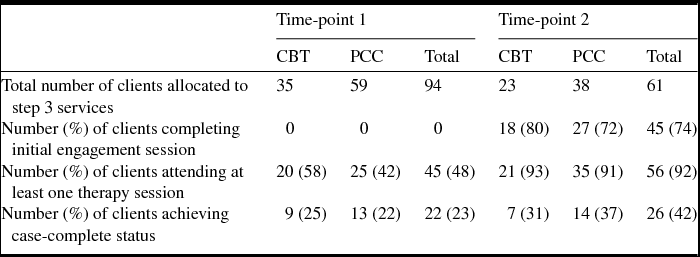
Table 1 shows the first therapy session attendance rates for those clients who were reviewed at the two time-points.
Initial session attendance and subsequent outcomes for clients allocated to step 3 services at two time-points
CBT, Cognitive behavioural therapy; PCC, primary-care counselling.
Analysis
Pearson's χ2 test of independence was used to examine the relationship between time-point and attendance at the initial therapy session. A significant difference was detected between the number of clients attending the first therapy session at time-points 1 and 2 (χ2 = 47.919, p < 0.05) and between the number of clients achieving case-complete status at these times (χ2 = 13.35, p < 0.05).
Discussion
With waiting times above national recommendations, one dilemma which may apply to services is whether to invest clinician time in assessment and engagement – offering a fast and thorough initial meeting, or whether to concentrate efforts on provision of therapy sessions. In an attempt to bring down waiting times, the former is more likely to ensure that resources are focused towards the specified clinical population, whereas the latter strategy is more likely to concentrate on offering the maximum possible sessions of active therapy. Engagement of potential clients in therapy services appears generally low and requires further attention.
This study shows that after initial telephone screening, those who were offered an initial face-to-face session with a clinician from a step 3 IAPT service were more likely to attend their subsequent therapy session and were also more likely to complete treatment, than those who were not offered this initial session. In the context of many factors influencing initial engagement which cannot be altered, it appears that a simple additional session may help engage potential clients in IAPT services. Although it is appreciated that offering this additional session will incur costs, particularly in therapist time, it is likely that these costs will be offset by engaging clients who may otherwise have disengaged from the service, and also lead to savings by avoiding later non-attended sessions.
The findings from the current study could be explained in line with the observations of McKinstry et al. (Reference McKinstry, Hammersley, Burton, Pinnock, Elton, Dowell, Sawdon, Heaney, Elwyn and Sheikh2010) who found that in comparison to face-to-face consultations, telephone consultations in general practice were associated with discussion of fewer problems, less data gathering and rapport building. This might suggest that clients in the current study who were offered an additional face-to-face appointment felt more able to express all of their difficulties, which would be likely to increase the chance of a return appointment. Over a third of those referred into the service did not complete an initial telephone contact, which is in line with figures reported by the national IAPT audit (Gyani et al. Reference Gyani, Shafran, Layard and Clark2011). The current paper concentrates on those individuals who have made at least one contact with the service. Therefore this does not necessarily reflect methods to improve overall engagement.
It was decided to concentrate on the step 3 aspect of the service, as an earlier service audit showed that those who were allocated to receive support at step 2 showed much better rates of attendance (over 80% attended their initial session) which may be accounted for by significantly shorter waiting times for the first appointment in this part if the service. However, this selection means that it is not possible to generalize the findings from the current study to the entire IAPT service.
The audit took place within one regional IAPT service and so represents only the service structure and pathways of that particular service. Therefore, the findings may not apply to other IAPT providers throughout the country, who may make use of different organizational structures and procedures.
Waiting time for commencement of therapy at time-point 2 was shorter than for time-point 1. It is likely that these shorter waiting times were related to a combination of factors including increased staffing levels, smaller overall number of referrals to the service and increased service provision from local non-NHS providers. The decreased waiting time could also have accounted for the increase in service engagement, as longer waiting times are associated with non-attendance (Gallucci et al. Reference Gallucci, Swartz and Hackerman2005). Therefore, one disadvantage inherent in the observational design used is the inability to isolate the effects of the initial session from concurrent local and regional service changes. Further research may benefit from incorporating into its design means to correct for additional observations including change in treatment waiting times.
The relatively small numbers used in the study is also a limitation, which may have been strengthened by inclusion of data from other services. A further limitation of the current study is that it may under-estimate the effect of the initial session by comparing the number of people who attended their first overall session (first treatment session) at time-point 1, with those who attended their second overall session (initial session plus first treatment session) at time-point 2. However, by also observing the proportion of clients who reached case-complete status, this impact may be minimized.
Unfortunately, in a small-scale clinical audit, resources did not allow for exploration of clinical outcomes or qualitative feedback from clients involved in the service at different time-points. As mentioned previously, it is important that IAPT services deliver the most effective and efficient services possible.
Further research would benefit from exploring the impact of initial sessions on clinical effectiveness by examining the impact of initial sessions on clinical outcomes, which may include those routinely collected in the minimum dataset completed by each client as part of usual practice. Use of information from client satisfaction questionnaires would help to understand more about the robustness of the findings. Seeking qualitative feedback from clients who did and did not attend therapy sessions may help to identify any potentially important aspect of the initial session on engagement. Identifying which aspect of the initial session was responsible for the observed effect may allow further streamlining of this process.
Conclusion
This audit shows that introduction of an initial face-to-face session, before placement on the waiting list, may lead to an increased proportion of clients going on to attend and complete therapy sessions within step 3 of an IAPT service. This audit may be confounded by its observational design. Further research may explore the impact of these engagement sessions on clinical outcomes and client experience.
Declaration of Interest
None.
(1) Low levels of engagement with Improving Access to Psychological Therapies services may be influenced by a combination of individual, organizational and psychological factors.
(2) Offering an initial face-to-face session before placing a client on a waiting list may increase later client engagement with that service.
(3) Further research is required to explore the impact of initial face-to-face sessions on client experience.




Comments
No Comments have been published for this article.