The Relationship Between People and Their Environment
Human beings and nature are not separate entities. From the beginning of their existence, people establish a specific link with the physical world and with nature. Although the ontogenetic understanding of this union is evident in its practical results, it is not easy to discern in all its conceptual depth (Bai, Reference Bai2013). More simply put, the phrase ‘I am not me, but I am with my environment’ can summarise this idea and reveal a knowledge that I not only coexist but also exist with a ‘more-than-human world’ (Abram, 1997, p. 101), with both its living and inanimate elements (Bai, Reference Bai2013). From the outset, this link involves a set of continuous communications between each person and his or her environment (Whitman, Reference Whitman1981, p. 136); thus, it is very difficult to abstract or renounce their response to each other, forming a mutual and constant relational activity. Often overlooked, this link constantly acts in a clear manner, for example, in the experience of breathing and being ‘immersed in the world’ (Abram, 1997, pp. 45, 204). This relationship determines the way in which one values oneself and understands his/her self through the environment, vividly awake to the world (Abram, 1997, p. 223). It is sometimes understood only as a utilitarian and exclusively materialistic link that carries behaviours that cause environmental damage (Bai, Reference Bai2013; Plumwood, Reference Plumwood2002). In the words of Leopold (Reference Leopold1966, Foreword p. X), ‘we mistreat the land because we see it as a commodity that belongs to us’.
There are many causes of this carelessness, between the division of the modern ‘I’ and nature, which include the loss of the sense of material (Flowers, Lipsett, & Barrett, Reference Flowers, Lipsett and Barrett2014) and spiritual communion (Mallarach, Reference Mallarach2008) as well as the loss of direct experiences with nature (Gigliotti, Reference Gigliotti1990; van Boeckel, Reference van Boeckel2015). These experiences can help the link to be understood in a more integral manner as a relationship of union, care and mutual need, of necessary synergy, leading to increasing environmental sensitivity (Leopold, Reference Leopold1966). In addition, this belonging includes an intrinsic and global vision of the environmental-social, where the spheres are ‘biophysical and sociocultural, held together with a film of psychological cement’ (Ingold, Reference Ingold2000, p. 3).
The link with nature is conditioned by its perception and, therefore, the capacity that we have to observe it, to contemplate it, to discover it, to interpret it and to understand it using ‘an ecological approach to perception’ (Ingold, Reference Ingold1987, p. 3; Tsevreni, Reference Tsevreni2011) that can facilitate the affect concept (Massumi, Reference Massumi2002a, Reference Massumi2002b; Riley & White, Reference Riley and White2020), the epiphanies (Vining & Merrick, Reference Vining, Merrick and Clayton2012) and the so-called significant life experiences (SLEs) (Chawla, Reference Chawla2001; Tanner, Reference Tanner1980).
Environmental Education and Ecological Spiritual Intelligence
Environmental education proposes the entire development of people and does it attending to the holistic and interdisciplinary character (Giordan, Reference Giordan1993; Palmer, Reference Palmer1998, p. 8) that presents reality. Environmental education thus tries to combat the reductionist vision that considers the universe as a collection of objects rather than as a material communion (Berry, Reference Berry1988, p. 107; Flowers et al., Reference Flowers, Lipsett and Barrett2014), a ‘merchandise that belongs to us’ (Leopold, Reference Leopold1966, Foreword X). The consequences of this vision are not innocuous but produce serious environmental problems (Bai, Reference Bai2013; Plumwood, Reference Plumwood2002). This vision proposes an ethics in the relationship with the Earth. In the development of this ethics, the ‘spiritual’ dimension (Iozzi, Reference Iozzi1989; May, Reference May1988; Skamp, Reference Skamp1991), the ecospirituality (Beringer, Reference Beringer1999) plays a role that can be decisive. All the great spiritual traditions of humanity have pointed in their distinct ways to the Oneness from which we come and the Oneness that we long for (Newell, Reference Newell2008, p. 11). From these spiritual visions flows an ethic of relationship with creation, as occurs for example with the Judeo-Christian Sabbath that provides a grounding (Browning, Reference Browning2014) or the ethic of the “common house” proposed by Laudato si’ (Holy See, 2015) or others such as Celtic spirituality (Newell, p. 11).
Gardner (Reference Gardner2010) shows us the existence of a transcendent intelligence in his renewed theory of multiple intelligences. Other authors (Torralba, Reference Torralba2011; Wolman, Reference Wolman2001) call it spiritual intelligence. Wolman (Reference Wolman2001, p. 1) defines it as: ‘the human capacity to ask about the ultimate questions of the meaning of life and the simultaneous experience of the complete connection between each single one of us and the world in which we live’.
Despite the advantages this type of intelligence can provide (Hawks, Reference Hawks1994; Keniger, Gaston, Irvine, & Fuller, Reference Keniger, Gaston, Irvine and Fuller2013; Kollmuss & Agyeman, Reference Kollmuss and Agyeman2002), the values of neoliberalism and prevailing materialism-consumerism do not favour the development of this type of intelligence, but on the contrary, they lead the West towards a spiritual desert. However, spiritual values have much to do with nature conservation (Mallarach, Reference Mallarach2008). In general, the areas of the planet that have conserved spiritual values have a better conserved environment. Nevertheless, authors such as Keniger et al. recognise the scarcity of studies related to the nature–spirituality binomial (about 5% of the total studies on nature).
Ecological spiritual intelligence can help raise people’s environmental awareness in a powerful and lasting way, favouring the acquisition of environmental commitments. These experiences and adventures, with a spiritual component, can provide a qualitative change that advances environmental education in the achievement of its conservationist and human objectives.
Ecological spiritual intelligence can also influence the understanding and experience of the person–nature link. Designing specific environmental education programmes with specific actions, creating environmental education facilities such as environmental meditation centres or ecological spirituality centres that favour the contemplation of nature and renewing our sense of wonder (Carson, Reference Carson2012) in the face of the beauty and continual wonder that nature presents to us at every moment can favour the valuation and conservation of our beloved environment.
Perhaps environmental education has focused more on fostering natural intelligence, understood as the intelligence that operates in our relationship with the natural environment. But in general, it has forgotten to focus also on spiritual or transcendent intelligence. Although we can think that the concept of spiritual intelligence and that of natural intelligence are current, bearing in mind that they have recently been conceptualised within Gardner’s theory of multiple intelligences (Reference Gardner2010), we have to say that they have existed as such for a long time. In fact, St. Paul already tells us about spiritual intelligence in the Bible, in his Letter to the Colossians (1, 9–14). As for natural intelligence, Thoreau, in Walden, refers to it, in his own way, already in 1854, asking himself this question: ‘Shall I not have intelligence with the Earth?’ (Thoreau, Reference Thoreau2004, p. 138). Both intelligences can converge in the ecological spiritual intelligence, in reference to the spiritual intelligence when it deals with environmental questions. In a certain way, it combines the transcendent and natural intelligences proposed by Gardner (Reference Gardner2010) and puts them in relation. This intelligence is of great interest to environmental education because it can generate motivations that arise from spirituality to foster the care of the world.
That is why sustainable spiritual intelligence and nature conservation must go hand in hand. This intelligence can develop a mindset that will make more environmentally, socially, economically and culturally sustainable decisions. It must generate a change in our lifestyles and patterns of production and consumption, proposing a model of development that ‘presupposes full respect for the human being but also pay attention to the natural world…’ (Holy See, 2015, n. 5). We have to discover other meanings of the natural environment. The challenge is to get to know many other messages that nature can transmit, such as those proposed by Hesse (Reference Hesse2012, p. 56). Some of them we can intuit and know, while others are certainly not so easy to get. This is where we have to put our ecological spiritual intelligence into play to discover the mysteries it contains, the other meanings and the other properties of the natural.
Contemplation, Wonder and Spirituality
The tangible reality that surrounds us captures our attention (Abram, Reference Abram2010, p. 50) and provides us with continuous messages (Clayton & Myers, Reference Clayton and Myers2015) that interactively generate different responses, some in the form of perceptions that allow different knowledge about objects (Whitman, Reference Whitman1981, p. 136). In the case of perception, it is carried out fundamentally through our senses, the most significant being the sight. It is for Cossio (Reference Cossio1929, p. 6) ‘the first and inescapable condition of knowledge’; in short, the so-called ‘visual thought’ (Arnheim, Reference Arnheim1969) that generates a thinking routine of ‘I see-I think-I ask’. However, our visual perception, like the rest of the senses, easily accommodates to what is known (Carson, Reference Carson2012) and needs to refocus its attention to reality to be able to deepen in a scrutinising and analytical way, by being attentive to all the details that allow to reawaken the sense of astonishment (Abram, Reference Abram2010, p. 49) and to obtain the maximum meaning of the immanence of things to make possible through them even transcendent experiences (Williams & Harvey, Reference Williams and Harvey2001).
Since childhood, the education of the gaze takes on a special relevance because it is the main way of knowing what things are. The development of this competence allows us to unravel the messages of things knowing how to see them (Cossio, Reference Cossio1929, p. 7). Throughout this gaze, we can obtain essential primary experiences (Yenawine, Reference Yenawine2013, p. 7). However, in order to do so, we must teach how to look deeply, how to contemplate, until we get the attention and possibility of the eye that listens (Palazuelo, Reference Palazuelo2011, p. 27), until we get the scrutinising gaze.
Constantly renewing our amazement at the reality, our world shows us is fundamental to value the environment. In order to be able to unravel the things of the world from their multiple meanings, we have to dedicate time to educate our gaze, to reach the contemplation of our world. More than seeing or looking, we have to contemplate; we have to use a scrutinising, deep and analytical gaze. We must learn to admire and be amazed at the wealth of wonders that the environment continually offers us (Frederickson & Anderson, Reference Frederickson and Anderson1999). That look does not come from the outside, but from the inside, from the link, from the immanence of things and from the connection of the person with the environment; an ontogenetic connection already from the atomic level but reinforced with the affect. Thus, we can discover messages that reality sends us, such as beauty. We are talking about fostering a vital attitude that makes us contemplate everything with serene attention. Precisely, this immanence can be the point of encounter with our companions on the journey, an encounter that opens a possible door to spirituality, through ecological spiritual intelligence.
Basque Mythology and Environmental Education: A Practical Example of Developing Environmental Education Through Spirituality
This encounter, this approach to nature, this continuous embrace, and this way of relating to the environment also depend on our culture. Our material and immaterial cultural heritage, our traditions, the way we understand the world, what our family and our social group have transmitted to us will condition our relationship with nature. Our cosmovision and our spiritual values also play a significant role in this link with more-than-human world. In this way we integrate ‘The indigenous sense of “belonging to the local”, which is highly valued in the discourse of environmental education’ (Straker, Potter, & Irwin, Reference Straker, Potter and Irwin2017). That is why the encounter between culture and the natural environment is, possibly, one of the most relevant aspects for environmental education. Without the environment, culture does not exist. The environment is very much involved, interweaving in all matters, with its evident integrality to the core, and its determining character in the complex holistic vision of cultural possibilities. These encounters with perceived natural reality can be described through metaphorical narratives (Borg & Wright, Reference Borg and Wright1999, p. 5) that generally include immaterial or spiritual aspects. These metaphorical stories spun in a structured way can lead to a mythological cosmovision that tries to explain creation.
Among the possible cultural values to elaborate the spiritual dimension of environmental education, we can find those provided by mythology (Baroja, Reference Baroja1974). Spirituality appears in all mythologies. Among the possible ones, we are going to focus on the cultural aspects provided by the Basque mythology (Spain and France), as a fundamentally intangible or immaterial cultural heritage, aware of the richness that can be presented to work the contents of environmental education. The Basque mythological universe is endowed with a great symbolic force. It collects and includes a set of symbols that express many of the concerns, needs, affections, fears and conceptions when it comes to the life of Basque people, trying to give an answer and formulate an explanation of the observed world. It is ‘the condensation of the experience of a community into images and stories, as the first way in which collective memory is organized’ (Ortiz-Osés & Garagalza, Reference Ortiz-Osés and Garagalza2006, p. 21). The myth does not seek to give ‘a [scientific] explanation of what happens’ (Ortiz-Osés & Garagalza, Reference Ortiz-Osés and Garagalza2006, p. 21) but rather sorts the world to facilitate its understanding, an understanding that gives us a security to face our life-giving meaning to the existential questions of individuals.
Basque mythology produces an interpretation of reality in which many of the elements existing in nature appear along with their specific relationship with people. ‘It is a question of giving an explanation, a global vision of what appears to be at first a puzzle, as something fragmentary, disordered, disconnected, chaotic’ (Ortiz-Osés & Garagalza, Reference Ortiz-Osés and Garagalza2006, p. 21). Generally, an animism of these elements is produced. They are personified and transformed into mythological characters with the intention of giving a coherent answer to what people observe in the environment. Nonetheless, they are also trying to give an explanation of what nature is, of the phenomena occurring in it, and of the totality of the whys that its existence and its relation with our existence encloses. The Basque mythological complexity includes many beings that establish many relationships and multiple legends that also illustrate in a certain way the complexity of the environment. We are still very far from knowing and understanding in depth all the complex relationships that arise between the various elements of the ecosystem, including human beings. Generally, the scenes and characters that this mythology proposes have a strong dramatic sense and often use actions confronted through various powers, various opposing forces, but complementary and necessary. For example, the Basque mythology believes in a principal numen called Mari (Barandiarán, Reference Barandiarán1979) (Figure 1), who is a feminine character and sometimes zoomorphic. Mari’s sons are Atarrabi, symbol of moral good, and Mikelats, evil genius, symbol of evil. In its understanding of the world, the Basque mythology generates two characters: Aideko, which represents the spiritual bond of things, and Berezko, which represents the material part of things, their immanence (Figure 2).
The god Mari, the main numen in Basque mythology, of feminine character, sometimes appears in the rainbow. (Archive of Rolan Deaconu).

Aideko (right), a spiritual part that exists in all things. Berezko (left), the physical part of things, could be said to represent their immanence. (Archive of Rolan Deaconu).

It also includes a rich diversity of deities associated with environmental elements including the four elements, that is, air, Earth, fire and water (Figure 3), and river, springs, wells, sea, mountain, sun, moon (Figure 4), sky, cosmos, rocks, caves and many others that make it an enabling path for environmental education.
The four elements: air (Aide), water (Ur), fire (Su) and Earth (Lur). (Archive of Rolan Deaconu).

Eguzki and Ilargi, of feminine character, represent the sun and the moon. (Archive of Rolan Deaconu).

In addition to the natural elements, it includes some intangible elements and many of the relationships between people and those elements, tangible or intangible that embody values. For example, Amilamia identifies himself as a genius of an affable and charitable nature who takes flour from an empty sieve. He favours the poor, having values such as justice, charity, kindness and solidarity. However, we are also warned against Sugoi, a genius in the form of a snake with darker intentions, who incarnates anti-values. These intangible proposals and these relationships, which should be preserved, are likely to be used by environmental education to help achieve its objectives. Basque mythology, as a cultural heritage of our ancestors, can make us advance in this way of establishing an adequate link with our environment, going back to a natural relationship with our Sister Mother Earth. This intangible heritage is a vehicle that can lead us towards a predisposition that facilitates our change of attitudes, values and behaviours towards that adequate development of the link with nature. Through the cultural fact and values it offers, we can point towards an improvement of the natural environment.
Basque mythology makes it possible to manage the local and the global scale, since it includes concepts ranging from domestic ecosystem Etxe to global ecosystem concepts of the ‘cosmos’ centred on the earthly Lur. Second, because it allows us an intuitive approach, of spontaneous immanence, to that person–nature link. Third, because it shows us in a concrete way the presence of the transcendence of natural elements, through Aideko, Adur, the energetic bonding of things and many other mythological beings that embody many intangible elements of the natural environment. In addition, many of them are centres of interest for the local population, such as Basajaun, lord and caretaker of the forests (Figure 5). They are not minor matters.
Basajaun, lord of the woods and shepherd of flocks. (Archive of Rolan Deaconu).

Environmental education intends to use these possibilities that Basque mythology presents because it is not only facts and concepts that intervene in decision-making but also values and perceptions. Our decisions may be guided by respect for nature or towards its misuse or deterioration. Our beliefs, therefore, influence our decisions and behaviours and, as a result, our effects and associated impacts on the environment. This decision-making includes putting into play our values, which are, in short, the triggers of all our actions. Mythology ‘appears as the condensation of a community’s experience into images and stories, as the first way in which collective memory is organized. Thus, together with language, it constitutes the first layer of culture in which values take root and meaning is gestated: the first step in the emergence of the human significance with which the cosmos is covered’ (Ortiz-Osés & Garagalza, Reference Ortiz-Osés and Garagalza2006, p. 21). From there, the importance that the mythological fact is going to have in the conformation of values determines in the end, our behaviour with the environmental.
Environmental Education and Basque Mythology Course: Mythologic-Environmental Methodology
Mythology matters for environmental education. There are various mythologies, metaphors and parables generated by different cultural and religious worldviews of peoples (e.g., Indigenous [e.g., Australian and North American]/faith communities [e.g., Christian and Islamic]) throughout the world that can be used to advance the goals of environmental education. For example, Basque mythology can be used to establish a point of union to advance towards an adequate relationship with nature, towards a naturalistic affect with people through their ecological spiritual intelligence (Frederickson & Anderson, Reference Frederickson and Anderson1999). To this end, among the possible ones, a summer course promoted by the Department of Environmental Biology of the University of Navarra was programmed, aimed at the general population that speaks Euskera, the Basque language. Ten people registered for the course. The course lasted 12 hours, divided into four sessions:
-
1. Session 1: Basque mythology and its relationship with the European Union. Mythological characters and elements of the natural environment.
-
2. Session 2: Perception: visit to the fairy forest of Ilundáin (Navarra, Spain).
-
3. Session 3: SLEs: visit for the contemplation of water: river and lake.
-
4. Session 4: Realisation of an environmental tale using mythological Basques characters.
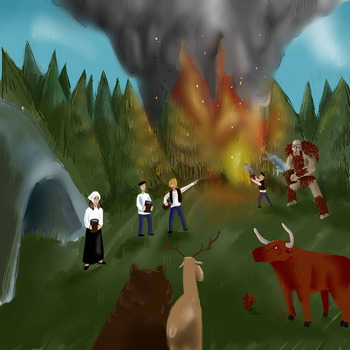
They employed a methodology adapted from the ‘Indigenous Research Methodology’ (Lowan-Trudeau, Reference Lowan-Trudeau, Stevenson, Brody, Dillon and Wals2013, p. 405), which takes into account spiritual ecology, spiritual cultural instructions from Time immemorial, based on observation. For this reason, the staging of environmental contents was programmed in specific scenarios that integrate different aspects of the Basque mythology and that, at the same time, try to gather the environmental problematic and relevant aspects proposed by environmental education. Each scenario included several of the main characters of the Basque mythology and the environmental problems associated with their contexts. Not all were included, but the most relevant ones due to their relation with the contents proposed by environmental education. The interest of this proposal was to offer a representative cast of the Basque mythology, organising its open system, as well as ordering coherently through scenes with environmental elements that use some of its different characters according to the requirements that the path of environmental education presents and requires. For example, aspects relevant to environmental problems, such as pollution and climate change, were included. Nevertheless, key aspects for environmental education were also included, such as the promotion of a system of values that includes the value of care, towards people and towards the natural (Figure 6), or as the concept ‘from the local to the global’, the ecosystem, the local economy, participation, diversity and biodiversity, energy management, complexity, the integrity of the environment, environmental spirituality, and so on.
Example of scene of environmental problem (big fire) and value of taking care of the environment in a participative way, including Basajaun. (Archive of Rolan Deaconu).

In order to work specifically on the spiritual values of Basque mythology, outings were programmed to the natural environment where contemplations of nature were carried out. After each contemplation, a time of meditation was left where each person deepened their link with the natural environment. The activity ended with the making of a collaborative story in which each participant, in real time, wrote a part of the story, including a story about a character from the Basque mythology and his relationship with an environmental problem.
Lastly, some time was devoted to the personal reflection that the experiences in the natural environment had provided. The evaluation was carried out by means of an anonymous survey with a note of general satisfaction with the course (9.6) and another with the evaluation of the experiences in the two experiential outings to the environment (9.8). In the field of observations, phrases such as ‘it has been a discovery to meet with nature from my inner world and to be able to connect with it through a spirituality that I did not know was within me’ or ‘I believe that Basque mythology has been a motor that has focused me towards a spiritual world that exists in nature and that I had not perceived until now’ were noted.
This formative experience with adults can be adapted to any other school level, and to other mythologies and cosmovisions. It must begin with the education of the gaze, contents of the respective mythologies through real-world experiences that help to strengthen the link between people and creation, both in its material and immaterial aspects. For example, Aboriginal songlines (Commonground, n.d.) relates their links to the Australian landscape.
Conclusions
Environmental education promotes the investigation of new and interesting ways to advance the understanding of the link between people and their environment. This relationship is so complex, changing and interesting that there is surely much work to be discovered and understood. Among the new enabling ways is the one that favours the development of the so-called ecological spiritual intelligence. It advocates restoring a correct relationship with nature by favouring an affect and enabling meaningful experiences, even SLE, through the contemplation of nature and the experiences that can occur there.
We cannot just stay in the utilitarian view of nature. We cannot think only of nature as a resource for our service. It would be too reductionist, too poor and too unfair to our travelling companion, nature. Our relationship with her is much more than that. The development of intelligences directly involved in environmental conservation, such as natural intelligence and spiritual intelligence, can help us better understand that person–nature link. Advancing in the understanding of this link can help achieve the objectives of environmental education.
Environmental education suggest specific programmes to develop this ecological spiritual intelligence. Knowing how to rediscover the value of nature as a means for the realisation — also spiritual — of the person, finding the intrinsic and indissoluble union between the environment and the human being, discovering its spiritual potential to meditate on the transcendence of the material to which it points and developing a correct relationship with it that advances towards the achievement of the possible fullness are the expressions of spiritual intelligence that can facilitate, together with environmental science, an ethical conservation of nature, worthy of humanity.
Mythology, in this case Basque mythology, which presents a transcendent cosmovision, can help us achieve the objectives proposed by environmental education, through and with culture, towards the improvement of environmental awareness and, consequently, the conservation of our environment. That is why it is necessary to preserve the values of our cultural heritage, both material and immaterial, and include them in the processes of teaching and learning. Thus, in a global way, they can help to shape and promote the development of the person in an integral way. In this specific case, they can also help to understand and strengthen in an appropriate way our link with nature. In short, they can help us consider a way of life that is more harmonious and coherent with what our link with nature offers us at each moment and in each situation.
Acknowledgements
None.
Financial Support
This research received no specific grant from any funding agency, commercial, or not-for-profit sectors.
Conflicts of Interest
None.
Fernando Echarri Iribarren holds a degree in Biological Sciences (University of Navarra, 1989) and PhD in Environmental Education (University of Navarra, 2007). He is an Associate Professor in the Department of Environmental Biology of the University of Navarra (Pamplona, Spain) and teaching the following subjects: ‘Ecology’, ‘Environmental Impact Assessment’, University Master’s Degree in ‘High-Education Teaching’ and Master’s Degree in ‘Biodiversity, Landscape and Sustainable Management’. Since 2014, he is working at the University of Navarra Museum as Head of the Educational Department. His subjects of interest are environmental impact, significant learning and significant learning experiences.
Víctor Echarri Iribarren holds PhD in Architect (University of Navarra, Spain). He is a Professor of the University of Alicante since 2000 and Director of the Department of Architectural Constructions since May 2014. He is a Director of the Doctorate Program ‘Architecture, city, civil works and construction’. He directs the Alicante Ceramic Tile Studies Workshop, sponsored by ASCER, since 2005. He is a Director of the Research Group ‘Technology and sustainability in architecture’. His research career focuses on Fortified Heritage and History of Military Architecture, and on Energy Efficiency and Conditioning of Architectural Spaces. victor.echarri@ua.es