Introduction
Polysomatism is an important concept in structural mineralogy and inorganic crystal chemistry that allows one to establish relationships among different structure types (Thompson, Reference Thompson1970, Reference Thompson1978), correlate their chemical composition, structure and properties (Veblen, Reference Veblen1991; Ferraris, Reference Ferraris and Merlino1997), and predict new structure types (Merlino and Pasero, Reference Merlino, Pasero and Merlino1997; Collins et al., Reference Collins, Dyer, Pitcher, Whitehead, Zanella, Mandal, Claridge, Darling and Rosseinsky2017; Ogawa and Walsh, Reference Ogawa and Walsh2025), etc. Though the term ‘polysomatism’ is due to Thompson (Reference Thompson1978), the concept of modular construction of crystal structures and structural homology was recognised long before (see, e.g. Magnéli, Reference Magnéli1953; Bragg and Claringbull, Reference Bragg and Claringbull1965). Ferraris et al. (Reference Ferraris, Makovicky and Merlino2005) provided both conceptual and factual overviews of the concepts of modularity and polysomatism (note that the term ‘polysome’ is different from ‘polymorph’; in contrast to polymorphs, different polysomes may have different chemical compositions). A number of recent works outline the usefulness of these approaches to the interpretation and description of both minerals and synthetic inorganic compounds (Cámara et al., Reference Cámara, Kampf, Nestola, Ciriotti, Spartà and Balestra2021; Malcherek et al., Reference Malcherek, Schlüter and Schäfer2021; Ciobanu et al., Reference Ciobanu, Verdugo-Ihl, Cook, Ehrig, Slattery and Courtney-Davies2022; Rao et al., Reference Rao, Gu, Wang, Xia, Dong, Hatert, Dal Bo, Yu and Wang2022; Yudintsev et al., Reference Yudintsev, Nickolsky, Ojovan, Stefanovsky, Nikonov and Ulanova2022; Conconi et al., Reference Conconi, Fumagalli and Capitani2023; Hatert et al., Reference Hatert, Mills, Pasero, Miyawaki and Bosi2023; Aksenov et al., Reference Aksenov, Charkin, Banaru, Banaru, Volkov, Deineko, Kuznetsov, Rastsvetaeva, Chukanov, Shkurskii and Yamnova2023, Reference Aksenov, Zarubina, Rastsvetaeva, Chukanov and Filina2024; Campo-Rodriguez et al., Reference Campo-Rodriguez, Ciobanu, Slattery, Cook, Schutesky, Ehrig, King and Yao2024; Tsuchiya et al., Reference Tsuchiya, Mizoguchi, Inoué and Thompson2024).
This paper is devoted to the analysis of the epidote–törnebohmite polysomatic series. It was first proposed by Bonazzi et al. (Reference Bonazzi, Bindi and Parodi2003) on the basis of their discovery of gatelite-(Ce), a mineral with a structure that can be described as an ordered alternation (ET) of epidote (E) and törnebohmite (T) two-dimensional modules. Further discoveries led Bonazzi et al. (Reference Bonazzi, Holtstam and Bindi2019) to the establishment of the gatelite supergroup that currently contains seven mineral species. In 2020, Kasatkin et al. discovered the natural ETT (= ET 2) polysome of the epidote–törnebohmite polysomatic series and defined the radekškodaite group that now contains three members: radekškodaite-(Ce), radekškodaite-(La) and zilbermintsite-(La) (Kasatkin et al., Reference Kasatkin, Zubkova, Pekov, Chukanov, Ksenofontov, Agakhanov, Belakovskiy, Polekhovsky, Kuznetsov, Britvin, Pushcharovsky and Nestola2020, Reference Kasatkin, Zubkova, Škoda, Pekov, Agakhanov, Gurzhiy, Ksenofontov, Belakovskiy and Kuznetsov2024).
In addition to the interest from the crystal-chemical point of view, the minerals of the epidote–törnebohmite polysomatic series attract attention as a potential source of rare earth elements (REE) (Hentschel et al., Reference Hentschel, Janots, Trepmann, Magnin and Lanari2020). For instance, allanite is mined as one of the REE ore minerals in the Nechalacho deposit (Northwest Territories, Canada) (Haque et al., Reference Haque, Hughes, Lim and Vernon2014; see also: Xiao and Zhang, Reference Xiao and Zhang2024). As the REE content of the epidote–törnebohmite polysomatic series increases from epidote to radekškodaite, further investigations are warranted to define the role of these minerals as REE concentrators in natural systems.
The aim of the present study is to derive the crystal-chemical formulae for the ETn row of the series (n ≥ 0) and analyse the evolution of information-based structural complexity parameters with the increasing n value. We shall demonstrate that for n > 4, the total information content of the crystal structure aristotypes is above 1000 bit per unit cell, which makes the corresponding polysomes unlikely to occur in nature as ordered crystals.
General crystallography of the epidote–törnebohmite series
Homologous rows
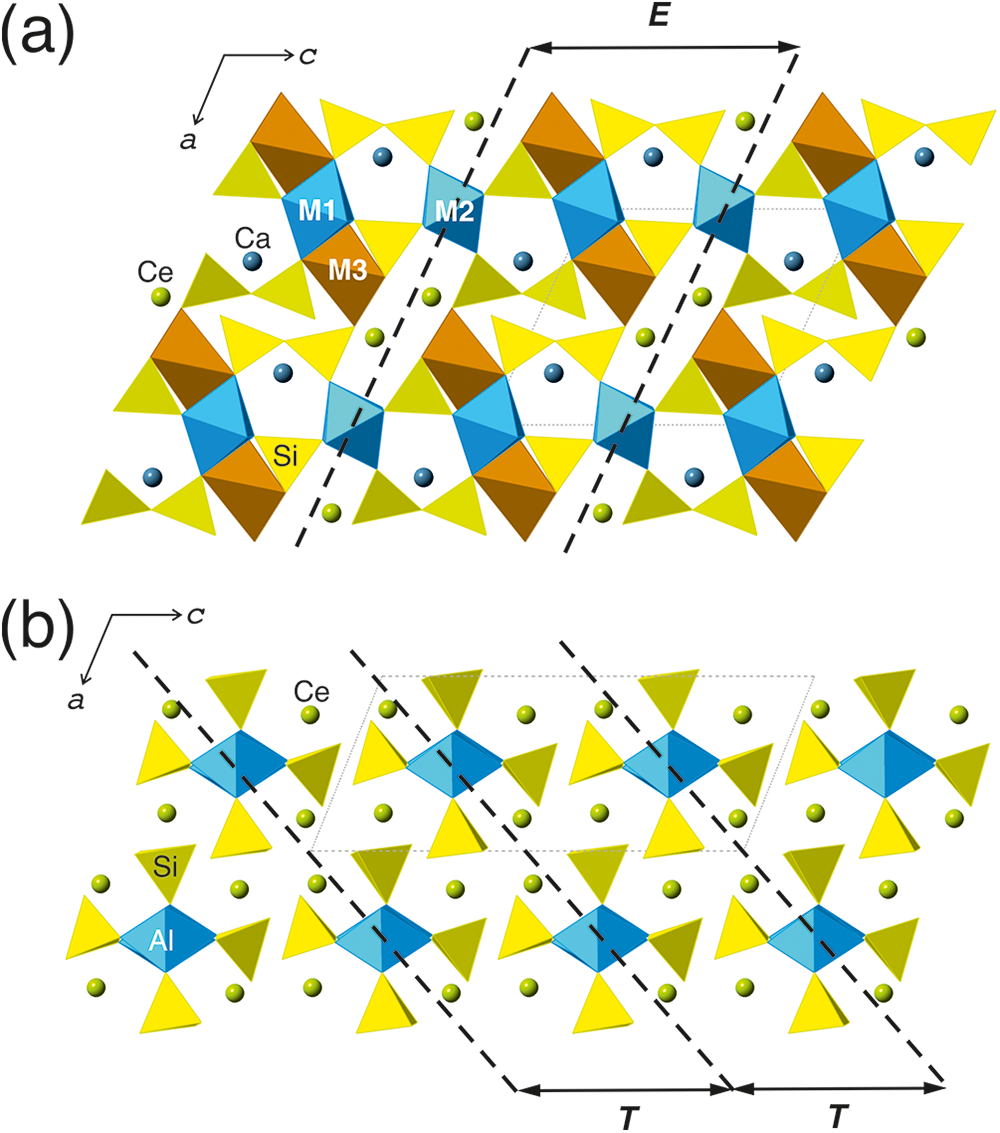
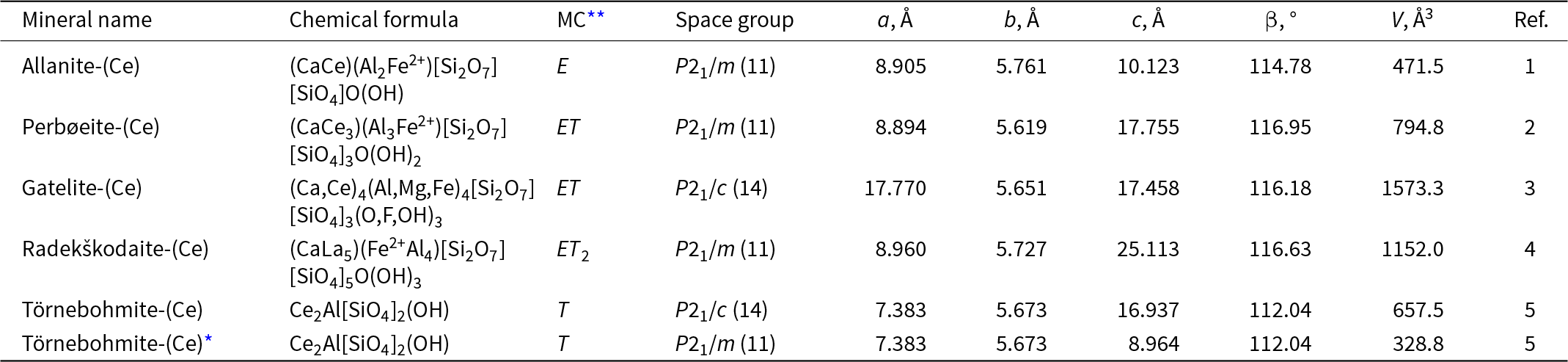
The crystal structures of allanite-(Ce) and törnebohmite-(Ce) as end-members of the series with indications of the E and T modules, respectively are in Fig. 1. The modular description of the representative members of the polysomatic series are in Table 1. It should be noted that the existing members of the series (Table 1) represent only one possible homologous row, namely, one that includes addition of T modules to the initial E module. This homologous row can be described by the general formula ETn. Other homologous rows can be theoretically foreseen, such as EETn, EETETn and EETEETn. As only the ETn members of the series have been observed in nature so far, only this homologous row is considered here.
The crystal structures of allanite-(Ce) (a) and törnebohmite-(Ce) (b) projected along the b axes with the indication of the E and T modules by the dashed lines, respectively. Legend: M3+O6 octahedra = light-blue; M2+O6 octahedra = brown; SiO4 tetrahedra = yellow; Ce and Ca (A) atoms are shown as green and blue balls, respectively. Drawn using the CrystalMaker 8.7 program.

Representative members of the epidote–törnebohmite polysomatic series

* aristotype structure model; ** modular composition
References: (1) Hoshino et al. (Reference Hoshino, Kimata, Nishida, Kyono, Shimizu and Takizawa2005); (2) Bonazzi et al. (Reference Bonazzi, Lepore, Bindi, Chopin, Husdal and Medenbach2014); (3) Bonazzi et al. (Reference Bonazzi, Bindi and Parodi2003); (4) Kasatkin et al. (Reference Kasatkin, Zubkova, Pekov, Chukanov, Ksenofontov, Agakhanov, Belakovskiy, Polekhovsky, Kuznetsov, Britvin, Pushcharovsky and Nestola2020); (5) Shen and Moore (Reference Shen and Moore1982).
Aristotype structures
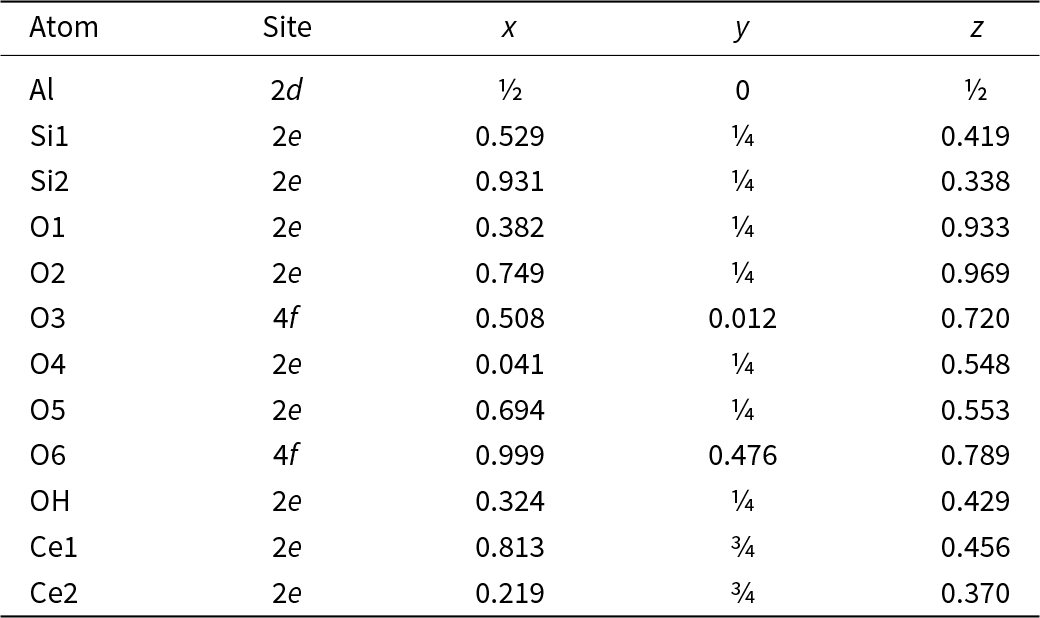
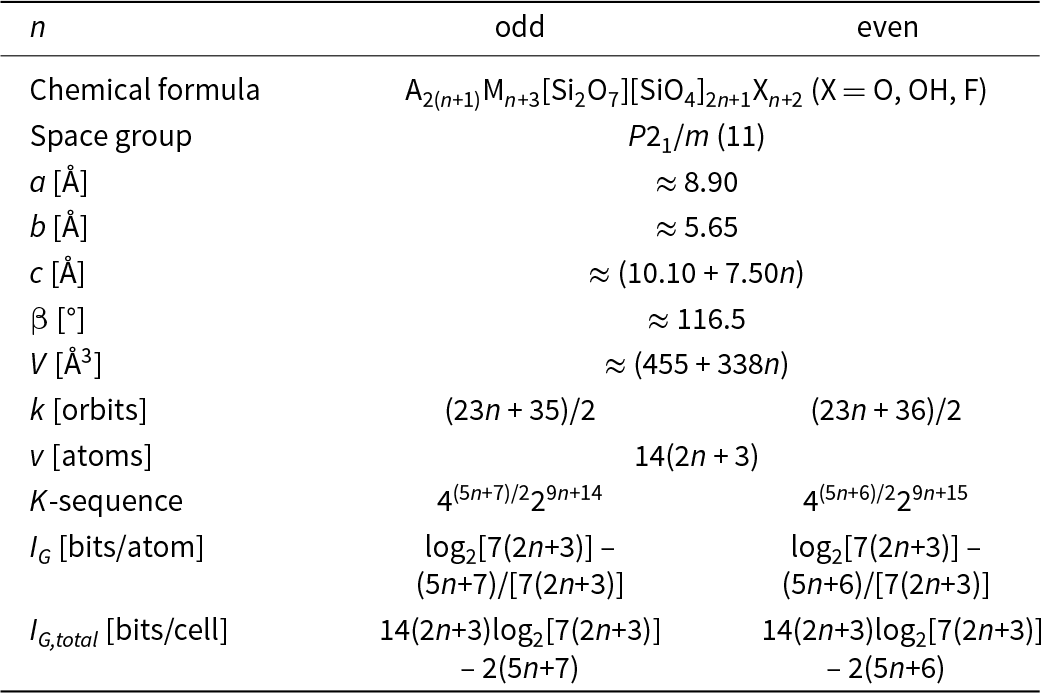
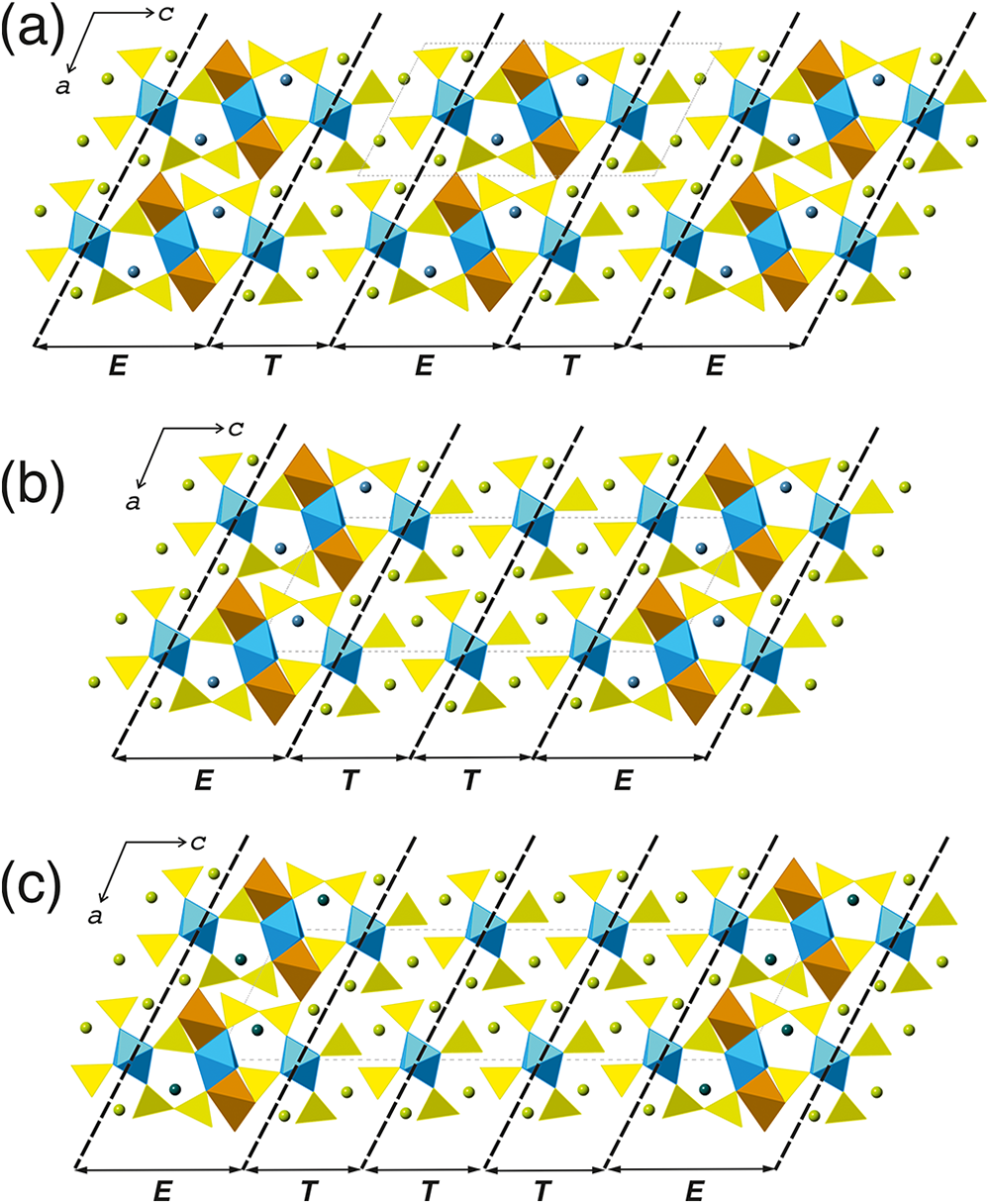
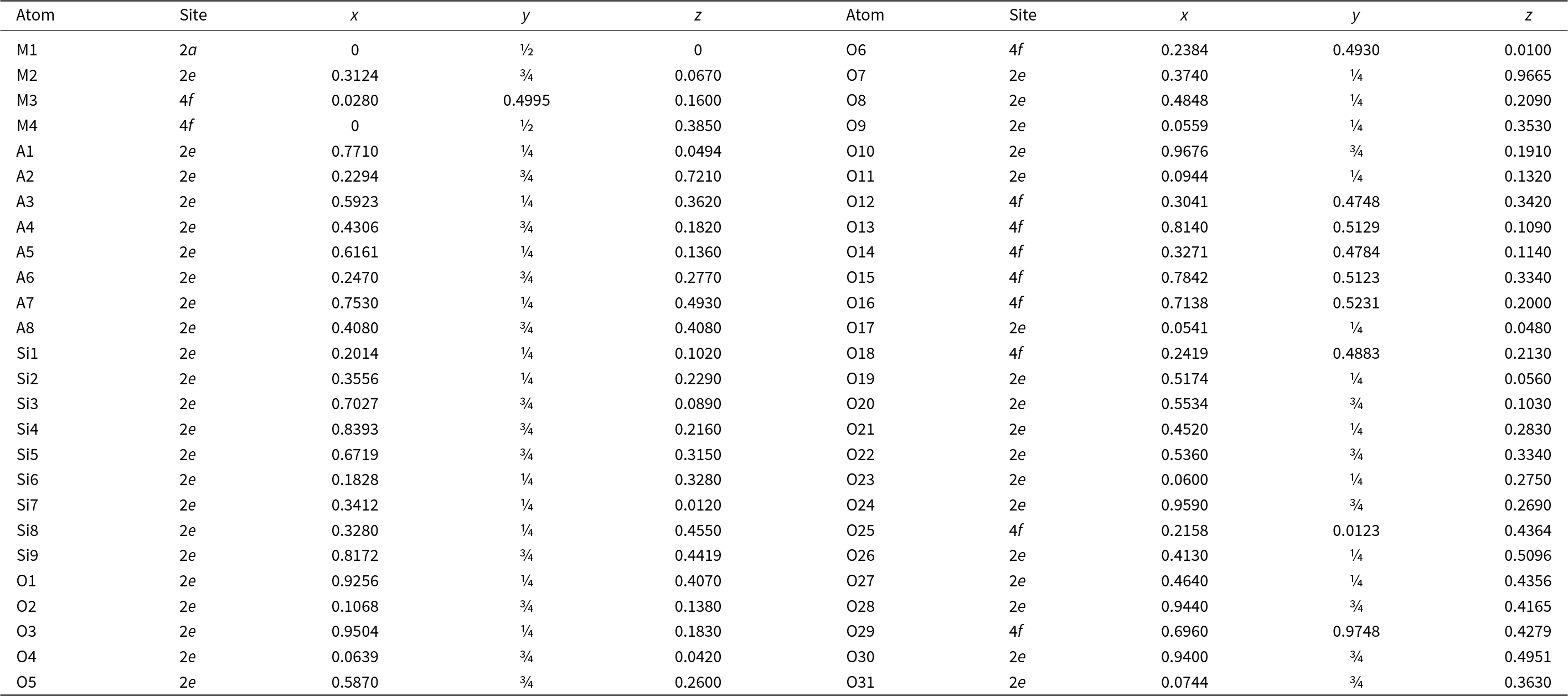
Each member of the polysomatic series can be characterised by its aristotype structure, which is defined here as a structure type with maximal possible symmetry. For instance, the crystal structure of perbøeite-(Ce) is an aristotype for the ET member, whereas that of gatelite-(Ce) is not, as the latter is a 2×1×1 superstructure with regard to its aristotype; its a parameter is doubled (Table 1). By analogy, the experimentally determined crystal structure of törnebohmite-(Ce) does not correspond to its aristotype, owing to its 1×1×2 superstructure. Table 2 contains full information about the aristotype structure model of törnebohmite-(Ce). The aristotype structures of all members of the ETn homologous row of the epidote–törnebohmite polysomatic series belong to the P21/m space-group-type. Their chemical formulae and approximate unit-cell parameters are listed in Table 3 as dependent upon the n value (i.e., the number of törnebohmite modules in a polysome). Figs 2a and b shows crystal structures of perbøeite-(Ce) and radekškodaite-(Ce) as aristotype structures for the ET and ET 2 members of the polysomatic series, respectively.
Aristotype structure model for törnebohmite-(Ce)

Crystallographic parameters and formulae for the calculation of information-based complexity parameters for the aristotype structures of the ETn row of the epidote–törnebohmite polysomatic series

K-sequences
The concept of K-sequence is a generalisation of the concept of Wyckoff sequence that reflects the diversity and numbers of Wyckoff sites occupied in a particular crystal structure (Hornfeck, Reference Hornfeck2022). Usually, the Wyckoff sequence contains the space-group number followed by a sequence of Wyckoff letters corresponding to the sites occupied by atoms in a particular crystal structure. In cases of more than one site of particular Wyckoff type, the number of such sites is indicated by a superscript. The following example is taken from Hornfeck (Reference Hornfeck2022). The unit cell of the crystal structure of RbAg4I5 (space group P4132 (no. 213)) contains 80 atoms distributed over six Wyckoff sites (crystallographic orbits) of four different types: two 24e (x, y, z); one 12d (1/8, y, y + ¼); two 8c (x, x, x); and one 4a (3/8, 3/8, 3/8). The total Wyckoff sequence is 213 e 2 d c 2 a. The K-sequence is a sequence of multiplicities of the occupied Wyckoff sites with the number of sites with the same multiplicities written in a subscript. For the crystal structure of RbAg4I5, the K-sequence is simply 2421218241. The K-sequence does not distinguish between different Wyckoff sites with the same multiplicity. For instance, the crystal structure of allanite-(Ce) (Hoshino et al., Reference Hoshino, Kimata, Nishida, Kyono, Shimizu and Takizawa2005) contains one 2a (0, 0, 0), one 2c (0, 0, ½), thirteen 2e (x, ¼, z), and three 4f (x, y, z) sites. The Wyckoff sequence is 11 f 3 e 13 c a, whereas the K-sequence is 43215.
The crystal structures of: (a) perbøeite-(Ce); (b) radekškodaite-(Ce); and (c) hypothetical ET 3 members of the epidote–törnebohmite polysomatic series projected along the b axes with the indication of the E and T modules by the dashed lines. Legend as in Fig. 1.

The K-sequences in Table 4 are for the representative members of the epidote–törnebohmite polysomatic series listed in Table 1 classified according to the atom types (A, M, Si, O and X) as well as K-sequences for the total crystal structures. The detailed analysis of the dependencies of the K-sequences upon the n value for the known members of the ETn homologous row allows one to derive general formulae, which are different for even and odd n. The corresponding formulae are 4(5n+7)/229n+14 and 4(5n+6)/229n+15 for even and odd n values, respectively. The number v of atoms in the unit cell is expressed by the same formula, irrespective of the parity of n: v = 14(2n + 3). In contrast, the numbers k of occupied Wyckoff sites (crystallographic orbits) are also dependent on the parity of n and are equal to (23n + 35)/2 and (23n + 36)/2 for odd and even n, respectively. It should be emphasised, however, that the formulae obtained (see also Table 3) are for the aristotype structures of the respective polysomes. In reality, structure types may be different for the same aristotype, owing to the formation of superstructures, as is the case for gatelite-(Ce) that has the 2×1×1 superstructure relative to its aristotype (as a consequence, the space-group type changes from P21/m to P21/c).
K-sequences and information-based complexity parameters* for some members of the epidote–törnebohmite polysomatic series

* without contributions from H atoms
** modular composition
*** aristotype structure model
On the basis of atom coordinates for the ETn members of the series with n = 0, 1 and 2, the structure model for the hypothetical ET 3 polysome with n = 3 was constructed (see Table 5 for crystallographic parameters and Fig. 2c for the structure diagram).
Atom coordinates* for the aristotype A8M6[Si2O7][SiO4]7X5 structure of the hypothetical ET 3 member of the epidote–törnebohmite polysomatic series

* P21/m, a = 8.9702, b = 5.7044, c = 32.600 Å, β = 116.766°.
Information-based analysis of structural complexity
The evolution of structural complexity with the changing n value in the ETn homologous row of the series was investigated using information-based measures first proposed in Krivovichev (Reference Krivovichev2012, Reference Krivovichev2013) and developed in Krivovichev et al. (Reference Krivovichev, Krivovichev, Hazen, Aksenov, Avdontceva, Banaru, Gorelova, Ismagilova, Kornyakov, Kuporev, Morrison, Panikorovskii and Starova2022).
For a crystal structure having v atoms per reduced unit cell split into k crystallographic orbits with multiplicities (m 1, m 2, …., mk), the amounts of structural Shannon information per atom (I G; in bits/atom) and per unit cell (I G,total; in bits/cell) are calculated according to the following equations:
 \begin{equation}I_G=-\sum\nolimits_{i=1}^kp_i\;\log_2\;p_i\;\;\;\left(\text{bits/atom}\right)\end{equation}
 \begin{equation}I_{G,total}=v\;\times\;^\text{str}I_G=-v\times\;\sum\nolimits_{i=1}^kp_i\;\log_2\;p_i\;\;\;\text{(bits/cell)}\end{equation}
where pi is the random choice probability for an atom from the ith crystallographic orbit, that is:
 \begin{equation}{p_i} = {\text{ }}{m_i}/{\text{ }}v\end{equation}
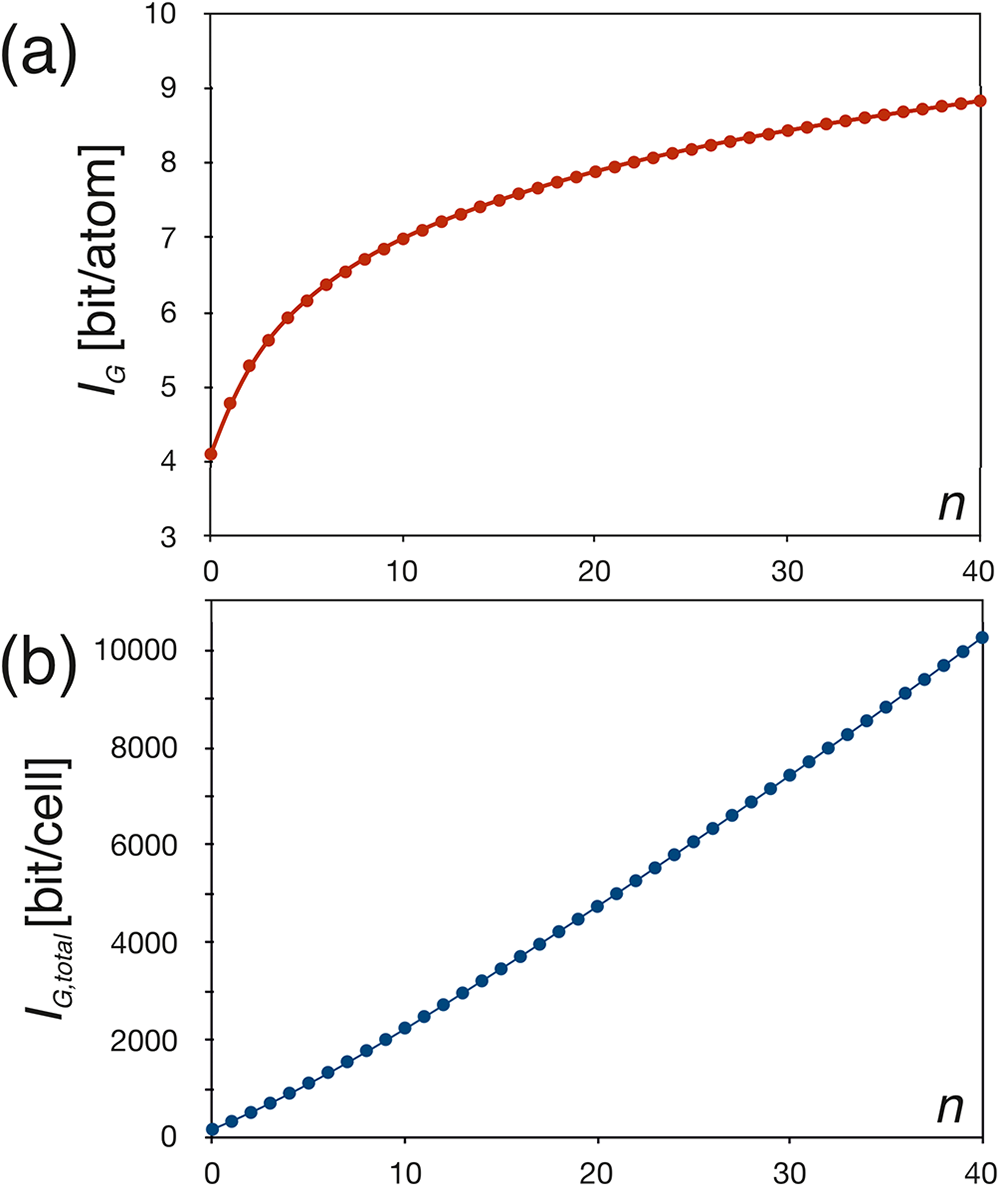
The structural complexity parameters for the representative members of the series listed in Table 1 are given in Table 4. The analytical expression of the K-sequences given in Table 3 (note their dependence on the parity of n) allows for the derivation of formulae for the calculation of structural complexity parameters using n as the only variable. The formulae are given in Table 3, whereas Fig. 3 shows the behaviour of both IG and IG,total values with increasing n. The dependence is almost linear for the total amount of structural information amount exceeding the level of 1000 bits/cell for n = 5. At this value, the structure belongs to the very complex class (Krivovichev, Reference Krivovichev2013, Reference Krivovichev2014), though there are no principal obstacles for its formation either in nature or experiments. However, possible natural occurrences of such structures would be very rare, as even the radekškodaite-group members are considered as rare mineral species, presently known from one world locality only (Mochalin Log, South Urals, Russia, Kasatkin et al., Reference Kasatkin, Zubkova, Pekov, Chukanov, Ksenofontov, Agakhanov, Belakovskiy, Polekhovsky, Kuznetsov, Britvin, Pushcharovsky and Nestola2020, Reference Kasatkin, Zubkova, Škoda, Pekov, Agakhanov, Gurzhiy, Ksenofontov, Belakovskiy and Kuznetsov2024).
The dependence of the atomic (a) and total (b) information contents versus n value for the ET n homologous row of the epidote–törnebohmite polysomatic series.

Conclusions
As has been pointed out elsewhere (Krivovichev, Reference Krivovichev2013, Reference Krivovichev2014; Krivovichev et al., Reference Krivovichev, Krivovichev, Hazen, Aksenov, Avdontceva, Banaru, Gorelova, Ismagilova, Kornyakov, Kuporev, Morrison, Panikorovskii and Starova2022), modularity (or polysomatism) is one of the most important complexity-generating mechanisms in the realm of mineral and synthetic inorganic structures. In the complexity analysis of polysomatic series, it is important to look at the complexity of aristotype structures (maximal-symmetry realisations of polysomes). The example of the epidote–törnebohmite polysomatic series considered here demonstrates that aristotype structures of the end-members of the series (epidote and törnebohmite) are relatively simple (172.477 and 98.606 bits/cell, respectively). The simplest combination of the E and T modules is that of E:T = 1 realised in the crystal structures of gatelite-supergroup minerals with the aristotype structure model more complex than those of the end-members (335.050 bits/cell). The addition of T modules results in the increasing structural complexity; the structures with n > 2 are presently unknown as minerals or synthetic compounds. It is likely that the higher members of the series can be found at the contacts between grains of lower members. It is of interest that mineral diversity generally correlates with the increasing trend of complexity in the polysomatic series: the epidote supergroup contains at present at least 36 mineral species, whereas the gatelite supergroup has seven, and the radekškodaite group only three. This further confirms the principle of maximal simplicity for modular inorganic crystal structures proposed in Krivovichev (Reference Krivovichev2021): structures with minimal information dominate over other structures with the same building principles. This principle has entropic origins and reflects the tendency of inorganic nature to form structures of high entropy.
Finally, it should be pointed out that temperature-driven phase transitions can be expected for those members of the series that form superstructures relative to their aristotypes (e.g. törnebohmite and gatelite-(Ce)) with the space-group change from P21/c to P21/m with twofold unit-cell volume contraction.
Acknowledgements
This manuscript is a contribution to the 80th anniversary celebration of Professor Edward Grew. I am grateful to Robert F. Martin, Luca Bindi and two anonymous referees for the constructive remarks on the manuscript.
Financial statement
This research was supported by the Russian Science Foundation, grant number 24-17-00083, https://rscf.ru/project/24-17-00083/ (accessed on 6 May 2025).
Competing interests
The authors declare none.