Introduction
In April 2009, the world media started to take notice of a new form of influenza, the A/H1N1 virus, mostly referred to as swine flu or Mexican flu. In May 2009, the World Health Organization (WHO) declared that “H1N1 appears to be more contagious than seasonal influenza,” 1 and in June 2009, it declared that “the virus was spreading easily from one person to another and that the world was now officially facing a pandemic.”Reference Chan 2
The societal burden of a disease is considerable in the case of pandemics because, by definition, they reach a level where the cost is not just measurable in fatalities and comorbidity, but also in economic loss and some level of societal chaos (as a result of a marked diminution of the healthy workforce, but also as a result of ensuing fear and panic). The worst known influenza pandemic in human history occurred in 1918 and is commonly referred to as the Spanish flu. This pandemic took the lives of approximately 50 million persons worldwide.Reference Johnson and Muller 3 There were two other flu pandemics in 1957 and in 1968 with in total 2-4 million deaths. 4 Because of the high death rate of earlier pandemics, new forms of influenza and new disease outbreaks remain a considerable cause for concern. When the threat of a new pandemic is just around the corner, panic and fear can occur on a large scale.Reference Van Damme and Van Lerberghe 5 In line with what has been remarked concerning the severe acute respiratory syndrome (SARS) epidemic of 2003, not only the human to human transmission of such a virus and its treatment are a concern, but also the fear of the global community for the virus.Reference Person, Sy and Holton 6 This latter factor is not less important than the virus itself, because it has been suggested that “widespread fear can lead to social and economic consequences as serious as the disease itself.” 7 Accordingly, it is assumed that not only the fact that a virus can be contagious and dangerous is a threat, but also the possible social chaos.Reference Greco 8
In this respect, the media may play an important role. Several authors have observed that when an infectious disease breaks out, the media report heavily about it (eg, the avian fluReference Hellsten and Nerlich 9 and SARSReference Person, Sy and Holton 6 ). Yet studies have shown contradictions in the way that the media report about these disease outbreaks. One studyReference Dudo, Dahlstrom and Brossard 10 analyzed American newspapers during the avian influenza outbreak from 2000-2006. The authors concluded that most of the articles did not provide the public information about how they could protect themselves, nor about the symptoms of the flu. In 38% of the examined articles, the journalists made a comparison with other serious threats (eg, the flu pandemics of 1957 and 1968), and in half of the articles, a worst-case-scenario was mentioned. In another study that discussed the SARS outbreak of 2003,Reference Cheng 11 the author suggested that during the SARS outbreak period, the media were (partly) responsible for the high anxiety level in the population and the high number of risk misperceptions. A study in the NetherlandsReference Vasterman and Ruigrok 12 concluded that during the swine flu outbreak, the media were too alarming. Television reports used an alarming tone and lacked factual background to a larger extent than newspaper reports did.
Content analytical research has shown that swine flu coverage in newspapers worldwide was extensive.Reference Hilton and Hunt 13 , Reference Duncan 14 However, despite this high number of articles in the newspapers, a study in the United Kingdom found almost no indications of exaggerations or overhyping.Reference Hilton and Hunt 13 This is in line with another content analysis of news articles concerning the swine flu in 31 different European countries during the first days of widespread media coverage of the outbreak.Reference Duncan 14 This study also concluded that the media gave mostly neutral information in a nonalarmist and factual way. Similarly, in the Australian media, the press “reflected well the pronouncements of risk and reassurance that the evolving nature of the Swine Flu threat lent itself to.”Reference Holland and Blood 15
The high frequency of media reports concerning infectious diseases lead to the question whether such reporting may affect human behavior and may, therefore, aggravate or alleviate the burden of a pandemic. An example of a more informed public was demonstrated with an internet studyReference Jones and Salathé 16 during the first week after the outbreak of the swine flu. This study found that 80% of the respondents reported that they had increased their hand washing. On the other hand, a more fearful public was found in an ecological study using aggregate level data from 23 member states of the European Union, that demonstrated that exposure to television was highly related with anxiety for avian flu.Reference Van den Bulck and Custers 17
Two prominent models are applicable to these studies: the agenda-setting theoryReference McCombs and Shaw 18 and the health belief model.Reference Rosenstock 19 The media agenda-setting theory argues that when something receives a lot of media attention, the perceived importance of the issue in the public's mind increases proportionally.Reference McCombs and Shaw 20 The health belief model states that mass media communication are part of the “cues to action” for lay individuals to evaluate certain health actions and behavior.Reference Janz and Becker 21
The present study extends this line of research by examining the number of people who presented themselves to the emergency department (ED) of a tertiary hospital in Flanders, Belgium, believing they displayed symptoms of the swine flu in relationship to the frequency of articles in the Flemish news press for the same time span. Previous American researchReference McDonnell, Nelson and Schunk 22 showed that there was a significant increase in ED visits when the swine flu became a public concern. In this study the following three research questions were addressed:
-
1. Is there a relationship between the number of self-presentations to the ED and the number of articles concerning the swine flu published in Flemish newspapers?
-
2. Does an increase in newspaper reports of the swine flu follow an increase in self-presentations (news as mirror of the disease) or vice-versa (ED visits as mirror of news attention)?
-
3. Is the relationship between self-presentations at the ED and news attention different for quality newspapers than for popular newspapers?
Methods
This study evaluated the number of patients who presented themselves at a hospital ED believing they had symptoms of the swine flu, and the number of newspaper articles concerning the swine flu during the same time span. The study was observational and compared time interval presentations for the two variables of interest, ED presentation and media publications.
Cases included in the study were those patients who presented themselves to a separate hospital ED that had been established in response to the fast growing threat of the swine flu in 2009. This separate flu ED was opened in response to the increased number of patients that came to the hospital's ED and to create a high virus density zone separated from the normal ED (low virus density zone), to prevent transmission of the virus throughout the hospital. The Leuven University Hospital registered patients into this separate ED when they presented themselves with a self-diagnosis of swine flu symptoms, or fulfilled the inclusion criteria of a national defined potential case. The case definition was provided by the Belgian Ministry of Health and was identical to the case definition of the Centers for Disease Control and Prevention (CDC) in the United States of America. A confirmed case of the A/H1N1 virus infection was defined whenever an individual with an acute respiratory illness had a confirmed infection by the identification of the virus through samples from the respiratory system by: (1) detection of viral RNA by polymerase chain reaction (PCR); (2) detection of the viral nucleoprotein antigen; and/or (3) isolation of the virus. If the patient fulfilled sufficient case definition criteria, the tentative diagnosis of swine flu was accepted, but immunologic confirmation was requested. Excluded from the study were patients who did not presented themselves to the separate ED. Data were collected during 24 weeks, from August 6, 2009 until January 20, 2010. This period marked the heaviest peak of the swine flu epidemic in Belgium. 23
The online press database Mediargus (Mediargus, Brussels, Belgium) was used to generate an overview of articles concerning the swine flu published during the pandemic. Mediargus is a digital press database that contains all content of the Flemish newspapers. Articles concerning the swine flu, published in newspapers during the same time span in which the Leuven University Hospital registered potential flu patients, were retrieved using the reference terms “Mexican flu OR Swine Flu OR H1N1.” Seven Flemish newspapers with high circulation figures were selected for this study. The sample consisted of three quality papers (De Morgen, De Standaard, and De Tijd) and of four popular papers (De Gazet van Antwerpen, Het Belang van Limburg, Het Laatste Nieuws, and Het Nieuwsblad). These seven newspapers had a total average circulation of 936,599 copies per day in 2009. 24 Most copies are read by more than one person. There are approximately six million residents in Flanders. 25
The Pearson's correlation coefficient was selected in the statistical program SPSS (Version 17.0; SPSS Inc., Chicago, Illinois USA) to test whether a relationship could be demonstrated between the number of potential patients and the number of news articles in the same period. The cross-correlation function was used to explain the relationship between these two variables: “The cross-correlation function indicates a direct or delayed dependence between two different time series.”Reference Box and Jenkins 26 This cross-correlation function is thus used when examining the correlation between the value of a variable in time (T) and the value of another variable at time (T-1).Reference Gupta 27 It suggests an answer to the question which of the two data series precedes the other one.
Results
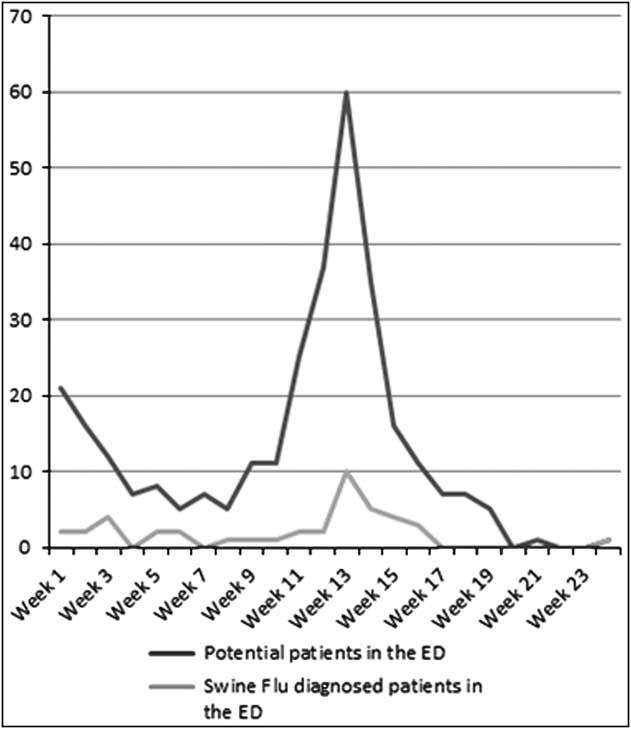
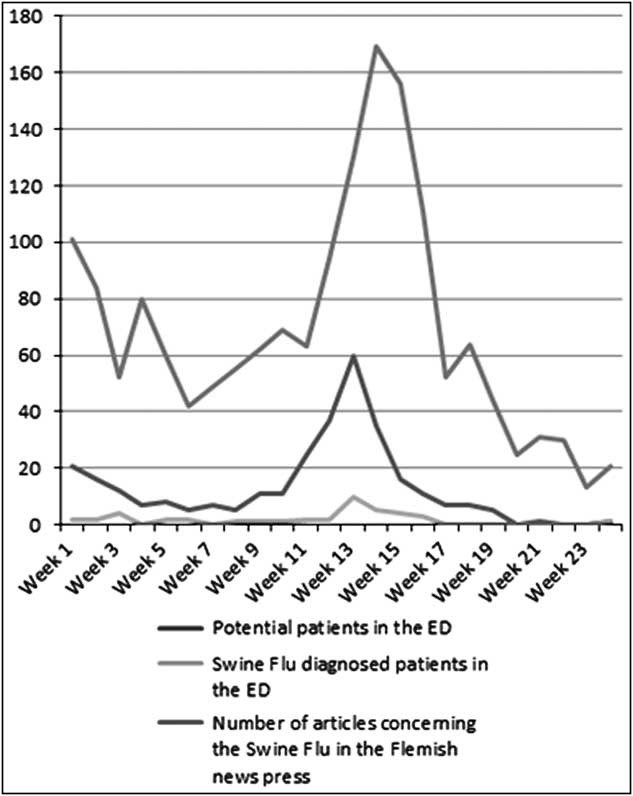
The number of potential patients (n = 308) was much higher than the number of actual patients (n = 42), which could be a result of a broad case definition or an indicator of fear and/or worry for the swine flu (in patients and/or in ED personnel). Figure 1 demonstrates the weekly number of patients that came to the separate ED thinking they had the flu (potential patients), and the number of these individuals who were actually diagnosed with swine flu (diagnosed patients), during the 6-month time span. During the search period, 1657 articles concerning the swine flu were published and archived in Mediargus. Figure 2 shows the number of articles about the swine flu in seven Flemish newspapers during the searched time span.
Prevalence of Potential Swine Flu Patients and Diagnosed Swine Flu Patients (the number of patients with a self-diagnosis of swine flu, or the potential patients, and the patients who were diagnosed with swine flu in an ED in Flanders) Abbreviation: ED, emergency department.

Prevalence of Potential Swine Flu Patients, Diagnosed Patients, and Swine Flu Articles in the Flemish Written Press (the number of articles concerning the swine flu in seven Flemish newspapers) Abbreviation: ED, emergency department.

A high positive correlation coefficient (r = .728; 95% CI, .460-.875; P < .001) was found between the number of potential patients and the number of articles. Similarly, the number of self-presentations was strongly correlated with the number of articles in quality papers (r = .700; 95 CI%, .413-.860; P < .001) and popular articles (r = .714; 95% CI, .436-.868; P < .001). These results suggests that the number of patients who thought they had the swine flu and the number of articles in the news press were closely related, and that there was no difference in this relationship between quality and popular newspapers.
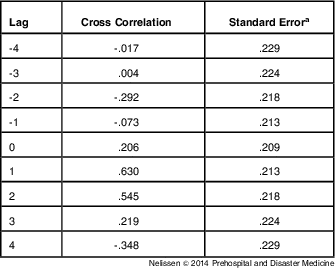
Furthermore, the cross-correlation function indicated that the number of potential patients appeared to determine the number of articles in the newspapers, rather than the other way around. To analyze the cross-correlation function, time lags were examined.Reference Gupta 27 Each lag represented one time unit of one week. Table 1 demonstrates that Lag 1 and Lag 2 had the highest cross-correlation (.63 and .55, respectively). The cross-correlation was positive, which suggested that the leading indicator, in this case, was the number of patients. This indicator worked best predicting the value of the number of articles one and two period(s) later. Thus, whenever the number of potential patients increased, the press wrote more about the swine flu in the following two weeks. Identical results were found when a distinction between quality and popular papers was made.
Cross-correlation Between the Number of Potential Patients in the ED and the Number of Articles Published in Seven Flemish Newspapers

Abbreviation: ED, emergency department,
aBased on the assumption that the series are not cross-correlated and that one of the series is white noise.
Discussion
This study indicated that there was a strong relationship between the number of patients who presented themselves to the ED of a tertiary hospital in Flanders with self-diagnosed symptoms of the swine flu and the frequency of articles concerning the swine flu in the written news press in Flanders. During the swine flu outbreak and the spreading of the disease, this topic was, as this study showed, discussed in the media excessively (a comparable number of newspaper articles during the same span were found in a Dutch study).Reference Vasterman and Ruigrok 12 This is particularly worrying if you consider the suggestion that “a pandemic or an epidemic is not only how widespread a disease actually is, but rather how it is perceived.”Reference Chan 28 If the topic of such a disease is frequently mentioned in the media, people may overestimate the risk of infection and the perceived severity of the disease, which could create fear and panic. The swine flu turned out to be more benign than a normal seasonal flu.Reference Vasterman and Ruigrok 12 The seasonal flu kills an estimated 250,000-500,000 people worldwide every year, 29 yet this is not a topic that attracts much media attention. Looking back, “we learned that when there is a widespread perception of a major health risk for the community, minor incidents or major non-events can turn into a public health crisis.”Reference Seynaeve 30
Previous research showed that news media write about new infectious diseases in both a fear-inducing and reassuring way.Reference Vasterman and Ruigrok 12 , Reference Ungar 31 The outcome of disease communication partly depends on the content of the messages that are being spread. The way the media and the government communicate about an infectious disease has a tremendous influence on the way the public will react: “Intensified anxiety at the start of a pandemic could mean that people avoid travel, fear going to hospitals, or start riots in the streets.” 7 Information could be the most important form of protection during health-related emergencies. 32 People react to threatening situations by seeking information that can help to protect themselves and the people around them.Reference Wray, Becker and Henderson 33
This study tried to increase the understanding of the dynamics between news and behavior and of the effects of news reporting about infectious diseases. The time series analysis of the number of people presenting themselves to the ED, on the one hand, and the number of press articles about the pandemic on the other hand, suggests that there was no evidence that increased reporting leads to increases in self presentations. The findings, therefore, do not support the conclusion that news reporting causes people to worry unnecessarily and thus, causes EDs to be flooded with “the worried well” at a time when resources are stretched by a real outbreak. Instead, the data suggest that increases in the number of patients are followed by more reporting about the pandemic, which suggests that, at least as far as self-presentations are concerned, media attention reflects reality rather than creates it. This finding does not cover all potential media effects and other effects of news reporting (including those not on the general public, but on policy makers) remain possible.
Future research concerning the effects of media reporting about infectious diseases and other health related subjects is needed. Experiments in this field of research still are rare, but could be very useful. Further, it could be very interesting to survey individual patients during a new outbreak of an infectious disease and to review media content that is being disseminated during the same time span. The present study only looked at newspapers, but other media, like television, internet, magazines, radio, etc, could be taken into account to examine additive or cumulative effects. Long term exposure to these different media could have a cumulative effect on knowledge, fear, risk perceptions, and attitudes of new infectious diseases. Finally, it could be interesting to conduct a qualitative study to investigate how the media influence health decision making.
Limitations
This study has some methodological limitations that further research should address. Although this study suggested a temporal relationship between newspapers and ED use, there is no evidence for a causal link between newspaper coverage and ED use or levels of worry. Furthermore, there could be other factors that lead to an increase in the newspaper reporting. The data used in this study only covered a limited period of the entire flu epidemic. Hospital swine flu ED visitors were only measured during six months, but the flu epidemic lasted over a year. However, these data covered the highest swine flu peak in Belgium. A fourth limitation is the fact that this study only used weekly data of the potential patients that came to the ED. It is possible that the actual size of the time lag between the two time series is less than one week. Finally, this study assumed that a higher newspaper coverage of the theme resulted in a higher exposure to news. This is just an assumption, the actual amount of exposure to the news media was not measured.
Conclusion
This study demonstrated that a strong relationship existed between the number of messages in Flemish quality and popular newspapers on the one hand, and the number of patients who presented themselves to a special swine flu ED on the other hand. It was assumed that media attention might lead to more patients in the ED, and that this could be an indicator for fear and worry. However, the opposite was found. In this case at least, the media reflected reality. Time series analyses showed that there was a temporal effect of the number of potential patients in an ED in a large teaching hospital on the number of articles in the press.