INTRODUCTION
For a man as wealthy, as powerful, and as supremely self-assured as Donald Trump, it is surprising how vulnerable he seems to be to the wounding power of words. Donald Trump's love of libel law as a cudgel for silencing his critics and the press is well known. The most litigious candidate to have ever run for the office of President, Trump has long used threats of legal action to advance and defend his business empire, and most importantly to silence the words of his public critics. As the title of a report commissioned by the American Bar Association would put it, “Donald J. Trump Is a Libel Bully” in his frequent threats of libel lawsuits to silence critics, but he is “Also a Libel Loser” in that he relies more on the threat of libel lawsuits than on actually filing such lawsuits – or winning them.Footnote 1 Trump has more recently mused as President on the need for “opening up” libel laws to make it easier to sue for libel, a view that has even been echoed in rare public remarks by Supreme Court Justice Clarence Thomas, who argued for overturning the landmark case of New York Times v. Sullivan, which definitively established the protections for freedom of the press, on the ground that the protections it provided from libel suits were constitutionally suspect.Footnote 2 Trump's more heated and escalating attacks, since becoming President, on the “fake news” of media outlets characterized as “enemies of the people” have been seen as marking what one commentator refers to as “The Return of Seditious Libel in the Age of Trump” – i.e. a return to that checkered period in the nation's past when the crime of “seditious” libel was used by President John Adams to censor and imprison his critics and political opposition.Footnote 3
This seemingly reflexive tendency of Trump's to cry libel in response to public criticism is most often understood simply as an expression, through the legal domain, of his seemingly acute and personality-defining “narcissism,” a narcissism so often invoked that it “has become cliché.”Footnote 4 Or Trump's seemingly obsessive concern with protecting his public persona is explained as the overactive reflex of a man who has built a fortune around the successful branding of that persona in his career as both a real-estate developer and reality-television star, and who is eager to protect the remunerative value deeply invested in that persona. Such a concern with the currency and value of one's public persona, moreover, is not so unusual in the world of politics into which Trump so spectacularly launched himself, particularly among those seeking that most vaunted political office of the President of the United States, for such an ambition depends upon a careful crafting of one's public image to both win public office and maintain one's political efficacy and governing power once in it.
It is thus perhaps not surprising that a President such as Trump, who has been particularly focussed throughout his career on developing his public persona into a highly remunerative brand through his many diverse marketing and mass-media ventures, and who then leveraged that persona into a bid for the presidency despite his lack of political, governmental, or military credentials, would continually seek to protect that carefully constructed character using the shield of libel law, the primary legal domain devoted to the jurisprudential protection of character. But what if this explanation of the President's litigious tendencies speaks less to an obsessive concern to protect a personally beloved, fabulously remunerative, and politically efficacious public image, and more to a deeper concern over the state's power to adjudicate disputes over such nebulous legal entities as reputation and character in the first place? What if, in other words, such an obsession with libel represents not merely a personal desire to use the legal system to protect his own highly remunerative character, but rather a broader, more structural concern to consolidate, shore up, and redeploy the power and authority of the state itself to judge what legally counts as character – to judge the content and value of its citizens’ characters – and to make such judgments the instrument through which access to the rights of citizenship and even residency within the US is afforded or denied?
Questions of character are adjudicated before the law not only in the domain of defamation law – which encompasses both the written form of libel and the spoken form of slander. One of the most consequential and far-reaching domains in which legal questions of character are decided is in the domain of naturalization and immigration law. In the domain of naturalization law, legal determinations of “good moral character” have been ensconced since 1790 as an explicit prerequisite for non-native-born residents who wish to obtain citizenship through the process of naturalization, a requirement that demands that applicants for citizenship prove their “good moral character” through documentary evidence, personal attestation, and the testimony of corroborating witnesses.Footnote 5 Such determinations of character also play a crucial role in immigration law, where they have historically been used to distinguish the desirable from the undesirable immigrant, and continue to be used as a legal lever for revoking the legal residency status of immigrants and executing deportation proceedings. Character has thus functioned in the law as an object of legal determination with far-reaching implications for the many individuals whose livelihood in the US has depended on having and demonstrating it. Character has more significantly functioned throughout the history of the US as a unique kind of legal instrument for controlling and crafting the imagined traits and qualities of the body politic, and in particular the ethnic and racial hierarchies that comprise it. And yet, while an object of legal determination with far-reaching implications for both the nation and those individuals seeking inclusion and rights within it, character is and has long been one of the most ambiguously defined objects in American jurisprudence.
As Kevin Lapp has argued, the problem with the “good moral character” requirement is that “for over 150 years, Congress offered no guidance whatsoever on what constituted good moral character,” and so the determination of whether, for example, a naturalization applicant had established their good moral character was left entirely to the discretion first of courtroom judges, and later of immigration officials.Footnote 6 The Immigration and Nationality Act of 1952 created for the first time a specific list of activities that violated the “good moral character” requirement, such as acts of “moral turpitude,” gambling, alcohol use, drug trafficking, prostitution, unlawful voting, fraud, etc., and thus provided statutory measures that could be employed by judges to bar citizenship to naturalization applicants. Seeming to provide greater legal clarity as to what counts as good moral character, these statutory bars functioned to provide clearer and more expanded legal measures for determining when an individual lacked “good moral character,” measures not only defined in terms of specific criminal acts, but also based on vaguely defined actions and behaviors such as “moral turpitude.” These definitions thus provide no guidance as to what would count as positive evidence of good moral character if none of the disqualifying bars were present, leaving a great deal of room for discretionary or subjective judgments that individuals had not met the positive standard for “good moral character” because such a standard was left up to judges to define.Footnote 7 Since 1952, the list of excludable bars to naturalization has grown exponentially, without any corresponding affirmative definition of what can count as good moral character, thus expanding the legal instruments through which judges can deny naturalization on character grounds, while also enabling judges and immigration officials to continue making entirely discretionary determinations of what counts as good moral character if none of those instruments can be applied.Footnote 8 With the passage of the Immigration Act of 1990, moreover, the authority to decide naturalization cases was fully moved from the law courts to the administrative agencies “responsible for immigration and naturalization matters,” which today is the United States Citizenship and Immigration Services, thus severely restricting the possibility of judicial review in the process. The “good moral character” requirement has thus provided a kind of legal fulcrum for efforts to arbitrarily exclude or deny entry into the US and access to citizenship, and in some cases to even retroactively strip individuals of their presumably “inalienable” citizenship rights, by enabling cultural norms, moral values, and subjective judgments to function as legal facts. Thus rather than standardizing and clarifying the measures used to adjudicate character, these legal developments have, as Lapp argues, “turned the good moral character requirement into a powerful exclusionary device.”Footnote 9
What I'd like to point to here is the danger in dismissing the President's obsession with libel as merely the expression of a particularly acute form of personal vanity, by arguing that this obsession is revelatory of a deeper interest in rehabilitating the power of the state, or rather of himself as the embodiment of the state, to judge the value of individuals’ character, and to make such judgments the basis for the conferral or denial of basic citizenship rights and the reshaping of the racial and ethnic character of the nation's citizenry. This interest finds its ultimate expression, I argue, in recent efforts by administration officials to appropriate the “good moral character” requirement as a powerful exclusionary instrument for restricting immigration and access to citizenship in the US. In order to make visible and understand the structural conditions that enable this power, I trace the development of the “good moral character” requirement in the history of US immigration and naturalization law, focussing in particular on the pivotal reforms of President Theodore Roosevelt, a President similarly concerned with the wounding power of libelous words, and with the state's power to adjudicate and define the nation's character. Taking Trump's and Roosevelt's shared obsession with libel as my clue, I examine the connections between Roosevelt's efforts to reform both libel law and immigration law in order to make visible the common role that an ideology of character plays in these efforts, and more particularly how these efforts aim to improve the character of the nation by expanding the state's power to adjudicate character through the “good moral character” requirement. In foregrounding the parallels between the presidencies of Trump and Roosevelt, such an analysis thus enables us to see the ways in which such legal determinations of character continue to play a critical, though unrecognized, role in recent efforts in the US to restrict immigration and access to citizenship, while bringing into relief the legal framework that gives these determinations such force and reach. Such an analysis thus enables us to recognize that the greater danger lies not in the contentious judgments and views spectacularly displayed in the barrage of daily, socially mediated pronouncements, but rather in the underlying and long-standing legal framework that enables such views to find such ready enactment.
PUNISHING WORDS: PROTECTING THE PUBLIC FROM CRIMES OF LIBEL
In December 1908, President Theodore Roosevelt, ordered his Attorney General Charles J. Bonaparte to draw up charges of criminal libel against the publishers of the Indianapolis News and New York World newspapers for their publication of a series of articles that called into question the motives and methods of one of the signature projects of Roosevelt's presidency, the still-incomplete building of the Panama Canal. Roosevelt's involvement in the affairs of Panama had always been the object of considerable public debate, particularly his role in Panama's emergence as an independent nation when it broke off from Columbia, of which it had been a part since Columbia's independence from Spain in 1821. Panama's declaration of independence from Columbia on 3 November 1903 was seen by many both in the US and abroad as less the act of a broad-based nationalist independence movement than the self-interested project of a small group of wealthy landowners interested in selling the rights over the Panama Canal Zone to the US in exchange for military and monetary backing, rights which Columbia itself had just refused to the United States.Footnote 10 Roosevelt apparently did not feel particularly libeled by many allegations emerging in the popular press that he was imposing US hegemony over foreign lands by, as William Randolph Hearst would put it, “buying a revolution,” nor by the endless stream of cartoons and editorials criticizing his expansionist agenda to extend the United States's sphere of influence across the hemisphere.Footnote 11 Indeed, Roosevelt had largely built his career on precisely this sort of imperial image making, and had long relied on his ability to prevail over his critics not through the courts but rather through his self-proclaimed “bully pulpit” and the court of public opinion, and through his well-honed skills in self-promotion and public image making, leading many to speculate as to why these particular attacks so incensed the President. That Roosevelt would single out a few particular newspaper articles for charges of libel was itself quite unusual, and to pursue in particular criminal charges of libel, and to do so employing the full prosecutorial force of the federal government, were even more unusual, for criticisms of this kind were certainly not new.
Roosevelt was, however, one of the first Presidents to fully mobilize the powers of the mass media in the service of his own image making, an image he was deeply invested in protecting. The arc of his professional career is a story of repeated rhetorical and visual refashionings of his public persona – particularly his quite deliberate self-transformation from an ambitious but young state assemblyman a bit too eager to impress with his dress (an eagerness that earned him ridicule as a “Jane-Dandy,” “Punkin-Lily,” and “the exquisite Mr. Roosevelt”), into the more robust and manly “Cowboy of the Dakotas” by the time he ran for mayor of New York five years later, and his subsequent shoring up of his tough, hyper-masculinized strenuousness through his self-promoted exploits as a solider in the Spanish American War.Footnote 12
Roosevelt's successful leveraging of his carefully crafted persona to ascend the summits of political power might thus explain the appeal of libel law as protection for the valuable persona in which he had invested so much, not only in the “Panama libel cases” (as they came to be known), but also in libel suits he was involved in after leaving public office in order to protect his public image.Footnote 13 But does it explain Roosevelt's extraordinary and unprecedented response not to pursue a civil suit of libel against the Indianapolis News and the New York World for damage incurred to his carefully crafted character, but rather his choice to mobilize the full police power of the federal government against the publishers themselves by charging them with criminal libel? Does it explain his decision to charge these individuals with a criminal act against the public and the state itself, a charge that carried with it the immediate threat of arrest and incarceration and that dangerously construed their acts of political critique in terms of the more serious crime of sedition or even treason?
The allegation, first published by Joseph Pulitzer in the New York World and subsequently reprinted as a series of columns, editorials, and political cartoons in the Indianapolis News (published by Delavan Smith and Charles Williams), was that the forty million dollars used to purchase the land, buildings, equipment, maps, and surveys of the French Canal Company, which at a cost of 22,000 lives and 234 million dollars had largely given up its project to build a canal on the isthmus by 1889, had not all gone to the French, but rather to a secret syndicate of American investors led by President Roosevelt's brother-in-law, Douglas Robinson; President-Elect Taft's half-brother, Charles P. Taft; Attorney William Cromwell; and Financier J. P. Morgan.Footnote 14 Raising the oft-repeated question “Who Got the Money?”, the New York World's article not only alleged that the federal government had been defrauded of millions of dollars with the knowing aid of the President and the president-elect, but that one of Roosevelt's most defining and celebrated foreign-policy initiatives, one that eventually resulted in the most spectacular achievement of his presidency – the creation of the globe-transforming marvel of the Panama Canal – had all been orchestrated to enrichen a small group of Roosevelt's friends, family, and political allies.Footnote 15
Roosevelt explained and defended his decision to pursue charges of criminal libel in a Special Message to Congress that he gave on 15 December 1908, just before filing the indictment:
these stories were scurrilous and libelous in character and false in every particular … they are in fact … a libel upon the United States Government … The real offender is Mr. Joseph Pulitzer … While the criminal offense of which Mr. Pulitzer has been guilty is in form a libel upon individuals, the great injury done is in blackening the good name of the American people. It should not be left to a private citizen to sue Mr. Pulitzer for libel. He should be prosecuted for libel by the governmental authorities.Footnote 16
Criminal libel is conventionally defined as “a libel against the state, against the dead, or against a large, ill-defined group (such as a race) in which the state prosecutes the libel on behalf of the injured parties,” and Roosevelt's justification evokes this conventional definition of criminal libel in its interweaving of two classes of victims typically requiring protection from it: libels against government officials and libels against groups and others who cannot defend themselves with civil suits.Footnote 17 But how these standards applied to this case was not altogether clear. The individuals did not seem, in the first instance, to represent some “ill-defined group” that needed government protection, nor was it clear why the particular individuals named in the newspaper stories – wealthy, politically powerful, and well connected white men – were incapable of bringing civil suits of libel themselves, nor how the government itself was libeled by charges that largely focussed on the actions of these individuals who profited from their speculations at the expense of the American government. Thus many of his contemporaries saw Roosevelt's action as nothing more than the abusive attempt of a lame-duck President to use the full powers of the presidency to silence his critics and endow a personal legacy upon which he could capitalize as he returned to private life at the end of his term. Not only did Judge Hough of the US Court for the Southern District of New York confirm these views when he quashed the indictment on 26 January 1910, but so too did the Supreme Court, where the case was ultimately heard on appeal, in its unanimous affirmation of Hough's decision on 3 January 1911.Footnote 18
While Roosevelt's efforts to prosecute Joseph Pulitzer, Delavan Smith, and Charles Williams were quickly stymied by the courts, the lengths to which Roosevelt was willing to go to ostensibly defend the reputation of such privileged, private individuals, despite the paucity of legal grounding, suggests Roosevelt's broader commitment to the enormous national value of such mens’ characters, a value which the state itself should have an interest in protecting. We might thus understand Roosevelt's invocation of criminal libel as an effort not just to protect these individual men from libelous words, but to defend more generally the importance of a kind of aristocracy of character. The aim of Roosevelt's invocation of criminal libel, in other words, seems to be to redefine the state's role in adjudicating issues of character and libel, in order to make protection from libel a sacred responsibility of the state, rather than a mere matter of civil dispute between two private individuals. We might thus understand Roosevelt's act as an effort to make criminal libel the instrument for government protection of what was increasingly seen as a unique and foundational kind of constitutional right, the right to a reputable character, for, as E. L. Godkin would put it, it is “the duty of the state to provide security for reputation as for property.”Footnote 19 Indeed, articles such as “The Newspaper Press and the Law of Libel” would go further in arguing that “the right to reputation is one of the most valuable rights of man in civilized society, we had almost said, the pivot of them all.” Thus the “right of reputation should be declared one of the fundamental rights of men” and a constitutional protection be provided for reputation as a fundamental right more urgent than the right to free speech or freedom of the press.Footnote 20
Defamation law today, whether in the spoken form of “slander” or the written or “published” form of “libel,” tends to be seen as a marginal area of civil law where celebrities and public figures wage spectacular, frequently lurid, battles with large media conglomerates over their extremely valuable and highly commodified public images. While defamation law recognizes this public image – or second self – as a form of personal property deserving of legal protection from unwarranted theft or damage, it is a form of personal property unlike any other. The reputation or character protected by defamation law confounds the very distinction between person and property in its constitution as a kind of second self or self transformed into commodity form. As Cheryl Harris has argued in her landmark essay “Whiteness as Property,” such a character might differ from classical forms of property in that it is not, for example, an alienable “thing” or possession separable from its possessor and thereby exchangeable as property for other “things” of value, but it is nonetheless a form of value that, like capital itself, can generate more value and property for its possessor (a doctor's good name, for example, being essential to the flourishing of her or his practice) and is therefore something to which an individual has the “right of use and enjoyment.”Footnote 21 But as Harris points out, the value of this character is by no means solely a product of, according to the Lockean formula, the labor the individual puts into it, but rather one also determined by the set of social distinctions through which the relative values of such identities are conferred. As Harris argues in relation to whiteness, for example,
Whiteness … became usable property, the subject of the law's regard and protection … by recognizing the reputational interest in being regarded as white as a thing of significant value, which like other reputational interests, was intrinsically bound up with identity and personhood [and] something in which a property interest could be asserted.Footnote 22
We might thus understand Roosevelt's actions as an acknowledgment not of the state's obligation to protect the valuable property these men have labored so hard to build, but rather of its obligation to protect the system of social distinctions that makes such valuable characters possible in the first place.
IMPUGNING THE PRESIDENT'S TWO BODIES
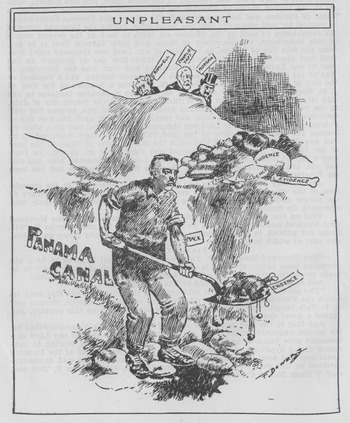
While the indictments filed by Roosevelt's Attorney General against the publishers of the Indianapolis News and the New York World ostensibly seek to defend the individuals accused in the articles from the libelous injury to their rights of privacy and property, the indictments also reveal the peculiar logic through which Roosevelt imagined the injury to his own presidential person, and thus to the government and nation itself.Footnote 23 The indictments focus in the first instance on the libel committed against Cromwell, Taft, and Morgan, arguing simultaneously for the harm to their valuable reputations and the injury of exposing them to the public eye. The first count of the indictment filed by the Attorney General, an indictment that resulted in a warrant for arrest being issued first for Indianapolis News publishers Delavan Smith and Charles R. Williams, focusses not simply on the criminal act of libel committed in the article titled “That Panama Canal Deal,” published on 8 October 1908, but also and more importantly on the criminal act committed in the form of a political cartoon by F. Bowers titled “Unpleasant,” published two days later on 10 October (see Figure 1).Footnote 24 In a rather fascinating demonstration of the jurisprudential art of visual hermeneutics, the indictment interprets the visual and textual elements of the cartoon within and as a kind of libelous semiotics of “innuendo.” The cartoon, the indictment argues, portrays Democratic National Committee chairman Norman E. Mack digging up mounds of a mysterious kind of “evidence,” presumably of their speculative business venture, while the guilty-looking faces of Cromwell, Taft, and Morgan disconcertedly watch from the distance. However, it is not the digging up of evidence, the indictment alleges, that constitutes the act of libel, but rather the recognition displayed by the men's “appearances, attitudes, and expressions,” expressions “signifying their complicity in the aforesaid fraud.”Footnote 25 Hence the portrait of the self-incriminating face of recognition constitutes the criminally libelous act that not only falsely confirms the “truth” of the allegation made about these individuals, but also results in “the great injury, scandal, ridicule and disgrace of them,” and by extension of Presidents Roosevelt and Taft.Footnote 26
F. Bowers, “Unpleasant,” Indianapolis News, 10 October 1908. Reprinted in Delavan Smith and Charles R. Williams, The Indianapolis News Panama Libel Case (Indianapolis: The Fulmer-Cornelius Press, 1909), 34.

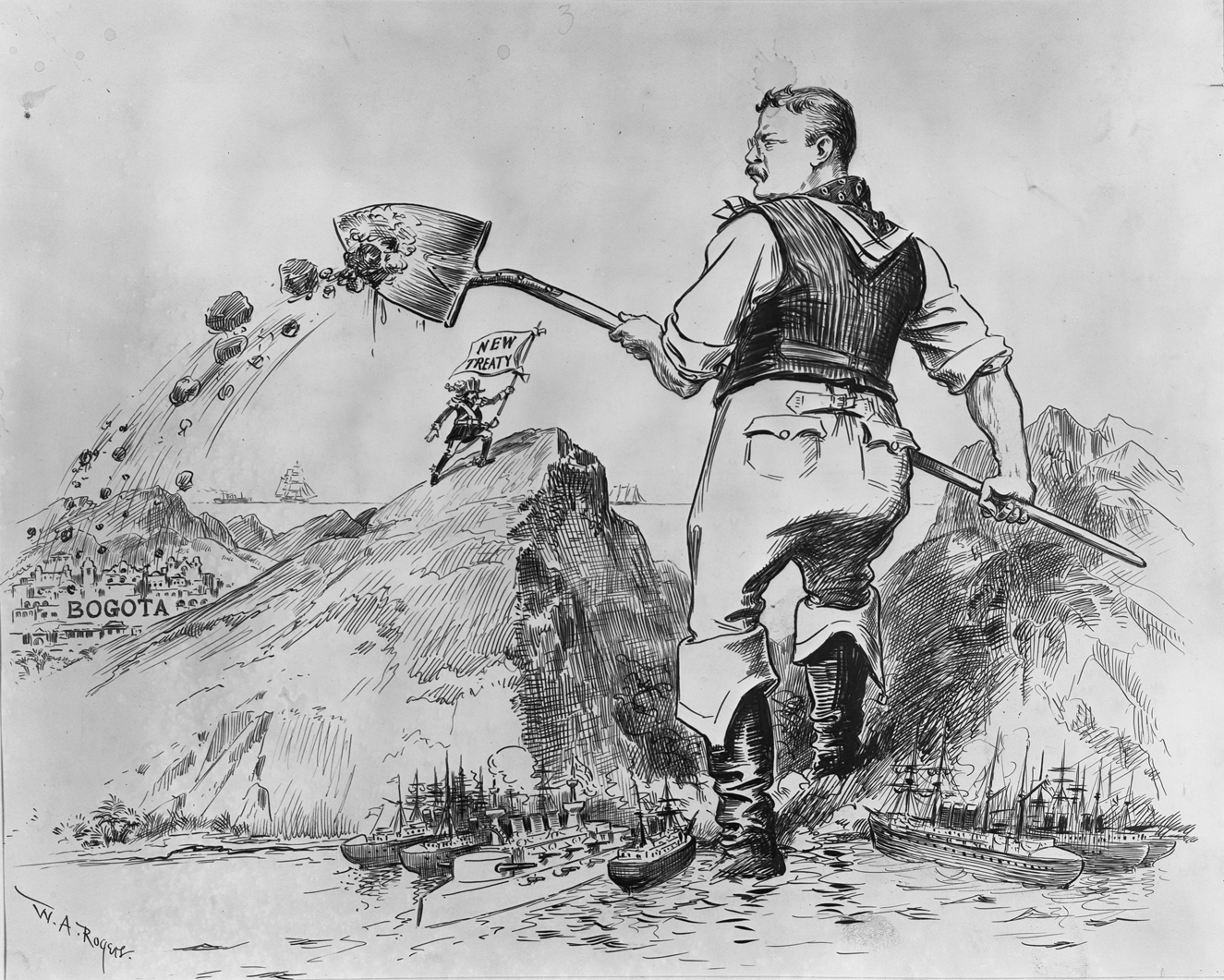
While the prosecutor's reading of the cartoon seemingly limits itself to some of its more literal visual referents, the emphasis on the implied guilt ascribed to the faces of the three men seems the most tenuous evidence of libel, but also seems to overlook the much more powerful meanings that seem to impugn the character of Roosevelt and the syndicate. What is most striking about the cartoon is its clear citation and inversion of a number of visual tropes commonly associated not only with the “labor” of the Panama Canal project, but also more specifically with the labor often visually ascribed to Roosevelt's own spectacular body. Drawings of an American colossus had long been used in political cartooning to represent different aspects of US foreign policy throughout the nineteenth century, an iconic tradition that Roosevelt also put to regular use, particularly to represent his defining role in the Panama Canal project (see Figure 2). The portrait of Norman Mack in “Unpleasant” would have surely called up and commented on these many images in its substitution of the colossal figure of Roosevelt with the relatively pedestrian image of Mack, whose act of digging is scaled back to human proportions, while the syndicate remains more ambiguously scaled in their positioning behind what could be one of the mountains through which the canal was cut, or could simply be a pile of dirt. The critical force of the cartoon, therefore, might be understood to derive not from its imputation of fraud in the guilty faces, but rather in its citation of the visual iconography of Roosevelt's own promotional imagery surrounding the Panamal Canal project and more broadly his exercise of national power through such projects. The force of the image, in other words, seems to derive from the ways that it calls into question and demystifies Roosevelt's fetishistic erasure of the enourmous human labor put into the Panama Canal in these images – labor drawn from, and transformative of much of, the Caribbean basin – by the labor of his own spectacular body in such images.
W. A. Rogers, “The News Reaches Bogota,” New York Herald, 15 November 1903. Library of Congress, Prints and Photographs Division, LC-USZ62-12029.

Perhaps more libelous still, although unnoticed by the hermeneutic eye of the Attorney General, is the unsettling evocation and redefinition of the “labor” of the Panama Canal that the “Unpleasant” cartoon enacts. Not only is Roosevelt's Herculean body replaced by the more humanly scaled and devitalized body of Norman Mack, but so too is the world-historical act of single-handedly carving a path between two oceans reduced down to the more pedestrian investigative labor of unearthing evidentiary remains. And the most “unpleasant” aspect of this investigative labor is that what it unearths is not simply the documentary evidence of fraud, but rather “evidence” taking the forensic form of bodily remains. Hence while the indictment finds libel in the suggestion that unpleasant evidence has been found of the alleged fraud (evidence which, it should be noted, was never conclusively proven – or disproven), perhaps the more damaging allegation of the cartoon is its argument that what lies at the “bottom” of the Panama Canal is the lost labor of the Caribbean, the thousands of dead bodies brought from around the Caribbean to labor on the canal, here directly represented in the forensic form of putrifying corpses and bodily remains – odd images indeed for a financial scandal. One thus wonders whether the libelous force of the cartoon stemmed not so much from its association of Cromwell, Taft, and Morgan, through their guilty faces, with the supposed “evidence” of fraud and international war profiteering that was rumored to have been found, but rather from the representational unearthing and exposure of the lost laboring bodies of the Panama Canal, bodies brought from around the Caribbean and the world, and bodies which testify to their own erasure by the fantastically laboring body of the Roosevelt colossus.
We can thus see why this recasting of the visual iconography through which he had crafted his presidential persona would be construed by Roosevelt not simply as an injury inflicted by the newspapers on his own personal character or reputation, but more significantly as an injurious assault on those actions and traits that embody his specifically presidential character. Roosevelt's reaction, in other words, turns on the claim that the injury to his own reputation was an injury to what we might call, following Kantorowicz, the President's two bodies – i.e. an injury not simply to himself as an individual, but to that self which embodied the presidency more generally, and by extension the state and nation as well.Footnote 27 Thus Roosevelt's charge of criminal libel stems from his belief in the danger of unchecked public critique of his or the government's actions, and thus was a charge that struck many as precisely what it was: an effort to reinvoke through the threat of criminal libel the more dangerous charge of seditious libel that John Adams had tried to use, through the Alien and Sedition Acts of 1798, to silence political dissent and censor the popular press.Footnote 28
Ostensibly devoted to the strengthening of national security in times of war, the cluster of four laws that comprised the Alien and Sedition Acts tightened the requirements for naturalization (Naturalization Act of 1798), authorized the President to imprison and deport all “aliens” from an enemy nation during wartime (Alien Enemies Act of 1798) or to deport those aliens deemed by the President to be “dangerous to the peace and security of the United States” whether peacetime or war (Alien Friends Act of 1798), and criminalized the publication of any “false, scandalous and malicious writing or writings against the government of the United States” with the intent to bring it into “contempt or disrepute” (Sedition Act of 1798). The Acts, particularly the Sedition Act, were widely seen, then and now, as a thinly veiled effort by President Adams and the Federalists to exploit the emerging possibility of war with France to silence their domestic political opponents by impugning their political views and criticisms as seditious acts endangering the “peace and security of the United States,” a danger aligned in the context of the overarching four laws with the combined threat of foreign immigrants and the threat posed by hostile nations seeking war against the nation.
The more insidious assumption behind the combined Alien and Sedition Acts of 1798 was that they implicitly defined the foreign-born resident of the US as an incipient hostile enemy whose words and deeds – and whose moral character – must be monitored for threats against the nation, while simultaneously defining the “libelous” citizen – i.e. the citizen who ventures criticism of the President or government – also as a kind of hostile alien presence whose foreignness must be expunged through imprisonment. The Acts thus empowered the government – and more specifically the President – to scrutinize the character of its critics and political opponents in the same ways it scrutinized the character of immigrants seeking to become naturalized citizens – by looking for those cultural, ethnic, and national attributes that distinguished the loyal American from the hostile foreigner. In linking libel to the conditions of naturalization and deportation, in other words, the Acts logically reduced citizens critical of the government's actions to the status of an immigrant whose potentially foreign character must be detected, tested, and, if necessary, expunged. Thus any questioning of the President's character inherently brought into question one's own “good moral character” as an American citizen, thus demonstrating one's inherent “otherness” to the interests and well-being of one's fellow Americans and marking that otherness in terms of the ethnic and racial differences of foreigners unassimilable to the American body politic.
What this history suggests is that Roosevelt's efforts to resuscitate this connection between libel, sedition, and naturalization by invoking criminal libel is not simply about protecting his own personal character, or the character of “great men,” or even about protecting the instrumentalities of governance from the unchecked power of a slanderous press, but more importantly about restoring the state's authority as the sole arbiter and judge on the most important questions of character of all – those that determine access to the rights of citizenship itself. In reinvoking the original Alien and Sedition Acts of 1798 and the regulatory connections they make between the crime of libel, the requirements of naturalization, and the dangers of warring nations and hostile immigrants, Roosevelt seeks to resuscitate the legal nexus that the original Acts were so concerned to establish: that the state's power to prosecute libel was the very instrument through which it distinguished between the loyal citizen and the alien enemy who must be rooted out and expunged from the national body, a power that continued to operate, I argue, long after the Acts were repealed, through the retention of “good moral character” as a requirement for naturalization ever since.
We can see such an agenda in not only Roosevelt's concern with perceived libels against himself, but also in his concomitant interest in redefining and reshaping the laws governing immigration and naturalization in the US, and the role of the “good moral character” requirement in them. Roosevelt's fascination with, and emphasis on, the importance of character in determining the destiny and success of the nation runs throughout his writings and shaped much of his political career. In well-known works such as “The Strenuous Life” and “Character and Success,” and in many other speeches and essays, Roosevelt preaches a gospel of character in which men of great character shall be leaders and drivers of national life, and forgers of the national character more generally. While Roosevelt is well known for the promotion of an ideology of character and of character-building in his speeches and writings, an ideology pervasive in the culture of the time, what are less well known are the legal and regulatory measures he took as President to make character an official governmental instrument of social reform. In his Fifth Annual Message to Congress, for example, Roosevelt outlines his vision for a new and pivotal arena of government oversight – the regulation of character. After opening with many of the dangers posed to the increasing prosperity of the nation, Roosevelt turns to character as the foundational principle upon which the future nation must be based: “In the long run the one vital factor in the permanent prosperity of the country is the high individual character of the average American worker, the average American citizen, no matter whether his work be mental or manual, whether he be farmer or wage-worker, business man or professional man.”Footnote 29 Rather than lodging his faith solely in the unfettered character of the individual, however, as the beacon and engine of American progress, Roosevelt emphasizes the critical role that government supervision and regulation plays in guiding the energies of character so that they are directed toward the “common good” rather than narrow self-interest, for “where there is no governmental restraint or supervision some of the exceptional men use their energies not in ways that are for the common good, but in ways which tell against this common good.”Footnote 30
As he expounds on the ability of government regulation to yoke the power of character to the progress and development of the nation, Roosevelt turns to immigration as the arena most in need of such governmental oversight. Writing at a time of unprecedented growth in immigration to the US, Roosevelt recognizes and celebrates the defining role immigrants have played in the development of the nation, while nonetheless calling for new measures to limit immigration to the “right sort” of person, as measured in terms of the standards of character:
It will be a great deal better to have fewer immigrants, but all of the right kind, than a great number of immigrants, many of whom are necessarily of the wrong kind. As far as possible we wish to limit the immigration to this country to persons who propose to become citizens of this country, and we can well afford to insist upon adequate scrutiny of the character of those who are thus proposed for future citizenship. There should be an increase in the stringency of the laws to keep out insane, idiotic, epileptic, and pauper immigrants. But this is by no means enough. Not merely the Anarchist, but every man of Anarchistic tendencies, all violent and disorderly people, all people of bad character, the incompetent, the lazy, the vicious, the physically unfit, defective, or degenerate should be kept out. The stocks out of which American citizenship is to be built should be strong and healthy, sound in body, mind, and character.Footnote 31
Central to such a project is the creation of an armada of government agents trained in the discernment of character, agents who will then be dispersed to ports of embarkation around the globe as gatekeepers ensuring that only those of that highest character are allowed to emigrate:
What we should desire to find out is the individual quality of the individual man. In my judgment, with this end in view, we shall have to prepare through our own agents a far more rigid inspection … of would-be immigrants at the ports from which they desire to embark before permitting them to embark.Footnote 32
Roosevelt sought to implement these measures through a series of proposed reforms to immigration and naturalization law that ultimately took shape as the Naturalization Act of 1906, the Immigration Act of 1907, and other legislative measures such as the Immigration Act of 1903 (or Anarchist Exclusion Act).Footnote 33 The central, common purpose of these different measures was to expand and strengthen the role of character as a primary qualification for entry into the US, and also for acquiring citizenship through the process of naturalization, and to put such determinations of character firmly into the hands of “government agents” rather than courtroom judges. Guiding Roosevelt's reforms was the vision of limiting immigration only to those individuals of the “highest” quality who were best suited for citizenship, as defined by the character requirements for naturalization. He thus set out first to tighten the requirements for naturalization and strengthen federal control over the naturalization process, and then to realign the requirements for immigration with the standards of naturalization.
In the Naturalization Act of 1906, the “good moral character” requirement, which had been in force in one form or another since 1790, was maintained, but also expanded to include for the first time the requirement that the applicant must also speak the English language. But the most significant reforms instituted by the Act were the seemingly more mundane, bureaucratic changes made to the administrative procedures for naturalization. Most significantly, the Act sought to standardize and tighten federal control over naturalization by moving naturalization proceedings from the domain of state courts to federal courts, and then by empowering the federal government as the sole arbiter of naturalization procedures, through the newly formed Bureau of Immigration and Naturalization. Perhaps most relevant to today, the Act also established for the first time procedures for denaturalization in cases where it was suspected that citizenship had been obtained illegally or by fraud, procedures which, as we will see, “opened the gates for the interpretation of fraud to support exclusionary and often racist investigations.”Footnote 34
In the Immigration Act of 1907, Roosevelt dramatically expanded the power and reach of the “good moral character” requirement in restricting immigration while also consolidating the authority of government agencies over such determinations of character. For example, the Act provided a newly detailed list of qualities and traits of character that would disqualify individuals for immigration to the United States. The Act expanded the categories of mental and physical disability that would disqualify individuals from entry and also introduced new or redefined categories of disqualification or exclusion, such as
idiots, imbeciles, feeble-minded persons … insane persons [or anyone] mentally or physically defective … [or] persons who have been convicted of or admit having committed a felony or other crime or misdemeanor involving moral turpitude; polygamists … anarchists … or women or girls coming into the United States for the purpose of prostitution or for any other immoral purpose. (Section 2)
The category of “moral turpitude” in particular made denials of good moral character easier to justify on the basis of more subjective moral values and social standards, and opened the door to the inclusion of an even broader range of beliefs, behaviors, practices, and traits of individuals (as opposed to proven criminal acts) that were deemed morally unacceptable in later revisions to immigration law (such as alcoholism, gambling, adultery, etc.). Most importantly, the Act realized the administrative ambition of Roosevelt's Fifth Annual Message to create an army of character judges by “providing for the mental, moral and physical examination of such aliens by American consuls or other officers of the United States Government” (Section 39) who would be distributed around to the globe to important points of embarkation to the US to select the most worthy applicants for immigration.
WEAPONIZING THE “GOOD MORAL CHARACTER” REQUIREMENT
If we might understand Roosevelt's obsession with libel in the Panama libel case as representative of a broader concern to consolidate and expand the legal authority of the state to judge the character of individuals, and to use such judgments to regulate the impact of a more ethnically and racially diverse body of immigrants on the “character” of the nation's citizenry, might we thus understand the current President's seemingly personal obsession with libel law as indicative of a similar effort to mobilize the state's power, or more specifically his own power as embodiment of the state, to make judgments of character the instrument of racial and ethnic exclusion in the US? Might we understand, for example, the seemingly casual racism in references to the character of “bad hombres” and “criminals and rapists” crossing the border not simply as a revelation of the President's own personal prejudices, prejudices that our presumably race-blind laws on immigration and naturalization would protect against, but rather as a kind of official pronouncement of the type of character judgment that is now going to be employed to police the racial and ethnic boundaries of citizenship, and the borders of the nation itself? What if, in short, the seemingly personal obsession with protecting his own beloved character, and with disparaging the character of foreigners, portends a new weaponizing of the “good moral character” requirement as an official government instrument of racial and ethnic exclusion, imprisonment, and even denaturalization in the United States, an instrument whose extraordinary power derives precisely from the ambiguity, arbitrariness, and subjectivity through which judgments of character can be made?
My point here is to show how the parallels between the presidencies of Roosevelt and Trump enable us to better see and understand the ways in which the “good moral character” requirement is being taken up as precisely such a weapon, but also to warn of the dangers in taking this parallel too literally. While Roosevelt sought to expand the state's power to adjudicate character through deliberate, strategic reforms in the arena of both libel law and immigration law, reforms guided by a broader vision of character building as an instrument of social reform, I don't mean to suggest that the recent remobilization of the “good moral character” requirement by the Trump administration is a specific strategic policy insight of Trump himself, nor that it necessarily reflects, or is guided by, a coherent, particularly moral vision of, or commitment to, the cultivation of “good” character on the part of the President. Indeed, the danger in viewing Trump as personally authoring, like Roosevelt, a strategic set of policy decisions in the name of an ideology of character is that it risks overlooking the underlying legal framework that makes the “good moral character” requirement such a potent, adaptable, yet unrecognized weapon for any number of ideologically driven agendas – racist, nationalist, or otherwise – and thus a ready instrument for immigration officials charged with implementing the President's more particular agenda of imposing new race-based limits on immigration and citizenship. The risk, in other words, is in mistaking the more endemic dangers posed by the legal framework that has historically developed out of Roosevelt's reforms as simply the more localized, term-limited dangers posed by the exclusionary agendas and prejudicial beliefs of this particular occupant of the Oval Office. Thus a consideration of the parallels between the presidencies of Roosevelt and Trump provides an important clue to the ways in which current efforts to restrict immigration and citizenship are grounded in such legal determinations of character, but its more important value is in bringing into relief the history of the legal framework that gives these determinations such force in the first place.
Although the history of immigration and naturalization law is imagined in terms of a progressive movement away from racially defined categories towards the race-blind and inclusive policies of today, the ascendance of the “good moral character” requirement in immigration and naturalization law has positioned it as a potentially powerful and little-recognized legal instrument of racial and ethnic exclusion, one that threatens to perpetuate rather than overcome the racial prescriptions that had long defined citizenship in the US.Footnote 35 The “good moral character” requirement for naturalization has been imagined since its inception as an instrument for improving the nation by ensuring the “quality” of those immigrants seeking citizenship through naturalization, but also by articulating the basic racial presumptions of such quality. Thus the requirement that immigrants be “persons of good character” in the original Naturalization Law of 1790 (which was revised five years later to “good moral character”) was conceived in tandem with the explicit requirement that such future citizens also be “free white persons.” This racial prerequisite remained an explicit requirement of citizenship up to the twentieth century, even though exceptions were incrementally extended first to “aliens of African nativity and to persons of African descent” in 1870, and to Native Americans in 1924, with the racial prerequisite being finally abolished altogether in 1952.Footnote 36 But while race was finally abolished as a condition of citizenship in 1952, forms of racial and ethnic exclusion continued to police access to citizenship in the form of the “good moral character” requirement, which remains the primary legal lens through which the immigrant's fitness for citizenship is still adjudicated today.
While racial prerequisites have been used to limit immigrants’ access to citizenship from the nation's founding, relatively few specifically racial limits were imposed as a condition of immigration to the US until the first Asian exclusion laws of the 1880s.Footnote 37 The use of race to define categories of exclusion in immigration law culminated in the establishment of a national quota system in the Immigration Act of 1924, a system that had its origins in the recommendations of the special commission (the Dillingham Commission) that Roosevelt had mandated in the Immigration Act of 1907, and that specifically sought to index for the first time the prerequisites for immigration to the racial prerequisites for naturalization by barring entry to all those who would be barred from naturalization because of race.Footnote 38 The system of quotas (or National Origins Formula) that governed immigration policy from the early 1920s up to the Immigration and Nationality Act of 1965 sought to mitigate the overall impact that increasingly large numbers of immigrants from increasingly diverse regions of the globe might have on American culture and society. The quota system was thus premised on the belief that the overall mix of migrants from different countries to the US should reflect and preserve the relative proportions of the different national groups that have historically contributed to the development of American culture before this influx, as documented by the census at a specific moment in the nation's past.
As Mendelson and others have argued, however, the quota system did not so much aim to preserve the actual racial and ethnic demographics from an idealized historical moment, but rather to produce a more racially purified America that was then retroactively imagined to be, and justified as, that America of the past.Footnote 39 Most immediately, the quota system was created in response to the perceived threat of the increasing number of new immigrant groups, particularly from Southern and Eastern Europe, who were viewed as “not part of the racially and ethnically homogenous America of the imagined past” and who thus threatened that homogeneity.Footnote 40 The number of immigrants from these regions could thus be dramatically curtailed by basing quotas on a historical moment before this “wave” of immigrants arrived, although views on which census best represented such an ideal moment (1890, 1910, or 1920) would shift over time. And while this reaching back to an America of the past was meant to erase those undesirables who had since arrived in the present, the quotas did not even reflect the demographics of the past but rather projected a racial fantasy onto historical fact by not including most nonwhite, non-European peoples from the American nation who were documented in the census.Footnote 41
The reforms introduced first by the Immigration and Nationality Act of 1952, which finally eliminated all racial prerequisites for citizenship, and then the dismantling of the quota system with the Immigration and Nationality Act of 1965, have been celebrated as a civil rights victory over the endemic forms of racial and ethnic exclusion that had long governed immigration and naturalization law. However, as Mendelson has argued, rather than eliminating race and ethnicity as a category of exclusion in naturalization and immigration law, these reforms have merely reinvented the terms and conditions through which such exclusions could be exercised. For example, while the Immigration and Nationality Act of 1965 has been celebrated for its elimination of the National Origins Formula, the 1965 Act nonetheless instituted new caps on immigration “from the Eastern Hemisphere, and, for the first time, from Latin America and the Caribbean as well.”Footnote 42 More importantly, while any and all specifically racial designations were abolished as a requirement of naturalization by the 1952 Act, the continued importance of the “good moral character” requirement has enabled it to remain a powerful instrument of racial and ethnic exclusion up to the present day.Footnote 43 Indeed, the requirement has emerged in naturalization and immigration law as one of the most unrecognized, most powerful, and most unregulated instruments of racial and ethnic exclusion in the twentieth and twenty-first centuries, for “while the original racist distinctions have faded in modern law, new restrictions and barriers to citizenship have arisen … [such as] the good moral character requirement.”Footnote 44
One of the aims of the 1952 Act was to eliminate some of the ambiguities that had long plagued the “good moral character” requirement by providing a “nonexhaustive list of statutory bars to establish good moral character.”Footnote 45 As early as 1878, the courts had responded to the absence of a clear measure of the “goodness” of good moral character by establishing the standard of the “average man”: the standard first that the character of the “average man of the country” “was probably as high a standard that could be set” for good moral character, but then that the measure of good moral character was what the average man in the community believed it to be – a kind of community average standard that opened the door to further inconsistencies in the adjudication of the “good moral character” standard.Footnote 46 The 1952 Act thus sought to “achieve greater clarity and uniformity” by adding a nonexhausitive list of bars to good moral character that moved beyond physical or mental “disabilities” or criminal acts by codifying a range of behaviors, traits, and tendencies that could be used to deny good moral character, including adultery, gambling, false testimony, or being “a habitual drunkard,” as well as the more general requirement of loyalty to the United States.Footnote 47 The 1952 Act also applied the “good moral character” requirement for naturalization more directly to the immigration requirements for entry into the US, tying them to the highly ambiguous standard of “moral turpitude,” which could be used as a ground not only for denying entry to the US, but also for deporting immigrants already residing in the US. Thus, rather than defining more clearly the legal meaning of “good moral character,” the 1952 Act only further broadened the list of specifics that could be cited as signs of lacking good moral character without providing any clear statutory measure through which applicants could definitively prove their good moral character, leading one judge to lament that “notions of ‘character’ and ‘morality’ are, to say it briefly, diverse. They are compounded of complex, rarely articulated, and subjective premises.”Footnote 48
These “irrationalities of character standards” continue to haunt immigration and naturalization law today, and have made the “good moral character” requirement a ready and powerful instrument in the hands of immigration officials for arbitrary and subjective exclusions from residency and citizenship in the US.Footnote 49 As Mendelson puts it,
The legal process surrounding immigration still articulates a narrow and exclusionary vision of the nation's values and character and exercises the coercive power to admit or exclude immigrants based on their compliance with that vision. Indeed, immigration courts around the country regularly deliberate upon and enforce national identity myths and … they do so with decreasing judicial review and oversight. Although race has been stripped from the statute, the process and the performances the statute generates are not race-neutral or culture-neutral in the vision of the “good” family and the “good” citizen that they both contemplate and demand.Footnote 50
It is this ability of the “good moral character” requirement to enforce narrow, extralegal cultural and social norms as a condition of legal residency and citizenship that makes it such a potentially powerful weapon of racial and ethnic exclusion today. For this reason, “the moral character requirement has,” as Deborah Rhode emphasizes, “taken on a new urgency under the Trump administration” given the actions it has taken to drastically restrict the entry, and seek the deportation, of entire groups seemingly on the basis of Trump's own personal assumptions about their good or bad character.Footnote 51 Trump's characterization of “many Mexican immigrants as rapists” and promises that “we are going to get the bad ones out,” and his “equally problematic assumptions about the link between religion, nationality, and moral character” in his “2017 executive order preventing citizens of seven Muslim-majority nations from entering the United States,” make visible the power of the “good moral character” requirement to transform such subjective character judgments into legal facts justifying new administrative policies and procedures.Footnote 52 Most significantly, the inherent ambiguities in the requirement have enabled immigration officials to instantiate Trump's own assumptions about the “bad” character of certain immigrant groups as legal grounds for mass deportations by reempowering them with the discretionary authority to arbitrarily determine the legal facts of an individual's moral character in naturalization and immigration cases. As Rhode has put it, “since the election of Donald Trump, the stepped-up use of deportation for undocumented individuals has given new urgency to questions about the use of criminal penalties and immigration violations as a proxy for poor moral character.”Footnote 53
This rehabilitation of the “good moral character” requirement as a legal instrument of racial and ethnic exclusion has taken its most extreme form not just in the efforts of the Trump administration to bar entire groups of immigrants from entering the US, and to mobilize government agencies to track down and deport immigrants without legal residency, but also in the efforts to strip certain immigrants not only of their legal status as permanent residents of the US, but also of the citizenship status that many have already acquired. This project of denaturalization culminated in the establishment of a denaturalization task force in June 2018 called “Operation Second Look,” and has resulted in a doubling of the number of denaturalization cases filed by the Department of Justice in the two years since President Trump took office.Footnote 54 The denaturalization task force was established as an extension of Operation Janus, a decade-old effort begun under President George W. Bush to review all past naturalization cases to identify individuals who may have naturalized using false identities because of a technical problem with existing databases at the time.Footnote 55 Seizing on the opening provided by Operation Janus, Trump's task force has sought to further weaponize the “good moral character” requirement by combing through the paperwork of past and current naturalization cases not simply to identify false identities, but also to identify any type of minor error, discrepancy, typo, or omitted information in the application itself that could be construed as criminal fraud and thus as grounds for denaturalization – and deportation. The expanded efforts of Operation Second Look to denaturalize current US citizens are made possible by certain ambiguities in the legal procedures for denaturalization, which were established by Roosevelt in the Immigration Act of 1907. The original purpose of this procedure was, as Stephanie deGooyer has argued, “to clean up a naturalization process that had been wildly inconsistent across state and federal courts. Once introduced, though, it quickly opened the gates for the interpretation of fraud to support exclusionary and often racist investigations.”Footnote 56 Perhaps most troubling about current efforts to actively target and strip certain citizens of their acquired rights is the way that the naturalization application itself has been revised to include particularly ambiguous or self-incriminating questions which artificially create conditions violating the “good moral character” requirement. For example, a question on Form N400, “Have you EVER committed, assisted in committing, or attempted to commit a crime or offense, for which you were NOT arrested?” (original emphasis), requires applicants to speculate on and confess to actions which may have been violations of a law but which were never detected or proven to be crimes – such as driving over the speed limit, jaywalking, or any number of acts that might constitute minor offenses – or invite investigation and raise the specter of fraud if they answer that they have never committed such acts.Footnote 57
Most importantly, the Trump administration has also mobilized the naturalization process of evaluating the moral character of legal residents as a new instrument for gathering evidence and initiating deportation proceedings of those legal residents.Footnote 58 What legal residents risk in seeking to become naturalized citizens is a review of their past conduct, actions, habits, and traits for proof of their good moral character – a review that would never occur if they simply remained legal residents. If they then fail to satisfy the “good moral character” requirement, this review can provide justification for initiating deportation proceedings based on the highly subjective and ambiguous grounds, and lower criminal bars, of naturalization's “good moral character” requirement, grounds not normally used to review the status of legal residents who do not apply for citizenship. Thus minor offenses, such as unpaid parking tickets, minor shoplifting, unpaid taxes, or mistakenly filling out a voter registration card, that might be used to deny naturalization, can be used to trigger deportation, even though the original legal standard for the deportation of legal residents established in the 1980s and 1990s was that they had committed crimes at the much more serious level of “‘aggravated felony and other specified offenses.”Footnote 59 Moreover, while this original standard for deportation remains the ostensible measure, “the term ‘aggravated felony’ is misleading,” as Rhode points out, “because Congress has expanded the list of deportable offenses to encompass crimes that are neither aggravated nor felonies. As currently interpreted, these crimes have included public urination, college drug offenses … shoplifting of … eye drops and deodorant … turnstile jumping.”Footnote 60
Thus while technically good moral character is not itself an explicit requirement for maintaining one's status as a legal resident, nor an explicit standard that could trigger deportation proceedings, the list of deportable offenses that Congress has expanded far beyond the original standard of aggravated felonies is clearly guided by, and parallels in many ways, the standards of good moral character within naturalization law, for example in the inclusion of crimes of “moral turpitude.” Not only has this list been increasingly used by immigration officials to move individuals directly from naturalization to deportation, but new criteria have been introduced by executive order that clearly evoke historical justifications for the “good moral character” requirement. For example, one of the first executive orders signed by President Trump directed all government agencies to begin actively targeting those “illegal” immigrants whose crimes threatened “the public safety of the American people” and who should thus be singled out for deportation. And yet the order also made possible the recategorization of legal residents as “removable aliens” if they too were deemed a threat to public safety, either by the commission of any crime, or simply because they were determined to be “a risk to public safety or national security,” a determination that could be based solely on “the judgment of an immigration officer.”Footnote 61
Where the “good moral character” requirement does explicitly come into play in immigration cases is in the process, known as “cancellation of removal,” through which an individual can appeal their deportation order. Once deportation proceedings are initiated, one of the primary avenues for appealing deportation is, ironically enough, to argue that the positive contribution the individual makes to their community because of their “good moral character” outweighs any potential harm from their deportable offenses. As in the case of naturalization, the ever-increasing list of acts and offenses deemed violations of the “good moral character” requirement, however, provides ample opportunity for rejecting these appeals, and “as a result, the INA prevents or hinders a greater number of immigrants than ever from proving their present good moral character.”Footnote 62 And in the case of those not automatically denied their appeal for having violated one of these many specified bars, the “good moral character” requirement's lack of any positive statutory definition still provides a flexibly indeterminate and dangerously ambiguous legal justification for denying appeal claims.
The result, as Mendelson has demonstrated, is that in these cancellation hearings the “courts conduct a highly intrusive inquiry into the immigrant's ‘Americanness’,” transforming these proceedings into an arena in which “performances of a caricatured, 1950s-style Americana have come to substitute for the ‘good moral character’ and ‘hardship’ requirements set forth in the doctrine.”Footnote 63 Thus both in the case of those who apply for citizenship and in the many cases where individuals are targeted for deportation even though they have not applied for citizenship, the “good moral character” requirement can be used in the appeals process to weed out ethnic and racial undesirables by making them prove their conformity to the cultural and social conventions of an imagined “American” identity by, for example, embodying the ideal, heteronormative parent within a traditional nuclear family, who regularly attends church, coaches little league, and more generally erases all signs of their original cultural or ethnic heritage:
In the case of cancellation of removal, good moral character and hardship frequently act as proxies for unspoken standards by which the nation evaluates immigrants. Indeterminacy and vagueness in the statutory language, coupled with jurisdiction-stripping and withering appellate review, permit a wide range of culturally consequential performances to take place largely unacknowledged within the legal sphere.Footnote 64
Perhaps the greatest danger posed by the “good moral character” requirement today, however, stems from its increasing insulation from the scrutiny of judicial review and the concentrated vesting of the power to decide these questions of character solely in the hands of immigration officials rather than courtroom judges. While this shift from the protections and objective standards of the law courts to the legally binding decisions of immigration officials began with the reforms implemented by Theodore Roosevelt in 1907, and has continued with the many revisions to immigration law ever since, reforms in 1996 and 2005 eliminated the last meaningful forms of judicial review to the degree that “individuals who are denied cancellation on discretionary grounds can no longer appeal to the circuit courts, but rather only to the BIA [Board of Immigration Appeals].”Footnote 65 Further regulatory changes to the structure of the BIA, moreover, now allow for “a single BIA member, rather than the traditional panel of three, to review nonprecedential cases,” and created a mechanism which even allows that single member of the appeals board to make
decisions without explanation. This process, called affirmance without opinion, is increasingly common … [and today] approximately 93 percent of appeals are decided by only a single board member … The effect of these laws has been to further insulate judicial constructions of hardship and good moral character and to create an even more protected sphere in which these concepts are performed and evaluated.Footnote 66
It is thus the legal ambiguity of the “good moral character” requirement, and the concentration of the legal power to parse that ambiguity in the hands of immigration officials, and often in the hands of just a single immigration official, who does not have to provide any rationale for their legally binding judgments, that has enabled the Trump administration to enact dramatically new restraints on immigration and citizenship beyond the reach of the legislative and judicial arena – restraints rooted in the power to judge a legally prescribed character that is, ultimately, wholly lacking in legal definition.