Gli storici (e, in modo diverso, i poeti) fanno per mestiere qualcosa che è parte della vita di tutti: districare l'intreccio di vero, falso, finto che è la trama del nostro stare al mondo.
Carlo GinzburgFootnote 1
The year 1968 ‘whether understood as that single year or as a metaphor for the larger mobilization cycle of 1965–1967 to 1975–1977, is one of those “moments of madness,” . . . that has left an incredible imprint on – and changed the direction of – the modern societies we live in’.Footnote 2 However, there is an absence of historical studies of the involvement of the neo-fascist right in the events of 1968, and particularly of its reaction to the legacy of that rather leftist year.Footnote 3 Useful information, especially for the Italian case, can be found in the archives of the Fondazione Ugo Spirito in Rome, and the neo-fascist press, memoirs and ideological pamphlets are a rich source for both France and Italy from the late 1960s to the end of the 1970s.Footnote 4 These kinds of source represent interesting internal standpoints which allow us not simply to reconstruct a historical process, but more pertinently, to comprehend the militants’ feelings during the so-called ‘red tide’ of 1968 and the genuine approach to it by neo-fascists. They were in fact obsessed by the hegemony of the left and Marxism over popular and youth culture. Neo-fascists thus felt a strong need for unity, and attempted, where possible, to keep all their diverse streams flowing together. This article primarily aims to reveal the activism and vitality of Italian neo-fascism as represented by the Movimento Sociale Italiano (Italian Social Movement, MSI), and, by means of a cross-border focus, its influence on similar foreign political movements such as the French Ordre nouveau (New Order, ON) and the Front national (National Front, FN). The article will also highlight the cultural reaction to 1968 and the prominence of the French Nouvelle Droite (New Right, ND) – which later went on to have a significant impact in France, Italy and well beyond. In sum, this article theoretically involves both a vertical dimension – the study of the neo-fascist political and cultural reaction to 1968 across two neighbouring countries – and a horizontal dimension –the question of transnationality, cross-fertilisation and ideological and political transfer and networks between different groups.
Wolfram Kaiser has rightly pointed out that ‘modern European history, has for a long time been treated as little more than the collation of clearly delineated national histories’.Footnote 5 A transnational historical analysis provides a more robust frame for the advancement of knowledge in this area. It connotes movement and connection through time and space, and highlights interconnecting themes and elements that unite case studies. In doing so, this article specifically challenges a certain idea of the extreme right as a specific national product; this is especially true for the French case, which is often viewed as a sort of unreproducible national populism rooted in domestic traditions.Footnote 6 However, in spite of all the claims about an alleged exceptionality of one's own national history, the current article shows that neo-fascism acted as a transnational phenomenon with a commonality of behaviour and an analogous political philosophy and discourse.
Italian neo-fascists in 1968: order and disorder
The year 1968 turned out to be one of the most important transnational moments of change. Revolts took place in many countries. In Italy, 1968 had even more radical consequences due to its combination with workers’ strikes, the failure of the centre-left governments, inefficient industrial development, internal migration, low wages and the predicaments of the housing and health systems. In general terms, the place of European neo-fascism in society and the political system in 1968 became that of the guardian of social order and, when possible, it moved closer to the traditional powers and the mainstream right. Moreover, in Italy – where the role of neo-fascism was more significant (the MSI dated back to 1946) and where it was fairly well represented at local and national level – it suffered from initial divisions and contrapositions between the party line and younger militants, between its backward-looking core and the most subversive fringes, and between the conservative souls usually stemming from the Fascist regime (Ventennio) and the anti-capitalist revolutionary streams belonging to the Repubblica Sociale Italiana (Italian Social Republic) or to a more idealised or spiritual vision of Fascism.Footnote 7
At that time the MSI youth organisations were the Raggruppamento Giovanile Studenti e Lavoratori (Students and Workers' Youth Group) led by Massimo Anderson, the Associazione Studentesca di Azione Nazionale Giovane Italia (Student Association of National Action – Young Italy) led by Pietro Cerullo, and, in the university milieu, Cesare Mantovani's Fronte Universitario d'Azione Nazionale (University Front of National Action, FUAN). The national leaders were linked to the party line and apparatus while local activists were undoubtedly closer to the peripheral structures than to the national organisations. Among the local associations, the FUAN-Caravella – established in 1950 – was particularly active in the first phase of 1968 at the Sapienza University of Rome, where neo-fascists were numerous.Footnote 8 The Caravella initially took part in the protests together with the hated ‘reds’, developing similar themes and declarations.Footnote 9 To a certain extent, neo-fascists had the imperceptible feeling of fighting for a common cause. But the reality was that leftists and rightists acted in parallel to one another. This early collaboration was unofficial and contingent.
The idea of causing the downfall of the outdated system was clearly tempting for many students.Footnote 10 This was, in fact, a moment when young people, no matter what their ideological convictions, believed that the status quo could and should be changed, and that the time had come for a new society and political system.Footnote 11 The apogee of this improbable unity between the younger generations of both left and right was represented by the demonstration at Valle Giulia, in Rome, in front of the faculty of architecture, on 1 March 1968. This demonstration symbolised the starting point of the Italian events of 1968, even if students had already occupied some other departments. At the end of February, the dean of La Sapienza, Agostino D'Avack, invalidated all examinations held during the occupations and sent in the police to remove occupying students from the schools. The student reply was unanimous: a demonstration of nearly 3,000 people against the authorities. This represented the first victory of the student movement, involving neo-fascists and communists together, and led to the occupation of other academic faculties. During the riots, many protesters and policemen were injured.Footnote 12 The law department was held by FUAN-Caravella and other neo-fascists, while leftists occupied the literature faculty.
According to Marco De Troia, at this point, the MSI's primary aim became that of breaking ‘the still fragile and hybrid union’ between young neo-fascists and communists.Footnote 13 In so doing, the party radicalised its anti-left standpoint. Arturo Michelini, the party leader, had made the position of the extreme right inconvertibly clear: ‘With the MSI for a national and social order.’Footnote 14
The party had showed its more conservative face. Thus neo-fascist students were not actually supported by the MSI; the only rightist extremists supporting their demands were the intellectual Giano Accame, Luciano Leccisi with his journal L'Orologio (The Clock), and the young MSI officer Adalberto Baldoni with his weekly La Sfida (The Challenge).Footnote 15 At any rate, the MSI, by means of its official organ Il Secolo d'Italia (The Italian Century), usually ignored the participation of its militants in the 1968 revolt, and strongly attacked the demands of the younger generations. For example, on 25 February, in reference to the student occupations, Il Secolo d'Italia's headline was ‘A pantomime that has already lasted too long’.Footnote 16
The day after the Valle Giulia demonstration, the MSI press, attempting to hide the presence of missini (MSI militants) at the mass meeting, identified the street brawls as a strategy of the Partito Comunista Italiano (Italian Communist Party, PCI), and the front page of Il Secolo d'Italia claimed that ‘The PCI sparked off the revolt’.Footnote 17
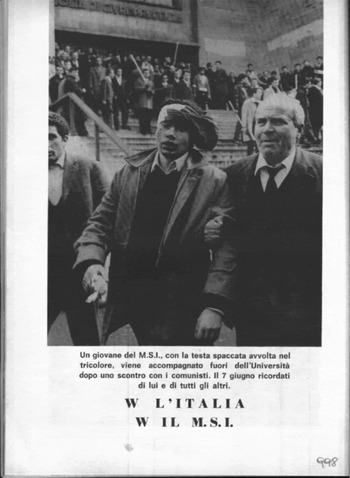
From such a perspective, we can easily understand why the attempts to bring about an agreement between young militants and the MSI failed, or why the party decided to retain its intransigent anti-communist policy. The organisations in Rome thus tried to isolate their base, who elaborated a tactic of active participation in 1968.Footnote 18 The point of irreversible crisis became the imminent national student demonstration of 16 March. On this turbulent day the MSI organised a semi-official march to La Sapienza. The party wanted to restore order, even if some missini were actually involved in the disorder. The MSI group of more than 300 activists was made up of, among others, the paramilitary group Volontari Nazionali (National Volunteers), the national youth leaders Mantovani, Anderson, Cerullo, Sandro Tribuzi, and the parliamentary deputies Giorgio Almirante and Giulio Caradonna, who was escorted by members of the Rome Boxing Academy. The news stories of 16 March tell us that the MSI group attacked the literature faculty occupied by left-wing students. At this point many neo-fascist students joined the MSI faction. In the meantime the MSI group had to shelter in the law department and was attacked by the leftist protesters. The outcome of the riots was 150 people injured and 52 right-wing extremists arrested. The defeat of the MSI ‘commando’ appears unquestionable but Il Secolo d'Italia, twisting reality, claimed that the gioventù nazionale (neo-fascist youth) had overthrown the communist control over the universities.Footnote 19 According to MSI propaganda, the PCI had in fact planned to exploit the student demonstration and protests for a ‘Bolshevik conquest of the Italian universities’.Footnote 20
‘On 7 June [election day] think of him and all the others.’ Neo-fascist electoral propaganda referring to a young MFI militant injured in clashes with leftist students (Rome, March 1968). Published by kind permission of the Fondazione Ugo Spirito, Rome.

Another kind of MSI victory was, on the other hand, clear. It caused an irreversible fracture among students, and preserved the traditional divisions within the political spectrum. Different views arose within youth associations, and after 1968 many activists left the MSI because of its ultra-conservative policy. 16 March marks, above all, the conclusion of neo-fascist participation in 1968 as well as a loss of influence in university circles. MSI students were marginalised by their own leaders, and this would leave a deep psychological mark on these activists.Footnote 21
The party position was nonetheless understandable, linked as it was to the fear of losing loyal voters. But this meant that to a certain extent the MSI was unable to take advantage of the difficulties experienced by the ruling parties. In such a context, the May 1968 elections represented a defeat for the party (who won only 4.5 per cent of the vote for the Chamber of Deputies, and 4.8 per cent for the Senate). It is interesting to highlight the rise of the moderate Democrazia Cristiana (Christian Democrats, DC), which won about 40 per cent of the vote. This retrospectively shows that in a moment of national crisis, right-wing voters preferred to lend their support to a more stable and moderate party. This tendency was repeated a month later in the French elections with the victory of Gaullism.
1968 and neo-fascist France: ‘Liberons la Sorbonne!’
René Rémond argues that 1968 was one of the principal crises in contemporary French history and that it took a three-dimensional shape: (i) a crisis of the political system; (ii) a crisis within ‘society’; and (iii) a more in-depth crisis of French civilisation.Footnote 22 As Joseph Algazy records, the academic year 1967–8 began with violent battles between left-wing students and the ultra-right-wing Fédération national des étudiants de France (National Federation of French Students). However, the absence in France of a long-established extreme-right party meant that there was less intense involvement in the events of 1968 than might have been expected.
In general, the 1960s neo-fascist milieu was already in a state of ferment due to the issue of Algerian decolonisation. The most important movements were Jean-Louis Tixier-Vignancour's Alliance républicaine (Republican Alliance), the Fédération des étudiants nationalistes (Federation of Nationalist Students, FEN), and Occident. Tixier-Vignancour, a lawyer and a former Vichy France collaborator, was a candidate in the 1965 presidential election (gaining 5.19 per cent of the vote). The FEN had been created by a handful of students in 1960. Their ideological manifesto, the so-called Manifeste de la classe 60, clearly showed their doctrinal positions. The FEN was in favour of a French Algeria, and was overtly anti-democratic, anti-communist and racist, with a strong focus on public security.Footnote 23 It supported the defence of a ‘superior’ west European civilisation and was also strongly anti-egalitarian. Interestingly, the FEN promoted a kind of nationalism that was less French-focused and subsequently backed what could be described as neo-fascist Europeanism. Its main publication was Cahiers universitaires. In 1963 the FEN contributed to the development of the elitist movement Europe-Action established around the journal of the same name, established by Dominique Venner. It attempted to act as a magnet for the different generations of neo-fascists. Europe-Action played a key role in the future developments of right-wing cultural streams and set about the renewal of traditional fascist thinking. Its intellectual elaboration dealt with a re-styled biological racism, Europeanist nationalism and, as with the FEN, the promotion of ‘white civilisation’. Another interesting movement stemming from this filière was the Mouvement nationaliste du progrès (Nationalist Movement of Progress, MNP). The MNP was equally nationalist and pro-European, and similarly promoted the defence of the West and the white race.Footnote 24
These movements often had many internal divisions and were unable to elaborate a common strategy. For this reason, it was difficult for militants to respond effectively to the events of May 1968, and oppose the more combative left-wing organisations.Footnote 25 Despite this, it was the neo-fascist, antisemitic, anti-communist and corporatist Occident, founded in 1964, that turned out to be the most active group during the 1968 events.Footnote 26 It was also one of the few factions that at least tried to exploit some anti-system aspects of the revolt, and strongly confronted the extreme left in the streets and universities.Footnote 27 In particular, many Occident militants considered French leftists as communist agents. Hence ‘they were not particularly open to new counter-cultural trends’.Footnote 28
The fascination with 1968 was only partial (less than in the Italian case), and in most cases, enthusiasm for these events was lacking among militants. Very few of them joined the leftists on the barricades.Footnote 29 However, some neo-fascists saw the protests
as motivated by straightforward, and justified, demands of bourgeois children for better campus facilities and job opportunities. This was the view expressed by the former Pétainist Bernard Fay in the conservative journal Ecrits de Paris. Others sympathized with the more radical student demands. The New Left . . . bore some resemblance to the old Maurrassian right. Both condemned centralization, materialism, and both were at odds with the Communist party.Footnote 30
The reality was that, as for the MSI in Italy, the domestic extreme right was taken aback by the events of May 1968.Footnote 31 There were clear divisions, opposing forms of mobilisations, and divergent strategies towards rebellious students and the ruling powers.Footnote 32 To be sure, the Gaullist regime, with its call for ‘order against anarchy’, became very attractive for the more institutionalised right-wing extremists such as Pierre Poujade and Tixier-Vignancour. Gaullism turned out to be, in anti-Marxist and counter-revolutionary terms, a flag of convenience and a shield keeping together forces willing to protect the social order and the status quo. As a way of overcoming the divisions between the mainstream and the extreme right, the government granted a political amnesty to certain extreme right-wing militants.Footnote 33 General Salan, chief of the terrorist Organisation armée secrète (Secret Armed Organisation, OAS) and other leading French-Algeria ultras, were released from prison. Others came back from exile. Naturally, groups involved in the struggle to retain Algérie française, welcomed these events.
On 30 May the massive Gaullist demonstration on the Avenue des Champs-Elysées in Paris marked the highest moment of unity among the different streams of the French political right.Footnote 34 All the opponents of communism seemed to be rallied around Charles de Gaulle. Many Occident militants marched with their Celtic cross flags alongside conservatives.Footnote 35 Yet resentments that were a quarter of a century old had not died away, and even if de Gaulle had granted an amnesty to the OAS, the supporters of Vichy did not grant amnesty to the famed French political leader.Footnote 36
In any case, since the loss of Algeria, the ‘leaders of the opposition nationale became obsessively opposed to de Gaulle and everything associated with him’. To be sure, if
in the Fourth Republic, anti-communism had helped to reintegrate the extreme right into mainstream politics; in the Fifth Republic anti-Gaullism marginalized it . . . It was also because de Gaulle struck nationalist chords that had previously provided the extreme right with its most potent sources of popular appeal. Indeed, many voters who had normally voted for the extreme right supported de Gaulle after 1958.Footnote 37
This is one of the reasons that may explain why the institutional line-up of Poujade and Tixier-Vignancour produced divisions and fractures in the universe of neo-fascism. Their strategy was, moreover, unable to provide a political voice and representation for all extreme right-wing activists. Neo-fascist periodicals such as Minute or Rivarol were overtly anti-Gaullist and against Tixier's excessively moderate line. Indeed, some neo-fascists, such as Jacques Isorni (former lawyer of Marshal Pétain), would even have preferred a new leftist government to a Gaullist cabinet.Footnote 38
Meanwhile, the parliamentary elections of June 1968 led to the impressive and triumphal victory of Gaullism, two Gaullist movements receiving more than 40 per cent of the vote. The final result of 1968 for neo-fascism was ‘catastrophic’.Footnote 39 Nevertheless, the times were edging towards a new page in the history of right-wing extremism.
Towards an Italian national right: ‘manganello e doppiopetto’
The year 1969 opened with the death of Michelini. Giorgio Almirante advanced his claim for the MSI leadership. The neo-fascist ‘moderates’ were worried about a possible party radicalisation because his political background seemed to be distant from a genuine democratic culture.Footnote 40 However, they were aware that unless it gained power, Almirante's group could have left the party. The fear of a split and the necessity of showing an image of unity led to the acceptance of Almirante as general secretary in June 1969.
Following the divisions of 1968, after Almirante's appointment the party structure was strongly centralised and peripheral organisations were kept on a tight rein. Nevertheless, the new political programme was essentially syncretic, with demagogic and excessively ambitious ideas. The MSI, in a celebratory and proto-modernist euphoria, developed a new paradoxical image of a non-totalitarian, pro-European and socially progressive movement.Footnote 41 In truth, Almirante's general approach was unsurprisingly that of defending public order by presenting the MSI as a bastion of public security against vicious communist revolutionaries.Footnote 42 This was conceptualised with the famous, and controversial, theory of Piazza di Destra (right-wing town square), where activists were encouraged to stand up to and confront leftist demonstrations and riots.
This was to lead the MSI in a new direction, although one that did not lose sight of the past. Almirante summed up this policy with the enigmatic phrase nostalgia dell'avvenire (back to the future).Footnote 43 To be sure, he continued Michelini's strategy of gradual insertion into the political system. There was indeed a compelling need to enlarge the electoral base after the failure of the 1968 elections. The ninth MSI congress, held in Rome in November 1970, renewed this policy through the potential creation of a Fronte articolato anticomunista (Articulated Anti-Communist Front) open to all anti-communist forces. The party similarly emphasised its ‘law and order’ and counter-revolutionary core, along with support for the police and the military, to take advantage of the conservative bourgeoisie's fears of social unrest and alternative cultures. This overall political line was intended to woo moderate voters, looking to establish a more attractive ‘national right’, a federation of the right, with the MSI acting as a magnet. In doing so, the party wished to force the mainstream political right to accept its presence in a governmental coalition, and subsequently influence domestic politics. Ideally, this process would have led to the hegemony of the MSI over the whole right-wing spectrum undermining the strength of the powerful Christian Democrats. To this end, the party held several demonstrations in the country, looking not only to co-opt non-nostalgic forces and potential electors but also with the aim of overcoming existing and spontaneous movements stemming from people's disaffection towards mainstream parties or from fears of a Marxist revolution (i.e. the 1971 Silent Majority movement in Milan). This was, in other words, the ambitious project of the Destra Nazionale (National Right, DN) that had to be perceived as something different from the old MSI. The only way to do this was to merge completely the neo-fascist identity – and party – in the new vessel. The MSI could as a result have claimed to be a new force, rooted in rightist tradition, but able to deal with the predicaments of traditional politics and society.
Given this, the MSI also abandoned conventional disagreements with the monarchist fringes that harked back to King Vittorio Emanuele III's supposed betrayal of Benito Mussolini, and the war armistice.Footnote 44 In spite of these divisions, the missini in this case highlighted shared beliefs (e.g. anti-collectivism, cult of the nation and state, authority) with Alfredo Covelli's monarchist party, the Partito Democratico Italiano di Unità Monarchica (Italian Democratic Party of Monarchist Unity).Footnote 45
The DN project – which officially saw the light of day with the change of the party name only a year later – was also carefully considered in many conservative and bourgeois circles, and attracted ‘members of the bureaucracy and the aristocracy’.Footnote 46 Several personalities, including the philosopher Armando Plebe, the former mayor of Naples, the industrialist Achille Lauro, the editor of Il Borghese (The Bourgeois) Mario Tedeschi, the ex-chief of NATO naval troops in the Mediterranean area Admiral Gino Birindelli, and two Christian Democrat MPs, Agostino Greggi and Filippo Murdaca, joined the new party.Footnote 47 The subsequent electoral result of 8.7 per cent in the 13 April 1972 legislative elections was their best ever.Footnote 48 Approximately 3 million Italians voted for the Movimento Sociale Italiano-Destra Nazionale (MSI-DN).Footnote 49
Nevertheless, the process of party change had hitherto hardly started. Almirante was interested only in ending the party's isolation, broadening its electoral base and regenerating the fascist identity. Indeed, this led to part of Pino Rauti's extra-parliamentary group Ordine Nuovo (New Order) re-joining the MSI. In sum, Almirante had been trying to redesign the external facade by adopting a new, and often moderate, style of communication. The party was at that time also carrying out a twofold strategy of street activism while maintaining a respectable parliamentary appearance. In Franco Ferraresi's reading of events this was celebrated as the manganello e doppiopetto (bludgeon and double-breasted suit) tactic.Footnote 50
Some external events sped up the apparent modernisation of the MSI. First, neo-fascists capitalised on the revolt of the southern city of Reggio Calabria. The town was affected in 1970–1 by a strong wave of disorder, due to the decision not to grant it the status of regional capital of the newly instituted region of Calabria.Footnote 51 The MSI took an ambiguous position at the beginning of the revolt. The party had violently opposed the division into different regions, in the name of the supreme unity of the state. This was also because they felt that the left could lead many regional governments.Footnote 52 The MSI, the party of the state, was thus leading, through the local leader Ciccio Franco, the demonstrators of Reggio Calabria against the state.Footnote 53 Neo-fascists hence radicalised a protest that became increasingly violent. They called for a populist protectionism for the economically disadvantaged southern Italy and its exploited peasants, and demagogically attacked the rich northern regions, the centre-left governments and the mass media such as Il Corriere della Sera and Il Giorno, perceived as being too close to the private sector and central state interests.Footnote 54 Reggio Calabria's revolt strengthened the party's electoral clout in southern regions.Footnote 55
Second, after the 1972 election, Almirante was formally accused of attempting to resurrect the Italian Fascist Party. The MSI was thus forced quickly to moderate its external image. The tenth MSI congress, held in Rome on 18–21 January 1973, turned out to be the perfect moment to counter accusations of persistent fascist roots. A new central committee was elected, with Almirante as senior secretary and the ‘non-fascists’ Covelli and Birindelli as presidents, and the party took the official denomination of Movimento Sociale Italiano-Destra Nazionale.Footnote 56
In any case, the outcomes of 1968–9 were partly unexpected. A more violent dimension was also pursued by some neo-fascists. Italy had already experienced a long tradition of neo-fascist violence, terrorism and clandestine activity,Footnote 57 and by this time an aggressive extra-parliamentary policy was particularly well-developed.Footnote 58 The 1970s in France have been described by Jean-Marie Le Pen as the ‘crossing of the desert’ for the local extreme right, years during which it ‘barely survived as a political entity’.Footnote 59 Italy in the same period was a nation which faced much more serious and alarming problems. The peninsula faced the real risk of a right-wing takeover as well as the bloody period of the ‘strategy of tension’, featuring acts of terrorism by the extreme left and right. In such a context, neo-fascist activity also consisted of violent uprisings, paramilitary trainings camps and bombings.Footnote 60 The news reports of 1969–82 claim that neo-fascists could be held responsible for more than 6,000 violent events, including roughly 190 deaths.Footnote 61 The MSI, pursuing the manganello e doppiopetto strategy, was incontestably discredited by its links to terrorism.Footnote 62 Almirante, by advocating concepts such as ‘reaction’, or Piazza di Destra, seemed in fact to tolerate a grey zone between the party and militant violence.
Towards a French National Front: ‘Avec nous avant qu'il ne soit trop tard’
With the decline of the de Gaulle era after 1969, the extreme right in France was divested of one of its main mobilisation themes. Moreover, after the dissolution of Occident in winter 1968, banned for public order reasons, French neo-fascists were once more scattered in a nebulous universe of Lilliputian groups. Among them, the Groupe Union Droit (Union Law Group, GUD) of Alain Robert and Gérard Longuet − which later changed its name to Groupe d'Union et de Défense (Unity and Defence Group) − was, at least locally, one of the most active.Footnote 63 The GUD had a certain strength in the University of Paris II Panthéon-Assas. Its political manifesto was corporative. The GUD tried to pass ‘unnoticed’ and henceforth transform Assas into a ‘national [fascist] bastion’.Footnote 64
This group, with other former Occident activists, injected new vigour into neo-fascism through the creation of Ordre Nouveau (New Order, ON) during the spring of 1969. Leading figures of the new movement were the lawyer Jean-François Galvaire, Alain Robert, François Brigneau and François Duprat.Footnote 65 Roughly 5,000 young activists represented the total strength of ON. They were mostly students based in Paris, Marseille, Lyon and Nice. ON became an umbrella organisation keeping together different extremist currents; it also published the periodical Pour un Ordre Nouveau (For a New Order). In ideological terms, ON was an ultra-nationalist, anti-capitalist and anti-Marxist movement. It attacked liberalism and, like the MSI-DN, promoted an archetypical European ‘third way’. The party manifesto called for the defence of national traditions, a strong state and a presidential regime. ON also tried to exploit the apocalyptic image of a new wave of north African immigrants assaulting the national borders and starting to counter-colonise metropolitan France.Footnote 66
In spite of internal divisions ON decided to contest elections, starting with the 1971 Paris city council campaign. The example to be imitated was naturally that of the MSI. As a militant suggested, ‘we want to build a large party, like the Italian MSI, which we have set up as a model for ourselves’.Footnote 67 The neo-fascist Rivarol had a weekly column, Chronique italienne, which followed all the events concerning the MSI. Later, in 1972, some ON militants even organised a demonstration in Paris to congratulate MSI-DN on their significant result in the Italian elections.Footnote 68 There was also a deeply held belief that the socio-political situation of the two countries had similar dynamics.Footnote 69 Moreover, ‘Ordre Nouveau’ is a literal translation of Pino Rauti's Ordine Nuovo. ON hence created important trans-border contacts by inviting notable Italian political leaders to France from its first meeting in May 1970. Moreover, as the MSI had combined violent activism and respectable electoral strategy, so the ON hoped to pursue a similar line of attack.Footnote 70 This tactic was made clear by Duprat. He took the MSI's electoral strength and the ‘bludgeon and double-breasted suit’ philosophy as the key examples to follow. Given this, the ON still had to stand up to face leftists in the street,Footnote 71 but also, and above all, contest elections ‘by presenting political solutions’.Footnote 72
The inconsistent results of the 1971 elections led to the second phase in ON's political tactics. This was the building of a mass party controlled by the same revolutionary nationalists, a would-be Front national pour un ordre nouveau (National Front for a New Order), gathering all forces in order to contest the forthcoming 1973 legislative elections. In such a context, Brigneau and Maurice Gaït organised a dinner-debate in Paris on 19 December 1971, with 150 in attendance. They discussed the strategy for a common political action based on two dimensions:
1. ‘Moral and material support for the national campaigns led by ON, spearhead of the [neo-fascist militant] opposition, within a spirit of unity’;
2. ‘The constitution of a national front gathering together all our political family in order to lead a combat assuring the national opposition's insertion within the country's political life, at the moment of the 1973 legislative elections’.Footnote 73
The creation of a unitary Front national (a term in use since the end of 1971) quickly became a priority, and many meetings and dîner-débats in cities such as Bordeaux, Toulouse, Nice and Avignon were soon organised. In this heady atmosphere, right-wing periodicals such as Rivarol greatly encouraged the creation of this black front.Footnote 74 In particular, Rivarol had a weekly column, ‘Nouvelles du “Front”’ (News from the Front), which was usually written by the journalist François Solchaga.
The ON party line was that of creating, first, a structure that would foster the reception of activists as they moved on a sort of dual track (i.e. double party membership). The diverse currents would then completely merge at a later stage.Footnote 75 During the 1972 congress, the foundations of the party were, in any case, already well laid. In the meantime, ON decided to exclude from the new party some influential, but controversial, notables such as Tixier-Vignancour. The establishment of the MSI shows a surprisingly similar trend. Party membership was forbidden to politicians who had contributed to the decline of Fascism or accepted the 1943 armistice, or to political ‘careerists’.Footnote 76 In France the main challenge was, however, that of keeping together two competing extremist cultures, the nationalistes and the nationaux. The latter were mostly currents stemming from French Algeria, Poujadists, and supporters of Tixier-Vignancour – and were more favourable towards a parliamentary strategy. The nationalistes were, on the other hand, those nostalgic for Action Française (French Action), ON and Occident, and were rooted in national-revolutionary activism. Nevertheless, not much time was wasted and the FN was formed on 5 October 1972 during a meeting at the Salle des Horticulteurs (Horticulturalists’ Hall) in Paris.Footnote 77 Jean-Marie Le Pen was chosen as party leader. The FN needed someone capable of carving out a niche in the mass media, and the young leaders of ON had not the political stature for such an ambitious position. In addition, the FN had to allow a wider participation of the nationaux.
The FN, being a synthesis of various forces, also had the ambition of developing into a significant mass party. It presented itself as an all-inclusive ‘social, popular and national right’.Footnote 78 Its early political discourse focused prominently on traditional themes such as the defence of colonialism, anti-Gaullism, anti-communism, and immigration control. Like the MSI-DN, it also desired a strong presidential regime, and called for the respect of traditional values – all in the name of a moral and social regeneration of France.Footnote 79 The appeal of Italian neo-fascism, and in part of the British-based National Front, was thus extremely strong for the French party. Indeed, it adopted a tricolour flame as the emblem of the movement, similar to that of the MSI, replacing the green of the Italian flag with the more consonant bleu de la France. Moreover, just as the backbone of the MSI was former fascisti, many old French fascists and Nazi collaborators rallied round the new front.
In such circumstances the party prepared for the March 1973 legislative election campaign, which had to offer the right opportunity to merge the different currents into the neo-fascist front and consolidate it.Footnote 80 But the electoral campaign was enshrined in the usual rhetoric and ultra-nationalist propaganda, and electors therefore perceived the FN as an intersection of radical and inadequate shibboleths. The resulting meagre electoral result provoked a clash between Le Pen and many ON activists. The former realised that the only possible way to escape a political backwater was to reinforce the image and structure of the party and to uphold the electoral strategy. The latter believed that the FN had been a complete failure and called for renewed militant activism. These unexpected complications simply cast a more truthful light on this historical process. ON strategists were probably not completely aware of the difficulties in keeping together such diverse figures. These divergences opened up a new political phase that was accelerated by an unexpected event in June 1973, when the ON held a meeting to protest against what it termed ‘uncontrolled immigration’. The meeting was followed by riots and violent clashes with the Ligue Communiste Révolutionnaire (Communist Revolutionary League). Unsurprisingly, the government promptly outlawed both movements. The dissolution of the ON therefore represented an incredible stroke of luck for Le Pen. He was finally in a position to lead the FN without the disreputable ON, and transform the party into a real parliamentary force. The outlawed ON leaders Brigneau and Robert founded in December 1973 the small group Faire Front and then the Parti des Forces Nouvelles (Party of the New Forces). As a major consequence, other ‘hardliners’ such as Duprat's Groupes nationalistes révolutionnaires (National Revolutionary Groups) in 1974, and Jean-Pierre Stirbois's Union Solidariste (Solidarist Union) in late 1977, joined the party shaping its image and ideology.
A similar quarrelsome attitude characterised the Italian side. After the alarming result (a loss of 2.6 per cent of the vote) in the 1976 legislative elections, Almirante's leadership was challenged by a moderate current, Democrazia Nazionale (National Democracy). This latter, represented by Gianni Roberti, Ernesto De Marzio and Gastone Nencioni, proposed an authentic doctrinal shift towards the defascistizzazione and democratisation. They left the party in December 1976 and formed a distinctive, but short-lived, parliamentary group.
The cultural reaction: the Nouvelle Droite
The FN represented the most interesting political outcome of French extremist activism of the 1960s, but it was by no means solely responsible for the regeneration of west European neo-fascism. As Peter Fysh and Jim Wolfreys have pertinently highlighted, ‘it was therefore left to others like Alain de Benoist who remained outside the National Front during the 1970s, to undertake the doctrinal renewal which the Front and the movement as a whole needed if it was to succeed’.Footnote 81 De Benoist quickly became the maître à penser of the meta-political think thank Groupement de Recherche et d'Études pour la Civilisation Européenne (Research and Study Grouping for European Civilisation, GRECE), later known as Nouvelle Droite (New Right, ND), which is one of the most important as well as one of the most controversial European rightist intellectual currents, and would later have a significant impact in the rest of Europe and beyond. The ND achieved particular prominence at the end of the 1970s, when it controlled the editorial line of Le Figaro Dimanche, and later the widely read weekly Le Figaro magazine. Footnote 82
GRECE was founded in 1968 and only formally established in January 1969. It benefited from the activism of a group of young ‘thinking’ activists such as Yvan Blot, Alain de Benoist, Jean-Yves Le Gallou, Guillaume Faye, Jean Mabire, Jean-Claude Valla and Pierre Vial. To be sure, setting aside the impact of the Algerian war and decolonisation, the creation of the ND was also speeded up by the failure of the extreme right in the 1967 legislative elections. It naturally enjoyed the favourable social and radical environment promoted by May 1968 and the outcomes of political and youth dissatisfaction of the end of the 1960s. 1968 therefore had important repercussions among these young neo-fascist intellectuals.Footnote 83
According to Alain de Benoist,
[W]hen in May 1968, the New Right emerged . . ., there was a Left hegemony, quite evident within university circles and, generally speaking, among intellectuals. The [ND's] objective was to reconstruct ideas and concepts, developed through an encyclopedic process, to create a structured discourse in every domain of thought and knowledge’.Footnote 84
De Benoist and the others realised the importance of facing the cultural activism and prominence of the extreme left. By borrowing a strategy developed earlier by the Italian Marxist Antonio Gramsci, they became conscious that only an authentic hegemony over society, culture and political elites could have supported their efforts to spread rightist ideas in public opinion and mainstream circles.Footnote 85 For these reasons, these right-wing Gramscians were incredibly productive and founded two journals – Nouvelle Ecole (New School) and Éléments – pour la civilisation européenne (Elements – for European civilisation) – and a publishing house (Editions Copernic). While borrowing old concepts and themes from the mythology of early revolutionary fascism and the Italian Social Republic, as well as from Maurice Barrès, René Guénon, Robert Brassillach, Pierre Drieu La Rochelle, Maurice Bardèche, Georges Valois, Julius Evola,Footnote 86 Armir Mohler, Arthur Moeller van den Bruck and the German Conservative Revolution, the most recent roots of the ND were to be found in the 1950s French Jeune Nation (Young Nation), and the neo-fascist milieus of the 1960s and specifically in the previously mentioned Fédération des étudiants nationalistes and Europe-Action.
For the purposes of what concerns us here, both the GRECE and ND called for a meta-political – almost spiritual – engagement which was probably influenced by Evola's ascetic doctrine, made up of cultural warriors, political soldiers and priests which had to promote a sort of traditionalist renaissance against the ruins of the modern world. For de Benoist this strategy had to be based on three clear points: (i) the definition of the goal (i.e. cultural power); (ii) the definition of the dominant and prevailing ideas; and, finally, (iii) the definition of which ideas the ND was eventually to replace with its own doctrine.Footnote 87 This led the group to distance itself, at least officially, from contemporary political philosophies and from the right/left cleavage,Footnote 88 even thinking of itself as representing a synthesis of opposite ideologies (‘être en même temps la droite et la gauche’).Footnote 89 It was in fact exactly this ‘third wayism’ along with a coherent project for a regenerated society and new mankind that was the only possible ‘future for France and Europe’.Footnote 90
On the one hand the ND has, indeed, adopted many New Leftist themes including ‘the valorization of regionalism, federalism and local communities’ and ‘the critique of the liberal and socialist “New Class”‘.Footnote 91 What is more, it backed a certain ecologist and feminist way of thinking developed in 1970sFootnote 92 and the ‘Third Worldist’ stance of the 1980s;Footnote 93 it also had a more rational approach than the traditional extreme right towards the abortion issue.Footnote 94 On the other hand, the French ND was still deeply indebted to the old values of the archetypal European ultra-right. Apart from its pro-communitarian stance, post-nationalism and pan-Europeanism, the role of culture, its paganism and anti-Catholic agenda, and the use of some New Left arguments, the ND is not an entirely new phenomenon. Its interest in leftist themes is not completely novel in French history. In Zeev Sternhell's sense, it harks back to the birth of fascist ideology and, in particular, to the revolutionary roots of fascism, and its synthesis of opposite political-cultural trends.Footnote 95
At any rate, the GRECE's fast-growing cultural productivity attempted to update neo-fascist philosophy, re-elaborate some controversial aspects of its doctrine, play down verbal extremism and give a clever and theoretically refined facade to some classic fascist themes.Footnote 96 For example, its anti-egalitarian stance became prominent in the ND's discourse. Linked to this, the concept of differentialism (i.e. an irreducible difference between people and cultures) – which promoted an unclear ‘right to difference’ – was quickly adopted as their main ideological innovation. It was certainly linked with an elitist image of society and the defence of a proper pan-European identity, but was also tremendously tied up with a fascist-type holism and social hierarchy.
In such a context, the ND's major enemies turned out to be the United States, the Christian Church, orthodox Marxism and liberalism. Liberalism – following Evola's pedagogy – was stoutly condemned for the consumer society and a vision of modern life almost entirely based on economic values. Surprisingly enough, liberal beliefs were also seen as being responsible for immigration in Europe, while colonialism allowed for the assimilation and integration into metropolitan France of those who were previously colonised.Footnote 97 The ND countered this with the key need for a renaissance of the whole European continent – a regeneration enthusiastically based on a hierarchic Indo-Europeanism. In other words, this was essentially a pre-Christian Europe that emphasised the oldest roots of the continent such as Greek theatre, the Roman epic, Celtic poems and the Germanic legends.Footnote 98 Christianity was, in addition, strongly criticised for its idea of equality and, especially in the post-1968 context, for its ‘acceptance’ of socialism.Footnote 99
The cultural reaction: Armando Plebe, Edizioni Giovanni Volpe, and the Nuova Destra
In Italy the extreme rightist cultural milieu was also in ferment after 1968. The attempt to improve the MSI's image, to update its doctrine and to move slowly into mainstream culture was entrusted to such eminent figures as the former Marxist philosopher Armando Plebe. The DN project was hence a kind of cultural counter-revolt against the modern world and its libertarian principles, which was obviously in line with both Plebe's thinking and the ultra-right, anti-modern and anti-Enlightenment worldview.Footnote 100 Plebe turned out to be an excellent organiser of culture through conferences, seminars and the establishment of intellectual journals, and brought together famous conservative and rightist intellectuals from around the globe. Plebe also represented, together with the monarchists and other non-fascist figures, the latest and tolerable facade of the controversial neo-fascist MSI.
Under Plebe's leadership much effort was thus focused on the intellectual world. Neo-fascism was culturally in a position of inferiority, and there was not much hope of improving the post-1968 situation. However, once again – and with very few exceptions – the analyses of neo-fascist predicaments regarding culture were completely incoherent and pretentious. Given this, the DN simply felt a vital obligation to ‘help’ intellectuals to revise or modify their leftist positions, and to bring to an end the Marxist monopoly over the culture industry, which forced intellectuals to be financially dependent on the communists. According to this view, intellectuals had no freedom of expression. As long as this was so, their cultural activity could only be justified if its products supported the culture of the left. Plebe also argued that a new rightist culture was emerging. This was a ‘people's culture’ and was clearly opposed the elitist communist ideology. A new literature acknowledged its ‘popular’ origins and was to be ‘ironic’, ‘dissident’ and ‘critical’ in its references to the official powers.Footnote 101
Armando Plebe was very active in promoting a non-Marxist culture. Alain de Benoist, Fausto Gianfranceschi and Claudio Quarantotto became members of his international association for Western culture. Plebe also created the journal La Destra (The Right) led by Quarantotto (the editorial board included Ernst Jünger, Michel de Saint Pierre, Giuseppe Prezzolini and Mircea Eliade). The establishment of La Destra aroused a certain interest among French neo-fascists. The French-based Rivarol considered this new journal (along with the fellow Defense de l'Occident, Ordre Français, Criticon, and Ecrits de Paris) as representing one of the best examples in Europe of that moral and intellectual renaissance which was supposedly growing from the ruins of modern civilisation.Footnote 102 Simultaneously, research centres and other journals such as the Rivista Italiana di Studi Corporativi (Italian Review of Corporative Studies) were created in order to spread these allegedly novel ideas within society and the mass media. On the other hand, the reality was that Plebe was unable to produce an innovative philosophy based on any significant theoretical foundations. The new doctrine was merely a set of anti- definitions and values. The right represented a mere opposition to the left, and the DN's culture came down to a series of non-committal and ‘conventional clichés’.Footnote 103 The DN's political programmes were in fact still economically corporative, in favour of public security, against the class struggle and ‘satanic communism’.Footnote 104 Finally, being perceived as a foreign non-fascist, Armando Plebe was furthermore violently disapproved of and opposed by the true ‘fascists’ as well as by many hardliners such as Adriano Romualdi and followers of Ordine Nuovo.Footnote 105 He was far from both the nostalgic mythology of Fascism and the Duce and core MSI beliefs.
The reality was that Destra Nazionale was merely a container presented as a kind of futurist party. It was simply a linear continuation of the MSI. Any difference lay in the use of a more sophisticated style of communication, trying to avoid all nostalgic references to the awkward past, and formally accepting democracy and liberal values. It was an attempt to adapt the extreme right to a post-1968 world. This DN strategy of adaptation was summed up by a neo-fascist observer on the pages of the previously mentioned Rivarol: ‘the Right must thus face modern-day conditions, by using contemporary tools and solutions which are adapted to the present time’.Footnote 106
Given this, it is clear that the DN basically represented an electoral strategy adopted by neo-fascists. Party strategists believed that the extreme right could become an important electoral force and influence political life without any serious revision of their past, or a shift in mentality, or cutting ties with violent activists, but simply by showing a more respectable face. Furthermore, the DN was actually perceived differently among militants. The DN could thus be seen only as nothing more than the newest mask worn by neo-fascists. It was unable to promote a change in mentality. It was a genuine facade of legitimisation adopted to make neo-fascism more acceptable, if not welcome, within mainstream political and cultural circles. 1972 was therefore the year of the best-ever electoral result but, simultaneously, also the beginning of another decline. The party, despite its achievements at the ballot box, was once again excluded from the coalition government, and the DN was thus already defeated well before its official birth.
As we noted with France, in Italy, if the extreme right's interests in culture were aroused, it was not exclusively thanks to the endeavours of official parties and their intellectuals. Publishers such as Rusconi Editore, Edizioni del Borghese and Edizioni Giovanni Volpe promoted another cultural reaction. Giovanni Volpe was particularly active in the spreading of rightist culture. Volpe became the founder of two important journals, Intervento (Intervention) (1972–84) and La Torre (The Tower) (1970–84).Footnote 107 His eponymous publishing company turned out to be a beacon for right-wing intellectuals, and published essays by theorists such as Oswald Spengler, Drieu La Rochelle, Jünger, Abel Bonnard and Charles Maurras. On the other hand, Edizioni del Borghese, alongside the daily paper Il Borghese and the journal La Destra, published works by Mario Tedeschi and Plebe and Prezzolini's important Intervista sulla Destra (Interview on the Right). Rusconi Editore was also active in promoting an anti-materialist culture by publishing, among others, René Guenon, Joseph de Maistre and Eliade. But, even here, the common ground for all those non-communist, conservative, fascist and traditionalist intellectuals was the reaction against historical materialism and libertarian values. Giovanni Volpe and others represented an interesting melting pot for the cultural and political right in Italy, but failed to produce any coherent philosophy. For this reason this process, more than an up-to-date project for society, merely attempted sketchily to oppose the leftist lifestyleFootnote 108 and communism as well to prevent the dangerous convergence between Marxist and Catholic cultures.
Finally, post-1968 Italy also witnessed the birth of a cultural movement directly inspired by the conservative revolution, Julius Evola, and, above all, the French ND. Called Nuova Destra (New Right – ND), it was established in 1974.Footnote 109 Led by Marco Tarchi, it developed at an early stage within the framework of the MSI, although later its ideological demands were rejected by the MSI and many of its members left or were purged from the party. Footnote 110 The Nuova Destra was established exactly when Tarchi ‘and a group of like-minded friends and militants met with members of the French New Right . . . This meeting was decisive, because it provided these young political militants (all of them in their twenties) with the inspiration and guide they needed’.Footnote 111 The Italian ND also created several periodicals such as La Voce della Fogna (The Voice of the Sewer) which later gave way to Diorama Letterario (Literary Diorama), and Elementi (Elements). Just like its French cultural model, the Italian Nuova Destra developed a tactic of meta-politics, right-wing Gramscianism and other similar themes.Footnote 112
Some final, and ‘transnational’, considerations
Teodoro Buontempo, a leader of youth missini in Rome, considers the year 1968 as ‘a great missed occasion, maybe the biggest in our history’.Footnote 113 Similarly, Philippe Ariès, a former member of Action Française, sees a parallel between leftist themes and extremist royalist discourse.Footnote 114 On the other hand, Adriano Romualdi, Mario Tedeschi, Maurice Bardèche and other prominent intellectuals such as Julius Evola, virulently criticised the revolt of 1968.Footnote 115 It may appear today that valid participation by neo-fascism in a leftist historical moment like 1968 was difficult and, perhaps, improbable. The ideals of 1968 and its libertarian aspects were far from the rightist philosophy. The official representatives of right-wing extremism did not follow people in the streets, neither did they start a process of modernisation. Instead, they became the guardians of social and institutional order. In politics, the reaction to Marxism promoted the creation of national fronts in Italy and France. These fronts completely rejected 1968 and its values, as a sort of counter-revolution that would fight communism. The rejection of 1968, in a broader perspective, represents for the extreme right a negative attitude towards the whole process of modernisation. After 1968 French and Italian political neo-fascism was nonetheless affected by an unusual vivacity. This was true even if the genuine regeneration of post-war fascism and the policy of insertion in mainstream circles was left to those mainly outside the parties. Indeed, at the same time, in the cultural field a powerful and productive intellectual fringe group, such as Alain de Benoist's Nouvelle Droite, greatly influenced other extremist circles in Europe and represented one of the major neo-fascist innovations since 1945. The ND was regarded as the chief model and a key doctrinal innovation by many Italian young activists. However, theoretically it was deeply indebted to the philosophy of Julius Evola and also aimed to develop a rightist version of Antonio Gramsci's ‘hegemony’.Footnote 116 A certain transnational cross-fertilisation was therefore inevitable. In any case, while the MSI completely rejected all possible ideological modifications, as the case of Plebe, and later that of the Nuova Destra, demonstrated, the FN later enjoyed a favourable environment promoted by the French ND and was subsequently strongly influenced by several of de Benoist's ideals.Footnote 117
In conclusion, transnational narratives reveal the importance of Italian political neo-fascism, its influence on their French counterparts and an unexpected number of ideological similarities and commonality of action between the MSI and ON/FN. They also show the vitality of the intellectual extreme right in France and an influence that went well beyond the hexagone. This article has demonstrated that the history of neo-fascism in France is actually less exceptional than it is claimed to be. Despite the mythology of a country allegedly immune to foreign paradigms, French neo-fascism has often taken Italy as a model to follow. For this reason − and at least for the period of time considered in this article − if one insists on the exceptionality of the Front national as a product of a specifically French Sonderweg, or includes the party within a vague national-populist tradition, then an analogous approach must be pursued for the neo-fascist MSI. These movements in fact adopted similar mobilising themes and a dual strategy based on a reassuring external facade alongside the use of street violence. They also passionately criticised mainstream politics as well as new libertarian beliefs. Their final goal was to creep into parliamentary life and culture and influence mass media discourse. Yet the political extreme right, due to its inability to renew its creed, took no advantage from the predicaments of the mainstream parties, nor did it attract significant numbers of electors. It was once more marginalised and left unable to cope with the strategies of the post-1968 European left, such as Euro-communism or Willy Brandt's Ostpolitik. The reaction to those threats on both sides of the Alps was very similar. It consisted, first, of an attempt to unify all political forces, in order to reduce isolation and react against an unfair history willing to exclude them from politics and power. Second, both movements shared an intellectual elaboration and literary activism which looked to break Marxism's hegemony over culture.