Introduction
The chub mackerel Scomber colias Gmelin, 1789, is a small pelagic fish with great commercial importance in Tunisia. According to the national fishery statistics of Tunisia, this species has a high economic value, with a production of approximately 4725 tons in 2011, and it constitutes a considerable biomass, with a potential fishery resource of ~11,750 tons in 2009. Scomber colias is widely distributed in Tunisian waters, but this distribution varies between localities and seasons (Ben Abdallah & Gaamour, Reference Ben Abdallah and Gaamour2004). Catches have undergone several fluctuations during the present decade in various areas of Tunisia (Ben Abdallah & Gaamour, Reference Ben Abdallah and Gaamour2004). Indeed, the highest production was recorded in the eastern region, while the lowest was reported in the northern area. Seasonal variability of the distribution of S. colias is related to the seasonal variation of the activity of the fishing fleets and the availability of resources (Ben Abdallah & Gaamour, Reference Ben Abdallah and Gaamour2004). This species, like many pelagic fishes, migrates in search of spawning grounds and optimal conditions for larvae (Binet, Reference Binet, Bard and Koranteg1995; Pauly, Reference Pauly and Moreau1997).
The parasite fauna of S. colias from the Mediterranean Sea has been studied by several authors. Akmirza (Reference Akmirza2013) reported the monogeneans Grubea cochlear (Diesing, 1858), Kuhnia scombri (Kuhn, 1829) and Pseudokuhnia minor (Rhode and Watson, 1985). Bray & Gibson (Reference Bray and Gibson1997) recorded the digeneans Prodistomum orientalis (Layman, 1930), Opechona bacillaris (Molin, 1859), Monascus filiformis (Rudolphi, 1819) Loss, 1907 and Lecithocladium excisum (Lûhe, 1901), Ectenurus lepidus Looss, 1907 and Tergestia acanthocephala (Stossich, 1887). Oliva et al. (Reference Oliva, Valdivia, Costa, Freitas, Pinheiro De Carvalho, Sánchez and Luque2008) found the nematodes Hysterothylacium aduncum (Rudolphi, 1802) and Anisakis simplex (Rudolphi, 1809).
Using parasites as biological tags to provide information regarding the stock discreteness of their fish hosts is an established methodology, and is broadly accepted as a tool for use in resolving fishery management problems (Lester, Reference Lester1990; Williams et al., Reference Williams, MacKenzie and McCarthy1992; MacKenzie & Abaunza, Reference MacKenzie and Abaunza1998; MacKenzie, Reference MacKenzie2002). It is also a promising tool for predicting harvest locations and can be used as an aid in combating illegal fishing (Power et al., Reference Power, Balbuena and Raga2005). This method is more appropriate for studies of small pelagic fishes such as Scombridae (Costa et al., Reference Costa, Cavallero, D'Amelio, Paggi, Santamaria, Perera, Santos and Khadem2011), because it is inexpensive and eliminates doubts concerning the possible abnormal behaviour of artificially tagged hosts (Williams et al., Reference Williams, MacKenzie and McCarthy1992; Arthur, Reference Arthur, Flegel and MacRae1997). Parasites have been used mainly in fish population studies (MacKenzie & Abaunza, Reference MacKenzie, Abaunza, Cadrin, Friedland and Waldman2005; Mackenzie et al., Reference MacKenzie, Campbell, Mattiucci, Ramos, Pinto and Abaunza2008; Marcogliese & Jacobson, Reference Marcogliese and Jacobson2015; Timi & Mackenzie, Reference Timi and Mackenzie2015). Discriminating between distinct populations of the same species of commercially exploited fish is essential, not only to determine their dynamics and manage their long-term sustainability but also to identify violations of fishing rights (Hilboran & Walters, Reference Hilborn and Walters1992). The stock discrimination of S. colias from the Atlantic and the Mediterranean Sea has been studied using parasitological, biometric, genetic and fishery methods (Roldán et al., Reference Roldán, Perrotta, Cortey and Pla2000; Tzong-Der & Shean-Yahyeh, Reference Tzong-Der and Shean-Yahyeh2007; Oliva et al., Reference Oliva, Valdivia, Costa, Freitas, Pinheiro De Carvalho, Sánchez and Luque2008; Crone et al., Reference Crone, Hill, McDaniel and Lo2009).
In Tunisia, most studies have determined the biology of this species. Hattour (Reference Hattour2000) studied its growth, its cycle of reproduction, its biometry and the composition of its diet. Derbel et al. (Reference Derbel, Châari and Neifar2012) investigated its parasites and collected only digeneans. Ktari-Chakroun & Azouz (Reference Ktari-Chakroun and Azouz1971), Ben Othman (Reference Ben Othman1973), Hattour (Reference Hattour2000), Hattour et al. (Reference Hattour, Ben Abdallah and Guennegan2004) and Ben Abdallah & Gaamour (Reference Ben Abdallah and Gaamour2004) studied the geographical distribution and the estimation of the biomass of S. colias along the Tunisian coast in different seasons, using acoustic methods, and they showed geographical and seasonal variability of this species. Despite its importance in the regional fishery, no study investigated the diverse areas of this species.
The aim of the present study was to assess the occurrence of seasonal and geographical variability using parasites as biological tags for identifying distinct areas for S. colias off the Tunisian coast.
Materials and methods
Study area and examination of samples
A total of 369 specimens of S. colias from 12 distinct fish samples were collected between September 2010 and August 2011 at four fishing localities off the coast of Tunisia, i.e. Bizerte (37°16′N, 9°52′E) in the north, Kelibia (36°50′N, 11°10′E) and Mahdia (35°30′ N, 11°5′E) in the centre and Zarzis (33°40′N, 10°30′E) in the south. Samples were obtained during three seasons (summer, spring and autumn–winter). Only one sample was released in the autumn for the autumn–winter season. Indeed, S. colias was not available for landing in the winter, due to bad meteorological conditions. Samples were kept fresh, or deep frozen in plastic bags at −10°C, until examination in the laboratory.
After defrosting, the total length of each fish was measured; mean total lengths of fish from Bizerte, Kelibia, Mahdia and Zarzis were 170.5 ± 1.03 mm; 171 ± 1.03 mm, 171.2 ± 1.04 mm and 167 ± 1.51 mm, respectively. Each specimen was systematically examined for parasites. For ectoparasites, the body of the fish was observed under a stereomicroscope with incident light. Fins, buccal cavity, nasal pits and eyes were thoroughly examined. Gill arches were separated by incision, removed, rinsed and examined individually. Finally, for endoparasites, the internal organs (heart, liver, spleen, gall bladder and gonads) were separated and examined individually. The stomach, pyloric caeca and intestine were separated, opened longitudinally and their contents rinsed into beakers where they were allowed to settle to remove endoparasitic helminths.
Data analysis
Prevalence and mean abundance were calculated following Bush et al. (Reference Bush, Lafferty, Lotz and Shostak1997) for each parasite. Non-parametric analyses were performed to evaluate the characteristics of the infections at the population and community levels. A univariate analysis was performed to evaluate the infections at infrapopulation levels for parasites with a prevalence >5%. Chi-square analyses and a posteriori multiple comparisons for proportions were used to test for significant differences in prevalence between seasons in each locality and between zones. Kruskall–Wallis and a posteriori Dunn's tests or Mann–Whitney tests were used to analyse the effects of season in each locality and between zones on abundance of each parasite species (Zar, Reference Zar1996). Analysis of variance (ANOVA) and a posteriori Tukey tests for unequal samples on log10(x + 1) transformed data were used to analyse the effects of locality on the total length of S. colias (Zar, Reference Zar1996). Discriminant analyses, based on Mahalanobis distances, were used to find differences between zones and to identify which parasite species were responsible for these differences. Indeed, for each group of our sample, we can determine the position of the average representative point of all variables in the multivariate space defined by the variables in the model. These points are called centroids of groups or centres of gravity. For each case, we can then calculate the Mahalanobis distances (respective observations) at each of the centres of gravity. Again, we will classify cases in the group they are closest to, that is to say with the weakest Mahalanobis distance (Highland Statistics, 2000). This was applied using the software package SPSS 18 (SPSS Inc., Chicago, Illinois, USA).
Results
The mean values of host total lengths from the four samples landed at Tunisian coasts ranged from 16.7 to 17.12 cm and were not significantly different between zones (F = 2.66, P > 0.05).
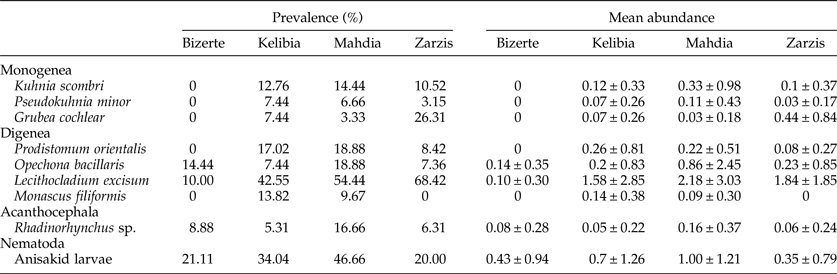
A total of 1113 helminth parasites belonging to nine species were found infecting S. colias (table 1). Three monogeneans Grubea cochlear (Diesing, 1858), Kuhnia scombri (Kuhn, 1829) and Pseudokuhnia minor (Rhode and Watson, 1985) were collected from the gills. Four digeneans Prodistomum orientalis (Layman, 1930), Opechona bacillaris (Molin, 1859), Monascus filiformis (Rudolphi, 1819) Loss, 1907 and Lecithocladium excisum (Lûhe, 1901), one acanthocephalan Rhadinorhynchus sp. and nematode anisakid larvae were found from the digestive tract. All parasite species with a prevalence >5% in at least one season and one zone were included in the analyses of classification of S. colias between seasons and between localities.
The prevalence and mean abundance of infection of Scomber colias with helminth species in four localities off the coast of Tunisia; mean values are given ± standard deviation.

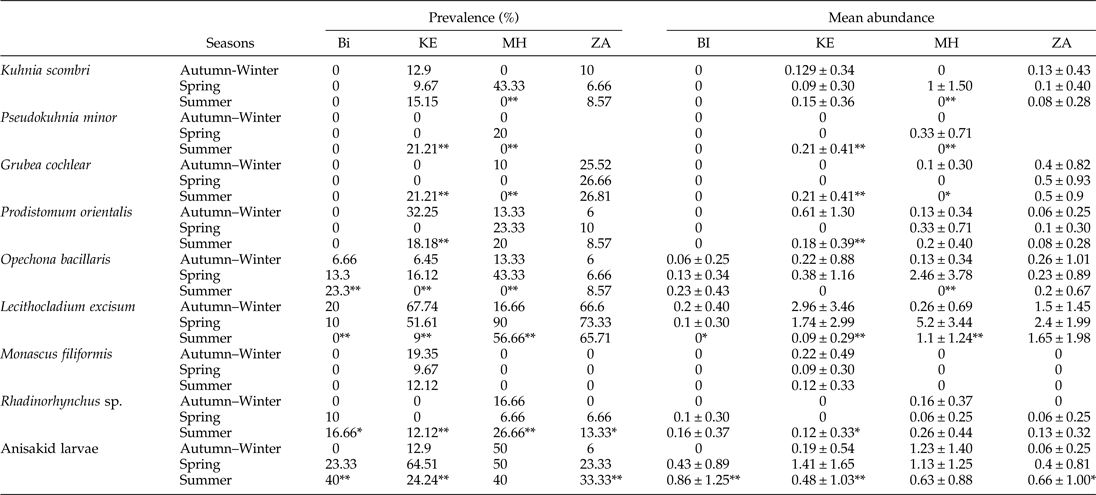
Infection parameters of parasites showed seasonal differences in each locality (table 2). Prevalence and mean abundance of six and five parasites species varied between seasons in Kelibia and Mahdia, respectively, while only one parasite species showed significant seasonal differences in both infection parameters in Zarzis and Bizerte. Some parasites were absent in one season and present in another.
Comparisons of the prevalence and mean abundance of selected helminth parasites from Scomber colias at four localities in each season off the Tunisian coast; mean values are given ± standard deviation; BI, Bizerte; KE, Kelibia; MH, Mahdia; ZA, Zarzis.
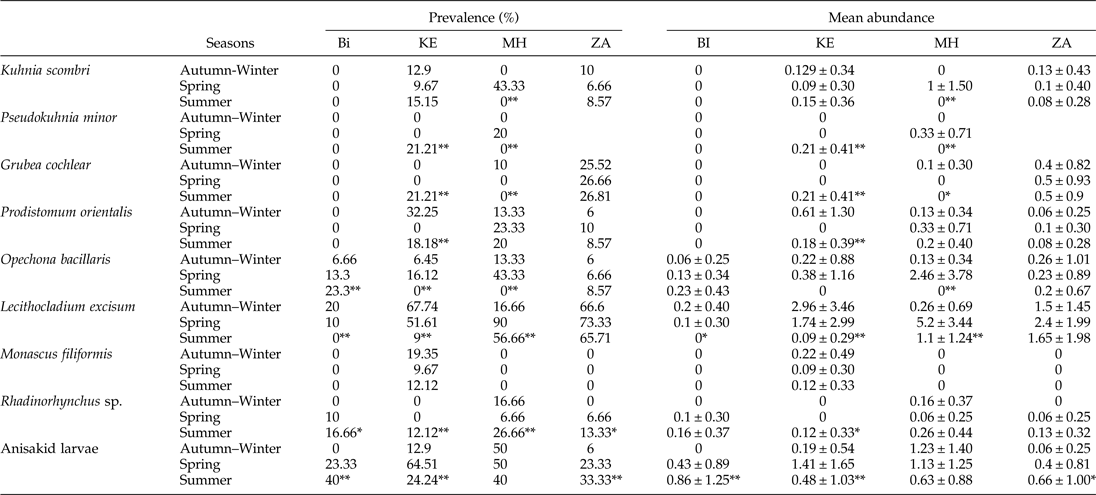
**, Level of significance with P < 0.01; *, level of significance with P > 0.01.
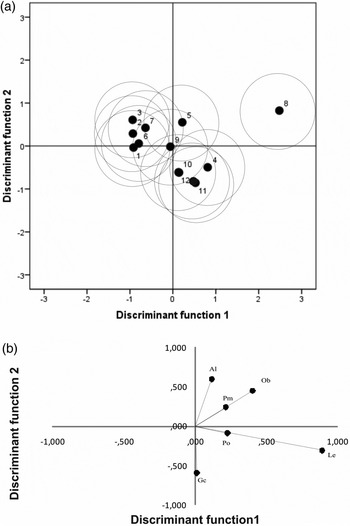
In seasonal multivariate parasitological analysis, all sampled specimens collected in each locality were separated into three seasons, giving 12 groups in total (locality–season). This analysis, used to identify distinct areas of S. colias between locality–season, was carried out according to traditional procedures and showed a significant difference between groups (Wilks’ lambda = 0.229, F = 9.08, χ2 = 529.6, df = 66, P < 0.01) (fig. 1a). Fish were classified correctly to the 12 component areas with an accuracy of 30%. Three groups were discriminated: one including fish from Bizerte in the three seasons, specimens from Kelibia in summer, and those from Mahdia in autumn–winter and in summer correlated negatively with monogeneans G. cochlear and P. minor, and endoparasites L. excisum, O. bacillaris, P. orientalis, and anisakid larvae; one grouped specimens from Kelibia and Mahdia in spring related to digeneans O. bacillaris and L. excisum, and anisakid larvae; and one grouped fish from Zarzis in three seasons and those from Kelibia in autumn–winter correlated positively with G. cochlear (fig. 1b).
(a) Sample scores of the first two discriminant functions for specimens of Scomber colias from (1) Bizerte in autumn–winter, (2) Bizerte in spring, (3) Bizerte in summer, (4) Kelibia in autumn–winter, (5) Kelibia in spring, (6) Kelibia in summer, (7) Mahdia in autumn–winter, (8) Mahdia in spring, (9) Mahdia in summer, (10) Zarzis in autumn–winter, (11) Zarzis in spring, (12) Zarzis in summer; lettering on the axes represents group averages surrounded by circles to show 90% tolerances. (b) Canonical correlations between the first two discriminant functions and the parasite species between localities in each season. Gc, Grubea cochlear; Pm, Pseudokuhnia minor; Po, Prodistomum orientalis; Le, Lecithocladium excisum; Ob, Opechona bacillaris; Al, anisakid larvae.

In each locality, all sampled specimens collected in three seasons were pooled. We did not find monogeneans G. cochlear, K. scombri and P. minor or digeneans P. orientalis and M. filiformis in S. colias from Bizerte. In specimens from Zarzis, we did not record M. filiformis (table 1). The comparisons of infection parameters for parasites present in the four chub mackerel populations studied showed that all parasite species vary significantly in both prevalence and mean abundance of infection between localities. The prevalence or the mean abundance of more than three parasites differed significantly among localities. Of the areas studied, Bizerte showed the greatest variation in infection parameters of helminth parasites. The prevalence and mean abundance of these species were less in Bizerte than in other localities.
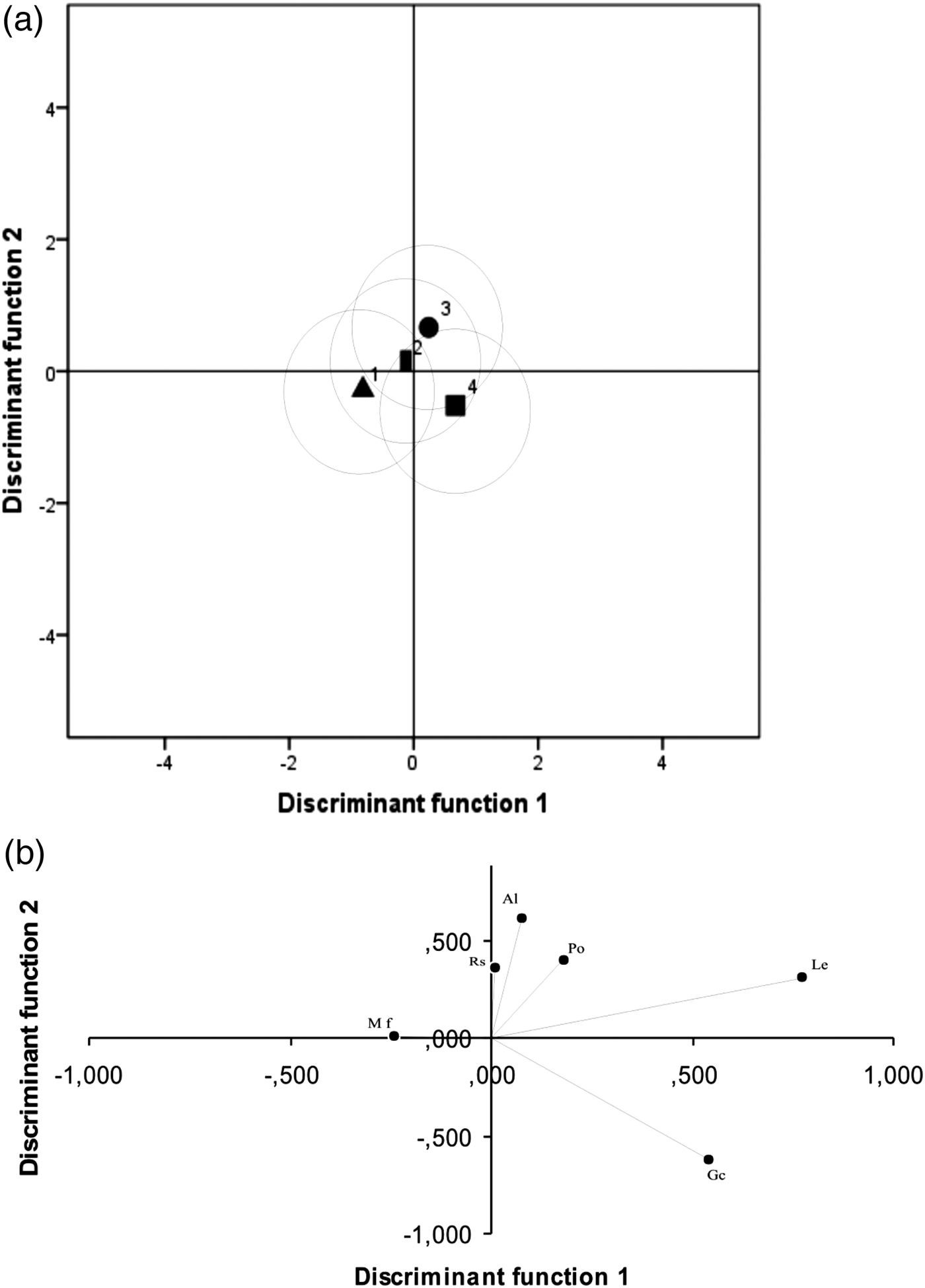
A multivariate parasitological analysis used to identify distinct areas of S. colias between localities was carried out according to traditional procedures and showed a significant difference between groups (Wilks’ lambda = 0.583, F = 11.88, χ2 = 195.66, df = 18, P < 0.01) (fig. 2a). Fish were classified correctly to the four component areas with an accuracy of 49.9%. Three groups were separated: one including fish from Bizerte correlated negatively with G. cochlear and L. excisum; one grouped specimens from Kelibia and Mahdia related to anisakid larvae, P. orientalis and L. excisum; and one grouped fish from Zarzis correlated positively with G. cochlear and L. excisum (fig. 2b).
(a) Sample scores of the first two discriminant functions for specimens of Scomber colias from (1) Bizerte, (2) Kelibia, (3) Mahdia and (4) Zarzis; lettering on the axes represents group averages surrounded by circles to show 90% tolerances. (b) Canonical correlations between the first two discriminant functions and the parasite species between localities. Mf, Monascus filiformis; Gc, Grubea cochlear; Po, Prodistomum orientalis; Le, Lecithocladium excisum; Rs, Rhadinorhynchus sp.; Al, anisakid larvae.

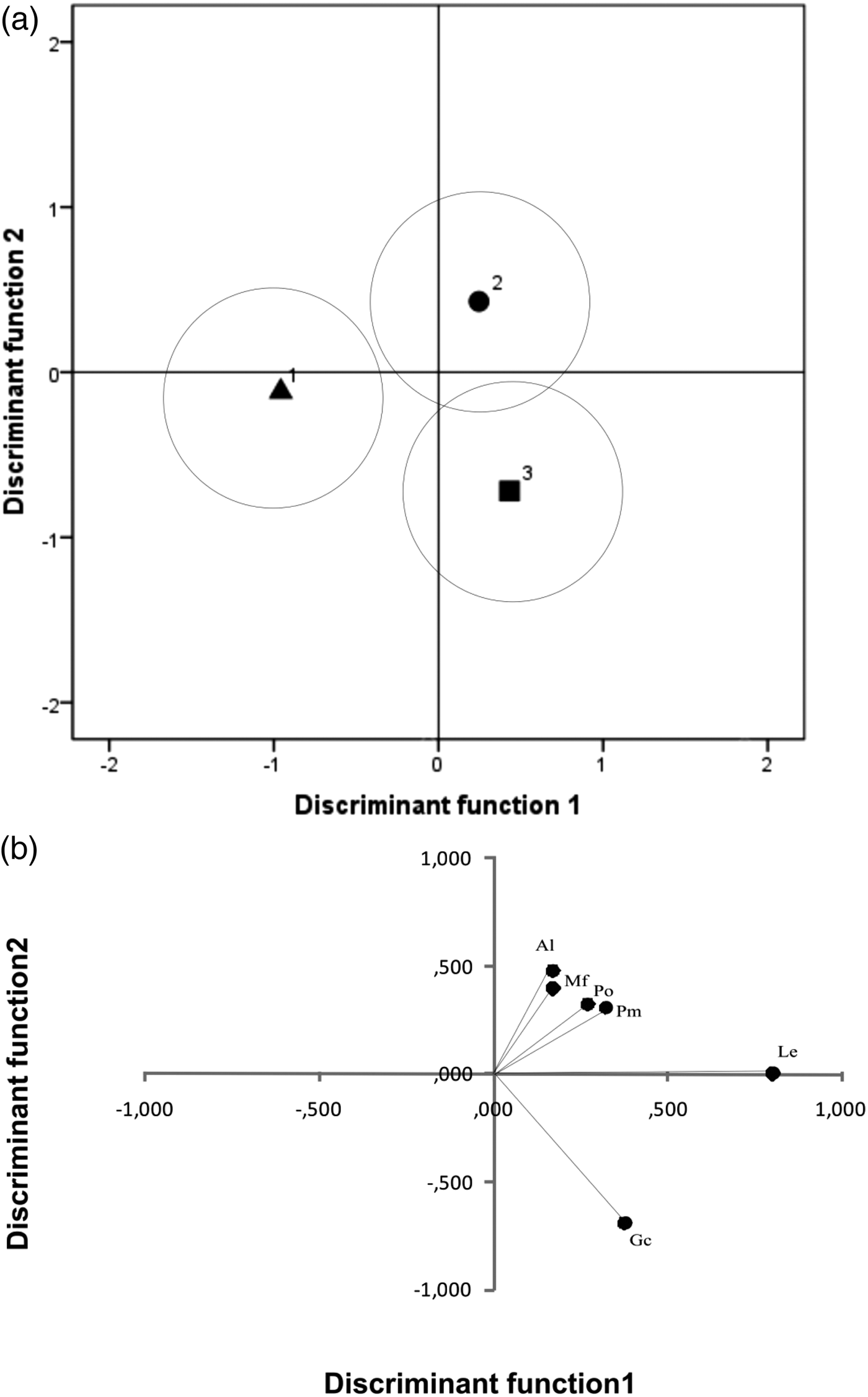
A multivariate parasitological analysis used for the classification of S. colias between localities after pooling specimens from Kelibia and Mahdia was carried out according to traditional procedures and showed a significant difference between groups (Wilks’ lambda = 0.623, F = 16.04, χ2 = 171.85, df = 12, P < 0.01) (fig. 3a). Fish were classified correctly to the three component areas with an accuracy of 69.3%. The same three groups were identified: one group from the north was correlated negatively with G. cochlear and L. excisum; one group from the centre was related to P. minor, P. orientalis, M. filiformis and anisakid larvae; and one group from the south was characterized by G. cochlear and L. excisum (fig. 3b).
(a) Sample scores of the first two discriminant functions for specimens of Scomber colias from (1) Bizerte, (2) Kelibia and Mahdia pooled and (3) Zarzis; lettering on the axes represents group averages surrounded by circles to show 90% tolerances. (b) Canonical correlations between the first two discriminant functions and the parasite species between localities. Po, Prodistomum orientalis; Le, Lecithocladium excisum; Pm, Pseudokuhnia minor; Al, anisakid larvae; Mf, Monascus filiformis; Gc, Grubea cochlear.

Discussion
To use parasites as biological tags for stock identification, two aspects related on quantitative and qualitative differences in the parasite fauna are evident (Love, Reference Love1980; Scott, Reference Scott1988; Stanley et al., Reference Stanley, Lee and Whitaker1992). In our study, qualitative and quantitative differences in the structure of nine helminth parasites found on S. colias from the coast off Tunisia allowed the identification of three distinct areas: one in the north from Bizerte, one in the south from Zarzis, and one in the centre from Kelibia and Mahdia.
The seasonal samples at Bizerte and at Zarzis were homogeneous, justifying their grouping as representatives of two distinct areas (fig. 2a, b; table 2). Our results showed that monogenean parasites were totally absent in the north (Bizerte), and present with high infection parameters of the monogenean G. cochlear in the south (Zarzis). Undoubtedly, parasites with a direct life cycle are the simplest to use for stock discrimination. The parasite must be present in one area and absent in others. Infection is ensured through close contact between infected and non-infected fishes (MacKenzie & Abaunza, Reference MacKenzie and Abaunza1998).
The absence of monogeneans in the north and their presence in the south could be explained by local abiotic factors, such as salinity, temperature and depth, that affect the completion of the life cycle of the parasite (Williams & Jones, Reference Williams and Jones1994). The northern marine zone was characterized by strong and very rugged currents and by a straight continental shelf that gave way to a steep slope. This can prevent the attachment of the oncomiracidium on its host. Also, in this region, the salinity and the water temperature had a zonal distribution, with values that generally increased from northwest to southeast off the coast of Tunisia. In the north, the minimum salinity of 36.8 psu was detected in the Atlantic current, which flows at a depth between 90 and 250 m in summer and between 40 and 50 m in autumn (Brandhorst, Reference Brandhorst1977; Alioua & Harzallah, Reference Alioua and Harzallah2008). The maximum water temperature was 13.6°C in winter and 24.8°C in summer (Gaamour et al., Reference Gaamour, Ben Abdallah, Khemiri and Mili2004). In the south, the water temperature reached 14.6°C in winter and >29°C in summer (Gaamour et al., Reference Gaamour, Ben Abdallah, Khemiri and Mili2004). The salinity was high (>39 psu) due to the high evaporation occurring over shallow water (Brandhorst, Reference Brandhorst1977; Alaoui & Harzallah, Reference Alioua and Harzallah2008). In the southern region, the success of the transmission of the monogenean G. cochlear in Zarzis may be related to the high values of the temperature and salinity of water, and to the important density of the host population of S. colias. Indeed, monogeneans can propagate rapidly on schools of host fish in warm water. The temperature promotes the rapid development of their life cycle and the salinity could be a factor conditioning the presence or absence of some monogeneans (Antonelli & Marchand, Reference Antonelli, Marchand, Carvalho, David and Silva2012). Furthermore, the transmission of monogeneans may also be related to differences in the density of the host population in different areas. Off the Tunisian coast, the abundance of S. colias was very low and consisted of a few dispersed specimens in the north, while in the south there were many dense schools (Ben Abdallah & Gaamour, Reference Ben Abdallah and Gaamour2004). Several studies have shown that infection parameters of monogenean ectoparasites depend on the water temperature, salinity and depth (Munroe et al., Reference Munroe, Campbell and Zwerner1981; Blažek et al., Reference Blažek, Jarkovský, Koubková and Gelnar2008; Blahoua et al., Reference Blahoua, N'Douba, Kone and Kouassi2009; Antonelli & Marchand, Reference Antonelli, Marchand, Carvalho, David and Silva2012).
The northern region was also characterized by the absence of the digeneans P. orientalis and M. filiformis, and the southern area was characterized by the total absence of the digenean M. filiformis and the high prevalence of the digenean L. excisum. The absence of endoparasites can be explained by the distribution of their intermediate hosts in these zones. The high transmission of L. excisum in Zarzis could be due to the proliferation of its intermediate hosts and the fast completion of its life cycle. Pérez-del Olmo et al. (Reference Pérez-del Olmo, Raga, Kostadinova and Fernández2007) proved that the predominance of digeneans is linked to the proliferation of their intermediate hosts.
The seasonal samples at Kelibia and at Mahdia are not homogeneous, justifying their seasonal variability combined with geographical origin (fig. 2 a, b; table 2). This could shed light on possible migratory patterns of specimens of S. colias from the central region. Indeed, the majority of parasite species collected from S. colias at Kelibia and Mahdia showed a seasonal variation. Fish from Kelibia in the autumn–winter and in the spring, and those from Mahdia in spring and in summer, were correlated positively with anisakid larvae and L. excisum. The latter species were negatively correlated with specimens from Kelibia in summer and those from Mahdia in autumn–winter. These differences can be explained by horizontal migration between fish of Kelibia and Mahdia. Changes in the infection levels of parasites can provide information about the migratory movements of the host. A decrease in the level of infection in a particular area could be the result of the immigration of another host population with a lower level of infection (MacKenzie & Abaunza, Reference MacKenzie and Abaunza1998).
Geographical analysis showed that there were no significant differences between Kelibia and Mahdia in the global prevalence or mean abundance of monogeneans G. cochlear, P. minor and K. scombri, digeneans L. excisum, P. orientalis and M. filiformis and anisakid larvae, but there were significant differences in the infection parameters of the digenean O. bacillaris and the acanthocephalan. The similarity and the high level of infection with monogeneans K. scombri and P. minor in Kelibia and Mahdia from the central area may be related to the adaptation of these species to the optimum ecological factors in this area. This zone was characterized by moderate hydrological conditions. The temperature was between 14.3 and 14.7°C and the salinity was relatively low throughout the year, at 37 psu (Ben Othman, Reference Ben Othman1973; Brandhorst, Reference Brandhorst1977; Alaoui & Harzallah, Reference Alioua and Harzallah2008). The currents were weak and had no effect on sedentary dynamics (Ben Mustapha & Afli, Reference Ben Mustapha and Afli2001). The similarity of endoparasites at Kelibia and Mahdia can be related to the distribution and the abundance of their intermediate hosts. Consequently, the qualitative diet composition of S. colias may be similar in both regions, although the quantity of ingested prey was likely to be different, as we recorded a significant difference between infection parameters of Rhadinorhynchus sp. and O. bacillaris. It appears that intermediate hosts of Rhadinorhynchus sp. and of the Lepocreadiidae O. bacillaris, which involves Nassarius pygmaeus as a first intermediate host and the cnidarian Podocoryne minima, the ctenophore Pleurobrachia pileus, a chaetognath (Bray & Gibson, Reference Bray and Gibson1999) or medusa (Diaz-Briz et al., Reference Diaz-Briz, Martorelli, Genzano and Mianzan2012) as second intermediate hosts (Koie, Reference Køie1975), may be more abundant in Mahdia. The qualitative and quantitative diet composition of S. colias from the four regions was different since we have not collected the same parasite species and we showed significant differences between prevalence and mean abundance. Specific habits of fish species and the differential availability of prey species can account for the heterogeneity in parasite burdens observed among geographical zones (Braicovich & Timi, Reference Braicovich and Timi2008). Infection parameters of digeneans depend on the structure of the food web (Marcogliese, Reference Marcogliese2002) and host feeding habits (Luque et al., Reference Luque, Mouillot and Poulin2004). Oliva (Reference Oliva2001) showed that the difference in infection parameters suggest a selectivity in the diet between localities, or lower availability of food items that are intermediate hosts for those parasites and, consequently, the distribution and the abundance of intermediate hosts, which were influenced by physical factors such as temperature, salinity, depth, and the bottom habitat and substrates (Esch & Fernândez, Reference Esch and Fernândez1993).
The ability to differentiate stocks on the basis of their parasites reflects the variations in ecological and environmental conditions in the regions that the hosts inhabit, resulting in non-uniform distributions and abundances of the parasites’ final and intermediate hosts. Differences in feeding habits may also account for the observed differences in infection between regions (Boje et al., Reference Boje, Riget and Køie1997).
The results of two discriminant analyses used for the separation of S. colias between localities (before and after pooling together specimens from the central area) were similar. Grubea cochlear and L. excisum were correlated negatively with specimens from Bizerte, in the north. Pseudokuhnia minor, P. orientalis, M. filiformis and anisakid larvae were characteristic of specimens from Kelibia and Mahdia in the centre. Grubea cochlear and L. excisum were correlated positively with fish of Zarzis from the south. The accuracy of classifying fish incorrectly in their ecological community can be explained by the seasonal migration of S. colias from inshore and offshore waters. These movements of migration can be induced by the reproduction and the search for the optimal hydrological conditions. Indeed, currents or water masses play an important role in the spatial distribution, movement and isolation of pelagic fish stocks (Tzeng, Reference Tzeng1988; Allen et al., Reference Allen, Wolotira, Sample, Noel and Iten1990). Indeed, Čikeš Keč & Zorica (Reference Čikeš Keč and Zorica2012) showed that S. colias is a migratory species which usually dwells at depths between 0 and 250–300 m. From April to September, it migrates towards the coastline and channel areas for spawning. After spawning, adults and their offspring migrate to the deeper and colder offshore areas. Driven by feeding activities, chub mackerel is also well adapted to daily vertical migrations (Maigret & Ly, Reference Maigret and Ly1986).
In this study, the parasite species L. excisum, P. orientalis, M. filiformis, G. cochlear, P. minor, K. scombri and anisakid larvae contributed most to the separation of samples from the four localities into three distinct areas, demonstrating that they satisfy the criteria of good biological tags for stock discrimination. Indeed, adult hemiurid digeneans are good biological tags for discriminating stock of anchovy from Argentinian waters (Timi, Reference Timi2003), of Sardinella aurita from Tunisian waters (Feki et al., Reference Feki, Chaari and Neifar2016) and of cod from waters off Greenland (Boje, Reference Boje, Stenmark and Malmberg1987). Moreover, Kabata et al. (Reference Kabata, McFarlane and Whitaker1988) used digeneans from the families Fellodistomatidae and Hemiuridae to distinguish the offshore seamount stock and the continental slope stock of Anoplopoma fimbria from the west coast of Canada. Monogenean parasites (mainly polyopisthocotyleans) have been widely used biological tags as a source of information on the discreteness of their fish host stocks (Oliva & Ballôn, Reference Oliva and Ballôn2002; Oliva et al., Reference Oliva, González and Acuria2004). Oliva (Reference Oliva1999) showed that the monogenean Cemocotyle trachuri was a good biological tag to discriminate specimens of Trachurus murphyi between different localities from Peru and Chile. Rohde (Reference Rohde1980) proved that K. scombri was a good biological tag to separate specimens of Scomber japonicus between the Mediterranean Sea and the Atlantic. Also, anisakid larvae that remained for a long time in the host were good biological tags in stock discrimination (MacKenzie, Reference MacKenzie1987). These helminth larvae were used as biological tags in stock discrimination of Sebastes spp. from the North Atlantic herring (Clupea harengus, Clupeidae) and mackerel (Scomber scombrus, Scombridae) (Bourgeois & Ni, Reference Bourgeois and Ni1984; Scott, Reference Scott1985, Reference Scott1988; Chenoweth et al., Reference Chenoweth, McGladdery, Sindermann, Sawyer and Bier1986; Dumke, Reference Dumke1988; Eltink, Reference Eltink1988; Avdeev & Avdeev, Reference Avdeev and Avdeev1989; Lang et al., Reference Lang, Damm, Weber, Neudecker and Kuhlmorgen-Hille1990; Moser, Reference Moser1991a, Reference Moserb). Boje (Reference Boje, Stenmark and Malmberg1987) used adults of Hysterothylacium aduncum as biological tags to separate cod stocks.
The present work improves our understanding of the population structure of an important economic and commercial species such as S. colias off the coast of Tunisia. It provides useful information both to the scientific community, and to the fisheries industry and managers from the Mediterranean Sea in general. Using the geographical variability of helminth parasites as a reliable tool to recognize the discrimination of specimens of the chub mackerel, S. colias, off the coast of Tunisia allowed the identification of three distinct areas.
Conflict of interest
None.