

A human carries out complex cognitive activities in everyday life, such as chatting on the phone, watching TV, or writing an e-mail message. Although they vary in nature, complexity, and modality, they have one feature in common: cognitive activities are carried out within limited cognitive resources. This concept of cognitive limitation in the human mind has had a great impact on theories of reading, and automatization (i.e., the process leading to automaticity) in word recognition is recognized as a crucial role in reading development (Stanovich, Reference Stanovich, Barr, Kamil, Mosenthal and Pearson1991). Although this notion of automaticity as an important component of reading also has been accepted in second language (L2) research (e.g., Koda, Reference Koda1996), there are only a handful of empirical studies on automatization in L2 reading. The present study, focusing on word frequency and working memory in L2 word-recognition improvement, explores the possible effects of word-recognition training on automatization in English as a foreign language (EFL).
Automatic word recognition has been considered as an indispensable component of fluent reading not only in a first language (L1; e.g., Stanovich, Reference Stanovich, Barr, Kamil, Mosenthal and Pearson1991), but also in an L2 or a foreign language (FL; e.g., Koda, Reference Koda1996; Segalowitz and Hulstijn, Reference Segalowitz, Hulstijn and Kroll2005). Reading is seen as the interactive activity of lower level processing (e.g., retrieving the orthographical, phonological, syntactic, and semantic information of a printed word) and higher level processing (e.g., processing a stream of words for comprehension while preserving the semantic and syntactic information of previous sentences in working memory). Because more complex multiple activities are involved in the higher level processing, successful reading (i.e., fluent reading with good comprehension) requires one to allocate as many cognitive resources as possible in the higher level processing. In other words, the reader needs to minimize cognitive resources necessary for the lower level processing, so that the higher level processing in reading can be successfully carried out within the rest of the limited cognitive resources. To do so, the reader needs to reach such a stage that the moment he or she fixes on a word, all the corresponding mental representations are automatically retrieved.
CRITICAL PROPERTIES OF AUTOMATIC WORD RECOGNITION
Automatic word recognition has several critical propertiesFootnote 1 in its execution and capacity usage. One of the properties is its obligatory execution. It has been pointed out that automatic word recognition makes its execution ballistic or unstoppable; one cannot stop retrieving mental representations (e.g., phonological and semantic representations) from an automatized word although one attempts not to do so (DeKeyser, Reference DeKeyser and Robinson2001; Segalowitz, Reference Segalowitz, Doughty and Long2003; Stanovich, Reference Stanovich1990, Reference Stanovich, Barr, Kamil, Mosenthal and Pearson1991). Popular measures for the obligatory nature of automatic word recognition are ones employed in the Stroop paradigm (MacLeod, Reference MacLeod1991). In the generic Stroop paradigm, subjects are required to respond to each stimulus in two contrasting conditions by naming its property. For example, given a set of color patches or colored letter strings of “XXXXX,” subjects are asked to name the color of each patch or letter string (a baseline condition). The contrasting condition would be providing a set of color names printed in a different color of ink (e.g., the word green printed in red) and asking subjects to name its color. The interference of the contrasting condition, which is observed as longer response time for the conflicting words, is taken as evidence for obligatory processing of automatized words because such interference is considered as reflecting the reader's failure to ignore the semantic representations of the words (MacLeod, Reference MacLeod1991).
Another critical property of automatic word recognition relates to its little cognitive capacity usage or effortless performance. Numerous studies have shown that once one comes to recognize words automatically, one draws little attentional capacity in processing the words and activating their corresponding mental representations. That is to say, automatic word recognition allows one to retrieve the mental representations of a word only with a few attentional resources. In studies on attentional resource allocation for word recognition, a dual-task paradigm has enjoyed its popularity. In the typical dual-task paradigm, subjects are required to respond to a primary task, which occurs constantly (e.g., deciding whether a visually given pair of letters are matched), whereas they need to respond to a secondary task, which occurs at random (e.g., pressing a button when a predetermined signal is heard). The response time to the secondary task is an index of automatization; the logic of the dual-task methodology is that the more fully automatized the processing necessary for the primary task is, and therefore, the less attentional capacity is needed to carry out the task, the more attentional resources can be allocated for the secondary task. Thus, no slowing down in the secondary task, compared to the performance on the secondary task alone as a baseline, is considered to be the proof of full automatization of cognitive processing involved in the primary task.
Fast performance is also regarded as a feature of automatic word recognition. Extensive exposure to a printed word leads to instant retrieval of all the necessary information of the word. Nonetheless, simply being able to recognize words quickly cannot be a critical property of automatic word recognition. This is because the concept of “fast” is a gradual notion, and thus, there are no objective criteria or thresholds for deciding what is fast (Moor & De Houwer, Reference Moors and De Houwer2006). Other critical properties accompanying fast performance are necessary for the concept of fast to become a critical property of automatic word recognition.
Ehri (Reference Ehri, Barr, Kamil, Mosenthal and Pearson1991, Reference Ehri, Gough, Ehri and Treiman1992) suggests that the concept of efficiency shed another light on word-recognition development. She proposes that one becomes efficient in processing words through exposure to print and the ultimate goal for word-recognition development is sight-word reading, that is, processing a word as a whole. When young children begin to read, they often use some salient, graphic cues of words as mnemonic devices, such as the shape of particular letters or that of a whole word; they normally do not regard letters or words as script. They soon, however, understand that the constituent letters of a word have orthographic and phonological value. Then they come to use letter–sound correspondences, typically the initial or final letter of a word, or both letters, as phonetic cues for retrieving the pronunciation of the whole word.
Through exposure to printed words, the readers accumulate knowledge of letter–sound correspondence rules and spelling patterns. Share (Reference Share1995) claims that this accumulated knowledge plays an important role in transition from letter–sound correspondence rules (one-to-one mapping rules) to unitization (lexicalization). Attention to letter–sound relations leads the readers to use not only grapheme–phoneme correspondence rules, but also relations between spelling patterns or multiletter units appearing across different words and their pronunciations. In other words, they come to process familiar sequences of letters as units or chunks in recoding words and employ such units automatically. Ultimately they acquire sight-word vocabulary (Ehri, Reference Ehri, Gough, Ehri and Treiman1992) or an autonomous lexicon (Perfetti, Reference Perfetti, Gough, Ehri and Treiman1992); they process a whole word as a unit. It is noteworthy that researchers and theorists on reading seem to agree that sight-word reading, the ultimate goal in word-recognition development, is associated with restructuring a word-recognition mechanism or with increasing cognitive efficiency in word-recognition processing (Ehri, Reference Ehri, Barr, Kamil, Mosenthal and Pearson1991).
AUTOMATIZATION IN L2 WORD RECOGNITION
In light of word-recognition development, Segalowitz and Segalowitz (Reference Segalowitz and Segalowitz1993) point out that the development of L2 word-recognition fluency involves two qualitatively different changes: simple speedup and automatization. They argue that an initial stage in the development of L2 word-recognition skills involves simple speedup of performance. Beginning L2 readers’ increase in speed and accuracy of word-recognition processing is the result of simply speeding up controlled processing (increases in performance fluency, but no increase in efficiency). This simple speedup stage is qualitatively different from a subsequent automatization stage because automatization is associated with restructuring a word-recognition mechanism or with increasing cognitive efficiency in word-recognition processing. After the automatization stage, L2 readers’ word-recognition performance reaches their optimal level, and therefore, no substantial speedup can be observed.
To differentiate an increase in L2 word-recognition fluency because of simple speedup from that because of automatization, Segalowitz and colleagues proposed that relative variability of performance be a valuable index of automatization (e.g., Segalowitz and Segalowitz, Reference Segalowitz and Segalowitz1993; Segalowitz, Poulsen, & Segalowitz, Reference Segalowitz, Poulsen and Segalowitz1999; Segalowitz, Segalowitz, & Wood, Reference Segalowitz, Segalowitz and Wood1998; Segalowitz, Watson, & Segalowitz, Reference Segalowitz, Watson and Segalowitz1995). Specifically, to assess the nature of L2 word-recognition fluency or qualitative differences in word-recognition processing, they used the coefficient of variation (CVRT) of response time (RT), which is a standard deviation (SD RT) of RT divided by mean RT.
When one improves performance by simply speeding up its component processes (i.e., simple speedup), mean RT and SD RT decrease proportionally, resulting in no change in CVRT. In word recognition, for example, this would be improving word-recognition performance by speeding up the processing of each constituent letter of a word. In contrast, when one's performance improves because of an increase in efficiency of a processing mechanism (i.e., automatization), SD RT decreases more drastically than mean RT does. Thus, in the case of improvement via automatization, CVRT is reduced. This type of improvement in word recognition would be associated with processing multiletter units or whole words as units, leading to development of sight-word vocabulary. This proposal of relative variability of performance as a valuable index of automatization has been supported in a series of studies carried out by Segalowitz and his colleagues.
Segalowitz and Segalowitz (Reference Segalowitz and Segalowitz1993) conducted two experiments using 66 French-speaking learners of English as an L2 (ESL), whose proficiency level of English varied. In the first experiment, the learners were given a computer-controlled detection task where they had to press a response key as quickly as possible when a square appeared on a computer screen. In the second experiment, the learners performed a lexical decision task. Provided with 160 English words (35 baseline words, 35 homophone words, and 15 words appearing six times at random) and 124 nonwords, they were required to indicate whether each item appearing on the screen was a real word or not by pressing a response key. The performance to the baseline words was used as an indicator of the level of the learner's word-recognition fluency.
Segalowitz and Segalowitz (Reference Segalowitz and Segalowitz1993) hypothesized that because the detection task in the first experiment involved simple cognitive processing, all the learners, regardless of their English proficiency, would show differences in RT via simple speedup. In contrast, it was expected that the lexical decision task in the second experiment, which involved more complex cognitive activities, would present qualitative differences in performance according to the learner's word-recognition fluency: the more quickly the learners recognized words, the more efficiently they processed words. These hypotheses were all verified by the results of correlational analyses: (a) CVRT did not significantly correlate with RT in the first experiment, (b) CVRT significantly correlated with RT in the second experiment, and (c) the correlation between RT and CVRT for less fluent ESL learners was lower than that for more fluent ESL learners in the second experiment.
Segalowitz et al. (Reference Segalowitz, Segalowitz and Wood1998) extended the second experiment of the previous study (Segalowitz & Segalowitz, Reference Segalowitz and Segalowitz1993) to focus on the effects of practice on automatization. One hundred five English L1 learners of French as an L2 (FSL) with varying proficiency participated in the study. Each participant performed a computer-controlled lexical decision task; unlike the previous study, however, the participant had to perform the task six times in 8 months. The major findings were similar to those of the previous study. Whereas the initially slow group (i.e., less fluent FSL learners) did not demonstrate automatization-based differences in word recognition, reflecting no significant correlation between RT and CVRT in the initial session of a lexical decision task, the initially fast group (i.e., more fluent FSL learners) showed a significant, positive correlation between RT and CVRT. This suggests that individual differences in word-recognition performance among more fluent FSL learners, who presumably had more practice with French than less fluent FSL learners did, are associated with differences in automatization or restructuring of the word-recognition mechanism. Furthermore, the correlations between the RT change scores and CVRT change scores for both more fluent and less fluent FSL learners were found to be significant, implying that individual learners improved their word-recognition fluency via automatization over a period of time (i.e., 8 months).
Fukkink, Hulstijn, and Simis (Reference Fukkink, Hulstijn and Simis2005), using relative variability of performance as an index of automatization, conducted an empirical study on the effects of training in FL word-recognition skills on automatization of word-recognition processing and on reading comprehension. In the first experiment, they administered two sessions of a computer-controlled word-recognition test (i.e., a lexical decision task) to 41 Dutch L1 learners (ages 13–14) of EFL, who had 3.5 years of formal EFL instruction. Between the two test sessions, the EFL learners received two sessions of word-recognition training that consisted of two computer-controlled tasks: a translation task and a cloze task. In the translation task, the learner saw a target English word along with two L1 words on the screen and had to select the one that was the correct translation of the target word by pressing one of two keys. In the cloze task, one English sentence with a blank and two target English words underneath the sentence appeared on the screen, and the learner had to select one of the two words that fits the sentence by pressing one of two keys. There were two training sessions, and the learners were exposed to each of 40 target words 11 times. Both accuracy and reaction time for trained words significantly improved. Furthermore, RT significantly correlated with CVRT in the posttest, whereas such a significant correlation was not observed in the pretest, suggesting that individual differences in word-recognition performance after training were because of restructuring of the word-recognition mechanism. These findings were consistent with those of previous studies (e.g., Segalowitz et al., Reference Segalowitz, Segalowitz and Wood1998; Segalowitz & Segalowitz, Reference Segalowitz and Segalowitz1993)
Fukkink et al. (Reference Fukkink, Hulstijn and Simis2005) extended the first experiment by providing more tests and tasks with a larger number of EFL learners. Word-recognition and reading comprehension tests in L1 and L2 were administered to 105 Dutch L1 speakers. Four types of word-recognition exercises requiring semantic processing of familiar and unfamiliar words were given in four training sessions. Significant training effects were found in the accuracy scores of unfamiliar words; because of ceiling effects, however, the training effects in those of familiar words were not statistically significant. In light of word-recognition speed, significant training effects were found in both familiar and unfamiliar words. Although these results suggested that the training accelerated word-recognition processing, training effects on automatization were observed for unfamiliar words only. Improvement in word-recognition speed with familiar words was not associated with that in word-recognition efficiency, that is, automatization.
THE PRESENT STUDY
The present study investigated the possible effects of word-recognition training on word-recognition performance of EFL learners. Specifically, the study focused on two aspects that possibly affect the development of word-recognition processing: word frequency and FL learner's working memory. The focus on these two aspects is motivated by previous studies on the effects of exposure to written L2 or FL words on automatization. These studies suggested that one improves word-recognition performance via simple speedup or automatization of word-recognition processing, depending on one's proficiency in the L2 or FL (e.g., Fukkink et al., Reference Fukkink, Hulstijn and Simis2005; Segalowitz et al., Reference Segalowitz, Segalowitz and Wood1998; Segalowitz & Segalowitz, Reference Segalowitz and Segalowitz1993); there are few, if any, studies, however, that investigated relations between practice effects on automaticity in L2 or FL word recognition and individual differences in other aspects than L2 or FL proficiency. Furthermore, the extent to which word properties (e.g., frequency, familiarity, or grapheme–phoneme consistency) affect automatization in L2 or FL word recognition has not been fully explored.Footnote 2
Word frequency has been recognized as one of the word properties that influence word-recognition performance in a L1 and a L2 (e.g., Akamatsu, Reference Akamatsu2002; Seidenberg, Reference Seidenberg, Frost and Katz1992). For example, according to the universal direct access hypothesis, which highlights similarities in word recognition among different writing systems (e.g., Baluch & Besner, Reference Baluch and Besner1991; Seidenberg, Reference Seidenberg1985), what determines word-recognition procedures is whole-word knowledge of spelling. Regardless of their L1, skilled readers are seen to recognize printed words via both visual and phonological mediation; “which route dominates for a given word depends on factors such as [word] frequency and reading skill” (Seidenberg, Reference Seidenberg, Frost and Katz1992, p. 99). The major assumption of the universal direct access hypothesis is that, in any writing system, high-frequency words (i.e., common words) are recognized via visual mediation, whereas low-frequency words are processed on a phonological basis (McCusker, Hillinger, & Bias, Reference McCusker, Hillinger and Bias1981; Seidenberg, Reference Seidenberg1985; Seidenberg, Waters, Barnes, & Tanenhaus, Reference Seidenberg, Waters, Barnes and Tanenhaus1984). This assumption is important for L2 research on automaticity in that word frequency may have a great impact on the extent to which word-recognition processing is automatized because word recognition via visual mediation is comparable to sight-word vocabulary (Ehri, Reference Ehri, Gough, Ehri and Treiman1992) or an autonomous lexicon (Perfetti, Reference Perfetti, Gough, Ehri and Treiman1992).
Working memory, the second aspect in this study, has been investigated in numerous studies, and it is stated that working memory plays a crucial role in information processing such as language comprehension (e.g., Carpenter, Miyake, & Just, Reference Carpenter, Miyake, Just and Gernsbacher1994; Daneman and Merikle, Reference Daneman and Merikle1996; Gathercole and Baddeley, Reference Gathercole and Baddeley1993; McLaughlin, Reference McLaughlin1995). The working-memory system, which consists of processing and storage capabilities, is assumed to be shared between the processing and storage of information because of one's limited cognitive resources. What is crucial here is that there are individual differences in the ability to coordinate the processing and storage functions (Daneman and Carpenter, Reference Daneman and Carpenter1980). It is pointed out that individuals with smaller working-memory capacity tend to have “deficits in comprehension, particularly in the processes that integrate successively encountered words, phrases, and sentences into a coherent representation” (Daneman & Merikle, Reference Daneman and Merikle1996, p. 423). This notion appears to imply that individual differences in working-memory capacity could lead to those in sight-word reading and vice versa because one generally develops vocabulary via exposure to text. Exposed to some words equally, therefore, individuals with larger working-memory capacity have more advantages in processing the words as units than those with smaller working-memory capacity.
In light of the literature on automaticity in L2 word recognition and its related issues, the present study tested the following three hypotheses:
1. Training in EFL word recognition improves word-recognition performance in speed and accuracy.
2. Effects of EFL word-recognition training differ in improvement of the efficiency of word-recognition processing, depending on word frequency. Specifically, as seen in Fukkink et al. (Reference Fukkink, Hulstijn and Simis2005), the efficiency of the processing of low-frequency words benefits from the training, whereas the processing of high-frequency words does not improve in efficiency.
3. EFL learners with larger working-memory capacity have more advantages in benefiting from word-recognition training than those with smaller working-memory capacity.
Automatization in word recognition is defined in this study as the process or state where one improves the efficiency of word-recognition processing. As an index of investigating the efficiency of word-recognition processing, the study adopted the method of previous studies (e.g., Segalowitz et al., Reference Segalowitz, Segalowitz and Wood1998); the CVRT, which is a standard deviation of RT divided by a mean RT, was used to evaluate the variability of word-recognition speed, independent of the scale of the mean values.
METHOD
Participants
A total of 49 EFL readers participated in this study. All the participants were first-year university students majoring in education in Japan, and they had received formal English education for approximately 6 years at the time of the study.
A reading comprehension and vocabulary testFootnote 3 was administered to assess the participant's reading proficiency and vocabulary knowledge. The reading comprehension scores ranged from 10 to 37 (maximum = 48; M = 24.0, SD = 6.3), and the vocabulary scores ranged from 10 to 30 (maximum = 45; M = 20.6, SD = 4.6). The estimated reliability of the reading comprehension test (i.e., Cronbach α) was 0.87 and that of the vocabulary test was 0.77.
Training
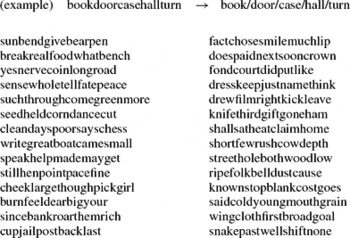
Word-recognition training was given as part of a regular reading class; the participants were given seven word-recognition training sessions (i.e., one training session per week). In each training session, the participants carried out a word chains task: they had to draw lines between words written with no spaces, as quickly and as accurately as possible, within 90 s (see Appendix A for a sample training sheet). Combinations of words consisting of letter strings (i.e., five words written with no spaces) were changed in each training session to prevent the participants from familiarizing some patterns of letter strings. The words used in each training session were 150 monosyllabic English words, which included 50 target words.
The choice of the word chains task was motivated by research findings that Japanese learners of ESL are relatively insensitive to the constituent letters of an English word. Brown and Haynes (Reference Brown, Haynes and Carr1985), for example, demonstrated that Japanese learners who were faster and more accurate in perceiving and discriminating English words had more difficulty in translating alphabetic symbols into spoken units than the Arabic and the Spanish learners. The Japanese were also found to be less dependent on phonological information in processing English words (Koda, Reference Koda1988, Reference Koda1990) and less efficient in processing the constituent letters of English words than ESL learners with an alphabetic L1 background, such as Arabic and Persian (Akamatsu, Reference Akamatsu1999, Reference Akamatsu2003). These disadvantages of the Japanese learners are seen to reflect their nonalphabetic L1 literacy experience, which normally lacks amalgamating intraword components of a word in the sound retrieval processes. Furthermore, it has been pointed out these L1 adverse effects hinder the Japanese from developing sight-word reading in the processes that native speakers of English and L2 learners with an alphabetic L1 background normally follow (e.g., Akamatsu, Reference Akamatsu, Joshi and Aaron2006). This is because “the ability to perceive words and syllables as wholes evolves only through complete and repeated attention to sequences of individual letters” (Adam, Reference Adams1990, p. 130). Thus, a word chains task was chosen for word-recognition training for the participants in this study: Japanese learners of ESL.
Tests
Two tests were administered to assess the participant's word-recognition performance and working-memory capacity.
Working memory The working memory test consisted of two parts (i.e., word span and reading span), and they were computer-controlled and administered individually. For the word span, which measures one's passive memory storage (Daneman & Merikle, Reference Daneman and Merikle1996), each participant was provided with three sets of English words ranging from three to seven words, and all the stimuli appeared on a computer screen, one by one, at the rate of one word per second. The participants were asked to read aloud each word, and after the last word of each set, they had to write the words that they remembered. All the stimuli were highly frequent, monosyllabic nouns. For the reading span, the reading span test created by Harrington and Sawyer (Reference Harrington and Sawyer1992) was modified and used. Three sets of short sentences ranging from two to five sentences appeared on a computer screen one at a time. The participants had to read aloud each sentence and remember the last, underlined word of the sentence. When the participants finished reading each sentence, the experimenter pressed a space key so that the next sentence appeared. After the last sentence of each set, the participants had to write down the target words that they remembered. All the target words were highly frequent, monosyllabic nouns. The working-memory scores constituted a total number of correctly remembered words.
Word recognition The word-recognition test was administered before and after training, approximately 8 weeks apart. As a word recognition test, a lexical decision task was used in the study. The stimuli were 25 high-frequency and 25 low-frequency monosyllabic English words, and 50 pronounceable nonwords. All the stimuli were consistent in spelling-sound correspondences among English words. The high- and low-frequency words were selected with reference to Computational Analysis of Present-Day American English (Kucera and Francis, Reference Kucera and Francis1967) and a word-frequency listFootnote 4 created by the author. According to Kucera and Francis’ word frequency list, the mean frequency for the high-frequency stimulus words was 556.8 (SD = 331.5) and that for the low-frequency words was 26.6 (19.5). According to the original EFL word frequency list, the mean frequency for the high-frequency stimulus words was 365.7 (SD = 226.7) and that for the low-frequency words was 4.8 (1.9). The stimulus words are listed in Appendix B.
The lexical decision task consisted of three blocks: a written instruction, 16 practice trials, and 100 test trials. The practice trials and test trials were randomized in the computer and presented to the participant. The procedure of the test trials was identical in all other respects to the set of practice trials, and the order of presentation of stimulus type was counterbalanced across participants.
At the beginning of each test trial, an asterisk appeared on the screen to mark the fixation point, and it was displayed for 500 ms. A blank screen followed the fixation mark for another 500 ms. Then the stimulus item was presented, and it was displayed until the onset of the participant's response. A masking stimulus, consisting of “######” on the computer screen, was introduced after the offset of the stimulus item. The duration of the mask was 50 ms. A blank screen followed the offset of the mask for 1 s (i.e., 1-s interval between trials).
Each stimulus word was presented singly in the center of the screen of a computer that was connected to a real-time clock. The participant was asked to indicate whether or not each stimulus word was a real word as quickly and as accurately as possible, by pressing RT panels. Latency was timed from the onset of the stimulus to the onset of the participant's response.
Experimental design and data analysis
Data were analyzed with word-recognition training (before training and after training) and word frequency-type (high-frequency and low-frequency) as within-subjects factors, using analyses of variance (ANOVAs). The RT, response accuracy (RA; i.e., accuracy percentage), and CVRT of RT in the word-recognition tests constituted the dependent measures. Correlational analyses were also carried out with (a) RT and CVRT and (b) changes in RT and CVRT, and working-memory scores.
RESULTS
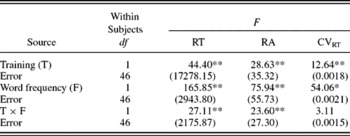
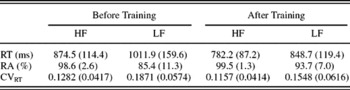
Because two participants did not attend all the training sessions, they were excluded from the data analysis. Table 1 lists ANOVA statistics of RT, RA, and CVRT; Tables 1 and 2Table 2 lists the means and standard deviations of RT, and RA, and CVRT scores under all the conditions.
ANOVA analyses of reaction time, response accuracy, and coefficient of variation of reaction time of lexical decision

Note: RT, reaction time; RA, response accuracy; CVRT, coefficient of variation of the RT. The values in parentheses are mean square errors.
*p < .001. **p < .0001.
Means (standard deviations) of reaction time, response accuracy, and coefficient of variation of reaction time under all conditions

Note: RT, reaction time; RA, response accuracy; CVRT, coefficient of variation of the RT; n = 47.
ANOVA
RT The analysis of RT was based on correct responses only. RT scores greater or less than 2 SD from the mean for each participant, across all conditions, were replaced with a value of 2 SD from the mean. The main effect of training was significant, F (1, 46) = 44.4, p < .0001; the RT scores in the pretest (M = 943.2, SD = 154.4) were significantly higher than those in the posttest (M = 815.4, SD = 109.2). There was also a significant main effect of word frequency, F (1, 46) = 165.9, p < .0001. This significant effect reflected the fact that high-frequency words (M = 828.3, SD = 111.3) were recognized significantly more quickly than were low-frequency words (M = 930.3, SD = 162.4). Furthermore, the two-way interaction between training and word frequency was significant, F (1, 46) = 27.1, p < .0001, suggesting that the differences in the RT scores with low-frequency words between the pre- and the posttest were larger than those with high-frequency words (see Table 2).
RA The analysis of RA was based on the rate (i.e., percentage) of correct responses. The main effect of training was significant, F (1, 46) = 28.6, p < .0001; the RA scores before the training (M = 92.0, SD = 10.5) were significantly lower than those after the training (M = 96.6, SD = 5.8). There was also a significant main effect of word frequency, F (1, 46) = 75.9, p < .0001, reflecting the fact that high-frequency words (M = 99.0, SD = 2.1) were recognized significantly more accurately than were low-frequency words (M = 89.5, SD = 10.3). Furthermore, the two-way interaction between training and word frequency was significant, F (1, 46) = 23.6, p < .0001. According to a post hoc analysis (i.e., the Scheffé test), the differences in the RA scores with low-frequency words between the pre- and the posttest were statistically significant (p < .0001), whereas such a statistical significance was not observed for high-frequency words. This appears to be because of ceiling effects with high-frequency words.
CV The CVRT scores were obtained for each stimulus type, by dividing the SD RT of the RT by the mean RT. The main effect of training was significant, F (1, 46) = 12.6, p < .0001; the CVRT scores before training (M = 0.158, SD = 0.058) were significantly higher than those after training (M = 0.135, SD = 0.056). There was also a significant main effect of word frequency, F (1, 46) = 54.1, p < .0001; the CVRT scores with low-frequency words (M = 0.171, SD = 0.061) were higher than those with high-frequency words (M = 0.122, SD = 0.042). Unlike the results of RT and RA, the two-way interaction between training and word frequency was not statistically significant, F (1, 46) = 3.1, p < .09. However, a post hoc analysis (i.e., the Scheffé test) showed that the differences in the CVRT scores with low-frequency words between the pre- and the posttest were statistically significant (p < .005), whereas such a statistical significance was not observed for high-frequency words.
Correlational analyses
Correlational analyses were carried to investigate (a) whether the improvement of word-recognition performance was because of automatization or simple speedup of word-recognition processing and (b) whether working memory affected the improvement of word-recognition processing.
The cross-sectional analysis of RT and CVRT revealed that, in both the pre- and the posttest, the participants’ RT and CVRT were weakly correlated in the processing of low-frequency words (r = .52, p < .0001 for the pretest; r = .40, p < .001 for the posttest), but not in the processing of high-frequency words (r = .26, ns for the pretest; r = −.20, ns for the posttest). This result suggests that individual differences in word-recognition performance with low-frequency words reflected automatization or efficiency of word recognition processing, whereas those with high-frequency words were not associated with automatization, but with simple speedup of word-recognition processing.
The within-subject analysis of RT and CVRT was also carried out to investigate whether gains in word-recognition speed were associated with automatization. Two types of scores (i.e., gain scores and residual scores) were calculated to measure each participant's word-recognition speed gain and automaticity gain. RT and CVRT gain scores were calculated simply by subtracting each participant's RT and CVRT scores for the posttest from those for the pretest. One needs to be cautious, however, in using these gain scores because either the pretest scores or the posttest scores could have a primary impact on the gain scores; therefore, they may not accurately reflect developmental changes or gains (Cohen and Cohen, Reference Cohen and Cohen1983). To avoid such a potentially misleading analysis, Segalowitz and colleagues (Reference Segalowitz, Segalowitz and Wood1998) suggested that “residual” be a safer measure because “[this] residual is an unambiguous measure of the degree of change from the Initial to Final test” (Segalowitz et al., Reference Segalowitz, Segalowitz and Wood1998, p. 61). Residual scores can be obtained by partialing out each participant’ score for the pretest from that for the posttest.
Results of the within-subject analysis of RT and CVRT showed that the correlations for low-frequency words in both gain and residual scores were found to be significant (r = .49, p < .001 for the gain score; r = .53, p < .001 for the residual score), but not for high-frequency words (r = .07, ns for the gain score; r = .25, ns for the residual score). This appears to suggest that although the participants gained word-recognition speed over the training sessions, there was a qualitative difference in the improvement of word-recognition fluency. That is, whereas the improvement in word-recognition speed with low-frequency words was associated with automatization, that with high-frequency words was associated with simple speedup.
In the analysis of RT and working-memory scores, the results of the gain and the residual scores were very similar; only those of the residual scores are reported here. Correlational analyses with changes in RT and working-memory scoresFootnote 5 showed that gains in RT were not associated with working-memory capacity (word span: r = −.12, ns for high-frequency words and r = −.06, ns for low-frequency words; reading span: r = .15, ns for high-frequency words and r = 0.11, ns for low-frequency words). Similar results were found in the relations between changes in CVRT and working-memory scores. No statistical significance was observed between changes in CVRT and working-memory scores (word span: r = −.13, ns for high-frequency words and r = −.05, ns for low-frequency words; reading span: r = −.14, ns for high-frequency words and r = −.09, ns for low-frequency words). These results seem to imply that individual differences in working memory capacity affected neither simple speedup nor improvement of word-recognition processing.
DISCUSSION
The present study addresses three issues. The first is the effects of word-recognition training on EFL word-recognition performance; both qualitative and quantitative differences in the development of EFL word-recognition performance were investigated. The second issue is the relations between word frequency and improvement in word-recognition performance. The study explored possible influences of word frequency on the effects of EFL word-recognition training. The third issue of the study is the contribution of working memory to improvement of word-recognition efficiency (automaticity) in EFL.
The results of the study showed that EFL learners benefited from word-recognition training in speed and accuracy. After the 7-week training, they recognized the target words more quickly and more accurately than they did before the training. This finding supports the first hypothesis that training in EFL word recognition improves word-recognition performance in speed and accuracy. It is also a significant finding that the training improved the learners’ word-recognition performance with a relatively small amount of exposure to words via simple practice.
In each training session, the learners were provided with a simple task: drawing slash marks between words with no interword spaces within 90 s, and over the training sessions, the learners were exposed to the target words only seven times. This training may appear to contradict the assertion of some L2 researchers and practitioners that the learner should be involved in the deep processing of words (e.g., learning vocabulary from context) in vocabulary learning, instead of learning words in isolation (Nation, Reference Nation2001). They argue that word-recognition practice, such as the one used in this study, may not lead the learner to access meaning during the practice, resulting in little contribution to vocabulary learning. This criticism against decontextualized vocabulary learning may be valid in learning new words that the learner has never encountered in speech or reading. When either phonological or orthographic representation provides no semantic information, simply activating a word's phonological or orthographic code is ineffective in acquiring the meaning of the word. However, when the learner has the oral vocabulary item in the lexicon, phonological, or orthographic coding is considered as playing an important role in vocabulary learning.
Stanovich (Reference Stanovich, Barr, Kamil, Mosenthal and Pearson1991), for example, highlights the importance of automatic semantic activation via the phonological or orthographic representation of a word. He argues that “there is no research evidence indicating that activating a word's phonological or orthographic code often takes place without meaning extraction, even in poor readers. To the contrary, a substantial body of evidence indicates that, even for young children, word decoding automatically leads to semantic activation” (Stanovich, Reference Stanovich, Barr, Kamil, Mosenthal and Pearson1991, p. 423). Read (Reference Read2000) also argues that vocabulary knowledge consists of its breadth (i.e., how many words the learner knows), depth (i.e., how well the known words are organized in the lexicon), and access (i.e., how quickly the learner can access the semantic information of a word). He proposes that semantic activation speed be one of the major components in L2 vocabulary assessment. In this respect, it is noteworthy that the participants in this study, who had already learned all the words before or during training, improved their word-recognition ability even via simple word-recognition exercises.
The results of the correlational analyses of changes in RT and CVRT underscored qualitative differences in improvement of word-recognition performance. Speci-fically, changes in RT and CVRT scores for low-frequency words were weakly correlated (r = .53, p < .001); those for high-frequency words, however, did not produce a statistical significance (r = .25, ns). This result appears to suggest that the improvement in word-recognition speed with low-frequency words was associated with automatization whereas that with high-frequency words was associated with simple speedup. This influence of word frequency on qualitative differences in word-recognition improvement was also shown in the ANOVA results from the CVRT data; the differences in the CVRT scores with low-frequency words between the pre- and the posttest were statistically significant (p < .005), but such a statistical significance was not observed for high-frequency words. These results support the second hypothesis of the study and are also consistent with those of previous studies on word recognition.
Discrepancy in word recognition between high- and low-frequency words has been observed in a number of studies on word recognition (e.g., Akamatsu, Reference Akamatsu2002; Fukkink et al., Reference Fukkink, Hulstijn and Simis2005; McCusker et al., Reference McCusker, Hillinger and Bias1981; Seidenberg, Reference Seidenberg1985; Seidenberg et al., Reference Seidenberg, Waters, Barnes and Tanenhaus1984). It is speculated that this discrepancy might reflect the nature of the dominant information used for semantic activation. The universal direct access hypothesis, for example, argues that familiar words are recognized via visual mediation or sight-word reading, whereas less familiar words are processed on a phonological basis in which knowledge of letter−sound correspondences and spelling patterns plays a crucial role (e.g., Seidenberg, Reference Seidenberg, Frost and Katz1992). Furthermore, Share (Reference Share1995) points out that “because orthographic information is acquired rapidly, high-frequency items are likely to be recognized visually with minimal phonological processing from the very earliest stages of reading acquisition” (p. 155).
In contrast with the item-based theories on discrepancy between high- and low-frequency words (e.g., Share, Reference Share1995), Segalowitz and colleagues propose a stage-based theory in L2 word-recognition development. They argue that an initial stage in the development of L2 word-recognition skills involves simply speeding up controlled processing (Segalowtiz & Segalowtiz, 1993). The learners in this stage improve word-recognition performance by increasing the speed of processing constituent letters. Their word-recognition speed and the stability of their word-recognition processing increase at more or less the same rate. Thus, their RT and SD RT decrease proportionally, resulting in no change in CVRT.
CVRT changes in the next stage that involves restructuring a word-recognition mechanism or increasing efficiency in word-recognition processing (Segalowitz et al., Reference Segalowitz, Segalowitz and Wood1998). When the learners begin improving their word-recognition skills by increasing their word-recognition efficiency (i.e., because of automatizing their word-recognition processing), their word-recognition processing stabilizes to a larger degree than their word-recognition speed increases. In other words, automatization of a word-recognition mechanism leads SD RT to decrease more drastically than RT. Subsequently, when word-recognition performance improves via automatization, CVRT is reduced. After the automaticity or efficiency of one's word-recognition mechanism reaches its optimal level, however, decreases in CVRT may not be observable. This is because once the readers become able to recognize words in a fully or nearly automatic manner, the word-recognition speed reaches asymptote (Ackerman, Reference Ackerman1987). It seems that this asymptote state was observed in the results with high-frequency words in this study.
As mentioned earlier, there were qualitative differences in the effects of training on word-recognition performance between high- and low-frequency words. Results indicated that individual differences in word-recognition performance with high-frequency words were not associated with restructuring the mechanism underlying word-recognition processing either before or after training. This appears to suggest that the EFL learners had already passed the automatization stage for the high-frequency words even before training. That is, the EFL learners had been so extensively exposed to the high-frequency words that they had recognized the high-frequency words in a fully automatic manner and the efficiency of their word-recognition mechanisms had been close to their optimal level. This asymptote state was also reflected in no significant correlations between gains in RT and those in CVRT. In contrast, the results with low-frequency words showed that the gains in RT during training statistically significantly correlated with those in CVRT, suggesting that their word-recognition performance was improved by restructuring the word-recognition mechanism. Note also that the effects of word-recognition training may not have been strong enough to lead the EFL learners’ word-recognition processing of low-frequency words to reach its optimal level. This was reflected on the results of the cross-sectional analysis of RT and CVRT that individual differences in word-recognition performance with low-frequency words were involved in automatization of the word-recognition mechanism even after training.
With respect to the third issue addressed in the study, the results provided no evidence that working-memory capacity contributes to the improvement of EFL word-recognition performance. There were no significant associations between changes in RT or CVRT and working-memory scores; the EFL learners with larger working-memory capacity showed no advantage in improving their word-recognition speed or word-recognition efficiency than those with smaller working-memory capacity. These results do not verify the third hypothesis that EFL learners with larger working-memory capacity have more advantages in benefiting from word-recognition training than those with smaller working-memory capacity. This hypothesis was based on the assumption that individual differences in working-memory capacity could lead to those in sight-word reading. With the same amount of print exposure, therefore, the EFL learners with larger working-memory capacity would have more advantages in automatizing the trained words (i.e., processing the words as units) than those with smaller working-memory capacity. One plausible reason for no associations between working memory and word-recognition improvement would relate to the simple nature of the task used in the word-recognition training (i.e., drawing dividing lines between words with no interword spaces). The word-recognition practice may have demanded so little cognitive load that no individual differences in working-memory capacity became observable.
CONCLUSION
In conclusion, consistent with the findings of previous studies on automaticity in L2 word recognition (e.g., Fukkink et al., Reference Fukkink, Hulstijn and Simis2005; Segalowitz et al., Reference Segalowitz, Segalowitz and Wood1998), the results of this study showed that word-recognition training was effective in improving EFL word-recognition performance in terms of speed and accuracy. The findings of the study also highlighted qualitative differences in the improvement of EFL word-recognition performance with respect to word frequency. The improvement in the processing of high-frequency words was associated with simple speedup; the processing of low-frequency words, on the contrary, was associated with automaticity. These differences may have reflected critical features in the developmental stages of word-recognition acquisition. Results also showed that working memory did not correlate with improvement in word-recognition speed or efficiency. This seems to suggest that larger working-memory capacity, which was measured by a reading span test, may not provide a noticeable advantage in improving word-recognition speed or efficiency.
Appendix A: A SAMPLE EXERCISE FOR THE WORD–RECOGNITION TRAINING SESSION
In the following, each letter string consists of five English words with no spaces between them. Please draw a line between each word as quickly and as accurately as possible within 90 s. (The instruction was written in Japanese for the original exercise.)
APPENDIX B
List of stimulus words

ACKNOWLEDGMENTS
The author is very grateful to the anonymous reviewers for their insightful comments on an earlier version of this paper.