


Introduction
Depression has strong self-perpetuating properties. Negative mood naturally draws efforts to think about causes and consequences that, although often initiated as an attempt at problem-solving, may easily lead into downward spirals (Watkins and Nolen-Hoeksema, Reference Watkins and Nolen-Hoeksema2014). Helping to disengage from such ruminative thinking is an important imperative in the treatment of acute depression. However, different strategies of achieving this aim may come with different benefits and costs.
Distracting oneself can effectively help to prevent spiralling of negative mood and thinking (Lyubomirsky, Caldwell and Nolen-Hoeksema, Reference Lyubomirsky, Caldwell and Nolen-Hoeksema1998; Lyubomirsky and Nolen-Hoeksema, Reference Lyubomirsky and Nolen-Hoeksema1993). Yet, distraction is likely to come at an expense in the long term as it may not lead into active attempts at coping and may have few benefits in terms of increasing regulatory skills. Recently, there has been considerable interest in the concept of mindfulness in this context, and mindfulness-based interventions have been shown to have significant effects in the prevention (for a recent meta-analysis see Piet and Hougaard, Reference Piet and Hougaard2011) and treatment (see for example Barnhofer et al., Reference Barnhofer, Crane, Hargus, Amarasinghe, Winder and Williams2009) of recurrent and chronic depression. In contrast to distraction, the adoption of a mindful stance entails bringing full awareness to the presence of negative thoughts and feelings. Mindfulness involves observing these thoughts and feelings from a “de-centred” perspective from which they are seen as transitory mental phenomena that do not require attempts at changing one's experience (Teasdale, Reference Teasdale1999).
Mindful “turning towards” initiates an effortful process that requires continuous observing of current experiences and the regulating of responses to them. In fact, as individuals bring awareness to their current experience, this experience is often augmented in its emotional impact and the modulating effect of mindfulness is seen not so much in initial emotional responses but in their further trajectory (Goldin and Gross, Reference Goldin and Gross2010). Yet, in depression, attentional control is undermined and patients often find it difficult to disengage from negative thoughts and images. Despite encouraging results from the use of mindfulness-based interventions in acute depression (e.g. Barnhofer et al., Reference Barnhofer, Crane, Hargus, Amarasinghe, Winder and Williams2009; Strauss, Hayward and Chadwick, Reference Strauss, Hayward and Chadwick2012), there has been concern that attempts at meditating during states of acute depression, that is when patients’ symptoms are severe enough to meet criteria for Major Depression, might reinforce rather than relieve negative mood, particularly if individuals have little experience with meditation practice (Teasdale et al., Reference Teasdale, Segal, Williams, Ridgway, Soulsby and Lau2000).
In order to investigate the relative costs and benefits of mindfulness and distraction in acute depression, we allocated depressed patients to receive minimal training of one-week duration in either mindfulness or guided imagery relaxation. While they are unlikely to yield lasting effects, research suggests that minimal interventions can be successfully utilized to gain insights into mechanisms of mindfulness (Zeidan, Johnson, Diamond, David and Goolkasian, Reference Zeidan, Johnson, Diamond, David and Goolkasian2010), and its early effects. Guided imagery was chosen as a control condition as it has been used in seminal studies on distraction and rumination (e.g. Lyubomirsky and Nolen-Hoeksema, Reference Lyubomirsky and Nolen-Hoeksema1993). Furthermore, the use of guided imagery relaxation potentially allows controlling for relaxing effects of meditation. Yet, while mindfulness training exercises attentional control and emotion-regulation, there is little emphasis on exercising these skills in guided imagery relaxation. The current test thus provided the opportunity to compare for the effects of the main distinguishing components.
Self-reports of current symptoms and self-regulatory functioning were assessed before and after the training, as well as at a one-week follow-up. We expected that both of the interventions would produce significant and equivalent reductions in symptoms, but that mindfulness training would produce significantly stronger gains in regulatory skills than the guided imagery relaxation. Furthermore, we explored relationships between changes in self-regulatory skills and changes in symptoms.
Method
Participants
Inclusion criteria were: (1) current diagnosis of major depression; (2) age between 18 and 65; (3) fluent in English. Exclusion criteria were: (1) high risk of suicide, history of psychosis, mania, recent self-harm, current eating disorder, OCD, substance abuse or dependence that would considerably interfere with the ability to engage in meditation; (2) current psychotherapy; (3) current meditation practice; and (4) change in antidepressant medication within 4 weeks prior to enrolment. Participants were recruited from waitlists of Improving Access to Psychological Therapies (IAPT) services in South London.
Measures
Current diagnostic status for Major Depression was determined using the Major Depression Module of the Structured Clinical Interview for DSM-IV Axis I (SCID-I; First, Spitzer, Gibbon and Williams, Reference First, Spitzer, Gibbon and Williams2002). Severity of depressive symptoms was measured using the Beck Depression Inventory II (BDI-II; Beck, Steer and Brown, Reference Beck, Steer and Brown1996), with instructions at post and follow-up assessments asking participants to rate symptoms within the past week.
Self-regulatory capacities were assessed using the following questionnaires: (a) the Five Facet Mindfulness Questionnaire (FFMQ; Baer, Smith, Hopkins, Krietemeyer and Toney, Reference Baer, Smith, Hopkins, Krietemeyer and Toney2006), a questionnaire that measures the general tendency to be mindful in daily life as reflected in the capacities to observe and describe experience, act with awareness, be non-judging of inner experience, and be non-reactive to inner experience (internal consistency of the total FFMQ score in the current sample was α = 0.86 at preintervention, α = 0.87 at postintervention, and α = 0.72 at follow-up); (b) the Decentring Scale of the Experiences Questionnaire (EQ; Fresco et al., Reference Fresco, Moore, van Dulmen, Segal, Ma and Teasdale2007), which assesses the ability to observe thoughts and feelings from a decentred perspective (in the current sample, the EQ had adequate internal consistency at preintervention, α = 0.78, postintervention, α = 0.82, and follow-up, α = 0.86); (c) the Difficulties in Emotion Regulation Scale (DERS; Gratz and Roemer, Reference Gratz and Roemer2004), which measures capacities for cognitive and behavioural regulation of emotions (in the current sample, the DERS total score had good internal consistency at preintervention, α = 0.85, postintervention, α = 0.89, and follow-up α = 0.91); and (d) the Attentional Control Scale (ACS; Derryberry and Reed, Reference Derryberry and Reed2002), which assesses differences in attentional control as reflected in the abilities to focus attention and flexibly use cognitive control (in the current sample, the ACS had good internal consistency at pre, α = 0.85, and postintervention, α = 0.86, but not at follow-up, α = 0.54).
Interventions
Mindfulness training
The mindfulness training consisted of a guided sitting meditation following the standard sequence of practices in mindfulness-based interventions (mindfulness of breath, body, sounds, and thoughts). The recording was taken from the guided meditation practices CD of Williams, Teasdale, Segal and Kabat-Zinn (Reference Williams, Teasdale, Segal and Kabat-Zinn2007). The practice was introduced in a one-hour one-to-one session at the start of the intervention period. The session began with a brief introduction, in which the trainer provided the rationale for the practice, after which the participant and the trainer practised the meditation together, listening to the guided meditation. The rationale highlighted the use of mindfulness to become better able to recognize and disengage from maladaptive patterns of thinking. Following the practice, participants were asked for their experiences, and feedback was used to facilitate the planning of home practice. The participant was then given the mindfulness CD and a log-sheet, and was asked to practise the meditation once a day for the following 6 days, and to record on the log-sheet whether they had practised using the 30 min guided meditation on each of the 6 days. Participants were asked to be accurate in the completion of the log-sheet and were told that, if they missed a day of practice, it would be preferable to state so. In case they had questions, participants were able to contact the trainer via telephone or email.
Guided visual imagery
The control intervention consisted of a brief relaxation training using guided visual imagery (Kingston, Chadwick, Meron and Skinner, Reference Kingston, Chadwick, Meron and Skinner2007). The relaxation training paralleled the mindfulness training in terms of therapist contact, time demand, and mode of delivery.
Both trainings were administered by a trained clinical psychologist (AC), who was supervised by an experienced mindfulness teacher (TB). All participants were free to continue their respective practice following the one-week intervention, but were not explicitly asked to do so.
Procedure
Interested patients were contacted by telephone and assessed for eligibility using the SCID-I interview. Those who were eligible were randomly allocated to one of the two trainings and invited for a research appointment, in which they completed the self-report measures, received the intervention, and were provided with the practice CD and log-sheets for home practice. In the second research appointment (one week after the first), participants brought the completed log-sheet, completed the measures again, and were reimbursed with £20. The assessor was not blind to group allocation, yet assessments were based on self-reports on questionnaires that the participants completed in private. The one-week follow-up consisted of an e-mail with a link to complete the measures online, or, alternatively, a letter with the measures and a pre-paid envelope. We also assessed whether and how much participants had continued to practise following the intervention period. Randomization was conducted following a simple randomization protocol using sealed envelopes. After participants had completed measures of the first assessment, the researcher picked one envelope and allocated the participant to the assigned intervention.
The study had received ethical approval from the South London and Maudsley NHS Ethics Committee (12/LO/1952).
Statistical analysis
Changes in symptoms and self-regulatory capacities over the different points of assessment were analysed using repeated measures ANOVAs. Factors related to change between assessments were explored using multiple linear regression analyses.
Results
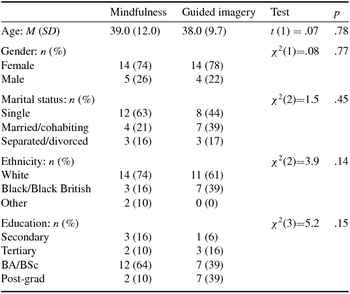
Of the 140 individuals contacted by telephone, 54 met inclusion criteria. Fourteen chose not to participate and 40 gave written consent and were randomized (n = 20 in each group); three participants dropped out after the posttreatment assessment due to unforeseen life events (2 from relaxation, 1 from mindfulness). The groups were comparable in terms of age, M = 38.5, SD = 10.85, and gender distribution, n female (%) = 28 (76), (see Table 1 for comparisons). Participants of both groups reported good adherence during the intervention (mindfulness: Mdn = 180, range: 120–210 min; guided imagery: Mdn = 180, range: 120–210), with the mindfulness group continuing practice on the same level during follow-up (Mdn = 180, range: 120–210 min; Wilcoxon signed rank Z = −.41, p = .67), and the guided imagery group reporting significantly lower levels of practice during follow-up (Mdn = 120, range: 0–240 min; Wilcoxon signed rank Z = − 2.50, p = .01).
Sociodemographic characteristics of participants receiving mindfulness training (n = 19) and guided imagery (n = 18)

A 2 (group: mindfulness versus guided imagery) × 3 (time: pre versus post versus follow-up) repeated measures ANOVA of BDI-II scores yielded a significant main effect of time, F(2, 70) = 45.5, p = .000, η 2 = .56, while there was no significant main effect for group, F(1, 35) = .78, p = .38, η 2 = .02, and no significant group by time interaction, F(2, 70) = .98, p = .38, η 2 = .02. Repeated measures ANOVAs to follow up the main effect for time showed significant reductions in symptoms from pre to posttreatment, BDI-II: F(1, 35) = 54.7, p = .000, η 2 = .61, but no significant changes in symptoms from posttreatment to follow-up assessment (p > .10). At the follow-up assessment, 9 out of 19 participants in the mindfulness group and 6 out of 18 participants in the relaxation group met criteria for “caseness” on the BDI-II (a score of 20 or higher), χ 2(1, 37) = .75, p = .35.
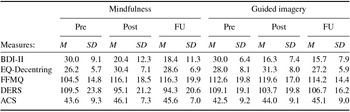
Similar analyses for self-regulatory variables, using Bonferroni correction for multiple tests, yielded significant effects of time for all of the dependent variables except the ACS score (EQ decentring: F(2, 70) = 6.8, p = .002, η 2 = .16; FFMQ: F(2, 70) = 8.5, p = .000, η 2 = .19; DERS: F(2, 70) = 5.9, p = .004, η 2 = .14; ACS: F(2, 70) = 4.3, p = .017, η 2 = .11), while there were no significant group or group by time interactions (all p > .10). There were significant changes from pre to postintervention (FFMQ: F(1, 35) = 13.7, p = .001, η 2 = .28; DERS: F(1, 35) = 9.7, p = .004, η 2 = .21; ACS: F(1, 35) = 6.7, p = .014, η 2 = .16), but no significant changes from postintervention to follow-up (all p > .10) for all self-regulatory variables except EQ-decentring, which showed significant increases from pre to posttreatment, F(1) = 20.1, p = .000, η 2 = .36, followed by significant reductions from posttreatment to follow-up, F(1) = 7.8, p = .008, η 2 = .18, thus reflecting a significant quadratic trend, F(1) = 22.4, p = .000, η 2 = .39 (see Table 2 for descriptives).
Means and Standard Deviations of symptom and cognitive functioning measures at preintervention, postintervention and follow-up in participants receiving mindfulness training (n= 19) and guided imagery relaxation training (n = 18)

Notes: BDI-II = Beck Depression Inventory II; RRS-Brooding = Ruminative Response Style Questionnaire-Brooding scale; EQ-Decentring = Experiences Questionnaire-Decentring scale; FFMQ = Five Facets Mindfulness Questionnaire; DERS = Difficulties in Emotion Regulation Scale; ACS = Attentional Control Scale
In order to investigate changes in self-regulatory variables over and above those associated with changes in depressive symptoms, we repeated analyses using pretreatment to follow-up symptom change as a covariate. This yielded significant group by time interactions for FFMQ, F (2, 68) = 3.85, p = .02, η 2 = .10, and DERS, F (2, 68) = 3.68, p = .03, η 2 = .10. Univariate ANCOVAs to follow-up the group by time interaction in FFMQ scores showed no significant group differences at any of the three assessment points. For DERS scores, there were significant differences at follow-up, F (1, 34) = 5.68, p = .02, η 2 = .14, but not at pre and postassessment. When the analyses of DERS scores were repeated with the amount of time participants practised the exercises, the interaction effect was rendered non-significant, F(2, 68) = 1.98, p = .14.
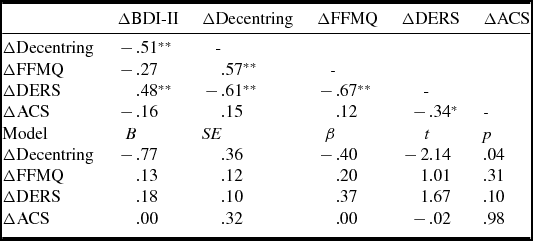
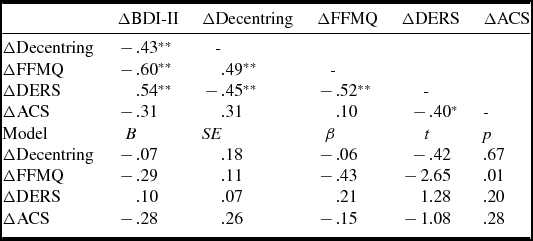
In order to investigate factors involved in symptom improvements, we explored relations between changes in symptoms and changes in self-regulatory variables. These analyses were exploratory in nature and need to be interpreted cautiously as differences in scores are less reliable than their composites. In a multiple linear regression analysis predicting pre to postsymptom change from change in self-regulatory variables, change in EQ-decentring emerged as a significant predictor with higher increases in decentring predicting more pronounced improvements in symptoms. In an identical analysis investigating post to follow-up symptom change, change in FFMQ scores emerged as the only significant predictor with higher post to follow-up increases in mindfulness predicting more pronounced improvements in symptoms (see Tables 3a and 3b).
Correlations of pre to post changes in BDI-II and self-regulatory variables and regression analysis predicting change in depressive symptoms from pre to postassessment (N = 37)

Notes: Δ = pre to postassessment change; Decentering = EQ decentering scale; FFMQ = Five Facet Mindfulness Questionnaire; DERS = Difficulties in Emotion Regulation scale; ACS = Attentional Control Scale
* p < .05, ** p < .01.
Correlations of post to follow-up changes in BDI-II and self-regulatory variables and regression analysis predicting change in depressive symptoms from post to follow-up assessment (N = 37)

Notes: Δ = post to follow-up assessment change; Decentring = EQ decentring scale; FFMQ = Five Facet Mindfulness Questionnaire; DERS = Difficulties in Emotion Regulation scale; ACS = Attentional Control Scale
* p < .05, ** p < .01
Discussion
Given the high rates of adherence in our sample and the tendency to continue practising after the end of the intervention observed in the mindfulness group, the current findings suggest that both mindfulness meditation and guided imagery relaxation are feasible and acceptable for currently depressed patients. Participants in both groups showed significant decreases in symptoms within the actual intervention period and gains were maintained during the brief follow-up period, in which participants were free to practise on their own terms.
Among the different self-regulatory skills investigated, the ability to decentre from negative thinking emerged as the most important skill for achieving this initial reduction in symptoms. Although training in mindfulness is specifically aimed at increasing meta-cognitive awareness and thus to facilitate decentring, the two trainings were equally effective in improving this capacity, thus indicating different pathways to establishing this skill. The guided imagery training used as a control condition required participants to repeatedly disengage from ruminative thinking and focus on imagery, and changes in how patients relate to their thinking may have arisen from this experience as implicit or explicit learning. In contrast, mindfulness explicitly focuses on training decentring. However, it is possible that advantages of explicit training in this skill may only become visible with more extensive practice. While early stages of training may serve to establish awareness of decentring as a strategic option, more extensive training may be necessary to effectively strengthen supporting cognitive and attentional functions that would support a more flexible use. Mindfulness meditation is regarded as a transformative technique and effects of brief periods of training are unlikely to be sustained without continuing practice.
Once levels of depression had been reduced to a moderate to mild range and maintenance of gains had become a more prominent task, changes in mindfulness skills became the most dominant predictor of symptom change. This finding is consistent with the currently recommended use of mindfulness in the treatment of depression and the assumption that maintenance of gains comes with more complex demands than symptom reduction. When we compared the trainings while controlling for changes in current symptoms, we found that the mindfulness training showed significant advantages in decreasing difficulties in regulating emotion. This suggests that in order to improve regulatory skills over and above levels that are explainable by reductions in symptoms, more intentional and effortful training is needed. Indeed, our analyses showed that levels of practice significantly accounted for the observed effect. Interestingly, practice of relaxation during follow-up was significantly lower than during active treatment: thus for sustained development of decentring, mindfulness may be a more acceptable intervention than guided imagery, even in acutely depressed patients.
Given the restricted nature of the study, there are a number of limitations to take into account. First, the study is based on a small sample of participants, which has provided only limited power to detect differences between mindfulness training and relaxation as both represent active interventions. Second, all assessments relied on self-report, which may be subject to reporting biases. Third, in the absence of a no-treatment control condition, it is difficult to know the actual size of effects attributable to the interventions. Despite significant reductions, most patients continued to experience at least mild symptoms and while, consistent with previous research (Ilardi and Craighead, Reference Ilardi and Craighead1999), our findings suggest that a certain degree of reductions in symptoms can be achieved rapidly, it is important to keep in mind that reaching full recovery constitutes a much more difficult challenge. Fourth, the study encompassed only a very limited follow-up period and evidence is therefore restricted to the short-term effects of the two interventions. Fifth, the current sample consisted mainly of participants who were female, white and highly educated, and further research would have to demonstrate how far results generalize to other groups.
Altogether our findings suggest that use of mindfulness meditation in acute depression is feasible and can be reasonably helpful in reducing symptoms and maintaining early gains. Whilst there is little evidence for specific efficacy at early stages of training as other means of helping patients to decentre from ruminative thinking seem equally beneficial, mindfulness training, even in small amounts, may become increasingly helpful as patients manoeuvre their way from acute stages towards recovery, fostering relevant regulatory skills.
Acknowledgements
The authors would like to thank Dr Janet Wingrove, Jeremy Oliver, Hielkje Verbrugge, and Leslie Rossouw for their help in recruiting the clinical sample, and Professor Paul Chadwick for his support and invaluable advice during all stages of this project.
Financial support: This research received no specific grant from any funding agency, commercial or not-for-profit sectors.
Conflict of interest: None.
Ethical standards: The authors assert that all procedures contributing to this work comply with the ethical standards of the relevant national and institutional committees on human experimentation and with the Helsinki Declaration of 1975, as revised in 2008.



Comments
No Comments have been published for this article.