INTRODUCTION
In recent decades, dramatic developments in genetics research—such as the course of events leading up to the decoding of the human genome and the new directions in bioscientific investigation this historic event subsequently made possible—have begun to transform not only the practice of medicine but also conceptions of the social world, from human nature to human interrelatedness (Bliss Reference Bliss2018; Condit Reference Condit1999; Conley and Fletcher, Reference Conley and Fletcher2017; Kevles and Hood, Reference Kevles and Hood1992; Nelson Reference Nelson2016; Panofsky Reference Panofsky2014). Genetics has captured the public imagination in myriad ways; in the media, in popular culture, and in everyday conversation, Americans routinely link genetics to individual behavior and social outcomes (Heine Reference Heine2017; Nelkin and Lindee, Reference Nelkin and Lindee1995). As Abby Lippman (Reference Lippman1991) put it, the late twentieth century ushered in the “geneticization” of increasing spheres of social life, “with most disorders, behaviors, and physiological variations defined, at least in part, as genetic in origin” (p. 19).
Confirming this observation, Toby Jayaratne and collaborators (2002) found that survey respondents associated social inequality with genetics. The historical record demonstrates that essentialist, biological concepts of race—as well as other social categories—have at times justified inequality and prejudice (Graves Reference Graves2001; Jones Reference Jones1993). As Keith Wailoo (Reference Wailoo1999) details, the genetic disease sickle cell anemia has been used to “endorse social order and lines of segregation in America” such that it became a justification, in some quarters, for anti-miscegenation laws (p. 254). Although Troy Duster (Reference Duster1990) presciently cautioned that genetics research proceeding from a priori assumptions of human difference might contribute to the production of biologically-based categories of social stratification anew, the extent to which contemporary genetic determinism has permeated ideas about race in particular is only beginning to be established (Lee et al., Reference Lee, Mountain and Koenig2001; Phelan et al., Reference Phelan, Link and Feldman2013; Roth and Lyon, Reference Roth, Lyon, Suzuki and von Vacano2018).
Several prominent social researchers contend that biological definitions of race have lost ground in the United States over the last fifty years (Bobo et al., Reference Bobo, Kluegel, Smith, Tuch and Martin1997; Schuman et al., Reference Schuman, Steeh, Bobo and Krysan1997). According to Lawrence D. Bobo and colleagues (1997), the overt anti-Black “Jim Crow racism” that distinguished early twentieth-century White racial attitudes gave way, by the century’s close, to a more covert “laissez-faire racism,” characterized in part by a decline in support for biological theories of race. Richard A. Apostle and colleagues (1983) concluded that American society was “well past the era in which genetic explanations [of racial difference] were dominant” (p. 229). Social scientists have attributed the downward trend in explicit anti-Black attitudes among Whites to a shift from biologically-based explanations for African Americans’ socioeconomic status to volitional and cultural explanations (Bobo et al., Reference Bobo, Kluegel, Smith, Tuch and Martin1997). Less explored is the fact that this change in public opinion owed in part to a concerted effort by social scientists and some scientists to debunk biological theories of racial difference in the aftermath of the atrocities of World War II (Barkan Reference Barkan1992; Stepan Reference Stepan1982), which culminated in the UNESCO Statement on Race of 1950 that concluded “there is no biological reality to the concept of race” (UNESCO 1952, p. 7). This “cultural turn” in race-thinking was bolstered, and to some extent authorized, by new developments in human population genetics (Cavalli-Sforza and Bodmer, Reference Cavalli-Sforza and Bodmer1971; Reardon Reference Reardon2004).
At present, scientific thinking on race—and the effect of these ideas on racial attitudes—is less definitive. Some scholars have argued that race never lost its currency in the sciences, just its acceptability (Bliss Reference Bliss2012; Fujimura and Rajagopalan Reference Fujimura and Rajagopalan2011; Reardon Reference Reardon2004). Richard S. Cooper (Reference Cooper2003), for example, likens the present-day association of race and genetics among scientists to “new wine in old bottles” (p. 23). Others suggest that biological thinking about race is having a resurgence (Brubaker Reference Brubaker2015). Ann Morning (Reference Morning2008) found that after a mid-twentieth century decline, there has been a steady increase in the use of biological notions of race in science textbooks. Similarly, Sandra S. J. Lee and colleagues (2001) argue that a renaissance in biological conceptions of racial difference has emerged concurrent with the development of genomics; the authors caution that the parsing of groups by race, even for the well-intentioned, if unproven, purpose of eliminating health disparities, may lead to the “reification of race,” and in turn, produce stigmatization and discrimination. Whether these ideas are the product of old scientific thinking or new scientific techniques, and regardless of how they have waxed or waned in the last several decades, their proliferation in the media combined with recent advances in genetics may be producing a new public consensus about the social implications of race and heredity (Condit et al., Reference Condit, Parrott, Harris, Lynch and Dubriwny2004). As well, these developments may be having an effect on how people think about race today, especially among the well-educated—the sector of the public most likely to be knowledgeable about contemporary genetic science.
At the crossroads of two trends—on one hand, the post-World War II recoil from biological accounts of racial difference, and on the other, the growing admiration for the advances of genetic science—the American public’s conception of race is a phenomenon that merits greater attention from sociologists than it has received to date. Despite the centrality of race to academic and lay discussions of American society, quantitative research on public conceptualizations of race—our definitions of what race is and our understandings of how races differ from each other—has been surprisingly limited (Condit et al., Reference Condit, Parrott, Harris, Lynch and Dubriwny2004; Morning Reference Morning2011). Instead, social scientific research has focused on racial attitudes, particularly evaluations of minority racial groups and opinions regarding race relations and policies (Bobo Reference Bobo, Smelser, Wilson and Mitchell2001). And, although such empirical data have been used at times to surmise whether respondents understand racial differences as the product of nature or nurture, they are not collected with such a goal in mind (Krysan Reference Krysan1998; Schuman et al., Reference Schuman, Steeh, Bobo and Krysan1997). In order to better understand the extent of support for biological conceptions of racial difference and the prevalence of biological justifications for social inequality, this paper uses a list experiment method to explore the following research questions: (1) What is the true proportion of support for genetic explanation of racial inequality? (2) Is there a social desirability effect? and (3) How do true support and social desirability vary by social status?
LITERATURE REVIEW
Academic studies of essentialism and constructionism in general, and of racial concepts in particular, frequently suggest that lower social status—whether female as opposed to male (Lieberman Reference Lieberman1997), Black versus White (Jayaratne Reference Jayaratne2002; Shanklin Reference Shanklin2000), or the poor compared to the more affluent (Littlefield et al., Reference Littlefield, Lieberman and Reynolds1982)—tends to be associated with a rejection of biological notions of difference (Morning Reference Morning2011). As Jerry A. Stark and colleagues (1979) hypothesized, “those who have benefited more from the extant structure of social relationships will tend to grant more legitimacy to the use of a concept reflecting and supporting that structure” (p. 97); this view is a common feature of more theoretical literature on constructionism as well (Gergen Reference Gergen, Velody and Williams1998; Shakespeare Reference Shakespeare, Velody and Williams1998). It should be noted, however, that other researchers suggest that both the more highly-educated and those in higher-level occupations are more likely to reject biological notions of race (Apostle et al., Reference Apostle, Glock, Piazza and Suelzle1983; Stark et al., Reference Stark, Reynolds, Lieberman, Jones and Kuklick1979). In addition to the factors of gender, race, or class, researchers have also suggested that age plays a role—specifically, younger people may be more likely to reject racial essentialism—but it is unclear whether these findings reflect a life-course trend or a cohort effect reflecting the ideas that prevailed in a given generation’s period of youth and formative education (Lieberman and Jackson, Reference Lieberman and Jackson1995). Finally, place of residence may be associated with racial conceptualization. When Stark and colleagues (1979) asked survey respondents their opinion of the anti-essentialist statement, “No races exist now or ever did,” those who agreed were much more likely to live in the Northeast or the West than those who did not (83% versus 57%).
However, these examinations of the status correlates of support for racially essentialist attitudes do not always systematically account for the bias introduced by socially-desirable reporting—that is, when survey participants report the answers they believe to be most in keeping with social mores, rather than their true opinion.Footnote 1 Survey data on racial attitudes has proven to be significantly affected by social desirability bias. Social desirability effects can distort survey data through the over-reporting of opinions that are socially acceptable or the under-reporting of socially-unacceptable ones, making it difficult for researchers to ascertain true support for a query about racial attitudes and to accurately discern the relationships between variables. Thus, the downward time trend in Whites’ ascription of racial disparities to Blacks’ lesser “in-born ability” detailed above (Schuman et al., Reference Schuman, Steeh, Bobo and Krysan1997) may say more about changing social mores concerning race-related discussion than it does about fundamental shifts in belief. Such a conclusion is also supported by discourse analysis of Whites’ race-related conversation (Bonilla-Silva Reference Bonilla-Silva2003; Frankenberg Reference Frankenberg1993).
Sociodemographic factors including gender, class, race, region, and education have been shown to influence social desirability effects. Socially-desirable reporting is significantly gendered; both male and female survey responses to questions about housework, gender roles, and relationship expectations are typically consistent with prevailing cultural norms (Press and Townsley, Reference Press and Townsley1998; Theriault and Holmberg, Reference Theriault and Holmberg1998). Using longitudinal national sample data, Monica K. Johnson and Margaret M. Marini (Reference Johnson and Marini1998) found that White women expressed more favorable attitudes toward Blacks than did White men, a characteristic that is consistent with women’s socialization and the social expectation that they be more empathetic and “out-focused” than men. However, in a complementary study, White women were more likely than White men to support policies to promote equality for Blacks in principal, yet they were no more likely than White men to support government funding for programs to help Blacks to improve their lot (Bobo and Kluegel, Reference Bobo and Kluegel1993).
This discrepancy suggests a gendered social desirability effect with regard to racial attitudes. Although those with advanced levels of education, and as a consequence, more familiarity with publicly-acceptable racial attitudes, have been associated with strong social desirability effects (Jackman and Muha, Reference Jackman and Muha1984); acquiescence bias (a tendency to agree with survey statements and/or the interviewer) has been documented among the less-educated (Jackman Reference Jackman1973). Acquiescence bias is also present for other social categories; respondents are more likely to agree with interviewers who share their race (Davis Reference Davis1997) or gender (Kane and Macaulay, Reference Kane and Macaulay1993). Contrary to studies that found White racial attitudes towards Blacks to be consistent across regions of the United States (e.g., Schuman and Bobo, Reference Schuman and Bobo1988), James H. Kuklinski and colleagues (1997) found that White Southerners did not express their true racial attitudes in surveys, but rather they responded with more socially-acceptable opinions. While a number of studies have attempted to measure social desirability bias with regard to racial attitudes, most have focused on racial policy preferences rather than genetic accounts of racial inequality (Krysan Reference Krysan1998; Schuman et al., Reference Schuman, Steeh, Bobo and Krysan1997). Given the growth of genetic explanations for biological and social phenomena alike in the public sphere, social scientists should devote serious effort to gauging the extent to which socially-desirable survey response obscures the incidence of essentialist ideas of racial difference.
RESEARCH DESIGN
Methodology
To measure the extent to which social desirability curtails respondents’ support for essentialist explanations of racial difference, we employ a “list experiment” design (Kuklinski et al., Reference Kuklinski, Cobb and Gilens1997). This approach calls for the random assignment of survey participants to either a baseline group or an experimental (or “test”) group. Members of the baseline group were presented with three statements. None of the statements for this group were related to the construct of interest (i.e., genetic conceptualization of race). Respondents were asked to indicate the number of statements (from zero to three) with which they agreed. However, they were expressly instructed to not reveal which exactly were the statements with which they agreed or disagreed. The baseline group question ran as follows:
Please tell us with how many of the statements listed below you agree. We don’t want to know which ones, just how many.
• The U.S. military action in Iraq will ultimately make the United States safer.
• The space program is a waste of taxpayer money.
• Immigration is good for the economy.
Number of statements you agree with: _______
Next, the experimental group was presented with the same statements and instructions. However, in addition, the statement “Genetic differences contribute to income inequality between Black and White people” was added to the end of the list, bringing the total number of statements to four. The added “test” statement was designed to measure belief in race having a genetic underpinning. Again, respondents in the experimental group were instructed to indicate the number of items they agreed with (which now could range from zero to four)—but not which items in particular.
Comparison between the baseline and test groups’ results is the list experiment’s fundamental strategy for estimating the degree of “true” support for a given statement in an unobtrusive way. As Kuklinski and colleagues (1997) explain:
The logic of the analysis is to compare the average number of items named in the test condition, with its maximum of four, to the average in the baseline condition, with its maximum of three. More precisely, subtracting the baseline from the experimental mean and multiplying by 100 provides an estimate of the level of anger directed toward the race item. Suppose, for example, that the estimated means in the baseline and test condition are 2.0 and 2.5, respectively. Because there is only one additional item in the test condition, the only way that the 0.5 increase can occur is for half of the treatment group to express anger at the race item (p. 328).
Note the assumption—based on the random assignment of individuals to either the baseline or experimental group—that had the experimental group been given only three statements, its average number of statements agreed with would be the same as the mean observed in the baseline group (i.e., 2.0 statements in the example given above). We also assume that the number of statements that respondents face does not affect their likelihood of agreeing with those items.
The method described by Kuklinski and colleagues aims to provide an unobtrusive measure of “true” support for the sensitive fourth, “test” statement on race—that is, a measure that is unbiased by socially-desirable reporting. However, to gauge the magnitude of the social desirability effect, this indicator of “true” support must be compared to a measure that does incorporate a social desirability bias. For this reason, we introduce a third, “comparison” group of respondents. The members of this group were presented with the same four statements that the test group respondents had faced, but instead of being asked to report the number of items they agreed with, the comparison group subjects were asked directly whether they agreed or not with each of the statements. The result is a series of proportions indicating the share of respondents who agreed with each statement. In particular, the proportion who openly agreed with the race-related fourth statement was then subtracted from our estimate of the “true” support for it in order to calculate the magnitude of the social desirability effect.
The list-experiment approach represents an important innovation in the measure of social desirability effects. First, social desirability is often suggested as a factor when interpreting sensitive survey results, yet its effect is rarely quantified. Second, attempts to measure social desirability through questions designed to gauge individuals’ likelihood of reporting socially desirable answers suffer from this source of bias themselves. For this reason, the unobtrusive approach employed in the list experiment—notably, its non-identification of any given individual’s opinion—is unlikely to provoke respondent concerns about revealing their true beliefs. Our project builds further on Kuklinski and colleagues’ development of the list experiment in two ways. First, as already mentioned, we include a third comparison group that permits us to estimate the presence and size of social desirability effects. Second, we make explicit the calculation of standard errors for our estimates of both true support for the sensitive statement and any social desirability effect. We are especially interested in the effect of education. Although most studies find that education is associated strongly and negatively with racist attitudes (e.g., Sniderman et al., Reference Sniderman, Piazza, Tetlock and Kendrick1991), this could at least in part be due to increased social desirability effects among the better educated. The difference in the mean number of items chosen between the test group and the comparison group should be higher among college-educated respondents than among others if this hypothesis were correct.
Once the degree of “true support” for the statement on genetics and racial inequality is estimated, the standard error for the estimate can be calculated by treating it as a difference between means. Even though we interpret the “true support” figure as a proportion (e.g., 50% of respondents truly support the race statement), the point estimate is calculated by taking the difference between the baseline and the experimental mean number of items supported. (Our hypothesis is that the experimental mean is greater than the baseline mean, so their difference is greater than zero.) Consequently, the standard error for the estimate of “true support” is calculated by deriving the standard error of the distribution of mean differences. We do so using a pooled estimator of the underlying population variance and incorporating the assumption that the baseline and test groups are independent samples (Carlson and Thorne, Reference Carlson and Thorne1997).
Data
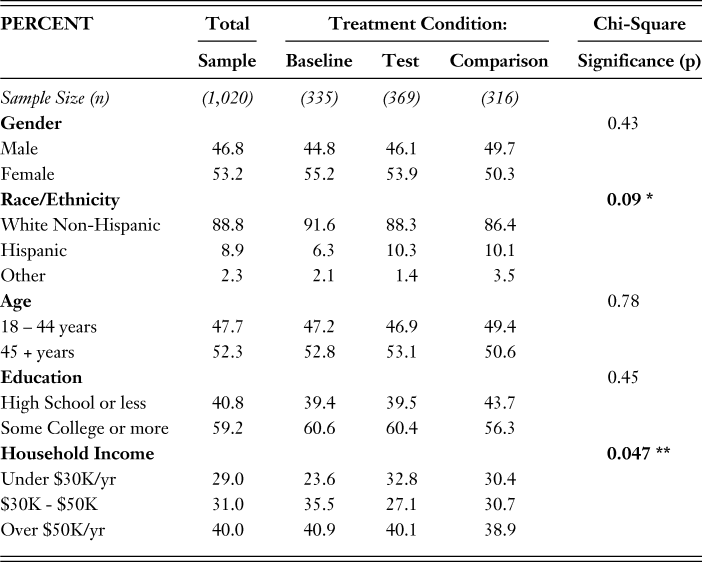
Thanks to the NSF-funded project Time-sharing Experiments in the Social Sciences (TESS), we were able to add a question module to the omnibus survey that TESS regularly constructs and fields. Our sample consists of 1,020 adults aged eighteen and over, randomly selected from across the nation to participate in a Web-based survey. Potential respondents were sampled using random-digit dialing. Once contacted, they were offered free internet access in exchange for participation in multiple Web-based marketing and research surveys. Consequently, our subjects may have participated in other online surveys prior to ours. Sociodemographic characteristics of the sample are reported in Table 1. Because our survey includes a measure of anti-Black prejudice, African Americans were excluded from the sample. 89% of the respondents identified themselves as White and non-Hispanic, while 9% identified as Hispanic.
Socio-Demographic Characteristics of Sample, by Experimental Treatment Condition

Key: * indicates statistical significance at the 90% level; ** indicates significance at the 95% level.
Collecting data via the internet offers certain advantages over telephone, in-person, or written surveys. They may be easier than the first two in that they permit respondents to read the questions for themselves and to go back over one or more items at will. As a result, this format may be particularly effective for list experiments like ours because such experiments could contain more items, and more complex contents could be communicated than is possible in a personal interview. However, a possible drawback of the written format is that having time to think carefully about the items without an interviewer waiting for the response may increase social desirability and thereby defeat the purpose of the list experiment. We also expect that a web-based survey will be less susceptible to socially desirable reporting than telephone (or in-person) interviews, because it is self-administered (Fowler Reference Fowler1995). Given the range of potential effects of the survey mode on list-experiment measurements of socially desirable reporting, which we will be able to explore in future comparisons of our internet to our telephone interview results, we expect this research to yield valuable information for future research on the measurement of social desirability effects.
FINDINGS
Randomization
Before going on to the list experiment results, we briefly address the question of whether randomization was in fact successful. Through random assignment, 335 respondents were assigned to the baseline group, 369 to the test group, and 316 to the comparison group, for a total sample size of 1020. To check that no group had strongly disparate characteristics compared to the others, we examined the composition of each group in terms of gender, age, education, household income, region, urban residence, and Hispanic ethnicity (see Table 1). More specifically, we used chi-square analyses to determine whether treatment group assignment showed any relationship to these socio-demographic factors, rather than being independent of such characteristics. Our expectation that randomization had been successful and group assignment carried out without regard to socio-demographic characteristics was largely borne out, with two exceptions. First, the share of non-Hispanic Whites varies somewhat across groups, from 86% of the comparison group to nearly 92% of the baseline group. This distribution could bias our estimate of the social desirability effect upward, as White underrepresentation in the comparison group could depress that group’s agreement with the race statement and thus inflate its calculated difference from our estimate of “true” support. As a robustness check, we conducted all analyses reported below for White respondents only, obtaining virtually identical results (tables available per request). Second, household income demonstrated an even greater relationship to treatment group status, such that the baseline group has a disproportionately large middle-income share and small lower-income share relative to the test and comparison groups. As suggested by one anonymous reviewer, we reran the analyses using a weight calculated such that the income distribution in the baseline group corresponds to that found in the treatment and comparison groups. Again, the results are very similar (available upon request). In the following we report differences between the baseline and experimental group (Table 2) and conduct significance tests with the null hypothesis that there is no difference between the two groups with respect to the number of items respondents agree with. We also report differences between specific groups of respondents (e.g. males and females) and conduct significance tests with the null hypothesis that there are no group differences in beliefs about genetic causes of inequality. We also report differences between the estimated level of support from Table 2 and the support for the item in the comparison group (Table 3) to measure social desirability. We test whether social desirability is present, and whether there are any group differences in social desirability.
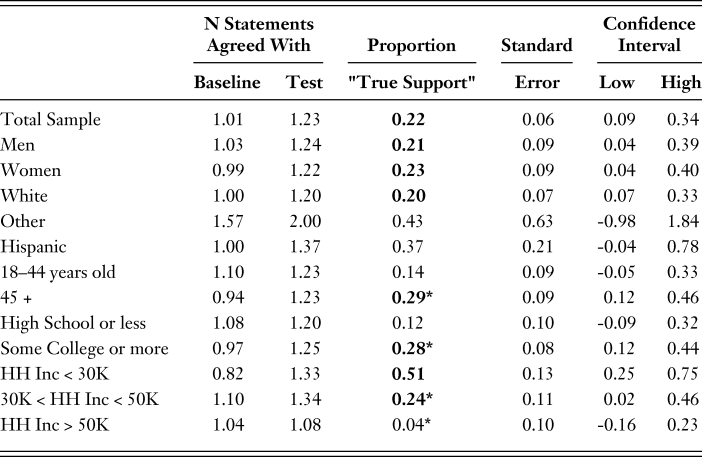
Calculation of "True Support" for Genetic Explanation of Racial Inequality

Note: Estimates in bold are statistically significant at the 95% level.
* indicates a statistically significant difference between a subgroup’s proportion of “true support” and that of its reference group (i.e. the first category listed for each variable).
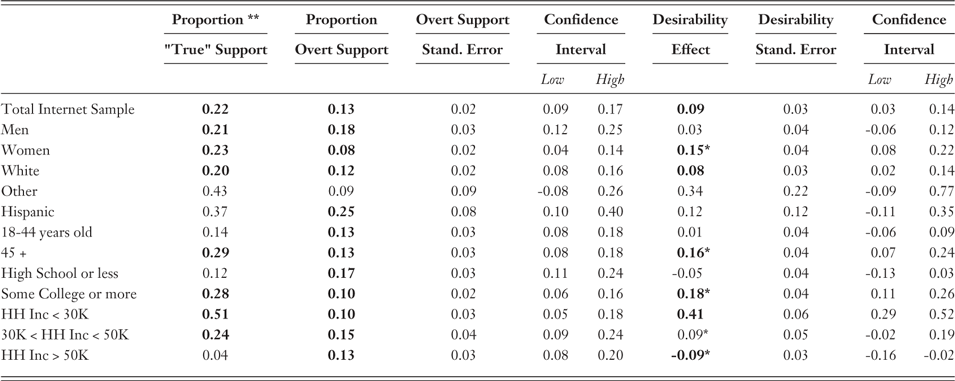
Estimates of Social Desirability Effect on Support for Genetic Explanation of Racial Inequality

Note: Estimates in bold are statistically significant at the 95% level
* indicates a statistically significant difference between a subgroup’s estimated desirability effect and that of its reference group (i.e. the first category listed for each variable).
** From Table 2.
Revealed Levels of True Support for a Genetic Account of Racial Inequality
As Table 2 shows, the mean number of statements agreed with by the baseline group was 1.01 (out of a potential maximum of 3), and the mean rose to 1.23 (out of 4) in the experimental group. Therefore, by taking the difference between these means, we put the true proportion of supporters of this statement at 22%, with a confidence interval (CI) of 9 to 34% (p = 0.001). In other words, we estimate that 22% of our respondents believe that “[g]enetic differences contribute to income inequality between Black and White people.”Footnote 2
Next, we explore how much true support for the genetic account of racial inequality exists within a series of subgroups. Starting with gender, Table 2 shows men and women tend to be very similar in terms of the average number of baseline statements they agree with (1.03 and 0.99, respectively, out of a maximum of 3 items) as well as the average number of “test” statements they agree with (1.24 and 1.22 respectively, out of a maximum of 4). As a result, our calculations of their degrees of true support for the race statement are quite close: we determine that 21% of the men and 23% of the women in our sample agree with the race statement (and both of these estimates are statistically significant, but not different from each other).
Turning to race/ethnicity, we find that Whites—who make up the majority of the respondents—also show a statistically significant degree of revealed support for the race statement (20%). At first glance, Hispanics and non-White non-Hispanics appear to be even more likely than Whites to agree with the statement; our point estimates for their true support of it are 37% and 43%, respectively. However, due to the small numbers of Hispanics and non-white non-Hispanics in our sample the estimates of the difference between baseline and test group have very large standard errors and we cannot conclude that these differences are statistically significant.
With respect to age, we find that respondents aged forty-five and above are more likely than younger adults to support a genetic rationale for racial inequality. (To avoid small sample sizes, we use only two age groups). Those in the older group are more than twice as likely to agree with this perspective; 29% do so (p < 0.05), compared to 14% (n.s.) among the younger respondents (and the difference between these two estimates proves to be statistically significant).
Comparing the groups by level of education yielded a surprising result: more highly-educated respondents were more likely to adhere to a genetic interpretation of inequality than those whose education had not advanced beyond high school. We estimate that 28% of respondents who had at least attended some college truly support the genetic statement, whereas only 12% of those with a high-school degree or less did so. While the estimate for the less-educated is not statistically different from zero, the estimate for college-educated respondents is highly significant, and the difference between them is statistically significant.
Interestingly, household income shows the opposite relationship than that for education: the less income respondents have, the higher the estimated proportion agreeing with the race item. Roughly half of the respondents with household incomes under $30,000 but only 24% of those with incomes between $30,000 and under $50,000 agree with the item. For those with incomes of $50,000 and higher, the estimated proportion is 4% and not statistically significant. The considerable support for the genetic explanation of racial inequality found in the lowest income tier is significantly greater than the support we estimated within the intermediate and upper income tiers.
In summary, we estimate that 22% of our sample truly agrees with the idea that genetics helps explain racial inequality. Moreover, we find evidence that this level of agreement varies by most of the socio-demographic factors we consider. First, simple comparison of the differing proportions of support within each subgroup suggests that every factor except gender is related to racial conceptualization. Second, difference of proportions tests between related subgroups show them to have statistically significant differences in their levels of support, with the exception of gender and race/ethnicity. So, for example, the 16-point difference between the proportion of less-educated respondents who support the race statement (12%) and the share of highly-educated subjects who do the same (28%) is statistically significant at the 95% level.
Socially Desirability
Having estimated the “true” level of support for the genetic interpretation of race, we can now compare it to the overt support for the statement offered by respondents in the comparison group, when asked directly for their opinion of the item. The difference between the two yields our estimate of the magnitude of the social desirability effect; Table 3 shows our findings. When respondents in the comparison group were asked directly whether they agreed with the statement on genetics and race, only 13% said they did. This figure is significantly lower than the 22% we estimated previously as “truly” supporting the race statement. As a result, we conclude that the social desirability effect for this item equals 9 percentage points (22 – 13). Moreover, we find this result to be statistically significant, having calculated the estimate’s standard errors using a difference-of-proportions test.
When we stratify the sample by gender, we uncover an interesting finding. Recall that men and women hardly varied in their revealed levels of true support for the genetic race statement. However, they do vary considerably in terms of their susceptibility to socially desirable reporting. While men’s overt support for the genetic statement (18%) barely dips from their estimated “true” support (21%), women’s overt support is more strongly depressed, falling to only 8% compared to their estimated true support of 23%. As a result, the estimated social desirability effect for men is minimal (3 percentage points) and not statistically significant, whereas the estimate for women is much larger (15 points) and statistically significant. In short, women are more likely to modify their answers to correspond to the responses they believe are most socially desirable. The 12-point disparity between men and women’s socially desirable reporting, moreover, is a statistically significant one.
Since they make up the overwhelming majority of the sample, non-Hispanic Whites’ estimated social desirability effect of 8 percentage points is very close to that of the sample as a whole. Although there is evidence that this effect is even greater among Hispanics (12%) and especially non-Hispanic non-Whites (34%), estimates for the latter two groups are again not statistically significant, due to their small sample sizes.
As anticipated, age plays a role in socially desirable reporting. Not only are younger adults less likely than older people to support the genetic account of racial inequality, but they are also less likely to vary their answers when constrained to state them overtly. Respondents under forty-five showed virtually no desirability effect, whereas we show that among those forty-five and over, the proportion who openly agree with the race statement (13%) is less than half the share we estimate as truly adhering to it (29%). As a result, for younger adults we calculate a social desirability effect of only 1 percentage point, which is not statistically different from zero, compared to a statistically significant effect of 16 percentage points for older respondents. This disparity between older and younger respondents, moreover, is statistically significant.
Educational attainment seems to function in much the same way as older age does. Advanced education not only increases support for the genetic view of race, but it also increases socially desirable reporting. In fact, the social desirability effect among the college-educated is so strong that it completely reverses the direction of the relationship between education and race concept. According to our estimates of “true” support for the genetics item, respondents with at least some college education were more than twice as likely to hold this biologistic view (28% did so versus 12% of those with a high-school degree or less, yielding a statistically significant 16-percentage-point gap). However, when asked directly to openly state their opinion of the genetics statement, the share of the college-educated respondents to agree with it plummeted to 10%, a level that is statistically indistinguishable from the non-college group’s 17%. This switch suggests that socially desirable reporting not only blunts the magnitude of measured support for essentialist race concepts, but that it may altogether reverse the directionality of hypothesized relationships between education and racial conceptualization.
Like education, household income is related to socially desirable reporting, but not always in the expected fashion. When it comes to openly supporting the statement on race, respondents across the income spectrum are fairly similar; the proportions of respondents in each household income class who support the statement ranges only between 10% and 15%. However, underlying that apparent similarity, we have seen that there is a wide divergence in the “true” levels of support across income groups, from 51% of those with household incomes below $30,000 to 4% of those from households earning above $50,000 a year. As a result, the estimated social desirability effect is largest for the low-income group; at 41 percentage points, this desirability effect is larger in magnitude than for any other subgroup examined here. At the other end of the income spectrum, we actually find a statistically-significant negative desirability effect, where respondents from the most affluent households were more likely to support the statement on race overtly than they were in the experimental “list” condition where their opinions were masked. In the conclusion, we will explore what “negative social desirability” might mean, both statistically and theoretically.
We have expressed the magnitude of social desirability effects above in terms of the percentage-point differences between proportions “truly” and proportions openly espousing a genetic explanation of racial inequality. A standardized approach, however, is to calculate the magnitude of the effect as the percentage decrease in the proportions of those truly and those openly agreeing with the statement. In this way, the drop in the whole sample’s “true” support of the statement at 22%, to 13% openly supporting it, can be expressed not as a 9 percentage-point drop but as a decrease of 40% (i.e., (13-22)/22). According to this standardized measure, the statistically significant social desirability effects are mostly in the range of 40% to 80% decreases for the various subgroups’ expression of a biological race notion (calculations derived from Table 3)—a series of steep drops.
In summary, we find evidence not only of significant social desirability effects on respondents’ support for a genetic explanation of racial inequality, but we also find variation in the magnitude of this effect according to socio-demographic characteristics. Specifically, we find women, older adults, the college educated, and members of low-income households to be particularly likely to give socially desirable responses. Difference of proportion tests, whose results are indicated in Table 3, reveal that all these factors (except race/ethnicity) are significantly associated with socially desirable reporting.
CONCLUSION
Beliefs about the contributions of genes to our actions and outcomes, previously the domain of behavioral geneticists and allied disciplines (Panofsky Reference Panofsky2014), are poised to make their mark on contemporary policies and practices. Perhaps the most sensational illustration of this is the recent claim by scientist He Jiankui to have edited the DNA of twin girls prior to their birth. Although his aim was to confer upon them a medical benefit (HIV resistance), the specter of genetic manipulation to favor particular behaviors or appearances is not far behind (Hasson and Darnovsky, Reference Hasson and Darnovsky2018). A less-heralded development is the rise of polygenic scores as “predictors” of behavioral outcomes like educational attainment (Lee et al., Reference Lee, Wedow, Okbay, Kong, Maghzian, Zacher, Nguyen-Viet, Bowers, Sidorenko and Linnér2018), which run the risk of fueling unwarranted conclusions about individuals’ or groups’ capacities (Novembre and Barton, Reference Novembre and Barton2018). Both innovations are examples of the search for essentialist answers to social questions that Duster (Reference Duster1990) and Dorothy Nelkin and M. Susan Lindee (1995) foresaw.
It is in this context that our findings regarding genetic understandings of racial difference derive their significance. In recent years, when asked directly whether African Americans have worse socioeconomic outcomes on average than White Americans due to “less in-born ability to learn,” less than 10% of White General Social Survey (GSS) respondents have agreed. Yet according to our estimates, twice that number actually attribute income inequality between Black and White people to unspecified genetic differences between the two groups. Asking direct questions about genetic causes of racial inequality may produce a substantial downward bias of estimates, a bias that is, we believe, owed to social desirability. Moreover, our analysis can be considered conservative, in that it is based on a self-administered interview, which generally reduces social desirability (Fowler Reference Fowler1995); in other survey modes social desirability bias might be even higher. Taken altogether, these findings suggest that the ground has remained more fertile than many have supposed for essentialist beliefs about racial difference.
In light of the scientific and pseudo-scientific discourse about the contribution of genes to social inequality, it is of great interest which groups are most likely to hold such beliefs, and which groups are less likely to admit to them. Understanding variation in the receptiveness to—and diffusion of—genetic accounts of inequality is an important path to identifying the mechanisms of socialization into essentialist thinking. According to our data, older people and those with higher education are more likely than others to believe in genetic causes of racial inequality, and at the same time, are less likely to say so. Women are just as likely as men to have such beliefs, but much less likely to admit to it. Thus, in addition to the empirical contribution of gauging more accurately levels of essentialism in the non-Black population, this work also offers new empirical data on the variation in socially desirable reporting across groups. Again, these findings furnish evidence for new reflections on American socialization into the expression of socially desirable stances on racial inequality.
Finally, our finding of occasional “negative social desirability” effects allows for a novel theoretical contribution. While such results may be produced by sample fluctuation or indicate a problem with the subsample randomization, the large and significant negative desirability effect that we detect for the highest-income group prods us to hypothesize an explanation. Socially desirable reporting is generally equated with either over-reporting “desirable” attitudes or under-reporting “undesirable” ones. Its negative version, then, suggests under-reporting of ostensibly desirable attitudes, or over-reporting of undesirable ones. A better way to think of it, however, may be that for some populations, the desirability and undesirability of certain ideas are inverted. In other words, respondents may always over-report the desirable and under-report the undesirable; it is simply that the analysts’ judgment of attitudinal desirability may not hold true for all (or any) populations under study. In this case, high-income respondents may feel that the socially optimal answer is to agree with the idea that genetics account for racial inequality, and so they openly adhere to this view when asked, even if privately they are not convinced this is the case. One reason may be that the mention of genetics in the statements lends it an air of scientific credibility and authority with which affluent respondents wish to identify. Another might be that genetic mechanisms appear to absolve individuals or groups of “blame” for negative outcomes (Nelkin and Lindee, Reference Nelkin and Lindee1995). This could function either to suggest that Blacks cannot be faulted for their relative socioeconomic disadvantage, or to reassure our largely White respondents that racial discrimination has little to do with it. While it could be expected that such ideas could be truly embraced by respondents and not just performed for researchers, they might be appealing as strategies for pre-empting potential follow-up questions about the causes of racial inequality. After all, the survey takers could not know what questions might ensue if they did not identify genetics as a mechanism for producing racial inequality.
Regardless of the directions in which socially desirable reporting distorts our measurement of essentialist thinking, this analysis contends that belief in genetic causes of racial inequality remains widespread in the United States. This is most notable among the lowest-income segment, where a majority subscribes to the belief. Elsewhere, it is a minority yet visible position. It is especially prevalent among the better educated, who may be most likely to be exposed to the new (and old) genetic science and therefore most likely to associate genes with social outcomes. On the other hand, they are also more likely to know that expressing such beliefs would be politically incorrect, and therefore more likely to disguise their true beliefs when asked directly. This is especially important because just like women, the better educated are traditionally seen as supporters of affirmative action and other policies aimed at reducing racial inequality. Support for such policies may indeed be weaker than we think, to the extent that it is associated with beliefs about genetic causes of racial inequality.
Finally, it is important to keep in mind that our list experiment—like the GSS—only gauges the extent to which respondents link genetics to racial stratification. A wider share may believe that races are demarcated by genetic difference, even if they do not believe such differences translate to socioeconomic differentials (Morning Reference Morning2011). Our findings then reflect just one dimension of a broader web of beliefs about race and the body. As a result, they can only hint at a wider range of cultural associations between race and biology that are likely to be consequential in the twenty-first century.
ACKNOWLEDGMENT
The data used in this paper were collected by Time-sharing Experiments for the Social Sciences, NSF Grant 0094964, Diana C. Mutz and Arthur Lupia, Principal Investigators. We gratefully acknowledge support and helpful suggestions from the TESS staff, anonymous reviewers, and Network Knowledge, Inc.