Introduction
Indium (In, Z = 49) has a continental crustal abundance of 50 ng/g (Wedepohl, Reference Wedepohl1995), similar to those of Ag (70 ng/g) and Hg (40 ng/g). However, whereas these latter elements are known in several mineral species, currently only 13 minerals are known where In occurs as an essential chemical constituent. This is clearly reflected in the low diversity index of this element (D = 0.39; Christy, Reference Christy2015) that can be explained in its usual dispersion in sulfides, where it replaces Fe, Cu, Zn and Sn. In particular, In occurs preferentially in sphalerite, stannite and chalcopyrite (e.g. Shaw, Reference Shaw1952; Johan, Reference Johan1988; Cook et al., Reference Cook, Ciobanu, Pring, Skinner, Shimizu, Danyushevsky, Saini-Eidukat and Melcher2009; Carvalho et al., Reference Carvalho, Relvas, Pinto, Frenzel, Krause, Gutzmer, Pacheco, Fonseca, Santos, Caetano, Reis and Gonçalves2018), and indeed Reich and Richter (Reference Reich and Richter1863) first identified this element in a specimen of sphalerite from Freiberg, Germany.
The currently known mineral species having In as an essential constituent are listed in Table 1. Among them, eight belong to the sulfide group. Roquesite and laforêtite are the Cu–In and Ag–In isotypes of chalcopyrite, respectively (Picot and Pierrot, Reference Picot and Pierrot1963; Meisser et al., Reference Meisser, Thelin, Chiappero and Maurel1999) and were originally described as inclusions in other sulfides; moreover, the former is probably the most widespread In mineral (see mindat.org). Roquesite was indeed one of the first In minerals to be described at the beginning of the 1960s (Picot and Pierrot, Reference Picot and Pierrot1963), a period when four other species were found. Ivanov (Reference Ivanov1964) reported the occurrence of native indium from the Orlovskoye mine, Zabaykalsky Krai, Russia, whereas Kato (Reference Kato1965) identified the new sphalerite-related mineral sakuraiite, from the Ikuno mine, Hyogo Prefecture, Japan. The actual crystal-chemistry of sakuraiite has been long debated (e.g. Shimizu et al., Reference Shimizu, Kato and Shiozawa1986; Kissin and Owens, Reference Kissin and Owens1986) and only recently Momma et al. (Reference Momma, Miyawaki, Matsubara, Shigeoka, Nagase, Kamada, Ozawa, Ohtani, Shimizu and Kato2017) proposed a structural formula in which In is dominant at one structural site. Finally, Genkin and Murav’eva (Reference Genkin and Murav’eva1963) described two In minerals from the cassiterite deposit of Dzhalindin, Eastern Siberia, Russia, i.e. indite and its supergene alteration product dzhalindite. The latter is the first known O-bearing In mineral, whereas the former is a member of the thiospinel group within the spinel supergroup (Bosi et al., Reference Bosi, Biagioni and Pasero2019a). Another In-thiospinel is cadmoindite, first reported by Chaplygin et al. (Reference Chaplygin, Mozgova, Bryzgalov and Mokhov2004) from the fumaroles of the Kudriavy volcano, Kuril Islands, Russia; in the same occurrence, another two In minerals were later described, that is the cylindrite homologue abramovite and the sulfosalt znamenskyite (Yudovskaya et al., Reference Yudovskaya, Trybkin, Koporulina, Belakovsky, Mokhov, Kuznetsova and Golovanova2007; Chaplygin et al., Reference Chaplygin, Mozgova, Bryzgalov, Belakovsky, Pervukhina, Borisov and Magarill2014). The second supergene In mineral, yanomamite, was described from topaz-bearing greisen in the Goiás Tin Province, Brazil by Botelho et al. (Reference Botelho, Roger, d’Yvoire, Moëlo and Volfinger1994). Since the end of the 1990s, three further In minerals, all containing platinum-group elements, have been reported. Yu (Reference Yu1997a, Reference Yu1997b) described two platinum–indium alloys from the Damiao Complex, Hebei, China, i.e. damiaoite and yixunite, while Vymazalová et al. (Reference Vymazalová, Laufek, Grokhovskaya and Stanley2020) identified a Pd–In–As phase, viteite, from the Monchetundra layered intrusion, Murmansk, Russia.
Mineral species having In as an essential chemical constituent

References: [1] Yudovskaya et al. (Reference Yudovskaya, Trybkin, Koporulina, Belakovsky, Mokhov, Kuznetsova and Golovanova2007); [2] Chaplygin et al. (Reference Chaplygin, Mozgova, Bryzgalov and Mokhov2004); [3] Yu (Reference Yu1997a); [4] Genkin and Murav’eva (Reference Genkin and Murav’eva1963); [5] Mullica et al. (Reference Mullica, Beall, Milligan, Korp and Bernal1979); [6] Ivanov (Reference Ivanov1964); [7] Smith and Schneider (Reference Smith and Schneider1964); [8] Meisser et al. (Reference Meisser, Thelin, Chiappero and Maurel1999); [9] Picot and Pierrot (Reference Picot and Pierrot1963); [10] Kato (Reference Kato1965); [11] Momma et al. (Reference Momma, Miyawaki, Matsubara, Shigeoka, Nagase, Kamada, Ozawa, Ohtani, Shimizu and Kato2017); [12] this work; [13] Vymazalová et al. (Reference Vymazalová, Laufek, Grokhovskaya and Stanley2020); [14] Botelho et al. (Reference Botelho, Roger, d’Yvoire, Moëlo and Volfinger1994); [15] Yu (Reference Yu1997b); [16] Chaplygin et al. (Reference Chaplygin, Mozgova, Bryzgalov, Belakovsky, Pervukhina, Borisov and Magarill2014).
Although the occurrence of minor In contents was reported in tetrahedrite-group minerals (e.g. Shimizu and Kato, Reference Shimizu and Kato1991; Gaspar, Reference Gaspar2002; George et al., Reference George, Cook and Ciobanu2017; Márquez-Zavalía et al., Reference Márquez-Zavalía, Vymazalová, Galliski, Watanabe and Murakami2020), the first occurrence of indium-rich members belonging to this group was reported by Voudouris et al. (Reference Voudouris, Repstock, Spry, Frenzel, Mavrogonatos, Keith, Tarantola, Melfos, Tombros, Zhai, Cook, Ciobanu, Schaarschmidt, Rieck, Kolitsch and Falkenberg2022), who referred to them as ‘In-tennantite’ and ‘tennantite-(In)’. By using the same sample studied by these authors, crystal chemical data were collected, confirming the existence of the hypothetical In end-member of the tennantite-series within the tetrahedrite group. In agreement with the nomenclature of this group, the name tennantite-(In) was proposed. The symbol is Tnt-In. The mineral, its name and symbol were approved by the Commission on New Minerals, Nomenclature and Classification of the International Mineralogical Association (IMA-CNMNC) under the IMA number 2023-011 (Voudouris et al., Reference Voudouris, Biagioni, Sejkora and Musetti2023). Holotype material (polished section) is deposited in the mineralogical collections of the Museo di Storia Naturale, Università di Pisa, Via Roma 79, Calci (Pisa), Italy, catalogue number 20029.
In this paper the description of tennantite-(In) is reported, along with a discussion of its crystal chemistry, genesis and nomenclature issues.
Occurrence and physical properties
Tennantite-(In) was found at the Pefka epithermal ore deposit (40°54’32’’N, 26°02’15’’E), Alexandroupolis, Evros, Western Thrace, Greece. This deposit is hosted in andesitic lavas and rhyodacitic pyroclastics. It is characterized by two different kinds of assemblages. The first one is a high- to intermediate-sulfidation (HS-IS) assemblage and it is formed by NNW- and NE-trending quartz veins with enargite/luzonite and gold; mineralogical investigations revealed the presence of a complex sulfide association, which includes pyrite, galena, galena–clausthalite, bournonite–seligmannite, enargite, luzonite, colusite, ‘arsenosulvanite’, watanabeite, goldfieldite, covellite, chalcopyrite, tennantite-(Cu), tetrahedrite-(Cu), tennantite-(Fe), chalcostibite and native gold. The second assemblage is represented by later NE-trending carbonate veins and breccias, representative of an intermediate-sulfidation stage (IS), associated with tetrahedrite-group minerals and tellurides. Identified sulfides are sphalerite, Zn-bearing tetrahedrite-group minerals, chalcopyrite, stibnite, hessite, stützite, altaite, coloradoite and native tellurium. Locally, the IS assemblages overprint the HS ones. Further details on the geological background and ore mineral assemblages can be found in Voudouris (Reference Voudouris2006), Repstock et al. (Reference Repstock, Voudouris and Kolitsch2015), Voudouris et al. (Reference Voudouris, Repstock, Spry, Frenzel, Mavrogonatos, Keith, Tarantola, Melfos, Tombros, Zhai, Cook, Ciobanu, Schaarschmidt, Rieck, Kolitsch and Falkenberg2022), and Melfou et al. (Reference Melfou, Voudouris, Klemd, Keith, Melfos, Papadopoulou and Kantiranis2023, Reference Melfou, Voudouris, Klemd, Keith, Melfos, Tarantola, Papadopoulou and Kantiranis2025).
Tennantite-(In) forms anhedral grains, up to 0.1 mm in size (Fig. 1). Colour and streak are black. Lustre is metallic. Mohs hardness was not measured owing to the scarcity of available material and its small size; it may be close to 3½–4, in agreement with the hardness of other members of the tetrahedrite group. Tennantite-(In) is brittle; cleavage is indistinct and fracture is conchoidal. Density was not measured, owing to the small amount of available material. Calculated density, based on empirical formula and single-crystal unit-cell parameters, is 4.763 g/cm3.
Back-scattered electron (BSE) image of the association of tennantite-(In) (Tnt-In) with roquesite (Ro), galena (Gn) and seligmannite (Seli). A rim of tennantite-(Fe) (Tnt-Fe) occurs around tennantite-(In). The black phase in BSE is quartz. The red box indicates the area where the grain used for single-crystal X-ray diffraction was extracted. Mineral abbreviations after Warr (Reference Warr2021).

In reflected light, tennantite-(In) is isotropic, with pale grey colour. Internal reflections were not observed. Reflectance values, measured in air with a MSP400 Tidas spectrophotometer and a Leica microscope with a 100× objective, are reported in Table 2 and shown in Fig. 2, along with those of other members of the tennantite series.
Reflectance curve for tennantite-(In) in air. For comparison, the reflectance curves for members of the tennantite series are shown: tennantite-(Fe), Wheal Jewel, Gwennap, Cornwall, UK (Criddle and Stanley, Reference Criddle and Stanley1993); tennantite-(Zn), Tsumeb, Namibia (Criddle and Stanley, Reference Criddle and Stanley1993); tennantite-(Cu), Layo, Peru (Biagioni et al., Reference Biagioni, Sejkora, Moëlo, Marcoux, Mauro and Dolníček2022a); tennantite-(Hg), Vyšný Klátov, Slovakia (Števko et al., Reference Števko, Sejkora, Mikuš and Peterec2022); tennantite-(Cd), Berenguela, Bolivia (Biagioni et al., Reference Biagioni, Kasatkin, Sejkora, Nestola and Škoda2022b).

Reflectance data for tennantite-(In)

Note: The four values required by the Committee on Ore Mineralogy (COM) are shown in bold.
In the sample studied, tennantite-(In) is associated with roquesite, galena and tennantite-(Fe) in quartz gangue; other species identified in the type material are bournonite, seligmannite and watanabeite. In agreement with Voudouris et al. (Reference Voudouris, Repstock, Spry, Frenzel, Mavrogonatos, Keith, Tarantola, Melfos, Tombros, Zhai, Cook, Ciobanu, Schaarschmidt, Rieck, Kolitsch and Falkenberg2022), the crystallization of tennantite-(In) is probably related to the transition from the HS to the IS stages during the evolution of the Pefka epithermal deposit.
Chemical data
Quantitative chemical analyses were carried out using a Cameca SX 100 electron microprobe (National Museum, Prague, Czech Republic) under the following experimental conditions: WDS mode, accelerating voltage 25 kV, beam current 20 nA, beam diameter 0.7 µm. Standards (element, emission line) were: chalcopyrite (CuKα, SKα), Mn (MnKα), pyrite (FeKα), ZnS (ZnKα), NiAs (AsLβ), CdTe (CdLα), InAs (InLα), Sb2S3 (SbLα), PbTe (TeLα), and PbS (PbMα). Matrix correction by the PAP algorithm (Pouchou and Pichoir, Reference Pouchou, Pichoir and Armstrong1985) was applied to the data. Results (average of 7 spot analyses) are given in Table 3. The amount of other elements with Z > 8 (including Ag, Ge, and Sn) was below detection limits.
Chemical data and atoms per formula unit (apfu, based on ΣMe = 16) for tennantite-(In)

Notes: n = number of spot analysis; S.D. = standard deviation.
The empirical formula of tennantite-(In), recalculated on the basis of ΣMe = 16 atoms per formula unit, is (with rounding errors) Cu10.82In0.69Fe0.18Zn0.14Mn0.06Cd0.02Pb0.02As3.01Sb1.00Te0.06S12.81. This formula can be written considering the results of structural analysis (see below) and it becomes M (2)Cu5.93M (1)(Cu4.89In0.69Fe0.18Zn0.14Mn0.06Cd0.02Pb0.02)Σ6.00X (3)(As3.01Sb1.00Te0.06)Σ4.07S12.81. The end-member formula of tennantite-(In) is Cu6(Cu5In)As4S13 (Z = 2), corresponding to (in wt.%) Cu 45.68, In 7.50, As 19.58, S 27.23, total 100.00.
X-ray crystallography
Single-crystal X-ray diffraction intensity data for tennantite-(In) were collected using a Bruker D8 Venture diffractometer equipped with a Photon III CCD detector and graphite-monochromatized MoKα radiation (Centro per l’Integrazione della Strumentazione scientifica dell’Università di Pisa, Università di Pisa, Italy). The detector-to-crystal distance was set at 38 mm. Data were collected using φ scan mode in 0.5° slices, with an exposure time of 60 s per frame. A total of 188 frames were collected and they were integrated with the Bruker SAINT software package using a narrow-frame algorithm. Data were corrected for Lorentz-polarization, absorption, and background using Apex4 (Bruker AXS Inc., 2022). Unit-cell parameters, refined on the basis of the XYZ centroids of 610 reflections above 20 σI with 9.709 < 2θ < 54.89°, are a = 10.285(2) Å, V = 1088.1(6) Å3. Systematic absences agree with the space group I  $\bar 4$3m.
The crystal structure of tennantite-(In) was refined using Shelxl-2018 (Sheldrick, Reference Sheldrick2015) starting from the structural model of Johnson and Burnham (Reference Johnson and Burnham1985). The occurrence of racemic twinning was modelled. The M(2) site was found to be split into two sub-positions, M(2a) and M(2b). The following neutral scattering curves, taken from the International Tables for Crystallography (Wilson, Reference Wilson1992) were used: Cu at M(2) (the sum of the site occupancies at the split positions was constrained to be 1), Cu vs. In at M(1), As vs. Sb at X(3), S at S(1) and S(2) sites. The anisotropic structural model converged to R = 0.0253 for 240 reflections with F o > 4σ(F o) and 23 refined parameters. Details of data collection and refinement are given in Table 4. Fractional atom coordinates and equivalent isotropic displacement parameters are reported in Table 5. Table 6 gives selected bond distances and Table 7 shows the weighted bond-valence calculations obtained using the bond-valence parameters of Brese and O’Keeffe (Reference Brese and O’Keeffe1991). The crystallographic information file has been deposited with the Principal Editor of Mineralogical Magazine and is available as Supplementary material (see below).
Summary of crystal data and parameters describing data collection and refinement for tennantite-(In)

* w = 1/[σ2(F o2)+(0.0322P)2+0.0762P], where P = (F o2+2F c2)/3
** Flack (Reference Flack1983)
Sites, site occupancy, fractional atom coordinates and equivalent isotropic displacement parameters (Å2) for tennantite-(In)

Selected bond distances (Å) for tennantite-(In)

Weighted bond-valence sums (in valence unit) for tennantite-(In)

Note: Left and right superscripts indicate the number of equivalent bonds involving cations and anions, respectively. The following site populations were used: M(2a) = Cu0.84; M(2b) = Cu0.08; M(1) = Cu0.817In0.117Fe0.033Zn0.0165Mn0.0165; X(3) = As0.72Sb0.28.
Owing to the small size of the available crystal of tennantite-(In), powder X-ray diffraction data were not collected. The calculated pattern, based on the structural model given in Table 5, is reported in Table 8.
Calculated powder X-ray diffraction data for tennantite-(In)

Notes: Intensity and d hkl were calculated using the software PowderCell2.3 (Kraus and Nolze, Reference Kraus and Nolze1996) on the basis of the structural model given in Table 5. Only reflections with I calc > 1 are listed. The five strongest reflections are given in bold.
Crystal structure description
Tennantite-(In) is isotypic with the other members of the tetrahedrite isotypic group (Fig. 3), in which the general structural formula is M(2)6M(1)6X(3)4S(1)12S(2) (Biagioni et al., Reference Biagioni, George, Cook, Makovicky, Moëlo, Pasero, Sejkora, Stanley, Welch and Bosi2020).
Fragment of the crystal structure of tennantite-(In) showing the relationship between the structural sites. Drawn with CrystalMaker (Palmer, Reference Palmer2014).

In the sample studied, the M(2) site is split into two sub-positions M(2a) and M(2b). The former has a triangular planar coordination, whereas the latter has a flat trigonal pyramidal coordination. This feature agrees with previous studies (e.g. Andreasen et al., Reference Andreasen, Makovicky, Lebech and Karup-Møller2008; Welch et al., Reference Welch, Stanley, Spratt and Mills2018; Biagioni et al., Reference Biagioni, Sejkora, Moëlo, Marcoux, Mauro and Dolníček2022a). Average bond distances are 2.238 and 2.347 Å for M(2a) and M(2b), respectively. Bond-valence sums (BVS) at M(2), calculated as sum of the BVS at the two split positions, is 1.03 valence units (vu), in accord with the presence of Cu+ only.
The tetrahedrally coordinated M(1) site has an average bond distance of 2.340 Å, similar to that observed by Wuensch et al. (Reference Wuensch, Takéuchi and Nowacki1966) in tennantite-(Zn) from Lengenbach, i.e. 2.337 Å, and longer than that observed in tennantite-(Cu), i.e. 2.308 Å, where the occupancy (Cu+0.77Cu2+0.13Fe3+0.10) was proposed (Biagioni et al., Reference Biagioni, Sejkora, Moëlo, Marcoux, Mauro and Dolníček2022a). In tennantite-(In), the mean atomic number refined at M(1) is 30.74 electrons. On the basis of electron microprobe data, the following site population could be proposed at the M(1) site: M (1)(Cu4.9In0.7Fe0.2Zn0.1Mn0.1), corresponding to a mean atomic number of 31.18 electrons per site, in agreement with the refined value. In agreement with Makovicky et al. (Reference Makovicky, Forcher, Lottermoser and Amthauer1990, Reference Makovicky, Tippelt, Forcher, Lottermoser, Karup-Møller and Amthauer2003), we could propose the following formal charges for atoms occurring at M(1): M (1)(Cu+4.9In3+0.7Fe3+0.2Zn2+0.1Mn2+0.1). The bond-valence sum, 1.56 vu, is higher than the theoretical value, 1.33 vu. Indeed, the observed average <M(1)–S(1)> distance is shorter than that calculated using the bond-valence parameters of Brese and O’Keeffe (Reference Brese and O’Keeffe1991). According to them, the ideal <Me–S> distances for the different tetrahedrally-coordinated cations at M(1) should be (in Å): Cu+ 2.373 Å, Zn 2.346 Å, Mn2+ 2.456 Å, Fe3+ 2.266 Å and In3+ 2.466 Å. Using this value, the calculated <M(1)–S(1)> distance would be 2.381 Å. This discrepancy is probably due to the covalent nature of bonds in tennantite-(In). For this reason, one can use the observed values of Cu+–S, Zn–S, Mn2+–S, Fe3+–S and In–S in tetrahedral coordination: Cu+ 2.312 Å, Fe3+ 2.248 Å (chalcopyrite, Knight et al., Reference Knight, Marshall and Zochowski2011); Zn2+ 2.342 Å (sphalerite; Skinner, Reference Skinner1961); Mn2+ 2.425 Å (browneite, Ma et al., Reference Ma, Beckett and Rossman2012); and In3+ 2.465 Å (roquesite, Abrahams and Bernstein, Reference Abrahams and Bernstein1973). In this case, the calculated <M(1)–S(1)> distance would be 2.330 Å, in good agreement with the empirical value.
The X(3) site has an average bond distance of 2.320 Å, with a refined site occupancy (As0.72Sb0.28), corresponding to As2.88Sb1.12, in quite good agreement with the empirical formula, i.e., As3.00Sb1.00, neglecting minor Te. The bond-valence sum, 3.03 vu, agrees with such an occupancy.
The anion sites S(1) and S(2) sites are fully occupied, with a BVS of 2.13 and 2.16 vu, respectively.
The structural formula of the sample of tennantite-(In) studied can thus be written as M (2)Cu6M (1)(Cu4.9In0.7Fe0.2Zn0.1Mn0.1)X (3)(As2.88Sb1.12)S(1)S12S(2)S (Z = 2).
Discussion
Tennantite-(In) is the first approved species of the tetrahedrite group with a trivalent element at the M(1) site, changing the ratio between the chemical constituents B and C from 4:2 to 5:1. This issue, related to the nomenclature of the tetrahedrite-group minerals, as well as the unusual chemistry and the chemical variability observed in the sample from Pefka, deserve some discussion.
Indium speciation in tennantite-(In)
Tennantite-(In) has the end-member formula Cu6(Cu5In)As4S13. Indium was assumed as In3+ and hosted at the M(1) site. The oxidation number of In is supported by the association of tennantite-(In) with roquesite, ideally Cu+In3+S2. Indium is usually hosted in four-fold coordination, as in the chalcopyrite isotypes laforêtite and roquesite or the thiospinels cadmoindite and indite.
Moreover, it is well known that In is incorporated in the crystal structure of sphalerite, where it can be accommodated through several substitution mechanisms (e.g. Mejías et al., Reference Mejías, Parbhakar-Fox, Jackson, Valenta and Townley2023, and references therein). Considering the crystal structure of tetrahedrite-group minerals, the tetrahedrally coordinated M(1) site is thus the right place to locate In. The two other cation sites, i.e. the triangular M(2) site or the trigonal pyramidal X(3) site, are less probable. However, let us consider these two hypotheses.
At the M(2) site, In3+ should replace Cu+, possibly through a substitution mechanism such as M (2)Cu+ + 2M (1)Me 2+ = M (2)In3+ + 2M (1)Cu+. This mechanism would lead to the end-member formula (Cu5In)Cu6As4S13, virtually indistinguishable from the Cu6(Cu5In)As4S13 proposed for tennantite-(In). Three-fold coordinated In is known, for instance, in In2Se3 microclusters in Ge–Se–In vitreous glasses (e.g. Saiter et al., Reference Saiter, Ledru, Saffarini and Benazeth1996). If In occurs at the M(2) site, thus the mean atomic number at this site, considering the empirical formula with 0.7 In apfu, corresponds to 31.3 electrons per site. A refinement of Cu vs. In at the M(2) site and a full occupancy of Cu at the M(1) site resulted in a worse R factor (4.07%) and a negative occupancy for In at the M(2) site. Moreover, observed bond distances at M(2) (i.e. 2.237 Å for an unsplit site) are in agreement with data for Cu-pure sites (e.g. 2.239 Å for tennantite-(Zn) from Lengenbach – Wuensch et al., Reference Wuensch, Takéuchi and Nowacki1966). On the contrary, the occurrence of the larger In cation would have increased the observed bond length. Thus, there is no evidence for In at the triangularly coordinated M(2) site.
One could finally hypothesize that a trivalent element like In3+ could replace As or Sb at the X(3) site. Owing to the similar scattering factors of In (Z = 49) and Sb (Z = 51), the crossed-substitution M (1)In3+ + X (3)Sb3+ = M (1)Sb3+ + X (3)In3+ would be undetectable considering the refined mean atomic numbers at these two sites; on the contrary, the replacement of As by In would increase the mean atomic number, thus causing a shift towards lower As/(As + Sb) values than those observed during electron microprobe analysis. As described above, there is a good agreement between refinement and chemical data. Moreover, the stereochemistry of In3+ and (As, Sb)3+ is very different. Indeed, the latter typically form trigonal pyramids, with As and Sb occupying the vertex, owing to the activity of their lone-electron-pair. This bonding is very different from the tetrahedral coordination of In3+; lone-pair activity is known for In+ (e.g. in InCl – van der Vorst et al., Reference van der Vorst, Verschoor and Maaskant1978) but this cation is not known in sulfides.
In conclusion, the available data fully supports the occurrence of In3+ at the tetrahedrally coordinated M(1) site in tennantite-(In).
Crystal chemistry of tennantite-(In) and tennantite-(Fe) from Pefka and genetic implications
Tetrahedrite-group minerals occurring in the sample from the Pefka epithermal deposit are represented by tennantite-(In) and tennantite-(Fe). As shown in Fig. 1, tennantite-(Fe) usually occurs as rims around tennantite-(In). Moreover, both phases are distinctly zoned. During this work, aimed at defining the new mineral species tennantite-(In), a grain in an area where the highest In contents were measured was selected (red box in Fig. 1) and the data given in Table 2 refer to the spot analyses performed in this area. These seven spot analyses belong to a series of 86 spot analyses collected on the studied sample (see Supplementary Material). The maximum In content (In = 6.68 wt.%) is represented by the empirical chemical formula Cu10.83In0.93Zn0.07Pb0.07Fe0.06Mn0.05Cd0.01(As2.40Sb1.50Te0.04)S12.90. The associated tennantite-(Fe) has the Fe-rich empirical formula corresponding to Cu10.11Fe1.72Pb0.02In0.01As4.09Sb0.05S13.51 (In = 0.05 wt.%).
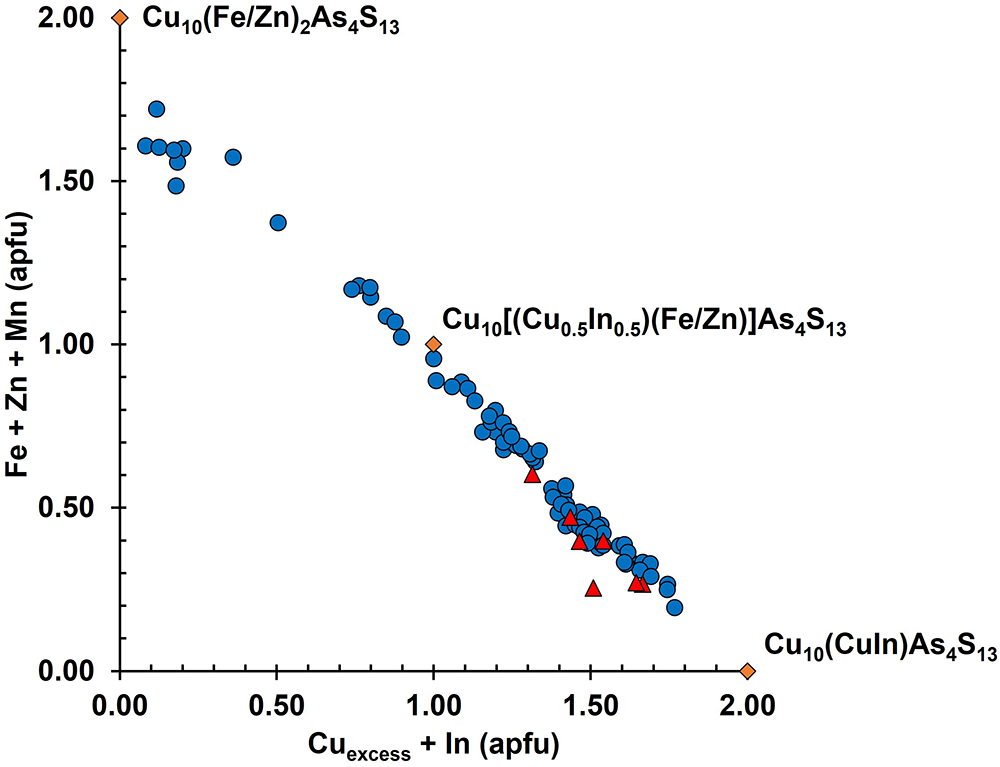
The relationship between the sum of apfu of Cuexcess (calculated as total Cu – 10 apfu) and In with the sum of Fe, Zn and Mn is shown in Fig. 4. Following Makovicky et al. (Reference Makovicky, Tippelt, Forcher, Lottermoser, Karup-Møller and Amthauer2003), it is very probable that the formal charge of Fe changes, passing from Fe3+ in Fe-poor (and In-rich) compositions to Fe2+ in tennantite-(Fe). The type material of tennantite-(In) has the following C chemical constituent, defined as C = 6 apfu – B, where B = 4 Cu apfu: (Cu0.89In0.69Fe0.18Zn0.14Mn0.06Cd0.02Pb0.02). The different chemical elements can be grouped in this way: [(Cu+0.69In3+0.69)Σ1.38(Cu+0.18Fe3+0.18)Σ0.36(Zn0.14Mn0.06Cd0.02Cu2+0.02Pb0.02)Σ0.26]Σ4.00, showing the clear dominance of the pair (Cu+In3+) over the other constituents. Minor formally divalent Cu may occur, whereas the occurrence of minor Pb is questionable. Indeed, the Pb content observed in tetrahedrite-group minerals from Pefka (up to 0.10 apfu, with a mean value of 0.01(2)) can be due to the intergrowths with other phases like galena or Pb-bearing watanabeite; intergrowths with this latter sulfosalt are made possible by the close structural relationship between tetrahedrite-group minerals and watanabeite (Biagioni et al., Reference Biagioni, Voudouris, Moëlo, Sejkora, Dolníček, Musetti and Mauro2024).
Relationship between (Cu + In) vs. (Fe + Zn + Mn) (in apfu) in tennantite-series minerals from Pefka. Red triangles indicate the composition of spot analyses in the area where the grain used for single-crystal X-ray diffraction was extracted.

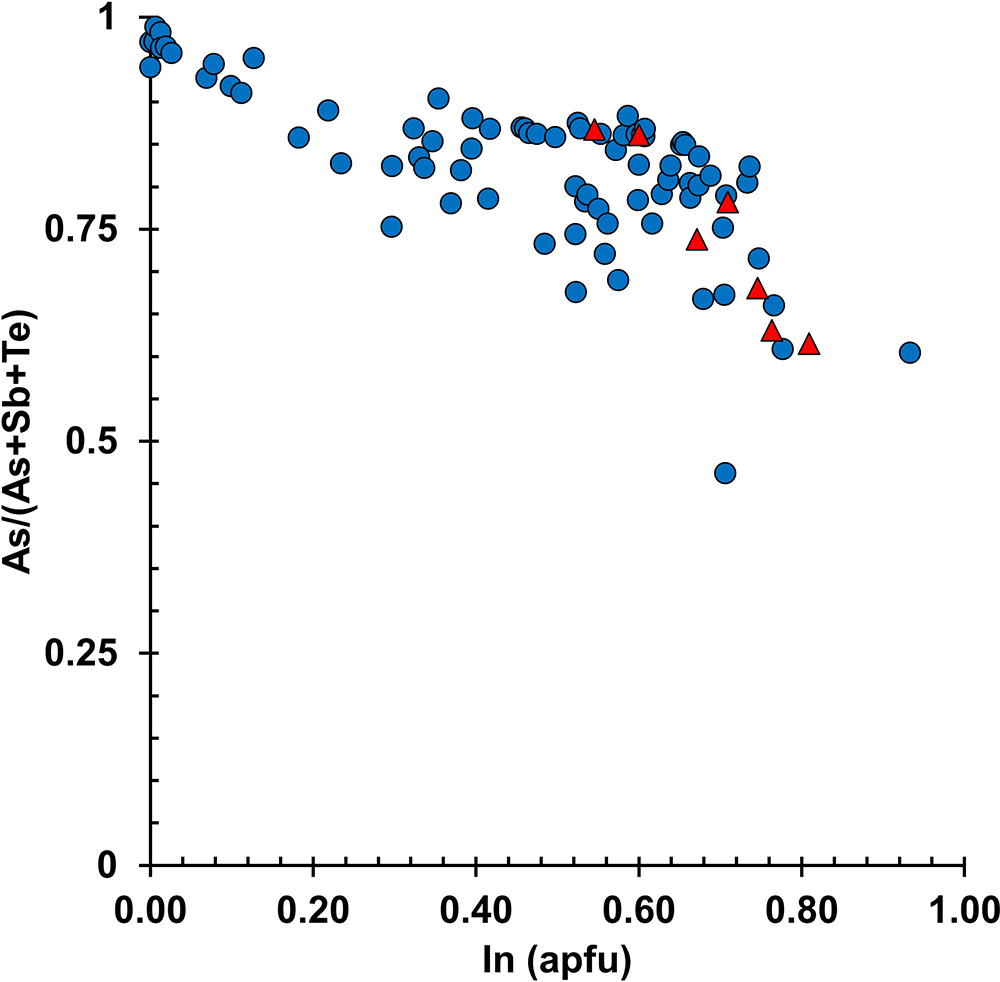
The In content vs. the As/(As+Sb+Te) ratio plotted in Fig. 5 shows a negative correlation. Indeed, tennantite-(In) is enriched in Sb relative to tennantite-(Fe), which is, in turn, relatively enriched in As. It is worth noting that one spot analysis corresponds to the formula Cu10.91In0.71Zn0.14Fe0.13Mn0.08Cd0.01Pb0.01(Sb2.16As1.85)Σ4.01S12.98, thus corresponding to the potential new species ‘tetrahedrite-(In)’.
Relationship between the In content (in apfu) and the As/(As + Sb + Te) ratio in tennantite-series minerals from Pefka. Same symbols as in Fig. 3.

The described chemical variations observed in tetrahedrite-group minerals from Pefka as well as the crystallization sequence roquesite → tennantite-(In) → tennantite-(Fe) (Fig. 1) probably indicate a progressive decrease in f(S2) and In contents of the crystallization environment from the high-sulfidation (HS) to the intermediate-sulfidation (IS) stages of the evolution of the Pefka epithermal deposit. More problematic is the As-enrichment observed in passing from tennantite-(In) to tennantite-(Fe). In fact, Voudouris et al. (Reference Voudouris, Repstock, Spry, Frenzel, Mavrogonatos, Keith, Tarantola, Melfos, Tombros, Zhai, Cook, Ciobanu, Schaarschmidt, Rieck, Kolitsch and Falkenberg2022) reported that late-stage IS veins are generally depleted in As than the HS veins. Consequently, the As-enrichment in tetrahedrite-group minerals could be due to the lack of a sink for As during the IS stage. Indeed, whereas during the HS stage the crystallization of enargite/luzonite was observed, thus depleting the fluids in As, these minerals do not precipitate during the IS stage, favouring a concentration of As in the crystallization medium and its incorporation in tennantite-series minerals.
Nomenclature issues: why is tennantite-(In) a valid mineral while tennantite-(Fe3+) is not?
Following Biagioni et al. (Reference Biagioni, George, Cook, Makovicky, Moëlo, Pasero, Sejkora, Stanley, Welch and Bosi2020), members of the tetrahedrite group are characterized by different pairs of B and C chemical constituents, both occurring at the M(1) site as a case of valency-imposed double site-occupancy (Hatert and Burke, Reference Hatert and Burke2008). Usually, the B:C ratio is 4:2, deriving from the occurrence of four formally monovalent and two formally divalent ions. This ratio is due to the requirement of electrostatic neutrality. Indeed, the sum of positive charge at the M(1) site should be +8. In tennantite-(In), the B constituent is represented by Cu+, whereas the C constituent is actually represented by one Cu+ and one In3+. Thus, the +8 positive charges are obtained through the addition of 5 Cu+ and one In3+. Hence, this new species is the first member of the tetrahedrite group having a formally trivalent cation as a species-forming element. Actually, there is another, probably more common, case where a trivalent cation could be species-forming, i.e. the case where Fe3+ is present.
Biagioni et al. (Reference Biagioni, Sejkora, Moëlo, Marcoux, Mauro and Dolníček2022a) highlighted that the empirical formula of tennantite-(Cu) from Layo (Peru) is ACu6[BCu4C(Cu2+0.8Cu+0.6Fe3+0.6)]D(As3.75Sb0.25)S13. This attribution of formal charges is supported by the results of Makovicky et al. (Reference Makovicky, Tippelt, Forcher, Lottermoser, Karup-Møller and Amthauer2003) that showed Fe3+ as the dominant iron species for a similar composition. Applying the site-total-charge approach (Bosi et al., Reference Bosi, Hatert, Hålenius, Pasero, Miyawaki and Mills2019b), the end-member formula Cu6(Cu5Fe3+)As4S13 is obtained. A similar situation was reported by Sejkora et al. (Reference Sejkora, Biagioni, Števko, Musetti and Peterec2024) for tetrahedrite-(Cu). In both cases, owing to the uncertainty in the actual oxidation states of Cu and Fe (Makovicky et al., Reference Makovicky, Forcher, Lottermoser and Amthauer1990, Reference Makovicky, Tippelt, Forcher, Lottermoser, Karup-Møller and Amthauer2003), it was preferred to consider only two chemical end-members: tennantite-(Cu)/tetrahedrite-(Cu) when CCu > CFe and tennantite-(Fe)/tetrahedrite-(Fe) when CFe > CCu. Finally, another difficult case is represented by tennantite-(Ni), having the following C composition: (Ni0.97Cu0.53Fe0.50) (Wang et al., Reference Wang, Chen, Gu, Hou, Nestola, Yang, Fan, Dong, Ye and Qu2023). If Fe is trivalent, it could result in [(Ni0.97Cu2+0.03)Σ1.00(Cu+0.50Fe3+0.50)Σ1.00]Σ2.00, corresponding to the boundary between tennantite-(Ni) and ‘tennantite-(Fe3+)’. However, as reported by Wang et al. (Reference Wang, Chen, Gu, Hou, Nestola, Yang, Fan, Dong, Ye and Qu2023), Fe seems to be at least partially divalent, and thus the evidence that Ni is the dominant C constituent was preferred.
One could object that such a classification does not fully describe the actual crystal chemistry of iron-bearing tetrahedrite-group minerals, missing some important information also useful for the description of the evolution of ore deposits. For instance, ‘tennantite-(Fe3+)’ would be indicative of high f(S2) (e.g. Marcoux et al., Reference Marcoux, Moëlo and Milési1994), whereas a decrease in f(S2) would stabilize ‘tennantite-(Fe2+)’. We agree with this point of view, because we think that a classification should convey as much information as possible. However, we have also to bear in mind that a mineral nomenclature should be sufficiently elegant and easy to use by all the geoscience community, and not only by crystallographers and mineralogists. The knowledge of the actual oxidation states of iron in tetrahedrites is not trivial, as thoughtfully discussed by Makovicky et al. (Reference Makovicky, Forcher, Lottermoser and Amthauer1990, Reference Makovicky, Tippelt, Forcher, Lottermoser, Karup-Møller and Amthauer2003), and probably the introduction of a classification based on an ionic description of iron-bearing tetrahedrite-group minerals would be unapplicable or, worse, would introduce several misidentifications, owing to the ambiguity in the actual amounts of Fe2+ and Fe3+ present for intermediate compositions.
Such an ambiguity does not occur for In. Indeed, this element occurs in chalcogenides in the 3+ oxidation state. For this reason, the end-member formula Cu6(Cu5In)As4S13 has been proposed for describing this unusual and exceptionally rare member of the tetrahedrite group, where the exotic element In plays the role of an essential chemical constituent.
Towards new members of the tetrahedrite group
Owing to the strong metallogenic relationship between In and Sn, Sn-rich members of the tetrahedrite group, known as synthetic compounds (e.g. Hansen et al., Reference Hansen, Makovicky and Karup-Møller2003; Kosaka et al., Reference Kosaka, Suekuni, Hashikuni, Bouyrie, Ohta and Takabatake2017; Nasonova et al., Reference Nasonova, Sobolev, Presniakov, Andreeva and Shevelkov2019) could be observed in natural occurrences. Tetravalent Sn, with tetrahedral coordination, could replace Cu+ at the M(1) site, whereas Sn2+, with a lone-electron-pair, could substitute Sb3+ and As3+ at the X(3) site. One could imagine a composition like Cu6(Cu+4+xCu2+2–2xSn4+x)[(Sb/As)3+4–xSn2+x]S13, following the substitution 2M (1)Cu2+ + X (3)(Sb/As)3+ = M (1)Cu+ + M (1)Sn4+ + X (3)Sn2+. With x = 1, the formula becomes Cu6(Cu5Sn4+)[(Sb/As)3Sn2+]S13. This is not an end-member formula because it shows a double occupancy at both M(1), i.e. (Cu0.833Sn0.167) and X(3), i.e. [(Sb/As)0.75Sn2+0.25]. The two end-member formulae would be Cu6(Cu5.33Sn4+0.67)(Sb/As)4S13 and (Cu6(Cu4Sn4+2)Sn2+4S13, respectively. The former formula may be more probable, since it agrees with results of Nasonova et al. (Reference Nasonova, Sobolev, Presniakov, Andreeva and Shevelkov2019) who refined the crystal structure of synthetic Sn-bearing tetrahedrites confirming the occurrence of Sn at M(1) and, through 119Sn Mössbauer spectroscopy, its Sn4+ nature. On the contrary, the replacement of Sb3+ by Sn2+ is ruled out by these authors.
Even if currently data on tetrahedrite-group minerals from Pefka does not reveal significant Sn contents (up to 0.01 apfu – Voudouris et al., Reference Voudouris, Repstock, Spry, Frenzel, Mavrogonatos, Keith, Tarantola, Melfos, Tombros, Zhai, Cook, Ciobanu, Schaarschmidt, Rieck, Kolitsch and Falkenberg2022), the possible natural occurrence of Sn-tetrahedrites cannot be neglected.
Conclusions
Five years ago, following the nomenclature of the tetrahedrite-group minerals, the tennantite series was defined as being characterized by the following chemical constituents: A = Cu, B = Cu, D = As and Y = S (Biagioni et al., Reference Biagioni, George, Cook, Makovicky, Moëlo, Pasero, Sejkora, Stanley, Welch and Bosi2020). According to the C constituent, two species were considered as valid, i.e. tennantite-(Fe) and tennantite-(Zn). The former was originally described by the Phillips’ brothers (Phillips, Reference Phillips1819a; Phillips, Reference Phillips1819b) from Cornwall, UK, whereas the latter has been reported by several authors from different localities since the latter half of the 19th century. Biagioni et al. (Reference Biagioni, George, Cook, Makovicky, Moëlo, Pasero, Sejkora, Stanley, Welch and Bosi2020) chose the Swiss material first used by Wuensch et al. (Reference Wuensch, Takéuchi and Nowacki1966) for the determination of the crystal structure as type material for tennantite-(Zn). A survey of the available literature led Biagioni et al. (Reference Biagioni, George, Cook, Makovicky, Moëlo, Pasero, Sejkora, Stanley, Welch and Bosi2020) to hypothesize the existence of other members of the tennantite series, i.e. tennantite-(Cu), tennantite-(Hg) and tennantite-(Mn). In the last five years these hypothetical species have now been formally defined and approved by the IMA-CNMNC and some other interesting species have been discovered (Table 9).
Members of the tennantite series

References: [1] Biagioni et al. (Reference Biagioni, Kasatkin, Sejkora, Nestola and Škoda2022b); [2] Biagioni et al. (Reference Biagioni, Sejkora, Moëlo, Marcoux, Mauro and Dolníček2022a); [3] Kharbish et al. (Reference Kharbish, Giester and Beran2010); [4] Biagioni et al. (Reference Biagioni, Sejkora, Raber, Roth, Moëlo, Dolníček and Pasero2021); [5] this work; [6] Keutsch et al. (Reference Keutsch, Kolitsch, Topa and Stanley2022); [7] Wang et al. (Reference Wang, Chen, Gu, Hou, Nestola, Yang, Fan, Dong, Ye and Qu2023); [8] Wuensch et al. (Reference Wuensch, Takéuchi and Nowacki1966).
The formal description of tennantite-(In) is the most recent addition to this series and documents the role of tetrahedrite-group minerals as potential carriers of In in ore deposits, filling a gap highlighted by Cook and Ciobanu (Reference Cook and Ciobanu2015). This finding is particularly remarkable as the element In is an important commodity for future sustainable development and a better knowledge of its speciation in ore deposits is desirable. Owing to the widespread occurrence of tetrahedrite-group minerals in hydrothermal ores, they could represent another host for this critical raw metal. It is very probable that tennantite-(In) and In-bearing members of the tetrahedrite group have been overlooked in other ores, especially those of the high-sulfidation epithermal category. The Pefka deposit is characterized by very low contents in sphalerite (a major host for In) and stannite, into which In is also partitioned. Extremely In-rich fluids caused crystallization of roquesite under high-sulfidation conditions and later of tennantite-(In) and watanabeite at the transition towards intermediate-sulfidation fluid conditions. Transitional HS-IS ore assemblages in In-enriched and Zn-deficient ores are the best candidates for new discoveries of tennantite-(In) and ‘tetrahedrite-(In)’ elsewhere.
Supplementary material
The supplementary material for this article can be found at https://doi.org/10.1180/mgm.2025.10140.
Acknowledgements
The helpful comments of the Associate Editor Ian Graham and three reviewers (Yves Moëlo, Pete Leverett, and an anonymous one) are greatly appreciated. CB acknowledges financial support from the Ministero dell’Istruzione, dell’Università e della Ricerca through the project PRIN 2017 “TEOREM – deciphering geological processes using Terrestrial and Extraterrestrial ORE Minerals”, prot. 2017AK8C32. The Centro per l’Integrazione della Strumentazione scientifica dell’Università di Pisa is gratefully acknowledged for providing the access to the single-crystal X-ray diffraction laboratory. The study was financially supported by the Ministry of Culture of the Czech Republic (long-term project DKRVO 2024-2028/1.II.c; National Museum, 00023272) for JS.
Competing interests
The authors declare none.