In the 1950s, Brazilian sociologist Gilberto Freyre became an important figure in French social-scientific and intellectual life as his books on colonial Brazil, plantation society, and slavery began to be translated from Portuguese into French. Fernand Braudel considered Freyre's work to be “singularly innovative,” as well as an important introduction from a country whose “original values matter … for all of humanity.”Footnote 1 Apropos of Freyre's most famous work Casa-Grande & Senzala, translated as Maîtres et esclaves, Roland Barthes emphasized, “The conjunction of a racial history still entirely fresh and of a great intelligence nourished by the most advanced disciplines has given Brazil this prestigious book.”Footnote 2 Lucien Febvre, editor of Annales: Histoire, sciences sociales, and sociologist Georges Gurvitch, editor of France's premier sociological journal, Cahiers internationaux de sociologie, visited him at his home in Pernambuco. They invited Freyre to France, where he presented his work at the Sorbonne, the École pratique des hautes études, and a several-day workshop at the Chatêau de Cerisy-la-Salle in Normandy.
What did these French intellectuals see in Freyre? And why did they continue to value his work, even after it began to be challenged in Brazil, in the US, and at UNESCO in the heart of Paris?
This article argues that in a period in which decolonization was already underway, Freyre piqued the interest of French social scientists looking to overcome the growing antagonism between colonizer and colonized. Coming out of the worst genocide in history, in which the French government actively took part, a number of French intellectuals embraced racial mixing or métissage in part to denounce racism and the proponents of ethnic purity and in part to blunt independence movements emerging in the colonies.
Such a contextual argument should enrich debates concerning the Annales-like nature of Freyre's intellectual project, the uniqueness of his sociological approach, and his lengthy correspondence.Footnote 3 It builds upon a growing historiography on France's twentieth century that has emphasized the openings and closings of imperial politics during the postwar period as well as the non-inevitability of decolonization in the form of the nation-state.Footnote 4 While I tend to agree with Michael Goebel that we should not overemphasize these possibilities, it is clear that for those who sought to preserve European empires in the postwar period, new combinations of assimilation and association were quite appealing.Footnote 5
The Portuguese, with the help of their Brazilian friends, such as Freyre, constructed a tempting model of a people adapted to the tropics by nature and prone to mixing with subject populations.Footnote 6 This “lusotropical” ideal of harmony and miscegenation contrasted with both the one-drop rule and the French civilizing mission.Footnote 7 Beyond his style, Freyre's lusotropicalism was what most interested the French. Indeed, sociologist Roger Bastide framed Freyre's 1952 conference in Cerisy-la-Salle with the question “What should we think of the ‘lusotropical’ solution to the racial question of which Gilberto Freyre has become the defender?”Footnote 8
Freyre, as early as the 1930s, defended Portugal's role in the colonization of Brazil, favoring renewed ties with Portugal in order to forestall new forms of political, economic, and cultural colonialism. Specifically, he was wary of the United States, Britain, and the capitalist world system that they largely controlled. If unchecked, he argued, these countries would seek to impose their way of life on places like Brazil and parts of the Portuguese Empire—“the Lusotropics.” In contrast with the Anglo-Saxons, Freyre insisted on the particularly “human” character of Portuguese colonization, based on racial mixing (mestiçagem)Footnote 9: “This human character of Portuguese colonization, if in Brazil it had its broadest and happiest expression, is, nonetheless common to Portugal's colonial efforts in general. Everywhere that this type of colonization predominated, racial prejudice appears insignificant, and mestiçagem is psychologically, socially, and, might we even say, ethically active and creative.”Footnote 10
Freyre lived in Jim Crow America during his undergraduate studies at Baylor University. In Waco, Texas, infamous for the lynching of Jesse Washington in 1916 just a year after the release of The Birth of a Nation, Freyre witnessed the poverty of black neighborhoods and heard firsthand of lynchings, even claiming to smell them.Footnote 11 Regardless of the necessarily constructive elements of Freyre's memoirs, these years were an experiential “coming to consciousness” for the young Freyre—a series of events that produced his own subjectivity as non-American.Footnote 12 (Whether or not the racialized ghettos of the US South were all that different from the macombos of his native Recife is another question). This experience encouraged him to look for models other than the United States and ultimately to insist on Brazil as an antithesis to countries such as South Africa in which formal, legal racial segregation predominated. By the 1950s, however, at the height of the Cold War, Freyre's idea that Brazil was a “racial democracy” took on a more specific meaning:Footnote 13 as a third way, between the US and the Soviet Union not only economically, but also racially. He wrote, for example, of Salvador,
Bahia leads the way, as in no other city of the world today, in the fraternally mestiço world towards which man marches forward, if the atomic bomb does not interrupt him. In Bahia: Salvador da Bahia. And not in New York: where antagonisms are admirably tolerated in their differences but do not balance or complete each other in new combinations. Nor in Moscow, where intolerance might not affect men of color but affect the color of their ideas, only allowing the orthodox red: an inhumane attempt by a dictatorial or totalitarian government to prohibit the ideas of men from mixing in such a way that the results would be mestiçamente balanced in their contradictions.Footnote 14
In the US, Freyre thought, the politics of difference prevented “new combinations”; in the Soviet Union, while racially tolerant, “red orthodoxy,” he argued, prevented free expression. In comparison to the superpowers, Brazil both racially and economically welcomed mixing. In the 1950s Freyre became increasingly associated with the Portuguese colonial mission—touring the Portuguese Empire, lecturing on the Portuguese openness to racial mixing, and downplaying the role of the exploitation of black labor by whites.
Freyre's personal ties with French social scientists such as Braudel, Febvre, Gurvitch, and Bastide were crucial for his generous reception in France. But, as I argue, what made Freyre's lusotropicalism stick was the ways in which it paralleled French republican ideology and Latin humanismFootnote 15 in a moment when France's African colonies more vociferously and violently demanded independence, especially Algeria. Freyre's accounts of “racial and humoral mixture,” as well as his historical “sexology,” to use Barthes's words, offered a tempting alternative in the form of racial mixing to the rise of ethnic nationalism and anticolonial struggle.Footnote 16
While it is doubtful that such ideas profoundly affected race relations or population control in the colonies,Footnote 17 French social scientists’ fascination with miscegenation in the postwar period provides fertile ground for a kind of archaeology of French attitudes toward race. In what follows, I consider Gilberto Freyre's place within this stratum, the critiques leveled against him by UNESCO, and the social-scientific countermodels offered by the likes of Florestan Fernandes, Claude Lévi-Strauss, and even Roger Bastide, who saw in Freyre's project a possibility for emancipation, however limited its present validity may have been.
Gilberto Freyre's Favorable French Reception
Freyre maintained cordial and even friendly relationships with PaulistaFootnote 18 intellectuals and the French professors who had helped to found the University of São Paulo (henceforth USP).Footnote 19 (He was comfortable reading and speaking in French, as many elite Brazilians were at the time, even if he generally wrote his correspondence in Portuguese). Paul Arbousse-Bastide, the founder of Brazil's first fully fledged sociology department at USP, wrote a long preface to Freyre's Um engenheiro francês no Brasil (A French Engineer in Brazil) in 1940, expressing the great honor of having been invited to do so and offering his most “amiable homage” to Freyre.Footnote 20 Freyre, in turn, dedicated his book Região e Tradição (Region and Tradition) in 1943 to Arbousse-Bastide, Bastide, and Pierre Monbeig, all three of whom were then teaching at USP. Bastide corresponded extensively with Freyre from 1938 onwards, ultimately visiting him in Recife—as other French scholars would in due course.
And then there were the Annales. Braudel, who had known of Freyre's work from his time teaching in Brazil in the 1930s, favorably reviewed Casa-Grande & Senzala while in a prison camp in Germany during World War II.Footnote 21 Immediately following the war, he sought Freyre's participation in Annales.Footnote 22 Freyre's most important French ally, however, was Lucien Febvre; the latter's visit to Brazil helped to consolidate Freyre's position at the height of French academic life.
Febvre's itinerary in Brazil in 1949 and in Latin America more generally was by no means centered on a visit to Recife, Freyre's hometown.Footnote 23 On the contrary, Febvre was more interested in ensuring that Annales would continue to have a following in Brazil. The logical basis of support of such an endeavor was at USP, where the French still counted on the major daily newspaper O Estado de São Paulo as a loyal disseminator of their work and where Braudel had managed to get jobs for his students Euripides Simões de Paula and Eduardo d'Oliveira França.
Freyre, however, made a point of ensuring Febvre's presence in Recife, in addition to the traditional bastions of French university influence—São Paulo and Rio de Janeiro. Upon Febvre's arrival, Freyre penned “Professor Febvre in Brazil,” outlining the credentials and intellectual background of this eminent visitor. A myriad of such articles appeared in Freyre's column “People, Things, and Animals” in the Rio-based newspaper O Cruzeiro, but the fact that he sent this one to Febvre suggests he was using it by way of introduction.Footnote 24 Febvre, of course, had known of Freyre's work as early as 1943 when Braudel published his review in Mélanges d'histoire sociale, of which Febvre was editor, and it appears that Febvre and Freyre met personally in Paris as well, likely in 1948.Footnote 25 Febvre, writing from São Paulo, thanked Freyre for his “charming article” that “touched him.”Footnote 26
Unfortunately, Febvre's archive contains no letters from Freyre, but Febvre's letters to Freyre, as well as his notebooks from his trip, allow for a partial reconstruction of his visit to Recife. It was his last stop on a whirlwind trip that took him to Chile and Porto Alegre, São Paulo, Belo Horizonte, and Rio in Brazil.Footnote 27
After his trip, upon his return to Paris, Febvre wrote to his cher ami,
I am once again Parisian. And above all, descended from heaven, my mind still filled with the beauties of America. I write to thank you. Because you guided the entire end of my voyage, in the most touching and effective ways. I saw Recife, her wide landscape of whitewater and of clouds, her charming bridges as old as those of Europe … her narrow roads with the talkative people of humble stock. I saw Olinda, her old churches, her remarkable convent of Saint Francis … I saw, one morning, Gilberto Freyre's home, and all around it his so typically pernambucan garden, with its old trees and young flowers … I saw one of your young relatives who entertained by himself an old talkative negro, mannerful [gesticuleux], with lively eyes.Footnote 28
Febvre's vision was little more than picturesque; then again, the very book upon which it was based, Freyre's own Recife: Practical, Historical, and Sentimental Guide to the City that he had given to Febvre, was too. Of course, for Febvre the “talkative, mannerful negro” was very much part of that landscape—not as a historical subject per se, but as decoration like the trees and flowers. This, too, is not entirely different from Freyre himself, who, despite valorizing African civilizations in some abstract sense, never really considered Africans or Afro-Brazilians as agents in historical processes.Footnote 29
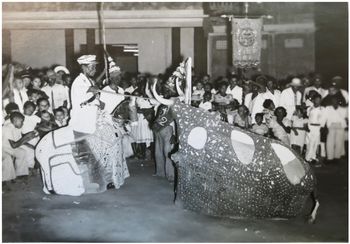
Freyre not only showed Febvre around Recife. From Febvre's letter, it appears as though Freyre accompanied him to places as far away as Goiania and Iguaçu on the Argentine border. Freyre introduced Febvre to popular folkloric traditions such as cavalo marinho and bumba-meu-boi,Footnote 30 “dazzling” him with all that “he did not know” about Brazil (Fig. 1). For Febvre, Brazil, considering its regional diversity, was nothing short of a “miracle”: “what a subject for meditation!”Footnote 31 Febvre's curiosity about Brazil—and his enthusiasm for Freyre as a person—may have been the primary reason for the French translation of Casa-Grande & Senzala.
Postcard of Bumba meu boi. EHESS-LF. Dossier Brésil (photos).

When hiring Roger Bastide at the Sixth Section of the École pratique des hautes études, Febvre and Braudel emphasized his knowledge of Brazil. Informing Bastide of his likely election to the post of directeur d’études, Febvre requested that Bastide “suggest one or two texts” for translation.Footnote 32Casa-Grande & Senzala, which Bastide ultimately translated as Maîtres et esclaves, was evidently one of them. Febvre wrote the preface.
In his preface, Febvre praised Freyre, highlighting his Annales-like methodology of doing social history and his approach to racial mixing.Footnote 33 Febvre's reservations and criticisms about Casa-Grande & Senzala were largely tempered, if not removed entirely. Gurvitch wrote to Freyre in June 1952, “Mr. Lucien Febvre has already written a preface for your beautiful book, but he is in the process of rewriting it, because he was more severe than he would like. I will take care of it. Braudel too.”Footnote 34
Drafting up criticism and toning it down is part of the dialectic of much academic writing, leaving no smoking gun of censorship in Febvre's final preface.Footnote 35 That said, Gurvitch's “I will take care of it. Braudel too,” suggests that Febvre's criticism was discouraged by his peers. In the absence of Febvre's original drafts, we cannot say whether Febvre's reservations about Freyre's Maîtres et esclaves were more methodological or political. We do know, however, that Gurvitch and Braudel saw to it that they were toned down or eliminated in the final version of his text.
In his preface, “Brazil, Land of History,” Febvre leaned toward the picturesque, describing the “fusion of races” and the “new society that was elaborated between the Equator and the Capricorn.” This society, he continued, offered “a palette of graded tones, from leather-red to rosy white.”Footnote 36 Febvre reproduced Freyre's (and that of so many other writers of his generation) exotification of darker bodies, especially those of women.Footnote 37 However picturesque Febvre's preface may have been, it was not blind to the violence and brutality of slavery. Febvre, more so than Freyre, emphasized the annihilation and exploitation of non-European peoples that laid the foundation for Brazilian society:
let us not be simplistic. There was nothing idyllic about the life of Indians upon contact with colonists. Nor that of blacks who survived when the sugar industry was implanted. With the large amounts of physical force that it required, it was necessary to look for a more resistant workforce than that of Indians. No, nothing idyllic. It is easy to accumulate testimonies, narratives of so many horrendous acts: blacks tied living by the mouth to a canon and receiving the projectile through their body or mulatresses loved by their master, whose jealous white wife, for once and for all, ordered that they rip out her beautiful eyes—and that they serve them at dessert, entirely bloody, to the unfaithful husband. It is no longer worth our while to bemoan paternalism when we need to scream out man's suffering. But, alongside such scenes, there are others, many others, more consoling for humanity. And, I will say, as a historian, with greater consequences for the future.Footnote 38
Febvre's criticism of Brazilian slavery, so abrupt after his lighthearted and colorful description of Brazil, overpowers and even contradicts the rest of his preface. Indeed, it is likely this section that he was working through when Gurvitch said, “I will take care of it.” For Febvre, however, it appears less that he was convinced by Freyre's historical treatment of the Portuguese colonizer as inherently benign, and more by the promise of racial mixing in the future. In a Europe recently destroyed by war and ethnic cleansing and in a French Empire that seemed increasingly divided into two camps—colonizer and colonized—Febvre looked to South America as a source of inspiration. Europeans, “haunted by what the world is becoming,” he claimed, “are turning their eyes in an anguished search, towards these immense South American lands—so rich in promise.”Footnote 39 South America, Febvre insisted, brought to light “the largest problems that are facing, in 1952, the carriers of the old European civilization.”Footnote 40
Among these problems, probably the most important was the right of “peoples of color” to be free from the “yoke” of “the civilized white man.”Footnote 41 Febvre defended this right, but worried about increasing divisions between societies and their visions of progress—something that he personally experienced vis-à-vis “Science,” with its increasing capacity to “annihilate Humanity.” (He was probably referring to the atomic bomb.) The world, instead of addressing its most pressing questions, Febvre claimed, “entered into revolution.”Footnote 42 And it is here, and precisely here, that Febvre saw Gilberto Freyre as providing “a grand lesson in Brazilian history”: “a privileged experiment in the fusion of races, the exchange of civilizations. This Brazil, a melting-pot [un creuset].”Footnote 43
Prior to writing his introduction to Maîtres et esclaves, Febvre had his own ideas for understanding French history as one of racial mixture. In his manuscript, written in 1950 and only published posthumously, entitled Nous sommes des sang-mêlés (We are Mixed Bloods), Febvre insisted that France had always been a “mixed” civilization.Footnote 44 Even if Febvre was primarily concerned with the different European origins of France (ranging from the primordial synthesis of Gauls and the Franks to late nineteenth- and early twentieth-century immigrants), there is no question that his positive treatment of racial mixing led him to valorize Freyre's work.
Febvre's willingness to write a preface to Maîtres et esclaves represented an enormous gain for Freyre, regardless of its eventual criticisms.Footnote 45 But Febvre was not alone in embracing Freyre in France. The promotion of Maîtres et esclaves was particularly well planned, both inside and outside the academy.
In addition to Febvre's support in placing his book within the academic mainstream, Freyre counted on Gurvitch's support for its dissemination. Freyre and Gurvitch met in Paris in 1948 at UNESCO.Footnote 46 But their relationship developed in 1952, when Gurvitch asked Freyre for an invitation to teach in Brazil, a favor Gurvitch said he would readily return.Footnote 47 Gurvitch served as the Freyre's intermediary with Roger Callois at Gallimard about the forthcoming publication of Maîtres et esclaves, discussed various possibilities for coming to Brazil, and expressed interest in his forthcoming book on Asia and Africa, “which we look forward to.”Footnote 48 Ultimately, Gurvitch received an invitation from the University of Pernambuco and the Casa Rui Barbosa in Rio, where he lectured in the fall of 1952. Freyre, in return, could count on Gurvitch's support in France.
Upon Gurvitch's return to Paris, just months after the publication of Maîtres et esclaves, he wrote Freyre to keep him abreast of its reception: “I can assure you that your book has been very successful in France. It was discussed at length in Combat. We speak of it often, and it was even cited in discussion during a recent session at the Faculty of Letters. They say that it sells well. I am preparing a review for the Cahiers, number 14.” In addition, Gurvitch insisted, “our friend Braudel and I are actively working to prepare some good surprises for you upon your arrival in Paris this spring. The École pratique des hautes études and the Centre d’études sociologiques are looking forward to your lectures.”Footnote 49
Gurvitch's reference to Combat was not the only one to suggest a broader reception in France. Roland Barthes reviewed Maîtres et esclaves in Lettres nouvelles and Jean Pouillon did the same in Les temps modernes.Footnote 50 The French, according to Bastide, understood the book's “human significance alongside its scientific value.”Footnote 51 Beyond the reviews that Bastide knew were in the works for Annales (Braudel) and Cahiers internationaux de sociologie (Gurvitch), he highlighted a review in Christianisme social, a Protestant journal that he had contributed to throughout his life.Footnote 52 Bastide did not always agree with Freyre's conclusions,Footnote 53 but that did not prevent him from translating Casa-Grande & Senzala, just as Febvre's reservations about Freyre's possible minimization of the cruelty of slavery did not prevent him from writing a generally favorable preface.
In France Freyre was on the rise both inside and outside academia. Heralded for his affinities with Annales, he became one of two non-French and the only non-European on the Director's Committee of the Fondation Marc Bloch.Footnote 54 His personal connections with Braudel and Gurvitch ensured his dissemination among historians and sociologists. And literary figures in and outside the Sorbonne embraced his particular brand of Latin humanism. Freyre's unquestionable emergence in 1950s France, however, is only part of the story. For at precisely the same time, his work was coming under attack in Brazil and in Paris—but not in French universities.
The UNESCO Project on Race Relations and the Critique of Racial Democracy
In the years 1951 and 1952, the United Nations Educational, Social, and Cultural Organization (UNESCO) organized and funded research into race relations in Brazil.Footnote 55 This field research followed UNESCO's statements on race by social scientists, including Lévi-Strauss, and biologists and geneticists from previous years.Footnote 56 A large part of Brazil's selection as a case study for race relations had to do with the fact that UNESCO's first director of the Department of Social Sciences, Arthur Ramos, was Brazilian. (Freyre was offered the job after his participation at the UNESCO conference on Tensions that Affect International Understanding, but turned it down.)Footnote 57 Swiss-born Alfred Métraux headed up the newly created race relations section of that very department.Footnote 58
In September of 1952, with research underway, the UNESCO Courier published a special edition on Race Relations in Brazil. Métraux's introduction, “An Inquiry into Race Relations in Brazil,” laid out the justification for such a study.Footnote 59 He sought to answer the fundamental question “is the [racial] harmony real or apparent?” The underlying question was whether Brazil was a model for replication. Did Brazil's racial model provide an example to the rest of the world, or was its claim to be a land free from racial prejudice a construction by intellectuals such as Freyre, and by foreigners such as Febvre, immediately impressed by Brazil's “palette of graded tones”?
Métraux had long been interested in Brazilian racial relations. His enthusiasm for Freyre's work as early as 1940 is evident in their correspondence, and even in his article “Brazil, a land of racial harmony for all races?” from 1950, he had no problem with characterizing the Portuguese as relatively humane.Footnote 60 According to Métraux himself, they “never attached much importance to race” and “inter-married freely with all native peoples they conquered and colonized.”Footnote 61 Freyre claimed that in Bahia Métraux recognized “that in Brazil there is almost no racial problem. That color prejudice does not create drama, crises, or agitations here as it does in other countries … That this is due to a historical formation different from that of North America or South Africa.”Footnote 62
After traveling throughout Brazil, meeting with his research teams in Salvador, Rio, Recife, and São Paulo, and receiving their initial results, however, Métraux's inquiry matured. In the name of science, he sought to critically test the gains of the “racial democracy” so frequently “remarked on by travelers and sociologists.”Footnote 63 While Métraux still held out hope for positive examples of race relations in Brazil, he forthrightly questioned the validity of preexisting scholarship—and implicitly that of Freyre.
Métraux nonetheless recognized Freyre's international clout and advanced as diplomatically as possible. He sought to keep Freyre affiliated with the project, but at a sufficient distance to prevent Freyre's vision from overriding the findings of those who had actually conducted sociological research.
In Métraux's visits to Brazil on behalf of UNESCO, Freyre was one of the first people he visited. Freyre, Métraux wrote in his diary, “accepts in principle to write about the theme of the ascent of mulattos and blacks and to use … unpublished documents.”Footnote 64 The following summer, still in the initial phases of UNESCO's research, Métraux confirmed a contract with Freyre concerning an introduction that Freyre would write for the final publication of the various regional studies.Footnote 65 But in their subsequent correspondence, even without Freyre's responses, we can understand the conflicts that ultimately led Freyre to back out of the project altogether—much to the chagrin of Métraux, who wrote to Freyre in March 1952:
René Ribeiro tells me that before writing your introduction you were waiting for the manuscripts prepared by the different research teams. Here, I think that there is a misunderstanding. If you remember our conversation correctly, you will recall that I asked for an introduction of historical character, that is to say a panorama of the history of blacks in Brazil from the 16th century until today. Your introduction should help to give a temporal depth to a study of contemporary sociology. In other words, I would ask you to summarize, for the European public, the masterpieces that made you famous … It is therefore not necessary for you to have read the different sociological contributions for you to write your introduction.Footnote 66
Métraux, still fond of Freyre's interpretation of Brazil and convinced of the value that it would bring to UNESCO's report, insisted on the specificity of Freyre's preface as being “historical” in a compilation of studies of “contemporary sociology.” In effect, Métraux sought to have it both ways: on the one hand, he wanted to have Freyre, a talented writer and public figure, as a symbolic part of the UNESCO inquiry, and on the other, he hoped to effectively silence Freyre's criticism of the respective regional studies. The latter's “historical” knowledge may have been interesting but in no way made him an adequate judge of the scientific investigation that followed.
Métraux, as a foreigner who had not spent considerable time in Brazil—and who, as a Swiss, had no direct loyalty to any formal empire—perhaps did not understand the gravity of what he was trying to do. This ultimately led him to a “huge disappointment” with Freyre, whose requests for a change in the nature of his contribution were nothing less than “impossible.”Footnote 67 Freyre never wrote the introduction, and in retrospect we can more fully understand why. It would have been a humiliating experience for the veteran intellectual, so well-known for his interpretation of race relations in Brazil, to be relegated to “history” while younger scholars, including several non-Brazilians, would take his place as the sociologists of the next generation.
Furthermore, in a period of decolonization in which his lusotropicalist discourse began to take on much more concrete meaning vis-à-vis Portugal's empire in Mozambique and Angola, Freyre could not let the more critical studies of Brazilian race relations offered by UNESCO have the last word. In 1951 and 1952, Freyre toured the Portuguese Empire, in Africa and Asia, serving as a state representative of Salazar's regime.Footnote 68 He advanced his ideas of the Portuguese peoples’ affinities with the tropics and relatively benign treatment of subject populations in the colonies.
Several months had passed since Métraux and Freyre's “disappointing” correspondence when it had become clear that neither would have his way. While Freyre did not write an extended historical essay, he did publish a two-page piece on “The Negro's Role in Brazilian History,” directly following Métraux's introduction discussed above.Footnote 69 It would be the last of Freyre's contributions to UNESCO's studies, well before the final publication of its results. In his essay, Freyre reemphasized his claim about Brazil's relatively humane slavery: “A number of reliable foreign observers tell us that slavery in Brazil was more humane than in other parts of America and of the world.” Freyre also emphasized that, in contrast to the situation of “workmen in the new factories of Europe during the early 19th century … it was better to be a slave in a typically patriarchal sugar or coffee plantation in Brazil than a labourer in a European factory at the time.”Footnote 70
Bastide and his team of Brazilian colleagues (many of whom were former students) mounted one of the more direct challenges to Freyre. Not only did Freyre and his regionalist movement in the 1920s define Recife and the Northeast as distinct from the Modernists of São Paulo, but, as I have mentioned previously, his “artisanal” sociology was also challenged by a more professional generation of sociologists at USP.Footnote 71 Beyond generational and interpersonal rivalries, those who worked on UNESCO's study on race relations shifted a historical perspective on race relations to a contemporary one—in a highly industrialized city of over two million people with an increasingly specialized workforce.
Roger Bastide's essay in the UNESCO Courier, on the pages following Freyre's “The Negro's Role in Brazilian History,” outlined the stakes involved in such a shift. In “São Paulo: The Octopus Town,” Bastide firmly situated his study within a “democratic” Brazil, in the midst of “industrialization.” That industrial Brazil, he argued, was “helping to improve the position of the coloured people as a whole [meaning that] the classic master-and-man relations are no longer applicable to the relations between whites and blacks at work.”Footnote 72 Unlike the period immediately following abolition whereby freed slaves could achieve certain social positions based on paternalist relationships with their former masters (benefiting from certain kinds of education or sources of employment in urban centers), Bastide signaled a new, more democratic space in which all people, by law, could achieve and compete as equals in the workforce.
At the same time as Bastide praised democratic and industrial advances in Brazil, insofar as they created opportunities for more equitable relationships between blacks and whites, he also recognized that the process towards achieving racial equality was neither linear nor inevitable. Pointing to “stereotypes and ideologies,” Bastide analyzed how traditional slave-owning families attempted to keep blacks in their place and how newer European and Middle Eastern immigrant families sought to distinguish themselves from blacks in an increasingly competitive workplace.Footnote 73 While Bastide remained generally optimistic about how an integrated workforce would contribute to the overcoming of stereotypes and prejudices, his initial analysis suggested that there was such a thing as prejudice based on skin color, if not race, in Brazil. To a certain degree, this corresponded with Freyre's own criticisms of industrialized São Paulo, where he saw “Americanized” race relations—that is to say, where white immigrants were given more opportunities than darker Brazilians who had been natives for hundreds of years.Footnote 74
Nonetheless, Bastide, like Freyre, maintained a rather harmonious view of Brazilian race relations. It was his student, course assistant, and later fellow professor, Florestan Fernandes, who more directly attacked Freyre's theses. Bastide and Fernandes's respective views, as we will see, came out more clearly in their respective parts of their joint study, Relações entre Negros e Brancos em São Paulo (Relations between Blacks and Whites in São Paulo).Footnote 75
Among UNESCO's studies on race relations in Brazil, Fernandes was among those most critical of Freyre. In Bahia, for example, American anthropologist Charles Wagley and his team criticized the “prejudice of skin color” so apparent in that state, but ultimately confirmed Donald Pierson's earlier studies that found racial discrimination as such to be nonexistent.Footnote 76 Fernandes, on the other hand, saw the “terrible system of slavery” and the “maladjusted” black labor force that it created upon abolition as the causes of preconditions for discrimination.Footnote 77
The first part of Bastide and Fernandes's study, penned by Fernandes and entitled “From Slave to Citizen,” offers a historical analysis not only of slavery, but also of its aftermath. Fernandes decried the institution of slavery for its role in the deformation of the black working classes, demonstrating how the transition to free labor little changed the conditions of black workers. Abolition, he argued, was an important means for landowners and capitalists to “secure” a labor force, rather than to free it.Footnote 78
Furthermore, Fernandes argued, “slavery degraded its human source of labor to such a degree that it made economic recuperation extremely arduous, difficult, and slow.”Footnote 79 Blacks, once free, were “reabsorbed” slowly into the labor system, occupying the most humble and worst-paid jobs. This created “flagrant inequality that separates blacks from whites in the professional structure of São Paulo.” He continued, “people of color neither participate, as a rule, in the guarantees offered by well-remunerated services or social representation, nor in the benefits drawn from free initiative in the urban economy.”Footnote 80
Fernandes always prioritized class over race as an analytic category. For example, he appears to have agreed with Freyre that the economic system during the beginnings of slavery was more important than race per se.Footnote 81 However, later in Fernandes's analysis, his position became clearer. Whatever economic preconditions may have shaped the systems of inequality, “it was color that went from indicating more than a physical difference or a social inequality,” and it was based upon color that a permanent system of exploitation was created, founded on “the supremacy of the white races, the inferiority of the black races, and the natural right of the former to violate their own ethical code, to exploit other human beings.”Footnote 82
Whereas Freyre considered racial inequality an epiphenomenon of the structural relationship between master and slave, Fernandes's analysis of white supremacy revealed that slavery was much more than an economic system. It was a set of cultural norms that reified and reinforced the social division of labor. In response to Freyre's insistence on miscegenation as the foundational proof of Brazil's racial harmony, Fernandes argued that color prejudice
did not look to avoid nor to even restrict miscegenation. But, on the contrary, to make sure that miscegenation occurred without substantially affecting the reciprocal positions of the two racial groups of the social system … despite all of the contact, intercommunication and intimacy that has always existed between blacks and whites, the two racial layers constituted two separate cultural and social worlds, mutually antagonistic and irreducible.Footnote 83
For Fernandes, Freyre's idyllic world shared by masters and slaves was not an exaggeration or a selective interpretation; it was a lie. These two “mutually antagonistic” cultural and social worlds were what characterized the plantation system. Furthermore, according to Fernandes, “The tendency to define it [miscegenation] as an indicator of the absence of prejudice, on the part of Portuguese colonizers and their descendants considered white, does not find analytically consistent proof.”Footnote 84
In industrialized São Paulo, sixty years after abolition, an unconscious racialization served to keep people in their place. Fernandes clarified that he was not insinuating that whites “deliberately and obstinately” attempted to prevent blacks and mestiços from equal treatment. Instead, he emphasized an “essential fact”: that “equality before the law does not guarantee blacks and mestiços an integral participation in all social rights,” particularly in those rights which are “assured to whites beyond the legal system, by way of the economic situation and social position.”Footnote 85
Fernandes's structural and even categorical treatment of racial inequality in São Paulo left Bastide, long a sympathizer of Freyre's work, in an ambiguous position. On the one hand, he respected Fernandes's findings and those of his other students who contributed to the study; on the other, he insisted on limiting the generalizations of his findings. In such a way, Bastide could leave open the possibility that São Paulo's industrialization and the highly competitive urban workplace that it created may have been the causes of new kinds of racism rather than a characteristic of Brazilian race relations in general. Bastide's sections of Relações Raciais entre Negros e Brancos em São Paulo, as well as his correspondence with Fernandes over the final version of the study, indicate precisely this tension.Footnote 86
Bastide's conclusion in many ways reflected that of one of his interviewees, a white man, who claimed, “we Brazilians … have the prejudice of not having prejudice.”Footnote 87 Much less categorical than Fernandes, Bastide attempted to understand the contradictions in discourse and representations. Why was it that so many blacks and whites alike in São Paulo insisted that there was no racism there? While condemning racism in general, Bastide would not do the same for São Paulo, where he insisted that “attitudes vary from one individual to another, creating a spectrum that goes from the maximum of prejudice to its total absence.”Footnote 88 Bastide, inspired by Gabriel Tarde, had never abandoned the individual as a category of analysis for sociology. But here, it was not only the individual in some abstract sense that Bastide was attempting to preserve; it was the very possibility of the generality of Freyre's visions of racial democracy.
The correspondence between Bastide in Paris and Fernandes in São Paulo highlights certain tensions between them. On multiple occasions, Bastide expressed concern about their study having “a harmonious unity, without repetition, nor possible (?) contradictions.”Footnote 89 Bastide's request of photos from Fernandes, “showing blacks and whites in their celebrations, in communion, or on the contrary!”, is suggestive too.Footnote 90 While Bastide emphasized relative racial harmony, except for, as in any society, racist attitudes in certain segments of the population, Fernandes constantly drew Bastide back to seeing racial (and, above all, class) discrimination. If it were not for Fernandes, whose structural arguments over inequality and “color prejudice” (a term Bastide himself argued that they should change from “racial prejudice”), Relações Raciais entre Negros e Brancos em São Paulo likely would have come to different conclusions.Footnote 91
Even if Bastide agreed with Fernandes's analysis of the cases that they studied—the interviews that they conducted largely did show the presence of color prejudice—he insisted that they be “prudent” in generalizing their results. “To what extent are the cases here valid for the ensemble of people of color? We need to be prudent with the conclusions and to verify each time, confronting our results with general statistics.”Footnote 92 Surely Bastide's insistence here was one of a responsible sociologist, making sure to limit his claims and not overstep his bounds. Furthermore, the largely qualitative research conducted by Bastide and his team had to be contextualized within broader phenomena. It was exactly this that Bastide attempted to do in his own part of the study, even if Fernandes's structural–historical interpretation remained the dominant thread for the study as a whole.
Bastide separately analyzed four different groups in his chapter “Manifestations of Color Prejudice”: traditional slave-owning families, largely of Portuguese descent, and recent Syrian, Italian, and Portuguese immigrants. His analysis of traditional families largely fit with Freyre's notion of a patriarchal family, insisting on the continued role of these families as mentors for their black protégés. As for the immigrant families, Bastide analyzed how heightened urban competition, rather than racial prejudice per se, lay at the heart of what he called color prejudice: the competition between groups to occupy jobs in the new middle classes and the skilled working classes led them to distinguish themselves from the highly informal, marginalized, and socially invisible working class.Footnote 93
Bastide ultimately concluded that “the stereotype of color is, at the bottom of it, a class prejudice.”Footnote 94
According to Bastide, overt racial discrimination became stronger as one went up the social ladder. Among the middle and upper classes “discrimination emerges in the form of more or less severe restrictions on social or even professional activity.”Footnote 95 Here Bastide cited, for example, two law professors who were prevented from being promoted at the university and a dentist whose competition used his race as a way of dissuading clients. And Bastide, too, mentioned the most infamous cases of segregation at sporting clubs, dancing venues, and the hotel where African American dancer and actress Katherine Dunham was barred entry.Footnote 96
Despite Bastide's introduction, which emphasized the multiplicity of experiences of prejudice at both the producing and receiving ends, he seemed to have convinced himself of the prevalence of racial discrimination by his essay's conclusion. However, he did not mean to indict Brazilian society as a whole. Just like Freyre and Donald Pierson, who considered the northeast of Brazil to be a positive example of racial harmony, Bastide insisted on the “absence of color prejudice as that which prevails in the United States.” In industrialized São Paulo, however, where blacks ascended “no longer as isolated individuals, but as a social group,” color prejudice was more prevalent.Footnote 97
The black community in São Paulo had had its own political organizations and newspapers since the last decade of the nineteenth century.Footnote 98 By the 1950s, with Teatro Experimental Negro and other cultural productions, black intellectuals began to more openly advocate for themselves collectively.Footnote 99 Compared to the United States, however, these organizations were relatively small. The US black community's separate organization led Freyre and other Brazilian intellectuals (including black ones) to fear that Brazilian blacks were becoming increasingly Americanized, importing the categories of racial discrimination to justify separation.Footnote 100 While recognizing many of the beneficial aspects of independent African American organization that sought to overcome the difficulties of institutional segregation (credit unions, universities, professional schools, etc.), Bastide nonetheless preferred the “Brazilian solution” of racial mixing to that of the United States:
the United States, prohibiting in certain cases weddings between blacks and whites, rejecting them everywhere, leaves a subsisting state of tension between the colors that Brazil, thanks to intense miscegenation, is unfamiliar with. The incessant mixture of blood progressively makes the oppositions of color disappear, forging them together in a “morena race,” and tending to abolish the racial problem in the best way possible, simply erasing the races.Footnote 101
Bastide's hope—that a new morena race would overcome divisions between blacks and whites—went against what he himself had witnessed in São Paulo. Du Bois's “color line,” Bastide admitted, actually facilitated the rise of blacks, whose parallel organizations could help them to achieve, independent of the discrimination that they faced. However, for Bastide such a phenomenon brought the republic into question with its guarantees of the equality of all citizens before the law and their treatment as individuals vis-à-vis the state; it also challenged Brazilian racial democracy. One option was to recognize that French and Brazilian ideologies were highly racialized and needed to be discarded for the reduction of inequality.
Another, which Bastide and many others preferred, was to put their faith in the full realization of these ideologies and in state formations as antiracist and egalitarian. Despite his own empirical research that had proved just the opposite, Bastide maintained hope in formal models of social equality in Brazil and in France. Bastide's French republican antiracism was couched in the colonial reformist project of the network around the Musée de l'homme.Footnote 102 And while at times critical of Freyre, Bastide translated Casa-Grande & Senzala into French, finding in it an important source for Europeans to understand Brazil as a model for a multiracial society with new possibilities.
This was quite different than for Fernandes, the son of a Portuguese-descended domestic worker who had shined shoes prior to becoming an academic. There was no mirror or model to be upheld other than the social reality out of which he had pulled himself and which he saw as such a tremendous obstacle to people of color in Brazil.
Despite their differences, together Bastide and Fernandes offered a powerful sociological critique of Gilberto Freyre. By insisting on the prevalence of “color prejudice” and even discrimination in São Paulo, they rejected Brazil's self-representation as a racial democracy. They, like other researchers of UNESCO's project on race relations, responded to Métraux's question “is the harmony real or apparent?” by demystifying Brazil's self-image as a racial democracy. For Fernandes, the response was trade unionism and the incorporation of blacks into a working class;Footnote 103 for Bastide, at least in 1953, it was further racial mixing, a Freyrian solution indeed. For both of them, however, much more than a weapon to take down Freyre, their work sought to bring prestige to USP's sociology department. Dethroning Freyre, nationally speaking, was as much about claiming São Paulo's preeminence as it was about differences in interpretation of racial phenomena.
In Brazil, Gilberto Freyre, known as the Brazilian sociologist for much of the 1930s and 1940s, increasingly became a figure of the past—an essayist or even a literary figure. His ultimate refusal to contribute to UNESCO's study on race relations organized by Métraux can be understood within this context. Delegitimized as a sociologist by being asked to limit his preface to historical background, he was also refused the possibility of commenting on the work of the newcomers such as Fernandes. Whereas Freyre counted on his training under Boas in the United States in the 1920s to insure his continued preeminence, by the 1950s his discipline had matured with advances in empirical research that made Freyre increasingly appear to be a dilettante.Footnote 104
Bastide and Fernandes's findings, as well as UNESCO's in general, brought into question both Freyre's ideas of racial democracy and his status as a sociologist.Footnote 105 But if an international organization and its head, Alfred Métraux, had helped to bring him down, Freyre would have an afterlife in France not only among historians and philosophers, but among sociologists as well.
Freyre's Contested Relevance in France during Decolonization
In 1956, three years after the publication of Bastide and Fernandes's Relações entre Negros e Brancos em São Paulo and after the French translation of Nordeste, Gurvitch and Sorbonne philosopher Henri Gouhier organized a several-day conference for Freyre at the château in Cerisy-la-Salle.Footnote 106 This conference, entitled Gilberto Freyre, Un maître de la sociologie brésilienne, continued to valorize Freyre, despite severe criticisms of his work by Brazilians, Americans, and, to a lesser extent, Bastide himself. Although the ageing Febvre did not attend (he would die within a year), Braudel, Arbousse-Bastide, Roger Caillois, and others did.
While Freyre's method and way of doing history may have pre-dated the Annales, earning him the sympathy of Braudel and Febvre in particular, the political ideology of racial mixing as a solution to tension and antagonism in the colonial world was at least equally important.Footnote 107 In 1954, the French retreated from Indochina. In the period between 1954 and 1956, the Algerian revolution had entered into “total war,” limiting the possibilities of a peaceful solution between France and its rebellious départéments as Algeria's cause gained force in international opinion.Footnote 108
Febvre's fear of an increasingly dichotomous relationship between colonizer and colonized, expressed in his preface to Maîtres et esclaves, took on new magnitude in the late 1950s. In this specific context, with a turn in the Algerian conflict that some people saw as a race war in France, a number of important French social scientists met in a castle in Normandy to discuss Freyre's work. Below is Bastide's description of the conference:
What should we think of the “lusotropical” solution to the racial question of which Gilberto Freyre has become the defender? Is the interpenetration of civilizations the proof of the absence of prejudice? Can the affectionate paternalism of the Portuguese become a racist solution of the problem of exploitation of one race by another instead of a solution based on love?
How can we envision the disappearance of color prejudice and what is the best way to organize a fraternal community between races?Footnote 109
Bastide, while keeping open the possibility of Freyre's thought as a “racist solution,” in general praised it. Unfortunately, there are no minutes from the conference or other documents to know exactly what was discussed in Cerisy. The only traces are those left by Freyre, who chronicled his experience for O Cruzeiro in Brazil. Freyre did not specifically mention the discussion of his racial theories, but he did insist that the conference was like a doctoral defense, with difficult questions being raised.Footnote 110
It would be irresponsible to claim a direct relationship between the conference in Cerisy and the interest of intellectuals such as Braudel in maintaining the status quo in Algeria and the French Empire more generally. What is interesting, however, is the search by social scientists, in this specific moment of decolonization, for a peaceful solution to “racial problems.” Freyre offered a solution of mixing or métissage, but it was not the only solution. Lévi-Strauss, who was absent from the conference in Cerisy, offered another in Race and History.
For Lévi-Strauss, it was not one civilization, national or international, that should be privileged, but many. The recognition and cultivation of human diversity, therefore, should be UNESCO's goal—and, by extension, that of the nation-states that made it up. In his famous deconstruction of race, Lévi-Strauss insisted instead on culture. For him, “progress” (his own scare quotes) was neither necessary nor continuous.Footnote 111 While he shared the fears of Freyre and other humanists about the increasingly “mechanical” Western civilization “in its North American form,” Lévi-Strauss approached the question of cultural mixture differently, at least in the short term.Footnote 112
Seeing the drive for economic development and cultural homogenization as annihilating difference—and therefore reducing future cultural permutations much as a limited gene pool reduces promising genetic variation—Lévi-Strauss argued instead for its cultivation. He proposed “a world-wide coalition of cultures, each of which would preserve its own originality.”Footnote 113 Although Lévi-Strauss never said so explicitly, such a preservation of difference had inherently conservative elements with regard to racial mixing. If “cultures” were to be preserved as separate, one might assume that races would be, too.Footnote 114
Beyond Marxist critiques of empire, Lévi-Strauss and Freyre offered two distinct positions from which to approach empire and its aftermath. Lévi-Strauss favored multiculturalism through the cultivation of diversity (at its limit in a kind of autarky), whereas Freyre favored cultural and racial mixing; the former's natural conclusion was decolonization, whereas the latter's was a kind of dual assimilation. Freyre's mestiçagem demanded the incorporation of non-European elements into European culture as a way of mutual, if hierarchical, influence: “In Brazil,” he wrote, “a Negro with a literary education finds no difficulty in considering himself not only a Brazilian, that is a full-fledged citizen of Brazil, but also a Latin, a member of the Latin race.”Footnote 115
Lévi-Strauss never had any personal relationship with Freyre, despite their shared interest in Brazil, claims to the legacy of Franz Boas, and at times literary style.Footnote 116 Part of this surely had to do with Lévi-Strauss's reluctance to enter professionally into any question having to do with African civilizations—the continent notably absent from Lévi-Strauss's doctoral thesis The Elementary Structures of Kinship. More recently, a heated debate between Lévi-Strauss and Caillois, Freyre's editor at Gallimard, present at Cerisy, had made their contact even less likely.Footnote 117 But the silence between Freyre and Lévi-Strauss is all the more striking with the knowledge of their shared intellectual network (notably Bastide and Braudel) and Lévi-Strauss's own participation at UNESCO, out of which Race and History emerged. The answer, at least in part, has to do with the politics of decolonization.
French social scientists were far from unanimous in their support of the French government in Algeria. Lévi-Strauss, Michel Leiris, and even Gurvitch were among the many signatories of a 1955 manifesto against the French government's use of force in quashing dissent.Footnote 118 Trained anthropologist Jacques Soustelle, then governor-general of Algeria, took their manifesto personally for obvious reasons.Footnote 119
In a letter dated November 1955, Soustelle praised his cher ami (dear friend) Lévi-Strauss for the latter's “sympathetic comprehension of the people upon which you came to work.” Soustelle was likely referring to the recently published Tristes tropiques. But after extending his compliments, Soustelle continued, “I regret to have to send you, herewith, a less pleasant message, but you will understand without difficulty that, having found your name among the signatories of the manifesto … I thought I must take a clear and unequivocal position.”Footnote 120
Lévi-Strauss, in his response, attempted to defuse Soustelle's anger, all while clarifying his own position—notably that the French government's policies vis-à-vis North Africa “are what they are” and that he, too, was “morally obliged” to take a position. Whatever Soustelle may have improved in day-to-day operations, it was unlikely to change the French government's extremism in the matter.Footnote 121 Lévi-Strauss, while justifying his own decision to speak out against the French colonial government, nonetheless excused himself for his naiveté insofar as his friend Soustelle's actions were concerned. Concluding his letter, he wrote, “this proves that, when one stays out of ‘public affairs,’ it is best not to budge.”Footnote 122
Soustelle and Lévi-Strauss's correspondence, however, did not end there. Soustelle sent Lévi-Strauss his “Algérie.”Footnote 123 Lévi-Strauss thanked him for the book, and reiterated that even if he and Soustelle at times had “divergent reactions” on certain subjects, “everything that you write interests me.” Nonetheless, Lévi-Strauss insisted that he would be “more at ease” in commenting on one of Soustelle's “scientific” works, for in this case “my information is quite unequal to yours.”Footnote 124 If, in the previous letter, Lévi-Strauss was apologetic about the unintended consequences of taking a position on “public affairs” in which he was not a specialist, in this letter he was much clearer to Soustelle. For Lévi-Strauss, France's policies in North Africa were, in the long-term, if not structurally, unjust.Footnote 125 Curiously, Lévi-Strauss's structural critique of colonialism was historical, not in any theoretical contradiction with Braudel's longue durée history. Lévi-Strauss may have adopted a developmentalist language in the late 1920s, but by 1956 he had broken with it entirely.Footnote 126
In the 1950s, in the heart of anticolonial struggles in Algeria and in other places in the world, Europe's political, economic, and cultural centrality was radically brought into question. The strategies for French intellectuals to cope with these changes, of course, varied enormously. Some allied themselves with Third World revolutionaries.Footnote 127 Others embraced anthropology as a means of renewed intercultural dialogue. Many attempted to humanize colonialism and coopt colonial populations, all while insisting on the intrinsically progressive value of European civilization—and, perhaps above all, of its economy.Footnote 128
Freyre became a favorite of those in France who preferred the latter. As he became discredited in his own country and in the international field of sociology, he increasingly referred to “Latin civilization” as a counterweight to the United States and the USSR. He maintained such a posture throughout Algerian and West African decolonization, all the way into the 1970s when Portugal's African empire finally came undone. In 1966, Freyre was offered an honorary doctorate at the Sorbonne. He ultimately refused to accept it in a country that had overtly criticized Brazil's government (a military dictatorship as of 1964).Footnote 129 Politics aside, however, Freyre wrote of a shared civilization between Brazil and France, indeed a France much larger than the nation-state:
a France that has inspired the leaders of Black Africa, Brazil's neighbor with its immense Atlantic coast and the great part of its population of African origins—one of those leaders, the admirable President Leopold Senghor [sic], of Senegal—a feeling of Latin solidarity that is one of the most capable forces to bring to the world a reorganization outside of Europe, that which Europe has most universal to offer: its Latinity.Footnote 130
Senghor had indeed claimed that “all great civilizations were from cultural and biological mixture,” but his métissage was part of an anticolonial project, regardless of what his critics—most notably Frantz Fanon—had to say.Footnote 131
For Freyre and his acolytes, the project was something else entirely: the preservation of hierarchical difference with the promise of mixture and harmony. France's Latinity, like that of the Portuguese, supposedly distinguished it from that of the racist Anglo-Saxon world, offering “universal” truths of a civilization that largely bypassed national or imperial boundaries. Admittedly, France and Brazil were never quite like the United States or South Africa, where discrimination was enforced by law. So, were France and Brazil less racist than the United States? The more interesting question was how to realize the egalitarian elements of Brazilian racial democracy and French republicanism all while recognizing the weight of the past and the right to difference.
Lévi-Strauss, it appears to me, seemed to ignore this question altogether, possibly because the very idea of racial democracy—even that proposed by people of color—largely neglected Brazil's indigenous inhabitants. Bastide, in his work and in his life, suggested that Afro-descended peoples in the Americas and Europe might embrace their rich heritage as a way of influencing dominant cultures, preserving their own, and integrating into late capitalist society (my language, not his) on their own terms. In his homage, Senghor wrote of Bastide, “he was, among the white professors, one of the most authorized to speak of nègres and of negritude with pertinence, as he proved to us in Dakar several years ago.”Footnote 132
As for Florestan Fernandes, who favored the incorporation of black workers into the class struggle against the bourgeoisie of all colors and who staunchly opposed the Brazilian military dictatorship, one is hard pressed to find anything of his translated into French. If Brazil is once again to become “an immense laboratory of experimental sociology” for the world, as Bastide thought it was in the 1930s,Footnote 133 Fernandes would be as good a place to start as any.