Introduction
The wellbeing of older adults has become an especially salient concern as populations across the globe have been experiencing rapid ageing (Kinsella and Phillips, Reference Kinsella and Phillips2005; Carr and Bodnar-Deren, Reference Carr, Bodnar-Deren and Uhlenberg2009). As people age, they face increasing risk of health issues (Prince et al., Reference Prince, Harwood, Blizard, Thomas and Mann1997; Schnittker, Reference Schnittker2005; Geldsetzer et al., Reference Geldsetzer, Vaikath, Wagner, Rohr, Montana, Gómez-Olivé, Rosenberg, Manne-Goehler, Mateen, Payne, Kahn, Tollman, Salomon, Gaziano, Bärnighausen and Berkman2019), which can increase their need for external means of support. Informal social support may be particularly important in rural and in low-income settings, where health care and social protection structures are often limited (Eaton et al., Reference Eaton, McCay, Semrau, Chatterjee, Baingana, Araya, Ntulo, Thornicroft and Saxena2011; Grimes et al., Reference Grimes, Bowman, Dodgion and Lavy2011; Acharya et al., Reference Acharya, Maru, Schwarz, Citrin, Tenpa, Hirachan, Basnet, Thapa, Swar, Halliday, Kohrt, Luitel, Hung, Gauchan, Pokharel and Ekstrand2017). It is, therefore, important to understand the prevalence and structure of informal social support across the lifecourse in these settings (Knodel and Ofstedal, Reference Knodel and Ofstedal2003). This paper contributes to that understanding by exploring the receipt of emotional support – one type of social support – among a cohort of adults, both middle-aged and older, in a rural setting in South Africa.
Even as ageing adults face increasing need for informal support, they may simultaneously face diminishing access to social contacts who will provide that support. As people grow older, the structure of their social networks changes due to life experiences such as reduced labour force participation, decreasing physical mobility, and out-surviving family and friends (Antonucci and Akiyama, Reference Antonucci and Akiyama1987b; Weiss, Reference Weiss2005; Schnittker, Reference Schnittker2007; Cornwell and Waite, Reference Cornwell and Waite2009; Isherwood et al., Reference Isherwood, King and Luszcz2017). In fact, these changes in social network structure can increase the risk of social isolation (Schnittker, Reference Schnittker2007), thereby further exacerbating the risk of depression, poor physical and mental health, and mortality (Berkman and Syme, Reference Berkman and Syme1979; Prince et al., Reference Prince, Harwood, Blizard, Thomas and Mann1997; Berkman et al., Reference Berkman, Melchior, Chastang, Niedhammer, Leclerc and Goldberg2004; Cacioppo et al., Reference Cacioppo, Hughes, Waite, Hawkley and Thisted2006; Cornwell and Waite, Reference Cornwell and Waite2009; Hawkley and Cacioppo, Reference Hawkley and Cacioppo2010; Hawkley et al., Reference Hawkley, Thisted, Masi and Cacioppo2010; Holt-Lunstad et al., Reference Holt-Lunstad, Smith and Layton2010; Lachman and Agrigoroaei, Reference Lachman and Agrigoroaei2010; Kim et al., Reference Kim, Park and Antonucci2016). Given the importance of social support in both mitigating health issues experienced in later life and in reducing the onset of further health problems, it is crucial to understand the factors that are associated with receipt of social support among ageing adults. Here we focus on gender and marital status, with the expectations that women and married people may be better off in terms of access to emotional support from their social contacts than their male and non-married counterparts (Arling, Reference Arling1987; Ross, Reference Ross1995; Wenger et al., Reference Wenger, Davies, Shahtahmasebi and Scott2008).
This paper offers insight into the social implications of ageing in rural South Africa. Identifying the impact of changing family relationships, such as divorce and widowhood, on social isolation was recognised as a research priority as early as three decades ago (House, Reference House1987). In this paper, we examine how the receipt of emotional support, the relationship to the person providing that support, and the number of contacts providing support differs by gender and marital status. We use recent data (2014–2015) from the first wave of Health and Aging in Africa: A Longitudinal Study of an INDEPTH Community in South Africa (HAALSI), a cohort study of rural South Africans aged 40 and older.
Setting and background
Demographic and historical context
The study area for this investigation is a cluster of villages in and near Agincourt, South Africa – a rural, low-income sub-district in Mpumalanga Province in the north-eastern part of South Africa. This region of sub-Saharan Africa faces a range of issues which affect health and mortality, the most salient of which is the HIV epidemic (Iwelunmor et al., Reference Iwelunmor, Airhihenbuwa, Okoror, Brown and Belue2006; Kahn et al., Reference Kahn, Garenne, Collinson and Tollman2007; Schatz and Ogunmefun, Reference Schatz and Ogunmefun2007; Madhavan et al., Reference Madhavan, Schatz and Clark2009; Gomez-Olive et al., Reference Gomez-Olive, Thorogood, Bocquier, Mee, Kahn, Berkman and Tollman2014; Kabudula et al., Reference Kabudula, Tollman, Mee, Ngobeni, Silaule, Gómez-Olivé, Collinson, Kahn and Byass2014). As a result, life expectancy is young in South Africa, relative to higher-income countries, at 67 for women and 61 for men (Population Reference Bureau, 2017). Moreover, the majority of sub-Saharan Africans live in poverty (Gupta et al., Reference Gupta, Pattillo and Wagh2009). While South Africa is one of the more economically advanced countries in the region, much of the population of Agincourt, like other rural areas, lives in poverty (McIntyre and Gilson, Reference McIntyre and Gilson2002; Jahan, Reference Jahan2016).
The older, Black South African population that we focus on in this study spent their childhood and, for many of them, much of their adulthood under apartheid, before it ended in 1994 (Collinson, Reference Collinson2010). During apartheid, migration – especially migration of men – to urban areas was common and led to many couples and families being separated for a period of time (Collinson et al., Reference Collinson, Tollman and Kahn2007). This likely had a profound impact on people's social networks.
Social support in rural South Africa
Family and other means of informal social support are important parts of ageing in this study setting, as formalised social support does not reach everyone. The old-age pension programme was made available to Black South Africans in the early 1990s. However, although this programme has been found to benefit those it reaches (Duflo, Reference Duflo2003), many people in Agincourt do not claim their pensions (Hamoudi and Thomas, Reference Hamoudi and Thomas2014). Instead, there is reliance on kin to provide support (Lloyd-Sherlock, Reference Lloyd-Sherlock2000; McIntyre and Gilson, Reference McIntyre and Gilson2002; Kon and Lackan, Reference Kon and Lackan2008; Schatz and Seeley, Reference Schatz and Seeley2015), and this is even more true of emotional support.
Family networks tend to be strong in this setting (Iwelunmor et al., Reference Iwelunmor, Airhihenbuwa, Okoror, Brown and Belue2006), but these networks are impacted by demographic changes. Households and family networks may diminish in size with decreasing fertility and many young men migrating elsewhere for work (Amoateng et al., Reference Amoateng, Richter, Makiwane and Rama2004; Garenne et al., Reference Garenne, Tollman, Collinson and Kahn2007; Schatz and Seeley, Reference Schatz and Seeley2015). Combined with the health issues that this population faces (Amoateng et al., Reference Amoateng, Richter, Makiwane and Rama2004; Iwelunmor et al., Reference Iwelunmor, Airhihenbuwa, Okoror, Brown and Belue2006; Kahn et al., Reference Kahn, Garenne, Collinson and Tollman2007; Kabudula et al., Reference Kabudula, Tollman, Mee, Ngobeni, Silaule, Gómez-Olivé, Collinson, Kahn and Byass2014), these demographic trends indicate that those surviving to older ages may face limited social support but may have a great need for it.
Marital context
Compared with other countries in sub-Saharan Africa, South Africa exhibits a low rate of marriage and a moderate rate of marital dissolution (Amoateng et al., Reference Amoateng, Richter, Makiwane and Rama2004; Clark and Brauner-Otto, Reference Clark and Brauner-Otto2015). Customary marriage, a common practice among Black South Africans, was not recognised by law until 2000 (Budlender et al., Reference Budlender, Chobokoane and Simelane2004). The median age for first (formal) marriages in South Africa in 2011 was 34 for men and 29 for women (Lehohla, Reference Lehohla2011). The age at customary marriage was slightly younger, at 32 and 27, respectively (Lehohla, Reference Lehohla2011). Non-marital co-habitation is also common, and tends to be initiated when partners are in their mid-thirties (Lehohla, Reference Lehohla2011). When marriages dissolve in this setting, it is most commonly due to the death of a spouse, rather than a divorce or separation (Amoateng et al., Reference Amoateng, Richter, Makiwane and Rama2004).
Conceptual framework
In this next section, we begin by defining emotional support and discussing the different sources of emotional support upon which people rely. We then discuss how men and women may differ in the kinds of emotional support they receive from each of these sources. Finally, we discuss how marital status may play an important role in the receipt of emotional support. We frame these discussions as a study of older adults, and our subsequent analyses use a sample of adults aged 40 and older. Although people under the age of 60 are not typically considered to be ‘older adults’ in Western studies, men and women in South Africa experience about 15 years shorter life expectancy than in Western countries (Population Reference Bureau, 2017). This suggests that the experiences often found to be associated with ageing may occur at younger ages in South Africa, and particularly in rural contexts and among Black South Africans. Moreover, including these middle-aged adults in our analytic sample faciltitates more comprehensive insight into what ageing from middle to older adulthood may look like based on a snapshot in time.
Emotional support among older adults
Informal social support is broadly conceptualised as the availability of help from people in one's social network (i.e. the people with whom they interact on a regular basis) in times of need, including financial, physical or emotional need (van Tilburg, Reference van Tilburg1998; Walen and Lachman, Reference Walen and Lachman2000; Ross and Mirowsky, Reference Ross and Mirowsky2002; Schnittker, Reference Schnittker2008; Kiral et al., Reference Kiral, Yetim, Özge and Aydin2017). In this paper, we focus specifically on one type of social support: emotional support. Emotional support refers to demonstrations of sympathy, help with psychological wellbeing, and caring (Ross and Mirowsky, Reference Ross and Mirowsky2002; Thoits, Reference Thoits2011). Our theoretical framing is largely informed by research in Western and higher-income settings, and we discuss whether we expect the same findings in this South African setting.
Sources of emotional support
Studies from Western settings suggest that close ties with friends, family and – for those who are married – spouses can be important sources and facilitators of emotional support (Seeman and Berkman, Reference Seeman and Berkman1988; Matt and Dean, Reference Matt and Dean1993; Walen and Lachman, Reference Walen and Lachman2000). People's networks may more heavily consist of friends than family as they age due to life changes that lead them to spend less time outside the home (Levitt et al., Reference Levitt, Guacci-Franco and Levitt1993; Matt and Dean, Reference Matt and Dean1993; van Tilburg, Reference van Tilburg1998; Schnittker, Reference Schnittker2007). Of course, people who are married presumably have the advantage of access to regular support from their spouse, and spouses may be an especially important source of emotional support as people age and their social networks diminish (Carstensen, Reference Carstensen1992).
In settings like rural South Africa, where kin networks are strong and intergenerational households are common, older people may be especially reliant on relatives for emotional support, much of which may even come from co-residing relatives (Lloyd-Sherlock, Reference Lloyd-Sherlock2000). Due to particularly strong family ties (Madhavan and Gross, Reference Madhavan and Gross2013; Manderson and Block, Reference Manderson and Block2016), people in this setting may first turn to relatives for support, and to friends secondarily. Yet friends may be an important source of support for many, as the out-migration of young adults from Agincourt can lead the left-behind older adults to rely more on their similar-aged peers. Spouses, too, are likely to be regular sources of emotional support here as they are in Western settings. We expect that the receipt of emotional support from spouses, as well as from relatives and friends, will vary by gender and marital status, as we discuss in the following sections.
The structure of emotional support by gender
There are reasons to expect that men and women will differ in their receipt of emotional support from friends, family and spouses. Women have been noted to have larger social networks, more frequent contact with people in their networks and to receive more social support than men (Arling, Reference Arling1987; Ross, Reference Ross1995). Women might, in part, have larger friend networks as a result of being more likely to take on care-giving and supportive roles, thus allowing them to reap more reciprocal support from friends than men (House, Reference House1987; Carr and Bodnar-Deren, Reference Carr, Bodnar-Deren and Uhlenberg2009). For similar reasons, women tend to get more support from their children than men (Knodel and Ofstedal, Reference Knodel and Ofstedal2003). Men, on the other hand, tend to rely exclusively on their wives for support (Antonucci and Akiyama, Reference Antonucci and Akiyama1987a; House, Reference House1987; Matt and Dean, Reference Matt and Dean1993).
The evidence from studies based in the West would lead us to expect that women get less emotional support from their spouses than do men, but more support overall and particularly from friends and other relatives. Although we might expect that, in general, gender roles will operate similarly in this setting, there is some evidence that South African women actually have fewer friends in their social network than men (Amoateng et al., Reference Amoateng, Richter, Makiwane and Rama2004). This piece of conflicting evidence points to the importance of testing these hypotheses in this setting to determine if social networks manifest themselves differently for men and women in different social contexts.
The structure of emotional support by marital status
Social support among the married
Marriage facilitates greater access to social support, which is associated with better health outcomes for married people relative to other marital statuses (Waite and Gallagher, Reference Waite and Gallagher2001; Carr and Bodnar-Deren, Reference Carr, Bodnar-Deren and Uhlenberg2009; Ng et al., Reference Ng, Kowal, Kahn, Naidoo, Abdullah, Bawah, Binka, Chuc, Debpuur, Egondi, Gómez-Olivé, Hakimi, Hirve, Hodgson, Juvekar, Kyobutungi, Van Minh, Mwanyangala, Nathan, Razzaque, Sankoh, Streatfield, Thorogood, Wall, Wilopo, Byass, Tollman and Chatterji2010; Herm et al., Reference Herm, Anson and Poulain2016). A person who is married or co-habiting has a partner from whom he or she can request emotional support, and from whom this kind of support is socially expected as part of spousal role obligations (Cornwell, Reference Cornwell2012). Marriage may further enhance one's social networks via access to one's spouse's network of friends and relatives (Kalmijn, Reference Kalmijn2003; Cornwell, Reference Cornwell2012). We expect that married and co-habiting adults are likely to receive the most overall emotional support and to have the greatest number of sources of support, relative to other groups. We also expect that they receive much of their emotional support from both relatives and friends, although we expect non-married people to rely more heavily on these sources, as we discuss below.
Social support among the widowed
Widowhood is a particular risk among ageing populations (Wenger et al., Reference Wenger, Davies, Shahtahmasebi and Scott2008). The experience of a spouse's death results not only in the loss of support from that spouse, but also an increased need for emotional support to overcome that loss (Carr and Bodnar-Deren, Reference Carr, Bodnar-Deren and Uhlenberg2009). Yet, a person who has been widowed may face an increased risk of social isolation through the loss of contact with friends and relatives that were more directly connected to their spouse than to them (Isherwood et al., Reference Isherwood, King and Luszcz2017).
Because existing research on the relationship between marital status and social support is largely based in Western societies, we do not yet have a good understanding of how widowed people in other settings fare. In rural South Africa, where kin networks are strong and family often lives nearby (Iwelunmor et al., Reference Iwelunmor, Airhihenbuwa, Okoror, Brown and Belue2006; Amoateng et al., Reference Amoateng, Heaton and Kalule-Sabiti2007), relatives may be more readily available to provide emotional support to a widowed person, buffering their risk of social isolation (Carr and Bodnar-Deren, Reference Carr, Bodnar-Deren and Uhlenberg2009). In fact, there is some evidence from the West indicating that widowed people may be able to replace spousal support with support from relatives, and they may also come to rely more on their friends (Matt and Dean, Reference Matt and Dean1993). For these reasons, we can expect that widows have a relatively high likelihood of receiving support from relatives and friends.
Social support among the separated and divorced
Separated and divorced people may have the least access to social support. In comparing separated and divorced people with married people, they have been found to have smaller social networks, on average, and fewer kin in their networks (Gerstel et al., Reference Gerstel, Riessman and Rosenfield1985). At the same time, they have particular need for emotional support, as they tend to exhibit higher levels of mental health issues and loneliness than married people (Gerstel et al., Reference Gerstel, Riessman and Rosenfield1985; Aseltine and Kessler, Reference Aseltine and Kessler1993). We might expect to see similar effects of divorce/separation and widowhood on receipt of emotional support, given that both events result in the dissolution of marriage and loss of a spouse. However, whereas widowed people may maintain support from their natal family and their in-laws after a spouse's death, a divorced or separated person may lose the support of their (former) in-laws (Cotten, Reference Cotten1999) as well as their spouse's friends (Gerstel et al., Reference Gerstel, Riessman and Rosenfield1985; Cotten, Reference Cotten1999). Given that these mechanisms are likely to be operating in this setting, we expect that separated and divorced people have the lowest likelihood of receiving emotional support from any source.
Social support among the never married
There has been limited research on the impact of prolonged singlehood on receipt of social support. Certainly, lifelong singlehood is uncommon in much of the world, and this is also true in rural South Africa – only 5 per cent of our analytic sample never married. People who never married have never had the support of a spouse to rely on. However, they may have an advantage in that, in lieu of a spouse, they may have built up a large network of non-spouse support over their lifetime and invested in maintaining support from those social contacts. In fact, never-married people have been found to have larger networks of non-family social contacts, such as friends and neighbours (Prince et al., Reference Prince, Harwood, Blizard, Thomas and Mann1997). This may, in turn, result in more supportive networks of friends and relatives, putting the older population of never-married people at a relatively lower risk of isolation than those who had a spouse but whose marriage dissolved. Again, these mechanisms are likely to be operating similarly in this setting. For these reasons, we expect that never-married people have a relatively high likelihood of receiving emotional support from friends and have the most sources of non-spousal support.
Data and sample
To investigate the interactive effects of marital status and gender on receipt of emotional support, we use data from HAALSI. The HAALSI study is a population-based survey that aims to examine and characterise a population of older men and women in rural South Africa with respect to health, physical and cognitive function, ageing and wellbeing.
Participants were sampled from the existing framework of the Agincourt Health and Socio-Demographic Surveillance System site in Mpumalanga province, a majority Black African area. Of the 116,000 people living in the study setting, 12,875 men and women met eligibility criteria for the study: aged 40 and older as of 1 July 2014 and permanently living in the study site for 12 months preceding the 2013 Agincourt census. Using these inclusion criteria, a sampling frame of the 12,875 (8,974 women and 3,901 men) was identified and 6,281 people were randomly selected to participate in HAALSI; gender-specific sampling fractions were developed to ensure a gender-balanced cohort. Out of these 6,281 people, 391 had moved outside the study site or were deceased. From the remaining 5,890 eligible individuals, 5,059 (86%) participated in the baseline survey.
Respondents were visited at home between November 2014 and November 2015. Data collection involved a survey using Computer Assisted Interviewing (CAPI) as well as collection of biomarker and cognitive data. The data used in this paper come from the CAPI interview.
Our analytic sample includes all respondents with complete information on measures used in the analyses. There were nine people with missing information on emotional support, and a total of 192 of the remaining people were missing information on at least one of the independent measures, described below, and were dropped from the analytic sample. We also dropped two respondents who either experienced a spousal death or a divorce/separation within the past year, in order to ensure than any marital dissolutions occurred before the reported receipt of emotional support. This leaves us with 4,856 people in our full analytic sample and 2,517 married or co-habiting.
Measures
Dependent
We use a series of dependent measures to test emotional support outcomes. Respondents were asked to name six adults, in order of importance, with whom they have been in communication (in person, by phone or by internet) over the previous six months (for more detail, see Gómez-Olivé et al., Reference Gómez-Olivé, Montana, Wagner, Kabudula, Rohr, Kahn, Bärnighausen, Collinson, Canning, Gaziano, Salomon, Payne, Wade, Tollman and Berkman2018; Harling et al., Reference Harling, Perkins, Gómez-Olivé, Morris, Wagner, Montana, Kabudula, Bärnighausen, Kahn and Berkman2018). If they were married and did not name their spouse as one of those six contacts then their spouse was added as a seventh contact. Respondents were then asked how they are related to the person, with options to answer ‘No relationship/do not know each other’, ‘Acquaintances’, ‘Married to each other or living together’, ‘Relatives with each other, but not married to each other’, ‘Friends with each other’, ‘Co-workers with each other’, ‘Involved in a club or organisation with each other’ and ‘Other’. Next, respondents are asked if they received emotional support from each social contact they identified, with an item phrased: ‘Which of the following answers best describes how often you typically received emotional support from [social network person], such as when you are feeling sad or anxious or upset, over the past six months?’ Response options included ‘every day or almost every day’, ‘a few times per week’, ‘once per week’, ‘a few times per month’, ‘once per month’, ‘a few times in the past six months’ and ‘not at all’. Only 4 per cent of the sample reported not getting any emotional support from any of their contacts. For greater variation, we code the measure of ‘any emotional support’ as 1 if the person reported getting emotional support from any of their named social contacts at least a few times per month in the past six months, and 0 otherwise.
Our next dependent measures reflect receipt of emotional support from specific sources, using the same survey items described above. We test three binary measures, reflecting receipt of emotional support from three particular sources (a) at least one relative (whom respondent is not married to), (b) at least one friend or (c) spouse. We code each of these dependent variables as 1 if the respondent named that type of contact and said that they provided emotional support at least a few times per month during the past six months. The variables are coded as 0 otherwise. Few people (14%) named an acquaintance, a co-worker, a co-member of a club or organisation, or an ‘other’ person as a source of emotional support. For this reason, we do not focus on types of contacts as particular sources of support, although we capture them in the ‘any emotional support’ measure described above and the number of sources of support described next.
Finally, we use a count variable to indicate the number of sources of support that the respondent identified. This measure is the sum total of all the social contacts (including acquaintances, co-workers, people they know from a club or organisation, and ‘other’) who they identified as sources of emotional support at least a few times per month in the last six months.
Independent
To measure marital status, we use a series of dummy variables reflecting whether the respondent (a) had never been married, (b) was currently married or living with a partner, (c) was separated/deserted or divorced, or (d) was widowed at the time of the survey. We use a dummy variable to indicate the respondent's gender, coded 1 if female and 0 if male.
Covariates
We control for other factors that might affect receipt of social support. First, we control for the respondent's age, coded into a series of five dummy variables to indicate decade of life, from ages 40–49 to age 80 and above. Next, we control for characteristics of respondents’ education and employment. Our control for respondent's education is coded into three dummy variables that indicate that the respondent (a) had not completed any formal education, (b) has some primary or completed primary education, or (c) has some secondary or higher education. Our control for respondents’ employment status is coded as four dummy variables to indicate that the respondent is (a) employed, (b) a ‘home-maker’, if they did not report that they were employed (both men and women chose the category of home-maker), (c) retired, if they did not report that they were employed or a home-maker, or (d) not working, if they did not report that they were any of the previous statuses.
Next, we control for household characteristics. First, we control for a series of five dummy variables that indicate household wealth quintiles. Households were ranked according to the scores from principal components analysis of household ownership of items such as televisions, refrigerators, livestock and vehicles, as well as housing characteristics, type of water and sanitation facilities (Filmer and Pritchett, Reference Filmer and Pritchett2001). Next, we control for the total number of people living in the respondent's household. Then, we control for the number of household members under age 15 (top coded at five because only 4 per cent of the sample lived in households with more than four people under age 15) and the number of household members above age 60 (top coded at three because only one person in the sample lived in a household with more than three people over age 60). In analyses restricted to married respondents, we control for a dummy variable indicating whether the respondent's spouse co-resides with them.
Next, we control for respondent's care-giving responsibility with a dummy measure indicating whether the respondent reports providing care to family or a household member, coded 1 if so and 0 otherwise.
In order to account for respondents’ need for emotional support, we control for the number of depressive symptoms, based on the Center for Epidemiologic Studies Depression Scale (CESD) (Turvey et al., Reference Turvey, Wallace and Herzog2005). This emotional wellbeing scale ranges from 0 (no depressive symptoms) to 8 (the highest possible number of depressive symptoms).
Lastly, because of evidence from the HAALSI study that reporting of social networks was impacted by the timing of the interview during the progression of fieldwork (Harling et al., Reference Harling, Perkins, Gómez-Olivé, Morris, Wagner, Montana, Kabudula, Bärnighausen, Kahn and Berkman2018), we control for the month in which the interview was conducted.
Analytic approach
We use logistic regression to analyse the odds of receiving (a) any emotional support, (b) emotional support from at least one relative, (c) emotional support from at least one friend, and (d) emotional support from spouse (only among the sample of married/co-habiting people). We then use Poisson regression to analyse the number of sources of emotional support, with a model that includes spouse as a source of support and a model that excludes spouse as a source of support.
Results
Descriptive results
Table 1 displays the means for the variables in our analyses, both among the full sample and among the married sub-sample. Most people (87%) had received emotional support at least a few times per month in the last six months. Married people are at a slight advantage, with 92 per cent receiving emotional support. More people get emotional support from relatives (63%) than from friends (20%). Most married people report getting emotional support from their spouse (83%). Married people also have a greater number of sources of emotional support than the full sample (2.64, on average, compared with 2.29), but this advantage shifts to the full sample when excluding spouses in that count (to 1.80 compared with 1.86). About half of the full sample is married, very few (5%) have never been married, nearly a third is widowed and 13 per cent are separated or divorced.
Sample characteristics

Notes: 1. Standard deviation (SD) = 1.60, range = 0–7. 2. SD = 1.86, range = 0–7. 3. SD = 2.78, range = 1–10. 4. SD = 1.58, range = 0–5. 5. SD = 0.75, range = 0–3. 6. SD = 1.61, range = 0–8. CESD: Center for Epidemiologic Studies Depression Scale.
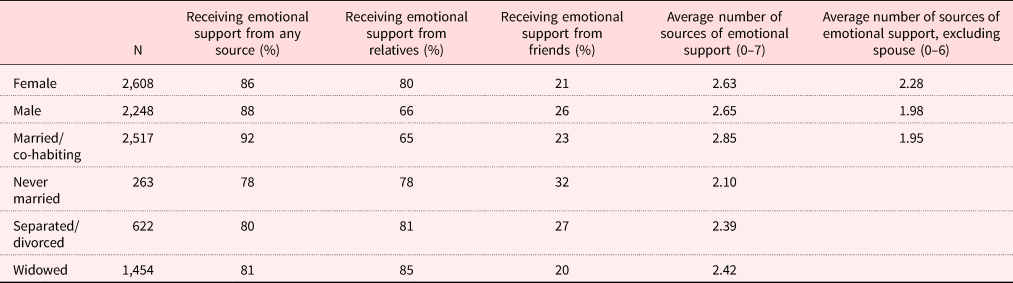
Table 2 displays the percentage breakdown of emotional support, by gender and marital status, to offer insight into prevalence of emotional support. The table shows that nearly the same percentage of women (86%) as men (88%) receive any emotional support. The subsequent columns display percentages among those who receive any support. More women receive support from relatives than men (80% compared with 66%), but fewer women receive support from friends than men (21% compared with 26%). Women have slightly fewer sources of emotional support when counting spouses as a source of support (2.63 for women compared with 2.65 for men). This is likely an artefact of women outliving men at each age, leaving fewer women with a spouse than men. In fact, women have a greater average number of sources of emotional support when excluding spouses from the count (2.28 sources for women compared with 1.98 for men).
Distribution of receipt of emotional support

Table 2 also shows that smaller proportions of never-married (78%), separated/divorced (80%) and widowed (81%) people get any emotional support compared with married/co-habiting people (92%). A slightly greater proportion of widowed people (85%) get emotional support from relatives than other marital categories, and never-married people (32%) get support from friends in the greatest proportions. Married people name the most sources of emotional support (2.85 sources, on average), while people who never married have the fewest sources (2.10 sources, on average). However, when comparing married peoples’ non-spousal sources of support, we see that they have fewer sources, on average (1.95 sources), than other marital categories. We cannot discount that this may be because of the upper limit of six sources of support that respondents were able to name, leaving married people with only five other possible sources if they named their spouse as one of their six.
Regression results
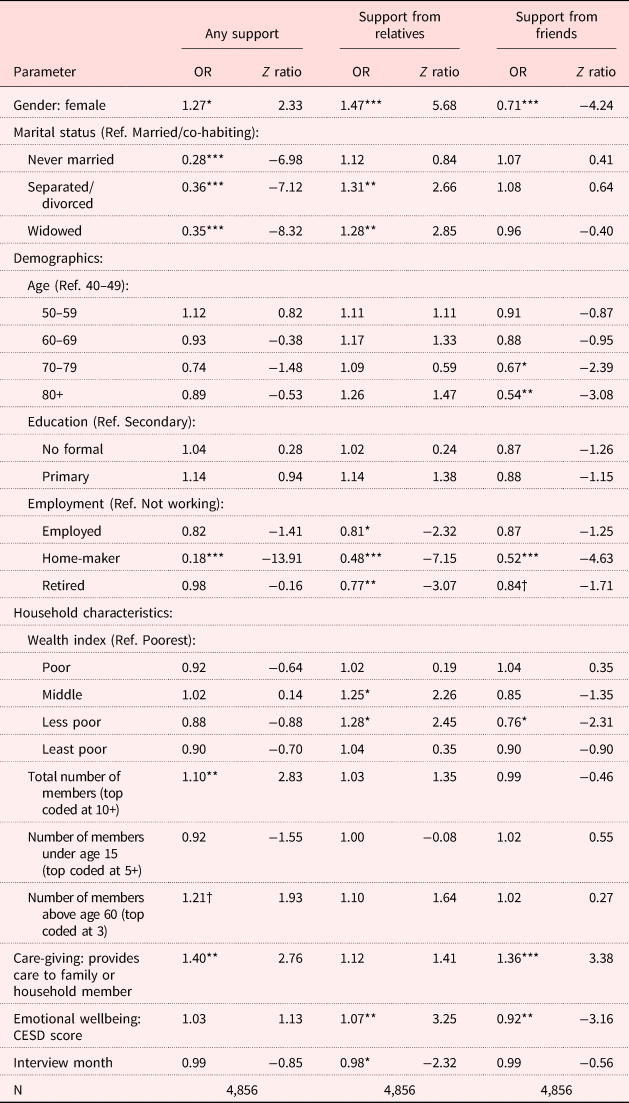
In Table 3 we use logistic regression to investigate the association between gender and receipt of emotional support, as well as the association between marital status and emotional support. In the first model, we see that women are more likely than men to get emotional support from anyone in their network. Specifically, women are 27 per cent more likely to be receiving emotional support. Never-married, separated or divorced, and widowed people are all less likely to be getting emotional support than married people. Never-married people are 72 per cent less likely, separated/divorced people are 64 per cent less likely and widowed people are 65 per cent less likely to be getting support than married people. Models, not shown, in which the reference categories were alternated revealed that there are no significant differences between other categories of marital status in the likelihood of getting any emotional support.
Logistic regression predicting emotional support

Notes: OR: odds ratio. Ref.: reference category. CESD: Center for Epidemiologic Studies Depression Scale.
Significance levels: † p < 0.10, * p < 0.05, ** p < 0.01, *** p < 0.001 (two-tailed tests).
In the second model of Table 3, we investigate the odds of getting emotional support from relatives. Results indicate that women are 47 per cent more likely to get support from relatives than men. Separated or divorced people have 31 per cent greater odds of receiving emotional support from relatives than married people, and widowed people have 28 per cent greater odds. However, widows do not get significantly different support from relatives compared with the never-married or the separated/divorced (not shown).
The third model of Table 3 shows the odds of getting support from friends. The results indicate that women are 29 per cent less likely to be getting support from friends than men. However, there are no differences between categories of marital status.
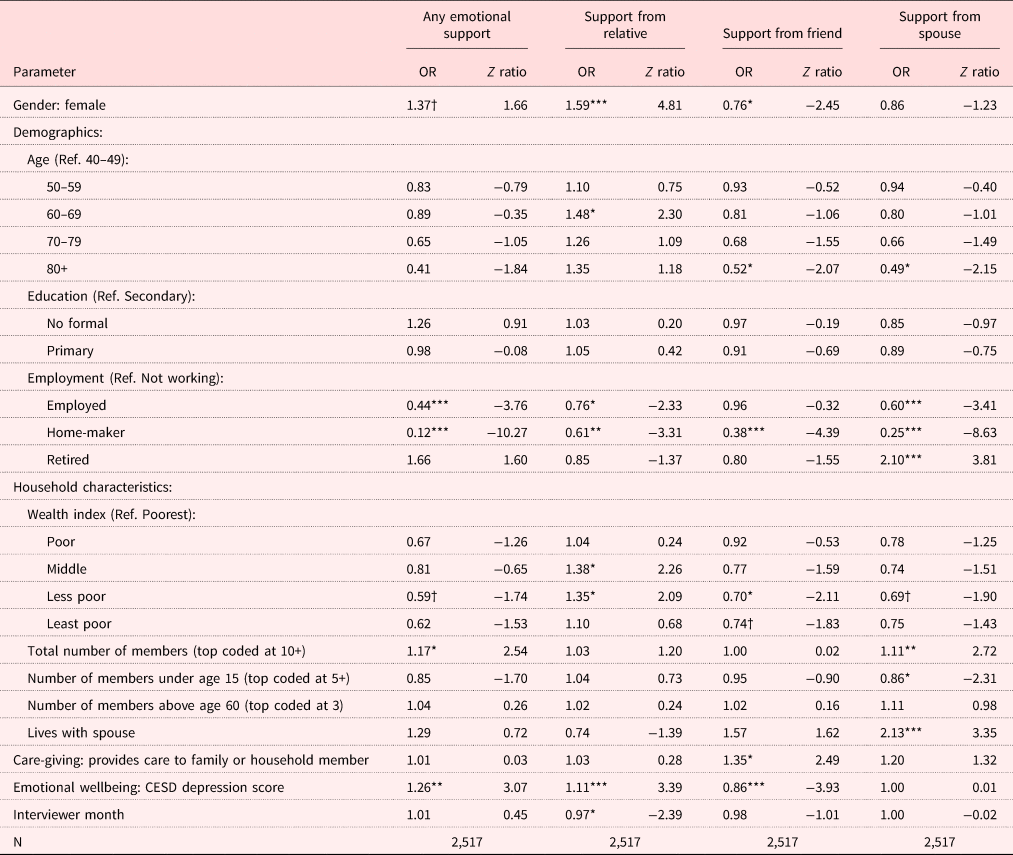
In Table 4, we limit the analytic sample to married respondents. Results from the first model indicate that married women are 37 per cent more likely than married men to get any emotional support. The second model indicates that married women are 59 per cent more likely than married men to get emotional support from relatives. In the third model, married women are estimated to be 24 per cent less likely than married men to get emotional support from friends. In the final model, we find no gender difference in receipt of emotional support from spouse.
Logistic regression predicting emotional support among married respondents

Notes: OR: odds ratio. Ref.: reference category. CESD: Center for Epidemiologic Studies Depression Scale.
Significance levels: † p < 0.10, * p < 0.05, ** p < 0.01, *** p < 0.001 (two-tailed tests).
Number of sources of emotional support
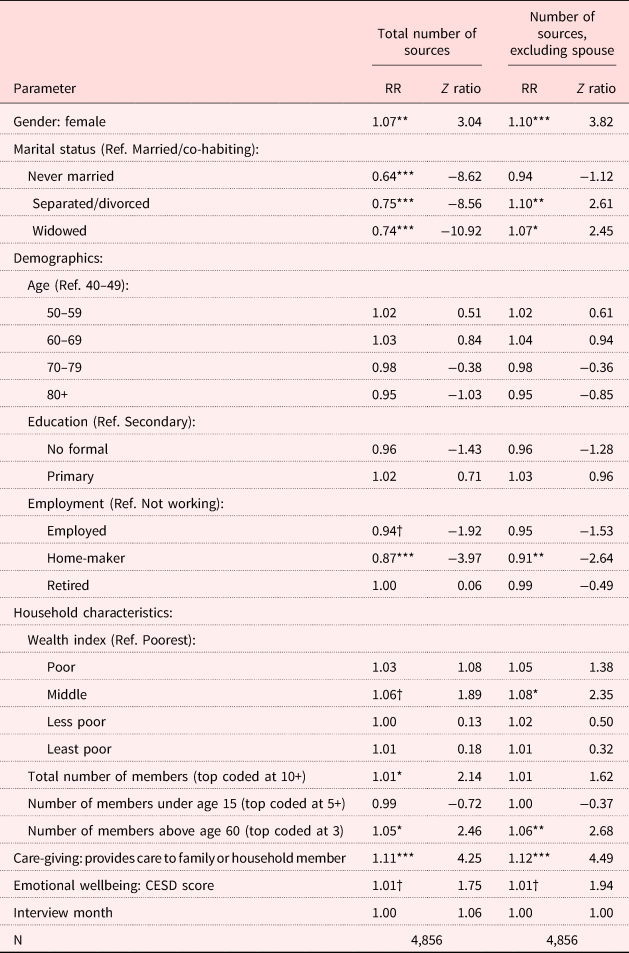
In Table 5, we us Poisson regression to investigate the number of sources from whom respondents receive emotional support. Results are presented as relative risks. The first model indicates that the expected number of sources of emotional support is 7 per cent greater for women than men. Moreover, never-married, separated or divorced, and widowed people have fewer expected sources of support than married people (36, 25 and 26% fewer, respectively). In models, not shown, where the reference category was alternated, we found that both widowed and separated/divorced people have a greater expected number of sources of support than never-married people.
Poisson predicting number of sources of emotional support, among those who get any support

Notes: RR: relative risk. Ref.: reference category. CESD: Center for Epidemiologic Studies Depression Scale.
Significance levels: † p < 0.10, * p < 0.05, ** p < 0.01, *** p < 0.001 (two-tailed tests).
The next model excludes spouses from the count of total sources of emotional support, in order to test whether differences still exist when we discount the built-in advantage that married people have in possible sources of support. This also helps us estimate the sources of support that married people might be expected to have if their spouse died or their marriage otherwise dissolved. In this model, we see that women maintain their advantage in receipt of emotional support from more sources than men, even when excluding spouses from that total. Moreover, the separated or divorced and the widowed have more expected non-spousal sources of emotional support than married people, but there is no significant difference between the never-married and the married. However, models (not shown) that alternated the reference categories revealed that the never-married have significantly fewer sources of non-spousal support than the separated/divorced and the widowed.
Note that models similar to those shown in Tables 3–5 but including interactions between gender and marital status (not shown) did not reveal a consistent moderating influence of gender on the association between marital status and emotional support. Additionally, we tested models for the respondents aged 60 and older separately from respondents under the age of 60 to determine whether there are substantial differences between these groups. The results from both of these sub-samples were consistent with those shown here, and the two sub-samples also showed similarity between them in their receipt of emotional support. This offers support for our previous suggestion that, although ‘older age’ is considered to refer to people aged 60 and older in Western settings, the experiences typically associated with older age may start at a younger age in this setting. At least in terms of receiving emotional support, those aged 60 and older in our sample do not look substantively different from those aged 40–59.
Conclusion
This investigation has used new data in rural South Africa to examine the structure of emotional support by gender and by marital status among an ageing adult population. Researchers often assume that social relationships, their structure and much of their function will show universal patterns based on studies done in Western and high-income settings. Our findings are representative of older adults living in rural South Africa and support earlier findings from other populations as well as highlight some unique patterns in this sample.
We find that women are more likely than men to get emotional support, and they are more likely than men to get support from relatives. Conversely, men are more likely than women to get emotional support from friends. However, we did not find evidence of gender differences in the likelihood of getting emotional support from a spouse. As expected, married people are more likely to get emotional support (from any source) compared with the never-married, the separated or divorced, and the widowed. Yet, separated/divorced and widowed people are more likely than married people to get emotional support from relatives. We also found that married people have a greater total number of sources of emotional support compared with others, and separated/divorced and widowed people have a greater number of non-spousal sources of emotional support.
Results regarding gender and receipt of emotional support are somewhat in line with other studies. Our finding that women are more likely to get emotional support than men is consistent with studies in the West that have shown that women tend to have larger social networks than men (Arling, Reference Arling1987). However, findings in the West (House, Reference House1987; Carr and Bodnar-Deren, Reference Carr, Bodnar-Deren and Uhlenberg2009) and evidence from South Africa (Amoateng et al., Reference Amoateng, Richter, Makiwane and Rama2004) pointed towards some uncertainty about whether men or women in this setting would be more likely to get support from friends. Our findings suggest that men are more likely than women to get support from friends, which is consistent with the evidence that South African men may have more friends in their networks than women (Amoateng et al., Reference Amoateng, Richter, Makiwane and Rama2004). Men in this setting may have more and/or closer friendships aside from kin than women, and this may be a unique aspect of the social structure in South Africa. On the other hand, it is possible that this finding is an artefact of gender differences in reporting of social contacts: women may name their relatives before listing friends, while men may do the opposite.
We find no evidence of a gender difference in the emotional support received from spouses. This null result is particularly interesting in light of the strong basis of evidence, in the West, that men benefit from marriage more than women and that women take on the role of care-giver to a greater extent than men (Berkman and Syme, Reference Berkman and Syme1979; Antonucci and Akiyama, Reference Antonucci and Akiyama1987a; Waite and Gallagher, Reference Waite and Gallagher2001; Carr and Bodnar-Deren, Reference Carr, Bodnar-Deren and Uhlenberg2009). It is possible that either (a) husbands take on more of the emotional care in this setting, wiping out the gender effect, or that (b) spouses are not an important source of emotional support for either men or women in this setting. The high rate of labour migration, especially under apartheid, that led to many men being separated from their families may have had a lasting impact on spousal dynamics such that gender is not a predictor of receipt of spousal support.
Married people in our sample tend to have a more beneficial structure of emotional support than non-married people. Married people are more likely to get support and have more total sources of support. This is not surprising, given that married people have access to a spouse and to their spouses’ social network as possible sources of support (Kalmijn, Reference Kalmijn2003; Cornwell, Reference Cornwell2012). In fact, when excluding spouse as a possible source of support, married people have fewer sources of support than the separated/divorced and widowed. This is contrary to previous research that found that separated and divorced people have smaller social networks than married people (Gerstel et al., Reference Gerstel, Riessman and Rosenfield1985). Perhaps, in this setting, both separated/divorced and widowed people may develop their network of friends, family and acquaintances to be larger and more supportive after their marriages dissolve.
In fact, we find that divorced/separated and widowed people are more likely to get emotional support from relatives than married people. Although this was somewhat expected of widowed people, we did not expect separated and divorced people to fare as well in support from relatives given the likelihood of losing relationships with some relatives during the process of marital breakdown (Gerstel et al., Reference Gerstel, Riessman and Rosenfield1985; Cotten, Reference Cotten1999). In addition to the possibility that widowed and separated/divorced people invest more in these relationships after their marriages dissolve, it is also possible that relatives make a concerted effort to be supportive of people who have experienced a marital dissolution.
We do not find evidence that never-married people invest more in their networks of friends and relatives, in lieu of having a spouse to rely on for support. In fact, we find few differences between never-married people and married people. One significant difference that we do find is that never-married people are less likely to get support (from anyone) than married people. We also find that never-married people have significantly fewer sources of support than separated/divorced or widowed people. These results suggest that marriage may offer people the opportunity to develop their social network, and this particular benefit of marriage may be retained even after a marriage dissolves. People who experienced a marital dissolution may more readily request support from a greater number of people in their network than never-married people, who have not experienced such a loss. Similarly, a greater number of the friends and relatives of people whose marriages dissolved may perceive that they are in need of support and offer it. On the other hand, it is also possible that never-married people face mental or other health issues that reduce their odds both of getting married and of having a large network of social contacts.
As people age and face various health issues, regardless of gender, marital status and the specific setting, whether in sub-Saharan Africa or in the global West, accessing and receiving social support becomes critical. While arguably social support is generally more readily accessible in urban and/or Western settings, this is not true of every sub-population within those settings. The data from this rural African population provide insight into the experiences of marginalised, poor communities. In the West, such experiences may be those of immigrant or other minority groups. Our findings may have implications for how elderly people in these communities are likely to turn to friends and relatives to provide care, and how this might differ by gender and marital status. Although we find differences in our sample compared with evidence from Western samples, we also find similarities. For example, there is an apparent marriage premium for receipt of support in this setting as has been found elsewhere (Kalmijn, Reference Kalmijn2003; Cornwell, Reference Cornwell2012). These results lend support to the supposition that married people fare better, overall, across settings and across social contexts. Given that our results do not entirely line up with expectations based on Western evidence, however, we can infer that the way in which emotional support operates and the sources from which this support comes is not universal. In order to understand the supply and demand of informal support systems, we must consider how relationships function in the specific setting we seek to understand.
Our study faces limitations that prevent us from approaching causal inference in the association between gender or marital status and receipt of emotional support. First, although future waves of data collection are being planned, the HAALSI study has only completed collection of baseline data thus far, limiting us to examining the structure of emotional support cross-sectionally. Second, we do not have complete data on people's marital histories to determine whether currently married people were previously separated/divorced or widowed – events that are likely to have impacted their social network trajectory. Third, it is possible that both marital status and emotional support are determined by a third factor, such as mental health. We have tried to control for such relevant measures in our analyses, but it remains possible that an unobserved factor is influencing these results. Likewise, this study faces issues of selection into and out of marriage. As alluded to above, healthier and more socially connected people are more likely to get or stay married, whereas people who face health issues may be both less likely to ever marry and less likely to have large networks of friends.
Another, more complicated, issue alluded to above is that of gender differences in perceptions of both who one's social contacts are and who provides emotional support. For example, when asked to name up to six social contacts, women may first think of their spouses and relatives before thinking of friends. Men, on the other hand, may take social contacts within the home and family for granted, and may first name their friends as their close social contacts. If this is the case, a woman may reach her sixth contact with a greater proportion of relatives than men, who may name a greater proportion of friends. While research on gender differences in social network reporting is limited, studies relying on survey data and self-reports find that men are more likely than women to rely on their spouse for support (Gerstel et al., Reference Gerstel, Riessman and Rosenfield1985; Antonucci and Akiyama, 1987; House, Reference House1987). This suggests that if anything, men are more likely than women to report their spouse as a source of social support. Nonetheless, gender differences may exist that affect the measurement of our dependent variables.
Overall, our results offer insight into the receipt of social support among an adult population in South Africa, ranging in age from their forties to their late nineties. Our findings suggest that men may be faring worse than women and the never-married may be faring worse than people who were ever married, pointing towards the need to focus attention on these groups when considering policies that may offer older populations formalised social protections. It will be especially important to uncover how the structure of social support revealed here is related to health outcomes, such as mental health, mortality and cardio-metabolic risks. Longitudinal follow-up, currently under way, will allow for the assessment of this risk. Certainly, if a lack of emotional support is related to poorer health, as evidence elsewhere suggests (Cacioppo et al., Reference Cacioppo, Hughes, Waite, Hawkley and Thisted2006; Hawkley and Cacioppo, Reference Hawkley and Cacioppo2010; Hawkley et al., Reference Hawkley, Thisted, Masi and Cacioppo2010), it is imperative to consider policies to boost social support, especially among men and the never-married.
Acknowledgements
We would like to thank Drs Kathleen Kahn and Stephen Tollman at the University of the Witwatersrand for their helpful comments on an earlier draft of this paper and the University of the Witwatersrand and MRC/Wits Rural Public Health and Health Transitions Research Unit (Agincourt) for collecting the data used here.
Author contributions
EAJ performed the data analyses and wrote the majority of the manuscript, NM contributed contextualisation of this topic within South Africa, and LB contributed to the conceptualisation of the overall framework and analyses.
Financial support
The HAALSI study, funded by the National Institute on Aging (P01 AG041710), is nested within the Agincourt Health and Demographic Surveillance System site, supported by the University of the Witwatersrand and Medical Research Council, South Africa, and the Wellcome Trust, UK (grant numbers 058893/Z/99/A, 069683/Z/02/Z;, 085477/Z/08/Z, 085477/B/08/Z).
Ethical standards
The HAALSI study received ethical approvals from the University of the Witwatersrand Human Research Ethics Committee (reference number M141159), the Harvard T.H. Chan School of Public Health, Office of Human Research Administration (reference number C13-1608-02) and the Mpumalanga Provincial Research and Ethics Committee.