INTRODUCTION
Official variety trials compare agronomic performance of new varieties with reference varieties. For silage maize, Belgian evaluation criteria include parameters for dry matter (DM) yield, harvest security (resistance to lodging and stalk rot), disease resistance and quality (Van Waes Reference Van Waes2009). Currently, varieties are tested in one trial network covering six locations situated in the important silage-maize-growing areas in Belgium. Trials are conducted in randomized block designs for at least 2 years. Owing to the relatively small variation in growing and weather/environmental conditions in the maize-growing areas, varieties submitted for registration in Belgium show a limited variation in earliness. All varieties are harvested on 1 day per location, based on a whole-crop DM content of approximately 34·0% of a reference variety (with an average maturity type). Upon data processing, varieties are grouped into an early and a late maturity group early and a late maturity groups. Each variety is then assigned to one of the groups based on the statistical analysis of whole-crop DM content at harvest. This methodology has been criticized. An alternative has been suggested, with several harvesting dates per location. This approach is based on the idea that varieties should be harvested at the physiological stage where they can show their optimal performance. Harvesting at a time with potentially sub-optimal performance is therefore expected to result in inconsistent variety ranking.
The nutritive value of maize silage is mostly affected by the choice of variety and the stage of physiological development at harvest. The effect of increased DM content on animal performance is well-known (Jensen et al. Reference Jensen, Weisbjerg, Norgaard and Hvelplund2005). Quality changes (including starch and organic matter digestibility (OMD)) during maturation have been studied extensively (Ettle & Schwarz Reference Ettle and Schwarz2003; Cone et al. Reference Cone, Van Gelder, Van Schooten and Groten2008; Arriola et al. Reference Arriola, Kim, Huisden and Adesogan2012). As the quality of the forage changes during maturation, the optimal harvest date is a compromise between whole-crop DM yield, ear DM yield or starch yield, OMD and a whole-crop DM content that is appropriate for storage (Wiersma et al. Reference Wiersma, Carter, Albrecht and Coors1993; Barriere et al. Reference Barriere, Argillier, Michalet-Doreau, Hebert, Guingo, Giauffret and Emile1997). At the animal level, the goal is to maximize forage intake, digestion and milk/meat production (Bal et al. Reference Bal, Coors and Shaver1997; Phipps et al. Reference Phipps, Sutton, Beever and Jones2000). Several independent studies recommend harvesting maize when the whole-crop DM content is between 30·0 and 35·0% (Johnson et al. Reference Johnson, Harrison, Hunt, Shinners, Doggett and Sapienza1999; Phipps et al. Reference Phipps, Sutton, Beever and Jones2000; Hetta et al. Reference Hetta, Mussadiq, Gustavsson and Swensson2012). Yield, quality and performance indices remain at 95% of their optimum with decreasing moisture content until whole-crop DM content equals 42·0% (Darby & Lauer Reference Darby and Lauer2002).
In an ideal variety testing system, each variety would be harvested at a comparable maturity stage. In reality, however, the feasibility of such a strategy is limited due to a number of practical, organizational and economic constraints. A limited number of studies compare varieties at a fixed whole-crop DM content (Hetta et al. Reference Hetta, Mussadiq, Gustavsson and Swensson2012). Most studies comparing variety performance are done by harvesting all varieties at a single date, which results in a comparison at different DM contents (Schwab et al. Reference Schwab, Shaver, Lauer and Coors2003; Wilkinson & Hill Reference Wilkinson and Hill2003; Cone et al. Reference Cone, Van Gelder, Van Schooten and Groten2008). The single harvest date usually corresponds with the date where a reference variety reaches the recommended whole-crop DM content. Under this testing system, only a limited proportion of the tested varieties are harvested at their optimal harvest date. It is as yet unclear whether a harvest window can be found that would guarantee a stable variety rank. Within such a harvest window, the variety rank based on a single harvest date would equal the variety rank based on harvesting all varieties at their optimal harvest dates.
The aim of the current paper was to develop a statistical method (i) to calculate the optimal harvest date for individual varieties and (ii) to define a harvest window using trials with a series of consecutive harvests.
MATERIALS AND METHODS
Experimental site, design and plant material
Eight varieties of silage maize were grown on three experimental fields (Bottelare (50°58′N, 3°45′E, 30 m asl), Hoogstraten (51°24′N, 4°46′E, 21 m asl) and Bocholt (51°10′N, 5°34′E, 42 m asl)) in Flanders (the northern part of Belgium) during 3 consecutive years (2007–2009). The field experiments were set up in the framework of the ‘Flemish Agricultural Centre for fodder crops’ programme. The three locations were characterized by different soil types: sandy loam, loamy sand and sand in Bottelare, Hoogstraten and Bocholt, respectively. Eight varieties were chosen with increasing Food and Agricultural Organization of the United Nations (FAO) maturity rating (Zscheischler et al. Reference Zscheischler, Estler, Staudacher, Gross, Burgstaller, Streyl and Rechmann1990), representing the variation between varieties available on the Belgian market. Two maturity types were represented: early varieties (Amilac (FAO 210, KWS), Aurelia (FAO 220, Limagrain), Banguy (FAO 220, Limagrain), and Justina (FAO 210, Pioneer)) and late varieties (Lafortuna (FAO 235, KWS), Crazy (FAO 250, Innoseeds), Franky (FAO 250, Scam), and Allstar (FAO 230, Limagrain)). In the FAO rating system, a 10-unit difference indicates a maturity difference of 1–2 days or 1·0–2·0% difference in DM concentration at harvest. The experimental design was a completely randomized block with three replicates. Plots consisted of four rows 12 m long. Row width was 0·75 m and the plant density was 105 000 plants/ha. Sowing dates were between 18 April and 19 May (depending on location and year). Manure, fertilizers and herbicides were applied according to recommended agricultural practices in line with current Belgian regulations.
Weather conditions and growing degree days
Growing degree days (GDD) (°Cd) were calculated from the daily average temperature minus the base temperature, accumulated over the period from sowing onwards, using the following equation:
 $$GDD = \sum\limits_{sowing}^{harvest} {\displaystyle{{(T_{\max} + T_{\min} )} \over 2} - T_{{\rm base}}} $$
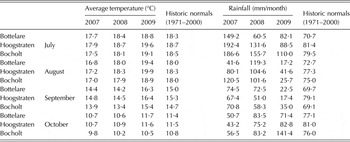
where T max (°C) is the daily maximum temperature, T min (°C) is the daily minimum temperature and T base = 6 °C. Temperatures were taken at meteorological stations in the proximity of the trials (maximum 20 km away). The 2007 growing season was characterized by normal temperatures and above-average precipitation in July followed by normal precipitation in August, September and October. In 2008, the growing season was characterized by normal temperatures, normal precipitation in July (Bottelare), August (Hoogstraten and Bocholt), September and October; above-average precipitation in July (Hoogstraten and Bocholt) and August (Bottelare). The growing season in 2009 was characterized by high temperature and average rainfall in July and October; below-average rainfall in August and September (Table 1).
Monthly temperature and rainfall from July to October in Bottelare, Hoogstraten and Bocholt in 2007, 2008 and 2009

Harvests and fractioning of plants
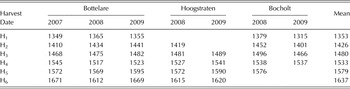
Six harvest dates (H x ) were applied during plant maturation at Bottelare. At Hoogstraten, a shorter harvest period was applied: harvest dates 2–6 in 2008 and harvest dates 3–6 in 2009. At Bocholt, harvests were limited to harvest dates 1–5 in 2008 and harvest dates 1–4 in 2009. Harvesting was initiated when the kernels of the earliest hybrid, Justina, were at the dent stage (R5) (Ritchie et al. Reference Ritchie, Hanway and Benson1997) targeting a whole-crop DM content of c. 25·0%. The first harvest date coincided with 1315–1379 GDD depending on location and year (Table 2). Subsequent harvests were taken with intervals of c. 40–70 GDD, targeting a whole-crop DM content of c. 40·0% for Justina at the last harvest date. At each harvesting moment, all varieties present at the location were harvested on the same day. Fresh yield was measured per plot by weighing all the plants from the two inner rows over a length of 8 m. Plants were cut by hand 10 cm above soil level. Five representative plants were chosen randomly and split into stover and ears (de-husked). Ears were dried at 75 °C for 16 h followed by 5 h at 105 °C to determine ear DM content and DM yield. Another five randomly chosen representative plants were chopped to determine DM content (72 h at 65 °C) and quality parameters of whole-crop material. The dry chopped material was milled over a 1-mm screen using a cutting mill (Retsch Model PK 1000).
Growing degree days (GDD) (Tbase = 6 °C) per harvest date, location and year

Determination of forage quality
Chemical parameters, including crude protein (CP), neutral detergent fibre (NDF), acid detergent fibre (ADF), acid detergent lignin (ADL) and OMD were estimated using near-infrared spectra (NIRs) collected at 1100–2500 nm at 4-nm intervals using an Infralyzer 500 spectrophotometer (Bran & Luebbe, Norderstedt, Germany) (De Boever et al. Reference De Boever, Vanacker and De Brabander2002). Calibration equations were provided by the Walloon Agricultural Research Centre in Gembloux (Belgium). Determination coefficients between laboratory analyses and NIRs predictions (R2), as well as standard errors of calibration were, respectively: 0·92 and 0·36 for CP, 0·93 and 1·71 for NDF, 0·95 and 1·15 for ADF, 0·84 and 0·39 for ADL, and 0·92 and 1·70 for OMD. Calibration equations were validated each year with laboratory analyses of Belgian maize samples. The samples in the calibration and validation set were subjected to standard wet chemical analyses. In determining NDF, ADF and ADL, the laboratory procedures given by Goering & van Soest (Reference Goering and van Soest1970) were followed. The determination of OMD was based on the in vitro cellulase technique (De Boever et al. Reference De Boever, Cottyn, De Brabander, Vanacker and Boucque1997). Determination coefficients between laboratory analyses and NIRs predictions are good for CP, NDF, ADF, ADL and OMD (De Boever et al. Reference De Boever, Cottyn, De Brabander, Vanacker and Boucque1997; Argillier et al. Reference Argillier, Barriere, Dardenne, Emile and Hebert1998).
Determination of the harvest window
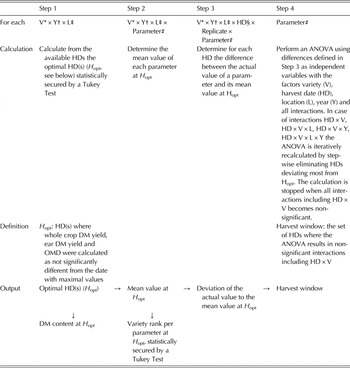
The harvest window is defined as the set of harvest dates that result in a stable variety rank. The harvest window was calculated according to the methodology presented in Table 3. First, the optimal harvest date or dates (H opt) was/were calculated as the harvest date(s) where whole-crop DM yield, ear DM yield and OMD were at a maximum. This calculation was done by using a Tukey Test comparing harvest dates with the date showing the highest values for these three parameters. Harvest dates that were not significantly different from the date showing the maximal values were called H opt. Taking into account requirements for ensiling and conservation, whole-crop DM content was restricted to 25·0–40·0%. Second, the mean value of each parameter at H opt was calculated, resulting in a variety rank at H opt per parameter. Rank differences were statistically tested with a Tukey Test. Third, the difference between the actual value of a parameter and its mean value at H opt was calculated for each harvest date. Fourth, a harvest window per parameter was calculated based on analyses of variance (ANOVA) using the differences defined in step 3 as independent variables with the factors variety (V), harvest date (HD), location (L), year (Y) and all interactions. Harvest dates were included in the harvest window if interactions HD × V, HD × V × L, HD × V × Y and HD × V × L × Y were not significant. ANOVAs were iteratively recalculated by stepwise elimination of the harvest dates that deviated most from H opt until all interactions including HD × V became non-significant. The remaining dates represented the harvest window.
Steps to calculate the harvest window

ANOVA, analysis of variance; DM, dry matter; OMD, organic matter digestibility; H opt, optimal harvest date(s).
* Variety = Amilac, Aurelia, Banguy, Justina, Lafortuna, Crazy, Franky, Allstar.
† Year = 2007, 2008, 2009.
‡ Location = Bottelare, Hoogstraten, Bocholt.
# Harvest date = 1, 2, 3, 4, 5, 6.
# Parameter = whole-crop DM yield, ear DM yield, crude protein, neutral detergent fibre, acid detergent fibre, acid detergent lignin, OMD.
Statistical analyses were performed using the statistical program R (version 2.14.1). Significance was declared at P < 0·05. Data that were more than 3 standard deviations from the mean were considered outliers and removed from the dataset. Normality and equal variances were checked with a quantile-quantile-plot and Levene's test, respectively.
RESULTS
Whole-crop dry matter content and response to growing degree days
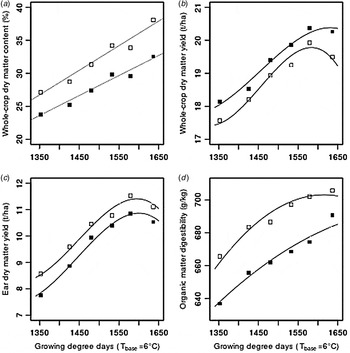
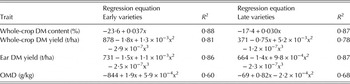
Whole-crop DM content increased linearly during maturation (Table 4 and Fig. 1(a)). At the first harvest date, corresponding with an average of c. 1350 GDD, early varieties showed a DM content between 25·6 and 28·1% while late varieties had a DM content between 22·6 and 25·2%. The increase in DM content was on average 0·038% per GDD with a significant difference between Aurelia (0·5 g/kg per GDD) and Lafortuna (0·03% per GDD). The last maturity stage, corresponding with 1637 GDD and referred to as harvest date 6, had a DM content of 31·0 to 40·6%. The DM content difference between all compared varieties at any harvest date increased during maturation: 5·5% at harvest date 1 to 9·6% at harvest date 6. Whole-crop and ear DM yield increased until about 1580 GDD (Fig. 1(b) and (c)). The OMD of early varieties reached a plateau at 1600 GDD, while OMD of late varieties continued to increase (Fig. 1(d)).
Relationship between (a) whole-crop dry matter content, (b) whole-crop dry matter yield, (c) ear dry matter yield, and (d) organic matter digestibility on growing degree days. Data are reported for early varieties (□) and late varieties (■). Each data point is the mean across four hybrids, three replicates, 3 years and three locations. Equations and coefficients of determination (R 2) for Fig. 1 are reported in Table 4.

Regression equations for whole-crop dry matter content, whole-crop dry matter yield, ear dry matter yield and organic matter digestibility. Data were pooled across years (2007, 2008, 2009), locations (Bottelare, Hoogstraten, Bocholt), hybrid (Early = Amilac, Aurelia, Banguy, Justina; Late = Lafortuna, Crazy, Franky, Allstar), and replication (n = 84) and regressed against growing degree days (GDD) (n = 6)

DM, dry matter; OMD, organic matter digestibility.
x = GDD (T base = 6 °C).
Optimal harvest date (H opt)
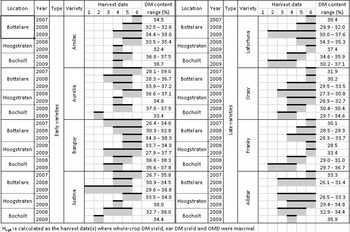
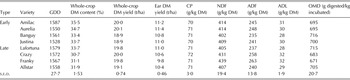
Optimal harvest date per variety, location and year are presented in Fig. 2. The whole-crop DM content that corresponded with the optimal harvest date ranged from 26·1–39·0% across varieties, years and locations. Within varieties, a range of 6·0–12·0% was measured between years and locations. The mean (s.d.) whole-crop DM contents at H opt per variety were 30·7 (2·59) for Crazy; 31·1 (3·2) for Franky; 31·9 (3·05) for Allstar; 33·4 (4·31) for Banguy; 33·6 (3·01) for Lafortuna; 34·0 (4·16) for Justina; 34·7 (3·71) for Aurelia and 35·2 (2·64) for Amilac. Between maturity types, whole-crop DM content at H opt was significantly higher for early types (34·2%) compared to late types (32·0%). Variety ranks at H opt differed per parameter: clear differences among the varieties were detected for all parameters except for CP (Table 5). Banguy, Justina and Allstar had the lowest whole-crop DM yield, but these varieties had the best values for OMD.
Optimal harvest dates (H opt) per variety, location and year (presented by grey lanes) with corresponding dry matter (DM) content range (%).

Variety rank at Hopt based on GDD, whole-crop DM content, whole-crop DM yield, ear DM yield, CP, NDF, ADF, ADL and OMD as means of the locations Bottelare, Hoogstraten, Bocholt and the years 2007, 2008, 2009

DM, dry matter; CP, crude protein; GDD, growing degree days; NDF, neutral detergent fibre; ADF, acid detergent fibre; ADL, acid detergent lignin; OMD, organic matter digestibility; s.e.d., standard error of difference.
Harvest window
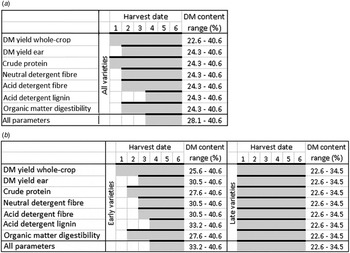
When all varieties were considered together, the harvest window included all harvest dates for the parameters whole-crop DM yield and CP (Fig. 3(a)). For ear DM yield, NDF, ADF and OMD the harvest window included harvest dates 2–6; for ADL it covered harvest dates 4–6. Therefore, the smallest harvest window that comprised all parameters consisted of harvest dates 4–6. This smallest harvest window corresponded with a whole-crop DM content of 28·1–40·6% for all varieties.
(a) Harvest window for all varieties (shown in grey) indicating harvest dates with a stable variety rank. (b) Harvest window for early (left) and late (right) varieties (shown in grey), indicating harvest dates with a stable variety rank. The intercept for each parameter is indicated with dark grey bars resulting in an overall harvest window.

The harvest window for early varieties for whole-crop DM yield comprised all harvest dates; for CP and OMD, harvest dates 2–6; for ear DM yield, NDF and ADF, harvest dates 3–6; and for ADL, harvest dates 4–6 (Fig. 3(b)). Consequently, the smallest harvest window for early varieties considering all parameters comprised harvest dates 4–6 and represented a whole-crop DM content of 33·2–40·6%. The harvest window for late varieties considering all parameters covered all harvest dates and represented a whole-crop DM content of 22·6–34·5%.
DISCUSSION
Whole-crop and ear dry matter content, dry matter yield and response to growing degree days
The current trials were conducted with a limited set of eight varieties, which is not large enough to generalize conclusions. However, this kind of research is very time- and labour-consuming, which makes it difficult to work with a large set of varieties. The harvest dates are defined using GDD to be able to compare between locations and years (Boon et al. Reference Boon, Struik, Engels and Cone2012). Average temperature and rainfall were comparable between 2007 and 2008, while 2009 was characterized by a hot and dry growing season. The harvest period covered an average whole-crop DM content of 22·6–28·1% at the first harvest date and a DM content of 31·0–40·6% at the sixth harvest date, with a statistically comparable increase between variety types of 0·038% per GDD, which is well in line with current practices. Indeed, the increase in DM content of the reference variety measured during the evaluation of the Belgian variety trials ranged from 0·029 to 0·041% per GDD in the period from 2007 to 2009 (data not published). At each harvest date, the whole-crop DM content varied with 4·0–6·0% between maturity types. All varieties were harvested at least on one occasion at a whole-crop DM content between 30·0 and 35·0% recommended by Johnson et al. (Reference Johnson, Harrison, Hunt, Shinners, Doggett and Sapienza1999). Averaged over all varieties, ear DM content increased from 40·0 to 55·0 with 0·07% per GDD; whole-crop DM yield increased from 17·8 to 20 with 0·01 t/ha per GDD and ear DM yield increased from 8·2 to 11·2 with 0·014 t/ha per GDD (data not shown), which is in accordance with results of Arriola et al. (Reference Arriola, Kim, Huisden and Adesogan2012). Ear DM content increased faster for Franky (with 0·08% per GDD) compared with Banguy, Aurelia, Justina and Lafortuna (with 0·065% per GDD) while whole-crop and ear DM yield increased at the same rate for all varieties.
Optimal harvest date (H opt)
Instead of assuming a fixed DM content at H opt, the optimal harvest dates were defined by optimizing whole-crop DM yield, ear DM yield and OMD within a whole-crop DM content range at harvest between 25·0 and 40·0%, to account for different DM contents at H opt between maize types. By simultaneously optimizing the whole-crop DM yield, ear DM yield and OMD, H opt is a compromise among quantity, starch yield and quality, respectively. Average whole-crop DM contents at H opt per variety were between 31·0 and 34·0%, within the recommended range suggested by Johnson et al. (Reference Johnson, Harrison, Hunt, Shinners, Doggett and Sapienza1999). However, whole-crop DM content at H opt varied between years and locations from 26·0 to 39·0%. Whole-crop DM content at H opt was significantly higher for early types compared with late types. This difference could not be confirmed by the literature. To compare whole-crop DM content at H opt between maturity types, sampling should continue until the latest harvest date is no longer optimal. In the current study, the latest harvest date was generally indicated as the optimal harvest date for the late varieties, which indicates that the harvest series were stopped too early. Values for CP, NDF, ADF, ADL and OMD at H opt were numerically comparable with Cone et al. (Reference Cone, Van Gelder, Van Schooten and Groten2008), who studied four maize types in the Netherlands on three harvest dates. Despite the variation in whole-crop DM content at H opt, the variety rank at H opt was statistically comparable with a variety rank based on a fixed DM content of 30·0–35·0% for each quality parameter.
Harvest window
To our knowledge, this is the first attempt to calculate a harvest window by comparing the variety rank at the optimal harvest date with the rank at a single harvest date. Such a harvest window is expected to be limited because the effect of harvest date is more pronounced in the early stages of ripening (DM from 29·0 to 32·0%) than during prolonged ripening (DM from 3·20 to 39·0%), as suggested by Cone et al. (Reference Cone, Van Gelder, Van Schooten and Groten2008). The harvest window for all varieties and all parameters included harvest dates 4–6 (GDD of 1533 to 1637). The span of 100 GDD offers a flexible harvest period of about 14 days, since the average daily temperature during the maturation period is 13 °C in Belgium. In contrast with the results of Cone et al. (Reference Cone, Van Gelder, Van Schooten and Groten2008), no differences were found in the current study between the variety rank of plants with a whole-crop DM content ranging from 28·1 to 35·3% (a difference of 7·2% between all compared varieties at harvest dates 4 and 5) and the variety rank of plants with a DM content ranging from 31·0 to 40·6% (a difference of 9·6% at harvest date 6). Furthermore, the variety rank based on a single harvest date equals the variety rank based on harvesting all varieties at H opt. Dividing varieties into an early and late group did not change the harvest window. Based on these results, harvesting varieties with a different maturity type on a single date does not jeopardize a consistent variety rank. The developed strategy of determining a harvest window guarantees the most relevant comparison of variety performances as long as the whole-crop DM content of the latest variety is >28·1% and the whole-crop DM content of the earliest variety is <40·6% while their difference is a maximum of 7·2%. The Belgian variety trials, currently based on the whole-crop DM content of c. 34·0% of a reference variety with average maturity type, correspond well to the conditions described above.
CONCLUSIONS
The current study allowed an optimal harvest date to be calculated for single varieties differing in earliness and to define a harvest window resulting in a variety rank that was statistically not different to the rank at the optimal harvest date. Based on the current results, performing and assessing variety trials with a single harvest date continues to be a scientifically justified practice in Belgium, provided the whole-crop DM content is between 28·1 and 40·6% with a maximum difference of 7·2% between all compared varieties at any harvest date.
We would like to thank the Flemish Agricultural Centre for fodder crops for financial support and the agricultural schools of Hoogstraten and Bocholt for technical assistance in carrying out the field experiments. Appreciation is extended to Miriam Levenson for reviewing the manuscript prior to submission.