The study of childhood aggression has become especially relevant in recent years (Lahey, Moffitt, & Caspi, Reference Lahey, Moffitt and Caspi2003; Oñate & Piñuel, Reference Oñate and Piñuel2006) due to its social impact and importance in predicting future problems at school, delinquency, and psychopathology (Bezdjian, Tuvblad, Raine, & Baker, Reference Bezdjian, Tuvblad, Raine and Baker2011; Monks, Palermiti, Ortega, & Costabile, Reference Monks, Palermiti, Ortega and Costabile2011).
A key distinction in the study of aggression was made by Dodge and Coie (Reference Dodge and Coie1987) between proactive aggressive behavior (intentional and aimed at doing harm) and reactive aggressive behavior (the result of responding to an evocative stimulus). The relevance of this distinction lies in the outcomes, or consequences, of the two types of aggressive behavior, as shown in different studies: while proactive aggression has been associated with externalizing behavioral problems, among others (Brendgen, Vitaro, Tremblay, & Lavoie, Reference Brendgen, Vitaro, Tremblay and Lavoie2001; Fite, Colder, Lochman, & Wells, Reference Fite, Colder, Lochman and Wells2008; Joussemet et al., Reference Joussemet, Vitaro, Barker, Cote, Nagin, Zoccolillo and Tremblay2008; van Baardewijk, Vermeiren, Stegge, & Doreleijers, Reference van Baardewijk, Vermeiren, Stegge and Doreleijers2011), reactive aggression has been associated with adjustment issues more akin to internalizing problems (Hubbard, Dodge, Cillessen, Coie, & Schwartz, Reference Hubbard, Dodge, Cillessen, Coie and Schwartz2001; Mathieson & Crick, Reference Mathieson and Crick2010; Salmivalli & Helteenvuori, Reference Salmivalli and Helteenvuori2007).
Temperamental variables pertaining to the subject as well as socializing variables involved in family dynamics have been essential to explain behavioral problems. Especially the tendency to experience frustration and negative emotionality, a temperamental trait, has been repeatedly associated with various externalizing problems (Sanson, Hemphill, & Smart, Reference Sanson, Hemphill and Smart2004). One of its components, anger, is one of the main emotions that predict aggression (Del Barrio, Aluja, & Spielberger, Reference Del Barrio, Aluja and Spielberger2004; Eisenberg, et al., Reference Eisenberg, Ma, Chang, Zhou, West and Aiken2007). In general, it has been observed that children with propensity to express negative emotions, low level of adaptability, high level of activity, low emotional regulation, and who may be described as temperamentally difficult, tend to have a higher incidence of behavioral problems during development (Bates, Kohnstamm, & Rothbart, Reference Bates, Kohnstamm, Rothbart, Bates, Kohnstamm and Rothbart1989; Chess, Thomas, Carey, & McDevitt, Reference Chess, Thomas, Carey, McDevitt, Chess, Thomas, Carey and McDevitt1989), especially when it comes to aggressive behavior (Chess et al., Reference Chess, Thomas, Carey, McDevitt, Chess, Thomas, Carey and McDevitt1989). These behavioral problems are even more apparent when a child’s high reactivity is not sufficiently regulated by his or her behavioral and biological processes, including effortful control, cuddliness, attentional control, perceptual sensitivity, and enjoyment of low-intensity stimulation (Rothbart, Reference Rothbart2007; Rothbart, Bates, Eisenberg, Damon, & Lerner, Reference Rothbart, Bates, Eisenberg, Damon, Lerner, Rothbart, Bates, Eisenberg, Damon and Lerner2006). The relationship between temperament and aggression should also be considered dynamically, given that temperamental factors shift as one matures. According to Putman, Ellis, and Rothbart (Reference Rothbart, Ahadi, Hershey and Fisher2001), temperament is initially governed by reactivity variables like perceptual sensitivity, high motor activity, and impulsivity. Meanwhile, temperamental variables involved in self-control, such as inhibition and changing attentional focus, become significantly more prominent after one year of age and throughout childhood.
From a parenting perspective, certain aspects have been repeatedly found to be significantly related to the onset and duration of aggression. Among the most widely-analyzed of such factors are attachment types and parenting styles. Relations with an infant marked by sensitivity on the part of the adult are the most likely to lead to strong bonds of attachment able to model a relationship based on trust, respect, and safety for the infant (Ainsworth, Blehar, Waters, & Wall, Reference Ainsworth, Blehar, Waters and Wall1978; Bowlby, Reference Bowlby1969). Conversely, a repeated inability to willingly respond with the intensity and quality needed to meet an infant’s needs, may favor child-parent interactions distinguished by anxiety and insecurity. Studies such as Constantino’s (Reference Constantino1996) have demonstrated a close association between pathological aggression in infants and insecure attachment. Also, research on education styles has reiterated that those defined by imbalance between elements of control and affect seem to be the basis for numerous childhood maladjustment issues. An authoritative parenting style or, in contrast, one characterized by a lack of discipline, may promote the occurrence of aggressive behavior in children (Baumrind, Reference Baumrind1967; Fite et al., Reference Fite, Rathert, Grassetti, Gaertner, Campion, Fite and Vitulano2011; Steinberg, Reference Steinberg2001; Steinberg, Blatt-Eisengart, & Cauffman, Reference Steinberg, Blatt-Eisengart and Cauffman2006). In addition, researchers have emphasized lack of affect and deficient communication as important predictors of childhood aggression (Romano, Tremblay, Boulerice, & Swisher, Reference Romano, Tremblay, Boulerice and Swisher2005). It can generally be said that deficient levels of affect and involvement, and the presence of hostility and rejection on the part of a child’s reference figures, are crucial to childhood development of aggressive behaviors that endure with time (Carrasco, Holgado, Rodríguez, & Del Barrio, Reference Carrasco, Holgado, Rodríguez and Del Barrio2009; Rubin, Burgess, & Hastings, Reference Rubin, Burgess and Hastings2002).
Understandably, many researchers conflate the two groups of variables, temperament and socialization, in attempting to predict and determine the factors that affect aggression’s appearance and endurance over time (Eisenberg, et al., Reference Eisenberg, Fabes, Shepard, Guthrie, Murphy and Reiser1999; Gilliom & Shaw, Reference Gilliom and Shaw2004; Veenstra, Oldehinkel, De Winter, Lindenberg, & Ormel, Reference Veenstra, Oldehinkel, De Winter, Lindenberg and Ormel2006). On that note, Degnan, Calkins, Keane, and Hill-Soderlund (Reference Degnan, Calkins, Keane and Hill-Soderlund2008) found that high reactivity and low regulation in children were associated with a trajectory of increasing behavioral disruptions from 2 to 5 years-old, and that temperamental characteristics depend on the level of control the mothers exert. Mothers’ control was associated with an increase in behavioral problems in highly reactive children, whereas for children with barely any regulation strategies, motherly control was beneficial. Similarly, Calvins, Smith, Gill, and Johnson (1998) observed that mothers who are sensitive to the responses of highly reactive children with regulation difficulties helped them to develop more socially appropriate behaviors. Studies by Steinberg and his collaborators about parenting styles have found that children do not exhibit delinquency or antisocial behavior when their parents have an authoritative style characterized by warm family relations and firm decisions, and who offer psychological autonomy to their children throughout development (Steinberg, Reference Steinberg2001; Steinberg et al., Reference Steinberg, Blatt-Eisengart and Cauffman2006).
Nevertheless, few studies have investigated the two groups of variables together and how they relate to the two aforementioned types of aggression. Especially few have examined this in the earliest years of life (González-Peña, Carrasco, Gordillo, Del Barrio, & Holgado, Reference González-Peña, Carrasco, Gordillo, Del Barrio and Holgado2011; Keenan & Shaw, Reference Keenan, Shaw, Lahey, Moffitt and Caspi2003; Stright, Gallagher, & Kelley, Reference Stright, Gallagher and Kelley2008). For example, Keenan and Shaw (Reference Keenan and Shaw1997) interestingly proposed that aggressive behavior can be explained based on individual differences and early family socialization processes. Specifically, they hold that irritability and low regulation up to two years of age, and emotional difficulty from the third year on, are associated with the onset of reactive aggression when one’s caregivers tend to overstimulate and are not very demanding. Meanwhile, children exhibiting underarousal in the first two years of life and low regulation/self-soothing as of three years-old are mainly associated with the onset and development of proactive aggression when caregivers are understimulating, uninvolved, and inconsistently exert control. This proposal is particularly grounded in the results of previous research within the literature, but has not been empirically tested, so it would be beneficial to further explore it.
Given the importance of individual factors and socialization processes in aggression’s etiology, and considering the need to differentiate between the types of aggression mentioned above, it is our understanding that a prime objective of childhood aggression research is to identify early factors that will enable us to better predict and prevent the future development of some type of aggression problem. In light of the data available in the literature, we expect the matrix of correlations between temperamental and parenting characteristics to surround three main hypotheses. First, we expect that temperamental characteristics associated with the factors reactivity and negative affect will be more closely linked to aggression (both reactive and proactive) in the youngest group of children (hypothesis 1). Second, in contrast, we expect that the temperamental indicators of regulation will be more closely related to aggression (proactive and reactive) in older children (hypothesis 2). Finally, we anticipate that the temperamental characteristics high reactivity, negative emotionality, and low control, if combined with low parental support and education strategies denoting little control, or permissiveness, or excessive autonomy, will be more closely associated with a reactive aggression profile than a proactive aggression profile (hypothesis 3).
Method
Participants
The total number of participants was 904. The sample was divided into two groups based on developmental criteria: 482 subjects 1 to 3 years-old (52.3 % boys) with an average age of 26.70 months and a standard deviation of 7.29, and 422 subjects between 3 and 6 years of age (42.42 % boys) with a mean age of 51.32 months and a standard deviation of 11.29. The sample was selected using probabilistic cluster sampling, with school serving as the sampling unit. Using this procedure, 11 public and semi-private early education schools were randomly selected from all such schools in the Community of Madrid. This research was authorized by the Department of Education and the directors of the schools in which it was conducted. Families’ participation in the study was voluntary and they were not compensated or otherwise rewarded for their collaboration.
The families’ socioeconomic status, estimated using the Hollinshead index (1975), reflected that 72.4% of the fathers and 73.2% of the mothers are middle class. The majority of families are intact, comprised of mother and father (85%).
Instruments
Two forms were used to evaluate temperament, one for each age group studied. The two are conceptually similar and derive from Rothbart and her collaborators’ (Gartstein, & Rothbart, Reference Gartstein and Rothbart2003; Putnam, Gartstein, & Rothbart, Reference Putnam, Gartstein and Rothbart2006; Rothbart, Ahadi, Hershey, & Fisher, Reference Rothbart, Ahadi, Hershey and Fisher2001) Temperament Model. The items’ content refers to the child’s behavior in numerous everyday situations and at play, and their care. Items fall on a Likert-type scale with seven response options assessing the frequency (1 = “never”, to 7 = “all the time”) of different occurrences during the week prior to the date the form was filled out. Parents were asked to respond based on the behaviors’ occurrence during the week preeceding the date the questionnaire was filled out. The two forms were the following:
The Early Childhood Behavior Questionnaire (ECBQ) (González-Peña et al., Reference González-Peña, Carrasco, Gordillo, Del Barrio and Holgado2011; Putnam et al., Reference Putnam, Gartstein and Rothbart2006; Rothbart et al., Reference Rothbart, Ahadi, Hershey and Fisher2001). This form is designed for subjects 1 to 3 years of age. It consists of 201 items grouped into six dimensions obtained through exploratory factor analysis: Perceptual Sensitivity: temperamental characteristics relating to the ability to detect weak, low-intensity stimuli in the external environment, approach tendency, and quick orientation, in addition to the tendency to sustain attention to objects and events in the environment (43 items; α = .88); Frustration/Negative Affect: tendency for the child to experience negative emotions toward limitations, sadness, high arousal, and low inhibition (39 items; α =.90); Cuddliness: child’s ability to enjoy affection and caresses and the tendency to mold their body to the caretaker holding or embracing them (17 items; α =.78); Withdrawal/Shyness: addresses the child’s tendency to experience fear, shyness, and ill-being (23 items; α = .85); Motor Activity: measures the child’s motor expression and body movements (20 items; α = .76); Impulsivity: measures the child’s tendency to respond quickly in emitting responses or initiating a behavior (19 items; α = .76). There has been ample evidence for the scale’s validity in a Spanish population (González-Peña et al., Reference González-Peña, Carrasco, Gordillo, Del Barrio and Holgado2011). The scales were obtained through exploratory factor analysis using the principal components extraction method and varimax rotation.
The Children’s Behavior Questionnaire (CBQ) (González-Peña et al., Reference González-Peña, Carrasco, Gordillo, Del Barrio and Holgado2011; Rothbart et al., Reference Rothbart, Ahadi, Hershey and Fisher2001). This is designed for subjects 3 to 8 years-old. It consists of 195 items with 6 dimensions extracted from exploratory factor analysis: Effortful Control measures the ability to plan and to suppress approach responses when instructed, or in situations of novelty or uncertainty (39 items; α = .91); Low reactivity: lack of expressiveness or any manifestation of emotions of positive affect, little sensitivity or ability to enjoy or derive pleasure from low intensity stimuli (20 items; α =.80); Negative Affect/Frustration: measures the child’s tendency to express anger and ill-being when confronted with limitations; this also includes the child’s tendency to experience negative emotions of fear and sadness (41 items; α = .89); Shyness: refers to a child’s low or inhibited approach tendency in situations of novelty or uncertainty (18 items; α = .92); High Intensity Pleasure: is defined as the amount of pleasure or enjoyment derived from high intensity stimuli or activities that imply high risk at that age (15 items; α = .81); Perceptual Sensitivity/Smiling: includes temperamental characteristics related to being able to detect weak, low-intensity stimuli in the external environment; this includes positive affect, pleasure, and enjoyment in response to change (22 items; α = .81). As in the case of the first version, there is adequate evidence for this instrument’s validity in a Spanish population (González-Peña et al., Reference González-Peña, Carrasco, Gordillo, Del Barrio and Holgado2011). The scales were obtained by means of exploratory factor analysis using the principal components extraction method and varimax rotation.
In accordance with the temperament model proposed by Rothbart (Reference Rothbart2007), the attentional control, effortful control, and cuddliness scales are included as regulatory processes. The remaining scales refer to reactivity, within which we distinguish between negative emotionality (frustration, fear, ill-being, sadness, and withdrawal/shyness) and extraversion-surgency (motor activity, impulsivity, perceptual sensitivity, and high intensity pleasure).
The following two questionnaires were utilized to assess parenting:
Parental Attitudes Scale (PAS) (Falender & Mehrabian, Reference Falender and Mehrabian1980; González-Peña et al., Reference González-Peña, Carrasco, Gordillo, Del Barrio and Holgado2011). It is made up of 46 items whose content refers to parents’ feelings and actions toward their children. Each item is accompanied by a Likert scale (1 = “strongly disagree” to 6 = “strongly agree”). For the purposes of this study, we utilized the dimensions Authoritative Control, which measures management of norms and the importance parents attribute to them in their children’s daily routines (5 items; α for the two age groups, respectively, was .68 and .51); and Satisfaction with Parenting, which assesses parents’ degree of enjoyment of and satisfaction with parenting their children, and with motherhood/fatherhood (18 items; α for the two age groups was, respectively, .71 and .73).
Parent-child Relationship Inventory (PCRI-M) (Gerard, Reference Gerard1994; Roa & Del Barrio, Reference Roa and Del Barrio2001). This consists of 78 items assessing a mother’s attitude toward parenting and her children. Each item is accompanied by a Likert scale (0 = “not applicable;” 1 = “strongly agree,” to 4 = “strongly disagree”). The present study has utilized the following scales, for a total of 28 items: Parental Support: this evaluates the amount of social and emotional support the mother perceives in her environment (9 items; α for the two samples was .62 and .66, respectively); Communication: assesses the extent to which the mother perceives her communication with her son/daughter to be effective (9 items; the scale’s internal consistency for the two age groups is .70 and .71, respectively); and Autonomy: this measures the mother’s ability to provide, promote, or stimulate her child’s independence and autonomy (10 items; the scale’s internal consistency for each age group is .61 and .68, respectively).
The Escala de Agresión Infantil (EAI) (Childhood Aggression Scale) (González-Peña et al., Reference González-Peña, Carrasco, Gordillo, Del Barrio and Holgado2011; Gonzalez-Peña, Carrasco, del Barrio & Gordillo, 2013). This evaluates 32 aggressive behaviors that children 0 to 6 years old may employ in their daily lives (e.g. kicking, scratching). The scale includes 32 items to which parents assign scores on a Likert scale (1 = “never” to 5 = “always” and 0 = not applicable), responding to the following two questions: (a) for reactive aggression, “how often have you observed your child (the behavior being assessed by the item appears in this space) when they don’t get what they want or they become annoyed?” (the scale’s internal consistency for each age group is, respectively, .92 and .92); (b) for proactive aggression, “How often have you observed your child…, either spontaneously or when he or she wants to achieve something?” The scale’s internal consistency for the two age groups is .92 and .91, respectively). Data on the scale’s construct validity can be found by consulting the cited references to the instrument. The scale’s dimensions have shown convergent validity with the externalizing problems dimension of Achenbach’s Behavior Problem Checklist and aggression scale (González-Peña, et al., Reference González-Peña, Carrasco, Gordillo, Del Barrio and Holgado2011). The scale was designed by expert judges who attested to its content validity. Also, through confirmatory factor analysis, adequate global fit indices were obtained, justifying the existence of a general aggression factor that explains two first-order factors (reactive and proactive aggression).
Procedure
Prior to sample selection, we sought authorization from the Community of Madrid Department of Education, and the schools’ directors and boards. At the time of those meetings, parents’ informed consent to participate in the study was sought. We collected information from the children and their families by using questionnaires filled out by the parents of each child together. Once completed, they were given to the researchers to be corrected and analyzed. After the study, all parents received a report with their child’s data.
Statistical Analysis
The data analysis included correlational analyses, Cluster Analysis and Discriminant Analysis. With the first, we aimed to explore relationships between the study’s variables. Using Cluster Analysis, we sought to obtain groups distinguished by different levels of proactive and reactive aggression, extracting three groups of clusters from each sample: clusters based on proactive and reactive aggression scores, clusters based only on proactive aggression, and clusters based only on reactive aggression. The solution was restricted to three groups, allowing us to obtain a middle group with an intermediate level of aggression. That way, the two extreme groups were better defined by their aggression levels. Finally, six Discriminant Analyses were performed, one for each cluster analysis carried out: three in the 1–3 year-old sample and 3 in the 3–6 year-old sample. Furthermore, in all cases, temperament and parenting variables were included as predictors along with gender variable, and group belonging, previously determined through cluster analysis, was included as a criterion variable. In neither the 1–3 year-old sample nor the 3–6 year-old sample was the intermediate group considered in order to obtain a stronger, more parsimonious discriminant function to differentiate between subjects.
Results
Correlational Analysis: Relationships among Variables
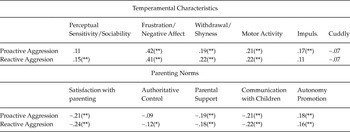
The initial correlational analysis of each age group revealed significant correlations between the variables studied. Regarding aggression in subjects 1 to 3 years of age, associations between the temperament and aggression dimensions indicate that Frustration/Negative Affect had the highest correlations with both proactive and reactive aggression. Other relevant variables include Withdrawal/shyness and Motor Activity. As for the parenting variables, all of them exhibited significant correlations with both types of aggression, the variables communication and satisfaction with parenting in particular, except for Authoritative Control with proactive aggression.
Looking at the differential pattern of correlations of the variables studied with aggression type, perceptual sensitivity showed a positive, significant correlation with reactive aggression, while impulsivity did so with proactive aggression. The authoritative control parental variable was negatively, significantly linked to reactive aggression.
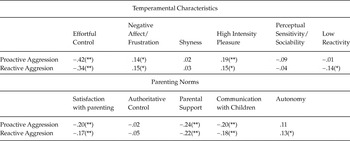
Among subjects 3 to 6 years-old, the Effortful Control dimension of temperament was found to be the most highly correlated with aggression. Other significant temperamental characteristics included High Intensity Pleasure and Negative Affect/Frustration. With regard to parenting variables, the correlations observed had similar pattern to the one detected in the 1 to 3 year-old group. Communication, satisfaction with parenting, and parental support continued to correlate negatively and significantly with the two types of aggression studied. In addition, autonomy only continued to be significantly linked to reactive aggression, and the negative, significant association between authoritative control and reactive aggression disappeared (see Table 2).
13–36 Month-old Sample. Correlations between Proactive and Reactive Aggression with Temperamental Characteristics and Parenting Norms

* p < .05, ** p < .01.
Note:
The correlation between Proactive and Reactive Aggression is .80.
3–6 Year-old Sample. Proactive and Reactive Aggression´s Correlations with Temperamental Characteristics and Parenting Norms.

* p < .05, ** p < .01.
Note:
The correlation between Proactive and Reactive Aggression is .74.
With respect to the types of aggression analyzed, we observed some significant differences in their correlations with independent variables. The low reactivity temperamental characteristic, for one, seemed to be associated (negatively) with reactive aggression. The latter also appears to be significantly linked to autonomy.
The correlational analysis conducted in the two samples revealed a high correlation between the two types of aggression studied (.80 in the 1 to 3 year-old group and .74 in the 3 to 6 year-old group); this result further supports an association previously observed in similar studies (Cosi, Vigil-Colet, & Canals, Reference Cosi, Vigil-Colet and Canals2009). Furthermore, that analysis also detected certain, specific associations between temperamental and parenting variables, and reactive and proactive aggression. In order to deepen our understanding of these differences and determine whether or not a differential profile can be established for subjects with different levels of reactive and proactive aggression, we conducted the analyses detailed below.
Cluster Analysis: Obtaining Groups with High and Low Scores
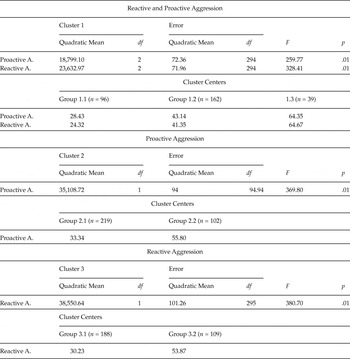
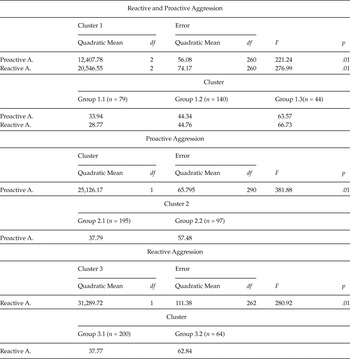
Table 3 displays the results of cluster analysis in the 1–3 year-old group, while Table 4 holds the 3–6 year-olds’ results.
13–36 Month-old Sample. ANOVA of Variables in the Clustering Process

Note:
K-means cluster solutions. Below, the final cluster centers; A = Aggression.
3–6 Year-old Sample. ANOVA of Variables in the Clustering Process

Note:
K-means cluster solutions. Below, the final cluster centers; A = Aggression.
In the 13–36 month-old sample, taking both types of aggression into account (cluster 1) yielded the following groups: group 1.1 with low aggression scores (proactive aggression mean = 28.43; reactive aggression mean = 24.32) and another group (Group 1.3) with high scores on both types of aggression (proactive aggression mean = 64.35; reactive aggression mean = 64.67). Subjects covered within the third profile (Group 1.2) exhibit intermediate levels of both types of aggression, so logically, there are more of them. Next, we used proactive aggression to form homogeneous subject groups (cluster 2), as shown in Table 3, yielding one group with low proactive aggression scores (Group 2.1) and another with high scores (Group 2.2). Finally, only taking reactive aggression into consideration yielded a cluster (cluster 3) with low aggression levels (Group 3.1) and a second one with high scores (Group 3.2). The same pattern occurred in the 3–6 year-old sample (see Table 4). These results reflect a link between the two types of aggression. However, mixed aggression profiles also emerged; that is, some individuals scored high on one of the two types and low on the other. To be specific, in the 13–36 month-old sample, there were 30 subjects with low proactive aggression and high reactive aggression, and 17 subjects with the opposite profile. Meanwhile, the 3–6 year-old sample included 14 of the first type and 44 of the second.
Discriminant Analysis: Creating Profiles from the Predictors Studied
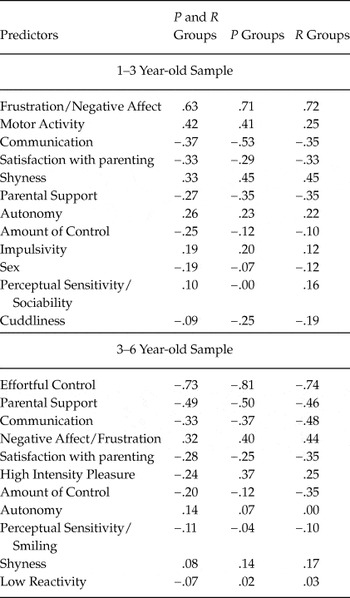
In the 1–3 year-old sample, utilizing proactive and reactive aggression (λ Wilks = .528; p < .05), proactive alone (λ Wilks = .819; p < .05), and reactive alone (λ Wilks = .812; p < .05), the Frustration-Negative Affect variable is the one to most clearly differentiate between subjects as a function of aggression type. The profiles’ composition in terms of the variables grouped into one cluster or the next, indicates that children with high proactive and reactive aggression scores exhibit high levels of negative emotionality, specifically, high levels of frustration, shyness, and motor activity (see Table 5). Of the parenting variables, communication and satisfaction with parenting were the most relevant. Comparing the variables that differentiate between subjects with high and low proactive versus reactive aggression scores, the differences occurred as a function of the variables temperamental reactivity, motor activity, and perceptual sensitivity. These results suggest the proactive and reactive children’s profiles are similar in terms of cuddliness and negative emotionality (frustration and shyness). The reactivity variables (motor activity and perceptual sensitivity) differentiated most clearly the subjects with high and low scores of proactive aggression from those with high and low reactive aggression. Communication was the parenting variable to show the greatest differences in the two discriminants; the remaining parental variables had similar loadings in the two groups of children.
Discriminant Function Analysis´s Matrix Structure in the Samples Studied.

Note:
P and R Groups = Groups Obtained through Cluster Analysis According to Reactive and Proactive Aggression (High Levels-Low Levels); P = Groups Formed According to Proactive Aggression (High Levels-Low Levels); R = Groups Formed According to Reactive Aggression (High Levels-Low Levels).
This discriminant function correctly classified up to 87.4% of cases when proactive and reactive aggressions were combined. Only 17 out of 135 cases were erroneously classified. When we only used only proactive aggression, on the other hand, 74.8% of cases were correctly classified; and when only reactive aggression was used, 70.7% of cases were.
In the 3–6 year-old group of children, the data indicated that when using proactive and reactive aggression (λ Wilks = .594; p < .05), proactive alone (λ Wilks = .808; p < .05), and reactive alone (λ Wilks = .832; p < .05), the effortful control variable discriminates the highest number of subjects as a function of aggression type, followed by parental support. Children with high aggression levels exhibited lower effortful control and parental support (see Table 5). The percentage of subjects correctly classified into groups were as follows: 83.7% of cases when proactive and reactive aggression were combined, with only 20 out of 123 subjects classified incorrectly; 72.6% were correctly classified using only proactive, and 78.1% using only reactive aggression.
The resulting profile also combined temperamental characteristics and attitudes about parenting. In this case, the most relevant variables were linked to regulation (effortful control) rather than negative emotionality (frustration and shyness). Subjects with high reactive and proactive aggression scores were largely children with low regulation, especially in terms of effortful control, and high negative emotionality (frustration/negative affect). The parenting variables to best discriminate between groups were parental support and communication. Those characteristics were essentially similar in the proactive and reactive subject groups. However, the former exhibited higher levels of the reactivity variable high intensity pleasure, and lower levels of the parenting variables communication, satisfaction with parenting, and authoritative control.
Discussion
The present study’s objective was to identify temperamental and parenting variables that are associated with aggression, both proactive and reactive, over the course of childhood. In the pursuit of that objective, we considered the possibility of differentiating specific profiles for subjects with high levels of reactive versus proactive aggression.
The study and identification of aggression-associated profiles have shown that the temperamental and parenting variables that best discriminate aggressive from non-aggressive children, in the form of reactive and/or proactive aggression, vary with age in the groups analyzed. Conducting analyses to extract the most relevant variables, we found that the temperamental traits to best characterize aggressive children are high frustration/negative affect in the 1 to 3 year-old group (consistent with hypothesis 1) and low effortful control in children 3 to 6 years-old (consistent with hypothesis 2). With respect to parenting variables, those related to affection (communication, satisfaction with parenting, and parental support) showed the closest (negative) association to aggression, surpassing authoritative control and permissiveness in importance.
These results are congruent with the bulk of the literature in reinforcing the association between negative emotionality, regulation problems, and externalizing problems in children (Degnan et al., Reference Degnan, Calkins, Keane and Hill-Soderlund2008). The majority of authors agree that aggression decreases as self-control increases, the latter being assessed as the child’s ability to delay gratification (Rothbart & Ahadi, Reference Rothbart and Ahadi1994; Rothbart, Ahadi, & Evans, Reference Rothbart, Ahadi and Evans2000) and use planning and strategy to carry out actions (Eisenberg et al., Reference Eisenberg, Spinrad, Fabes, Reiser, Cumberland, Shepard and Thomson2004). This demonstrates self-regulation’s importance as a personal variable geared toward controlling actions prospectively (planning, strategy), simultaneously (self-control strategies), and retrospectively (assessment and reflection strategies), and that it has a significant impact on manifestations of aggression in older children. Moreover, the importance of some variables over others in each age group can be understood within the context of the developmental calendar itself. Until 3 or 4 years of age, the child does not acquire effective emotional self-control (Kochanska, & Knaack, Reference Kochanska and Knaack2003; Kochanska, Murray, & Harlan, Reference Kochanska, Murray and Harlan2000; McClowry, Halverson, & Sanson, Reference McClowry, Halverson and Sanson2003), which is perhaps why, in the 1 to 3 year-old group, negative emotionality appears to be among the most influential variables. At that age, the child has greater difficulty changing their attentional focus from negative stimuli, generating ill-being, and has fewer self-control strategies, implying greater difficulty with emotional regulation in general and particularly in their experience of anger, an essential component of aggression. Then again, the child’s regulatory dimensions evolve through development, from the first months to preschool age (Posner & Rothbart, Reference Posner and Rothbart1998). Children are born with basic attentional abilities and develop attentional control around 30 months of age. The basic core of effortful control and the executive attentional system is present close to the first year of life (Posner, & Rothbart, Reference Posner and Rothbart1998; Rothbart, Reference Rothbart2007) However, it is not until six or seven years-old when effortful control’s development takes on greater importance (Rothbart, Reference Rothbart2007). Therefore, it is to be expected that through childhood, children with high levels of effortful control exhibit fewer reactive and proactive aggressive behaviors. This result highlights the importance of developing temperamental dimensions to regulate such behaviors.
On another note, parenting variables have been revealed to be an additional element to differentiate between aggressive and non-aggressive children, although parenting was more weakly associated with childhood aggression than temperament in both age groups studied. Nevertheless, discriminant function analyses showed parenting variables to be increasingly important with age in identifying groups with low and high aggression levels. Overall, the present study’s results are congruent with findings within the literature. As in previous studies, lack of affect and parental involvement (Rodríguez, Del Barrio, & Carrasco, Reference Rodríguez, Del Barrio and Carrasco2009; Rubin et al., Reference Rubin, Burgess and Hastings2002), a mother’s low sensitivity to her child’s reactivity (Calvins et al., Reference Calvins, Smith, Gill and Johnson1998), and the regulatory role of control exerted by parents over their children’s negative emotionality and reactivity (Degnan et al., Reference Degnan, Calkins, Keane and Hill-Soderlund2008) play an important role in the onset of externalizing behavior in children. Furthermore, the importance our data assign to aspects of affection suggest that, at this age and in the general population, it is mainly deficient levels of affect, rather than control, that form the basis of aggressive behavior. Data such as these support the idea that interactive, theoretical models must be developed with which to study the combined effects of temperamental variables and socialization processes.
With regard to the third hypothesis we formulated, we found that temperamental aspects related to reactivity and perceptual sensitivity, if associated with lack of control on the parents’ part, or excessive autonomy, may encourage the onset of reactive aggression. This result supports the hypothesis that the most reactive or proactive aspects of children’s aggression profiles may result from interactions between temperament and parenting variables. By virtue of these results, let us assume that lack of authoritative control and excessive autonomy favor the appearance of reactive aggression in cases where children exhibit salient traits like perceptual sensitivity and reactivity. This hypothesis coincides with the results of our discriminant function analyses, where authoritative control showed a clear association with the reactive (versus proactive) aggression profile in the 3 to 6 year-old group.
Last, we should point out that the discriminant function analyses performed did not yield clearly differentiated profiles of children assigned to the proactive versus reactive aggression group. Despite their similarity, however, a differential trend occurred in the loadings of temperamental and parenting variables as a function of age and type of aggression studied. It was observed that, progressively, parenting variables become increasingly relevant in distinguishing between the two types of aggression. While the differences between reactive and proactive children 1 to 3 years-old are concentrated on reactivity variables (motor activity and perceptual sensitivity), they manifest themselves mainly in the form of parenting variables (communication, enjoyment of parenting, and level of control) in children 3 to 6 years-old. These results suggest that despite the coexistence of the two forms of aggression, there may be certain aspects that are part of the etiology of one type of aggressive behavior and not the other. On the whole, this suggests not only interactions between parenting and temperament variables, but also their differential role in relation to children’s age in explaining reactive, compared to proactive, aggression.
In closing, we would like to point out certain limitations restricting the scope of these results. First of all, these different assessments and measures were collected transversely, which eliminates the possibility of analyzing reactive and proactive aggression profiles’ configuration over time. Second, this study’s source of information was limited to data provided by the parents, so bias may have entered into their evaluations of the children tied to partiality and the family context.
Despite these limitations, the generalizability of this study’s findings supports the idea that temperament and parenting jointly contribute more similarly than differentially to proactive and reactive manifestations of childhood aggression. This could be explained by the high correlation between proactive and reactive aggression at this age. However, this foundational profile reflects differential aspects related to age and aggression type, suggesting that different explanatory models for one type of aggression or the other should be considered further, along with preventative measures suited to each type as well as the child’s developmental stage.
These results emphasize the importance of familiarizing both parents and educators with how to identify aggressive behaviors early on, and the existence of certain temperamental characteristics and parenting factors associated with aggression. Precocious intervention ensures success at bringing about future changes. Difficult temperamental characteristics may be altered with appropriate actions on the part of adults. Therefore, even the most slightly elevated frustration/negative affect level or low effortful control should prompt parents and educators to put the necessary adjustments in motion.
The knowledge of childhood aggression’s main predictors derived from this study provides a basis to design preventative actions, like developing strategies to manage and regulate negative emotionality in children, or to potentiate their regulatory processes.