Solar radiation establishes the ultimate limit for crop production since all the energy used by crops throughout the growing season is obtained from solar radiation (Ray and Sinclair, Reference Ray and Sinclair1998). Cultivation practices such as increased plant population density (PPD) and reduced row spacing have taken advantage of higher light interception to increase yield per area. Increased light interception has a positive effect on productivity, often described as a linear function when the crop does not experience biotic and/or abiotic stress (Kiniry et al., Reference Kiniry, Jones, O'toole, Blanchet, Cabelguenne and Spanel1989; Monteith, Reference Monteith and Moss1977; Tollenaar and Bruulsema, Reference Tollenaar and Bruulsema1988). Stinson and Moss (Reference Stinson and Moss1960) suggested that light can be a limiting factor in corn production when nutrients and soil moisture are non-limited. Maize grown with decreased row spacing and increased plant density may not take full advantage of available radiation especially in production environments with a short growing season (Westgate et al., Reference Westgate, Forcella, Reicosky and Somsen1997). Innovative approaches such as seed-oriented planting through its effects on leaf azimuth by orientation could optimize the use of resources without major changes in cultural practices.
The principle of seed-oriented planting was first mentioned by Peters and Woolley (Reference Peters and Woolley1959), who suggested that seeds planted upright with flat side facing the adjacent row, seemed to be a promising mean for saving soil moisture as a result of more efficient soil shading. They observed a relationship between initial seed orientation and leaf azimuth of maize, and suggested that more solar radiation could be intercepted with leaves from oriented seeds. In addition, they indicated that more efficient soil shading could reduce soil moisture evaporation losses and improve weed control. Later, research done by Fortin and Pierce (Reference Fortin and Pierce1996) confirmed the effect of seed-oriented planting on the ear leaf azimuth and showed that random seed orientation results in random ear leaf orientation.
Other aspects of initial seed position of maize were presented by Patten and Van Doren (Reference Patten and Van Doren1970) who found earlier and more complete emergence with more seedling growth when maize was planted with the proximal end of the seed down (caryopsis attachment point downward). Girardin and Tollenaar (Reference Girardin and Tollenaar1992) observed the systematic nature of leaf azimuths up to 6–7th leaf, since then random orientation was predominant, attributed to the canopy intra-specific interference that provided a more uniform light distribution. Later, Maddonni et al. (Reference Maddonni, Otegui, Andrieu, Chelle and Casal2002) showed that the proportion of inter-row-oriented leaves is hybrid dependent. Moreover, germination rate and success of eight weed species were found to be highly dependent on seed position in controlled environment germination (Bosy and Aarssen, Reference Bosy and Aarssen1995). Recently, Torres et al. (Reference Torres, Vossenkemper, Raun and Taylor2011) found that leaf azimuth and emergence were significantly affected by seed-oriented planting and hybrid. They suggested that if seeds are systematically planted in the same manner, emergence can be more uniform and leaves methodically oriented resulting in more homogeneous crop stands.
Previous results from plots planted in 1959 by Peters and Woolley using two row spacing's (0.76 and 1.01 m) demonstrated a yield advantage from seed-oriented planting. Conventionally, planted plots were out-yielded by seed-oriented plots (Peters and Woolley, Reference Peters and Woolley1959). Toler et al. (Reference Toler, Murdock, Stapleton and Wallace1999) used seed-oriented planting to manipulate plant canopy and orient leaves across-row, with-row and randomly. Across-row leaf orientation intercepted more light (10 and 25%) and produced higher grain yield (10 and 21%) than random and with-row leaf orientations.
The yield increase observed in these experiments was attributed to the higher light interception and quicker canopy closure as well as reduced inter- and intra-plant competition. The effect of increased light interception gives the crop a competitive advantage in relation to weeds, because available light for weeds will be reduced. Environmental concerns associated with the use of pesticides and fertilizers in agriculture, and the challenge to feed a growing population motivates the development of innovative management practices.
This research was initiated to support the development of precision planting of maize and to evaluate if seed-oriented planting of maize can be used as a management practice to increase grain yields specifically improving the crop's ability to intercept light. The hypothesis was that oriented maize leaves intercept more light than randomly distributed maize leaves due to a reduction on reciprocal shading. Consequentially, because grain yield is generally proportional to the amount of photosynthetically active radiation (PAR) intercepted during the growing season, seed-oriented planting of maize could lead to yield increase.
MATERIALS AND METHODS
Site description and experimental design
Field trials were conducted at two sites in 2010, 2011 and 2012 to evaluate the influence of seed-oriented planting on light interception, radiation use efficiency and grain yield. Experiments were conducted at Lake Carl Blackwell (LCB) near Stillwater (OK, USA), on a Port silt loam-fine-silty, mixed, thermic Cumulic Haplustoll. The other experimental site was at EFAW Research Station located at Stillwater (OK, USA), on a Norge loam, fine-silty, mixed thermic Udic Paleustoll.
The experimental design used was a randomized complete block with three replications. Treatment structure consisted of a factorial combination of seed-oriented planting and PPD using a planophile hybrid and an incomplete factorial using an erectophile hybrid. Seed orientations were chosen to manipulate maize leaves perpendicularly to the row direction. Conventionally planted seeds with random seed orientation were used as control. According to Torres et al. (Reference Torres, Vossenkemper, Raun and Taylor2011), seed orientations described as upright with caryopsis pointed down, parallel to the row (upright) and laying flat, embryo up, perpendicular to the row (flat) will result in leaves predominantly oriented ± 30° from the direction perpendicular to the row (see supplementary figure S1). Experiments located at EFAW were planted on 29 April 2010, 4 April 2011 and 19 April 2012 at PPD of 37,000, 49,400 and 61,700 plants ha−1. Trials were planted at LCB on 25 May 2010, 4 May 2011 and 10 April 2012 at PPD of 49,400, 74,100 and 98,800 plants ha−1. Maize hybrids planted at both sites were P0902HR and P1173HR in 2010 and 2011, and hybrids PO876HR and P1395XR in 2012. Hybrids P0902HR and PO876HR have planophile canopy architecture and require on average 749 and 705 thermal units (TU, °C d) from emergence to silking and 1366 and 1433 °C d to physiological maturity, respectively. Hybrids Pioneer P1173HR and P1395XR have erectophile leaf architecture and require on average 727 and 777 °C d to silking and approximately 1516 °C d to physiological maturity for both hybrids (DuPont Pioneer, Johnston, IA).
The method for planting the seed-oriented treatments consisted of blocking the central seed boxes on a four-row planter to open furrows and at the same time raising the press wheels in order to keep furrows open. Subsequently, seeds were carefully hand-planted in the furrows to ensure proper placement. A template that marked the exact distances between plants to reach a given PPD was used to sow seed-oriented plots. Plots with random seed orientation were conventionally planted using a four-row planter. Individual plots measured 6.09 m long by 3.50 m wide and row spacing was 0.76 m.
All plots received pre-plant nitrogen rates of 180 kg N ha−1 and a top dress application around V8 growth stage of 60 kg N ha−1 with a mixture of urea and ammonium nitrate (UAN, 28%). Phosphorus and potassium were applied according to soil test recommendations determined each year. In 2011 and 2012 at EFAW, a drip irrigation system was used to provide water and ensure crop production. However, no irrigation was used at EFAW in 2010 and productivity was hindered by drought stress.
Measurements, calculations and analysis
Dependent variables included grain yield and fraction of intercepted PAR. Light interception data were collected by a quantum sensor as photosynthetic photon flux density (PPFD, µmol s−1 m−2) during the crop development between V4 and R1 growth stages. Three light measurements were taken per plot, under clear sky, around solar-noon. The quantum sensor was placed diagonally under the crop canopy at the soil level, across the space between the centre rows. A line quantum-sensor LI-191SA connected to a LI-1400 data-logger (both from LI-COR, Lincoln, NE) was used to gather incident PAR above and under the canopy. Measurements were then expressed as a fraction of intercepted photosynthetically active radiation by the canopy (fPAR) calculated as the ratio of incident PAR under the canopy at the soil level and incident PAR above the canopy.
Since crop development and growth rate are dependent on temperature in the absence of stress (Hay and Porter, Reference Hay and Porter2006), fPAR measurements were evaluated as a function of TU accumulated from emergence until each measurement date. Thermal units integrate temperature above a base temperature and below a maximum over time. In this work, base and maximum temperature used for maize was 10 °C and 30 °C (Coelho and Dale, Reference Coelho and Dale1980). Asymptotic sigmoid equations were fitted to the relation between fPAR and TUs using the software TableCurve 2D version 5.01 (SYSTAT Software Inc. 2002). Coefficients from fitted equations were used to predict daily intercepted PAR (IPAR) for seed-oriented planting, PPD and hybrid. Daily solar radiation data for every site and year was obtained from the Mesonet weather stations located near each experimental site (http://www.mesonet.org/, verified 25 September 2012). Daily solar radiation was transformed to daily incident PAR (400–700 nm) by assuming that 45% of total solar radiation is actually PAR (Meek et al., Reference Meek, Hatfield, Howell, Idso and Reginato1984). The product of IPAR and incident PAR for each day of the growing season was accumulated from emergence to silking and to physiological maturity to determine cumulative intercepted photosynthetically active radiation (CIPAR, MJ m−2) (Ritchie et al., Reference Ritchie, Hanway and Benson1993). In this paper, RUE was calculated based on grain yield instead of the conventional method that uses crop dry weight. Grain yield radiation use efficiency (RUEGY, g MJ−1) was determined as the ratio of grain yield and CIPAR at silking and at physiological maturity.
In a first step, statistical analysis was performed to evaluate main and interaction effects of seed-oriented planting and PPD. Afterward, analysis of main and interaction effects of seed orientation and hybrid was performed. Analysis of variance (ANOVA) and means by site and year were performed using the GLM procedure from SAS software version 9.2 (SAS Institute Inc., 2008). Orthogonal and single degree of freedom contrasts were used to make specific comparisons between treatments while trend analysis was performed to understand the effect of increasing PPD. In addition, regression analysis and correlation coefficients were generated from treatments means using PROC REG and PROC CORR procedures in SAS (SAS Institute Inc., 2008) to investigate the relationship between grain yield, CIPAR, RUEGY at silking and physiological maturity.
RESULTS AND DISCUSSION
Effect of seed-oriented planting on light interception
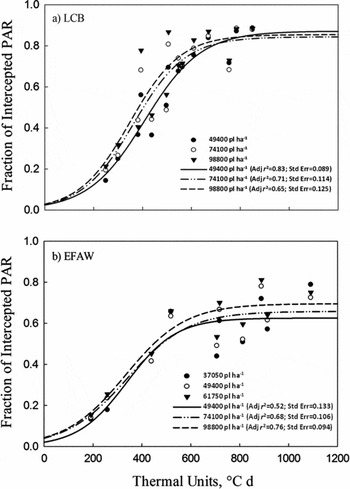
Higher light interception as a result of increased PPD was expected until LAI reached a critical level. We observed that the highest PPD resulted in higher intercepted PAR at both locations (Figure 1). As TUs accumulated during the growing season fPAR increased until about 90% at LCB and 70% at EFAW. The highest level of fPAR was typically observed between 600 and 700 °C d accumulated after emergence, but depended on the location and PPD.
Fraction of intercepted photosynthetically active radiation (fPAR) as a function of thermal units for plant population density (PPD) at (a) Lake Carl Blackwell (LCB) and (b) Stillwater (EFAW) Research Stations, 2010–2012.

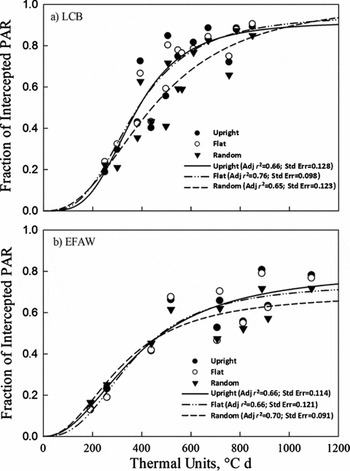
Measurements showed that, between 500 and 800 °C d, upright and flat treatments intercepted more PAR than random seed orientation, but no treatment effect was found at earlier vegetative stages and during reproductive stages at LCB (Figure 2a). At EFAW, the effect of seed-oriented planting on fPAR was observed at late vegetative growth stage in which both seed-oriented treatments tended to improve light interception compared to random seed treatments (Figure 2b). Toler et al. (Reference Toler, Murdock, Stapleton and Wallace1999) reported that differences in fPAR among leaf orientation treatments were significant at 6, 8 and 10 weeks after planting but not significant at 12 weeks after planting.
Fraction of intercepted photosynthetically active radiation (fPAR) as a function of thermal units for seed-oriented planting pooled over plant population at (a) Lake Carl Blackwell (LCB) and (b) Stillwater (EFAW) Research Stations, 2010–2012.

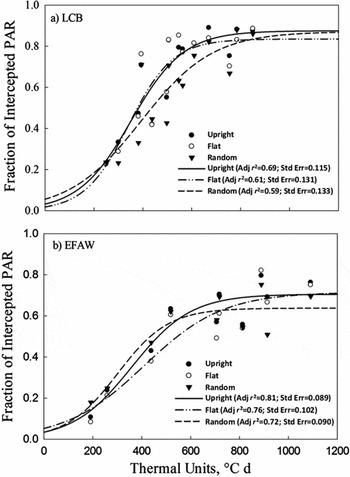
When pooled over hybrids, fPAR showed similar results to what was found when seed-oriented planting was evaluated across PPD at LCB (Figure 3a), but not at EFAW (Figure 3b). Small differences in fPAR measurements were observed at early vegetative stages, but from approximately V8 to tassel differences between measurements became more evident at LCB. Differences in light interception between planophile and erectophile hybrids were small and not significant.
Fraction of intercepted photosynthetically active radiation (fPAR) as a function of thermal units for seed-oriented planting pooled over hybrid (Pioneer P1173HR) at (a) Lake Carl Blackwell (LCB) and (b) Stillwater (EFAW) Research Stations, 2010–2012.

Effect of seed-oriented planting on cumulative intercepted light
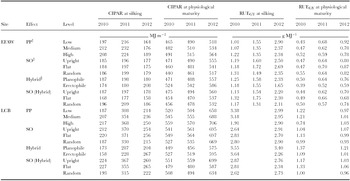
Using asymptotic regression functions obtained from the fPAR and TU regression, it was possible to predict how much light was intercepted at each day of the growing season since emergence. Due to the limited data that was collected, it was not possible to calculate the proper statistical measures to compare treatments regarding CIPAR. However, these are macro numbers without any ability to get a duplicate number of any kinds. In addition, it is possible to draw conclusions as far as the effect of light interception by looking at fPAR measurements. Table 1 shows CIPAR and RUEGY at silking and physiological maturity for seed-oriented planting, PPD and hybrid, and seed-oriented planting pooled over hybrids at EFAW and LCB from 2010 to 2012. Generally, CIPAR increased as PPD increased at silking and physiological maturity at both sites. Likewise, Edwards et al. (Reference Edwards, Purcell and Vories2005) showed that increasing PPD resulted on increased CIPAR for short-season maize hybrid. Highest CIPAR was observed for the PPD of 49,400 plants ha−1, following a quadratic trend in 2010 and 2011 at EFAW. Average CIPAR at physiological maturity was 491, 508 and 523 MJ m−2 for 37,050, 49,400 and 61,750 plants ha−1 at EFAW, respectively, while at LCB they found CIPAR was 561, 598 and 612 MJ m−2 for PPD of 49,400, 74,100 and 98,800 plants ha−1, respectively (Table 1).
Cumulative intercepted photosynthetically active radiation (CIPAR) and grain yield radiation use efficiency (RUEGY) at silking and physiological maturity for the effects of seed-oriented planting (SO), plant population density (PPD), hybrid, and seed-oriented planting pooled over hybrids [SO (Hybrid)] at Stillwater (EFAW) and Lake Carl Blackwell (LCB) Research Stations, 2010–2012.

†Low, medium and high plant population densities at EFAW were 37,050, 49,400, and 61,750 plants ha−1 and at LCB plant population densities were 49,400, 74,100, and 98,800 plants ha−1.
‡Seed orientation used to achieve predominantly across row leaf orientation were; Upright – seeds planted upright with caryopsis pointed down, kernel parallel to the row; and Flat – seeds planted laying flat, with embryo up, kernel perpendicular to the row. Conventionally planted seeds with Random seed orientation were used to achieve random leaf orientation.
§Planophile, leaf angle is predominantly horizontal; Erectophile predominantly vertical leaf angles.
There were no differences in CIPAR between seed-oriented treatments up to silk stage at EFAW, but at maturity-oriented seed treatments had between 4 to 7% higher CIPAR compared to random seed orientation (Table 1). Toler et al. (Reference Toler, Murdock, Stapleton and Wallace1999) also observed that across-row leaf orientation from oriented-seed planting generally intercepted more light than random seed orientation. Cumulative IPAR at LCB tended to be higher for both seed-oriented treatments. For example, upright and flat seed positions had approximately 15% greater CIPAR than the random treatment at silking and about 4% higher at physiological maturity (Table 1).
Up to physiological maturity, upright seed orientation intercepted 552 MJ m−2 of PAR; flat seed orientation intercepted 549 MJ m−2 of PAR and random seed orientation intercepted 525 MJ m−2 of PAR averaged over all sites and years. Due to adverse environmental conditions encountered during the maize development, the crop rarely reached the critical LAI to intercept 95% of light which likely restrained grain productivity. These environmental conditions affected LAI and promoted changes in maintenance respiration, leaf area development and crop cycle (Lindquist et al., Reference Lindquist, Arkebauer, Walters, Casman and Dobermann2005; Otegui et al., Reference Otegui, Nicolini, Ruiz and Dodds1995). Relatively small differences in CIPAR were found during reproductive growth stages; however, even small increments in CIPAR may have contributed to grain yield increases.
When pooled over hybrids mean CIPAR of the random treatment was higher than seed-oriented treatments at silking but not at physiological maturity at EFAW (Table 1). At LCB, CIPAR for oriented seeds was higher at silk stage (284 and 282 MJ m−2 for upright and flat treatments, respectively), whereas at maturity estimated CIPAR of random-oriented seeds was 29 MJ m−2 greater than flat seed orientation, but 58 MJ m−2 lower than upright seed orientation (Table 1).
Regarding CIPAR of planophile and erectophile hybrids, small differences were noted at silking whereas at physiological maturity a greater CIPAR was found for the erectophile hybrid. Maddonni and Otegui (Reference Maddonni and Otegui1996) who used a model to calculate CIPAR for planophile and erectophile hybrids reported mean values of 250 ± 21.7 MJ m−2 around silking (±15 days) and 531 ± 64 MJ m−2 of CIPAR at 15 days before physiological maturity. Mean CIPAR for the planophile was 205 ± 42 MJ m−2 at silking and 499 ± 54 MJ m−2 at physiological maturity. For the erectophile hybrid, mean CIPAR at silking and physiological maturity was 203 ± 40 MJ m−2 and 549 ± 33 MJ m−2. However, compared with the planophile hybrid the erectophile hybrid required a higher TU requirement to achieve physiological maturity. Phenotypic and ontogenic differences between hybrids influenced the relation between light interception and green LAI (GLAI), and failure to acknowledge for these differences can be misleading when the relation of fPAR and GLAI is used in models to estimate crop production, RUEGY and yield components (Maddonni and Otegui, Reference Maddonni and Otegui1996).
Effect of seed-oriented planting on radiation use efficiency
At EFAW, average RUEGY for 37,050, 49,400 and 61,750 plants ha−1 was 1.82, 1.60 and 1.60 g MJ−1 of CIPAR at silking, whereas at LCB, mean RUEGY for 49,400, 74,100 and 98,800 plant ha−1 was 3.19, 3.06 and 2.40 g MJ−1, respectively (Table 1).
Highest RUEGY was observed for flat at silking (1.86 g MJ−1) and physiological maturity (0.68 g MJ−1) at EFAW. Although, at LCB random seed orientation used radiation more efficiently at silking, while at maturity, it was the least efficient. When pooled over hybrids, seed-oriented planting tended to improve RUEGY in relation to the random. Moreover, the planophile hybrid had consistently better RUEGY compared to the erectophile hybrid at both locations which likely occurred because of higher yield of planophile hybrids.
Effect of seed-oriented planting on grain yield
In general, interactions by year were not consistent; although, there was a significant year by PPD interaction effect for grain yield at EFAW. Due to differences in environmental conditions experienced at each trial, analysis was performed by location and year. Plots at LCB were severely damaged by wildlife in 2011, as such grain yield data were lost and not used in the analysis.
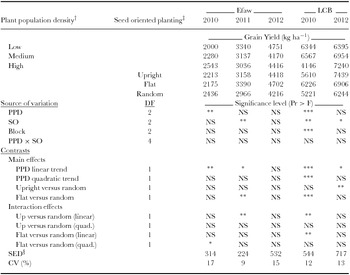
Orientation of maize seeds resulted in higher yields compared to random seed orientation, except at EFAW in 2010 when the random produced 223 and 261 kg ha−1 higher yield than the upright and flat-oriented seeds, respectively (Table 2), even though this difference was not significant. In 2010 was a very difficult year for maize cultivation at EFAW because of extreme drought conditions and elevated temperatures. Excluding the data from the experiment at EFAW in 2010 from the analysis, the average yield gain due to upright and flat seed orientation was 9 and 14% compared to the random, respectively. Table 2 shows that at LCB, upright seed orientation was 7% higher than random while flat seed orientation produced 19% greater yield than random in 2010. Contrasts showed that only the flat seed orientation was actually significantly higher than random; no difference was found between upright and random seed orientations in 2010 at LCB.
Analysis of variance and orthogonal contrasts for main effects of plant population density (PPD) and seed-oriented planting (SO) on grain yield at Stillwater (EFAW) and Lake Carl Blackwell (LCB) Research Stations, 2010–2012.

*, **, ***Significant at 0.10, 0.05, and 0.01 probability levels, respectively; NS, not significant.
†Low plant population density at Efaw and LCB was 37,050 and 49,400 plants ha−1, respectively; Medium plant population density at EFAW and LCB was 49,400 and 74,100 plants ha−1, respectively; High plant population density at Efaw and LCB was 61,050 and 98,800 plants ha−1, respectively.
‡Seed-oriented planting used to achieve predominantly across row leaf orientation were; Upright – seeds planted upright with caryopsis pointed down, kernel parallel to the row; and Flat – seeds planted laying flat, with embryo up, kernel perpendicular to the row. Conventionally planted seeds with Random seed orientation were used to achieve random leaf orientation.
§ SED, standard error of the difference between two equally replicated means.
Alternatively, the upright treatment was significantly different from the random in 2012 while no difference between flat and random treatments was observed. The yield of the upright seed orientation was the highest observed in 2012, representing a difference of 1195 kg ha−1 greater than the random seed orientation (Table 2). Further, a positive but not significant difference of 662 kg ha−1 in favour of flat seed orientation was observed when compared to random orientation. Even though, there was 9% yield difference between flat and random, single degree of freedom contrast revealed that this difference was not statistically significant.
A significant yield response to increasing PPD was observed in 2010, but no effect was observed in 2011 and 2012 due to increased PPD at EFAW. Yield increased linearly in 2010, while in 2011 yield decreased in linear fashion as PPD increased. In 2012, neither linear nor quadratic trends were observed; highest yield was found at the lower PPD (4751 kg ha−1) and lowest yield found at the medium PPD (4170 kg ha−1) (Table 2). PPD effect on yield observed in 2010 was different from the trends found in 2011 and 2012, which justify the year by treatment interaction found at EFAW. No irrigation was used at EFAW in 2010 and drought severely affected yield and response to PPD. In 2011 and 2012, PPD of 37,050 plants ha−1 was sufficient to achieve maximum yield compared to medium and high PPD.
At LCB, ANOVA showed a significant effect of PPD on yield in 2010 while contrasts indicated that linear and non-linear trends were significant (Table 2). PPD of 49,400 and 74,100 plants ha−1 had similar productivity that was greater than with 98,800 plants ha−1. This suggests plant competition likely occurred at PPD of 98,800 plants ha−1, exceeding the optimum PPD required to reach the critical amount of light as suggested by Hunter (Reference Hunter1980). Karlen and Camp (Reference Karlen and Camp1985) also reported that reproductive development and grain yield can be negatively influenced by PPD in excess of optimum levels. In contrast, a significant linear trend for grain yield as a function of PPD was observed in 2012 and the highest yield was 7240 kg ha−1 produced with PPD of 98,800 plants ha−1 (Table 2).
No interaction effect of seed-oriented planting and PPD on yield was detected with ANOVA contradicting the findings of Toler et al. (Reference Toler, Murdock, Stapleton and Wallace1999) who found a significant seed orientation by PPD interaction. However, contrasts showed some inconsistency in the yield response of seed-oriented treatments across levels of PPD at EFAW in 2010 and 2011 as well as at LCB in 2010 (Table 2). In 2011 at EFAW, the yield of random seed-oriented planting was higher at low PPD and decreased as PPD increased while the yield of upright seed position was lower at low PPD and increased with PPD. In 2010 at LCB, interaction contrasts revealed a linear trend for upright versus random and flat versus random. These results indicate that PPD influence maize yield response to seed-oriented planting.
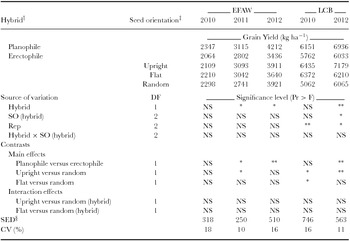
Pooled over hybrids, no effect of seed-oriented planting on yield was detected by ANOVA at EFAW (Table 3). However, contrast analysis indicated that upright was 351 kg ha−1 greater than random in 2011. In addition, the flat seed orientation had 301 kg ha−1 higher yields than random but this difference was not statistically different. The yield of the random treatment was 88 and 189 kg ha−1 greater than upright and flat treatments respectively in 2010 at EFAW, nonetheless, no statistical difference was observed. In 2012, upright and random seed orientation produced similar yields that were higher than the yield produced by the flat seed orientation (Table 3).
Analysis of variance and orthogonal contrasts for main effects of hybrid and seed orientation (SO) pooled over hybrid on grain yield at Stillwater (EFAW) and Lake Carl Blackwell (LCB) Research Stations, 2010–2012.

*, **, ***Significant at 0.10, 0.05 and 0.01 probability levels, respectively; NS, not significant.
†Planophile, leaf angle is predominantly horizontal; Erectophile predominantly vertical leaf angles.
‡Seed orientation used to achieve predominantly across row leaf orientation were; Upright – seeds planted upright with caryopsis pointed down, kernel parallel to the row; and Flat – seeds planted laying flat, with embryo up, kernel perpendicular to the row. Conventionally planted seeds with random seed orientation were used to achieve random leaf orientation.
§SED, standard error of the difference between two equally replicated means.
Seed-oriented treatments improved yield compared to random-oriented seed treatments at LCB. Upright and flat seed placements out-yielded conventionally planted seeds in 2010 by 1373 and 1310 kg ha−1, which represents an increase over the random by 27 and 26%, respectively (Table 3). In 2012, upright-oriented seeds produced 7179 kg ha−1 that was significantly higher than 6065 kg ha−1 produced by the random, whereas flat-oriented seeds orientation yielded 6210 kg ha−1 and so not significantly different from random orientation.
Results in Table 3 indicate that hybrid performance was significantly different in 2011 and 2012 at EFAW and at LCB in 2012. The hybrid with planophile leaf architecture generally out-yielded the hybrid with erectophile canopy architecture. At EFAW, the planophile hybrid produced 283, 313 and 776 kg ha−1 more yield than the erectophile hybrid in 2010, 2011 and 2012, respectively, whereas at LCB, the planophile out-yielded erectophile hybrid by 389 kg ha−1 in 2010 and by 903 kg ha−1 in 2012 (Table 3).
Grain yield and CIPAR relation
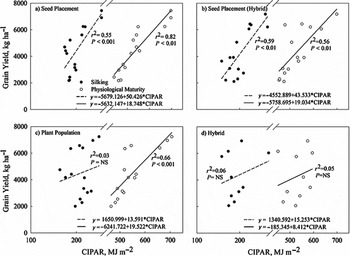
Overall, there was a positive and significant correlation between yield and CIPAR at physiological maturity (Figure 4a). The correlation between yield and CIPAR for the hybrid effect was weak and not significant at both phenological stages (r = 0.26 and r = 0.23, silking and maturity, respectively). Grain yield and CIPAR were highly correlated at silking (r = 0.75, p < 0.01) and physiological maturity (r = 0.91, p < 0.01) for the seed-oriented planting main effect. Relatively small differences in CIPAR were found during reproductive growth stages; however, even small increments in CIPAR resulted in grain yield increases.
Regression of grain yield as a function of cumulative intercepted active radiation (CIPAR) for (a) seed-oriented planting; (b) seed-oriented planting pooled over hybrids; (c) plant population density and (d) hybrids at silking and physiological maturity. Analysis was performed using combined data over years, locations and treatment levels.

The relation between yield and CIPAR can be represented by a linear function for seed-oriented planting (r 2 = 0.82, p < 0.01), PPD (r 2 = 0.66, p < 0.01), and seed-oriented planting pooled over hybrid (r 2 =0.56, p < 0.01) especially at maturity (Figure 4a and Figure 4b). In addition, the relation between PPD and CIPAR was also linear and significant at physiological maturity (r 2 = 0.66, p < 0.01) but at silking this relation was not significant (Figure 4c). Figure 4d shows a non-significant relation between yield and CIPAR for hybrids. According to Edwards et al. (Reference Edwards, Purcell and Vories2005), the relationship between grain yield and CIPAR from emergence to maturity was explained by an asymptotic curve that showed diminished increase as CIPAR increased above 555 MJ m−2. Moreover, regression analysis of yield as a function of CIPAR at physiological maturity revealed that a second order polynomial was highly related to yield (data not shown).
CONCLUSIONS
In the recent past, it was difficult to imagine that oriented seeds could be mechanically planted, but current advances in precision planting (Koller, Reference Koller2013) may change the way maize seeds are planted around the world. This work was initiated to support the development of precision planting and to show that seed orientation and its effects canopy structure can be beneficial to maize production. Moreover, this study identified an opportunity for improvement of maize crop light interception and grain yield through the use of precision planting. A positive relation between intercepted light and yield was found and explained the yield differences encountered in this study. Under irrigated conditions, precision planting of oriented seeds increased yield by promoting higher light interception especially as interplant competition begins to limit light availability. Increased light interception owed to management practices such as oriented-seed planting and PPD caused grain yield to increase. In conclusion, oriented-seed planting improved light interception of maize and resulted in grain yield increases from 9 to 14% compared to seeds planted with random orientation.
SUPPLEMENTARY MATERIALS
For supplementary material for this article, please visit http://dx.doi.org/10.1017/S0014479716000326.