Gouro masks, well known to art lovers, are at the centre of masquerades in Côte d'Ivoire, their country of origin. These performances are much appreciated by audiences, so much so that avatars of certain masks, sometimes borrowed by neighbouring ethnic groups, are presented in shows for tourists in the capital and abroad. This is the case for Flali and Zaouli. The latter is renowned for the varieties of scenes represented in the sculpted top-pieces that crown the mask. For the Gouro most of these masks derive from each other and are related, as is expressed in the genealogical idiom used when talking about them. In this idiom Flali, a feminine mask, is the distant grandchild of the Gù fertility mask which may have inspired Modigliani (Wilkinson Reference Wilkinson and Rubin1991). In this lineage of the so-called ‘pretty’ masks (zìma), which are fully accessible to admiring audiences, Flali was preceded by many masks with feminine faces. This popular and international success raises fears that the tradition may become folklorized, which would ossify it (Vogel Reference Vogel1991).
The present analysis, however, is concerned with only a part of the ‘family’ to which Gù belongs, in which she is presented as the wife, or the mother, of Zamble, the best-known mask and the one the family is named after.
However it is the father figure, Zàùlì (voiced in low tones), also presented as Zamble's wild brother and an ‘ugly’ figure (nɛɛ or naanɛ), who is purported to be the most powerful member of this family; spectators keep their distance and must not touch this mask. The avatars in this line, a series of ugly masks, are undoubtedly too obscure or too kitsch for art lovers, outside of the rare collectors of ‘disease masks’. Nonetheless they constitute a vigorous and living tradition that has been neglected by ethnologists, with the exception of occasional descriptions by Bouttiaux (2000). This raises questions, because our analysis must take the entire family into account.
Like my interlocutors, by the term ‘mask’ I designate not only the wooden object that covers the face, and which the Gouro call specifically ‘wood’ (yiri) or ‘head’ (wuo), but also the personage and its trappings, acolytes, attributes and accompanying troupe. The masks are accompanied by singers who compose ad hoc verses, by specific bands of musicians, and by the mask's servants who guide it and carry its animal-skin train.Footnote 1 Certain masks possess a hollowed-out bark case containing various objects that are the source of their power and on which sacrifices are performed.Footnote 2 In local French parlance they are called ‘sacred’. Their cult is offered by ‘worshippers’, ‘intermediaries’, or ‘cooks’, who remain in the background with the ‘fetisher’.
Thus Gouro make a distinction between two kinds of masks: ‘forest’ masks (that is, sacred) that are endowed with powers, and ‘amusement’ masks (znà). The forest masks (plö-ji-yυ or ‘powers of the forest’) come out only at night, when the women are shut up inside their houses. Women are allowed to see the amusement masks, the so-called ‘women's masks’ (löun-yυ), which are profane. Among these, the ugly masks (nɛɛ) are the counterparts of the ‘pretty’ figures (zìma) that are well known to audiences. Nonetheless all the masks are designated by the generic term yυ, ‘power’.3
The Zamble family of masks are called ‘sacred’ but, while they do indeed emerge from the sacred forest, they do so in broad daylight, and in public. This leads me to think that this family has been secularized. Their descendants are likely to continue this secularization process. This is the case for the ‘pretty’ masks, but the ‘ugly’ masks are deemed to be ‘a bit sacred’, and women cannot touch them.Footnote 4 Their potential is therefore latent. Over time, masks whose original makers and circumstances of apparition are known (‘profane’), may evolve into masks said to be of non-human origin and endowed with powers (‘sacred’). This leads us to consider the possible involutions of the apparent secularization of these cults.
In the Gouro country a woman ethnologist cannot directly pursue an investigation of sacred masks, and I had to use a semiotic approach to validate information about the role of certain masks obtained surreptitiously.Footnote 5 My work on illness and misfortune gave me access to knowledge of the sacred and its language, through study of the notion of the person.Footnote 6 But the secret of masks could only be approached by correlating various secreta (Zempleni Reference Zempleni1996) that are available in the public space.Footnote 7 The specific discourse of each mask is developed by the masquerade, singing, dancing and accoutrements that can be interpreted thanks to the encyclopaedic knowledge acquired.8
The ugly masks were meant to ‘seize [someone] with fright’, which all the Gouro know to be an effect of power. This effect was to be produced by the relative plastic disharmony of the mask, which creates an ambivalent space. The need to ritualize these spaces and incarnate the central character was analysed in detail for Pay-your-round, the last masquerades studied. In their comments my interlocutors set these masks in relation to the upheaval of the world, and establish them as much as performances that ensure the renown of their creators as a historical trace of the events that surrounded their origins.Footnote 9 The diachronic perspective enables us to follow the reworkings of social relationships tracked by these masquerades, each generation seeming to resolve the problem raised by the preceding generation while discovering a new issue that emerges from the resolution.10
Through our study of the avatars to which we have access we should be able to deduce, by inference, the capacity of the Zamble family of masks to ‘advance social relationships through agency’ in the meaning attributed by Gell (1998), if the avatars do indeed update a network of intentions of the same order. This perspective, less radical than Gell's, does not block the semiotic approach that is required according to Layton (2005).
FIELD DESCRIPTION
The Gouro, a southern Mande-language group, live in the central part of Côte d'Ivoire,Footnote 11 in a region that was once forested in the south, and savanna in the north (Tauxier Reference Tauxier1924). This study was conducted in the area around Zuenoula. Farmers, hunters and traders, the Gouro now raise coffee and cocoa crops and, with the current drought, cotton. A patrilinear society with a segmentary organization, following the Omaha parentage terminology, the Gouro identify themselves with territorial units that used to have complex relationships of alliance and war. The villages are made up of one or several lineage segments. As marriage is prohibited with partners who are related by family ties, on either the mother's or the father's side, the Gouro seek wives ‘abroad’ – ideologically speaking, among the enemy. Marriage is concluded by a matrimonial compensation paid to the woman's lineage by the husband's lineage in exchange for the children that the wife will give to him (Deluz Reference Deluz1970a). Cash crops belong to the men, as did formerly the subsistence crops such as rice and yams, and are managed by the heads of the lineage segments. The women handle the income from vegetables in their own right. With monetarization the agricultural work groups described by Meillassoux (1964) have ceased to answer to the elders, and have formed peer groups who work alternately on the plantations of each member. In this way the younger generation has become increasingly independent, and the economic power of the elders is crumbling.
Upon arriving in Côte d'Ivoire in 1982 to work on illnesses and their remedies, I was assigned by the wives of my hosts the task of working on women's ailments. This is what I did for a while, but without remaining exclusively in the company of women, because I was conducting surveys among the community as a whole. Even so, I was excluded from a large swathe of the men's lives. The assembly of the lineage heads, which had agreed to my coming, had taken care to make quite sure that I would not be involved in any work related to the sacred forest. Thus I found myself sharing in the leisure activities of the ‘youths’ of my own age, members of the dancers’ troupes which I will describe, mixed-gender groupsFootnote 12 organized in the manner of women's associations or mutual-aid groups – that is, as peer groups, not based on lineage. In fact I was in the social company that suited my ambiguity. Over the years I enjoyed accompanying the dancers and musicians from my host village to the funeral ceremonies to which they were invited, often in competition in jousts, for our Flali dancer was reputed to be the best at the time. At the ceremonies we met other friendly troupes, such as the renowned Zaouli troupe from Tibeita, which at one time had an ‘international’ reputation (albeit short-lived) in the form of invitations to perform abroad.Footnote 13 The money earned for the performances was divided up among all the members, and this money, earned by a pleasurable pursuit, was meant to be spent in the same way. We were privileged to attend top performances during the ceremonies in our own village, and also the necessary rehearsals held in the evening so that the artists could maintain their form. The same youths had the job of training younger people, in the evening, at dances without masks. At other times, after returning from the fields, they entertained the village with profane dances. At night, I suspect they took part in sacred dances. As for the masks in the Zamble family, I could see them, like the other women, and recognize the members of their troupes. When vast bush fires had wreaked havoc on the whole area, and no decent clothes or accessories were left for festivities, the youngest of the group invented the pauper's dance ‘Night-time youth’, which features an ugly mask, and my dancer and musician friends joined their troupe. This sparked my interest in the ‘ugly’ masks.14
THE AMBIGUITY OF THE SACRED ZAMBLE, ZÀÙLÌ AND GÙ MASKS
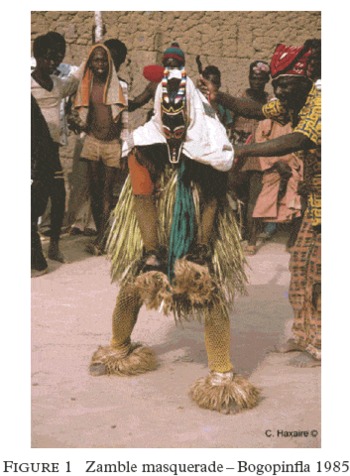
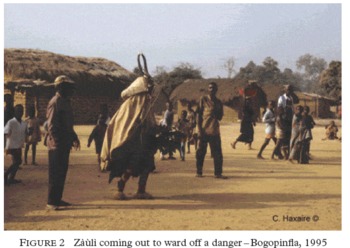
In the first group, the ‘forest’ masks, the Zamble family of masks, comprising the three masks Zamble, Zàùlì and Gù, has the special place of sacred masks that are brought out of the forestFootnote 15 to be seen in public. Gù, with a handsome woman's face, always black in colour, is a fertility mask, endowed with the attributes of its function. Her ‘smooth’ face, her ‘calm’ dance (literally ‘fresh’) are the signs of her youthfulness and hence her fertility (Haxaire Reference Haxaire and Retel-Laurentin1987). She wears only precious finery and trappings. Zàùlì, a savage disease mask, the most powerful in this family, bears a stem of Asparagus Africanus twined around his horns, neither vine nor leaf, ‘vine that cannot be used to tie, and tiny leaves that are just as useless’, etymologically the ‘discussions plant’. But this plant reinforces his nyale, or life force,Footnote 16 and he bites into a kola nut, at once a source of food for his force and an offering to the ancestors. The mask holds remedies in his hand. This is a composite figure, combining carnivore and long-horned antelope. Zamble, his more civilized brother, or his wife according to other exegetes (and sometimes his son), appears as an intermediate figure between the two, decked out in the fruit Cnestis ferruginea D , a plant that gives strength to women and is a fertility remedy. But like his brother he is a combination of carnivore and antelope, in this case possessing bushbuck horns. The Cnestis plant associated with Zamble is also nicknamed ‘palm rat kola’, thus iterating the attributes of the powerful mask in a minor mode.
While Zàùlì, like all sacred masks, wears a robe of fresh palm fronds that fall to his calves (Haxaire Reference Haxaire and Hladick1996), Zamble and Gù have considerably shortened attire, but still sport young palm fronds crossed on their chests. Zamble and Gù hide their arms and legs under plaited nets. They have attractive wraps and nice animal skins in the place of the old torn sacks that cover the bushbuck hide attached to Zàùlì’s back as a train.
The male figures are in charge of the collective calamities that befall the whole community, and not just one family. They come out when an epidemic or an even worse danger – witchcraft, locusts – threatens the village. In this case Zàùlì, a mask of the sacred forest, takes over the transitional spaces between the village and the bush. The feminine figure Gù comes out to install the hearthstones of new brides, or to stimulate fertility that is late in coming. Gù is said to live in the village of her fathers, married to one of their family slaves in order to keep the children in their own lineage (Benoist Reference Benoist1978).
In this aspect these two masks transgress the rules that apply to their status, one by venturing outside of his territory, the other on the contrary by not leaving it for her husband's domain. It is thus only fitting that they come together in the mask whose name announces their common comportment: Zamble (zan-blι), from yυ e zan blι / ‘the one who has broken the rules of his cult’.Footnote 17 Zamble had to kill his own mother, who was the first to enter the hut where the spirit he had captured in the bush was hidden (Deluz Reference Deluz1992; after Fischer and Homberger Reference Fischer and Homberger1985; Kacou Reference Kacou1978).
All of these ambivalent figures – Zàùlì between village and bush, Gù married in her father's house, Zamble brother, son, or wife – can be situated in the dynamics of the search for a transition/transgression that will resolve the paradox in which they find themselves. As shown in Figure 8 (p. 566), today's Zamble figure may well have been the original point of intersection in this series. A twin to the wild male figure to whom he is wedded, or civilized male version of the female figure, this updated Zamble is in fact still an ambivalent mask, and therefore enshrines within itself (an abîme, or mirror text) the necessity for other entities. There can be no doubt, however, of the fecundity of this posture, as Gù’s beauty is a guarantee of restored fertility. Zamble joins the beauty and delicacy of Gù with the mixed traits of bush entities such as Zàùlì. In his current configuration, he tames the power of the ugly masks to reinforce the village order, civilness. Both Gù and Zamble are called zìma, ‘pretty’, a term which can be applied to manners as well as to a person or an object. Thus zìma qualifies a woman or a ‘pretty’ mask, but also a comportment that is upright, in keeping with the norms of society. The contrary is nɛɛ, meaning ‘ugly’ or ‘unsightly’ with reference to both appearance and behaviour. Thus nɛɛ, ‘ugly, unsightly’, evokes disorder, and zìma, ‘pretty, civil’, evokes order. The mask's appearance codes for the state of the person, itself the consequence or reflection of the state of social relationships. In order to fight against calamity Zàùlì must be ugly, nɛɛ, and his wild manners show him to be of the bush. Springing from disorder, he holds the power of disorder (Douglas Reference Douglas1971). It appears to be necessary to invoke this power of disorder so as to re-establish an order, a tension that animates this segmentary society. This is the paradox enacted by this family of masks: out of transgression is born establishment of an order.
THEIR ‘PROFANE’ AVATARS
This capacity for engendering avatars does not seem to have waned with the progressive secularization of these figures, for according to some exegetes these masks have spawned the amusement masks, both ‘pretty’ and ‘ugly’, that are renewed each generation.
The ‘pretty’ masks
Djɛla, the lion, and first of these pretty masks, cannot deny its parentage. Depending on the sculptors, the mask wears either Gù’s face on Zamble's muzzle, or the two faces side by side, or the face of its two parents in a medallion on the mask's characteristic neck-piece. Having given up its robe of thatched palm fronds for a short skirt of dry fibres that gives him more room, the mask must include a neck-piece to hide the bindings of the mask's fibre collar. Djɛla dances as rapidly as Zamble. He is accompanied by a small group of women who ostentatiously rub coloured head scarves, mimicking what all fertile women do each month, that is, wash out the small cloths that serve as sanitary napkins.
After Djɛla comes Zaouli (spoken in medium tones), a woman's face that always wears horns but is also surmounted by sculptures that represent the moon, a bird, the siren Mamiwata, a boa snake or rainbow snake darting out of a pond, and sometimes the Zamble mask itself, in a full-length standing figure. The figurines for the most part evoke signs of power and humidity, thus of fertility. Zaouli attaches his scarves and wraps directly to the oval ring of his ‘wood’. His band has expanded to include a group of gourds borrowed from the Baoulé Goli.
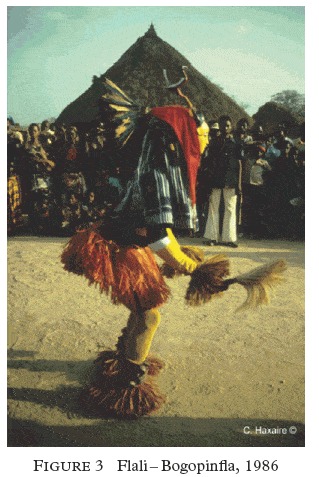
The succeeding masks have lost, with their horns, the mark of their bush identity. Flali / fla li / ‘village woman’, the best known of these, has a woman's face ornamented with a bird and represents a beloved woman who has died too young, and whose inconsolable widowed husband wants to see her reproduced in image and dance. Flali used to be danced by women in certain villages; the men who now excel must achieve the same gracefulness.18
These ‘pretty’ masks may be the sole survivors of ‘ugly’ ensembles. The famous ‘Zauli from Tibeita’ was initially ‘powerful man's daughter’. Other ensembles include similarly crafted pretty masks. Like the dancers disguised as women, these masks were introduced to attract spectators.
The ‘ugly’ masks as signs of social changes
If, as is the opinion of my respondents, the ugly masks renewed each generation are derived from Zàùlì, then the analysis of recent masks should enable us to grasp the function and evolution of this tradition with respect to the type of collective calamities confronted. The circumstances that prevailed at the time of their creation can be known, since these are profane games. The survey pertaining to the masks that appeared in Wagye country (in the Zuénoula region) in response to the massive destruction of belongings after the big bush fires in 1983–4 (Haxaire Reference Haxaire and Caprile1993) extended back two generations in time, in this territorial unit and allied areas. Certain masks of preceding generations reappear at the funeral ceremonies for members of their troupe, their old comrades getting together to give the shadow-double of the deceased all that he had been attached to in his youth.
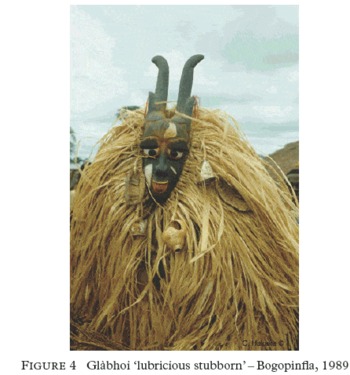
In the 1950s Glà-bhoi (/to oblige/goat/) the lubricious stubborn goat was created by the present-day keepers of a Zamble cult. The goat behaves like a dog, following anybody who has any food, and butts him or her until it obtains what it wants. This being incarnates a power that needs to be tamed. The mask, once profane, is now presented to a naive audience as sacred. Wearing a thick fibre robe, it is decked out with powerful objects: acatine shells, Afzelia seed pods. These are ‘midden fetishes’ that, while protecting against theft and uncleanness, give the yaws disease that pocks the mask (Haxaire Reference Haxaire and Bardolph1994). This leaves doubts as to the origins of the mask's illnesses: did it steal from the harvest? Everything in the mask's behaviour recalls the wildness of the bush spirits. It saunters through the village, scattering laundry and dishes as it goes, pursuing women and stopping to run through a few obscene dance steps. The arrival of this he-goat liberates among the spectators a flood of gestures and words loaded with sexual innuendo.Footnote 19 The mask appropriately dons the colours black and red, the colours of the penis and the vagina, and their qualities, sizes and escapades are recounted without limits.
This letting-go seems to correspond to a specific need of the time, because in the following years (1960s) masks that permitted this kind of talk spread to neighbouring villages.
Dana-bi-gbànau ‘Gbanau, son of Acacia pennata (climbing wattle)’, is contemporary with Djɛla. Paradoxically, to get this thorny mimosa plant off one's clothes one has to come closer to it and, working in the direction of the curved thorns, gently pull free. ‘It's as if the plant were saying “Come” (ιd à lɛ), hence its name dana.’ It grows on the middens that surround Gouro villages, intermediate spaces where sometimes bush entities that are fond of the young shoots venture. Drawn from a folktale, the mask represents a spirit covered with penises which came to dance on these middens at the time when men and women were not differentiated into two sexes. The spirit initiates them into the workings of sexuality and reproduction.
Other masks in this series are Bösölù, ‘timid, awkward’, and Tubhi, whose name comes from the sickness contracted by women who transgress the ban on sexual intercourse during the amenorrhea of lactation.
Just as Djɛla came from Gù, the masks of these generations continue down from Zàùlì: they display ugliness, deformities, the obscene gestures and talk of the bush spirit. The themes evoked are related to women's fertility. These enacted ‘sicknesses’ ensue from what was becoming a source of ‘discussion’, that is, the restriction of sexuality to a woman's fertile periods. Displacing these earlier traditions, the ‘laws of the ancestors’, raised problems. If the ancestors guarantee the fecundity of the lineage, on the condition that their laws are respected, to which ‘gods’ can one turn when these laws are broken? The ‘pretty’ mask Djɛla and its ‘ugly’ colleagues are the two faces of the upheaval of man/woman relationships, caused by their desire for emancipation from the tutelage of their elders, in a time when the younger generation was starting to free itself economically (Meillassoux Reference Meillassoux1964). The feminine sicknesses attributed to transgression of the ancestors’ laws, and that in the 1980s were presented as having ‘newly appeared’, were a last attempt to maintain this order. The masks, even though they were meant to be ‘sacred’ in the aftermath, were not themselves therapeutic, but they permitted the expression of tension at a time when the solutions were being elaborated – for example, the remedies I have analysed in earlier work, that were intended to be preventive and curative (Haxaire Reference Haxaire and Guerci1999, Reference Haxaire, Lammel, Katz and Goloubinoff2003b).20
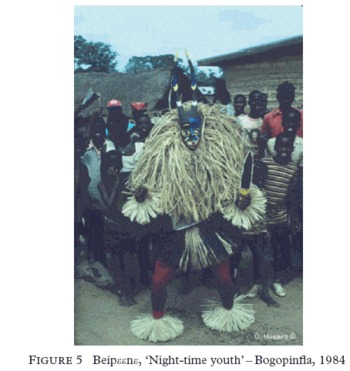
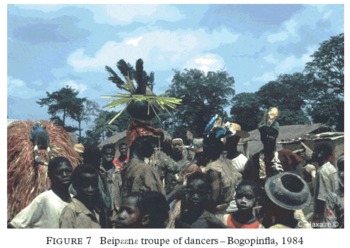
The 1980s, marked by economic crisis, drought and bush fires, saw the ruin of planters already located at the outskirts of residual forest areas exploited for coffee and cocoa crops. Their plantations and villages destroyed, famished and in rags, in these regions the Gouro could no longer hold the funeral ceremonies that produce the most handsome masks, nor even gather together around Flali in the evening. Affected by the economic crisis (‘conjoncture’) that took on the traits of a mythical personage, relatives in the city were no longer able to help the farmers, as they themselves were often ‘conjoncturés’, that is, laid off for economic reasons. The village of Bogopinfla reactivated and updated its old Zɛkɛ mask, inventing for this purpose a mixed-gender dance. This is how Beipɛɛnɛ, ‘Night-time youth’, was born, taking the name of the hero of a folktale who suffered from impetigo and was so ugly he could come out only at night (Haxaire Reference Haxaire and Caprile1993). Although he has long bongo horns and is marked by yaws – one eye closed, nose eaten away – ‘Night-time youth’ has a human face, half black and half blue. In the legend, only the snake gives him food. The first songs sung by ‘Night-time youth’ mocked the food eaten in time of famine, and its consequences for the intestines. But very rapidly, by dint of inverting day and night, men and women, it was the traditional authorities themselves who were lambasted, and their inability to foresee and a fortiori prevent the disasters, both economic and subsequently environmental.
The entity that appeared the following year in the village of Goifla bears the name of a plant, Blɛsυ-blɛsɛ, Tiliacora leonensis, neither vine nor tree, ‘that cannot be used to tie, nor can it be chopped down’, a figure of ambiguity. The ‘myth’ of origins designates the plant as a ritual transmitted by a female spirit to a farmer who returned from his wasted field holding this plant which had disappeared in the aftermath of the fires. For healers, the plant treats hemorraghic dysentery, in this case intestinal troubles caused by diet in times of famine.
‘Night-time youth’ and the ‘ambiguous vine’ are a condensation of the feelings that prevailed at the time, at least among old farmers, of the world's disenchantment (if we can use this term). Drought, the invasion of the self-propagating and inflammable plant Chromoleana odorata, and the ensuing fires were the consequences, for my interlocutors, of the disappearance of the powerful entities. When trees are cut down and hills razed by forestry operators, the forest no longer harbours the bush spirits who attracted the humidity of rain clouds (Haxaire Reference Haxaire, Lammel, Katz and Goloubinoff2002). On top of this, the powers themselves have lost their efficacy now that their taboos are no longer respected, and men and women mix up their roles. It is as if maintaining opposite poles at all levels gives birth to these powers through which the world can find order.
As described above, these figures freely disseminated in neighbouring territories where local populations adapted them according to their own tradition, or reactivated their own figures. For a few years the village of Tibeita was animated with the antics of Pawɛ, ‘Fat fritter’, an asymmetrical and therefore failed sculpture that an apprentice sculptor tossed out, and some boys picked up. One of his puffy cheeks made him look as if he was eating a large fritter, like those sold by the mother of one of the boys, who decided to give him this name.
Is it just by chance that these masks that appeared in the 1990s represented old people, no longer composites but fully human figures, in the midst of small troupes in which women and little spirits mingled?
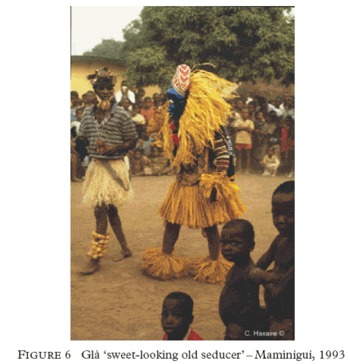
The Glà mask (‘to oblige, force’) might be named after the designer's father, who had in his time established the woman's mask Bèdùò. By obliging his son, in a dream, to pursue the tradition, he sought to maintain his reputation, ‘so that his name would stay alive’. In praising the son people would not fail to remember from whom he came. As Bèdùò is a woman's mask, the shadow asked the son to introduce the mask's wife and daughter into the dance. The men in women's dress enter in the company of a good-looking and prosperous young man, the rival of the old man Glà. A series of skits offer instruction to the audience. Glà, the son of a very rich man, is so ugly, with enlarged eyes deformed by measles, that without a potion no woman would have him. Even so, he has fallen in love with Sita and pursues her with his attentions over four years, in vain. Until one day the object that he is holding falls to him from the sky, and makes the beauty succumb. A young city dweller who ‘works in the capital’ appears, and tries to lure her away from her old husband.21
In a village farther north appeared Buluwo, ‘oaf’, also called Dolo gönɛ bι gun bo, meaning ‘dumb and son of dumb’. Having fallen from an airplane, he suffers from the after-effects of his accident, even though he was treated at the hospital. He also is negotiating for a young third wife.
This last series of dances directly enacts ‘the old parents’ who are still alive, and no longer the ancestral lineage. The constraints that they impose in daily life are evoked, and perhaps their unease at seeing traditions abandoned, an abandonment that threatens their very existence as ancestors. The ancestors who survive are those who are nourished by sacrifices, whose names are included in the list recited before all prayers. The certainty of this survival and this power is shaken when the elders’ prerogatives in this lineage-based society can no longer be ensured. Here the money from trade or business is used solely for the profit of the old man whose preoccupation is seducing women and the songs warn him against these practices. The young farmers express their rancour at having to face competition from the ‘groto’ (overfed and wealthy fat cats) or city-dwellers who steal away their girlfriends, whom often they have to attract with their own resources alone, because at the same time their own ‘old folks’ have become incapable of putting up the matrimonial compensation payments to be furnished by their descendants. These masks express their sense of dereliction. The spectators recognize in these scenes the sources of the ‘discussions’ and conflicts that threaten social cohesion. In these acceptable shows, the solutions lie with the government authorities, but their weaknesses are criticized: coming back from the hospital in the oaf's condition is not the sign of success.
One of the last masks studied, Bɛ nö / ‘Pay-your-round’, appeared in 1993, and seems to reflect preoccupations from which the elders are excluded. The subject here is the regulation of exchanges between peers. The young men of Danangoro had a custom of gathering on their days off to share bottles of wine. Those who joined the group to drink were supposed to pay for a round of drinks, and were greeted with insults: ‘Here is our drink, if you have some – pay your round!’ There was no other possibility, and these gatherings took on the name of the specific insults they generated. After a while the group felt obliged to represent this, ‘to give him his zìè, his nickname’. A party with drinking and a pig on the menu celebrated the day when the entity representing this idea emerged: the Bɛ nö mask. In this context sönö wö, ‘to insult’, means criticizing a person's supposed malformations, in particular of the nose, teeth and sexual organs. The mask had to embody this. The tongue of the spirit hangs out and the horror of its nose consumed by yaws is rivalled by a syphilis-deformed cheek.
It is not always easy to handle the exchange of money and relationships within groups. Here we see that the scale of the conflict has changed, and the ritual must be added to back up the old authorities of the lineage in order to regulate the relationships between peers.
Analysis of the generations of ‘ugly’ masks that emerged in the 1950s in this region enables us to identify the nature of the tensions that the ritual enacts. They revolve around gender relationships, first of all, with the need to express and modify the constraints involved in the reproductive role of women, and to distinguish it from sexuality. Then comes management of the environment, which in a disenchanted world cannot be controlled by the actors in the sacred sphere. More recently, the tension between elders and the young generation described by Meillassoux has become pointless, and the elders are completely forsaken. Economic conflicts are based on competition between rural residents and city-dwellers, in a global context that goes beyond this rivalry, and in which regulation of exchange must be reinvented day by day, between individuals.
Considering the succession in time and the evolutions of the masquerades, it appears that the tensions expressed in the first-generation representation were resolved in the second generation, which integrates women into the troupes, marking an organization between peers, and not a vertical lineage structure. But in this second generation the mixing up of genres could only lead to the disappearance of powers and to the upheaval of the world order on which the elders rely, thereby weakening their control over economic wealth, and eventually their power. In this same period farm workers’ organizations adopted the egalitarian model of trade unions, and tension ran high around the issue of public life freed from the lineage power structure (Haxaire Reference Haxaire1992). The dereliction of the elders staged by the troupe members in the ‘Night-time youth’ generation quickly became a core aspect in the third generation studied, where the issue is who holds economic power (the man from the city) and exercises a hold on the women. The elders out of the race, there remain the conflicts between peers, which emerge with sharp perspicuity in the last generation.
These masquerades are set up by the young people, who thus found their own reputation, while eventually consolidating the father's renown, and take the leadership position that is theirs by right, renewing the tradition. One of the inventors of ‘Night-time youth’ is the son of the creator of ‘lubricious goat’, a Zamble worshipper.
The masquerades prescribe disorder in these moments of passage when the old order is decaying, a disorder that is rich in new arrangements, because open to novelty. The songs in ‘Night-time youth’, for example, anticipate the necessary changes of diet in times of food shortages: ‘maize, you make us sick, but we eat you’. The mask's avatars are all ‘mixed-up’, say my respondents: the goat that acts like a dog, a thorny mimosa plant that one has to get closer to in order to pull free, a youth who hides during the day and shows himself at night. This ambivalence surrounding the personages is clearly expressed in the case of Blɛsυ-Blɛsɛ, being neither of the bush nor of man: ‘It is a human beast, that does not act like a human, but one cannot kill it either, because it is a human even so,’ the young people say. Their behaviour is contrary to what is expected, as is always the case when, though initially they were zoomorphic figures evoking the spirits, these masks become anthropomorphic, and instead of being ancestors, they come to represent unworthy old folks. The troupes invert conventional forms and genres. They show themselves in the intermediate spaces between village and bush, at the outskirts of the village. But the masks can only bring illness from these places, the illnesses of the bush spirits, that some of the masks are meant to be. They are accompanied by soothsayers, by healers or by prominent villagers in full decline, who have only the outward appearance of their function.
The masks are called ‘ugly enough to scare you’, they are meant to frighten, just as meeting a bush spirit will make the blood run cold, a literal description of the effects of his power (his nyale that ‘cuts off the blood in the heart’). Their attributes are all signs of the disquieting strangeness of entities from an Other world, detached from the familiar rules of politeness because recognition of illness is the equivalent of an inverted judiciary procedure: the ‘wood’ with a severely deformed face (nose eaten away, cheek swollen with abscess, toothless mouth), the objects worn as ornaments that connote contamination (midden fetishes) and illness, the obvious origins of these horrors which are sometimes even given as the mask's name.
Nonetheless, these ‘disease masks’, while deformed by the after-effects of the ordeals they have been through, by the very fact that they have crossed this line are endowed with all the attributes of a power that is derided, but is real. Being ill, they know and transmit the remedies, just as any person who has been sick can become a healer specialized in the maladies that have affected him. They prepare the apparition of the ‘pretty’ masks which, in the positive form of fertility masks, deploy all the associations of water and snake, moon and rain, and expressions of bodily youthfulness, that is, strength and blood.
THE NATURE OF THE MASKS, NECESSITY AND POWER
While the masks we have discussed seem to emerge from a progressive secularization, an underlying countercurrent of re-sacralization can also be detected. Power is attributed to the ‘ugly’ masks and the ‘pretty’ masks remain as vestiges of ‘ugly’ masquerades that have disappeared. It would seem that when confronted with the upheaval described above, their function as power (yυ) continues to be necessary.
What the birth of the masks reveals of the function and necessity of the ritual
In all cases, an ‘ugly’ mask appears to be necessary to prolong, institute or regulate spaces devoted to games and amusement. The ‘dana’ mask comes after story-telling sessions devoted to uncouth subjects that could cause disorder. ‘Night-time youth’ opens the inverted space of a poor man's dance, ‘Pay-your-round’ regulates the exchange of jokes. The ‘games’ dances discussed here are characterized by the type of jokes exchanged, ‘insults’ that refer to physical deformities. The masks display these deformities, and inversely, the discovery and use of a failed mask implies exchange of insults.
For the group of young men in Tibeita who created Gönɛ-blɛn, ‘Fat boy’, the creation of this mask was imperative in these circumstances. They gathered after working in the fields, or on their days off, and had developed the habit of proffering insults as a form of joking: ‘Look at so-and-so with his big ears!’ They had to give a name to these exchanges that had become ritual, and then incarnate the mask Gönɛ-blɛn. The young men in Danangoro were even more explicit. Under similar circumstances they felt obliged ‘to make zìè,’ the namesake of Bɛ-nö, ‘Pay-your-round’ (see below). These repeated practices become rituals, requiring naming and representation. This is currently expressed by the phrase ‘take a photograph of’ (folo, in local French), whereas classically the expression was ‘take the measure of, compare, identify’ (dan).
The need for the personage is not a purely formal necessity, however, it also fulfils a function. ‘When people insult each other, discussion starts … that is why we said that, since we are insulting each other, the mask we make has to be ugly, because when there are insults, that's when the disputes start’, say the young men. The mask, even though it is an amusement mask, nonetheless operates as an inverter, opening up a time and space where insults can be exchanged without harm. Its presence, limiting ‘discussions’ to the duration of the ritual, neutralizes their effects. In this segmentary society, gatherings after work in the fields, with drinking, singing and dancing, are necessary to establish cohesion among the young people. Conflicts are expressed there under cover of joking, but can easily degenerate to the point where the feistiest participants leave and set up camp elsewhere. A ritual, stabilized by the mask, is evidently required to hold such opposing forces in balance. These rituals are established by the young men of a village in this patrilocal society, specifically at times when situations of conflict emerge (about women, harvests, sharing) that involve everybody.
‘Pay-your-round’ or ‘Fat fritter’ do not seem to have any therapeutic function, in the way that Zàùlì treats illnesses. The wild ancestor intervened when collective disasters struck, such as epidemics introduced by witches via breaks in social cohesiveness, but also at times of all misfortunes and unhappy events. His recent avatars work to avoid these rifts in society. These figures seek to redefine the place of each individual in the village community for whom they perform.
This ritualization of the expression of tension, in order to resolve conflicts, follows a more general model of segmentary organization elaborated by Gouro society. In her article ‘An African dualism’ (1970b) Deluz has clearly analysed the function of ritual insults during two fundamental ceremonial events, the yυ-nɛ-tan ‘dances of the little spirits’ and zɛn, jokes. The first event takes place at the elaborate funeral ceremonies for an old man. Renowned singers declaim the accomplishments as well as the obscure origins and piteous exploits of ancestors and denigrate the self-important ‘grands types’. Naturally the latter are reluctant to hold these ceremonies.Footnote 22 The second ceremony takes place during the day, after the burial of an old married woman. The village is traversed by two groups of women, the ‘girls’ or maidens from the village itself, and the ‘women’ who are married to the men in the village, and hence come from ‘outsider’ or allied lineages. They reveal the petty slights or the more serious offences committed by the women in the opposing camp. The periodic unveiling of conflicts helps resolve them, if necessary by segmentation.
The ‘ugly’ masks open an intermediary space of games where formerly, using the power of disorder, the necessary harmony could be re-established.
Confirmation of the masks' re-sacralization: the power of namesakes
The masks, agents of inversion that guarantee these spaces, are indeed amusement masks (znàn), notwithstanding their description that is ambiguous about their status.
Over time, and doubtless with the arrival of naive young spectators, the sacred nature of the masks tends to be more strongly affirmed. Quite rapidly an ‘origins myth’ came into being to describe Glàbhoi, ‘the lubricious goat’, as a bush spirit who was found with his tree-bark in a silk cotton tree. Sacrifices are made to his tree-bark.
The ritual is meant to be very consensual, for the charges are shared between the three neighbourhoods of the village of origin. In the same generation, Danan-bi-gbanau is thought to be endowed with powers by god since a sugar-cane thief cursed in his name became sick. The mask is worshipped in the sacred wood, where sacrifices are done on its ‘wood’. In the following generation a ritual was held to present ‘Night-time youth’ with his namesake, the child of one of the mask's creators, as if the mask had answered this wish for offspring. The process by which a sculptor's reject can become a mask is the same as the one that endows any artefact with power(s), making it into a yυ, a fetish. To create the zìè (the namesake) of the fat fritters made by the mother of one of the youths, all it took was to blacken half of his face with charcoal, and spit kola onto his forehead, making the zìè into a bearer of ‘life force’.
The masks are presented to us as zìè, namesakes, of the circumstances that prevailed at their creation, as a sort of allegory of this misfortune. These figures are destined to displace the misfortune. For the Gouro, to say a child is the namesake of an ancestor does not mean that he is the reincarnation of the ancestor. He bears the name of the ancestor who has interceded with bhalι so that some of the life breath can be transferred to the child via the ancestor.Footnote 23 The shadow of this new being, derived from this life breath, remains under the protection of those of his ancestors who interceded for his life. The Gouro speak of them as tutelary ancestors (zu), or as gods (pa bhalι) who bring up the children. Protecting those in his charge, and punishing them with illness or misfortune in case of transgression, no tutor, however, can deprive his charges of their freedom. They can influence, but not constrain. The ancestors cannot be identically reproduced (see Coquet and Houseman 2006). The namesake of misfortune, or the allegorical incarnation of this misfortune, of this disorder, has its own spirit that can just as easily turn against this misfortune. In any event he possesses the motive forces.
By creating the ‘ugly’ profane masks the young men institute something like golems, which when supported by the ritual that they introduce could well come to life and reveal their power – by punishing a thief, or by granting offspring. This power can only derive from bhalι, the prime power from which all others proceed. Such a manifestation is a sign that the creature is invested by god, who has given him life, as it were. These masks are no more subject to testing than a bush being, a tall tree or mountain that might be inhabited by powers and to whom sacrifices are made, in the hopes that it will grant wishes. The young men provide a medium to be invested by a power, by acting as if their mask was also inhabited for a time, long enough to clarify the current disorder. Only the duration over time will attest this power: if the mask is still performed at the funeral ceremonies for troupe members, it is still meaningful.
The staging of ambivalence recreates order and union: pushing the incipient disorder to an extreme, the performance reverses it. This is the particular genius of the segmentary Gouro society that plays off conflicts, where other societies would build a multitude of altars (Zempleni Reference Zempleni1968). Such altars, clay mounds containing powerful objects, exist in Gouro country, but by nature they are not intended to support an exploration of the unknown.
When they are materialized in the form of a statuette, the ancestors are anthropomorphic figures that are known to aesthetes who appreciate their harmonious forms, just as the Gouro do. The masks, bush spirits who come out of disorder, belong to the Other world. If it can be said that they represent ancestors, it is because the spirits, metamorphosed into powerful bush beings – rock, tree or animal – are the ultimate incarnations of shadows reincarnated seven times over. Their power matches a material density that generates possibilities, as translated by the composite mix of forms (Coquet and Houseman 2006). The masks we have studied are born, or intervene, in times of transition.
CONCLUSION
The tradition of profane ‘ugly’ masks continues strong. Through this study of the circumstances of their emergence we have been able to reconstitute the matrix from which they come, the family of sacred masks. The various masks draw their efficacy from the creative ambivalence of a transition space, a disorder from which is born a new figure. This figure is a namesake of this disorder and surpasses it, because like all namesakes it differs from the namesake entity while deriving from the same nurturing principle. The masks of this family and their avatars have a different function from that of altars, which fix the succession of ancestors of the lineage.
The rituals that we have described and their updated versions, while they continue to meet the need for expression, bringing subjects of discord out into the open, are little by little losing their capacity to resolve these issues. As shown by the most recent generations of masks, the disturbances come from the outside, from government action or even from global upheaval. The communities that suffer these disturbances, while they can try to make adjustments, know that by themselves they have little power to change the course of events.
Does this mean that the secularization of Zàùlì’s descendants is ineluctable, and that these rituals are bound to disappear? Zàùlì was once in charge of yesteryear's epidemics, but now that health care clinics have spread through the countryside there are fewer epidemics in evidence. The emerging AIDS epidemic does not have the same collective nature as earlier epidemics. At the time of these surveys, the cases of AIDS that were confirmed in the eyes of the general population were still relatively isolated. Inversely, the rising rate of mortality due to opportunistic diseases, which by definition are diverse, was linked to witchcraft, a diffuse threat for which one can appeal to Zàùlì. The practice of interrogating cadavers, which had not been seen for thirty years, reappeared. As the number of witches identified in this way multiplied exponentially, whole villages set up, at great cost, the protective ‘cow head’ altar, a practice that came from the north. To obtain the favours of their home villages, and not stand accused in turn, the successful members of society, village children who had made their way in the city, paid all or part of these costs.24
The power to combat witchcraft is no longer wielded by the population as a whole, but by wealth from the city, which derives from another form of organization. Building altars, the community's last line of defence, shows the limits of its own capacity to enter into the transitional space that could regenerate order, the space opened up by Zàùlì/Zamble. If this space were to be closed off, and this family reduced to its sole dimension as prestigious masks, Zamble would indeed be ‘folklorized’, and trapped in a net of intentions quite different from those revealed by his name. The powerful members of society who exhibit this mask to their peers, politicians and potential foreign investors would undoubtedly like to see it amputated of its subversive capacity, and made over into an object that reflects only their glory, in the same way they have managed to suppress singers’ jousts in the sacred wood. But Glà, the ‘groto’, joli cœur or ‘pretty heart’, and his comrades make mockery of the pretensions of these powerful persons. They continue to resist, and Zàùlì continues to come out among the people.
ACKNOWLEDGEMENTS
I would like to thank A. Zempleni and M. Houseman for their helpful criticism of earlier versions of this text.
Zamble masquerade – Bogopinfla 1985

Zàùlì coming out to ward off a danger – Bogopinfla, 1995

Flali – Bogopinfla, 1986

Glàbhoi ‘lubricious stubborn’ – Bogopinfla, 1989

Beipɛɛnɛ, ‘Night-time youth’ – Bogopinfla, 1984

Glà ‘sweet-looking old seducer’ – Maminigui, 1993

Beipɛɛnɛ troupe of dancers – Bogopinfla, 1984