Introduction
As I sit and type this paper I am overwhelmed by the sheer amount of memory one can ‘squeeze’ from one's everyday surroundings. From my hundred-year-old apartment building, to my dining room table on which my girlfriend ate meals as a child, to my computer keyboard, which bears use-wear from the papers and e-mails I have written over the past year, I am literally inundated with signs of the past. In addition to these examples, there are likely countless other instances of memory affecting me in covert ways. It is important to note that even though I never actually experienced some of the ‘memories’ that confront me, I remember nonetheless.
Anthropological interest in memory has increased dramatically over the last two decades. Some practitioners focus on how individuals or societies remember, while others concentrate on the affects that memory and memory-making practices have within societies. In this essay I do both of these to some extent. As an archaeologist who studies colonialism and its legacies, my interest in memory lies in the ways that it ‘lives on’ in networks of human and non-human actors, namely artefacts, and in the ways in which it constitutes social identities. Social identity, or the ways in which people classify themselves and their social surroundings, is a key theme in the study of colonialism. This is because social identities were often drastically refashioned in colonial contexts as people drew upon both traditional and introduced cultural elements to construct ‘hybrid’ cultural identities. At times, archaeologists interested in colonial North America overemphasize the distinctions in the archaeological record that they find most pertinent to their research question, which often has to do with the polarity between Europeans and Native peoples and, in turn, between European-manufactured items and Native-manufactured items (see Silliman Reference Silliman2005 for a critique). This reification of cultural essences reverts back to the resistance/accommodation dichotomy, which portrays all Native choices and actions in such contexts as either actively pushing European culture away or embracing it. In contrast, this essay examines theories of memory and considers them in terms of semi-intentionally or unintentionally discursive practices of everyday life and their pragmatic affects. The case study I present, which focuses on butchery practices on the 19th-century Eastern Pequot reservation, suggests new directions in which to push theories of memory in anthropology, while also demonstrating archaeology's unique and invaluable perspective on memory practices in daily life. I first summarize important theories and trends in memory studies in order to set the context for my case study.
Memory
Popular conceptions of memory treat it as somehow fixed and objective. From this perspective, memory is likened to a storehouse (see A. Jones Reference Jones2007 for a critique) where information on past events is filed away for safekeeping. In this model, as people become motivated to recall – either consciously or unconsciously – they simply retrieve the necessary information from their storehouse. Unfortunately, memory is not so simple. First, the ways in which people remember is a social process (Halbwachs Reference Halbwachs and Coser1992) and therefore draws upon individual and group interpretations of the past. These interpretations are subject to change as people age and interact with other individuals and surroundings. Second, since people cannot remember every detail of their past, they learn to selectively forget (Forty Reference Forty, Forty and Küchler2001; Lowenthal Reference Lowenthal, Forty and Küchler2001; Joyce Reference Joyce, Van Dyke and Alcock2003, 105; Connerton Reference Connerton, Tilley, Keane, Küchler, Rowlands and Speyer2006; Lucas Reference Lucas1997). This means that remembering must always coincide with forgetting in some capacity. What we allow ourselves to forget is partially determined by the other human and non-human actors that surround us. Third, as just mentioned, people are not the only important players in memory processes. Landscapes and material culture, including anything from monuments to tin cans, also affect the ways in which people conceive of their pasts (Lucas Reference Lucas1997, 8). Scholars across the social sciences explore these complexities in a multitude of ways. In this essay I focus mainly on anthropological and related sociological discourses.
Early studies
A seminal work in memory studies is Maurice Halbwachs's On collective memory (1992, first published 1941). Halbwachs laid the groundwork for much of the contemporary discourse on memory by building upon Durkheimian theory to describe memory's social character. He argued that the phenomenon we call ‘memory’ is socially conditioned in the present. That is, we remember only as part of social groups, ‘weaving’ memory by interacting with our surroundings. Halbwachs saw dreams as the only examples of purely ‘non-social’ memory. And the incoherent nature of dreams demonstrated to Halbwachs (ibid., 41) that individuals’ memories were inherently incomplete: ‘Our dreams are composed of fragments of memory too mutilated and mixed up with others to allow us to recognize them’. Drawing on Durkheim (Reference Durkheim and Cosman2001, 327–35), Halbwachs argued that cultural conventions partially homogenize individual perceptions, including perceptions of the past, or memories. Halbwachs (Reference Halbwachs and Coser1992, 168) wrote, ‘there are no perceptions that can be called purely exterior, since when a member of the group perceives an object, he gives it a name and arranges it into a specific category’. As individuals process their unique sense experiences and memories into coherent thoughts, the conventions of culture (e.g. language) serve to ‘depersonalize’ them. In other words, according to Halbwachs, all conception – including memory – is not wholly objective, but subject to change in relation to society and the needs of the present.
Critiques of Halbwachs often frame his ideas in the extreme (Fowler Reference Fowler2007). For instance, Gedi and Elam (Reference Gedi and Elam1996) argue that Halbwachs's concept of collective memory presupposes the existence of a collective mind. Also, Schwartz (Reference Schwartz1982, 376) argues that Halbwachs denied the structuring potential of the past in the present, suggesting that Halbwachs portrayed the past as wholly constructed through contemporary social interaction. Such critiques overlook Halbwachs's acknowledgement that there can be multiple orientations to the past, which are simultaneously constrained by traces of the past and socially conditioned in the present. Despite these critiques, collective memory remains a useful theory. Halbwachs even recognized the links between material culture and memory, although he failed to fully explore the implications of the relationship. This is one void that contemporary studies fill, although, as I will argue, in a slightly unbalanced manner, devoting much of their efforts to only certain types of material culture.
Contemporary studies of memory
Monuments, death and landscapes are the most popular topics investigated in contemporary memory studies. The most obvious means of exploring memory may be through the study of monuments. On the most basic level, monuments are purposely created to represent something from the past to the people of the present and future. ‘A monument is an object taken out of history, by history. Yet it stands for history in terms of what it has left behind, as a mnemonic trace that also separates it from the past’ (Rowlands and Tilley Reference Rowlands, Tilley, Tilley, Keane, Küchler, Rowlands and Speyer2006, 500). Scholars interested in power and discourse often ask how monuments relate to the social and political climates in which they were created and in which they exist. Do monuments continue to shape the present and the future? How do people change monuments or create counternarratives to juxtapose with monuments (see Hall Reference Hall2006; also Forty and Küchler Reference Forty, Forty and Küchler2001)? These basic questions concern important issues of power, memory, material culture and social change.
In a similar vein, studies of memory and death focus on the ways in which societies use material practices to remember their dead. Throughout history, people have used a variety of commemoration practices to mark and make memories of the dead (Tarlow Reference Tarlow1999; Hallam and Hockey Reference Hallam and Hockey2001; Williams 2003; Reference Williams2006). These practices employ a variety of material culture, including monuments and gravestones. Some archaeologists even study portable forms of material culture. For example, Howard Williams (Reference Williams2005) examines the differences between cremations and inhumations in 5th- and 6th-century England in order to compare the mnemonic affects of each. He pays particular attention to the distribution of weapons in these two types of funerary feature, noting that weapons were more often associated with inhumations. Based on this pattern, Williams suggests that inhumation and cremation had different mnemonic affects. ‘Whereas inhumation rites created memories by “scene-making” with weapons in which personhood was represented in idealized form, cremation rites created memories through the display and subsequent transformation, fragmentation and redistribution of bodies and artefacts’ (Williams Reference Williams2005, 269; my emphasis). The weapons associated with the cremated dead continued to have ‘social lives’ (Kopytoff Reference Kopytoff and Appadurai1986) in comparison with weapons in inhumations. This means that the weapons associated with the cremated dead had a different affect on social memory than did those that were buried and never seen again.
Finally, studies of memory and landscape examine the ways in which natural features, buildings, streets, monuments and general layouts of social spaces shape the ways that people remember and identify (Basso Reference Basso1996; Holtorf and Williams Reference Holtorf, Williams, Hicks and Beaudry2006). Since people inherit the places that they inhabit (from the past), connections between memory, identity and landscape are usually quite strong. In this sense, space, as configured in the past (which could be the recent past) by either natural or cultural processes, ties reflexively to social relations in the present (see Bourdieu Reference Bourdieu and Nice1977; Lefevbre Reference Lefebvre and Nicholson-Smith1991) and, in turn, to social memories. This fact is evident in the ways in which powerful individuals sometimes manipulate landscapes to emphasize their interpretations of the past in hopes of shaping the present and the future. Studies of landscape focus on a variety of topics and time periods, including monumental constructions such as the prehistoric mounds of the Mississippi Valley (Pauketat and Alt Reference Pauketat, Alt, Van Dyke and Alcock2003) and the castles of Dutch colonies (Hall Reference Hall2006), or more mundane features such as house placement at the prehistoric site of Lepenski Vir in south-east Europe (Boric Reference Boric2003) and the creation of road systems in 20th-century highland New Guinea (O'Hanlon and Frankland Reference O'Hanlon, Frankland, Stewart and Strathern2003).
Beyond the study of monuments, death and landscapes, other vectors of social life, such as the everyday aspects, have received comparatively little attention in terms of social memory. How else does memory participate in social life? How do more portable (see Lillios Reference Lillios1999; Eckardt and Williams Reference Eckardt, Williams and Williams2003; Williams Reference Williams2006) and less durable forms of material culture affect the ways in which people remember? Practitioners can significantly add to memory studies by expanding their foci to incorporate other types of material culture and more quotidian practices, such as those theorized in the case study below.
Theorizing memory
Contemporary anthropologists theorize memory in a variety of ways, some of which tie back to Halbwachs's ideas (Reference Halbwachs and Coser1992). The archaeologist Dusan Boric (Reference Boric2003, 49–51) categorizes memory studies into three types. In this essay, I do not address the first two, which centre on ‘monumental’ history and cognitive processes, but rather focus on the third type, which approaches memory as a textual practice (see also Fentress and Wickam Reference Fentress and Wickam1992). This last approach recognizes the social qualities of memory à la Halbwachs:
Memory is recognized as similar to the interpretive practice of reading. Text is conceptualized as independent from the author's original intentions as it ‘lives its own life’. Thus, similar to text, memory is never a ‘complete work’ but an ongoing montage of ‘scraps’ and fragments of meaning (Boric Reference Boric2003, 49).
However, Boric also notes some weaknesses in textual approaches that are particularly important for this essay. ‘On the other hand, the hermeneutic approach and “textual analogy” in the study of social memory – predominantly conceptualizing memory as conscious archiving of documentary evidence – largely neglected, less formal, and less conscious aspects of mnemonic activities’ (Boric Reference Boric2003, 49; my emphasis). One can approach these neglected aspects of social life from a variety of standpoints. In this essay, I endorse a broad semiotic perspective.
In a recent book, Andrew Jones (Reference Jones2007) also applies a semiotic framework that effectively accounts for less conscious aspects of remembering. Unfortunately, many social scientists, including anthropologists and archaeologists, still conceptualize semiotics as a form of idealism (Keane Reference Keane2003, 413; Daniel Reference Daniel1984), which is not the case. Building upon the pioneering work of philosopher Charles Sanders Peirce, several semiotic approaches in anthropology recognize that semiotic mediation cross-cuts material and immaterial realms of social interaction and therefore does not reify the dichotomy between materialism and idealism (see, for example, current debates in ‘materiality’). On a fundamental level, our material surroundings are signs of the past and therefore relate to memory. A key concept for archaeologists using Peircian-inspired approaches (Preucel Reference Preucel2006; Preucel and Bauer Reference Preucel and Bauer2001; Knappett Reference Knappett2005) is that of indexicality (Peirce Reference Peirce and the Peirce Edition Project1998c; Reference Peirce and the Peirce Edition Project1998a). Indexical sign vehicles relate to their ‘meanings’ via a physical (i.e. spatio-temporal) relationship and do not depend upon social convention as do symbolic or semantic sign vehicles. Indexicality is often associated with pragmatic (i.e. less conscious) actions and meanings. ‘An index stands for its object by virtue of a real connection with it, or because it forces the mind to attend to that object’ (Peirce Reference Peirce and the Peirce Edition Project1998b, 14). For instance, the presence of smoke indexes fire and the direction in which a weathervane points indexes the direction of the wind (Peirce Reference Peirce and the Peirce Edition Project1998b). In this sense, one's material surroundings index past events. Andrew Jones (Reference Jones2007, 19) elaborates on this phenomenon:
What I develop herein is an understanding of the way objects can act as physical traces of past events which are amenable to the process of reading. It is this aspect of material culture which helps us consider how artifacts act as aids to remembrance.
Anthropologist Alfred Gell employed a similar semiotic framework in Art and agency (1998), moving beyond the symbolic aspects of art objects in order to explore the ways in which human agency (defined here in the broadest sense) flows through networks of humans and material culture in the art world. Semiotic approaches such as these (see also Preucel Reference Preucel2006; Preucel and Bauer Reference Preucel and Bauer2001; Knappett Reference Knappett2005) warrant further exploration as they show interpretive potential for memory studies. With this case study I employ a general semiotic framework loosely patterned on Peircian semiotics in order to focus on less conscious memory practices and their pragmatic affects. My argument rests upon an archaeological example of less overt, if not completely unconscious, discursive practices that might have had important pragmatic affects upon the social identities of members of the Eastern Pequot community living on the reservation in the 19th century.
Signs of identity, signs of memory
In regard to any single social entity – be it individual or group – identity is simultaneously controlled and out of control, exuded and absorbed, actively forged and ‘slipped’ into (Casella and Fowler Reference Casella, Fowler, Casella and Fowler2005; see also Voss Reference Voss2008, 9–40). Social identities are also feverishly dynamic – nearly transparent at one moment and embroiled in political fronts in the next. To complicate matters, we – as anthropologists – conflate various aspects of our own identities with those that were at play in the pasts that we interpret (Daniel Reference Daniel1984, 47–57). I begin this section with some very basic considerations, turning to semiotics as a means of sorting out the complexities of social identification and memory practices.
First, what is ‘identity’ and where is it located for the archaeologist? Identities are rooted both in the ways we classify our social world and in the ways that the social world classifies us. Signs lie at the heart of this process. It is with them – as sent or received ‘messages’ – that individuals or groups mediate social interactions and categorize their social surroundings. The impetus for identity lies in the construal of social difference or likeness that individuals or groups act upon when they use signs to either bolster or create difference or likeness for the rest of the social world to observe and react with. It is important to note that social identity is not limited to the ways in which material culture is used to express social classifications but also includes the general classificatory schemes that exist within the social nexus.
Although artefacts and practices are entangled in these fluid processes of social identity on various levels of consciousness, many archaeologists fetishize intentionally discursive signs of difference while throwing more nuanced significations on the proverbial ‘back burner’. As highlighted above, this pattern is also prevalent in memory studies. In contrast to many archaeologies of identity and memory, I am not necessarily dealing with intentional or overt means of partitioning the colonized and the colonizers (i.e. ‘resistances’). Instead I focus on one set of signs that had the capacity to reinforce the solidarity of the 19th-century Eastern Pequot community regardless of the intentionality of their ‘senders’.
Now that I have established my perspective on social identity and outlined the general ways in which it works, it is important to discuss the close relationship between identity and memory (Linde Reference Linde2000). This is perhaps best articulated in the work of Sian Jones (Reference Jones1996; see also S. Jones Reference Jones2007) on ethnic identity. She demonstrates that people's shared experiences and histories (what I refer to here as ‘memories’) lead them to identify with one another, transforming certain aspects of their shared cultural practices and representations into symbols of membership in that group. Such symbols are not fixed. They change as individuals negotiate their places within societies and as societies transform (as in the case of colonialism). It is in this fluidity that individual agency and power lie (in the Foucauldian sense; see Foucault Reference Foucault and Gordon)1980). Individuals can manipulate signs in order to create and re-create identities. ‘The recombining of fragments of memory re-constitutes and re-creates one's identity, where power and creativity lie in the play of gaps or lacunae of meaning and remembering with a general impression of “scrapiness”’ (Boric Reference Boric2003, 50).
Eastern Pequot case study
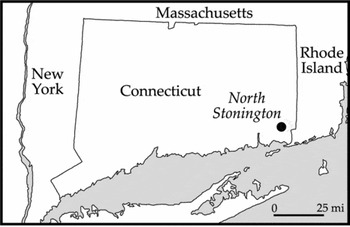
The Eastern Pequot reservation, located in North Stonington, Connecticut, was officially established in 1683 (figure 1). Prior to this date, the English led an attack on the Pequot during the Pequot War of 1636–37, massacring many Pequot peoples and subsequently pushing them off their lands (Cave Reference Cave1996; Hauptman Reference Hauptman, Hauptman and Wherry1990; McBride Reference McBride, Hauptman and Wherry1990; Newell Reference Newell, Calloway and Salisbury2003). Despite these efforts to alienate the Pequot from their lands in south-eastern Connecticut, Pequot peoples continued to return to their homelands (Den Ouden Reference Den Ouden2005, 20), forcing the Connecticut government eventually to establish reservations. The division between Western, or Mashantucket, Pequot and Eastern Pequot Tribal Nations relates to the founding of two different reservations: the western reservation, founded in 1666, and the eastern reservation or Lantern Hill reservation, founded 17 years later.
Map of Connecticut with the location of the Eastern Pequot reservation at North Stonington.

Life on the Eastern Pequot reservation was not easy (DeForest Reference DeForest1964; Den Ouden Reference Den Ouden2005). The reservation system imposed strict limitations on indigenous subsistence practices, bounding Pequot peoples to crowded reservations and restricting them from traditional subsistence areas. Additionally, Euroamericans frequently violated boundaries to extract resources such as lumber and often allowed their livestock to graze on reservation property (Den Ouden Reference Den Ouden2005). This, coupled with the rocky nature of the reservation soils, made it nearly impossible to grow crops. Many able-bodied Pequot males were forced to take employment off the reservation, as either day labourers, soldiers or seamen (Bragdon and Simmons Reference Bragdon and Simmons1998). This left females, elders and children as the main occupants of the reservation, shifting traditional Pequot family and community structures. By 1820 there were only 50 individuals reported as residing on the 224-acre reservation (DeForest Reference DeForest1964).
In spite of these hardships, Eastern Pequot peoples eked out livings (Bragdon and Simmons Reference Bragdon and Simmons1998; Cipolla Reference Cipolla2005; Cipolla, Silliman and Landon in review). Documents from the time period – usually kept by reservation overseers – describe lifeways on the reservation as centred on communal cooperation such as reciprocal exchange and the sharing of food, labour and other resources, including cooperative childcare (Bragdon and Simmons Reference Bragdon and Simmons1998, 54). Also at this time, Eastern Pequot peoples on the reservation began to specialize in crafts, making brooms, baskets and other items to exchange with Euroamericans for goods. This case study allows me to link the people described above and one particular aspect of their daily lives to colonial processes and history in terms of identity.
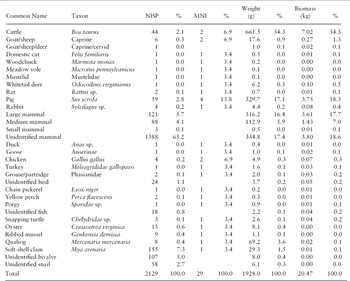
The foci of this study are two early 19th-century household faunal assemblages excavated during the summer of 2004 at a collaborative field school run by Dr Stephen Silliman of the University of Massachusetts Boston and the Eastern Pequot Tribal Nation. The collections (Table 1) (Cipolla Reference Cipolla2005; Cipolla, Silliman and Landon in review) predominantly consist of domestic animal remains: cattle, pig, chicken, goat/sheep and one specimen from a domestic cat represent 84% of the combined assemblages, while indigenous North American mammal, bird, fish, shellfish and reptile specimens make up the remainder. Meat sources were intensively processed. Historical sources confirm that the early 19th century was a time of impoverishment for those Eastern Pequot peoples living on the reservation, making it necessary to stretch food sources (Bragdon and Simmons Reference Bragdon and Simmons1998). Sources of meat might have been obtained through animal husbandry, hunting and possibly even trading, based on the presence of marine fish and shellfish remains that could only have come from habitats five or six miles away. Cut marks and marrow breaks on the remains of old cattle specimens serve as direct evidence of their consumption; older animals, particularly those once used as sources of labour, tend to yield meat that is tough and considered undesirable. Despite this, these animals were eaten, their remains making up a relatively high percentage of the meat represented in the combined faunal assemblages. Also, the locations of butchery modifications on bones show that marrow was often extracted. This, coupled with the high frequency of long-bone fragmentation and unnatural patterns of skeletal representation, indicates that body parts were processed in a way that stretched the nutritional yield from meat, bones and marrow.
Taxonomic representation in the Eastern Pequot faunal assemblage (from Cipolla, Silliman and Landon in review). Note: NISP is the number of identified specimens; MNI is the minimum number of individuals required to account for all of the specimens; Weight (g) is the weight in grams; and Biomass is an estimate of the total biomass weight in kilograms, based on the allometric relationship between animal skeletal weight and total weight

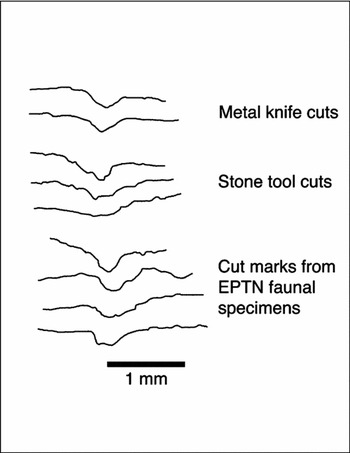
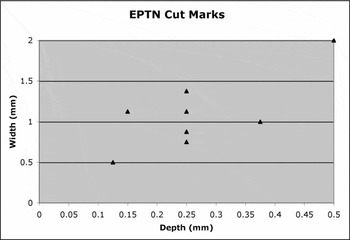
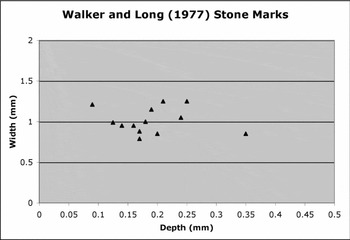
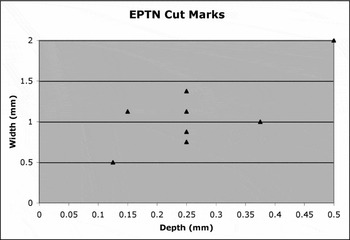
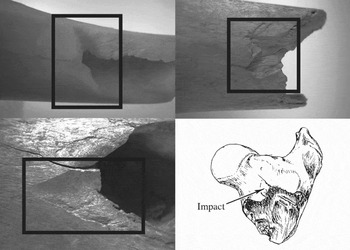
As stated earlier, the crux of my argument lies in the presence of certain butchery marks in the faunal assemblages. Butchery-mark analysis consisting of casting, cross-sectioning, measuring and electronically tracing a sample of both experimentally known and archaeologically unknown butchery modifications shows that saws, hatchets, metal knives and non-metal cutting implements were used for butchery on the reservation (Cipolla Reference Cipolla2005, 65–81). Figures 2 and 3a–c present evidence for non-metal cut marks on faunal materials recovered from the reservation. Figure 2 illustrates the similarity between profiles of cut marks on reservation faunal materials and experimentally known stone-tool marks. Stone-tool marks are generally U-shaped and irregular while metal knives tend to make V-shaped marks (Walker and Long Reference Walker and Long1977; Greenfield Reference Greenfield1999; Cipolla Reference Cipolla2005; Cipolla, Silliman and Landon in review). Figures 3a–c show the distinctions between width-to-depth ratios of cut marks made by metal and stone tools, also illustrating the similarity between cut marks on reservation faunal materials and marks made by stone tools (for a detailed discussion of these data see Cipolla Reference Cipolla2005). Additionally, while most of the bone breaks in the collection are sheared off, indicating the use of saws or hatchets, several of the broken bone shafts exhibit areas of thin-walled bone in the area of impact, indicative of ‘percussion breaks’ (figure 4). Percussion breaks result from striking the end of a long bone against an anvil stone in order to extract marrow (Binford Reference Binford1981, 159). I concentrate on the practices that generated these particular marks and patterns in the faunal remains, a set of ‘signs of signs’. In terms of semiotics, Charles Sanders Peirce would classify these as indexical signs,Footnote 1 as they share a physical relationship with the practices that generated them.
Comparative cut morphologies in cross section: (top) experimental metal-knife cuts, (centre) experimental stone-tool cuts, (bottom) cuts from faunal specimens recovered from the Eastern Pequot reservation.

Dimensions of experimental cut marks made with a steel knife. Data originally published in Walker and Long (Reference Walker and Long1977).

Dimensions of experimental cut marks made with a stone knife. Data originally published in Walker and Long (Reference Walker and Long1977).

Dimensions of a sample of cut marks found on faunal materials recovered from the Eastern Pequot reservation. These distributions closely resemble those shown in Figure 3a.

Comparison of breakage types: (top left) goat tibia broken with axe chop, (top right) pig tibia broken with percussion (archaeological example), (bottom left) cattle femur broken with percussion (archaeological example) and (bottom right) illustration of proximal femur broken for marrow extraction (from Binford Reference Binford1981).

It is important to note that signs operate on multiple levels of specificity, which are partially dictated by the particular observer's knowledge of the world and familiarity with the sign at play. In their 2001 Archaeological pragmatics article, Preucel and Bauer (Reference Preucel and Bauer2001, 93) note that meanings ‘are not inherently ambiguous, but become so as the same or different “knowers” (or, if you prefer “agents”) engage with the Sign (artefact, building landscape, etc.) again and again in different contexts’. For instance, a particular projectile point in the early 19th century might conjure up a myriad of denotations depending on who the interpreter was and what they knew: for an Englishman the point might denote savagery, for an American colonist ‘Indian-ness’, for a Cherokee person ‘Algonkian-ness’, for an Iroquois person ‘Pequot-ness’, for a Pequot person a specific ‘gender’ group, and for a member of that ‘gender’ group a specific person and so on and so forth. With this case study it is difficult to uncover much concerning tiers of denotation within Pequot society. This is partially due to the fact that contexts such as 19th-century reservations in the North-east have received limited archaeological and historical attention. I consequently frame my discussion around relations between Eastern Pequot people on the reservation and their colonists/neighbours. A key distinction here relates to disparities in social memories.
The possible denotations I focus on are thus contingent on receivers’ life histories and memories. This work presupposes that there was an important difference in perception of ‘traditional’ butchery practices such as chipped-tool usage and bone breakage between people that had these traditions engrained in their recent pasts and those that did not. The 19th-century Eastern Pequot community surely exhibited a wide range of experience with these practices. Prior to colonization, they were the only means of processing meat sources. Based on the frequencies of metal cuts versus non-metal cuts on faunal specimens and the presence of multiple metal knives in each of the household assemblages, chipped-tool usage and percussion breakage did not occur as frequently as they might have in the 17th and 18th centuries.Footnote 2 The bones bear 181 recognizable marks; out of 109 cut marks, 49 per cent are from metal tools, 36 per cent are from non-metal tools and 15 per cent are unidentified. I recognize the small sample size on which this study is based but insist on its pertinence nonetheless.Footnote 3
The fact that excavations revealed very little in the way of chipped tools (stone or otherwise) presents an interesting contrast to the relative frequencies of cut types found on bones. This might relate to the changing uses and/or meanings of chipped tools on the reservation in the 19th century. The Eastern Pequot might have relied upon metal tools for everyday butchery practices and reserved stone tools for other special circumstances, explaining the relatively high frequency of metal tools recovered in relation to the low numbers of chipped tools. Trash pits located just outside each house foundation contained the majority of the faunal materials analysed. For this reason it is difficult to speak of the various contexts in which metal and chipped tools might have been used. Likewise, in terms of the locations of cut marks on faunal materials, there are no major distinctions between metal-knife and chipped-tool cuts.
Although metal tools had become the major means of performing butchery processes by the 19th century, some individuals still possessed first-hand experience with chipped-tool usage and bone percussion – most likely acquired by watching or by receiving explicit instructions from other individuals who possessed the appropriate experience with these skills. Elders on the reservation possibly associated these practices with memories of their elders or ancestors who lived before the times of colonization and metal tools. Other community members might have lacked first-hand experience with these techniques; however – considering the tight-knit nature of the reservation community as commented on in various documents from the time (Bragdon and Simmons Reference Bragdon and Simmons1998) – it is likely that they associated these practices with certain relatives or other community members residing on the reservation. This factor is also important in terms of social memory, as the things we ‘remember’ were not always experienced first-hand (Lucas Reference Lucas1997).
Bourdieu's concept of ‘doxa’ is applicable in this case, despite the fact that his portrayal of power reifies the domination/resistance dichotomy that thinkers like Foucault (e.g. Foucault Reference Foucault and Gordon)1980) rejected:
The dominated classes have an interest in pushing back the limits of doxa and exposing the arbitrariness of the taken for granted; the dominant classes have an interest in defending the integrity of doxa or, short of this, of establishing in its place the necessarily imperfect substitute, orthodoxy (Bourdieu Reference Bourdieu and Nice1977, 169).
Social negotiations are not always mediated in such a dichotomous manner. In other words, not all practices are evoked to either push ‘back limits of doxa’ or defend ‘the integrity of doxa’. Between these two extremes there exist many subtle grades of variation. The example I present in this essay demonstrates how certain practices exist beyond the motivations of domination or resistance. Looking past Bourdieu's limited depiction of power, the concept of doxa is still useful. One could argue that traditional (pre-contact) butchery practices existed in a state of doxa until contact and colonialism introduced new butchery technologies. Once there was a choice of tools, these traditional practices were no longer unquestioned. The choice was politicized to some degree (see Silliman Reference Silliman2001 for a similar application of doxa). It was only orthodox to engage in traditional forms of butchery on the reservation. In contrast, it is safe to say that the 19th-century Euroamerican community clustered around the Pequot reservation had little or no first-hand experience with these faunal processing techniques. At this scale, butchery practices involving metal knives were likely in a state of doxa. As I argue, it is within the reservation community that this politicized choice was most important for social identities and community solidarity. These practices had the potential to index social distinctions – namely in the ways in which agents oriented themselves to the past – between those communities in which they existed and those where they were absent.
Given the distant locations and likely private nature of the household contexts under study, both the ‘senders’ and ‘receivers’ of this set of signs were likely Eastern Pequot people living on the reservation. From this, I cannot argue that these traditional butchery practices were sets of intentionally discursive actions meant to signify difference from the encroaching Euroamerican community. As mentioned above, I contend that – as far as identities are concerned – the significance of these practices lay in the ties they fortified between individuals living on the reservation. Therefore my interest is not necessarily in the intentionality of ‘senders’, but rather in the effects certain practices generated in the ‘receiving’ community. The practices I focus on were potential emblems of ‘sameness’ that linked ‘senders’ to ‘receivers’. Those engaging in these practices possessed some degree of special knowledge that was exclusive to individuals with particular histories or experiences (memories) – in other words, non-colonists. Aspects of identity maintenance such as these are important for sorting out the nebulous qualities of colonialism and colonial identity.
Colonial processes are highly complex. Individuals and groups define their identities with introduced materials, practices and concepts while recasting ‘traditional’ cultural elements in potentially new political fronts of social engagement. The colonist and the colonized are brought closer together in these processes, especially in relation to the material residues on which we focus in archaeology. Despite this, colonial societies still exhibit heterogeneous qualities, specifically in terms of memories and identities. Even within the restrictions of the reservation system, Pequot peoples still made choices of how to live their everyday lives and construct their material surroundings. It is these choices that had pragmatic affects on the world, sometimes marking or making social distinctions that were laminated over existent and emerging colonial tensions. The perpetuation of identities such as ‘Pequot’, ‘English colonist’ or ‘American settler–citizen’ are not limited to consciously discursive processes. Practices of daily life have the potential to reinforce memories of origins and common descent, which are integral to maintaining certain social boundaries in colonial contexts. Similarly, Carsten (Reference Carsten and Carsten2007, 4) emphasizes ‘how, cumulatively and over time, small everyday processes of relatedness . . . have a large-scale political import’. Butchery practices that involved chipped tools and bone percussion were not flags of opposition to be waved in the face of the non-indigenous, they were simply parts of a common past that contributed to the ‘sameness’ shared by community members living on the reservation, a shared-ness that accented differences between the encroachers and the encroached, Pequot and wonnux (the Pequot word for ‘white man’) (Prince and Speck Reference Prince and Speck1904).
Final thoughts
The concept of social memory is clearly important for contemporary archaeology. With it, archaeologists can interpret the uses and affects of memory in past societies, and also better understand their own roles as memory-makers in the modern world. Up to this point archaeological studies of memory have focused mainly on monuments, death and landscapes as the major loci of memory-making in past societies. In this essay I have argued that, by concentrating largely on consciously discursive forms of memory-making, archaeological treatments of memory have yet to realize their full potential. By turning an eye towards the unquestioned practices of everyday life as potential sites of memory-making, this essay has explored a slightly new direction for archaeological studies of memory.
In certain contexts, everyday practices have the potential to mark and reinforce identities via their indexical links to the past and to social memories. Since, as discussed in the Introduction, almost all of our everyday surroundings index the past in some fashion, the challenge is to understand how certain practices have the potential to function as emblems of in-group identity while others do not. Above I argued that signs with the ability to index histories and memories that starkly contrast others’ histories and memories in highly politicized contexts – such as those of colonialism – are likely to be powerful identity markers.
In contexts such as the Eastern Pequot reservation, where material surroundings and community structures changed dramatically in a relatively short period of time, it is likely that social memory played a key role in reifying the line between colonist/settler and indigene. Excavations at the reservation revealed one memory practice that potentially functioned in just such a way. Cut-mark analysis on faunal materials from two 19th-century Eastern Pequot households revealed that butchery practices were performed with both metal knives and chipped tools. Written sources from this period are blind to such memory practices as literate Euroamericans rarely ventured onto reservation grounds. This is what makes the archaeological perspective so valuable.
While a purely functional or technological perspective might predict the wholesale replacement of stone tools with metal tools based on the latter's technological superiority, and a class-based model might interpret metal tools as marking prosperity and non-metal tools as signs of impoverishment, evidence for parallel practices involving both types of tool at two different households suggests that practices involving traditional tools might have functioned on a different register than those involving metal knives. Taking a pragmatic perspective, which looks beyond the intentions of ‘senders’ and emphasizes the affects that signs have on ‘receivers’ or ‘receiving’ communities, I have argued that the persistence of traditional butchery practices functioned to bind Eastern Pequot community members together by emphasizing a shared past, a social memory. On the reservation, memory ‘lived on’ in the form of semi-intentionally or unintentionally discursive practices that had important, albeit practical, affects on the reservation community. In this sense, individuals engaging in and observing traditional butchery practices on the reservation were re-membering their identities in the courses of their everyday lives.
Acknowledgements
This essay is based on data from my master's thesis research at the University of Massachusetts Boston; a paper written for the 2006 Society for American Archaeology meetings in San Juan, Puerto Rico; and a paper written in a graduate seminar with Dr Richard Leventhal at the University of Pennsylvania. I would like to thank the Eastern Pequot Tribal Nation and Dr Stephen Silliman for allowing me to participate in the field project, along with Dr David Landon and Dennis Piechota for helping with my analysis, specifically the work with cut marks. Thanks are due to Dr Robert Preucel, Dr Stephen Silliman, Dr Richard Leventhal, two anonymous reviewers and the editorial board at Archaeological dialogues for offering me many helpful comments on this essay. Of course, I am solely responsible for any shortcomings found within. Finally, I thank Kat Hayes for co-organizing the Society for American Archaeology session in which I presented an earlier version of this paper and Kelly Ferguson for always offering a critical ear for my ideas.