I. INTRODUCTION
Stimuli-responsive hydrogels, showing strong responsive ability to external stimuli (such as temperature, pH, light, magnetic field, and electric field) in a predictable fashion, have attracted a great deal of interest because of their potential applications in biomedical and industrial fields.Reference Zhang, Wu and Chu1–Reference Hou, Matthews, Smitherman, Bulick, Hahn, Hou, Han and Grunlan5 However, so far, conventional hydrogels (abbreviated as OR gels) synthesized by using an organic crosslinker or irradiation by γ-rays have shown obvious disadvantages in terms of their mechanical, structural, and absorption properties due to their chemically cross-linked networks, which largely restricts their application.Reference Hirotsu and Onuki6,Reference Takigawa, Araki, Takahashi and Masuda7
According to the previous reports, adding nanosized materials into the gels is an effective method to improve the weakness of the OR gels.Reference Fu, Xu, Song, Chen, Yang and Niu8–Reference Sun and Wu10 Especially, a kind of novel nanocomposite hydrogels (abbreviated as NC gels) with excellent mechanical, optical, and swelling properties was created by Haraguchi, which breaks through all limitations of OR gels described above and is considered as a great achievement in the field of hydrogels. Generally, the NC gels were synthesized by the in situ free-radical polymerization of monomers such as N-isopropylacrylamide (NIPA), N,N-dimethylacrylamide (DMAA) in the presence of nanosized sheet clay Laponite XLG as a multifunctional physical cross-linker. The excellent characteristics are due to the organic/inorganic networks structure formed in the NC gels, which consist of exfoliated clay platelets uniformly dispersed in an aqueous medium with flexible polymer chains linking them together, more homogeneous distribution and less number of cross-linking units than OR gels that avoid the localization of stress during deformation and improve the mechanical properties of gels dramatically.Reference Haraguchi, Takehisa and Fan11–Reference Endo, Miyazaki, Haraguchi and Shibayama15 However, it was found that the homogeneous NC gels with the high clay concentration were difficult to prepare due to the high viscosity of the clay aqueous dispersion. Clay Laponite XLG, as a kind of sheet clay carrying strong negative charges on the surface and weak positive charges on the rim, could form homogeneous aqueous colloidal suspensions when the concentration is low. Whereas, the high concentration of clay in water has a strong tendency to aggregate due to the formation of a so-called “house of cards” structure caused by unlike charges interaction, which indeed affects the polymerization and the properties of gels seriously. For preparing the NC gels with high content of clay, Zhu et al.Reference Zhu, Liu, Sun, Zhang, Liu, Yu, Zhang, Kuckling and Adler16 used a novel modified clay Laponite XLS as an inorganic cross-linker. Clay Laponite XLS with negative charges on both the surface and the rim of clay sheet could be dispersed in water and form low viscosity suspensions uniformly and stably due to the repulsion of like charges, which guarantees the successful preparation of homogeneous and transparent NC gels with a high clay content (the concentration could reach 20 wt%).
Among these series prepared NC gels, it was noticed that the monomers used in preparing NC gels are mainly the hydrophilic–hydrophobic amphiphilic monomers such as NIPA, DMAA, and ethylene glycol, which exhibit nonstimulus responsive or only temperature responsive. Undoubtedly, the hydrogels with multiple sensitiveness while keeping excellent properties of NC gels are of increasing interest for some applications requiring a response to several stimuli simultaneously with particular emphasis on the pH and the temperature. Aiming at this target, researchers have tried to synthesize the NC gels by copolymerizing the thermosensitive monomers with seldom electrostatic monomers to avoid the influence of electrolyte on aggregation of clay and ensure the successful synthesis.Reference Aoyagi, Ebara, Sakai, Sakurai and Okano17–Reference Xu, Zhang, Cheng, Zhuo and Kennedy21 For example, Song et al.Reference Song, Zhu, Chen and Haraguchi22 designed a temperature and pH double-sensitive NC gels by structuring a semi-interpenetrating organic/inorganic network, which could be prepared through polymerizing poly(N-isopropylacrylamide) (PNIPA) network cross-linked by clay Laponite XLG in the present of linear poly(acrylic acid). Mujumdar and SiegelReference Mujumdar and Siegel23 synthesized various pH responsive NC gels by the copolymerization of NIPA with several electrolyte monomers including 2-(dimethylamino) ethyl methacrylate (DMAEMA), sodium methacrylate, and methacrylic acid. Lin et al.Reference Lin, Xu, Shi, Feng and Wang24 created a novel (PAAm/PAA) double network nanocomposite hydrogel by a two-step solution polymerization, the gel achieved a responsive swelling capacity in water and NaCl solution and exhibited high compression strength. Zhu et al.Reference Zhu, Xiong, Wang, Liu, Wang and Tong25 synthesized a positively chargeable NC hydrogels consisting of acrylamide, DMAEMA, and clay by in situ free-radical polymerization and UV initiation, the gels showed obvious pH-responsive swelling behavior. Comparably, using a single monomer possessing double or multisensitive to synthesize responsive NC gels has seldom been reported before.
DMAEMA, a cationic electrolyte monomer with both temperature and pH sensitiveness, is appropriate to prepare double sensitive gels and have been researched deeply. Previous studies were mainly respect to the synthesis and properties of poly (2-(dimethylamino)ethyl methacrylate) (PDMAEMA) hydrogels cross-linked by a chemical cross-linker or UV irradiation, the results showed that PDMAEMA gels have definite volume transition temperatures in water due to the establishment and damage of the hydrogen bond between –N– in tertiary amine group and water at different temperatures, various lowest critical solution temperatures (LCSTs) of PDMAEMA hydrogels are in the wide range of 39–50 °C depending on the molecular weight, pH, and salt concentration.Reference Chen and Yi26–Reference Xu, Kang and Neoh28 Also, the pH sensitiveness of gels has been investigated. Under acidic condition, the protonation of the tertiary amine group in DMAEMA increases the hydrophilism of molecular chain and makes the hydrogels swell drastically, correspondingly, the limitation of the protonation under alkaline condition leads the gels to shrink. However, all prepared PDMAEMA hydrogels are mechanically weak and extremely brittle, which cause the gels to be worthless in application.
In this work, for preparing NC gels with double stimulus responsiveness through a convenient method, monomer DMAEMA was cross-linked by two kinds of clay Laponite XLG and Laponite XLS as an inorganic cross-linker in situ free-radical polymerization. DMAEMA was chosen for its temperature and pH sensitiveness and similar molecular structure to NIPA. Both prepared gels and preparation processes were investigated through the analysis of yield, transparency, UV/Vis, Fourier transform infrared spectroscopy (FTIR), x-ray, and scanning electron microscopy to figure out the mechanism with respect to the effect of clay on the polymerization from which the appropriate cross-linker for preparing a better NC gels was found. Additionally, for the purpose of replacing traditional OR gels, the properties of resulting NC gels, including LCSTs, mechanical properties, and swelling/deswelling behaviors and repeated swelling/deswelling behaviors were investigated systematically and compared with the OR gels.
II. MATERIALS AND METHODS
A. Materials
DMAEMA provided by TCI Co., Japan, was purified by vacuum distillation prior to use. N,N-methylene-bisacrylamide (BIS), N,N,N,N-tetramethylethylenediamine, potassium peroxodisulfate were purchased from Alfa Co., England, and used without further purification. Synthetic hectorite “Laponite XLG” ([Mg5.34Li0.66Si8O20-(OH)4] Na0.66 layer size = 20–30 nm ×  $\phi$ 1 nm) was purchased from Rockwood Co., (Rockwood Additives Ltd., Cheshire, UK) modified clay “Laponite XLS” was prepared by adding 7.68 wt% Na4P2O7 into clay Laponite XLG. Sodium phosphate monobasic dehydrate, sodium phosphate dibasic dodecahydrate, sodium hydroxide, and hydrochloric acid for preparing buffer solution were all provided by Aladdin Co., China, and used without further purification. Deionized water was double distilled for using in all synthesis and analysis experiments.
B. Methods
1. Synthesis of PDMAEMA NC gels
PDMAEMA NC gels were synthesized by free-radical polymerization following the method described previously.Reference Haraguchi, Takehisa and Fan11 Briefly, monomer (DMAEMA), cross-linker clay (Laponite XLS or Laponite XLG), and deionized water were stirred at ice water temperature for at least 1 h (when Laponite XLG was used as a cross-link agent, the suspensions consisting clay and water were stirred to be homogenous first, then, the monomer was dropped into slowly for obtaining a stable colloidal suspensions). Next, the suspensions were ultrasonically oscillated for 20 min to get a homogenous aqueous solution. Next, a solution with an initiator and a catalyst was added to the suspensions with stirring at ice water temperature for 5 min, pure nitrogen was bubbled, passing through the solution in all stirring processes. Finally, the solution was transferred to a columnar glass vessel  $\phi$ 5.5 × 120 mm and sealed. Free-radical polymerization was allowed to proceed in an ice water bath for 20 h. The prepared samples were immersed in deionized water at room temperature for at least 48 h, and the water was changed several hours to wash the unreacted monomer. The mass ratio of monomer, initiator, and catalyst was 100:1:0.75, the mass ratio of water/polymer ratio was fixed at 6/1 (w/w). The resulting hydrogels were named as S-NCn and G-NCm gels related to the gels cross-linked by Laponite XLS and Laponite XLG, m and n correspond to the mole percent of clay against the DMAEMA monomer in gels.
2. Characterization of PDMAEMA NC gels
FTIR spectra of the hydrogels were taken under ambient conditions by a FTIR-380 spectrophotometer (Thermo Fisher Scientific Inc., Waltham, MA) with milled dried unpurified hydrogels by the conventional KBr disk tablet method. X-ray diffraction profiles of clay, S-NC gels, and G-NC gels were obtained by using a D8 advance Cu Kα x-rays diffractometer (Bruker AXS Inc., Madison, WI) with milled dried samples. The yields of gels were evaluated by the weight of the dried gels. The LCST of the samples was determined by using a Q20-Series differential scanning calorimeter (DSC; TA Instruments Inc., New Castle, DE), all samples used in DSC measurement were immersed in deionized water and buffer solution with different pH values at room temperature and allowed to swell for at least 48 h to reach the equilibrium state, the thermal analyses were performed from 20 to 50 °C at a heating rate of 1 °C/min under a dry nitrogen atmosphere with a flow rate of 40 mL/min. The transparency of the gels [polymer/water = 6/1 (w/w)] was detected with a Lambda 950 UV/Vis spectrophotometer (Perkin-Elmer Inc., Waltham, MA) at 600 nm wave length and ambient temperature (about 20 °C). The morphology of the network structure in gels was observed by a S000-N (Hitachi High Technologies America Inc., Schaumburg, IL) low-vacuum scanning electron microscope (Hitachi Inc.), each sample for observation was rapidly frozen and subsequently frozen-dried for 48 h under vacuum at −40 °C. In our experiments, unless otherwise noted, all dried samples were prepared by drying purified hydrogels.
3. Mechanical measurements
Tensile mechanical measurements were performed on S-NC gels of the same size  $\phi$ 5.5 × 80 mm length using a UTM6000 universal mechanical tester (Suns Inc., Shenzhen, China). The sample length between the jaws was 35 mm, and the crosshead speed was 100 mm/min, the initial cross-section 23.75 mm2 was used to calculate the tensile strength and the tensile modulus, the tensile strain was taken as the length change relative to the initial length of the sample. The tensile strengths and moduli were calculated from the increase in load detected between the elongation of 20 and 120%.
4. Swelling experiment
The swelling experiment was performed by immersing the dried gels in water and buffer solution with different pH values at least for 48 h to reach the equilibrium at every particular temperature. The weight of gel was measured after wiping off the excess water on the surface with moistened filter paper. The swelling ratio was calculated from the following formula:
 $${\rm{Swelling}}\,\,{\rm{ratio}}\,{\rm{(SR)}} = {\rm{(}}W_{\rm{s}} - W_{\rm{d}} {\rm{)/}}W_{\rm{d}}\quad ,$$
where W s is the weight of equilibrium swollen hydrogels, and W d is the dry weight of the hydrogels.
5. Deswelling kinetics experiment
The deswelling kinetics of the hydrogels after a temperature jump from the equilibrated swollen state at 20 °C to the hot water at 60 °C were measured after wiping off the excess water on the surface with moistened filter paper. The water retention corresponding to the deswelling ratio was calculated from the following formula:
 $${\rm{Water}}\,\,{\rm{retention}}\,{\rm{(WR)}} = {\rm{(}}W_{\rm{t}} - W_{\rm{d}} {\rm{)/}}W_{\rm{s}} {\rm{\quad,}}$$
where W t is the weight of swollen hydrogels at different time, and W s is the weight of equilibrate hydrogels.
6. Oscilliating swelling/deswelling experiment
To determine the repeated swelling/deswelling behaviors with alternating temperature changes, S-NC4 and S-NC8 gels with the same size and water/polymer ratio as described above were used. At first, the original gels were retained at 60 °C for 48 h. Then the hydrogels were alternately moved into water at 20 and 60 °C. The hydrogels were retained for 48 h at each temperature and weighed at specific times after removing the excess water from the surface. The swelling ratio was calculated from the following formula:
 $${\rm{Reswelling \,\,ratio}}\,{\rm{(RR)}} = W_{\rm{t}} {\rm{/}}W_{{\rm{60(48)}}} {\rm{\quad,}}$$
where W t is gel weight at specific time t (h), and W 60(48) is the gel weight after retention of the first 48 h at 60 °C.
III. RESULTS AND DISCUSSION
A. Preparation of PDMAEMA NC gels
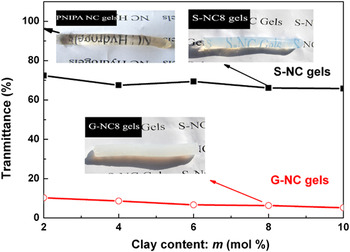
According to the previous research, the NC gels consisting of clay and amphiphilic polymer network such as PNIPA or PDMAA gels could be synthesized through simple and diversified processes. Relative to that, electrolytic DMAEMA, being a single monomer used to synthesize NC gels, has not been reported yet. In this work, for preparing the PDMAEMA NC gels successfully, the clay Laponite XLG, as a frequently used inorganic cross-linker for preparing NC gels, was used firstly, various methods have been attempted to ensure the realization of polymerization and improve the properties of NC gels, such as polymerizing in buffer solution with various pH values, varying the mass ratios of monomers, clay, and water, ultrasonically oscillating the suspensions for a long time before polymerization and adding an organic cross-link agent as a cocross-linker in polymerization. However, although the polymer network could be achieved successfully by the method described in Experiment section, all resulting gels were basically opaque (shown in Fig. 1). Furthermore, the gels exhibited viscous state more or less after polymerization, revealing the incomplete reaction of cross-link. These phenomena indicate that adding an electrolytic monomer indeed precipitates the aggregation of clay Laponite XLG and further affects the cross-link of polymer chain around clay. For avoiding such a negative influence, the novel modified clay Laponite XLS with the same negative ions in both rim and surface was used as a cross-linker, the visible aggregation of clay was not observed due to the charge repulsion, resulting in the successful synthesis of homogeneous PDMAMEA NC gels. To figure out the mechanism of synthesizing both G-NC gels and S-NC gels, the resulting gels and synthesis process were analyzed comprehensively.
Transmittance change in S-NC gels and G-NC gels with different clay contents. The transmittance of hydrogels were measured at 20 °C.

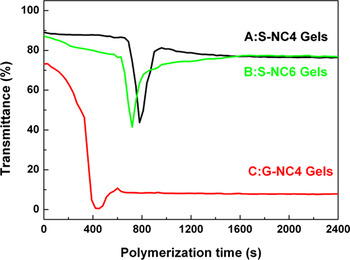
Figure 1 shows the transparency of G-NC and S-NC gels. As shown in Fig. 1, the differential homogeneity of these two kinds of gels is apparent. For S-NC gels, the transmittances of gels all reach about 70%, which are regardless of the ratio of monomer/clay, indicating that there exists no conspicuous aggregation of clay, and the polymer network is homogeneous. For G-NC gels, all of them look like opaque, corresponding to the transmittances <10%, which may be attributed to the aggregated clay and heterogeneous polymerization of molecular chain. Moreover, during the process of synthesizing both G-NC and S-NC gels, it was interestingly found that the transparencies of initial aqueous suspensions with monomer and clay before polymerization are higher than resulting gels apparently, meaning that the change of transparency was happened in the polymerization process. To clarify the mechanism, the UV/Vis spectrophotometer was used in analyzing the transparency change of the solution in the polymerization process. Figure 2 exhibits the time dependency of transmittance during the in situ polymerization of G-NC and S-NC gels at 20 °C. In the polymerization of G-NC gels, the profile (curve a) shows that the transmittance decreases dramatically from 70% to almost 0% and is kept at a low transparency followed a slight recovery, suggesting that the occurrence of polymerization intensifies the inhomogeneous of gels probably due to the formation of clay aggregates as a “card house” structure. As a comparison, the curves b and c belonged to the S-NC gels with different clay contents reveal that the suspensions exhibit good transparency at the beginning of reaction, then the transmittances decrease to about 45% abruptly and revert to 65%, and then remain unchanged. The change of transmittance is similar to that of other NC gels described by Haraguchi.Reference Haraguchi and Li13 To explain it in detail, the significant decrease of transmittance, corresponding to the start of polymerization, is related to the change in density locally due to the formation of clay–brush particles in the surface of clay. After that, the formation of the longer grafted polymer chain and the disappearance of density discrepancy between clay–brush particles and matrix collectively result in the recovery of transparency. The mass of clay influences the time for starting the change of transmittance slightly but not the resulting transparency of the gels.
Changes of optical transparency during the polymerization of S-NC (S-NC4 and S-NC6 gels) and G-NC4 gels.

It was also noticed that comparing with the PNIPA NC gels, which is a typical clay cross-linked NC gels with high transparency (transmittance is >95%, shown in Fig. 1), the transmittance of PDMAEMA S-NC gels is still low obviously. As we know, the transmittance of gels is determined by the local density change, which is dependent on the hydrophilicity of polymer chain and the heterogeneity of polymer network since the clay cross-linked NC gels possess very few cross-link points and homogenous cross-link network than that of OR gels relatively, indicating that there is no significant effect of the increased clay on the heterogeneity of polymer network, it could be concluded that if the hydrophilicity of monomer is strong enough to attain good compatibility between the clay–polymer brush particles and water (i.e., complete hydration), the high transparency of the initial solution should be kept after polymerization due to the unobvious local density changes, otherwise the transparency should decrease. Consequently, due to the weaker hydrophilicity of monomer DMAEMA than NIPA, the PDMAEMA S-NC gels exhibit lower transparency.
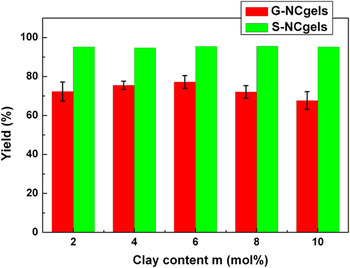
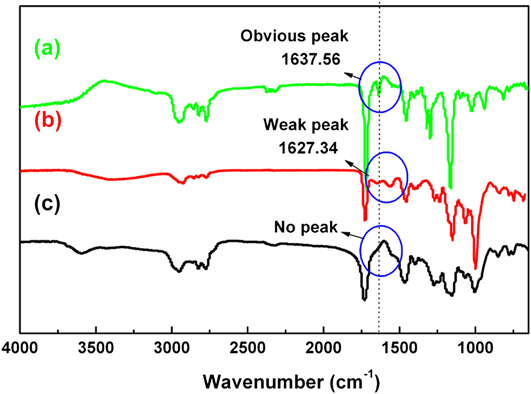
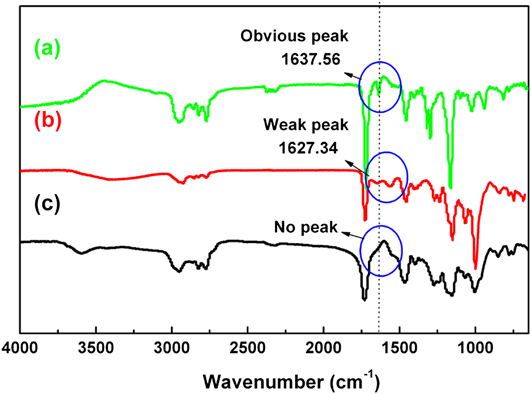
After polymerization, it was found that the surface of unpurified S-NC and G-NC gels exhibit different degree of viscosity, indicating that there exists unreacted monomer or uncross-linked polymer chain in the gels. Figure 3 shows the polymerization yields of both S-NC and G-NC gels, evaluated from the weights of dried gels. The yields of both S-NC and G-NC gels exhibit unobvious clay dependency. For G-NC gels, the yields are all <80%, especially to the gels with m > 8, the yields decrease significantly to about 65%. It demonstrates that the aggregation of clay indeed affects the polymerization of monomer and the entanglement of polymer chains around clay. Relatively, the yields of S-NC gels are >95%, meaning the complete polymerization of monomer basically. This result could also be proved by the FTIR analysis of the unpurified gels. Figure 4 shows the FTIR spectra of the S-NC and G-NC gels, respectively. All curves of S-NC and G-NC gels show the characteristic absorption of PDMAEMA (3450, 2970, 2920, 1720, 1450, and 1180 cm−1) and clay (1005 and 650 cm−1). Noticeably, the curves (a) and (b) related to G-NC gels exhibit an absorption peak around 1630 cm−1, corresponding to the bend vibration of C=C groups, which indicates that the considerable C=C groups are existed in those gels. It is reasonably believed that the existed C=C groups is attributable to the DMAEMA monomer in gels, indicative of the presence of incomplete reacted monomer. The stronger C=C absorption peak appeared in curve (a) suggests that the increasing content of clay Laponite XLG should intensify the incomplete polymerization of DMAEMA monomer. Reversely, the spectrum of S-NC gels [curve (c)] shows no similar absorption around 1630 cm−1, indicating the complete reaction of monomer in gels.
The polymerization yields of S-NC and G-NC gels with various m.

FTIR spectra of (a) G-NC8 gel, (b) G-NC4 gel, and (c) S-NC8 gel.
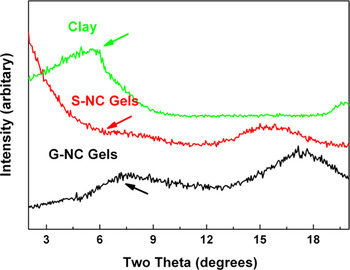
To investigate the state of clay existed in gels, the x-ray diffractograms of clay, G-NC gels, and S-NC gels are shown in Fig. 5. The spectrum of clay shows obvious diffraction band centered at 2θ = 6°, which is attributed to the basal layer spacing between clay platelets of 1.30 nm. Meanwhile, in the spectrum of G-NC8 gel, the absorption peak at 2θ = 8° is visible, corresponding to the aggregation of clay. The resulting left shift of this characteristic peak of clay may be caused by the alteration of layer space of clay in gels due to the effect of polymerization on the aggregate status of clay. As a comparison, in x-ray profile belonged to S-NC8 gels, it is observed that the infraction peaks in the 2θ range from 2 to 10° disappear completely, which reveals that the nanosized clay particles are dispersed in gels uniformly without obvious heterogeneous aggregation.
X-ray diffraction profiles with Cu Kα x-rays for milled dried materials of clay, S-NC8 gel, and G-NC8 gel.

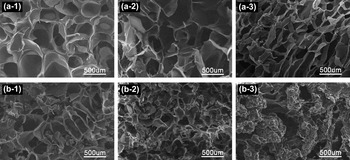
The kind and content of cross-linker used in synthesis determines the network morphology of the gels. Figure 6 shows representative SEM micrographs of frozen dried G-NC and S-NC gels with various clay contents. The morphologies belonged to these two kinds of hydrogels exhibit a striking disparity. The images of S-NC gels [Fig. 6(a)] all present distinct macroporous structure profile with smooth surface, which is similar to that of typical NC hydrogels observed by Endo et al.Reference Endo, Miyazaki, Haraguchi and Shibayama15 The size of pores increases with the decreased clay content, which is attributed to the decrease of cross-link density. These morphologies give an evident to support that the clay is uniformly dispersed and makes slight effect on the polymerization of gels. As a comparison, the image of G-NC gels with a low clay content (image b-1) still presents a clear skeleton structure despite the surface exists a few polymer fragments. This morphology illustrates that the polymer network is structured without significant influence by clay. With the increase of clay content, it is observed from image b-2 that the pores of G-NC6 gel become smaller and unsharp, the tiny aggregated clay and cracked polymer fragments appear in the polymer network, revealing that the aggregation of clay happens in the polymerization process and influences the cross-link of polymer network. When m reaches 10, it could be seen from image b-3 that the gel possesses extremely vaguer network profile, a substantial number of clay aggregates appear and nearly cover the whole surface of polymer. There is no doubt that the clay aggregates drastically, which makes a great positive impact on the synthesis of gels.
Representative SEM images of frozen dried gels (a-1): S-NC2 gel, (a-2): S-NC6 gel, (a-3): S-NC10 gel, (b-1): G-NC2 gel, (b-2): G-NC6 gel, and (b-3): G-NC10 gel.

Summing up the analyses above, using modified clay Laponite XLS could guarantee the successful synthesis of PDMAEMA NC gels with better homogeneity and yield than using clay Laponite XLG. Based on the point, in the next section, the properties of S-NC gels were researched systematically to represent the superiority relative to traditional OR gels.
B. Mechanical properties of S-NC gels
PDMAEMA OR gels cross-linked by BIS, exhibiting weak and brittle fracture, are broken easily by elongation, bending, and compression only in a small deformation, which limits the application of this hydrogels. It is well known that PNIPA NC gels possess excellent mechanical properties, especially the ultralong elongation at break, is considered as the most important advantage of NC gels. To prepare PDMAEMA gels with improved mechanical properties is the main target of this research.
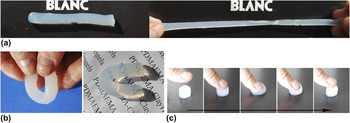
From tensile tests on the prepared S-NC gels, it was found that in general, the gels could still be elongated to a great extent [shown in Fig. 7(a)], suggesting that the S-NC gels show obvious ductility. Besides, the S-NC gels can withstand moderate deformations in bending and compression [shown in Figs. 7(b) and 7(c)].
The behaviors of S-NC gels in mechanical tests (a) elongation, (b) Bend, and (c) Compression and relaxation.

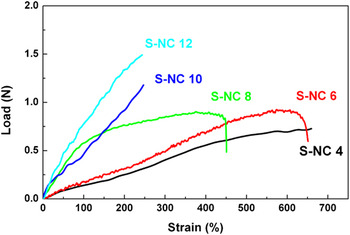
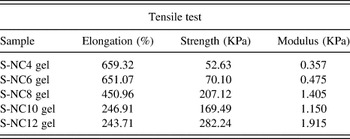
The typical strain–stress curves for S-NC gels with various m values are shown in Fig. 8. It is observed that the tensile properties of P-NC gels exhibit a marked dependence on the content of clay. According to the results shown in Table I, which are calculated by using the data in Fig. 8, with the increased clay content, the strength and modulus of gels increase, and the elongation of break decreases significantly, especially for the gels with m > 10, the break at extent decreases to <200%. Additionally, it is worthwhile to point out the significant distinctions of mechanical behaviors between the PDMAEMA S-NC gels and the PNIPA NC gels. Firstly, the elongation at break and load of S-NC gels are obviously lower than that of PNIPA gels, which could reach 1900% and 6N, respectively. This substantial decrease may be resulted from the looser entanglement of molecular chains around clay than that of PNIPA due to the faint repulsion between weak alkaline DMAEMA monomer and negatively charged clay and the steric effect of the big-branched chain belonged to DMAEMA. Secondly, it could be seen from the profile of S-NC4, 6, 8 gels that the load exhibits a slow increase domain with increased elongation before the break. It may be attributed to the mild break or unwrapping of molecular chain from clay. Relatively, the gels with m > 10 break abruptly followed a rapid increase of strength, suggesting that the high cross-link density should make the gels become easily broken.
Load–strain curves of S-NC gels with different values of m in the tensile test.

The mechanical properties of S-NC gels in the tensile test.

Specially, the poor recovery of S-NC gels was also observed in tensile tests. Taking an example, after relaxation, the S-NC4 gel stretched to 700% of original length still kept about 80% length. This character may be also caused by the entanglement of DMAEMA macromolecule around clay, which is not as tight as that of PNIPA NC gels. According to our further research, it was found that adding a small quantity of chemical cross-link agent BIS into S-NC gels as a cocross-linker could improve the strength and recovery of the gels effectively. Based on this found, it should be described and discussed in detail in next paper.
C. LCST of S-NC gels analysis
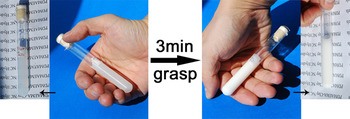
Responsiveness, as the most important factor, must be considered for the applications of response hydrogels. According to the previous reports, the LCST of PDMAEMA gels, even for those cross-linked by UV irradiation, is equal or higher than 40 °C, which is above the body temperature of human being. This is considered as a large obstacle in application of drug release. Surprisingly, it was interestingly found that the transparent S-NC gels in alkaline solution changed to white after a 3 min grasp by hand, as shown in Fig. 9. This typical phase transition of gels indicates that the LCST of this S-NC gel is close to the body temperature. On account of this found, the detailed analysis of LCSTs of the S-NC gels is necessary, while the LCSTs of OR gels with the same moles of cross-linker are exhibited for comparison.
The transparency change of S-NC4 gels before and after a 3 min grasp by hand.

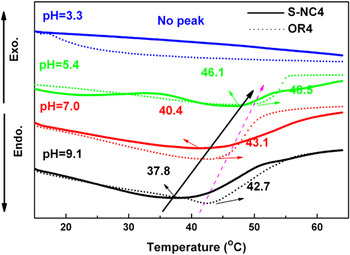
Figure 10 shows the DSC thermograms of S-NC4 gels and OR4 gels in buffer solution with various pH levels. Here, the temperature at the maximum point of the endotherm is referred to the LCST as illustrated in the figure. With decreasing pH (become to acidic), the LCSTs of both S-NC4 and OR4 gels shift to higher temperature and even disappear in pH 3.3 buffer solution, which is ascribed to the enhanced protonation of tertiary amine group in DMAEMA.
DSC thermograms of S-NC4 and OR4 gels under different pH conditions.

For DMAEMA, as a typical cationic electrolyte monomer, the LCST related to hydrophilicity-to-hydrophobicity transition is determined by the overlapped effect of both hydrogen bond and protonation in polymer. Under low pH conditions, the protonation makes a polymer chain keep hydrophilicity even when the hydrogen bonds between NH groups and water are destroyed at high temperature. Moreover, it is shown in Fig. 10 that the LCSTs of NC4 gels are lower than that of OR4 gels in all pH conditions, which may be reasonably explained by the theory that the more cross-link points of OR gels than NC gels limit the mobility of molecule chain and hinder the conformational change of molecular chain from stretch to aggregate. More important, we can clearly see that the LCST of S-NC4 gels is about 38 °C in pH 9 buffer solution as a conclusive evidence of what we observed.
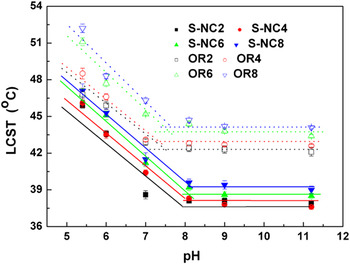
For investigating the regularity of changes in the LCST of S-NC gels, the LCSTs of S-NC4, 6, 8 series gels as a function of pH level are shown in Fig. 11, the LCSTs of OR gels are also shown as a comparison. The changes of LCSTs for S-NC gels and OR gels with increased pH display the similar tendency, which could be described that the LCSTs decrease with the increased pH first and then stay at a platform when the pH value higher than a critical value. This phenomenon reveals that when the pH value is higher than pK of tertiary amine group (about 7.8), the protonation should be inhibited and thus results in the change that the hydrophilia of PDMAEMA is determined by only hydrogen bond between polymer and water and effected by change of temperature directly.
Changes in LCSTs of S-NC gels and OR gels under different pH conditions.

Besides, the OR gels with higher cross-link density exhibit higher LCST, which is attributed to the tighter cross-link limiting the activity of polymer chain. For the same reason, the LCST of NC gels exhibits the same tendency but a slighter degree due to the quite a few amount of clay cross-link points in unit volume gel matrix. As seen in Fig. 11, the LCST of NC2 gel in pure water falls to 38.5 °C, being closed to the body temperature when people suffer a fever, which makes this research of PDMAEMA NC gels become more valuable.
D. Swelling ratio analysis
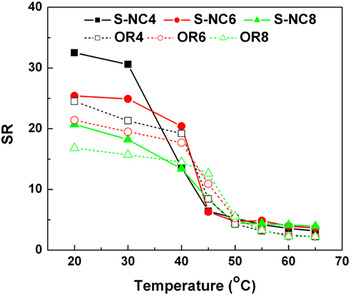
Figure 12 shows the equilibrium swelling ratios of S-NC and OR gels as a function of temperature. The swelling degrees of all gels decrease with the increase of temperature and exhibit a steep downtrend when the temperature reaches the special critical value, which corresponds to their LCST gotten from DSC measurement roughly. The more significant volume transition behavior of S-NC gels stands for the more obvious temperature sensitiveness. As shown in Fig. 12, the S-NC and OR gels with low m show a higher swelling ratio than that of gels with high m, which is ascribed to the increased cross-link density limiting the motion of molecular chains and the expansion of polymer network. Besides, the swelling capacity of S-NC gels is stronger than that of OR gels with the same m. These phenomena could be explained by the model of NC gels advanced by Haraguchi that the cross-link points for OR gels are 100 times than that of NC gels with the same m per unit volume, the less limitation of molecule chain in NC gels results in a stronger expanding ability of the polymer network. The higher swelling ratio of S-NC gels than OR gels should widen the range of application undoubtedly.
Equilibrium swelling ratios of S-NC gels and OR gels at different temperatures.

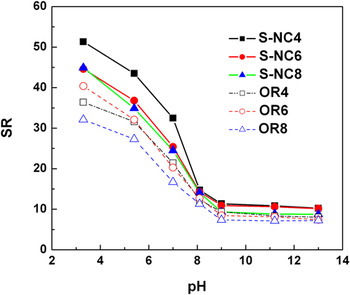
Figure 13 shows the equilibrium swelling ratios of the S-NC and OR gels immersed in buffer solution as a function of pH value at 20 °C. The changes of swelling ratios for both gels are similar, the gels in buffer solution with low pH present higher swelling ratio than that of gels in alkalinous solution, the swelling ratios decrease significantly with the decrease of pH due to the protonation of the tertiary amine group in DMAEMA under acidic condition. Moreover, the complete restriction of protonation in buffer solution with pH value >8 leads the swelling ratio to decrease and attain a low value close to unity. These results indicate that the S-NC gels exhibit significant pH sensitiveness. Notably, the swelling ratio of S-NC4 gels under pH3 condition could reach about 55, which is higher than that of any PDMAEMA gels reported previously.
Equilibrium swelling ratios of S-NC gels and OR gels under different pH conditions at 20 °C.

E. Deswelling kinetics of S-NC gels analysis
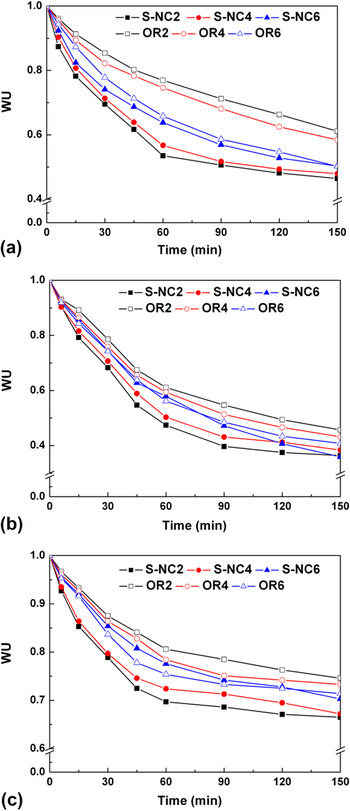
The deswelling kinetics of S-NC gels under water, weak acidic, and alkaline conditions are shown in Fig. 14, respectively, in which the results of OR gels in the same test are also shown for comparison. It can be seen that the shrinking rates of S-NC gels are faster than that of OR gels with the same m value under all pH conditions obviously, especially to the gels with low m. The diffusion rate of the freed water in gels is controlled by the collective diffusion coefficient of molecular chain and the channel in gels for the freed water diffusion in/out, the S-NC gels with less cross-link points than OR gels provide larger channel and thereby improve the deswelling rate.
Deswelling kinetics of S-NC4 gels and OR gels in solution at 60 °C. (a) In pure water, (b) in alkaline buffer solution at pH 9.1, (c) in acidic buffer solution at pH 3.3.

Moreover, the deswelling rate of S-NC gels increases significantly with the increase of cross-link density, while the OR gels exhibit opposite tendency. This marked discrepancy may be due to the different mechanism for these two kinds of gels. For OR gels, the polymer chains are cross-linked by huge amounts of chemical cross-link points, the inhomogeneous aggregation of polymer chains around cross-link points provides more channels for water diffusion when the phase transition happens, thus, the increased cross-link density brings about a increased heterogeneity of gels and results in faster deswelling rate eventually. For S-NC gels, the number of physical cross-link points is almost negligible compared with that of OR gels, the increased clay content should not influence the heterogeneity of gels markedly, which could be proved by the unchanged transparency of gels with different m, hence the decrease of pore sizes of gels becomes the dominant factor to lead a slower deswelling rate.
Through comparison of the image a, b, and c in Fig. 12, it is easily found that the deswelling rates of gels in water are similar to that in alkalinous solution and are obviously great faster than that in acidic solution. The difference of deswelling rate is ascribed to the discrepancy of the force driving the network shrinkage under different pH conditions. According to the theory about hydrogels, the equilibrium swelling state of hydrogels means that the stretching force of water getting out the gel is equal to the contraction force of the polymer network, from which the conclusion could be deduced that the force of shrinkage is determined by the differential of equilibrium swelling ratio of the gel in different test states. After a temperature jump from equilibrated swollen state at 20–60 °C in water or alkaline solution, the equilibrium swelling ratio of gels decreases dramatically due to the complete restriction of protonation, which provides enough force for deswelling. Relatively, the gels exhibit some degree of water retention under acidic conditions due to considerable hydrophily caused by the protonation of NH group, which decreases the driving force of deswelling and results in a slow deswelling rate.
F. Oscillating swelling/deswelling behavior analysis
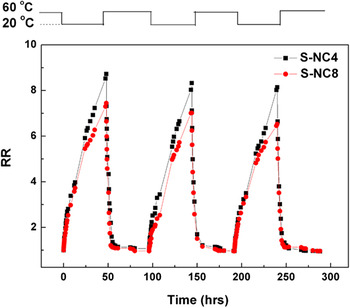
The aforementioned investigation shows that the PDMAEMA S-NC gels possess controllable response properties. From the applications viewpoint, it is necessary to study the kinetics of oscillating swelling/deswelling in response to temperature cycles for guaranteeing a repeated use of gel. Therefore, the circular swelling/deswelling behavior of S-NC gels was also investigated by using S-NC4 and S-NC6 gels as typical examples. The hydrogels swelled and deswelled in water over 48 h temperature cycles between 20 and 60 °C and the results were shown in Fig. 15. From the figure, it can be observed that the swelling/deswelling behaviors of gels in three times sequential circular test are highly similar, indicating the stable swelling/deswelling behavior of S-NC hydrogels. However, the equilibrium swelling ratio exhibits a slight decrease in sequential test, which may be caused by the damage and rearrangement of the polymer network.
Repeated swelling and deswelling behavior of S-NC gels by alternating temperature circularly.

IV. CONCLUSIONS
In this work, the PDMAEMA NC gels were synthesized in situ free-radical polymerization by using clay Laponite XLG and Laponite XLS as inorganic cross-linker, respectively. The results gotten from the analysis of yield, transparency, FTIR, x-ray, and SEM showed that using Laponite XLS as a cross-linker could avoid the aggregation of clay and guarantee the successful synthesis of NC gels with higher homogeneous and yield. The prepared hydrogels cross-linked by Laponite XLS exhibit obvious temperature and pH double responsiveness. Comparing with the traditional PDMAMEA gels cross-linked by chemical cross-linker BIS, the S-NC gels exhibit better mechanical properties, larger swelling ratio, faster deswelling rate, and lower LCST. It is interestingly noticed that the LCSTs of S-NC gels with the low clay concentration (m < 4) are close to the temperature of human being, which makes the gels potential in application of drug release. All properties of the gels could be adjusted by controlling the content of clay. Additionally, in our further research, it has been found that the S-NC gels own good function on releasing some special drugs, which is valuable and should be described in next paper detailedly.
ACKNOWLEDGMENTS
We acknowledge the financial supports of the National Natural Science Foundation (Grant Nos. 21104017 and 61174100); Hunan Provincial Science and Technology project (Grant No. 2012FJ4369).