How public opinion affects foreign policy in democracies has been a subject of long-standing controversy. Some argue that public opinion has no real impact on foreign policy. They contend that voters focus on domestic concerns, and that leaders pursue foreign policies with relatively little regard for what ordinary citizens think.Footnote 1 Others maintain that public opinion shapes foreign policy by affecting who wins elections and constraining what leaders do after taking office.Footnote 2
Whether public opinion shapes foreign policy has profound importance for theories of international relations. As many have documented, democracies behave differently from autocracies in military disputes, trade, alliances, and other forms of international conflict and cooperation.Footnote 3 Some theorize that these differences arise because public opinion carries more weight in democracies, or because citizens in democracies have unique preferences about foreign affairs. Accordingly, a growing body of research focuses on the foreign policy attitudes of the mass public as a way to gain insight about international relations.Footnote 4 If public opinion proved inconsequential in democracies, however, scholars would need to rethink prominent explanations for the democratic peace, trade protectionism, and other regularities in world affairs.
The connection between public opinion and foreign policy is also normatively important. If leaders routinely ignore public opinion on matters such as war, trade, and immigration, is this apparent lack of representation a flaw that democracies need to address? If, on the other hand, leaders follow public opinion even when citizens lack expertise, would it be better to insulate elected leaders and the larger foreign policy establishment from public pressure? Before judging whether democratic institutions ought to be reformed, we need to know how closely the foreign policies of democracies reflect the will of the people and why.
We use experiments to shed new light on the connection between public opinion and decisions about military force. Although previous scholars have made valuable progress, disagreement remains about whether and how public opinion influences this important area of foreign policy. This disagreement may reflect the limitations of available data. Past scholarship, though insightful, has relied on observational data, which are vulnerable to problems of selection bias, reverse causation, and confounders. Moreover, little research has directly measured how leaders think about the connection between public opinion and the use of military force. We take a fresh approach by presenting experiments involving policymakers and voters. Our experiments complement existing work by helping to illuminate the causal relationship between public opinion and decisions about military force in two geopolitically important democracies: Israel and the United States.
We begin by distinguishing two pathways—responsiveness and selection—through which the public could shape foreign policy.Footnote 5 First, incumbent leaders may respond to public opinion out of concern that rebuffing the public could be politically costly. Second, the public could select parties or candidates whose foreign policy preferences reflect their own, whether or not those policymakers respond to public pressure after taking office.
To test the responsiveness mechanism, we provide the first experimental evidence about how leaders at the highest levels incorporate public opinion into decisions about foreign policy.Footnote 6 Our experiment presented eighty-seven current and former members of the Israeli parliament with a foreign policy crisis in which we randomized information about how the public wanted to respond. The experiment indicated that, all else equal, policymakers were more likely to support the use of military force when the public was in favor. For additional insight we asked about the likely consequences of making military decisions that conflicted with public preferences. The vast majority of parliamentarians thought the government would pay significant political costs if it failed to heed public opinion.
To test the selection mechanism, we administered conjoint experiments to citizens in two political contexts: Israel and the US. Participants evaluated hypothetical parties (in Israel) or presidential candidates (in the US), which varied randomly in their positions on security policy (the use of military force), economic policy, and religious policy, as well as on nonpolicy attributes. In both countries, positions about security policy exerted powerful and consistent effects on voting preferences. Our experiments also allowed us to compare the importance of security policy to other electoral considerations. Security policy proved at least as important as economic and religious policy, and far more consequential than nonpolicy attributes such as gender, race, and political experience.
Our studies make several contributions to the debate about the importance of public opinion for decisions about military force. By recruiting not only ordinary citizens but also policymakers at the highest level, we test key mechanisms and document how they operate. By using randomized experiments, we provide new data that ameliorate problems of selection bias, reverse causation, and confounders. And by combining data from Israel and the US, we not only learn about the effects of public opinion in two important democracies but also gain confidence that our conclusions hold in diverse political settings. Overall, our studies advance a long-standing debate by providing experimental evidence that public opinion can affect security policy in two ways: by influencing leaders once they take office, and by shaping who gets elected in the first place.
How Might Public Opinion Affect Decisions About Military Force?
In nearly all democracies, citizens delegate power to political representatives. Although representative democracy is often praised, it creates the potential for principal-agent problems: elected officials may implement policies that contradict the will of the people. Past scholarship has argued that citizens in representative democracies can influence the policy choices of their elected leaders through two mechanisms: responsiveness and selection.
Responsiveness
Many influential theories in international relations presume that, after taking office, leaders respond to current public opinion and/or expectations about future opinion.Footnote 7 Incumbents might worry that ignoring current opinion could prove costly during their time in office. Unfavorable public opinion could, for example, make it harder to surmount institutional checks on war powers, raise funds for foreign interventions, and amass the political capital to achieve other international and domestic goals.Footnote 8 Policymakers may also fear that unpopular policies could contribute to defeat in the next election or reduce their margin of victory, weakening their mandate to govern in the future.
Scholars have used observational data to test responsiveness in three ways. First, they have estimated the correlation between public opinion and government policy. Some have found that security policy follows public opinion,Footnote 9 while others have uncovered little evidence of responsiveness.Footnote 10 However, scholars employing this approach acknowledge that “when opinion and policy correspond, it is extremely difficult to sort out whether public opinion has influenced policy, or policy has influenced opinion, or there has been some mixture of reciprocal processes; or, indeed, whether an outside factor, by affecting both, has produced a spurious relationship.”Footnote 11 Problems like these, which could lead researchers to overestimate or underestimate the effect of public opinion on foreign policy, are unfortunately “a curse of nonexperimental sciences.”Footnote 12
Second, authors have used historical data to measure the price leaders paid for defying public opinion. Research has examined whether democratic leaders suffered public backlash or fell from power when they lost wars and enacted other unpopular foreign policies, with different scholars reaching conflicting conclusions.Footnote 13 This research strategy is prone to selection bias, however. When the anticipated costs of bucking public opinion are high, leaders will tend to avoid that path, depriving researchers of the opportunity to observe the penalties and causing them to underestimate the risks of going against public sentiment.Footnote 14 Recognizing this problem, scholars have begun using experiments to estimate how potentially unpopular decisions might affect public opinion.Footnote 15 However, these experiments have been conducted on citizens; we still know relatively little about whether leaders expect to be punished/rewarded, and how they weigh these expectations in their decision calculus.
Third, a few authors have used case studies or personal interviews to infer decision makers’ motivations. Unfortunately, case studies have produced mixed evidence about the extent to which leaders respond to public opinion.Footnote 16 While case studies are informative about particular leaders, it is difficult to draw general conclusions from them. In turn, interviews have focused on bureaucrats rather than elected officials and have reached varied conclusions about the importance of public opinion.Footnote 17
In summary, previous studies of responsiveness have reached conflicting conclusions, faced challenges associated with observational research, and been constrained by the paucity of data about the perceptions of leaders who make foreign policy. We help advance the debate by using experiments to estimate how leaders at the highest levels respond to public opinion.
Selection
Less research in international relations has focused on a second solution to the principal-agent problem: selecting leaders based on expectations about the foreign policies they would pursue if elected. By empowering like-minded leaders (ones with policy preferences similar to their own), citizens can minimize the risk that representatives would want to act against the public's wishes. Voters can use various sources of information, including campaign statements, party platforms, and past decisions, to infer whether candidates share their preferences.Footnote 18
Selection does not require voters to have detailed views on every specific policy issue. Research shows that voters hold core foreign policy postures—for example, general beliefs about the proper role of military force or the appropriate degree of engagement in world affairs—that inform specific foreign policy preferences.Footnote 19 Voters can use these “superordinate beliefs” to guide their thinking about foreign policy issues and select like-minded leaders.Footnote 20
Selection differs from responsiveness. Selection reduces the likelihood of shirking, not by incentivizing politicians with carrots and sticks, but by empowering politicians whose preferences match what the voters want. Thus, selection can be effective even when citizens cannot punish politicians for stepping out of line, and even if leaders are unresponsive to public pressure once elected. Nonetheless, the two mechanisms are not mutually exclusive and can complement each other to tighten the correspondence between public opinion and foreign policy.Footnote 21
Scholars have used two main approaches to infer how much weight voters place on foreign policy when selecting leaders. First, they have analyzed polls in which American voters name the “most important problem” facing the country. In these polls, voters often rank domestic problems higher than foreign ones, leading some to conclude that foreign policy is relatively unimportant in elections.Footnote 22 However, issues can be electorally consequential even when they are not ranked first in the public mind. Moreover, surveys about the “most important problem” conflate whether an issue is important, and whether the status quo on that issue is problematic.Footnote 23 Voters could care deeply about foreign policy yet find the domestic status quo more problematic than the foreign one.
Second, scholars have used public opinion surveys to estimate how positions on foreign policy have affected support for candidates in historical elections. Early studies of this nature, focusing on the US, found that foreign policy had little electoral effect.Footnote 24 However, selection bias could lead researchers to underestimate the effect of foreign policy on voting. When citizens agree about foreign policy, politicians face incentives to converge on that dimension, effectively neutralizing foreign policy as a campaign issue and giving observers the mistaken impression that citizens didn't care about foreign policy.Footnote 25 Given that the 1940s through the 1960s were “the era of bipartisan consensus in American foreign policy,”Footnote 26 it makes sense that foreign policy might not have been a major influence on vote choice during that period.
Later research adopting this approach found that foreign policy had a substantial effect on elections.Footnote 27 However, reverse causation could have led these studies to overestimate foreign policy's effect on support for candidates. As Berinsky has noted, voters could adopt the foreign policy positions of their preferred candidate, rather than the other way around.Footnote 28 Without accounting for this endogeneity, observers could overstate the effect of foreign policy attitudes on voting.
Finally, both early and recent studies about the electoral effects of foreign policy are vulnerable to confounding. Evaluating how foreign policy affects vote choice requires holding constant other factors—such as domestic policy and leaders’ personal characteristics—that influence voting and are correlated with foreign policy.
For all these reasons, it is hard to know whether studies of historical elections have underestimated or overestimated foreign policy's effects on voting behavior. We complement previous research by taking an experimental approach. Our conjoint experiments, administered in two different democratic contexts, provide to our knowledge the first experimental evidence about how foreign policy positions affect voting. While survey experiments feature their own limitations, including concerns about external validity,Footnote 29 randomizing information about the policy positions and other attributes of candidates/parties offers two distinct advantages. First, it allows us to study the effects of foreign security policy while reducing potential problems such as confounding, selection bias, and reverse causation. Second, it allows us to compare the importance of security policy to other electoral considerations.
Testing Responsiveness
To test how leaders respond to public opinion, we surveyed eighty-seven current and former members of the Israeli Knesset (MKs) in 2015. Israel is a parliamentary democracy in which elected MKs also populate the executive branch. Many legislators are therefore directly involved in decisions about military force. Israeli election cycles are short, political turnover is common, and coalitions are fluid, creating opportunities for MKs to serve on the cabinet.Footnote 30 By surveying current and former MKs, we not only sampled lawmakers but also accessed current, former, and potentially future members of the executive branch.
Our survey contained an experiment in which each MK considered the following vignette:
Ten armed terrorists emerged from an underground tunnel in northern Israel, close to the border with Lebanon. The terrorists were planning to attack a Jewish town, take civilian hostages, and bring them back to Lebanon. The Israel Defense Forces caught some of the terrorists, but others escaped back into Lebanon. Several IDF soldiers were wounded during the operation.
The cabinet discussed whether Israel should send special forces and planes to attack the terrorist bases in Lebanon.
The security establishment is divided over whether Israel should carry out this military operation. Supporters say the operation would punish the terrorists, reduce the threat from the tunnels, and deter future attacks. Opponents say the operation would lead to IDF casualties, would cause terrorists to retaliate against Israeli cities, and would escalate into a large-scale military conflict.
We then randomized information about public opinion. In half the vignettes, the public supported military action; in the other half, the public opposed.
The public strongly [supports/opposes] taking military action against the terrorists. The media has covered the situation extensively, and polls show that more than 75 percent of voters think Israel [should/should not] attack the terrorist bases. Citizens have started demonstrating [for/against] the military action and sending letters to their representatives.
Having manipulated perceptions of public opinion, we asked: “Would you favor or oppose sending special forces and planes to attack the terrorist bases?”
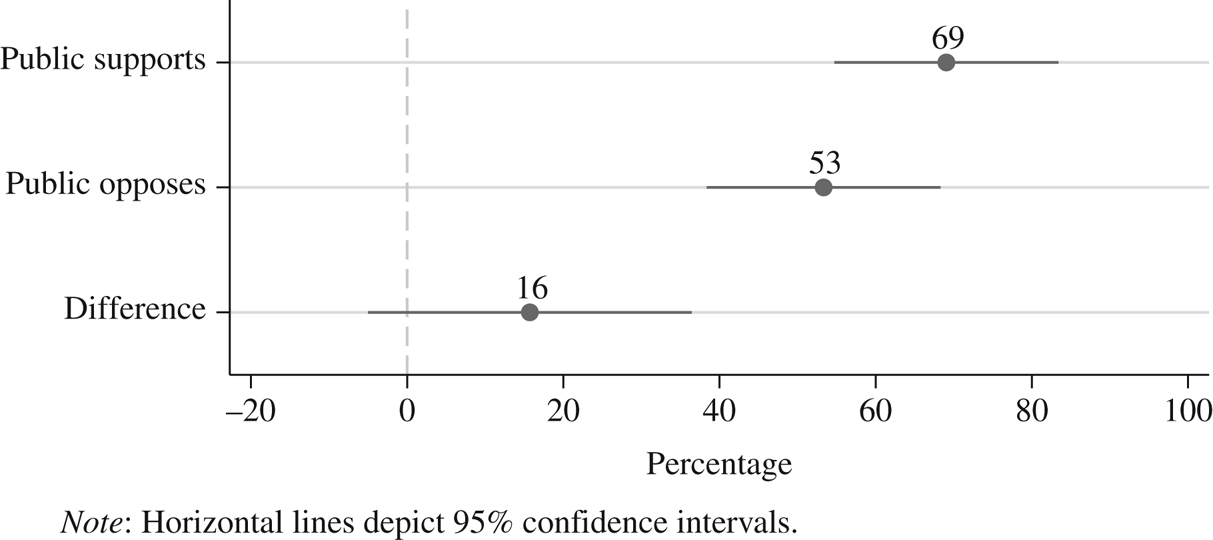
Among MKs, willingness to strike was nearly sixteen percentage points higher when citizens supported a strike than when citizens opposed one (Figure 1). The estimated effect, though large, fell just shy of conventional statistical significance (p = .135 for a two-sided test, .068 for a one-sided test). When dealing with elite samples, it would be difficult to gain more precision. To detect a sixteen-point effect at a significance level of .05, we would have needed responses from 290 MKs, more than the number of living MKs for whom we found contact information.Footnote 31 (Given these constraints, the sample is not large enough for precise estimates within smaller demographic or political subgroups.) We believe the treatment effect is informative, even if not estimated with the precision one sees in mass public surveys.
Effect of public opinion on support for military strike

When presenting the scenario, we randomized information about public opinion as a whole instead of varying sentiment within the respondent's political party. We did this to enhance external validity by not administering unlikely treatments to MKs from predominantly dovish or hawkish parties. Having found that MKs care about public opinion in general, though, it seems likely that MKs would care even more about the views of co-partisans and swing voters. Moreover, we informed MKs about current public opinion, even though opinion on the eve of the next election may be more important to leaders.Footnote 32 In these ways, our experiment established a lower bound on how MKs would have responded if we could have manipulated information about the opinions of specific voter groups or what public opinion would be at the time of the next election.
We supplemented the experiment by directly asking: “When you consider whether to use military force against a foreign adversary, to what extent do you take domestic public opinion into account?” Around 33 percent said that public opinion influenced their military decisions to a large or very large extent; 38 percent gave medium consideration to public opinion; 26 percent weighed public opinion to a small extent; and only 3 percent did not consider public opinion at all. Could answers to this question have been tainted by social desirability bias? Three factors help allay such concerns. First, respondents were guaranteed anonymity, reducing the incentive to respond in socially desirable ways. Second, it is unclear whether any lingering biases would cause MKs to overstate or understate the role of public opinion. Some policymakers might see value in appearing deferential to ordinary citizens, but others might want to portray themselves as autonomous, relying on their own expertise and values when making decisions about military force. Third, the responses corroborate our experimental findings by suggesting that public opinion exerts a substantial but not overdetermining effect on elite decisions about war.
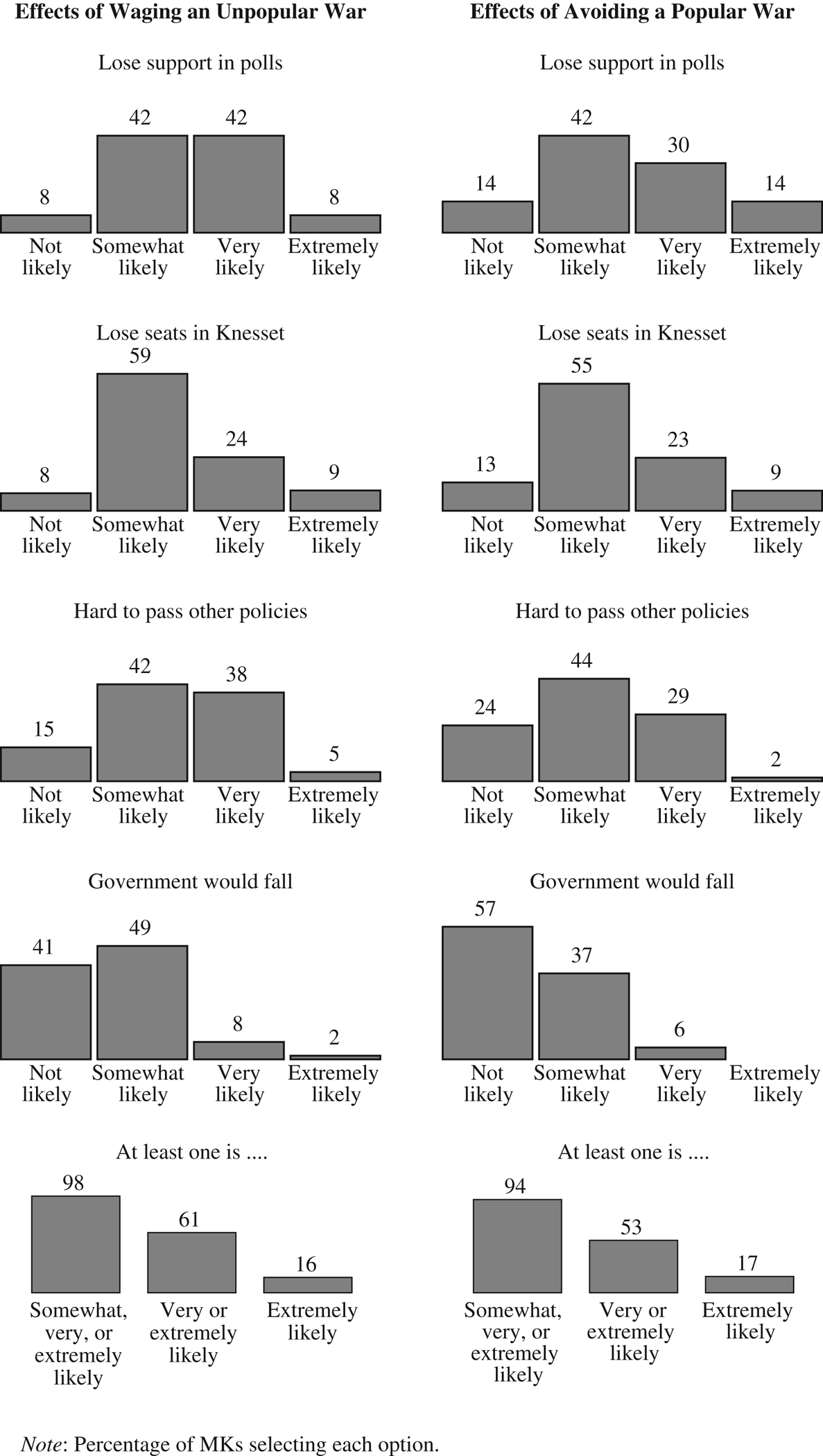
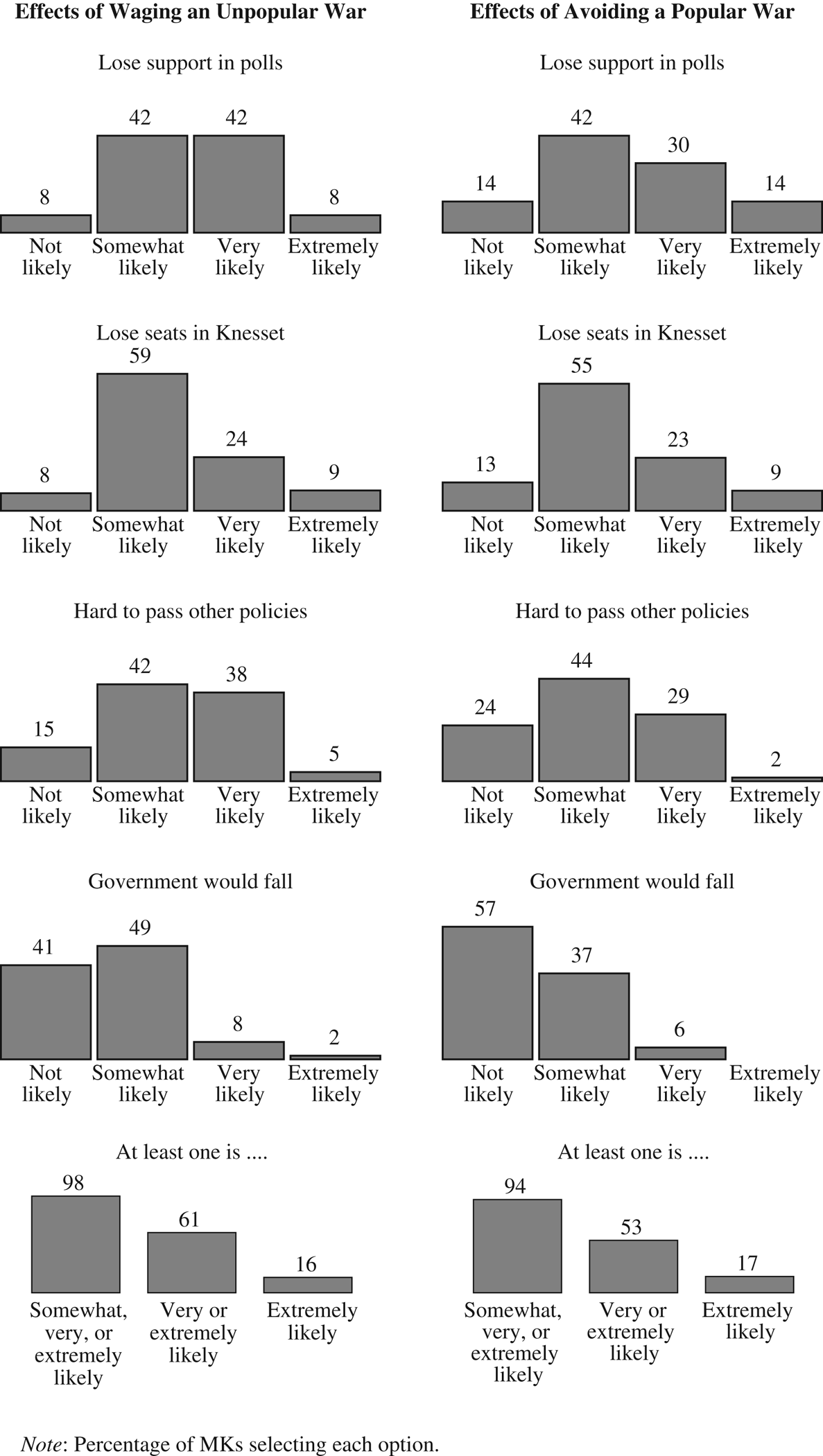
Finally, to understand why MKs respond to the public, we measured the anticipated costs of contravening public opinion. “If the public strongly opposed war, but the government nonetheless decided to go to war,” would it be extremely likely, very likely, somewhat likely, or not likely that the government would lose support in the polls; lose seats in the Knesset; find it difficult to get support for other foreign and domestic policies; and/or fall from power? As the bottom left of Figure 2 shows, 61 percent of MKs thought at least one of these adverse outcomes was very or extremely likely. We also asked what might happen if the government avoided a popular war (right side of Figure 2). Again, a majority (53%) thought at least one of the negative consequences was very or extremely likely. Clearly, the repercussions of going against public opinion loom large for Israeli politicians.
Expected consequences of contravening public opinion
Would our findings generalize to elites in other democracies? In some senses, Israel represents a hard case for the responsiveness mechanism. Given mandatory military service, the ongoing Arab-Israeli conflict, and frequent terrorist attacks, Israeli policymakers presumably hold a priori preferences about how to react, which could reduce the effect of new information such as public opinion.Footnote 33 For these reasons, our study could underestimate policymaker responsiveness. At the same time, protracted conflict between Israel and its neighbors could make security policy especially important to Israeli voters, increasing policymakers’ incentives to respond. However, as we demonstrate later, security policy is a weighty electoral consideration not only in Israel, but also in the US. This suggests that Israeli policymakers should not be unique in expecting domestic political consequences for their decisions about using military force.
Testing Selection in Israel
To what extent do citizens select representatives based on security policy, and how does security policy compare to other electoral considerations? As a step toward answering these questions, we hired iPanel to recruit a representative sample of 1,067 Jewish adults in March 2016.Footnote 34
The survey began by measuring respondents’ policy preferences. Since selection does not require voters to have detailed views about specific issues, we focused on overall orientations toward security policy, economic policy, and religious policy. To measure public attitudes about security policy we asked about hawkishness, a traditional cleavage in Israel.Footnote 35 “On matters of foreign affairs and security,” we inquired, “do you support a dovish (left) or a hawkish (right) approach?” Options were definitely dovish (9% of the sample); more dovish than hawkish (27%); more hawkish than dovish (39%); and definitely hawkish (25%).
We took a similar approach to measuring economic and religious policy orientations. For economics, we asked: “About the structure of economic life in the country, do you support a capitalist or a socialist approach?” Responses were definitely socialist (11%), more socialist than capitalist (53%), more capitalist than socialist (30%), or definitely capitalist (5%). To capture views about religious policy, we inquired: “To what extent should the government require Jewish religious traditions in public life?” The options were never (36%), sometimes (40%), often (16%), or always (8%).
After measuring policy preferences, we administered a conjoint experiment in which respondents evaluated pairs of hypothetical political parties that varied randomly on seven dimensions: security, economic, and religious policy; military experience, political experience, and gender of the party leader; and party size.Footnote 36 Each party's security policy was randomly assigned to be definitely dovish, more dovish than hawkish, more hawkish than dovish, or definitely hawkish. Likewise, economic policies ranged from definitely socialist to definitely capitalist, and religious policies ranged from never to always requiring Jewish religious traditions in public life.
For military experience, we randomized whether the leader had served only the mandatory minimum, risen to junior officer, or attained the rank of senior officer. For political experience, we drew an integer between 0 and 30 representing the years the party leader had been in national politics. Finally, we randomized whether the party leader was male or female, and whether the party was one of the three largest in the political system. We presented the information in a table.Footnote 37 Before asking respondents to choose between the parties, we measured attentiveness. Our analysis focused on the 1,067 (of 1,277) respondents who correctly answered at least 85 percent of the attention checks. (The appendix shows that effects were similar, but slightly smaller, when we included inattentive respondents.)
We randomized the seven dimensions independently, and concluded by asking, “If you had to choose, which party would you vote for?” Full randomization reduced confounding; allowed us to estimate reactions to all combinations of policy positions, including ones that might have proven electorally disadvantageous; and enabled us to estimate how much weight (if any) voters attached to each piece of information. Each participant reviewed four pairs of parties, yielding many judgments about a rich political space.
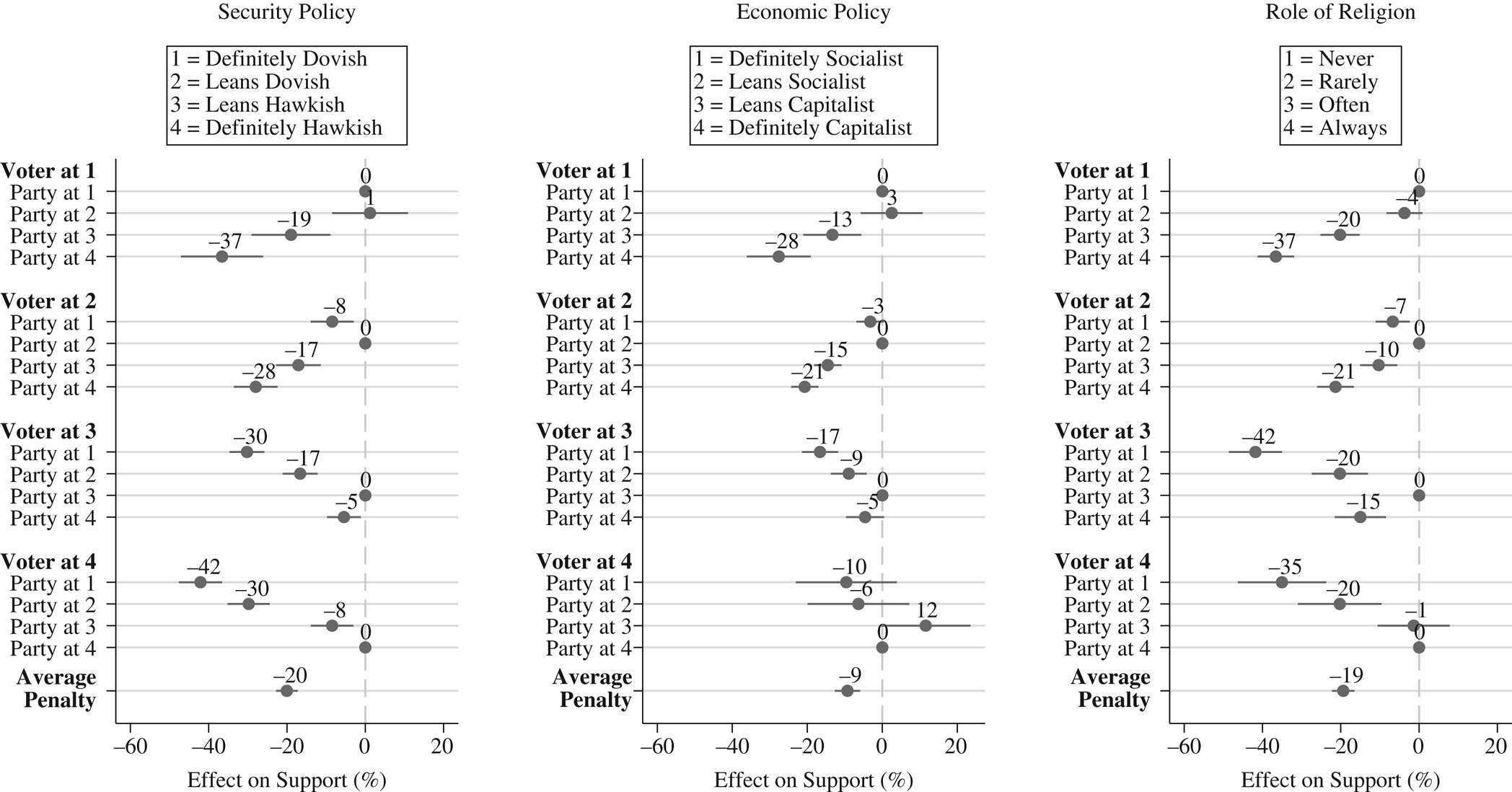
We simplify the discussion by presenting the effect of each attribute, averaging over all the other dimensions of the experiment.Footnote 38 The left side of Figure 3 shows that voters awarded substantially less support to parties with distant security policy views than to parties who concurred with them about security policy. For instance, dovish voters (located at 1) gave thirty-seven points less support to hawkish parties (located at 4) than to parties who shared their dovish ideal point. Likewise, hawkish voters (located at 4) awarded forty-two points less support to dovish parties (located at 1) than to parties who sympathized with their own hawkish preferences. Moderate voters also penalized deviations from their ideal points. Moderate doves (located at 2) were twenty-eight points less supportive of parties at 4 than of parties at 2. Similarly, moderate hawks (located at 3) were thirty points less supportive of parties at 1 than of parties at 3.
Effects of policy positions in Israel
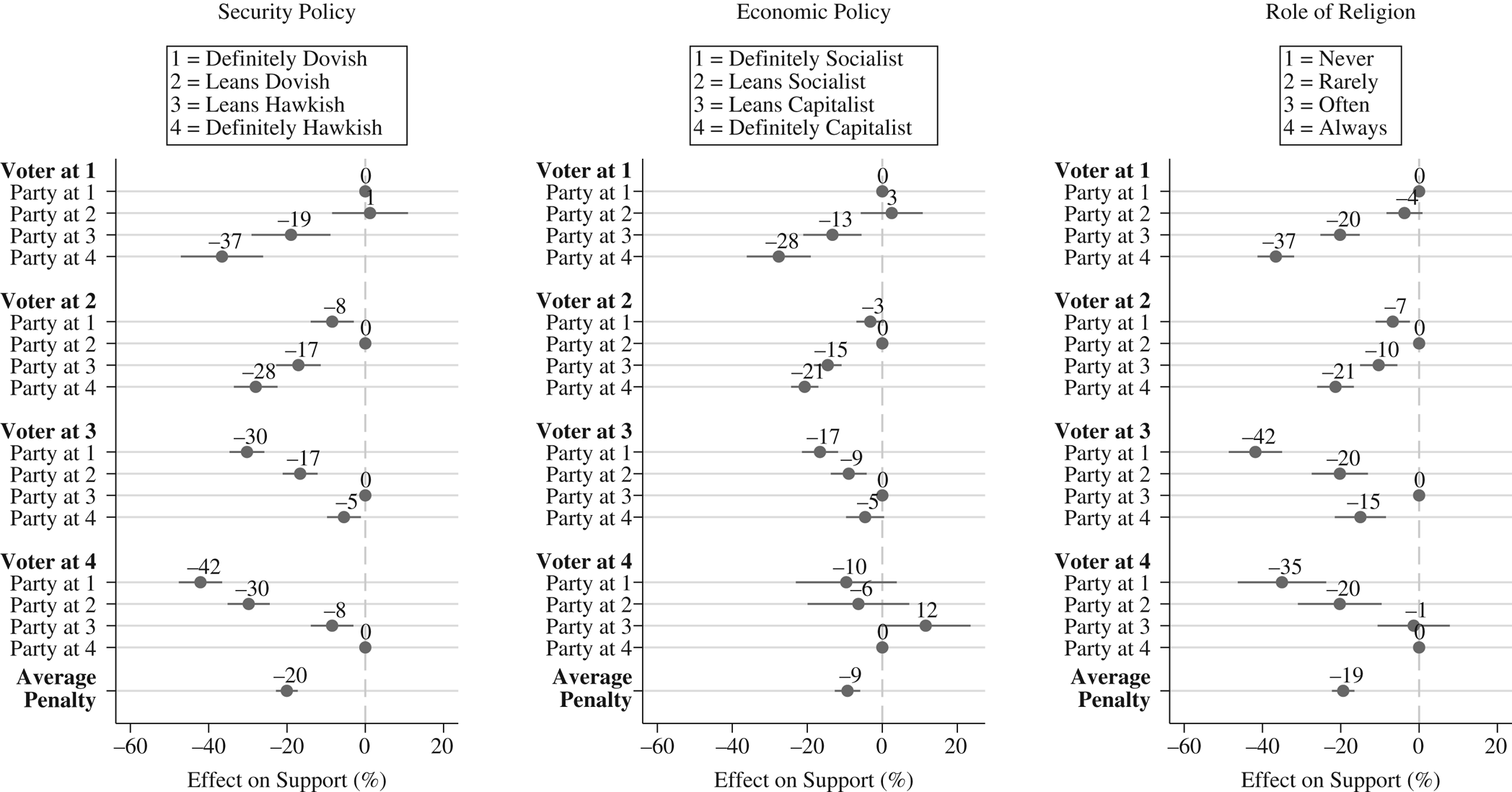
The second and third columns of Figure 3 present analogous estimates for economic and religious policy. To summarize the electoral importance of the three policy dimensions, the bottom row gives the average penalty that voters assigned to a party that did not share their ideal point on that dimension (averaging across the twelve ways that parties and voters could diverge). The average penalty for being out of step with the voter on security policy was twenty percentage points, compared to nine points for economic policy and nineteen points for religious policy. Thus, in our study, security policy was as important as religious policy and more important than economic policy.
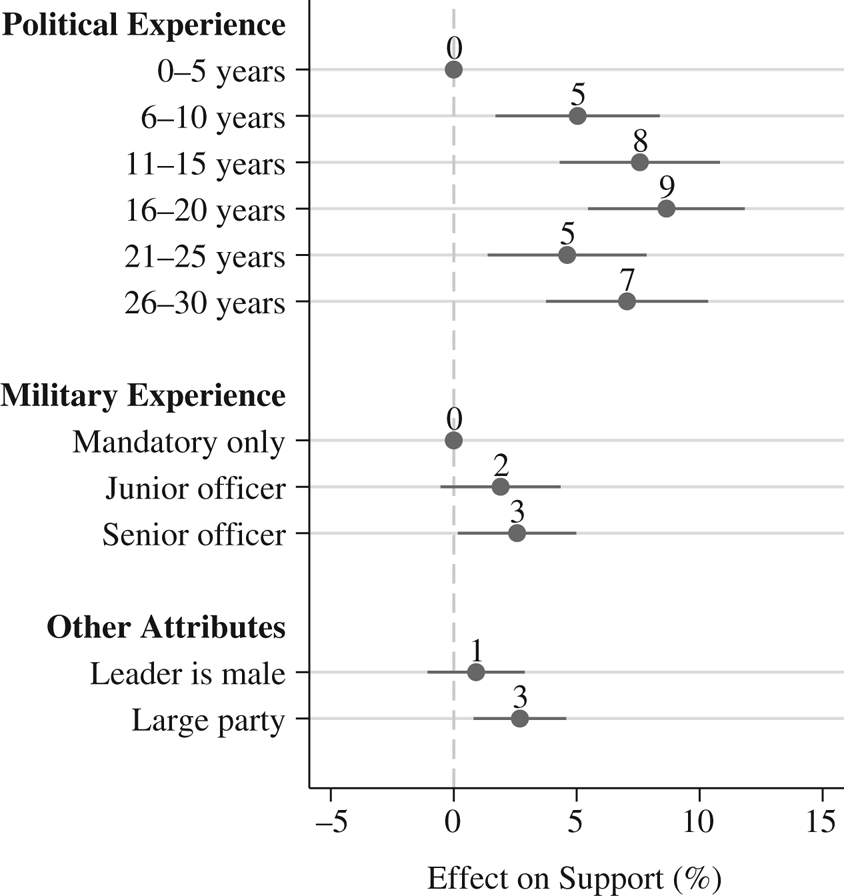
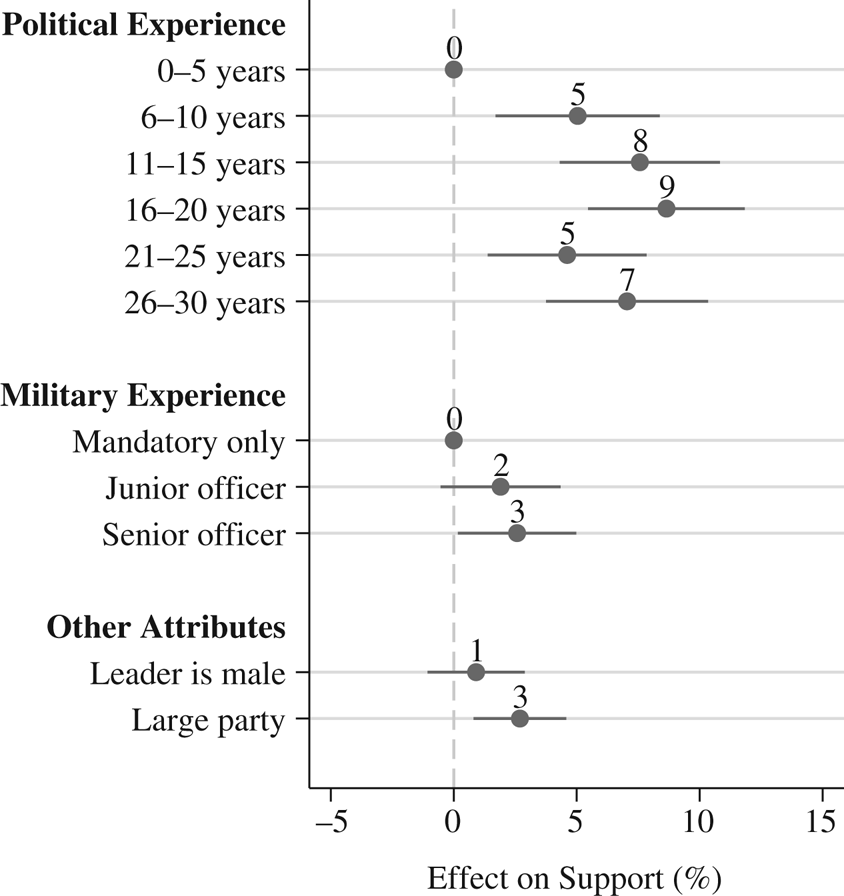
Security policy also outweighed the four nonpolicy attributes in our experiment. Figure 4 summarizes the average effect of the party leader's political experience, military experience, and gender, and the size of the party. Other factors equal, parties guided by leaders with at least five years of political experience performed substantially better than otherwise comparable parties with less experienced leadership. Israelis also slightly preferred leaders with extensive military experience. Israeli voters did not, on average, favor male leaders over female ones, but did throw 3 percent more support behind large parties. This could be taken as evidence of strategic voting, since large parties might stand a better chance of forming governments and leading coalitions.
Effects of nonpolicy attributes in Israel
We ran many auxiliary tests to confirm the robustness of our findings.Footnote 39 Our results were robust to different specifications of the dependent variable. Moreover, the effects of security policy were strong regardless of the nonpolicy characteristics of the party/leader or characteristics of voters, including gender, age, education, income, military service, religiosity, ideology, political interest, and political involvement. Finally, security policy remained an important electoral consideration regardless of the stances parties took on other policy dimensions. For example, the effects remained strong when we eliminated parties that were hawkish but nonreligious, or dovish but highly religious. More generally, security policy mattered greatly whether parties took extreme or moderate positions on economic and religious policy.
Testing Selection in the US
To assess the generalizability of our findings, we replicated our selection experiment in the US. Israel and the US differ in important ways, including electoral system, size, geographic location, and threat environment. Finding similar results in the US would increase confidence that the selection mechanism operates in other democracies.
In April 2017, Survey Sampling International recruited a sample of US adults chosen for demographic representativeness according to age, education, gender, income, race, and region.Footnote 40 As in the Israeli experiment, we began by asking subjects about their policy preferences. On security policy, 15 percent were definitely dovish, 50 percent were more dovish than hawkish, 27 percent were more hawkish than dovish, and the remaining 9 percent were definitely hawkish.Footnote 41
For economics, we inquired: “Some people favor capitalist economic policies. They think the government should play only a small role in the economy and should let the market determine economic outcomes. Other people favor socialist economic policies. They think the government should play a large role in the economy by regulating businesses and redistributing income. Which approach to US economic policy do you prefer?” Around 5 percent were definitely socialist (large government role), 28 percent were more socialist than capitalist, 39 percent were more capitalist than socialist, and 28 percent were definitely capitalist (small government role). Finally, we asked: “How big of a role do you think religion should play in shaping government policy in the United States?” The options were no role (46%), small role (21%), medium role (20%), or large role (14%).
We then presented pairs of hypothetical presidential candidates, which varied randomly in their foreign, economic, and religious policy positions, as well as four nonpolicy attributes: home region (Northeast, South, Midwest, or West), race (White, Black, or Hispanic), gender, and political experience (years in politics, from 0 to 30).Footnote 42 We concluded by asking, “If you had to choose, which candidate would you vote for?” Each respondent evaluated four pairs of candidates.
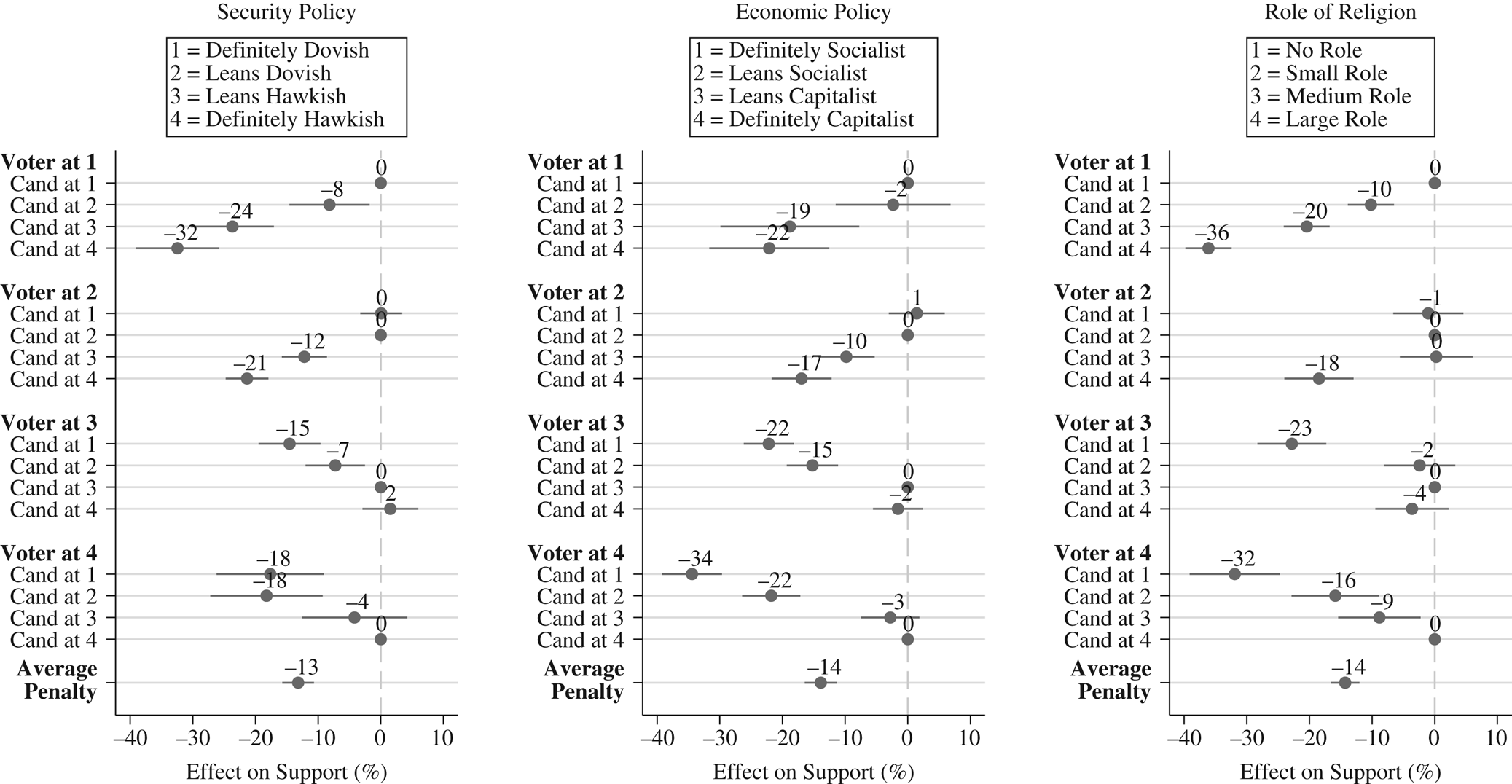
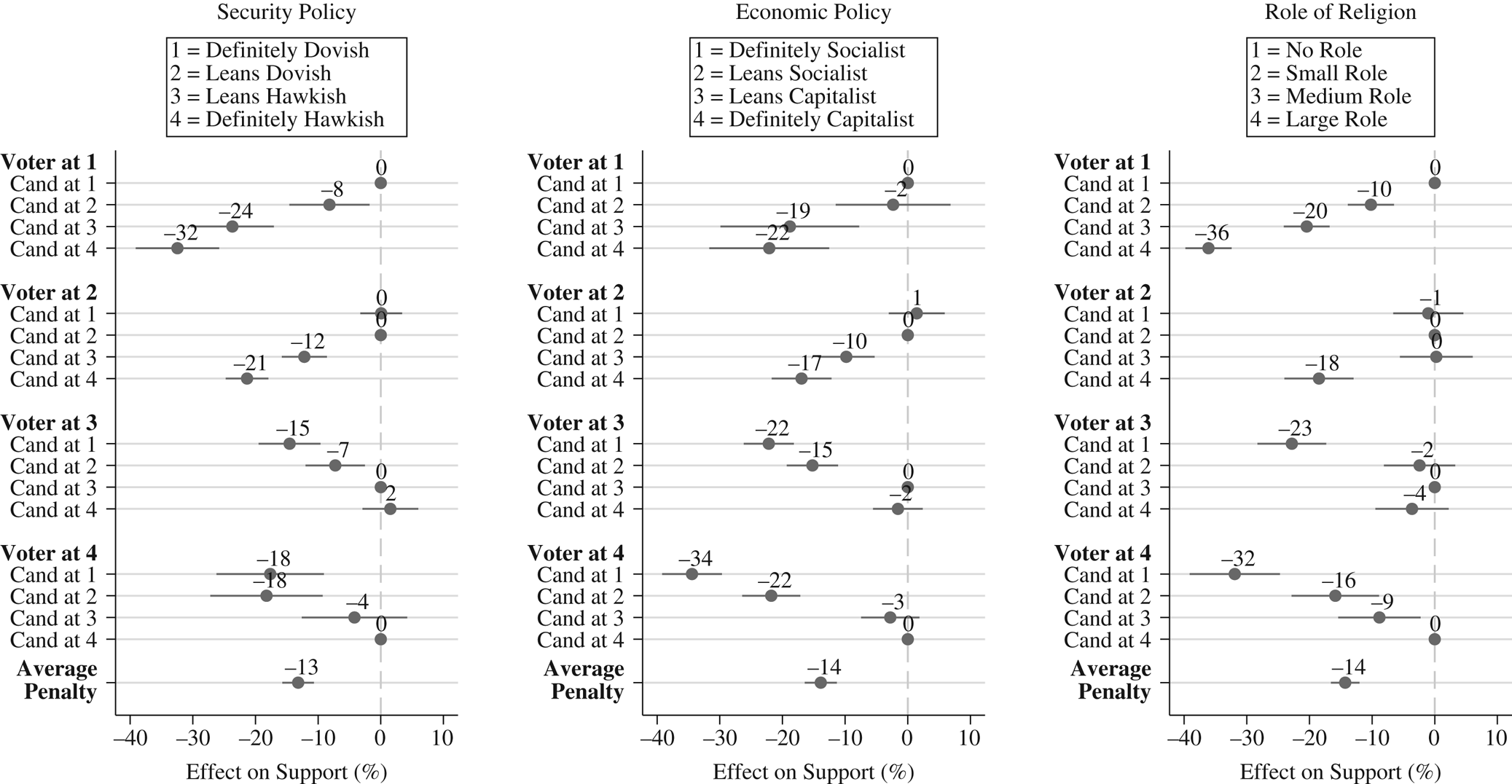
Figure 5 shows that security policy had powerful effects in the US. Dovish voters (1s) were thirty-two percentage points less supportive of candidates with hawkish platforms (4s). Other groups of voters reacted similarly, extending substantially less support to candidates whose security policy views diverged from their own. The effects of security policy were not only large in an absolute sense, but also comparable to the effects of economic and religious policy. The bottom row of Figure 5 summarizes the average penalty for deviating from the voter's ideal point. On average, mismatches on security policy sapped support by thirteen percentage points. The effects for economic and religious policy were similar: fourteen points, on average. These findings indicate that the powerful effects of security policy are not limited to Israel.
Effects of policy positions in the US
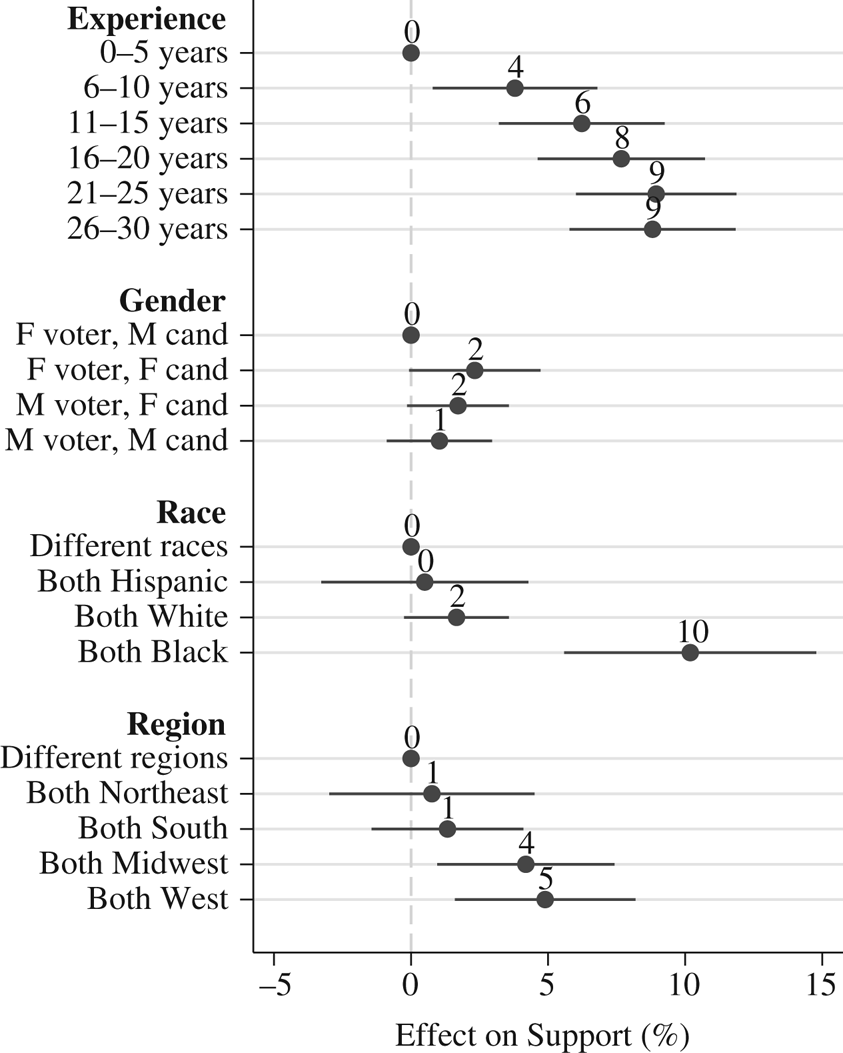
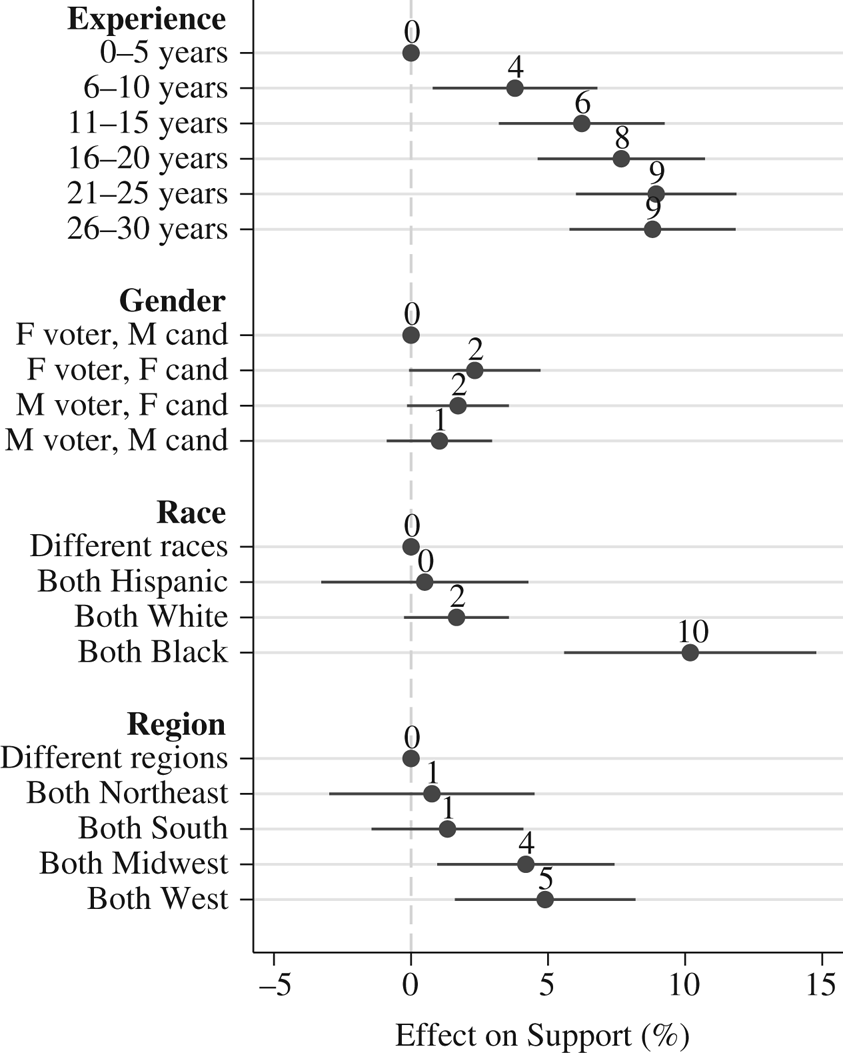
Nonpolicy attributes mattered to a lesser degree. Figure 6 shows that region and gender had minor effects on preferences over presidential candidates. Race was relatively unimportant as well, although Black voters favored Black candidates by ten percentage points. Finally, voters rewarded candidates who had spent more extensive time in politics by up to nine percentage points.
Effects of nonpolicy attributes in the US
As in Israel, the effects of security policy remained strong regardless of the specification of the dependent variable; the home region, political experience, gender, and race of candidates; and the gender, age, race, education, income, religion, religiosity, party affiliation, home region, political activism, and political interest of voters. Moreover, as in Israel, security policy had a large effect regardless of whether candidates took extreme or moderate positions on economic and religious policy.Footnote 43
We opted not to associate the candidates with existing US parties. If we had independently randomized party labels, the policy positions of many candidates would have contradicted their party membership. For instance, some Republicans would have advocated socialism, and some Democrats would have called for a major role for religion in politics—combinations that might seem unusual today. Subjects who encountered such candidates might have doubted their policy positions, party allegiance, or both.
Nonetheless, it is interesting to ask whether security policy remains important when respondents know candidates’ party affiliations. To answer this question, we administered a follow-up experiment to 1,461 US adults in September 2017.Footnote 44 This experiment retained the core design of the earlier study, with a few necessary changes. First, within each pair, one candidate was a Democrat and the other was a Republican. Second, to reduce potential contradictions between party and policy, we held all economic policies constant at “more capitalist than socialist” and had all candidates favor a “small role” for religion in shaping government policy. As in our previous experiment, we independently randomized gender, race, political experience, and security policy.Footnote 45
As expected, partisanship mattered: other factors equal, Democratic voters favored Democratic candidates 76 percent of the time, Republicans favored co-partisans 79 percent of the time, and independents were indifferent to party. Personal attributes such as political experience, gender, and race showed patterns similar to our earlier US study (see appendix).
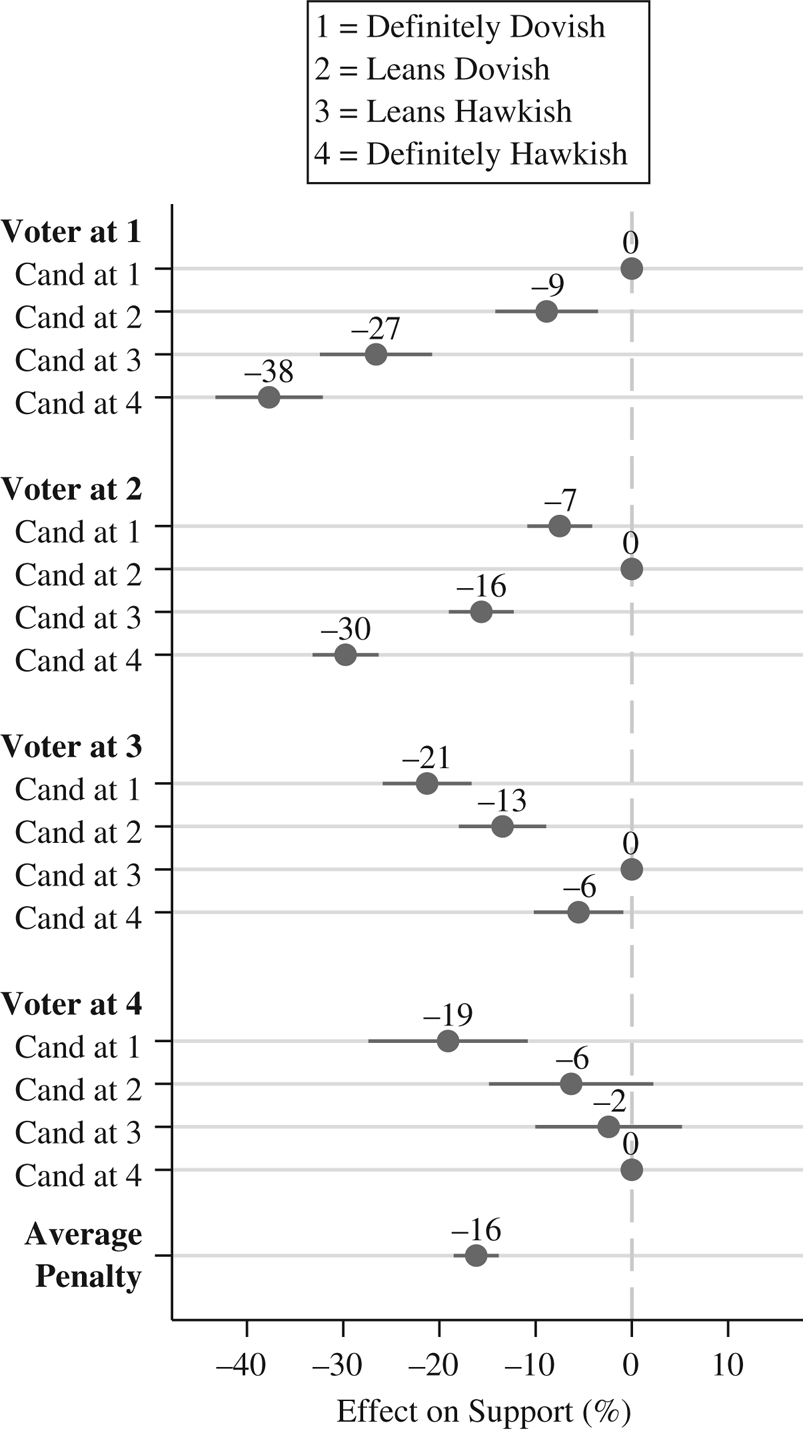
Nonetheless, security policy positions remained important. Figure 7 shows the effect of security policy when subjects chose between Democratic and Republican candidates. As in our earlier study, voters were much more likely to support candidates whose security policy positions matched their own. For example, dovish voters (voters at 1) were thirty-eight percentage points less likely to favor strong hawks (candidates at 4). On average, voters were sixteen points less likely to prefer candidates whose security policy positions diverged from their own. The appendix shows that security policy positions mattered not only for independents but also for Democrats and Republicans, who often crossed party lines to find better matches on security policy.
Effect of security policy in the US, with party labels
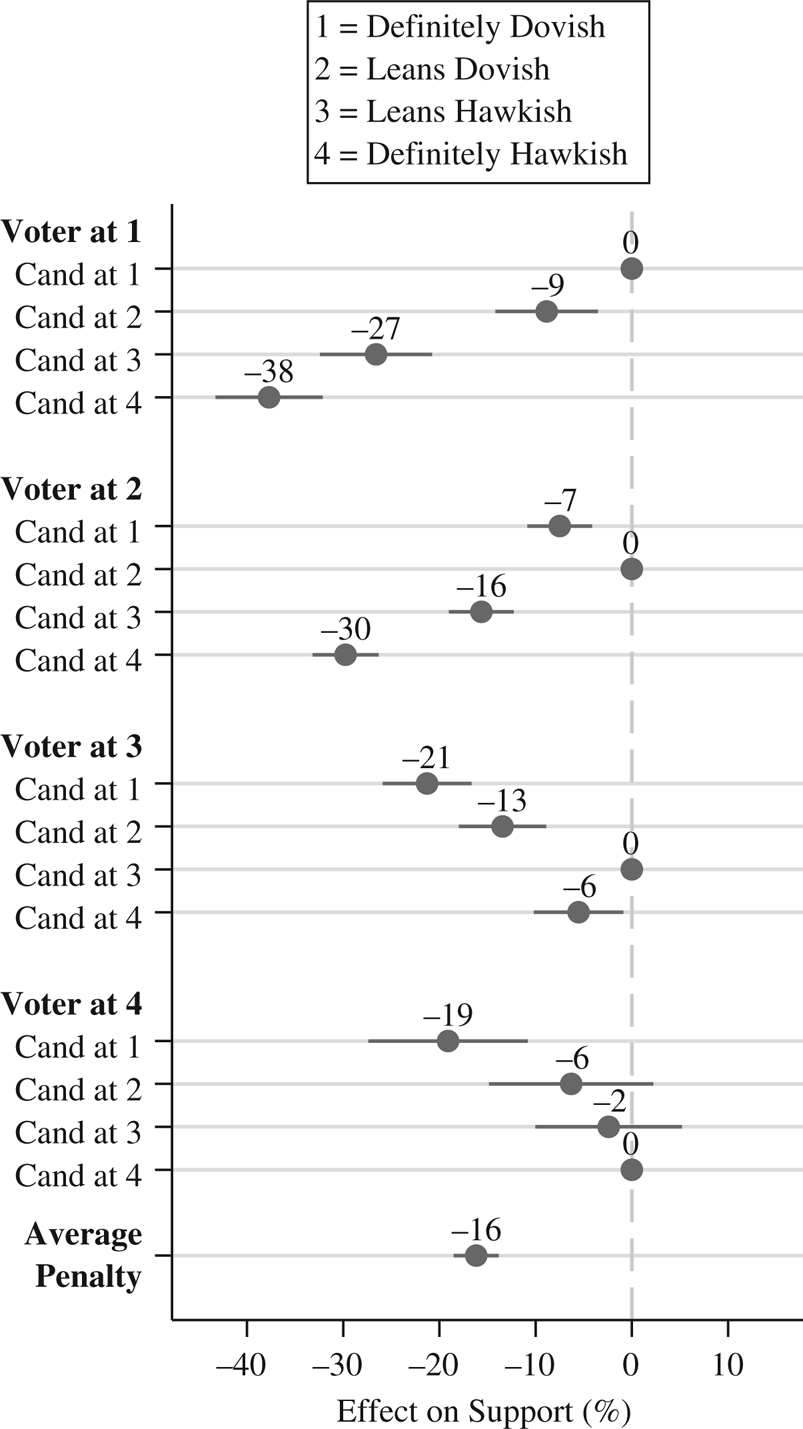
Did our experiments occur at a time when foreign policy was unusually important to American voters, reducing the generalizability of our findings? To assess this possibility, we analyzed survey data about the “most important problem” facing the country.Footnote 46 During the months our surveys were in the field, 12 to 18 percent of Americans named a foreign policy issue as the most important problem facing the country, much lower than the median of 23 percent between 1939 and 2015.Footnote 47 This increases confidence that the powerful effects we found were not caused by the timing of our experiments, and confirms that security policy can profoundly affect evaluations of candidates even when voters do not identify foreign policy as the most important problem facing the country.
Conclusion
There has been much debate about whether and how public opinion influences foreign policy. In this research note we complement previous work by using randomized experiments to test two mechanisms—selection and responsiveness—through which public opinion could affect decisions about military force. Our experiments, administered to Israeli elites and Israeli and American voters, shed new light on an important debate, with empirical, theoretical, and normative implications.
Broadly, our findings increase confidence that scholars can gain insight into foreign policy by studying the opinions of ordinary citizens, an approach taken by a recent wave of international relations scholarship. Moreover, our experiments bolster many influential theories of international relations in which citizens play prominent roles in shaping foreign policy. The long list includes, for example, work on liberalism, the democratic peace, selectorate theory, audience costs, diversionary war, the democratic advantage, two-level games, and theories about how citizens help enforce international law and promote international cooperation. These theories, and many more, presume a strong connection between domestic opinion and foreign policy.
Our evidence that security policy plays an important role in elections also has implications for theories about leaders’ effect on foreign policy. Recent work demonstrates that the ideologies, experience, and demographic characteristics of leaders shape decisions about war.Footnote 48 We contribute to this growing literature by uncovering the criteria citizens use to select leaders. Our experiments reveal that, when voting, Israeli and American citizens not only place heavy weight on the security policy positions of parties and presidential contenders, but also select on the basis of experience and—to a lesser extent—race. By illuminating the electoral processes that contribute to variation in leader type, we show important ways in which the public can influence international relations.
Our findings suggest many avenues for future research. We focused on public opinion about the use of military force, but scholars could adapt our experimental approach to explore the effect of public opinion on decisions about international trade, foreign aid, and climate change.Footnote 49 Following Trager and Vavreck, scholars could also use experiments to study how voters select leaders on the basis of foreign policy outcomes rather than positions.Footnote 50
Future studies could also explore how voters obtain information about foreign policy. Our selection experiments exposed respondents to seven pieces of information about parties and candidates. The experiments should, therefore, be interpreted as estimating how voters would decide if they knew—in broad strokes—about the personal attributes and policy positions we presented. In actual campaigns, though, knowledge varies across individuals, countries, and time. Future research could, therefore, study how much citizens know about their political options, and how party competition, the media, and individual effort affect the information at their disposal.
Future scholarship could also investigate to what extent political elites can—or believe they can—manage public preferences and perceptions. While some scholars have argued that elites can shape what the public thinks,Footnote 51 others do not see public opinion as being at the command of policymakers.Footnote 52 Still others have found that elite cues are important only in some issue areasFootnote 53 or that elites’ ability to shape public opinion varies over time.Footnote 54 Scholars could develop new theories to shed light on these questions and test them by building on the methods described here.
Our findings also raise questions about whether responsiveness and selection are more powerful in some countries and political contexts than in others. For instance, leaders may be more responsive when they are eligible for re-election and face serious political competition, leading to differences between parliamentary and presidential systems and dual versus multiparty environments.Footnote 55 Responsiveness and selection could also depend on levels of domestic polarization,Footnote 56 the media environment,Footnote 57 or public attention to foreign policy, which could vary across and within countries as a function of geographic location, security relationships, political structures, and campaign strategies. These are rich areas for future theoretical and empirical exploration.
Finally, our experiments raise important normative questions. We found that citizens use security policy as a criterion in choosing their representatives, and that representatives are sensitive to public attitudes once in power. This is good news from the standpoint of political representation. However, the powerful role of public opinion means that citizens bear responsibility for making sound decisions about weighty matters such as the use of military force. It is therefore deeply important to understand how voters form opinions about foreign affairs, who they look to for information, and how to increase the likelihood that the public will make sensible judgments about international politics.
Supplementary Material
Supplementary material for this research note is available at <https://doi.org/10.1017/S0020818319000341>.
Acknowledgments
We thank colleagues at Princeton University, Stanford University, and the University of Wisconsin-Madison, and seminar participants at the Hebrew University of Jerusalem, Kobe University, the University of California, Berkeley, the University of California, Merced, the University of Kentucky, the University of Konstanz, the University of Pennsylvania, the University of Pittsburgh, the University of Zürich, and participants at the annual meeting of the American Political Science Association and the Peace Science Society. We are particularly grateful to Bernd Beber, Ryan Brutger, Guy Grossman, Anne Jamison, Jesse Johnson, Robert Keohane, Josh Kertzer, Michaela Mattes, Jon Pevehouse, Mark Peffley, Lauren Prather, Jonathan Renshon, Ken Schultz, Carly Wayne, and Jason Wittenberg for feedback on earlier versions of this project.