


Introduction
Universal healthcare is a cherished Canadian symbol and unifying national element across the country (Jedwab Reference Jedwab2019; Statistics Canada 2021). However, this vision of healthcare belies the variation that exists across provinces and territories in terms of what health services are funded and made available, thereby leading to “less-than-universal” access. While the 1984 Canada Health Act ensures equal access to healthcare and outlines criteria for funding transfers, including that provincial health insurance plans cover “medically necessary” or “medically required” hospital, physician or surgical dental services, provinces are left to determine what exactly is listed for coverage (Flood et al. Reference Flood, Stabile and Tuohy2006; Martin Reference Martin2017; Tiedemann Reference Tiedemann2019). In doing so, provincial governments determine what medical services their healthcare systems will provide, what is considered medically necessary and, more broadly, what constitutes healthcare (Stewart and Ryan Reference Stewart and Ryan2015).
As a result, the “malleability” of medical necessity can lead to variation in health services (Cattapan Reference Cattapan2020, 7). This malleability results in particularly pronounced variation among contested services associated with women’s health, and the gendered, reproductive body, or what we might term “gendered-reproductive” health services, including in vitro fertilization (IVF), abortion, human papillomavirus (HPV) vaccines, or gender-affirming care. This variation brings about questions of equity and, more broadly, how provinces and territories conceptualize medical necessity and how they might use other funding levers to provide coverage for contested health services. Beyond this, it introduces questions as to how the public understands medical necessity and under what circumstances funding is deemed appropriate, and for whom.
This ideational component is key to this paper as it interrogates the extent to which perceptions of necessity and deservingness impact preferences for contested health care services. Using an original survey experiment with more than 2,000 respondents fielded in winter 2025, I probe how social constructions shape respondents’ support for provincial funding of contested, gendered, reproductive health services. The survey examines support for the funding of IVF, abortion, gender-affirming care, and HPV vaccine programs. It uses an experiment to test how respondent support is affected by the phrasing of the question, namely, how each of the four health services and associated target populations are described. Using a control group and three treatment groups, each of which was exposed to either medicalization, positive social construction, or negative social construction, the results indicate how public perceptions of a health service can affect support for provincial funding, and more broadly, whether the public considers a service to be sufficiently “medically necessary.” The results speak to the contested nature of gendered, reproductive healthcare and point to the role that ideational elements play in shaping support for, and opposition to, funding these services. More broadly, the results shed light on the degree to which Canada’s health systems intersect with debates of medical necessity and how this shapes less-than-universal health care across provinces and territories.
Background and theory
The social construction of medical necessity and deservingness
This study builds on the growing literature that examines the role of medical necessity and deservingness in shaping public attitudes toward health policy. Across a range of welfare state contexts, scholars have shown that citizens’ willingness to extend public benefits is contingent not only on fiscal constraints or institutional design, but also on ideas about who deserves support and what services count as “essential” (Applebaum Reference Applebaum2001; Ellis and Faricy Reference Ellis and Faricy2020; Laenen Reference Laenen2020; Tarkiainen Reference Tarkiainen1985). This study expands on this by examining areas where perceptions are especially important, such as areas of health care that are gendered, reproductive, or socially contested, and where medical framing intersects with moral debates.
To make sense of these dynamics, this paper draws on two interconnected theories of the policy process: policy feedback and the social construction of target populations (Pierson Reference Pierson1993; Schneider and Ingram Reference Schneider and Ingram1993, Reference Schneider and Ingram2019; Mettler and Sorelle Reference Mettler and Sorelle2018). Both are rooted in the insight that policy creates politics, shaping not only institutional incentives but also the interpretive frames through which the public evaluates policies and their beneficiaries. Schneider and Ingram’s foundational work on social construction posits that policies confer benefits and burdens unevenly across groups, in ways that reflect and reinforce stereotypes of power and deservingness. Their typology classifies target populations into four categories: advantaged groups (powerful and positively constructed, such as veterans), contenders (powerful but negatively constructed, such as corporations), dependents (positively constructed but politically weak, such as children), and deviants (weak and negatively constructed, such as incarcerated individuals). Where a group is placed in this schema affects both the policy benefits it is likely to receive and the degree of public support those benefits command.
The literature on health policy underscores these mechanisms. Studies of infertility show that terminology and framing matter deeply: describing infertility as a “disease” elicits higher levels of public support for insurance coverage compared to describing it as a “condition” or “disability” (Fauser et al. Reference Fauser, Boivin, Barri, Tarlatzis, Schmidt and Levy-Toledano2019; Ho et al. Reference Ho, Aghajanova, Mok-Lin, Hoffman, Smith and Herndon2017; Mancuso et al. Reference Mancuso, Summers, Chung, Ryan and Scherer2021). Similarly, attitudes toward HPV vaccination vary depending on whether it is presented as a preventive health measure or framed in moralized terms tied to sexual activity (Abdelmutti and Hoffman-Goetz Reference Abdelmutti and Hoffman-Goetz2009; Tu et al. Reference Tu, Lin, Fan, Tsai and Wang2019). Research on abortion and gender-affirming care further illustrates how public perceptions are filtered through social constructions of the beneficiaries: women seeking abortion are often framed in debates over sexual responsibility, while transgender people remain socially constructed in ways that invite stigma and exclusion (Baker et al. Reference Baker, Papp, Crawford and McClelland2023; Kirkland et al. Reference Kirkland, Talesh and Perone2021).
Policy feedback theory complements this perspective by showing how policies themselves shape public opinion. As Pierson (Reference Pierson1993) argues, policies create resource effects, altering access to benefits and organizations, and interpretive effects, signaling which groups are legitimate and what forms of need are publicly recognized (Campbell Reference Campbell2011; Ellis and Faricy Reference Ellis and Faricy2020; Mettler and Sorelle Reference Mettler and Sorelle2018; Lerman and McCabe Reference Lerman and McCabe2017). In the Canadian context, provincial variation in health coverage provides a natural experiment in these dynamics: when a service is publicly funded in one province but not in another, citizens receive different interpretive cues about whether that service is considered “health care.” Coverage decisions thus feed back into public perceptions of medical necessity, legitimacy, and deservingness. Medicalization provides an important bridging concept across these strands of literature. As Conrad (Reference Conrad2007) and others have shown, the process of framing a condition as medical, as opposed to moral, social, or personal, has profound implications for policy legitimacy and contested state intervention, especially where health can signal hierarchies and deservingness in policy action (Conrad and Schneider Reference Conrad and Schneider1992; Fassin Reference Fassin2007; Wu Reference Wu2023). Medicalization does not necessarily guarantee universal support, but it shifts the terms of debate by recasting contested issues as questions of health care delivery rather than personal choice or morality. In doing so, it interacts with social constructions of deservingness: groups framed as medically needy are more likely to be perceived as deserving of support, even when they occupy marginal or contested positions in the social order.
Taken together, these theoretical perspectives suggest that public attitudes toward gendered-reproductive services are shaped by more than partisanship or ideology. Instead, they are conditioned by the discursive frames of medicalization, the social constructions of beneficiaries, and the feedback effects of existing policy decisions. Understanding this interplay is crucial for explaining why some gendered-reproductive health services enjoy broad support while others remain persistently contested, even within a universal health care system like Canada’s.
Gendered-health service variation across provinces
Of the four cases under study (IVF, gender-affirming care, abortion, and HPV vaccines), each is regarded as a contested health service where both the gendered, sexualized body and reproduction are at the forefront, such that conceptions of medical necessity and ensuing coverage vary by population or beneficiary group. Second, services vary in terms of the accessibility of the service, funding, and breadth of coverage (i.e., procedures covered and for whom) across provinces and territories. Looking first to IVF, a procedure wherein eggs are fertilized outside the body, and the resulting embryos are reimplanted, we see both a “presence/absence” story and one of variation in cases where funding is provided. Ontario and Quebec have relatively long-standing IVF programs, and the British Columbia government announced in 2024 that it is developing its own standalone funding program (Government of BC 2025). British Columbia was, for a long time, without any form of IVF funding, alongside Alberta, Saskatchewan, Nunavut and the Northwest Territories (Snow Reference Snow2018). Besides British Columbia, Ontario and Quebec, other governments opt for either grant-style funding (New Brunswick, Prince Edward Island, and Newfoundland and Labrador) or refundable tax credits (Nova Scotia, Yukon, and Manitoba).
For abortion, service availability varies across provinces and territories in terms of when abortions are provided (i.e., the functional gestational limit), when and how medical abortions (Mifegymiso) are covered, whether abortion providers have legislated protester-exclusion zones, and whether doctors who conscientiously object are mandated to refer patients to another provider. For functional gestational limits, we see a range of 13 weeks in Prince Edward Island up to 25 weeks in British Columbia (Action Canada for Sexual Health and Rights 2024). Note, however, that provincial/territorial governments do not impose these limits, but rather limits are imposed by self-regulating professional associations, hospitals and clinics based in part on clinical/medical capacity. This variation is mirrored again when looking at gender-affirming care, where funding coverage for services varies by jurisdiction, as do the requirements to access treatment. This variation includes whether funding covers extended procedures such as tracheal surgery and facial surgery, what documentation and diagnoses (if any) are needed, and whether services can be provided in-province, and if not, whether travel reimbursements are available (Gwun et al. Reference Gwun, Snow, Potter, Walker, Millman, Krakowsky and Lorello2024). Finally, looking at HPV vaccines, we do not see a “presence/absence” scenario, as all provinces and territories have in-school vaccine programs for youth, but rather one where expanded coverage varies. While some governments extend coverage to those who may have a higher prevalence of infection or complications, including those living with HIV and men who have sex with men, others are more limited in access (Bruzzesi et al. Reference Bruzzesi, Galli, Poli, Bossolasco, Cernuschi, Spagnuolo and Tamburini2022; Goldstone et al. Reference Goldstone, Palefsky, Giuliano, Moreira, Aranda, Jessen and Hillman2011; Goyette et al. Reference Goyette, Yen, Racovitan, Bhangu, Kothari and Franco2021). As a result, variable coverage for all four services creates a patchwork of access along two dimensions: medical necessity and deservingness. The former includes legality, financing, benefit duration, etc., while the latter includes access to funding and subsequent benefits.
Using this variation in contested, gendered-reproductive health services as a backdrop, this study uses an experimental survey design to examine the social construction of services and how social constructions of target populations affect support for provincial funding of each health service, where I hypothesize the following:
-
H_MED: Respondents are more likely to support funding of a service if they receive the medicalization treatment.
-
H_sPOS: Respondents are more likely to support funding of a service if they receive the positive social construction treatment.
-
H_sNEG: Respondents are less likely to support funding of a service if they receive the negative social construction treatment.
Beyond experimenting on the treatment effects of medicalization and deservingness, we also posit that feedback effects may play a critical role in fostering support for funding these health services. In particular, we probe for interpretive feedback effects, where funding signals the legitimacy of the policy and government intervention in this area (Pierson Reference Pierson1993). Here, we would expect respondents who know their province funds the service to be more likely to support funding than those who believe their province does not fund the service or who do not know. Knowing that a province funds a service legitimizes the service itself, such that the policy feeds back into itself (Mettler and Sorelle Reference Mettler and Sorelle2018). Critical here is a respondent’s belief – either correct or incorrect – that funding is already in place, where knowledge of this funding signals the service as something worthy of government intervention, thereby legitimating the service as a site for healthcare spending. We thus test for feedback effects as part of a fourth hypothesis:
-
H_FBE: Respondents are more likely to support funding of a service if they believe that their government already funds the service.
This signaling is particularly important in the Canadian context, given the strain that the health system is under and the increasingly limited access to primary care physicians and long wait times in hospitals (MacKinnon Reference MacKinnon2017; McCracken et al. Reference McCracken, Ruth Lavergne and Hedden2025; Vogel Reference Vogel2020). Even as healthcare represents an increasing share of provincial budgets, access to primary care remains both a practical problem for patients and a political problem for policymakers. As such, studying perceptions of funding contentious health services against a backdrop of limited access helps shed light on the role feedback effects play in a policy area marked by scarcity, where questions of deservingness and necessity are critical.
Methods
Data collection and measures
Survey responses were collected as part of a separate, broader survey examining child care experiences among parents of young children. This survey experiment was embedded within that survey, and is therefore a sample of convenience facilitated by an existing survey projectFootnote 1 . While the treatment was applied at random, parents are relatively homogenized in terms of age and may be more familiar with some reproductive services such as IVF or have less varied views than had the sample included younger people without children or much older respondents. If anything, this may dampen the treatment effects but still provides an opportunity to examine the role of medicalization and social constructions across provinces, partisanship, and left-right ideology.
Data collection was conducted via a survey firm in Winter 2025. Responses were collected across six provinces, British Columbia, Alberta, Saskatchewan, Manitoba, Ontario and Nova Scotia, generating more than 2,000 complete responses. The experiment was not a standalone survey but instead a block of questions embedded within a broader survey examining child care experiences. While support for each health service was captured via a Likert scale, the survey also captured general demographics, federal party identification, left/right ideological self-placement, and used a battery of questions to generate a score for “progressive” views, which included Likert scale statements linked to women’s role in the home and workplace, equal rights, income inequality, and immigration (Appendix A). Party, ideological self-identification and progressive views were then used to examine the results across the control group, comparing how these factors, divorced from treatment effects, affect support for funding gendered-reproductive health services (section 4.3).
The analysis was pre-registered prior to receiving the data (AsPredicted #212063, Appendix B). The survey design is intended to capture the treatment effects of medicalization, positive social constructions and negative social constructions relative to the control group, so we employed ordinal logistic regression to assess how the treatment (categorical) affected support (Likert scale) for provincial funding. As we were looking at four separate health services, each model was run four times so that the analysis compares treatment effects for each of the four health services.
Survey design
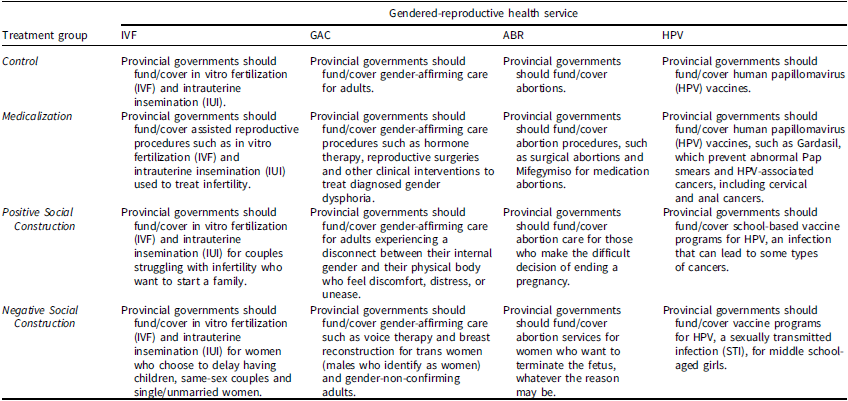
Participants are randomly assigned to one of four groups: control, medicalization, positive social construction, or negative social construction. Using a Likert scale from strongly disagree to strongly agree, respondents are asked the extent to which they agree that provinces should fund each health service: in vitro fertilization (IVF), abortion (ABR), gender-affirming care (GAC) and human papillomavirus vaccine programs (HPV). The “base prompt” of each question remains the same, starting with “in your personal opinion, provincial governments should fund/cover [treatment language].” The text following the base prompt then changes depending on to which of the four groups the respondent is assigned (Table 1).
Survey experiment questions across services and treatment groups

Table 1. Long description
The table presents data on participants’ opinions regarding provincial funding for different gendered-reproductive health services. It is divided into four treatment groups: Control, Medicalization, Positive Social Construction, and Negative Social Construction. Each group’s opinions are assessed across four health services: IVF, GAC, ABR, and HPV. The table has four rows and four columns. Column headers are Treatment group, IVF, GAC, ABR, and HPV. Row labels are Control, Medicalization, Positive Social Construction, and Negative Social Construction. Row 1: Control, Provincial governments should fund/cover in vitro fertilization (IVF) and intrauterine insemination (IUI)., Provincial governments should fund/cover gender-affirming care for adults., Provincial governments should fund/cover abortions., Provincial governments should fund/cover human papillomavirus (HPV) vaccines. Row 2: Medicalization, Provincial governments should fund/cover assisted reproductive procedures such as in vitro fertilization (IVF) and intrauterine insemination (IUI) used to treat infertility., Provincial governments should fund/cover gender-affirming care procedures such as hormone therapy, reproductive surgeries and other clinical interventions to treat diagnosed gender dysphoria., Provincial governments should fund/cover abortion procedures, such as surgical abortions and Mifegymiso for medication abortions., Provincial governments should fund/cover human papillomavirus (HPV) vaccines, such as Gardasil, which prevent abnormal Pap smears and HPV-associated cancers, including cervical and anal cancers. Row 3: Positive Social Construction, Provincial governments should fund/cover in vitro fertilization (IVF) and intrauterine insemination (IUI) for couples struggling with infertility who want to start a family., Provincial governments should fund/cover gender-affirming care for adults experiencing a disconnect between their internal gender and their physical body who feel discomfort, distress, or unease., Provincial governments should fund/cover school-based vaccine programs for HPV, an infection that can lead to some types of cancers., Provincial governments should fund/cover abortion care for those who make the difficult decision of ending a pregnancy. Row 4: Negative Social Construction, Provincial governments should fund/cover in vitro fertilization (IVF) and intrauterine insemination (IUI) for women who choose to delay having children, same-sex couples and single/unmarried women., Provincial governments should fund/cover gender-affirming care such as voice therapy and breast reconstruction for trans women (males who identify as women) and gender-non-conforming adults., Provincial governments should fund/cover abortion services for women who want to terminate the fetus, whatever the reason may be., Provincial governments should fund/cover vaccine programs for HPV, a sexually transmitted infection (STI), for middle school-aged girls.
Text in the control group uses very little descriptive language and does not refer to the target population or patientsFootnote 2 , instead simply naming the service. The medicalization group is treated with technical language and invokes medical terminology (e.g., procedure, treat/treatment, surgeries, clinical interventions, diagnosis, cancers, etc.). This treatment group language is a proxy for medical necessity, where medicalized language is intended to highlight the benefits of the treatment or service while also signaling the legitimacy of funding by using technical, clinical language to foster support. Here, the prompts do not name the target population and instead refer only to the services themselves. It is worth noting that these prompts are intentionally medicalized and may be seen as pathologizing or “making sick” what is not an illness, something that critical feminist and trans scholarship has documented (Bancroft Reference Bancroft2002; Conrad and Schneider Reference Conrad and Schneider1992; Nelson Reference Nelson2016; Richie Reference Richie2019). The intent here, though, is to intentionally apply and then assess how this medicalization affects funding support, not to suggest that this is best practice in conceptualizing gendered-reproductive care.
Compared to the control and medicalization groups, the social construction groups (positive and negative) actively describe the target populations and refer to the health services in more expressive but less technical terms. The prompts move away from describing the services in medicalized terms and instead use language that is more politicized to describe the target populations. The positive social construction treatment invokes images of deservingness and aims to elicit an empathetic view of those receiving the service, or what Schneider and Ingram (Reference Schneider and Ingram1993) might refer to as “dependent” language (e.g., struggling with infertility, wanting a family, feeling discomfort and distress, difficult decision, school-based program that can lead to cancer). This treatment language is juxtaposed with the negative social construction prompts, where the language is designed to elicit perceptions of undeservingness, or cues for “deviance” in Schneider and Ingram’s typology (Reference Schneider and Ingram1993). The language here includes focusing on personal responsibility and the rejection of heteronormative social norms when describing the target population (e.g., women who choose to delay having children, women who want to terminate the fetus, males who identify as women) or using language that might elicit feelings that the service is risky or unnecessary. For gender-affirming care, the prompt involves naming specific procedures that may be seen as less medicalized or “important” or even “new” to respondents (e.g., voice therapy and breast reconstruction). For HPV vaccines, the prompt uses both the terms “sexually transmitted infection (STI)” and “middle school-aged girls” to invoke ideas of a dependent target population or a group in need of protection from sexualization, which may elicit stronger opposition to funding (Casciotti et al. Reference Casciotti, Smith, Tsui and Klassen2014). The language also shifts away from families/couples or language inclusive of men/fathers and instead focuses on women, girls and same-sex couples.
Results
Sample description
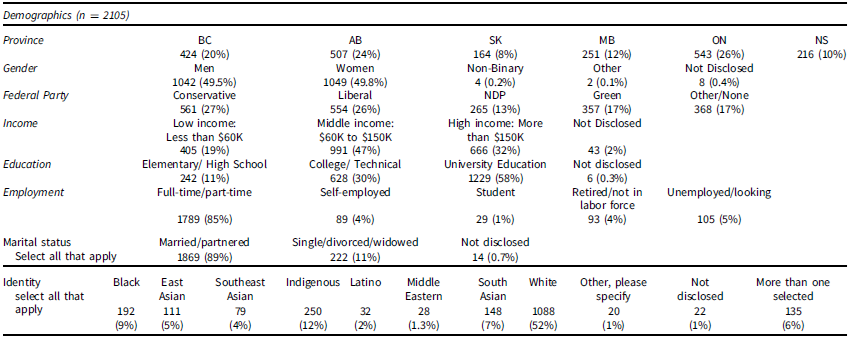
The sample includes a total of 2,105 participants, distributed across six Canadian provinces, with Ontario (26%), Alberta (24%), and British Columbia (20%) representing the largest shares (Table 2). The gender breakdown shows near-equal representation of men-identifying (49.5%) and women-identifying (49.8%) respondents, with very small numbers identifying as non-binary, other, or choosing not to disclose. Politically, respondents are spread across major federal parties, with the largest groups identifying as Conservative (27%) or Liberal (26%), with 17% reporting no political affiliation. Household income levels are mostly in the middle-income range (47%), followed by high-income earners (32%) and low-income households (19%).
Demographic breakdown of survey sample

Table 2. Long description
The table presents demographic data of a survey sample with 2105 participants. It includes six columns for provinces: BC, AB, SK, MB, ON, and NS, with respective participant counts and percentages. The table also categorizes participants by gender, federal party affiliation, income levels, education, and employment status. Each category is broken down into specific subcategories with corresponding participant counts. For example, under gender, there are categories for men, women, non-binary, other, and not disclosed. Income levels are divided into low income, middle income, high income, and not disclosed. Education is categorized into elementary/high school, college/technical, university education, not disclosed, and other. Employment status includes full-time/part-time, self-employed, student, retired/not in labor force, and unemployed/not looking.
In terms of education, the majority of respondents (58%) have a university education, followed by a sizable group (30%) who have some college or technical education, with a small portion (11%) having either an elementary or high school education. Most participants are employed either full-time or part-time (85%). Marital status is predominantly married or common-law partnered (89%), with smaller proportions reporting single status or other categories. Recall, though, that the sample is drawn as part of a larger survey on child care experiences targeting parents with children under five (respondents had an average of 1.6 children), such that we anticipate middle-aged respondents (average age of the entire sample is 35 years old) and more married/partnered households and dual incomes than a general population sample. When it comes to identity, the largest group identifies as White (52%), followed by IndigenousFootnote 3 (12%), Black (9%), and South Asian (7%). This demographic snapshot reveals a well-educated, politically diverse, and primarily working-age population with a relatively high level of income.
Treatment effects and feedback effects
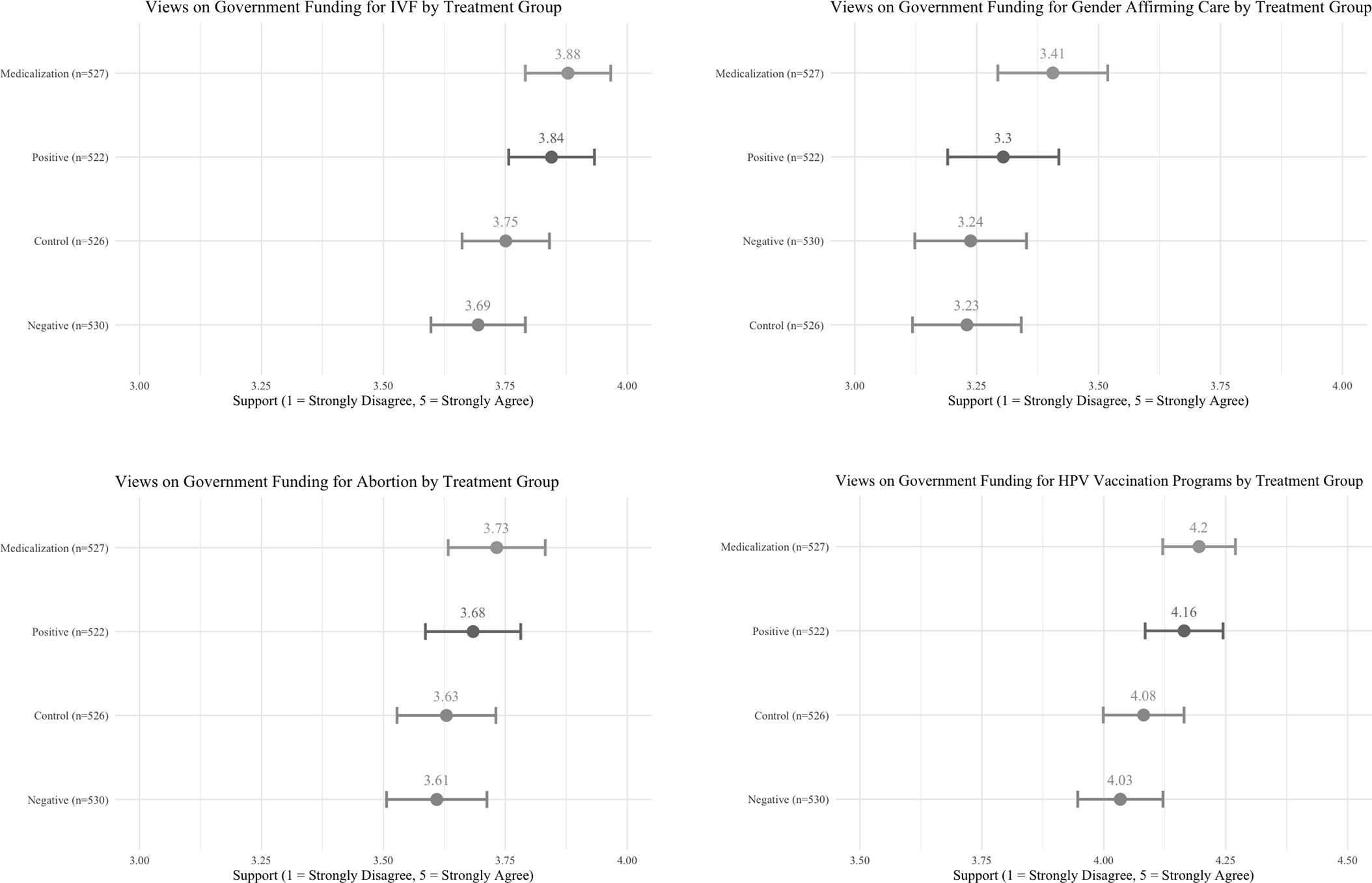
Respondents were randomly assigned to one of four groups, such that the survey yields the following subsamples: control (n = 526); medicalization (n = 527); positive social construction (n = 522), and negative social construction (n = 530). The mean level of agreement for each health service, sorted by treatment group, is plotted below in a quadrant (Figure 1). Levels of support mirror the hypothesized pattern, where we expect that medicalization and positive social constructions will see increased levels of agreement and negative social constructions will see the opposite. This holds for all four services, except gender-affirming care, where the control group sees a marginally lower mean compared to the negative social construction group (3.23 and 3.24, respectively). Across all four services, the medicalization group sees the highest mean level of support for funding each service, ranging from an average of 3.41 for gender-affirming care to 4.2 for HPV vaccines.
Mean levels of agreement for each health service across treatment groups.

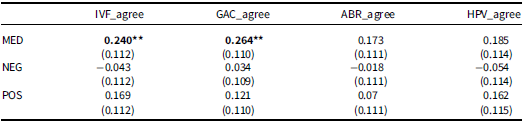
Looking beyond the comparative means for each treatment group across services, I also assess the main hypotheses, how the representation of each health service and target population affects support for provincial funding, using four ordinal regression models, one for each service. The models capture how categorical treatment groups affect the degree to which participants agree with provincial funding for each health service relative to the control group. The results (Table 3) show two statistically significant findings, both within the medicalization treatment group. For both IVF and gender-affirming care, the medicalization treatment is associated with a more positive view of provincial funding. When looking at the odds ratios (and change therein), the results show that those in the medicalization group are 27% more likely to support funding IVF compared to those in the control group and 30% more likely to support funding gender-affirming care.
Ordinal regression results (treatment effects on support for provincial funding)

Table 3. Long description
The table presents ordinal regression results for treatment effects on support for provincial funding across different health services. It has four columns and three rows. The columns are labeled IVF_agree, GAC_agree, ABR_agree, and HPV_agree. The rows are labeled MED, NEG, and POS. Each cell contains a value with a standard error in parentheses. Row 1: IVF_agree, 0.240 (0.112); GAC_agree, 0.264 (0.110); ABR_agree, 0.173 (0.111); HPV_agree, 0.185 (0.114). Row 2: IVF_agree, -0.043 (0.112); GAC_agree, 0.034 (0.109); ABR_agree, -0.018 (0.111); HPV_agree, -0.054 (0.114). Row 3: IVF_agree, 0.169 (0.112); GAC_agree, 0.121 (0.110); ABR_agree, 0.07 (0.111); HPV_agree, 0.162 (0.115). The table shows statistically significant findings within the medicalization treatment group for IVF and gender-affirming care.
*p < 0.1; **p < 0.05; ***p < 0.01.
For those in the negative social construction subsample, we see some suggestion of the hypothesized relationship (Table 3), where negative social constructions may reduce support for funding relative to those in the control group (except for gender-affirming care), but none of the results for this treatment group are statistically significant. The same can be said for those in the positive social construction group, where we see positive coefficients across each service but no statistically significant results. Despite not being statistically significant, it is worth noting that the positive effects of the positive social construction group are stronger than the negative effects of the negative social construction group. This finding suggests that the social constructions of target populations, be they positive or negative, may not serve as a strong driver of funding support for contested health services, where, instead, the medicalization of services may offer more leverage in generating public backing.
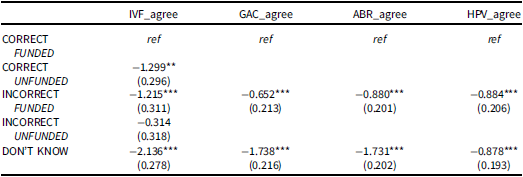
While the construction of target populations and the medicalization of services shed light on support for these contentious health services, the results also point to positive feedback effects. In particular, we examine interpretive feedback effects, where funding signals the legitimacy of the policy and government intervention in this area (Pierson Reference Pierson1993). Here, we would expect that respondents who know that their province funds the service are more likely to support funding than those who either believe their province does not fund the service or those who do not know. Knowing - or simply believing - that a province funds a service legitimizes the service itself, such that the policy feeds back into itself (Mettler and Sorelle Reference Mettler and Sorelle2018). To examine this, we again use four ordinal regression models to examine how knowledge about the funding of each service affects support for funding, but this time only looking at the control group (n = 526). Respondents are asked whether their province funds or covers the costs associated with each service, using the following prompt: “Does your province fund or reimburse costs associated with [service]?” As there is at least base funding for abortions, gender-affirming care and HPV vaccines, respondents are marked either “correct” (knows it is funded), “incorrect” (thinks the service is not funded) or “don’t know” (does not know that the service is funded). For IVF, there are two additional groupings, as some provinces have no funding: “correct-unfunded” (knows that their province does not fund IVF) and “incorrect-unfunded” (thinks the service is funded when it is not).
The results (Table 4) support the hypothesis such that across all services, not knowing or assuming their provinces do not fund a service significantly reduces support for the service. Looking first to gender-affirming care, respondents who incorrectly assume no funding are 48% less likely to support funding, with the same being said for those who do not know (82%). The results are similar for abortion, where we again see a drop in likelihood of support for both the “incorrect” and “don’t know” groups, at 59% and 82%, respectively. For HPV vaccines, not knowing sees a reduced likelihood of support of 58% and 59% for incorrectly assuming no funding from the province. For IVF, the results are similar, though with additional categories. For those who “don’t know” or wrongly assume no funding, we see a drop in the likelihood of support of 88% and 70%, respectively. For those who correctly identify their provinces as not funding IVF, we see a decreased likelihood of support of 73%, suggesting that the government’s unwillingness to fund a service means that the service is not subject to legitimization. The only result that is not statistically significant is that for respondents who incorrectly assumed that IVF is funded by their province when it is not, which suggests further support for the expected pattern.
Ordinal regression results (feedback effects: whether respondents know their province’s funding status)

Table 4. Long description
A table with ordinal regression results for feedback effects on respondents’ knowledge of provincial funding status. The table has four columns labeled IVF_agree, GAC_agree, ABR_agree, and HPV_agree, and five rows labeled CORRECT FUNDED, CORRECT UNFUNDED, INCORRECT FUNDED, INCORRECT UNFUNDED, and DON’T KNOW. Each cell contains a value and a standard error in parentheses. The values indicate the likelihood of support for different services based on the respondents’ knowledge of provincial funding status. Notable trends include significant reductions in support for services when respondents do not know or incorrectly assume no funding.
*p < 0.1; **p < 0.05; ***p < 0.01.
Control group – partisanship, ideology and progressiveness
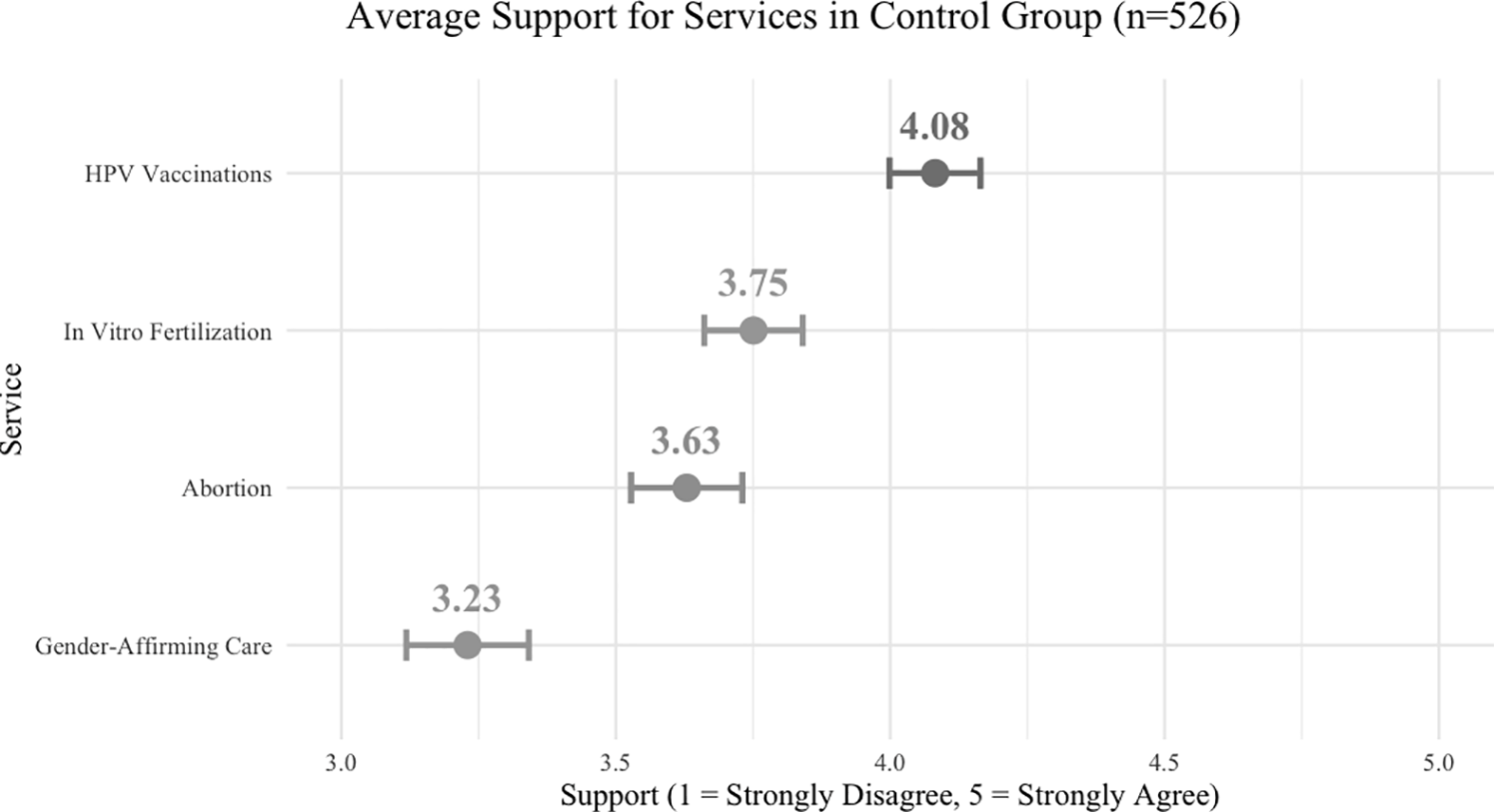
Beyond capturing treatment and feedback effects, the survey gathered demographic indicators, political party affiliation, left/right ideological-identification, and the degree to which respondents support progressive policy statements (Appendix A). The following section looks exclusively at the control group (n = 526) and examines how these additional non-treatment, political variables play a role in shaping the control group’s support for each service, shedding light on the variation within these four contested health services (Figure 2). The analysis of the control group reveals that support for health funding is not merely a matter of general public health consensus but is significantly shaped by partisanship, ideological self-placement, and progressive values, and that the services vary in how they are perceived by the public.
Mean support for each health service across the control group.

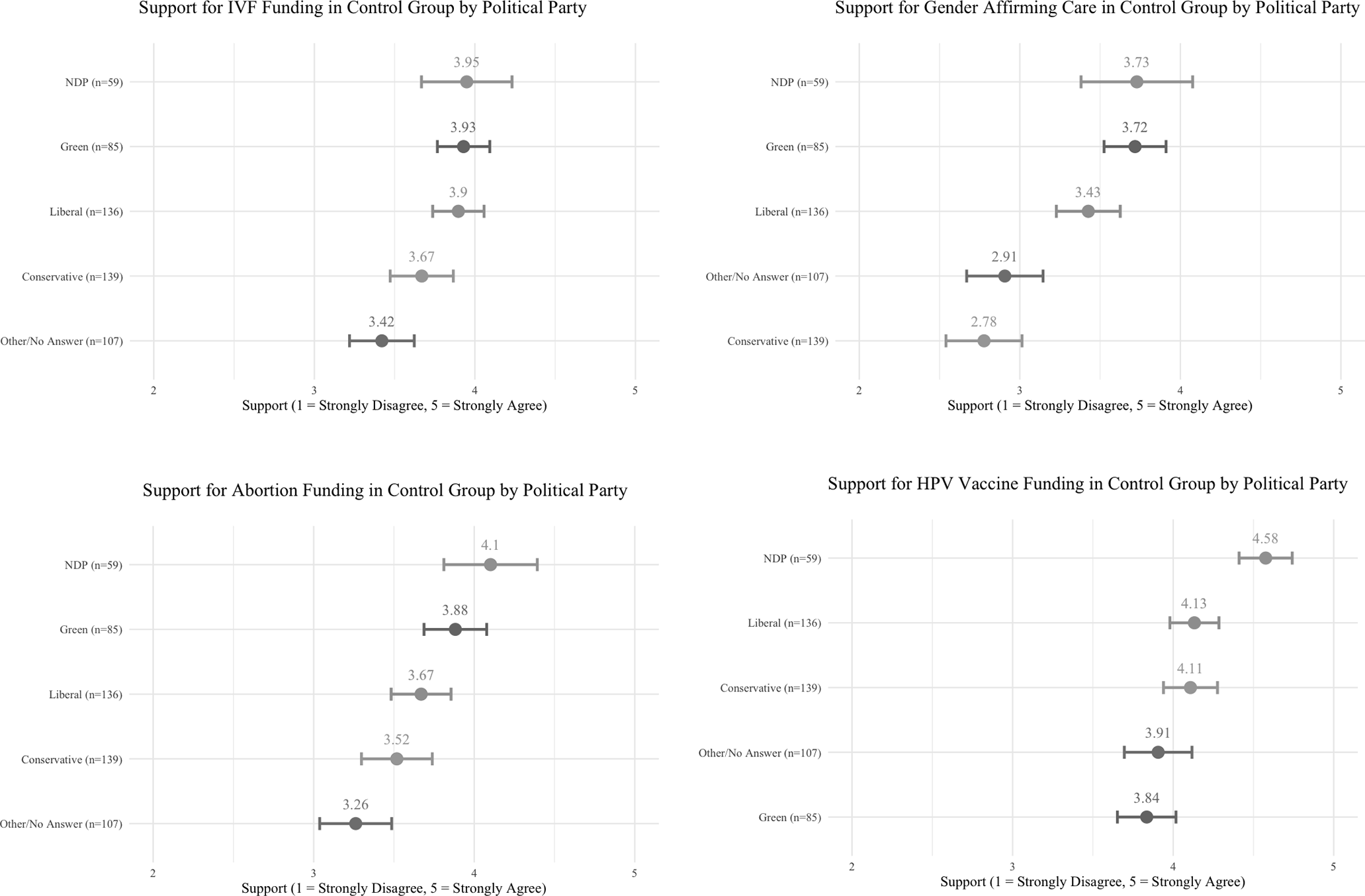
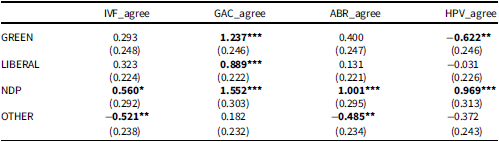
We first look at the role of partisanship, with respondents grouped by their identification with Canada’s main federal parties: Conservatives (Right to Center-Right), the Liberals (Center to Center-Left), the New Democratic Party (NDP) (Left), and the Greens (Left/Ecological). Figure 3 shows that the rank order of groups does not shift across each service, save for HPV vaccines, while the regression results (Table 5) highlight variation across services. Across all four health services, NDP identification is the most consistent predictor of support, with these respondents being significantly more likely than Conservatives to favor funding for abortion, HPV vaccines, and especially gender-affirming care. While Liberal and Green supporters generally show higher support than Conservatives, these results are often not statistically significant, except for gender-affirming care, where all three progressive parties show significantly higher favorability. The primary takeaway is that while the NDP leads in support for contentious services, unique partisan shifts occur, such as Green party voters being specifically less likely to support HPV vaccines and non-partisan identifiers showing significantly lower support for IVF.
Control group levels of agreement for each health service, sorted by federal party.

Ordinal regression results (party affiliation across control group, n = 526)

Table 5. Long description
The table presents ordinal regression results for party affiliation across a control group of 526 respondents. It compares support for four health services: IVF, GAC, ABR, and HPV vaccines, across different political parties: GREEN, LIBERAL, NDP, and OTHER. The table has four rows and four columns. Column headers are IVF_agree, GAC_agree, ABR_agree, and HPV_agree. Row labels are GREEN, LIBERAL, NDP, and OTHER. Each cell contains a value and a standard error in parentheses. Notable trends include NDP showing the highest support across most services, while GREEN shows significantly lower support for HPV vaccines. The values and standard errors are as follows: Row 1: GREEN, IVF_agree: 0.293 (0.248), GAC_agree: 1.237 (0.246), ABR_agree: 0.400 (0.247), HPV_agree: -0.622 (0.246). Row 2: LIBERAL, IVF_agree: 0.323 (0.224), GAC_agree: 0.889 (0.222), ABR_agree: 0.131 (0.221), HPV_agree: -0.031 (0.226). Row 3: NDP, IVF_agree: 0.560 (0.292), GAC_agree: 1.552 (0.303), ABR_agree: 1.001 (0.295), HPV_agree: 0.969 (0.313). Row 4: OTHER, IVF_agree: -0.521 (0.238), GAC_agree: 0.182 (0.232), ABR_agree: -0.485 (0.234), HPV_agree: -0.372 (0.243).
*p < 0.1; **p < 0.05; ***p < 0.01.
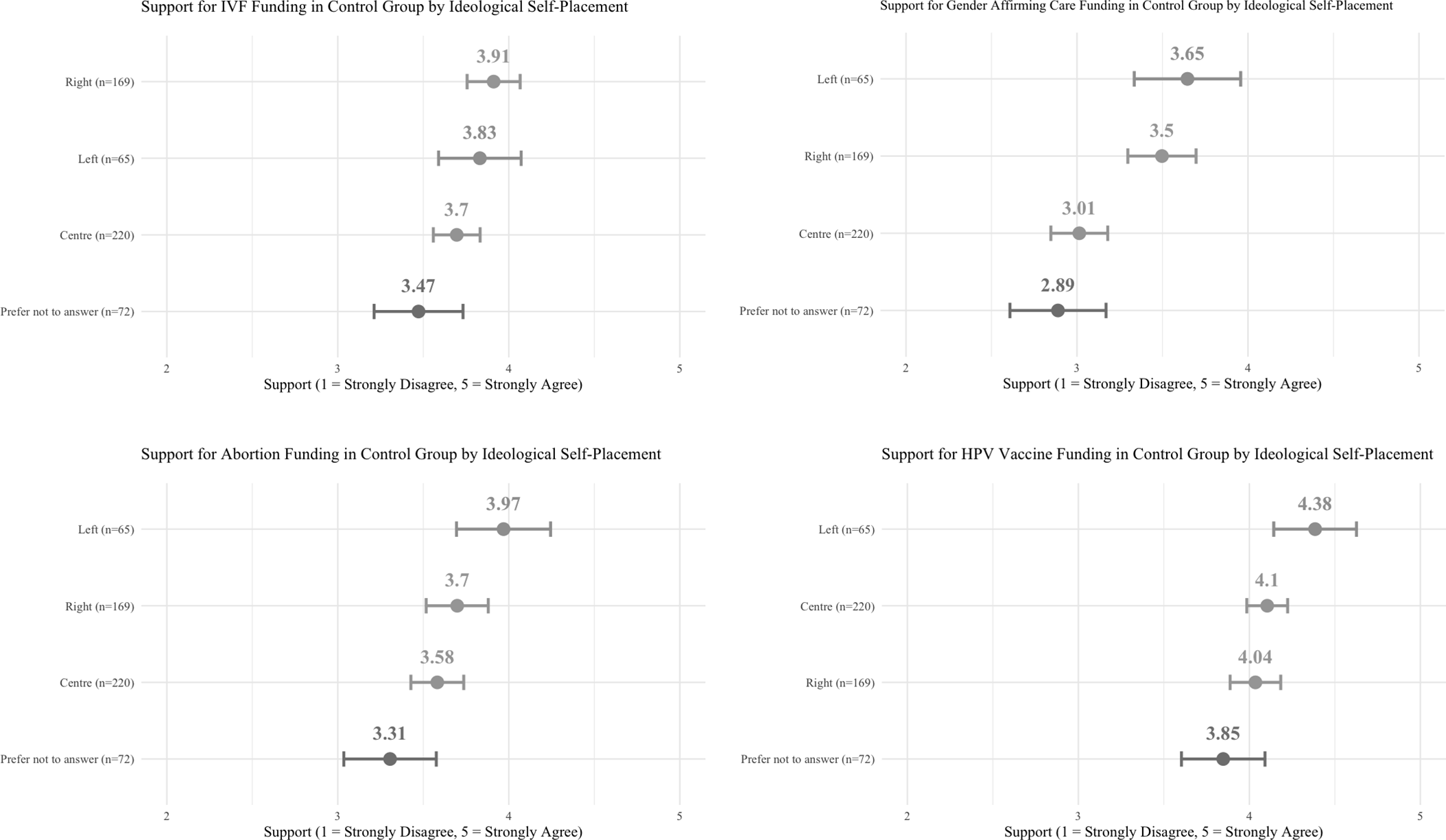
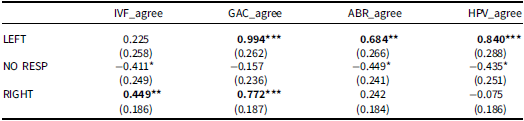
Beyond partisanship, we also examine how ideological self-placement on the left-right continuum impacts funding support (Figure 4). We might expect that those who identify as left-leaning have more positive views of funding; however, this pattern only holds for HPV vaccines, while IVF sees the greatest support from those who identify as right-wing (Table 6). For abortion and HPV, the left-identifying group is more likely to support funding than those in the center. Somewhat surprisingly, both the right and left groups are statistically significantly more likely to support funding for gender-affirming care, compared to those in the center.
Control group levels of agreement for each health service, sorted by ideological self-placement.

Ordinal regression results (ideological self-placement across control group, n = 526)

Table 6. Long description
The table presents data on how ideological self-placement on the left-right continuum impacts funding support for various causes. It includes four columns: IVF_agree, GAC_agree, ABR_agree, and HPV_agree, and three rows: LEFT, NO RESP, and RIGHT. Each cell contains a value and a standard error in parentheses. Row 1: LEFT, IVF_agree: 0.225 (0.258), GAC_agree: 0.994*** (0.262), ABR_agree: 0.684** (0.266), HPV_agree: 0.840*** (0.288). Row 2: NO RESP, IVF_agree: -0.411* (0.249), GAC_agree: -0.157 (0.236), ABR_agree: -0.449* (0.241), HPV_agree: -0.435* (0.251). Row 3: RIGHT, IVF_agree: 0.449** (0.186), GAC_agree: 0.772*** (0.187), ABR_agree: 0.242 (0.184), HPV_agree: -0.075 (0.186). The table shows the impact of ideological self-placement on funding support for IVF, gender-affirming care, abortion, and HPV vaccines.
*p < 0.1; **p < 0.05; ***p < 0.01.
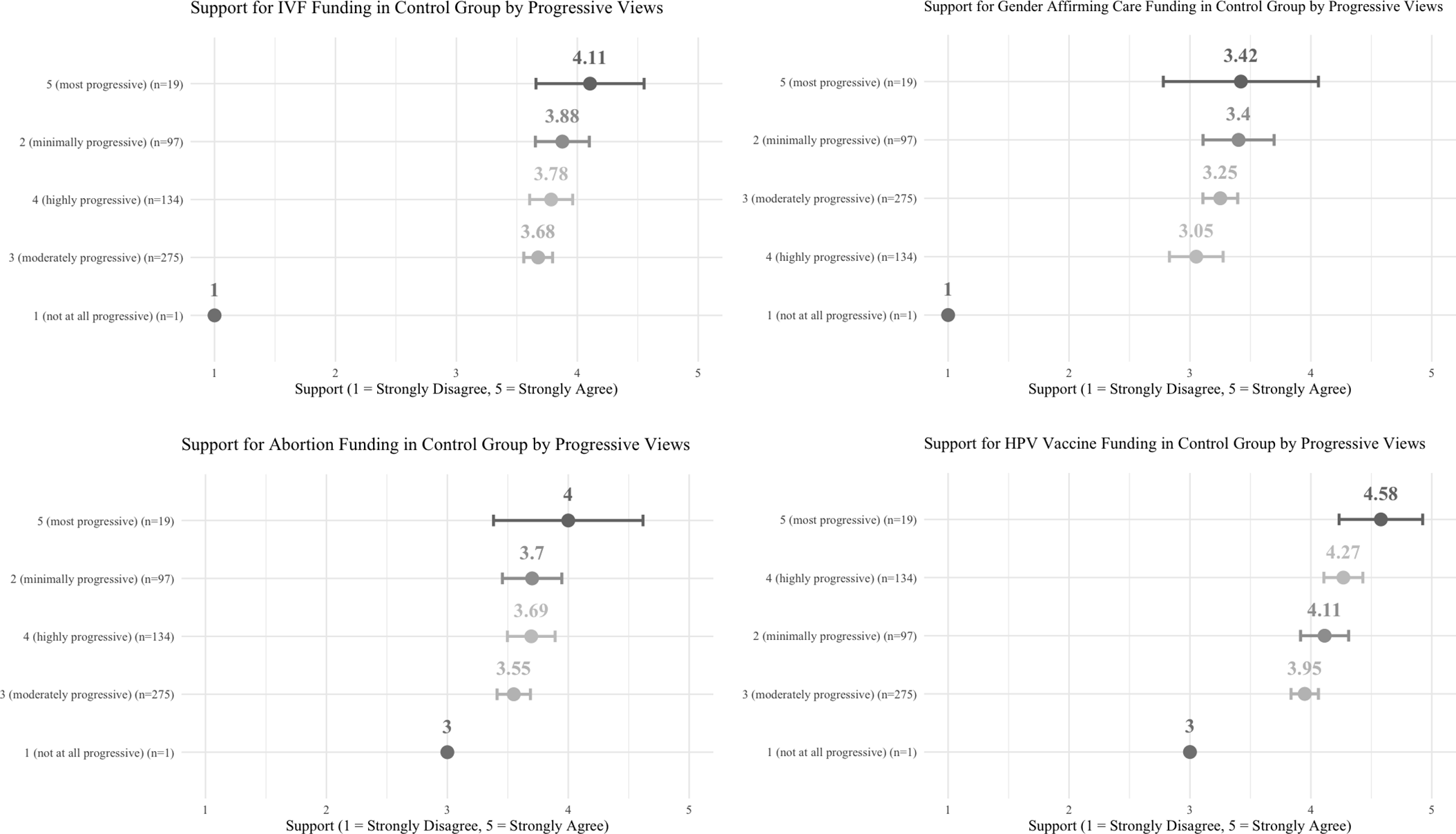
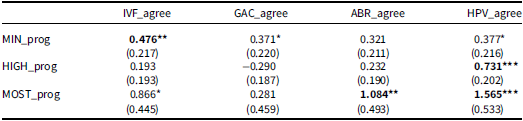
Lastly, we look at the control group and how their views on other progressive policy stances align with their funding support (Figure 5). Somewhat surprisingly, the findings for subgroups are mixed, but those in the “most progressive” group see the highest levels of agreement, followed by those in the minimally progressive group in all cases but HPV vaccines (Table 7). Those in the minimally progressive group are more likely to support IVF funding, as are those in the most progressive group, though results for gender-affirming care are not statistically significant. For abortion and HPV vaccines, those in the most progressive group are more likely to support funding than those in the moderately progressive group.
Control group levels of agreement for each health service, sorted by progressive views.

Ordinal regression results (progressive viewpoints across control group, n = 525)

Table 7. Long description
The table presents data on agreement levels for IVF, gender-affirming care (GAC), abortion rights (ABR), and HPV vaccines (HPV) among subgroups categorized as minimally progressive (MIN_prog), highly progressive (HIGH_prog), and most progressive (MOST_prog). The table has four columns and three rows. Column headers are IVF_agree, GAC_agree, ABR_agree, and HPV_agree. Row labels are MIN_prog, HIGH_prog, and MOST_prog. Row 1: MIN_prog, IVF_agree 0.476, GAC_agree 0.371, ABR_agree 0.321, HPV_agree 0.377. Row 2: HIGH_prog, IVF_agree 0.193, GAC_agree -0.290, ABR_agree 0.232, HPV_agree 0.731. Row 3: MOST_prog, IVF_agree 0.866, GAC_agree 0.281, ABR_agree 1.084, HPV_agree 1.565.
*p < 0.1; **p < 0.05; ***p < 0.01.
The findings for the control group highlight that while contested, these four health services under study vary in the way they are perceived through partisan, ideological and progressive lenses. Results on partisanship show consistently stronger funding support among NDP voters and very limited support for those who do not identify with any party. The ideological lens highlights important variation in services, where those identifying as left-wing are significantly more likely to support funding for abortion and HPV vaccines than those in the center, while IVF sees more support from right-leaning respondents than those in the center, where IVF may serve as an important “family values” policy that differs from the other three services. This pattern is also reflected in the progressive placement of respondents, where “most progressive” individuals show the expected high levels of support for abortion and HPV vaccines. However, the relationship is non-linear for IVF, where both the “minimally progressive” and “most progressive” groups show statistically significant support for IVF, suggesting that this service may appeal to different value sets across the progressive spectrum and engender support for different reasons.
Discussion and conclusions
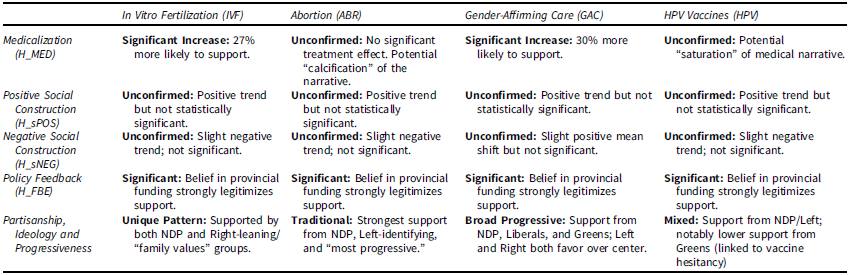
The survey results, summarized in Table 8, shed light on both the hypothesized nature of medicalization, social constructions of target populations, policy feedback effects, as well as the role that broader political leanings play in shaping support for funding contentious, gendered-reproductive health services. We first discuss variation in how each service responded to treatment effects, then speculate on what might be shaping the strength of policy feedback effects across all four services, and lastly, suggest that the varied patterns seen across partisan, ideological and progressive lines point to avenues for further inquiry.
Summary of hypotheses and survey results

Table 8. Long description
The table compares support for funding In Vitro Fertilization (IVF), Abortion (ABR), Gender-Affirming Care (GAC), and HPV Vaccines (HPV) across several factors. It has four columns and five rows, including headers. The columns are labeled IVF, ABR, GAC, and HPV. The rows are labeled Medicalization (H_MED), Positive Social Construction (H_SPOS), Negative Social Construction (H_SNEG), Policy Feedback (H_FBE), and Partisanship, Ideology, and Mixed. Each cell contains text describing the impact or trend observed for that factor and health service. For example, under Medicalization, IVF shows a significant increase of 27 percent more likely to support, while ABR shows no significant treatment effect. Under Policy Feedback, all services show significant belief in provincial funding support. Partisanship, Ideology, and Mixed row details unique patterns of support from different political groups for each service.
The results of the experiment are consistent with our hypothesized theory, but only the medicalization treatment on in vitro fertilization and gender-affirming care are statistically significant. We speculate that these two services differ from the other two such that they might be considered newer or “novel” and are highly salient, where both IVF and gender-affirming care are topics of ongoing political debate in the US, and to a lesser degree, in Canada. Here, it may be the case that opinions on these issues are more malleable, and perhaps amenable to language that “depoliticizes” them and grounds them instead in healthcare. Furthermore, medicalization may be particularly powerful when discussing IVF and gender-affirming care, as both issues are politically salient, but the technical aspects of the procedures are obfuscated. The positive effects of medicalization on IVF and gender-affirming care suggest that this narrative may not only yield positive policy effects, but it also highlights the potential influence of medicalization in shaping broader ideas around deservingness and suggests avenues for addressing opposition to funding particularly contentious health services, especially those that are permeable and the target of increased political attention, such as IVF and gender-affirming care.
While treatment effects had little impact on abortion and HPV vaccines, we posit that the reason for this varies between the two services. We might consider that abortion is less susceptible to treatment effects, given that the service is not seen as being as new or novel, with legal access having been granted in 1988, and where contestation over the service has waned, especially when comparing access in Canada to the United States (Johnstone Reference Johnstone2017; Muldoon Reference Muldoon2021; Saurette and Gordon Reference Saurette and Gordon2016; Ziegler Reference Ziegler2022). Further, signaling around policy changes to abortion has been limited, where even the Conservative party has indicated a commitment to letting the abortion debate lie (Johnstone Reference Johnstone2017). As is, perceptions of the service may be more calcified and less permeable, thereby limiting the role that framing in the treatment groups may have played. Comparatively, HPV vaccine programs are relatively new, having been rolled out in the early to mid 2000s, but never reached the same degree of public moral and political contestation as abortion (Abdelmutti and Hoffman-Goetz Reference Abdelmutti and Hoffman-Goetz2009; Feinberg et al. Reference Feinberg, Pereira and Quach2015). Instead, the rollout of the vaccines in Canada was highly medicalized, and the cancer-prevention benefits were central to messaging the vaccines (Abdelmutti and Hoffman-Goetz Reference Abdelmutti and Hoffman-Goetz2009; Goyette et al. Reference Goyette, Yen, Racovitan, Bhangu, Kothari and Franco2021; Minio Reference Minio2019; Steben et al. Reference Steben, Durand, Guichon, Greenwald, McFaul and Blake2019; Tu et al. Reference Tu, Lin, Fan, Tsai and Wang2019). As a result, support may have already been strong, and existing messaging may have “saturated” the medicalization narrative.
While we posit that the political landscape may shape the impact of treatment effects, we also examine the strength of the positive feedback effects suggested in the results, where respondents who believed their province funded a service were significantly more likely to support funding. Here, perceptions of government intervention are associated with perceptions of whether funding is appropriate, suggesting that policy intervention may legitimize policy need (Pierson Reference Pierson1993; Mettler and Sorelle Reference Mettler and Sorelle2018). Earlier work in the policy feedback literature has looked at both lock-in effects and ideational and symbolic legacies (Béland Reference Béland2010, 579). These survey results contribute to this literature as perception of these services as worthy of spending or being classified as “healthcare” may legitimize the funding itself. This echoes earlier work in health policy, where the policy feedback literature has examined how personal experience or personal knowledge of a policy can shape attitudes on health care programs (Campbell Reference Campbell2011; Lerman and McCabe Reference Lerman and McCabe2017). These findings are especially pertinent in the Canadian case, given the challenges facing healthcare systems across the country. Limited access to primary care, long wait times for specialty care, and emergency room closures have been brought to public attention, with policymakers and politicians grappling with strain across the system (Fierlbeck and Palley Reference Fierlbeck and Palley2016; Larsen et al. Reference Larsen, Nolan and Gomez2023; Varner Reference Varner2023). We speculate that in this context, policy feedback effects may be particularly strong, such that funding would be reserved or limited to medically necessary services; If governments are spending money on a service while other elements of the system are strained, this would positively feedback to the public that the legitimacy of the service and apparent need for funding, even in times of financial strain. In other words, the public may assume that governments would not be spending on unnecessary health services when the system is grappling with systemic access challenges.
Beyond the treatment and feedback effects and implications that medicalization holds for broader discussions around funding perceptions and deservingness, we also consider how political factors interact with contestation and the Canadian policy context. In terms of party positions, the results generally aligned with expectations, such that more left-leaning parties or those with more generous views of the welfare state had higher support for funding these contentious health services. Across all services, NDP respondents had the highest support for funding, followed by Green and Liberal respondents. This differs for HPV vaccines, though: Greens had the lowest level of support for the vaccines despite having the second-highest levels for the other three services. We speculate that this may be tied to vaccine hesitancy, including the heightened politics of vaccine skepticism following COVID-19 (Cénat et al. Reference Cénat, Noorishad and Farahi2023; Corsten at al. Reference Corsten, Vang and Gold2023; Griffith et al. Reference Griffith, Marani and Monkman2021), but tracing the exact root of this diversion is beyond the scope of this paper. A similar pattern of divergence within policies is also mirrored when we start parsing left-right identification from party identification. While IVF sees the highest support from right-leaning respondents, this is not the case when looking at political parties, where Conservatives have the second-lowest support score. Again, the same mix of results can be seen when comparing progressive subgroups, where rank orders of subgroups change depending on which services are being looked at and where regression results show a mix in the direction of results, as outlined in Table 8.
These mixed findings across treatment groups and political leaning suggest that these contentious, gendered-health services are not necessarily a homogeneous class of policy that sees even approval across subgroups or where perceptions of each service are equally malleable to the forces of medicalization and politicization. Instead, funding support and broader views about the medical necessity of each service are unique to each service, where saliency and connection to other health areas, such as vaccine skepticism or fertility/nativism, can generate different levels of support. This result, that these contested health services are not homogeneous and not necessarily understood along the left/right or progressive spectrum, highlights the complexities surrounding gendered-reproductive health services, where core ideas about health care, the salience of an issue, and the ideational component shape support for services. These policies are, however, united by contestation linked to the gendered, reproductive body, where debates as to what “counts” as healthcare – and for whom – continue to shape access across and within welfare states.
Glossary
ABR
abortion; includes both medical abortions (those that use mifepristone/misoprostol tablets) and procedural abortions (removing the contents of the uterus, usually by vacuum aspiration) to terminate a pregnancy.
GAC
gender-affirming care; a series of services and supports that affirm a person’s gender identity. This can include medical services like a mastectomy, phalloplasty, vaginoplasty, hormone therapy, etc.
HPV
human papillomavirus; a common sexually transmitted infection, some forms of which can lead to anal, cervical, oropharyngeal, penile, vaginal, and vulvar cancers.
IUI
intrauterine insemination; a fertility treatment procedure where washed and concentrated sperm are directly inserted into the uterus during ovulation to increase the chances of fertilization; less invasive/expensive than IVF and often used prior to IVF.
IVF
in vitro fertilization; series of fertility procedures where eggs are removed from ovaries and combined with sperm outside the body to form embryos for reimplantation.
Supplementary material
To view supplementary material for this article, please visit https://doi.org/10.1017/S0143814X26101196.
Data availability statement
Replication materials to be made available in the Journal of Public Policy Dataverse: Quelch, Jenna, 2026, “Replication Data for: Medicalization, Deservingness, and Policy Feedback: Survey Evidence on Public Support for Gendered-Reproductive Health Care in Canada,” https://doi.org/10.7910/DVN/PALYC3, Harvard Dataverse, DRAFT VERSION
Acknowledgements
I would like to thank Linda White and Adrienne Davidson for their feedback while I refined the design of the survey experiment. I am also grateful to Robert Schertzer, Andrew McDougall and Christopher Cochrane for their constructive feedback on earlier drafts of this manuscript. I thank Tobin LeBlanc Haley and Olivier Jacques for serving as discussants and for their thoughtful comments, which strengthened the analysis and framing of the paper. All remaining errors are my own.
Funding statement
This study draws on research supported by the Social Sciences and Humanities Research Council (funds no. 216883 and 430-2025-00061).
Competing interests
The author declares that she has no relevant or material financial interests that relate to the research described in this paper.
Ethical approval
Ethical approval for this study was obtained from the University of Toronto Research Ethics Board (protocol #47763).


 Open access

