


I
On 16 November 1890, the 15th Earl of Derby, a renowned Conservative British politician, took up his pen after reading his morning newspapers to register a most noteworthy event. ‘It seems that the great Baring house has been involving itself rashly in S. American speculation and at last was compelled to apply for help to the Bank [of England].’ Lord Derby was then unequivocal, noting that ‘[h]ad this been refused, it would have put up the shutters, and the mischief done would have been more widespread than in 1866, when Overend and Gurney smashed’.Footnote 1 Few would have disagreed with Lord Derby at the time: a Baring Brothers & Co. bankruptcy threatened the entire international financial system.Footnote 2 Thus, as soon as Edward Baring, senior partner of the house, had communicated the situation to his friend Everard Hambro, the leading houses of the City and the Bank of England arranged a swift bailout program in secrecy under the leadership of its governor, William Lidderdale.Footnote 3
Ever since the crisis unfolded in late 1890, much ink has been spilled over its origins and implications. ‘The whole mischief seems to have arisen from the recklessness of the Baring house in lending money to impecunious S. American republics’, Lord Derby wrote a week later.Footnote 4 And again, few in London would have sponsored a different view (Flores Reference Flores2011, p. 196). In the years that followed that fateful November, contemporaries sought to locate responsibility for the crisis and uncover its culprits. The scholarship that sprung up in the following decades retained a taste for this quest, and scholars have since tended to alternate between condemning Argentine policymakers and London merchant bankers, while rarely considering the institutional and social environment that shaped the interactions between them.
The existing literature on the causes of the Baring crisis has focused either on Argentina's monetary and fiscal policies (Terry Reference Terry1893; Williams Reference Williams1920; Ford Reference Ford1962) or Barings’ unhedged risk-taking behavior (Ferns Reference Ferns1960, Reference Ferns1992). More recently, Flores (Reference Flores2010, Reference Flores2011, Reference Flores2012) has focused on the effects of information asymmetries and actors’ responses to the structural inefficiencies of nineteenth-century international capital markets. Flores has suggested that Barings had an information lead on Argentina's affairs due to its long-term relationship with the country's governments, and consequently performed the role of ‘delegated monitor’ for Argentine affairs vis-à-vis the investing public in London. During the 1880s, however, increasing competition between merchant banks in the underwriting business weakened the house's ability to influence monetary and fiscal policy in Buenos Aires by enforcing conditionality lending (Flandreau and Flores Reference Flandreau and Flores2012). In fact, competition gave banks (including Barings) stronger incentives to offset monitoring costs by taking on more risk. As a result, competition allowed the Argentine government to obtain better borrowing conditions from international syndicates on new loans despite deteriorating fundamentals, while impairing Barings’ capacity to monitor the country effectively.
In this article I focus instead on how the development of personal ties between statesmen, bankers and entrepreneurs helped actors in Buenos Aires, London and Paris overcome problems of commitment and foster cooperation, thus shaping governments’ access to international financial markets in the nineteenth century. More specifically, I argue that the evolution of these social structures connecting Argentine decision-makers to financial intermediaries in European capital markets in the 1870s and 1880s created the conditions for the Baring crisis.
In the absence of information clearinghouses, information asymmetries permeated transactions in nineteenth-century sovereign bond markets. Merchant bankers justified their role as financial intermediaries by helping borrowers and investors overcome information asymmetries. Their reputation rested on their ability to assess sovereign risk accurately, monitor the performance of their sovereign clients and implement penalties that guaranteed borrowers would adhere to best practices. The incapacity to monitor sovereign borrowers, conversely, carried high reputational costs which could threaten their market position (Flandreau and Flores Reference Flandreau and Flores2009, p. 648).Footnote 5 Though over the course of the nineteenth century additional sources of information became available to European bondholders, the reputation of the issuing house remained a key indication of the borrower's credibility because investors expected bankers to have access to privileged information about countries’ performance.Footnote 6 Merchant bankers were, therefore, key information brokers that facilitated ‘transactions between actors lacking access to or trust in one another’ (Marsden Reference Marsden, Marsden and Lin1982, p. 202). As a broker, a bank's comparative advantage vis-à-vis other market participants (including its competitors) stemmed from its ability to shape the flow of information between parties, which would lead to an augmentation of its social capital (Burt Reference Burt1992, Reference Burt2005).
In order to develop a comparative advantage, however, banks had to overcome structural holes – ‘holes in the structure of information flows’ produced by ‘gaps between clusters’ which had exclusive access to distinctive intelligence (Burt Reference Burt2005, p. 16).Footnote 7 Using detailed evidence from archival records, I look at the role played by brokers, the mediators who merchant bankers employed in an attempt to bridge information gaps with Argentine counterparties and competing European banks. Drawing on a growing literature on social networks (Neal and Quinn Reference Ferguson2001; Rauch and Cassela Reference Rauch and Cassela2001; Ferguson Reference Ferguson2017; Shepard Reference Shepard2018), I show how such mediators controlled the flow and quality of information and promoted collaborative arrangements between previously unconnected parties, shaping how Barings evaluated the tradeoff between risk and opportunity in the 1880s.
Granovetter (Reference Granovetter1973) has argued that actors connected by strong ties (that is, within a cluster) have access to redundant information. Access to new intelligence has to be sought outside one's own group in a different cluster. While ties spanning clusters can be initially weak – when actors have little incentive to trust each other – their value lies in granting brokers access to new information.Footnote 8 But how did actors evaluate the quality of information they accessed through brokerage? Following Krackhardt (Reference Krackhardt, Nohria and Eccles1992), I argue that cooperative arrangements were facilitated when brokers were connected to at least one actor in the bridging relationship by philos ties – a particular type of strong tie supported by a history of (and the opportunity for future) repeated interactions and the existence of affective bonds, which enhanced the expectation that the information shared was trustworthy and that the receiving party was not going to use the intelligence against the one disclosing it.
The article is structured as follows. In Section ii, I show that the notion that Barings had developed a form of ‘relationship banking’ with Argentina before the 1880s is inaccurate.Footnote 9 From 1857 to 1876, the house relied on mediators who, in the absence of philos ties, failed to provide it with accurate privileged information at critical turning points. In Section iii, I analyze how Barings came to realize during the 1876 crisis in Buenos Aires that their local correspondents had not provided them with trustworthy intelligence. I also examine Barings’ attempt to remedy this situation by sending a permanent agent to Buenos Aires, and the monitoring challenges that ensued when personal circumstances weakened the agent's reliability as a source of intelligence.
Section iv explains what led Barings to abandon their previous risk-averse behavior towards Argentine affairs. The argument here is twofold. First, the presence of an information broker with philos ties to the Banque de Paris et des Pays Bas allowed cooperation to emerge in 1884 between the French bank and the London house. While collaboration was an attempt to offset the consequences of heightened competition for Argentine business, it also gave Barings incentives to deepen their relationship with the Anglo-Argentine house of S. B. Hale & Co. Second, towards the end of the decade, Hales’ Charles Sanford was able to broker the development of autonomous business ties with London houses. Consequently, by late 1888, many of the former competitors had become members of the same cluster. Access to redundant information hindered Barings’ ability to assess risks, while collaboration gave the house a deceptive sense of confidence about its ability to hedge against adversities. Section v concludes.
II
In 1824, Barings issued the province of Buenos Aires’ first loan in London. Five years later, the province defaulted on its foreign debt. For the following three decades, the province remained incapable or unwilling to resume repayment. During the 1820s, the first wave of Latin American defaults alerted merchant bankers and investors’ to the dubious quality of the information to which they had access regarding the new borrowers’ repayment capacity (Marichal Reference Marichal1989; Dawson Reference Dawson1990). Lack of accurate information on the region even led to the floating of bonds on behalf of a fictitious country (Flandreau and Flores Reference Flandreau and Flores2012). After Buenos Aires’ default in 1829, Barings remained reluctant to head the negotiations with porteño representatives, but did so on a few occasions in the 1840s and early 1850s at the bondholders’ insistence.Footnote 10 They all failed.
Argentina had been plagued by centrifugal forces that framed the disputes around nation making since independence. During the following decade internecine wars between unitarians and federalists led to further fragmentation and the formation of autonomous provinces governed by local caudillos. After the federalists’ victory under the leadership of the porteño army officer Juan Rosas, the country was reorganized into a confederation under the hegemony of Buenos Aires. Rosas’ fall in 1852 and the dissolution of his authoritarian regime loosened Buenos Aires’ grip over the provinces, but also broke down the fragile institutions that had kept the country together. Garavaglia (Reference Garavaglia2015) and Adelman (Reference Adelman1999) have shown how the ensuing secession of Buenos Aires from the Argentine Confederation in the 1850s brought the problem of national integration to the forefront of public debate, and statesmen on both sides of the border came to agree that only economic prosperity could engender a unified nation. If the nation-state in the River Plate could not emerge out of shared identities only, it would result from economic growth and distributive policies promoted by the state and foreign capital. Thus, access to international capital markets had to be restored.Footnote 11
The Buenos Aires government signaled its desire to reach a settlement with the bondholders of the 1824 loan by resuming interest payments in 1855. The previous year, with Barings’ assistance the Committee of Spanish Bondholders had sent an agent to Buenos Aires to negotiate with porteño statesmen. Disagreements with the provincial government led to the agent's replacement in 1857 by Barings’ most trusted clerk, George White (Orbell Reference Orbell2004a). As the right hand of the head of the London house, White benefitted from the confidence placed in him by Thomas Baring and enjoyed broad latitude to negotiate the best possible agreement with the provincial government. White's mission was successful, and the provincial parliament ratified the agreement later that year.Footnote 12 The 1857 agreement, however, did far more than restore the province's public credit. It inaugurated a long-term relationship between Thomas Baring and the porteño politician behind the agreement, Norberto de la Riestra, then minister of finance of the semi-independent state of Buenos Aires.Footnote 13
In previous years, Baring had pursued correspondent or business relationships with firms in the countries where they had interests. In 1832, the house initiated a business relationship with Zimmermann, Frazier & Co. of Buenos Aires. Two decades later, Edward Zimmerman became the house's correspondent, and in this capacity he wrote a monthly letter to London that included information on the provincial government's disposition to negotiate a settlement for the 1824 loan.Footnote 14 Skillful merchant bankers, however, also sought to cultivate relationships with men with access to the higher echelons of government. A trusted relationship with a well-positioned statesman or government official meant that merchant bankers expected to be able to rely on privileged information to evaluate risks and opportunities. From 1857 to the 1876 crisis, de la Riestra was Barings’ main source of special intelligence on provincial and federal affairs.
De la Riestra's gentlemanly traits and financial knowledge indeed boosted his private capital as a well-suited interlocutor.Footnote 15 Yet, what could have motivated de la Riestra to share privileged information with the London house? Since de la Riestra's interests and ties were embedded in local politics, he derived limited personal (social or pecuniary) benefit from his rapport with Thomas Baring, who rarely acceded to de la Riestra's exceptional requests.Footnote 16 The porteño statesman, moreover, had no long-term official appointment in Europe. Thus, the opportunities for repeated interactions between Baring and de la Riestra were limited to the latter's occasional sojourns in the United Kingdom. As Krackhardt (Reference Krackhardt, Nohria and Eccles1992, p. 219) has argued, repeated interactions create the ‘opportunity for the exchange of information, some of which may be confidential’. Given that their interactions were sporadic and mostly reduced to episodes when the porteño politician approached Barings for resources on behalf of his country, they faced limited incentives to develop what Krackhardt has termed a philos tie.
In early 1865, the invasion of Argentine territory by Paraguayan military forces led Argentina to join Brazil and Uruguay in their war effort against the offending country. Soon after, de la Riestra was sent to London to negotiate the floating of a war-time loan with Barings. It was a time of heightened uncertainty. De la Riestra's wavering commitment to sharing accurate information regarding the country's finances with Thomas Baring during the negotiations further diminished the reduced influence the porteño statesman had with the house.Footnote 17 Barings eventually issued the first part of the loan under onerous conditions the following year, after being under pressure influential holders of Argentine securities who feared military defeat would lead to a second default. Interactions with de la Riestra during the negotiations, however, taught the partners at Barings that the porteño statesman could not be trusted to share accurate information when incentivized to do otherwise. This episode casts doubt on the notion that Barings assumed the role of Argentina's delegated monitor thanks to a special relationship that guaranteed it access to better information through its contacts and private agent(s) in Buenos Aires.
Even before the entry of new competitors in the 1880s, which eroded Barings’ ‘monopolization of knowledge’ and its ability to extract rents from it (Flandreau and Flores Reference Flandreau and Flores2009; Flores Reference Flores2010, Reference Flores2011), it is not clear to what extent the London house's connections with Argentine authorities evolved into a form of relationship banking. In fact, from the 1850s to the late 1860s, Barings’ strongest links were with the province of Buenos Aires, and even those were fragile. It is also doubtful whether the house invested in developing a form of relationship banking with either the provincial or the federal governments. During this period, the house made few inroads into acquiring new sources of privileged information. Indeed, Ferns (Reference Ferns1992, p. 242) has argued that in the late 1880s, after the house had issued a number of loans on behalf of the country, Barings did not see itself as the ‘bankers of the Argentine republic’. Even if we accept that the house ever performed this role – and its corollary assumption, that Barings had developed a special relationship with Argentina – the introduction of C. Murrieta & Co. as issuers of loans on behalf of Buenos Aires (1870) and the Argentine government (1871) compromised Barings’ ability to monitor the country and enforce conditionality lending.Footnote 18
The entry of a new house into Argentine affairs in no way meant that Barings abandoned all efforts to acquire access to better information during the 1870s. A second wave of Latin American defaults during the first half of the decade enhanced a sense of urgency: a 1875 report published by a special parliamentary committee appointed by the British government to examine the causes behind the new defaults pointed to the wealth of deceptive information upon which some of the loans had been negotiated and issued.Footnote 19 Apart from its connections with English banks and railroad companies in Buenos Aires and British diplomatic representatives in the country, de la Riestra had remained Barings’ main contact within the porteño elite up until the early 1870s. As the Argentine and Buenos Aires governments gradually pushed for negotiations to be held locally and as Barings started to diversify its business connections with the country, the need to invest in expanding relationships with local actors became more evident. The effectiveness of these new connections would be tested during the 1876 crisis.
III
Argentina was severely affected by the 1873 panic and the ensuing global economic depression. The worldwide recessive trend meant a reduction of demand for Argentine exports with no immediate equivalent reduction of local demand for imported goods. The resulting trade imbalance and the diminution of foreign capital inflow after 1873 produced a deficit in the balance of payments that soon manifested itself in inflation and exchange depreciation – making the service of foreign debt costlier. Since revenues largely depended on customs receipts, the depression reduced the government's resources. Argentina's increased expenditure on public works and its military outlays in the early 1870s magnified the blow, as the government could not resort to local reserves to offset the immediate impact of the global recession. As a result, what started as a commercial crisis in Buenos Aires in 1873 took a turn for the worse in May 1876, when the porteño provincial bank decided to suspend convertibility.
Between the eruption of the crisis and the suspension of convertibility, Barings actively engaged in the acquisition of information through the house's local connections to assess the likelihood of the provincial bank navigating the difficulties without risking solvency. Whether suspension resulted from efforts to protect gold reserves or from depletion due to attempts to contain currency depreciation, foreign creditors did not celebrate the government's decision to return to inconvertibility. As the oldest surviving bank of issue in Argentina, the Banco de la Provincia de Buenos Aires was an institution independent from the provincial and federal governments. Inconvertibility could give a struggling exchequer leeway to challenge the bank's autonomy, which could result in the sequestration of its gold reserves and in the use of its printing press as a tool to finance fiscal deficits (Gerchunoff et al. Reference Gerchunoff, Rocchi and Rossi2008).
In the months that preceded inconvertibility, Barings sought assurances everywhere: among presidents of the Banco, federal and provincial finance ministers, governors, leading porteño businessmen, and even the president of the Republic himself. Throughout 1875 and in the weeks immediately before the announcement, these men gave Barings contradictory intelligence about the state of local finances.Footnote 20 But all had agreed that the Banco could not and would not declare inconvertibility.Footnote 21 A few days after inconvertibility was declared, de la Riestra assumed command of the finance ministry. The experienced financier promised Barings that the government would do everything it could to continue interest payments, but did not hide his expectation that it would suspend sinking funds in the future. This alarmed partners at Barings, who did not seem to fully trust their local informants: ‘It would be a great advantage if you could send over a confidential agent here with whom we would frankly communicate’, they wrote back.Footnote 22 The request fell on deaf ears. De la Riestra's resignation four months later could not have come at a worse time. On more than one occasion the porteño politician had been called to office to remedy financial troubles; his resignation could only mean the situation was beyond repair.
The 1876 crisis taught Barings that the house had a number of correspondents, but no trustworthy source of privileged information. The house received contradictory reports from porteño statesmen and government officials, who disagreed about both the causes of the crisis and the remedies to alleviate it. All of them, however, dismissed the possibility of a return to inconvertibility. When the government announced the decision in May 1876, the London house was taken aback by the turn of events. Soon after, unsurprisingly, Barings decided to send one of its clerks on a permanent mission to Buenos Aires. In November that same year, Nicholas Bouwer was appointed the house's agent in Argentina for an initial term of three years, reaching Buenos Aires the following month.Footnote 23
Some scholars have already concluded that Bouwer's appointment was prompted by the house's desire to acquire better information (Ferns Reference Ferns1960, Reference Ferns1992). None, however, has explained how Barings came to realize it had to supplement sources of local intelligence. In the appointment letter, the house instructed Bouwer to send immediately a ‘detailed report of the condition of the finances both of the national government and of the province with all such information as you may think useful to us’ as well as updated intelligence on the Banco. The partners emphasized, moreover, that Bouwer was not allowed to ‘transact any business for others without our consent’ and that he was required to devote his ‘whole time and attention to our affairs’.Footnote 24 Bouwer's mission was to become Barings’ agent and information broker.
If Bouwer was to become more than an overseas correspondent, he needed to cultivate relationships that offered him access to privileged local information. Bouwer had the opportunity for repeated interactions with Argentine decision-makers in Buenos Aires which could have allowed him to develop trusting bonds through information sharing. Bouwer, however, failed to turn his initial weak bridging ties into stronger bonds with Argentine statesmen and government officials. The agent's prejudices were to blame. They prevented him from capitalizing on what Burt (Reference Burt2004, p. 351) has called ‘a vision advantage’, the opportunity to turn access to different ideas and beliefs from outside your cluster into social capital when in a bridging position.
Upon his arrival, Bouwer became convinced that the most reputable banking institution in Buenos Aires, the Banco de la Provincia, was ‘seriously compromised’ after examining its balance sheet. Barings’ agent was befuddled by how, in the light of such knowledge, local merchants and ‘country people’ continued to support the institution and even preferred it to the bullet-proof local English bank, whose manager (according to Bouwer) was ‘universally disliked’. Bouwer could only square this apparent incongruence by pointing to the fiscal privileges enjoyed by the porteño bank and the unbounded support the institution provided to local business.Footnote 25 Bouwer failed to comprehend, however, that businessmen and landowners’ sponsorship of the Banco was justified by their understanding that its board members’ interests and lives were embedded in provincial networks of trust and interdependence – unlike the local English bank.Footnote 26
Bouwer was also unable to develop close ties with Argentine statesmen due to the same set of prejudices, and he rushed to judge local political relationships through the lens of a London clerk. When the brother of the Argentine President Nicolás Avellaneda approached Bouwer to request a personal unsecured loan from Barings to invest in the sugar industry in Tucumán (the birthplace of the Avellaneda siblings), Bouwer refused it without hesitation. He subsequently considered President Avellaneda untrustworthy due to his brother's advances – even though Bouwer would later acknowledge the president's role in alleviating the crisis. Barings’ agent abided by the merchant's code of honor and favored short-term considerations. As a result, he missed the chance to develop a closer relationship to members of the Argentine elite, one that would have given him access to privileged information – a priceless asset in the long term.
The agent, however, quickly became enmeshed in the local expat community. Bouwer was captivated by the charms of the partners of the Anglo-Argentine firm of S. B. Hale & Co., and about one year after his arrival to Buenos Aires he became engaged to Samuel B. Hale's granddaughter, whose father was also one of the house's partners. The agent communicated the betrothal to his principals in London, and the wedding took place in 1879.
Scholars have missed how Bouwer's engagement to Miss Pearson shaped Hales’ relationship with Barings. This oversight is partly explained by the belief that S. B. Hale had replaced Zimmermann, Frazier & Co. as Barings’ correspondents in Buenos Aires earlier in the decade. That assumption does not seem to be supported by the documents available at the Barings Archive. In 1876, John Pearson sent Barings a letter from Buenos Aires where he introduced S. B. Hale & Co. and presented a business opportunity which the London house then declined.Footnote 27 Their first business connections seem to date from 1879, when Charles Sanford (another partner at Hales) visited London. Coincidently this was the year of Bouwer's wedding. Barings had then agreed to advance Hales money on the security of cattle. In 1880, the London house started to suspect Sanford had lied about the true state of Hales’ books.Footnote 28
Contemporaries did not miss the implications of the union, and early on pointed to Bouwer's sponsorship of Hales’ business.Footnote 29 The Argentine entrepreneur Eduardo Madero had been a regular correspondent of the London house during the second half of the 1870s, and derived great prestige from his known association with Barings.Footnote 30 In early 1879, Madero accused Bouwer of deliberately staining the Argentine entrepreneur's reputation to forward Hales’ local interests. According to the porteño businessman, Bouwer had spread rumors that Barings had cut connections with Madero to ensure that the London house and the Argentine government would resort to Hales as their local intermediary when it came to Argentine affairs.Footnote 31 We are currently unable to evaluate whether Madero's accusations were unfounded. Three years later, however, Bouwer was using his position as Barings’ agent to further Hales’ business connections in Paris.Footnote 32
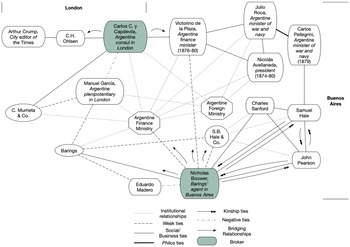
Figure 1 represents Bouwer's performance as an information broker. He is connected by business ties to Barings because, during his first three years as the house's representative in Buenos Aires, the house had no reason to distrust the agent – that is, the partners at Barings had no evidence he was acting against the house's interests. The figure also shows Bouwer's connection to John F. Pearson and Samuel B. Hale by kinship ties due to Bouwer's marriage to Isabel Hale Pearson, in addition to Bouwer's bridging relationship with S. B. Hale & Co. through a weak tie. Institutional ties in the figure either characterize relations between institutions (like Barings’ connection to the Argentine Ministry of Finance) or represent an actor's membership of an institution. Negative ties denote the existence of aversive or hostile relationships. Negative ties connect the Argentine representatives in London, Carlos C. y Capdevila and Manuel García, who undermined each other's influence vis-à-vis foreign creditors and the Argentine government. Given their intimate friendship, Julio Roca and Carlos Pellegrini are connected by philos ties. Social and business ties indicate the existence of a track record of repeated interaction in either sphere, but do not guarantee the presence of affective bonds and do not necessarily survive environments of heightened uncertainty.
Social structures connecting actors and institutions in London and Buenos Aires, 1879

Ferns (Reference Ferns1992, p. 244) is a strong advocate of the view that the partners held responsibility for bankrupting the firm. He argued that Bouwer, ‘an intelligent young man with a good knowledge of business procedures and capable of a general overview of an economy’, followed the house's instructions to the letter, providing the partners with ‘disinterested and objective’ reports during his first years. Bouwer's reports were indeed detailed and initially deserving of the approval of Edward Baring, then head of the house.Footnote 33 The agent, however, started his new position with the house without full disclosure: Bouwer sailed off to Buenos Aires indebted to creditors in England, in all likelihood hoping that his new position would bring him status and fortune.Footnote 34
Bouwer brought the situation to Edward Baring's attention only after he had incurred new debts in Buenos Aires and was unable to repay creditors on both sides of the Atlantic. In the letter in which Bouwer disclosed his liabilities (which then amounted to three times his annual salary), he assured the London house he had not revealed his situation to his father-in-law. Bouwer explained that he had kept his debts from John F. Pearson to safeguard his own autonomy as Barings’ representative when dealing with Hales. The assurances did not completely convince the London house.Footnote 35 The partners then expressed their ‘great regret that you thought it right to undertake to represent us in Buenos Aires without informing us of the debts you had in England’, noting how ‘[t]he position which you were about to occupy was one which demanded that you should be in every respect a free agent’. They were categorical: the partners would not have employed Bouwer had they known about his outstanding debts. Barings’ senior partners knew – and thus reported to Bouwer – that their agent's liabilities impaired not only his private credit, but the house's as well. They refused to increase Bouwer's £1,500 annual salary (more than twice that of Argentine senators), instead granting him an advance to settle his debts.Footnote 36
Bouwer's seemingly overzealous behavior on behalf of his principals changed drastically after his wedding and the renewal of his appointment. Thus, when President Julio Roca approached Bouwer in early 1880 for an unsecured open credit of £200,000, Barings’ agent recommended the affair to the house. A few months earlier, however, Bouwer had declined the finance minister's request for an open credit of the same amount precisely because it was not secured by saleable assets.Footnote 37 Nonetheless, Barings refused the credit, leading the Argentine government to invest in new relationships with bankers on the European continent. Bouwer also tried to overcome Barings’ refusal to take loans firm during the negotiations for Roca's 1880 ‘Railway loan’, arguing that the house needed to adapt to the new rules to remain competitive. Bouwer's argument reflected Hales’ growing interest in becoming the principal intermediary in loan negotiations between federal and provincial governments and European merchant bankers.
Bouwer was therefore in no way a ‘free agent’, and his situation became more compromised as his liabilities increased. It would be simplistic, however, to argue that Bouwer's attitude derived from his personal moral failings. During the first years, Bouwer's reports were coated in good mercantile principles, and the agent himself did not hesitate to identify Hales’ shortcomings when he thought it imperative. Bouwer was greedy and ambitious, but so were many information brokers who occupied structural holes between foreign creditors and sovereign borrowers.Footnote 38
Did Barings have access to information to monitor Bouwer's performance? As we have seen, the London house had received early reports that questioned Bouwer's business ethics and true loyalties. Yet, the authors of those reports could not be considered disinterested actors: how would Barings decide to take their word over that of their agent? If the London house struggled to monitor Bouwer's performance abroad, could they have developed strategies to reduce the shortcomings inherent to principal–agent relationships? Barings could have sought to circumvent the moral hazard by increasing the utility Bouwer derived from protecting the house's interests. Barings’ investment in an interdependent relationship with their agent could have achieved that objective. Without stronger ties to the London firm (participation in the form of a junior partnership) or to the Baring family itself (a wedding offer, for example), however, Bouwer was free to surrender to local opportunities that gradually alienated the firm's interests.
When in 1883 Bouwer found himself once more unable to meet his liabilities, he again applied to Edward Baring, who threatened to close the agency if Bouwer was not able to finance it with his salary. By then the agent had already established firm roots in Buenos Aires. He subsequently applied to his father-in-law, who covered the agent's liabilities with Barings. Afterwards, Bouwer began insisting on his version of a compromise. The agent would join Hales as a partner and take the agency with him, receiving henceforth a smaller salary from Barings; the London house would henceforth reduce their expenses with the agency and further profit from Hales’ local business contacts. The house initially declined Bouwer's offer to restructure the agency, a decision the partners justified by citing their deep distrust of Sanford. Nevertheless, Barings eventually reconsidered the proposal, and a year later Bouwer joined Hales, making the Anglo-Argentine firm Barings’ new agent in Buenos Aires.Footnote 39
Bouwer's agency may have given Barings’ senior partners a misleading sense of access to accurate information, but they did not blindly act on it during the first years of the 1880s. They remained suspicious of Hales even as Bouwer became closer to the senior partners of the porteño house, and did not acquiesce to all of Bouwer's suggestions and business propositions. Bouwer's story is, thus, insufficient to explain Barings’ modus operandi after 1884. It does explain, nevertheless, why Barings established a close relationship with Hales in the first place. Bouwer's ties to the Anglo-Argentine firm paved the way towards a more interdependent partnership between Hales and Barings during the second half of the 1880s.
But if Barings had reservations about Hales and Sanford in particular, how to explain their decision in 1884 to grant Bouwer's request to join Hales and take the agency with him? Changes in the structure of Barings’ financial networks, themselves the result of the London house's response to increasing competition for Argentine business in the 1880s, crucially shaped the decision. We will turn to this now.
IV
Argentine statesmen faced strong incentives to expand the country's foreign debt in the 1880s. After years of internecine wars, politicians like Julio Roca, Carlos Pellegrini and Miguel Juárez Celman believed the Argentine federation risked fragmentation unless provinces shared in national economic growth (Ford Reference Ford1962; Gerchunoff et al. Reference Gerchunoff, Rocchi and Rossi2008).Footnote 40 The process of centralization sponsored by President Roca thus depended on the federal government's capacity to promote distributive policies that benefitted provincial elites, while support for the regime was contingent on its ability to deliver rising prosperity.Footnote 41
During the 1880s, the country became the third preferred global destination for British capital, and issued loans in Paris and Berlin for the first time since independence. The national, provincial and municipal governments raised a total of 50 loans abroad throughout the decade (Marichal Reference Marichal, Quennouelle-Corre and Cassis2011). Domestic and global conditions attracted foreign capital. A military campaign against indigenous populations in the late 1870s opened up new land for cultivation, agricultural productivity was soaring, immigration increased population growth, and the federalization of the city of Buenos Aires put an end to decades of tension between the province and the federal governments. In the early 1880s, Argentina not only seemed to achieve political stability, but also expanded its stock of the two factors of production that nineteenth-century investors associated with economic growth: land and population.Footnote 42
With interest rates declining all over Europe and money cheap in Paris during the first years of the 1880s, French banks with no connection to Argentina decided to take their chances and put forth proposals for Roca's 1880 loan. Two circumstances facilitated the risky move: first, President Roca's decision to negotiate the operation in Buenos Aires via the intermediation of local houses; second, the use of banking syndicates, whereby banques d'affaires and deposit banks joined forces as underwriters, thus spreading between them the risks of taking a loan firm and introducing a new type of security into the Paris market.
As a result, a French banking syndicate led by the Banque de Paris et des Pays Bas (hereafter Paribas) contracted the 1880 loan, via the local intermediation of Bemberg, Heimendahl & Co., a porteño associate of the Parisian house of Otto Bemberg & Cie. The first Argentine loan issued in Paris was a tremendous success. Consequently, during the first half of the decade, the Paribas syndicate bought firm four other loans from the Argentine national and provincial governments, while a rival group emerged under the leadership of Société Générale of Paris and with the support of the London firm of J. S. Morgan & Co.Footnote 43
Barings was initially reluctant to participate in this new way of doing business. The house opposed the purchase of loans firm and refused to participate in syndicates formed to compete for the same loan because they understood the potentially catastrophic consequences of open competition among merchant houses.Footnote 44 Barings feared the government would use the proposals as leverage for higher prices. They were right. Bouwer eventually managed to convince Barings to bid for Roca's 1880 loan. President Roca, however, was determined to weaken the country's dependence on the London market, and could not forgive Barings’ failure to grant the government an open credit in 1879 and 1880. Roca used Barings’ offers to get better terms from French bankers.Footnote 45 The lesson would not be easily forgotten by the house. In 1883, amid renewed insistence from Bouwer to present a firm offer for a new loan, the house remarked that ‘it is going to be difficult for us to compete with the numerous houses among which it has of late become the custom to distribute these loans’.Footnote 46 This risk-averse behavior was, however, abandoned in 1884, when Barings finally decided to adopt the new rules and engage in a syndicated loan for the ‘Banco Nacional’ alongside Paribas. What enabled this change?
Marichal (Reference Marichal, Quennouelle-Corre and Cassis2011) and Regalsky (Reference Regalsky2002, Reference Regalsky, De Arce and Mateo2013) have shown how collaboration between French houses in Buenos Aires and merchant bankers in Paris fostered a French presence in Argentine affairs and sustained competition among European bankers. Jones (Reference Jones1972) has suggested that coordination emerged in the 1880s as a strategy employed to offset the consequences of increasing competition. None of them, however, has examined how coordination became possible in a time of rising uncertainty. What created the conditions for Barings to cooperate with Paribas in 1884? The answer lies with Hermann Hoskier, a London banker with philos ties to Everard Hambro, Brown, Shipley & Co., and Charles Sautter – Paribas’ senior director.Footnote 47 Hoskier established a bridging relationship between Barings and Paribas in late 1883 and subsequently mediated the exchange of information between the London and the Paris firms. In 1884, Hoskier successfully mediated Barings’ admission into the ‘Banco Nacional’ syndicate.Footnote 48
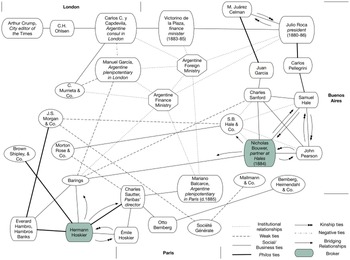
Figure 2 represents Bouwer's and Hoskier's performances as information brokers. Bouwer joined S. B. Hale & Co. as a partner in 1884 and is here connected to the house by institutional ties. Given Barings’ distrust of Sanford, he is connected to the London house by weak ties. While Hales initiated a business relationship with J. S. Morgan & Co. in 1884 (indicated here by weak ties to the house), the porteño house mediated the involvement of Morton, Rose & Co. in Argentine loan operations in 1882 and 1883. In this sense, Hales are connected to Morton, Rose & Co. by business ties. Hoskier is connected to Sautter, Brown, Shipley & Co. and Everard Hambro by philos ties given the existence of affective bonds between them. Sautter's correspondence with Hoskier at the BPPA shows that they were connected by an intimate friendship, trusted each other and shared privileged information. Hoskier also seems to have travelled to France often. Hoskier is at the same time connected to his brother, Émile Hoskier, by kinship ties. It is possible that they were also connected by philos ties, but the documents available do not allow us to assess whether they also shared affective bonds. Hoskier and Sautter coordinated Russian business, and are thus connected here by business ties (see Appendix). The Société Générale contracted its first Argentine loan, mediated by Mallmann & Co. in Buenos Aires and issued by J. S. Morgan & Co. in London, in 1883. Therefore weak ties here connect the three houses.
Social structures connecting actors and institutions in London, Paris and Buenos Aires, 1883–5

An effective broker needed to be seen as a trustworthy intermediary by both parties. Hoskier enjoyed Edward Baring's respect and Sautter's trust and affection. He had developed a pristine reputation in London as an honest and reliable banker since his establishment in the City first as a clerk and later as a partner at Brown, Shipley & Co.Footnote 49 According to Krackhardt (Reference Krackhardt, Nohria and Eccles1992), philos ties are expected to be especially effective in the promotion of trust in an environment of heightened uncertainty. Hoskier was a successful information broker because he was connected by a philos tie to the head of Paribas and enjoyed the esteem of a select group of City bankers. Moreover, as a broker based in London, Hoskier had numerous opportunities to develop a personal, trusting relationship with Barings’ senior partners by sharing information in repeated interactions. He continued to cultivate his friendship with Sautter while in London via a regular and frank correspondence and frequent trips across the Channel, where his siblings lived. Hoskier's ties to Sautter and the Parisian banking community were further supported by the fact that Émile Hoskier, Hermann's brother, had his own firm, which was a prized intermediary in negotiations with the Russian government.
The ‘Banco Nacional’ loan was a success and paved the way for a new collaborative project with the ‘Riachuelo/Salubridad’ loan. Paribas had bought the loan firm from the government and offered Barings a participation, which the firm accepted.Footnote 50 Differences soon arose about the timing of the issue. Barings wanted to issue the loan in the spring of 1885, ‘as it would not be creditable either to the government or to us, to make two applications to the public in one year’.Footnote 51 Paribas insisted they were under pressure from the Argentine government to issue the loan in the fall of 1884.Footnote 52 Hoskier heard and resolved disagreements, taking care to present to both parties the image of an unbiased mediator while softening the impact of divergent preferences. The mediation was effective, and Barings finally agreed to issue the loan in the fall of 1884, though they feared it would affect their reputation.Footnote 53 Legal complications, however, delayed the issue. By the time they were resolved, a banking crisis in Buenos Aires and the failure of a £2m Argentine loan issued by J. S. Morgan and the Société Générale in 1884 made it impossible to offer the ‘Riachuelo/Salubridad’ loan to the public.Footnote 54
Both Paribas’ and Société Générale's syndicates had unsaleable Argentine bonds in their portfolio by early 1885. As the crisis in Buenos Aires worsened following inconvertibility, the Argentine government decided to send the porteño Senator Carlos Pellegrini to Europe to negotiate a new consolidation/funding loan with the two syndicates.Footnote 55 Once again, Hoskier facilitated coordination between merchant houses that had not only previously competed for Argentine affairs, but that could have chosen to seek better terms from the Argentine government at each other's expense. ‘Indisputably I have the merit of having brought together all the camps – you know that it's been a year since I have started preaching the necessity of amalgamation and through me [par mon entremise] we could say things that are impossible to say directly’, Hokier noted to Sautter after a provisional agreement between the two syndicates and Pellegrini had been reached.Footnote 56 By mid 1885, Barings’ collaboration with bankers in Paris was so entrenched that when Pellegrini approached Edward Baring ‘to get out of the Frenchmen's hands’ and establish an exclusive relationship with the London house, Lord Revelstoke replied that ‘at present that was impossible’.Footnote 57
Hoskier had allowed collaboration to emerge between Paribas and Barings, and thus the London house participated in a syndicate with French houses for Argentine loans for the first time in 1884. Cooperation with Paribas also helps explain why Barings permitted Bouwer to join Hales as a partner that same year. Barings’ partners had deeply distrusted Sanford. And yet, by late 1884 Hales had become Barings’ agent in Buenos Aires. The London house expected coordination with the Paribas syndicate to hedge against the risks of engaging in business with Hales while allowing them to benefit from a connection with a local house with access to the Argentine government.Footnote 58
Ziegler (Reference Ziegler1988, pp. 227–8) has suggested that by 1885 Barings’ senior partners started to take more risks. Indeed, from 1885 to 1890 Sanford managed to engage the London house in different high-risk business ventures. Scholars have explained the relationship as a function of Sanford's ability to charm the London house's partners. Hoskier himself seemed to have fallen for Sanford's social skills – by the late 1880s they had become friends.Footnote 59 Barings, however, knew by then that Argentine business could not be secured on the reputation of private men.Footnote 60 This explanation is, therefore, insufficient. In reality, Sanford managed to establish independent relationships with other London houses, eventually brokering the formation of a new cluster of financial intermediaries by 1888.Footnote 61 Following the landmark of the 1885 agreement, cooperation deepened between Barings, Morgan & Co., Hambros, Morton, Rose & Co., Brown, Shipley & Co. and Paribas regarding Argentine affairs, through Hoskier's intermediation and Sanford's and Hales’ investment in the development of independent business connections in London. Thereafter, Barings faced strong incentives to engage in joint enterprises through the use of syndicates.Footnote 62
Hales and Sanford indeed brought business to the London house. Two ventures taken over by Barings in 1888 would prove especially ill-fated during the next two years: the financial agency of the Uruguayan government and the Buenos Aires Water and Drainage Works (BAWDW) – a project first recommended by Bouwer in the late 1870s.Footnote 63 Barings relied on Hoskier's intermediation and syndicated loans to carry out both undertakings. The Uruguayan agency had been highly recommended in 1887 by reputable English banks and houses in the River Plate, including E. Tornquist & Co., which would emerge as the leading information broker in the 1890s and 1900s after intermediating the admission of German banks as contractors and issuers of Argentine sovereign debt in the late 1880s.Footnote 64 In 1888, Paribas participated in Barings’ first Uruguayan loan, another move that Hoskier facilitated.Footnote 65
In June 1888, the Argentine government granted Hales a concession to form a company in Europe to carry out sanitation works in Buenos Aires. Following the registration of the company in London, Hales sold £3.5 m in preference and ordinary shares and £5 m in debentures of the company to Barings. A syndicate was soon formed to underwrite the flotation of the securities which included Barings, Paribas, Morgans, Hambros, Brown, Shipley & Co., Morton, Rose & Co., Hoskier, Greenwood & Co., and W. H. Cole & Co.Footnote 66 ‘This is an operation that one day will give us a good profit, I believe’, Hoskier wrote to Sautter in late November.Footnote 67 While Hoskier mediated Paribas’ participation, it is possible that the involvement of Hambros and Brown, Shipley & Co. was facilitated by the British banker's philos ties with the senior partners at these firms. The initial issue of shares to the European public in 1888 was a failure, and members of the syndicate held onto large parts of their underwritten amounts.
The Buenos Aires Water and Drainage Works is often considered the catalyst of the Barings crisis (Ferns Reference Ferns1992). The business venture is also the clearest example of how reliance upon coordination led Barings to overextend. Indeed, in a private ex-post recounting of the facts to a fellow member of the BAWDW syndicate, Barings remarked that it had been ‘on the faith of the underwriting letter signed by yourselves and others that we originally took up this company’.Footnote 68 By early 1890, however, the BAWDW's finances were in disarray. The project was to be financed locally by fees levied in paper currency. But as inflation and depreciation set in in 1889, the contractors perceived only a fraction of the estimated revenue to continue the works. Barings became aware of the deteriorating situation only after John Baring, Edward's son, visited Buenos Aires in early 1890 and sent back reports on the company. The house continued to support the operation, however, and even made advances against debentures around the same time a coup forced President Juárez Celman's resignation in the summer of 1890.Footnote 69 Two factors can explain this decision: the house did not believe in the crisis’ severity and expected the syndicate to continue to pump resources into the company.
Indeed, in August the house circulated a call amongst the syndicate members for additional resources.Footnote 70 The political and financial crisis in Argentina had caused a sharp decline in the quotation of the country's securities, making the BAWDW securities that the syndicate held unsaleable. Cracks started to appear in the syndicate. After the call, Paribas asked Barings to provide them with a report on the liabilities of the company, and others started to question the legality of the underwriting letters.Footnote 71 In late October 1890, after Barings had requested 60 per cent of the underwritten amount of the debentures, Morton, Rose & Co., Hambros and Shipley, Brown & Co. refused to honor Barings’ request.Footnote 72 Paribas, Hoskier and Morgans – the members of the syndicate ‘who did not run away’, according to Francis Baring – never contested their obligations towards Barings as the de facto head of the syndicate and fulfilled the house's request.Footnote 73 The philos ties that had connected Paribas, Hoskier and Barings survived even the most challenging trials.
Coordination first with Paribas and then with former competitors led the London house to adopt some of Hales’ riskier business proposals. If Bouwer had not joined Hales in 1884, would Barings have developed such a close relationship with the Buenos Aires firm given their distrust of Sanford? It seems highly unlikely. Furthermore, had Barings not been able to coordinate their moves with the Paribas syndicate and later with J. S. Morgan, would the firm have participated in new loans on behalf of the Argentine national government after 1884? Again, probably not. Cooperation across the English channel, however, had limits. Barings and Paribas wanted to keep German banks out of Argentina.Footnote 74 Through the intermediation of Ernesto Tornquist, who had developed strong ties with German businessmen since the 1850s, the Disconto Gesellschaft issued the first Argentine national loan in Berlin 1887.Footnote 75 It was oversubscribed several times. Renewed competition among merchant houses after 1887 allowed the Argentine national and provincial governments to keep borrowing abroad.
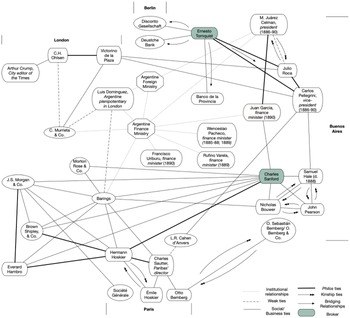
Figure 3 represents Sanford's and Tornquist's performances as information brokers. Following the death of Samuel Hale, Sanford seems to have assumed the de facto leadership of the firm in London, while Bouwer and J. F. Pearson took care of business in Buenos Aires. From 1887 to 1889, Sanford could be found in London on different occasions, and even took permanent residence in the city sometime in 1890. Sanford brokered independent business relationships for Hales with Hambros Bank and Brown, Shipley & Co., and developed a friendship with Hoskier. Sanford and Hoskier seem to have shared affective ties: after the Baring crisis, Hoskier did not accuse Sanford of contributing to the difficulties faced by the BAWDW. In the figure, Sanford is therefore connected by business ties to Barings, J. S. Morgan, E. Hambro, Brown, Shipley & Co. As we have seen, business ties point to a track of repeated interactions in the business sphere, but do not guarantee that actors shared trustworthy information nor that such cooperation would survive in times of heightened uncertainty. E. Tornquist shared affective bonds with Roca and Pellegrini, in addition to connections with German bankers (see Appendix). Sautter had weak ties to L. R. Cahen d'Anvers, a French house that sought to circumvent Paribas’ relationship with the Argentine government and develop its own business ties through Pellegrini. Morton, Rose & Co. is described by Ziegler (Reference Ziegler1988, p. 228) as one of Barings’ allies in 1886; both houses are connected here by business ties. Carosso (Reference Carosso1987, p. 205) has noted the that Everard Hambro was a ‘close friend of Junius and Pierpont Morgan's’, and the two houses are connected by philos ties.Footnote 76
Social structures connecting actors and institutions in London, Paris and Buenos Aires, 1888–90

From 1884 to 1889 Barings invested heavily in South American securities. At the time of the application to the Bank of England in November 1890, Argentine and Uruguayan securities represented around 64 per cent of Barings’ portfolio.Footnote 77 When Francis Baring communicated to Thomas Baring – a partner at the firm from 1867 to 1888 and later one of Baring Brothers & Co.’s directors – the news that the firm had applied for a Bank of England rescue loan, he noted how ‘You always said that B. Ayres would be the death of us … We have also been caught hopelessly locked up in various Argentine and Uruguay stocks, concerns of which the waterworks (which once looked so good) has perhaps turned out the most difficult.’Footnote 78
Francis's words have shaped the way we look at the crisis, linking the firm's collapse to developments abroad. The letter, however, also reveals that the firm's difficulties preceded the June 1890 political revolution in Argentina, though it fails to explain why Barings had abandoned its early risk-averse behavior towards South American affairs in the second half of the 1880s.Footnote 79 The emergence of collaboration between Barings and Paribas in 1884 and the gradual closure of the cluster of London merchant bankers connected to Argentine affairs due to Sanford's own bridging ties in the late 1880s explain Barings’ overreliance on cooperation and syndicates to guard the house against its increasingly risk-taking behavior.
V
At first glance, it may seem that Lord Derby had a point with regard to the firm's reckless behavior. Would Barings have faced difficulties if Argentina had delivered uninterrupted prosperity as they had expected? There is reason to believe they would, given the firm's development of an appetite for risk in the second half of the 1880s. The shift was not solely the product of the partners’ personal preferences, however. The mediators who provided the partners with access to a regular flow of information supported Barings’ belief that coordination with French and later British houses would offset the impact of competition. Reliance on information brokers explains Barings’ continual engagement in South America, including the expansion of the firm's own holdings of Argentine and Uruguayan securities in the late 1880s. Collaboration, however, was not an effective strategy against growing competition. The admission of competitors from Berlin and the closure of the London cluster of financial actors with ties to Argentina hindered the house's ability to correctly assess risks.
Collaboration supported Barings’ growing enthusiasm for South American securities after 1884, but it also created the means to solve the crisis the house faced in late 1890. As Snowden (Reference Snowden, Lamoreaux and Raff1995) pointed out in a study of nineteenth-century mortgage credit channels, coordination between firms did not prevent overextension but helped them survive lending crises. Coordination allowed the bailout to be negotiated in secrecy with the governor of the Bank of England, the Chancellor of the Exchequer and the leading houses of the City, while cooperation in the following months ensured the success of the program.
Appendix: Biographical details
Edward Charles Baring, 1st Lord Revelstoke (1828–97). Banker. Edward joined Baring Brothers & Co. in 1850 as a clerk and became the head of the house alongside John Hubbard Sturgis in 1873. Joshua Bates wrote in 1856 that Edward was ‘sharp at a bargain’, but admitted that the future head of the house was ‘slovenly in keeping his accounts, inexact in his calculations, and I doubt his judgements, expensive in habits but he likes business’ (Orbell Reference Orbell2004b, Reference Orbell2006b). Thomas Baring also had little confidence in Edward but failed to tame his behavior. Edward became the house's de facto leader in 1883 and was held responsible for Barings’ bankruptcy in 1890. He retired publicly humiliated.
Thomas Baring (1799–1873). Banker and politician. Thomas joined Baring Brothers & Co. as a partner in 1828. By the 1850s, Thomas Baring shared the leadership of the house with Joshua Bates. While Bates administered Barings’ trade finance, Thomas specialized in bond issues with George White's assistance. Bates died in 1864. Thereafter, Thomas assumed Baring Brothers’ leadership. He had little confidence in the junior partners, including Edward Charles Baring, who became the head of the house after Thomas’s death in 1873 (Orbell Reference Orbell2004a, Reference Orbell2006a).
Nicholas Bouwer (d. 1898). Clerk and banker. Bouwer was born in the late 1840s in Georgetown, British Guiana. Edward Baring appointed Bouwer the representative of Baring Brothers & Co. in 1876. In 1879, he married Isabel Pearson Hale, granddaughter of Samuel B. Hale, an American merchant who had founded S. B. Hale & Co., an export house in Buenos Aires. Isabel was the daughter of John F. Pearson, son-in-law of Samuel and also a partner at the firm. Bouwer joined S. B. Hale & Co. as a partner in 1884, where he worked alongside Charles Sanford, another partner at the firm. Bouwer died in Buenos Aires in 1898.
Hermann Hoskier (1832–1904). Banker. Born in Oslo, Hoskier spent his time between London, Liverpool and New York in the 1850s. During this period, he established a relationship with the Hambros Bank, which later turned into a friendship with Everard Hambro. Hoskier became a partner at Brown, Shipley & Co. in London in 1866. In 1880, he retired from Brown, Shipley & Co., but one year later joined the directorship of the Union Bank of London. In 1887, Hoskier became a director of the Guinness Brewery following Barings’ flotation of the first public offering of shares of the company. Hoskier's brothers and sisters lived in Paris, including Émile Hoskier, who had his own merchant house in Paris. Émile Hoskier had access to the Russian government due to family ties and developed a close business relationship with Charles Sautter, the director at the Banque de Paris et des Pays Bas (Paribas). Hermann Hoskier became an intimate friend of Sautter and Charles Sanford, a partner at the porteño firm S. B. Hale & Co. He maintained warm relations with Hambros, Browns and Morgans (Brown 1909). He brokered the development of a business relationship between Paribas and Baring Brothers & Co., and was part of the syndicate that underwrote the Buenos Ayres Water and Drainage Works in 1888.
Miguel Juárez Celman (1844–1909). Lawyer and politician. Senator for Córdoba (1883–6), Juárez Celman was elected president of the Argentine Republic in 1886, succeeding his friend and brother-in-law Julio Roca. Carlos Pellegrini was then elected Juárez Celman's vice-president. During his presidency, Juárez Celman distanced himself from Roca and took control of the Partido Autonomista Nacional. He resigned in 1890 following a failed political coup by the Unión Civica opposition party, and retired from public life.
Eduardo Madero (1833–94). Businessman and politician. Madero was interested in commercial affairs and hydraulic engineering. He served as national deputy, president of the Buenos Aires Bolsa (1874) and Banco de la Provincia de Buenos Aires (1875; 1878–9). In 1861, Madero proposed the construction of a port in the current district of La Boca in Buenos Aires. He advocated the project to successive federal and provincial administrations until it was finally approved by parliament in 1882 during Roca's first term and with the support of Senator Carlos Pellegrini. He sought financial support for the project in London and tried to engage the participation of Baring Brothers & Co. He corresponded with the house during the second half of the 1870s and the 1880s. Puerto Madero bonds were floated in Europe during the 1880s. The construction of the port began in 1887, and the first section was delivered two years later. In 1898, the works were completed. Madero, however, died before seeing his project completed.
Carlos Pellegrini (1846–1906). Lawyer and politician. Pellegrini met some of his closest political allies – including Vicente Fidel Lopez and Julio Roca – at the Partido Autonomista Nacional. Pellegrini and Roca developed an intimate friendship in the late 1870s. Pellegrini represented Buenos Aires as a deputy (1873–7; 1906) and senator (1881–6; 1895–1903) and served as minister of defense (1879–80; 1885–6) during Avellaneda's and Roca's administrations. In 1885, President Roca sent Pellegrini to Europe to negotiate a complex loan operation with British and French bankers amidst a banking crisis in Buenos Aires. The following year, he was elected vice-president alongside President Miguel Juárez Celman, Roca's political ally and brother-in-law. Pellegrini became president in 1890 following Juárez Celman's resignation.
Victorino de la Plaza (1840–1919). Lawyer and politician. De la Plaza served as finance minister of the Argentine Republic under Avellaneda's administration (1876–80). During Julio Roca's presidency, de la Plaza was appointed foreign minister (1882–83) and then finance minister (1883–5). Following the 1885 banking crisis in Buenos Aires, Plaza resigned and moved to London, where he lived for more than a decade. In 1890, President Carlos Pellegrini appointed de la Plaza the country's negotiator in Europe in the wake of the Baring crisis. Plaza returned to Argentina in the 1900s. In 1910, he was elected vice-president alongside President Roque Sáenz Peña. Plaza succeeded Sáenz Peña as president after the latter's renunciation in 1914 due to failing health.
Norberto de la Riestra (1825–79) Merchant and politician. De la Riestra received his commercial education in England. As finance minister of the semi-independent state of Buenos Aires in 1857, de la Riestra helped negotiate the resumption of interest payment on the Buenos Aires 1824 foreign loan. He then worked closely with George White, Barings’ and the Committee of Spanish Bondholders’ agent. From 1860 to 1861, he served as finance minister of the Buenos Aires province and, after reunification, of the national government. During the war against Paraguay, de la Riestra was sent to London to negotiate a new loan with Thomas Baring. He developed a close relationship with the Scottish stockbroker David Robertson, former chairman of the Committee of Spanish Bondholders. De la Riestra served as finance minister (1876) for the last time during Nicolas de Avellaneda's presidency.
Julio Roca (1843–1914). Army officer and politician. Born into a distinguished family, Roca studied at the Colegio del Uruguay, where he met Victorino de la Plaza and other prominent personalities of the 1880 Generation. Roca served as minister of defense under President Avellaneda and directed the ‘Conquest of the Desert’, a military campaign against the indigenous populations in Patagonia. Due to the success of this campaign and Adolfo Alsina's death, Roca became the Partido Autonomista Nacional's presidential candidate in 1880, when he was elected. Miguel Juárez Celman, Roca's brother-in-law, succeeded him in 1886. Roca was a close friend of Carlos Pellegrini, whom he commissioned to negotiate the outstanding Argentine loans with merchant bankers in Europe in 1885. Roca was re-elected president in 1898 and became known as ‘el zorro’ (the fox) due to his political skills (Richmond Reference Richmond1989, p. 9).
Charles Sanford (1840–1928). Banker. Sanford has remained an elusive historical figure, and we know very little about his life. Born in New Jersey, USA, Sanford emigrated to the River Plate and could be found in Buenos Aires in the late 1870s. By 1879, he was already a member of S. B. Hale & Co. He seems to have met Baring Brothers & Co. in London for the first time that same year. During the 1880s, Sanford cultivated influential friendships in Buenos Aires and London, including with Hermann Hoskier. He died in London in 1928.
Charles Sautter (d. 1894). Banker. Sautter became the first director of the Banque de Paris et des Pays Bas in 1872, where he remained until his death in 1894. He had previously worked for the Crédit Lyonnais (Saul Reference Saul, Cassis and Brussière2005).
Ernesto Tornquist (1842–1908). Merchant banker and entrepreneur. Tornquist studied accounting, finance, and languages in Germany. The Argentine banker became the head of the Buenos Aires firm Ernesto Tornquist & Co. in 1873. During the 1870s, Tornquist consolidated his childhood friendship with Carlos Pellegrini and developed a lasting partnership with Julio Roca, then minister of war and the navy. Tornquist developed close ties to Dutch and German bankers in Europe and mediated the first Argentine federal loan issued in Berlin in the late 1880s (Coelho and Tornquist Reference Coelho and Tornquist2011).
George White (1817–89) Bank clerk. White joined Barings in 1834 as a junior clerk. He had risen to first-class clerk by 1850 and had then become Thomas Baring's assistant in the business of bond issuing. During the 1850s, White turned into the house's troubleshooter. In 1856, Baring Brothers & Co. sent White to Buenos Aires to head the negotiations for the resumption of interest payments on the 1824 loan. In Argentina, White worked closely with Norberto de la Riestra, finance minister of the semi-independent state. In the 1860s, White was sent to Mexico and Italy on similar missions. He was never invited to join the firm as a junior partner and retired in 1872 (Orbell Reference Orbell2004a).