Introduction
Older people living in care homes are more dependent, have more co-morbidities and use health services more than age-matched community-dwelling counterparts.Reference Bajekal1, Reference Bowman, Whistler and Ellerby2 As a consequence, they are more vulnerable to infections and more likely to suffer significant sequelae.Reference Nicolle, Strausbaugh and Garibaldi3 Their living facilities may provide both opportunities for transmission of infection and the possibility of early identification and treatment.Reference Nicolle4
Pneumonia and influenza constitute the most important infections in care home residents in terms of incidence, morbidity and mortality, and we have discussed these in a previous article.Reference Gordon and Ewan5 Here we discuss important non-respiratory infections in this cohort. As with our previous article, we focus on considerations in the classification, epidemiology, diagnosis and management that are particular, or particularly relevant, to the care home setting.
Search strategy
We searched Medline (1950 to present) to week 4, January 2010. We used the search terms ‘nursing homes’ OR ‘homes for the aged’ OR ‘residential care facilities’ AND ‘urinary tract infections’ OR ‘gastroenteritis’ OR ‘colitis’ OR ‘soft tissue infections’ OR ‘skin infections’. We found 294 articles, of which 7 were duplicate entries, 20 were not relevant to care homes and 2 were about children. This left 265 articles, which were read in full. Relevant publications from the reference lists of these articles were also reviewed.
What is a care home?
A care home is defined in the UK as ‘an establishment [which] provides accommodation, together with nursing or personal care, for persons who are or have been ill, who have or have had a mental disorder, who are disabled or infirm, or are or have been dependent on alcohol or drugs’.6 All care homes provide support with activities of daily living, but are classified as either residential care homes or care homes with nursing, depending on whether they provide dedicated 24-hour professional nursing care. Considering the whole sector, only 8.6% of residents are aged less than 70 years, with 76% overall requiring assistance with their mobility or being immobile, 78% having at least one form of mental impairment and 71% suffering incontinence.Reference Bowman, Whistler and Ellerby2
Although most developed countries have a care home equivalent, the model of separate residential and nursing care is far from universal.Reference Ribbe, Ljunggren, Steel, Topinková, Hawes, Ikegami, Henrard and Jónnson7, Reference Conroy, Van Der Cammen, Schols, Van Balen, Peteroff and Luxton8 Furthermore, models of care differ between countries, ranging from the highly medicalized, where medical support is provided in hospital-style surroundings, to the highly socialized, where a primarily residential ethos is adopted, such as in the UK.
This residential ethos presents a number of challenges regarding infection control. Firstly, such homes in the UK are small, with a mean number of residents of 36 in 2009.9 This facilitates containment of infections, but makes a structured response in the face of outbreaks difficult.Reference Fell10 Secondly, most homes are decorated with carpets and soft furnishings, which are difficult to keep clean.Reference Cheesebrough, Green, Gallimore, Wright and Brown11 Finally, the residential ethos of homes makes hospital-style isolation procedures difficult.
Not all aspects of the literature on infections in long-term care can be readily translated across national boundaries. We attempt here to present findings of sufficient generalizability to be useful in most contexts.
What is the prevalence of infection in care homes?
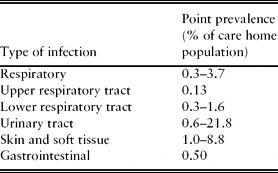
Data on the prevalence of infections in care homes come from the USA,Reference Nicolle, Strausbaugh and Garibaldi3, Reference Strausbaugh and Joseph12, Reference Tsan, Davis, Langberg, Hojlo, Pierce, Miller, Gaynes, Gibert, Montgomery, Bradley, Richards, Danko and Roselle13 Norway,Reference Andersen and Rasch14, Reference Eriksen, Iversen and Aavitsland15 Germany,Reference Engelhart, Hanses-Derendorf, Exner and Kramer16 the NetherlandsReference Cools and van der Meer17 and Belgium.Reference Moens, Haenen and Jacques18 These studies adopted differing designs, ranging from point-prevalence studies to rolling surveillance programmes, identified and reported infections in different ways and used different classification systems for infection. All were compromised by the fact that acute infections resulting in hospital admission, such as viral gastroenteritis, are readily identified, whereas endemic but unobtrusive infections, such as tinea corporis, are not. Regardless of these concerns, a clear hierarchy is evident with urinary tract infection (UTI) being the most prevalent non-respiratory infection, followed by soft tissue and gastrointestinal infections, as summarized in Table 1.
Point prevalence of common infections in care home populationsReference Nicolle, Strausbaugh and Garibaldi3, Reference Cheesebrough, Green, Gallimore, Wright and Brown11–Reference Tsan, Davis, Langberg, Hojlo, Pierce, Miller, Gaynes, Gibert, Montgomery, Bradley, Richards, Danko and Roselle13

Urinary tract infections
UTI is common amongst care home residentsReference Eriksen, Iversen and Aavitsland15, Reference Beck-Sague, Banerjee and Jarvis19 and is a major source of antibiotic prescribing in this group. Incidence and prevalence rates vary according to the diagnostic criteria used and whether they include patients with asymptomatic bacteriuria or catheters.Reference Garibaldi20 A study in Californian nursing homes using resident records and laboratory reports determined an incidence of 34.2%,Reference Beck-Sague, Villarino, Giuliano, Welbel, Latts, Manangan, Sinkowitz and Jarvis21 whilst a prospective year-long surveillance study in a 103-bedded nursing home in Germany reported an incidence of one infection per 1000 resident-days.Reference Engelhart, Hanses-Derendorf, Exner and Kramer16 Point-prevalence rates have been reported to be 1.58 to 3.8 in nursing homes.Reference Tsan, Davis, Langberg, Hojlo, Pierce, Miller, Gaynes, Gibert, Montgomery, Bradley, Richards, Danko and Roselle13, Reference Eriksen, Iversen and Aavitsland15 The prevalence of asymptomatic bacteriuria is much higher, with rates of 15 to 50% in non-catheterized US residents of long-term care facilities,Reference Nicolle22 and similar rates documented in other countries.Reference Hedin, Petersson, Widebäck, Kahlmeter and Mölstad23, Reference Aguirre-Avalos, Zavala-Silva, Daz-Nava, Amaya-Tapia and Aguilar-Benavides24
Bacteriology
The commonest causes of UTI in older people are Escherichia coli and Proteus mirabilis. Reference Nicolle22, Reference Vromen, van der Ven, Knols and Stobberingh25 However, care home residents more frequently experience UTI due to bacteria that are antibiotic-resistant or more commonly associated with hospital infection, including Pseudomonas aeruginosa, Klebsiella pneumoniae, Citrobacter spp. or Providencia stuartii. Reference Muder, Brennen, Wagener and Goetz26 This may, in part, be attributable to the high incidence of antibiotic prescribing in the older population, with studies suggesting a strong link between the frequency with which an antibiotic is prescribed and subsequent antimicrobial resistance amongst urinary pathogens.Reference Vromen, van der Ven, Knols and Stobberingh25, Reference Cohen, Lautenbach, Morales and Linkin27
Asymptomatic bacteriuria describes a positive urine culture, with or without pyuria and without associated clinical symptoms. It is more common in women, with advancing age,Reference Hassanzadeh and Motamedifar28 is associated with pyuria in over 90% of cases,Reference Nicolle22 is inevitable in long-term catheterization and has an incidence of 3–6% per day with short-term catheters.29 Treatment has no effect on mortality or incidence of symptomatic infection and leads to morbidity from drug side-effects and a higher incidence of antimicrobial resistance.Reference Nicolle22 The number needed to harm (NNH) for antibiotic treatment of asymptomatic bacteriuria is 3 (95% CI 2–10).29
Diagnosis
The diagnosis of UTI is frequently overestimated in care home residents.Reference Stevenson, Moore and Sleeper30 Asymptomatic bacteriuria should not be treated and symptomatic enquiry should therefore guide diagnosis. Symptoms are commonly divided into lower urinary tract symptoms (LUTS) – dysuria, urgency and frequency – and upper urinary tract symptoms (UUTS) – LUTS plus loin pain and fever.
Diagnostic criteria for UTI in residents of long-term care facilities were developed in 2000 by a US expert-consensus panel using a modified Delphi approach.Reference Loeb, Bentley, Bradley, Crossley, Garibaldi, Gantz, McGeer, Muder, Mylotte, Nicolle, Nurse, Paton, Simor, Smith and Strausbaugh31 They suggested, for patients without a catheter, that a UTI could be diagnosed on the basis of acute dysuria alone, or a fever of 37.9 °C plus any of: new or worsening urgency, frequency, suprapubic pain, macroscopic haematuria, urinary incontinence or costovertebral angle tenderness. In those with a catheter, LUTS were held to be less useful and it was therefore suggested that diagnosis be on the basis of a fever of 37.9 °C or 1.5 °C over baseline, new costovertebral angle tenderness, rigors or new onset of delirium. It is likely, however, that the false attribution of delirium to urinary tract infection because of the high prevalence of asymptomatic bacteriuria results in much of the over-treatment previously describedReference McMurdo and Gillespie32 and these guidelines should therefore be applied with some degree of caution.
A study of 551 non-catheterized nursing home residents found dysuria (RR 1.58, 95% CI 1.10–2.03), change in character of urine (RR 1.42, 95% CI 1.07–1.79) and change in mental status (RR 1.38, 95% CI 1.03–1.74) to be associated with bacteriuria and pyuria.Reference Juthani-Mehta, Quagliarello, Perrelli, Towle, Van Ness and Tinetti33 Dysuria plus one or both other symptoms was the highest predictor of bacteriuria/pyuria and identified 63.2% of people with a UTI.
Obtaining samples
Obtaining samples of urine from care home residents may be difficult due to frailty, incontinence and cognitive impairment. A mid-stream urine is non-invasive but is associated with a high contamination rate which, contrary to received wisdom, is not reduced by cleansing the urethra with water.34 In men a urethral sheath can be used in patients who cannot produce a specimen, whilst in women an in-and-out catheter may be the best option.Reference Nicolle22 Newcastle urine collection pads (UCPs) represent a non-invasive way of collecting urine, although specimens collected from these are much more useful for dipstick urinalysis than microbiological analysis.Reference Macfarlane, Ellis, Hughes, Houghton and Lord35, Reference Farrell, Devine, Lancaster and Judd36
Bedside tests
Bedside tests are useful only as an adjunct to clinical diagnosis. Visual inspection of urine has a 90.4% sensitivity, but only a 66.4% specificity for bacteriuria and is dependent upon the experience of the observer, so is not a useful test.29 Dipstick tests are frequently positive for leucocytes, due to the high prevalence of asymptomatic bacteriuria in the care home population. A dipstick positive for leucocytes and nitrites has a disappointingly low positive predictive value of 44%.Reference Juthani-Mehta, Quagliarello, Perrelli, Towle, Van Ness and Tinetti33 Dipstick tests can also miss UTI as some organisms, including Streptococcus pneumoniae, Enterococcus or Pseudomonas aeruginosa, do not express bacterial nitrate reductase.Reference Beier37 They are therefore of limited value in care homes. Men have a high incidence of UTI secondary to organisms that may not form nitrites and should have urine sent for culture if they have symptoms of UTI, regardless of dipstick result.29 Dipstick tests should not be performed in patients with long-term catheters, as constant bacteriuria and pyuria means that the test is not useful.
Laboratory diagnosis
The threshold for laboratory diagnosis of UTI varies between countries. In the UK, 104 colony-forming units per ml (cfu/ml) is used as a lower threshold of a positive culture.34 However, counts as low as 102 cfu/ml may be accepted in women with definite symptoms of urinary tract infection (‘low-count’ UTI).29 In men, while there is less evidence to guide laboratory diagnosis, a lower cut-off of 103 cfu/ml with 80% predominance of one organism may be diagnostic of UTI.29 This is lower than the current UK laboratory standard of 104 cfu/ml, and samples with 103 cfu/ml may be reported as ‘no significant growth’. Liaison with a microbiologist may be indicated if a UTI is suspected clinically but a sample is negative.
In catheterized patients, surveillance cultures are not necessary and may lead to harm of the patient through unnecessary treatment. Similarly, follow-up cultures after successful treatment are not required.34
Prevention
A recent Cochrane review considering prevention of UTI suggested that antibiotic prophylaxis was beneficial in non-pregnant patients.29, Reference Albert, Huertas, Pereiró, Sanfélix, Gosalbes and Perrota38 The benefit of antibiotics ceased after discontinuation. However, the majority of studies were in younger patients and no studies were conducted specifically in the care home setting. Furthermore, the incidence of Clostridium difficile enteritis in care homes is high and the role of antibiotics in the aetiology of such infections well demonstrated.
The Scottish Intercollegiate Guideline Network (SIGN) suggests that high-dose cranberry tablets can be used to prevent recurrent UTI.29 Only one head-to-head trial has compared the effectiveness of antibiotic prophylaxis with cranberry products, showing a modest but statistically non-significant advantage for antibiotics, with a relative risk of symptomatic UTI during treatment of 1.62 in the cranberry group compared with antibiotics.Reference McMurdo, Argo, Phillips, Daly and Davey39 The number needed to treat to prevent one infection with cranberry is 6.4, compared with 1.1 for antibiotics, but the number of adverse events is significantly lower.Reference Sumukadas, Davey and McMurdo40 Care is needed when advising cranberry for those on warfarin as the INR (international normalized ratio) may be increased. Oral oestrogens appear to be less effective than antibiotic prophylaxis and are not recommended for prevention of UTI.29 Vaginal oestrogens may be of some benefit.
Treatment
Women with LUTS may be treated with 3-day courses of antibiotics,29 though some older women will relapse and in this case longer courses of up to 10 days may be needed. A Cochrane review compared single dose, 3–6 days and 7–9 days of antibiotic therapy for UTI and concluded that 3–6 days was associated with fewer adverse effects than longer courses, but had similar benefits.Reference Lutters and Vogt-Ferrier41 Single-dose therapy was least effective.
Men usually need longer courses of antibiotics (7–14 days) due to high rates of prostatic involvement.29 Some UTIs are described as ‘complicated’ because bacteria are more difficult to eradicate, and longer courses of antibiotics are necessary. Examples of abnormalities that cause complicated UTI include renal or bladder stones, the presence of a urinary catheter, diabetes mellitus, neurogenic bladder, bladder outflow obstruction and ureteric reflux, all of which are common in care home residents. Because patients with catheters commonly present with multi-resistant organisms, treatment should be given according to antibiotic sensitivities. If treatment cannot be delayed, then antibiotic choice should take into account any previous positive urine cultures.
SIGN guidelines recommend ciprofloxacin for 7 days as first-line treatment for patients with UUTS because of the possibility of bacteraemia.29 Quinolones may be particularly useful in the care home setting because they produce similar plasma levels whether given orally or intravenouslyReference Beier37 and thus can mitigate the need to admit to hospital. It should be noted that quinolones should not be used for treatment of UTI in general due to a high associated incidence of Clostridium difficile 29 and should probably only be commenced following discussion with a microbiologist. Men in care homes should be referred to urology if they fail to respond to antibiotics, develop two UTIs within 3 months, or manifest UUTS.29
Skin and soft-tissue infections
The prevalence of skin infections is 1.0–8.8% amongst the care home population, but they may account for up to 50% of infections.Reference Eriksen, Iversen and Aavitsland15, Reference Garibaldi20 Infections with methicillin-resistant Staphylococcus aureus (MRSA), infected decubitus ulcers, scabies and tinea raise specific issues for consideration in the care home setting.
MRSA
In the UK, 22–23% of care home residents are colonized with MRSA,Reference Baldwin, Gilpin, Hughes, Kearney, Gardiner, Cardwell and Tunney42, Reference Barr, Wilcox, Brady, Parnell, Darby and Tompkins43 compared with 0.8% of community-dwellersReference Nicolle22 and 15% of hospital in-patients aged over 65 years.Reference Maudsley, Stone, Kibbler, Iliffe, Conaty, Cookson, Duckworth, Johnson and Wallace44, Reference Hori, Sunley, Tami and Grundmann45 Colonization is seen in 1.1–35% of residents of long-term care facilities depending on country;Reference Baum, Schmidt, Svoboda, Bock, Hensley and Wendt46–Reference Manzur and Gudiol50 though the reasons for such wide-ranging prevalence are unclear, they may include institutional factors, such as the frequency of transfer to acute hospital, local infection control and antibiotic prescribing policies, and also the frequency of instrumentation.
Patients colonized with MRSA have a higher mortality than those colonized with methicillin-sensitive Staphylococcus aureus (MSSA), with an odds ratio of death of 1.93 (95% CI 1.54–2.42),Reference Cosgrove, Sakoulas, Perencevich, Schwaber, Karchmer and Carmeli51 though this difference is less marked in the care home population than in hospitalized patients,Reference Bradley52 possibly due to lower rates of instrumentation. Care home residents are more likely to become colonized if they have invasive devices (such as in-dwelling catheters or gastrostomy),Reference Mody, Maheshwari, Galecki, Kauffman and Bradley53 decubitus ulcers,Reference Bradley, Terpenning, Ramsey, Zarins, Jorgensen, Sottile, Schaberg and Kauffman54 have previously been colonized with MRSA, or have recently been on antibiotics.Reference O'Sullivan and Keane55
The interaction between reservoirs of MRSA in care homes and hospitals is well recognized, with recent transfer representing an independent risk factor for MRSA infection.Reference Manzur, Gavalda, Ruiz de Gopegui, Mariscal, Dominguez, Perez, Segura and Pujol56–Reference Fraise, Mitchell, Brien, Oldfield and Wise58 Failure to control infection rates in one reservoir can overwhelm the otherReference Cooper, Medley, Stone, Kibbler, Cookson, Roberts, Duckworth, Lai and Ebrahim59 and controlling colonization rates in care homes has therefore been seen as a possible way to influence infection rates in acute hospitals.Reference Hughes, Smith and Tunney60 Unfortunately, a Cochrane review revealed no evidence for effectiveness of eradication of MRSA using either topical or systemic antimicrobial therapy in any setting, including care homes.Reference Loeb, Main, Walker-Dilks and Eady61 A second Cochrane review, which sought randomized controlled trials evaluating barrier methods, hand-washing or environmental hygiene in a care home setting, found no studies to meet its inclusion criteria.Reference Hughes, Smith and Tunney60 Clearly, further care home-specific trials of MRSA-eradication and prevention strategies are needed if a cogent argument is to be made that such measures are either effective or beneficial.
Decubitus ulcers
Decubitus ulcers are common in care homes, with a prevalence of 11.9–39% compared with 8.3–23% of acute hospital in-patients.Reference Vanderwee, Clark, Dealey, Gunningberg and Defloor62 There is considerable international variation with prevalence being six times higher, for example, in the Netherlands than in Germany, with no apparent explanation for the difference.Reference Tannen, Dietz, Dassen and Halfens63 Incidence rates are at their highest in the first few days following admission to a home,Reference Bergstrom and Braden64 suggesting that many ulcers are sustained during acute admissions, prior to transfer to the home, or in the recovery period immediately following acute illness. The higher prevalence of MRSA and other antibiotic-resistant organismsReference Wiener, Quinn, Bradford, Goering, Nathan, Bush and Weinstein65 in care homes increases the likelihood that these ulcers will become colonized by multi-resistant bacteria. MRSA is more virulent and more likely to cause acute bacteraemia in active wounds such as decubitus ulcers than other bacteria.Reference Manzur and Gudiol50
Signs of infection in pressure ulcers are erythema at the ulcer margin, malodour, new pain, warmth, or purulent discharge. The International Guidelines on Pressure Ulcer Management recommend that infection be confirmed by either tissue biopsy or quantitative swab techniques before commencing antibiotics.66 Randomized controlled trial evidence to guide treatment is unavailable, but expert consensus suggests use of silver and iodine impregnated dressings as a first-line treament, with topical antibacterial agents reserved for patients slow to respond.66, 67 Systemic sepsis as a complication of decubitus ulcer has a high mortality in the care home population and physicians should have a low threshold for instituting hospital admission in patients who develop signs of sepsis.Reference Smith68
Osteomyelitis secondary to decubitus ulcer is significantly more likely in full-thickness ulcers involving bone.Reference Smith68 It cannot be diagnosed clinically in the care home setting and, when suspected, patients should be admitted to hospital for definitive imaging, usually magnetic resonance imaging, followed by deep bone biopsy to guide treatment.Reference Gannon and Braun69 Clearly, such decisions need to be shaped by an understanding of a resident's overall prognosis.
Scabies
Scabies is common in care homes. In one survey of 179 Canadian long-term care facilities, 25% reported a scabies outbreak over a one-year period.Reference Holness, DeKoven and Nethercott70 It is caused by irritation from the eggs, faeces and saliva of the Sarcoptes scabiei mite, which reproduces in the interdigital spaces of the hands and feet, axillae and genital regions of infected patients. The usual response is for a patient to scratch, killing the mite and therefore keeping the number of infesting organisms low. The classical presentation is of intense pruritis, widespread papules, vesicles and excoriations and, most characteristically, serpiginous burrows a millimetre or two in length in the interdigital spaces or on the forearm. On close inspection, the lesion can sometimes be seen to have a burrow entrance, with a vesicle (and sometimes a mite, visible as a black dot) at the opposite end.Reference Tjioe and Vissers71 Scabies can be sexually transmitted and it is important to remember this as a differential diagnosis for genital pruritis in the care home population.Reference Garcia, Lopez-Areal and Martinez72
Norwegian, or crusted, scabies is a fulminant version of the infection, characterized by high levels of infestation with thousands of mites on a single patient,Reference Tjioe and Vissers71 due to frailty, immunosenescence and a reduced ability to scratch.Reference Tjioe and Vissers71, Reference Heukelbach and Feldmeier73 A consequence of such high levels of infestation is the formation of atypical crusted skin lesions, which can be indistinguishable from psoriasis or eczema. Eosinophilia is seen in just over half of cases, which may raise suspicion.Reference Roberts, Huffam, Walton and Currie74 Serum IgE levels are increased in up to 98% of cases, but this test is not routinely conducted in clinical practice. Classical (non-Norwegian) scabies is contagious where there is prolonged skin-to-skin contact,Reference Mellanby75 which is common in care homes. Furthermore, patients are often asymptomatic but contagious during the 3-week incubation periodReference Chosidow76 – during which time they could easily infect staff members or other residents. Norwegian scabies is highly contagious because of the high parasite load and can spread by even transient skin-to-skin contact.Reference Heukelbach and Feldmeier73, Reference Chosidow76
Current guidelines tend to favour the use of topical permethrin on the basis of proven efficacy and a favourable side-effect profile.77, Reference Strong and Johnstone78 Malathion is probably better tolerated, but has less evidence supporting its efficacy and, in particular, no head-to-head trial with permethrin is available.Reference Strong and Johnstone78 Effective application, with complete body coverage below the neck and concordance with treatment is essential for efficacy – permethrin requires two applications lasting 12 h, and malathion requires one application lasting 24 h. A key issue in care homes is that all residents with scabies, along with all residents or staff who have had contact with them, are treated simultaneously – this in practice often means treating all residents and staff in the home.79
Oral ivermectin is an effective but controversial treatment against scabies,Reference Meinking, Taplin, Herminda, Pardo and Kerdel80 because of excess deaths following treatment amongst 47 residents of a Canadian long-term care facility.Reference Barkwell and Shields81 However, most authorities assert that the treatment is safe, as these findings were not reproduced in cohorts of 47 ColombianReference Diazgranados and Costa82 and 220 DutchReference Reintjes and Hoek83 nursing home residents. It is available in the UK on a named patient basis for treatment of Norwegian scabies,77 but is not recommended by the Food and Drug Administration in the US.Reference Scheinfeld84
Following treatment, the patient's bedding and clothing should be washed at minimum 50 °C and all soft furnishings and carpets vacuumed.77 The scabies mite is incapable of surviving outside of the body for longer than 24–36 h in conditions typically found in centrally heated care homesReference Arlian, Runyan, Achar and Estes85 and is dependent on shed skin cells for survival, which are readily removed by modern vacuum cleaners.
Tinea
Tinea pedis, corporis and capitis describe fungal infections of the feet, body and scalp, respectively. These are characteristically superficial skin infections of tricophyton or microsporum species and are usually sporadic and readily controlled by routine topical antifungal therapy.Reference Havlickova, Czaika and Friedrich86 Both outbreaks and epidemics of tinea have been described in care homesReference Summerbell, Krajden and Kane87, Reference Kakutani, Kakutani and Mochizuki88 and involved atypical fungal organisms, spread by staff and personal hygiene utensils (combs and razors). Staff also contracted the infection. Therefore staff need to ensure both prompt medical attention and close attention to barrier nursing methods when index cases of tinea are identified.
Gastrointestinal infections
Although the incidence of gastroenteritis is relatively low in older patients, care home residents are much more likely than their community-dwelling counterparts to be hospitalized or die as a consequence of infection.Reference Kirk, Roberts and Horvath89 A US review conducted between 1995 and 1997 reported the death rate in nursing home residents due to gastroenteritis as 38.91 per 100,000 people (95% CI 38.55–39.27), compared with 8.50 for all over-65sReference Frenzen90 (95% CI 8.47–8.53). Gastroenteritis can be split into viral and bacterial aetiology, with special consideration given to Clostridium difficile given its high mortality in this group.
Viral gastroenteritis
The incidence of viral gastroenteritis, of which the two most common causes are norovirus (synonyms ‘Norwalk-like viruses’ and ‘small, round-structured viruses’) and rotavirus, considerably outstrips that of bacterial gastrointestinal infections in care homes.Reference Marshall, Botes, Gorrie, Boardman, Gregory, Griffith, Hogg, Dimitriadis, Catton and Bishop91 In 2006, norovirus was the cause of 96% of acute gastroenteritis outbreaks in the US. Of these, 50% of the non-food-related outbreaks occurred in long-term care facilities.92 In Europe, 34–39% of norovirus outbreaks occur in care homesReference Fretz, Svoboda, Thi, Tanner and Baumgartner93, Reference Lopman, Adak, Reacher and Brown94 and are commonly associated with person-to-person spread, predominantly via the faecal oral route, even when the index case is acquired from food.92, 95 A characteristic winter peak in incidence occurs, which coincides almost exactly with the winter peak in respiratory infections.Reference Lopman, Adak, Reacher and Brown94
Kaplan et al.Reference Kaplan, Feldman, Campbell, Lookabaugh and Gary96 suggested that viral gastroenteritis can be diagnosed clinically and is characterized by a short incubation period (24–60 h), a short infection duration (12–60 h) and a high frequency of vomiting (>50% of cases). These criteria are, however, based upon studies in healthy volunteers and critics suggest that infections are both less typical and less benign in care home residents.Reference Lopman, Adak, Reacher and Brown94
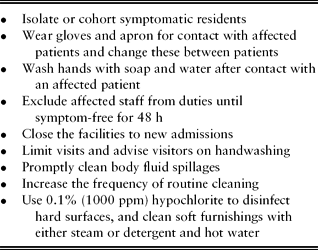
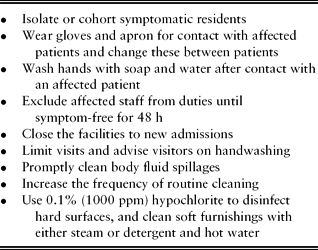
Because norovirus is environmentally very stable, difficult to eradicate and highly infectious, particular attention is required to infection control measures. Chadwick et al.Reference Chadwick, Beards, Brown, Caul, Cheesbrough, Clarke, Curry, O'Brien, Quigley, Sellwood and Westmoreland97 provided useful recommendations for the containment of norovirus outbreaks in the hospital setting, most of which also apply to the care home setting, and these are summarized in Box 1.
Measures for containment of norovirus infection, from Chadwick et al.Reference Chadwick, Beards, Brown, Caul, Cheesbrough, Clarke, Curry, O'Brien, Quigley, Sellwood and Westmoreland97
Chlorhexidine and alcohol are ineffective against norovirus and therefore bleach must be used for cleansing surfaces, and soap and water for washing hands.Reference Chadwick, Beards, Brown, Caul, Cheesbrough, Clarke, Curry, O'Brien, Quigley, Sellwood and Westmoreland97, Reference Drinka98 Staff must wear protective clothing during contact with infected residents, as exposure to vomitus increases the risk of contracting the illness, though concordance with wearing gowns in particular appears poor.95 Isolation and cohorting of residents can prove difficult in care homes due to shared bathroom facilities and wandering residents. Minimizing the amount of time for which residents are isolated helps considerably. For norovirus, viral shedding in stool normally peaks between 24 and 72 h,Reference Graham, Jiang, Tanaka, Opekun, Madore and Estes99 but can last longer and has been reported up to 45 days following resolution of symptoms in care home residents.Reference Tu, Bull, Kim, McIver, Heron, Rawlinson and White100 On the basis of pragmatism, most authors recommend isolating patients for 48–72 h after symptom resolution.Reference Drinka98
The recommendation that staff be excluded from work for 48 h following resolution of symptoms is similarly pragmatic, although longer periods of staff exclusion may be both desirable and cost-effective. A UK case-control study comparing staff exclusion for either 48 or 72 h showed significantly lower infection and attack rates in the 72-h group and suggested that the net effect on staff availability was minimal.Reference Vivancos, Sundkvist, Barker, Burton and Nair101 Staff education and a no-blame culture are essential to maintain staff compliance with such protocols, as staff ‘presenteeism’ during illness is common.95
Much of the excess morbidity and mortality associated with viral gastroenteritis in the care home cohort is likely to be due to the effects of dehydrationReference Lopman, Adak, Reacher and Brown94 and treatment largely focuses on avoiding this. UK care homes are unable to provide intravenous fluids and such therapy necessitates transfer to hospital. Clearly such transfer is problematic, because it spreads infection and exposes a frail patient to the risks of the acute hospital. An alternative is to use antimotility drugs, such as loperamide or racecadotril,Reference Gallelli, Colosimo, Tolotta, Falcone, Luberto, Curto, Rende, Mazzei, Marigliano, De Sarro and Cucchiara102 whilst pursuing aggressive oral rehydration.
Food-borne gastroenteritis
Food-borne gastroenteritis outbreaks can readily take place in care homes because food is often prepared in a central kitchen and served communally. Outbreaks due to Bacillus cereus, Reference DeBuono, Brondum, Kramer, Gilbert and Opal103Salmonella enteritidis Reference Frank, Buchholz, Maass, Schröder, Bracht, Domke, Rabsch and Fell104 and verotoxin-producing Escherichia coli serotype O157105 have been described. Depending on the organism, these outbreaks can either be self-limiting or perpetuated by person-to-person spread. The potential for spread is greater in care homes than in the community due to the combination of close contact between residents and the high rates of faecal incontinence, especially during diarrhoeal illness. E. coli O157 is particularly important because of its association with haemolytic uraemic syndrome and excess mortality is reported above the age of 50 years.Reference Reiss, Kunz, Koin and Keeffe106 It can present non-specifically in care home residents, with visible bloody diarrhoea in only 65–75% of patients.Reference Reiss, Kunz, Koin and Keeffe106 Of the four care home outbreaks reported in the literature, the rate of conversion to haemolytic uraemic syndrome ranged from 0 to 14.2%, and the mortality rate from 3 to 14.2%.Reference Reiss, Kunz, Koin and Keeffe106–Reference Waters, Sharp and Dev110
Clostridium difficile enteritis
Residence in a care home, especially in the first year after admission, is an independent risk factor for Clostridium difficile infection, which occurs in 7–9% of residents in the US compared with 2% of healthy adults.Reference Al-Tureihi, Hassoun, Wolf-Klein and Isenberg111 Reasons for this include high levels of antibiotic prescribing, the increased incidence of proton-pump inhibitor-mediated achlorydia and the frailty of care home residents.Reference Al-Tureihi, Hassoun, Wolf-Klein and Isenberg111, Reference Crogan and Evans112 Once established in a home, Clostridium difficile can spread via the faecal-oral route and through contact with contaminated surfaces and attention to isolation measures is, again, important. Handwashing using soap and surface cleansing using hypochlorite-based substances are essential because these, unlike alcohol, are sporicidal.Reference Crogan and Evans112
Generic issues around gastroenteritis in care homes
Analysis of stool specimens is particularly important in care home residents because it allows correct selection of treatment. Loperamide, for example, is best avoided in haemorrhagic E. coli or Clostridium difficile infectionsReference Holtz, Neill and Tarr113 but represents an important therapy in viral gastroenteritis. It also allows epidemiological analysis of infections to identify the infecting strain of each organism and track its spread.
Regardless of the cause of enteritis, it is likely that the early parts of recognition and management will be conducted without input from a doctor, or possibly even a nurse. Thus operational definitions for gastroenteritis outbreaks are essential.Reference Drinka98, Reference Frank, Buchholz, Maass, Schröder, Bracht, Domke, Rabsch and Fell104 These should, ideally, be written in lay language and presented alongside clear guidelines about early isolation, specimen collection and fluid management. Such guidelines are not, at present, universally available.
Conclusion
Because of the concentration of frail older people in a semi-closed environment, care homes present particular challenges in the diagnosis and management of infection. Infections that are frequently inconsequential in community-dwelling adults can be life-threatening in care home residents, as is the case with UTI. Infections can also behave in atypical ways in this cohort, as is the case with Norwegian scabies or epidemic tinea.
A further challenge when dealing with such frail patients is deciding when to admit them to acute hospital care – which is fraught with risk. There is often an alternative, for example by using intramuscular antibiotics or oral quinolones for UTI, or by using antimotility agents in viral gastroenteritis. Occasionally, however, hospitalization cannot be avoided, as when there is need for detailed imaging and bone biopsy in suspected osteomyelitis complicating decubitus ulcer. When such difficult decisions are required they should be made with attention to the patient's overall prognosis and stated wishes.
At an individual home level, prompt recognition and treatment coupled with rigorous infection control are needed to minimize the impact of infection. The fact that care, in the UK at least, is often provided by staff without healthcare qualifications is a challenge to such systematic response. Consideration must be given as to what role care home staff can and should play. Guidelines for the sector should be written with them in mind and, almost certainly, with their input.
At a public health level, antibiotic stewardship and improved links from homes to microbiology and infection control services seem intuitive responses. How to provide such support consistently to a highly heterogeneous sector is a genuine challenge for health service providers and an area for research and development going forward.
Conflicts of interest
The authors declare that they have no conflicts of interests.