INTRODUCTION
The ESRC project, “What makes an Important Case?”Footnote 1 that is currently underway looks at a very fundamental, yet largely unexplored subject, as it asks how the case based approach of the common law actually develops in practice. Against a background of precedent within the common law – where decisions of higher courts are binding on lower courts – the project examines exactly how and why particular reported cases become significant in the sense that they are cited more frequently than others and come to represent or define the legal position in a particular area of practice or doctrine. The research has three objectives. Firstly it seeks to significantly advance understandings of the actual operation of the common law in practice and, in particular, how some judicial decisions, rather than others, come to be regarded as “important” in the sense that they shape law and practice. The research will thus develop a fully dimensional, socio-legal understanding of the operation of precedent within the common law. Drawing upon the specialist area of judicial review, the research seeks to provide an account of the creation, transmission and validation of legal knowledge within legal practice, academia, and policy communities. This will operate as a corrective to those dominant traditional accounts within the existing literature which, where they address the question at all, generally characterise precedent as operating somehow automatically and in a mechanistic way. In this way, the research makes a strong theoretical contribution to understanding how precedent is actually developed within the dynamics of legal practice and practice-related scholarship. Secondly, the research provides an account of how various communities of practice and communities of interest utilise legal precedent in one particular area, and how they interact with one another when transmitting and validating “important” legal precedents. The research attempts to provide an understanding of the interplay of various factors, which range from the exigencies of case reporting, through the requirements and social dynamics of practice, the judicial endorsement of a case, and the influence of academic and academic related commentaries. It provides an account of how the legal knowledge that defines “an important case” is transmitted across various levels of the legal community, and how it is accepted, acted upon and shaped by various users, and then subsumed within wider repositories of legal knowledge. Thirdly, the research tests a particular hypothesis about the sociology of legal knowledge – how it is created and transmitted between and among elites and satellite groups; how it is validated by judges; and how it is then returned to the practice communities for further refinement within an iterative process. This involves building upon the earlier work of one of the researchers which developed socio- legal understandings of legal knowledge as a concept involving more than straightforward doctrinal law but including also a variety of social, procedural and practical elements.Footnote 2
John Morison

THE WIDER CONTEXT: PRECEDENT AND INDETERMINACY
There are approximately 250,000 cases heard in the United Kingdom courts and tribunals every year. About 5000 decisions are given in the higher courts. Of course most of these are fact-specific and have no application beyond the case being considered. It can be estimated that perhaps only somewhere between 1.25% and 2.0% of the total are reported annually in some form; although of course, as shall be discussed later, there are many forms and varieties in the way that “raw” legal data can be now be accessed. Nevertheless, this still means that there is a vast, and increasing, volume of judicial decisions for lawyers and judges to work with. Each lawyer within the system is under a duty to bring the court's attention to any relevant decision and each judge is subject to appeal if his or her decision does not adequately reflect existing law. How do those working within the legal system deal with this? How is this huge accretion of legal authority managed within the system? How is it agreed which cases are significant and when to stop finding further potentially relevant precedent? In short, how is the potential for almost limitless indeterminacy resolved?
The starting point is the doctrine of stare decisis, or binding precedent, that is central to the workings of the UK's hierarchical court structure. At its most basic, this doctrine means that a decision of a higher court in an individual legal case becomes binding on any lower court that subsequently hears a dispute raising similar points of law. The doctrine has been described as the “life-blood of every legal system”Footnote 3 but there is, as yet, very little socio-legal work that explains the reality of how it works in practice, and, in particular, why exactly some individual precedents become elevated within the body of legal knowledge that is shared by communities of lawyers. It is not really enough to say that only “relevant” decisions of an equal or higher court count as precedent, as if the ratio decidendi of any case was clear, unambiguous and easily discernable. Law, like fact, is, in any individual application or circumstance, something that is socially created and capable of being almost infinitely debated – so long as resources permit – until some authoritative pronouncement is made. The world cannot be modelled in terms of clear issues of law and obvious matters of fact, where the task of the lawyer is simply one that involves selecting the “correct” law to match the relevant, universally agreed fact situation. There is a much more complex, socially conditioned process going on as legal information is sorted, evaluated and deployed within the dynamic circumstances of legal practice. We know very little about how legal actors select cases for use in argument in a court setting or how cases come to be used repeatedly, thereby attaining the status of a “landmark” ruling that all related arguments must navigate. While the idea of an important or leading case is a familiar phenomenon to anyone practicing law or regularly reading law reports, there is limited understanding about exactly how particular cases are taken up by communities of experts and transmitted or translated to other practice communities or, indeed, how academic commentary, or the vagaries of case reporting in the electronic age, is reflected in the practice of law when it comes to deciding on which cases to deploy in argument. Instead we are left with the formal description that precedent in UK law is a binding doctrine under which decided cases are vested with the quality of “law” and given the status of “rules” that must be followed if they cannot be distinguished.Footnote 4 As one classic statement puts it,
“our common law system consists in the applying to new combinations of circumstances those rules of law which we derive from legal principles and judicial precedents; and for the sake of attaining uniformity, consistency and certainty, we must apply those rules, where they are not plainly unreasonable and inconvenient, to all cases which arise”.Footnote 5
Such descriptions of the doctrine do not explain how, in the reality of practice, a particular case comes to be selected, and more specifically, how it attains the status of an important precedent that will appear repeatedly in arguments and come to be seen as a statement of the legal position.
In terms of scholarly enquiry, legal philosophers have long recognised the operation of precedent as central to law.Footnote 6 In the UK, Goodhart opened up an agenda for enquiry in the area focusing on discussion of how courts determine the ratio decidendi of a case, and exploring issues of continuity, certainty and change within a legal system.Footnote 7 This debate was joined by SimpsonFootnote 8, Stone,Footnote 9 and MontroseFootnote 10 along with Goodhart.Footnote 11 to produce a classic discussion asking important questions about when courts should follow earlier decisions, when they must, as well as when they should not. This debate ranged across basic questions about the nature of authority, and the proper relationship between courts at different levels, as well as the value of continuity and change in a legal order. In more recent times interest in this area has remained central to legal theory.Footnote 12 Basic questions about how precedent operates are central to educational concerns in law, too, and are seen as fundamental to legal skills and understanding the machinery of justice.Footnote 13 However, as precedent is discussed in the context of legal systems even socio-legal aware student texts such as Cownie et al.Footnote 14 Stychin and Mulchay,Footnote 15 Goodrich,Footnote 16 and Manchester and SalterFootnote 17 tend quickly to move the emphasis to issues about rules for statutory interpretation, Pepper v Hart, and the impact of the Human Rights Act in the courts.
A similar phenomenon is true in the United States where there are some classical works dealing directly with precedent.Footnote 18 There are also several important modern general accounts.Footnote 19 Quickly, however, here too the mainstream debate moves to consideration of other issues. There is analysis of precedent in relation to the Constitution.Footnote 20 The issue of judicial activism speedily demands attention,Footnote 21 particularly in the context of the Supreme Court's handling of precedent.Footnote 22 Here there are also some insider accounts of precedent from retired judges at different levels.Footnote 23 However all these approaches tend to look at the consequences of following precedent rather than the mechanics of how some cases rather than others come to be recognised as binding by those within the system. As Roscoe Pound complained, as long ago as 1949, there is in all discussion a tendency to characterise the operation of precedent as something that simply happens: as “ the mechanical, logical application of fixed rules”.Footnote 24
Of course this is not universal. There have been attempts to look at how precedent develops in terms of communication theory,Footnote 25 from a law and economics approach,Footnote 26 as well as from the perspective of game theory.Footnote 27 Perhaps most interestingly for this research study are the efforts of the Critical Legal Studies (CLS) movement. In the course of its general critique of the assumptions of liberalism found in law, and the contradictions inherent in a system that claims that it mechanically applies appropriate rules to disputes, CLS has asked some basic questions about precedent.Footnote 28 The CLS critique of the indeterminacy in law focuses on the looseness of the relationship between legal decision makers and the supposedly authoritative material in the form of cases that can in some way compel determinate results in concrete cases.Footnote 29 While legal reasoning may attain an appearance of coherence it does so only by constructing boundaries or compartments between areas of law, shutting down consideration of counter-principles that might suggest another outcome. While the system may give an appearance that legal decisions are justified by clear reference to agreed legal rules, CLS insists that such coherence is illusory. It is always possible to see facts differently or invoke different principles of law as relevant and governing. Asking basic questions about how judges settle on what is important to them when faced with innumerable possibilities from the case reports, the CLS perspective aims to unmask the essentially political nature of law (and then the fundamental conflicts in law's foundation). This provides a critical edge that has not been seen since the American Realists asked similar questions through the work of Jerome Frank and Felix Cohen.Footnote 30
RESEARCH QUESTIONS
It is just such a critical edge that is central to this study and its core research question: how do cases come to be recognised as “important” by a range of actors who exist at varying removes from the more narrow legal business of creating precedents? In answering this question, the study focuses firmly on the experience of the actors themselves and on exactly how and why they put value on particular decisions rather than others. Within this, there are a number of related questions that pertain to the nature of legal knowledge. They include: How is information transmitted? In what way do precedents become known to both specialists and less specialist communities of users? What is it that ensures that some cases are recognised generally as important? How are these cases transmitted from specialist communities of interest (where they may be tested in specialist cases) to more general, user communities, and what is the effect of this? What is the relationship between the specialist practitioners and the wider group of occasional users of precedents? Where do practitioners obtain their information about new cases? What is the influence of the formal case reports and new media sources as opposed to practitioner blogs, informal networks or academic writing on the way in which practitioners select precedent? How in the reality of legal practice, do lawyers cope with the infinite potential for indeterminacy that faces them in the precedent system?Footnote 31 What is it that constrains lawyers from all parts of the system – opposing counsel pitted against each other as well as judges, each operating within the context of their own legal and professional milieu – from going off in pursuit of ever more arcane precedents to support particular positions? After all, as Unger says, “it will always be possible to find, retrospectively, more or less convincing ways to make a set of distinctions, or failures to distinguish, look credible …. every thoughtful law student or lawyer has had the disquieting sense of being able to argue too well or too easily for too many conflicting solutions”.Footnote 32 The fact that this potential for uncertainty is avoided is central to this project which asks how exactly legal knowledge is made, recognised and transmitted.
These research questions, or more precisely the answers that may be offered to them, have significance beyond legal theory. For those in legal practice there is an exponentially expanding reservoir of legal authority which must be sorted through and the “relevant” authority produced. Advisors, those litigating in court and judges face a babel of information in all sorts of formats. It is important for them to know what will “work” for their cause. Those providing legal advice require a degree of certainty that comes from there being a settled understanding of the legal position in any area. In court, an advocate needs to be able to engage with the other side, and with the judge, and process his or her argument. In a legal dispute, as with any argument in the real world, the disputants must agree about more than they disagree about: they must agree the basic terms on which the sides meet and interact and what the dispute is about. There is little point in an advocate on either side unleashing a range of authorities on points that are not agreed to be central to the issue. The details of the process by which this agreement occurs, and the way in which particular authorities come to be agreed as governing, is a fascinating and largely unexplored area. In part it will come down to what the advocates believe will be seen as relevant to the judge but here too there is a rich and complex social process occurring. For the judge, who by and large can consider only the authorities that are put to the court, there is the question of which authorities are relevant. This is by no means an automatic process where settled understandings are brought to bear. The judge does not simply consider “the facts” and select the “correct” authoritity to determine the issue in the same way as someone doing a jigsaw puzzle finds the piece that fits. Neither fact nor law exists in this reified sense. Both are created and conditioned from a complex social milieu.Footnote 33 The creation of an “important case” is a central element of this complex process, and investigation of this phenomenon is vital to understanding how legal practice actually happens.
The research has very obvious relevance to the world of legal information management which is currently undergoing a continuing revolution in terms of the number and variety of platforms available through developments in information and communication technology. Law reporting in the traditional sense, where accurate, more-or-less official, reports of cases are produced after an interval, is now augmented by a whole range of other resources which may be more immediate and accessible. The potential for uncertainty and indeterminacy increases exponentially with the increased volume of sources that are available. As shall we discussed briefly later, this introduces a whole range of practical considerations where relevance, immediacy and simple availability need to be balanced against obscurity, uncertainty and expediency. While a skilled researcher could produce authority for almost any proposition, it may well fall to the legal information specialist to make a judgement about what is really cogent and useful.
When it comes to legal education it is clear that the traditional law school within the common law world gives considerable emphasis to the role of precedent within the legal system. Research which questions the idea that cases simply emerge as important, and are generally agreed to be so in an uncritical way, is an useful corrective to some of these trends in traditional legal education. Indeed in an earlier project which considered the disparity between law in books and in the classroom, and law in action in the courts, one of the researchers on this project argued that an over-emphasis on traditional, uncritical ideas of precedent as generally agreed and beyond question, is potentially damaging.Footnote 34 It can contribute to a static view of law as something that exists complete and systematically at any given time, without admitting the dynamic nature of law and its role in facilitating change. Jerome Frank complained as long ago as 1949 that “in most university law schools the major part of the three years is spent in teaching a relatively simple technique – that of analyzing upper court opinions, ‘distinguishing cases’, constructing and modifying or critizing legal doctrinces. Three years is much too long for that job. Intelligent men [sic] can learn that dialectical technique in about six months …. but in law schools, much of the three years in squandered by bored students”.Footnote 35 An uncritical view of precedent as something that can be taught as a mechanical skill, to be deployed unthinkingly when analysing hierarchies of cases, is limiting the potential of law students. As Frank's contemporary and fellow American realist jurist, Felix Cohen, wrote, “law is a social process, a complex of human activities, and an adequate legal science must deal with cause and effect, with the past and the future”.Footnote 36 It is not helpful for legal education to offer up uncritically a series of “important cases” as if mastery of this arcane knowledge was by itself enough to become a successful lawyer. Law is dynamic, and a critical take on how cases become important, is a necessary element in a legal education that seeks to be be either an adequate preparation for practice or an education in how the legal system and society actually works.
SOME METHODOLOGICAL CONSIDERATIONS
As this project seeks to uncover what makes an important case, and so how the case-based approach of the common law actually develops in practice, it considers how and why particular reported cases come to represent or define what is the law in a particular area. The research focuses on the area of judicial review where it is hoped that the processes of creating an important case, and transmitting it across various communities of practice, can be seen in a speeded-up way because of the dynamic nature of this area of practice and the speed with which developments in the doctrine occur here. Also the cross-cutting nature of judicial review gives it a very real potential to engage the interest of different communities of lawyers and practitioners. Furthermore, the number of elite practitioners who are involved as either advocates, solicitors, judges or academic commentators is relatively managable, while at the same time the area is not so specialist as to inhibit the existence of a reasonable hinterland of practice where vital information about the state of the law is awaited by a sizeable community of less specialist practitioners and policy users.
With this in mind the research identifies some twenty to forty “important cases” over a period from 2005 to 2010. This is done in two ways. First, by creating and then reducing down a list of cases taken from the annual “Leading Cases” feature of the specialist Judicial Review journal; and, secondly, by making a trawl of the databases where cases are reported and some basic data about the frequency of citation can be obtained. A number of specialist blogs also provide information to refine the list in terms of how some expert users view new cases.
The list produced in this way is then tested and explored in a number of semi-structured interviews with elite informants. The idea here is simply to ask directly, those involved in the creation and transmission of legal information, how exactly they identify and value particular cases, and on exactly what basis. Interviewees include practitioners – both solicitors and barristers – involved in this specialist area, as well as specialist academics and judges, and a group of wider users of law. The interviews identify and analyse the characteristics that users of precedent believe make a case “important”. This information is used to create and test a typology highlighting elements for each case, such as its straightforward contribution to doctrine, its wider political significance, its role in consolidating precedent, or its practical importance in terms of effect on procedure. At the same time, the interviews elicit information on how particular cases are heard about and chosen, how their persuasive power is identified and calibrated, what specific role they play within a given argument, and how a particular case gains currency as a landmark to be negotiated in a specific area. The role of judges at the hearing of cases and on appeal, where they may endorse and validate a case, is also considered closely.
At the same time as the research follows straightforward socio-legal interview methodology it also uses the potential that newer formats of legal data bases present for researchers. Each of the selected cases is investigated through database searches and tracked in terms of how it came to be reported, in what format it was reported, and how it was distributed and accessed. Its subsequent use as a precedent, including the frequency with which it is cited, and the extent to which it is relied upon in argument, is mapped in detail and considered against the typology. This assists in gaining an understanding not only of how a case becomes “important” but also how an individual case is transmitted across the various practice communities and communities of interest, and how it becomes validated as useful legal knowledge. Moving from specialist to more general application in practice, and reflecting on how such information interacts and is mediated by academic scholarship, the research develops important knowledge about how legal argumentation is actually constructed and valued by different legal communities.
A FEW IMPORTANT DISTINCTIONS
It is, however, important when considering the idea of “importance” to make a number of basic distinctions. First of all, an “important” case is not the same as a “famous” case. There are many cases that are well-known, even to the general public. They may have shaped the law but they are not “important” in the sense of this research. Many people would be able to recall various sensational murder trials from Dr Crippen to Fred and Rosemary West, or widely reported cases such as that relating to Julian AssangeFootnote 37 or Max Mosley.Footnote 38 But these are not necessarily important cases in any wider sense. Further, some cases have a wider significance politically or constitutionally, such as the Belmarsh caseFootnote 39 or the Pinochet litigationFootnote 40 but again these are not “important” in the special sense used here.
The Law Reports and the Weekly Law Reports produced a Special Issue to celebrate the achievements of the Incorporated Council for Law Reporting in England and Wales where it collected together some ten “landmark cases”.Footnote 41 This is a sort of “Desert Island Discs” selection of cases nominated by the Society's reporters and contains such notable judgments as R v Dudley and Stephens Footnote 42, Carhill v Carbolic Smoke Ball Company,Footnote 43Donoghue v Stevenson,Footnote 44Associated Provincial Picture Houses Ltd v Wednesbury Corpn,Footnote 45 and American Cyanamid Co v. Ethicon Ltd.Footnote 46 These are all undoubtedly significant cases. Many will have changed the law markedly. Some will remain important statements of doctrine. Most will be known by almost all lawyers. However even these are not “important” in the sense of this research project. The project retains this label less for landmark cases and more for those authorities that are directly and continually useful to practitioners in the daily pursuit of legal practice. The fact that we have chosen to look particularly at the practice of judicial review, to find out what a range of lawyers working at different levels there find useful, restricts the view of importance to a particular area of law and to a group who encounter judicial review to a greater or lesser extent. It does however allow us to develop a very practical and specific view of what is “important”.
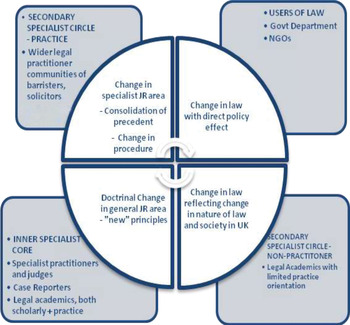
Indeed this focus puts the definition of “importance” very much within the group of actors working more or less within that specialist area of judicial review and allows this group to develop the concept. “Importance” here is defined initially by an inner core of specialist users who, in a sense, create the new law. Counsel and judges in the Administrative Division of the High Court who are regularly involved in judicial review cases are well-placed to discern which cases are novel and significant. Indeed, “importance” here, can perhaps be defined in terms of cases that make a change in the law or introduce “new” law. A case that consolidates precedent or makes significant or useful changes in procedure will also be seen as important. Specialist academics, particularly those who contribute to journals such as Judicial Review or write practitioner texts are also especially well placed to take a more detached yet still engaged look at what is an important case. We also include law reporters within this inner core because, as shall be discussed shortly, although they may perhaps tend to inclusion when deciding what cases to report, they do have a particular role in editing what comes to be seen as primary legal material.
At a second level there are also more occasional users of cases, a group which will include practitioners who would occasionally advise or argue judicial review matters, although this will not be their main focus of interest. In this group too, we include specialist advice workers who, although not necessarily lawyers, do work in fields such immigration or housing where judicial review proceedings are familiar. Within this secondary circle are included those more scholarly academic writers whose main interests are focused less on providing useful legal information for practitioners but more on looking at the law in general, in terms of its systemic direction and overall coherence. Importance here is a slightly different concept with a more long term orientation that reflects changes in the nature of society and how it is regulated by law. A further group who have a role in defining importance are those users of law, both in government and in nongovernmental organizations, who actually administer an administrative area within a legal framework. Here, importance will have much to do with how a case influences policy on the ground in areas such as immigration or planning.
Figure 1 above seeks to capture this dynamic conception of importance and the range of actors who construct it.
Initial criteria of “importance” for various users of law

The understandings of importance that are gleaned from these various actors are linked to the original understandings of importance that the researchers have developed from looking at the list of important cases in the specialist literature and how they have been subsequently used, as discerned from interrogating various databases. All this contributes to the development of a sophisticated, multi-dimensional view of “importance”, created from an iterative process and capable of being taken further by the researchers.
TRANSMITTING IMPORTANT LEGAL KNOWLEDGE
In the next stage, the research examines how this multi-textured idea of importance that is attached to particular cases is transmitted throughout the system. This involves looking at how legal knowledge is not only created and validated within the legal system but how it is passed on and to whom.
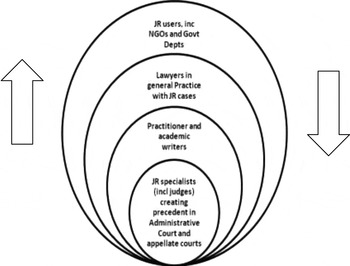
It is here that the researchers are keen to test a particular hypothesis about how legal knowledge is disseminated. It is one drawn from a key historical work in the sociology of scientific knowledge. Ludwik Fleck's classic text, Genesis and Development of a Scientific Fact,Footnote 47 which influenced the much better known work of Thomas Kuhn, is an important account of how scientists develop knowledge. Unlike Kuhn, who saw developments occurring in paradigm shifts, Fleck elaborated a more complex process whereby elite scientists working on pure research elaborate theories which are passed out (through scientific papers, seminars and more popular work) to other scientists who have a more practical orientation, and to technologists who seek to harness scientific advance. Fleck modelled a process whereby ideas move outwards through concentric circles of expertise and across various communities of practice. As this occurs, the ideas are tested and developed in practice. Here, their value and practicality is assessed in everyday application and evidence of their success in explaining what is happening then becomes raw material that returns to the specialist circle so that the initial idea can be subject to further evaluation and refinement. A version of this is modelled for use in the context of judicial review practice. See Figure 2 below.
Precedent Moving outwards from Specialists to Wider Communities of Practice – and back (after Ludvick Fleck)

This sees important cases being created by an elite group of specialist, judicial review practitioners and judges who are regularly involved in the Administrative Court and appellate courts in judicial review practice. The knowledge created there is then collected and passed onwards and outwards to practitioner and academic writers, and others, who make judgements about what is important. Through various case reports, textbooks and other material this information is then disseminated further to wider communities of practice where lawyers with a more general orientation actually use the cases in more quotidian circumstances, and find out how it works for them in everyday practice. Beyond this, certain “important cases” may spread out further to the users of judicial review, such as non-governmental organisations or government departments. Here, a case – such as (to take an example at the most extreme) Wednesbury – becomes well-known among users of law and policy, and determining of their actions. At each of these stages, and in the various practice communities, it will become apparent if the cases are in fact “important” in a practical sense.
If cases are used and cited by wider groups, and gain a degree of currency appropriate to the various levels of specialism in the different communities of practice, they will be cited and become established, and in turn will come back to the more elite group of practitioners, as authorities that have currency and value in wider practice. The definition of importance is, in this way, a self-referencing, endogenous one with the system.
By testing how judicial review cases become recognised as “important”, the research is seeking to better understand how, within a common law system generally, legal knowledge is not only created but validated and transmitted to the various user groups. It is at this point that it becomes important to gain a fuller understanding the mechanics of the process by which legal information is actually passed on.
THE CONDUITS OF LEGAL INFORMATION
There are clearly various conduits for the flow of information. These all have an influence on what information is passed on and how it reaches different actors within the system. One of the most significant is the law reporter. The history of law reporting is a long and interesting one dating from as early as 1189 with the Year Books transcribed from the Plea Rolls, and involving a whole range of competing providers and a multiplicity of resources. The number, range and variety in quality in the sources of reported cases led in 1865 to the creation of a scheme to publish the decisions of the superior courts of law and equity under the management of a council composed of members of the Inns of Court and the Incorporated Law Society. This is the Incorporated Council of Law Reporting (ICLR). The basis for reporting cases by this new body was set out by Nathaniel Lindley QC (who later became Master of the Rolls and a Law Lord) in A Paper on Legal Reports. This maintained that what should be reported should be limited to:
1. “All cases which introduce, or appear to introduce, a new principle or a new rule;
2. All cases which materially modify an existing principle or rule;
3. All cases which settle, or materially tend to settle, a question upon which the law is doubtful;
4. All cases which for any reason are peculiarly instructive”.Footnote 48
This remains an excellent definition, echoing our own within the research project. However, like our definition, it is one that is given full meaning only as it is interpreted, modified, and implemented by the variety of actors who are involved. In the area of law reporting, early findings from the research show that there is a rich social process within different professional and practice milieus which determine exactly how a case comes to the fore.
To start with there is a straightforward editing role. Out of the 5,000 cases per year capable of being binding precedents (and the figure may be as high as 8,000) there is a process of selection. There are various editing processes going on. The wide range of commercial bodies engaged in reporting law will select cases that they believe are in the specialist field that is of particular interest to their subscribers. One of the most significant editing processes occurs within the Incorporated Council of Law Reporting. The particular importance of ICLR reported cases arises in part because of the Council's semi-official role in deciding what is to become part of the record that has been given official endorsement of enhanced status by the 2001 Practice Direction.Footnote 49 This gives particular interest to the editing process that occurs in the ICLR process. They provide overnight “daily case” reports available free at www.lawreports.co.uk or via RSS feed. This is a fairly unedited, unselected source of law. From this, about 350 cases per annum are selected by the Council to appear in the Weekly Law Reports. Of these, about 150 are subsequently published in one of the four divisions of law as those that are the most important. To get to this stage (and level of importance) there has been a considerable amount of selection and editing.
All of these cases have been selected initially by a law reporter. Reporters have their own ideas of what importance means, and how to discover it. One of the interviewees told us: “after a while you develop a sort of nose for the indicators which tell you if there's going to be any new law.” This would seem to depend on several factors. For example, one law reporter told us how it was important to have relationships with the court participants. We were told that you “speak to the lawyers on either side … see skeleton arguments ..[but]..it varies from court to court how much access [you] can get to documents”. Another reporter told us that personalities are important: “… you know these judges have said this or these judges have said that.” Well-known advocates also are perhaps more likely to be reported. A reporter, speaking of a leading QC. told us: “he does tend to [be reported ] because of his reputation and he gets involved in cases that are significant”. It is also perhaps important to be present in court. We were told how reporters at ICLR have
“maintained that tradition of being in court…. You get much more of a feel for whether a case is really significant if you've listened to it being argued … [you] become familiar with the judges and with the content of the case law and therefore when a case comes up it will be readily apparent whether it's treading old ground or making a significant breakthrough”.
The report that is prepared by the reporter in the court may then be subject to an extensive editing process. This will involve, as one editor told us, “a process of being checked and annotated and filtered ..[putting in] …the head note and the various bells and whistles that we add to the judgement to make up the full report”. This may involve checking material with the participants, and much will depend on the speed, diligence and efficiency that the judges and counsel exhibit in commenting on drafts. For example we were told of a particular judge that “he is very nice and personable and would always come and be helpful. That makes a big difference to us”.
Such help factors may help a case come to the fore but the criteria of importance that the law reporters use remain wedded closely to the value that a case may bring to legal practitioners. We were told that it;
“is all based on our principles about what make a reportable case. Which is - a case is reportable if it establishes a new point of law or modifies an existing point of law; or clarifies, settles a question on which there's any doubt or is …. peculiarly instructive.”
It is not all about novelty or consolidation however. We were told that:
“sometimes a case will summarise the law really, almost like a text book. It will look at all the previous cases and although it hasn't changed the law or developed it in any way, the fact that it has gathered them all in one place and analysed them and commented on them makes it a useful case to report”.
Academic points, such as might interest those looking more broadly at the development of the law are not really significant here. Neither are wider issues of policy or political considerations. For example, one interviewee told us directly: “… you mentioned the political importance in cases - that's not something that we would really think was very significant”. The editors of the law reports are offering a product and it is one that must appeal to its main users. One senior editor put it this way:
“I suppose one way of looking at it is to say you're running a shop … or a department store and you employ buyers to go out and basically guess what the public is going to want to buy …. the buyers are there to choose what they think the shop will be successful in selling. And sometimes they don't get it right … But you're trying to anticipate what they're going to want….. so we're really trying to present in our publications the cases that we think people will need to want to look at.”
Of course this mediated form of law reporting, where editorial decisions have been made and criteria of importance considered, applies only to the more official forms of law reporting. While the early origins of official law reporting lay with the multiplicity of providers in Victorian Britain, there is now a remarkably similar situation as the proliferation of electronic resources offers a huge variety of legal information. Some of this is what the editors of the law reports describe as ‘“raw” legal data’, not subject to the various degrees of endorsement that comes from being one of the more recognised law reports. The enthusiastic adoption of the internet by many lawyers has hugely increased the amount of law on tap. There now exists a whole series of databases, newsletters, electronic updates, RSS feeders, twitter postings and blogs which provide enormous access to huge quantities of legal material. Unreported cases (which have always been available) are now perhaps easier to obtain but the degree and ease of access to such material must be balanced against its currency. (There are other factors involved too. For example, early investigations of this issue produced the story of the highly relevant unreported case which could be obtained from the court at a cost which exactly matched the counsel's brief fee.) The complex interplay of factors here will repay close investigation within the research project. So too will the very significant role played by the British and Irish Legal Information Institute (BAILII). It provides a very significant source of both reported cases and raw law.Footnote 50
FUTURE RESEARCH DIRECTIONS
Beyond the law reporters in their various guises there are a whole series of other conduits for information which will include law librarians and legal information specialists, professional networks and associations, and the various electronic means that each of these use to communicate information. The work of the project is to explore further these and other aspects, in an attempt to map the intricacies by which legal information is created, and then transmitted. This task is underway but not yet fully completed. It is expected however that the results will have a real resonance among a very wide group. It is hoped that the members of BIALL and the readership of Legal Information Management will be among that group.