

INTRODUCTION
Research examining U.S. racial disparities in health has often neglected Latinos, despite the fact that the Latino population is comprised of individuals who possess various combinations of European, African, Asian, and Indigenous ancestry (Mays et al., Reference Mays, Ponce, Washington and Cochran2003; McKenney and Bennett, Reference McKenney and Bennett1994; Rodriguez Reference Rodriguez2000). Latin America shares a common history of colonization with the United States in which Indigenous populations were decimated, slave labor was imported from Africa, and colonizers were European (Klein Reference Klein1986; Mintz Reference Mintz1989). As with the United States, notions of a racial hierarchy emerged within Latin America, where power and privilege were often associated with Whiteness, and disadvantage and disenfranchisement with Black and Indigenous populations (Torres-Saillant Reference Torres-Saillant, Dzidzienyo and Oboler2005).
Despite the shared colonization histories between the United States and Latin America, the racial diversity of the Latino population has been largely obscured within the United States by the pan-ethnic categorization of individuals from Latin America as Hispanic or Latino (Alcoff Reference Alcoff, Gracia and De Greiff2000). In adopting the Hispanic/Latino label, the impression may have been created that race is inconsequential for Latinos, potentially masking the challenges faced by a substantial segment of the population.
The pan-ethnic label may have also assisted in creating the impression that all individuals classified within the group are faring equally when it comes to health. Namely, despite the fact that, as a group, Latinos have poorer socioeconomic (SES) profiles compared to non-Latino Whites, their health has often been found to be equal to or better than non-Latino Whites (Escarce et al., Reference Escarce, Morales, Rumbaut, Tienda and Mitchell2006; Franzini et al., Reference Franzini, Ribble and Keddie2001). This finding, often referred to as the Hispanic or Latino Health Paradox (Hummer et al., Reference Hummer, Powers, Pullum, Gossman and Frisbie2007; Markides and Coreil, Reference Markides and Coreil1986; Markides and Eschbach, Reference Markides and Eschbach2005), has often overshadowed the fact that not all Latino subgroups benefit from the paradox (Acevedo-García and Bates, Reference Acevedo-García, Bates, Rodriguez, Saenz and Menjivar2008; Carter-Pokras and Zambrana, Reference Carter-Pokras, Zambrana, Aguirre-Molina, Molina and Zambrana2001). Of the three primary Latino groups in the United States—Mexican Americans, Cuban Americans, and Puerto Ricans—only Mexicans have health profiles that have been found to go against the expected SES/health relationship (Fuentes-Afflick and Lurie, Reference Fuentes-Afflick and Lurie1997; Markides and Coreil, Reference Markides and Coreil1986; Palloni and Arias, Reference Palloni and Arias2004; Palloni and Morenoff, Reference Palloni and Morenoff2001; Scribner Reference Scribner1996; Vega and Amaro, Reference Vega and Amaro1994).
Birth outcome is one of the most studied examples of the Latino Health Paradox (Acevedo-García et al., Reference Acevedo-García, Soobader and Berkman2007; Hummer et al., Reference Hummer, Powers, Pullum, Gossman and Frisbie2007). In the aggregate, U.S. Latinos display favorable birth outcomes when compared to non-Latino Whites. The pattern of health is mixed, however, when one examines the three largest subgroups within the population: Mexicans and Cubans display favorable outcomes while Puerto Ricans lag behind (Marotta and Garcia, Reference Marotta and Garcia2003). The disparities in health between the subgroups are also found for other health outcomes, and, with few exceptions, show Puerto Ricans at a disadvantage compared to Cubans and Mexicans (Carter-Pokras and Zambrana, Reference Carter-Pokras, Zambrana, Aguirre-Molina, Molina and Zambrana2001; Rosenwaike Reference Rosenwaike1987).
Although race has played an instrumental role in patterning birth outcomes for non-Latinos in the United States, little has been done to determine whether race has played a similar role in the observed patterns of birth outcomes within the Latino population. Suggesting the promise of this line of approach, researchers have found that skin tone impacts Puerto Rican birth outcome differentially across geographic areas with historically different race-relations: Puerto Rico, New York City, and other eastern areas of the continental United States (Landale and Oropesa, Reference Landale and Oropesa2005). In this vein, one potential explanation for the differences observed between Mexicans, Cubans, and Puerto Ricans could be attributed to differential racialization processes experienced by each group. Racialization is the process by which race is produced and ascribed to groups and occurs externally to those being categorized (Barot and Bird, Reference Barot and Bird2001; Martinot Reference Martinot2003). Martinot (Reference Martinot2003) posits that racialization occurs through social actions of institutions and is inextricably linked to structures of class. Through racialization, groups are assigned to a structural position within society.
Individuals born and raised in the United States instantly become racialized actors in the pre-existing racial paradigm, which shapes their lives in consequential ways (Crenshaw Reference Crenshaw1997; Koshy Reference Koshy2001; Sharfstein Reference Sharfstein2003). All immigrants to the United States at one point or another are incorporated into U.S. racial stratification categories that may or may not have had meaning in their homeland, and regardless of their desire to be categorized (Bashi and McDaniel, Reference Bashi and McDaniel1997; Carbado Reference Carbado2005).
Latinos, however, are different from the prior waves of immigration due to the fact that the population is comprised of individuals with a wide heterogeneity of the traits that are used to assign race. The racial heterogeneity of the Latino population has resulted in several hypotheses about the population's future impact on the racial structure within the United States (Bonilla-Silva Reference Bonilla-Silva2004; Forman et al., Reference Forman, Goar and Lewis2004; Yancey Reference Yancey2003) as well as in adjustments to theoretical frameworks on assimilation that recognize the role race plays in the process (Golash-Boza Reference Golash-Boza2006). Absent from these frameworks, however, is a discussion of the possibility that various subgroups within the Latino population have been differentially racialized from each other, a process we term segmented racialization (Henry Reference Henry2007).
Segmented racialization refers to the differential manner in which Mexicans, Cubans, and Puerto Ricans may be racialized within the United States. The term was inspired by Portes and Zhou's segmented assimilation theory (Portes and Zhou, Reference Portes and Zhou1993; Zhou Reference Zhou1997). Portes and Zhou's theory differs from other assimilation theories in that they hypothesize that three distinct pathways of assimilation exist: 1) traditional assimilation, where immigrants become part of the dominant culture and reap the benefits of upward mobility; 2) downward assimilation, where opportunities for mobility are restricted and immigrants are marginalized and disadvantaged; and 3) selective acculturation, where immigrants reinforce the importance of maintaining traditional cultural values while simultaneously adopting U.S. norms around success. Other theories of assimilation propose one process for all groups, without regard to dynamic social or historical processes that may differentiate the reception of particular immigrant groups by the host society or the engagement of immigrant groups with it.
Similar to Portes and Zhou, we hypothesize that distinct pathways of racialization exist for each Latino subgroup within the United States, based upon the varied political and economic histories as well as the differential distribution within each group of phenotypic characteristics used to assign race (Henry Reference Henry2007). Segmented racialization also differs from racialized assimilation (Golash-Boza Reference Golash-Boza2006) in that it articulates a group-level versus individual-level racialization process that, more often than not, regardless of how individuals racially identify and are assimilated into the United States, has consequences for individual outcomes.
Specifically, the segmented racialization approach leads us to hypothesize that given differences in each group's socioeconomic, demographic, political, and geographic immigration patterns and histories, Cubans were structurally racialized as White, Mexicans as non-White or other, and Puerto Ricans as Black, and that these initial modes of racialization have had long-lasting consequences for health, contributing to the patterns of birth outcome seen among the groups. For example, we hypothesize that Cubans have been structurally racialized as White not only due to the Golden Exile's (the initial group that fled Cuba post-revolution and settled in the United States) White racial homogeneity, but also because of their economic and political capital and pre-established ties in the United States and that this racialization persists, despite the influx of Afro-Cubans into the United States after 1980 (Pedraza-Bailey Reference Pedraza-Bailey1985). Similarly, we hypothesize that Puerto Ricans are racialized as Black due to the initial wave's lack of social ties and capital, racial heterogeneity which included a sizeable proportion of Black Puerto Ricans, and spatial assimilation processes that left this group less segregated from African Americans than other immigrant groups (Massey and Bitterman, Reference Massey and Bitterman1985). Combined, these factors resulted in a group that grew increasingly socially and economically isolated, despite being U.S. citizens (Massey and Denton, Reference Massey and Denton1989).
The racialization of the groups has impacted health through the differential socioeconomic opportunities available to individuals within each group, as well as through differential exposure to discrimination or stigma based upon where the groups are located within the racial hierarchy. In addition, we hypothesize that this segmented racialization process has had consequences for health, regardless of how individuals and groups have chosen to self-identify racially or ethnically.
In this perspective, race is related to Latino health and the patterns of Latino health through three mechanisms:
(1) At the individual level, race operates as it has for non-Latino groups, with racial categorizations having consequences for health;
(2) At the group level, race contributes to the patterns of health among Mexicans, Puerto Ricans, and Cubans through the disproportionate distribution of phenotypic characteristics used to assign Black racial categorization to individuals across the groups (a compositional effect); and
(3) At the group-level, race impacts health through the process of segmented racialization, where Mexicans, Puerto Ricans, and Cubans are differentially racialized from one another, with health implications of group racialization inhering, to some extent, in all members of each group, regardless of individual phenotypic characteristics.
With all mechanisms combined, Puerto Ricans would be subjected to the double jeopardy of having a larger proportion of the population racially classifiable as Black, according to phenotypic characteristics, as well as having been racialized as a group as Black. This combination of factors would result in worsened health for this group in comparison to Cubans and Mexicans, regardless of whether or not individuals in the group identify as Black. In the segmented racialization perspective, while Mexicans and Cubans face challenges associated with being ethnic minorities, they are conferred some protection by having been racialized as White (Cubans) or other (Mexicans). If segmented racialization processes hold true, everything equal, we would expect to see Black Puerto Ricans fare worse than Black Cubans because of their group's respective racialization process. Similarly, White Cubans would fare better compared to White Mexicans and White Puerto Ricans.
Race and Infant Mortality
One of the most persistent health disparities within the United States is the infant mortality disparity between non-Latino Whites and Blacks (Lillie-Blanton et al., Reference Lillie-Blanton, Parsons, Gayle and Dievler1996). Much of the disparity has been attributed to the higher prevalence of low birth weight (LBW), very low birth weight (VLBW), and preterm births among African Americans (Lillie-Blanton et al., Reference Lillie-Blanton, Parsons, Gayle and Dievler1996). Although traditional risk factors associated with birth outcomes, such as prenatal care utilization, maternal infections, weight gain, smoking, and SES, explain some of the disparity in LBW between non-Latino Whites and Blacks, a gap persists after all these factors are controlled for (Lu and Halfon, Reference Lu and Halfon2003; O'Campo et al., Reference O'Campo, Xue, Wang and Caughy1997; Valero de Bernabe et al., Reference Valero de Bernabe, Soriano, Albaladejo, Juarranz, Calle, Martinez and Dominquez-Roja2004).
Multiple investigators have found evidence for the impact of “weathering” on African American reproductive health (Colen et al., Reference Colen, Geronimus, Bound and James2006; Geronimus Reference Geronimus1986, Reference Geronimus1992, Reference Geronimus1996, Reference Geronimus2001; Geronimus and Korenman, Reference Geronimus and Korenman1993; Holzman et al., Reference Holzman, Eyster, Kleyn, Messer, Kaufman, Laraia, O'Campo, Burke, Culhane and Elo2009; Love et al., Reference Love, David, Rankin and Collins2010; Osypuk and Acevedo-García, Reference Osypuk and Acevedo-García2008; Rauh et al., Reference Rauh, Andrews and Garfinkel2001; Reichman and Pagnini, Reference Reichman and Pagnini1997; Rich-Edwards et al., Reference Rich-Edwards, Buka, Brennan and Earls2003). Through the cumulative impact of exposure to and high-effort coping with subjective and objective stressors over the life course—i.e., with the psychosocial, economic, and environmental stressors that are associated with Black racialization in the United States—African Americans may undergo an accelerated aging process, with consequences for birth outcome (Colen Reference Colen2011; Geronimus Reference Geronimus1987, Reference Geronimus1992, Reference Geronimus2001; Geronimus et al., Reference Geronimus, Hicken, Pearson, Seashols, Brown and Cruz2010). A key feature of weathering is the early onset of chronic diseases of aging, such as hypertension, that are deleterious themselves, and are also important risk factors for poor birth outcome in the United States (Geronimus Reference Geronimus1992, Reference Geronimus1996, Reference Geronimus2001; Geronimus et al., Reference Geronimus, Hicken, Keene and Bound2006, Reference Geronimus, Bound, Keene and Hicken2007). Ethnic groups that have been racialized as Black would be expected to experience weathering, at least to some degree, and there is some evidence of weathering among Puerto Ricans and, to a lesser extent, Mexican Americans (Geronimus Reference Geronimus1992; Wildsmith Reference Wildsmith2002).
Testing the Segmented Racialization Hypothesis
Given that birth outcomes have been consistently patterned by race in the non-Latino population, it is important to understand whether race plays a similar role in patterning birth outcomes within the Latino population. More specifically, it is important to determine whether or not evidence exists to support the differential racialization of the Latino subgroups.
Link and Phelan (Reference Link and Phelan1995, Reference Link and Phelan1996) argued that viewing socioeconomic position or race/ethnicity as fundamental causes of health disparities implies that racial disparities in birth (or other health) outcomes may widen when technological advances in health care are made, because these innovations will be unevenly accessible to members of different racial groups according to their structural location. In consideration of this theory, Frisbie and colleagues (Reference Frisbie, Song, Powers and Street2004) examined changes in infant mortality between non-Hispanic Blacks and Whites. The authors examined whether the increasing racial disparity in infant mortality observed between the late 1980s and late 1990s could be attributed to differential access to health technology innovations. The authors focused specifically on the impact of surfactant therapy on respiratory distress syndrome (RDS) mortality.
Introduced in the early 1990s, surfactant therapy is used to treat RDS, which arises from the impaired functioning of alveoli in the lungs to exchange gas. The ailment primarily affects LBW and preterm (≤36 weeks gestation) infants who have a decreased capacity to produce surfactant (Malloy and Freeman, Reference Malloy and Freeman2000). Despite these key risk factors, RDS fell from being the second leading cause of death for infants in 1970 to the seventh in 2007 (Singh and van Dyck, Reference Singh and van Dyck2010). Much of this improvement is attributed to the advent of surfactant therapy (Engle et al., Reference Engle2008).
In their analyses, Frisbie et al. (Reference Frisbie, Song, Powers and Street2004) found that in the pre-surfactant period, after controlling for a series of covariates, the odds of infant mortality due to RDS were lower for non-Hispanic Blacks than non-Hispanic Whites and no difference existed in infant mortality due to other causes. In the post-surfactant period, while both Blacks and Whites experienced decreasing infant mortality rates relative to the earlier period, Whites experienced a more dramatic decline. Moreover, the trend in RDS deaths reversed, with non-Hispanic Blacks experiencing an increase in odds of infant mortality due to RDS and other causes relative to non-Hispanic Whites. The authors concluded that observed increases in the Black/White infant mortality gap over the 1990s resulted from a combination of social inequalities and, in relation to RDS specifically, a differential degree of unmet need for intervention between the two racial groups.
In the perspective of segmented racialization theory, disparities in unmet need, generally, and particularly in surfactant therapy, could partly signal differential access to the innovation by structural location, including differential treatment by health care providers. Previous research has demonstrated differences in physician perceptions and treatment of patients by race/ethnicity and the possibility that such racial/ethnic profiling reflects broader cultural assumptions and expectations that then influence treatment decisions and healthcare delivery (Fisher and Groce, Reference Fisher and Groce1985; Schulman et al., Reference Schulman, Berlin, Harless, Kerner, Sistrunk, Gersh, Dube, Taleghani, Burke, Williams, Eisenberg and Escarce1999; Smedley et al., Reference Smedley, Stith and Nelson2003; van Ryn and Fu, Reference van Ryn and Fu2003). In addition, physicians within low-resourced institutions may not be as well connected to emerging effective practices, also resulting in higher proportions of individuals in need not receiving necessary treatments (Smedley et al., Reference Smedley, Stith and Nelson2003).
Frisbie et al. (Reference Frisbie, Song, Powers and Street2004) excluded Latino births from their analyses. Here, we follow their research strategy, but focus on the Latino population. First, we restrict our analyses to the Latino population and, to test our theory of segmented racialization, we examine infant mortality trends in the pre- and post-surfactant periods in two ways. We disaggregate the Latino population by race and compare White and Black Latinos. We hypothesize that infant mortality rates and rate ratios across the pre- and post-surfactant periods will be racially patterned among Latinos similar to their patterning among non-Latinos. Then we compare Mexicans, Cubans, and Puerto Ricans. We hypothesize that differences among Latino subgroups will favor Cubans (and disadvantage Puerto Ricans) and that, relative to Cubans, Puerto Rican odds of infant survival will worsen between the pre-and post-surfactant periods, even net of important covariates.
Finally, to contextualize our findings for Cubans, Mexicans, and Puerto Ricans within the broader context of racial stratification in the United States, we estimate models including all U.S. births in the pre- and post-surfactant periods, disaggregated into non-Latino Whites and Blacks, as well as Cubans, Mexicans, and Puerto Ricans.
DATA AND METHODS
Data Source
We use the National Center for Health Statistics (NCHS) Linked Infant Birth/Death Cohort data files for 1989–1990 (pre-surfactant) and 1995–1999 (post-surfactant). The dataset includes information extracted from birth and infant death certificates on maternal demographic characteristics, pregnancy characteristics, medical risk factors, and infant birth and death characteristics. The NCHS cohort files successfully linked over 97% of all infant deaths to their birth certificates over these time periods (Frisbie et al., Reference Frisbie, Song, Powers and Street2004). Our data set is restricted to singleton live births.
We begin the pre-surfactant period in 1989 because U.S. birth certificates underwent a major revision starting with that year, including the addition of a broad range of risk factors we seek to control. FDA approval of surfactant occurred late in 1990, indicating it was not generally available for therapeutic use until after that year. We count as post-surfactant years 1995–1999 to ensure widespread availability of and experience with surfactant therapy and for the practical reason that linked cohort files were not compiled for the years 1992–1994.
We note that, unfortunately, recoding conventions required by the NCHS for the data sets used in these analyses, re-allocated the majority of individuals who select “some other race” into the other pre-defined racial categories based upon written-in responses. Individuals who racially identified as “some other race” and listed “Cuban, Mexican, Puerto Rican, Hispanic, Spanish” in the space provided got recoded as White.
According to Census data, it is rare for members of any of these Latino groups to self-identify as “Black”; however self-identifying as “other” is common, accounting for almost 50% of Latino responses (Logan Reference Logan2003). Although notions of race and a hierarchy based on race emerged and continue to persist throughout Latin America (Appelbaum et al., Reference Appelbaum, Macpherson, Rosemblatt, Appelbaum, Macpherson and Rosemblatt2003; Rodriguez Reference Rodriguez2000), many believe that individuals with Indigenous and Black ancestry can improve social standing by mating with individuals of European descent, resulting in the whitening of one's blood (Dulitsky Reference Dulitsky, Dzidzienyo and Oboler2005; Torres-Saillant, Reference Torres-Saillant, Dzidzienyo and Oboler2005). Given the complexity surrounding racial allocation for individuals of biracial and triracial backgrounds in Latin America, it is not surprising that there would be added resistance to being ascribed a race based on the presence of “undesirable” blood, i.e., Black and Indigenous, when the belief is that it is overruled by the presence of European blood (Martinez Reference Martinez1993).
Due to the different paradigms of racial classifications and the NCHS recoding conventions, we expect many of the mothers coded as White have originally self-identified as “other” and might appear phenotypically non-White or Black to their health care providers. This coding convention may dilute any evidence of racial differences in health among Latino groups, especially if those who have been recoded as White are viewed or treated by others as non-White. As a result, we expect the results from our analyses to underestimate the differences between the groups due to both the Latino paradigm of race that makes it unlikely that Latinas would identify as Black combined with the NCHS recoding convention.
Our second set of analyses where we disaggregate Latino births by maternal identification as Puerto Rican, Mexican or Cuban focuses on the “group level” aspect of the segmented racialization hypothesis: that race impacts women's health differentially over their life course in ways that can impact birth outcome through the process whereby Puerto Ricans, Mexicans, and Cubans as groups may be differentially racialized from one another. Such segmented racialization is posited to have multiple and cumulative consequences for their health. These include: 1) the degree to which they are weathered by the time they give birth; 2) differential treatment by health care providers, whereby Puerto Ricans are more likely than Mexicans or Cubans to be treated according to what providers view as appropriate for Black mothers and babies (and Cubans are more likely than Mexicans or Puerto Ricans to be treated according to cultural assumptions about what is appropriate for White mothers and babies); and 3) differential access to innovations and quality care, whereby Puerto Ricans are disproportionately located in areas with decreased access to innovations and poorer quality of care compared to Mexicans and Cubans.
Variables
Our outcome variable is three categories—infant mortality due to RDS, infant mortality due to other causes, and infant survival (reference group). We assigned Latino subgroup based on mother's self-identified Latino ethnicity as Puerto Rican, Mexican, or Cuban. A categorical variable, we created two dummy variables to represent Puerto Ricans and Mexicans, leaving Cubans as the reference group. We also measured Race based on maternal self-identification and created two dummy variables to represent Blacks and others, leaving Whites as the reference group. As mentioned previously, we presume that in many cases, those who have self-identified as other have been categorized as White depending on their write-in responses.
In addition to racial/ethnic group, we included several covariates representing demographic, social and medical risk factors for poor birth outcome. Nativity is a dichotomous variable, coding women born outside of the fifty states, including Puerto Rico as (1) and those born within the fifty states as (0). Among Latinos, nativity status has been associated with birth outcome, with immigrant mothers less likely to experience a poor birth outcome than the U.S. born. Maternal Age is a dichotomous variable, with mothers less than eighteen coded as (1) and those eighteen and over (0). Marital Status is included as a dichotomous variable, with unmarried women coded as (1) and married women (0). Both very young maternal age and non-marital births are associated with higher infant mortality, although they are likely to be markers of other social risks rather than inherently detrimental to infant survival (Geronimus Reference Geronimus1987, Reference Geronimus2001). As sex differences exist in the probability of being born LBW (with girls likely to be lighter than boys) and in birthweight-specific survival (with girls more likely to survive than boys), Infant sex is included as a dichotomous variable with females coded as (0) and males coded as (1).
Maternal Education is associated with birth outcome and is included as a categorical variable. Two dummy variables are included for mothers with less than twelve years education and mothers with twelve years of education. Inclusion of both variables leaves mothers with thirteen or more years of education as the reference group.
Parity was estimated using the Kleinman-Kessel Index which combines birth order with maternal age (Kleinman and Kessel, Reference Kleinman and Kessel1987). We created two dummy variables—low parity and high parity. Inclusion of the two dummy variables leaves first births as the reference group (0). Prenatal Care is assessed using the Adequacy of Prenatal Care Utilization Index which employs an algorithm incorporating both length of pregnancy and number of prenatal visits (Kotelchuck Reference Kotelchuck1994). A categorical variable, three dummy variables were included in the model—inadequate care, intermediate care, and adequate-plus care. Inclusion of the three dummies leaves women receiving adequate prenatal care as the reference group.
Weight Gain in pregnancy is related to fetal development (Chomitz et al., Reference Chomitz, Cheung and Lieberman1995) and is included in the model as a categorical variable with three dummy variables: women who gained less than fifteen pounds during their pregnancy, women who gained over forty pounds during their pregnancy, and those missing weight gain information. Inclusion of the three dummy variables leaves women who gained between fifteen and forty pounds during their pregnancy as the reference group. Smoking during pregnancy is a risk factor for LBW and is included as a categorical variable. We created two dummy variables—smokers and those with missing information on smoking status. Inclusion of both dummy variables leaves non-smokers as the reference group. Because data on weight gain and smoking during pregnancy are systematically missing, the conventional practice is to include a separate category to retain cases with missing data (Frisbie et al., Reference Frisbie, Forbes and Hummer1998; Singh and Yu, Reference Singh and Yu1996). This is particularly relevant for our analyses since California is one of the states that did not collect this information early on, and therefore, eliminating data missing on one or both of these variables would threaten the validity of our results since the largest proportion of Latino births, particularly to Mexicans, occur in California.
Medical Risks for poor pregnancy outcome are included as a dichotomous variable, with women who had any medical risks (e.g., chronic or pregnancy induced hypertension or diabetes, and anemia) coded as (1) and women with no medical risks as (0). Labor/Delivery Complications is included as a dichotomous variable, with women who had any complications coded as (1) and women with no complications as (0). Previous Loss is included as a dichotomous variable with women who experienced a previous pregnancy loss coded as (1) and no previous loss as (0).
Gestational Age is included as a dichotomous variable with infants born less than thirty-seven weeks gestation coded as (1) and infants thirty-seven weeks or more as (0). Birth Weight is included as a dichotomous variable coded (1) for infants born weighing less than 2500 grams (LBW) and infants weighing 2500 grams or more as (0).
ANALYSES
Due to the categorical nature of the outcome variable, multinomial logistic regression analyses were performed. We present the results as odds ratios. Odds ratios are commonly used in health research and compare the odds of an event happening in one group to the odds of it happening in another group, where a value of 1.00 means that the event is equally likely to happen in both groups. For each analysis, we entered the covariates in a series of successive risk factor blocks, such that we first estimated the unadjusted odds ratios (Model 1); included sociodemographic variables (maternal age, marital status, nativity, parity and infant sex) (Model 2); added indicators of knowledge of and access to health care (maternal education and prenatal care) (Model 3); then added maternal health variables (previous pregnancy loss, medical risks, smoking, weight gain, and delivery complications) (Model 4); and finally, inserted the infant health variables (gestational age and birth weight) (Model 5).
RESULTS
Latino Population Disaggregated by Race
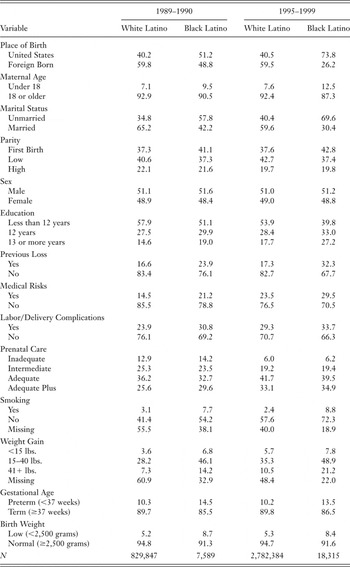
Table 1 provides the breakdown of the distribution of risk factors between the two racial groups at both time periods. The risk profiles are mixed. While Black Latinos are more likely to have twelve years or more of education,Footnote 2 be non-smokers, and have lower levels of parity, they are also more likely to be U.S. born, under eighteen years of age, unmarried, experienced a previous loss, have medical risks and labor/delivery complications, have inadequate prenatal care, gain minimal weight during pregnancy, and have a preterm birth and low birth weight infant.
Percentage Distribution of Risk Factors for Infant Mortality by Race, Latino Live Births, United States, 1989–1990 and 1995–1999

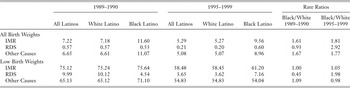
Table 2 displays the IMRs for Latino births, disaggregated by race, and the Black/White rate ratios in the pre- and post-surfactant periods. Black Latinos have substantially higher IMRs than White Latinos in both time periods. In the pre-surfactant period, Black and White Latinos have roughly comparable RDS mortality, overall, but in the post-surfactant period, White Latinos have one-third the rate of RDS mortality of Black Latinos. Among LBW babies, White Latinos experience more than twice the rate of RDS mortality than Blacks in the pre-surfactant period, indicating that Black Latino babies experienced higher birth-weight-specific survival than White Latinos in that period. In the post-surfactant period, while IMRs have declined for both Black and White Latinos, the decline is the same or larger for White Latinos, with the exception of other causes of mortality among low birth weight infants. Moreover, while RDS mortality is cut by more than one-half for White Latinos between the time periods, it increases for Black Latino babies. Focusing on LBW babies, RDS mortality rates among Black Latinos are less than half the size of White Latinos in the pre-surfactant period, but are more than two times larger than White Latinos in the post-surfactant period, as White Latino rates are cut by almost two-thirds, while Black Latino rates almost double. Black/White Latino rate ratios for RDS deaths change qualitatively across time periods such that the survival advantage Black Latino infants had in the pre-surfactant period reverses in the post-surfactant period.
Infant Mortality Rates (IMR) per 1000 Live Singleton Births by Race and Black/White Rate Ratios: U.S. Latinos, 1989–1990 and 1995–1999

Analytic Results
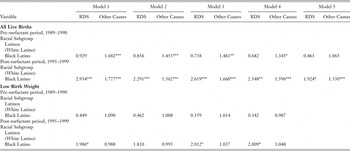
Table 3 displays results of analyses for infants of all birth weights and then restricted to low birth weights for the pre- and post-surfactant periods, respectively. Looking at infants of all birth weights in the pre-surfactant period (see top panel), there is no difference in RDS mortality risk between White and Black Latinos in the unadjusted model. For other causes of mortality, Black Latinos have an elevated risk for mortality in this model. As the covariates are entered in the model, the point estimates suggest that Black Latino infants exhibit an RDS survival advantage over White Latinos, although the difference is not statistically significant. Similarly, when all covariates are controlled, the mortality advantage of White Latinos disappears for other causes of death, indicating that the Black Latino mortality disadvantage works to some extent through the measured maternal risk factors and, to a greater extent, through unobserved factors that work through gestational age and birth weight.
Odds Ratios for Effects of Risk Factors on Infant Mortality, Racial Comparisons, Latino Live Births, 1989–1990 and 1995–1999

Model 1: Unadjusted
Model 2: includes maternal age, marital status, nativity, parity and infant sex in the model;
Model 3: includes all variables in Model 2 and maternal education and prenatal care;
Model 4: includes all variables in Model 3 and previous pregnancy loss, medical risks, smoking, weight gain, and delivery complications;
Model 5: includes all variables in Model 4 and infant gestational age and birth weight.
Variables in parentheses are reference groups.
* p ≤ .05;
** p ≤ .01;
*** p ≤ .001
The pre-surfactant period patterns for infants of all birth weights are not followed in the post-surfactant period. While there was no difference between Black and White Latinos in RDS mortality in the unadjusted models in the pre-surfactant period, in the post-surfactant period, Black Latinos begin with about three times the odds of RDS mortality compared to White Latinos. The odds of mortality due to other causes increased slightly for Black Latinos in the post-surfactant period, as well. In addition, the White Latino mortality advantage for RDS and other causes of mortality, while somewhat reduced, is maintained even after controlling for all covariates. In the pre-surfactant period, Black Latinos had an estimated RDS mortality advantage relative to White Latinos and there was no difference between the groups in other causes of mortality once the covariates were controlled. In the post-surfactant period, Black Latinos face almost twice the odds of RDS deaths as White Latinos and about 1.3 times the odds of dying from other causes, net of all risk factors. This indicates that in the later period, Black Latinos had lower birth weight and gestational age specific survival than White Latino infants, especially if they had RDS.
Low Birth Weight
The lower panel of Table 3 displays results for analyses restricted to LBW infants. In the pre-surfactant period, Black Latino infants begin with an estimated mortality advantage over Whites in the unadjusted model and there is no difference in other causes of mortality between the two groups. Controlling for the covariates only serves to increase the estimated size of the survival advantage of Black Latino LBW infants compared to Whites (although none of the estimates are statistically significant). In the post-surfactant period, however, the unadjusted advantage Black infants held in the pre-surfactant period reverses to a substantial and highly statistically significant mortality disadvantage, with Black Latino LBW infants having almost two times greater odds of RDS mortality compared to White LBW infants, while having parity with White LBW Latino infants on deaths to other causes. As in the pre-surfactant period, there is little movement in Black/White odds ratios in the post-surfactant period for either RDS or other cause mortality once risk factors are controlled, suggesting they do little to explain the mortality gap.
Latino Population Subgroup Analysis: Puerto Ricans, Mexicans, and Cubans
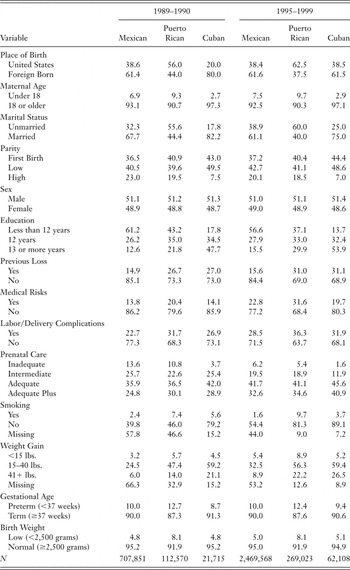
Table 4 displays the distribution of risk factors for each Latino subgroup. Comparing the groups, we see that Puerto Ricans are more likely to have elevated risks on several measures as compared to Mexicans and Cubans, regardless of time period. Puerto Ricans are more likely to be under eighteen years of age, unmarried, have medical risks and labor/delivery complications, have smoked during pregnancy, gained little weight during pregnancy, and have a preterm birth and low birth weight infant, and less likely to have been born outside the fifty states. In contrast, Cubans have the most advantaged profiles and Mexicans fall out between the two groups on maternal demographic factors.
Percentage Distribution of Risk Factors of Infant Mortality by Latino Subgroup: U.S., 1989–1990 and 1995–1999

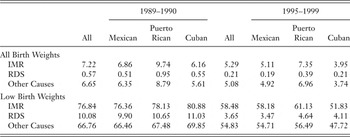
Table 5 displays infant mortality rates (IMRs) for each Latino subgroup for all causes of death, and RDS and other causes separately, for all birth weights and LBW infants in the pre- and post-surfactant periods. Among infants of all birth weights, Puerto Ricans have the highest IMRs for RDS and other causes of mortality compared to the other groups in both periods. Among LBW infants, the picture is slightly different. Cuban LBW infants have the highest IMRs due to both RDS and other causes of death in the pre-surfactant period but the lowest IMRs overall and for other causes of death in the post-surfactant period. All groups experienced declines in IMRs over time.
Infant Mortality Rates (IMR) per 1000 Live Singleton Births by Latino Subgroup: U.S., 1989–1990 and 1995–1999

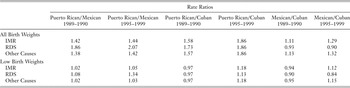
Table 6 displays rate ratios among the groups. Looking at the rate ratios for all birth weights, small increases in relative risk over time occur across the board for Puerto Ricans compared to Cubans or Mexicans. Mexicans also experience an increase compared to Cubans in other cause mortality.
Infant Mortality Rate Ratios by Latino Subgroup: U.S., 1989–1990 and 1995–1999

While Puerto Rican LBW infants had close to equal or lower relative risks of infant death in the pre-surfactant period when compared to Mexicans or Cubans, their relative risk increased in the post-surfactant period when compared to either group. While Mexicans had an advantage when compared to Cubans in the pre-surfactant period, that advantage disappeared in the post-surfactant era for other causes of mortality.
Analytic Results
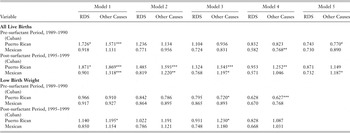
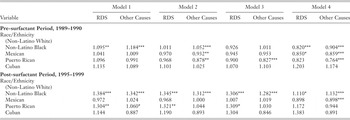
Table 7 displays results for odds ratios of infant mortality in the pre- and post-surfactant periods for all birth weights and low birth weight infants. Looking at all birth weights (top panel) in both periods, Puerto Ricans have significantly higher odds of infant mortality due to RDS and other causes of death compared to Cubans in the unadjusted model. The estimated odds ratios between Puerto Ricans and Cubans increase somewhat between the two periods. Mexicans, who had equivalent odds to Cubans in the pre-surfactant period, have higher odds in the post-surfactant period for deaths to other causes. Major differences emerge between the periods as covariates are included in successive models, with differences most pronounced between Cubans and Puerto Ricans.
Odds Ratios for Effects of Risk Factors on Infant Mortality, Latino Subgroup: U.S., 1989–1990 and 1995–1999

Model 1: Unadjusted
Model 2: includes maternal age, marital status, nativity, parity and infant sex in the model;
Model 3: includes all variables in Model 2 and maternal education and prenatal care;
Model 4: includes all variables in Model 3 and previous pregnancy loss, medical risks, smoking, weight gain, and delivery complications;
Model 5: includes all variables in Model 4 and infant gestational age and birth weight.
Variables in parentheses are reference groups.
* p ≤ .05;
** p ≤ .01;
*** p ≤ .001
During the pre-surfactant period, differences in RDS and other causes of mortality between Cubans and Puerto Ricans become insignificant as soon as any maternal risk factors are controlled (Model 2). Differences between the two groups disappear once education and prenatal care are introduced in Model 3; and by Model 4, Puerto Ricans obtain an estimated advantage in RDS and other causes of mortality compared to Cubans—an advantage that increases in Model 5. In the post-surfactant period, however, Cubans maintain a survival advantage in other causes of mortality, before controlling for birth weight and gestational age. Regarding RDS mortality, Puerto Ricans remain at a disadvantage in the unadjusted model. Control for all maternal and infant health risks reduces the Puerto Rican/Cuban odds ratio to an insignificant advantage in RDS deaths and to a small disadvantage in other causes. Little changes between the two time periods between Cubans and Mexicans in RDS mortality, although Mexicans remain at a disadvantage in other causes of mortality in the post-surfactant period when all covariates are controlled.
Latino Population Subgroups: Low Birth Weight
The lower panel of Table 7 displays results from analyses restricted to LBW infants. In the pre-surfactant period, there is no difference in RDS and other causes of mortality between Cubans and Puerto Ricans in the unadjusted models. However, as with previous analyses, Puerto Rican LBW infants obtain an estimated survival advantage for RDS and other causes in the pre-surfactant period as risk factors are controlled, although the advantage for RDS is not significant. Mexicans also show some evidence of moving from parity to a survival advantage relative to Cubans for other causes, as risk factors are controlled. In contrast, in the post-surfactant period, Puerto Rican LBW infants show evidence of a disadvantage relative to Cubans in the unadjusted model for RDS and other causes, although the disadvantage is only statistically significant for other causes of death. The disadvantage is maintained for other causes of death until maternal health factors are controlled, where parity between Puerto Ricans and Cubans is attained. The picture for Mexicans and Cubans is mixed as Mexicans experience their pre-surfactant survival advantage over Cubans from other causes of death erode in the post-surfactant period, but continue to maintain an insignificant estimated survival advantage for RDS mortality.
Entire U.S. Population
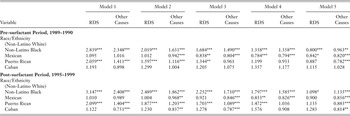
To understand Latino subgroup changes in infant mortality compared to the non-Latino U.S. population, we replicated analyses using data for the entire U.S. population, for all infants and LBW infants (see Tables 8 and 9). With the analyses among all infants in the pre-surfactant period (Table 8), we see that Puerto Ricans and non-Latino Blacks each begin with statistically significantly higher odds of infant mortality for both causes of death as compared to non-Latino Whites in the unadjusted model. Cuban and Mexican odds ratios are comparable to White odds ratios in the unadjusted model. Once all covariates are controlled for, Cuban rates remain on a par with White rates, while non-Latino Blacks, Mexicans, and Puerto Ricans are estimated to have a survival advantage compared to Whites, and these estimates are statistically significant in most cases. In the post-surfactant period, once all covariates are taken into account, the non-Latino Black survival advantage from the pre-surfactant period is completely eroded, with the group now showing statistically significantly higher odds of infant mortality due to both causes. Changes are small between the periods for Mexicans, while Puerto Ricans show slight evidence of a deteriorating position relative to whites in the post- compared to pre-surfactant period, and Cubans gain a survival advantage in deaths due to other causes.
Odds Ratios for Effects of Risk Factors on Infant Mortality, Entire U.S. Population: U.S., 1989–1990 and 1995–1999

Model 1: Unadjusted
Model 2: includes maternal age, marital status, nativity, parity and infant sex in the model;
Model 3: includes all variables in Model 2 and maternal education and prenatal care;
Model 4: includes all variables in Model 3 and previous pregnancy loss, medical risks, smoking, weight gain, and delivery complications;
Model 5: includes all variables in Model 4 and infant gestational age and birth weight.
Variables in parentheses are reference groups.
* p ≤ .05;
** p ≤ .01;
*** p ≤ .001
Odds Ratios for Effects of Risk Factors on Infant Mortality, Entire U.S. Population, Low Birth Weight Infants: 1989–1990 and 1995–1999

Model 1: Unadjusted
Model 2: includes maternal age, marital status, nativity, parity and infant sex in the model;
Model 3: includes all variables in Model 2 and maternal education and prenatal care;
Model 4: includes all variables in Model 3 and previous pregnancy loss, medical risks, smoking, weight gain, and delivery complications;
Model 5: includes all variables in Model 4 and infant gestational age and birth weight.
Variables in parentheses are reference groups.
* p ≤ .05;
** p ≤ .01;
*** p ≤ .001
With analyses restricted to LBW infants (Table 9), in the pre-surfactant period, non-Latino Blacks begin with a disadvantage, which reverses to an advantage once all covariates are included. While Puerto Rican LBW infants begin on par with non-Latino Whites, they gain a survival advantage for other causes of infant mortality after controlling for all covariates. In the post-surfactant period, the gap increases for non-Latino Blacks in the unadjusted model and the survival advantage reverses to a disadvantage, after controlling for all covariates. Similarly, while Puerto Ricans in the pre-surfactant period begin on a par with non-Latino Whites in the unadjusted model, in the post-surfactant period they begin with a statistically significant disadvantage. Also, the survival advantage in other causes of mortality obtained in the pre-surfactant period erodes in the post surfactant period for Puerto Ricans. There are no differences between LBW Cuban and non-Latino White infants across both periods.
DISCUSSION
The results from both race and ethnic group analyses underscore the importance of considering race in studies of Latino health, and of disaggregating Latino subgroups rather than rely on a pan-ethnic category. The results also provide initial support for the segmented racialization hypothesis.
In both periods, the unadjusted models show that Black Latinos in the first set of analyses, and Puerto Ricans in the second, have as high or higher odds of infant mortality due to RDS and other causes of death when compared to White Latinos or Cubans, respectively. While the Black Latino and Puerto Rican disadvantage disappears or reverses in the pre-surfactant period as risk factors are controlled, the same does not occur for these populations in the post-surfactant period. These findings were further magnified in analyses restricted to LBW infants.
Without a direct examination of who received surfactant therapy, we are unable to distinguish whether the differences that emerged are directly associated with surfactant therapy and, if they are, whether they are due to differences in response to surfactant therapy versus receipt of surfactant therapy. It might be possible that White Latino and Cuban infants respond better to surfactant therapy as opposed to Black Latino and Puerto Rican infants, respectively, resulting in the widening of the gap over time. However, we know of no physiological mechanism that is consistent with this possibility. Even more importantly, the disappearance of the Black Latino and Puerto Rican advantage on other causes of mortality seems to suggest that other processes are occurring that may not be related solely to infant response to surfactant therapy.
Regarding differential receipt of surfactant therapy, one possibility is that socially disadvantaged groups are less likely to have the economic resources, or in this case, health insurance, needed to secure surfactant therapy. Material or health-insurance hardship may track with race/ethnicity in a racialized society and be one means through which Latino individuals or groups racialized as Black may be less likely to access technological health innovations. Hardships for this population may also be operating though quality of care. Disadvantaged groups, such as Puerto Ricans and Black Latinos, could arguably be living in places where their hospitals do not have an adequate supply of surfactant therapy to administer to all LBW and premature infants, the hospitals do not adhere to recommended practices for administering treatment, or the hospitals and health care system has an over-representation of physicians that are not up-to-date with the appropriate standard of care. Smedley et al. (Reference Smedley, Stith and Nelson2003) found that all these factors play a role in lessening the quality of care that disadvantaged populations receive as compared to advantaged populations, and therefore, could be playing a role in the results we observed in these analyses.
Another possible explanation for the difference between Cubans and Puerto Ricans and Latino Blacks and Whites is segmented racialization leading to Cuban and White Latino infants in need to actually receive therapy, while Puerto Rican and Black Latino infants do not, even independent of economic resources. Although surfactant therapy is not an elective therapy, the decision to administer therapy and the appropriateness of therapy is determined by a physician. Previous research has demonstrated differences in physician perceptions and treatment of patients by race/ethnicity so it is possible that the same behavior is occurring here (Schulman et al., Reference Schulman, Berlin, Harless, Kerner, Sistrunk, Gersh, Dube, Taleghani, Burke, Williams, Eisenberg and Escarce1999; van Ryn and Fu, Reference van Ryn and Fu2003).
As noted, in Unequal Treatment, Smedley et al. (Reference Smedley, Stith and Nelson2003) concluded that a major contributor to the disparities in health care treatment of racial/ethnic groups was associated with physician biases, prejudices, and stereotyping of patients. The extent to which such factors impact a physician's decision to administer surfactant therapy to infants is unknown. However, as hypothesized, it is expected that physicians would have different views of each of the Latino subgroups and that these viewpoints would in part explain the differences in RDS mortality observed after the advent of surfactant therapy. Interestingly, between the pre- and post-surfactant periods, secular trends indicate increases in the proportion of mothers across all groups receiving prenatal care, such that by the post-surfactant period the vast majority of all mothers received at least adequate care, while substantially fewer than 10% of any group received inadequate prenatal care, according to our measure. While this index provides no qualitative information on the nature of care or on physician-patient interaction, it does suggest that most mothers in the post-surfactant period were connected to health service providers who made therapy determinations that could be influenced, in part, by prejudices or stereotypes.
Results from analyses that included non-Latino Whites and Blacks also provide some support for the segmented racialization hypothesis. The advantage that Puerto Ricans had in RDS mortality net of the measured controls seems to have eroded over time, with Puerto Ricans, like non-Latino Blacks, reversing from an RDS survival advantage to an estimated disadvantage across the time periods. Mexicans remained slightly advantaged across both time periods. Among Cubans in the pre-surfactant period, net of controls, their estimated odds of mortality were roughly comparable to non-Latino Whites (and therefore, like non-Latino Whites, worse than Mexican Americans or Puerto Ricans). In the post-surfactant period Cubans remained on a par with whites in RDS mortality and achieved a survival advantage compared to non-Latino Whites in other causes of mortality.
LIMITATIONS
One major limitation of this study is that infant race was coded based on maternal self-report. We do not expect self-reported race among Latinos to reflect assigned racial categorization since Latinos are less likely to identify as Black and the NCHS recoding conventions classified many who identified as “other” as White. As a result, we expect these results to be a conservative test that underestimates the difference between White and Black Latino infants. In addition, future research on segmented racialization of U.S. Latinos might consider differences across geographic areas within the United States, as there is likely to be heterogeneity in the social interpretation of phenotypic characteristics and ethnic characterizations across locales, or in the intensity with which stereotypes that may affect physician behavior are held.
CONCLUSION
Despite the aforementioned limitations, the results in this paper seem to indicate that something is occurring within the larger sociological context that is systematically affecting Puerto Ricans, Mexicans, and Cubans differently with implications for their population health. We cannot definitively conclude that a differential racialization process has occurred. However, the patterns seem to indicate that at the very least, the three major Latino populations are dealing with different conditions that are translating into different health outcomes. As the presence of Dominicans and other Latino sub-groups with high-levels of African ancestry has increased, it is worth examining how those sub-groups have become incorporated into the racial structure of the United States, and the implications of their racialization for their outcomes and opportunities.
We believe that the differences we observed provide further justification for eliminating the practice of combining the Latino sub-groups for analyses under the pan-ethnic category; a practice that ignores the differences that exist among the groups. Similarly, our research shows that Latino health follows the same patterns of health that we observe in the non-Latino population when it comes to race, adding to other research that has examined racial patterns in health within the Latino population (Borrell Reference Borrell2006; Borrell and Crawford, Reference Borrell and Crawford2006; Borrell and Dallo, Reference Borrell and Dallo2008). As a racially heterogeneous population, Latinos should not be treated as a population that lacks racial diversity. Research should be expanded that documents not only the racial patterns of health for this population, but also, develops and tests theories about how group-level racialization processes translate into outcomes. If we continue to conduct research that assumes racial homogeneity within or among Latino groups, we will ignore the life experience of significant segments of this growing population, rendering them and their health needs invisible.