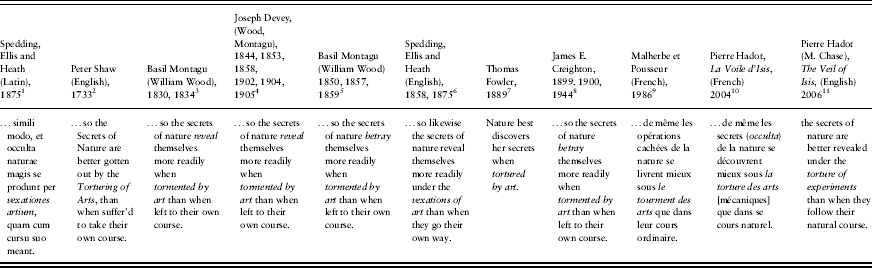
… the secrets of nature reveal themselves more readily under the vexations of art than when they go their own way.
Francis Bacon, Novum Organum, 1620, Book I, Aphorism 98Footnote 1Francis Bacon's concept of vexation, as an intervention into a nature confined and ‘in bonds’ for the purpose of extracting its ‘secrets’, holds a major key to his idea of experimentation and the role it plays in his philosophy and attitude toward nature. Known as the ‘father of experimental philosophy’, Bacon was admired for his emphasis on experimentation as a way both to know and to obtain power over the natural world. His contrast between experimentation and the speculative deduction that had dominated the thought of his predecessors was welcomed as the foundation for a new philosophy. In linking vexation to the idea of nature confined and in bonds, Bacon anticipated the idea of the contained, controlled experiment. That idea, nascent in Bacon's thought, was realized even more fully in the meaning given to the word ‘vexation’ and its association with experimentation pursued by his followers.
The meaning Bacon himself gave to the phrase ‘vexations of art’ (vexationes artium) has been intensely debated by scholars of his work. Although the standard edition of his works by Spedding, Ellis and Heath and the new Oxford edition by Graham Rees translate the phrase vexationes artium as the ‘vexations of art’, a significant number of scholars over the past four centuries have read and translated Bacon's Latin as the ‘torment’ or ‘tortures of art’.Footnote 2 Since the mid-1990s, a lively, sometimes contentious debate over Bacon's use of the word ‘vex’ and his attitudes toward science and nature has arisen.Footnote 3 The defenders of Bacon (see below), relying primarily on the English translations by Spedding and Rees, have argued that by ‘vexation’ Bacon meant only ‘annoy’, ‘irritate’, or ‘harass’, rather than ‘torment’ or ‘torture’. In this article, I examine the language used by scholars, translators and editors of Bacon's work from his own time to the present and speculate on the reasons for their interpretations of vexation and its association with experimentation. While we may never know the precise meaning that Bacon himself gave to the Latin word vexare, a stronger, interventionist meaning for the term is consistent with the significance Bacon and his followers gave to the experimental method.Footnote 4
Bacon on vexation
Bacon began using the term ‘vexations of art’ in The Advancement of Learning, written in English in 1605, in relation to the sea god Proteus, in language that presaged his interventionist approach to nature. Bacon wrote,
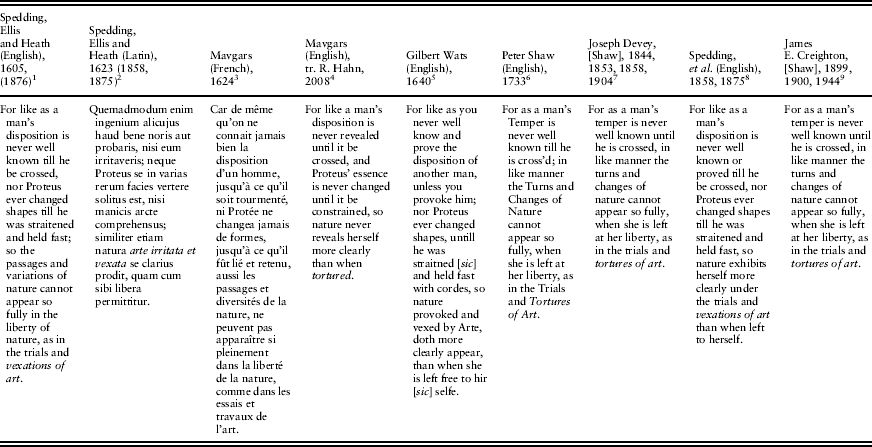
For like as a man's disposition is never well known till he be crossed, nor Proteus ever changed shapes till he was straitened and held fast; so the passages and variations of nature cannot appear so fully in the liberty of nature, as in the trials and vexations of art [added emphasis; see Table 4, column 1].
In his discussion of Proteus, Bacon drew on Natale Conti's Mythologie (1551), which, along with Lilio Gregorio Giraldi's History of the Gods (1548) and Vicenzo Cartari's Images of the Gods (1556), was a well-known Renaissance work on mythology. But while Conti related the ancient myth of the sea god Proteus, he did not use the terms ‘vexation’ or ‘binding and straitening’, but stated merely that ‘Idothea told Menelaus to grab Proteus while he was sleeping, and then hold on to him as he went through his various changes, until he went back to his original shape’.Footnote 5 It was the phrase ‘binding and straitening’ that was to become an integral part of Bacon's approach to experimentation.
Bacon's reference to Proteus seems, instead, to come from the poet Virgil. George William Kitchin, in his 1860 edition of the 1605 Advancement of Learning, provides a footnote citing Bacon's source for the phrase ‘straitened and held fast’ as Virgil's Georgics, IV, lines 387 ff. (see Table 4, column 1, note 1). Virgil wrote,
In Neptune's Carpathian flood there dwells a seer, Proteus, of sea-green hue, who traverses the mighty main in his car drawn by fishes and a team of two-footed steeds … To him we Nymphs do reverence, and aged Nereus himself; for the seer has knowledge of all things – what is, what hath been, what is in train before long to happen – for so has it seemed good to Neptune, whose monstrous herds and unsightly seals he pastures beneath the wave. Him, my son, you must first take in fetters [vinclis capiendus], that he may unfold to you all the cause of the sickness and bless the issue. For without force [vi] he will give you no counsel, nor shall you bend him by prayer. With stern force and fetters [vim duram et vincula capto tende] make fast the captive; thereon alone his wiles will shatter themselves in vain. I myself, when the sun has kindled his noonday heat, when the grass is athirst, and the shade is now welcome to the flock, will guide you to the aged one's retreat, whither when weary he retires, so that you may assail him with ease as he lies asleep. But when you hold him in the grasp of hands and fetters [manibus vinclisque tenebis], then will manifold forms baffle you, and figures of wild beasts. For of a sudden he will become a bristly boar, a deadly tiger, a scaly serpent, or a lioness with tawny neck; or he will give forth the fierce roar of flame, and thus slip from his fetters [vinclis], or he will melt into fleeting water and be gone. But the more he turn himself into all shapes, the more, my son, should you tighten his fetters [tenacia vincla], until after his last changes of body he become such as you saw when he closed his eyes at the beginning of slumber.Footnote 6
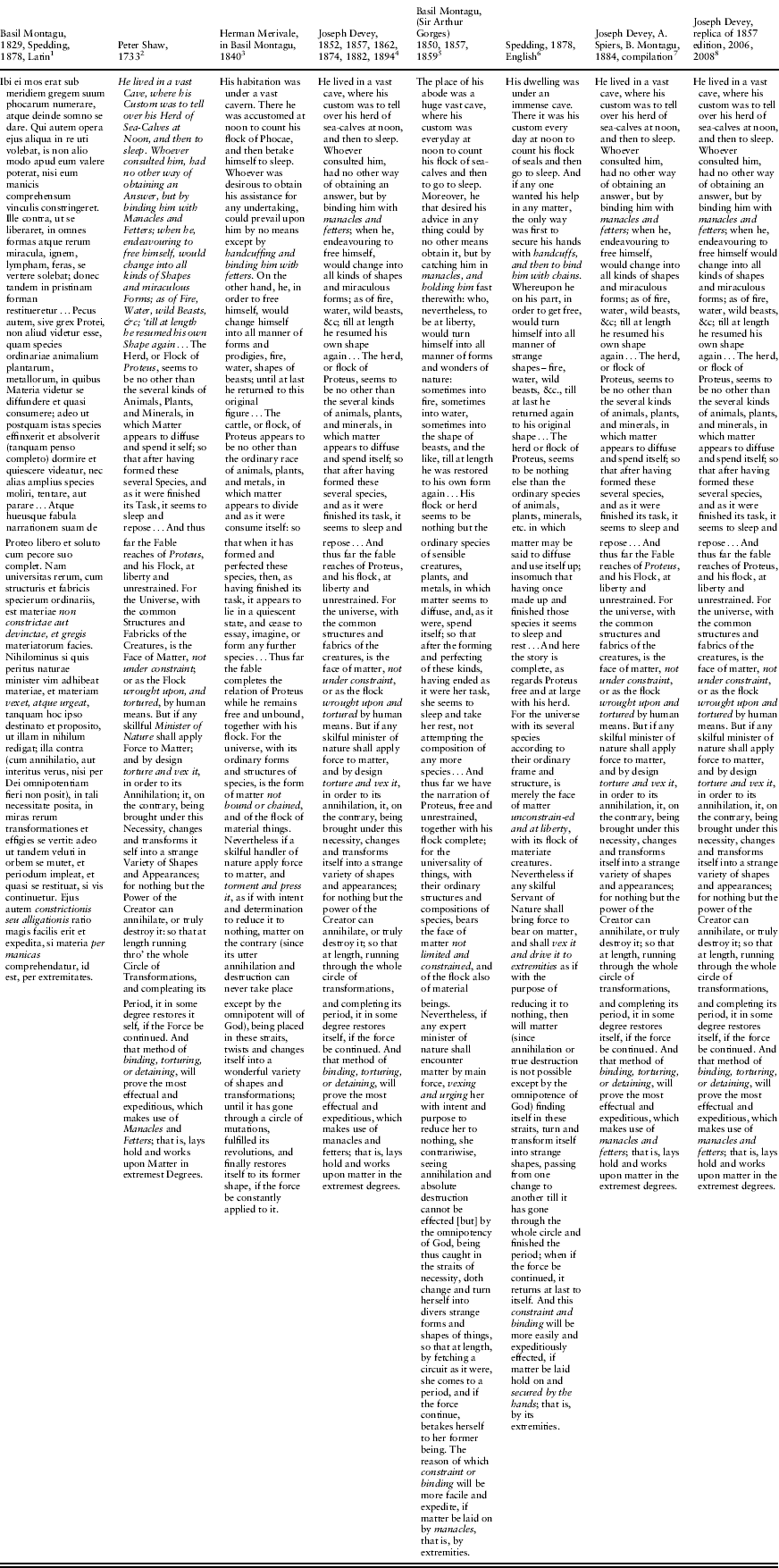
Thus in his earliest use of Proteus, in 1605, as being ‘straitened and held fast’, Bacon, following Virgil, already implied a forceful intervention for the purpose of extracting information. In his next work, the 1609 De Sapientia Veterum (The Wisdom of the Ancients), written in Latin, and again relying on Virgil's account, Bacon went a step further to include the use of handcuffs and chains (fetters) for the binding of Proteus: ‘if any one wanted his help in any matter, the only way was to secure his hands with handcuffs, and then to bind him with chains’ (nisi eum manicis comprehensum vinculis constringeret) (Table 1, column 6). This idea he analogized to vexation:
Nevertheless if any skilful Servant of Nature shall bring force to bear on matter, and shall vex it and drive it to extremities [vexet, atque urgeat] as if with the purpose of reducing it to nothing, then will matter (since annihilation or true destruction is not possible except by the omnipotence of God) finding itself in these straits, turn and transform itself into strange shapes, passing from one change to another till it has gone through the whole circle and finished the period; when if the force be continued, it returns at last to itself. And this constraint and binding will be more easily and expeditiously effected, if matter be laid hold on and secured by the hands; that is, by its extremities [Table 1, column 6].Footnote 7
Bacon and ‘Torture’. ‘Proteus’*The Wisdom of the Ancients. De Sapientia Veterum, 1609

* Italics added to ‘torture’ and its variants.
1 Francis Bacon, The Works of Francis Bacon, Lord Chancellor of England, A New Edition, by Basil Montagu, Esq. London: William Pickering, 1829, vol. 11, De Sapientia Veterum, ‘Proteus’, p. 309. idem, De Sapientia Veterum, in idem, Works (ed. James Spedding, Robert Leslie Ellis and Douglas Devon Heath), 14 vols., London: Longmans, 1868–1901, vol. 6, pp. 651–652.
2 Francis Bacon, ‘The Fable of Proteus; Explained of Matter and its Changes’, in Physical Mythology, in The Philosophical Works, methodized and made English, from the originals, with occasional notes, to explain what is obscure, by Peter Shaw, 3 vols., London: J.J. and P. Knapton, D. Midwinter and A. Ward, and others, 1733, vol. 1, p. 567. Other editions: Philosophical Works, London: Knapton, Midwinter, Ward, 1737.
3 Francis Bacon, The Essays or Counsels Civil and Moral and Wisdom of the Ancients, by Francis Lord Verulum (ed. Basil Montagu), London: William Pickering, 1840, pp. 276–278; Montagu's preface, pp. xxiii–xxiv states, ‘In the year 1619, this tract was translated by Sir Arthur Gorges … For the translation of this little volume I am indebted to the learned Mr. Herman Merivale’. See also p. 225: The Wisdom of the Ancients, Written in Latin by Lord Bacon and translated into English by Herman Merivale.
4 Francis Bacon, The Moral and Historical Works of Lord Bacon: Including his Essays, Apopthegms, Wisdom of the Ancients, New Atlantis, and Life of Henry the Seventh. With an Introductory Dissertation and Notes by Joseph Devey, M.A., London: Henry G. Bohn, York Street, Covent Garden, 1852, 1857, 1862; reprinted London: George Bell & Sons, York Street, Covent Garden, 1874, 1882, 1894, ‘The wisdom of the Ancients. A series of mythological fables’, p. 201, ‘Proteus’, p. 228. Note: The translation of the Wisdom of the Ancients in Devey's edition is that of Peter Shaw, London, 1733, but is unacknowledged by Devey or Henry Bohn in these editions.
5 Francis Bacon, Wisdom of the Ancients, in Works (ed. Basil Montagu), 3 vols., Philadelphia: Carey & Hart and Parry & McMillan, 1850–1859, vol. 1, p. 297. In the editor's preface to The Wisdom of the Ancients, Montagu writes, ‘In the year 1619 this tract was translated by Sir Arthur Gorges … As this translation was published during the life of Lord Bacon, by a great admirer of his works, and as it is noticed by Archbishop Tenison, I have inserted it in this volume’ (p. 273). Note: this translation by Sir Arthur Gorges, made in 1619, was reprinted in English some twenty-one times during the seventeenth century, as well as into French, Italian, Dutch and German. See Francis Bacon, The Wisdom of the Ancients, written in Latin [1609] by the Right Honourable Sir Francis Bacon, Knight, Baron of Verulam, and Lord Chancellor of England. Done into English by Sir Arthur Gorges Knight … Printed for A. Swalle, and T. Childe, at the Unicorn, in St. Paul's Church-Yard, 1696, ‘Proteus, or Matter’, pp. 47–49 (bound with The Essays or Councils, Civil and Moral of Sir Francis Bacon …): ‘Nevertheless if any expert Minister of Nature, shall encounter Matter by main force, vexing and urging her with intent and purpose to reduce her to nothing; she contrariwise (seeing annihilation and absolute destruction cannot be effected [but] by the Omnipotency of God) being thus caught in the straits of necessity, doth change and turn her self into divers strange Forms and Shapes of things, so that at length (by fetching a circuit as it were) betakes her self to her former being. The reason of which constraint or binding, will be more facile and expedite, if matter be laid hold on by Manacles, that is Extremities’ (pp. 48–49). See also Francis Bacon, The Wisdom of the Ancients and the New Atlantis, London: Cassell & Co., 1900, pp. 63–66. Note: this edition contains an Introduction by ‘HM’ (Henry Morley), editor of the Cassell's National Library, new series, in which the translation of the Wisdom of the Ancients is stated to be that of Sir Arthur Gorges (p. 5). It also corrects the omission of the word ‘but’ in the phrase ‘but by the Omnipotency of God’ (p. 65).
6 Francis Bacon, Wisdom of the Ancients, in Works, op. cit. (1), vol. 6, pp. 775–726.
7 Francis Bacon, Bacon's Essays and Wisdom of the Ancients, with a Biographical Notice by A. Spiers, Preface by B. Montagu, and Notes by Different Writers, Boston: Little, Brown, & Company, 1884, pp. 361–362. Advertisement: ‘In preparing the present volume for the press, use has been freely made of several publications which have recently appeared in England. The Biographical Notice of the author is taken from an edition of the Essays, by A. Spiers, Ph.D. To this has been added the Preface to Pickering's edition of the Essays and Wisdom of the Ancients, by Basil Montagu, Esq. Parker's edition, by Thomas Markby, M.S., has furnished the arrangement of the Table prefixed to the Essays, and also “the references to the most important quotations.” The Notes, including the translations of the Latin, are chiefly copied from Bohn's edition, prepared by Joseph Devey, M.A.’ Note: The Wisdom of the Ancients translation is that of Peter Shaw, 1733, but unacknowledged by Devey.
8 Francis Bacon, Of the Moral and Historical Works of Lord Bacon: including his Essays, Apopthegms, Wisdom of the Ancients, New Atlantis, and Life of Henry the Seventh. With an Introductory Dissertation and Notes By Joseph Devey, M.A. Elibron Classics Replica of the 1857 edition published in 1857 by Henry Bohn, London (2006), ‘The Wisdom of the Ancients. A Series of Mythological Fables’, pp. 201–268; ‘Proteus’, p. 228. Note: the translation of the Wisdom of the Ancients is that of Peter Shaw, 1733, but unacknowledged by Devey. See also Sir Francis Bacon, The Wisdom of the Ancients, Gloucester: Dodo Press, 2008, pp. 29–30. This edition is evidently reprinted by Dodo Press from that of Joseph Devey using Peter Shaw's translation, but neither Devey nor Shaw is acknowledged by Dodo Press. The title page says, The Wisdom of the Ancients, by Francis Bacon, a Series of Mythological Fables, Published in 1609. Note: 1609 is the date of the original Latin edition, not that of an English translation. Devey's notes at the bottom of the page in earlier volumes are rearranged in Dodo's reprint as endnotes appearing at intervals throughout the volume. I am indebted to Anthony Funari for bringing the Dodo Press volume to my attention.
In the Parasceve, written in 1620, Bacon again used the term ‘handcuffs’, now coupling it with the word ‘bonds’:
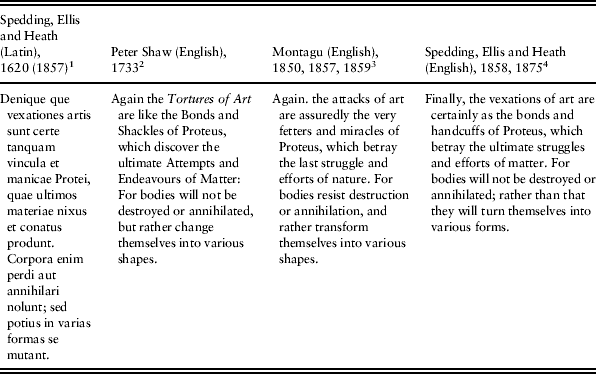
The vexations of art [vexationes artis] are certainly as the bonds and handcuffs [vincula et manicae] of Proteus, which betray the ultimate struggles and efforts of matter. For bodies will not be destroyed or annihilated; rather than that they will turn themselves into various forms [see Table 5, column 4].Footnote 8
Then, in 1623, in the expanded version of the Advancement, written in Latin under the title De Augmentis Scientiarum, Bacon retained Virgil's terms ‘straitened and held fast’, again coupling them with the ‘vexations of art’:
For like as a man's disposition is never well known or proved till he be crossed, nor Proteus ever changed shapes till he was straitened and held fast [nisi manicis arcte comprehensus], so nature exhibits herself more clearly under the trials and vexations of art [arte irritata et vexata] than when left to herself.Footnote 9
It is thus Bacon's use of the terms ‘straitened and held fast’ in the Advancement and De Augmentis, the terms ‘handcuffs’ and ‘chains’ (fetters) (manicis comprehensum vinculis constringeret) in the Wisdom of the Ancients, and ‘bonds and handcuffs’ (vincula et manicae) in the Parasceve that together imply a strong interventionist approach to extracting the secrets of nature. While Bacon's use of Virgil may help us to understand Bacon's source for the terms ‘handcuffs’, ‘chains’, ‘bonds’ and ‘fetters’, it does not explain why he chose the words ‘vexations of art’ as the means for extracting those secrets.
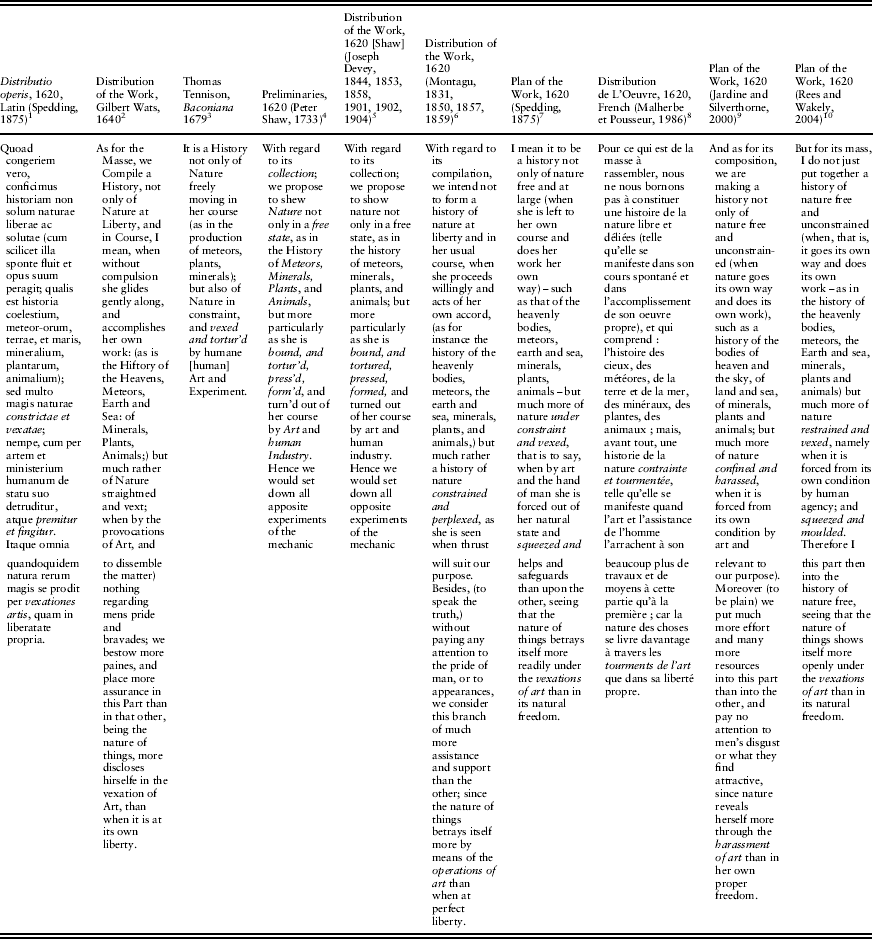
Of the possible words Bacon could have used to describe the state of nature in constraint, he chose the term ‘vexation’ (vexare). In the 1620 ‘Plan of the Work’ for the Instauratio Magna, in contrasting nature at liberty with nature ‘under constraint and vexed’, he wrote, ‘the nature of things betrays itself more readily under the vexations of art [vexationes artis] than in its natural freedom’ (Table 2, column 6). And in Book 1, Aphorism 98, of the 1620 Novum Organum, he wrote, similarly, ‘so likewise the secrets of nature reveal themselves more readily under the vexations of art [vexationes artium] than when they go their own way’ (Table 3, column 5; emphasis added).
Francis Bacon and ‘Torture’. ‘Plan of the Work’, *Instauratio Magna, 1620
* Italics added to ‘torture’ and its variants.
1 Francis Bacon, ‘Distributio operis’, in idem, Works (ed. James Spedding, Robert Leslie Ellis and Douglas Devon Heath), 14 vols., London: Longmans, 1868–1901, vol. 1, p. 141.
2 Gilbert Wats, Of The Advancement and Proficience of Learning or the Partitions of Sciences, IX Bookes, Oxford, 1640, pp. 32–33.
3 Thomas Tennison, Archbishop of Canterbury, Baconiana, or Certain genuine remains of Sr. Francis Bacon, Baron of Verulam, and Viscount of St. Albans in arguments civil and moral, natural, medical, theological, and bibliographical, London: Printed by J.D. for Richard Chiswell, 1679, p. 41.
4 Francis Bacon, ‘Preliminaries’, in idem, The Philosophical Works, methodized and made English, from the originals, with occasional notes, to explain what is obscure, by Peter Shaw, 3 vols., London: J.J. and P. Knapton, D. Midwinter and A. Ward, and others, 1733, vol. 1, p. 14; reprinted as Philosophical Works, London: Knapton, Midwinter, Ward, 1737. Other editions: The Works of Francis Bacon, Baron Verulum, Viscount St. Alban, and Lord High Chancellor of England, vol. 6 containing De Augmentum Scientarium, vol. 1, London: Printed for M. Jones, Paternoster-Row, 1815, p. xxvi (Peter Shaw translation, unacknowledged on title page).
5 Francis Bacon, The Physical and Metaphysical Works of Lord Bacon (ed. Joseph Devey), London: Pickering, 1844; Bell and Daldy, 1853, http://en.wikisource.org/wiki/Instauratio_Magna/Plan_(Devey), para. 13; Francis Bacon, The Physical and Metaphysical Works of Lord Bacon, including the Advancement of Learning and Novum Organum (ed. Joseph Devey), London: Henry Bohn, 1858; reprinted by George Bell & Sons, 1904), ‘The Distribution of the Work’, p. 17. Note: Devey's Preface on his sources for his translations is omitted from the online 1844 and 1853 versions. The following preface by Devey is contained in the ‘Preface’ by JD (Joseph Devey), pp. 10–11, in the 1858 and 1904 printings: ‘Of the De Augmentis, though one of the greatest books of modern times, only three translations have appeared, and each of these strikingly imperfect. That of [Gilbert] Wats, issued while Bacon was living, is singularly disfigured with solecisms, and called forth the just censures of Bacon and his friends. The version of Eustace Cary is no less unfortunate, owing to its poverty of diction, and antiquated phraseology. Under the public sense of these failures, another translation was produced about sixty years ago, which might have merited approbation, had not the learned physician been impressed with the idea that he could improve Bacon by relieving his work of some of its choicest passages, and entirely altering the arrangement. In the present version, our task has been principally to rectify Shaw's mistakes, by restoring the author's own arrangement and supplying the omitted portions … The version of the Novum Organum contained in this volume is that of [William] Wood [1830], which is the best extant … JD.’ The Advancement of Learning by Lord Bacon (ed. Joseph Devey), New York: P.F. Collier, 1902; and Novum Organum, by Lord Bacon (ed. Joseph Devey), New York: P.F. Collier & Son, 1901, reprinted 1902, were separately printed as volumes 21 and 22 of the Science Library. The Advancement contains Devey's preface (above) attributing the translation to Shaw, but the Novum Organum lacks his preface attributing that translation to Wood.
6 Francis Bacon, ‘Distribution of the Work’, in Works (ed. Basil Montagu), 3 vols., Philadelphia: Carey & Hart and Parry & McMillan, 1850–1859, vol. 3, p. 341. See the following online note: ‘This was the first complete English translation since 1733. It was first printed in 1831 in volume 14 of The Works of Francis Bacon, Lord Chancellor of England, 16 vols. (ed. Basil Montagu), London: Pickering, 1825–1834. It was more frequently seen in the three-volume edition printed by a succession of publishers in Philadelphia almost annually from 1841 to 1859 and a few times in the 1870s and 1880s. An 1848 printing of the three-volume edition is available at Google Books.’ See http://en.wikisource.org/wiki/Novum_Organum.
7 Francis Bacon, ‘Plan of the Work’, in Works, op. cit. (1), vol. 4, p. 29.
8 Francis Bacon, ‘Distribution de L'Oeuvre’, in Novum Organum, Introduction, traduction et notes par Michel Malherbe et Jean-Marie Pousseur, Paris: Presses Universitaires de France, 1986, p. 83.
9 Francis Bacon, ‘Plan of “The Great Renewal”’, in The New Organon (ed. Lisa Jardine and Michael Silverthorne), Cambridge: Cambridge University Press, 2000, pp. 20–21.
10 Francis Bacon, “Plan of the Work,” in The Oxford Francis Bacon, vol. 11, ‘The Instauratio magna, Part II: Novum organum and Associated Texts, ed. with introduction, notes, commentaries, and facing-page translations by Graham Rees with Maria Wakely’, Oxford: Clarendon Press, 2004, p. 39.
Francis Bacon and ‘Torture’. Book I, Aphorism 98,*Novum Organum, 1620
* Italics added to ‘torture’ and its variants.
1 Francis Bacon, Novum Organum, in idem, Works (ed. James Spedding, Robert Leslie Ellis and Douglas Devon Heath), 14 vols., London: Longmans, 1868–1901, vol. 1, Book 1, Aphorism 98, p. 203.
2 Francis Bacon, Novum Organum Scientiarum: A New Machine for Rebuilding the Sciences, in The Philosophical Works, methodized and made English, from the originals, with occasional notes, to explain what is obscure, by Peter Shaw, 3 vols., London: J.J. and P. Knapton, D. Midwinter and A. Ward, and others, 1733, vol. 2, Pt I, aphorism 98, p. 394. Other editions: Philosophical Works, London: Knapton, Midwinter, Ward, 1737; Novum organum scientiarum: containing rules for conducting the understanding in the search of truth: and raising a solid structure of universal philosophy, J. Cundee, 1802; Bacon's Novum Organum, Peter Shaw, J. Kerr, London: Ostell & Lepage, 1845.
3 Francis Bacon, Novum Organum, in idem, Works, ed. Basil Montagu, 3 vols., Philadelphia: Carey & Hart and Parry & McMillan, 1850–1859, vol. 3, p. 363. See also The Works of Francis Bacon, Lord Chancellor of England, Volume 16, Part 2, By Francis Bacon, A New Edition by Basil Montagu, ESQ., Volume XVI, Part the Second, London: William Pickering, 1834, Note BBB: ‘In 1733 Peter Shaw, M.D. published a translation of the Novum Organum. In the year 1830, the translation published in this edition was by my friend William Wood’ (see 1834 digitized copy from Harvard Library, p. 259).
4 Francis Bacon, Novum Organum, in The Physical and Metaphysical Works of Lord Bacon, Including the Advancement of Learning and Novum Organum (ed. Joseph Devey), London: William Pickering, 1844; Bell & Daldy, 1853, available at http://en.wikisource.org/wiki/Novum_Organum/Book_I_(Wood); Francis Bacon, The Physical and Metaphysical Works of Lord Bacon Including His Dignity and Advancement of Learning, in Nine Books; and his Novum Organum; or, Precepts for the Interpretation of Nature (ed. Joseph Devey), London: Henry G. Bohn, 1858, Book I, Aphorism 98, p. 429. On the ‘Preface’ of Joseph Devey (JD) to the 1858 edition acknowledging Wood as the translator, see Table 2, note 5. See also Francis Bacon, The Physical and Metaphysical Works of Lord Bacon, including the Advancement of Learning and Novum Organum, ed. Joseph Devey, London: George Bell & Sons, 1904, ‘Preface’ of Devey (JD) on p. 11; Novum Organum, Book I, Aphorism 98, p. 434. Note: the separately printed Novum Organum, by Lord Bacon, ed. by Joseph Devey, M.A., New York: P.F. Collier & Son, 1902, 1905, Book I, Aphorism 98, p. 79, contains Bacon's ‘Preface’, but has no preface by Devey or information on translation. The 1858 and 1902 printings, like that of the 1850, 1857 and 1859 Montagu editions (see Table 3, Footnote note 5 below), substitute the word ‘betray’ for ‘reveal’ in Book I, aphorism 98.
5 Francis Bacon, Novum Organum, in Works, op. cit. (3), vol. 3, p. 363. For acknowledgment of William Wood as the translator of the Novum Organum, see Montagu's Preface (written 17 November 1834) to ibid., vol. 1, p. vii; and Montagu, Editor's Preface (to the Novum Organum), in ibid., vol. 3, p. 330: ‘For the translation of the Novum Organum contained in this volume, I am indebted to my friend William Wood.’ Note: the Philadelphia (1850–1859) printing substitutes the word ‘betray’ for ‘reveal’ in Novum Organum, Book I, aphorism 98; there are also slight differences in punctuation.
6 Francis Bacon, Novum Organum, in Works, op. cit. (1), vol. 4, Book 1, aphorism 98, p. 95.
7 Francis Bacon, Novum Organum, edited with an introduction and notes by Thomas Fowler, 2nd edn corr. and rev., Oxford: Clarendon Press, 1889, p. 304 n. 82. See also introduction, p. 127: ‘Nature like a witness when put to the torture would reveal her secrets’.
8 Francis Bacon, The Advancement of Learning and Novum Organum, with a special introduction by James Edward (Edwin) Creighton, Ph.D., Professor of Logic and Metaphysics at Cornell University, rev. edn, New York: The Colonial Press, 1899; New York: Willey Book Co., 1900, copyright 1900 by the Colonial Press; reprinted Willey Book Co., 1944, Book 1, aphorism 98, p. 351. Note: Creighton's edition uses the same translations as those in Devey's Physical and Metaphysical Works of Lord Bacon (see Footnote note 5 above), namely that of Peter Shaw for the Advancement and William Wood for the Novum Organum. Creighton omits Bacon's ‘Distribution of the Work’. Creighton does not acknowledge the source of either translation. While Devey places the notes for both works at the bottom of the page, Creighton places them at the end of the volume. The notes are identical to those of Devey.
9 Francis Bacon, Novum Organum, Introduction, traduction et notes par Michel Malherbe et Jean-Marie Pousseur, Paris: Presses Universitaires de France, 1986, Book 1, aphorism 98, pp. 159. Also, Glossary, p. 348: tourment = vexatio.
10 Pierre Hadot, Le voile d'Isis: essai sur l'histoire de l'idée de nature, Paris: Gallimard, 2004, p. 133.
11 Pierre Hadot, The Veil of Isis: An Essay on the History of the Idea of Nature (tr. Michael Chase), Cambridge, MA: Harvard University Press, 2006, pp. 93, 340 n. 6. See also p. 120: ‘so the secrets [occulta] of nature are better discovered under the torture of the [mechanical] arts than when it proceeds in its natural course’, and p. 35: ‘Francis Bacon, for instance, declared that Nature unveils her secrets only under the torture of experimentation.’ Also p. 149: ‘Goethe thus contradicts Francis Bacon who sought to force Nature to talk under the torture of experimentation. For Goethe, rather than talk, “Nature keeps silent under torture”’. Note on early translations of Bacon's Novum Organum from http://en.wikisource.org/wiki/Novum_Organum: Novum Organum, by Francis Bacon, translated by Wood, Devey, Spedding, et al. The Novum Organum (New Organon) was the second (and the only somewhat complete) part of Sir Francis Bacon's Instauratio Magna, published in England in 1620. Because nearly nothing of the other five parts was printed in the Instauratio, the whole is often known by the name of the dominant part. In the pocket-sized 1650 edition … the name was Novum Organum Scientiarum (New Organon of the Sciences). There were four complete translations done in the 19th century. Three of them, in reverse chronological order, are linked below. (The fourth was The Novum Organon, or a true guide to the interpretation of nature, trans. G.W. Kitchin. Oxford: Oxford University Press, 1855.) The Spedding edition printed in London … is generally the standard for scholarly citation, but citation by section, book, and aphorism, instead of volume and page, is frequently more useful and now widely accepted. Instauratio Magna, translated by William Wood and Joseph Devey, edited by Joseph Devey (1844) * Proem for the published work * Preface to Instauratio Magna * Plan of the Instauratio Magna * Part II: Novum Organum • Preface • Book I • Book II Joseph Devey edited a one-volume edition entitled The Physical and Metaphysical Works of Lord Bacon. It was published first by Pickering in 1844 then by Bell & Daldy as part of Bohn's Scientific Library starting in 1853. Devey used Wood's translation of the Novum Organum itself but wrote his own translations of the preliminary material. [Note: the translation of the ‘Plan of the Work’ actually appears to be Peter Shaw's translation]. Devey also added many footnotes (not reproduced here). His editions did not include the dedication. The Preface, Book I, and Book II pages linked here are the same as those for the Montagu edition. Devey made some changes to punctuation, capitalization, italicization, and paragraph boundaries that are not reflected here. * Proem for the published work * Dedication to Instauratio Magna * Preface to Instauratio Magna * Plan of the Instauratio Magna * Notice regarding Part I * Part II: Novum Organum • Preface • Book I • Book II Instauratio Magna, translated by William Wood, edited by Basil Montagu (1831). This was the first complete English translation since 1733. It was first printed in 1831 in volume 14 of The Works of Francis Bacon, Lord Chancellor of England, 16 vols., ed. Basil Montagu (London: Pickering, 1825–1834). It was more frequently seen in the three-volume edition printed by a succession of publishers in Philadelphia almost annually from 1841 to 1859 and a few times in the 1870s and 1880s. An 1848 printing of the three-volume edition is available at Google Books.
The word ‘vexation’ had been used in several contexts that were familiar to Bacon: alchemy,Footnote 10 witchcraft,Footnote 11 the BibleFootnote 12 and the Inquisition,Footnote 13 and Bacon probably appropriated it from his acquaintance with these instances. The idea of ‘the vexations of art’ imparted a strong interventionist connotation to experimentation as the extraction of the secrets of nature by constraining it in bonds.
Nature, for Bacon, existed in three states – at liberty, in error and in bonds – elaborated in the 1623 De Augmentis.Footnote 14 The third state, in which nature is ‘put in constraint [constringitur], molded [fingitur], and made as it were new by art and the hand of man [arte et opera humana]’, forms the core of his experimental philosophy. This image presaged the idea of the contained, controlled experiment in which a hypothesis could be tested in an isolated setting by manipulating and controlling the conditions and processes to which it was subjected. It anticipated the experiments of the 1660s done on living things as air was evacuated from a container by means of the air pump (see discussion below). Confining nature in bonds (‘the vexations of art’) was a means for extracting knowledge from nature.
In the four centuries following Bacon's work, a significant number of commentators, translators and editors used the words ‘torture’ or ‘torment’ to characterize the meaning that Bacon gave to vexation. In what follows, I examine those uses and relate them to the idea of experimentation.
Seventeenth-century translators and commentators
During the seventeenth century, a strong interventionist meaning for vexare emerged among translators and commentators. In 1624, the year after Bacon had published, in Latin, the expanded text of his 1605 Advancement under the title De Augmentis Scientiarum, a French translation by A. Mavgars was published in Paris. Mavgars rendered the relevant portion of the Latin, ‘similiter etiam natura arte irritata et vexata se clarius prodit, quam cum sibi libera permittitur’ as ‘ne peuvent pas apparaître si pleinement dans la liberté de la nature, comme dans les essais et travaux de l'art’ (see Table 4, column 3). Roger Hahn has modernized Mavgars original French phrasing and translated it as: ‘so nature never reveals herself more clearly than when tortured’. The French travaux/travailler/travail stems from the word tripalium, an instrument of torture (see Webster's 2nd edition), which the Oxford English Dictionary (OED) gives as ‘an instrument or engine of torture … the etymological sense was thus “to put to torture, torment,”: s.v. travail’ (see Table 4, column 4).
Francis Bacon and ‘Torture’. Book II, Chapter 2,*De Augmentis Scientiarum, 1623
* Italics added to ‘torture’ and its variants.
1 Francis Bacon, On the Advancement of Learning, in Works (ed. James Spedding, Robert Leslie Ellis, Douglas Devon Heath), 14 vols., London: Longmans, 1868–1901, vol. 3, p. 333. See also Francis Bacon, Advancement of Learning, in Works, ed. Basil Montagu, 3 vols., Philadelphia: Philadelphia: Carey & Hart and Parry & McMillan, 1850–1859, vol. 1, p. 189; Francis Bacon, The Advancement of Learning, edited with an introduction by G.W. Kitchin, London: J.M. Dent and New York: E.P. Dutton, 1915; originally published 1860, p. 73. Kitchin provides a note to the phrase ‘straightened and held fast’ that cites Virgil, Georgics, IV, ll. 387 ff. Note: The verb ‘straiten’ in the seventeenth century meant ‘to tighten a knot, cord, or bonds – an act that would hold a body fast as on the rollers and levers of the rack’. Oxford English Dictionary, compact edn, vol. 2, p. 3080.
2 Francis Bacon, De Augmentis Scientiarum, in Works (ed. Spedding, Ellis and Heath), op. cit. (1), vol. 1, p. 500.
3 Francis Bacon, Le Progrez et avancement aus sciences diuines & humaines (tr. A. Mavgars, Paris: Pierre Billaine, 1624), pp. 105–106. French passage modernized by Roger Hahn, University of California, Berkeley, 2008. See also ‘la nature alteree et travaillee’, p. 197, on the three states of nature.
4 Bacon, op. cit. (3), pp. 105–106. French passage translated by Roger Hahn, University of California, Berkeley, 2008. Travaux/travailler/travail stems from tripalium, an instrument of torture. See Webster's New Twentieth Century Dictionary of the English Language, unabridged, 2rd ed., s.v. ‘travail’; the Oxford English Dictionary states, ‘an instrument or engine of torture … the etymological sense was thus “to put to torture, torment”’, s.v. ‘travail’.
5 Francis Bacon, Of the Advancement and Proficience of Learning; or, The Partitions of Sciences IX Bookes, by Francis Lo. Verulam, Viscount St. Alban, Interpreted by G[ilbert] Wats, Oxford, L. Lichfield, for R. Young & E. Forrest, 1640, p. 84 (Early English Books Online).
6 Francis Bacon, De Augmentis Scientiarum, in Philosophical Works, methodized and made English, from the originals, with occasional notes, to explain what is obscure, by Peter Shaw, 3 vols., London: J.J. and P. Knapton, D. Midwinter and A. Ward, and others, 1733, vol. 1, p. 46. Other editions: Philosophical Works, 3 vols., Knapton, Midwinter, Ward, 1737; De Augmentis Scientiarum, M. Jones, 1803.
7 Francis Bacon, The Physical and Metaphysical Works of Lord Bacon, Including the Advancement of Learning and Novum Organum (ed. Joseph Devey), London: William Pickering, 1844; Bell & Daldy, 1853, available at http://en.wikisource.org/wiki/Novum_Organum/Book_I_(Wood); Francis Bacon, The Physical and Metaphysical Works of Lord Bacon Including His Dignity and Advancement of Learning, in Nine Books; and his Novum Organum; or, Precepts for the Interpretation of Nature (ed. Joseph Devey), London: Henry G. Bohn, York Street, Covent Garden, 1858, Advancement of Learning, Book II, Chapter 2, p. 82. On Joseph Devey's preface to the 1858 edition, acknowledging that the translation is that of Peter Shaw, see Table 2, note 5.
8 Francis Bacon, De Augmentis, in Works (ed. Spedding, Ellis and Heath), op. cit. (1), Book 2, Chapter 2, vol. 4, p. 298.
9 Francis Bacon, Advancement of Learning and Novum Organum, with a special introduction by James Edward [Edwin] Creighton, Ph.D., Professor of Logic and Metaphysics at Cornell University, rev. edn, New York: The Colonial Press, 1899, reprinted New York: Willey Book Co., 1900, copyright 1900 by the Colonial Press; reprinted Willey, 1944, Book II, Chapter 2, p. 49. Creighton does not give the translator of the Advancement of Learning, but it is clearly Peter Shaw's translation of the De Augmentis, 1733, and not Bacon's 1605 Advancement of Learning written originally by Bacon in English. Note: Creighton's edition uses the same translations as those in Devey's Physical and Metaphysical Works of Lord Bacon (see Devey, column 7 and note 7 above and Table 3, columns 4 and 8), namely that of Peter Shaw for the Advancement and William Wood for the Novum Organum. Creighton omits Bacon's ‘Distribution of the Work’. Creighton does not acknowledge the source of either translation. While Devey places the notes for both works at the bottom of the page, Creighton places them at the end of the volume. The notes are identical to those of Devey.
In 1640, Gilbert Wats translated the De Augmentis into English. He rendered the phrase arte irritata et vexata as ‘provoked and vexed by Arte’, but translated the Latin, ‘neque Proteus se in varias rerum facies vertere solitus est, nisi manicis arcte comprehensus’ as ‘nor Proteus ever changed shapes, until he was straitned and held fast with cordes’, thus emphasizing the cords (fetters) in the binding and constraint that Bacon associated with the Proteus myth (see Table 4, column 5).
By the late 1670s, however, commentators had begun explicitly to associate Bacon's Latin with the word ‘torture’. It is not clear why this strong and forceful meaning was given to Bacon's language, but it may have been associated with the idea of experimentation as a means of extracting information (secrets) from nature. Torture implies a response to intervention associated with the widely held view that nature was sentient and everywhere alive. The term ‘torture’ in reference to Bacon may have been circulating in letters passed among the cognoscenti in an age when much communication was done though shared letters.
By the end of the century animal experimentation was used to extract nature's secrets. Bacon's work had been the inspiration for the formation of European scientific societies, such as the Accademia del Cimento (1657), the Royal Society of London (1662) and the Paris Academy of Sciences (1666), which, in emphasizing the experimental method, performed experiments on living things. In 1667, Thomas Sprat reported on experiments done by the Royal Society on living creatures (such as chickens, snakes, frogs and fish) in the rarefied air of the bell jar, on injecting dogs with liquid infusions, and on blood transfusions. In the 1640s and 1650s, Descartes and Hobbes had conceptualized the bodies of animals as machines.Footnote 15 Objections to this idea were raised by Thomas More, Thomas Willis, John Locke, John Keill, John Ray, David Hartley and David Hume.Footnote 16 Bacon's use of ‘vex’, which over the ensuing decades became associated with torture, was not limited to ideas about animals or even living things, however, but referred more broadly to nature itself – still widely considered to be alive. Nature harboured secrets that could be revealed by experiments. In whatever way torture, as a method of extracting information from nature, may have been viewed, Bacon's emphasis on experimentation, as the foundation of knowledge, made his approach innovative and compelling to his followers.
The first of the references in English that explicitly associated the idea of torture with Bacon's concept of experimentation occurred in 1679 in an edition published under the title Baconiana, compiled by the Archbishop of Canterbury, Thomas Tennison. In his introduction, Tennison referred to Bacon's Sylva Sylvarum as a history of nature, using the word ‘torture’ in reference to the third of Bacon's three states of nature and the art of experiment. He wrote, ‘It is a History not only of Nature freely moving in her course (as in the production of meteors, plants, minerals); but also of Nature in constraint, and vexed and tortur'd by humane [human] Art and Experiment’ (emphasis added; see Table 2, column 3).
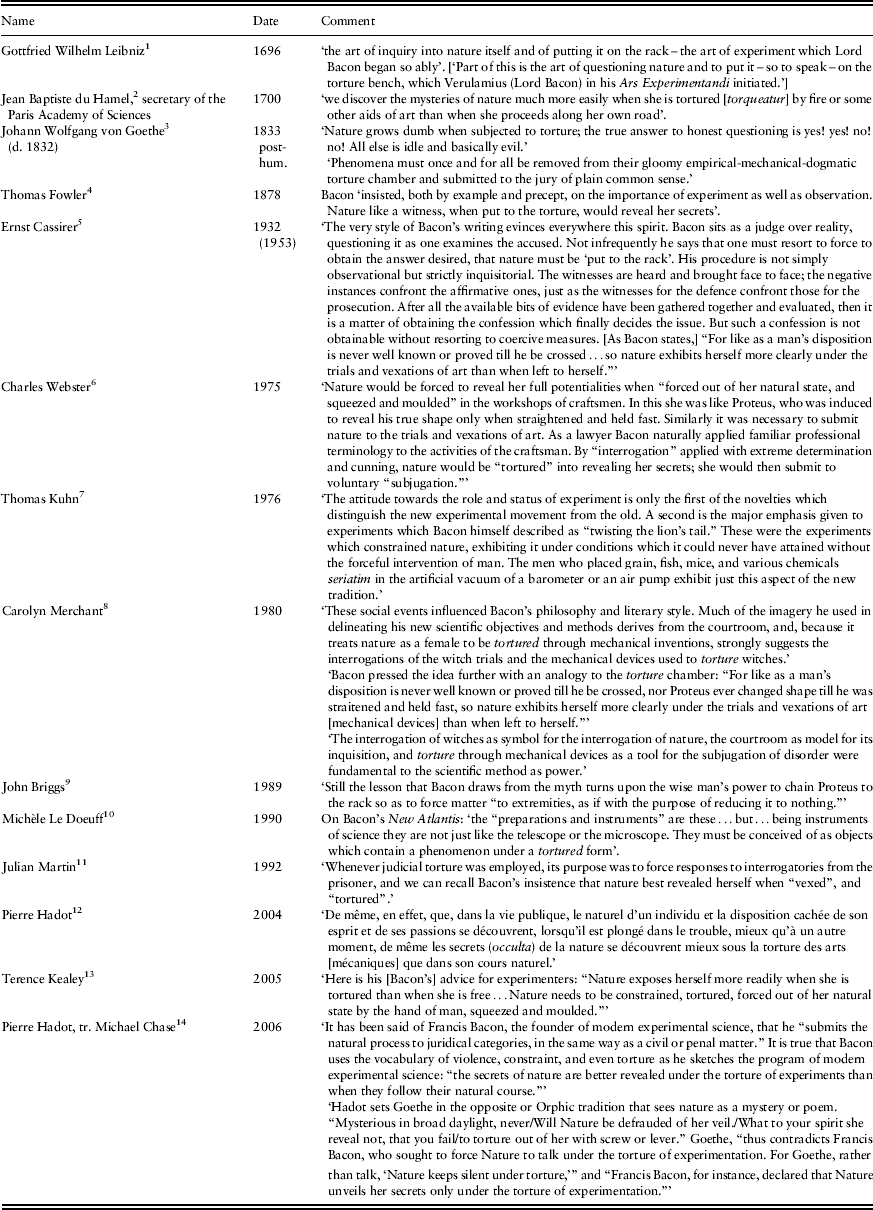
Two additional scholars who associated the word ‘torture’ with Bacon and experimentation wrote at the turn of the seventeenth century. Gottfried Wilhelm Leibniz, in a letter of 1696 to Gabriel Wagner (publisher of the Hamburg weekly Vernunftübungen) concerning the nature of logic, used the word folterband. The word folter in German meant ‘torture’ and folterband was translated as the ‘torture bench’ or ‘rack’. In this major letter on logic, Leibniz wrote of ‘the art of inquiry into nature itself and of putting it on the rack [die folterband] – the art of experiment (Ars Experimentandi) which Lord Bacon began so ably’. An alternative translation by Niklaus Largier that renders folterband as the ‘torture bench’ is, ‘Part of this is the art of questioning nature and to put it – so to speak – on the torture bench, which Verulamius [Lord Bacon] in his Ars Experimentandi initiated’ (see Table 6). Although opposed to human torture, Leibniz seems to have associated the term with experimentation as a means of gaining information from nature. In 1696, Leibniz had begun using the term ‘monad’ to represent a substance endowed with perception and activity, existing in a state of accommodation and consensus with other substances. He considered all of nature to be animated and alive, composed of living forces (vis viva), while the world around us consisted of ‘well-founded’ phenomena. Experimentation was the method for gaining an understanding of the phenomenal world.Footnote 17
Francis Bacon and ‘Torture’. Aphorisms on the Formation of the Primary History, Aphorism 5,*Parasceve, 1620
* Italics added to ‘torture’ and its variants.
1 Francis Bacon, Parasceve, ‘Aphorismi de Conficienda Historia Prima’ (1620), in idem, Works (ed. James Spedding, Robert Leslie Ellis, Douglas Devon Heath), 14 vols., London: Longmans, 1868–1901, vol. 1, Aphorism V, p. 399.
2 Francis Bacon, Parasceve, ‘A Set of Aphorisms for Compiling a Just History of Nature and Art’ (1620), Aphorism V, in De Augmentis Scientiarum, in idem, Philosophical Works, methodized and made English, from the originals, with occasional notes, to explain what is obscure, by Peter Shaw, 3 vols., London: J.J. and P. Knapton, D. Midwinter and A. Ward, and others, 1733, vol. 3, p. 11.
3 Francis Bacon, Parasceve, A Preparation for a Natural and Experimental History, in idem, Works (ed., and tr. Basil Montagu), 3 vols., Philadelphia: Philadelphia: Carey & Hart and Parry & McMillan, 1850–1859, vol. 3, p. 428.
4 Francis Bacon, Parasceve, ‘Aphorisms on the Composition of the Primary History’ (1620), in idem, Works, op. cit. (1), vol. 4, p. 257.
Bacon scholars and ‘Torture’
1 Gottfried Wilhelm Leibniz, ‘Letter to Gabriel Wagner’, in idem, Philosophical Papers and Letters (ed. Leroy E. Loemker), vol. 2, Chicago: University of Chicago Press, 1956, p. 758; also in idem, Die Philosophischen Schriften (ed. C.I. Gerhardt) , 7 vols., Berlin: 1875–1890, vol. 7, pp. 514–527, 518. ‘Dahin gehöret auch die Kunst die Natur selbst auszufragen und gleichsam auff die folterband zu bringen, Ars Experimentandi, so Verulamius wohl angegriffen.’ Alternative translation in brackets by Niklaus Largier, Professor of German, Univeristy of California–Berkeley.
2 Jean Baptiste du Hamel, Regiae Scientiarum Academiae Historia, 2nd edn, Paris: J.B. Delespine, 1701, p. 16: ‘sic natura arcana longe facilius deprehendimus, cum per ignem aut alia artis adminicula varie torquetur, quam ubi itinere quodam suo progreditur’. Cited and translated by S. Beasley Linnard Penrose Jr, ‘The reputation and influence of Francis Bacon’, doctoral dissertation, Columbia University, 1934, pp. 97–98.
3 Johann Wolfgang von Goethe, Maximen und Reflexionen. Nach den Handschriften des Goethe- und Schiller-Archivs herausgegeben von Max Hecker, Weimar: Goethe-Gesellschaft, 1907, Maxim 115, p. 21: ‘Die Natur verstummt auf der Folter; ihre treue Antwort auf redliche Frage ist: Ja! ja! Nein! nein! Alles Übrige ist vom Übel.’ idem, Sämtliche Werke, Jubiläums-Ausgabe, ed. Eduard von der Hellen, 40 vols., Stuttgart and Berlin: J.G. Cotta, 1902–1912, vol. 39, Maxim 430, p. 64: ‘Die Phänomene müssen ein für allemal aus der düstern empirisch-mechanisch-dogmatischen Marterkammer vor die Jurn des gemeinen Menschen-verstandes gebracht werden.’ For the English see idem, Maxims and Reflections (tr. Elisabeth Stopp, ed. Peter Hutchinson), London: Penguin, 1998, Maxim 115, p. 14: ‘Nature grows dumb when subjected to torture; the true answer to honest questioning is yes! yes! no! no! All else is idle and basically evil’; and Maxim 430, p. 55: ‘Phenomena must once and for all be removed from their gloomy empirical-mechanical-dogmatic torture chamber and submitted to the jury of plain common sense.’ See also Erich Heller, The Disinherited Mind: Essays in Modern German Literature and Thought, Cambridge: Bowes & Bowes, 1952, p. 18: ‘Goethe regards it as his own scientific mission to “liberate the phenomena once and for all from the gloom of the empirico-mechanico-dogmatic torture chamber”’, as taken from Goethe, Jubliäums-Ausgabe, op. cit., vol. 34, p. 64.
4 Thomas Fowler, Bacon's Novum Organum, with introduction, notes, etc. Oxford: Clarendon Press, 1878, p. 124; see p. 127 in the second edition of 1889. Also, ‘He insisted, both by example and precept, on the importance of experiment over observation’.
5 Ernst Cassirer, The Platonic Renaissance in England (tr. James P. Pettegrove), Austin: University of Texas Press, 1953, pp. 47–48; Cassirer cites Bacon, Works, Book II, Chapter 2, De Augmentis. See Ernst Cassirer, Die Platonische Renaissance in England und die Schule von Cambridge (Studien der Bibliothek Warburg, xxiv), Leipzig: Teubner, 1932, in idem, Gesammelte Werke (ed. Friederike Plaga und Claus Rosenkranz), 25 vols., Hamburg: Feliz Meiner Verlag, 2002, vol. 14, pp. 260–261: ‘Schon der Stil Bacons atmet überall diesen Geist. Bacon sitzt über die Wirklichkeit zu Gericht, und er verhört sie, wie man einen Angeschuldigten verhört. Nicht selten ist die Rede davon, dass man ihr die Antwort, die man begehrt, abnötigen, dass man die Natur “auf die Folter spannen” muss. Das Verfahren ist nicht einfach betrachtend oder beobachtend, sondern es ist streng inquisitorisch. Die Zeugen werden verhört und miteinander konfrontiert: Den “affirmativen” treten die “negativen” Instanzen, wie den Belastungszeugen die Entlastungszeugen, gegenüber. Und nachdem alle verfügbaren Zeugnisse gesammelt und in ihrem Wahrheitswert gegeneinander abgewogen sind, gilt es zuletzt, das Geständnis zu gewinnen, das die Frage endgültig entscheidet. Ein solches Geständnis is ohne Zwangsmittel nicht erreichbar. “Wie man die Denkweise eines Menschen nur dadurch erkennt und erprobt, dass man ihn aufreizt und herausfordert … so wird auch die Natur, wenn sie durch die Kunst gereizt und bedrängt wird, sich uns weit klarer offenbaren, als wenn man sie in Freiheit lässt.’
6 Charles Webster, The Great Instauration: Science, Medicine, and Reform, 1626–1660, London: Duckworth, 1975, p. 338. Quoting from Bacon, Novum Organum, Book 1, Aphorism 98, in Works (ed. James Spedding, Robert Leslie Ellis, Douglas Devon Heath), 14 vols., London: Longmans, 1868–1901, vol., 1, p. 258; and De Augmentis, ibid., vol. 3, p. 333.
7 Thomas S. Kuhn, ‘Mathematical vs. experimental traditions in the development of physical science’, Journal of Interdisciplinary History (1976) 7, pp. 1–31, 12.
8 Carolyn Merchant, The Death of Nature: Women, Ecology, and the Scientific Revolution, San Francisco: HarperCollins, 1980, pp. 168, 169, 172. Note: Peter Shaw's (1733) translation of the Proteus quotation (omitting the Proteus phrase) is: ‘For as a man's Temper is never well known till he is cross'd; in like manner the Turns and Changes of Nature cannot appear so fully, when she is left at her liberty, as in the Trials and Tortures of Art.’ Francis Bacon, De Augmentis Scientiarum, in idem, Philosophical Works, methodized and made English, from the originals, with occasional notes, to explain what is obscure, by Peter Shaw, 3 vols., London: J.J. and P. Knapton, D. Midwinter and A. Ward, and others, 1733, vol. 1, p. 46; see also 1737 edition of ibid.; De Augmentis Scientiarum, M. Jones, 1803.
9 John C. Briggs, Francis Bacon and the Rhetoric of Nature, Cambridge, MA: Harvard University Press, 1989, p. 35.
10 Michèle Le Doeuff, ‘Man and Nature in the gardens of science’, in William A. Sessions (ed.), Francis Bacon's Legacy of Texts, New York: AMS Press, 1990, p. 132.
11 Julian Martin, Francis Bacon: The State and the Reform of Natural Philosophy, New York: Cambridge University Press, 1992, p. 166. See p. 217 n. 73: ‘Many references, e.g., Parasceve, Aph 1, Works, I, pp. 138–9 (IV, p. 26), Advancement of Learning, Works, III, p. 333. Note: Julian Martin's citations for ‘vexed’ and ‘tortured’ (p. 217 n. 73) do not correctly refer to passages where the Latin might lead one to translate vexare (and its variants) as ‘torture’. In the Parasceve, Aphorism 1, neither the Latin nor the English uses ‘vex’ or ‘torture’. In the 1605 (English) Advancement of Learning, Bacon's English is ‘vexations of art’. Martin's first citation should be to Parasceve, Aphorism 5, where the Latin is vexationes artis. Bacon, Works, op. cit. (6), vol. 1, p. 399. Spedding's translation is ‘vexations of art’ (ibid., vol. 4, p. 257); Peter Shaw's (Philosophical Works, op. cit. (8), vol. 3, p. 11), is ‘Tortures of Art’. Martin's second citation should be to the De Augmentis (1623), where the Latin is irritata et vexata (Works, op. cit. (6), vol. 1, p. 500). Spedding's translation (Works, op. cit. (6), vol. 4, p. 298), is ‘vexations of art’; Peter Shaw's (Philosophical Works, op. cit. (8), vol. 1, p. 46), is ‘Tortures of Art’. I thank Robert Westman for drawing my attention to Julian Martin's book.
12 Pierre Hadot, Le voile d'Isis: essai sur l'histoire de l'idée de nature (Paris: Gallimard, 2004), p. 133.
13 Terence Kealey, ‘Bacon's shadow’, Prospect (October 2005) 115, pp. 44–47, 47 (sources of the two quotations not referenced). Possible sources of the two quotations: Quotation 1: De Augmentis Scientiarum, 1623, Book II, Chapter 2, Spedding, 1875: ‘so nature exhibits herself more clearly under the trials and vexations of art than when left to herself’. Latin: Francis Bacon, De Augmentis Scientiarum, in Works, op. cit. (6), vol. 1, p. 500: ‘similiter etiam natura arte irritata et vexata se clarius prodit, quam cum sibi libera permittitur’. Quotation 2: Francis Bacon, ‘Plan of the Work’, in ibid., vol. 4, p. 29: ‘nature under constraint and vexed; that is to say, when by art and the hand of man she is forced out of her natural state and squeezed and moulded’. Latin: Francis Bacon, ‘Distributio operis’, in ibid., vol. 1, p. 141: ‘naturae constrictae et vexatae; nempe, cum per artem et ministerium humanum de statu suo detruditur, atque premitur et fingitur’. Note: vexata in Quotation 1 and vexatae in Quotation 2 have been translated as ‘torture’, for example: Quotation 1: Table 4, column 4: Francis Bacon, De Augmentis Scientiarum, in Philosophical Works, op. cit. (8), vol. 1, p. 46; column 7: Francis Bacon, The Physical and Metaphysical Works of Lord Bacon, Including the Advancement of Learning and Novum Organum (ed. Joseph Devey), London: William Pickering, 1844; Bell & Daldy, 1853, available at http://en.wikisource.org/wiki/Novum_Organum/Book_I_(Wood); Francis Bacon, The Physical and Metaphysical Works of Lord Bacon, including the Advancement of Learning and Novum Organum (ed. Joseph Devey), London: George Bell & Sons, 1904, Advancement of Learning, Book II, Chapter 2, p. 83. Quotation 2: Table 2, column 2: Thomas Tennison, Archbishop of Canterbury, Baconiana, or Certain genuine remains of Sr. Francis Bacon, Baron of Verulam, and Viscount of St. Albans in arguments civil and moral, natural, medical, theological, and bibliographical (London: Printed by J.D. for Richard Chiswell, 1679), p. 41; col. 3: Francis Bacon, ‘Preliminaries’, in Philosophical Works, op. cit. (8), vol. 1, p. 14; col. 4, Francis Bacon, The Physical and Metaphysical Works of Lord Bacon, op. cit., para. 14.
14 Pierre Hadot, The Veil of Isis: An Essay on the History of the Idea of Nature (tr. Michael Chase, Cambridge, MA: Harvard University Press, 2006, pp. 93, 340 n. 6, citing Francis Bacon, Novum Organum, tr. from the Latin by M. Malherbe and J.-M. Pousseur, Paris, 1986, Book I, Aphorism 98, p. 159 (italics added): ‘de même les opérations cachées de la nature se livrent mieux sous le tourment des arts que dans leur cours ordinaire’. On p. 120 Hadot again quotes the above passage: ‘so the secrets [occulta] of nature are better discovered under the torture of the [mechanical] arts than when it proceeds in its natural course’. From Bacon, Novum Organum (tr. Malherbe and Pousseur), Book I, Aphorism 98, p. 159. On Goethe see Hadot, Veil of Isis, op. cit., pp. 148–149 and 35.
The other turn-of-the-century scholar who believed that Bacon was referring to the torture of nature was secretary of the Paris Academy of Sciences Jean Baptiste du Hamel, writing in 1700. Referring implicitly to Bacon and his first and third states of nature, Hamel wrote, ‘we discover the mysteries of nature much more easily when she is tortured [torqueatur] by fire or some other aids of art than when she proceeds along her own road’ (see Table 6). The secrets, or mysteries, of nature could be understood through ‘art’ (technology) such as fire.
These seventeenth-century scholars, while presumably opposed to human torture, and potentially to animal torture as well, were writing close to the time when torture had a vivid physical meaning. While in no way implying that Bacon advocated human torture, they nevertheless associated his Latin usage of vexare with the torture of nature as a means of experimentation and hence of gaining knowledge of the natural world. This reading of Bacon as a founder of the experimental method was to continue into the eighteenth and nineteenth centuries.
Eighteenth-century translators and interpreters
The first comprehensive English translation of Bacon's works was made in the eighteenth century by Peter Shaw (1694–1763), chemist and physician-in-ordinary to Kings George II and George III.Footnote 18 A devoted follower and translator of Francis Bacon (1733), Shaw had also edited and popularized the work of Robert Boyle (1725 and 1738) and Herman Boerhaave (1727). He was a strong advocate of the experimental method and of the advancement of the ‘useful arts’. He designed a portable laboratory and in 1734 (revised 1755) published a volume entitled Chemical Lectures Publically Read at London in the Years 1731 and 1732. In 1733 he published his three-volume edition of Francis Bacon, entitled The Philosophical Works … Methodized and made English, from the Originals, with Occasional Notes, to explain what is obscure … A second printing appeared in 1737. In this, the first and most comprehensive English edition and translation of Bacon's works, Shaw consistently rendered vexare and its variants as ‘torture’.
In four of Bacon's works, The Wisdom of the Ancients (1609), the Instauratio Magna (1620), and the De Augmentis Scientiarum (1623) in volume 1 and the Novum Organum (1620) in volume 2, Shaw consistently used the word torture in his translations. (Subsequent editions of Shaw's translation of the Novum Organum appeared in 1802, 1813 and 1845 and of the De Augmentis in 1803.)
First, Shaw translated the Proteus passages in the 1609 Veterum sapientium, which he entitled Physical Mythology, as follows, using the word ‘torture’ in three places:
And thus far the Fable reaches of Proteus, and his Flock, at liberty and unrestrained. For the Universe, with the common Structures and Fabricks of the Creatures, is the Face of Matter, not under constraint; or as the Flock wrought upon, and tortured, by human means. But if any skillful Minister of Nature shall apply force to Matter; and by design torture and vex it, in order to its Annihilation; it, on the contrary, being brought under this Necessity, changes and transforms it self into a strange Variety of Shapes and Appearances; for nothing but the Power of the Creator can annihilate, or truly destroy it: so that at length running thro’ the whole Circle of Transformations, and compleating its Period, it in some degree restores itself if the Force be continued. And that method of binding, torturing, or detaining, will prove the most effectual and expeditious, which makes use of Manacles and Fetters; that is, lays hold and works upon Matter in extremest Degrees [see Table 1, italics added].
Second, in the 1620 ‘Plan of the Work’ to the Instauratio Magna, which Shaw translated as the ‘Preliminaries’, where Bacon used the Latin phrase vexationes artis, Shaw gave the translation as ‘the torturings of Art’:
With regard to its collection; we propose to shew Nature not only in a free state, as in the History of Meteors, Minerals, Plants, and Animals, but more particularly as she is bound, and tortur'd, press'd, form'd, and turn'd out of her course by Art and human Industry. Hence we would set down all apposite experiments of the mechanic and liberal Arts; with many others not yet formed into Arts: for the nature of things is better discover'd by the torturings of Art, than when they are left to themselves [see Table 2, italics added to ‘torture’ and its variants].
Third, in Aphorism 98, Book I, of the Novum Organum (1620), where Bacon's Latin is vexationes artium, Shaw rendered the translation as: ‘so the Secrets of Nature are better gotten out by the Torturing of Arts, than when suffer'd to take their own course’ (see Table 3; italics added).
Finally, in the 1623 De Augmentis Scientiarum, where Bacon's Latin is arte irritata et vexata, Shaw's translation was, ‘For as a man's Temper is never well known till he is cross'd; in like manner the Turns and Changes of Nature cannot appear so fully, when she is left at her liberty, as in the Trials and Tortures of Art’ (see Table 4, italics added).
Shaw's three-volume set, as the first major English edition of Bacon's Works, would become an important milestone, both for its usage and treatment of Bacon's ideas and as a point of comparison and refinement for nineteenth-century editors and translators. It is not clear why Shaw so consistently translated vexare and its variants as ‘torture’, even inserting the word in places where vex itself did not appear. But Shaw was an ardent advocate of experimentation and of Bacon's emphasis on the useful arts as a means of understanding nature. He was also intimately familiar with Boyle's experiments, having, in 1725, translated a volume of his Works, and had himself performed numerous public experiments in chemistry. Shaw's Lectures on Chemistry covered the characteristics of the four traditional elements, fire, air, water and earth; Boerhaave's ideas on putrefaction and fermentation; and lectures on the useful arts and their applications in order to ‘apprehend what lies in the Verulamian Method’.Footnote 19
Although Shaw associated the Verulamian (Baconian) method with experimentation, his Lectures do not contain experiments on living things. Indeed concerns about experimentation on live animals were prevalent in the cultural milieu of the period. In the years following Shaw's translation, William Hogarth painted The Four Stages of Cruelty (1751), depicting the torture of dogs, cats, chickens, sheep, horses, donkeys, cattle and humans. James Ferguson's lecture on ‘Experiments with the Air Pump’ (1761) warned that experiments in which living things expired as the air was extracted from a receiver might prove too shocking for most audiences to view. And in 1768, Joseph Wright of Derby painted An Experiment on a Bird in the Air Pump, in which a pet cockatoo is placed in a bell jar from which an experimenter prepares to evacuate the air. Such experiments from the 1660s onward may have raised public awareness about animal experimentation and the idea of torture as a method of extracting information about the natural world.Footnote 20
Nineteenth-century translators and interpreters
In the nineteenth century, several writers and translators continued the tradition of associating the torture or torment of nature with Francis Bacon. These included Johann Wolfgang von Goethe, William Wood, Herman Merivale, Basil Montagu, J.A.C. Buchon, Joseph Devey, James Creighton and Thomas Fowler. James Spedding, who along with Robert Leslie Ellis and Douglas Devon Heath produced the fourteen-volume English edition of Bacon's works (London, 1857–1874), was perhaps the first consistently to translate vexare and its variants as ‘vexation’, rather than ‘torture’ or ‘torment’.
The first of these writers, Johann Wolfgang von Goethe, seemingly influenced by Francis Bacon's ideas, strongly objected to the very idea of the torture of nature, although his thoughts were not published until 1833, just after his death. In Maxim 115 of his Maxims and Reflections, he wrote, ‘Nature grows dumb when subjected to torture [folter]; the true answer to honest questioning is yes! yes! no! no! All else is idle and basically evil’. In Maxim 430 he stated the idea thus: ‘Phenomena must once and for all be removed from their gloomy empirical–mechanical–dogmatic torture chamber [marterkammer] and submitted to the jury of plain common sense’ (see Table 6).
Several translators in the early nineteenth century used the word ‘torment’ rather than ‘torture’ in their translations of Bacon's writings. Between 1825 and 1834, Basil Montagu edited a new edition of Bacon's Works, printed as a sixteen-volume set, published by William Pickering in London and reprinted in Philadelphia in three volumes in 1844, 1852, 1857 and 1859.Footnote 21 In it, he included two translations that rendered vexare as ‘torment’. He also included a very extensive set of notes on Bacon that listed the various editions and translations of his writings. In volume 16, Note BBB, of the William Pickering edition, Montagu stated, ‘In 1733 Peter Shaw, M.D. published a translation of the Novum Organum. In the year 1830, the translation published in this edition was by my friend William Wood.’ Wood translated Aphorism 98, Book 1, of the Novum Organum, as: ‘so the secrets of nature reveal themselves more readily when tormented by art than when left to their own course’ (see Table 3, columns 3 and 5, italics added).
In his 1840 edition of the Essays or Counsels Civil and Moral and Wisdom of the Ancients, Montagu used Herman Merivale's translation of De Sapientium Veterum which likewise rendered vex as ‘torment’:
Nevertheless if a skilful handler of nature apply force to matter, and torment and press it, as if with intent and determination to reduce it to nothing, matter on the contrary (since its utter annihilation and destruction can never take place except by the omnipotent will of God), being placed in these straits, twists and changes itself into a wonderful variety of shapes and transformations [see Table 1, column 3].
It is not clear why both Wood and Merivale chose to translate Bacon's Latin as ‘torment’, but, like ‘torture’, it carried connotations of harshness, intervention and violence as a means of extracting information about the natural world.
In addition to Montagu in England, another major edition of Bacon's Works appeared in France that consistently used the word ‘torment’ to characterize Bacon's experimental philosophy. J.A.C. Buchon's edition of François Bacon's Oeuvres Philosophiques, Morales et Politiques was published in Paris, in 1840. Buchon compiled his edition of the Oeuvres from several French translations, primarily those of Antoine de la Salle, published in Dijon in fifteen volumes in 1800. Buchon and La Salle used both ‘torment’ and ‘torture’ in the translation of Aphorism 98 (Book I) of the 1620 Novum Organum (Nouvel Organe): ‘Nature … releases her secret more readily when tormented [tourmentée] or tortured [torturée] by human agency than when left to its normal course.’ They translated Bacon's Latin in the 1620 ‘Plan of the Work’ (Distribution de l'ouvrage) in two places as torment – ‘Nature reveals herself better when tormented [tourmentée] by art (human agency) than when abandoned to herself and left completely alone’ – and when writing of the third state of nature, that is, of ‘nature bound and tormented [tourmentée], that is to say, of nature, when by means of art and the ministry of man, she is put out of her own state, pressed or forged’. Tourmentée was also the translation used in the Proteus passage in the 1623 De Augmentis (De La Dignité et De L'Accroissement des Sciences): ‘just as nature also is irritated [irritée] and tormented [tourmentée] by human agency’. And in the section on Proteus in the 1609 ‘The Wisdom of the Ancients’ (De La Sagesse Des Anciens), the translation particularly emphasized the torment associated with the binding of Proteus. The garrotte, a rope or iron collar used around the neck for torture and hanging, was used to describe the capturing of Proteus: ‘Those who wanted to question him could not extract any response without choking him with a garrotte [garrottant très étroitement].’ Once captured, the questioning of Proteus could only be done with torment, violence and handcuffs, achieving answers only ‘if a minister of nature, enlightened and guided by the spirit, takes care to administer force [violence] and torment [tourmentée] by all kinds of means’, and ‘if one places him in handcuffs [menottes], that is by using extreme measures’.Footnote 22
Bacon's English writings soon began to appear in smaller editions intended for the general reader. A major contributor to this new market was an editor named Joseph Devey. Devey edited a two-volume set that appeared in London as part of Bohn's Scientific Library in the 1850s. All of Devey's editions that contained translations of vexare and its variants used either Peter Shaw's translation as ‘torture’ or William Wood's translation as ‘torment’.
The first of these two volumes was The Physical and Metaphysical Works of Lord Bacon, Including the Advancement of Learning and Novum Organum, edited by Joseph Devey, M.A. In this volume, Devey used Wood's translation of the Novum Organum (1620), in which Aphorism 98, from Book I, read, ‘so the secrets of nature reveal themselves more readily when tormented by art than when left to their own course’ (see Table 3, column 4, italics added). For the ‘Distribution of the Work’ (‘Plan of the Work’, 1620), from the Instauratio Magna, he used Peter Shaw's translation (modernizing the spelling and changing the capitalization):
With regard to its collection; we propose to show nature not only in a free state, as in the history of meteors, minerals, plants, and animals; but more particularly as she is bound, and tortured, pressed, formed, and turned out of her course by art and human industry. Hence we would set down all opposite experiments of the mechanic and liberal arts, with many others not yet formed into arts; for the nature of things is better discovered by the torturings of art, than when they are left to themselves [see Table 2, column 5, italics added].
He also used Shaw's translation of the De Augmentis Scientiarum (1623), again changing the capitalization. ‘For as a man's temper is never well known until he is crossed, in like manner the turns and changes of nature cannot appear so fully, when she is left at her liberty, as in the trials and tortures of art’ (see Table 4, column 7, italics added).
Devey's volume was published in London by Pickering in 1844. It was then taken up by Henry Bohn for his Scientific Library and reprinted by Bell & Daldy in 1853, by Henry Bohn in 1858, and by George Bell and Sons in 1904, all located in London. The 1858 edition contained the following preface by Joseph Devey (immediately following the title page):
Of the De Augmentis, though one of the greatest books of modern times, only three translations have appeared, and each of these strikingly imperfect … In the present version, our task has been principally to rectify Shaw's mistakes, by restoring the author's own arrangement and supplying the omitted portions … The version of the Novum Organum contained in this volume is that of [William] Wood [1830], which is the best extant … JD
But in 1902 the two works were printed separately by P.F. Collier & Sons in New York. While the Advancement of Learning contained Devey's ‘Preface’, acknowledging Shaw as the source for the translation of the Advancement (actually the 1623 De Augmentis), the separately printed edition of the Novum Organum lacked Devey's preface in which William Wood was acknowledged as the translator.
Efforts to reach a popular audience soon perpetuated the unacknowledged appropriation of Peter Shaw's translations of Bacon. In 1899, James Edward (Edwin) Creighton, Sage Professor of Logic and Metaphysics at Cornell University, American editor of Kant-Studien, and soon to be president of the American Philosophical Society and dean of the Graduate School, edited The Advancement of Learning and Novum Organum, by Francis Bacon (Lord Verulum).Footnote 23 It was printed in New York by the Colonial Press and reprinted by Willey Book Co. in 1900 and 1944. Creighton's sources for his translations – without acknowledgement – were identical to those of Devey, namely Shaw for the Advancement (actually Bacon's De Augmentis), which used ‘torture’, and Wood for the Novum Organum, which used ‘torment’. Moreover, Creighton's notes were identical to those of Devey, but placed at the end of the volume as opposed to the foot of the page (see Table 4, column 9 and Table 3, column 8). It is not clear why these translations and notes were published under Creighton's name, but the demands of the popular market for books of the ‘World's Great Classics’, assembled together in the crimson-covered volumes of the Colonial Press series, may have been the reason.
The second volume in Devey's set, entitled Bacon's Moral and Historical Works, was published by Bohn in 1857, and contained The Wisdom of the Ancients. Unlike the first volume, however, it did not acknowledge the source of the translation. The translation, however, is clearly that of Peter Shaw, with the capitalization modified. Devey's passages from the Proteus myth that contain the word ‘torture’ are as follows:
And thus far the fable reaches of Proteus, and his flock, at liberty and unrestrained. For the universe, with the common structures and fabrics of the creatures, is the face of matter, not under constraint, or as the flock wrought upon and tortured by human means. But if any skilful minister of nature shall apply force to matter, and by design torture and vex it, in order to its annihilation, it, on the contrary, being brought under this necessity, changes and transforms itself into a strange variety of shapes and appearances; for nothing but the power of the Creator can annihilate, or truly destroy it; so that at length, running through the whole circle of transformations, and completing its period, it in some degree restores itself, if the force be continued. And that method of binding, torturing, or detaining, will prove the most effectual and expeditious, which makes use of manacles and fetters; that is, lays hold and works upon matter in the extremest degrees [see Table 1, column 4, italics added].
Subsequent printings of Devey's Moral and Historical Works, containing The Wisdom of the Ancients, without acknowledging Peter Shaw as the translator, appeared in 1857 and 1862 by Henry Bohn, publisher, and in 1874, 1882 and 1894 by George Bell & Sons, the latter at the same London address as Henry Bohn – a replica of the 1857 edition was published in 2006 by Elibron Classics Replica (see Table 1, columns 4 and 8). In 1884 an edition of Bacon's Essays and Wisdom of the Ancients was printed in Boston by Little, Brown, & Company. The advertisement stated, ‘In preparing the present volume for the press, use has been freely made of several publications which have recently appeared in England’, and noted that ‘the Notes, including the translations of the Latin, are chiefly copied from Bohn's edition, prepared by Joseph Devey, M.A.’ (see Table 1, column 7). Again, however, no notice was given that the translation of the Wisdom of the Ancients was that of Peter Shaw made in 1733. All these popular mass-market volumes helped to disseminate the work of Francis Bacon as the father of experimental philosophy and to illustrate the importance of the experimental method.
One other major nineteenth-century scholar used the word ‘torture’ in conjunction with Bacon's Novum Organum. Thomas Fowler employed it in his Latin edition of the Novum Organum (published in 1889), both in his notes to Aphorism 98 (Book I) and in his introduction, associating it with experimentation. In his footnote to Aphorism 98, Fowler gave the translation as: ‘Nature best discovers her secrets when tortured by art’ and further noted, ‘This is an excellent illustration of the advantage which Experiment, at least in many cases, possesses over Observation’ (see Table 3, column 7, italics added). In his introduction to the volume, Fowler reiterated what he thought to be one of Bacon's singular influences on science: ‘He insisted, both by example and precept, on the importance of experiment over observation. Nature like a witness when put to the torture would reveal her secrets’ (see Table 6). Fowler, therefore, like his predecessors, interpreted Bacon's experimental method for obtaining secrets (information) in terms of the torture of nature.
These editions of Bacon's works, spanning the nineteenth century from the 1820s to 1900 (with reprints as late as 1944 and 2006), continued the tradition begun by Peter Shaw of viewing vexare in a strong, interventionist manner, interpreting Bacon's meaning as ‘torture’ or ‘torment’. They are indicative of the process of confining nature in bonds in order to extract useful information from it, a method associated by Bacon's followers with experimentation. By now advances in science associated with the experimental method had become sufficiently powerful and well known in fields such as electricity and magnetism, hydrodynamics and thermodynamics that interventionist techniques for isolating and operating on phenomena in closed systems for the purposes of discovery and harnessing the forces of nature were widely accepted. Soon, perhaps associated with the establishment and acceptance of the experimental method, the language of torture and torment would begin to recede in translations and editions of Bacon's work. This reassessment would begin with Bacon's myth of Proteus.
The myth of Proteus in the nineteenth century
The case of Proteus is of particular interest as it has become a point of contention between the defenders of Bacon, who in the mid-1990s argued that he did not use harsh language when talking about nature, and those who maintain that Bacon's objective was to re-establish human dominion over nature, thereby advancing its control and domination (see discussion below). The several instances in which Bacon compared the vexations of art to the constraint of Proteus lend credence to the importance of the Proteus myth in Bacon's thinking. Whether, in choosing the term ‘vexation’, Bacon himself meant the harsher connotations of the torture or torment of nature (as his earlier translators seem to believe), or the milder implications of agitation or annoyance (as his defenders argue), is central to the debate. The large number of printings of Bacon's works disseminated in the nineteenth and twentieth centuries through popular outlets to a general audience (for example, by Montagu, Devey and Creighton, using the translations of Shaw, Wood and Merivale) convey an interventionist and harsher reading of Bacon than the defenders acknowledge. They continue the idea of experimentation as an interventionist approach to extracting information from nature.
By 1857, however, it appears that both Basil Montagu and Spedding, Ellis and Heath were moving away from the use of the words ‘torture’ and ‘torment’. Both Montagu's 1857 and Spedding's 1878 translations of the Proteus myth in The Wisdom of the Ancients use the word ‘vex’ as opposed to ‘torture’. The three instances in which Shaw and Devey use the word ‘torture’ can be compared to the three places in that same passage as translated by Montagu and Spedding (see Table 1, italics added). In the first instance, where Shaw and Devey have ‘the Face of Matter, not under constraint; or as the Flock wrought upon, and tortured’, Montagu (using Gorges, 1619; see Table 1, column 5) has ‘The face of matter not limited and constrained and of the flock also of material beings’, and Spedding has ‘the face of matter unconstrained and at liberty, with its flock of materiate creatures’. In the second instance, where Shaw and Devey have ‘torture and vex it’ and Merivale has ‘torment and press it’, Montagu (Gorges) uses ‘vexing and urging her’, while Spedding has ‘vex it and drive it’. Finally, in the third instance, Shaw and Devey have ‘binding, torturing, or detaining’, while Montagu (Gorges) uses ‘constraint or binding’ and Spedding uses ‘constraint and binding’.
Bacon's comparison between the vexations of art and the constraint of Proteus in Montagu's (1857) and Spedding's (1858, 1875) editions is particularly striking in Aphorism 5 of the 1620 Parasceve, or ‘Aphorisms on the Formation of the Primary History’ (see Table 5, italics added). Here Peter Shaw's 1733 translation uses the ‘tortures of art’, Montagu's uses ‘the attacks of art’, and Spedding's uses ‘the vexations of art’. The comparison with Proteus is to ‘the Bonds and Shackles of Proteus’ (Shaw), ‘the very fetters and miracles of Proteus’ (Montagu) and ‘the bonds and handcuffs of Proteus’ (Spedding). Another place where Bacon compares the vexations of art with the ‘straitening’ of Proteus is in the De Augmentis Scientiarum of 1623. Here he repeats the passage from the 1605 Advancement discussed above, but writes in Latin. Shaw, Devey and Creighton, however, omit the Proteus phrase from their translation of the Latin, stating simply, ‘the Turns and Changes of Nature cannot appear so fully, when she is left at her liberty, as in the Trials and Tortures of Art’ (see Table 4, italics added).
With respect to Aphorism 98 in Book I of the Novum Organum, a more complex picture emerges. Where Buchon (1840) uses both tourmentée and torturée, Kitchin (1855) uses ‘provoke’ and Johnson (1859) uses ‘vexation’, Montagu (1859) retains Woods's translation, using ‘torment’, and Fowler (Latin edn, 1889) uses ‘torture’ both in his notes and in his introduction (see also Table 3, columns 5 and 7).Footnote 24 Graham Rees (although not writing in reference to the term ‘torture’), states that Fowler's 1889 edition of the Novum Organum was the
greatest of them all. Who would now dare to follow Fowler and publish the Latin text without a translation … [I]n an age when knowledge of Latin slumped, only two new translations of Novum Organum appeared and these not until the very end of the [twentieth] century, and long after the ingenious, mock-Jacobean “Spedding” translation had begun to look embarrassingly dated.Footnote 25
In interpreting Bacon's intentions, therefore, a spectrum of meanings exists depending on the translation.
It is not clear why Montagu and Spedding published editions that moved away from associations with torture and torment. One possibility is that over time language loses its sharper edges and vivid associations, taking on more moderate meanings. Another is that in the new age of industrialization nature itself was no longer considered everywhere alive, animate and able to give up its secrets. A third is the continued awareness of the abilities of animals to suffer and feel pain and the beginnings of an animal-rights movement. Thus Jeremy Bentham, in his Introduction to the Principles of Morals and Legislation, wrote, ‘The question is not, Can they Reason? Nor, Can they talk? But, Can they suffer?’Footnote 26 Nevertheless, Francis Bacon was still held in high esteem for his experimental method, a method that depended on the constraint of nature through the vexations of art. In the twentieth century, however, a different critique of experimentation rooted in the torture of nature would emerge.
Twentieth-century translators and interpreters
Graham Rees argues that during the twentieth century Bacon's star declined. While held in high esteem from the seventeenth century onward, in the 1900s scepticism over Bacon's experimental method arose. In 1748, Colin MacLaurin had written, ‘Sir Francis Bacon Lord Verulam, who was cotemporary [sic] with Galileo and Kepler, is justly held amongst the restorers of true learning, but more especially the founder of experimental philosophy’, such that ‘all theory was to be laid aside that was not founded on experiment’. But, according to Rees, ‘in the twentieth century, Lord Verulam, once regarded as one of the greatest philosophers of Western tradition, was relegated to an intellectual salon des refusés from which he has been hard put to escape’. While Rees associates this decline with attacks on Bacon's inductive method, I argue that scepticism over the implications of Bacon's experimental method, as a means of extracting information from nature, is of equal or greater significance.Footnote 27 From characterizations of coercion and interrogation to the rape of female nature, Bacon's language and metaphors were subjected to an intense scrutiny that undermined his once-lauded reputation.
In the twentieth century, numerous scholars continued the tradition of reading Bacon's Latin as ‘torture’ or ‘torment’ and of interpreting Bacon's idea of experimentation in a strong interventionist manner. Yet the sharp edge now given to these readings evinced a scepticism over the character of the experimental method itself. Thus Ernst Cassirer in Die Platonische Renaissance in England und die Schule von Cambridge (1932, English translation 1953) described Bacon's experimental method as akin to the interrogation of witnesses through coercive measures, quoting from Bacon's 1623 De Augmentis Scientiarum (Book II, Chapter 2): ‘For like as a man's disposition is never well known or proved till he be crossed … so nature exhibits herself more clearly under the trials and vexations of art than when left to herself.’ Perhaps following Leibniz, Cassirer interpreted Bacon's meaning as ‘torture’. Like Leibniz, he used the German words ‘auf die Folter spannen’, meaning the torture bench or rack: ‘Not infrequently he says that one must resort to force to obtain the answer desired, that nature must be “put to the rack” (“auf die Folter spannen”)’ (see Table 6; for Cassirer's German see Table 6, note 5). The goal was thus to extract information from nature by coercive means through experimentation.
In his 1947 Eclipse of Reason, Max Horkheimer discussed Bacon's experimental method as an extraction of knowledge by instrumental means, akin to interrogation by the police, to be put purely to pragmatic use. Horkheimer, who with Theodor Adorno had fled the coercions of Nazi Germany, pinned the rise of instrumentalism on Bacon's philosophy. Quoting Bacon's concept of vexation and his comparison to Proteus (in Latin) from the De Augmentis (citing Montagu's 1827 edition of Bacon's Works), Horkheimer maintained that in experimentation, nature itself becomes identical to the laboratory. The interests of society become those that can be verified through the practices and apparatus of the laboratory, similar to the methods of interrogation employed by the metropolitan police. Objective knowledge (that of the philosopher) gives way to instrumental knowledge (that of the pragmatist). He wrote,
In accordance with the pragmatists' worship of natural sciences, there is only one kind of experience that counts, namely, the experiment. The process that tends to replace the various theoretical ways to objective truth with the powerful machinery of organized research is sanctioned by philosophy, or rather is being identified with philosophy. All things in nature become identical with the phenomena they present when submitted to the practices of our laboratories, whose problems no less than their apparatus express in turn the problems and interests of society as it is. This view may be compared with that of a criminologist maintaining that trustworthy knowledge of a human being can be obtained only by the well-tested and streamlined examining methods applied to a suspect in the hands of metropolitan police. Francis Bacon, the great precursor of experimentalism, has described the method with youthful frankness: ‘Quemadmodum enim ingenium alicujus haud bene noris aut probaris, nisi eum irritaveris; neque Proteus se in varias rerum facies vertere solitus est, nisi manicis arete comprehensus; similiter etiam Natura arte irritata et vexata se clarius prodit, quam cum sibi libera permittitur’.Footnote 28
Both Cassirer and Horkheimer, influenced by Second World War methods of interrogation, compared the questioning of human witnesses to the interrogation of nature, seeing a parallel between the coercive methods used to extract information from humans to that of the experimental laboratory.
In the 1970s, another type of criticism of the experimental method emerged, also in the context of war and the kinds of research it fostered. These critiques followed in the wake of post-war scepticism over the atomic bomb and nuclear power that threatened to annihilate both nature and humanity by extracting the secrets of nature. Although not overtly tied to scepticism over those particular projects, both Charles Webster and Thomas Kuhn evinced concerns about submitting nature to Baconian-style vexation. In his 1975 volume The Great Instauration: Science, Medicine, and Reform, 1626–1660, Webster drew on Bacon's comparison to Proteus, interpreting his meaning as torture, and writing,
Nature would be forced to reveal her full potentialities when ‘forced out of her natural state, and squeezed and moulded’ in the workshops of craftsmen. In this she was like Proteus, who was induced to reveal his true shape only when straightened and held fast. Similarly it was necessary to submit nature to the trials and vexations of art. As a lawyer Bacon naturally applied familiar professional terminology to the activities of the craftsman. By ‘interrogation’ applied with extreme determination and cunning, nature would be ‘tortured’ into revealing her secrets; she would then submit to voluntary ‘subjugation’ [See Table 6].
The following year, in his discussion of the mathematical versus the experimental traditions, Thomas Kuhn (incorrectly interpreting Bacon as having advocated ‘twisting the lion's tail’) continued the view that Bacon's approach to experimentation was extractive, forceful and strongly interventionist:
The attitude towards the role and status of experiment is only the first of the novelties which distinguish the new experimental movement from the old. A second is the major emphasis given to experiments which Bacon himself described as ‘twisting the lion's tail.’ These were the experiments which constrained nature, exhibiting it under conditions which it could never have attained without the forceful intervention of man. The men who placed grain, fish, mice, and various chemicals seriatim in the artificial vacuum of a barometer or an air pump exhibit just this aspect of the new tradition [see Table 6].
The critiques by Webster and Kuhn were published during the time of the internalist–externalist debates in the history of science. While the internalist approach was associated with efforts to understand the history of science from within its own developments in mathematics and experimentation, the externalists emphasized the role of economic, social and cultural forces, often with an overt criticism of the social consequences of those influences. The implications of the experimental method for nature itself needed to be taken into consideration.
In the 1980s, a new critique of Bacon's experimental method arose. Feminist historians and philosophers criticized Bacon's science as dedicated entirely to the domination and control of a nature gendered as female, comparing the experimental method to the inquisition of nature. Carolyn Merchant, in The Death of Nature (1980), while not claiming that Bacon used the word ‘torture’, argued that Bacon's ‘imagery … treats nature as a female to be tortured through mechanical inventions and strongly suggests the interrogations of the witch trials and the mechanical devices used to torture witches’. She quoted the Proteus passage from the 1623 De Augmentis, viewing it as ‘an analogy to the torture chamber’. She concluded, ‘the interrogation of witches as symbol for the interrogation of nature, the courtroom as model for its inquisition, and torture through mechanical devices as a tool for the subjugation of disorder were fundamental to the scientific method as power’ (see Table 6, italics added). Evelyn Fox Keller, in Reflections on Gender and Science (1985), wrote, ‘It is important … to see how deeply Bacon's use of gender is implicated in his conception of mastery and domination.’ And Sandra Harding, in The Science Question in Feminism (1986), wrote, ‘Bacon uses bold sexual imagery to explain key features of the experimental method as the inquisition of nature … Both nature and inquiry appear conceptualized in terms of rape and torture … and this modeling is advanced as a reason to value science.’Footnote 29 Thus Bacon's method was now implicated in a patriarchal, sometimes sexist, scientific culture devoted to the domination and control of nature and human society.
By the early 1990s, more scholars had made a negative comparison between Proteus, vexation, torture and the rack, the goal of which was the interrogation of nature by means of experimentation. John Briggs, in Francis Bacon and the Rhetoric of Nature (1989), wrote, ‘Still the lesson that Bacon draws from the myth turns upon the wise man's power to chain Proteus to the rack so as to force matter “to extremities, as if with the purpose of reducing it to nothing”’. Michelle Le Doeuff, in 1990, said of Bacon's experiments in the New Atlantis (1627), ‘the “preparations and instruments” are these … but … being instruments of science they are not just like the telescope or the microscope. They must be conceived of as objects which contain a phenomenon under a tortured form’. And Julian Martin, in 1992, wrote, ‘Whenever judicial torture was employed, its purpose was to force responses to interrogatories from the prisoner, and we can recall Bacon's insistence that nature best revealed herself when “vexed”, and “tortured”’ (see Table 6, italics added). These critiques sullied Bacon's reputation as the father of an experimental method, now seen to hold negative implications for nature and for human society.
In the twenty-first century, yet another critique of Bacon's philosophy of experimentation emerged, this one rooted in a deep dichotomy between a Promethean (Baconian) attitude dedicated to revealing secrets through technology, and an Orphic (Goethean) view, dedicated to unveiling secrets through discourse, poetry and art. French scholar Pierre Hadot continued the tradition of reading Bacon's Latin as ‘torture’, drawing on a new 1986 French translation of the Novum Organum, by Michel Malherbe and Jean-Marie Pousseur. Malherbe and Pousseur translated Spedding's Latin text (from volume 1 of Bacon's Works) into French, rendering the Latin vexare into the French tourmenter and also supplying a glossary noting the equivalency of ‘tourment: vexatio’. In the Distribution de L'Oeuvre, they translated the Latin as la nature contrainte et tourmentée and les tourments de l'art (see Table 2, column 8). Their translation of Aphorism 98, Book I, of the Novum Organum was, ‘de même les opérations cachées de la nature se livrent mieux sous le tourment des arts que dans leur cours ordinaire’ (see Table 3, column 9, italics added.)
Hadot's discussion of Bacon in La Voile d'Isis (2004) was based on Malherbe and Pousseur's translation, which he modified slightly and into which he substituted the phrase la torture des arts: ‘de même les secrets (occulta) de la nature se découvrent mieux sous la torture des arts [mécaniques] que dans se cours naturel’ (Table 3, column 10, italics added). Michael Chase's English translation of Hadot's book, The Veil of Isis (2006), made clear the connection between torture and experimentation: ‘the secrets of nature are better revealed under the torture of experiments than when they follow their natural course’ (see Table 3, column 11, italics added). Hadot and Chase thus emphasized the relationship between torture and experimentation that lay at the root of earlier readings of Bacon's Latin.
Hadot's analysis, like those of the twentieth-century scholars discussed above, was sharply critical of Francis Bacon's attitude toward experimentation and its implications for human dignity. He wrote, ‘Francis Bacon, for instance, declared that Nature unveils her secrets only under the torture of experimentation’. And elsewhere: ‘It is true that Bacon uses the vocabulary of violence, constraint, and even torture as he sketches the program of modern experimental science’ (see Table 6). Of Goethe, he wrote, ‘Goethe thus contradicts Francis Bacon, who sought to force Nature to talk under the torture of experimentation. For Goethe, rather than talk, “Nature keeps silent under torture”’ (see Table 6). The two traditions hold different destinies for humankind. In the Promethean tradition, nature in ‘her’ hostility toward humans refuses to hand over the secrets. They need to be stolen by trickery and treachery, affirming ‘mankind's right to dominate nature’ and to ‘submit it to a judicial procedure and even to torture in order to make it hand over its secrets – Francis Bacon's famous metaphor would still be used by Kant and by Cuvier’. In the Orphic tradition, on the other hand, knowing nature through aesthetics, philosophy and rational discourse provides an authentic access to knowledge.Footnote 30
Numerous scholars in the twentieth and twenty-first centuries, therefore, continued to read Bacon's Latin as ‘torture’ or ‘torment’. In understanding nature through experiment, they interpreted Bacon as meaning that nature should be constrained and manipulated by technology in order to extract its truths. Together they criticized the implications of experimentation, technology and the mechanical view of nature on instrumental, feminist and environmental grounds, undermining Bacon's once-lauded reputation.
By the mid-1990s, a defence of Francis Bacon's status, along with new English translations of his works, would transform the landscape of vexation. Peter Urbach and John Gibson (1994), like Spedding, along with Graham Rees and Maria Wakely (2004), used the term ‘vexations of art’, while Lisa Jardine and Michael Silverthorne (2000) translated the Latin as ‘the harassment of art’, ‘harassments applied by the arts’, and ‘the manipulations of art’.Footnote 31 These translations were consistent with scholarly defences of Bacon that attempted to rehabilitate his reputation by subjecting the twentieth-century critics to intense scrutiny.
Defenders of Bacon
Despite the long tradition of reading Bacon's Latin as meaning ‘torture’ or ‘torment’, a contentious debate arose in the mid-1990s about the meaning that Bacon himself gave to the word ‘vex’. A number of scholars argued that Bacon did not intend to use harsh language when discussing nature. These included physicists Peter Pesic and Alan Sokal, philosophers Alan Soble and Iddo Landau, literary scholar Brian Vickers, and historical biographer Nieves Mathews. They mainly used Spedding when citing Bacon's works, but made different arguments as to Bacon's meanings. Here I discuss the points made by these defenders regarding Bacon's use of the term ‘vexation’.
Both Pesic and Sokal were physicists who took up the defence of Bacon as a defence of science itself. Defending Bacon against the implications of the torture of nature was vital to the integrity of science as a means of understanding nature. The laboratory and experimentation were not dedicated to altering and controlling the entities of nature, but gateways to discerning its deepest functions.
Pesic focused several papers on Proteus as emblematic of the heroic struggle between the ‘scientist’ and nature to uncover its secrets. In ‘Wrestling with Proteus: Francis Bacon and the “torture of Nature”’ (1999), ‘Proteus rebound: reconsidering the torture of Nature’ (2008) and ‘Shapes of Proteus in Renaissance art’ (2010), Pesic defended Bacon against the implications of torture. He identified a number of post-Baconian scholars (some of whom are discussed above) who had attributed a language of torture to Bacon.Footnote 32 By Proteus and the ‘vexations of art’, Pesic maintained, Bacon meant the ‘interrogations of a divine minister worthy of respect and reverence’. Such ‘interrogation requires handcuffs and chains, but it is not a scene of torture’.Footnote 33 He argued that
Bacon does not use the crucial term ‘torture’ here, nor are its legal cognates tortura or quaestio used in the Latin text. The Latin root vexare suggests shaking, agitation, disturbance; the English uses of ‘vexation’ contemporaneous with Bacon pertain to conditions that are troubling, afflicting, or harassing.Footnote 34
Pesic examined instances of vexation in Bacon's cultural milieu, pointing out cases where vexation refers to the agitation of the soul or spirit in Shakespeare's King Lear and A Midsummer Night's Dream, John Donne's prose and Robert Burton's Anatomy of Melancholy, as well as the biblical book of Ecclesiastes. He did not discuss cases where vexation meant physical restraint or manipulation.Footnote 35
Experiment, for Bacon, Pesic believed, was not an exploitation of the natural world, but a means of understanding its functions through examination and evidence: ‘By the “vexation” of nature Bacon meant an encounter between the scientist and nature in which both are tested and purified.’Footnote 36 He saw Bacon as an exemplar of the heroic scientist working to uncover the truths of nature through investigation and experimentation. ‘Bacon’, he asserted, ‘held that experiment should be a heroic struggle that will ennoble humanity’.Footnote 37 He ‘never speaks of experiment expressly as the “torture of nature.” In contrast, he uses “vexation” to indicate agitation or disturbance within legitimate limits’. Pesic concluded his essay with the statement, ‘Close examination shows that Bacon did not conceive of experiment as torture. The time has come to dismiss this idol.’Footnote 38
Pesic's analysis is scholarly and thorough, but he does not provide textual evidence that for Bacon experiment was a ‘heroic struggle’ or that Bacon held that vexation was an encounter between the ‘scientist and nature’ in which both are ‘tested and purified’. Nor does he give credence to scholars or translators closer to the period in which Bacon lived who read his Latin as meaning ‘torture’ or ‘torment’. Those who lived in the seventeenth and eighteenth centuries presumably had a more immediate context for interpreting variants of vexare than those more distant from Bacon's era. Additionally, language itself tends to soften over time so that ‘vexation’ itself may have lost its sharper edge by the time the defenders initiated their crusade.
In his 2010 article ‘Shapes of Proteus in Renaissance art’, Pesic offered an analysis of Renaissance images of Proteus between 1542 and 1663, four of which show Proteus in bonds and chains. Consistent with his earlier analysis of Proteus, Pesic interprets these as ‘divine wrestling’ and a ‘dance’, at once benign and delicate. Concerning Giulio Buonasone's Proteus and Aristaeus (1555), Pesic argues that ‘to be sure Proteus is bound, but the restraints seem rather slight, perhaps only a couple of turns of rope’, and that although ‘Aristaeus is adjusting or applying the bonds to Proteus, he is doing so with some delicacy and care’; ‘their encounter is mutually liberating, not a scene of slavish torture or hostile interrogation’. Of a fresco at the Villa Farnesse at Caprarola (1575) he observes that ‘Aristaeus's hands calmly rest on Proteus's wrist and shoulder, suggesting not struggle but balance achieved through mutual support’. Pesic thus reads into the images his own assumptions about the Proteus myth as a gentle, non-violent encounter between the scientist (seeker) and nature. The goal of the paper is once again to show that Francis Bacon did not advocate violence or the torture of nature.Footnote 39
Physicist Alan Sokal is the author of the so-called ‘Sokal hoax’, an article published in Social Text in 1996 which he later revealed to be spoof on social constructivism, hermeneutics and postmodernism. Sokal's follow-up book, Beyond the Hoax: Science, Philosophy, and Culture (2008), was aimed at ‘a new and more radical breed of critique, which aims at the scientific method itself’. These new challenges, he said, were directed at the natural sciences, which were viewed as permeated with relativism and contaminated by prejudices stemming from sexism and Eurocentrism. At the core of these radical critiques was feminism and central to them were those feminists who ‘mine[d] the works’ of Francis Bacon in an effort to show that the scientific method itself was mysogynist.Footnote 40 Those feminists whose work most threatened the very character of science, Sokal believed, were Carolyn Merchant, Sandra Harding and Evelyn Fox Keller, whose books ‘have by now attained the status of canonical texts in Women's Studies courses’.Footnote 41 Metaphors of torture, rape and sexual dialectics found in these books seemed to Sokal to undermine the integrity of scientific inquiry itself.Footnote 42
While Sokal defended science as a method of inquiry against ‘the feminist wing of social constructivism’, philosophers Alan Soble and Iddo Landau defended Bacon himself from those same feminists. Soble, in his 1995 essay ‘In defense of Bacon’, asserted that ‘even though Bacon's use of “vex” is occasionally strong, “vex” does not always or usually carry a pernicious connotation but is meant, innocuously, along the lines of his “hound” and my “pester.”’ Soble also maintained that Bacon's association of the ‘vexations of art’ with Proteus did not pertain to nature in the female gender because Proteus was a ‘guy’.Footnote 43 There is, however, no contradiction between Bacon's use of male mythological figures, such as Pan, Proteus and Prometheus, and his comparison to and use of nature in the female gender, an association and perceived reality that goes beyond the fact that natura in Latin and the Romance languages is a feminine noun.
Landau's 1998 essay was entitled ‘Feminist criticisms of metaphors in Bacon's philosophy of science’. Like Soble, he criticized the association of the ‘vexation of arts’ with Proteus in Bacon's phrase, ‘so nature exhibits herself more clearly under the trials and vexations of art’, on the grounds that Proteus was male: ‘nature here is compared not to a woman but to a man, and then to Proteus who, as we learn from the Odyssey, was a male mythological creature who knew everything, but was reluctant to impart his knowledge’. Comparing nature as female to Proteus as male, however, and both to the vexations of art is not a contradiction.
Bacon's reference to nature in the female gender, Landau stated, was a ‘dead metaphor’, one that had lost its original connotations:
In his Latin texts Bacon had, of course, to employ feminine pronouns when referring to nature, since natura is feminine. In English these would normally be translated as ‘it’ and ‘its’, rather than ‘she’ and ‘her’, since in English ‘nature’ is neuter. However, Spedding, Ellis and Heath decided correctly to employ feminine pronouns when referring to nature in their English translations, since this is how Bacon himself frequently refers to nature and some other concepts in his English writings.Footnote 44
While it is clearly appropriate today to refer to nature as ‘it’, Landau does not acknowledge the rich historical tradition from ancient times through that of Bacon in which nature was literally considered to be a mother, virgin or witch. Moreover, Spedding's rendering of nature as ‘she’ rather than ‘it’ reflected more than just Bacon's use of nature as she, but was commonplace usage in the medieval and early modern periods.
Vickers, in ‘Francis Bacon, feminist historiography, and the dominion of Nature’ (2008), argued that ‘the trials and vexations of art’ in Bacon's 1605 Advancement of Learning referred to ‘“experiments that disturb nature's order” [no citation given] from which “axioms”, higher-order generalizations, can be established’ (no citation given), and that (following Pesic) ‘the Latin version does not refer to tortura but to vexatio, which we might translate as a frustration or provocation, a state in no way comparable to torture’.Footnote 45 Vickers frequently cited Gilbert Wats (1640) in defence of Bacon's language and meaning, but did not do so in this instance. Wats indeed translated Bacon's 1623 De Augmentis as ‘nature provoked and vexed by Arte’ (similiter etiam natura arte irritata et vexata), thus giving ‘vex’ a milder meaning, although he rendered Bacon's phrase concerning Proteus, manicis arcte comprehensus, as ‘straitned (sic) and held fast with cordes’ (Table 4, column 5). In ‘The Distribution of the Work’, Wats translated Bacon's Latin as ‘Nature straightned and vext (naturae constrictae et vexatae) when by the provocations of Art and the ministry of Man (cum per artem et ministerium humanum), she is put out of her commune road, distressed and wrought’ (Table 2, column 2).Footnote 46 Thus Wats translated irritata et vexata as ‘provoked and vexed’ and constrictae et vexatae as ‘straightened and vexed’, but gratuitously inserted ‘provocations’ into the Latin phrase per artem. Given Bacon's own association of the Proteus myth with bonds, fetters and force, it is not clear that Bacon's use of vexare meant merely ‘frustration or provocation’.
In her provocative essay ‘Francis Bacon: slave driver or servant of Nature’, Nieves Mathews argued that Bacon's reputation suffered at the hands of leftist, feminist and ecological thinkers who laid the ills of a polluted age at his doorstep. Marcuse and Heidegger in the 1940s identified him with the evils of technology, while philosophers such as Karl Popper labelled him a sham philosopher. Bacon was made the scapegoat for the pitfalls of science and the ecological decline of the planet by the ‘friends of Gaia’. Far from the ‘racking or torture’ of nature, Mathews (following Pesic) asserted that Bacon's
‘trials and vexation of art … indicat[ed] the agitation or provocation of nature in the course of an experiment aimed at verifying the evidence of the senses. Bacon depicted this vexing or crossing of nature with vivid images related to discovery or pursuit – never to torture.
Following and hounding nature in her wanderings, according to Mathews, was Bacon's model for the controlled experiment: ‘If you “follow and as it were, hound nature in her wanderings, you can drive her afterwards to the same place again”: this is Bacon's description of controlled experiments aimed at making results replicable’.Footnote 47 Mathews does not explain, however, how ‘following and hounding nature’ provides an example of the controlled experiment or how ‘agitation and provocation’ can be used to verify evidence of the senses during experimentation.
Vexation, Mathews argued, referred to the ancient crafts that gently moulded and changed nature into new forms:
On the role played by man in vexing nature, within these limits, Bacon is quite clear. He gives examples from the age-old crafts – baking, brewing, pruning – by which nature is ‘forced out of her natural state, and squeezed and moulded’, and he cites experiments such as confining the spirits of wine in a sealed vessel, or making a rainbow in a spray of water.Footnote 48
But while the ancient crafts of baking, brewing and pruning were clearly examples of the arts, so were harsher activities such as hammering metals on the anvil, operating forges and crucibles, and milling grains. Vexationes artium refers to all types of craft and art, not just the milder activities of baking bread and brewing beer.
Mathews asserted that the Proteus myth was Bacon's way of explaining the gentle holding of nature as ‘she’ revealed her secrets:
He described experimentation as a wrestling-match with that indestructible ‘thrice-great prophet, Proteus, or Matter’ – a matter permeated with spirit – who has to be gently but firmly held in place with the ‘handcuffs’ of mechanical aids, as he wriggles from one shape to another – or disappears for a time, as a gas; until, having rung all his changes, he finally discloses some of nature's secrets, thus assisting her to ‘achieve her ends’.
Mathews made a strong case that Bacon did not advocate the torture of human beings, and produced many phrases that showed the softer side of Bacon's character and writing. She also agreed that Bacon could not be held responsible for the ills of today's world. Whether Bacon intended vexation to be a gentle handcuffing of nature or a mild coaxing-out of ‘her’ secrets is nevertheless debatable given the constraint of nature needed under experimentation.Footnote 49
Despite the assertions of Soble, Landau, Vickers and Mathews that feminist historiography had brought down Bacon and even philosophy itself, a recent article by Frederick Amrine maintains that the feminists have not gone far enough.Footnote 50 He asserted,
Bacon has been sharply criticized by feminist historians of science, such as [Carolyn] Merchant, Sandra Harding, and Evelyn Fox Keller, for describing his experimental methods in metaphorical terms that ‘strongly suggest’ the interrogation of witches using torture … [T]heir case against Bacon is, if anything, grossly understated. In The Advancement of Learning, Bacon praises his new patron [James I] for conducting his inquisitions in Scotland because from them ‘light may be taken, not only for the discerning of the offences, but for the further disclosing of nature’ – not ‘science should as it were torture nature's secrets out of her’, but rather: ‘Bravo, James: the actual torturing of witches might contribute directly to the cause of science.’Footnote 51
Bacon, as a panderer to James I, Amrine argued, tied much of his career to gaining James's favour for his own personal gain and advancement. ‘No Goethean “zarte Empirie” for Bacon’, he wrote: ‘Scientific investigation is to be conducted as an “inquisition” with no holds barred: [Men] should omit no way of “vexing and working it, if they would detect and bring out its ultimate powers of resistance”’;.Footnote 52 We are told that nature is ‘by all proper methods vexed’ only ‘when every way of escape is cut off’.Footnote 53
Amrine, in contrast to the defenders of Bacon, reads the Proteus myth as permeated with violence. ‘If we want to know nature's secrets, Bacon advises us to treat her like Proteus: “the only way was first to secure his hands with handcuffs and then to bind him with chains”’.Footnote 54 And Amrine, drawing on his background as a Goethe scholar, likewise sees no contradiction between Proteus and the torture chamber, as Bacon's metaphors are filled with violence. ‘Even where Bacon's language is not directly that of the torture chamber’, he states, ‘it is one of violence. We are to “hound nature in her wanderings” and we are advised that “[T]he secrets of nature reveal themselves more readily under the vexations of art than when they go their own way”’.Footnote 55 Contrary to Pesic's citations from the OED, Amrine cites the OED as follows:
According to the Oxford English Dictionary, vexation meant in the sixteenth century ‘the action of troubling or harassing by aggression or interference’ and ‘the action of subjecting to violence or force.’ It was a strong word: Bacon's contemporary, Ben Jonson, equates ‘vexation’ with ‘martyrdom’; elsewhere, a plow is described as ‘vexing’ the earth (OED).’ … Everywhere [in the New Atlantis] we see the language of violence and violation.Footnote 56
In contrast to Pesic and Mathews, therefore, Amrine reads many of Bacon's phrases far more harshly than do the defenders, and he interprets vexation as implying force and violence.
Amrine also contradicts the conclusions of Soble and Landau that Bacon's language is mild and innocent with no real consequences for the domination of nature. ‘Recent apologists’, he states, ‘have attempted to explain away Bacon's language as “dead metaphors” [Landau] or “mere literary embellishments” [Soble], but the major figures in the subsequent history of science understood Bacon to mean what he wrote: science should assault nature violently, to the end of controlling it.’Footnote 57 Landau and Soble see Bacon's language as literary metaphor; Amrine takes it not only as descriptive of reality, but also as prescriptive for action and intervention.
Looking at Bacon through the lens of Goethe, Amrine – the Goethe scholar – sees a science and technology inspired by Bacon that led (following Faust's fall) to a Faustian control of nature, a control radically rejected by Goethe. First published in 1604 by Christopher Marlowe, in Bacon's own era (and performed in public for some twenty years prior to its publication), Dr Faustus, who sells his soul to the devil in exchange for power and knowledge, becomes the basis for later renderings such as that of Goethe. But Amrine notes that (before Faust's fall) ‘it is just this notion of science as the torture and violation of nature that Goethe's Faust explicitly rejects in the first scene of the drama.’ ‘Goethe rightly identifies Baconian Entzauberung as the dominant paradigm of modernity, and he rejects that project so radically that he felt the need to devise an entirely new, alternative scientific method.’Footnote 58 Pushing the comparison further it would seem that Goethe's critique of the ‘gloomy empirical-mechanical-dogmatic torture chamber’ was indeed a denunciation of a Baconian ‘nature that grows dumb when subjected to torture’ (see Table 6).
Conclusion
From the 1620s to the present, numerous scholars and translators of Bacon's texts have interpreted the meaning of ‘vexation’ (vexare) to mean ‘torture’ or ‘torment’. Whether based on their own reading of the Latin; on translations such as those of Peter Shaw, Herman Merivale, William Wood and Basil Montagu; or on popular editions such as those of Joseph Devey and James Creighton, commentators have perpetuated the idea that vexation implied the torture or torment of nature. Despite the standard translation by Spedding, Ellis and Heath in the late nineteenth century, which used the word ‘vexation’, the idea has persisted. The comparison made by Bacon between the bonds, fetters and shackles of Proteus and the vexations of art is sufficiently powerful to suggest a harsher meaning than mere annoyance or irritation.
Beyond the translations, however, is the significance of experiment as Bacon, the ‘father of experimental philosophy’, conceptualized it. Nature constrained and in ‘bonds’ would allow it to be understood, imitated and altered by technology (art) so that its secrets could be unveiled. Through the arts and sciences, humanity could recover the dominion over nature lost in the Fall from Eden. Through metaphor and myth, Bacon attempted to convey his nascent idea of the controlled experiment that could lead to the control of nature. Admired for four centuries for his experimental method, during the twentieth century Bacon's approach came under critique for its instrumental, environmental and anti-feminist implications.
Bacon's defenders attempted to rehabilitate his reputation by defining ‘vexation’ in milder terms, such as ‘annoyance’ or ‘provocation’. But for Bacon's experimental method to be successful, a more robust meaning was needed that implied interference, intervention and injection into the processes of nature. Such an ambitious goal could not be achieved by merely agitating, pestering, coaxing or nipping at the heels of nature as ‘she’ wandered. Although it may not be possible to say with certainty what Bacon meant by ‘vexation’, the context of his thought, the rich set of metaphors on which he drew, and the interpretations of dozens of scholars over four centuries would seem to favour assigning a stronger rather than milder meaning to vexare.