Introduction
Humans, as typical vertebrates, are characterized by bilateral symmetry of their bodies. The identical development of the right and left sides of the human body is genetically determined, but full implementation of a genetically determined type of symmetry is possible only in optimal and stable environmental conditions (Nijhout & Davidowitz, Reference Nijhout and Davidowitz2003; Zaidi, Reference Zaidi2011).
Basic types of body asymmetry include directional asymmetry (DA) and fluctuating asymmetry (FA). Directional asymmetry refers to a statistically significant difference in paired bilateral traits in a sample of individuals, but the larger side is mainly the same for all individuals in the sample. Fluctuating asymmetry refers to small random deviations from perfect symmetry in bilaterally paired structures, which are symmetrical at population level. Fluctuating asymmetry is significantly related to exposure to adverse environmental conditions during ontogeny and its level significantly increases as a result of stressful events (Palmer & Srobeck, Reference Palmer and Srobeck1992; Graham et al., Reference Graham, Raz, Hel and Nevo2010). Additionally, a positive correlation between the degree of fluctuating asymmetry and developmental disorders has been found (Debat & David, Reference Debat and David2001). According to numerous researchers, the heritability of FA is typically very low or zero (see review by Leamy & Klingenberg, Reference Leamy and Klingenberg2005).
Fluctuating asymmetry is commonly used as a bio-indicator of developmental stress and as a measure of developmental instability, i.e. the inability of an organism to buffer its development against random perturbations (Hardersen & Frampton, Reference Hardersen and Frampton2003; DeLeon, Reference DeLeon2007). Analysis of FA has been undertaken in many botanical and zoological research studies. The method has been also applied in anthropological studies. Fluctuating asymmetry has been correlated with environmental and nutritional stresses in several human populations and using animal models (Livshits et al., Reference Livshits, Davidi, Kobyliansky, Ben-Amitai, Levi and Merlob1988; Livshits & Kobyliansky, Reference Livshits and Kobyliansky1991). Higher levels of FA have been associated with undernutrition, infections, parasites, increased noise stress and exposure to extreme temperatures or to pollution, especially tobacco smoke (Møller & Swaddle, Reference Møller and Swaddle1997; Nijhout & Davidowitz, 2003; Zadzinska, Reference Zadzinska2003; Wells et al., Reference Wells, Hallal, Manning and Victora2006; Hoover & Matsumura, Reference Hoover and Matsumura2008; Bigoni et al., Reference Bigoni, Krajícek, Sládek, Velemínský and Velemínská2013). High asymmetry levels have also been observed in children with chronic diseases (Møller & Swaddle, Reference Møller and Swaddle1997). Bioarcheological studies of osteological material have demonstrated an increase in FA levels in populations experiencing stressful environmental conditions, including increased population sizes and famines (DeLeon, Reference DeLeon2007; Gawlikowska-Sroka et al., Reference Gawlikowska-Sroka, Szczurowski, Czerwinski, Miklaszewska, Adamiec and Dzieciociołowska-Baran2007). Also, studies conducted in contemporary populations suggest that poor living conditions increase the level of FA (Waynforth, Reference Waynforth1998; Flinn et al., Reference Flinn, Leone and Quinlan1999; Gray & Marlowe, Reference Gray and Marlowe2002; Little et al., Reference Little, Buschang and Malina2002). However, others do not confirm this (Quinto-Sanchez et al., Reference Quinto-Sanchez, Cintas, Silva de Cerqueira, Ramallo, Acuna-Alonzo, Adhikari and De Avila2017).
If body symmetry is associated with an assortment of environmental stressors, one should expect that more-symmetric people will have been raised in wealthy and high social position families. It is well-documented that living conditions and lifestyles are related to an individual’s socioeconomic status (SES). Children from families with a high socioeconomic status have better conditions for development, in particular a well-balanced and healthy diet, better medical care and better hygiene. For this reason, the extent to which a child realizes his or her genetic potential depends on their socioeconomic environment (Bielicki, Reference Bielicki1998). Many studies have reported an influence of SES on the rate of development, adult anthropometric parameters and health status, both during childhood and adulthood, but there have only been a few studies on the association of SES with FA, especially in contemporary populations. Additionally, their results are contradictory (Özener, Reference Özener2010; Özener & Graham, Reference Özener and Graham2014; Quinto-Sanchez et al., Reference Quinto-Sanchez, Cintas, Silva de Cerqueira, Ramallo, Acuna-Alonzo, Adhikari and De Avila2017). To the best of the authors’ knowledge, only two studies have focused on socioeconomic differences in contemporary, well-nourished and healthy populations, and both studies evaluated the relationship between asymmetry level and socioeconomic factors during adulthood (Özener, Reference Özener2010; Quinto-Sanchez et al., Reference Quinto-Sanchez, Cintas, Silva de Cerqueira, Ramallo, Acuna-Alonzo, Adhikari and De Avila2017).
Therefore, the aim of this study was to analyse the relationship between childhood socioeconomic conditions and fluctuating asymmetry, assessed from five bilateral body traits in young women.
Methods
Data
Data were obtained from 620 female students aged 19–25 years recruited from Jagiellonian University in Cracow, Poland. The research was carried out in the period from January 2016 to May 2017. The geographic backgrounds of the subjects were diverse and a significant number of students had originally come from locations far from the city in which they were currently receiving higher education. Data were collected following the ethical principles as stated in the Declaration of Helsinki and the study protocol was approved by the local Ethics Committee.
The length and width of the ear, lengths of the 2nd and 4th digits, as well as the wrist widths of the right and left sides were measured twice using standard methodology. Measurements were made using a Vernier digital caliper of 0.01 mm sensitivity. The following data were collected in a questionnaire: the degree of urbanization of the subject’s place of residence during childhood, number of older siblings, parents’ education and woman’s dominant hand handedness. The following socioeconomic variables were studied: 1) place of residence: village, town with up to 100,000 inhabitants, and city with over 100,000 inhabitants; 2) parent’s education: vocational, secondary, higher; and 3) number of older siblings: 0, 1, 2 or more.
Calculation of asymmetry
A two-way mixed ANOVA was used to test the relative magnitudes of measurement error and between-sides variation for traits size. In this model individuals and sides and their interaction were the factors evaluated. An error term represented measurement error, e.g. replications within sides by individuals (Palmer & Strobeck, Reference Palmer and Strobeck2003). The ratio of the sides by individual mean square to the residual (error) mean square provides an F-test of whether the estimated non-directional asymmetry (i.e. fluctuating asymmetry) is significantly greater than zero (Palmer & Strobeck, Reference Palmer and Strobeck2003).
For each studied bilateral trait the difference between the right and left side (R–L) was calculated to obtain the ‘signed asymmetry’. For each individual this was adjusted according to the trait size by dividing it by the average value of the trait measurement to give the ‘relative asymmetry’ (
 ${{R{\minus}L} \over {(R{\plus}L){\times}0.5}}$
.). This method allows the direct comparison of asymmetries in dimensions of different size (Swaddle et al., Reference Swaddle, Witter and Cuthill1994; Palmer & Strobeck, Reference Palmer and Strobeck2003; Fink et al., Reference Fink, Weege, Manning and Trivers2014).
Further analysis considered absolute values of relative asymmetry. For each individual the arithmetic mean of the relative FA for all the traits was calculated, thus obtaining a composite FA (cFA). Additionally, the second composite asymmetry index was calculated. In order to increase accuracy of analysis the individual FA values were standardized and each relative FA was divided by the standard division (SD). For composite fluctuating asymmetry (cFA2), the absolute values of standardized asymmetries of the each analysed trait were averaged.
Multifactor analysis of variance (MANOVA) was used to assess differences in the level of asymmetry between socioeconomic groups. Level of significance was accepted at p<0.01. All calculations were performed using the Statistica 10 software pack.
Results
Asymmetry patterns
No significant differences in the length of digits, wrist width or ear lengths and widths between the right and left hand were observed (F-ratios ranged from 1.90 to 2.34 with all p>0.05). The lack of significance of the side factor indicates FA rather than DA. The effects of the interaction between factors (side and individual) were statistically significant (ear length: F=12.30, p<0.01; ear width: F=12.64, p<0.01; 2nd digit length: F=13.43, p<0.01; 4th digit length: F=13.09, p<0.01; wrist wide: F=11.93, p<0.01). The measurement error in any case was not larger than the difference between the two sides for any studied trait. Measurement error accounted for only 0.954–1.516% of the total variance and 11.13–18.15% of the asymmetry variance (side×individual interaction). The additional analysis in which handedness was taken into account showed no difference in finger length and wrist width between the left and ring hand in either the right-handed or left-handed group of women (p>0.05).
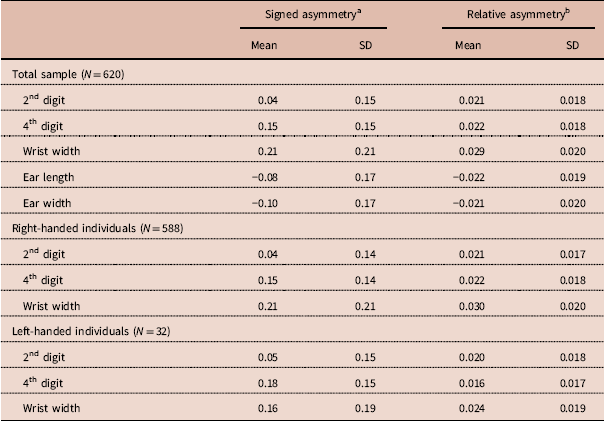
The signed symmetry and relative asymmetry values of the analysed traits are presented in Table 1. Asymmetries in all analysed traits were normally distributed (as determined by a Shapiro-Wilk test) around a mean of zero (determined by a one-sample t-test with the null hypothesis set to a mean of zero), which is also indicative of the presence of FA. The asymmetry of these traits however differed in direction. On average, ear length and width showed higher measurements on the left side, while 2nd digit and 4th digit lengths and wrist width showed higher measurements on the right side. Both right- and left-handed individuals displayed the same direction of asymmetry in hand measurements (Table 1).
Signed and relative asymmetry values of the analysed body traits of young Polish women by handedness

a Signed asymmetry: R−L.
b
Relative asymmetry:
 ${{R{\minus}L} \over {(R{\plus}L){\times}0.5}}$
.
Socioeconomic differences in FA
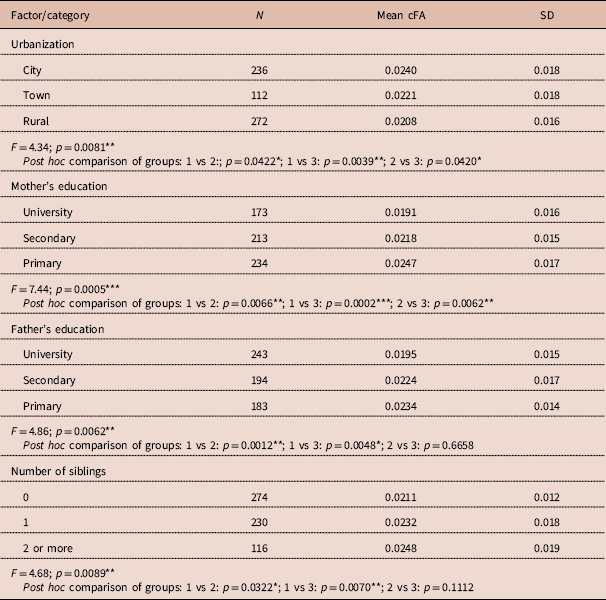
Table 2 presents mean levels of the composite FA by socioeconomic group. The results showed a tendency for FA to rise with a decrease in parents’ education and with an increase in number of older siblings. In subjects from rural areas the level of asymmetry was lower than in subjects from cities. The differences were statistically significant.
The composite fluctuating asymmetry (cFA) of participants by socioeconomic factors
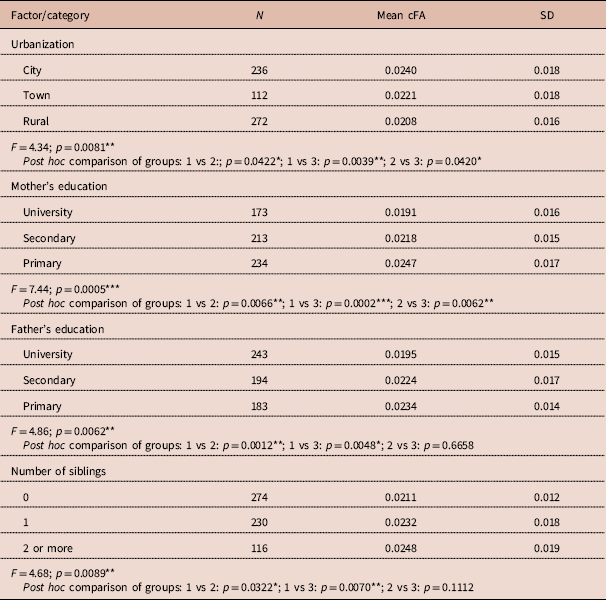
*p≤0.05; **p≤0.01; ***p≤0.001.
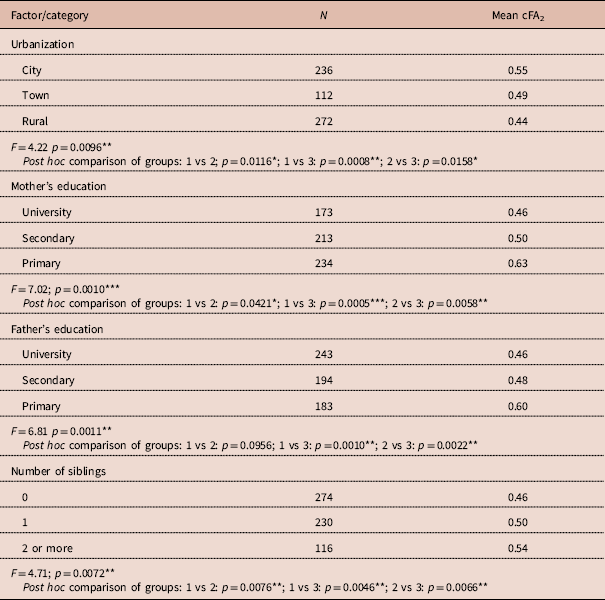
The same calculations were performed using another composite asymmetry index. The average levels of standardized composite FA (cFA2) by socioeconomic group are presented in Table 3. The analysis confirmed the presence of a statistically significant difference in relation to socioeconomic factors among subjects whose mother and/or father had higher education: their level of asymmetry was significantly lower than among subjects whose mother and/or father had only primary education. A rural environment was found to be associated with a lower level of asymmetry. Children who had no older siblings were more symmetrical.
The standardized composite fluctuating asymmetry level (cFA2) of participants by socioeconomic factors
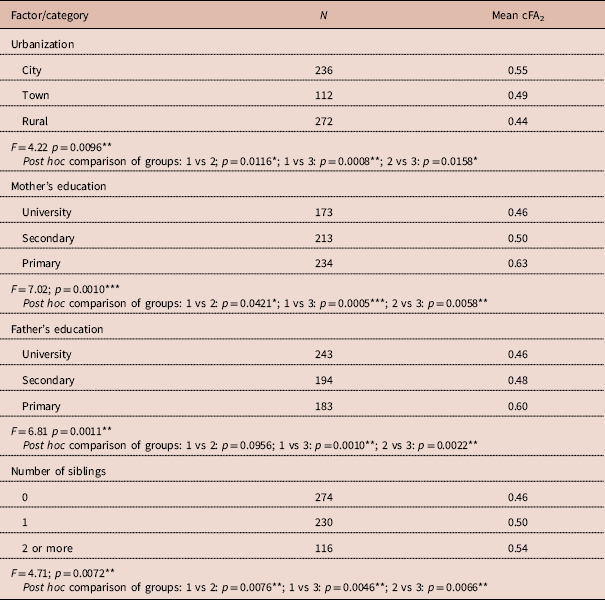
*p≤0.05; **p≤0.01; ***p≤0.001.
Discussion
Fluctuating asymmetry is considered to be a good indicator of various factors that disturb ontogenetic development (Hardersen & Frampton, Reference Hardersen and Frampton2003), but relatively few studies have been done on the relationship between socioeconomic status and FA in modern populations. Research carried out in Turkey revealed that high school students from a slum area had greater facial asymmetry than those from an upper-class neighbourhood (Özener & Fink, Reference Özener and Fink2010). Weisensee and Spradley (Reference Weisenseea and Spradley2018) examined the levels of FA between three groups that probably represent differing SES groups: US residents, Mexican residents and undocumented border crossers who died while crossing the US–Mexico border. The highest level of FA was noted in males who died while crossing the US–Mexico border, and the lowest level of FA was noted in US-resident males. Other studies indicated a high level of asymmetry among foragers such as the !Kung San, Kavango and the Hadza (Gray & Marlowe, Reference Gray and Marlowe2002; Kirchengast, Reference Kirchengast2017; Kirchengast & Christiansen, Reference Kirchengast and Christiansen2017). The findings could be attributed to severe living conditions and the lack of adequate medical care.
Conflicting findings regarding the effects of SES on asymmetry level have also been reported. Hope et al. (Reference Hope, Bates, Penke, Gow, Starr and Deary2013) found that men who experienced a lower SES in early life had lower late-life facial symmetry, but the relationship was non-significant in women. The study also showed that only facial asymmetry was related to SES and no significant association between early-life deprivation and bodily asymmetry was found. Another study showed that there was no association between fluctuating asymmetry in an offspring’s face and factors such as age of the mother at child birth, number of hospitalizations of the pregnant woman, tobacco smoking during pregnancy, tobacco smoking by the father (or a person from the pregnant woman’s closest environment) and alcohol consumption during pregnancy (Zadzinska et al., Reference Zadzinska, Kozieł, Kurek and Spinek2013). The experience of trauma by a pregnant woman was only one factor among other stressors that significantly rose the FA level of the child’s face. Similarly, a recent investigation on a large Latin American sample failed to detect any strong statistical relationship between socioeconomic status and facial asymmetry. The authors suggested that a possible explanation of this result was that the sample did not cover cases of extreme poverty (Quinto-Sanchez et al., Reference Quinto-Sanchez, Cintas, Silva de Cerqueira, Ramallo, Acuna-Alonzo, Adhikari and De Avila2017). It is worth adding that this study assessed the relationship between FA and SES in adulthood (Quinto-Sanchez et al., Reference Quinto-Sanchez, Cintas, Silva de Cerqueira, Ramallo, Acuna-Alonzo, Adhikari and De Avila2017). Since FA is the most common indicator of developmental instability, it is necessary to consider living conditions during the developmental period rather than in adulthood.
Available literature shows that the conditions during prenatal development have a large impact on FA (Kieser et al., Reference Kieser, Groeneveld and Da Silva1997). Studies conducted among 80-year-olds from the Lothian Birth Cohort 1921 also showed that lack of symmetry is the result of stress factors at early stages of development. Hope et al. (Reference Hope, Bates, Penke, Gow, Starr and Deary2013) found that FA was positively correlated with SES in early childhood but not in adulthood. These are related mainly to the mother’s health and lifestyle. Also included in these mechanisms may be parental behaviours such as alcohol consumption and smoking during pregnancy, improper treatment of childhood illnesses, unhealthy child’s diet and/or the presence of toxins in the childhood environment (Zadzinska, Reference Zadzinska2003).
Although the present study only included subjects of average or high socioeconomic status, the results confirm that lower SES is associated with higher asymmetry. The results indicate a relationship between living conditions at early stages of development, defined indirectly by SES, and FA. The offspring of parents with a lower level of education displayed a higher level of asymmetry, which may be the result of limited knowledge about healthy lifestyle, as well as lower financial resources. Correlations between FA and number of older siblings can be explained by the incidence of infectious diseases. Siblings, especially those attending kindergartens, are often a source of infections in infants. In addition, women in first pregnancy can afford to take more rest and are less burdened with physical effort than women who need to look after their young children. The level of asymmetry in individuals from cities was higher compared with that of individuals from villages, which indicates a greater exposure to adverse environmental factors in cities than in rural areas. This result is surprising, given that most of the results of other research presented better developmental parameters in children from cities (Wronka & Pawlinska Chmara, Reference Wronka and Pawlinska-Chmara2009; Gurzkowska et al., Reference Gurzkowska, Kułaga, Litwin, Grajda, Świąder and Kułaga2014; Zienkiewicz et al., Reference Zienkiewicz, Okoński, Matuszewski, Zienkiewicz, Goździewska and Klatka2014; Krzywińska-Wiewiorowska et al., Reference Krzywińska-Wiewiorowska, Stawińska-Witoszyńska, Krzyżaniak, Kaczmarek and Siwińska2017). However, differences in growth rate between children from rural and urban areas result mainly from different living conditions and lifestyle in childhood and adolescence, while fluctuating asymmetry is caused by factors at the prenatal and infant periods, when it is not yet possible to speak of differences in lifestyle depending on urbanization, and may be due to air pollution, noise or light pollution.
In conclusion, the results of this study confirm that FA may be a good indicator of stress factors in the early stages of development. Variation in levels of FA were found to be associated with socioeconomic factors during infancy. The findings could be explained by the fact that socioeconomic status strongly affects the living conditions and lifestyles of individuals.
There are some limitations of the present findings. The study included only students, who may not be fully representative of the general population. Persons from families with very low income were not enrolled, since such individuals tend to become quickly independent, leave school and take up jobs at early age rather than attend university. In addition, the study group consisted only of women. Hence, this research should be conducted on a larger group of young adults of both genders.
Ethical Approval
The authors assert that all procedures contributing to this work comply with the ethical standards of the relevant national and institutional committees on the human experimentation and with the Helsinki Declaration of 1975, as revised in 2008.
Conflicts of Interest
The authors have no conflicts of interest to declare.
Funding
This research received no specific grant from any funding agency, commercial entity or not-for-profit organization.