Although it is well documented that obesity among females is a major health concern and that keeping one's weight at a healthy level is conducive to one's physical wellbeing, many women engage in weight restricting and control behaviours (WRCBs) either unnecessarily or to levels not conducive to good health. Dieting, for example, is highly prevalent, is associated with a number of deleterious physiological and psychological consequences, and is engaged in by an alarming number of women who are of normal or underweight status (Kenardy, Brown, & Vogt, Reference Kenardy, Brown and Vogt2001; Neumark-Sztainer, Wall, Larson, Eisenberg, & Loth, Reference Neumark-Sztainer, Wall, Larson, Eisenberg and Loth2011; Neumark-Sztainer, Wall, Story, & Standish, Reference Neumark-Sztainer, Wall, Story and Standish2012). Similarly, although exercise is undoubtedly beneficial to one's health, compulsive/obligatory exercise has been found to be associated with many physical and emotional problems (Gulker, Laskis, & Kuba, Reference Gulker, Laskis and Kuba2001; McLaren, Gauvin, & Steiger, Reference McLaren, Gauvin and Steiger2001). Finally, purging behaviours, including self-induced vomiting and the abuse of laxatives, diet pills, appetite suppressants and/or diuretics, are unambiguously detrimental to one's health and have been associated with numerous harmful effects on the body (Goldman, Govindaraj, Franco, & Lim, Reference Goldman, Govindaraj, Franco and Lim2001; Lasater & Mehler, Reference Lasater and Mehler2001; Newton & Travess, Reference Newton and Travess2000).
The WRCBs of dieting, exercise and purging are important to examine due to their high prevalence and potentially deleterious consequences, not the least of which is the potential trajectory towards clinical eating disorders (Brewerton, Stellefson, Hibbs, Hodges, & Cochrane, Reference Brewerton, Stellefson, Hibbs, Hodges and Cochrane1995; Hsu, Reference Hsu1996; Peñas-Lledó, Vaz Leal, & Waller, Reference Peñas-Lledó, Vaz Leal and Waller2002). Furthermore, it is important to investigate potential factors associated with WRCBs so that they can be targeted in early intervention programs. One such factor is perfectionism, which was noted as an identifying characteristic of anorexia nervosa in the very early work of Bruch (Reference Bruch1973), and has been found empirically to be associated with both anorexia nervosa (e.g., Moor, Vartanian, Touyz, & Beumont, Reference Moor, Vartanian, Touyz and Beumont2004) and bulimia nervosa (e.g., Fairburn, Welch, Doll, Davies, & O’Connor, Reference Fairburn, Welch, Doll, Davies and O’Connor1997; Tachikawa et al., Reference Tachikawa, Yamaguchi, Hatanaka, Kobayashi, Sato, Mizukami and Sugie2004). A number of researchers have suggested a biological or genetic basis for the association between perfectionism and eating pathology (Gowers & Shore, Reference Gowers and Shore2001; Kaye et al., Reference Kaye, Barbarich, Putnam, Gendall, Fernstrom, Fernstrom and Kishore2003), and Shafran, Cooper, and Fairburn (Reference Shafran, Cooper and Fairburn2002) have put forward a cognitive behavioural account of ‘clinical perfectionism’, outlining its role in the development of eating issues. In addition to being related to clinical eating disorders, perfectionism has also been linked with less pathological forms of eating issues and weight restriction practices. For instance, perfectionism has been found to be associated with fasting, binge eating, self-induced vomiting, diuretic abuse, laxative abuse, obligatory/compulsive exercise, over-evaluation of weight and shape, dietary restraint, and body dissatisfaction (Bardone-Cone et al., Reference Bardone-Cone, Wonderlich, Frost, Bulik, Mitchell, Uppala and Simonich2007; Forbush, Heatherton, & Keel, Reference Forbush, Heatherton and Keel2007; Hall, Kerr, Kozub, & Finnie, Reference Hall, Kerr, Kozub and Finnie2007; McLaren et al., Reference McLaren, Gauvin and Steiger2001; Pearson & Gleaves, Reference Pearson and Gleaves2006; Steele, O’Shea, Murdock, & Wade, Reference Steele, O’Shea, Murdock and Wade2011; Taranis & Meyer, Reference Taranis and Meyer2010).
Despite the frequency with which perfectionism has been linked to eating and weight issues, compared to other areas of psychopathology, there is less research investigating multidimensional aspects of perfectionism in relation to both the clinical eating disorders (Bardone-Cone et al., Reference Bardone-Cone, Wonderlich, Frost, Bulik, Mitchell, Uppala and Simonich2007) and WRCBs in non-clinical samples (Bardone-Cone et al., Reference Bardone-Cone, Wonderlich, Frost, Bulik, Mitchell, Uppala and Simonich2007). Although perfectionism was initially conceptualised and measured in a unidimensional manner, it is now widely considered to be multidimensional in nature. However, the particular dimensions of perfectionism differ depending on the measure employed. Hewitt, Flett, Turnbull-Donovan, and Mikail's (Reference Hewitt, Flett, Turnbull-Donovan and Mikail1991) Multidimensional Perfectionism Scale (MPS) differentiates between self-oriented perfectionism (reflecting the degree to which an individual sets high standards), socially prescribed perfectionism (reflecting the degree to which an individual perceives that others set high standards for them) and other-oriented perfectionism (reflecting the degree to which an individual has high expectations of others). Similarly, the originally unidimensional perfectionism subscale of the Eating Disorder Inventory (Garner, Olmstead, & Polivy, Reference Garner, Olmstead and Polivy1983), widely employed in the disordered eating area, has now been shown to comprise two subscales reflecting self-oriented perfectionism and socially prescribed perfectionism, mirroring two of the dimensions outlined by Hewitt and colleagues (Joiner & Schmidt, Reference Joiner and Schmidt1995; Sherry, Hewitt, Besser, McGee, & Flett, Reference Sherry, Hewitt, Besser, McGee and Flett2004).
Frost, Marten, Lahart, and Rosenblate (Reference Frost, Marten, Lahart and Rosenblate1990) have also developed a Multidimensional Perfectionism Scale (FMPS) comprising six dimensions. The first two dimensions of Concern Over Mistakes and Personal Standards are self-imposed and therefore purported to be forms of self-oriented perfectionism. While Concern over Mistakes focuses on the interpretation that making even the slightest mistake is equivalent to failure, Personal Standards focuses on the setting of unrealistically high standards for oneself, with an exaggerated value placed on these high standards for self-evaluation (Frost et al., Reference Frost, Marten, Lahart and Rosenblate1990). Both Parental Criticism and Parental Expectations are described as ‘familial facets’ of perfectionism and emphasise the tendency for perfectionistic individuals to believe that their parents set extremely high standards for them and are very critical (Frost et al., Reference Frost, Marten, Lahart and Rosenblate1990). Individuals exhibiting higher levels of Organisation are proposed to have an exaggerated concern with precision, orderliness and organisation, while those who have higher levels of Doubts about Actions never feel that their performance is complete or satisfactory (Frost et al., Reference Frost, Marten, Lahart and Rosenblate1990).
Research conducted to date investigating the relationship between the various conceptualisations of perfectionism and WRCBs has yielded mixed results. For example, self-oriented forms of perfectionism have been shown to be associated with body dissatisfaction, dietary restraint, bulimic symptoms, weight/food preoccupation, and anorexic attitudes and behaviours (Bardone-Cone et al., Reference Bardone-Cone, Wonderlich, Frost, Bulik, Mitchell, Uppala and Simonich2007; Hewitt, Flett, & Ediger, Reference Hewitt, Flett and Ediger1995; McLaren et al., Reference McLaren, Gauvin and Steiger2001; McVey, Pepler, Davis, Flett, & Abdolell, Reference McVey, Pepler, Davis, Flett and Abdolell2002; Ruggiero, Levi, Ciuna, & Sassaroli, Reference Ruggiero, Levi, Ciuna and Sassaroli2003) and have been found to be associated with higher eating disorder psychopathology in both eating disorder samples and community samples (Lethbridge, Watson, Egan, Street, & Nathan, Reference Lethbridge, Watson, Egan, Street and Nathan2011). Self-oriented perfectionism has also been found to be higher in anorexic and bulimic samples compared to controls (Bastiani, Rao, Weltzin, & Kaye, Reference Bastiani, Rao, Weltzin and Kaye1995; Cockell et al., Reference Cockell, Hewitt, Seal, Sherry, Goldner, Flett and Remick2002; Lethbridge et al., Reference Lethbridge, Watson, Egan, Street and Nathan2011; Pratt, Telch, Labouvie, Wilson, & Agras, Reference Pratt, Telch, Labouvie, Wilson and Agras2001) and has been found to be more specific to eating disorders than to depressive or anxiety disorders (Castro-Fornieles et al., Reference Castro-Fornieles, Gual, Lahortiga, Gila, Casulà, Fuhrmann and Toro2007). Socially prescribed perfectionism has been found to be associated with bulimic symptoms, dietary restraint, and anorexic attitudes and behaviours (Bardone-Cone et al., Reference Bardone-Cone, Wonderlich, Frost, Bulik, Mitchell, Uppala and Simonich2007; McLaren et al., Reference McLaren, Gauvin and Steiger2001; Sherry et al., Reference Sherry, Hewitt, Besser, McGee and Flett2004) and has been found to be higher in bulimic samples compared to controls (Bastiani et al., Reference Bastiani, Rao, Weltzin and Kaye1995; Cockell et al., Reference Cockell, Hewitt, Seal, Sherry, Goldner, Flett and Remick2002).
With respect to the dimensions outlined by Frost et al. (Reference Frost, Marten, Lahart and Rosenblate1990), Concern Over Mistakes and Personal Standards have been found to be higher in anorexic and bulimic patients compared to controls (Bastiani et al., Reference Bastiani, Rao, Weltzin and Kaye1995; Halmi, Sunday, Strober, & Kaplan, Reference Halmi, Sunday, Strober and Kaplan2000) and have been found to be associated with compulsive/obligatory exercise (Hall et al., Reference Hall, Kerr, Kozub and Finnie2007; Taranis & Meyer, Reference Taranis and Meyer2010). Both Parental Criticism and Parental Expectations have been found to be associated with WRCBs and body dissatisfaction in community samples (Ruggiero et al., Reference Ruggiero, Levi, Ciuna and Sassaroli2003). Organisation has been found to be higher in anorexic patients compared to controls (Bastiani et al., Reference Bastiani, Rao, Weltzin and Kaye1995) and has been found to be associated with exercise behaviour in college students (Anshel & Seipel, Reference Anshel and Seipel2006). Finally, anorexic patients have been shown to score significantly higher on Doubts About Actions than controls (Bastiani et al., Reference Bastiani, Rao, Weltzin and Kaye1995).
It is evident from the research outlined above that a variety of perfectionism dimensions and outcome measures have been investigated and found to be related. What is lacking, are studies devoted to the investigation of potential interaction effects between perfectionism and other variables on WRCBs (Bardone-Cone et al., Reference Bardone-Cone, Wonderlich, Frost, Bulik, Mitchell, Uppala and Simonich2007). One construct that has been partially explored in terms of its potential interaction with perfectionism on WRCBs, is body dissatisfaction (BD). BD has not only been linked to the clinical eating disorders (Ghaderi, Reference Ghaderi2003), but also to disordered eating (Ackard, Croll, & Kearney-Cooke, Reference Ackard, Croll and Kearney-Cooke2002), dieting (van den Berg, Thompson, Obremski-Brandon, & Coovert, Reference van den Berg, Thompson, Obremski-Brandon and Coovert2002), exercise behaviour (Seigel & Hetta, Reference Seigel and Hetta2001) and bulimic symptoms (Stice & Agras, Reference Stice and Agras1998).
With respect to the limited available literature to date regarding the interaction between perfectionism and BD on eating/weight restriction issues, only self-oriented and socially prescribed perfectionism have been investigated. Downey and Chang (Reference Downey and Chang2007) found that BD interacted with Socially Prescribed perfectionism to predict dieting and bulimic symptoms. Similarly, Brannan and Petrie (Reference Brannan and Petrie2008) found that Socially Prescribed perfectionism moderated the effect of BD on bulimic symptoms, and that Self-Oriented perfectionism moderated the effect of BD on anorexic symptoms, such that higher levels of both BD and Self-Oriented perfectionism were associated with higher levels of anorexic symptoms. Finally, Welch, Miller, Ghaderi, and Vaillancourt (Reference Welch, Miller, Ghaderi and Vaillancourt2009) found that both Self-Oriented and Socially Prescribed perfectionism moderated the relationship between BD and disordered eating, and that various types of perfectionism interacted with BD to predict binge eating. Thus, there is emerging evidence to suggest that a combination of perfectionism and BD is important to eating and weight restriction issues.
Of particular interest to this study was the possible interaction between perfectionism and BD on the WRCBs of dieting, purging and exercising. In order to comprehensively investigate the interactive relationship between perfectionism and BD on these WRCBs, all subscales of the Frost Multidimensional Perfectionism Scale (Frost et al., Reference Frost, Marten, Lahart and Rosenblate1990), and the Self-Oriented and Socially Prescribed subscales of the EDI-2 (Garner, Reference Garner1991) were included. The study was somewhat exploratory in nature. However, given that each measure of perfectionism has been associated with various forms of weight restricting and control behaviours in different studies, it was broadly hypothesised that the association between perfectionism and weight restricting practices would be stronger at high rather than low levels of BD.
Method
Participants
Participants were 167 female first-year psychology students from the University of Queensland, Brisbane, Australia aged 17–25 years (M = 19.22 years, SD = 1.79 years), the majority of whom (82%) were born in Australia. Body Mass Index (BMI) scores ranged from 15.11 to 33.46 (M = 21.52, SD = 2.84). According to the classification of BMI by the National Centre for Chronic Disease Prevention and Health Promotion (2011), 12.6% of the sample were considered underweight (BMI < 18.5), 76.6% normal weight (BMI = 18.5–24.9), 10.2% overweight (BMI = 25–29.9) and 0.6% obese (BMI ≥ 30).
Measures
Body Mass Index
BMIwas calculated by dividing the participants’ weight (kg) by their height (m2). Height and weight were measured by the authors using standardised instrumentation.
Body Dissatisfaction
The Body Dissatisfaction subscale of the Eating Disorder Inventory-2 (EDI-2; Garner, Reference Garner1991) was employed to measure BD. The Body Dissatisfaction subscale comprises nine items assessing level of satisfaction with the shape and size of one's overall body, hips, thighs, stomach, and buttocks. The internal consistency of the Body Dissatisfaction subscale has been shown to be high, with alpha coefficients ranging from .90 to .92 (Garner, Olmsted, Polivy, & Garfinkel, Reference Garner, Olmsted, Polivy and Garfinkel1984). Test-retest reliabilities of .95 over 1 week (G. Welch, Hall, & Walkey, Reference Welch, Hall and Walkey1988), .97 over 3 weeks (Wear & Pratz, Reference Wear and Pratz1987), and .75 over 1 year (Gulker et al., Reference Gulker, Laskis and Kuba2001) have also been demonstrated.
Weight Restriction and Control Practices
The Weight Restriction and Control Questionnaire (WRCQ) is a 39-item inventory developed by the authors, with three component subscales focusing on the behavioural aspects of weight restriction and control with respect to dieting (e.g., ‘Do you fast (not eat) for one day or more in order to restrict/control your weight?’), purging (e.g., ‘Do you intentionally make yourself vomit after eating in order to restrict/control your weight?’) and exercise (e.g., ‘Do you exercise for longer periods of time than you originally intended in order to restrict/control your weight?’). Thus, the questions were put forward to explicitly assess whether or not the participants engaged in each activity with the intention to lose weight or control their weight. Participants were required to indicate how often they engaged in each behaviour on a 6-point scale from 0 (never) to 5 (always). Dieting, Exercise and Purging subscales comprised 14, 17, and 8 items respectively. In this study, the dieting, purging and exercise subscales of the WRCQ demonstrated internal reliabilities of .95, .92, and .96 respectively. The suitability of a three-component structure was evaluated using principal axis factor analysis with an oblique rotation. The total variance explained was 60.90% (exercise — 22.54%; diet — 20.56%; purging — 17.80%). A Kaiser-Meyer-Oklin (KMO) value of .92 and Bartlett's Test of Sphericity of <.001 supported the factorability of the correlation matrix.
Perfectionism
Multidimensional perfectionism was measured using the Frost Multidimensional Perfectionism Scale (FMPS; Frost et al., Reference Frost, Marten, Lahart and Rosenblate1990). The FMPS is a 35-item inventory that assesses six dimensions of perfectionism: concern over mistakes (COM), personal standards (PS), parental expectations (PE), parental criticism (PC), doubts about actions (DAA), and organisation (ORG). Items are measured on a 5-point Likert scale where participants are required to indicate the extent to which they agree which each item, from 1 (strongly disagree) to 5 (strongly agree). The internal reliabilities of the COM, PS, PE, PC, DAA, and ORG subscales have been found to be .88, .83, .84, .84, .77, and .93 respectively (Frost et al., Reference Frost, Marten, Lahart and Rosenblate1990). The FMPS has been found to correlate significantly with the Burns’ Perfectionism scale (r = .85) (Burns, 1983), and the perfectionism subscale of the EDI-2 (r = .59) (Garner et al., Reference Garner, Olmstead and Polivy1983).
Self-oriented and socially prescribed perfectionism were measured using the EDI-SOP and EDI-SPP subscales respectively of the Perfectionism subscale of the EDI-2 (Garner, Reference Garner1991) as outlined by Sherry et al. (Reference Sherry, Hewitt, Besser, McGee and Flett2004). Participants were required to indicate their agreement with each item on a 6-point scale from 0 (never agree) to 6 (always agree; Garner, Reference Garner1991). Alphas of .74 and .76 have been found for the SOP and SPP subscales of the EDI respectively (Williamson, Anderson, Jackman, & Jackson, Reference Williamson, Anderson, Jackman and Jackson1994).
Results
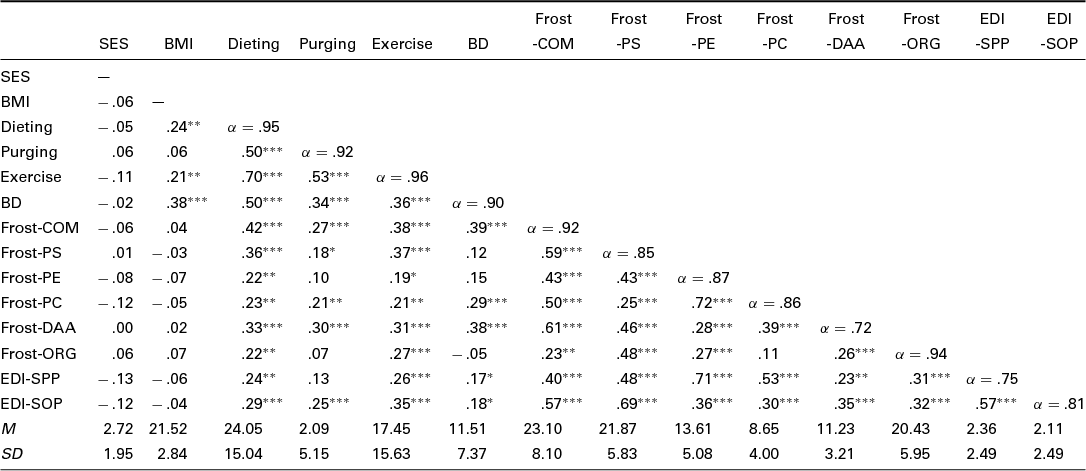
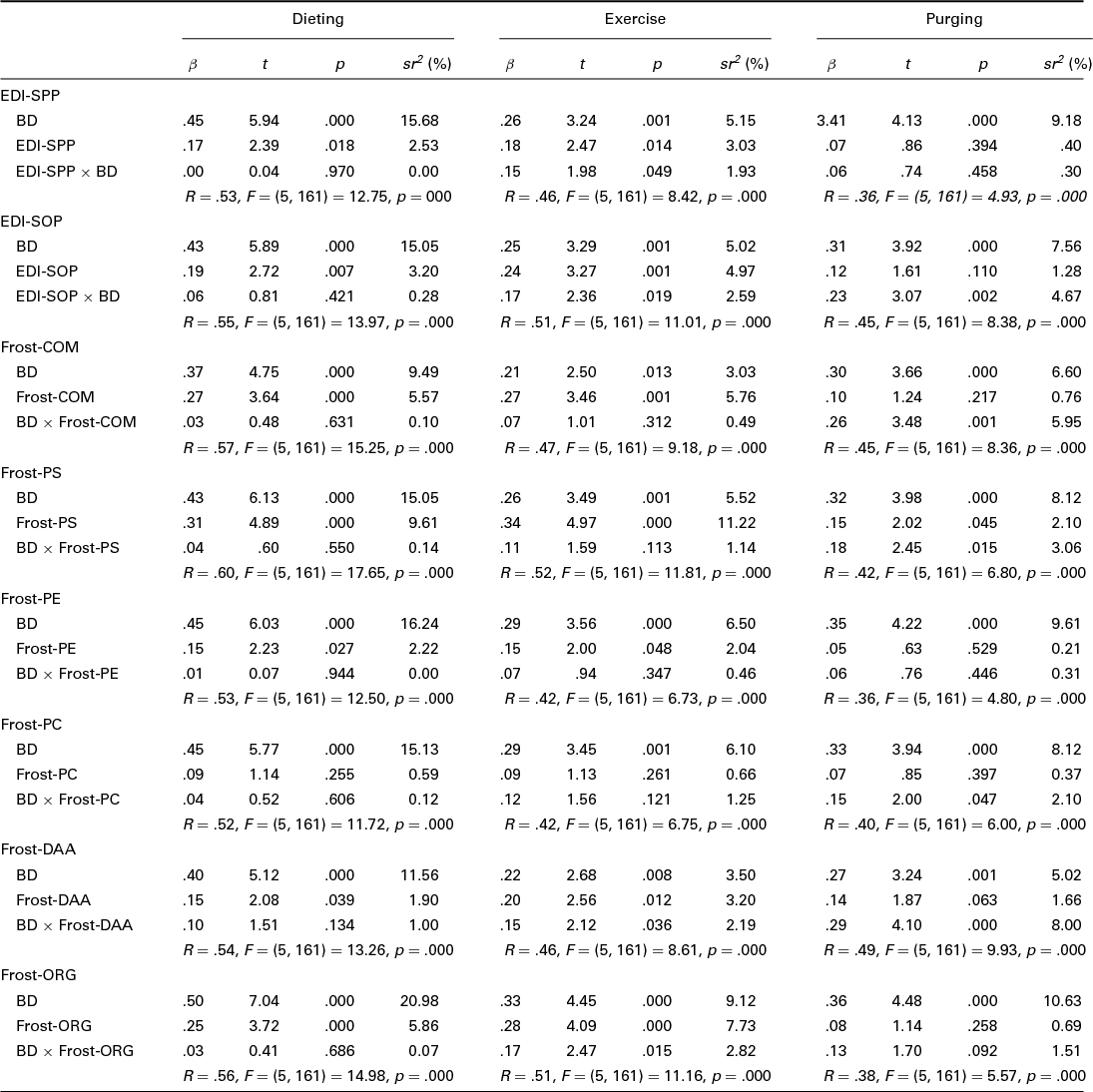
Table 1 reports the means, standard deviations, zero-order correlations, and Cronbach's coefficient alpha reliabilities of all variables used in the analyses. To test for possible moderating effects of BD on the relationship between the various aspects of perfectionism and WRCBs, three sets of moderated multiple regressions were conducted: one for the Dieting subscale, one for the Exercise subscale and one for the Purging subscale of the WRCQ. For each set of regressions, the moderating effect of BD was tested for each measure of perfectionism (Frost-COM, Frost-PS, Frost-PE, Frost-PC, Frost-DAA, Frost-ORG, EDI-SPP, and EDI-SOP). For each regression, socio-economic status (SES) and BMI were entered on the first step as control variables due to their previously found associations with WRC behaviours (Ricciardelli & McCabe, Reference Ricciardelli and McCabe2003; Rogers, Resnick, Mitchell, & Blum, Reference Rogers, Resnick, Mitchell and Blum1997). BD and the particular perfectionism measure under investigation were entered at step 2, using mean-centred variables to avoid multicollinearity. Finally, as outlined by Aiken and West (Reference Aiken and West2000), an interaction term was calculated by multiplying the mean-centred BD variable by the mean-centred perfectionism measure, and was entered at step 3. Due to the number of regression analyses performed, a more stringent significance level of .01 was set. For the sake of brevity, only results pertaining to the final step of each analysis are reported (see Table 2) and because neither BMI nor SES were found to significantly predict dieting, exercise or purging in any of the analyses, the statistics for BMI and SES on the final step are not presented. The results of the series of regressions conducted for each type of WRCB will now be discussed in turn.
Correlations, Means, Standard Deviations and Cronbach's Alpha Coefficients of the Predictor, Moderator and Criterion Variables

Note: *Correlation is significant at the 0.05 level (two-tailed); **Correlation is significant at the 0.01 level (two-tailed); ***Correlation is significant at the 0.001 level (two-tailed). BMI = Body Mass Index, SES = socio-economic status, BD = body dissatisfaction
Statistics for the Third Step of Each Regression Analysis
Note: BD = body dissatisfaction.
Dieting
As is shown in Table 2, BD was not found to moderate the relationship between perfectionism and dieting in any of the analyses. However, BD was found to be a significant unique predictor of dieting in all analyses and EDI-SOP, Frost-COM, Frost-PS, and Frost-ORG were also found to be significant unique predictors of dieting.
Exercise
As for dieting, inspection of Table 2 suggests that BD was not found to moderate the relationship between perfectionism and exercise in any of the analyses and BD was found to be a significant unique predictor of exercise in all analyses except for that involving Frost-COM (where it approached significance at .013). Similarly as for dieting, EDI-SOP, Frost-COM, Frost-PS and Frost-ORG were found to be signficant unique predictors of exercise.
Purging
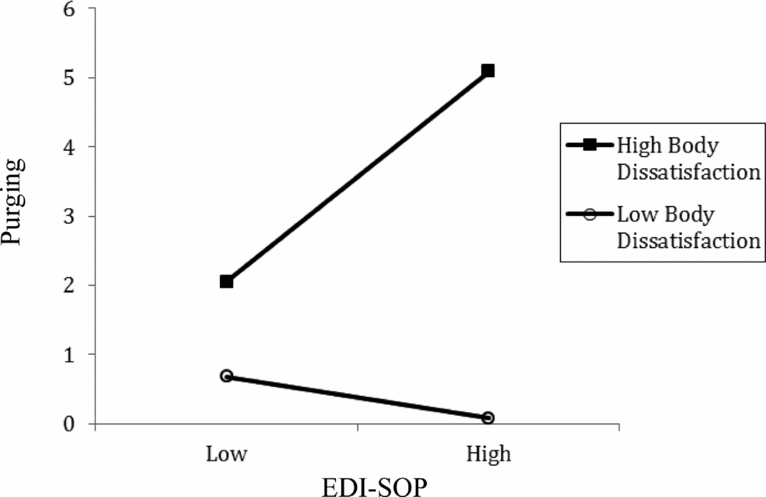
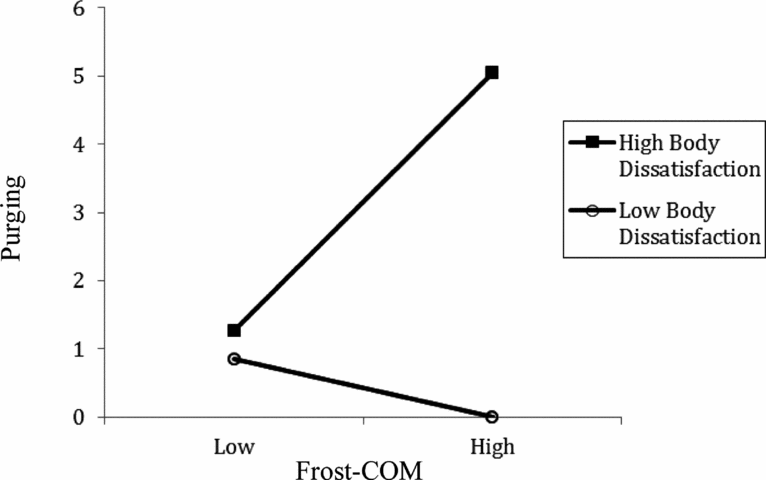
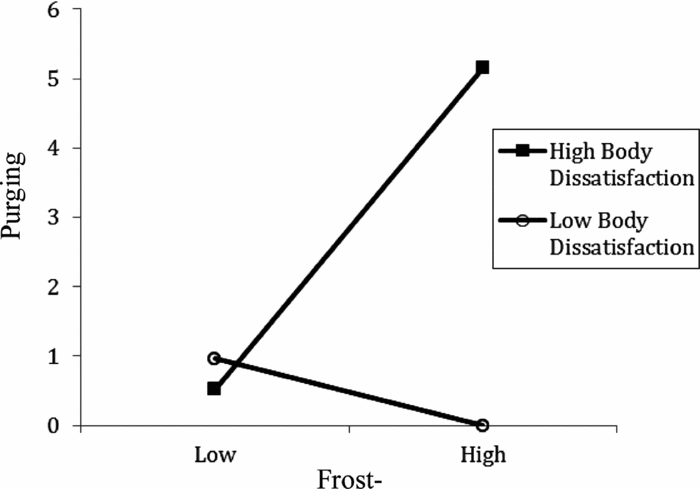
From Table 2, it is clear that significant interaction effects were found for EDI-SOP, Frost-COM, and Frost-DAA. Subsequent simple slopes analyses revealed a similar pattern of results for all three significant interactions, such that at high levels of BD, the relationship between perfectionism and purging was positive and significant. At low levels of BD, the relationship between perfectionism and purging was not significant. Specifically, at high levels of BD, the relationships between EDI-SOP (t = 3.88, p = .000), Frost-COM (t = 3.69, p = .000), and Frost DAA (t = 4.53, p = .000) and purging were positive and significant. At low levels of BD, however, the relationships between EDI-SOP (t = −0.71, p = .481), Frost-COM (t = −1.23, p = .222), and Frost DAA (t = −1.27, p = .204) and purging were not significant. Figures 1–3 illustrate these interactions graphically. BD was found to be a significant unique predictor of purging in all analyses whereas perfectionism was not found to be a significant predictor of purging in any of the analyses.
Interaction between Self-Oriented Perfectionism (EDI-SOP) and body dissatisfaction on purging.
Interaction between Concern Over Mistakes (Frost-COM) and body dissatisfaction on purging.
Interaction between Doubts About Actions (Frost-DAA) and body dissatisfaction on purging.
Discussion
This study sought to examine the interactive effects of perfectionism and body dissatisfaction (BD) on the weight restricting and control behaviours (WRCBs) of dieting, exercise and purging. It was broadly hypothesised that the relationship between the various measures of perfectionism and weight restriction would be stronger at high rather than low levels of BD. The hypotheses were partially supported for purging, but not for dieting or exercise. The results for each type of WRCB will be discussed in turn below.
BD was not found to moderate the relationship between any of the measures of perfectionism and dieting. Instead, BD was found to be directly and strongly related to dieting. Furthermore, self-oriented perfectionism, concern over mistakes, parental standards and organisation were also directly related to dieting. Thus it would seem that only certain types of perfectionism are related to dieting and when they are, they are related irrespective of the level of BD. The lack of interaction effects found for dieting is in contrast to the limited evidence available finding significant interactions between BD and socially prescribed perfectionism on dieting and disordered eating (Downey & Chang, Reference Downey and Chang2007; E. Welch et al., Reference Welch, Miller, Ghaderi and Vaillancourt2009), and between BD and self-oriented perfectionism on anorexic symptoms and disordered eating (Brannan & Petrie, Reference Brannan and Petrie2008; E. Welch et al., Reference Welch, Miller, Ghaderi and Vaillancourt2009). However, the findings are consistent with the extant literature finding evidence for a strong association between BD and dieting (e.g., van den Berg et al., Reference van den Berg, Thompson, Obremski-Brandon and Coovert2002) and between various measures of perfectionism and dieting (e.g., McLaren et al., Reference McLaren, Gauvin and Steiger2001).
The results for exercise were identical to those found for dieting. That is, BD was not found to moderate the relationship between perfectionism and exercise in any of the analyses. Instead, BD was found to be strongly related to exercise; and self-oriented perfectionism, concern over mistakes, parental standards and organisation were all found to predict exercise irrespective of BD level. The results for exercise are new, and to the authors’ knowledge, no other study has investigated the moderating effects of BD on the relationship between perfectionism and exercise behaviour. The results suggesting that concern over mistakes, parental standards and organisation are directly associated with exercise, are consistent with previous studies also finding these associations (Anshel & Seipel, Reference Anshel and Seipel2006; Coen & Ogles, Reference Coen and Ogles1993; Hall et al., Reference Hall, Kerr, Kozub and Finnie2007; Taranis & Meyer, Reference Taranis and Meyer2010).
The results for purging were quite different. As hypothesised, BD was found to moderate the relationship between perfectionism and purging for the measures of self-oriented perfectionism, concern over mistakes and doubts about actions. For these measures, when BD was high, higher levels of perfectionism were associated with greater purging behaviour. When BD was low, there was no relationship between perfectionism and purging behaviours. Again, BD was found to be strongly related to purging. However, none of the perfectionism measures were found to uniquely predict purging. Thus, it would seem that for purging, perfectionism only has an effect when BD is also high. The results are in accord with those of Welch et al. (Reference Welch, Miller, Ghaderi and Vaillancourt2009), who found interaction effects between self-oriented perfectionism and BD on a combined measure that incorporated both dieting and purging behaviours. However, the results are in contrast to those of Welch et al. (Reference Welch, Miller, Ghaderi and Vaillancourt2009), Downey and Chang (Reference Downey and Chang2007), and Brannan and Petrie (Reference Brannan and Petrie2008), who found that socially prescribed perfectionism interacted with BD in the prediction of bulimic symptoms. In these studies, however, ‘bulimic symptoms’ are also likely to have included binge eating, which this study did not measure. It may be that socially prescribed perfectionism is related to bingeing but not purging, and therefore future research should attempt to determine whether socially prescribed perfectionism is important to bingeing, purging, or a combination of the two.
In summary, the results suggest that both perfectionism and body dissatisfaction are important to the WRCBs of dieting, exercise and purging, but that their effects differ substantially depending on the particular WRCB under consideration. For dieting and exercise, the more a woman has high expectations of herself (self-oriented perfectionism), is concerned with making mistakes, perceives that her parents set high standards for her, and is overly concerned with organisation, precision and orderliness, the more likely she is to diet and exercise to control her weight, regardless of how dissatisfied she is with her body. For purging, it would seem that perfectionism is only important when BD is also high. Thus, when a woman has high levels of BD and also sets high standards for herself (self-oriented perfectionism), is concerned with making mistakes, or has doubts about her actions, the more she is likely to purge in order to control her weight.
The results of this study have a number of implications for future research and clinical practice. First, consistent with previous research, higher levels of BD were consistently associated with higher levels of dieting, purging and exercise, highlighting the importance of this construct to weight restriction and control behaviours. Thus, the focus on BD evident in most prevention and treatment strategies of disordered weight restricting practices is warranted and should be continued. Second, various aspects of perfectionism, in combination with BD, also appear to be important to weight restricting behaviours. Screening instruments for problematic weight restriction and control practices might therefore benefit from the inclusion of multidimensional measures of perfectionism. Furthermore, treatment and prevention programs should aim to assess and target various aspects of perfectionism in order to reduce their potential influence in the development and maintenance of eating and weight restriction issues. It is likely that without this more multidimensional assessment, many aspects of an individual's perfectionistic nature may remain undetected and untargeted, and therefore may continue to exert influence on problematic weight restricting practices. The current research thus supports the emphasis on perfectionism made by those such as Fairburn, Cooper, and Shafran (Reference Fairburn, Cooper and Shafran2003), who suggest that perfectionism can be of vital importance to eating-related psychopathology. Finally, the results highlight a similarity between dieting and exercise with respect to the influence of perfectionism, and a difference with purging. Oftentimes, outcome variables are diffusely labelled ‘disordered eating’ and incorporate a number of different eating and weight-related attitudes and behaviours. As is evident from the results of the present study, however, such a combined approach may hide important distinctions between various weight control issues.
This study adds to the very small research base investigating the role of multidimensional aspects of perfectionism on weight restriction. Very few studies thus far have investigated the interaction between BD and perfectionism on dieting and purging, and none to the authors’ knowledge have investigated the multiple dimensions of perfectionism outlined by Frost in this regard, nor has the interaction between perfectionism and BD been previously examined with respect to exercise behaviour. Furthermore, in contrast to previous studies that have tended to measure dieting, exercise and purging in isolation, the present study provided a more comprehensive picture of all three weight-restricting behaviours, and ensured that the participants were endorsing that they engaged in these behaviours with the express intention of reducing or controlling weight (as opposed to health or other reasons).
There are a number of limitations with respect to the present study. It was conducted on a relatively small and restricted non-clinical sample, and therefore replication is required with larger samples of women of different ages, both with and without clinical eating disorders. Also, the present study was cross-sectional in design, which did not allow determination of temporal effects, and therefore future studies should utilise prospective or longitudinal research designs. It is hoped that future research will build on the findings and recommendations of the present study in an attempt to improve the lives of those caught up in the cycle of disordered eating and weight restriction practices.