INTRODUCTION
Physical touch is an important element in nursing care (Barnett, Reference Barnett1972; Bottorff, Reference Bottorff1993; Lugton, Reference Mackey1993; Chang, Reference Chang2001). Therefore, methods such as soft tissue massage (STM, corresponding to tactile massage) have come to play an important role. In contrast to deep tissue massage (Swedish massage), STM is a structured gentle massage of the skin, engaging the touch receptors and providing release of the hormone oxytocin (Uvnäs-Moberg, Reference Uvnäs-Moberg1998). In previous research, Uvnäs-Moberg (Reference Uvnäs-Moberg1998) emphasized that oxytocin has psychophysiological effects influencing the relationship between humans. She implied that the combination of physical touch and a positive social interaction may enhance relations and relaxation by stimulating the release of oxytocin. The release is a direct consequence of physical touch. Therefore, it may prove to be especially effective in situations where psychological support is difficult (Barnett, Reference Barnett1972; Uvnäs-Moberg, Reference Uvnäs-Moberg1998).
Initially, STM was used in the care of prematurely born infants, with effects on stress and growth (Vickers et al., Reference Vickers, Ohlsson and Lacy2007), followed by studies of STM on patients with dementia and with effects on their agitation and stress (Routasalo & Isola, Reference Routasalo and Isola1996; SBU-Alert, 2002; Viggo Hansen et al., Reference Viggo Hansen, Jørgensen and Ørtenblad2004, Reference Weinrich and Weinrich2006). In cancer care one of the first studies on the use of massage was published by Weinrich and Weinrich (1990). They examined the effects of Swedish massage on pain in cancer patients but did not specifically target patients in the palliative stage. Their findings showed that the nursing intervention of Swedish massage had a short–term effect on pain among males. Today, different massage methods being used as a complement in the care of patients with advance cancer disease include aromatherapy, (Fellowes et al., Reference Gessner2006), Swedish massage, and therapeutic touch (Robinson et al., Reference Robinson, Biley and Dolk2007), but only a few focus on STM (Sims, Reference Sims1986; Meek, Reference Molassiotis, Fernadez-Ortega and Pud1993; Zuberbueler, Reference Zuberbueler1996; Mackey, Reference Marton and Booth1998; Billhult & Dahlberg, Reference Billhult and Dahlberg2001; Goodfellow, Reference Graneheim and Lundman2003; Cassileth and Vickers, Reference Cassileth and Vickers2004; Fellowes et al., Reference Fellowes, Barnes and Wilkinson2004; Robinson et al., Reference Robinson, Biley and Dolk2007).
To assess the effects, The Cochrane Collaboration (Chang, Reference Chang2001; Viggo Hansen et al., Reference Viggo Hansen, Jørgensen and Ørtenblad2004, 2006; STM and aromatherapy) and the Swedish national organization for recommendations of new medical methods (SBU-Alert, 2002; STM) focused on scientific research concerning patients in cancer care and with dementia. The main findings suggest decreased anxiety and increased well-being among cancer patients and decreased agitation among demented patients.
Patients and spouses seek to an increasing extent non pharmacological alternatives in the search for enhanced quality of life and existential well-being (Sims, Reference Sims1986; Meek, Reference Molassiotis, Fernadez-Ortega and Pud1993; Billhult & Dahlberg, Reference Billhult and Dahlberg2001; Fellowes et al., Reference Gessner2006). In previous studies positive effects of STM have been shown on symptoms such as anxiety (Sims, Reference Sims1986; Cassileth & Vickers, Reference Cassileth and Vickers2004; Deng and Cassileth, Reference Deng and Cassileth2005; Fellowes et al., Reference Gessner2006; Robinson et al., Reference Robinson, Biley and Dolk2007), pain (Grealish et al., Reference Hessig and Arcand2000; Cassileth & Vickers, Reference Cassileth and Vickers2004; Calenda, Reference Calenda2006; Fellowes et al., Reference Gessner2006), and nausea (Grealish et al., Reference Hessig and Arcand2000; Cassileth & Vickers, Reference Cassileth and Vickers2004; Fellowes et al., Reference Gessner2006). Studies also suggest better bowel function (Preece, Reference Riet van der and Mackey2002), a decrease in fatigue (Cassileth & Vickers, Reference Cassileth and Vickers2004), and improved sleep (Smith et al., Reference Smith, Kemp and Hemphill2002). Previous studies also indicate physiological benefits of STM such as a decrease in blood pressure and heart rate (Meek, Reference Molassiotis, Fernadez-Ortega and Pud1993).
Riet and Mackey (1998) and Hessig et al. (Reference Lugton2004) introduced separate educational programs in integrative methods (complementary and alternative method, CAM) that differed considerably in length. Mackey (Reference Marton and Booth1998) introduced a comprehensive course in STM to remote home care teams in Australia as a complement in advanced palliative home care. The course lasted all together 8 weeks and introduced theoretical education as well as hands-on training. The findings showed that nursing staffs enhanced skills and promoted greater job satisfaction and communication with the patients. Further, it initiated a devotion among them to organize and incorporate STM in daily nursing care. The evaluation of the study included focus-group discussions, interviews, and questionnaires.
In contrast to the 8-week-long course, Hessig et al. (Reference Lugton2004) evaluated the effects of a 1-day educational intervention with a focus on oncology nurses' opinions and perceived understanding of 10 CAM therapies. The study showed that a lack of knowledge was the main reason for the nursing staff not to apply integrative methods into nursing care. The education did, however, improve the understanding and enhanced applicability of some therapies.
In a Swedish study (Edvardsson et al., Reference Edvardsson, Sandman and Rasmussen2003), 12 health care workers with formal training in STM were interviewed about their experiences of giving STM to older patients on a daily basis. The informants said that the method had given them an increased awareness about the value and impact of touch when using the method among elderly. The informants found satisfaction from providing STM to patients, as it produced well-being among the elderly. They also expressed an improved ability to communicate with their patients and satisfaction in receiving a tool that gave them a choice of alternatives in different caring situations.
The increased interest in STM by patients and their spouses has made nursing staffs more aware of the importance of touch and the desire for education in Sweden. The courses available today do not specifically focus on STM in relation to patient care, but welcome different groups such as SPA therapists and child-care teachers, among others. Further, the educational opportunities are many but with considerable economical implications for the palliative units. In Sweden today, courses in STM typically range between 2 and 8 days, followed by 60–80 hours of practical hands-on training.
Our intent was to introduce and evaluate a 1-day course in hand, foot, and back massage with a special focus on palliative nursing staff, based on a pilot study engaging nursing staff (n = 80) at four geriatric wards (two with special care for demented individuals). Follow-up discussions with the geriatric ward staff indicated an increase in the general interest and application of STM in the nursing care.
Aim
The purpose of the study was to:
• clarify through focus-group discussions the nurses' experiences and opinions of a 1-day introductory course in STM
• to shed light on the nurses' motivations to employ STM in the care of dying patients.
METHOD
This study received ethical approval from the The Human Ethics Committee at Karolinska University Hospital, Stockholm, Sweden (03-513).
Participants
In total 135 participants from three palliative care units in Sweden attended the 1-day course in STM. Of these, 30 nursing staff members were randomly chosen to participate in the focus group interviews.
Procedure
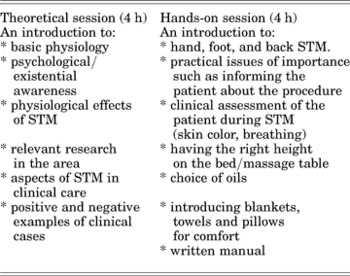
The first author orally informed the head nurse (HN) at each unit (they also received written information). The staff received information about the study from each respective HN. The introductory courses were performed during a compulsory educational day by the first author (R.N. and qualified STM masseur) at each unit during working hours. The nursing staff at each unit was divided into two groups and participated on different days in order to cover for each other and thereby saving costs (no extra staff was needed). The course was divided into two blocks, theory and practical hands-on work (see Table 1).
Content of STM introductory course

Soft tissue massage was carried out with slow strokes, light pressure, and circling movements using a light scented (citrus) vegetable oil. Approximately 4 weeks after the intervention, tape-recorded focus group discussions (n = 6) were conducted by the coauthors, who had no previous contact with the subjects. Each interview took approximately 45 min. All together 30 nursing staff participated in the focus group discussions. Generally, there was one facilitator and one observer according to focus group guidelines. The interview guide focused on questions concerning relevance, content, and pedagogical issues. Typical questions asked were: “Would you like to tell me about the theoretical session?” “What concerns do you have regarding planning of the theoretical part?” and “Were you satisfied with the content of the course?” The observer had the role of transcriber, with tasks such as making the observations and taking notes, asking follow-up questions, and ending the interviews by summarizing the content.
Analysis
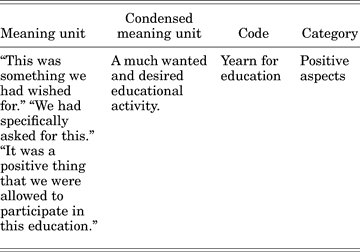
In the present study we employed a qualitative approach using content analysis with a manifest focus with descriptions rather than interpretations (Graneheim & Lundman, Reference Grealish, Lomasney and Whiteman2004). During the analytic process the interviews were initially transcribed slightly modified from verbatim. As focus was on content analysis, no predetermined categories were identified. The following steps were employed: (1) The interviews were read through to obtain a first impression and to identify themes (naïve reading). (2) The responses were then read thoroughly to identify significant text segments and meaning units and to develop codes and preliminary categories (the nurses' own words were used to the greatest extent). (3) The categories were then scrutinized and compared in order to find central components. (4) The final categories were compared to avoid overlapping and content descriptions. Quotations were used to exemplify the categories (see Table 2).
Example of meaning units, condensed meaning unit, code, and category

Still, some results are presented in semiquantitative numbers to clarify and describe discrepancies. In most circumstances there was a relative unity in the target group (nursing staff), but in some instances there was not. This is illustrated in the Results section in the following way: “a few” means <3, “some” 4–9, and “many” means >10. This kind of qualitative summary has been proposed elsewhere: “The quantification is used merely to condense the results to make them easily intelligble; the approach to the analysis remains qualitative since naturally occuring events identified on theoretichal grounds are being counted” (Mays & Pope, Reference Meek1996; Sandelowski et al., Reference Sandelowski, Barroso and Voils2007, p. 231, See also Mays & Pope, 1996).
Trustworthiness
To strengthen the trustworthiness of the present study, the interviews were initially read through and coded by the last author (P.S.), as the coauthors (M.F., A.M.) had been involved in the activities concerning the interviews. The results of the analysis was then evaluated and compared by all four authors to reach agreement and to broaden the perspective. To further strengthen the trustworthiness, peer debriefing was conducted at two separate research seminars.
RESULTS
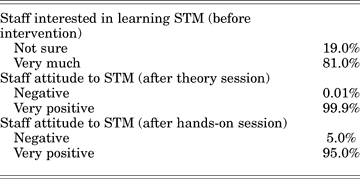
The results of the focus group discussions reflect on 30 participants of the whole group of 135. In Table 3 data from the whole group are presented as descriptive quantitative background data.
Background data concerning attitudes toward a 1-day education in STM (n = 135)

The information about the 1-day course was perceived differently despite similar oral and written information. For some nursing staff, shortcomings in the information procedure were claimed to be a main reason for unwillingness to participate. However, partly based on previous experiences, the majority of participants expressed a positive attitude toward STM and recognized its value. They were also able to identify some of the effects related to receiving STM as relief of pain and anxiety, enhanced well-being, and improved sleep, again related to their own previous experiences. The education was seen as an inspiration to many participants, who also developed plans for how to implement STM in the daily care of patients.
During analysis, three categories were identified: experiences of and attitudes toward the education (positive and negative), experiences of implementing the skills in everyday care situations, and attitudes to the physical body in nursing care. Most of the staff were positively inclined toward participating in the STM education, even though some individuals did not embrace the idea and did find it “consuming important time.”
Experiences of and Attitudes toward the Education
Positive Aspects
The theoretical part was good. Clear and inspiring, the teacher seemed to have knowledge, experience and was interested. She had lots of articles (about STM), that was great. She inspired us to read more.
The theoretical part was generally considered to be relevant and extensive enough and appreciated as being informative and easy to follow. The participants acknowledged the importance of ensuring significant evidence of STM, as it would give the method a stronger position in palliative care. Emphasis was also put on the teacher's enthusiasm, knowledge, and facilitation, and she was also appreciated for her ability to explain the method from a clinical point of view to make it more applicable. This utilization enhanced the communication and stimulated the participants to involve themselves in the discussions. Emphasis was also put on the importance of bringing up negative aspects of STM.
The opportunity to participate was regarded as positive, as the majority of participants had already requested an introduction to STM. Therefore, some participants perceived the 1-day course as a generous gesture from the employer. Some staff also had some previous insight and valued STM as an important alternative in nursing care. The positive attitude enhanced their motivation to gain understanding for its implications during the course.
The practical hands-on session was emphasized the most by all participants. They saw the practical session as a starting point toward implementing STM in the nursing care.
The teacher's ability to demonstrate with a variety of clinical cases and hands-on instructions was appreciated, as was the opportunity for group and individual support. The participants enjoyed the environment and the warm atmosphere that was created in the room. This encouraged the participants to overcome bodily embarrassments and helped them to feel comfortable in practicing STM. The manual was seen as an instruction that was easy to follow.
This has been the kick-off for me, to have the courage to suggest it [STM].
Negative Aspects
We experienced that an important day was taken from us as it was a compulsory course.
Some staff found the theoretical part to be lengthy and tedious, whereas others perceived the theory to be too basic and not adjusted toward the main target group. Some requested more focus on the physiological and bodily aspect whereas others did find it to be too much. A small number of participants found the scientific articles numerous and hard to comprehend. Some stressed that they were not fully aware that the compulsory day in STM was also part of a scientific study, which put a negative shimmer on the day. A few considered the day to be an unwanted replacement of a regular education day, which overshadowed the whole day. This attitude was partly directed to a less than positive approach when the course was introduced by the HN but also as perceived inability to opt out. Some criticized the organization, as the approval to participate in the study was made at a higher level in the organization.
It was compulsory because the decision came from above and the HN did not have anything to do with it. I would like to use my education day to other things.
Still, some of the participants who were critical of the poor or sparse introduction were satisfied with the actual teaching. A few expressed a self-assumed stress of not being “good enough” in comparing their own ability and skills to that of others. This was perceived as a negative experience.
Experiences of Implementing the Skills in Everyday Care Situations
For example, when I am thinking of someone giving a blood transfusion in the home, it will take time and while one is waiting there is an opportunity to give STM.
The majority perceived the introduction to STM as being a positive contribution to palliative care even though not all were in favor of practicing it themselves. Consequently, in most cases past experiences were perceived as positive. The majority shared the attitude that there was time and opportunities enough during the day to give STM. For a majority, time did not present a problem, as they perceived STM as gaining time in dealing with patients suffering from anxiety or pain. Others found lack of time to be the main obstacle for implementing STM as a routine. “We don't have any specific time set aside for STM.”
The work routines were mentioned as possible obstacles and a minority believed STM would put a further strain onto an already burdened situation. A few also expressed doubts about STM as an appropriate method, as it would take time away from other nursing activities. For some, the limited time for the hands-on training was perceived as insufficient, as it made them feel insecure and not ready for their own responsibility. Others practiced at home to gain more hands-on training, and some indeed experienced that they had sustained enough training during “the day.” Other obstacles were on a more personal level. A small number of participants brought up the sexual aspect as a concern. It was apparent that touch was regarded as a threat of getting too close to the patient not being able to keep a professional distance. Also bodily taboos were expressed as an obstacle and uncomfortable and distressing feelings in touching colleagues were expressed. A few articulated the opinion that patients in general would be hesitant about the idea of introducing STM, as it was thought to be an unfamiliar method.
Attitudes to the Physical Body in Nursing Care
Instead of thinking sleeping pill as a first hand option when some patient finds it difficult to sleep, one could lift the duvet to get the feet out.
The attitudes toward the physical body varied, both that of the patients and that of staff. The majority emphasized bodily touch as being one of the most important and self-evident aspects in nursing care. Most participants enjoyed receiving STM themselves during the hands-on training. They felt relaxed, could unwind, and experienced no embarrassment in general. “Even if it was just the hands, it was much more.”
Physical touch was perceived as comprising many different aspects of caring. It was both a natural means of communication and a way of getting close to the patient. “One often feels powerless and doesn't know what to do to ease or to make it more pleasurable for the patients.”
For some, physical touch in itself was more important than giving special structured STM, but this opinion was not shared by everyone. A few declared that STM was not a convincing method to use in nursing care, predominately due to their own attitudes toward physical touch. “I believe people in general don't appreciate physical touch.”
DISCUSSION
In general, the 1-day introduction of STM was well received and appreciated. The participants' attitudes toward the course proved to be of importance for how they perceived the new knowledge. According to Armstrong et al. (Reference Armstrong, Gessner and Kane1999) and Marton and Booth (Reference Mays and Pope2000), all individuals have different abilities for learning, depending on their own personal histories. Armstrong (1999) and Marton and Booth (Reference Mays and Pope2000) suggest that the attitude toward learning may be superficial or profound. The superficial learning is based on demands (own or others) and seen as learning with no inner needs, but is task related. Profound learning, on the other hand, has a value in itself and sheds light on new and old experiences. With this in mind, one might argue that the nursing staff's ability and willingness to learn could be partly predetermined by their own personal history. Hessig et al. (Reference Lugton2004) suggests that when knowledge is introduced, nurses' ability to apply complementary therapies improves. Also, previous insight into STM probably influenced the nurses' positive outlook toward the 1-day course.
Further, the teacher's pedagogical ability to engage and involve the participants was emphasized as an important aspect of comprehending the theoretical and practical sessions. This may be seen as a limitation, as some of the positive results may have been related to the teacher's personal skills, rather than to the theory and the method itself. However, this is a general phenomenon in all forms of teaching. According to Gessner (Reference Goodfellow1989), teaching and learning are two separate components in education. Learning may occur without a formal teacher and teaching does not guarantee learning. Still, Gessner (Reference Goodfellow1989) implies that a dynamic and creative teacher motivates learning by using different aspects in teaching such as introducing instructive materials, but also by continuously assessing his or her own teaching strengths (Gessner, Reference Goodfellow1989). However, some participants experienced the education to be too short, whereas others found the length of the course to be adequate enough to get started.
Besides the direct educational aspects, the findings indicate a generally positive attitude towards STM as a complement to medical treatment and relief of symptoms. In “attitudes to the physical body in nursing care,” the majority emphasized physical touch as a facilitator in communication and social interactions. These finding are in agreement with Mackey (Reference Marton and Booth1998) and Edvardsson et al. (Reference Edvardsson, Sandman and Rasmussen2003), where STM was perceived as a “tool” in communication. This insight may prove to be of clinical importance, as the findings in the present study indicate that own experience of touch may influence how nurses perceive STM as a nursing intervention.
The majority of participants perceived STM to be relaxing and worthwhile. However, a few found it intimidating, predominantly due to their own reported negative experiences of physical touch. The own experiences of touch, positive or negative, are of significance in end-of-life care, as closeness and physical touch are valid aspects, and focus should be upon the patients' needs (Molassiotis et al., Reference Preece2005).
The main obstacle for introducing STM in patient care was perceived to be lack of time. It can be argued that time is of the essence in all care of dying, and how time is spent is of importance to the patient. In an unpublished study by Cronfalk et al., patients in palliative home care were introduced to STM for 9 consecutive days. The results showed that STM provided the patients free zones of time when they could focus on well-being, instead of thoughts and worries of illness and impending death. They also experienced being in the focus of special attention, which indicates that there are productive ways in generating a sense of time span.
Other obstacles were on a personal level concerning sexual aspects, closeness, and body taboos. A few staff members were concerned about personal integrity in situations engaging physical touch. Schuster (Reference Schuster2006) argues that the importance of physical touch is the core in nursing care. According to Schuster (Reference Schuster2006), the professional understanding of closeness and distance requires the ability to reflect on one's own feelings and accomplishments, but also awareness and insight into who we are as persons. With this perspective, one could argue that providing structured STM presents a professional tool that would enhance security of their own integrity.
For some, the information about the educational day and being part of a study were perceived as a drawback and regarded as unsatisfactory. In the present study, the information was given differently and this may have influenced the nurses' attitudes towards STM. It is surprising that certain registered nurses expressed this negative attitude to research and systematic collection of knowledge, considering that the need for evidence-based measures in nursing care is strongly stressed in their education.
Today, available courses in STM have limitations, as they do not specifically focus on health care workers, nor do they have a practical clinical experience as their focus. A tailored course in STM for this target group may therefore generate skills that would be of relevance. It may also provide a financial framework that would fall within the budgetary limits of caregivers. In this study each HN made a decision to reserve a compulsory educational day for the introduction of STM. This is one way to reach out with the information to a majority of nursing staff. It is, however, important to note that the decision to use STM among nurses should be voluntary, as it is not suited for all as exemplified in the present study.
CONCLUSION
The majority of nurses in this study found the content of the 1-day STM course adequate and sufficient. The education was addressed as a worthy source of complement in palliative care. Courses in STM available today present an economic strain on the already burdened health care system. These findings may, however, encourage hospital organizations to introduce directed short courses in STM to improve nursing staff attitudes and understanding of physical touch.
ACKNOWLEDGMENTS
We thank The Vårdalinstitute, Gunnar Nilsson Foundation, The Cancer Research Founds of Radiumhemmet, The Swedish Cancer Society, and Stockholm County Council for financial support.