Introduction
Among the most famous translations of the Iliad and the Odyssey are those made by Alexander Pope between 1715 and 1726.Footnote 1 They were a product of their times: a modern scholar commented that ‘this is Homer in a powdered wig declaiming in a baroque theatre’.Footnote 2 Yet, they were influential enough to deserve a place in the major exhibition on Troy at the British Museum as one of the main phases of the transmission and circulation of Homeric poetry from antiquity to today, alongside, for example, the editio princeps by Demetrius Chalcondylas (Florence, 1488).Footnote 3 Homeric poetry, and the task of translating it, played a major role in Pope's life and work: his interest in Homeric poetry began very early, and lasted a lifetime. He was born in 1688 and, as he claims in the Second Epistle of the Second Book of Horace (53–4):
In a similar vein, Pope writes in a letter that Homer ‘was the first author that made me catch the itch of poetry, when I read him in my childhood’.Footnote 5 Another of the ‘early indications of his devotion to the poet’ was a play based on the Iliad that he wrote at the age of twelve and that was then produced by his fellow pupils.Footnote 6 His debut as a poet, in 1709, included a translation of the episode of Sarpedon in the Iliad (from Books 12 and 16).Footnote 7 Among other projects, Pope embarked on what was perhaps his most challenging poetic enterprise, the translation of the Iliad and the Odyssey: the first volume of the Iliad was published in 1715 and the last in 1720, while the Odyssey was published between 1725 and 1726. As Shankman notes, that is ‘some sixteen years of a young poet's life…spent with Homer’.Footnote 8
Pope's attitude towards Homer is to be understood within the trends of the literary debates that animated the eighteenth century, dominated by the Querelle des anciens et des modernes (Battle of the Ancients and Moderns), started by Charles Perrault in 1688.Footnote 9 Homer was then one of the main targets of the attacks of the modernists – ‘censured for his comic gods, his ill-mannered heroes, his digressive and garrulous style, and the frequency of “low” details in his narrative, particularly in the similes’.Footnote 10 But for Pope, Homer was an important witness of the heroic past and, more than that, a voice addressing questions of contemporary – indeed eternal – importance. In his Introduction to the Iliad, Pope claims that:
Homer is universally allow'd to have had the greatest Invention of any writer whatever…his invention remains yet unrival'd. Nor is it a Wonder if he has been acknowledg'd in That which is the very Foundation of poetry. It is the Invention that in different degrees distinguishes all great Genius's.Footnote 11
This great genius, Pope suggests, is able to drive his audience out of itself through the power of his poetry, and turns the reader ‘in one place to a Hearer, in another to a Spectator’.Footnote 12 As suggested in a famous passage from his Essay on Criticism (which was published in 1711, while Pope was working on his Iliad), Homeric poetry offers an all-encompassing gaze on the world, and mirrors the world in all its nuances, so much so that ‘Nature and Homer were, he found, the same’ (135).Footnote 13
It is clear, therefore, that Homeric poetry held a special place in the eighteenth century, and Pope engaged very closely with it. But how, precisely, did he engage with it? What did it mean for Pope, as a poet and as a man, to approach and bring to completion the task of translating the greatest poems of all time? While scholarship has long worked on the translations themselves, debating their poetic value and impact on Pope's original poetry, this article will focus on a different aspect, namely the personal relationship that Pope developed with Homer the poet.Footnote 14 Throughout his works – and, indeed, his life – Pope interacted not only with Homeric poetry, its values, and its language, but also with Homer himself – almost as if he felt the Greek poet's physical presence at his side. Recent scholarship has developed the idea of ‘embodiment of literature’: for example, Graziosi has suggested that the lived, embodied experience of readers and admirers is one of the factors upon which authorial representations depend.Footnote 15 Ancient and modern readers alike, ‘stimulated by a desire for the figure “behind” the texts’, establish a personal connection with a work of literature by drawing up in their mind – or on a portrait – the face of the ancient author as they imagine it, wishing they could meet them in person, and going to (or looking for) their tomb in order to feel physically closer to them.Footnote 16 This, I argue, happens to translators as well. In every step of his development as a translator, as well as a poet in his own right, Pope confronts himself with Homer, a silent but tangible figure at his side.Footnote 17
Although Pope is not the only author who engages in an embodied experience of Homeric poetry, his is a particularly interesting and important case.Footnote 18 As has been noted, Pope's was the last major translation of Homer published before Wolf's revolutionary Prolegomena ad Homerum (1795): we could say, with the editor of the Twickenham edition of Pope's work, that ‘in a sense, Pope's translation is the end of an old Homer and F. A. Wolf's Prolegomena ad Homerum the beginning of a new’.Footnote 19 Wolf highlighted the fact that the Homeric poems were initially composed and transmitted in oral form, as writing did not exist at the time in which Homer was supposed to have lived. Thus, after millennia, the focus shifted away from the poet Homer as a genius creator, and onto the idea of a more fluid and lengthy process of transmission and refinement of orally composed poetry, only written down for the first time probably under the Peisistratids, and later edited further by the Alexandrian scholars. This means that it was, in fact, impossible to attribute with certainty any sections of the so-called Homeric poetry to ‘Homer’, if such a poet ever existed.Footnote 20 This was a major change in the way that people approached and appropriated Homeric poetry and the poet Homer. Even the Vitae Homeri, the ancient biographies of Homer that collect centuries of biographical traditions about the poet and that were transmitted in the medieval manuscripts of the Iliad and the Odyssey, stopped being published in editions of the Homeric works, and were reinserted only in the twentieth century in the Oxford edition by Thomas W. Allen.Footnote 21
But all this happened after Pope, for whom Homer was still an individual, a real presence, one that he imagined in terms not dissimilar to those of the ancient biographical tradition: a divine, blind, and poor bard. This article will explore this peculiar case of embodiment of Homeric poetry by investigating not Pope's translations, but what stood behind and alongside them: how Homer features in Pope's correspondence as he works on the translations; how the Greek poet is described in the prefatory essay by Thomas Parnell and Pope's own notes to the text; and, finally, how his physical presence materializes in the illustrations within Pope's translations.
Pope's correspondence
Studying Homeric poetry was, for Pope, a pleasurable experience as well as an opportunity for personal growth. In his Essay on Criticism (124–5) he suggests:
But translating it was a completely different affair. The task was demanding, at times even (and understandably) daunting, and Pope's correspondence offers interesting and honest glimpses into his feelings at various stages of this enterprise. Already in 1713/14 he claimed that the translation was consuming all of his time, and even keeping up with correspondence – something that would give him some relief – was hard.Footnote 23 It would not take long for him to confess that translating Homer was in fact making him hate anything related to poetry, and writing more generally: ‘To say truth I am weary of translating; I am weary of poetry itself; I am weary of prose (thanks to my note). I begin to hate to write at all.’Footnote 24 By 1718, Pope had come to the realization that he had set himself to a ‘cruel, unproportionable task’.Footnote 25 In 1725, the year of the publication of his translation of the Odyssey, after more than a decade of hard work, Pope stated that he had had enough of translating: ‘I mean no more translation, but something domestic, fit for my own country, and for my own time.’Footnote 26 Only two months later, he expressed his feeling in even more colourful terms: ‘When I translate again I will be hanged; nay I will do something to deserve to be hanged, which is worse, rather than drudge for such a world as is no judge of your labour.’Footnote 27
But Pope was aware that this task, wearisome as it might have been, was necessary in order not only to provide a wider audience with access to the Homeric poems, but also to prove himself as a poet: the physical presence of Homer and his heroes felt by Pope embodied poetry in its highest form, and Pope constantly measured and compared himself against this ideal, with its challenges and rewards. The Homer imagined by Pope shares many features with the poet depicted in the ancient biographical tradition, and while trying to exercise his poetic skills and emulate him, the translator even acquired some of the Greek poet's features – but not quite in the way he might have been hoping. Only a few months before the publication of the first volume of the Iliad, Pope complained to a correspondent that Homer had taken up all his energy:
I have no better excuse to offer you, that I have omitted a task naturally so pleasing to me as conversing upon paper with you; but that my time and eyes have been wholly employ'd upon Homer, whom I almost fear I shall find but one way of imitating, which is, in his blindness.Footnote 28
One of the most distinguishing and common traits of the Homeric biographical tradition is that the poet was, or became, blind. In some accounts this blindness was a sign of Homer's divine inspiration and closeness to the gods, a metaphor for his ability to see what no other human being could see.Footnote 29 Pope was working hard, but despite his attempts to imitate Homer he still felt very far from achieving the Greek poet's glory; for him, blindness was a much more prosaic and human sign of extremely hard and even physically damaging work.
But Homer himself helped Pope to build a strategy in order to tackle his task: as early as 1714, Pope wrote that the poet demanded he ‘write fifty verses a day, besides learned notes’.Footnote 30 Just as Homer appeared and accompanied his translator through his work, so, when the first volume of the Iliad was ready for publication, Pope announced to his relief that ‘Homer's image begins already to vanish’ from before him.Footnote 31
Parnell's Essay on Homer and Pope's notes
Thomas Parnell (1679–1718) was a poet and friend of Pope, and composed for his friend's Iliad an ‘Essay on the Life, Writings, and Learning of Homer’. The inclusion of Parnell's essay is another sign of Pope's interest in Homer as the embodiment of poetry in its highest form, against which he could measure himself. Two features of this essay, in particular, stand out as revealing of the attitude to Homer behind the translation of his works: its high level of engagement with the ancient biographical tradition, and its overall encomiastic, even apologetic, approach to Homer.
Parnell offers a comprehensive and informative biographical introduction to the Greek poet, but also engages critically with the biographical tradition. In his essay, he ‘shall consider him [Homer] Historically as an Author’, while recognizing that ‘his Life has been thus rather invented than written’.Footnote 32 Later, he claims:
It looks as if Men imagin'd the Lives of Poets should be Poetically written, that to speak plainly of them, were to speak contemptibly; or that we debase them, when they are plac'd in less glorious Company than those exalted Spirits which they themselves have been fond to celebrate.Footnote 33
Parnell does not question the historicity of Homer's existence – after all, as explained, this is a work before Wolf – but acknowledges clearly that the biographical tradition of the poet did not necessarily transmit reliable historical information about his life, and might have been influenced by audiences’ perceptions of his poetry. For example, Parnell suggests, some of the stories circulating about Homer were the ‘Effects of extravagant Admiration’ and ‘Indulgence of Fancy’ – as in the case of the genealogies where the poet was connected to other mythical poets and even gods, with the aim ‘to raise our Idea to the highest’.Footnote 34 On the other hand, the tradition has handed down less flattering stories that Parnell claims must proceed from mere envy; such stories include the episode of Homer's death ‘in a manner altogether beneath the Greatness of a Genius’ (31), following his inability to solve a riddle posed to him by some fisher-boys, and his defeat in a poetic contest against Hesiod.Footnote 35
Parnell seems to deny or contradict anything that might not fit his, or indeed Pope's, idea of the great Homer, and in doing this he adopts an approach that resembles the ancient one. For example, while some biographers claimed that Homer died of despair as he failed to solve the riddle, some make the riddle a simple terminus post quem for his death, so as not to question his wisdom; similarly, the vast majority of the ancient sources strive to find a way to mitigate Homer's defeat at the contest, or deny it altogether.Footnote 36 The conclusion of Parnell's essay is just as apologetic:
If ever he appears less than himself, it is from the Time he writ in; and if he runs into Errors, it is from an Excess, rather than a Defect of Genius. Thus he rose over the Poetical World, shining out like a Sun all at once, which if it sometimes makes too faint an Appearance, ’tis to be ascrib'd only to the unkindness of the Season that clouds and obscures it; and if he is sometimes too violent, we confess at the same time that we owe all things to his Heat.Footnote 37
The only problem with a poet of Homer's stature is that it is virtually impossible to emulate him and reach his heights: ‘A Work which shall always stand at the top of the sublime Character, to be gaz'd at by Readers with an Admiration of its Perfection, and by Writers with a despair that it should ever be emulated with Success.’Footnote 38
Indeed, as we have seen, Pope did feel this despair as he measured himself against Homer, and the feelings expressed in his private correspondence are shared with his public in his notes to the translated text. In the Introduction to the Iliad, he declares himself ‘utterly incapable of doing Justice to Homer’, and that he merely attempted to offer ‘a more tolerable Copy of him than any entire Translation in Verse has yet done’.Footnote 39 But at least Pope, unlike Homer, found support. In the Preface to his Iliad he claims:
I have found more Patrons than ever Homer wanted. He would have thought himself happy to have met the same Favour at Athens, that has been shewn me by its learned Rival, the University of Oxford. And I can hardly envy him those pompous Honours he receiv'd after Death, when I reflect on the Enjoyment of so many agreeable Obligations, and easy Friendships which make the Satisfaction of Life.Footnote 40
The comparison with Homer continues and develops in biographical terms. According to his Vitae, Homer did receive honours after his death, but constantly struggled to find support in his lifetime: he was a poor, wandering poet, who made his living by teaching letters or reciting his poetry.Footnote 41 Pope, on the other hand, received financial benefit from his hard work, and acknowledged it. In The Second Epistle of the Second Book of Horace (68–9) he writes:
As he reflects on the labour required to tackle another massive poetic enterprise, namely the translation of the Odyssey, Pope continues to imagine what Homer's experience must have been, and how his own experience relates to it. Both poets faced a demanding task in respectively composing and translating the poem, but it was necessary. In his postscript to the Odyssey, Pope writes: ‘If, after the unmerited success of that translation [i.e. of the Iliad], any one will wonder why I would enterprise the Odyssey; I think it sufficient to say, that Homer himself did the same, or the world would never have seen it.’Footnote 43 The enterprise might be equally challenging, but the two poems are very different from each other. Pope reflects on this as well, again taking the clue from the thoughts of the ancient audiences, claiming in the Odyssey postscript:
In his own particular taste, and with respect to the Sublime, Longinus preferred the Iliad: and because the Odyssey was less active and lofty, he judged it the work of the old age of Homer. If this opinion be true, it will only prove, that Homer's age might determine him in the choice of his subject, not that it affected him in the execution of it: and that which would be a very wrong instance to prove the decay of his imagination, is a very good one to evince the strength of his judgment.Footnote 44
According to part of the tradition aiming to explain the reasons behind the different subject and tone of the two poems, Homer composed the Iliad in his youth and the Odyssey as an old man. Pope reports only Longinus’ opinion, but the relative chronology of the two poems was a hotly debated topic throughout antiquity.Footnote 45
While it is becoming clear that Pope created his own image of Homer to embody his perception of Homeric poetry, and did so by drawing extensively from the ancient biographical tradition, a comment on one of the most famous passages and characters of the Odyssey shows that, for Pope, engaging with this tradition was also a way to establish his own authority as a translator, against his competitors. In a note on Odyssey 8.57 ff., he remarks:
It has been generally thought that Homer represents himself in the person of Demodocus: and Dacier imagines that this passage gave occasion to the Ancients to believe that Homer was blind. But that he really was blind is testify'd by himself in the Hymn to Apollo, which Thucydides asserts to be the genuine production of Homer.Footnote 46
As noted, between the seventeenth and the eighteenth century Homer was at the centre of learned discussions all around Europe, and several translations were made available in different European languages.Footnote 47 The competition between Pope and Anne Dacier, who published translations of Homer in French between 1699 and 1708, is also articulated through their different views on Homer's life. While Dacier follows those who suggest that the tradition of Homer's blindness was inspired by Demodocus, Pope (with the support of Thucydides 3.104) claims to find a more reliable source in Homer himself, who signs the Hymn to Apollo (169–72) as the ‘blind bard from Chios’. This might, perhaps, be a way for Pope to claim a stronger and closer connection with the Greek poet, and a more developed ability to understand him and his works, thus ultimately lending stronger authority to his own interpretation – and translation – of the poems.Footnote 48
The illustrations
More evidence of Pope's interest in Homer as a person comes from the extreme care he took, from the very beginning of his enterprise, over the illustrations featured in his translations. As early as 1714, before publishing the first volume of the Iliad, he writes that ‘Homer advances so fast, that he begins to look about for the ornaments he is to appear in, like a modish modern author.’Footnote 49 He took on the administration of the illustration project himself and, in the case of the Odyssey, he even personally commissioned the plates from the architect William Kent (1685–1748).Footnote 50 The editor Lintot seems to have had ‘ill designs’ and caused some problems,Footnote 51 but on 15 April 1725 Pope could advertise in the Evening Post the imminent publication of his Odyssey, taking particular pride in its illustrations that could not be compared to anything ever published before:
In a few days will be published the translation of Homer's Odyssey. Mr. Pope hereby gives notice, that the first three volumes are ready to be delivered to the subscribers…No other edition of this work is printed on the same paper, or in the same size, or with the ornaments on copper, which are fifty in number, designed by Mr. Kent. Nor will any ever be exposed to sale, or to be procured by any but the subscribers.Footnote 52
In both translations, we find a great number of portraits of Homer, alongside several images of the events narrated in the poems. But what did Homer look like? At the time of Pope, it was acknowledged that no extant image of the Greek poet could represent his true likeness. In his essay on Homer, Parnell notes: ‘It could not be thought that they who knew so little of the Life of Homer, could have a right Knowledge of his Person; yet they had Statues of him as of their Gods, whose Forms they had never seen.’Footnote 53 And yet these fictional portraits offer a consistent image of him – one that seems to emphasize his wisdom and his divine inspiration. Indeed, Parnell continues: ‘but tho’ the ancient Portraits of him seem purely notional, yet they agree (as I think Fabretti has observ'd) in representing him with a short curl'd Beard, and distinct Marks of Age in his Forehead’.Footnote 54
There is a clear relationship between these illustrations and the written description of the Greek poet in Pope's The Temple of Fame, a work published in 1715, the same year as the first volume of his Iliad:
As well as adding decorative (and economic) value to the books, the representations of Homer found in Pope's translations illustrate who Homer was for Pope and what he, and his poetry, meant for him.
Busts of Homer: the frontispieces of Pope's Iliad and Odyssey
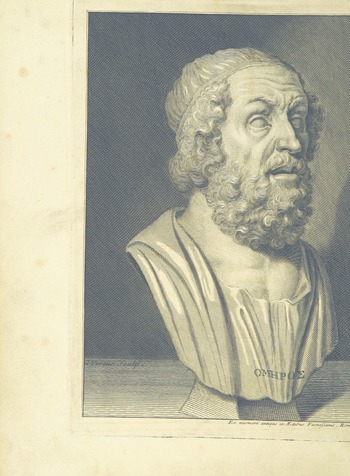
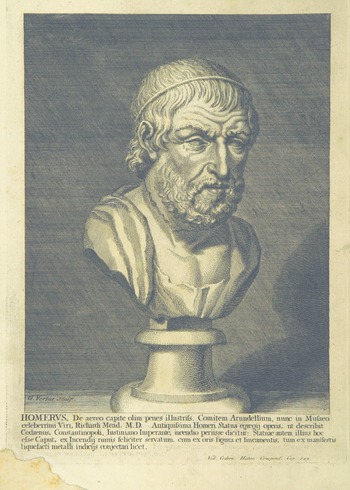
It is precisely as an old, blind, but inspired and powerful character that Homer appears in the two busts that decorate the frontispieces of both Pope's Iliad and his Odyssey. The frontispiece of the Iliad (figure 1) was engraved by George Vertue, and the original size of the plate is 25 × 18 cm. The caption under the image reveals that it is a reproduction of a bust of Homer from the Farnese collection. This bust has been dated to the third quarter of the second century ad on stylistic grounds and belonged to the Farnese family, who displayed it in their palaces in Rome (first at Palazzo Farnese and then at Villa Farnesina). It was then passed on to the Borbone family, and has been held in the Archaeological Museum in Naples since 1790.Footnote 56 The bust of Homer in the frontispiece of the Odyssey (figure 2) was also engraved by George Vertue (size 24 × 18 cm) and represents the so-called ‘Arundel’ Homer, a bronze head of Homer dating from the Hellenistic age. It was brought to Thomas Howard, the second Earl of Arundel, from Constantinople or Smyrna, and Pope's friend Dr Richard Mead bought it in 1721 – just when Pope was working on his Homeric translations. It has been held in the British Museum since 1760.Footnote 57 On its arrival in the West, it was a sensation – in the preface to his Itinerarium Septentrionale (1726), Alexander Gordon said that it was ‘most capital in its Kind’, and thus established it as an ‘icon of contemporary British taste’.Footnote 58 It is not surprising, then, that Pope chose it for his frontispiece.
A. Pope, The Iliad of Homer (London, 1715–20), frontispiece (from the digital collection of the British Library, General Reference Collection DRT Digital Store 12270.k.9, https://creativecommons.org/publicdomain/mark/1.0/)

A. Pope, The Odyssey of Homer (London, 1725–6), frontispiece (from the digital collection of the British Library, General Reference Collection DRT Digital Store 12270.k.8, https://creativecommons.org/publicdomain/mark/1.0/)

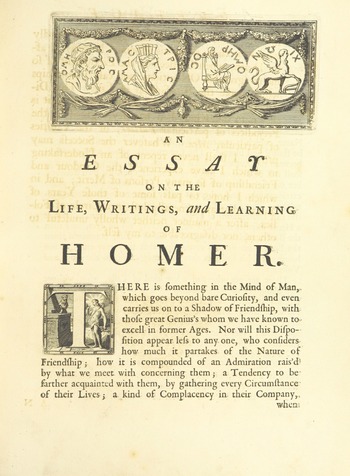
There are many other busts of Homer in Pope's translations, and all seem to offer the same view of the poet. For example, the decorated initial letter of Parnell's essay (figure 3) represents a bust of Homer resting on the poet's tomb and being contemplated by Apollo – showing once again the twofold nature of Homer, a mortal who has gained eternal glory through poetry and is honoured by the god of poetry himself. But an interest in the physical representations (and, more specifically, the bust) of Homer pervaded Pope's whole life, not only his work. Indeed, some sources indicate that Pope liked to surround himself with figures of Homer in his own house and garden. According to the inventory of his possessions compiled after his death, he kept a drawing of Homer in a bedroom and one in the great parlour, as well as a bust of Homer in the library.Footnote 59 Furthermore, a drawing by William Kent (dated c. 1725–30) indicates that there might have been a bust of Homer in Pope's garden at Twickenham. To be sure, there are elements in the drawing, with its ‘luxuriance and exuberance’, that suggest that it represents ‘the power of the poetic imagination’, rather than the actual garden.Footnote 60 Therefore, the bust of Homer might or might not have been in Pope's garden, but it certainly held an important place in the ideal representation of it.
T. Parnell, ‘An Essay on the Life, Writings, and Learning of Homer’, in Pope, Iliad, first page (British Library, General Reference Collection DRT Digital Store 12270.k.9)

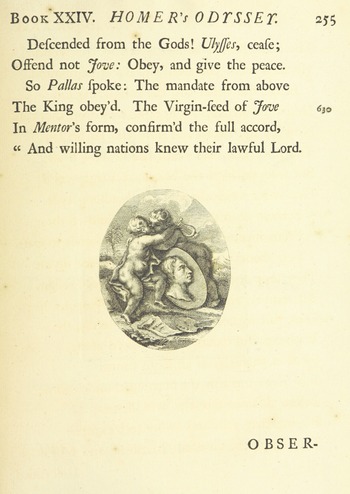
Finally, it seems significant that, while the two frontispieces feature busts of Homer, the tailpiece of the twenty-fourth and final book of the Odyssey (figure 4) hosts an image of the head of Pope himself. Homer had been with him throughout the project, challenging and inspiring him as a model to emulate; now, as he draws his biggest poetic enterprise to a close, Pope seems to indicate that, thanks to Homer, he has established his poetic authority. In his well-earned place among symbols of poetry and celestial figures, he can finally look up with pride.
Pope, Odyssey, p. 255, tailpiece (British Library, General Reference Collection DRT Digital Store 12270.k.8)

Homeric coins: the decoration on Parnell's essay
As well as sculptures and busts, antiquity transmitted several representations of Homer on coins; two important ones appear in Pope's Iliad at the beginning of Parnell's biographical essay, one from Amastris and one from Chios (figure 3). As Parnell explains, ‘the most valuable with respect to the Largeness of the Head is that of Amastris’, a very influential depiction of the Greek poet which was reproduced in Orsini's book, and, due to the similarity, was later used as a criterion for the identification of the Apollonius of Tyana type Homer.Footnote 61 But if the Amastris coin is notable for its size and the success of its depiction of Homer, the Chian coin is equally interesting, influential, and meaningful.
Chios has always held a special place in Homer's biographical tradition, and was one of the places with the strongest claims to be Homer's birthplace.Footnote 62 Depictions of Homer on Chian coins date back at least to the early first century ad, and, although these coins never became part of the regular coinage of the island, they may have covered a need for money within the context of a local festival honouring the poet.Footnote 63 Parnell describes the coin by noting that ‘the Chian Medal of him (which is of great Antiquity, according to Leo Allatius) seats him with a Volume open, and reading intently’, which, incidentally, for Parnell is evidence that the poet ‘who thus inimitably copies Nature’ could not have been blind from birth.Footnote 64 It is by reading Leo Allatius’ own words that the full extent of the relevance of this coin to Pope's project becomes clear. A Chian himself, Allatius included in his 1640 treatise De patria Homeri a lengthy discussion of the Chian coin, using it as evidence that Homer, too, was from Chios. But Allatius gives more than a simple description: he unpacks the meaning of each and every element of that representation of Homer, which appears to fit exactly Pope's views on the Greek poet: his cloak and beard emphasize his wisdom, giving him the look of a Greek philosopher, the open book in his hands marks him as an erudite teacher, the hairband and the fillet as a poet and a seer – one who, ultimately, should be venerated as a divinity.Footnote 65
Episodes from the life of Homer: the title page of Pope's Odyssey
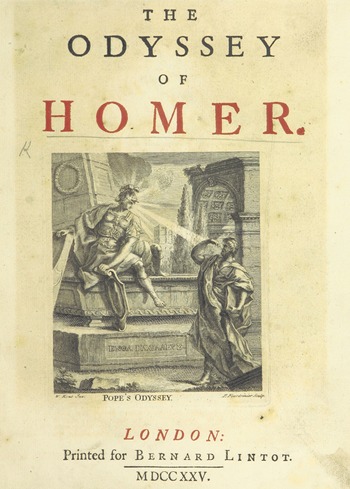
The final, but perhaps most interesting, illustration analysed in this article is the title page ornament of the first volume of the Odyssey (figure 5), engraved by Paul Fourdrinier after William Kent (1725; original size of the plate 14 × 11.5 cm). This illustration, which has often been ignored in modern studies of Pope's translations, draws on an episode of the Homeric biographical tradition that originated in antiquity, interested Renaissance poets, and inspired seventeenth-century painters and scholars. On the Odyssey's title page, the tradition appears to be carefully constructed and crafted to represent Pope's views on Homer and his poems. The image represents Achilles, now dead, sitting on his own tomb, while a ray of light emanating from him blinds Homer. The identification of the two characters is certain: the tomb on which the hero is sitting carries the inscription ἔνθα δ᾿ Ἀχιλλεύς (‘Here lies Achilles’), while the head of the other figure is the same as the Homer bust bought by Richard Mead and reproduced as the frontispiece of the Odyssey.Footnote 66
Pope, Odyssey, title page (British Library, General Reference Collection DRT Digital Store 12270.k.8)

Both characters in this scene inspire reflection on several interrelated issues connected to Pope's engagement with the Odyssey. To start with, the Odyssey is where Achilles makes an appearance as a dead character. In Book 11, Odysseus undertakes a journey to the Underworld, where, among other things, he consults Tiresias about how to get home. There, Achilles addresses Odysseus with a controversial statement (Od. 11.488–91): ‘I should choose, so I might live on earth, to serve as the hireling of another, some landless man with hardly enough to live on, rather than to be lord over all the dead that have perished.’Footnote 67 These words clash with the heroic system of values that Achilles championed in the Iliad, where he was ready to welcome an early death in exchange for eternal glory. But it is precisely this sharp contrast that emphasizes their message: the Odyssey is the poem of homecoming, where the familial dimension becomes prominent, and even the quintessential epic hero seems to prefer a perhaps less glorious, but quieter and more domestic life. Pope was aware that this enhanced focus on the family and the return home is an important feature of the Odyssey. As we have seen, he was aware that this is reflected in the style and energy of the poem, and that ancient critics such as Longinus thought the poem ‘less active and lofty’, so much so that it was judged the ‘work of the old age of Homer’. The image of a dead Achilles therefore recalls an episode that emphasizes a particular feature of the work, one that has an impact not only on the original poem, but also, necessarily, on the translation.
Furthermore, with its explicit reference to Homer's blindness, this illustration explores the figure of the poet, his relationship with the characters, and his divine inspiration – again, all issues that are at the core of the Odyssey and are relevant to Pope himself. It is in the Odyssey, indeed, that we find Demodocus, an important character on whom, according to some ancient and modern scholars, Homer modelled the image of himself that he wanted to transmit to posterity: a bard who can count on the divine inspiration granted by the Muses, but who lost his sight for that. As we have seen, Pope engages on several occasions with the figure of Demodocus, the blindness that affects both Homer and his character, and its meaning.Footnote 68 Finally, the background of the scene, with the tomb and the arch, offers the chance to the creator, the architect William Kent, to engage in an exercise of imagination and reconstruction of ancient material remains that suited both his taste and the taste of his time: the result is a combination of Greek and Roman architecture that might not reflect a genuine ancient setting, but does echo the contemporary taste of mixing the two.Footnote 69
This image, with its reference to a dead Achilles and a blind Homer, engages with issues that are crucial to the Odyssey and to Pope as a poet and translator, and therefore fits very well as the title page of his translation. But where does the inspiration for this image come from? What sources tell us about Homer being blinded by Achilles? As Parnell reports in his discussion of Homer's blindness, ‘some…will not allow even this [i.e. blindness] to have happen'd after the manner in which it falls upon other Men: Chance and Sickness are excluded’.Footnote 70 Instead, he continues, Hermias in his commentary on Plato's Phaedrus informs us that the poet became blind as a result of seeing the ghost of Achilles in his shiny armour. Hermias’ commentary is lost, but the relevant passage is preserved by Leo Allatius:
varios tamen de caecitate Homerica rumores in unum nobis Hermias collegit in Phoedrum Platonis, a quo sua Politianus, aliique recentiores habuere. Illius verba, quia inedita sunt, lege per me lector: Περὶ τῆς Ὁμήρου τυφλώσεως διάφοροι φέρονται ἱστορίαι. Οἱ μὲν γὰρ αὐτὸν καὶ τυφλὸν ἐκ γενετῆς λέγουσι καὶ οὕτω τετέχθαι, οἱ δὲ ποιμαίνοντα παρὰ τῷ τάφῳ τοῦ Ἀχιλλέως πολλάς τινας καταβαλέσθαι εἰς τὸν ἥρω χοὰς καὶ στεφάνους, καὶ παρακαλεῖν αὐτὸν ὀφθῆναι αὐτῷ. Ὁ δὲ ἥρως ὤφθη μετὰ τῆς πανοπλίας λάμπων, καὶ ὁ Ὅμηρος μὴ ἐνεγκὼν τὴν θέαν καὶ τὴν λαμπηδόνα τῶν ὅπλων ἐτυφλώθη.
Hermias has collected many stories about Homer's blindness in one place for us in the commentary on Plato's Phaedrus, from which Politian and other more recent authors made their own version. Reader, you can read his words thanks to me, since they are unpublished. ‘Many different stories are told about Homer's blindness. For some say that he was blind from birth and was born that way, some others that while shepherding around the tomb of Achilles he offered many libations and garlands to the hero and prayed that he would appear to him. The hero appeared in his splendour with his armour and Homer, who could not bear the sight and the shine of the armour, was blinded.’Footnote 71
Parnell (and Pope) likely knew the story from Allatius, a source he used on many occasions (see the discussion of the coins above). But between antiquity and Pope, the story was transmitted by several other sources, including Politian (1454–94), and a drawing by Pietro Testa (1612–50).Footnote 72 For the title page of his Odyssey, Pope commissioned an image that is full of significance, one that embodies issues of poetics by exploring an ancient and long-lived (albeit today largely neglected) episode from the Homeric biographical tradition.
Conclusion
Alexander Pope's experience as a translator of the Iliad and the Odyssey is driven and influenced by a deep engagement not only with the Homeric texts, but also with Homer as a poet. To an extent, this is due to the cultural environment in which the translations were produced: Homer was then at the centre of debates about the value and relevance of ancient authors to modernity, and Wolf's studies had yet to shake the belief in the ancient and lasting image of Homer as an inspired poet. But Pope also establishes his own unique personal relationship with the Greek poet: the figure of Homer that emerges from the sources considered in this article embodies what Homer and his poetry mean for Pope. Modern scholarship has enhanced our understanding of the embodied experience of ancient poetry, and how the desire for the ancient author stimulates later audiences and readers. This article has shown that this can be applied to the experience of a translator as well: engaging with the biography of Homer allows Pope to explore issues such as poetic authority and divine inspiration, promote his own translations against European competitors, and ultimately establish himself as a translator and as a poet. Furthermore, this contribution has highlighted how a full understanding of an embodied experience of literary reception of ancient poetry needs to include an analysis not only of the receiving and the received literary works, but also of the elements that surround both. It is in Pope's correspondence, his and Parnell's biographical notes to the poems, and the illustrations by Kent included in the translations that Homer appears as a presence that forces Pope constantly to challenge himself, until he feels he can stand a comparison with the greatest poet ever.