INTRODUCTION
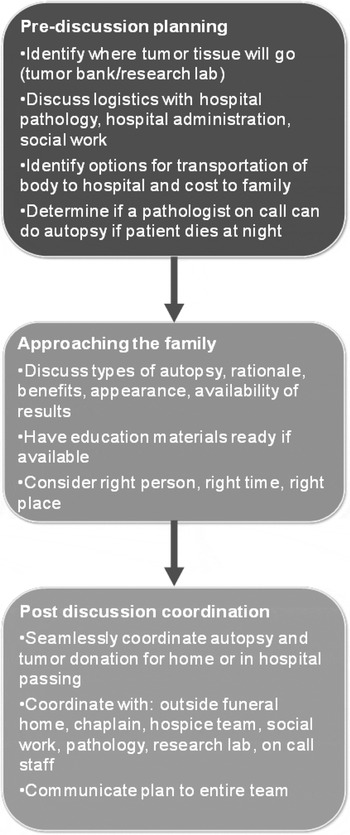
This report details a bi-institutional experience of coordinating a rapid autopsy for a pediatric patient with anaplastic ependymoma who died at home. The goal was to quickly obtain and freeze tumor samples from multiple predetermined sites, along with nonneoplastic tissue, and perform more detailed analysis of the patient's tumor than would occur with a traditional autopsy. Tumor tissue was previously collected for analysis at each surgical resection. The procedure was coordinated by the oncology team, the pathology department, and the Institute for Precision Medicine (IPM) at two institutions in collaboration with home hospice and the funeral director. We successfully collected high-quality tumor and control tissue from multiple central nervous system (CNS) sites in order to advance the study of anaplastic ependymoma. We discuss the logistical, scientific, and psychosocial issues that arose in an elective postmortem procedure and suggest a framework, outlined in Figure 1, for clinicians who wish to streamline this process for appropriate candidates going forward.
Flowchart of major events necessary to coordinate a rapid autopsy.

CASE REPORT
A previously healthy 3-year-old female presented with fever, emesis, neck pain, and dysarthria. Magnetic resonance imaging (MRI) revealed a 4.9 × 2.6 × 3.0 cm mass occupying the fourth ventricle. A gross total resection was achieved, and pathology revealed a glial tumor with prominent true ependymal rosettes and perivascular pseudorosettes, diagnostic of ependymoma. While the tumor was predominantly compatible with a WHO grade II tumor, focal areas with higher-grade features were seen. Baseline MRI spine and CSF cytology were negative. She received proton beam radiation therapy (54 Gy) to the resection cavity.
Two years after initial diagnosis, MRI spine revealed a new lesion resected via lumbar laminectomy. Pathology was consistent with anaplastic ependymoma. The patient received radiation therapy to the lumbosacral spine followed by 1 year of metronomic chemotherapy (DFCI 04-343). She subsequently developed several distinct subcentimeter intracranial nodules. Over the course of the next 2 years, she received several chemotherapy agents, including sunitinib, lapatinib, bevacizumab, oral etoposide, 5FU, and gemcitabine, as well as reirradiation to the left temporal lobe and four surgical resections. Though all surgeries were primarily palliative, the tissue obtained was sent for molecular profiling, which helped guide further therapy decisions. Finally, the patient received a short course of azacitidine and vorinostat (Mack et al., Reference Mack, Witt and Piro2014) but had neurologic decline, at which time her parents transitioned her to home hospice.
The primary oncology team members who knew the patient and the family best discussed the options for postmortem tissue collection. The family elected to utilize the rapid autopsy program at the Englander IPM of Weill Cornell Medicine Center at New York–Presbyterian (Pisapia et al., Reference Pisapia, Salvatore and Pauli2017), a collaborating institution that would perform postmortem analysis of the patient's brain and spine with tissue collection for further research. Prior to death, autopsy consent was reviewed with the family. An oncology team member served as the liaison for coordination and communication among the various services. The team contacted the hospice agency and funeral home to explain the family's wish for a rapid autopsy to ensure no delay in pronouncing death, in processing the death certificate, or in releasing the body to the funeral home for transport to New York–Presbyterian (NYP) Hospital. The team also spoke with the admitting department at the hospital to ensure that administrative signoff for autopsy could be processed at all hours. All the details were compiled by the liaison and emailed to all services as well as on-call staff to ensure that everyone understood the sequence of events and timing required.
When the patient died at home at approximately 1:30 a.m., her hospice team quickly notified the on-call IPM rapid autopsy team's pathologist, processed the death certificate, and released the body to the funeral home. The body was transferred to NYP for the planned autopsy. The postmortem interval in this case, from time of death to autopsy procedure start time, was 4.5 hours, despite an offsite location of death and the need for third-party transportation.
Rationale for Offering Rapid Autopsy
Tumor tissue obtained at autopsy can provide valuable clinical information about the components of a tumor. It can allow for larger specimens to be collected and allow for sampling multiple sites of disease. The advantage of performing an autopsy within a shorter postmortem time interval is that the degree of tissue degradation, and in particular RNA degradation, can be reduced, and there is a higher probability of obtaining viable tumor cultures for ex-vivo assays. Hence, streamlining the process from death to collection of tissue specimens is important in order to maximize the value of the donation. Tumor tissue can be contributed to research labs and institutions, where examination can reveal molecular mechanisms of tumor progression and resistance, and donations may lead to the creation of tumor banks and development of tumor cell lines. Postmortem tissue collection is especially helpful in cases where tumors are not often biopsied or resected (Alabran et al., Reference Alabran, Hooper and Hill2013).
The majority of the families of a child with cancer would prefer to be offered some form of autopsy, and none of the families who consented regretted their decision (Alabran et al., Reference Alabran, Hooper and Hill2013; Baker et al., Reference Baker, Windham and Hinds2013; Wiener et al., Reference Wiener, Sweeney and Baird2014). Among parents, the overwhelming reason for consenting to autopsy was the desire to advance knowledge and find a cure for other children with the same tumor as their child (Baker et al., Reference Baker, Windham and Hinds2013; Wiener et al., Reference Wiener, Sweeney and Baird2014).
Approaching the Family
Broaching the subject of autopsy can be challenging. Clinicians report feeling guilty about asking for more from the family after an unsuccessful attempt at cure and have expressed worry that unexpected findings can reveal an error in clinical judgment. In addition, clinicians are often unfamiliar with the details and logistics of the autopsy procedure. Families identify lack of educational materials as a barrier to discussion (Alabran et al., Reference Alabran, Hooper and Hill2013). Overcoming these obstacles by educating the family and the care team is key to initiating the discussion.
Prior to initiating the discussion, clinicians should identify who will accept the tumor tissue for donation and what testing will be performed on the specimens. Hospital administration and the pathology departments can provide information about reimbursement for transportation when funds are available. Having a plan in place prior to discussion allows the family to make an informed decision. Finally, if the family agrees to an autopsy, providers should then contact the appropriate members of the team (including the funeral home/chaplain, hospice team, social worker, hospital pathologists, and researchers) to coordinate autopsy and tumor donation.
The primary clinician who has a consistent and caring relationship with the family should initiate the autopsy discussion (Alabran et al., Reference Alabran, Hooper and Hill2013; Baker et al., Reference Baker, Windham and Hinds2013). Parents report that the most appropriate time to raise the subject is when the conversation has turned from curative to initiation of end-of-life care. The least desirable time is immediately before or after the death, when overwhelming emotions hinder clear decision making (Alabran et al., Reference Alabran, Hooper and Hill2013; Wiener et al., Reference Wiener, Sweeney and Baird2014). Clinicians can improve the autopsy discussion by: (1) being mindful of timing, (2) acknowledging that the discussion is a difficult one, (3) being compassionate during the request, and (4) using laymen's terms. Many families want reassurance that the child's body will be presentable after the autopsy. Families may ask about when and what information they will receive after the autopsy, and about how the findings will benefit others and the medical community (Alabran et al., Reference Alabran, Hooper and Hill2013; Baker et al., Reference Baker, Windham and Hinds2013; Wiener et al., Reference Wiener, Sweeney and Baird2014).
Preautopsy Coordination
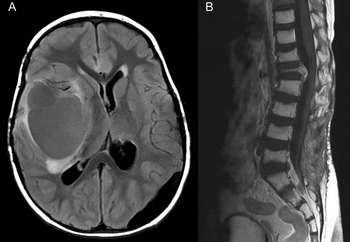
Coordination between clinicians and pathologists prior to autopsy facilitates quick and accurate collection of the desired specimens at the time of autopsy. In the case described here, the patient's primary neurosurgeon coordinated with the IPM rapid autopsy team, which included attending and resident pathologists, autopsy technicians, and members of the laboratory team receiving her tissue. Together they reviewed her recent MRI scans (see Figure 2) to help guide gross examination during the autopsy procedure and selected seven disease sites as well as uninvolved cortex from which to procure flash-frozen samples.
MRI images: A (brain) and B (spine) used to plan autopsy tissue sampling sites.

Rapid Autopsy Procedure
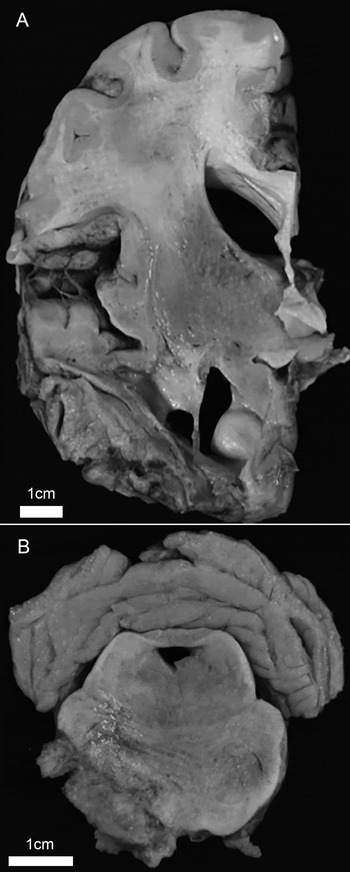
Referring to the most recent MRI, the approximate sites of interest were located. Visually, gross tissue abnormalities were evident in all the preidentified sites (selected areas shown in Figure 3). Using procedures established by the IPM (Beltran et al., Reference Beltran, Eng and Mosquera2015; Faltas et al., Reference Faltas, Prandi and Tagawa2016; Pisapia et al., Reference Pisapia, Salvatore and Pauli2017), high-quality neoplastic and nonneoplastic tissues were obtained.
Gross anatomy images: A (brain) and B (spine) from patient's autopsy.

DISCUSSION
This case report details the process that was required to perform a rapid autopsy for our patient. There have been previous reports on the feasibility and usefulness of performing autopsy to collect brain tumor tissue for further study (Broniscer et al., Reference Broniscer, Baker and Baker2010; Kambhampati et al., Reference Kambhampati, Perez and Yadavilli2015). Partly as a result of this case, Memorial Sloan Kettering Cancer Center now has an open institutional protocol to streamline the process of autopsy collection.
By sampling the tumor at multiple sites and timepoints, we are able to characterize the histological and molecular evolution of the tumor in our patient. By increasing the number of patients and samples and eventually consolidating the results in an international registry, we hope to advance our understanding of the pathophysiology of rare tumors like ependymoma. National and international cooperative groups have tumor procurement protocols (ACNS02B3 and ACRN077) and nontherapeutic protocols for living patients, which have contributed valuable data regarding disease subtypes and prognostic indicators (Carter et al., Reference Carter, Landier and Schad2008). Rapid autopsy programs (Broniscer et al., Reference Broniscer, Baker and Baker2010; Kambhampati et al., Reference Kambhampati, Perez and Yadavilli2015; Spunt et al., Reference Spunt, Vargas and Coffin2012) may add similar information, but with the advantage of providing multiple high-quality samples as well as normal tissue. Tumor registries for a particular disease entity serve as an important resource for consolidating data related to the disease to be studied.
To that end, repositories in line with tumor registries on a regional scale that are inclusive of autopsy specimens may help circumvent the tissue shortage for such pediatric diseases as ependymomas, diffuse midline gliomas, other low- and high-grade gliomas, and CNS embryonal tumors.
We coordinated a rapid autopsy on our patient. The collection of tumor tissue during treatment-related resections as well as additional high-quality disease and normal tissue at the end of her life is allowing researchers to investigate how her tumor had responded to various therapies over time. Given the significant advances in the understanding of diffuse intrinsic pontine glioma through autopsy specimens, further efforts need to be made to promote autopsy in all pediatric patients.
ACKNOWLEDGMENTS
We would like to acknowledge the patient and her family for their altruism in supporting research to further our understanding of pediatric ependymoma. We would also like to acknowledge Joseph Olechnowicz, Editor for Pediatrics at Memorial Sloan Kettering Cancer Center, for his assistance with the manuscript. We also acknowledge the support of the NIH Cancer Center (grant no. P30 CA 008748).