Hospital room environmental surfaces are frequently contaminated and serve as a source for healthcare-associated multidrug-resistant (MDR) pathogens including methicillin-resistant Staphylococcus aureus (MRSA), vancomycin-resistant Enterococcus (VRE), MDR-Acinetobacter species, and Clostridioides difficile.Reference Weber, Anderson and Rutala1–Reference Otter, Yezli, Salkeld and French3 Contact with these contaminated surfaces may result in hand or glove contamination of healthcare personnel that can be transferred to patients. In addition, the surface environment in patient’s rooms may be persistently contaminated despite routine room cleaning and disinfection and recontaminated via healthcare personnel and patients.Reference Hardy, Gossain, Henderson, Drugan, Oppenheim, Gao and Hawkey4 For these reasons, there is a need to develop methods of continuous disinfection (eg, self-disinfecting surfaces).
Low-dose hydrogen peroxide (HP) gas (eg, 0.1 ppm) is considered a potential method for continuous room decontamination.Reference Weber, Rutala, Sickbert-Bennett, Kanamori, Anderson and Prevention Epicenters5 This HP level is below the existing safety limit (ie, 1 ppm). The ozone-free, dilute HP (DHP) system generates HP from humid ambient air (>20% relative humidity) via exposure of an interior titanium catalyst, which is activated by ultraviolet light. The released DHP should mix with the air and may decontaminate microorganisms on surfaces.6 A study evaluated microbial contamination in the hospital environment using a DHP system and described a reduction in some healthcare-associated pathogens.Reference Herman, Hess and Cerra7 In this study, we used a DHP device for continuous room decontamination and experimentally examined the germicidal efficacy of this new technology against MDROs in a model patient room.
Methods
Dilute hydrogen peroxide (DHP) device installation
This study assessed a DHP device (Lee Antimicrobial Solutions, Armonk, NY) in a model patient room without windows (13.9 m2 [150 ft2]). DHP devices were installed by the DHP manufacturer in the ceiling supply duct of the room and the hallway in front of the room. To minimize extraneous factors (eg, volatile organic carbons [VOCs]) that could interfere with HP concentration in the room the following measures were implemented: (1) the front door and bathroom doors were closed to limit VOCs from entering the room from untreated outside air; (2) the room was maintained at ambient temperature and relative humidity using a pan of water on a table; (3) the room lights were turned off during the evaluation; and (4) additional cleaning and disinfection were not performed. The concentration of HP in the room was measured daily using a Draeger tube (Drägerwerk AG and Co. KGaA, Lübeck, Germany) capable of measuring HP ≥ 0.1 ppm.
Study design
The 3 test organisms (MRSA, VRE, and MDR A. baumannii) were grown on sheep blood agar. Serial dilutions of inocula were made with trypticase soy broth (TSB, Remel, Lenexa, KS). Rodac plate templates were drawn on the Formica sheet and inoculated with 15 µL of a 104 dilution of test organisms suspended in TSB, producing an estimated inoculum of 100–500 organisms. The inoculum was spread evenly and separately on each Formica sheet using a sterile glass hockey loop. After inoculation, each surface was allowed to air dry for 10 minutes and were then exposed to the DHP gas released into the room air. Rodac plates containing Dey-Engley neutralizing agar in triplicate samples were collected at multiple time points and were then incubated aerobically at 37°C for 48 hours. After incubation, the colony-forming units of the organisms on each Rodac plate were quantified. Each template area was sampled only once. A control Formica sheet was placed in an adjacent area but not exposed to the DHP device to accommodate the expected natural in vitro die-off of vegetative bacteria. Triplicate samples were collected with Rodacs at the same test times as the test surfaces.
Results
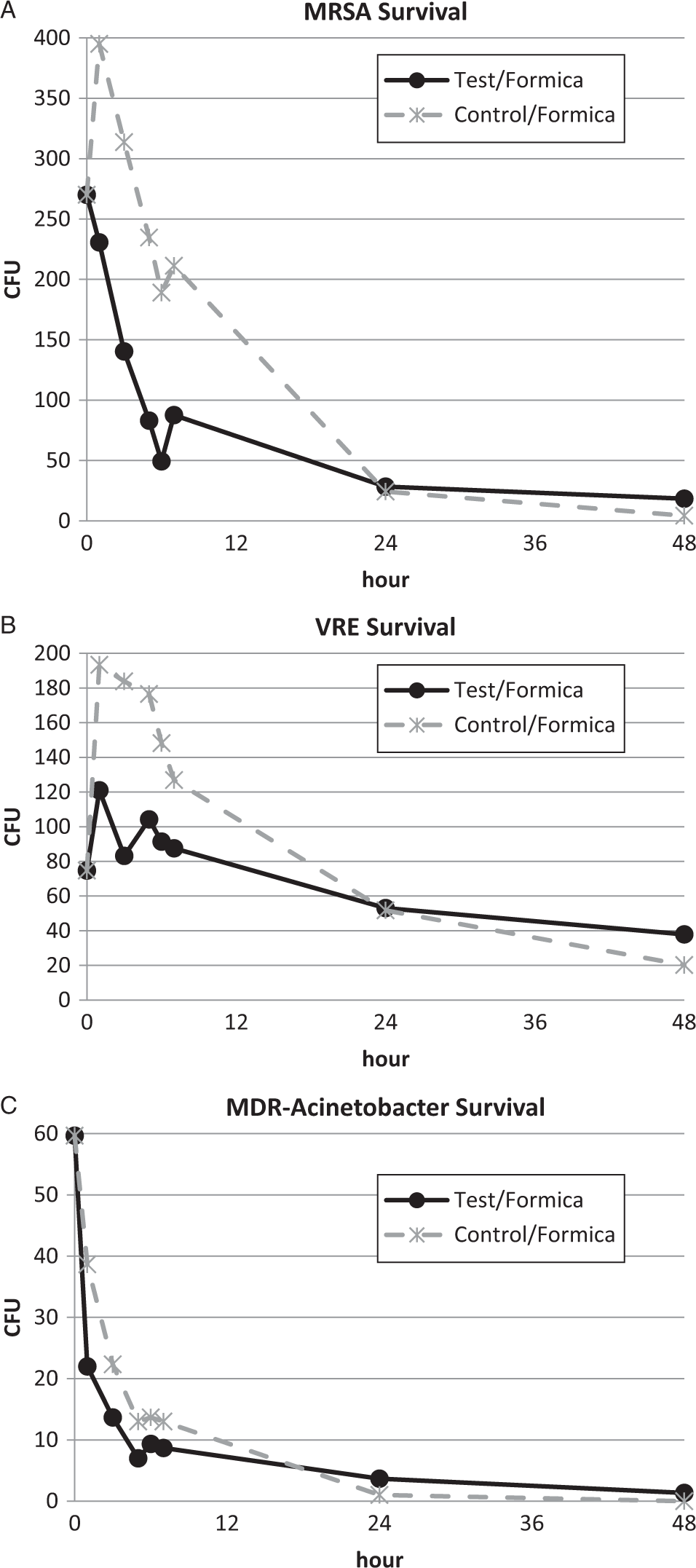
The DHP level was <0.1 ppm in all experimental runs. The survival curves of test organisms are shown in Figure 1. The displayed curves reveal no clinically relevant differences in die-off of the test organisms comparing interventions and control groups, especially in the periods >24 hours.
Survival of methicillin-resistant Staphylococcus aureus-MRSA (A), vancomycin-resistant Enterococcus-VRE (B), and MDR Acinetobacter (C) with dilute hydrogen peroxide technology. Two experimental runs were performed for VRE at all time points, and 1 experimental run was conducted for MRSA and Acinetobacter. Note. MDR, multidrug-resistant clinical strain A. baumannii; MRSA, methicillin-resistant Staphylococcus aureus (ATCC strain 43300); VRE, vancomycin-resistant enterococci (ATCC strain 51299); CFU, colony-forming unit.

Discussion
Vaporized HP systems, although effective for terminal room decontamination, cannot be used in occupied areas due to the high concentrations of HP (>1 ppm). However, DHP can be used in occupied spaces as the concentrations are below safety requirements of 1 ppm. Our preliminary study was not able to verify the DHP device studied consistently reduced microbial contamination in contaminated surfaces. The main reason for obtaining negative results was likely the DHP device’s inability to maintain a germicidal concentration of DHP (ie, DHP level was <0.1 ppm), although we tried to control factors (eg, VOCs) that could interfere with the HP concentration. Our survival curves suggest a possible small benefit to HP in the 1–6-hour period, which might have been due to levels of hydrogen peroxide below our ability to measure (ie, <0.1 ppm). A study limitation was our small sample size. Additionally, our evaluation involved a DHP device operating in one room of a larger area serviced by a shared air handler, which could have affected the concentration of HP. An optimal experimental design would have been to install devices throughout an entire area covered by the shared air handler (written communication, JE Lee, 2016).
In summary, our study results show that using a DHP device failed to consistently kill our test MDROs due to the inability to generate a sufficient germicidal level of HP. Creating consistent germicidal levels of HP for continuous room decontamination in actual patient rooms may be much more challenging than that in experimental model rooms, given the difficulty of keeping room space closed and controlling the introduction of VOCs. Even if additional studies demonstrate that DHP is germicidal, additional studies will be needed to demonstrate that this method reduces healthcare-associated infections using a well-designed clinical trial.
Acknowledgment
We thank Lee Antimicrobial Solutions (Armonk, NY) for use of the dilute hydrogen peroxide device.
Financial support
UNC Hospitals and the CDC Prevention Epicenters Program (U54CK000483). H.K. received financial support from the JSPS Postdoctoral Fellowship for Research Abroad.
Conflicts of Interest
Drs. Rutala and Weber are consultants for Professional Disposables International. Dr. Weber is a consultant for Germitec.