INTRODUCTION
According to a consensus in second language acquisition research, language proficiency can be captured by the constructs of accuracy (i.e., lack of errors), complexity (i.e., being able to produce adequately complex linguistic structures), and fluency (Pallotti, Reference Pallotti2009; Wolfe-Quintero, Inagaki, & Kim, Reference Wolfe-Quintero, Inagaki and Kim1998). While fluency is central to studies of L2 speaking proficiency (de Jong, Steinel, Florijn, Schoonen, & Hulstijn, Reference de Jong, Steinel, Florijn, Schoonen and Hulstijn2012; Derwing, Munro, & Thomson, Reference Derwing, Munro and Thomson2008; Lennon, Reference Lennon1990; Révész, Ekiert, & Torgersen, Reference Révész, Ekiert and Torgersen2016), in L2 writing research fluency is frequently ignored. When it is considered, it is often measured across whole writing sessions as the number of words written per minute (Baba & Nitta, Reference Baba and Nitta2014; Chenoweth & Hayes, Reference Chenoweth and Hayes2001). Such global measures of writing fluency, however, lack both explanatory power and instructional value. Knowing that a student writes slowly overall is less useful, from both the research and the practical perspective, than being able to identify what specifically it is that the student struggles with when a drop in production fluency occurs. To draw a parallel with the construct of accuracy, knowing how many errors, in total, the text produced by a student contains is less useful than knowing what the specific types of errors are and how they are distributed across sentences. Therefore, useful measures of fluency in writing need to (a) identify specific locations where normal fluent production breaks down and (b) support inferences about the cognitive causes of these disfluencies. Sometimes, of course, pausing to stop and think is a normal, and desirable, feature of written production. However, pausing may also indicate underlying difficulties with the written medium (e.g., spelling) or the language in which the text is being written.
In this article, we describe and illustrate a method for distributed collection and automated analyses of L2 writing processes through deployable, low-cost, concurrent keystroke logging and eye-tracking. We demonstrate the application of this method to a study of L1 and L2 writing processes in the setting of an English-medium university in Turkey. We investigate differences in the pausing and eye-fixation behavior of students who wrote in their L1 (Turkish) and their L2 (English).
INVESTIGATING WRITING FLUENCY
Investigating the fluency of written text production is important for both theoretical and practical reasons. Accounts of the mental processes that underlie writing (Hayes, Reference Hayes, Fayol, Alamargot and Berninger2012; Olive, Reference Olive2014; van Galen, Reference van Galen1991), following models of speech (Dell, Reference Dell1986; Levelt, Reference Levelt, Brown and Hagoort1999; Skehan & Foster, Reference Skehan and Foster1997), describe text production as a cascade of cognitive processes, starting from the writer’s intended message and ending with keystrokes (or pen strokes). Early, high-level processes in this cascade are responsible for generating ideas and making decisions about appropriate rhetorical strategies and discourse structures. This processing can be a conscious, deliberate, and effortful “problem-solving” activity (Flower & Hayes, Reference Flower, Hayes, Gregg and Steinberg1980; Hayes & Nash, Reference Hayes, Nash, Levy and Ransdell1996). This message is then passed on to low-level processes that are responsible for lexical retrieval, grammatical encoding, and spelling. In young and developing writers these processes are also effortful, but, with instruction and practice, they become increasingly automatized, allowing attention to be devoted to high-level thinking and reasoning. In principle, if low-level processes run smoothly and without demanding attention, the writer can, simultaneously and in parallel, attend to deciding on what to say next. The resulting message is then delivered to low-level processing.
The parallel functioning of the high-level and the low-level processes in language production leads to a fundamental “now-or-never” bottleneck, which Christiansen and Chater (Reference Christiansen and Chater2016) explain using a stock-control metaphor: information from upstream processes is delivered “just in time” to the processes necessary for output. If low-level processing is delayed—the writer struggles with the syntax, word retrieval, or spelling necessary for expressing their message—then the message may be lost: a writer who stops in the middle of a sentence to worry about making verbs agree with nouns may, in a literal sense, forget what they were going to say next (or be unable to come up with new ideas).
Previous studies of L2 writing fluency largely employed methodologies similar to those used in oral fluency studies. The measure of fluency that researchers have most commonly depended on is number of words written per unit of time. Chenoweth and Hayes (Reference Chenoweth and Hayes2001), who defined written fluency as “the rate of production of text” (p. 81), measured it by words written per minute. Similarly, in their study on the effect of planning on fluency, complexity, and accuracy in second language narrative writing, Ellis and Yuan (Reference Ellis and Yuan2004) used oral fluency measures to measure written fluency: the number of syllables produced per minute and the rate of disfluencies, operationalized as the number of reformulated words divided by the total number of words produced. They were not able to measure length of pauses in writing. In contrast to these studies, Chandler (Reference Chandler2003) looked at the total amount of time students spent writing an assignment and measured the fluency of written production as the number of minutes it took writers to produce 100 words (self-reported by student participants).
It has been a common finding that, even though writers may write proficiently in their L1 and their basic L1 literary operations do not need to be reacquired in another language (Cummins, Reference Cummins1980; De Larios, Murphy, & Marín, Reference De Larios, Murphy, Marín, Ransdell and Barbier2002), their fluency declines when they produce text in L2: the same low-level language skills that work smoothly in L1 may become disfluent in L2, largely due to poor automation of L2-specific lexical retrieval and syntactic planning (Chenoweth & Hayes, Reference Chenoweth and Hayes2001; Ransdell, Arecco, & Levy, Reference Ransdell, Arecco and Levy2001; Wolfersberger, Reference Wolfersberger2003). From the theoretical perspective, therefore, being able to identify local disfluencies and infer their cognitive causes is important for developing an understanding of the cognitive processes that underlie writing, and particularly the development of L2 writing skills. From the practical perspective, we argue (a) that information about the moment-by-moment fluency of a student’s written output gives valuable insights into the aspects of the students’ L2 competence that require remediation, and (b) that developing fluent written production can be, in and of itself, an important focus of intervention. Such interventions, however, need to rely on more detailed measures of fluency than the global speed (rate) of text production.
KEYSTROKE LOGGING FOR MEASURING WRITING FLUENCY
The question then is what methods can provide such measures of fluency. Analyzing the text produced by the writer provides few insights into the cognitive processes whereby the text was produced. What is needed is a method that can directly capture the dynamics of the text production.
Because for most adult writers keyboarding is the dominant method of writing, keystroke logging has seen widespread adoption as a method of capturing the observable aspects of writing process. The keystroke-logging method involves accurate (millisecond) timing of each keypress made during text production. Inter-keystroke intervals (IKIs) can then be automatically calculated from the keystroke log. An IKI is defined as the time that elapsed between two consecutive key presses. For example, if the writer is fluently typing the word hello, the first two letters would be produced by consecutively pressing and releasing the keys “h” and “e” on the keyboard. If the key “h” was pressed at time t 1 and the key “e” was pressed at the time t 2, then the IKI associated with the latter key would be IKI = t 2 − t 1. The entire time-course of text production can thus be segmented into sequential, nonoverlapping IKIs, and any event that took place during this time-course can be mapped to exactly one IKI during which such event occurred.
IKIs, arguably, can give considerable insight into the cognitive processes that underlie written composition. Obviously, minimum IKI is determined by the motor constraint of typing: the brief time that it takes to move fingers between keys. As we previously discussed, behind each key press is a cascade of cognitive processes that start with content generation; go through syntactic, lexical, and orthographic processing; and end with the motor planning of finger movements. All these cognitive processes may occur in parallel with output (i.e., the actual implementation of the motor program), providing a steady flow of information from mind to fingers, in which case text production will be fluent. However, if there is a delay in any of the upstream processes (e.g., search for content, syntax, spelling, or keys), then this delay propagates down the cascade and is observed as a longer IKI. Therefore, disfluencies in writing can be identified by prolonged IKIs. Such IKIs that are indicative of a disfluency are often termed pauses, however operational definitions of pauses vary. In many studies, pauses are defined as IKIs above a particular threshold (Alves & Limpo, Reference Alves and Limpo2015; Barkaoui, Reference Barkaoui2019; Chukharev-Hudilainen, Reference Chukharev-Hudilainen2014; Connelly, Dockrell, Walter, & Critten, Reference Connelly, Dockrell, Walter and Critten2012; Leijten & Van Waes, Reference Leijten and Van Waes2013; Torrance, Rønneberg, Johansson, & Uppstad, Reference Torrance, Johansson, Johansson and Wengelin2016).
Inferences about the cognitive cause of a disfluency must necessarily be made on the basis of the location of the corresponding IKI within the text: an IKI at a particular linguistically relevant location is associated, in part, with the cognitive activity of planning the linguistic unit that follows. Thus, for example, a word-initial IKI is likely to be partially associated with the planning of this word (Torrance et al., Reference Torrance, Johansson, Johansson and Wengelin2016). Because L2 writers’ processes are poorly automatized compared to L1 writers, it is expected that L2 writers would have longer IKIs before the linguistic units that require more planning effort. This was confirmed by Spelman Miller (Reference Spelman Miller2000), who used keystroke logging to investigate writing-process differences between native English speakers (L1 group) and ESL learners (L2 group) composing text in English. The study reported the L2 group paused longer at all locations, but especially at the beginning of clauses and sentences.
Some of the activity that occurs during an IKI may be related to reading, defined here loosely as looking back at the text produced so far. Therefore, further inferences about the writer’s cognitive activity during an IKI can be made if keystroke data are combined with information about where the writer looks between consecutive keystrokes (Torrance, Johansson, Johansson, & Wengelin, Reference Torrance, Johansson, Johansson and Wengelin2016; Wengelin et al., Reference Wengelin, Torrance, Holmqvist, Simpson, Galbraith, Johansson and Johansson2009). For example, if the writer’s eye fixations remain within the unfinished sentence containing the current point of inscription, cognitive processing during the pause is likely to be concerned with this sentence. However, looking back at stretches of text beyond the current sentence will indicate a different kind of processing, which might be more ideational than linguistic in nature (e.g., deciding what to say next based on what has just been said in the text).
EYE-TRACKING FOR MEASURING WRITING FLUENCY
Although eye-tracking per se is an established technique in psycholinguistic research, it has not seen widespread adoption in the study of written production. Arguably, the application of eye-tracking to the study of writing processes has been impeded by two factors. First, commercially available eye-movement analysis software is tailored to the most common use cases of the eye-tracking technology: reading and visual perception studies and user-experience research. In this case, the standard approach to analyzing the eye-tracking data is by predefining “areas of interest” within the stimulus images and then using software to calculate the duration and sequencing of visual fixations that fall within each area of interest. This approach will not work for writing, where each participant composes a different text, and the onscreen configuration of the text constantly changes as composition progresses. Editing, line wrapping, and scrolling operations all mean that words will not retain their original position on the screen. Therefore, using the (x, y) coordinates of gaze point on the screen—the data provided by the eye-tracker—to identify the character (and word, and sentence) within the text that the writer is looking at is a nontrivial issue.
The second factor is the prohibitively high cost of eye-tracking hardware and software. A single research-grade unit may cost tens of thousands of dollars, making it impossible to collect data at large scales and in settings other than a psycholinguistic laboratory. While much work has been done on logging and analyzing keystrokes in naturalistic writing environments (Chukharev-Hudilainen, Reference Chukharev-Hudilainen2014; Lindgren, Spelman Miller, & Sullivan, Reference Lindgren, Spelman Miller and Sullivan2008; Schoonen et al., Reference Schoonen, Gelderen, Glopper, Hulstijn, Simis, Snellings and Stevenson2003; Uppstad & Solheim, Reference Uppstad and Solheim2007; Van Waes & Leijten, Reference Van Waes and Leijten2015), it has not been logistically and financially feasible to augment keystroke data with gaze-point information outside of laboratory settings. Collecting data at scale, however, would radically increase sample sizes and thus the noise possibly associated with loosely controlled data collection environments may be compensated by the increased statistical power. Collecting data in settings that are closer to real-world classroom environments is necessary for applied research that seeks to improve language learning practices.
The first issue has been addressed in multiple ways. The most obvious approach is to overlap a screen recording of the composition process with visualizations of gaze-point movements, such as fixation paths or heat maps, and then manually annotate the resultant video stream (Révész, Michel, & Lee, Reference Révész, Michel and Lee2019). This, however, is very time consuming due to the amount of manual coding involved. A more technologically advanced approach is to automatically capture and save a bitmap screenshot each time the writer strikes the space bar or return key, or moves the cursor in the text. These bitmaps can then be annotated to map the coordinates of each word on the screen to eye-tracking measurements (Hacker, Keener, & Kircher, Reference Hacker, Keener and Kircher2017). The ideal approach, however, would be to allow for fully automatic mapping of eye fixations to the characters of the text being edited without any need for manual annotation. This approach is clearly preferable, especially for research involving quantitative hypothesis testing, because any need for additional manual annotation substantially increases the cost of analyses, diminishes scalability, introduces human-related sources of error, and reduces the reproducibility and transparency of the research. To our knowledge, the only system that follows this approach is EyeWrite (Simpson & Torrance, Reference Simpson and Torrance2007; Torrance, Reference Torrance2012), which is designed for experimental, laboratory-based research and only works in conjunction with high-end eye-trackers manufactured by SR Research Ltd. Thus, the EyeWrite system does not solve the second problem: the need for use of expensive research-grade equipment.
In this article, we describe and illustrate a method for scalable, distributed collection and automated analyses of L2 writing processes through deployable, low-cost, concurrent keystroke logging and eye-tracking. This method resolves both of the issues identified in the current section. The data collection instrument that we present takes the form of a specially developed web-based text editor with embedded keystroke logging capabilities and an interface with eye-tracking hardware. Time-aligned keystroke and eye data allow for a deterministic reconstruction of all observable aspects of the text-production process. Such reconstructions can take two forms: animated visualizations for qualitative review and machine-readable log files for quantitative analysis.
In the remaining parts of this article, we will first introduce our prototype system implementing the proposed method of data capture and analysis, focusing on qualitative visualizations and on the extraction of quantitative data (i.e., variables of interest). Then we will proceed to report the empirical study demonstrating the method. The article will conclude with a discussion of both the results of the empirical study and the affordances of the methodology employed.
THE CYWRITE SYSTEM
DATA CAPTURE
The proposed research method is implemented in a prototype system named CyWrite. The key innovation of the approach is the collection of machine-readable data that capture all observable aspects of text production and allow for its deterministic reconstruction and automated analyses. These data include concurrent, time-aligned logs of keystrokes, eye fixations, and moment-by-moment changes to the contents and layout of the text on the screen.
In CyWrite, control over the layout of the text (formatting, scrolling, wrapping) is achieved by using a custom text editor with a clearly defined, deterministic (i.e., stably replicable) text-rendering behavior. To enable scalable and distributed data collection, the text editor is implemented as a client-server web application. This affords easy deployment not requiring any specialized software (beyond eye-tracker drivers) to be installed on user computers. The editor provides a familiar writing experience identical to any other low-feature word processor (e.g., Microsoft WordPad): it supports typing, clipboard operations (copy, cut, paste), simple character formatting (bold, italic, underline), and paragraph justification (left, center, right). By contrast, laboratory software (EyeWrite) is restricted to typing, deleting, and keyboard-based cursor navigation—a limitation that may not be an issue for controlled environments, but may diminish the usability of the software in classroom settings.
The editor application consists of the client part that works in the user’s browser, and the server part that is deployed in the cloud (i.e., on any machine that is accessible from the Internet through the HTTP/S and WebSocket protocols). Instead of relying on the browser’s internal text-editing capabilities (such as HTML forms or ContentEditable elements), the editor programmatically implements text editing and visualization. At all times, the internal state of the editor is represented as Et = {Tt, Dt}, where Et is the state of the editor at the time point t, Tt is the text that has been composed as of this time point, and Dt is the vector of display parameters, such as screen size, window size, font size, and the scrolling position of the viewport within the text. Each time the user interacts with the editor by pressing a key or clicking a mouse button, a custom JavaScript event handler is invoked within the client part of the editor application. The event handler obtains a timestamp for the input event and generates an object representing an editing operation (e.g., “insert character z into paragraph x at offset y”) that transforms the text or a display operation (e.g., “move the scrolling viewport n lines up in the text”) that modifies the display parameters. Both editing and display operations are similar in that they modify the editor state: Ei+ 1 = oj(Ei). Here Ei is the original state of the editor before the operation is applied, oj is the operation, and Ei+ 1 is the resultant state of the editor after the operation has been applied. Crucially, this process is deterministic: applying the same sequence of operations to the editor state guarantees an identical resultant state.
JavaScript code is further used to programmatically render the text in the browser window each time an editing or display operation is applied. To simplify text-rendering procedures, nonproportional fonts are used in the editor so that each character occupies exactly one cell in a rectangular grid. When the text is rendered, associations between characters and grid cells are computed. As a result, at any particular point in time the character in each square is known.
Thus, editor states do not need to be stored in a log file. Instead, it is sufficient to store the timestamped sequence of operations that occurred during the editing session to reconstruct, for any given time point, both the current text (including portions scrolled out of the current viewport) and the characters displayed at any given (x, y) coordinates within the onscreen viewport. It should be noted that most keypresses produce two operations: a text-editing operation “add a character” and a display operation “move cursor forward.” Some keypresses might not produce any operations at all (e.g., a modifier key, such as Shift, does not produce an editing operation, but rather affects the character typed by the alphanumeric key that is pressed while the modifier key is held down). Thus, generally speaking, keypresses and operations are related as “many to many.” To allow for IKI analyses, a separate timestamped log of keypresses is recorded in addition to the log of operations. The two logs are cross-indexed to simplify analyses. This method of keystroke data collection and analysis allows for the measurement of IKIs with the standard deviation of 5 ms from the true value (Chukharev-Hudilainen, Reference Chukharev-Hudilainen, Lindgren and Sullivan2019), which is similar to other software-based techniques (Frid, Wengelin, Johansson, Johansson, & Johansson, Reference Frid, Wengelin, Johansson, Johansson and Johansson2012).
Eye-tracking in CyWrite can be performed, in principle, by any device that supports an application programming interface for the real-time streaming of gaze data, which includes most of commercially available eye-tracking devices. Eye fixations, similarly to keypresses, are recorded in a timestamped log. In this study, GazePoint GP3 devices (0.5–1 degree of visual angle accuracy, 60 Hz sampling rate) were used due to their low cost: at the time the study was conducted, they were available from the manufacturer at US$495 per unit, which is a fraction of the cost of a research-grade system. At this price, both the lead institution in the United States and the remote data-collection site in Turkey were able to afford multiple devices to be installed in on-campus teaching labs, classrooms, and faculty offices. The editor software interfaces with the GP3 devices using the Open Gaze protocol (Hennessey & Duchowski, Reference Hennessey and Duchowski2010), which provides a real-time feed of eye-fixation coordinates.
Timestamped records of keypresses, eye fixations, and editing/display operations are streamed live to the server side through a WebSocket connection. The server-side application is implemented in JavaScript (with NodeJS) and shares most of its codebase with the client-side application running in the user’s browser. The server application can run in the online and the offline mode. In the online mode, the server receives timestamped records from the client, stores them in a log file for further analysis, and applies editing operation records to the server-side copy of the text. This way, the server maintains a real-time copy of the editor’s internal state Ei identical to the one in the browser. The fact that both the server and the client software is implemented in a single programming language and share the same codebase substantially simplifies this implementation. A custom application-level communications protocol, implemented on top of WebSockets, provides data integrity and consistency checks and seamlessly renegotiates the connection between the client and the server should the WebSocket be closed. In the offline mode, the server is instructed to read records from a log file and “replay” them as if they were being received from the client side over the live connection. This allows for repeated computational reconstructions of the writing session for various analyses.
For the present study, while the data collection site was located in Turkey, the server was deployed on the lead institution’s campus in the United States. No technical issues due to network connectivity or latency were noted. Research team members in the United States were able to assist the researcher in Turkey with data collection procedures in real time, including monitoring the quality of eye-tracking data.
VISUALIZATIONS
A second client-side web application, called “the viewer,” was developed to generate visualizations of the process of composition. The viewer connects to the server, running in either the online or the offline mode, and obtains the editor-state information E i from the server. This results in an animation looking just as if it were a high-fidelity screen-captured video of composition except that it is stored in a log file that is much more compact than an actual video file would be and, more importantly, permits various automated analyses.
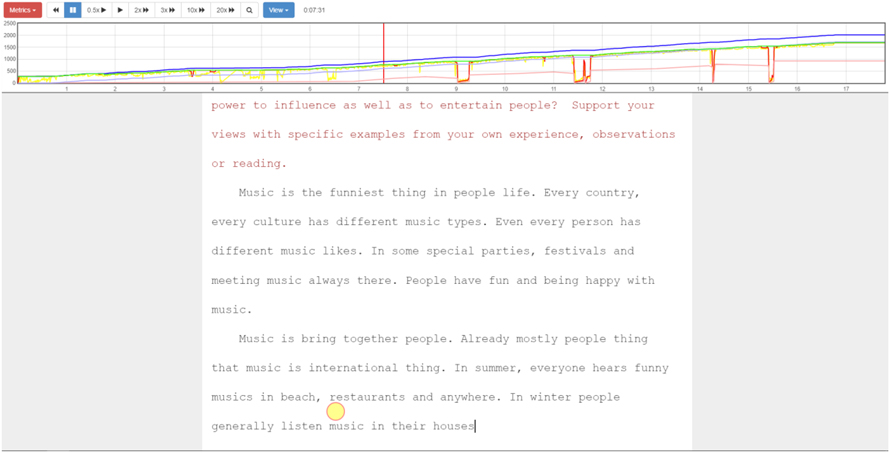
In the offline mode, the viewer also plots the entire writing session as a “process graph” similar to one that is plotted by InputLog (Leijten & Van Waes, Reference Leijten and Van Waes2013), but different in that the graph is dynamically linked to the animated playback. The current position on the playback timeline is indicated by a movable playhead in the graph. The playback of any desired fragment of the writing session can be immediately viewed by clicking on the corresponding area in the graph. This idea was borrowed from the user interface of many audio editors, where the entire timeline of an audio file is shown as a waveform or a spectrogram, and clicking on a point in that timeline allows the user to quickly jump to the corresponding time point in the file. In our case, the “process graph” of a writing session takes place of the waveform visualization of audio (Figure 1).
Process graph visualization.
The graph plots the current length of text, the total number of characters produced so far including those that have been subsequently deleted, the current location of the cursor, the location within the text of the character that is currently displayed in the top-left corner of the viewport, and the position of the eye fixation. All in-text locations are represented as character-wise offsets from the beginning of the text (the y axis) changing over time that elapsed since the beginning of the writing session (the x axis, in minutes). In the playback, the current eye fixation is marked by a yellow circle.
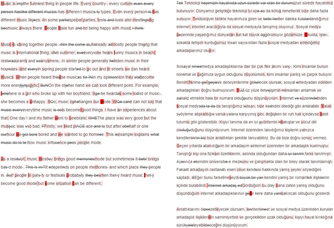
Another visualization generated by CyWrite that is useful for exploring the pausing behavior is shown in Figure 2.
Pause analysis visualization of texts produced by the same participant in L2 (English) and L1 (Turkish).
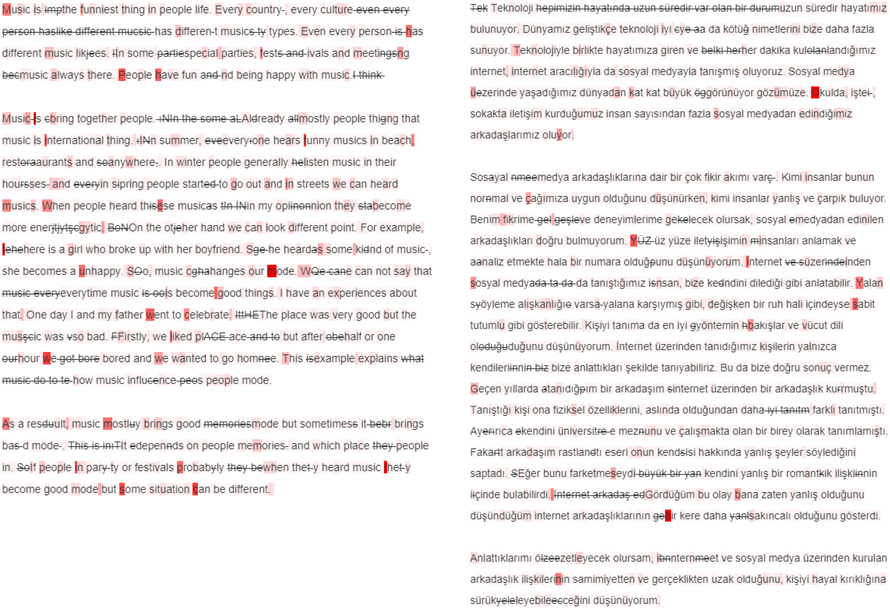
In the pause analysis visualization, the intensity of the shade corresponds to the duration of the IKI that occurred before producing the shaded character: the darker the color, the longer the IKI.
As is evident from Figure 2, longer IKIs are more prevalent in L2 writing than in L1. The patterning of IKIs is also different across languages: longer IKIs tend to occur at the beginning of sentences and clauses (or around revisions that are indicated with strikethrough text) in L1, while in L2 they appear more frequently in mid-sentence locations. These observations provide some tentative and qualitative insights into the differences between L1 and L2 production.
QUANTITATIVE ANALYSES
To permit automated quantitative analyses of keystroke and eye-fixation data, the server code, when running in the offline mode, provides interfaces for controlling the replay of the logged data programmatically. This allows the programmer to supply a callback function that will be called each time a log entry is processed or the editor-state information is updated. An analysis program (script) can then be written to output datasets in arbitrary formats based on what is required for further analyses. The analysis script has programmatic access to both the log entries (i.e., the operations being replayed) and the resultant states of the editor.
COMPARING WRITING PROCESSES IN L1 (TURKISH) AND L2 (ENGLISH) IN UNIVERSITY-LEVEL WRITERS
To illustrate the use of the combined eye-tracking and keystroke logging methods that we have just described, we report an exploratory study in which we compared L1 (Turkish) and L2 (English) writing in adult English language learners. Our general aim in this study is to establish whether, as we suggested in our previous discussion, it is indeed possible to differentiate, in systematic and predictable ways, writing processes in L1 and L2 on the basis of output time-course as measured by IKIs and writers’ reading activity as captured by eye-tracking measures.
More specifically, we would expect that if L2 writers require more cognitive effort for syntactic planning, lexical retrieval, and orthographic production, then longer IKIs would occur at those points in the text where this processing is expected to occur, namely, at clause and word boundaries. While L1 writers can engage in message planning (i.e., thinking what to say next) in parallel with outputting the previous text segment, L2 writers are less likely to do so due to processing demands imposed by poorly automatized low-level language skills. Assuming that ideational planning happens at a sentence level, we would expect longer IKIs at sentence boundaries in L2.
If reading during writing serves to help the writer refresh in their memory the contents of what they have previously written, and lower L2 proficiency would reduce chances of parallel processing and increase chances of the writer forgetting what they have just said, then more reading activity would be expected when writers pause in L2 than when they do so in L1.
Therefore, the empirical study reported in this article was driven by the following two research questions:
RQ1: To what extent does students’ writing fluency in L1 (Turkish) and L2 (English) differ, as determined by length of IKIs at word, clause, and sentence boundaries?
RQ2: To what extent do students engage in reading activity when they write in L1 (Turkish) and L2 (English), as determined by eye-tracking measures?
PARTICIPANTS
Participants were 24 native speakers of Turkish (20 female) selected through convenience and volunteer sampling. They were all undergraduate students enrolled in three education majors at a private university in Turkey with English as the medium of instruction: 14 students majored in guidance and psychological counseling, 6 in English language education, and 4 in early childhood education. They were in different years of their undergraduate programs of study: 2 were in their first year, 17 in their second year, 4 in their third year, and 1 in their fourth year. The age of the participants ranged from 19 to 24 years.
INSTRUMENTS
Participants completed two writing tasks, one in Turkish (L1) and one in English (L2), with language and topic counterbalanced across participants. The prompts were adapted from the Test of English as a Foreign Language (TOEFL), a widely adopted high-stakes standardized test. Both prompts were translated into Turkish for the L1 writing condition.
Prompt 1: “Some people say that music not only entertains us but changes how we think and feel about ourselves. Do you think music has the power to influence as well to entertain people? Support your views with specific examples from your experience, observations or reading.”
Prompt 2: “Some people say that computer technology is a barrier to developing real friendships. To what extent do you agree or disagree with the statement? Support your views with specific examples from your experience, observations, or reading.”
DATA COLLECTION PROCEDURES
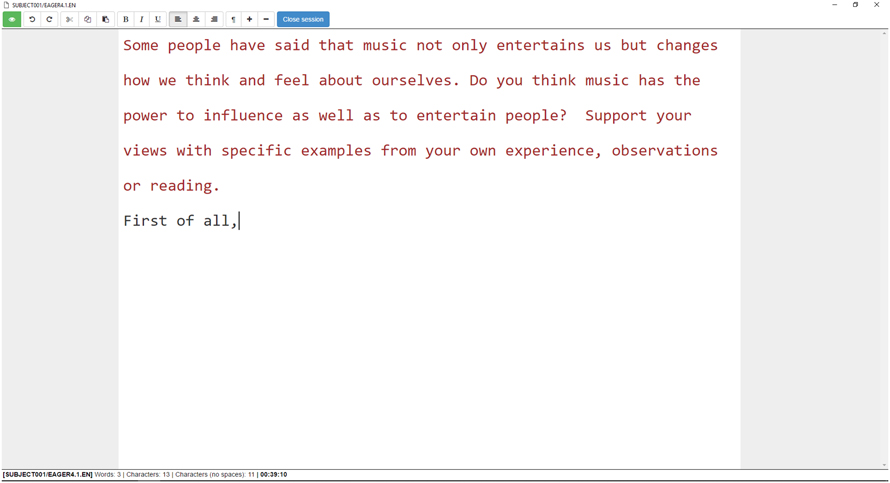
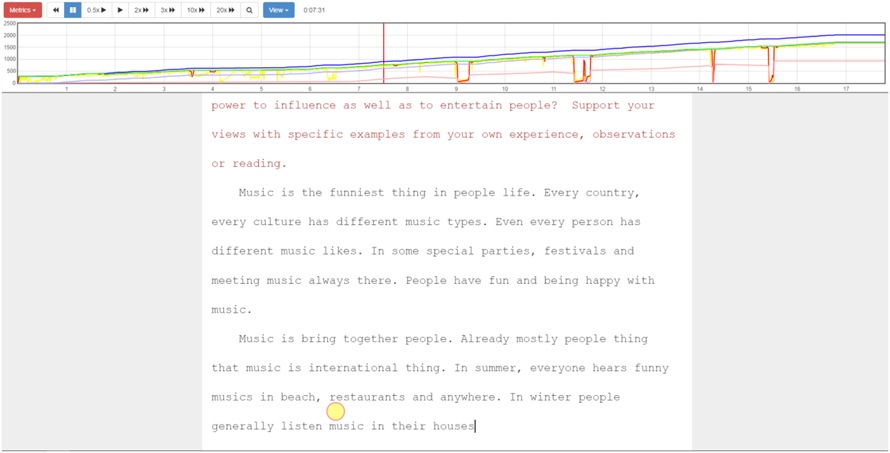
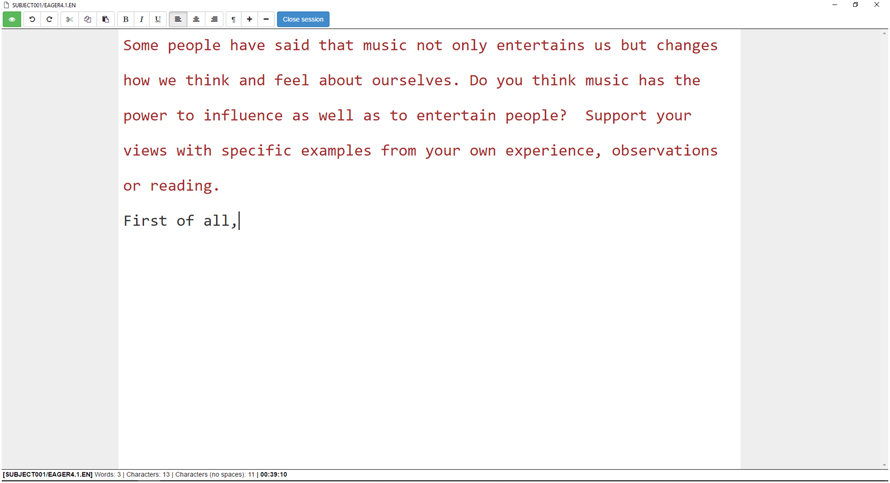
After completing the informed consent process, participants were seated in front of a computer (Lenovo Ideapad 100 with an external USB keyboard and an external Dell SE2216H 21.5-inch monitor screen set to the resolution of 1920 × 1080). A 60 Hz version of the GazePoint GP3 eye-tracking device was mounted on a standard tripod below the external monitor screen. First, the eye-tracker was calibrated, which involved participants looking at a moving target displayed on the screen (a nine-point calibration pattern was used similar to the standard one provided by the GazePoint software, but modified to randomly rearrange the sequence of fixation points and thus prevent participants from anticipating the movement of the target). After the calibration, students composed the two essays. The prompt was placed at the top of the editable file. The paragraph containing the prompt was specially marked to permit separate tracking and analysis of cursor movements and eye fixations within that paragraph. The editor was configured to use the fixed-width Consolas font (font size 35 pixels, with interlinear spacing increased by 26 pixels). A screenshot of the interface is presented in Figure 3.
Screenshot of the CyWrite interface.
Participants were given a maximum of 40 minutes to compose each essay, but they were free to finish writing earlier if they were satisfied with their text. They received a monetary compensation for taking part in the study.
DATA ANALYSES
Analysis of Log Files
An analysis script was developed to generate two types of output: (a) a tabular file describing each character that was added to the text, including those that remained in the final version of the text and those that were removed at some point in the composition process, and (b) a plain-text version of the final text produced in the editing session. Each character in the text was labeled with a unique identifier that allowed for easy automatic mapping between the two types of output.
The first type of output included variables that described the character produced, the duration of the IKI immediately preceding the production of this character, and eye fixations that occurred during this IKI. When multiple keys had to be pressed to produce a single character (e.g., the Shift key pressed first, followed by a letter key to produce a capital letter), the IKIs were measured to the initial keypress in the sequence (i.e., the Shift key in the example given).
For present purposes, we report analysis of disfluencies that involved the writer pausing but did not then involve revision of the text to, for example, correct an error. Thus, this first type of the output was filtered to eliminate all keystrokes that were used for moving the cursor around in the text and for deleting characters. We also excluded from analysis character keypresses that occurred immediately after the cursor was moved or after one or more characters were deleted.
In the second type of output, clauses and orthographic sentences were annotated. Clause boundaries were annotated manually. The beginning of each clause was marked in the text file with an opening bracket, and the end of each clause was marked with a corresponding closing bracket. Square brackets were used for finite clauses (i.e., those where the main verb is marked for mood or modality), and curly brackets were used for nonfinite clauses (i.e., those that do not show mood or modality, such as infinitive and participle clauses in English). Embedded clauses were marked as being part of the matrix clauses (e.g., “[The house [that Jack built] was destroyed.]”). In those instances where two clauses were connected by a coordinating conjunction, such conjunction was deemed, by convention, part of the clause immediately following the conjunction. When a dependent clause was introduced by a subordinator, such subordinator was included in the dependent clause. Similarly, when one subordinator introduced multiple dependent clauses, joined in turn by coordinating conjunctions, the subordinator was marked as part of the first dependent clause it immediately preceded, and coordinating conjunctions were marked as parts of the dependent clauses they immediately preceded. Prepositions preceding nonfinite dependent clauses (with the latter acting as the objects of such prepositions), however, were not considered part of such clauses but rather deemed part of the matrix clause. When sentence-level punctuation was at odds with syntactic constituency, constituency information prevailed in annotation. When a grammatical error precluded annotation, the minimal and simplest edits that would make the sentence grammatically acceptable were considered, and clause boundaries were marked based on such potential edits (without applying any edits to the text).
Independently from clause-level annotations, texts were split into orthographic sentences using the Natural Language Toolkit sentence tokenizers for English and Turkish (Perkins, Reference Perkins2010). Sentence splitting then was manually corrected. All conflicts between sentence splitting and clause annotation (i.e., when an orthographic sentence did not begin with an independent clause) were manually resolved, and the few instances that were not resolvable due to syntactic irregularities of the text were marked as ambiguous and excluded from further analysis.
Linguistic annotations were mapped onto IKI data to label each IKI with a factor variable describing the linguistic location of the character produced immediately after the IKI. The levels of the location factor were defined as follows: “within-word” for IKIs that occurred between the typing of two-word characters; “word-initial” for those after typing the space and before the first letter of a word that did not start a new clause; “non-finite-clause-initial” for the beginning of a nonfinite clause that did not start a new sentence; “finite-clause-initial” for the beginning of a finite clause that did not start a new sentence; and “sentence-initial” for the beginning of a new orthographic sentence. As discussed previously, we assume that an IKI at a particular location is associated, in part, with the cognitive activity of planning the linguistic unit that follows. This, for example, would predict longer “word-initial” IKIs than “within-word” IKIs.
Next, log files were used to determine the position of eye fixations in the text relative to the current point of inscription (i.e., the location of the cursor) at the time of fixation onset. Three eye-tracking measures were derived: probability of looking back, mean character-wise lookback distance, and lookback distance in terms of the types of linguistic units fixated. For all three measures, only fixations on the text five or more characters behind the cursor were included to eliminate fixations on the cursor (i.e., to exclude the monitoring behavior while typing and only retain fixations that represent looking back at the text produced so far). Off-screen fixations, fixations on the writing prompt, and fixations on user-interface elements other than the writer’s own text were excluded. For each character of the text, we identified all eye fixations that began during the IKI immediately preceding the production of this character. Mean character-wise lookback distance then was measured for each IKI as the mean number of characters in the text between the points of fixation and the point of inscription, counted in the version of the text that existed at the time of fixation onset.
Character-wise lookback distance, however, does not account for the distribution of the linguistic structures in the text: a fixation that is a certain number of characters behind the cursor can be both linguistically close to the point of inscription (e.g., within the same clause) and linguistically remote (e.g., in a different sentence). To account for linguistic structures, each fixation was automatically coded with one of the following four labels: “same-clause” if the point of fixation and the point of inscription belonged to the same clause; “crossing-clause” if the fixation was on a character in a different subordinate clause yet within the same matrix clause as the point of inscription; “different-clause” if the fixation was on a character within a different matrix clause than the point of inscription, but still within the same orthographic sentence; and “different-sentence” if the fixation was on a character within a different orthographic sentence than the point of inscription. Whenever coding was ambiguous (e.g., if the space character between two clauses was fixated), by convention the code representing the shortest linguistic distance was preferred (e.g., “different-clause” over “different-sentence”).
Statistical Analyses
Our analyses were based on fitting linear mixed-effects regression (MER) models to predict dependent variables related to pausing and reading behaviors based on the two factors described in the preceding text: Location (with levels corresponding to the linguistic location of the IKI based on the linguistic unit that immediately follows) and Language (L1 vs. L2). Specifically, for each dependent variable of interest, four nested MER models were fit to the data: M0, an intercept-only model; M1, a model adding a fixed effect for Location; M2, a model adding a fixed main effect for Language; and M3, a model adding an interaction between Language and Location. All models included random by-subject intercepts and random slopes for Language and Location. Gains in goodness of fit of successive models were evaluated by chi-square change. Fixed-effect parameters of the full model were used to estimate means of the dependent variables at different levels of Language and Location. Wald estimates of the confidence intervals (CIs) for means were then derived from the model.
RESULTS
IKIS AT LINGUISTICALLY RELEVANT LOCATIONS
The distribution of IKIs showed a strong negative skew typical for response time data. We therefore trimmed the data to remove IKIs longer than 8 s (0.14% of IKIs), and then log-transformed the remaining values prior to inferential testing.
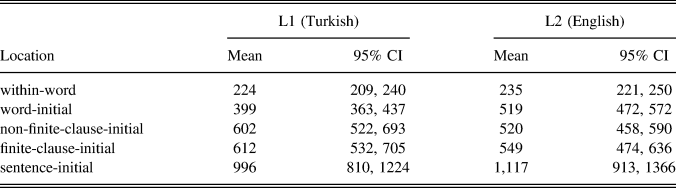
Each consecutive model, of the four nested MER models, resulted in a significantly better fit to the data than the previous one: M1, χ 2(4) = 59.3, p < .001; M2, χ 2(1) = 16, p < .001; M3, χ 2(4) = 247, p < .001. Table 1 gives estimated mean IKIs and 95% CIs derived from this model.
Estimated inter-keystroke intervals, in milliseconds, by Language and Location within the text, and 95% CIs

Participants typed more slowly when they composed text in English than when they did it in Turkish, except at clause boundaries. Their mean within-word IKIs, however, were longer by just 11 ms. When writing in their L1, participants were slower at the beginnings of words than within words, slower at the beginnings of clauses than at the beginnings of words, and slower at the beginnings of sentences than at the beginning of non-sentence-initial clauses.
The improved fit of the nested models allows us to infer that patterns of participants’ pausing behavior differed significantly between the two languages. Contrary to what was predicted by Language alone, at the beginning of nonfinite clauses participants were 82 ms faster, and at the beginning of finite clauses they were 63 ms faster. However, for words that were not at the start of clauses, initial IKIs were slower by 121 ms in English.
EYE FIXATIONS
Fixation Probabilities
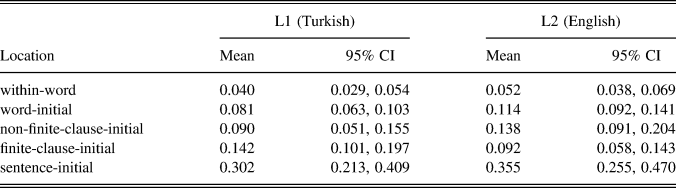
Mixed-effects logistic regression models were fit to predict the probability of one or more lookback fixations occurring during an IKI. Four nested models were evaluated, starting with an intercept-only model (M0) and then adding the fixed effects. Each consecutive model resulted in a significantly better fit: M1, χ 2(4) = 40.36, p < .001; M2, χ 2(1) = 5.46, p = .02; M3, χ 2(4) = 10.79, p = .03. Estimates derived from the full model (M3) are given in Table 2.
Probabilities of one or more lookback fixations during an inter-keystroke interval, by Language and Location, and 95% CIs
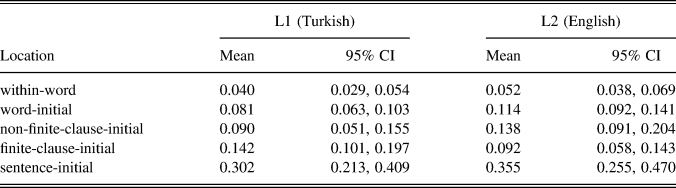
In L1, lookback fixations were more probable at the start of larger linguistic units, increasing almost eightfold from within-word locations to sentence-initial locations. Probabilities of looking back when writing in L2 were generally higher than in L1, except for locations at the start of embedded clauses: interestingly, the mean probability of looking back in L2 was higher at the start of a nonfinite clause than at the start of a finite clause, which is different from the pattern observed in L1.
Character-wise Lookback Distances
The distribution of mean lookback distances was negatively skewed, but approximated the normal distribution after log-transformation. The four nested MER models were fit to the data. M1 (the model adding a fixed effect for Location) resulted in a significantly better fit than M0 (the intercept-only model): χ 2(4) = 17.97, p = .001. However, adding the fixed effect of Language (M2) and the interaction of Language and Location (M3) did not provide a further improvement: χ 2(1) = 2.15, p = .14; χ 2(4) = 2.87, p = .58. This permits inferring that fixation behavior during IKIs, in terms of the character-wise distance of lookbacks, was similar in L1 and L2.
Estimated mean character-wise lookback distances (Table 3) during IKIs before subsentence units (i.e., at all locations except “sentence-initial”) were similar, with numerically close means and largely overlapping CIs. Before starting a new sentence, however, participants would look significantly farther back in their text.
Lookback distances (characters), by Language and Location, and 95% CIs

Linguistic Fixation Distances
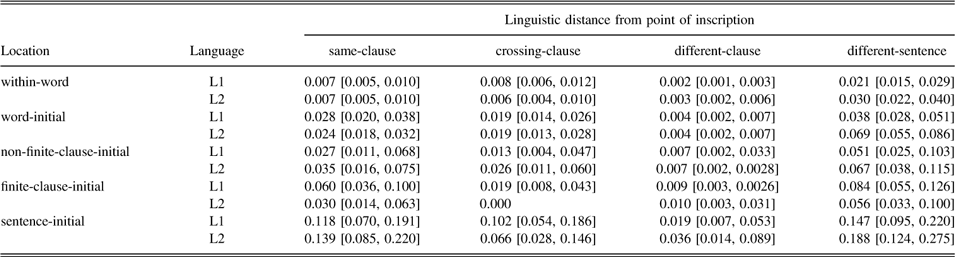
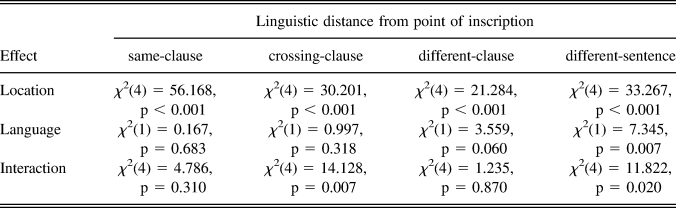
Next, we analyzed lookbacks in terms of their linguistic distances from the point of inscription. A separate series of nested mixed-effects logistic regression models was built for each type of linguistic distance (i.e., “same-clause,” “crossing-clause,” “different-clause,” “different-sentence”; see “Analysis of Log Files” for operationalizations) to predict probabilities of one or more fixations occurring during an IKI at this linguistic distance from the point of inscription. Within each series, every model added a fixed effect to the previous model, and improvement of model fit was evaluated. Estimated mean probabilities and the respective CIs are given in Table 4, and contributions of the fixed effects to the model fit are presented in Table 5.
Probabilities of fixations at a given linguistic distance from the point of inscription, by Language and Location, and 95% CIs (in brackets)

Contribution of fixed effects to the fit of models predicting probabilities of fixations at a given linguistic distance from the point of inscription

The probability of one or more fixations occurring on the text of the clause currently being composed (“within-clause” label) varied based on the Location of the point of inscription, but not based on Language. Specifically, fixation probabilities increased with the increasing hierarchical status of the linguistic unit of text that followed. For example, within-clause fixations were more likely to occur during word-initial IKIs than during within-word IKIs, and so forth. A similar pattern was evident for fixations on other clauses within the same sentence (“crossing-clause” and “different-clause” labels).
However, when it came to looking back at a previous sentence, participants’ behavior varied across languages with a significant main effect and interaction. For example, at the beginning of a mid-sentence word, participants were almost twice as likely to look back at a previous sentence when they wrote in L2 versus L1. Similar patterns (L2 > L1) were observed for all other locations except finite-clause-initial, where, interestingly, fixations on a different sentence were more likely in L1 than in L2.
DISCUSSION AND CONCLUSION
This article focused on describing and illustrating a method for scalable, distributed collection and automated analyses of L1 and L2 writing processes through deployable, low-cost, concurrent keystroke logging and eye-tracking. As demonstrated in the article, the method allows for the collection of data through a web application deployed at a remote site while using inexpensive eye-tracking hardware. Although inexpensive hardware has relatively low spatio-temporal resolution, statistical power can be boosted by the larger size of samples that can be collected in this manner. Writing-process data can be automatically triangulated with linguistic annotations of texts produced by participants. In the reported study, certain types of annotation were conducted manually, in part because manual annotation was necessary for a separate corpus-based project utilizing the same dataset. In principle, however, natural language processing tools can be used to perform such annotations automatically and in real time. This shows the potential for the method to be used in practical applications, such as automated writing evaluation and computer-assisted language learning.
The reported empirical study shed some light on the two research questions that we posed. Specifically, RQ1 asked to what extent students’ writing fluency would differ when writing in L1 (Turkish) and L2 (English). We predicted that IKIs at word, clause, and sentence boundaries would be longer in L2 than in L1. In fact, pausing behavior did differ significantly between L1 and L2: participants were generally slower, with longer IKIs, when writing in L2. This finding is consistent with previous research demonstrating that written production tends to be less fluent in L2 than in L1 (Schoonen et al., Reference Schoonen, Gelderen, Glopper, Hulstijn, Simis, Snellings and Stevenson2003; Van Waes & Leijten, Reference Van Waes and Leijten2015), and L2 writers tend to pause more at all linguistically-relevant locations (Spelman Miller, Reference Spelman Miller2000).
However, contrary to our prediction, at the beginning of non-sentence-initial clauses participants were significantly faster in L2 than in L1. Even though they spent less time planning the clause that they were about to produce, writers were subsequently less fluent in producing individual words within the clause, as evidenced by the increased word-initial IKIs. This is an interesting finding indicating that planning effort might be reallocated in L2 compared to L1: participants may be more thoroughly preplanning the structure of the clauses they are about to produce in L1 (hence longer clause-initial IKIs), while in L2 they may be “jumping” into outputting the clause before it has been sufficiently planned, and postponing some of the planning decisions until after part of the clause has already been output. This could be described as a shift in planning effort from clause-initial locations to within-clause locations.
This finding was incidental to the study reported in this article, and thus calls for more thorough investigation in a follow-up study. If this shift in planning effort is confirmed, it may have crucial practical implications as it may be signaling the redistribution of effort that may be potentially disruptive to the flow of text production: a writer who does not sufficiently plan ahead at clause boundaries but pauses at the beginning of words within the clause instead might be distracted from the ideas that are being expressed in the clause and thus might end up producing a lower-quality text. If this is the case, then interventions directly and strategically modifying the distribution of planning effort during L2 production might be warranted to minimize associated disfluencies.
RQ2 asked whether reading behavior would differ between L1 and L2. We predicted, specifically, that more reading activity would occur in the (less automatized) L2 than in the (more automatized) L1. Indeed, participants were found to look back more frequently during L2 production than they did during L1 production. Look-back fixations, however, would stay within the same mean distance (character-wise) from the point of inscription in both languages. Similarly, the probability of looking back within the current sentence did not differ between languages. However, participants were significantly more likely to look at a previous sentence when they composed in L2 than in L1. This was especially evident at the beginning of mid-sentence words: at these locations participants were almost twice as likely to look at a previous sentence in L2 than they were in L1. This finding calls for additional investigation in future work. If looking back at a previous sentence serves as a memory refresher (or as scaffolding for planning future content), it may be especially problematic from the practical standpoint: writers who not only pause longer mid-clause, but also use the pause time to look back at the previous sentence may thus be distracted from the idea package they are currently trying to express. This, again, may warrant interventions that explicitly modify behaviors that contribute to disfluencies in L2 writing.
The present results are interesting from both the theoretical and the applied standpoints. Theoretically, they shed light onto the differences between the cognitive processes that underlie written production in L1 and L2. Because each IKI is associated, in part, with planning the linguistic unit that follows, differences in IKI patterns indicate that the planning effort is distributed differently based on the language in which the text is being produced. Much of this planning, in either language, occurs at very short timescales (under 2 s) and may not, therefore, reach awareness in the writer (Torrance, Reference Torrance, MacArthur, Graham and Fitzgerald2015). The proposed method thus permits the detection of differences that might not be detectable using conventional verbal reporting protocols.
Practically, as was mentioned previously, explicit fluency-focused interventions may be warranted in L2 writing instruction. On the one hand, such interventions at this point may seem far-fetched because more research first needs to be done to understand what may be causing these shifts in pausing and reading behaviors in L2 text production. On the other hand, interventions based on compensatory L2 writing strategies that implicitly target writing fluency (e.g., using L1, to a different extent, for ideational planning) have already been proposed (Kim & Yoon, Reference Kim and Yoon2014; Wolfersberger, Reference Wolfersberger2003). It is important to note that existing interventions are blind to the actual writing process and thus have to infer disfluencies from indirect data. The deployability of combined eye-tracking and keystroke-logging technology being a central feature of the proposed method of data collection and analysis, new interventions may make direct use of the real-time writing-process data similar to those analyzed in the present article to provide for adaptive computer-assisted learning experiences that would otherwise be impossible even in principle.
This study is not without limitations. Specifically, the differences in orthographic depth (Durgunoğlu, Reference Durgunoğlu2006) and language typology (morphological and syntactic) between English and Turkish were not considered, only one type of writing prompt was used, and the sample size was smaller than what the technology could have afforded. The relatively low resolution of the eye-tracker should also be acknowledged as a limitation of the study. However, it is important to underline that the main purpose of this study was to illustrate the method and to demonstrate that it can provide potentially interesting data that would not be otherwise readily available. We believe that this purpose was satisfactorily achieved: this article serves to prepare the methodological ground necessary for subsequent investigation of writing processes in L1 and L2.