The Bantu languages stretch out from Cameroon in the west to southern Somalia in the east and as far as Southern Africa in the south.Footnote 1 This group of closely related languages is by far Africa's most widespread language group. Nevertheless, Bantu is commonly seen as one of the most recent offshoots of the largest African language family, Niger-Congo.Footnote 2 What, then, caused the Bantu languages to expand over the huge area they occupy today? This question constitutes a ‘major puzzle in the history of Africa’,Footnote 3 i.e. the ‘Bantu Expansion’ or the ‘Bantu Problem’.Footnote 4 Although the Bantu language expansion is primarily a linguistic issue, non-linguists have also tackled this conundrum. Historians, anthropologists and archaeologists have reformulated the problem in terms of societies: how does one explain the means by which a group of closely related speech communities came to populate a disproportionately large part of Africa? To answer this question, linguistic data have been associated with non-linguistic facts, notably remains of material culture, and archaeology has played an ever-increasing role in the linguistic paradigms that account for the Bantu language dispersal.Footnote 5 Archaeological evidence has been used to buttress linguistic theories, and, conversely, linguistic assumptions have helped to frame archaeological data into a historical narrative.
While historians initially held exclusive rights on brokering between the two sets of data, historical linguists and archaeologists have responded to each other's hypotheses, creating an interdisciplinary discourse on the topic of Bantu origins that relies heavily on the continuously changing and contested internal classifications of the Bantu languages.Footnote 6 Moreover, Bantu ‘genealogical’ trees are predominantly the result of lexicostatistics whose historical significance is restricted. Based on the comparison of a limited list of lexical items belonging to what is presumed to be a universal ‘core vocabulary’, this short-cut method can be useful for establishing tentative relationships between languages that lack the descriptions necessary for the more comprehensive historical-linguistic studies using the comparative method. Lexicostatistical classifications may, therefore, be supported by further comparative research, but should never be considered as definitive genealogical classifications, even if some scholars of early Bantu history have taken their ‘genetic’ status for granted.Footnote 7 Because of these limitations, Eggert is right in claiming that ‘it is hardly adequate to prematurely link, as has been so frequently done, archaeological finds and features with linguistic phenomena and to suggest possible routes for language diffusion of whatever nature’.Footnote 8 A linguist should not call upon ceramic tradition X to lend a historical status to subgroup Y for want of proper linguistic arguments. Similarly, an archaeologist should not advance the same subgroup Y as evidence for its assumption on ceramic tradition X, definitely not if this subgroup has been proposed solely on account of lexicostatistical data. Such ‘fachübergreifenden Klonung’ (‘interdisciplinary cloning’) is bound to lead to historical chimaeras, rather than to reliable insights into Africa's past.Footnote 9 Nevertheless, even if certain methodological anomalies from the past may advocate prudence in interdisciplinary exchanges, they should not be taken as a pretext for abolishing all forms of cross-border collaboration. From this angle, the present paper discusses how the diachronic study of cultural vocabularies may contribute to a judicious interdisciplinary approach to the ‘Bantu Problem’.
WORDS-AND-THINGS: FROM LEXICAL TO HISTORICAL RECONSTRUCTION
In addition to lexicostatistics, another development in the field of Bantu historical linguistics is the diachronic study of cultural vocabularies, also known as the Words-and-Things method. Although the method was a product of early twentieth-century Indo-European linguistics, it has only hesitantly gained ground amongst African linguists.Footnote 10 The method is founded on the basic idea that a community's culture is reflected in its language. The major domains of human activity have an appropriate vocabulary, which is historically significant when it is shared with other languages. Vocabulary shared between two languages is evidence of shared history. In essence, apart from coincidence and independent convergent evolutions, this shared vocabulary can basically have two distinct sources. One language may have borrowed a word from the other or both from a third language, or both languages may have inherited a word from a common ancestor language. In the case of lexical borrowing, one may presume contact between both speech communities or between each of the two communities and a third community. In the case of inheritance, the vocabulary in question may be reconstructed into their ancestral language, which is, due to the lack of written records, generally a hypothetical proto-language in the Bantu context.Footnote 11 A term can be traced back to Proto-Bantu if it has a significant distribution among the different Bantu subgroups, or to a regional proto-language like Proto-East-Bantu if the term's distribution is limited to East-Bantu. Most historical linguists agree that ‘a reconstructed proto-language can be, at best, an approximation to what the putative unique ancestor of a given language family may have been like’.Footnote 12 Nonetheless, the reconstruction of vocabulary in a proto-language allows one to hypothesize about the culture of its speakers. Although the method's principles are simple, a rigorous linguistic approach is still indispensable for reliable conclusions.
In the domain of Bantu studies, historians were the first to apply the Words-and-Things method to reconstructing history. Following the pioneering work of Christopher Ehret, a school of ‘linguistic historians’ has relied heavily on Words-and-Things principles to reconstruct the early history of different Bantu-speaking regions.Footnote 13 In contrast to ‘historical linguists’, who primarily analyse and compare languages to reconstruct the history of languages, ‘linguistic historians’ use language essentially ‘to reconstruct the human past’ and ‘they see the classification of languages not as an end in itself, but rather as the first step towards the reconstruction of broader and encompassing human histories’.Footnote 14 Consequently, the historian's analysis of linguistic data tends to be more superficial and does not always follow what linguists consider as their code of practice. A concrete example of this situation is Jan Vansina's recent claim that the speakers of Proto-Njila, the latest common ancestor language of the South-West-Bantu languages, were potters.Footnote 15 Although the claim is probably not false, the lexical evidence on which it is based is shaky and partial. Vansina's claim is based on attestations of the verb *-b  mb- (to make pottery), which Malcolm Guthrie detected in these languages.Footnote 16 In a footnote, Vansina cites the noun omumi (potter) from the Angolan language Nyaneka as supplementary evidence. However, historical linguistic analysis of this noun reveals that it cannot derive from *-b mb-, but is a reflex of the verb *-mà (to make pottery).Footnote 17 Since his basic interpretation of this lexical evidence was faulty, Vansina did not consider the broader distribution of the verb root *-mà in the South-West-Bantu languages. Furthermore, systematic data collection reveals that it is also attested in other languages of the same group, a fact that has considerable historical implications. It is obvious that such inconsistencies may weaken the soundness of the historical assumptions built on language data.Footnote 18 However, the amount of lexical data covered by ‘linguistic historians’ is often so vast as to make close scrutiny of all their lexical evidence quasi- impossible. As a result, the historical validity of their conclusions is difficult to assess. Even working out a single set of reflexes for two roots involves massive amounts of individual comparisons of words and meanings.
The example from Vansina's recent study demonstrates several possible pitfalls of using the Words-and-Things method for the reconstruction of early history. First, in order to achieve reliable results, data must be collected from as many languages as possible, rather than relying on apparently representative sets of languages, as found in existing Bantu lexical reconstruction databases.Footnote 19 Thorough data collection helps to ensure more accurate mapping of a word's distribution. Secondly, the major comparative series for each of the semantic fields concerned must be defined.Footnote 20 Thirdly, a sound diachronic phonological analysis of each comparative series, according to the principles of the comparative method, is necessary to distinguish real from apparent reflexes and inherited from borrowed reflexes.Footnote 21 Fourthly, a diachronic semantic analysis of each comparative series allows one to identify possible semantic innovations. As this paper will demonstrate, neglecting such semantic shifts may have significant implications for the historiography at stake. Finally, even if one focuses on the comparative vocabulary of one particular region, one cannot lose sight of the entire Bantu domain, or even data beyond Bantu. This information is necessary to assess the chronological depth of the vocabulary concerned and to avoid what I call ‘historical myopia’.
COMPARATIVE BANTU POTTERY VOCABULARY
The invention of pottery is a highly significant cultural phenomenon in human history. Although the role of early ceramics in different areas of the world is still a matter of debate, the emergence of pottery in a culture has often been linked with important changes in lifestyle, such as sedentary living and the emergence of food production. Although pottery may have had different functions in different communities, and at distinct times in the same communities, it obviously had, and still has, a major impact on people's lives. Ceramics have not only assumed a utilitarian role, for instance in the preparation and storage of food and beverages, but clay pots and figurines have also served ritual and medical purposes.Footnote 22 In sub-Saharan Africa pottery is invested with great symbolic importance. The craft is surrounded with rituals and prohibitions and several steps in the production sequence serve as a metaphor for interpreting and acting upon certain facets of human experience. People make metaphoric use of pottery vocabulary to refer to transformations from wet to dry, soft to hard, raw to cooked, natural to cultural and impure to pure through the operation of heat. This vocabulary is also used to mark isolation and destruction, to designate bodily cavities or to discuss concepts like spirit, conception and essence.Footnote 23 Moreover, ‘potting traditions are “sociotechnical aggregates”, an intricate mix of inventions, borrowed elements, and manipulations that display an amazing propensity to redefinition by individuals and local groups’.Footnote 24 A potter's technical behaviour thus leaves room for choices along both functional and social or symbolic lines, creating multifaceted associations between technological styles and social identity.
Because pottery making continues to be practised throughout Africa, its manufacturing process, well-described in ethnographic literature, has also become a key topic in ethno-archaeology. In addition, ceramics are archaeologists' principal data source in Africa, at least for Ceramic Later Stone Age (CLSA) and Iron Age (IA) assemblages, because of their survival in poor conservation contexts. As part of their analysis, archaeologists classify pottery into related traditions ‘to situate cultures in time and in space, and to reconstruct not only exchange networks of goods and peoples, production and consumption patterns, and sociopolitical structures, but also more recently, thought systems’.Footnote 25 This high archaeological visibility and ethnographic prominence, combined with a high linguistic prominence, makes pottery a particularly attractive subject for interdisciplinary research.
Particular ceramic traditions and Bantu language subgroups have often been associated with each other.Footnote 26 The absence of a systematic comparative study of Bantu pottery vocabulary, however, led to the present work, which relies on a lexical database of more than 5,800 pottery-related terms from about 400 different Bantu languages.Footnote 27 The vocabulary was subdivided into five main categories: (a) verbs meaning ‘to make pottery’, (b) nouns designating ‘potter’, (c) nouns for raw materials like pottery clay and grog, (d) nouns for different types of pots, and (e) nouns and verbs referring to the different gestures and implements of the ‘chaîne opératoire’ or production sequence.Footnote 28 The extensive vocabulary included in this database made it possible to map accurately the current distribution of lexical items, retrace historically crucial semantic shifts, reconstruct pottery vocabulary to different stages of chronological depth and reconstitute the lexical diffusion networks of different geographic areas.
HISTORICAL POTENTIAL OF COMPARATIVE POTTERY VOCABULARY
Although the diachronic study of early Bantu pottery vocabulary may contribute to our knowledge of the early history of pottery in the Bantu area, the historical conclusions drawn from these lexical data are valuable, but limited. In this paper, I will illustrate these potentialities and limitations through the analysis of one crucial category of pottery vocabulary: verbs referring to the fabrication of pottery.
The semantic field related to pot-making in Bantu languages is organized around the generic verbs meaning ‘to make pottery’. Insofar as the manufacture of clay pots is still a regular activity, most Bantu-speaking communities have such a generic verb. The semantic ranges of these verbs are so general that to a large extent they stand for the craft as a whole. They not only refer to the act of shaping pots as such, but also serve as roots from which nouns and other verbs are derived. Such derivatives refer to the potter, the potter's clay, particular types of pots, potters' tools and certain gestures of the manufacturing process. In Tetela (Inner Congo Basin, Democratic Republic of Congo [DRC]), the verb -kenga refers to the making of pots, while the derived nouns onkengi and lokenga designate the potter and a type of clay pot, respectively.Footnote 29 In Rundi (Burundi's national language), different pottery-related nouns and verbs are derived from kubÛmba (to make pottery), i.e. kubumbabumba (to knead the clay), kubumbagira (to rough out the mould of a pot), umubÛmvyi (potter), ibǔmba (potter's clay), umubǔmbwa (a clay pot or utensil), and ikibumbuzo (a board for beating the bottom of a pot until it is even).Footnote 30 Cross-linguistically, the most widespread derivations of these generic verbs are the nouns for ‘potter’ and ‘potter's clay’.
Interestingly, these common Bantu verbs meaning ‘to make pottery’ are very restricted in number. Among the Bantu languages, only four verbs are sufficiently recurrent to reconstruct them beyond a purely local level, i.e. *-mà- in the northwestern and some extreme southwestern languages, *-b mb- in the eastern and certain southwestern languages, *-gìng- in the Inner Congo Basin Bantu languages and *-màt- in the Lake Corridor languages, as illustrated in Map 1.Footnote 31 This small number suggests that these verbs are only very rarely replaced. Given their significant degree of preservation, one may presume that their eventual substitution must be the result of an important historical disruption. Consequently, they constitute the lexical category par excellence to bring to light certain aspects of early pot-making history in the Bantu domain. However, two factors hamper the historical potential of these verbs.
Distribution of the main Bantu verbs meaning ‘to make pottery’.
First of all, the semantic range of each of the verbs is quite general, which may partially explain why they are so rarely replaced. From an ethno-archaeological point of view, it is interesting to note that no link exists between a community's verb for shaping pottery and the precise manner in which their pots are made. Although the shaping technique constitutes the quintessence of the manufacturing process, it does not determine the choice of the corresponding verb. Two speech communities with the same manufacturing technique may use different verbs. Both the Beti-Fang in Cameroon and the Haya in Tanzania, for instance, are reported to apply the coiling technique, but they use the verbs *-mà- and -b mb-, respectively.Footnote 32 Alternatively, the same verb may be used in two communities having a different technique. Both the Copi of southern Mozambique and the Nande of DRC, for example, have the verb *-b mb-, but the former apply the drawing-of-a-lump technique, and the latter the coiling technique.Footnote 35 Therefore, these recurrent verbs cannot reveal historical details on the evolution of pot-shaping techniques within the Bantu area. This dissociation should warn against hasty correlations between the archaeological and comparative linguistic records. As a result, pottery production techniques shared by different Bantu speech communities rarely match with shared vocabulary.
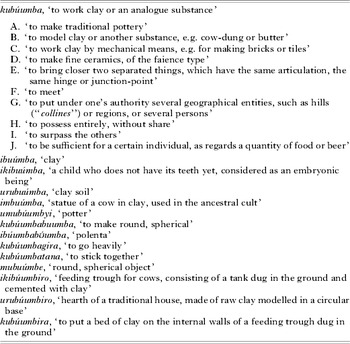
Secondly, the semantic scope of generic verbs is often more general than ‘to make pottery’. Although dictionaries and certainly ethnographic sources tend to focus on this particular meaning, in many languages it is only one meaning among several others. The multifaceted semantic field of the verb kub umba and its derived nouns and verbs in the Kinyarwanda language illustrate this point well.Footnote 36
The semantic range of the verb kubúumba and some of its derivatives in Rwanda.

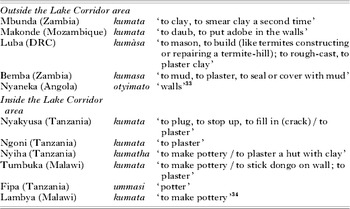
This diversity of meanings of the verb *-b mb- is found throughout Bantu languages, though seldom so condensed in one language as is the case with Kinyarwanda. Cross-linguistically, the sense ‘to make pottery’ can at best be considered as a very prominent specialization of a fundamental meaning that is still more comprehensive. Although the semantic multiplicity of *-b mb- is unequalled, a wide range of different meanings applies for the other generic verbs as well. Interestingly, most of them manifest a particularly intimate link with the use of clay for building purposes. The above-mentioned verb *-màt-, for example, which means ‘to make pottery’ in the Lake Corridor languages, refers to the smearing of clay, more particularly to the plastering of mud walls, in other Bantu languages, as seen in the examples in Table 2.
Reflexes of the verb *-màt-inside and outside the Lake Corridor area
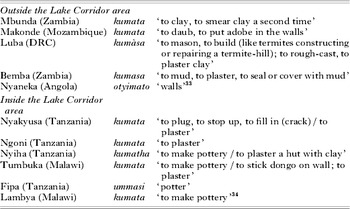
Even in certain Lake Corridor languages, the meaning ‘to smear clay, to plaster’ is still attested, sometimes in co-existence with ‘to make pottery’. These definitions suggest that the latter meaning is the result of a semantic innovation characteristic of this particular language group. Consequently, the association of the four common Bantu verbs with pot-making may be the result of a semantic shift from ‘building with clay’ to ‘building clay pots’.Footnote 37 As I will argue further on, this is especially the case for the verb *-b mb-.
GENERIC POTTERY VERBS REPRESENTING DISTINCT HISTORICAL STRATA
Despite the previously mentioned limitations, generic verbs for pot-making are historically significant. Their importance derives not only from the fact that people do not change them easily, but also from their actual distribution in the Bantu languages. Apart from the comparative method and diachronic semantics, a third important auxiliary approach of the Words-and-Things method is linguistic geography. The geographical distribution of present-day lexical items constitutes one basis of historical interpretation, because spatial distribution is interpreted as a function of time. When studying the different Bantu terms for a certain concept, true cognates are first identified by means of the comparative method and then mapped on linguistic charts. The terms with the larger distribution are generally considered older than the ones with a more limited distribution. ‘Large’ and ‘limited’ should not be interpreted purely in terms of quantity, however, but rather vis-à-vis a term's spread in the different Bantu subgroups. In this respect, a term that is rare but scattered amongst the North-West and East-Bantu languages, for example, will be judged as older than a term having a very dense distribution restricted to the West-Bantu languages. These terms are cross-language synonyms, so the more local (=more recent) terms can be interpreted as innovations replacing the more widespread (=older) terms. Thus, different recurrent terms for the same semantic notion represent distinct historical strata. The oldest stratum emanates from Proto-Bantu, while younger strata go back to subsequent phases of Bantu language divergence. The remainder of this paper will focus on the oldest pottery-related lexical strata.Footnote 38
PROTO-BANTU POTTERY VOCABULARY: CONTINUATION OF AN INHERITED TRADITION
The reconstruction of a Proto-Bantu verb meaning ‘to make pottery’ is more complicated than one would presume, considering the unanimity amongst scholars who, following Guthrie, consider the verb *-b mb- as lexical evidence for the fact that ‘pot-making was a regular activity of the speakers of PB-X’.Footnote 39 As can be seen on Map 1, this verb is indeed the most common in the Bantu domain. However, the same map shows that this verb only means ‘to make pottery’ in most Eastern and certain South-West-Bantu languages. It is completely absent from the North-West-Bantu languages of Cameroon and Gabon, from the northeastern DRC Bantu languages, also known as Boan and Lebonya, and from the Forest Bantu languages of the Central Congo Basin, at least with the meaning ‘to make pottery’.Footnote 40 The verb occurs as a term in certain of these languages, but with different meanings, such as ‘to plaster (mud) walls’, ‘to roughcast’, ‘to make a hillock (as on tomb)’ and ‘to apply cob’. The historical-linguistic implications of this semantic variation for *-b mb- cannot be underestimated.
The North-West languages are spoken in an area adjacent to the Bantu homeland and constitute a primary subdivision. The historical status of the poorly documented Bantu languages of the Uele region is far less established, but they possibly form a primary Bantu branch too. The Central Forest Bantu languages do not constitute a main subdivision, but they flank the North-West languages and are one of the main West-Bantu subgroups.Footnote 41 In other words, *-b mb- does not refer to pottery in several of the principal Bantu subdivisions. Moreover, though predominant, ‘to make pottery’ is only one of the many senses of the verb in the Eastern and South-West-Bantu languages, as the above-cited Rwanda example illustrates. Therefore, the semantic range of *-b mb- is much larger than Guthrie supposed and probably did not specifically refer to pot-making in Proto-Bantu. The specialized meaning ‘to make pottery’ is the result of a subsequent semantic shift.
In sum, the verb *-b mb- can be reconstructed in Proto-Bantu, since the phonological form has a wide distribution among present-day Bantu languages. Nevertheless, it constitutes shaky lexical evidence for the hypothesis that pottery was produced at the historical depth of Proto-Bantu because the known distribution of the meaning ‘to make pottery’ with the form *-b mb- is not attested across the main Bantu subgroups.
More solid evidence for this hypothesis is provided by a verb that has never been reconstructed before in Bantu, i.e. *-mà-. As can be seen on Map 1, this is because it has left fewer traces amongst present-day languages than *-b mb-. The verb has only been documented in some twenty exclusively West-Bantu languages. However, it always has the meaning ‘to make pottery’. Moreover, it occurs in several historically significant subgroups and is present in at least one of the subgroups that lacks *-b mb- (to make pottery), i.e. in the North-West languages. Most of its reflexes occur in this part of the Bantu domain. It may also occur in the Uele Bantu languages, but the scarcity of language data for this area prevents us from conclusively establishing them as *-mà- reflexes, and the term is absent in the Central Forest Bantu languages, where *-gìng- is the main verb.Footnote 42 Remarkably, reflexes have also been detected in some languages from Southern Angola and Northern Namibia, e.g. Khumbi, Ndonga and Kwanyama that belong to the South-West subgroup of West-Bantu. Thus, despite its numerically weak representation, *-mà- is dispersed among at least as many main Bantu subdivisions as *-b mb-. This scattered distribution is typical of an old term, while the continuous distribution pattern of *-b mb- is characteristic of a more recently spread term.
Nonetheless, the presence of *-mà- in the western part of the Bantu domain is less scattered than one may suppose at first sight. The most common name for potter's clay in this area is a noun historically derived from this verb, i.e. *-mà. It covers both the West-Coastal and South-West-Bantu languages. Surprisingly, reflexes of the verb *-mà- and the noun *-mà rarely co-occur in one and the same language. Together, however, they occupy the better part of the West-Bantu domain. What is more, *-mà- is attested with the sense ‘to make pottery’ in non-Bantu Benue-Congo languages, and even in Niger-Congo languages beyond Benue-Congo.Footnote 43 This distribution means that the application of *-mà- to pot-making largely predates Proto-Bantu and the expansion of its daughter languages. This verb root can be reconstructed in Proto-Bantu, from which the West-Bantu languages inherited it. Given its wide distribution beyond Bantu, however, it cannot be seen as a Bantu innovation. Proto-Bantu itself inherited it from an ancestor language. Although a more detailed study of non-Bantu data is needed, this verb presumably goes back to Proto-Benue-Congo, and perhaps even earlier. Thus, in terms of cultural history, *-mà- is better lexical evidence than *-b mb- to establish that pot-making was a regular activity in the Proto-Bantu era.Footnote 44 Moreover, it also suggests that Proto-Bantu-speakers certainly did not invent pottery. The linguistic data indicate that ancestors of Proto-Bantu-speakers had practised the craft long before.
EARLIEST POTTERY VOCABULARY AND EARLIEST CERAMICS IN THE BANTU DOMAIN
Language data suggesting that Proto-Bantu-speakers elaborated upon an inherited pot-making tradition is supported by archaeological data. The earliest sub-Saharan African ceramics are situated far to the north of the Bantu homeland. The so-called ‘wavy-line pottery’ and ‘dotted wavy line pottery’, uncovered in different sites of the southern Sahara, e.g. in northern NigerFootnote 45 and central Sudan,Footnote 46 are believed to be a local invention from as early as 9,500 years ago.Footnote 47 The linguistic affiliation of these early potters is far from established. Slightly more recent ceramics discovered across West Africa were probably produced in a Niger-Congo language context. These ceramics were found in the Sahel at sites such as Ounjougou and Kourounkorokalé in Mali,Footnote 48 Konduga in Northern Nigeria,Footnote 49 and in the Guinean Gulf in sites such as Iwo Eleru in the Ivory Coast,Footnote 50 Dutsen Kongba in Nigeria,Footnote 51 and Kintampo 6Footnote 52 and BosumpraFootnote 53 in Ghana. The decoration of all these ceramics, i.e. comb and stick impression and grooving,Footnote 54 is similar to their Saharan counterparts. Philippe Lavachery argues that ‘[t]his strongly suggests that, between 8000 and 6000 bp, the technology of pottery slowly moved southward after its appearance in the Sahara. Potsherds from the Shum Laka rock shelter in northwestern Cameroon, while being the southernmost examples among these, fit quite well in the overall picture’.Footnote 55 These ceramics certainly date back to 4000 bp,Footnote 56 but their emergence could be older.Footnote 57 Not only were they uncovered in the Bantu homeland, but according to the currently available data, they are also the earliest ceramics found in the Bantu speaking area. As such, they constitute a bridge between the older Guinean Gulf potteries and the more recent ones, which emerged further south in the Equatorial West-Bantu area.
Lavachery sees a significant link between the technological diffusion of pottery in western Africa and the serious climatic deterioration that occurred around 7100-6900 bp in the Sahara and the Sahel.Footnote 58 This dessication may have forced Sahelian groups to move southwards into West Africa, for instance into the Guinean Gulf, and more particularly into the Grassfields where the climate was favourable to forest extension.Footnote 59 The result was a kind of cultural symbiosis, whereby local microlithic Late Stone Age (LSA) traditions mixed with new Stone to Metal Age (SMA) technologies with macrolithic tools, polishing and pottery. Traces of the new practices turn up in the archaeological record beginning in 7000-6000 bp, but they only become predominant from 5000 to 4000 bp onwards.Footnote 60 This chronology suggests that pottery, like the other new technologies, underwent a long local development in the Grassfields, most likely in relative isolation from the rest of eastern West Africa.Footnote 61 As a working hypothesis, which needs far more substantive historical linguistic research and evidence, one can suppose that this process might have coincided with some stage of the evolution of Proto-Bantu from Proto-Benue-Congo.
In the latest classifications, Bantu constitutes a subgroup of Southern Bantoid, which forms part of Bantoid. This group in turn is one of the several lower twigs on the Benue-Congo branch of the Niger-Congo tree.Footnote 62 K. Williamson tentatively located the proto-Benue-Congo homeland around the Niger–Benue confluence in Nigeria.Footnote 63 Consequently, the linguistic development concurring with the gradual adoption of the SMA technologies in the Grassfields needs to be situated lower in the Benue-Congo tree. Since all non-Bantu Bantoid languages occur in the Nigerian–Cameroonian borderland, the separation of Proto-Bantu from the rest of the Bantoid languages presumably took place there. The reconstruction of *-mà- (to make pottery) to Proto-Bantu and beyond suggests that Benue-Congo speakers introduced pottery into the Grassfields.
The earliest ceramics south of Shum Laka have been excavated at sites such as Obobogo in Cameroon,Footnote 64 Okala and Lopé in Gabon,Footnote 65 Ngovo,Footnote 66 Imbonga, Maluba in DRC, Pikunda in the CongoFootnote 67 and Batalimo in the Central African RepublicFootnote 68 – i.e. scattered in the current North-West-Bantu area. They belong to technological assemblages comparable with the Shum Laka SMA ceramics, in association with polished stone tools such as axes and hoes, nuts of the Elaeïs guineensis, and the grains of the Canarium schweinfurthii. None of these ceramic traditions is definitively older than the earliest Shum Laka pottery. They date from the first centuries of the second millennium bc onwards until the last centuries bc.Footnote 69 Interestingly, when comparing Map 2 with Map 1, one notes that the distribution area of these early pottery sites coincides, at least partially, with the geographic range of the reflexes of *-mà- (to make pottery). It seems significant that both the oldest ceramics in the Bantu domain and the oldest pottery-related Bantu vocabulary stratum are located in the same area. It is all the more important that the northern reflexes of *-mà- (to make pottery) occur in languages descending from one or more of the primary offshoots of Proto-Bantu. Thus, the distribution of *-mà- appears to confirm the historical link between these archaeological sites and the earliest West-Bantu language expansion. Early Bantu speech communities were in all likelihood responsible for the introduction of pottery to this region.Footnote 70 While the technological transition between LSA, SMA and EIA took place very gradually in the Grassfields over a period of about 5,000 years (7000 to 2000 bp), the transition was much more abrupt in Atlantic Central Africa. From the second millennium bc onwards, the LSA industries give way to the typically SMA ceramic assemblages over the span of only a few centuries.Footnote 71 All these elements favour the hypothesis of a technological revolution, which happened concurrently with the early spreading of Bantu languages in this area.Footnote 72 Although technical diffusion and language shift amongst the pre-existing communities need to be taken into account, these processes were in all likelihood initiated by the migration of small Bantu speech communities.Footnote 73
Location of archaeological sites and early ceramic traditions cited in this paper.
Examining archaeological parallels for the southwestern extension of the earliest lexical stratum is less obvious, since archaeological data for Angola and Namibia are relatively scarce. In Angola, the earliest known ceramics originate from Benfica, a site close to Luanda, and are no older than the second century ad.Footnote 74 They are possibly analogous to the SMA potteries from Kinshasa and the Lower Congo region.Footnote 75 The typology of other early Angolan ceramics has little in common with the northern SMA industries.Footnote 76 In northern Namibia, early ceramics date back to the first centuries of our era. These have been discovered at several sites in KaokolandFootnote 77 and along the Kavango River,Footnote 78 at Falls RockFootnote 79 and at Geduld.Footnote 80 Bones of domestic sheep and a high quantity of microlithic projectile points connected with some of these finds suggest an economy based on small cattle herding and hunting. Therefore, it is generally assumed that this Ceramic Late Stone Age pottery predates the arrival of Bantuphone farmers in the area and was produced by Khoi speakers.Footnote 81 Early Bantu-speakers were not necessarily agriculturists, however. The linguistic affiliation of a past community cannot be derived from its material culture. Hunter–gatherers and herders may have played a prominent role in the dispersal of South-West-Bantu languages. Originally relying on forest-based subsistence strategies, Bantuphone agriculturalists have long been dependent on autochthonous communities as they adapted to new climatic and environmental conditions.Footnote 82 This long-term interaction may have induced assimilation and language shift, both from Bantu- to non-Bantu-speakers and vice versa. Clearly, early Bantuphone communities established south of the equatorial forest relying on either herding/hunting or a mixed economy of agriculture and herding/hunting, are not unimaginable.Footnote 83
Interestingly, this CLSA pottery is probably not an independent innovation. The earliest examples are high-quality ceramics, well baked and with thin walls. They do not represent the initial phase of a local invention. Consequently, the technique was most likely importedFootnote 84 and may be related to another kind of pottery with herder affiliations, i.e. Bambata ware, known from western Zimbabwe,Footnote 85 central Botswana,Footnote 86 Magaliesberg in South Africa and the Waterberg Plateau in Namibia.Footnote 87 Most of the findings pre-date ad 500,Footnote 88 but the oldest date back to as early as 200 bcFootnote 89 Its emergence could thus precede the beginning of the EIA south of the Zambezi, but the distribution and dating of Bambata sites is not a settled issue. Being found in LSA contexts containing domestic ovicaprid remains, Bambata pottery is generally imputed to Khoi herders. All the same, even if these ceramics are stylistically distinctive from EIA potteries and even if they were transmitted through LSA networks, their roots might still lie in earlier contacts between (Khoi) herders and (Bantu) agriculturalists further north, e.g. in southern Zambia,Footnote 90 but more substantive evidence for this Bantu contact scenario still needs to materialize.Footnote 91 Regardless, the precise relationship between Bambata and the CLSA potteries found in Namibia is not yet established. For the time being, a distinct origin cannot be excluded. Given the remnants of the earliest pottery-related Bantu lexical stratum in southwestern Africa, the possible link between the introduction of pottery in this region and the more northern SMA ceramics of Atlantic Central Africa merits a more detailed investigation. Future archaeological finds in Namibia and Angola and better documentation of the South-West-Bantu languages may shed new light on this question. A study of pottery vocabulary in the Khoisan languages should also be undertaken.
POST-PROTO-BANTU POTTERY VOCABULARY: INNOVATION AND OVERLAPPING STRATA
Even if *-b mb- did not belong to the Proto-Bantu core pottery vocabulary, its historical importance within this semantic field cannot be underrated. The distribution and quantity of current-day languages in which a reflex of it is the principal verb for making pots suggests that *-b mb- became increasingly prominent after the first fragmentations of the Proto-Bantu nucleus, but when and where? Before formulating an answer, we must recall two preliminary facts. First, we are considering a semantic shift from a general to a specialized meaning, not the emergence of an entirely new word. Since semantic changes are more volatile than, for example, sound changes, it is possible that this shift took place independently more than once.Footnote 92 However, the verb did not develop this meaning in any of the Forest Bantu languages, which implies that its emergence as the dominant core of the pottery semantic field was not completely random. If the meaning turned up so easily, one would expect it to appear in at least some of the Forest Bantu languages that attest the verb phonologically. Secondly, on geographical-linguistic grounds, the large number of present-day *-b mb- reflexes needs to be subdivided into two clearly distinct groups. Map 1 shows that, in the eastern part of the Bantu domain, the *-b mb- reflexes meaning ‘to make pottery’ are ubiquitous and distributed almost uninterruptedly. In only a minority of East-Bantu languages, a more recent verb replaced *-b mb-, e.g. *-màt- (to make pottery), found in the Lake Corridor languages. In the western part of the Bantu domain, however, the presence of *-b mb- is much less pervasive. It is only one amongst several other pottery verbs. What is more, its distribution area is squeezed between the main group of *-mà- reflexes in the north-west and the few in the south-west. This fact is most significant from a historical point of view. It means that the West-Bantu *-b mb- reflexes cut through the earliest Bantu pottery-related lexical stratum, represented by *-mà-, and, therefore, constitute a more recent layer of vocabulary. This distribution is unlike East-Bantu, where *-b mb- is definitely the oldest verb signifying ‘to make pottery’. This overlap of lexical strata indicates contact between Bantu speech communities of distinct historical origin.
Allowing for the omnipresence of *-b mb- as the main generic verb for pot-making in East-Bantu, it is quite likely that it acquired this meaning in the latest common ancestor of these languages, i.e. Proto-East-Bantu.Footnote 93 However, initially, the speakers of Proto-East-Bantu relegated to oblivion the verb *-mà- that they inherited from their Proto-Bantu ancestors, by giving prominence to *-b mb- as the core pottery verb. Having made its way to the centre of this lexical domain before the fragmentation of Proto-East-Bantu, *-b mb- was passed down from one generation to the next, as the East-Bantu languages gradually diverged and spread over the area they currently occupy. This initial spread occurred with the dispersion of a branch of Bantu languages and their speakers over territories where no Bantu speech communities had lived before. This point explains the quasi-exclusive occurrence of *-b mb- as the core pottery verb in East-Bantu.
The history of the verb in West-Bantu is an entirely different story. Taking into account the scattered remains of the oldest *-mà- stratum in both the northwestern and southwestern ends, its emergence and spread as the main pottery-related verb must have taken place in a context of pre-existing Bantu speech communities that already had pottery vocabulary. The languages attesting *-b mb- (to make pottery) belong to the only two West-Bantu subunits located in the savannahs south of the equatorial rain forest i.e. West-Coastal and South-West.Footnote 94 These units are historically closely related. In both groups, traces of *-mà- can be identified. As discussed above, the derived noun *-mà (potter's clay) is predominant in the two groups (its equivalent *-b mbà [potter's clay] is rare, unlike in East-Bantu where it is omnipresent). The verb has only survived in the South-West-Bantu languages of Southern Angola and Northern Namibia. This distribution suggests the intermingling of two historically distinct lexical strata, whereby the more recent one has gradually – but not completely – absorbed the earliest one through contact with historically distinct Bantu speech communities. Two possible origins can be proposed for this more recent stratum.
The progressive adoption of *-b mb- in the West-Bantu savannah languages might be the result of East-Bantu influences.Footnote 95 As indicated above, the savannah south of the equatorial rain forest is known to have been a major contact zone. Long-lasting lateral influences have led to the merging of speech communities and the incorporation of Eastern linguistic traits into West-Bantu and vice versa, despite their origins in distinct sub-branches of Proto-Bantu.Footnote 96 In terms of pottery vocabulary, it is not unimaginable that contact and the gradual and small-scale immigration of communities of eastern origin favoured the increasing use of *-b mb-, and induced the partial disappearance of the earliest lexical stratum in the West-Coastal and South-West-Bantu languages.
A second possible scenario is the independent emergence of *-b mb- (to make pottery) in the West-Bantu savannah languages. This would mean that the verb autonomously underwent the same semantic shift in the latest common ancestor of the West-Coastal and South-West-Bantu languages as it did in Proto-East-Bantu. In that case, the subsequent expansion of these two subgroups would have involved the steady absorption of earlier pot-making Bantu speech communities using *-mà-. In most of the languages resulting from this assimilation, the verb of the newcomers, i.e. *-b mb-, won its suit, but in some of the South-West-Bantu languages the old verb was maintained. This interpretation is based on some preliminary conditions that are not inconceivable, but require confirmation. Firstly, it presupposes that the West-Coastal and the South-West-Bantu languages have a latest common ancestor that is, contrary to common belief, not shared with the West-Bantu languages of the Inner Congo Basin. Secondly, it presumes the existence of Bantu speech communities in this region prior to the dispersal of the West-Coastal and the South-West-Bantu languages, even if these languages are generally seen as the first Bantu representatives there.
In either case, the presence of *-b mb- in the southwestern part of the Bantu domain is an innovation vis-à-vis Proto-Bantu. Contrary to the recent claims of Vansina concerning the pottery vocabulary in Proto-Njila,Footnote 97 the central position of this verb in the semantic field is not a Proto-Bantu retention, but the result of a secondary evolution. Ignoring the presence of *-mà- in these languages is ignoring a pre-existing pottery-related lexical layer, and, consequently, the fact that the Bantu speech communities using *-b mb- were not the introducers of pot-making in this region.
ON THE RELATIONSHIP BETWEEN *-b  mb- AND THE CHIFUMBAZE COMPLEX
The promotion of *-b mb- to the status of the generic pot-making verb in Proto-East-Bantu indicates a shift in pottery vocabulary, which might indicate an innovation or break in the ceramic tradition. Likewise, the transfer of this verb to the East-Bantu daughter languages as they gradually dispersed over the area they occupy today may indicate the transmission of the renewed pottery tradition. This historical-linguistic picture obviously correlates with the archaeological picture of the Early Iron Age Industrial Complex, also known as the Chifumbaze complex,Footnote 98 whose archaeological sites ‘make a marked contrast with those that had gone before, and contain the first evidence … for the cultivation of crops, for the herding of domestic animals, for settled village life, for metallurgy and, south of Tanzania, for the manufacture of pottery’.Footnote 99 Its oldest ceramic indicator is the Urewe tradition, found over the East-African Great Lakes region and dated to between 550 bc and ad 650.Footnote 100 On both typological and chronological grounds, several regional ceramic traditions of more southerly latitudes can be derived from this ancestral Urewe tradition.Footnote 101 Since a majority of the Chifumbaze sites are in the area where East-Bantu languages are spoken, this EIA complex is often believed to be ‘the archaeological signature specifically of eastern Bantu and its influences’.Footnote 102 In this respect, the eastern predominance of *-b mb- lends support to the widely held belief that the first East-Bantu-speakers in these areas were responsible for the introduction of pot-making. The thorny issue, however, is to determine how far East-Bantu influences reached.
Archaeologists generally distinguish separate subgroups of the Chifumbaze complex. The easternmost – Phillipson's ‘eastern stream’ – is actually the only one that is well established and directly related to the Urewe tradition.Footnote 103 An EIA coastal ceramic continuum cutting through Kenya, Tanzania, Mozambique, Swaziland and South Africa in less than two centuries from the early second century ad links the Great Lakes Region with southern Natal. Kwale and Matola wares constitute the main EIA coastal lowland traditions. Possibly derived from the Matola traditions are slightly more recent EIA wares found further inland in sites scattered over Malawi, eastern Zambia and much of Zimbabwe, although certain archaeologists see the Nkope and Gokomere/Ziwa traditions as representatives of a distinct subgroup.Footnote 104 This eastern stream is also clearly mirrored in the linguistic record. Languages from the northeastern and southeastern ends of the Bantu domain and some intermediate coastal languages display a marked linguistic proximity.Footnote 105 As demonstrated elsewhere,Footnote 106 the easternmost East-Bantu languages also share with the ‘Northeast Savannah’ languagesFootnote 107 a characteristic lexical pottery-related innovation, which possibly has its morphological equivalent in the EIA archaeological record.Footnote 108 Moreover, other linguistic data point towards the northeastern part of the Bantu domain as a centre from which different pottery-related lexical innovations diffused.Footnote 109 This distribution correlates with the Great Lakes region as the homeland of the Urewe tradition and relates to the hypothesis that the EIA technique of pottery in East-Bantu Africa has its origin in this part of the continent. Thus, we can safely propose that the development of this eastern facies went along with the dispersal of at least a part of the East-Bantu subgroups.
The correlation between the distribution patterns of more westerly EIA manifestations and East-Bantu is more problematic. Phillipson once supposed that the ‘western stream’ of the Chifumbaze complex resulted from a spread of Urewe culture to the southern savannahs around the flank of the equatorial forest.Footnote 110 This scenario could correlate with the hypothesis that the dispersal of the *-b mb- stratum in the western savannah Bantu languages is due to East-Bantu influences. However, neither the internal coherence nor the western extent of this EIA facies is established. Moreover, the historical relationship of the more westerly EIA ceramic traditions to Urewe ware is far more questionable than is the case for the eastern traditions. This may, in part, be attributed to the fact that fewer archaeological projects have been undertaken in these regions. The EIA is well known from sites in the Congolese–Zambian Copperbelt, central Zambia and northeastern Zimbabwe. The EIA potteries from this area belong to three distinct but closely related traditions, respectively Chondwé, Kampwirimbwé and Sinoia, ranging from ad 300 to the eleventh century.Footnote 111 They are not only slightly younger than their more easterly counterparts, but also typologically distinctive. Another well-known tradition is represented by the earliest ceramics of the Upper Lualaba region, which bear witness to an EIA that is quite different from the interlacustrine EIA.Footnote 112 The origin of these western EIA manifestations is unclear. Unlike the eastern ceramic traditions, none of them can be directly derived from the Urewe tradition. The Great Lakes Bantu languages and westernmost East-Bantu languages (southeastern DRC, Zambia, Malawi, northeastern Zimbabwe) share – apart from *-b mb- – a set of pottery-related terms that are absent from the rest of (East-)Bantu. Although this distinctiveness could be the reflection of a ‘western stream’, both the linguistic evidence and the archaeological data are, for now, too weak to confirm this hypothesis. Moreover, it is difficult to estimate how far the influence of this western EIA facies extended. It was once assumed that the ceramic traditions of central and southern Zambia expanded considerably westwards,Footnote 113 but finds of ceramics dated as early as ±200 bc in the upper Zambezi valley,Footnote 114 or maybe even the fourth century bc,Footnote 115 raise questions about the direction of this expansion. Several sites in northern Angola contain abundant finds of early ceramics, which have been identified as EIA because they have nothing in common with the more northerly SMA potteries of the Lower Congo region, Gabon and Cameroon.Footnote 116 However, only the ceramics of the Dundo site in the extreme northeast of the country can be safely considered as a western extension of the Copperbelt EIA.Footnote 117 These elements may be archaeological correlates of early East-Bantu influence on West-Bantu. However, the currently available archaeological data from this area are too fragmentary to exclude a distinct origin of the EIA, just as the linguistic data cannot exclude the independent emergence of *-b mb- (to make pottery) in savannah West-Bantu.
The way Urewe ceramics emerged west of Lake Victoria provides another historical problem. Proto-East-Bantu replaced the Proto-Bantu verb *-mà- for pot-making with *-b mb-, but it maintained two common terms inherited from Proto-Bantu, i.e. *-bìgà (pot) and *-j ng (cooking pot). In terms of cultural history, these terms suggest the renewal of ceramic knowledge Proto-East-Bantu-speakers inherited from their Proto-Bantu-speaking ancestors. In terms of the available archaeological evidence, and in contrast to the North-West-Bantu domain where the first potteries appear as a continuation of the Shum Laka tradition, the Urewe tradition seems to appear ‘out of the blue’. Although there are some similarities with pottery from ChadFootnote 118 and the Central African Republic (CAR),Footnote 119 no scholar has yet identified an earlier tradition from which Urewe could unquestionably derive.Footnote 120 Van Grunderbeek suggests a possible relationship with the SMA ceramics from Batalimo (CAR), which might indicate that Urewe pottery has its origins in the emigration of Bantu-speakers from the northern equatorial forest. However, the evidence is weak and needs further substantiation. For the time being, the relationship between archaeological evidence for the ancestral SMA Grassfields and for the EIA Urewe traditions, both most likely exported south(east)wards by Bantu-speakers, remains unclear. Similarly, the precise link between Proto-East-Bantu and its ancestor Proto-Bantu awaits clear-cut linguistic evidence.
CONCLUSION
Bantu language classifications having long been linguists' main contribution to the reconstruction of early African history, both ‘linguistic historians’ and ‘historical linguists’ increasingly rely on the study of cultural vocabularies to disentangle the ‘Bantu Problem’. Although tackling the same historical questions with the same sources of evidence, the two groups of scholars may differ in their methodological rigour. This paper advocates strict adherence to the best practices in historical-comparative linguistics for independently arriving at the best possible historical conclusions, which may subsequently be integrated into a historical narrative developed from interdisciplinary data. A number of fundamental methodological conditions, such as a sound phonological and semantic analysis and a sufficiently large and representative database, must be satisfied to produce reliable results. Based on the comparative study of one particular lexical field of great historical prominence, Bantu pottery vocabulary, this case study shows that only carefully conducted comparative linguistic research, however laborious it may be, yields useful insights into the early history of areas without ancient written traditions.
In this particular case, the diachronic development of Bantu pottery vocabulary reflects broad patterns of historical evolution. More specifically, the two primary Bantu verbs meaning ‘to make pottery’, i.e. *-mà- and *-b mb, represent the two oldest historical layers of Bantu pottery vocabulary. The reconstruction of the verb *-mà- into Proto-Bantu indicates that its speakers were acquainted with the art of pot-making. Moreover, taking into account both the occurrence of this verb beyond Bantu languages and the archaeology of the Guinean Gulf region, one can formulate different assumptions on the origin of this ‘Proto-Bantu ceramic tradition’. First, pot-making had a long, local Grassfields development in a speech context coinciding with the gradual separation of Proto-Bantu from the other Bantoid languages. Second, Benue-Congo speakers most likely introduced this craft into the Grassfields region. Within the Bantu domain, the parallel between this oldest lexical stratum and the distribution area of the earliest SMA potteries corroborates the hypothesis that early Bantu-speakers introduced pottery into Atlantic Central Africa. The extension of this lexical layer into the Bantu languages of Southern Angola and northern Namibia suggests that early Bantu-speakers may even have initiated it in this part of the continent, where the currently available archaeological data are too scanty to look for reasonable parallels for this linguistically founded assumption.
The disappearance of *-mà- and the emergence of *-b mb- in Proto-East-Bantu as the main pottery verb seems to match with a cut-off point in the archaeological record, i.e. the introduction of EIA ceramics into the Great Lakes region and their subsequent dispersal in eastern and southern Africa. The dispersal of this stratum coincided at least partly with the primary spread of East-Bantu languages and the craft of pottery in this area. The western extension of the *-b mb- distribution area cuts through the earlier *-mà- stratum and indicates the dispersal of a more recent stratum. This suggests far-reaching East-Bantu influences on the West-Bantu savannah languages, and by extension that the introduction of EIA pottery in this area could have an eastern origin. However, neither the historical-linguistic situation nor the current state of archaeology can exclude the possibility that these phenomena are the outcome of an independent western innovation. Regardless, one can assume that potters using *-b mb- introduced EIA pottery into the southwestern savannahs. However, they were neither the first potters nor the first Bantu-speakers in this region.
This rudimentary historical narrative built on the comparative study of one particular semantic field simultaneously substantiates and revises existing narratives on the early past of Bantu-speaking societies, and raises new questions to direct future research in particular ways. It illustrates the historical potentialities of the Words-and-Things method, but accentuates at the same time its limitations. The comparison of Bantu pottery vocabulary is quite unsuccessful, for instance, for reconstructing the history of particular ceramic fashioning or decoration techniques. The generic verbs discussed in this article are not distinctive in this respect and the specialized vocabulary for the technical gestures or tools involved is cross-linguistically diversified to an extent that no lexical reconstruction or mapping of loan-word diffusion routes is possible. Moreover, the kind of data used make it easier to ask and to attempt to answer the ‘when’, ‘where’ and ‘by whom’ questions of the emergence and diffusion of pot-making than to push into the ‘why’ questions or into the implications of the increasing importance of pot-making for people's lives in the past. In sum, the historical insights supplied by comparative lexical data may be substantial, but often lack the sophistication needed to write the sweeping histories some people would like to draw from language data.