INTRODUCTION
Nowadays there is great concern about gas production by ruminants in the scientific community. Many research institutions are building facilities for accurate measurement of such production, in many cases with small economic budgets.
Usually, indirect calorimeters are associated with high-cost facilities where respirometry chambers and equipment are allocated in a laboratory building. Any method developed to estimate energy metabolism needs to comply with various requirements: validity, reliability, acceptability, accuracy and cost (Lachica & Aguilera Reference Lachica and Aguilera2008). The first four requirements are accomplished in a calorimetry laboratory but with high economic cost. If the cost has to be low, one option is to build a mobile open-circuit respirometry system where costs can be reduced drastically, becoming an outdoor method. A detailed description of a home-made mobile open-circuit respirometry system was published previously (Fernández et al. Reference Fernández, López and Lachica2012a ): it showed that no recording apparatus was required to obtain the total average gas concentration during the measured period, by using non-diffusing gas bags for air collection and a face mask. Also, prior to gas analysis the air sampled was dried, passing through silica gel to absorb the moisture.
To obtain rapid response times on relatively short periods, a face mask enclosing only the mouth of animals or head hoods in connection with the open-circuit have been employed before, with good results (Brosh Reference Brosh2007). However, face masks prevent animals from eating during the measurements and extended use may cause discomfort and distress; therefore, the use of head hoods is preferred to masks for long-term measurements (Takahashi et al. Reference Takahashi, Chaudhry, Beneke and Young1999). Computerized system control, data acquisition and recording requires low labour input and has the advantage of producing, if required, minute-to-minute records of gas exchange. Also, with respect to labour reduction, the use of a chemical drier (e.g. silica gel) to absorb moisture instead of a physics approach using a gas cooler is a disadvantage, since the drier needs to be replaced periodically.
The objective of the present study was to evaluate an improved system intended for use in energy metabolism studies: its construction, function and technical approach. It describes the improvements made on a previous home-made mobile open-circuit respirometry system that can also be used outdoors. Additionally, an experimental test was performed with sheep using three different diets where heat production (HP) determined by indirect calorimetry (respiratory quotient (RQ) method) was compared with the estimated carbon–nitrogen balance (CN method).
MATERIALS AND METHODS
Open-circuit respiration system
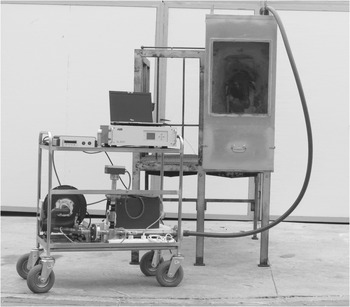
The system was made and set up for small ruminants (sheep and goats). Improvements made over a previous home-made mobile open-circuit respirometry system consisted of: (1) the substitution of a face mask by a head hood; (2) substitution of collecting bags for air sampling by a computerized control system, data acquisition and recording for gases and air flux; and (3) substitution of a chemical drier (silica gel) approach for a gas cooler to remove moisture from the air sample. A detailed description of the home-made mobile open-circuit respirometry system was published previously (Fernández et al. Reference Fernández, López and Lachica2012a ). Briefly, the instrumentation was installed on a mobile cart to make the system portable (Fig. 1). Pipes, rotameter (DK800; ABB, Alzenau, Germany), flow meter (Thermal Mass Flowmeter Sensyflow VT-S; ABB Automation Products GmbH, Alzenau, Germany), air volume totalizer (Totalizer VT-S; ABB Automation Products GmbH, Alzenau, Germany), adjustable and precise membrane pump (ABB Automation Products GmbH, Alzenau, Germany), gas cooler (SCC-C; ABB, Alzenau, Germany) and fan (CST60; Soler Palau Inc., Parets del Vallès, Barcelona, Spain) were attached to the bottom of the mobile unit. A gas analyser unit for measurement of methane (CH4), carbon dioxide (CO2) and oxygen (O2) (Easyflow 3020; ABB Automation Products GmbH, Alzenau, Germany) and a computer for system control, data acquisition and recording were on the upper part of the unit. All the analytical apparatus were acquired with digital output for computer connection. The respirometry system had two separate but linked sampling lines. The main line suctioned air across a head hood attached to a polyvinyl chloride corrugated tube (internal diameter 25 mm) equipped with an air filter to avoid atmospheric dust. A secondary line (internal diameter 5 mm), situated behind the mass flow meter, took a gas sample from the main line by means of the aforementioned membrane pump attached to the rotameter and connected to the gas analyser unit. The gas sample was filtered and dried through the gas cooler to remove moisture prior to analysis.
Whole mobile open-circuit respirometry system. Head hood attached to the front structure of a double metabolic cage with an animal on it.

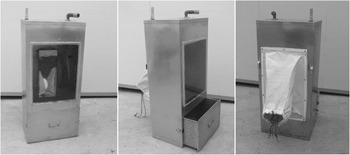
The head hood (Fig. 2) was made with 1·5 mm galvanized plate (530 mm long × 1160 mm high × 360 mm wide; volume = 219 litres). It was suspended on the front structure of the metabolic cage by two hooks placed on its rear side. The hood had a transparent acrylic window (bolted and glued with silicon on the edge) at the front (420 mm long × 530 mm high), and a drawer (500 mm long × 290 mm high × 350 mm wide) with a handle to open and place the animal food and water in a bucket. The drawer was locked by two lateral locks situated in the front side and in the main body of the head hood. A foam tape was placed on the edge of the drawer for an adequate seal. An opening (200 mm long × 520 mm high) in the rear panel of the hood was set up with a tightly woven nylon curtain (funnel shape) with a hole in the middle for the animal neck, fixed by four bolted platens and glued all around the opening edge. It was set up with a nylon drawstring through a fold around the edge to fit and tie it around the neck to avoid gas leakage. The animal was attached to the front structure of the metabolic cage by a necklace and chain so that it could freely stand or lie down. Atmospheric air entered into the head hood through a hole (internal diameter 20 mm) made in the top on the opposite side from the main suction line.
From left to right: front, lateral and rear side of the head hood.

System control, data acquisition and recording were handled by a computer (Fujitsu Siemens; Lifebook Series, Pentium 4 laptop, Munich, Germany) under a LabVIEW (www.ni.com/labview) environment. The software to operate the system was created using National Instrument LabVIEW 7.1 (National Instruments, Austin, TX, USA) running on Microsoft Windows XP. The system was capable of recording data at intervals of 1 s, but intervals of one per minute were used in the present study. The gas analyser unit and flow meter were connected to the computer by a universal serial bus connector. A serial communication protocol was used with its programmable logic controllers (MODBUS Organization, Inc., Hopkinton, MA, USA; www.modbus.org) for connection between the analytical devices (analyser unit and flow meter) and the computer. The electronics prototyping platform Arduino (www.arduino.cc) was used to send data from the gas analyser unit to LabVIEW by RS-232 protocol in real time. The flow meter was monitored by a 10-bit analogue to digital converter (model DS2438; Maxim Integrated Products, Inc. Sunnyvale, CA, USA).
Whole system calibration
The whole system was calibrated by injecting from a cylinder pure nitrogen (N2) gas (0·9999) and CO2 (0·9999) into the head hood (McLean & Tobin Reference McLean and Tobin1987), to produce an O2 decrement and CO2 increment. Calibration factors comparing the volume of gas injected and detected by the system were obtained. Total gas released was determined gravimetrically using a precision electronic scale (MOBBA mini-SP 0·2–30 kg). Sufficient gas was released (c. 375 and 177 g of N2 and CO2, respectively, during 6 h) to ensure accuracy in the measurement of the cylinder weights, and subsequently injected at the required flow rate to simulate the O2 and CO2 exchange produced by an animal in the system. Calibration factors were calculated according to Brockway et al. (Reference Brockway, Boyne and Gordon1971).
Calculations
Methane and CO2 production, and O2 consumption, were calculated as described by Aguilera & Prieto (Reference Aguilera and Prieto1986) using the Haldane transformation, except that no theoretical values for atmospheric CH4, CO2 and O2 concentrations were used. Before gas measurement, atmospheric air was sampled and the gas concentration values were used as reference in calculations.
Experimental test
Animals and feeding
Experimental procedure was approved by the Committee on Animal Use and Care at the Polytechnic University of Valencia (Spain).
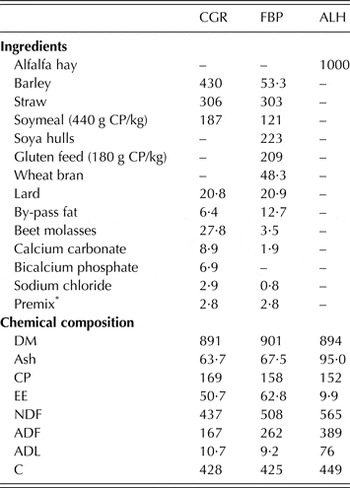
Twelve Manchega female dry sheep of similar body weight (58 ± 1·2 kg BW) were selected to determine the energy and C–N balances. Three diets were used based on cereal grain (CGR), fibrous by-products (FBP) and alfalfa hay (ALH) with four sheep per diet. Cereal straw was offered as forage in CGR and FBP diets, and the concentrate was mixed and pelleted along with the premix. The forage : concentrate (on dry matter (DM) basis) ratio of CGR and FBP diets was 30 : 70. Ingredients and chemical composition of the diets are shown in Table 1. The feeding level was close to metabolizable energy for maintenance (MEm). Sheep had free access to a vitamin-mineral block and water. Full daily ration was offered at 09·00 h.
Ingredients (g/kg) and chemical composition (g/kg DM) of the three diets based on cereal grain (CGR), fibrous by-products (FBP) and alfalfa hay (ALH)

DM, dry matter; CP, crude protein; EE, ether extract; NDF, neutral detergent fibre; ADF, acid detergent fibre; ADL, acid detergent lignin; C, carbon.
* Provided by NACOOP S.A. (Spain) to give (ppm or IU/kg of premix): Se, 40 ppm; I, 250 ppm; Co, 80 ppm; Cu, 3000 ppm; Fe, 6000 ppm; Zn, 23 400 ppm; Mn, 29 000 ppm; S, 60 000 ppm; Mg, 60 000 ppm; vitamin A, 2000 000 IU; vitamin D3, 400 000 IU; vitamin E, 2000 ppm; nicotinic acid, 10 000 ppm; choline, 20 300 ppm.
Sheep were housed in a barn where temperature and relative humidity were recorded automatically every 15 min and averaged daily during the experimental trial; these ranged from 20·2 to 25·1 °C and from 62 to 77%, respectively.
Chemical analysis
Feed and faeces were dried in a forced air oven at 55 °C for 48 h and then ground to pass through a 1 mm screen. Urine was dried by lyophilization. Chemical analyses were conducted according to the methods of AOAC (2000) for DM (no. 934·01), ash (no. 942·05), ether extract (EE; no. 920·39) and crude protein (CP; no. 968·06). Gross energy (GE) content was determined in an adiabatic bomb calorimeter (Gallenkamp Autobomb; Loughborough, UK). Acid detergent fibre (ADF) and neutral detergent fibre (NDF) of diets were determined using filter bags and a fibre analyser (A220; ANKOM Technologies, Fairport, NY, USA) following AOAC (2000) official methods (no. 973·18) according to Mertens (Reference Mertens2002). Acid detergent lignin (ADL) was determined according to Robertson & Van Soest (Reference Robertson, Van Soest, James and Theander1981). Carbon and N were analysed by Dumas principle (TruSpec CN; Leco Corporation, St. Joseph, MI, USA).
Energy and carbon–nitrogen balances, and heat production determination
Sheep were allocated individual metabolism cages. After 12 days of adaptation to experimental conditions, feed intake, total faecal and urine output were recorded daily for each sheep over a 5-day period. Body weight was recorded at the beginning and end of the experimental period. Representative samples of diet, faeces and urine were collected daily, stored at −20 °C, and pooled for chemical analysis.
Metabolizable energy intake (MEI) was the difference between GE intake and energy losses via faeces, urine and CH4 (with an energy equivalent value of 39·5388 kJ/l; Brouwer Reference Brouwer and Blaxter1965).
After the energy and C–N balances, gas exchange was sequentially measured for 24 h/sheep/diet. Gas exchange was repeated with two sheep from the ALH diet after a 3-day fast to measure the fasting HP.
Daily HP (kJ), determined by the RQ method, was calculated according to Brouwer (Reference Brouwer and Blaxter1965) for O2 consumption, CO2 and CH4 productions (l), and urine-N (g) as HP = 16·18 × O2 + 5·02 × CO2 − 2·17 × CH4 − 5·99 × urine-N. The RQ was calculated as the ratio of CO2 produced : O2 consumed. Retained energy (RE) was determined as the difference between MEI and HP.
Retained energy (kJ), determined via the CN method, was calculated according to Brouwer (Reference Brouwer and Blaxter1965) from the C (g) and N (g) balance (RE = 51·8 × C − 19·4 × N). Heat production was calculated as the difference between MEI and RE.
Statistical analyses
Analysis of variance was conducted on the experimental data, with the animal as the experimental unit, to determine the treatment (diets) effect. The effects of the diet (based on CG, FBP and ALH) on energy and C–N balances were analysed using the PROC GLM of SAS (2001). The statistical model was Y = μ + (D) + ε, where Y was the dependent variable, μ the overall mean, D the fixed effects of diet and ε the random error. A Tukey multiple range test was used to ascertain the statistical significance of differences (P < 0·05). Mean values of HP obtained by RQ and CN method were compared by Fisher's least significant difference test, and significance was set at P < 0·05. Regression analysis (PROC REG of SAS (2001)) was used to establish the relationship between HP obtained by RQ and CN methods.
RESULTS
The average value for the calibration factor was 1·006 ± 0·0016 (standard deviation (sd); n = 5) and 0·992 ± 0·0092 (sd; n = 5) for O2 and CO2, respectively. The values were consistent, proving the absence of leaks and good performance of the whole system.
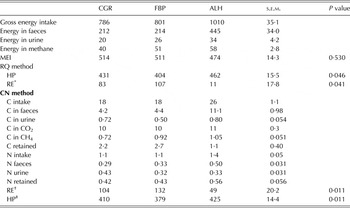
Table 2 shows the daily energy balance and HP determined by the RQ method, including the average MEI and the resultant RE. Although comparison among diets was not the main objective of the present study, MEI was similar for all three (P > 0·05); however, HP was higher (P < 0·05) for the ALH diet with respect to the other two. This was possibly as a result of the different nature and physical structure of the feed consumed (Lachica et al. Reference Lachica, Aguilera and Prieto1997) since the period of eating was included in the 24 h gas exchange measurements.
Daily energy (kJ/kg0·75 BW) and carbon–nitrogen (g/kg0·75 BW) balances, heat production (HP) and retained energy (RE) of female dry Manchega sheep (n = 12; 58 ± 1·2 kg BW as average; four sheep per diet) with the three offered diets based on cereal grain (CGR), fibrous by-products (FBP) and alfalfa hay (ALH) calculated by indirect calorimetry (RQ method) and carbon–nitrogen balance (CN method)

s.e.m., standard error of mean; degrees of freedom = 2; MEI, metabolizable energy intake; RQ, respiratory quotient; CO2, carbon dioxide; CH4, methane; C, carbon; N, nitrogen.
* Calculated as RE = MEI − HP.
† Calculated as RE = 51·8 × C retained − 19·4 × N retained.
‡ Calculated as HP = MEI − RE b .
Daily C–N balance, calculated RE and estimated HP by the CN method are also displayed in Table 2.
The RE determined with the CN method was greater than that calculated with the RQ method (95 v. 67 kJ/kg0·75 BW per day, on average).
When daily HP (kJ/kg0·75 BW) obtained with the RQ method was related to the CN method, the best fit corresponded to the following equation:
 $$\eqalign{& {\rm HP}_{{\rm RQ \; method}} = 1\!\cdot\!07 \pm 0\!\cdot\!018{\rm (S. E.)} \times {\rm HP}_{{\rm CN \; method}}\semicolon \cr & R^2 = 0\!\cdot\!769;\;{\rm RMSE} = 24\!\cdot\!7;\; n = 12}$$
where s.e. is the standard error (sd), R 2 is the coefficient of determination and RMSE is the root-mean-square error. However, both methods have shown no significant differences for each diet, accounting for 431 v. 410 (P = 0·987), 404 v. 379 (P = 0·269) and 462 v. 425 (P = 0·315) kJ/kg0·75 BW/day (CGR, FBP and ALH, respectively) for RQ v. CN methods.
The average RQ value for the three diets was 0·92 ± 0·031 (sd) and 0·71 ± 0·024 (sd) for fasting sheep. Fasting HP for the ALH diet was 269 ± 10·3 (sd) kJ/kg0·75 BW/day.
DISCUSSION
An open-circuit respirometry system has the primary function of measuring gas exchange and then the determination of HP based on the animal's CH4 and CO2 production, and O2 consumption. The accuracy of the gas exchange determination is further dependent on the ability of the system to measure gas composition and importantly, the total volume of the air moved through the respirometry system (Fernández et al. Reference Fernández, López and Lachica2012a ). To obtain a fast response from the system in a short time period, masks or hoods enclosing only the animal's face or head in connection with open circuits have been frequently employed with ruminants (Young et al. Reference Young, Walker and Whitmore1988; Takahashi & Young Reference Takahashi and Young1992; Puchala et al. Reference Puchala, Tovar-Luna, Goetsch, Sahlu, Carstens and Freetly2007). An open-circuit system attached to a face mask presents the lowest cost and it is best suited and sufficiently accurate for fast response applications for measurement of gas exchange in animals for a short period of time (Fernández et al. Reference Fernández, López and Lachica2012a ). However, the mask prevents animals from eating and may cause discomfort and distress, which can consequently affect the gas exchange. Also, the use of a face mask requires very close contact with the staff involved in the study to ensure full adaptation of animals to the experimental conditions (Lachica & Aguilera Reference Lachica and Aguilera2005). To avoid this inconvenience, the head hood represented a better and cheaper alternative for measuring gas exchange for 24 h, with minimum disturbance for the animal (Kelly et al. Reference Kelly, Kerrigan, Milligan and McBride1994; Brosh Reference Brosh2007). The system was built for operational flexibility, which allows a variety of experimental arrangements. It can be connected not only to a head hood, but also to a mask or a respirometry chamber and is able to measure a broad range of body weights.
The range of temperature during the experimental test implied that no HP associated with temperature stress was elicited. The diets used were typical of those in Eastern Spain for dry sheep to prepare the herd for a new production cycle.
Fasting HP was also measured in order to compare the present data with that from the literature, since fasting reduces the possible effect of the diet on HP to a minimum. The agreement with published data can be considered as further evidence of the system's reliability. Fasting HP was in agreement with the value obtained for the same sheep breed by using the previous non-improved mobile open-circuit respirometry system (268 kJ/kg0·75 BW/day; Fernández et al. Reference Fernández, López and Lachica2012b ) and similar to that obtained for Segureña sheep, also by indirect calorimetry (272 kJ/kg0·75 BW/day; Aguilera et al. Reference Aguilera, Molina, Prieto and Boza1986). Freetly et al. (Reference Freetly, Nienaber, Leymaster and Jenkins1995, Reference Freetly, Nienaber and Brown-Brandl2002) found no differences for fasting HP between Suffolk and Texel ewes (318 kJ/kg0·75 BW/day, on average) or between Finnsheep and Ramboulliet ewes (297 kJ/kg0·75 BW/day, on average) when compared at the same proportion of mature BW, and no differences were found in fasting HP (296 kJ/kg0·75 BW/day, on average) with ewes of seven breeds differing in production potential (Olthoff et al. Reference Olthoff, Dickerson and Nienaber1989). It is well known that differences in fasting HP could be explained by the previous MEI of the animals. Fasting HP is typically determined after a 3-day fast and one might expect less variation in energy expenditure than in the fed state. Distribution of body components (protein and fat) is important in determining fasting HP, especially with an ad libitum consumption before the fasting HP measurement. Tovar-Luna et al. (Reference Tovar-Luna, Puchala, Sahlu, Freetly and Goetsch2010) determined fasting HP in lactating dairy goats after ad libitum consumption (1·98 kg DM/day) and subsequently after an intake close to maintenance (0·84 kg DM/day), reporting a 13% decrease for the latter.
The RQ for fed and fasting sheep were in close agreement with the regular values obtained under such circumstances (Kleiber Reference Kleiber1972) and could also be used as evidence for reliability of the measurements.
The C–N balance (CN method) is frequently determined in association with indirect calorimetry measurements (Blaxter Reference Blaxter1967) and it depends on measurements of C and N intake and their losses as urine, faeces and gases (CO2 and CH4). The CN method generally results in an overestimation of RE because C–N balance is usually overestimated due to evaporative and other losses in excreta (Just et al. Reference Just, Fernández, Jørgensen, LaPlace, Corring and Rerat1982). Thus, the RQ method can be expected to systematically yield higher values for HP than the CN method. Both methods are partially dependent on each other and the close agreement between them may be considered as further evidence of the system's reliability (as shown by the regression analysis). Detailed descriptions of the errors on the estimation of RE (or HP) by the CN method have been given elsewhere (Blaxter Reference Blaxter1967; Christensen et al. Reference Christensen, Chwalibog, Henckel and Thorbek1988). Discrepancies between both methods averaged 0·055 when expressed as percentage of the MEI, a rather satisfactory value taking into account the considerable amount of technical and analytical work involved. Fernández et al. (Reference Fernández, López and Lachica2012b ) obtained an average discrepancy of 0·005 in sheep using a face mask and the same diet at three different MEI (instead of the same MEI for the three diets in the present study), and Aguilera & Prieto (Reference Aguilera and Prieto1986) of 0·018 in respirometry chambers and fed at about maintenance level. As an outdoor method, the present mobile open-circuit hood system complies with the accuracy requisite for determining gas exchange and hence HP (where the maximum acceptable error is 0·1; Lachica & Aguilera Reference Lachica and Aguilera2008).
CONCLUSIONS
The present study shows the improvements made on a home-made mobile open-circuit respiration system to measure CH4, CO2 and O2 animal exchange and consequently HP. All sheep were easily adapted to the head hood for periods of 24 h with no sign of discomfort or stress. The low-cost system described is suitable and feasible to be adapted and used for studies of gas exchange and energy metabolism under a wide range of physical, physiological and nutritional situations with a considerable labour reduction.
This study was supported by INIA Project (ref. no. RTA2011-00107-C02-02).