Introduction
Current research suggests that bilingualism has strong modulatory effects on a range of cognitive control abilities, most notably tasks requiring attentional control or some form of inhibitory control (Adesope, Lavin, Thompson & Ungerleider, Reference Adesope, Lavin, Thompson and Ungerleider2010; Bialystok, Martin & Viswanathan, Reference Bialystok, Martin and Viswanathan2005; Blumenfeld & Marian, Reference Blumenfeld and Marian2010; Colzato, Bajo, Wildenberg & Paolier, Reference Colzato, Bajo, Wildenberg and Paolier2008; Costa, Hernández, Costa-Faidella & Sebastián-Gallés, Reference Costa, Hernández, Costa-Faidella and Sebastián-Gallés2009; Garbin, Sanjuan, Forn, Bustamante, Rodríguez-Pujadas, Belloch, Hernández, Costa & Ávila, Reference Garbin, Sanjuan, Forn, Bustamante, Rodríguez-Pujadas, Belloch, Hernández, Costa and Ávila2010; Green, Reference Green1998; Martin-Rhee & Bialystok Reference Martin-Rhee and Bialystok2008; Namazi & Thordardottir, Reference Namazi and Thordardottir2010). Such a cognitive advantage can be seen emerging in bilinguals at an early age (Kovács & Mehler, Reference Kovács and Mehler2009) and persists throughout the lifetime (Bialystok, Craik, Klein & Viswanathan, Reference Bialystok, Craik, Klein and Viswanathan2004; Bialystok, Craik & Luk, Reference Bialystok, Craik and Luk2008). Bilingual's performance on tasks such as the ANT (Attention Network Task, e.g. Costa, Hernández & Sebastián-Gallés, Reference Costa, Hernández and Sebastián-Gallés2008), the Stroop task (Hernández, Costa, Fuentes, Vivas & Sebastián-Gallés, Reference Hernández, Costa, Fuentes, Vivas and Sebastián-Gallés2010), and the Simon task (Bialystok, Craik, Grady, Chau, Ishii, Gunji & Pantev, Reference Bialystok, Martin and Viswanathan2005) have revealed superior cognitive control advantages compared with monolinguals. Highly relevant to the present study, Hernández et al. (Reference Hernández, Costa, Fuentes, Vivas and Sebastián-Gallés2010) found smaller Stroop interference and greater facilitation in bilinguals and a general speed advantage on all types of trials compared with monolinguals. However, it is still not known if a bilingual's ability in conflict resolution and inhibitory control as seen with manual tasks extends into other domains of human action control such as the oculomotor domain. The aim of this study is to determine if the bilingual cognitive control advantages seen previously in tasks that require manual responses extend to an oculomotor Stroop task. Specifically, we examined whether the language proficiency of a bilingual speaker affects conflict resolution in an oculomotor task given recent evidence that language proficiency can modulate cognitive control in bilinguals (Festman, Rodriguez-Fornells & Münte, Reference Festman, Rodriguez-Fornells and Münte2010; Tao, Marzecova, Taft, Asanowicz & Wodniecka, Reference Tao, Marzecova, Taft, Asanowicz and Wodniecka2011).
A long history of research in the domain of eye movement control has established the casual link between attentional mechanisms and eye movements (Hoffman & Subramanium, Reference Hoffman and Subramaniam1995; Ray, Schall & Murthy, Reference Ray, Schall and Murthy2004). Eye movement programming provides a good measure of cognitive control (Corbetta, Akbudak, Conturo, Snyder, Ollinger, Drury, Linenweber, Petersen, Raichle, Van Essen & Shulman, Reference Corbetta, Akbudak, Conturo, Snyder, Ollinger, Drury, Linenweber, Petersen, Raichle, Essen and Shulman1998; Henderson, Reference Henderson and Rayner1992; Hoffman & Subramanian, Reference Hoffman and Subramaniam1995; Kowler, Reference Kowler and Kowler1990) and can be informative about the nature of inhibitory control (Hallet, Reference Hallett1978; Munoz & Everling, Reference Munoz and Everling2004; Wijnen & Ridderinkhof, Reference Wijnen and Ridderinkhof2007.
The measure of oculomotor control is derived from the degree to which goal directed saccades can override or suppress exogenous reflexive saccades. Given a conflicting scenario, as with the Stroop tasks (e.g. looking at a colour patch that is similar to the colour in which the word is written avoiding its meaning), cognitive control is necessary in order to make saccades in a goal-directed manner, ignoring the irrelevant information and selecting the relevant motor plan to initiate a saccade to that location. Therefore, inhibition is required to make goal-specific saccades whereas failure in inhibition leads to saccadic error. We expected high proficient bilinguals to show less interference in such conflicting situations and to programme faster and accurate saccades towards the correct colour patch in the oculomotor version of the classic Stroop task
Using the saccadic Stroop task, Hogdson, Parris, Gregory & Jarvis (Reference Hodgson, Parris, Gregory and Jarvis2009) have shown that linguistic and symbolic cues can lead to automatic programming of saccades. Previous research has shown that linguistic cues have the same tendency to “capture” the saccade just like the sudden onset of exogenous cue would do in oculomotor capture tasks (Theeuwees & Godijn, Reference Theeuwees and Godijn2004; Theeuwees, Kramer, Hahn & Irwin, Reference Theeuwees, Kramer, Hahn and Irwin1998). The task is subtle enough to capture the dynamic nature of inhibitory control in eye movement programming. The participants were presented with four coloured patches along with Stroop words. There were both colour and direction type Stroop words (see appendices). The task required the participants to respond by quickly programming a saccade towards the colour patch that matched the colour of the ink in which the word was printed, while ignoring the meaning of the word. Successful performance on the saccadic Stroop task requires the suppression of automatic saccadic eye movements generated due to a linguistic cue in favour of voluntary saccades to the colour patch that matched the ink in which the word is printed. Successful performance on this task therefore requires efficient oculomotor inhibition.
The present study examines whether oculomotor inhibition is modulated by the language proficiency of the bilinguals. Two groups of Hindi–English bilinguals were selected who differed in their L2 (English) proficiency. We used the oculomotor version of the Stroop task (adapted from Hogdson et al., Reference Hodgson, Parris, Gregory and Jarvis2009) which included both colour and direction words. We hypothesized that, if current language proficiency of bilinguals enhances their executive system, then the high proficient bilinguals should show less Stroop interference than the low proficient bilinguals on the oculomotor version of the Stroop task. This decrease in Stroop-related interference for the high proficient bilinguals would be manifested in smaller saccadic latency to the correct target.
Materials and methods
Participants
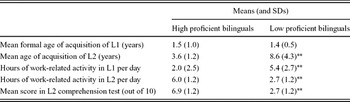
Sixty-eight Hindi (L1) – English (L2) bilinguals (54 males and 14 females) participated in the eye tracking experiment. All the participants were from the Allahabad University student community and were native speakers of Hindi. Out of the 68, 34 participants belonged to the low proficient group with low English proficiency (mean age = 21.7 years, SD = 2.6 years) and the other 34 were high proficient bilinguals with high English proficiency (mean age = 22.8 years, SD = 2.4years). All participants being students in the same University had entered the system through a nationally held entrance test and had similar educational backgrounds. High proficient bilinguals (Mean number of years of education = 16.1, SD = 1.7) did not differ from low proficient bilinguals (Mean number of years of education = 15.9, SD = 1.0) significantly, t(66) = .58, p = .56. Previous research comparing bilinguals and monolinguals has considered educational levels as an indicator of socio-economic status (SES; Emmorey, Luk, Pyers & Bialystok, Reference Emmorey, Luk, Pyers and Bialystok2009). Thus, participants in both the groups shared similar socio-economic backgrounds as students of a larger community and had shared cultural norms. The schooling system and medium of instruction and their effects on bilingualism in an Indian context is a complex issue (Srivastava, Reference Srivastava and Pattanayak1990). Second language instruction for the high proficient group began at least five years earlier (Table 1) than that for the low proficient bilinguals. This difference in acquisition of English played a major role in the participants’ bilingual competence when tested. The participants differed significantly in an objective comprehension test. Participants’ level of proficiency was also assessed through a language background questionnaire with questions on native language, languages known, age of acquisition of L1 and L2, percentage of time exposed currently to L1 and L2, and daily usage of L1 and L2 in both work- and non-work-related activities, and a set of L2 listening comprehension test (Table 1). These tests were administrated by one of the authors, who herself is a fluent bilingual.
Demographic data and daily uses of L1 and L2 (in number of hours) along with scores in L2 comprehension test.

** p < .01
Participants completed a self-rating performa with questions on proficiency in both the languages (L1 and L2). They stated their ability in writing, reading, speaking fluency, and listening on a seven-point scale ranging from “very poor” (=1) to “excellent” (=7). The t-tests revealed no significant difference between the groups for L1 proficiency. However, the two groups differed significantly in their rated proficiencies in reading, writing, speaking, and listening for English (L2) (Table 2). In day-to-day communication, low proficient bilinguals in our sample used English less often compared with the high proficient bilinguals.
Self-ratings for reading, writing, speaking and comprehension in L1 and L2. Standard deviations are given in parentheses.

** p < .01
Self-ratings scale: 1 = very poor, 2 = poor, 3 = fair, 4 = adequate, 5 = good, 6 = very good, 7 = excellent
Stimuli
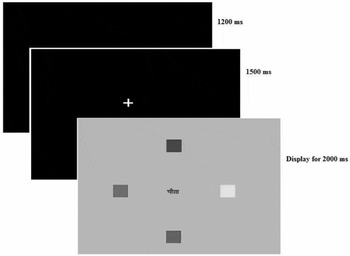
The display contained four colour patches at four different locations around a central fixation, i.e. up, down, left, and right. These were presented against a grey background (Figure 1) on a 1024 × 768 computer monitor. Each square patch subtended 1.6° of arc at an eccentricity of 7.3° from the centre of a screen. The four Stroop colours chosen were red, blue, green, and yellow. Stimuli were divided into two blocks, i.e. colour and direction word Stroop. The colour and direction Stroop words were presented in Hindi (L1): laal “red”, neela “blue”, hara “green”, and peela “yellow” written in Devanagari script. Each block consisted of congruent, incongruent and neutral trials. In the congruent condition, the ink of the printed word matched the meaning of the word, i.e. neela “blue” written in blue ink. In the incongruent condition, the ink of the printed word did not match the word, i.e. neela “blue” printed in red ink (Appendix A). In this condition, the colour of one of the squares corresponded to the ink of the word, while that of another square corresponded to the word meaning itself; and the other two squares served as distractors. In the neutral condition, in place of a meaningful word, three non-meaningful symbols (“XXX”) were presented. These were printed in the ink corresponding to the colour of the target square. Participants were instructed to make a saccade to the colour patch which matched the ink of the printed stimulus, ignoring the meaning of the word itself for both the colour and direction type trials. Each condition had 48 trials, making a total of 144 trials in all. In the incongruent condition, the target square (i.e. the one with the ink of the printed word matching the colour of the square) and the square matching the word meaning were presented in such a way that the other squares corresponding to them were either in a clockwise or an anticlockwise direction. Thus, out of 48 incongruent trials, on 24 trials the competitor square was in the clockwise direction while in the other 24 trials it was in an anti-clockwise direction. The trials from all three conditions were presented in a pseudo-random order in a mixed block. The second block of trials consisted of the direction word Stroop task. The direction words used were upar “up”, neeche “down”, daayein “right”, and baayein “left”, presented with four coloured squares, as in the first block. The task was the same as the previous one, i.e., the participants were required to make a saccade to the square matching the ink of the printed word rather than the square in the location which matched the meaning of the word (Appendix B). As in the word Stroop task, there were three conditions: congruent, incongruent, and neutral trials totaling 144 trials.
A sample trial showing an incongruent trial.

Apparatus
Stimuli were presented on a 17″ colour monitor (LCD) with 1024 × 768 pixel resolution with a screen refresh rate of 75 Hz using PRESENTATION (Neurobehavioral systems). Eye movement data were recorded by IViewX high-speed eye tracking system (Sensomotoric Instruments, Berlin) that had an interface with PRESENTATION. The recorded data were stored in a computer different from the one used by the experimenter to control the recording. The eye tracking system used an ergonomic chin rest for head movement balance and video-based image processing algorithms for calculating eye position, comparing corneal and pupillary reflex positions. Eye movement data were collected with sampling rate of 1250 Hz. The eye tracker recorded X Y coordinates of eye gaze with an accuracy of 0.01 degree. Participants were seated at 75 cm away from the monitor.
Procedure
Participants were first briefed about the eye tracking system and were instructed to keep their head still on the chin rest throughout the experiment. They were further asked to refrain from excessive body movements and not to blink while the display was on. The experiment began with an automatic calibration process which consisted of presentation of a cross at 13 different locations on the computer monitor successively. Each trial began with the presentation of a colour or direction Stroop stimulus (depending on the task) at the centre of the screen accompanied by four colour patches. Within a block, the presentation of congruent, incongruent, and neutral trials was randomized for each subject. The participants’ task, in all three conditions, was to make a saccade to the colour patch that matched the ink of the printed central stimulus ignoring the meaning of any word. A fixation cross was presented at the centre of the screen for 1200 ms, followed by the presentation of the Stroop stimulus at the centre of the screen along with the four coloured squares at four fixed locations (Figure 1). The display stayed on the screen for a fixed duration of 2000 ms. After this, a blank screen was presented for 1500 ms and then the next trial began.
Data analysis
Eye tracking data were analysed using BeGaze analysis software (Sensomotoric Instruments, Berlin). A saccade was defined as a movement of the eye more than 30 deg/sec, following a velocity criterion from its present position in any direction. Each colour patch was considered as an AOI (area of interest) for calculation of saccades and their latencies. Saccadic latency was calculated only for the correct trials. We did not consider those trials where the first saccade had landed on a wrong colour patch. Fixations were counted if they fell on the colour patch or very near it. This area was 135 × 135 in pixels. Each colour patch was of 63 × 63 pixels. We also calculated saccadic error rates.
Results
Saccadic latency
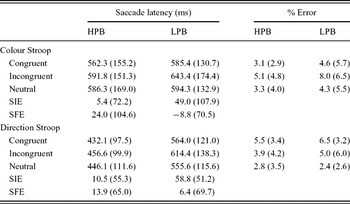
Saccadic latency or saccadic reaction time is the time lag between the onset of the display and the initiation of a saccade towards the correct colour patch, i.e. the colour patch matching the ink colour of the central stimulus. Saccade latency indicates the amount of time taken to programme a saccade towards a location after target selection and thus reflects decision-making and control processes (Schall, Reference Schall1995). Only saccades that were programmed towards the correct colour patch were included in the analysis. Saccades with latencies more than two standard deviations from the mean and less than 80 ms (anticipatory) were excluded from the final analysis. We carried out a repeated measure of analysis of variance (ANOVA) on the latency data with proficiency (high proficient and low proficient) as a between-subjects factor and congruency (incongruent, congruent, and neutral) and Stroop type (colour and direction) as within-subject factors. The main effect of language proficiency on saccadic latency to the correct target colour patch was found to be highly significant, F(1,66) = 12.0, p = .001, revealing overall shorter saccadic latencies for the high proficient bilinguals compared with the low proficient bilinguals (see Table 3). The main effect of congruency on overall saccade latency was also significant, F(2,132) = 16.0, p = .001. Saccadic latencies were shorter for congruent and neutral trials compared with incongruent trials. Additionally, the main effect of Stroop type, F(1,66) = 17.09, p = .001, was also significant, which revealed that the overall saccade latency for the direction Stroop task was less than that of the colour Stroop task.
Mean saccadic latencies to the correct target, percentage of errors, SIE (Stroop interference effect obtained by subtracting saccade latencies to the neutral trials from those on incongruent trials), and SFE (Stroop facilitation effect obtained by subtracting saccade latencies to the congruent trials from those on the neutral trials) for high and low proficient bilinguals (HPB and LPB) for the colour and direction type Stroop trials. Standard deviations are given in parentheses.

Most importantly, the interaction between proficiency and congruency was found to be significant, F(2,132) = 4.7, p = .01. The data indicate that for the high proficient group, the saccade latency on incongruent trials did not differ significantly from those on the neutral trials whereas for the low proficient group, the two trial types differed significantly (see Table 3). To see how the two groups differed on Stroop interference effect (SIE) and Stroop facilitation effect (SFE), separate t-tests were conducted for each Stroop task (i.e. colour and direction). The SIE was obtained by subtracting saccadic latencies on neutral trials from those on incongruent trials whereas SFE was obtained by subtracting saccade latencies on the congruent trials from those on the neutral trials. High proficient bilinguals showed a significantly smaller SIE than the low proficient group on the colour Stroop task, t(66) = 1.96, p = .05, as well as on the direction Stroop task, t(66) = 3.7, p = .001. Further t-tests for SFE on the two different types of Stroop tasks revealed no significant difference between the two groups.
The interaction between Stroop type and proficiency was also significant, F(1,66) = 7.0, p = .01, demonstrating relatively shorter saccadic latencies for the high proficient group on the direction Stroop task but comparable latencies on the colour Stroop task (see Table 3). No other interactions were significant (F < 1).
Error rates
Any saccade programmed towards a non-target colour patch was considered as an error. The effect of language proficiency on error rates was found to be close to significance, F(1,66) = 3.01, p = .08 (Table 3). However, congruency had a significant effect on the error rates, F(2,132) = 17.1, p = .001, revealing more errors on incongruent (5.5%) and congruent (4.9%) trials than on neutral trials (3.2%). The interaction between congruency and Stroop task, F(2,132) = 18.6, p = .001, was found to be significant. The relative error rates were higher for incongruent than congruent trials on the colour Stroop task but showed the reverse pattern for the direction Stroop. This effect, however, was not statistically significant. Further, for neutral trials, the difference in the error rates for the two different types of Stroop was not significant.
Time course of proportion of fixations
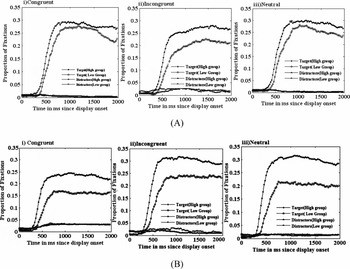
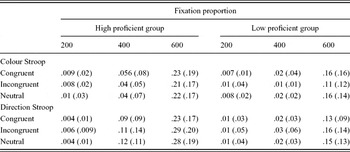
In eye tracking studies, the proportion of fixations on any target object in the visual display provides information about online shifts and the persistence of visual attention (Altmann & Kamide, Reference Altmann and Kamide2009; Mishra, Reference Mishra2009; Mishra & Marmalejo-Ramos, Reference Mishra and Marmolejo-Ramos2010). Figure 2 shows proportion of fixations on target colour patches and distractors for different trial types for the two proficiency groups. For statistical analysis, we selected a time window from the onset of the display till 2000 ms and divided the timeline into 20 ms bins. Fixation proportions to the target colour patch were compared for different trials as a function of language proficiency at 200 ms, 400 ms, and 600 ms time points, respectively (see Figure 2).
Fixation proportions to the correct target and distractors for high and low proficient bilinguals for colour Stroop (panel A) and direction Stroop (panel B) trials. Fixation proportions were calculated from the onset of the display till 2000 ms.

An ANOVA with congruency, Stroop type and time points as within-subject factors and proficiency as a between-subjects factor showed a significant effect of proficiency on the proportion of fixations on the target colour patch, F(1,66) = 12.9, p = .001. It showed a higher proportion of fixations for the high proficient group than for the low proficient group (see Table 4).
Mean proportion of fixations and standard deviations to the correct target and for high and low proficient bilinguals on the two different Stroop types.

The main effect of congruency on the proportion of fixations was not significant, F(2,132) = 1.6, p = .19. But there was a main effect of time points, F(2,132) = 121.4, p = .001, indicating a gradual increase in proportion of fixations from the onset of the display through 600 ms. The Stroop task had a significant effect on proportion of fixations on the correct colour patch, F(1,66) = 5.5, p = .021, revealing a higher proportion of fixations on the target in the direction Stroop task than in the colour Stroop task. The main effect of proficiency entered a two-way interaction with Stroop task, F(1,66) = 2.80, p < .01), as well as the effect of time points, F(2,132) = 7.6, p = .001. This indicates that high proficient bilinguals had a higher proportion of fixations on the correct target for the direction Stroop task and this was maintained for a longer time. The interaction between congruency and proficiency was not significant, F(2,132) = .634, p = .53, indicating similar proportion of fixations for different types of trials. The interaction between congruency and Stroop task was found to be significant, F(2,132) = 16.8, p = .001. There was a higher proportion of fixations on the target on incongruent and neutral trials in the direction Stroop task than in the colour Stroop task. There was also one three-way interaction between congruency, time window and proficiency, F(4,264) = 2.4, p = .04. High proficient bilinguals had a higher proportion of fixations on the correct targets for all types of trials compared with low proficient subjects. This group difference was not significant at 200 ms time point but was significant at 400 ms and 600 ms time points.
Discussion
Past studies have shown that bilinguals demonstrate executive control advantages on attentional control tasks compared with monolinguals. In this study we examined if language proficiency of bilinguals modulates inhibitory control in the oculomotor domain. High and low proficient Hindi–English bilinguals participated in an oculomotor version of the classic Stroop task with both colour and direction words. Participants were asked to make saccades towards the correct target, i.e. to look at the colour patch matching the font colour of the written word. The most significant result was that high proficient bilinguals demonstrated a smaller conflict effect compared with the low proficient bilinguals for both colour and direction Stroop tasks. High proficient bilinguals had faster saccadic latencies on incongruent trials compared with low proficient ones and were faster on all types of trials and had lower error rates. High proficient bilinguals also deployed greater visual attention in terms of proportion of fixations on the correct colour patch.
These results provide the first robust evidence of the modulatory effect of bilingual language proficiency on conflict resolution in the oculomotor domain which has earlier been observed in tasks with manual responses (Bialystok, Reference Bialystok1999; Bialystok et al., Reference Bialystok, Craik and Luk2008; Bialystok & Majumder, Reference Bialystok and Majumder1998; Bialystok & Martin, Reference Bialystok and Martin2004; Bialystok & Viswanathan, Reference Bialystok and Viswanathan2009; Costa et al., Reference Costa, Hernández, Costa-Faidella and Sebastián-Gallés2009; Hernández et al., Reference Hernández, Costa, Fuentes, Vivas and Sebastián-Gallés2010; Martin-Rhee & Bialystok, Reference Martin-Rhee and Bialystok2008; Soveri, Rodriguez-Fornells & Laine, Reference Soveri, Rodriguez-Fornells and Laine2011). High proficient bilinguals’ enhanced saccadic control also provides further support for Green's (Reference Green1998) original hypothesis about a general inhibitory control mechanism in bilinguals which modulates non-linguistic processing in non-linguistic domains.
High proficient bilinguals were faster at selecting the correct target among distractors for all types of trials and programming saccades towards it. This indicates a general executive control advantage in high proficient bilinguals in oculomotor control that is consistent with earlier findings (Bialystok & Feng, Reference Bialystok and Feng2009; Braver, Reynolds & Donaldson, Reference Braver, Reynolds and Donaldson2003; Costa et al., Reference Costa, Hernández and Sebastián-Gallés2008; Green, Reference Green, Cook and Bassetti2011; Luo, Luk & Bialyastok, Reference Luo, Luk and Bialystok2010). High proficient bilinguals also exhibited fewer errors compared with low proficient bilinguals on both colour and direction type Stroop trials. This suggests that high proficient compared with low proficient bilinguals were both faster and more accurate at programming a correct saccade in the face of Stroop interference. Higher fluency in bilinguals seems to induce superior control and decision-making processes in the oculomotor domain. Thus, our results indicate that superior inhibitory control seen in bilinguals is domain general.
Language proficiency had differential effects on saccadic latencies for colour and direction type Stroop tasks. Saccadic latencies for the direction Stroop task were in general smaller compared with the colour Stroop task for both the groups. However, for the high proficient bilinguals saccadic latency for the direction Stroop task was significicantly smaller compared with the low proficient bilinguals, where as there was no such difference in latency for the colour Stroop task. Additionally, the high proficient bilinguals had significantly smaller conflict effects for both the direction and the colour Stroop tasks compared with the low proficient bilinguals, demonstrating excellent oculomotor inhibition. No definite interpretation of these data differences can be made because of differential practice effects.
The analysis of proportion of fixations over time to the correct targets shows the early development of attentional bias towards the correct target in high proficient bilinguals and its persistence over time. High proficient bilinguals thus showed a more consistent deployment of attention to the correct targets than low proficient subjects compared with distractors. Fixation proportions to correct targets for the direction Stroop trials were higher compared with the colour Stroop trials. This suggests that the high proficient bilinguals not only oriented their visual attention earlier (as seen with lower saccadic latencies) towards the correct targets for the direction Stroop task compared with the low proficient bilinguals but also maintained attention on it. Thus, in addition to the saccadic latency data which showed quick selection of the correct targets and enhanced oculomotor preparedness on the part of the high proficient bilinguals, higher proportion of fixations on the correct targets over time reflects the robustness of this selection and persistence of visual attention (Mirman, Dixon & Magnuson, Reference Mirman Dixon and Magnuson2008). This additional analysis suggests that bilingualism not only modulates oculomotor inhibitory control but also strengthens one's ability to persistently deploy attention to the task-relevant target.
Our study is one of the first to show that bilinguals’ language proficiency could modulate the attentional and executive control systems which make them better in action planning and goal maintenance even in the oculomotor domain. Thus, we extend recent findings that show the effect of language proficiency on attention control with manual tasks (Linck, Kroll & Sunderman, Reference Linck, Kroll and Sunderman2009; Salvatierra & Rosselli, Reference Salvatierra and Rosselli2011; Tao et al., Reference Tao, Marzecova, Taft, Asanowicz and Wodniecka2011; Vega & Fernandez, Reference Vega and Fernanez2011) and provide further support for the view that high proficiency in two languages combined with their active use can boost executive control (Luk, De Sa & Bialystok, Reference Luk, De Sa and Bialystok2011). In an earlier study using eye movements, Bialystok, Craik and Ryan (Reference Bialystok, Craik and Ryan2006) did not find any advantage for bilinguals in the antisaccade task. The authors interpreted their findings as suggesting that executive control advantages of bilingualism could enhance manual response but not eye movements because of a time scale difference. However, our results seem to suggest that bilingualism affects both manual and oculomotor responses similarly in any conflicting situations. Further, in contrast to earlier studies where the cognitive advantages of bilingualism have been found with young children, our findings suggest that even late bilinguals with high proficiency do better on attentional control tasks.
Bilinguals have been shown to use a separate neuronal control mechanism that helps them to suppress the unwarranted response and exert inhibitory control (Abutalebi & Green, Reference Abutalebi and Green2007, Reference Abutalebi and Green2008; Bialystok et al., Reference Bialystok, Craik, Grady, Chau, Ishii, Gunji and Pantev2005). Thus, it is likely that an increase in bilingual language proficiency may strengthen a frontostriatal network along with other frontal networks that specifically inhibit saccades that are not aligned with the current action plans (Raemaekers, Jansma, Cahn, Van der Geest, van der Linden, Kahn & Ramsey, Reference Raemaekers, Jansma, Cahn, Van der Geest, van der Linden, Kahn and Ramsey2002). Additionally, bilingualism may also modulate and recruit the supplementary motor areas along with neuronal structures in the frontal eye fields that have been found to be active in saccadic inhibition in different populations (Anderson, Jenkins, Brooks, Hawken, Frackowiak & Kennard, Reference Anderson, Jenkins, Brooks, Hawken, Frackowiak and Kennard1994; Law, Svarer, Holm & Paulson, Reference Law, Svarer, Holm and Paulson1997). We can conclude that language proficiency of bilinguals can have substantial effect on the attentional control mechanisms related to eye movements. Future studies may explore the impact of specific tasks on oculomotor control in different bilingual situations (Balkenius & Johansson, Reference Balkenuis and Johansson2007; Barnes & Donelan, Reference Barnes and Donelan1999; Kamide, Altmann & Haywood, Reference Kamide, Altmann and Haywood2003; Kao & Morrow, Reference Kao and Morrow1994).
Appendix A. Colour Stroop
Congruent trial: laal “red” written in red ink (upper left). Incongruent trial: peela “yellow” written in blue ink (upper right). Neutral trial: XXX written in green colour (bottom).

Appendix B. Direction Stroop
Congruent trial: baayein “left” written in red ink (upper left). Incongruent trial: daayein “right” written in blue ink (upper right). Neutral trial: XXX written in yellow colour (bottom).