Introduction
Scolytus schevyrewi Semenov (Coleoptera: Curculionidae: Scolytinae) (also known as the banded elm bark beetle) is an invasive alien species in North America. It is native to central Asia and China (Michalski Reference Michalski1973), and the first North American collections date from Colorado, United States of America in 1994 (Negrón et al. Reference Negrón, Witcosky, Cain, LaBonte, Duerr and McElwey2005). It was first detected in Canada in 2006 in southern Alberta (Langor et al. Reference Langor, DeHaas and Foottit2009). Scolytus schevyrewi has now been recorded from 28 states in the United States of America (Lee et al. Reference Lee, Negrón, McElwey, Williams, Witcosky, Popp and Seybold2011; Rabaglia et al. Reference Rabaglia, Cognato, Hoebeke, Wood Johnson, Labonte, Carter and Vlacj2019); Mexico (Campos-Bolaños et al. Reference Campos-Bolaños, Atkinson, Cibrian-Tovar and Méndez-Montiel2015); the Canadian prairie provinces of Manitoba, Saskatchewan, and Alberta; and the Canadian provinces of Ontario and British Columbia (Humble et al. Reference Humble, John, Smith, Zilahi-Balogh, Kimoto and Noseworthy2010).
In its native range, S. schevyrewi has two or three overlapping generations annually and overwinters mostly as mature larvae in brood galleries (Li et al. Reference Li, Jiang and Liu1987; Yang et al. Reference Yang, Hu and Zhao1988; Wang Reference Wang and Xiao1992; Wang and Chen Reference Wang and Chen2000; Fan et al. Reference Fan, Zhang, Li, Luo, Zong and Yang2011). Negrón et al. (Reference Negrón, Witcosky, Cain, LaBonte, Duerr and McElwey2005) compiled a list of reported host trees in Asia and North America, and for Asia, the list includes four plant families in addition to the Ulmaceae. The recorded North American host range is restricted to some Ulmus Linnaeus (Ulmaceae) species (Negrón et al. Reference Negrón, Witcosky, Cain, LaBonte, Duerr and McElwey2005; Lee et al. Reference Lee, Negrón, McElwey, Williams, Witcosky, Popp and Seybold2011) of which the native American elm (U. americana Linnaeus) and introduced Siberian elm (U. pumila Linnaeus) occur quite commonly in Saskatchewan and Manitoba (Hosie Reference Hosie1979; Brouillet et al. Reference Brouillet, Coursol, Meades, Favreau, Anions, Bélisle and Desmet2012). Most studies of the natural history of S. schevyrewi in North America have been conducted in western or south-western states and have focussed on responses to semiochemicals and hosts (e.g., Negrón et al. Reference Negrón, Witcosky, Cain, LaBonte, Duerr and McElwey2005; Lee et al. Reference Lee, Hamud, Negrón, Witcosky and Seybold2010, Reference Lee, Negrón, McElwey, Williams, Witcosky, Popp and Seybold2011), interactions with congeners (Lee et al. Reference Lee, Aguayo, Aslin, Durham, Hamud and Moltzan2009; Lee and Seybold Reference Lee and Seybold2010), and the potential to transmit Dutch elm disease (Jacobi et al. Reference Jacobi, Koski, Harrington and Witcosky2007, Reference Jacobi, Koski and Negrón2013).
Bark beetles, including several Scolytus Geoffroy (Coleoptera: Curculionidae: Scolytinae) species, are vectors of the fungus Ophiostoma novo-ulmi Brasier (Ophiostomataceae) (Lanier and Peacock Reference Lanier, Peacock, Stipes and Campana1981) that causes Dutch elm disease (Brasier Reference Brasier and Dunn2000). Adult S. schevyrewi emerging from diseased U. americana wood carry O. novo-ulmi spores at similar levels to those of Scolytus multistriatus (Marsham) (Coleoptera: Curculionidae: Scolytinae) (Negrón et al. Reference Negrón, Witcosky, Cain, LaBonte, Duerr and McElwey2005; Jacobi et al. Reference Jacobi, Koski, Harrington and Witcosky2007), which is the most important vector in climatically milder regions of North America (Lanier and Peacock Reference Lanier, Peacock, Stipes and Campana1981). Spore-bearing S. schevyrewi can transfer O. novo-ulmi to xylem of U. americana, although vectoring of Dutch elm disease by S. schevyrewi appears to be relatively inefficient (Jacobi et al. Reference Jacobi, Koski and Negrón2013).
Dutch elm disease has been present in Manitoba since 1975 (Hildahl Reference Hildahl1977) and in Saskatchewan since 1990 (Emond and Cerezke Reference Emond and Cerezke1990; Cerezke et al. Reference Cerezke, Emond and Gates1991). In these provinces, the main insect vector of the pathogen is Hylurgopinus rufipes (Eichhoff) (Coleoptera: Curculionidae: Scolytinae) (Hildahl and Wong Reference Hildahl and Wong1965). Unlike most other areas of North America, where the disease is responsible for the loss of most U. americana trees (Brasier Reference Brasier and Dunn2000), the species continues to be an important shade tree in urban areas in Manitoba and Saskatchewan, and there are ongoing integrated Dutch elm disease management programmes to protect it (Westwood Reference Westwood1991; Domke Reference Domke2005). A major component of these programmes is insecticide applications to the base of U. americana trunks to control H. rufipes which, on the prairies, overwinters only as an adult at the base of elm trees (Oghiakhe and Holliday Reference Oghiakhe and Holliday2011). The published information on the natural history of S. schevyrewi presents an overwintering behaviour that differs considerably (Yang et al. Reference Yang, Hu and Zhao1988), and so changes may be necessary if the programmes are to remain effective. There have been no published studies of the natural history of S. schevyrewi in northern areas of North America, and such information is essential to determine whether, and if so how, to modify Dutch elm disease management programmes. Therefore, the objective of this study was to learn about the natural history of S. schevyrewi on the prairies, focussing on elements that might be relevant to Dutch elm disease management. These elements included determination of the number of generations and overwintering stages, and the suitability of potential host trees for S. schevyrewi in Saskatchewan and Manitoba.
Materials and methods
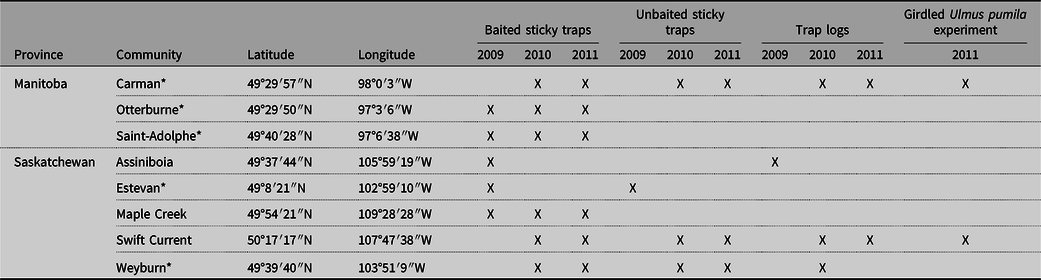
Field studies were carried out in 2009, 2010, and 2011 in five Saskatchewan and three Manitoba communities (Table 1). Study communities were selected because provincial surveillance programmes had previously detected S. schevyrewi there, and because infrastructure and resources were available for sampling to be conducted. Voucher specimens of adult S. schevyrewi from study communities were deposited in the J.B. Wallis/R.E. Roughley Museum of Entomology, University of Manitoba (Winnipeg, Manitoba, Canada).
Communities in Manitoba and Saskatchewan in which studies were performed in 2009, 2010, and 2011, and sampling methods used in each community.

* Dutch elm disease was present in these communities at the time of sampling.
Adult flight activity
To investigate adult flight periods, a minimum of three baited sticky traps were deployed in each community. These traps were stapled at a height of 2 m on the north face of utility poles that were at least 25 m apart, did not bear transformers or street lights, and were at least 10 m from U. pumila and U. americana trees. Trap panels (Contech Enterprises, Victoria, British Columbia, Canada, or Great Lakes IPM, Vestaburg, Michigan, United States of America) had an area of approximately 3000 cm2, and at the centre of each an Eppendorf custom elm bark beetle lure (Contech Enterprises) was fixed. This lure, which is attractive to S. schevyrewi (Negrón et al. Reference Negrón, Witcosky, Cain, LaBonte, Duerr and McElwey2005), consisted of the tree volatiles, hexanal, hexanol, and α-cubebene, as well as 4-methyl-3-heptan-1-ol and α- and γ-multistriatin, which are components of the aggregation pheromone produced by S. multistriatus (Gore et al. Reference Gore, Pearce, Lanier, Simeone, Silverstein, Peacock and Cuthbert1977). Sticky trap panels were changed once a week throughout the trapping period, which began in late May or early June and extended until mid- to late September in all communities and to late October in many (Table 2). Baits were changed halfway through the summer so that they would never reach their 90-day life expectancy (Contech 2011). Following removal, trap panels were examined in the laboratory and the numbers of S. schevyrewi were recorded.
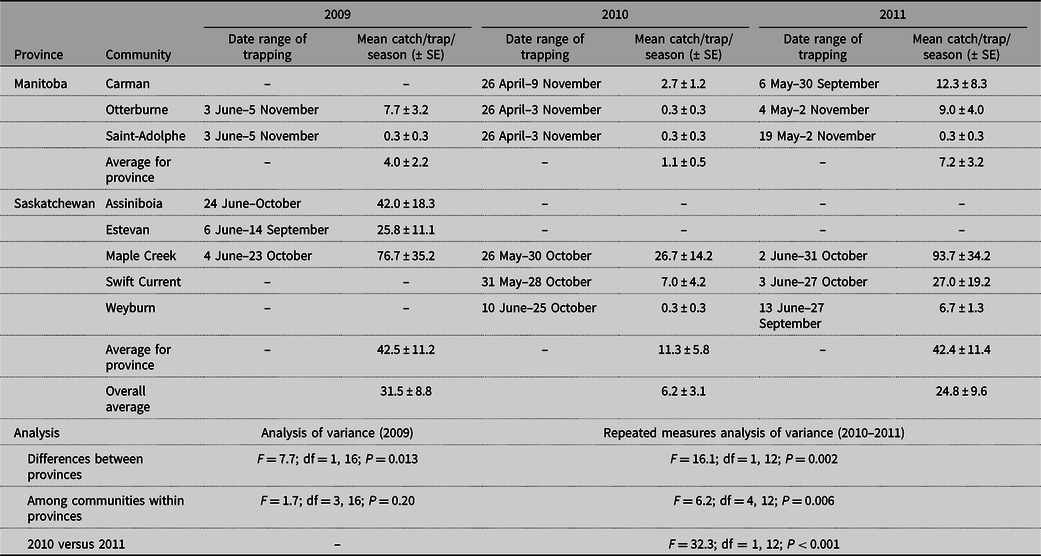
Number of adult Scolytus schevyrewi caught over the entire trapping season on baited sticky traps in communities in Manitoba and Saskatchewan.
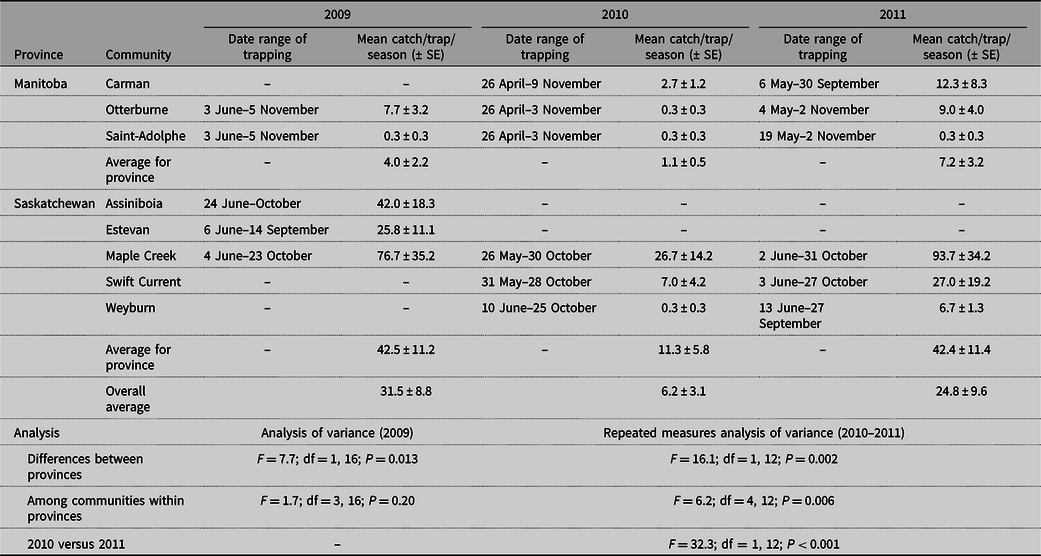
Note. There were three traps in each community in each year, except in 2009 when there were six traps in Assiniboia and Estevan. Traps were attached to utility poles ≥ 10 m from Ulmus trees.
SE, standard error.
Host tree attaction
Unbaited sticky traps were deployed in selected communities to learn about attraction to host tree species from among those identified as potential hosts by Negrón et al. (Reference Negrón, Witcosky, Cain, LaBonte, Duerr and McElwey2005). Unbaited traps were the commercial panels described above, cut in half so that they would fit smaller tree trunks. Unbaited trap panels were stapled above the understorey on the trunks of trees of a diameter at breast height ≥ 15 cm. Unbaited traps were deployed on at least three tree species in one to three communities each year (Table 1). In each of these communities, a minimum of five traps were attached to U. americana and to U. pumila. Five traps in Carman and two traps in Estevan were attached to trees of Salix alba Linnaeus (Salicaceae) but, due to a shortage of this species, the remaining three traps in Estevan and five each in Swift Current and Weyburn were attached to Elaeagnus angustifolia Linnaeus (Elaeagnaceae). Unbaited sticky traps were changed every two weeks throughout the trapping period, which was a similar duration to that for baited traps. Once removed, traps were examined in the laboratory and numbers of S. schevyrewi were recorded.
Host use and insect development
Trap logs were deployed in selected communities to learn about use of potential host tree species and the life stages and survival of S. schevyrewi present. A total of 72–177 trap logs, about 15 cm in diameter and 50 cm long, freshly cut from the trunks of S. alba, U. americana, and U. pumila were deployed in May of each year in one to three communities (Table 1). In Swift Current, S. alba logs were replaced by E. angustifolia and Caragana arborescens Lamarck (Fabaceae) logs due to the unavailability of the first species. With the exception of S. alba logs in Assiniboia and Weyburn, all trap logs were from trees felled close to the community in which they were deployed. All trap logs were held vertically; they were located in a gravel-covered yard at Assiniboia and Swift Current, and in a grassy area at Carman. At monthly intervals from the beginning of July until late autumn, batches of logs of each species were removed and brought back to the laboratory.
Each batch of logs was divided into two groups; logs in one group were dissected immediately to determine what stages were present at the time of removal from the field, and logs in the other group were placed in emergence cylinders to determine whether adult S. schevyrewi would emerge from them. To assess overwintering natural history, for logs deployed in Assiniboia in 2009 and in Carman and Swift Current in 2010, final batches of logs were removed from the field after at least a week of daytime maximum temperatures below 0 °C. Logs in each of these batches were randomly allocated to one of two groups: one group for immediate dissection and the other group in which logs were placed in an outdoor roofed insectary at the University of Manitoba (Winnipeg, Manitoba) and then, at the end of the following March, brought into the laboratory and placed in emergence cylinders.
Logs for immediate dissection were held at 4 °C until they could be dissected. To dissect logs, bark was removed and chipped carefully, using chisels, hammers, and pliers. The number of galleries characteristic of S. schevyrewi (Yang et al. Reference Yang, Hu and Zhao1988), and the number of larvae, pupae, and adults of S. schevyrewi were recorded for each trap log.
Emergence cylinders for assessing adult emergence were cardboard cylinders (123 cm long × 52 cm diameter) with capped ends, to one of which was attached a 3.8-L clear glass jar containing moist paper towels. As soon as possible after trap logs arrived in the laboratory, they were placed individually in emergence cylinders so that the long axis of both log and cylinder was horizontal. Emergence cylinders were maintained in a continually lighted room at approximately 22 °C, and jars were checked for emerged S. schevyrewi adults every two days. When a period of two weeks with no emergence had occurred for a batch of logs in emergence cylinders, the logs were taken out of the cylinders and dissected as described above. Numbers of insects recovered in post-emergence dissections were used to estimate the percentage of insects that emerged.
Girdled Ulmus pumila experiment
In 2011, the relative attractiveness of water-stressed and unstressed U. pumila trees was assessed by deploying unbaited sticky traps on pairs of girdled and ungirdled U. pumila at two locations. Pairs of similarly sized apparently healthy trees of diameter at breast height 20–60 cm were selected from a shelterbelt in Carman and from trees in three boulevards in Swift Current. Pairing was used to control for positional effects; trees within each pair were separated by approximately 20 m and pairs were never less than 20 m apart. In late May or early June 2011, one member of each pair was girdled within 1 m of the ground using a chainsaw; girdling cuts were about 2.5 cm deep and severed the xylem.
The five girdled trees from Carman were felled on 2 November 2011 and used to augment information from trap logs on colonisation, development stage, and survival of S. schevyrewi and to investigate whether emerging adults were carrying spores of O. novo-ulmi. Trees were cut into 60-cm lengths for storage. In November, all portions of two girdled trees were dissected as described for trap logs. All portions of the three remaining trees were stored in an unheated building until late March 2012, when they were moved to emergence cylinders under the conditions described above. Collection jars were checked at weekly intervals for emerged adults. Initially, all emerged adult beetles were tested for the presence of spores of O. novo-ulmi, but later, because of the large number of beetles emerging, a subsample of beetles was tested. To test for the presence of O. novo-ulmi spores, individual adults were placed in 100 × 15 mm Petri dishes on malt extract (2%) agar (Difco, Fisher Scientific, Ottawa, Ontario, Canada), to which cycloheximide (Sigma-Aldrich, Oakville, Ontario, Canada) was added after autoclaving. Petri plates, each with one adult S. schevyrewi, were incubated for 10 days on a laboratory bench where they were exposed to temperatures of about 22 °C, and alternating light and dark. Fungal growth around insects was compared with that of a known sample of O. novo-ulmi incubated in the same way, and Petri dishes with suspected O. novo-ulmi growth were taken to Manitoba Agriculture’s Crop Diagnostic Centre for verification.
Statistical analyses
For each sticky trap, the numbers of beetles caught on the trap were summed over the entire season of trapping, and the seasonal totals subjected to analysis of variance. Graphic inspection of residuals was used to assess the need for, and adequacy of, transformations.
To assess whether numbers of beetles varied among communities within and between provinces, univariate analysis of variance of seasonal total catches on baited traps was used for 2009, with province and community nested within province modelled as fixed effects. In 2010 and 2011, baited traps were on the same utility poles in both years, so a repeated measures analysis was performed, with trap location as the subject and province and community nested within province as fixed effects.
To compare the attractiveness of different host trees, seasonal total catches on unbaited traps on different trees species were compared for the seven combinations of community and season, herafter termed “community-seasons,” where unbaited traps were deployed. The seven community-seasons were used as a random blocking variable in an analysis of variance in which tree species was a fixed effect. Analysis of variance was performed only for tree species where more than one beetle was caught during the study.
The paired design of the girdled U. pumila experiment was recognised by analysing seasonal total trap catches by repeated measures analysis of variance, in which “subjects” were the pairs of trees with traps, and community was an among-subjects fixed effect. In the within-subject analysis, the main effect represented the influence of the girdling treatment, and the interaction of the main effect with community tested whether the main effect differed between the two communities in which the experiment was conducted.
Seasonal variations in insect stage composition and in postdevelopment emergence were investigated using contingency table analysis of data from emergence cylinders and dissections. All statistical analyses were done using Systat 13 (Systat 2008) with an α-level of 0.05.
Results
Adult flight activity
Over the entire study, S. schevyrewi was the only Scolytus species caught on baited traps, although considerable numbers of Hylurgopinus rufipes and Hylesinus Fabricius (Coleoptera: Curculionidae: Scolytinae) species were also caught.
In all three years of trapping, the number of S. schevyrewi adults caught on baited sticky traps was greater in Saskatchewan than in Manitoba (Table 2). In 2009, variation among communities within provinces was not significant. In the repeated measures analysis of 2010 and 2011 data, within-province variation among communities was significant; also, catches were higher in 2011 than in 2010, but the pattern of between-year variation did not differ significantly between the two provinces (F = 1.6; df = 1, 12; P = 0.23) or among communities within provinces (F = 2.4; df = 4, 12; P = 0.11).
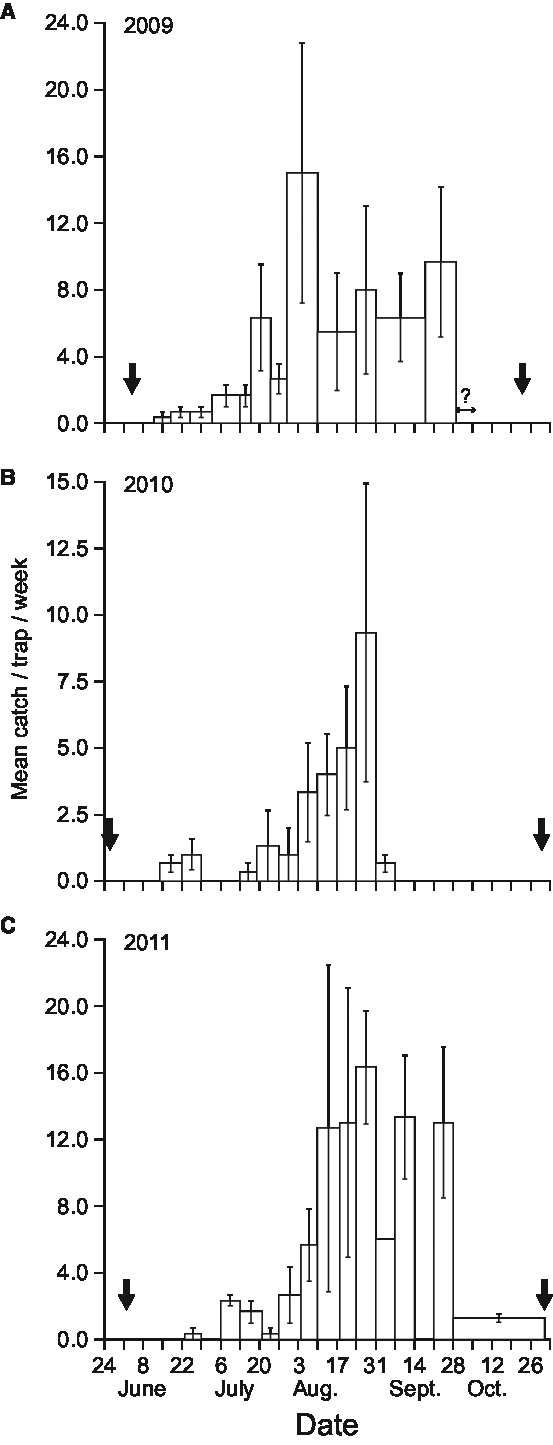
Catches on baited traps showed that seasonal flight activity began in May or June, peaked in late summer, and then declined steeply. For all three years, trap catches were highest at Maple Creek (Table 2) and provided the most complete data (Fig. 1). After the initial catches in spring, in 2010 and 2011, there was a decline in catch in July; this decline was not evident in 2009. In all three years, catches increased until the main peak in August, and there was no evidence of flight after mid-October. Although fewer S. schevyrewi adults were caught on baited sticky traps in other communities, data for these communities showed a similar pattern. Out of the 15 combinations of year and community in the study, the late summer peak occurred before 15 August twice, and after 1 September in seven instances. No beetles were caught in the first week of trapping in any of the communities and years. The earliest catch of a S. schevyrewi adult occurred between 10 May and 18 May in Carman in 2010.
Mean catch per trap per week (±standard error) of adult Scolytus schevyrewi on three baited sticky traps in Maple Creek, Saskatchewan. A, 2009; B, 2010; C, 2011. The beginning and ending of the trapping period in each year are indicated by vertical arrows; the ? in A indicates a week when traps were not deployed. Traps were normally changed at weekly intervals; when this was not so, catches were converted to a per week basis and the bar extends over the interval between changes.

Host tree attaction
Catches on unbaited sticky traps showed that healthy trees of both Ulmus species were weakly attractive to S. schevyrewi. A total of 10 adult S. schevyrewi were caught during 78 season-long exposures of unbaited traps on U. americana. One of the trap-bearing U. americana in Carman in 2010 exhibited symptoms of Dutch elm disease, but no S. schevyrewi were caught on this tree. A total of 12 S. schevyrewi were caught during 40 season-long exposures of unbaited traps on healthy U. pumila. Mean (± standard) catches on unbaited traps on U. americana (0.13 ± 0.05 beetles/trap/season) and on U. pumila (0.30 ± 0.10 beetles/trap/season) did not differ (F = 3.2; df = 1, 110; P = 0.08) and were much lower than catches on baited traps (Table 2). No S. schevyrewi were caught on S. alba during 12 season-long trap exposures, and in 13 season-long trap exposures on E. angustifolia one adult S. schevyrewi was caught.
Host use and insect development
In three year-community combinations, the planned monthly interval of trap log removal from July–October was carried out (Table 3). This pattern did not occur in Assiniboia in 2009 or in Weyburn in 2010. Winter samples were taken from one community in 2009 and two communities in 2010.
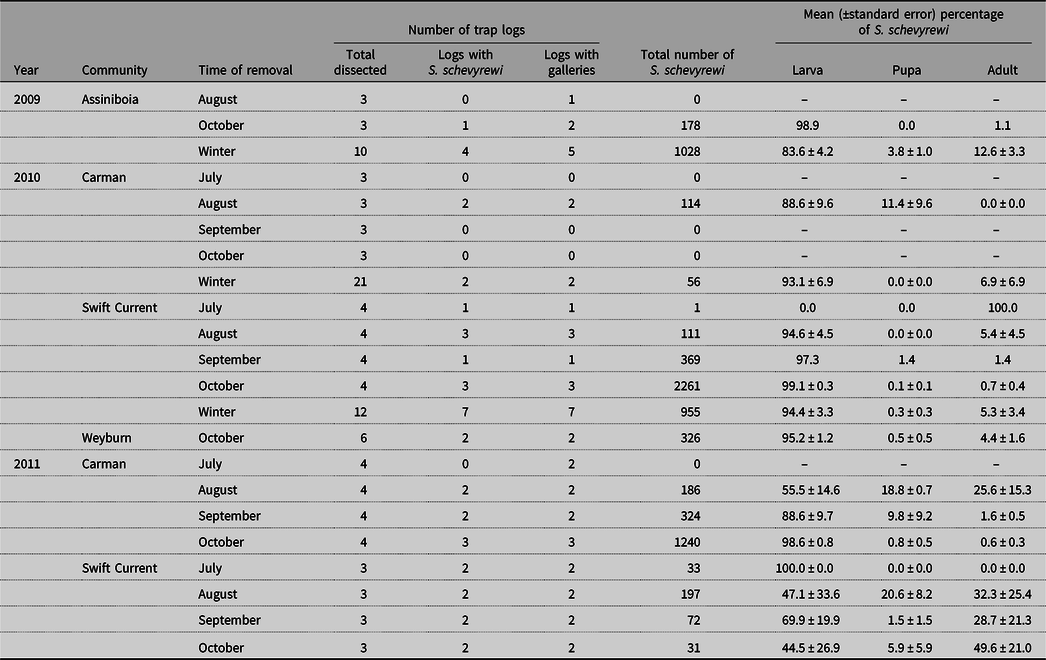
Percentage of Scolytus schevyrewi in larval, pupal, and adult stages, total number of S. schevyrewi in these stages, and incidence of colonisation and galleries in Ulmus pumila trap logs dissected immediately after removal in relation to removal date.
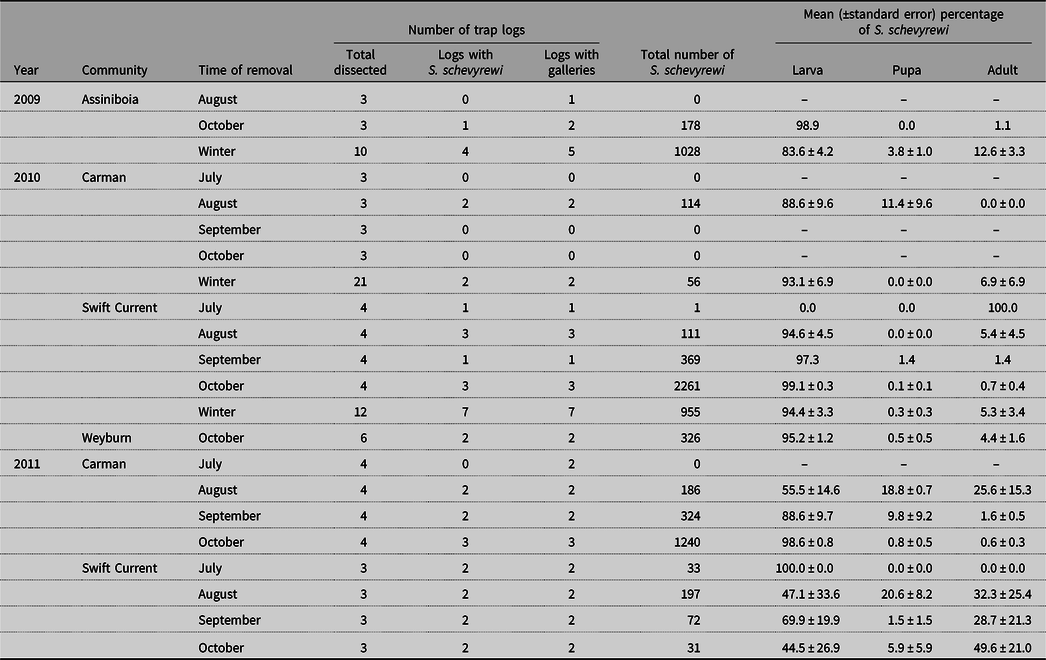
Note. Numbers in each stage include both living and dead insects. Eggs of S. schevyrewi were not counted.
The only species of trap logs that were ever colonised during the study was U. pumila. Over the three years of the project, 10 C. arborescens logs, 54 E. angustifolia logs, 137 S. alba logs, 150 U. americana logs, and 190 U. pumila logs were dissected, either immediately or after being in emergence cylinders. Logs were considered to have been colonised if S. schevyrewi brood galleries were detected during dissection. Overall, 41% of U. pumila logs were colonised, which differed significantly from the 0% for all other species (likelihood ratio [LR] χ 2 = 189.7; df = 1; P < 0.001).
Dissections immediately after recovery of trap logs showed the insect stage composition throughout the season (Table 3). Galleries of S. schevyrewi were detectable in some batches of logs removed in July. The number of insects (larvae, pupae, and adults) per brood gallery in colonised logs was 4.2 ± 3.9 in July, which differed significantly from all other removal times (F = 13.3; df = 1, 40; P < 0.001). In colonised logs removed in August or later, the number of insects per brood gallery did not differ among removal times (F = 1.8; df = 4, 40; P = 0.2) and averaged 27.6 ± 3.9. In most samples, the larval stage was the most frequent. Over all S. schevyrewi in immediately dissected logs removed before winter, 95% were larvae, 2% were pupae, and 3% were adults. These frequencies differed significantly (LR χ 2 = 126.7; df = 2; P < 0.001) from those for logs removed during winter, when 88% of S. schevyrewi were larvae, 3% were pupae, and the remaining 9% were adults. In logs removed in winter, all the adults were dead and the majority of larvae were mature.
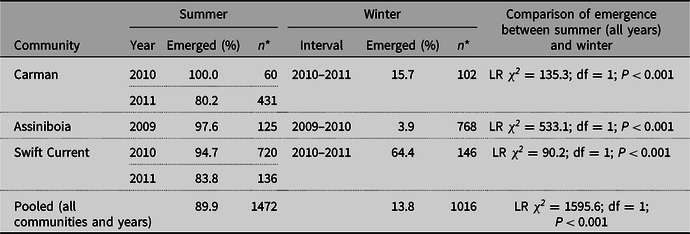
The proportions of S. schevyrewi that survived to emerge were greater in summer than after exposure to winter conditions, both overall, and when compared community by community (Table 4). There was also considerable variation in survival among years and communities in logs removed in summer (LR χ 2 = 86.3; df = 4; P < 0.001) and in those removed in winter (LR χ 2 = 282.6; df = 2; P < 0.001). Notably, winter survival was significantly different between Carman and Swift Current (LR χ 2 = 61.9; df = 1; P < 0.001), even though, once removed from the field in mid to late November 2010, the logs were exposed to identical conditions in the insectary and emergence cylinders, and the stage composition entering winter (Table 3) was virtually identical.
Effect of season of removal from the field on the percentage of Scolytus schevyrewi that emerged from trap logs in emergence cylinders.

Note. Trap logs removed in summer were put in emergence cylinders shortly after removal from the field. Trap logs removed in winter were exposed in an outdoor insectary until late March before being placed in emergence cylinders. Trap logs were dissected two weeks after emergence ceased. Emerged (%) = 100 (number emerged/(number emerged + number found when log was dissected)).
* Number of S. schevyrewi emerged plus number found by dissection.
Girdled Ulmus pumila experiment
Water-stressed U. pumila were much more attractive to S. schevyrewi than were healthy trees of the same species. In Swift Current, the catch on unbaited sticky traps on girdled U. pumila was 251.3 ± 207.2 beetles/trap/season and on ungirdled trees was 6.0 ± 3.0 beetles/trap/season (n = 3 pairs). In Carman, the average catch on girdled trees was 25.6 ± 18.5 beetles/trap/season and was 0.4 ± 0.2 beetles/trap/season on ungirdled trees (n = 5 pairs). Overall, analysis of log-transformed data showed that catches were higher on traps on girdled trees (F = 9.31; df = 1, 6; P = 0.02), and this pattern did not differ significantly between the two communities (F = 0.67; df = 1, 6; P = 0.44).
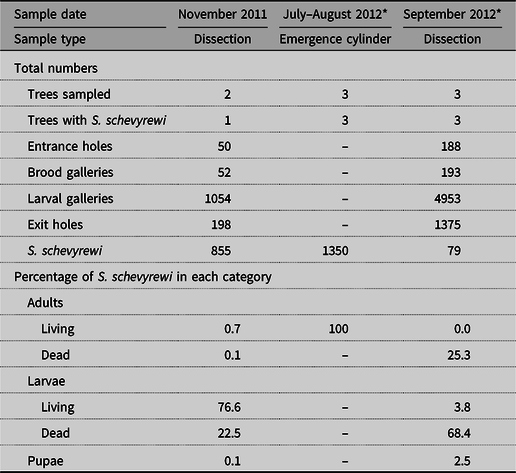
The stage composition of S. schevyrewi in girdled trees dissected in November 2011 (Table 5) did not differ from that in trap logs dissected immediately before winter (LR χ 2 = 4.9; df = 2; P = 0.09); however, only one dissected tree had evidence of S. schevyrewi infestation. In that tree, the number of entrance holes was similar to the number of brood galleries (Table 5), and the number of larval galleries was about 20 times the number of brood galleries. Also, the number of larval galleries was approximately equal to the sum of exit holes and number of S. schevyrewi within the tree; almost all S. schevyrewi were larvae of which more than 75% were alive.
Results of sampling five girdled Ulmus pumila from Carman, Manitoba for Scolytus schevyrewi and their galleries.
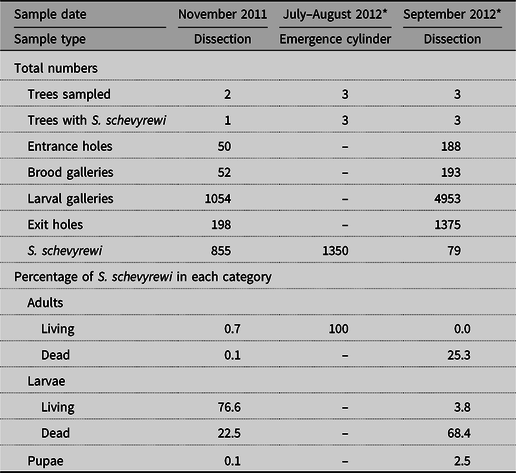
Note. The three trees sampled in emergence cylinders were dissected in September 2012 after emergence had ceased. Eggs of S. schevyrewi were not counted.
* The trees dissected in September 2012 were those that had previously been in the emergence cylinders.
In trees dissected in September 2012, there were about 26 larval galleries per brood gallery. Adults had begun emerging from these trees on 6 July 2012 and emergence continued to 15 August, and the total number of living adults that emerged closely corresponded to the number of exit holes found when the trees were dissected in September 2012. However, the number of larval galleries was more than three times the sum of the number of exit holes and insects remaining in the trees. We assume that the discrepancy in numbers is attributable to death and decay of the soft-bodied larvae so that they were undetected in the September dissections. Of the S. schevyrewi detected in the trees in September, none of the adults and only three of the larvae were alive.
Throughout the period of emergence, S. schevyrewi adults were tested for the presence of O. novo-ulmi spores by plating in Petri dishes. Of the 787 emerged adults plated, none resulted in fungal growth characteristic of O. novo-ulmi.
One of the girdled trees dissected in November 2011, and two of those dissected in September 2012 showed evidence of occupation by H. rufipes. Three entrance holes, three brood galleries, and two dead H. rufipes adults were detected in the infested tree in November 2011. In September 2012, the two trees yielded a total of 320 H. rufipes entrance holes, 345 brood galleries, 6356 larval galleries, and two exit holes. Seven adult H. rufipes and six larvae were found; except for four larvae, all these insects were dead. One adult H. rufipes was found in emergence cylinders.
Discussion
Distribution and life cycle of Scolytus schevyrewi
In 2009, 2010, and 2011, catches of S. schevyrewi adults on baited sticky traps were higher in Saskatchewan than Manitoba, and each year the mean catch per trap in Saskatchewan decreased from west to east. Patterns of population growth and dispersal from the original site of introduction could explain this distribution of captures. In the United States of America, the earliest record of S. schevyrewi was in Colorado, and the beetle was first observed in other western states before being caught in the east (Negrón et al. Reference Negrón, Witcosky, Cain, LaBonte, Duerr and McElwey2005). In Canada, S. schevyrewi was first noticed in 2006 in Medicine Hat, Alberta (Langor et al. Reference Langor, DeHaas and Foottit2009), which is 100 km west of Maple Creek and 225 km west of Swift Current. All other study communities are further from the assumed site of introduction. However, environmental factors could also influence the pattern of distribution. Within the southern parts of Manitoba and Saskatchewan, precipitation increases from west to east, with long-term average annual precipitation of less than 395 mm in Maple Creek and Swift Current and greater than 540 mm in southern Manitoba (Environment Canada 2019). Chinese regions in which S. schevyrewi exhibits the highest reproductive capacity (Yang et al. Reference Yang, Hu and Zhao1988; Wang Reference Wang and Xiao1992; Fan et al. Reference Fan, Zhang, Li, Luo, Zong and Yang2011) are arid with most localities having average annual precipitation less than 400 mm and some with less than 300 mm (Jin and Qian Reference Jin and Qian2003). Thus, although further dispersal from sites of introduction could remove the patterns of distribution we observed, these patterns may remain if S. schevyrewi is favoured by low precipitation, as appears to be the case in its native range.
Scolytus schevyrewi overwinters as mature larvae, but the number that can survive prairie winters is relatively low. The percentages of S. schevyrewi that were larvae in dissections of trap logs and trees in early winter in our study were similar to the 98.2% of overwintering S. schevyrewi that were larvae in Ningxia Province, China (Fan et al. Reference Fan, Zhang, Li, Luo, Zong and Yang2011). Fan et al. (Reference Fan, Zhang, Li, Luo, Zong and Yang2011) found no evidence that larvae in autumn were in diapause, and a few moulted to pupae before winter, although the majority did so the following spring. A lack of diapause could result in S. schevyrewi entering winter in adult or other stages that cannot survive winter conditions. Such a phenomenon would contribute to the comparatively low and variable winter survival that we observed. Winter survival was lowest in trap logs collected in winter in Assiniboia in 2009; the frequency of dead adults in dissected logs from the same collection was relatively high.
The low winter survival of S. schevyrewi on the prairies probably explains the low catches on baited sticky traps early in the trapping period. However, this phenomenon is also observed in Colorado and Nevada, United States of America (Lee et al. Reference Lee, Negrón, McElwey, Williams, Witcosky, Popp and Seybold2011). Higher survival in summer would allow a steady population increase that is suggested by the pattern of increasing catches until the late summer peak is reached. In Colorado and nearby states, flight traps collect adults from March or April until October, but frequently the peak of captures is in July or August (Negrón et al. Reference Negrón, Witcosky, Cain, LaBonte, Duerr and McElwey2005; Lee et al. Reference Lee, Aguayo, Aslin, Durham, Hamud and Moltzan2009, Reference Lee, Negrón, McElwey, Williams, Witcosky, Popp and Seybold2011), which is earlier than we observed. Although at the beginning and end of the season, catches may have been depressed in our study by low-temperature inhibition of flight, this is unlikely to have shaped the pattern of catches during most of the season. Adult S. schevyrewi fly most actively in the afternoon and can fly when daily maxima are as low as 12–19 °C (Lee et al. Reference Lee, Negrón, McElwey, Williams, Witcosky, Popp and Seybold2011). In our study communities, average daily maxima are greater than or equal to 17.5 °C from May to September (Environment Canada 2019).
During summer, S. schevyrewi has a generation time lasting from 30 days at an unspecified temperature (Negrón et al. Reference Negrón, Witcosky, Cain, LaBonte, Duerr and McElwey2005), to 45 days under field conditions in northwest China (Wang Reference Wang and Xiao1992). In the laboratory, development is completed in 31 days at 26 °C, and adult lifespan averages 17 days for males and 23–27 days for females, with some females surviving 43 days and oviposition continuing for 5–15 days (Wang and Chen Reference Wang and Chen2000; Fan et al. Reference Fan, Zhang, Li, Luo, Zong and Yang2011). Variable environmental conditions and the prolonged adult life span and oviposition periods result in overlapping generations in China (Wang Reference Wang and Xiao1992). The seasonal pattern of trap catches for 2010 and 2011 in Maple Creek could be interpreted as having a distinct early period of flight of adults that emerged after overwintering. If the generation time on the prairies is similar to that in the literature, there appears to be time for completion of two generations following this, with the late summer peak of catches representing a combination of first-generation and second-generation adults. Second-generation adult beetles that developed more slowly were probably the ones caught in September and October and present in dissected trap logs in autumn and winter removals; it is unlikely that the offspring of these adults would develop to the mature larval stage that can survive winter.
Hosts of Scolytus schevyrewi
Our use of unbaited sticky traps provides the first published attempt to compare the attraction of S. schevyrewi to standing trees of species considered by Negrón et al. (Reference Negrón, Witcosky, Cain, LaBonte, Duerr and McElwey2005) to be potential hosts. As might be expected, catches on unbaited traps on healthy Ulmus were much lower than on our baited traps: Scolytus are secondary bark beetles that attack stressed or recently dead trees (Rudinsky Reference Rudinsky1962). Of the list of hosts presented in Negrón et al. (Reference Negrón, Witcosky, Cain, LaBonte, Duerr and McElwey2005), only Ulmus species were colonised in the United States of America (Lee et al. Reference Lee, Negrón, McElwey, Williams, Witcosky, Popp and Seybold2011), and catches on unbaited sticky traps in our study are consistent with this.
Catches on unbaited sticky traps showed that adult S. schevyrewi were strongly attracted to U. pumila that were girdled. The stress caused by girdling favours brood development by S. schevyrewi: beetles caged on young healthy U. pumila produce short galleries in which no eggs are laid but breed successfully in trees with their roots severed (Shi and Chen Reference Shi and Chen1990). Two other studies on unspecified Ulmus species in China provide evidence that S. schevyrewi is most attracted to stressed or dying trees and breeds successfully only in those that are dead or near death (Li et al. Reference Li, Jiang and Liu1987; Wang and Chen Reference Wang and Chen2000). Oviposition and offspring survival is reduced in declining trees that still have sap flow, and reproductive output is highest in recently dead trees that retain bark (Wang Reference Wang and Xiao1992). The U. pumila girdled trees that we exposed in our study retained bark but had no sap flow, so may have been ideal sites for S. schevyrewi reproduction.
Trap logs that retain bark and have not fully dried out emulate stressed or newly dead trees, and so successful use of U. pumila trap logs as brood hosts is consistent with use of stressed U. pumila. However, the failure of S. schevyrewi to use U. americana trap logs in our study contrasts with results of studies from the United States of America. In Colorado, the death of mature drought-stressed U. americana was attributed to S. schevyrewi attack, and large numbers of S. schevyrewi emerged from U. americana logs (Negrón et al. Reference Negrón, Witcosky, Cain, LaBonte, Duerr and McElwey2005). In the same state, when stem sections of U. americana were exposed to natural infestations of bark beetles, large numbers of new-generation adults emerged of which 98% were S. schevyrewi (Jacobi et al. Reference Jacobi, Koski, Harrington and Witcosky2007); also, when S. schevyrewi adults were confined with U. americana logs, galleries were constructed within one week (Lee et al. Reference Lee, Negrón, McElwey, Williams, Witcosky, Popp and Seybold2011). Thus, U. americana is a suitable brood host of S. schevyrewi, and there is strong evidence that in Colorado S. schevyrewi adults recognise trap logs of this species as suitable for colonisation; this is not so in Manitoba and Saskatchewan.
Although there may be as-yet undocumented differences between Colorado and prairie Canada in the host quality of U. americana or the host selection mechanisms of S. schevyrewi, there is one well-documented difference in the circumstances of colonisation in the two localities. In much of the continental United States of America, S. schevyrewi is sympatric with S. multistriatus (Lee et al. Reference Lee, Aguayo, Aslin, Durham, Hamud and Moltzan2009), and in reported natural infestations in U. americana, the two Scolytus species co-occur in the same tree (Negrón et al. Reference Negrón, Witcosky, Cain, LaBonte, Duerr and McElwey2005; Jacobi et al. Reference Jacobi, Koski, Harrington and Witcosky2007). Although S. multistriatus has been caught on multilure-baited traps in Manitoba (Buth and Ellis Reference Buth and Ellis1981), such captures are extremely rare in Manitoba (J. Leferink, personal communication) and Saskatchewan (C. Arndt, personal communication).
We hypothesise that pioneer S. schevyrewi seeking brood hosts recognise stressed U. pumila as hosts solely on the basis of tree volatiles, but that recognition by pioneers of U. americana as hosts depends on semiochemicals produced during colonisation of the trees by S. multistriatus. Quite likely the semiochemicals to which U. americana-colonising S. schevyrewi respond include components of S. multistriatus aggregation pheromones: mimics of S. multistriatus pheromones were effective attractants of S. schevyrewi to our baited sticky traps and have been characterised as at least moderately attractive in other studies (Negrón et al. Reference Negrón, Witcosky, Cain, LaBonte, Duerr and McElwey2005; Lee et al. Reference Lee, Aguayo, Aslin, Durham, Hamud and Moltzan2009, Reference Lee, Negrón, McElwey, Williams, Witcosky, Popp and Seybold2011). Electro-antennographic studies of S. schevyrewi show high sensitivity to multistriatin, the aggregation pheromone of S. multistriatus, as well as lower sensitivity to host tree volatiles (Lee et al. Reference Lee, Negrón, McElwey, Williams, Witcosky, Popp and Seybold2011). Once pioneer S. schevyrewi have established on a tree, they may release aggregation pheromones (Fan et al. Reference Fan, Niu, Zhang, Liu, Yang and Zong2015), although Lee et al. (Reference Lee, Hamud, Negrón, Witcosky and Seybold2010) found no evidence of aggregation pheromones in this species.
A test of our hypothesis could be conducted by determining whether colonisation by S. schevyrewi of U. americana trap logs is enhanced by previous colonisation by S. multistriatus. A test of attraction (but not colonisation) has been carried out (Lee et al. Reference Lee, Hamud, Negrón, Witcosky and Seybold2010) and revealed no enhancement. However, those authors did not regard the test as definitive: catches of S. schevyrewi were very low in all treatments, and the authors suggested that their U. americana logs were unattractive because they were too dry (Lee et al. Reference Lee, Hamud, Negrón, Witcosky and Seybold2010).
Impact of Scolytus schevyrewi on the prairies
The preference of S. schevyrewi for dying U. pumila implies that the exotic beetle is unlikely to compete with, or displace, H. rufipes, as may be occurring in its interactions with S. multistriatus in the United States of America (Lee et al. Reference Lee, Aguayo, Aslin, Durham, Hamud and Moltzan2009, Reference Lee, Hamud, Negrón, Witcosky and Seybold2010; Lee and Seybold Reference Lee and Seybold2010). Hylurgopinus rufipes usually breeds in U. americana (Hildahl and Wong Reference Hildahl and Wong1965), and our dissections of girdled U. pumila suggest that it is an unsuitable brood host.
The preference of S. schevyrewi for weakened U. pumila may reduce the risk that the beetle will transmit Dutch elm disease. Ulmus pumila rarely shows symptoms of Dutch elm disease on the prairies (R. McIntosh, personal communication); it is highly resistant to the disease, and when infected, symptoms are internal, and any xylem infection is localised (Webber Reference Webber and Dunn2000). On these grounds, the probability of spore acquisition within U. pumila is likely to be small, and the lack of spores on the S. schevyrewi that emerged from our girdled trees tends to support that. As S. schevyrewi was not attracted to U. americana in our study, if S. schevyrewi adults were to acquire spores, they may not be transported to U. americana. Although spore-bearing S. schevyrewi can transfer spores to feeding wounds on U. americana, its vectorial efficiency is low (Jacobi et al. Reference Jacobi, Koski and Negrón2013). Thus, we conclude that there is no immediate need to modify existing Dutch elm disease management programmes in Manitoba and Saskatchewan, as the additional vectorial capacity resulting from the arrival of S. schevyrewi is currently small.
Conditions could change if populations of S. schevyrewi were to increase greatly. Dying and dead U. pumila, and bark-covered logs of this species, are foci for growth of large populations of S. schevyrewi that attack nearby trees (Wang Reference Wang and Xiao1992). It would be prudent to remove these potential sources of S. schevyrewi outbreaks, which could result in attacks on less suitable hosts, such as healthy U. pumila and U. americana, as has been observed for other bark beetle species (Coulson Reference Coulson1979; Berryman et al. Reference Berryman, Stenseth and Wollkind1984).
Acknowledgements
We thank L. Babey, D. Holder, J. Crowe, R. Duarte, C. To, S. Ibarra, T. Klos, T. Paton, E. Finkler, I. Pines, J. Leferink, M. Desjardins, and T. Sharanowski for technical assistance; J. Du for translations; and C. Arndt and R. McIntosh, Forest Service of the Saskatchewan Ministry of Environment, for facilitation and input. The Urban Forestry Branch of the City of Winnipeg, the Forestry and Peatlands Branch of Manitoba Sustainable Development, and the Forest Service of the Saskatchewan Ministry of Environment provided logistical support. Funding was provided by Natural Resources Canada, the provinces of Saskatchewan, Manitoba, and Ontario via Spray Efficacy Research Group International, the City of Winnipeg, the Society to Prevent Dutch Elm Disease – Alberta, the Natural Sciences and Engineering Research Council of Canada, and the Manitoba Ministry of Advanced Education and Literacy.