Introduction
Coffee is an essential source of income for a large number of countries in the intertropical zone. Coffee-producing countries are spread over Latin America, Africa and Asia, roughly between the 30th northern and southern parallels, along a geographical area often referred to as the coffee belt. Two coffee species of economic importance are grown over the coffee belt, Arabica coffee (Coffea arabica L.) and Robusta coffee (Coffea canephora Pierre ex A. Froehner) (DaMatta and Ramalho, Reference DaMatta and Ramalho JD2006; Bunn et al., Reference Bunn, Läderach, Rivera and Kirschke2015). Arabica coffee dominates with about 60% of the coffee world production (ICO, 2020). This species prefers cooler climates of tropical highlands, plateaus and mountain slopes, where it is usually grown at elevations between 800 and 2000 m above sea level (DaMatta and Ramalho, Reference DaMatta and Ramalho JD2006). Recent studies have shown that Arabica coffee is particularly sensitive to climate change and revealed that warming will change land suitability for coffee farming in most producing countries (Bunn et al., Reference Bunn, Läderach, Rivera and Kirschke2015; Ovalle-Rivera et al., Reference Ovalle-Rivera, Läderach, Bunn, Obersteiner and Schroth2015). One may legitimately question whether the change in coffee distribution will be further aggravated by the increased pressure of pests and diseases.
Here, we focus on the most devastating insect pest of coffee worldwide, the coffee berry borer, Hypothenemus hampei Ferrari (Coleoptera: Curculionidae, Scolytinae) (Vega et al., Reference Vega, Infante, Castillo and Jaramillo2009). This tiny beetle (about 1 mm in length) is native to Africa and has spread throughout the world due to the green coffee trade (Damon, Reference Damon2000; Jaramillo et al., Reference Jaramillo, Borgemeister and Baker2006). Hypothenemus hampei feeds on beans inside the berries and proliferations lead to significant direct crop loss. In addition, damage by colonizing females that bore galleries in berry endosperm for feeding and egg laying usually leads to the drop of the developing berries and opens the door to diseases that make beans unmarketable (Vega et al., Reference Vega, Kramer and Jaramillo2011; Mariño et al., Reference Mariño, Pérez, Gallardo, Trifilio, Cruz and Bayman2016). Globally, the economic coffee losses due to H. hampei infestation is estimated at US$500 million annually (Pardey, Reference Pardey and Gaitán2015), underscoring the importance of this pest in the coffee industry.
Under field conditions, each infested mature coffee berry is attacked by only one H. hampei female and finding a berry bored by more than one female is rare (Jaramillo et al., Reference Jaramillo, Borgemeister and Baker2006; Vega et al., Reference Vega, Kramer and Jaramillo2011). Females avoid attacking the developing berries, which have dry matter content of less than 20% (Jaramillo et al., Reference Jaramillo, Chabi-Olaye and Borgemeister2010). This is because the dry matter content of the endosperm is a crucial factor for offspring development and survival (Jaramillo et al., Reference Jaramillo, Chabi-Olaye and Borgemeister2010). After egg, larva and pupa development, adults emerge and stay for sometimes inside the berries, where females mate with their males' siblings. After that, females leave those berries to colonize new ones and deposit their eggs. However, sometimes females lay their eggs in the same berry where they were born (Baker et al., Reference Baker, Barrera and Rivas1992; Jaramillo et al., Reference Jaramillo, Chabi-Olaye and Borgemeister2010). Due to this, hundreds of individuals can be found in a single berry as a result of generations overlapping, especially when mature berries are rare on trees.
Prediction of the pest infestation risk is crucial to develop well-prepared control strategies. Many recent studies attempted to characterize potential pest distribution as influenced by temperature (i.e., Khadioli et al., Reference Khadioli, Tonnang, Muchugu, Ong'amo, Achia, Kipchirchir, Kroschel and Le Ru2014; Mwalusepo et al., Reference Mwalusepo, Tonnang, Massawe, Okuku, Khadioli, Johansson, Calatayud and Le Ru2015; Ndlela et al., Reference Ndlela, Azra and Mohamed2021). Most of these studies reported expansion and/or shift in pest distribution, which raises concern about the threat of polyphagous species invading new crops in new areas, and totally out of control (Wei et al., Reference Wei, Zhang, Zhao and Zhao2017; Tanga et al., Reference Tanga, Khamis, Tonnang, Rwomushana, Mosomtai, Mohamed and Ekesi2018). Although H. hampei may have a wide range of host plants (Vega et al., Reference Vega, Davis and Jaramillo2012), its distribution seems to be restricted to the coffee belt, where the pest is found virtually everywhere coffee is grown, with the exception of high elevation Arabica coffee (>1500 m). A study by Jaramillo et al. (Reference Jaramillo, Muchugu, Vega, Davis, Borgemeister and Chabi-Olaye2011) used the Climex model to predict H. hampei distribution in East Africa and showed a worsening and an expansion of the infestation by the pest to higher elevations, threatening the renowned Arabica coffee of East Africa highlands. The present study is a contribution to a different risk assessment method, the insect life cycle modelling (Kroschel et al., Reference Kroschel, Sporleder, Tonnang, Juarez, Carhuapoma, Gonzales and Simon2013; Tonnang et al., Reference Tonnang, Juarez, Carhuapoma, Gonzales, Mendoza, Sporleder, Simon and Kroschel2013). This method uses the data obtained from life table studies in the laboratory to develop temperature-based development models, which are further used to simulate population demographic parameters. These allow the calculation of risk indices that can be mapped at different geographical scales based on temperature data, such as those available in opensource through Worldclim (Hijmans et al., Reference Hijmans, Cameron, Parra, Jones and Jarvis2005).
Although H. hampei is an important pest of coffee worldwide, literature reports contradictory information on female fecundity. For example, Bergamin (Reference Bergamin1943) found a maximum of 64 eggs per female at 27°C, while Jaramillo et al. (Reference Jaramillo, Chabi-Olaye, Kamonjo, Jaramillo, Vega, Poehling and Borgemeister2009) reported 160.0 eggs per female at the same temperature. This variation might be attributed to the different methodologies used to assess female fecundity. In fact, H. hampei has a cryptic nature and a small size, which make it difficult to study its life-history traits in controlled conditions. Therefore, a new and standardized observation method for fecundity assessment is required to provide robust information. In a previous study, we developed temperature-based development models and provided the thermal requirements of H. hampei immature stages using a new rearing method (Azrag et al., Reference Azrag, Yusuf, Pirk, Niassy, Mbugua and Babin2020). The present paper reports the follow-up of the life table study we conducted in the laboratory in order to complete temperature-dependent development models for H. hampei. The first output of the current study is a new rearing and observation method that overcomes the difficulty of fecundity assessment in fresh coffee berries. Secondly, we report data on H. hampei fecundity at different constant temperatures and then the relationship between fecundity and temperature is modelled. In a third step, the fecundity model is combined to temperature-dependent development models for immature stages (Azrag et al., Reference Azrag, Yusuf, Pirk, Niassy, Mbugua and Babin2020) to simulate the population growth parameters of the reared population at different temperatures.
Materials and methods
Assessment of H. hampei fecundity at different temperatures
Initiation of the laboratory colony
Hypothenemus hampei individuals used for this study were collected from a dozen coffee farms located on the Aberdare range, Kenya (sampling area between 0.710°S – 37.083°E and 0.695°S – 36.923°E, with elevation range ≈ 1300–1800 m asl). The farms were small with approximately 100 Arabica coffee trees, from variety SL28, an old variety introduced into Kenya in the 1930s. Coffee berries infested by H. hampei were collected from the trees to fill 30 plastic containers (10.4 cm in mean diameter and 6 cm deep) (Foodmate, Kenpoly Manufacturers Ltd, Kenya). The containers with infested berries were transported to the coffee pest laboratory at the International Centre of Insect Physiology and Ecology (icipe), Kenya, and kept for 3 weeks in an incubator (SANYO MIR-553, Sanyo Electrical Ltd., Tokyo, Japan) set at temperature = 25 ± 0.5°C, with 80 ± 5% RH and photoperiod 12:12 L:D. Afterward, the berries were dissected under a stereo microscope ( × 10 magnification) using a scalpel blade and H. hampei pupae were gently collected using a fine camel-hair brush and kept in Petri dishes (diameter 100 mm and 15 mm deep). Approximately 1200 H. hampei pupae were collected and kept in 15 Petri dishes for the experiments. Pupae were kept in the same incubator under the same climatic conditions (T = 25 ± 0.5°C, RH = 80 ± 5% and photoperiod 12:12 L:D).
Female preparation
The pupae were monitored daily until adult emergence. All adults that emerged on the same day were collected using a fine camel-hair brush and placed in a Petri dish (diameter 100 and 15 mm deep) without food for 48 h for cuticle hardening (Andersen, Reference Andersen1974). Then males and females were sorted and kept separately in small plastic containers (diameter 3.9 cm and depth 3.5 cm) containing a powder of green coffee seeds as a food source (approximately 1 mm layer). Adults were kept separately in the same incubator (T = 25 ± 0.5°C, RH = 80 ± 5% and photoperiod 12:12 L:D) for a sexual maturation period of 10 days (Vega et al., Reference Vega, Infante, Johnson, Vega and Hofstetter2015). After that, adults were mated for 5 days in groups of 3 males and 10 females kept together in the same containers with the same food source and kept in the same incubator. Adults were then removed from the container and the coffee powder was carefully checked under the microscope to see whether any female has started laying eggs. If eggs were found in the coffee powder, all the females in that container were excluded from the fecundity assessment. On the other hand, the females that did not lay eggs in the coffee powder were individually introduced into new containers of the same size, each containing three mature coffee berries and kept at room temperature for 24 h for berry infestation. The next day, all these berries were checked for infestation, which was detected by the hole drilled by the female at the apex of the berry. Infested berries, i.e., berries with only one female ready to lay eggs inside, were collected for fecundity assessment.
Fecundity assessment
Infested berries described above were distributed in 12-well plats, one berry per well, and kept in incubators (SANYO MIR-553, Sanyo Electrical Ltd., Tokyo, Japan) set at six different constant temperatures viz., 15, 18, 20, 23, 25 and 30°C (± 0.5°C), with 80 ± 5% RH and 12:12 L:D photoperiod. One hundred (100) infested berries were kept at each temperature. After 14 days, the berries were dissected under a stereo microscope ( × 10 magnification) and the females were gently extracted from berries, as well as the offspring. For each female, eggs and larvae extracted from the berry were counted, including the dead ones, which usually remained in the berry. The dead eggs turned a blackish colour, while the dead larvae were found either complete or as head capsules. If only eggs were found in the berry, they were carefully removed using a fine camel-hair brush and placed on discs made of paper towels in small Petri dishes (diameter 3.5 and 1 cm deep) and then incubated at 25°C until hatching. This process was to ensure that all females used for experiments were fertile, the females having laid sterile eggs only being excluded. In a second step, these females extracted from berries were kept for a new period of 14 days on fresh coffee beans, as described by Azrag et al. (Reference Azrag, Yusuf, Pirk, Niassy, Mbugua and Babin2020). Fresh coffee beans were extracted from mature berries and a slit approximately 1.5 mm deep and 2 mm long was dug using a scalpel on the surface of the bean. A female was carefully introduced into the slit and the bean was gently wrapped with aluminium foil to enclose the female. This way, the females were immediately in good conditions to lay new eggs, without having to drill a new hole to infest a new berry. After 14 days, the beans were dissected, the new eggs and larvae were counted (included the dead ones) and the females were extracted and transferred into a new fresh bean for a new period of 14 days. Fecundity assessment continued this way at each temperature until all females died. We assessed the fecundity every 14 days to avoid females being disturbed and ensure that females had enough time to bore more galleries into the beans and lay the maximum number of eggs.
Data analysis and modelling
Impact of temperature on fecundity
In our study, H hampei fecundity was assessed as the total offspring produced by the female throughout its lifetime, i.e., eggs and larvae found in fresh coffee beans alive or dead. In order to compare fecundity at different temperatures, a generalized linear model with a Poisson distribution was fitted to the fecundity data, with the count of total offspring produced by the female as the dependent variable and temperature as the independent variable. Once significant differences were detected, data were subjected to a Tukey test at α = 0.05 for the mean separation.
Modelling the relationship between fecundity and temperature
The mean fecundity (mean offspring per female) was calculated at each constant temperature and then was plotted against temperature. Thirty-one nonlinear models were fitted to determine the relationship between H. hampei fecundity and temperature. This was done with ILCYM, an open-source software that helps develop models for studying insect population ecology (Tonnang et al., Reference Tonnang, Juarez, Carhuapoma, Gonzales, Mendoza, Sporleder, Simon and Kroschel2013). The best-fitted model was selected based on the coefficient of determination (R 2) and Akaike's information criterion (AIC) (Tonnang et al., Reference Tonnang, Juarez, Carhuapoma, Gonzales, Mendoza, Sporleder, Simon and Kroschel2013). The polynomial function 8 gave the best fit to the data, with the following expression:

Where f(T) is the fecundity at temperature T and b 1, b 2 and b 3 are the parameters of the model (Tonnang et al., Reference Tonnang, Juarez, Carhuapoma, Gonzales, Mendoza, Sporleder, Simon and Kroschel2013).
Simulation of life table parameters
Fecundity model developed in the present study was combined with development and mortality models obtained for immature stages in a previous study (Azrag et al., Reference Azrag, Yusuf, Pirk, Niassy, Mbugua and Babin2020) using ILCYM. This allowed the simulation of life table parameters for eight constant temperatures in the range 18–32°C with a 2°C interval. The number of individuals used for the simulation was 100 at the egg stage and the simulation was replicated five times for each constant temperature. In addition, the simulated life table parameters were compared across constant temperatures using an analysis of variance (ANOVA). The simulated life table parameters were the gross reproductive rate (GRR), which is the average number of daughters produced by a female throughout her lifespan, the net reproductive rate (R0), which is similar to GRR but takes into account the mortality rate of immature stages, the intrinsic rate of natural increase (rm) and the finite rate of increase (λ) that determine the ability of a population to grow under specific ecological conditions, the mean generation time (Tc), which is the average time between the birth of parents and that of offspring and the doubling time (Dt), which is the time required for the population to double (Tonnang et al., Reference Tonnang, Juarez, Carhuapoma, Gonzales, Mendoza, Sporleder, Simon and Kroschel2013).
Modelling the relationship between life table parameters and temperature
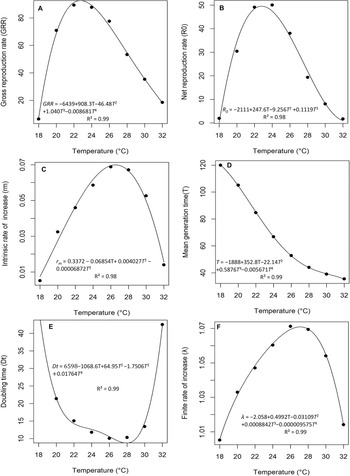
To determine the lower and upper temperature thresholds for H. hampei population growth, the simulated life table parameters were regressed against respective temperatures and fitted to polynomial functions. The third order of polynomial function gave the best fit to R0 and rm variation according to temperature, while GRR, Tc, Dt, and λ variation fitted well by the fourth order of polynomial function. The following equations were used:

where L(T) is a life table parameter at temperature T, and a, b, c, d, and e are polynomial function parameters.
Results
Effect of temperature on fecundity
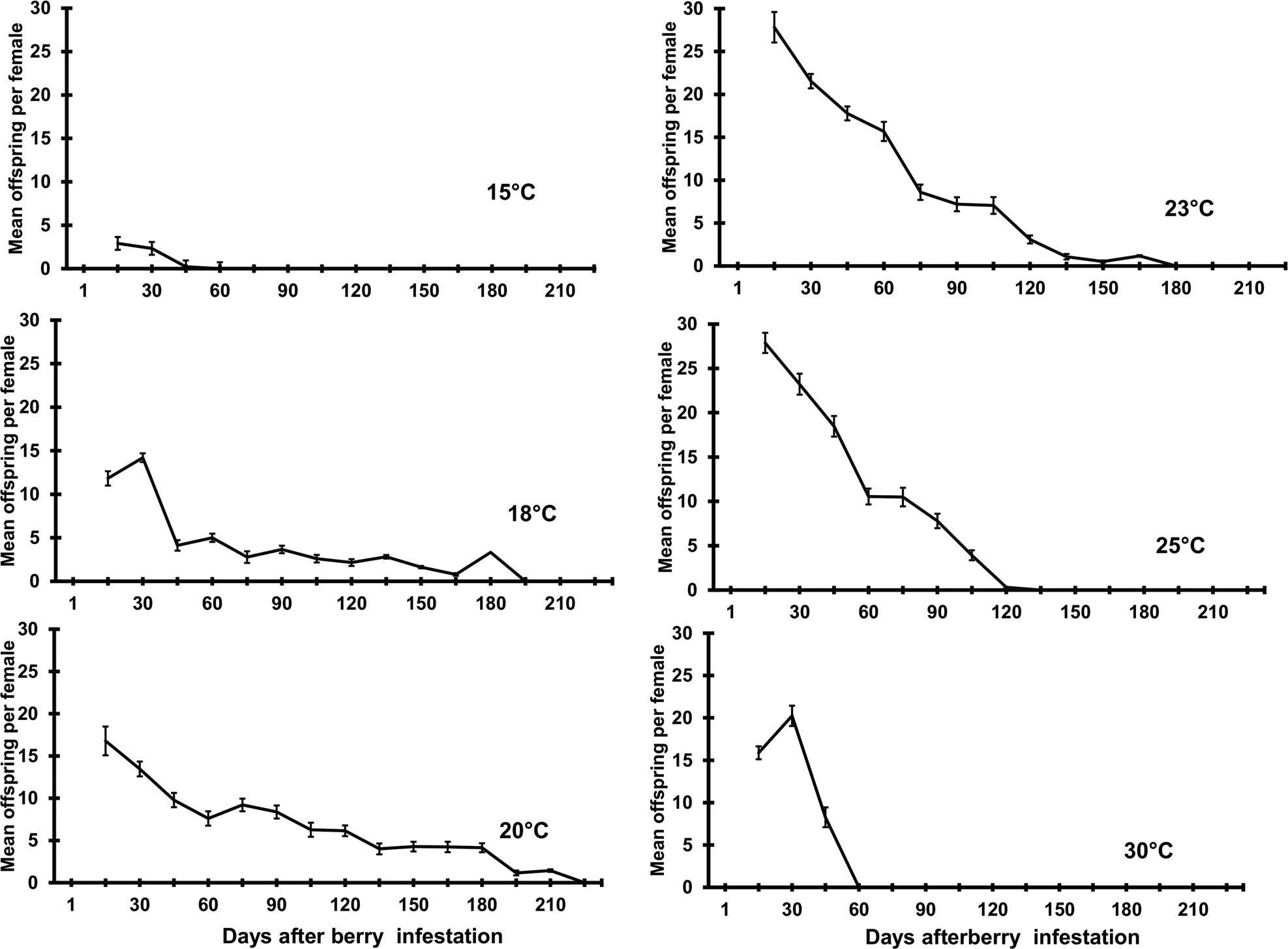
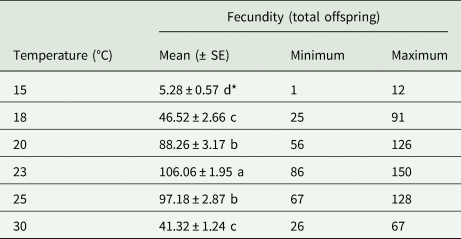
Females of H. hampei successfully reproduced in the constant temperature range 15–30°C, with temperature having a significant effect on the average offspring per female (χ2 = 272.42, df = 276, P < 0.0001) (table 1). The highest fecundity was at 23°C, with an average of 106.1 offspring per female. In contrast, the lowest fecundity was at 15°C, with an average of 5.3 offspring per female (table 1). During the female lifespan, the fecundity peaked in the first two weeks after infestation at all tested temperatures except 18 and 30°C (fig. 1). After the peak, fecundity gradually decreased with time and reached zero, 60, 195, 225, 180, 135 and 60 days after infestation under temperatures of 15, 18, 20, 23, 25 and 30°C, respectively (fig. 1).
Variation of the mean (± SE) offspring per female assessed for Hypothenemus hampei. Assessment was done at 6 different constant temperatures and every 14 days during entire female lifespan.

Effect of six constant temperatures on the fecundity (mean offspring ± SE) of a laboratory colony of Hypothenemus hampei (number of females tested for each temperature = 100).

*Means followed by the same letter are not significantly different.
Modelling the effect of temperature on fecundity
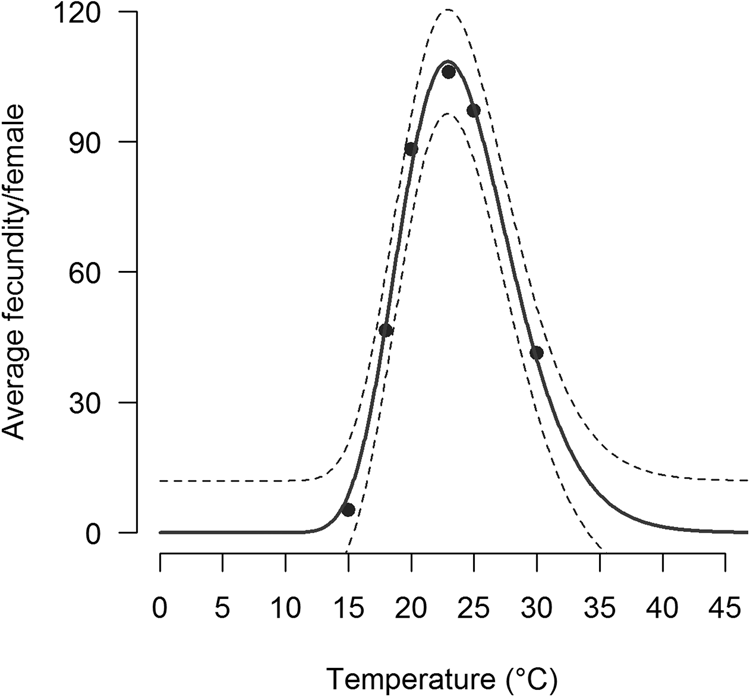
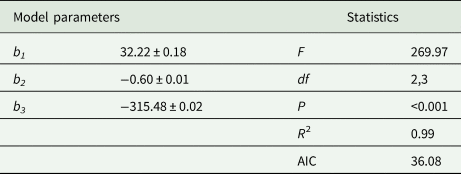
Polynomial function 8 well predicted the relationship between the average fecundity per female and temperature, with R 2 = 0.99 and AIC = 36.08 (table 2; fig. 2). The model predicted that H. hampei females cannot lay eggs at a temperature below 13°C and above 39°C, with 23°C being the optimum temperature for fecundity (maximum average of 110.33 offspring per female) (fig. 2).
Polynomial function 8 fitted to the relationship between Hypothenemus hampei fecundity (mean offspring per female) and temperature. The black dots are the observed fecundity at each temperature. The solid black line is the fitted model (Polynomial function 8) with dashed lines above and below representing the upper and lower 95% confidence interval.

Parameters and statistics of the goodness of fit of the model (Polynomial model 8) fitted to describe the relationship between Hypothenemus hampei fecundity and temperature F, F-test statistic; df, degree of freedom; P, probability value, R 2, coefficient of determination, and AIC, Akaike's information criterion.

Simulation of the life table parameters
Temperature had a significant effect on all life table parameters of H. hampei. The GRR was significantly higher at 22°C, with 89.4 daughters per female and gradually decreased with increasing temperature to reach 18.5 daughters per female at 32°C (F = 286.03, df = 7, 32, P < 0.0001) (fig. 3a). The R0 was maximal at 24°C, with 50.08 daughters per female per generation, but it was significantly decreased at extreme temperatures and reached its minimal level at 18 and 32°C, with value 1.69 daughters per female (F = 317.37, df = 7, 32, P < 0.0001) (fig. 3b). rm was significantly higher at 26°C, with a value of 0.069 and minimal at 18°C, with 0.003 (F = 124.99, df = 7, 32, P < 0.0001) (fig. 3c). The third-order polynomial function predicted that temperatures 18 and 32°C were respectively the minimum and the maximum temperature with rm > 0, meaning that beyond these temperatures the laboratory colony was not able to grow (fig. 3c). Tc decreased significantly with an increase in temperature, with 119.9 days at 18°C and 35.4 days at 32°C (F = 5077.81, df = 7, 32, P < 0.0001) (fig. 3d). The time required for H. hampei rearing population to double (Dt) was significantly affected by temperature, but 18°C was the only temperature giving a Dt significantly different from the other temperatures (F = 19.11, df = 7, 30, P < 0.0001) (fig. 3e). λ ranged between 1.003 and 1.071 at temperatures ranging between 18 and 32°C and it was significantly higher at 26°C (F = 126.42, df = 7, 32, P < 0.0001) (fig. 3f).
Polynomial functions fitted to the relationships between simulated life table parameters and temperature for a laboratory colony of Hypothenemus hampei, with a: gross reproductive rate, b: net reproductive rate, c: intrinsic rate of increase, d: mean generation time, e: population doubling time and f: finite rate of increase.

Discussion
In the present study, H. hampei fecundity was assessed through an original method, keeping H hampei females individually on fresh coffee beans during the entire lifespan, with living conditions similar to those found in coffee berries. Offspring was assessed by bean dissection every two weeks only in order to minimize female disturbance. In the past, different diets and methods such as artificial diet, moistened coffee bean parchment, or daily dissections of fresh berries were used to assess female fecundity. Unfortunately, these different methods resulted in inconsistent data. For example, Brun et al. (Reference Brun, Gaudichon and Wigley1993) obtained an average of 16 eggs per female when the pest was reared on an artificial diet at 25°C, while Fernández and Cordero (Reference Fernández and Cordero2007) reported 43 eggs per female using moistened coffee bean parchment at the same temperature. By contrast, Jaramillo et al. (Reference Jaramillo, Chabi-Olaye, Kamonjo, Jaramillo, Vega, Poehling and Borgemeister2009) reported 201 eggs per female at 25°C using an artificial infestation of coffee berries in the laboratory, where berries were dissected on a daily basis to count immature stages. Using our rearing method, we obtained a mean fecundity of 97 offspring per female, which was higher than those reported by Brun et al. (Reference Brun, Gaudichon and Wigley1993) and Fernández and Cordero (Reference Fernández and Cordero2007), but only half as high as that recorded by Jaramillo et al. (Reference Jaramillo, Chabi-Olaye, Kamonjo, Jaramillo, Vega, Poehling and Borgemeister2009) at the same temperature. Similarly, our findings at 20, 23 and 30°C were lower than those obtained by Jaramillo et al. (Reference Jaramillo, Chabi-Olaye, Kamonjo, Jaramillo, Vega, Poehling and Borgemeister2009), who reported 296, 199 and 64 eggs per female at the same constant temperatures, respectively. The maximum offspring we obtained at 25°C (128) was closer to that reported by Barrera (Reference Barrera1994), who obtained 119 eggs at the same temperature. The differences between these studies clearly show that the rearing method has an impact on H. hampei reproduction. The artificial diet might not be acceptable enough for the female to lay all her eggs because of insufficient nutrient content. Since H. hampei immature stages develop to adults in 18–25 days at temperature 25–30°C (Baker et al., Reference Baker, Barrera and Rivas1992; Azrag et al., Reference Azrag, Yusuf, Pirk, Niassy, Mbugua and Babin2020), the method used by Jaramillo et al. (Reference Jaramillo, Chabi-Olaye, Kamonjo, Jaramillo, Vega, Poehling and Borgemeister2009) may have resulted in overestimation of fecundity due to generation overlapping. Some females from the offspring indeed may have laid their eggs in the same berry where they were born (Baker et al., Reference Baker, Barrera and Rivas1992; Jaramillo et al., Reference Jaramillo, Chabi-Olaye and Borgemeister2010). On the other hand, although we counted all immature stages including dead ones, we may have underestimated fecundity by missing hardly visible larva remains. However, the fact that egg and larva mortality is usually low (Azrag et al., Reference Azrag, Yusuf, Pirk, Niassy, Mbugua and Babin2020) and may be considered negligible compared to the fecundity we obtained, gives some weight to our results.
In nature, insects' development, survival, and reproduction do not occur at constant temperatures in the same living conditions of a laboratory. However, temperature-dependant development models obtained from our experiments provide crucial information on the pest biology, such as the thermal requirements for development, reproduction and population growth. These models can be useful for simulating the pest population dynamics under field conditions and for predicting the pest distribution based on temperature (Tonnang et al., Reference Tonnang, Juarez, Carhuapoma, Gonzales, Mendoza, Sporleder, Simon and Kroschel2013; Azrag et al., Reference Azrag, Pirk, Yusuf, Pinard, Niassy, Mosomtai and Babin2018). In this study, we developed a temperature-based reproduction model to in order to complement our previous models developed for immature stages (Azrag et al., Reference Azrag, Yusuf, Pirk, Niassy, Mbugua and Babin2020). The model predicted that 23°C is the optimal temperature for the female reproduction, with an average fecundity of 110 eggs per female and maximum oviposition 150 egg. This result is in line with our previous findings that predicted that 23°C was the optimal temperature for H. hampei immature stage survival (Azrag et al., Reference Azrag, Yusuf, Pirk, Niassy, Mbugua and Babin2020). This temperature matches the thermal conditions of low elevations (1000–1400 m asl) in East Africa, where infestation by H. hampei is the highest in coffee plantations (Jaramillo et al., Reference Jaramillo, Muchugu, Vega, Davis, Borgemeister and Chabi-Olaye2011).
In this study, H. hampei life table parameters were simulated for a large range of temperatures. The net reproductive rate (R0) is one of the most important parameters that indicates the population growth rate from a generation to the next one. According to the theory of population dynamics, R0 < 1 indicates a decreasing population (Lotka, Reference Lotka1913; Lewis, Reference Lewis1942). In our study, R0 ranged between 1.6 and 50 daughters per female, at temperatures between 18 and 32°C. In the same range of temperature, the intrinsic rate of increase (rm) ranged between 0.003 and 0.069. Our results suggest that our H. hampei laboratory population was able to grow in a wide range of temperatures. Adaptation to a wide range of temperatures may be one of the factors that contributed to the success of H. hampei to invade coffee-growing areas over the coffee belt. In our study, rm was maximal at 26°C, with a value of 0.069, which was similar to that reported by Baker et al. (Reference Baker, Barrera and Rivas1992), who obtained 0.07 at the same temperature under field conditions. Similarly, our results at 20°C (rm = 0.032) were close to that reported by Ruiz-Cárdenas and Baker (Reference Ruiz-Cárdenas and Baker2010), who obtained 0.04 at an average temperature between 20.7 and 21.6°C under field conditions in Colombia. However, our findings at all tested temperatures were different from those of Jaramillo et al. (Reference Jaramillo, Chabi-Olaye, Kamonjo, Jaramillo, Vega, Poehling and Borgemeister2009), who recorded rm ranging between 0.06 and 0.14 at temperatures between 20 and 30°C. Such difference may be explained by the higher fecundity reported by the authors. The mean generation time we obtained at 26°C (Tc = 52.83 days) was higher than that obtained by Baker et al. (Reference Baker, Barrera and Rivas1992), who reported 45.19 days under field conditions, and Jaramillo et al. (Reference Jaramillo, Chabi-Olaye, Kamonjo, Jaramillo, Vega, Poehling and Borgemeister2009), who recorded 35.5 and 32.76 days at 25 and 27°C, respectively. However, our results agree with those recorded by Ruiz-Cárdenas and Baker (Reference Ruiz-Cárdenas and Baker2010), who obtained 54.7, 55.2 and 50.9 in Naranjal, La Catalina and Supía locations, respectively, in Colombia, at 150 days after infestation under field conditions.
Conclusions
In conclusion, we developed a new rearing and observation method that allowed monitoring the fecundity of the same H. hampei females on fresh coffee beans during the entire life span. This method provides the females with living conditions similar to those found in coffee berries in the field. The fecundity model predicted 23°C as the optimal temperature for H. hampei females to produce the highest number of eggs. We integrated the fecundity model with immature stage development models from Azrag et al. (Reference Azrag, Yusuf, Pirk, Niassy, Mbugua and Babin2020) to simulate the life table parameters. These models are now available and may be used to development other tools for risk assessment such as distribution maps that will help for the control of H. hampei in the context of climate change.
Acknowledgements
We acknowledge the financial support of this research by the following organizations and agencies: The Centre de Coopération Internationale en Recherche Agronomique pour le Développement (CIRAD), Montpellier, France; UK's Foreign, Commonwealth & Development Office (FCDO); the Swedish International Development Cooperation Agency (Sida); the Swiss Agency for Development and Cooperation (SDC); the Federal Democratic Republic of Ethiopia; and the Government of the Republic of Kenya. The views expressed herein do not necessarily reflect the official opinion of the donors.