


The period from 1848 to 1905 is often called the “Golden Age of Automata.” This is because of the general proliferation of automata during the period; whereas in the eighteenth century, each automaton was a unique, carefully made handcrafted art object (like those of Jacques de Vaucanson and the Jaquet-Droz family), in the nineteenth century an increased output of parts allowed nineteenth-century automata makers to create more products to sell. As a result, automata became both more affordable and widely available. Automata makers had a team of expert artisans who worked for them and each step of the construction involved detailed care and attention.1 In the case of the Golden Age of Automata, French automata makers were highly influenced by popular performers of the period and reproduced their performances in commissioned toys. While a number of everyday figures were the subjects of automata, such as nursemaids, girls, cooks, flower sellers, boys being reprimanded by their teachers, and gentlemen smoking, often automata makers mimetically rendered their subjects from popular performers of the day, such as the automata based on Little Tich, Loïe Fuller, and Wild Buffalo Bill Cody, all of which will be discussed in this chapter. In my book Automata and Mimesis on the Stage of Theatre History (2011), I wrote extensively about the connections between mimesis (or representation and imitation) and automata and the direct connection these performing objects have with the mimetic faculty. In his essay “Notes on the Mimetic Faculty,” Walter Benjamin defined the mimetic faculty as the compulsion “to become and behave as something else.”2 This mimetic desire drives every aspect of our education from language learning to performative behavior. We learn by copying. The creators of Golden Age Automata copied the popular performers of the day and made these bespoke performing objects available for wealthy middle-class people to own as delightful imitations of their favorite performers. The commodity being purchased was social status, via ownership and appreciation of a highly crafted (and expensive) device, which allowed the owner to share in the prestige of the performer and craftsmen, as well as imitate the social status of those able to afford such luxury goods and entertaining curiosities.
As ideal commodity fetishes, automata functioned as central figures in the bourgeois drawing room. Expert automata collectors Christian and Sharon Bailly write in their book The Golden Age of Automata:
The automaton brought a decorative note and a touch of gaiety to the drawing room. This room, richly draped with velvets and filled with a profusion of knick-knacks, the place where visitors were received and guests were entertained, formed the center of social life. The automaton was perfectly at home in this ornate decor; its artistic character, its elegant movements, the richness of its costume, made it the ideal ornament of the nineteenth-century drawing room.3
As a performing object and conversation piece for the drawing room, these ornamental automata were not intended for children directly, but “for the wealthy customer who, while desiring to give an expensive present to a mother, finds it convenient to use her child as a pretext.”4 Automata became the ultimate commodity fetish objects; this is a moment where the collecting of automata changed and a well-off middle-class family could own a unique automaton that performed for them in their drawing room. We might imagine a family gathered around an automaton, marveling at the spectacle of its performance.
What we see in the transformation of popular performers into automata is the reflection of popular desires and fears, and the gradual commodification of performance into a “take home” version, much like today’s action figures. However, what becomes clear in the exploration of these automata is the way that they contributed to what Tony Bennett calls “the exhibitionary complex” and a general movement toward a commodity culture. The spectacle of new technological advances, gas lighting, and popular performances prevalent throughout the Universal Expositions all helped to promote the power/knowledge complex of “an exhibitionary complex.” The exhibitionary complex is a key component of the historical beginnings of the contemporary museum. The restricted access and private ownership of the Kunstkammern (art cabinets) and other royal art collections of early modern Europe dramatically changed into museums owned by and open to the public. Bennett has argued that these institutions were “administered by the state for the benefit of an extended general public” as a form of voluntary self-regulation and that Universal Expositions were key to developing this museum-oriented “exhibitionary complex”:5
The institutions comprising “the exhibitionary complex” … were involved in the transfer of objects and bodies from the enclosed and private domains in which they had previously been displayed (but to a restricted public) into progressively more open and public arenas where, through the representations to which they were subjected, they formed vehicles for inscribing and broadcasting the message of power (but of a different type) throughout society.6
By organizing the spectacle and controlling the spectators and the behaviors of a carefully ordered crowd, the Universal Expositions could control masses of people under the patriotic sponsorship of the national state apparatus. The expositions demonstrated the tools and toys of progress and civilization, all of which are bound up with ideas of imperialism, progress, science, art, modernization, capitalism and empire. Early world’s fairs also served not only to give audiences a sense of nationalistic pride, but also to educate the working classes on decorum and proper behavior in a large public forum by placing them on equal footing with the middle classes.7 They thereby served as a cultural unifier of ambition and aspiration through shared wonder and awe at public spectacles of “progress.”
For both urbanites and tourists, the city of Paris itself was transformed into a spectacle, a commodity fetish to be experienced through the pleasure of the gaze and the power of purchasing during the Universal Expositions. Above all else, the expositions were celebrations of the reified products of the spectator’s labor or “places of pilgrimage,” according to Benjamin, “to the fetish Commodity.”8 Among these numerous fetish commodities were automata and mechanical toys. The Universal Expositions gave a great boost to toymakers, bringing them together in large numbers and giving them an immense, captive audience. Important figures who might normally have given no thought to toys were entertained by the spectacular automata displays they saw on official visits to the exhibitions. Christian and Sharon Bailly cite a commentator on the 1867 Universal Exposition, who remarked: “Among the collection of toys on exhibition at the entrance to Class 46 are to be seen senators, deputies, and conseilles d’etat in official dress paying their respects like simple mortals with none of the heavy responsibilities of state, to shiny cardboard dolls no less sparkling than their own embroidered uniforms.”9 Automata were key figures in the International Expositions, and mimetically copied performers were at the very height of fashion.
Both Jane Goodall and Linda Austin have written about performers imitating automata, but much less has been said about the mimetic inversion of this phenomena: automata imitating performers.10 The overwhelming majority of Golden Age automata created by the houses of Roullet et Decamps and Leopold Lambert are popular performers.11 Acrobats, magicians, and clowns captivated crowds in the circus, while the music halls and cafe concerts were celebrated as popular entertainments. Many of these popular performers were captured in the figures of automata: Circus acts, clowns, acrobats, and jugglers were rendered as automata. The most popular subject was the circus, as can be seen in figures like the “Lady Magician with Three Surprises” by Jean Roullet (1880). The Magician’s porcelain head is bisque, commissioned from the doll maker Pierre-François Jumeau, and she wears an elaborate magician’s costume of red silk with matching silk headdress and soutache embroidery. Her right hand holds a magic wand and waves side to side, up and down, and then taps three times on the flowerpots and the large gold die to reveal a monkey whose mouth moves, a clown who sticks out his tongue, and a cherubic bisque-headed baby who blows kisses.12
In the section of Capital (1867) on “The Fetishism of the Commodity and its Secret,” Karl Marx (1818–1883) borrows the concept of fetishism from anthropology to refer to the power of commodities, which have a mysterious life of their own:
A commodity appears at first sight an extremely obvious, trivial thing. But its analysis brings out that it is a very strange thing, abounding in metaphysical subtleties and theological niceties. So far as it is a use-value, there is nothing mysterious about it, whether we consider it from the point of view that from its properties it satisfies human needs, or that it first takes on these properties as the product of human labor. It is absolutely clear that, by his activity, man changes the forms of the materials in nature in such a way as to make them useful to him. The form of wood, for instance, is altered if a table is made out of it. Nevertheless the table continues to be wood, an ordinary, sensuous thing. But as soon as it emerges as a commodity it changes into a thing which transcends sensuousness. It not only stands with its feet on the ground, but, in relation to all other commodities, it stands on its head, and evolves out of its wooden brain grotesque ideas, far more wonderful than if it were dancing of its own free will.13
Using language markedly similar to that used to describe the Freudian uncanny to explain the commodity fetish, Marx demonstrates that the psychic life of objects far exceeds their use-value. Since a commodity object no longer simply has utility (use-value), it comes to be regarded as though it were an autonomous being endowed with life. For Marx, a definite social relation exists between humans and labor, which assumes a fantastic relationship when commodities are produced for purposes of exchange in the market. The exchange purpose is aptly labeled “exchange-value” and refers to the mysterious value given to a commodity that exceeds its use-value (utility). A commodity, in this case our dancing table full of grotesque thoughts, becomes a “mystical thing” because it acquires a “social” character produced by individuals carrying out their work alone solely for the purposes of exchange. The commodity object is strangely alive. “If commodities could speak,” Marx tells us, “they would say this: our use-value may interest men, but it does not belong to us as objects.”14 In other words, the use-value or utility of a commodity is not a property inherent in the object; it is produced by social values. Instead, “what does belong to us as objects” is not commodity but “our value. Our own intercourse as commodities proves it. We relate to each other merely as exchange-values.”15 This exchange-value is produced through each object’s relationship to one another within the marketplace: A person is rich, but a pearl or diamond has value. In the case of the Golden Age Automata, which are mimetic replicas of popular performers of the day, the commodity fetish extends beyond the object and into the phantasmatic realms of celebrity. Owning an automaton of a celebrity means that the consumer, by extension, is part of celebrity culture. The celebrity automaton offers status by way of association. The consumer has a unique object that performs solely at their whim. Owners could marvel at something that was unique and made by clever people. By owning an automaton, the consumer is connecting with the status of the makers and the performers on which the automaton is modeled.
In the “Portrait of a Lady Juggler,” also by Jean Roullet (1880), the subject is a circus performer in a brightly colored, harlequin-patterned silk kimono with an orientalist fan that she waves in order to get the audience’s attention. Upon a metal rod attached “to her torso, she carefully balances a miniature version of herself above her head: this little figure spins on tiptoe while shaking the tiny tambourine he carries.”16 Other circus figures include the acrobatic clown dressed in a yellow, sequined suit who carefully balances himself in a handstand while lifting a chair, and a red-headed gluttonous clown who licks his pastry, sticks his tongue out at the crowd, and slaps his thigh while his body shakes with laughter.
The French have celebrated clowns since the advent of commedia, and they were enormously popular subjects for automata. Perhaps this is because of clowns’ association with French Enlightenment notions of Universal Man as a kind of Fool. For an inexpensive admission fee, one could participate in progress and cleverness simply by being there in its presence, and by association with its presence, as a subjective expression of Universal Man, thereby lay claim to one’s own cleverness and status in “the order of things” in virtue of being a member of the human species. People were particularly fond of the Pierrot clown, the favorite stock figure of French pantomime, with his sad white grease-painted face, and his classic loose black-and-white clown costume with a matching pointed hat. Gustav Vichy, one of the finest Parisian automata makers, was particularly well known for his Pierrot clowns. In “Pierrot Serenading the Moon” by Vichy (c. 1890), the classic Pierrot sings and plays the mandolin for his favorite audience of one, the moon. The two almost seem to flirt, as Pierrot sticks his tongue out at the moon and the moon winks back at Pierrot. In “Petit Pierrot,” by Leopold Lambert, the clown strums his mandolin with concentration. He wears the classic Pierrot costume of ivory crepe with black pompoms, “he nods his head up and down while strumming the mandolin, his eyes open and close in a dream manner,” and he taps his foot in time to the music.17
But it wasn’t just generic circus performers who captivated the imaginations of automata makers. The makers also created automata based on specific popular performers of the day. In keeping with the clowns, let us move on to the famous music hall clown, Little Tich. Little Tich was the stage name of English comedian Henry Relph (1868–1928), who was billed as “the funniest man in the world.”18 He made a virtue of his shortness at only 4'6" tall, and the slang word “tichy,” meaning very small or tiny, comes from his name. Little Tich was perhaps best known for his physical comedy, particularly his “big boot dance,” involving him balancing haphazardly on gigantic boots. He would position himself carefully above his tall boots, which were 28 inches tall and thus half his height. When he did this act, he would grow substantially (and comically) in height.19 As Mary Tich, Little Tich’s daughter describes it, his act involved
a showpiece of acrobatic strength and skill as well as comic timing. He leans over to take a bow, so very far forward that it seems certain that he will topple over into the orchestra pit; he doesn’t, but he hits his forehead on the stage in a near horizontal position, then raises himself to the upright position again, straight-legged with magical rapidity. Then finally he reaches the longed-for consummation of the “dance.” Slowly, winking knowingly at the house as if he were inviting them to share in another of his minor debacles, Little Tich rises up on the toes of his elongated wooden feet. Defying the laws of gravity for a moment of delicate balance – a giant nearly seven feet tall.20
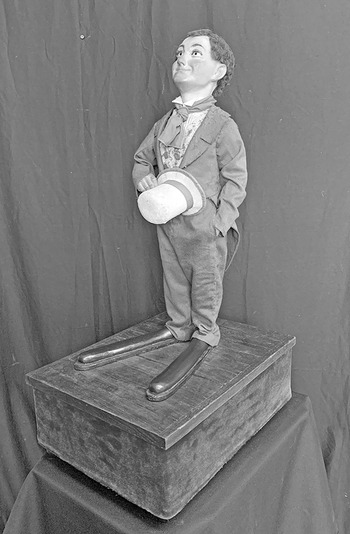
Tich’s dynamic physical comedy was celebrated by many excited crowds throughout the world. As a variety artist, Little Tich worked successfully in the United States and Europe, especially in France where he performed at L’Olympia theatre and the famous Folies Bergère music hall to such acclaim that in 1910 he was made an officer of the Academie française for his service to French theatre.21 The desire to celebrate Little Tich is clearly at work in the automaton designed by the house of Roullet et Decamps in roughly 1910 (see Figure 1.1). The 30-inch tall Little Tich automaton sports the performer’s ginger hair, a charming Victorian-era suit, and a bowler hat. The automaton leans forward precariously at an angle over his gigantic boots while he doffs his bowler hat for the crowd. One of these rare automata is pictured below. It was recently repaired by the House of Automata in Forres, Scotland, and shown on the television show The Restorers (Season 5, Episode 4) and is thought to be one of five remaining in the world.22
Little Tich automaton repaired by the House of Automata in Forres, Scotland

Little Tich was not the only popular performer who found fame and fortune at the Folies Bergère. Nala Damajanti, the Hindu Snake Charmer, was probably the model for an automaton called “The Snake Charmer” by Roullet et Decamps (c. 1900). Made during the height of the orientalist fascination with the so-called exotic women of the East, when the danse du ventre (belly dance) was all the rage, “The Snake Charmer” embodies the automaton as fetish object; she is an eroticized automaton. In her left hand she clasps a snake, and in her right hand she holds a trumpet. With her curvy hips and sensuous movements, including various swivel joints to allow articulation of hands, feet, and hips, she moves rhythmically to one of the four tunes the automaton’s music box plays. The snake also slithers around her. Roullet et Decamps originally intended to exhibit “The Snake Charmer” in the nude until Madame Decamps expressed her moral outrage.23 In response to this, “The Snake Charmer” was then given a more modest costume of metallic gilt with green faux emeralds. Other models for “The Snake Charmer” might have been Miss Paula, the Amphibian Woman, who trained crocodiles and snakes, and performed in next to nothing. Christian Bailly also speculates that the novelist Collette’s repeat performances as the titular heroine Salome in Oscar Wilde’s play, a role that she famously played bare-breasted, might have inspired the creation of this automaton.
The innovative American modern dancer Loïe Fuller (1862–1928) was famous for creating a serpentine dance in which she draped herself in yards of billowy fabrics and used magic lanterns to project lighting all over herself while dancing. Fuller’s avant-garde dance involved yards and yards of gossamer fabric that she manipulated by rods and wands attached to her arms. The fabric swirled and spiraled around her while she danced and colored lights were projected onto the fabric. Fuller brought her serpentine dance to the music hall Folies Bergère in 1892–1893, where she attracted unprecedented crowds and became one of the city’s most beloved celebrities.24 She was able to create different shapes out of her fabric: a butterfly, a snake, a flower, or flames. Fuller is often credited with forming a new movement-based dance expression, and “also for encouraging an early sense of the avant-garde in film and theatre through her experiments in lighting, set design, costuming, and special effects.”25 Often called the mother of modern dance, Fuller’s dances preceded those of Isadora Duncan. Fuller always promoted her stage dancing with electricity as a kind of science commingled with high art. Accompanied by a large orchestra, Loïe regularly performed three dances: “La Serpentine,” “La Violette,” and “Le Papillon.” Through her unique combination of motion and light, Loïe became the newly “modern woman” who embodied the decorative style of Art Nouveau and her dance became the example of the Art Nouveau choreography, which ultimately made Loïe an icon of the Art Nouveau movement. She was celebrated by Henri de Toulouse-Lautrec in over sixty prints in 1893, which depict her manipulating her billowing silk gown into fabulous shapes. In 1900 Fuller built her own theatre at the Paris Universal Exposition, with a sculpture by Pierre Roche in her image above the entryway. Of all the famous female entertainers in 1900 Art Nouveau Paris, including Sarah Bernhardt, Cléo de Mérode, Caroline Otero, Liane de Pougy, and Émilienne d’Alençon, only Loïe had her own pavilion at the exposition.26 In fact, Loïe’s name was associated with revolution – particularly the novelty of electric lighting – and the popularity of the Palace of Electricity embodied the same kind of fluid energy that was synonymous with her dances.27 Patrizia Veroli has argued that because Fuller “conceptualized her dance as the animation of a tableau vivant, as a form-producing mechanism that is set in motion and then stopped, the public had to remain in doubt as to whether the form dancing in front of them was a woman or a machine.”28 Perhaps audiences saw Fuller as a kind of automaton dancer, but they certainly connected her movements to a technologized body. Enthusiasm over electricity exposed the public to the spectacle of electricity and prepared them for the coming technological revolution. When leaving Fuller’s theatre spectators could commemorate their experience by buying commodities of their beloved dancing star: bronze lamps, statuettes, or ashtrays in her image. The Loïe craze extended to fashion, and department stores like Bonmarché as well as the Louvre sold Loïe Fuller skirts, hats, ribbons, shoes, and petticoats. Thus, the Loïe Fuller automata represent a veritable craze that swept through fin-de-siècle Paris. The Lambert automaton of Loïe (c. 1910) depicted her wearing a long, white lace skirt and having blinking eyes (complete with Loïe’s long eyelashes). It signals an interest in her costuming and demonstrates an idealized image of her en pointe. But pointe shoes were not something Loïe actually ever wore in performance; she was often barefoot. The automaton of Fuller is clearly idealized as the prototypical, popular ballet dancer, despite the fact that she danced barefoot.29 Another automaton design of Loïe Fuller from the Bailly collection shows her swathed in fabric and dancing with a smiling moon.30 Dancing with the moon was normally the province of the clown Pierrot, and this indicates that Fuller was an idealized figure. As the “modern woman” of Art Nouveau, Fuller was a model of innovation, so it makes sense that she would be a popular figure for automata. Just as Loïe Fuller could market her own image at the Paris Universal Exposition in 1900 with statues and ashtrays, so too did her automata represent an idealized commodity version or souvenir of herself.
Loïe actually began her career working for another American pop culture icon who was also a brilliant self-publicist: William F. “Wild Buffalo Bill” Cody (1846–1917). He too would be commemorated and fetishized as an automaton. With his long yellow moustache and perpetually lit cigarette, Buffalo Bill was the living embodiment of the hypermasculinity of the American cowboy. His spectacular performances transformed history into power/ knowledge through the great myth of the American West. “As the ‘Knight of the Plains,’ the ‘Last of the Plainsmen,’ or the ‘Last of the Great Scouts,’ Cody was the nostalgic symbol for the ‘disappearing’ west of the buffalo, pioneer, hunter, and cattle trails in the new age of the railroad, the settler and the mining company.”31 Staging frontier dime novel plots in the dramaturgy of melodrama, Buffalo Bill’s show ignored political issues of the day like land exploitation, farmers’ rights, and the rights of Native Americans in favor of high heroics and spectacular entertainment.
Buffalo Bill’s Wild West Show appealed not only to Americans, but was also wildly popular with the French, especially during his performances at the Universal Exposition of 1889.32 During their six-month stay in Paris, members of Buffalo Bill’s Wild West Show narrated a series of different spectacular “epochs” of American history: beginning with Indian dancers, moving onto the Pilgrims, the settlement of the Great Plains, life on a cattle ranch, attacks on a settler’s cabin, buffalo hunts, and demonstrations of marksmanship by Annie Oakley and Cody himself. Directed by Steele MacKaye, these epochs offered a claim of authenticity, but ultimately Cody’s Wild West Show was a nineteenth-century precursor to the spectacular narrative of “the struggle between civilization and savagery that Hollywood would later perfect.”33 Preying on the French love of wide-open spaces, the narrative of the Wild West Show also reinforced dominant notions of colonial entitlement and the subjugation of the colonial other: Both of which were present throughout the Universal Expositions.
Our study ends with the advent of electrical automata. At the turn of the twentieth century, electrical automata were the future and the cutting edge of all mechanical toys. The delicate, hand-wound clockwork Golden Age automata would be a thing of the past, replaced by new, long-running electrical automata.34 By the 1890s, electrical automata appeared in answer to commercial demands. In the effort to attract consumers, the automaton became an ideal advertising object. The innovator of the electrical advertising automata was Jean Marie Phalibois, and such automata made up a large percentage of his production. In 1905, “these are described as ‘animated figurines for window displays driven either by electricity or clockwork motor, figures and groups of all sizes.’”35 The demand for advertising automata was soon so great that Phalibois began making almost nothing else. He quickly became the manufacturer of the figurines for Phoenix washing powder, “Valda” lozenges, and “Star” razors. An automaton placed in a display window drew the eyes of people in the street; its movements could be adapted to display any product.36 As Christian and Sharon Bailly write in The Golden Age of Automata:
At first the automata used for advertising were no different from the mechanical pieces that had been popular as drawing-room ornaments. A typical one might be a little girl with a porcelain head, holding a handkerchief in one hand and in the other a bottle of toilet-water from which seems to pour a few drops. The name of the toilet-water, the essential element, is written in gold letters on the automaton’s velvet covered base.37
The beautiful little girl with the delicate bisque porcelain face and dressed in pale-green velvet with ribbons samples the toilet water with a look of pleasure in her eyes. The little automaton instills the brand name of the perfume into the spectator’s mind.
In another advertising automaton, a well-groomed salesman in a fashionable brown suit demonstrates the wonder of an electric light bulb using the gestures of a carnival barker. His sign tells the viewer, “It’s possible, but it’s certainly not the case that the Z lightbulb is the most robust, the most luminous, and the most current of electric lamps.”38 The salesman demonstrates the product, as the light bulb in his hand turns on and off.
A woman in a fashionable red dress and coat admires herself in the mirror wearing a luxurious hat with elaborate pink feathers. She adjusts the hat with her left hand, as though in a private moment in her front hallway, making her preparations to go out the front door, or perhaps studying herself in a milliner’s shop. This is perhaps the most interesting automaton in terms of mimesis, because the automaton displays her mirrored image. It suggests that she is human, because she can recognize herself in the mirror. We see her looking at herself, powdering her nose, adjusting her hat, and as we gaze at her, she gazes at herself. Despite the fact that she is an automaton and cannot see, this looking is familiar – all of us regularly check our appearances before leaving home, or when trying on a hat. We can identify with the automaton’s moment of self-conscious vanity. What is being mimicked here is the woman’s private preparation for the public realm. So, what is being manufactured in this spectacle is both a feeling of solidarity with all women in this shared reflection, but also a reflection of how a woman has to make herself into a doll, and thereby an automaton, in order to be sufficiently glamorous for public presentation. In this respect, the automaton and mirror present a reflection of the shared struggle of women, being something for the gaze of others. Here advertising works by selling the normalization of a public (and therefore objective) performance as an object as a way of resolving subjective and private feelings of inadequacy about one’s appearance. So, it is not that the woman wants to be the automaton, but that she sees herself in the automaton and therefore gains some private sense of freedom from it, by not being it.
“The triumph of advertising in the culture industry,” says Theodor Adorno, is made possible by “the compulsive mimesis of the consumers onto the cultural commodities, even as they see through them.”39 As the consumer identified with the little automaton – not exactly willingly suspending disbelief, but also not rejecting the charm of the moving object in a sort of “I know it is advertising, but why not buy the hat anyway?” Thus, these electrical advertising automata were double-commodity fetish objects: They represented, created, and produced objects of desire. Automata grew larger in size to fill display windows. “Their gestures also changed – it became common to see automata tap on a store window with a cane, or wave a large sign containing certain information about a product.”40 With attention-getting tricks and the wonders of electricity to bolster their performances, the new advertising automata signaled the growing importance of consumer power in the landscape of commodities. It is important initially that these Golden Age commodity fetish automata were unusual and rare as this increased their value in the eyes of the public; however, these later mass-produced electrical automata were equally desirable, because for the previous generation they were scarce and expensive, and thus owning an automaton meant they were in possession of something once seen as totally unique.
Ultimately, Golden Age automata are predominantly mimetic representations of popular performers of the day, from circus clowns and magicians to actual named performers. The International Expositions used the “exhibitionary complex” to promote nationalism and bourgeois values, and automata that represented performers were a key part of this society of the spectacle. Owning an automaton gave the consumer a chance to take home an object that would allow them to commemorate a special performance and use it to impress guests in their home by demonstrating their appreciation and ownership of the object. The commodity being sold here is status by association – the cleverness of the object, as a manufacturer’s device, alongside the cleverness of the performer, as an object of spectacle – connects the viewer and owner with the culture from which such objects emerge, thereby making them key participants in a greater vision of human achievement and civilization itself. This status by association is a key part of what is sold, and from which such objects, through projection, gain their exchange-value as objects of commodity fetishism. The commodity fetish of a celebrity automaton also allowed the consumer to “own” a piece of the celebrity, and by extension, their glamour. While electrical automata changed the industry, these automata were still desirable commodity fetishes, because of their scarcity for the previous generation, which gave the objects a legacy of uniqueness. But just as automata mimicked performers, so too did performers mimic automata in ballets like Coppélia (1870) and operas like Les Contes d’Hoffmann (1881), both of which are still performed in our contemporary moment. The Golden Age automata show us that the compulsion to copy performance is the mimetic faculty at work, and the consumer’s desire to be associated with such copied performances affords the opportunity to mimic a vision of participating in the performance of progress, civilization, and oneness with human achievement, skill, intelligence, and status.

 Open access