

Following the Asian financial crisis, the Finance Committee highlighted the problem in Malaysia of complicity between significant shareholders and the board of directors in expropriating corporate property to the detriment of the company and its shareholders.Footnote 1 Directors’ duties are owed to the company, and the rule in Foss v Harbottle Footnote 2 requires that the company, rather than its shareholders, should bring proceedings for breaches of these duties. In situations where the alleged wrongdoers wield considerable influence over the board of directors, the company may be unwilling to institute proceedings. The derivative action provides an important means by which shareholders may seek redress for breaches of directors’ duties.Footnote 3
This article analyzes the extent to which the Malaysian statutory derivative action has achieved its objective of facilitating easier access to redress through derivative proceedings. As shareholders are required to obtain leave of the court in order to bring derivative actions, the analysis considers whether the statutory derivative action has enabled shareholders to obtain leave more easily than under previous common law requirements. In this context, the ease by which leave is obtained is ascertained qualitatively, by considering the manner in which the criteria for granting leave were interpreted and applied by the courts, and quantitatively, by reference to the rate of success in obtaining leave. The analysis focuses on derivative actions for breaches of directors’ duties, as directors’ duties are among the significant safeguards for shareholders against self-dealing by directors.Footnote 4
Several methods are used in the analysis. First, all available Malaysian judicial decisions from 2008 to 2015 involving applications for leave to bring derivative actions for alleged breaches of directors’ duties are analyzed by way of descriptive statistics. The analysis considers the rate of success in obtaining leave and the grounds commonly cited for the refusal of leave. Second, the decisions are examined by way of doctrinal analysis in order to better understand how the courts interpreted and applied the criteria for granting leave. Third, a comparison is made with Australian cases to facilitate insights as to whether the Malaysian experience is shared by a comparable common law jurisdiction.
Australia is a suitable jurisdiction for comparison with Malaysia for several reasons. For over fifty years, Malaysian law reformers have drawn from Australian corporate law in drafting statutory reforms, while the courts and scholars have referred to Australian cases in interpreting and applying Malaysian corporate law.Footnote 5 In addition, the Malaysian Court of Appeal’s influential decision in Celcom (Malaysia) Berhad v Mohd Shuaib Ishak Footnote 6 based its restrictive interpretation of the statutory derivative action on the Australian case of Swansson v R. A. Pratt Properties Pty Ltd.Footnote 7 Comparative studies suggest that the implementation of corporate law is affected by the economic and socio-political institutions in individual countries, leading to divergence in interpretation and enforcement even when formal laws appear to converge.Footnote 8 The analysis in this article likewise suggests the possible relevance of corporate ownership structures and perceptions of the role of legal institutions in explaining the different approaches reflected in the analysis of Malaysian and Australian decisions.
Part I outlines the introduction of the statutory derivative action in Malaysia. Part II analyzes Malaysian judicial decisions by way of descriptive statistics. The interpretation and application of criteria for granting leave in Malaysian cases are examined in Part III. Part IV considers comparable Australian data on statutory derivative actions. In Part V, Malaysian and Australian judicial approaches are compared. Part VI analyzes the findings in a broader comparative context and seeks to ascertain possible explanations for the differences in Malaysian and Australian approaches to the statutory derivative action. Part VII concludes.
I. BACKGROUND
The statutory derivative action was introduced in Malaysia in 2007, following a major review of company law by the Corporate Law Reform Committee (CLRC).Footnote 9 The CLRC observed that shareholders faced significant challenges in seeking redress through the common law derivative action. Barriers to shareholder litigation included the necessity of obtaining leave of the court, the inherent ambiguities and restrictiveness of the ‘fraud on the minority’ exception, the cost of litigation, and difficulty in accessing information.Footnote 10 In seeking to alleviate the limitations of the common law derivative action, the CLRC referred to Australian reforms, citing the perceived benefits of the statutory derivative action in facilitating more effective enforcement of shareholder rights.Footnote 11
The CLRC recommended the adoption of a statutory derivative action, taking the view that in considering whether to grant leave, the courts should consider whether the applicants are acting in good faith and whether the derivative action is in the best interests of the companies.Footnote 12 The CLRC’s recommendations were based on reforms in other common law countries, including Australia. Sections 181A and 181B of the Companies Act 1965 were introduced in 2007, largely in accordance with the CLRC’s recommendations. The reforms allow the courts to grant shareholders leave to bring derivative actions on less onerous criteria than that imposed by common law. Leave to bring a statutory derivative action may be granted even if the general meeting were to ratify the impugned conduct.Footnote 13 The courts were also given powers to allow shareholders access to corporate information and to order that litigation costs should be borne by the company.
The CLRC recommended that the common law derivative action should be abolished.Footnote 14 This suggestion was not implemented, and as a consequence, the statutory derivative action co-exists with the common law derivative action in the Malaysian legal framework. The preservation of the common law derivative action was criticized as potentially giving rise to uncertainty and confusion.Footnote 15 Choong and Balan anticipated that these potential problems would be mitigated by a decline in reliance on the common law derivative action. They argued that the common law derivative action would ‘be disused and eventually become redundant’, reasoning that shareholders would rely on the statutory derivative action which offers better access to redress.Footnote 16 Nevertheless, the analysis of judicial decisions in this study indicates that a significant proportion of applications for leave to bring derivative actions have been determined on the basis of the common law despite the availability of the statutory derivative action. Notably, the Companies Act 2016, which came into effect on 31 January 2017, abolishes the common law derivative action.Footnote 17
II. Malaysian cases 2008-2015
This part examines all available Malaysian judicial decisions from 2008 to 2015 involving applications for leaveFootnote 18 to bring derivative actions for breaches of directors’ duties. The analysis considers the rate of success in obtaining leave and the grounds commonly cited for the refusal of leave. A comparison is made with cases decided from 1999 to 2006 to ascertain whether there has been any difference in the rates of success in obtaining leave following the introduction of the statutory derivative action in 2007. In order to ensure that a comprehensive search for judicial decisions involving allegations of impropriety by directors was conducted, searches were made on the Lexis and CLJ Law databases for Malaysian cases using the search term ‘derivative’. The two major Malaysian law reports are the Malayan Law Journal (MLJ) and Current Law Journal (CLJ). MLJ cases are available on the Lexis database and CLJ reports are available online through the CLJ Law electronic database. The searches identified thirty-two relevant reported and unreported judicial decisions from 2008 to 2015 involving applications for leave to bring derivative actions for breaches of directors’ duties.
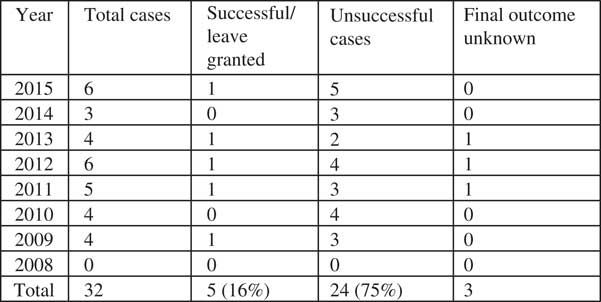
Figure 1 shows that there were thirty-two decisions involving shareholders’ derivative actions from 2008 to 2015. Leave to bring derivative actions was granted in five cases (16 per cent). Twenty-four out of the thirty-two cases (75 per cent) were unsuccessful cases that failed in the initial stages. Leave to bring a derivative action was refused in eighteen of the unsuccessful cases. Six cases were struck out in early stages of the application for leave.Footnote 19
Derivative actions from 2008 to 2015

In order to gain a better understanding of the reasons behind the low success rate in derivative actions, the reasons for judgment were examined to ascertain why leave was refused. Many cases cited several reasons for the refusal of leave. As it was not clear from the reasons for judgment as to the weight placed on various issues in coming to the conclusion that leave should not be granted, this analysis does not seek to rank the reasons in terms of importance. Greater emphasis is placed on the recurrent mention of specific issues of concern, rather than how determinative they may have been in the courts’ decisions.
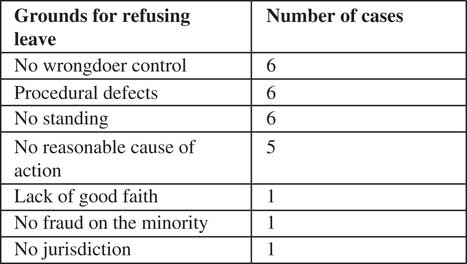
Grounds for refusing leave in derivative actions from 2008 to 2015
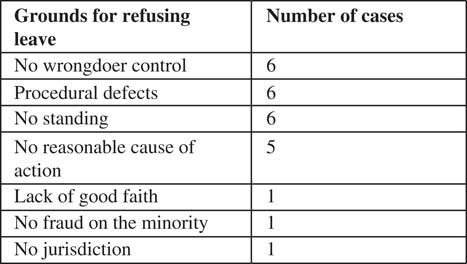
The three most common grounds cited for refusing leave were the absence of wrongdoer control,Footnote 20 lack of locus standi,Footnote 21 and procedural defects.Footnote 22 Each of these grounds was cited in six cases. The absence of wrongdoer control was cited in four cases in which the courts found that the plaintiff had no locus standi.Footnote 23 The absence of a reasonable cause of action or reasonable prospects of success was cited in at least four cases in which leave to bring a derivative action was refused, while another case in which the claim was not supported by the evidence was struck out.Footnote 24 Other reasons for refusal of leave include a lack of good faithFootnote 25 and the absence of fraud on the minority.Footnote 26 One case was dismissed on grounds that the court did not have jurisdiction over foreign companies.Footnote 27
In many cases, costs were awarded to the successful party. Hence, in line with the high proportion of unsuccessful derivative actions, costs orders were made against the plaintiff in more than half of the cases. There were no orders as to costs, or costs were left to subsequent proceedings, in a few cases. In eighteen of the thirty-two derivative actions (56 per cent) brought, plaintiffs were required to pay the defendants’ costs as well. Plaintiffs were awarded costs in only three cases. The costs would arguably have been prohibitive for individuals who were the litigants in most cases. Costs are regarded as a significant disincentive to shareholders’ enforcement of their rights through litigation, and the statutory derivative action provides the courts powers to order shareholders’ costs to be paid by the defendant.Footnote 28 There was no indication in the decisions that this power was used. However, the CLRC anticipated that this power should be used in cases where the applicants were successful.Footnote 29 As costs are usually awarded to the successful party in any event, the statutory power to award costs is arguably of little effect.
The statutory derivative action further gave the courts the power to make orders to facilitate shareholders access to corporate information.Footnote 30 This provision was intended to assist shareholders who are not involved in management to overcome barriers to accessing the necessary information.Footnote 31 There was no indication in any of the thirty-two decisions involving derivative actions that the power had been used to facilitate shareholder access to information. By contrast, there were five cases where leave was refused or the case was struck out on grounds that there was insufficient evidence or there was no reasonable cause of action. These could potentially have been situations in which the courts could have used the power to facilitate the applicants’ access to information. However, there was no discussion in any of these judgments on the possible use of this power.
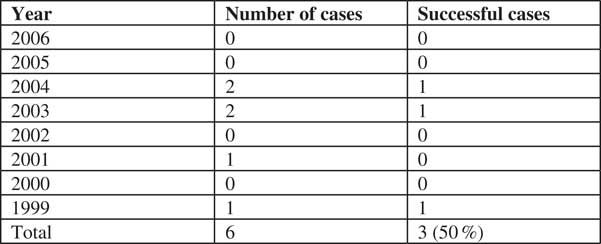
Figure 3 shows the number of derivative actions from 1999 to 2006. There were six reported and unreported cases involving derivative actions during this period, which is an average of 0.75 cases each year.
Derivative actions from 1999 to 2006

When compared with the number of derivative actions from 2008 to 2015 shown in Figure 1, it is clear that since the introduction of the statutory derivative action in 2007, the number of reported and unreported derivative actions has increased substantially. There is an average of four derivative actions yearly for the period 2008 to 2015. Despite the increase in the average annual number of derivative actions, the rate of success in obtaining leave has declined. While leave was obtained in an average of 50 per cent of the derivative actions from 1999 to 2006,Footnote 32 the average for 2008 to 2015 is 16 per cent.
Figure 2, indicated earlier, highlights the absence of wrongdoer control as among the most commonly cited reasons for refusal of leave to bring derivative actions. The recurrent refusal of leave on grounds that wrongdoer control was not proved is incongruous with the statutory derivative action.Footnote 33 Section 181B(4) of the Companies Act 1965 makes no mention of any need to prove wrongdoer control. The criteria for leave under Section 181B(4) are good faith and that the proceedings appear to be prima facie in the best interests of the company. Wrongdoer control is an essential element of the ‘fraud on the minority’ exception of the rule in Foss. Hence, the recurrent refusal of leave on the ground that wrongdoer control was not proven is reminiscent of the common law derivative action.
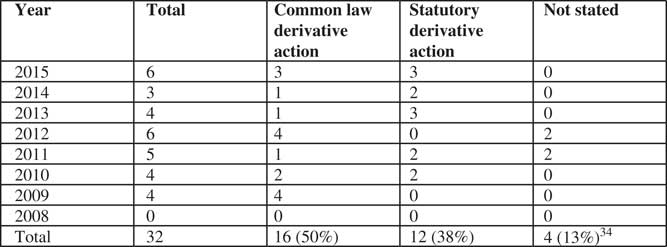
A closer scrutiny of the cases indicates that many of the cases were decided by reference to common law principles. Figure 4 below shows the number of cases which were decided on the basis of common law principles and the cases which were decided by reference to Sections 181A and 181B of the Companies Act 1965.
Basis of decisions

Figure 4 shows that the matters were decided solely by reference to common law principles in sixteen (or 50 per cent) of the thirty-two cases. In these cases, there was no discussionFootnote of the statutory derivative action. In three cases, this may be explained by the proceedings having commenced prior to the introduction of the statutory derivative action.Footnote 35 However, even in cases as recent as 2015, decisions on the granting of leave have in some cases been based solely on the common law.Footnote 36 The judgments for the sixteen cases in which the decisions were based solely on the common law did not contain any discussion of the statutory derivative action, and it is not known whether Sections 181A and 181B of the Companies Act 1965 were raised during the proceedings.
Section 181A of the Companies Act 1965 expressly preserves the operation of the common law derivative action. Accordingly, litigants had the option of relying on the common law derivative action from 2008 to 2015. However, given the less onerous criteria under the statutory derivative action, the logical choice for shareholders seeking to bring derivative actions would have been to rely on Sections 181A and 181B of the Companies Act 1965. As applicants would have benefitted from the application of the less onerous criteria under the statutory derivative action, the applicants’ lawyers should arguably have attempted to have the matter decided by reference to statute. Part III further considers possible reasons for the substantial proportion of applications which were decided solely on the basis of common law principles.
In addition, the facts of these cases indicated that they did not fall outside the ambit of the statutory derivative action. Cases from Australia indicate that at times, litigants rely on the common law derivative action where the statutory derivative action is not available to them, such as where the company is a foreign company. However, this was not the case with the sixteen Malaysian cases which were decided solely by reference to common law principles. On the contrary, the facts of the cases indicate that the statutory derivative action should have been available to the applicants.
Figure 4 indicates that twelve cases (38 per cent) were decided on the basis of Sections 181A and 181B of the Companies Act 1965. When the cases decided by reference to the statutory derivative action were examined,Footnote 37 it was apparent that these cases had a higher rate of success than cases decided under common law principles. The last column of Figure 4 shows the number of judgments which were very brief and did not set out the basis for the decisions. Four (13 per cent) of the cases from 2008 to 2015 fell within this category and, accordingly, it is not clear whether these decisions were made based on common law principles or Sections 181A and 181B of the Companies Act 1965.
Leave was granted in 25 per cent of the applications decided by reference to the statutory derivative action. Cases decided by reference to common law principles were less successful in obtaining leave, with leave granted in only 13 per cent of the cases. The comparison clearly indicates that cases decided by reference to the statutory derivative action had better outcomes than the cases determined under the common law. Nevertheless, the results show that even under the statute, shareholders seeking leave to bring derivative actions for breaches of directors’ duties were successful in only 25 per cent of cases. In order to better understand the basis on which leave was granted or refused under the statutory derivative action, the principles relied on by the courts in deciding whether to grant leave are discussed below.
III. INTERPRETATION AND APPLICATION OF THE CRITERIA FOR GRANTING LEAVE BY THE MALAYSIAN COURTS
One of the significant factors on which the success of cases turns is the way in which the courts interpret and apply the relevant law. The leading case on the statutory derivative action in Malaysia is the Court of Appeal decision in Celcom. Footnote 38 The case has been influential for its judicial interpretation of the criteria for the granting of leave under Section 181B of the Companies Act 1965. To recap, Section 181B states that in deciding whether to grant leave, the court should consider whether the complainant is acting in good faith and whether it appears prima facie to be in the best interests of the company that the application for leave be granted.Footnote 39 Thirty days’ notice in writing to the directors of the intention to bring a derivative action is also required.Footnote 40
In Celcom, the Court of Appeal remarked that ‘leave to bring a derivative action must not be given lightly’, citing the Australian case of Swansson v R. A. Pratt Properties Pty Ltd.Footnote 41 Abdul Hamid Embong JCA stated:
The learned judge must as a matter of judicial prudence exercise a greater caution in satisfying himself that the requirements under s181A of the [Companies Act] are met. A low threshold of merely determining if there existed a prima facie case is therefore a wrong basis for granting the leave. There needs to be a strict interpretation of s181A of the [Companies Act].Footnote 42
The plaintiff in Celcom was a former shareholder who alleged that the directors of Celcom (Malaysia) Berhad had caused the company to breach an agreement which resulted in a mandatory general offer being made at a lower share price. As a consequence, the plaintiff’s shares were compulsorily acquired at RM2.75 per share. The plaintiff asserted that the acquisition would have taken place at RM7.00 per share if the directors had not caused the company to breach the agreement. The court of first instance granted the shareholder leave to bring a derivative action. On appeal, the trial judge’s grant of leave was overturned. The Court of Appeal held that the trial judge had too readily granted leave, asserting that Section 181A of the Companies Act 1965 should be applied restrictively. In reaching the decision, the Court of Appeal took into account the fact that a committee of independent directors had reached the decision in question on the basis of legal advice. The Court of Appeal was reluctant to interfere with the commercial decisions of disinterested directors.
The Court of Appeal considered the criterion of ‘good faith’ specified in Section 181B. Citing Swansson, the court observed that this involved considering whether ‘the applicant honestly believes that a good cause of action exists and has reasonable prospects of success’.Footnote 43 Further, the application should not have been brought for a collateral purpose. The court also considered the criterion in Section 181B(4) as to whether it ‘appeared prima facie to be in the best interest of the company that the application for leave be granted’, noting that Swansson had raised the issue of reasonable prospects of success.Footnote 44
On the facts, the Court of Appeal held that the applicant lacked good faith. The court reasoned that the applicant was merely advancing his personal interests, as he had brought a personal action against the defendant in relation to the same subject matter. This conclusion appeared to have been influenced in part by the applicant having ceased to be a member six years prior to the proceedings. The proceedings were also found to be counterproductive to the company’s interest. Success of the application would have entailed unwinding of the entire mandatory general offer, which would have been detrimental to the company’s market reputation and caused substantial hardship to shareholders. There was ‘no reasonable commercial sense’ to the proposed derivative action.Footnote 45
The Court of Appeal’s decision in Celcom has often been cited for its exposition of the principles to be applied in interpreting Sections 181A and 181B.Footnote 46 In Lembaga Tabung Angkatan Tentera v Prime Utilities Bhd, Footnote 47 the court referred to the Court of Appeal decision in Celcom and applied the test of good faith espoused in that case. Hashim J found that the plaintiff, an institutional shareholder, had established through affidavit evidence that it was acting in good faith.Footnote 48 There was no evidence of collateral purposes. Her Honour referred to the criterion that the granting of leave should appear prima facie to be in the best interest of the company. Noting that the plaintiff’s affidavits showed that the complaints were ‘not without basis or substance’, leave was granted to the institutional shareholder to bring a derivative action.Footnote 49
In many of the cases, however, the judgments emphasized the need for a restrictive application of the statutory derivative action espoused by the Court of Appeal in Celcom.Footnote 50 This appears to have engendered some caution in the granting of leave to bring statutory derivative actions. The cases indicate that the courts often referred to several other criteria in addition to the conditions expressly set out in Sections 181A and 181B in deciding whether to grant leave. At times, these were considered as part of Section 181B(4)(b) – whether it was prima facie in the best interests of the company that leave be granted. For instance, the courts examined whether there were reasonable prospects of successFootnote 51 or considered the strength of evidence adduced in support of the claim.Footnote 52 Applicants were also required to have exhausted all internal management avenues, demonstrating to the courts’ satisfaction that the company would not bring proceedings against the directors for the wrongs alleged.Footnote 53 This condition appears to have a less obvious connection with the criteria set out in Sections 181A and 181B of the Companies Act 1965.
The cases indicate that the Malaysian courts have drawn on common law principles in interpreting the statutory derivative action. Consequently, some of the restrictions of the common law derivative action have encroached on the statutory derivative action, limiting the latter’s effectiveness in facilitating shareholders’ access to judicial redress. An example of this is seen in the refusal of leave in Suhaimi Ibrahim v Hi-Summit Construction Sdn Bhd. Footnote 54 Leave was refused on the ground that the applicants were not a genuinely aggrieved minority, despite the absence of any express requirement in Sections 181A and 181B to that effect. When imposing these conditions, the courts referred to the purpose of the common law derivative action, emphasizing its role in allowing minority shareholders to bring proceedings where wrongdoers are in control of the board.Footnote 55 Accordingly, the judges reasoned that the implied purpose of the statutory derivative action was likewise to allow an aggrieved minority to seek redress. The effect of this judicial approach was to limit the statutory derivative action to ‘genuinely aggrieved minorities’,Footnote 56 although Sections 181A and 181B do not contain such restrictions. This resonates with a purposive approach, rather than a more literal approach based on the ordinary meaning of the words.Footnote 57 Nonetheless, the law reform reports canvassed in Part I indicate that the statutory derivative action was intended to alleviate the limitations of the common law derivative action, raising questions as to whether the extent to which judges have imported restrictions from common law is consistent with the underlying aims of the reforms. The influence of common law principles on the interpretation of the statutory derivative action is reflected in the emphasis on the need for wrongdoer control which prevents the company from pursuing legal action,Footnote 58 and citation of Malaysian authority on the common law derivative action.Footnote 59 Similarly, in Dato’ Daljit Singh a/l Gurdev Singh v Forefront Online Sdn Bhd, the judge referred to common law principles in Foss in interpreting the statutory derivative action.Footnote 60 In contrast with the Malaysian courts, the analysis of Australian decisions in Part IV below indicates that the Australian courts did not import such restrictions from the common law.
In addition, the cases indicate that the Malaysian courts often took a strict approach towards compliance with formal requirements, with the result that in a significant number of cases, leave was refused on grounds of technicalities. As will be seen in Part IV below, the Australian cases demonstrate a more pragmatic and liberal approach to the requirements for leave, focussing on the substance rather than the form of the requirements. The remainder of this part describes the manner in which the courts have applied the legal principles considered to be relevant to the decision whether to grant leave to bring derivative actions under Sections 181A and 181B of the Companies Act 1965.
As earlier observed, the Court of Appeal decision in Celcom Footnote 61 has been influential on Malaysian decisions involving the statutory derivative action. One of the cases in which the restrictive approach espoused in Celcom was cited is Abdul Rahim Suleiman v Faridah Md Lazim. Footnote 62 The judgment in this case cited a number of quotes from Celcom, such as: ‘there needs to be a strict interpretation of s. 181A’; ‘s.181A [CA] should thus be restrictively applied’; ‘we agree that the court should thus not interfere and substitute its own judgment in what we hold to be was a proper and prudent business and commercial decision of the directors’; ‘leave should not be too easily allowed in an application of this nature’; and ‘leave is a filtering process which in this instance, the court should have used with vigilance’.Footnote 63
The court refused leave on grounds that the derivative action had no reasonable prospect of success, and it was not prima facie in the best interests of the company that leave should be granted. In addition, the court found that the notice requirements of Section 181A were not met on the basis of a number of technicalities. The case arguably demonstrates a strict application of the notice requirements. The court appeared to impose additional technical requirements, above and beyond what a literal interpretation of Section 181A necessitates.
First, the judge stated that the complainant should have given notice of his or her intention to make an application under Section 181A of the Companies Act 1965 to all the individual directors of the company in question. Notice to the board of directors was held to be inadequate, despite the fact that Section 181B(2) of the Companies Act 1965 merely requires notice to be given to the directors of the company. Second, the applicant had sent several letters informing the defendants of the matters complained of and the intention to seek leave to bring derivative proceedings. However, these were considered to be inadequate for the purposes of Section 181B(2). Wong JC asserted that notice requirements were important to ensure that the company’s internal processes were duly exhausted before derivative proceedings are brought.Footnote 64 A comparison with the Australian cases in Part V below demonstrates that the Australian courts have taken a different and more pragmatic approach to notice requirements.
A restrictive approach is also reflected in the case of Lim Aik Chin v Hong Leong Bank Bhd. Footnote 65 In this case, Lim JC observed that there was a need to construe Sections 181A and 181B of the Companies Act 1965 strictly. His Honour cited the Court of Appeal’s ruling in Celcom that ‘leave to bring a derivative action must not be given lightly’ and that Section 181A should ‘be restrictively applied’.Footnote 66 Consequently, the application for the grant of leave retrospectively was refused. The requirement of thirty days’ notice was also strictly interpreted, and the plaintiff’s failure to comply with this criterion was held to preclude the court’s grant of leave.Footnote 67
As noted above, half of the applications to bring derivative actions were decided based on common law principles.Footnote 68 Many of these cases relied on the fraud on the minority exception to the rule in Foss. The most commonly cited ground for refusal of leave was the lack of wrongdoer control,Footnote 69 failure to comply with procedural requirements,Footnote 70 and the lack of evidence.Footnote 71 The judgments for cases decided on the basis of common law did not contain sufficient detail to determine the reasons why the decisions were based on common law, rather than the statutory derivative action. The statutory derivative action was not mentioned in these judgments. In examining one of the cases decided under common law, Salim posits that the plaintiffs may have opted to bring a common law derivative action instead of a statutory derivative action on the misconception that the former did not require leave of the court.Footnote 72 Nevertheless, locus standi must be determined as a preliminary hurdle under common law. Consequently, Salim argues that in the interest of clarity, the common law derivative action should be abolished. Following the introduction of the Companies Act 2016 which came into effect on 31 January 2017, common law derivative actions are no longer permitted in Malaysia.
In summary, the analysis above demonstrates that the statutory derivative action has had a limited effect in facilitating shareholder access to redress. Leave to bring derivative actions has been granted in 25 per cent of cases by reference to the criteria specified in Section 181B of the Companies Act 1965, which are less onerous than the requirements of the common law derivative action. Applications for leave decided by reference to Sections 181A and 181B had a higher rate of success than applications decided by reference to common law principles. Shareholders obtained leave to bring derivative actions in only 13 per cent of cases decided under common law from 2008 to 2015. When compared with the decisions from 1999 to 2006, there was an increase in the number of applications for leave to bring derivative actions after 2007. However, the rate of successful applications decreased from 50 per cent during the period from 1999 to 2006, to 25 per cent under the statutory derivative action. The low success rate in obtaining leave to bring derivative actions may be attributed, at least in part, to a restrictive judicial approach to the granting of leave under the statutory derivative action and continued reliance on common law principles.
IV. AUSTRALIAN STATUTORY DERIVATIVE ACTIONS
This part examines the Australian approach to statutory derivative actions for the purpose of comparison with the Malaysian position in Part V. Australia is a comparable jurisdiction for the reasons stated earlier, including consistent reference to Australian corporate law by Malaysian law reformers, courts, and scholars for many decadesFootnote 73 and reliance on Australian case law in the influential Court of Appeal decision in Celcom.Footnote 74 The statutory derivative action was introduced in Australia following several government reports which emphasized the limitations of the common law derivative action.Footnote 75 The reports proposed the introduction of a statutory derivative action in order to alleviate these difficulties. While the statutory derivative action has been an important means of facilitating better shareholder enforcement of breaches of directors’ duties, it is worth noting that public enforcement of directors’ duties is more robust in Australia than in Malaysia.Footnote 76 Australian regulators have a broader range of enforcement mechanisms in addition to criminal proceedings, such as civil penalty proceedings,Footnote 77 enforceable undertakings,Footnote 78 and disqualification of directors under Section 206F of the Corporations Act 2001 (Cth) for breaches of directors’ duties.Footnote 79
The legal principles on which the courts in Australia grant leave to bring derivative actions are set out in Sections 236 and 237 of the Corporations Act 2001 (Cth).Footnote 80 Section 237(2) sets out the criteria for granting of leave, stating that the Court must grant the application for leave to bring a derivative action if it is satisfied that:
(a) It is probable that the company will not itself bring the proceedings, or properly take responsibility for them, or for the steps in them; and
(b) the applicant is acting in good faith; and
(c) it is in the best interests of the company that the applicant be granted leave; and
(d) if the applicant is applying for leave to bring proceedings – there is a serious question to be tried; and
(e) either:
(i) at least 14 days before making the application, the applicant gave written notice to the company of the intention to apply for leave and of the reasons for applying; or
(ii) it is appropriate to grant leave even though subparagraph (i) is not satisfied.
Although the Australian statute sets out more criteria for the granting of leave, the Malaysian courts have in practice relied on similar criteria in considering whether to grant leave to bring derivative actions under the Malaysian statutory equivalent.
A. Australian Judicial Decisions from 2008 to 2015
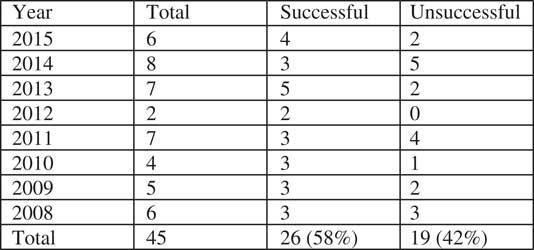
Australian judicial decisions from 2008 to 2015 involving applications for leave to bring statutory derivative actions for breaches of directors’ duties are examined in this Part. The analysis provides comparable data which facilitates a determination of whether Australian applications for leave had a comparable success rate to Malaysian applications for leave to bring derivative actions for breaches of directors’ duties. In order to facilitate the cross-country comparison, a search was conducted for all available Australian judicial decisions involving applications for leave to bring derivative actions against directors for breaches of their duties from 2008 to 2015. The search term ‘derivative’ was used to identify relevant cases on the LexisNexis Australia database. From the search, forty-five relevant cases involving applications for leave to bring derivative actions under Sections 236 and 237 of the Corporations Act 2001 (Cth) were identified. As with Malaysian derivative actions, the analysis examines the rate of success in obtaining leave to bring derivative actions, as set out in Figure 5 below.
Australian applications for leave to bring shareholders’ derivative actions
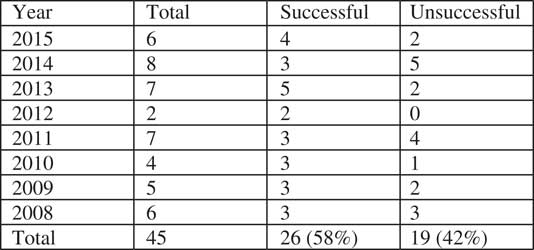
Figure 5 indicates that in 58 per cent of the cases, shareholders were granted leave to bring derivative actions under Sections 236 and 237 of the Corporations Act 2001 (Cth). 42 per cent of the applications for leave were unsuccessful. The proportion of successful and unsuccessful applications was quite evenly distributed throughout the eight-year period.
The rate of success in obtaining leave in the Australian cases was substantially higher than in Malaysian cases. As noted in Figure 1, only 16 per cent of Malaysian applications for leave to bring shareholders’ derivative actions for breaches of directors’ duties were successful over the same period. Although the Malaysian cases decided under the statutory derivative action had a higher success rate than cases decided under common law, this was less than half the rate of success for Australian statutory derivative actions. In Part I above, it was observed that 25 per cent of the Malaysian applications for leave under the statutory derivative action were successful, substantially less than the 58 per cent of successful Australian applications for leave to bring statutory derivative actions.
In order to better understand the reasons for the difference in success rates, the Australian judicial decisions are examined by way of doctrinal analysis in Part IV.B below. The analysis considers the manner in which the criteria set out in Section 237(2) of the Corporations Act 2001 (Cth) have been interpreted and applied. Subsequently, Part V below highlights differences in approaches adopted by Australian and Malaysian courts on several issues.
B. Australian Courts’ Interpretation and Application of the Criteria for Granting Leave
In deciding whether to grant leave to bring derivative actions under Section 237(2) of the Corporations Act 2001 (Cth), the Australian courts commonly considered five criteria, in line with the matters specified in Section 237(2), which are required to be satisfied in order for leave to be granted. The first criterion to be established by the applicant is the probability that the company itself will not bring proceedings. The cases reflect a pragmatic approach by the courts, who have been willing to find that this criterion was satisfied where the directors of the company had been informed of the applicant’s complaints and had not taken any steps against the directors for breaches of their duties, particularly where board decisions depended on directors who were alleged to have breached their duties.Footnote 81 Judges reasoned that directors were unlikely to authorize the company to bring proceedings against themselves. Likewise, where the directors were likely to be deadlocked as to whether proceedings should be brought, the courts have found that it was probable that the company would not bring proceedings.Footnote 82
The second criterion considered by the Australian courts for the granting of leave to bring a derivative action relates to whether the applicant is acting in good faith. In determining whether the requirement of good faith is satisfied, case law suggests that two inter-related factors are examined. The first relates to whether the applicant honestly believes that ‘a good cause of action exists and has a reasonable prospect of success.’Footnote 83 The second factor is whether the applicants are acting for a collateral purpose.Footnote 84 The authorities clearly state that the courts should readily draw an inference of good faith where the applicant has a substantial economic interest in the company and would indirectly benefit from any recovery by the company as a result of the proceedings.Footnote 85
The requirement of good faith is relatively easy to satisfy where the applicant holds more than a token shareholding and the derivative action seeks recovery of property which would increase the value of the applicant’s shares.Footnote 86 Where the applicant has clearly devoted significant efforts in applying for leave to bring a derivative action, this has been found to support the court’s finding of good faith.Footnote 87 In Dynamic Industries Pty Ltd, it was found that the applicant’s efforts and expenses incurred in obtaining access to the books of the company and in undertaking to indemnify the company in respect of the costs of proceedings, supported the finding that the proceedings were brought in good faith.Footnote 88
The third matter for the granting of leave is whether it is in the best interests of the company that leave be granted. Case law indicates that there is a high threshold to be met with regard to this matter.Footnote 89 Factors considered by the courts in relation to this point include the prospects of success, likely costs, likely recovery if the action succeeds, and likely consequences if the action is unsuccessful.Footnote 90 The courts also consider whether the company would be prejudiced by being exposed to the cost and expense of litigation and risks of adverse cost orders.
The grant of leave is often conditional on the applicant indemnifying the company for costs.Footnote 91 This is seen as an important means of alleviating risks which might otherwise flow to the company from the proceedings. Conversely, the lack of an adequate indemnity to safeguard the company against exposure to the costs of proceedings reduces the likelihood of leave being granted.Footnote 92 In Cooper v Myrtace Consulting Pty Ltd, the applicant did not have the financial capacity to provide an adequate indemnity.Footnote 93 The court took this into account in refusing leave on grounds that it was not satisfied that the proceedings were in the best interests of the company. Prospects of success are also relevant to the question of whether the proceedings are in the company’s best interests.Footnote 94 In Re Fishinthenet Investments Pty Ltd and Coastal Waters Seafood Pty Ltd, Footnote 95 the prospect of significant recovery was so slight that the proceedings were held not to be in the company’s interest.
Fourth, the courts assess whether there is a serious question to be tried. The test applied is similar to the test used in relation to interlocutory injunctions.Footnote 96 This involves ascertaining whether the applicant has established a prima facie case. More specifically, there should be a sufficient likelihood of success at the trial.Footnote 97 In this regard, there is some overlap between the prospects of success considered in relation to the question of whether the proceedings are in the best interest of the company. In addition, there is a need to consider whether the inconvenience or injury that the applicant would suffer, as a result of leave being refused, would outweigh the injury which the defendant would suffer if leave is granted.Footnote 98
Finally, the courts consider whether adequate notice has been given to the company of the intention to apply for leave and of the reasons for applying for leave. A default notice period of at least fourteen days is specified in Section 237(2)(e)(i), although the provision allows for some flexibility in this matter. The courts are permitted to grant leave in appropriate cases despite fourteen days’ notice not having been given, and the cases reflect a pragmatic approach by the courts on the issue of notice.Footnote 99
V. Comparison of Malaysian and Australian judicial approaches
As observed in Part III, the analysis of Malaysian cases reflects a narrow and strict application of the statutory derivative action, with cases often citing Celcom as authority for the restrictive interpretation. This part compares judicial approaches in Malaysia and Australia, and finds that the Australian cases reflect a more liberal and pragmatic approach than is seen in Malaysian cases. Nevertheless, at first glance, there are significant differences in the criteria for granting leave under the Malaysian and Australian statutes. The Australian requirements for granting leave are more extensive than their Malaysian counterparts. However, an examination of judicial approaches reveals that, in practice, the Malaysian courts have imported several additional criteria. As a result, when considering whether to grant leave to bring derivative actions under Sections 181A and 181B of the Companies Act 1965, the Malaysian courts consider similar criteria to the express requirements of Sections 236 and 237 of the Corporations Act 2001 (Cth).
Both the Malaysian and Australian statutes require the courts to be satisfied that the applicants are acting in good faith and that the grant of leave would be in the best interests of the company. Likewise, adequate notice should have been given to the company of the applicants’ intentions to apply for leave and of the reasons for the application. In Malaysia, thirty days’ notice is required, while the default notice period in Australia is fourteen days.Footnote 100 The Australian statute specifies two additional criteria. The first concerns the probability that the company itself will not bring proceedings, while the second requires that there should be a serious question to be tried. Although these are not expressly set out in the Malaysian statute, the courts have imposed similar requirements on applicants, reasoning that it would not be in the interests of the company to grant leave if these criteria are not satisfied. As observed in Part III above, the Malaysian courts have refused leave on the ground that the applicant had not shown that the company was unwilling to bring proceedings for the wrongs alleged. In Suhaimi Ibrahim,Footnote 101 the court required internal processes to have been exhausted prior to seeking leave.
As for the criterion that there is a serious question to be tried, the Australian courts have examined whether the applicant has established a prima facie case, and whether there is sufficient likelihood of success at trial.Footnote 102 These considerations have been taken into account by Malaysian courts in assessing whether granting leave would be in the best interests of the company. In the case of Lee Suan Ngee v On Network Sdn Bhd,Footnote 103 leave to bring a derivative action was deemed not to be in the best interests of the company due to the lack of evidence. Likewise, in Abdul Rahim Suleiman, Footnote 104 leave was refused as the derivative action was deemed to have no reasonable prospect of success. Consequently, the court held that it was not prima facie in the best interests of the company that leave should be granted.
Having established that the Malaysian and Australian courts have applied similar criteria in considering whether to grant leave to bring derivative actions, the discussion now turns to the application of these principles to the facts of cases. The analysis indicates that there are significant differences in judicial approaches between the two jurisdictions. In summary, the Australian courts have adopted a pragmatic approach and demonstrated a greater propensity towards positive findings that specific criteria have been met. In particular, the Australian courts have applied a lower threshold for the criterion of good faith. The Australian courts have also readily drawn inferences from surrounding circumstances that the requisite criteria of good faith, and the probability that the company itself would not bring proceedings, have been met. The Malaysian courts, on the other hand, have often reiterated the need for a restrictive interpretation of the statutory derivative action. Malaysian cases reflect a stricter approach to the requirements for the granting of leave, often citing the principle that ‘leave should not be given lightly’.Footnote 105 While the Malaysian courts have adhered strictly to formal notice and procedural requirements, this trend is not seen in Australian cases. The contrasting position of the Australian and Malaysian courts is also apparent in applications for retrospective leave to bring derivative actions. A final observation concerns the courts’ power to grant applicants access to the company’s books. While orders for access to the company’s records have been made in a number of Australian cases, Malaysian cases demonstrate limited use of these powers. These findings are examined in further detail below.
One of the significant differences in the approaches of the Malaysian and Australian courts centres on the divergent ways in which both courts have interpreted and applied the Australian case of Swansson. Footnote 106 This case is referred to as an authority in setting out the principles to be applied in granting leave under the statutory derivative action in both jurisdictions. In Malaysia, this case has been cited as the basis for the proposition that leave to bring derivative actions should not be granted lightly. This may be attributed to the influential Malaysian Court of Appeal decision in Celcom, Footnote 107 which is frequently referred to by Malaysian courts.
Notably, the decision in Swansson did not impose a single standard across all the criteria specified by statute for the granting of leave. Instead, the judgment stated that the requirement of good faith is relatively easy to satisfy.Footnote 108 The relative ease with which applicants may satisfy the requirement of good faith has been reiterated in the Australian cases,Footnote 109 but is absent from the Malaysian cases. Instead, Malaysian cases have cited the need for a restrictive approach in granting leave without differentiating the threshold for the criterion of good faith. Notably, the judgments in Swansson and other Australian cases drew a clear distinction between the lower threshold applicable to the criterion of good faith, and the higher threshold required of the criteria that the grant of leave should be in the interests of the company and whether there is a serious question to be tried.Footnote 110
The Australian cases reflect a more liberal judicial approach toward a positive determination of good faith. The authorities clearly state that the Australian courts should readily draw an inference of good faith where the applicant has a substantial economic interest in the company and would indirectly benefit from any recovery by the company as a result of the proceedings.Footnote 111 Inferences of good faith have also been made where applicants have devoted significant efforts in applying for leave.Footnote 112 Malaysian cases provide few details on the facts which led the courts to positive findings of good faith. However, differences in approaches between the Australian and Malaysian courts are evident in situations where there is a history of animosity between the parties.
In the Malaysian case of Daljit Singh v Forefront Online Sdn Bhd,Footnote 113 the court held that the applicant lacked good faith, noting that there had been ongoing disputes between the parties for some years. Abu Backer JC reasoned that the application for leave was a ‘collateral step’ in the dispute between the parties.Footnote 114 His Honour noted that the applicant had delayed in seeking leave to bring derivative proceedings and was reluctant to hear the application in the absence of the defendant who had not entered an appearance. In finding that the applicant lacked good faith, the judge emphasized the parties’ acrimonious relationship, but provided no further explanation as to why the application for leave was deemed to be a collateral step in the dispute between the parties. The applicant was a shareholder and director of the defendant company and was seeking to bring a derivative action to recover monies owed to the defendant company. As a shareholder and director, he would have stood to benefit from the proceedings indirectly had they been successful. As noted above, the Australian authorities state that the Australian courts should readily draw an inference of good faith where the applicant holds more than a token shareholding and the derivative action seeks recovery of property which would increase the value of the applicant’s shares. If the Australian approach had been applied in Daljit Singh, it is likely that the courts would have drawn an inference of good faith. In addition, the facts of the case indicated that the board of directors was deadlocked and paralyzed, which led to the company not bringing proceedings for the recovery of monies owed.
A similar situation arose in the Australian case of Ragless v IPA Holdings Pty Ltd (in liq) Footnote 115 where the court found that the plaintiff, who was seeking leave to bring a derivative action with the intention of breaking the deadlock between the parties, was acting in good faith. If successful, the proceedings would have added value to the plaintiff’s shares. The court also considered that the plaintiff honestly believed he had a good cause of action and reasonable prospects of success. Although the Malaysian courts have adopted the principle in Swansson that in assessing good faith, the courts should consider whether the applicants honestly believed they had a good cause of action and reasonable prospects of success;Footnote 116 these matters were not mentioned in the judgment handed down in Daljit Singh.
The Australian cases indicate that the Australian courts have been more willing to find the requirement of good faith satisfied in situations where relationships among shareholders are acrimonious. Australian case law has found that the ‘existence of personal animosity towards other shareholders, or between the shareholders in dispute, does not necessarily involve a lack of good faith.’Footnote 117 While the parties in Suh v Cho had ongoing disputes for several years, the court found the requisite good faith on grounds that ‘Mr Suh has a real interest in the company recovering moneys from Mr Cho’ and ‘Mr Suh would suffer a real and substantive injury if a derivative action were not permitted and the … injury is connected with the status of Mr Suh as a shareholder and director of the company’.Footnote 118
Another essential criterion for the granting of leave under the Australian statutory derivative action is the probability that the company itself will not bring proceedings. In several Malaysian cases, the courts refused leave on grounds that the applicants had not shown wrongdoer control which prevented the company itself from bringing proceedings, hence imposing an equivalent consideration on Malaysian applicants.Footnote 119 The Australian cases reflect a greater willingness to find that the criterion has been satisfied. In several cases, the courts were willing to draw inferences from the facts that the companies would not bring proceedings.Footnote 120 These included situations where the director complained of was supported by the majority shareholder;Footnote 121 where the company was denying that it was in the best interests of the company that leave be granted;Footnote 122 or where the directors of the company were informed of the applicant’s complaints and a substantial period had elapsed without proceedings being brought by the company against the directors for breaches of their duties.Footnote 123 Likewise, where the directors were likely to be deadlocked as to whether proceedings should be brought, the courts found that it was probable the company would not bring proceedings.Footnote 124
In contrast, despite the deadlock in the company’s decision-making processes in Suhaimi Ibrahim, the Malaysian Court of Appeal refused leave on grounds that the internal processes of the company had not been exhausted. The court stated that they preferred to have a clear resolution of the company on the matter.Footnote 125 The facts indicated that at various times, the parties had sought, without success, to obtain a resolution of the board of directors on the issue of the proceedings for which leave to bring a derivative action was sought. Efforts had also been made to obtain a resolution of shareholders at an extraordinary general meeting without success. Despite the evidence of the deadlock in the company’s decision-making structures, the Court of Appeal was insistent on formal procedures being met, regardless of whether this was achievable in the circumstances.
The pragmatic and more liberal approach of the Australian courts is also seen in relation to notice requirements. This may be attributed to the Australian statutory provision which allows the court discretion to waive the requirement of fourteen days’ notice.Footnote 126 The Australian decision of Suh Footnote 127 demonstrates that the courts are prepared to consider that notice requirements have been satisfied when the underlying objectives are fulfilled. In Suh, the parties had been in proceedings for three years and, as such, fourteen days’ notice was found to be unnecessary. Similarly, in Gandangara Services Ltd, leave was granted due to the urgency of the circumstances despite notice requirements not being satisfied.Footnote 128
Malaysian courts, on the other hand, have demonstrated inflexibility toward the fulfilment of formal notice requirements. The Malaysian statute does not expressly provide the courts with discretion to waive notice requirements. The decision in Abdul Rahim Suleiman v Faridah Md Lazim indicates that the court imposed stricter conditions than the requirements expressly set out in the statute.Footnote 129 Notice requirements were also strictly interpreted in Lim Aik Chin. Footnote 130 In this case, the applicant failed to give thirty days’ notice as required, and leave to bring a derivative action was refused.
The Malaysian cases also reflect a stringent approach to formal procedural requirements, which is not seen in Australian cases. In Koh Jui Hiong v Ki Tak Sang,Footnote 131 the company was not joined as a nominal respondent. Consequently, the award of damages was set aside due to the procedural defects in the derivative proceedings brought under Section 181A of the Companies Act 1965.Footnote 132 Likewise, reliance on the restrictive approach in Celcom has arguably led to divergent positions on whether leave to bring derivative actions may be granted retrospectively. Leave has been granted retrospectively in several Australian cases.Footnote 133 In contrast, the Malaysian courts have refused to grant leave retrospectively, reasoning on the basis of Celcom that Sections 181A and 181B of the Companies Act 1965 should be strictly construed.Footnote 134
The discussion above indicates that across a number of criteria relevant to the granting of leave, the Australian courts adopted a broader approach than the Malaysian courts. The Australian courts demonstrated a greater willingness to find that the requirements for leave were fulfilled. This provides some explanation for the higher rate of success of Australian applicants obtaining leave to bring derivative actions, as indicated by the success of 58 per cent of Australian statutory derivative actions compared with the success of 25 per cent of Malaysian statutory derivative actions.
One further factor that is likely to have contributed to a higher incidence of leave being granted in Australia was the more extensive use of the courts’ power to order access to the company’s books. As noted earlier, Section 181E(1)(c) of the Companies Act 1965 and Section 247A of the Corporations Act 2001 (Cth) provide the courts the power to order that applicants should be granted access to the company’s books.Footnote 135 The underlying objective of this power is to assist shareholders, who would otherwise be unable to access information on the company’s internal management in support of their claims. As noted above, the applicant’s ability to show that there is a sufficient likelihood of success at the trial is an essential condition for the granting of leave, and the threshold for this criterion is fairly high. Consequently, access to the company’s records has a significant bearing on the applicants’ capacity to obtain evidence, which in turn affects their ability to satisfy essential criteria for obtaining leave.
There were no Malaysian cases involving allegations that directors’ duties were breached in which orders for access to the company’s books were granted, or even discussed. However, orders to allow inspection of the company’s books were granted in one case involving an application for leave to bring proceedings on behalf of the company against a third party.Footnote 136 In contrast with the minimal use of this power in Malaysia, the Australian cases reflect a more extensive use of the courts’ power to order access to the company’s books. Orders for inspection of the company’s books were granted under Section 247A of the Corporations Act 2001 (Cth) in several Australian cases.Footnote 137 These include cases in which the applicant sought to investigate whether the directors had breached their duties,Footnote 138 and where the applicant sought orders of inspection to facilitate the determination of whether to apply for leave to commence a derivative action against the directors of the company.Footnote 139
In short, the Malaysian courts’ narrow interpretation of the statutory derivative action, and the lack of use of the courts’ powers to order costs and access to information, constrain the effectiveness of the statutory derivative action as a means of improving shareholders’ access to redress. Another possible factor which may have affected the levels of success in obtaining leave is the degree of risk which lawyers and litigants were prepared to take in instituting proceedings. Where the lawyers were more cautious or selective in instituting proceedings, by allowing cases to proceed to litigation only when there were considerably good prospects of success, this may have engendered higher rates of success. In addition, the co-existence of the common law derivative action in Malaysia appears to have led to less reliance on the statutory derivative action, as observed in Part III. More broadly, the challenges of obtaining leave to bring a derivative action, the cost of litigation and lack of incentives, in that the benefits of a successful action accrue to the company rather than the applicant, limit the utility of the derivative action as a means of strengthening the governance of companies.
VI. ANALYSIS OF THE FINDINGS IN A BROADER COMPARATIVE CONTEXT
The differences in the interpretation and implementation of the statutory derivative action discussed in Part V above resonate with observations in previous cross-country studies that have found persistent divergence in the implementation of laws, despite similarities in formal law.Footnote 140 Scholars have observed a trend towards convergence in corporate law across countries brought about by the competition for capital in increasingly globalized markets and transnational harmonization.Footnote 141 Nevertheless, clear distinctions have been drawn between the law in the books and law in practice.Footnote 142
Puchniak’s analysis of the derivative action in Asia’s leading economies highlights the superficiality of convergence in formal law, emphasizing that ‘unique regulatory, economic, institutional, and socio-political features in each of Asia’s leading economies result in significant divergence as to how the derivative action in each jurisdiction actually functions in practice.’Footnote 143 Likewise, substantial differences in the effectiveness of similar laws were noted in The Anatomy of Corporate Law, which attributed this divergence particularly to the influence of shareholding structures.Footnote 144 Political influence flowing from corporate ownership structures is thought to have a significant influence on the shape of corporate law.Footnote 145 Through corporate law, dominant groups may allocate a larger portion of resources to themselves, thereby consolidating their continued dominance.Footnote 146 Nevertheless, better prospects of raising capital in the face of increasing internationalization may be perceived as a worthwhile exchange for reforms which weaken controlling shareholders’ dominance. Coffee argues that the subsequent implementation of such reforms may, however, be impeded by interest group politics.Footnote 147 Likewise, scholars assert that international best practices in blockholder jurisdictions may to some extent be ‘ornamental’.Footnote 148
When considering possible explanations for the differences observed between the Malaysian and Australian statutory derivative actions, assistance may be derived from the notion that legal transplants interact with and adapt to the local context. The milieu of the present study suggests that corporate ownership structures and prevailing socio-political conditions may provide some explanations for the observed differences in the implementation of the statutory derivative action. Professor Harding’s analysis of transplanted law in Southeast Asia emphasizes the interaction between legal transplants and local socio-cultural, economic and political conditions, arguing that legal transplants are modified by contextual influences.Footnote 149 Milhaupt and Pistor argue that the law functions differently even among successful economies. They posit that the processes of legal interpretation and enforcement depend largely on the proclivities of the institutions and people involved.Footnote 150 In particular, they argue that the political economy has significant implications for the effectiveness of legal transplants.Footnote 151
Studies suggest that there are significant differences between Malaysian and Australian corporate ownership structures, and in perceptions of the role of legal institutions.Footnote 152 Malaysia’s corporate ownership structures are concentrated and reflect the strong presence of state ownership, with an estimated 42 per cent of the 100 largest listed companies controlled by the state.Footnote 153 While state ownership of corporations is common to various Southeast Asian countries,Footnote 154 in Malaysia, the state is substantially involved in the ownership and control of companies both directly and indirectly. The state maintains its influence over Malaysian companies through some of the country’s largest institutional investors.Footnote 155 Known as government-linked investment companies, these institutional investors are subject to state control in matters such as the appointment of directors and senior management who report directly to the state.Footnote 156 The investment policies of these institutional investors are often thought to be aligned with state policy.Footnote 157 The extent of state influence through institutional investors is reflected in Wahab, How and Verhoeven’s analysis, which found that five of the largest public institutional investors held close to 70 per cent of the institutional shareholdings in companies listed on Bursa Malaysia’s Main Board in 2003.Footnote 158 Scholars also assert that redistribution and privatization policies have fostered the political patronage of many Malaysian companies,Footnote 159 further strengthening the nexus between the state and controlling shareholders.
The statutory derivative action was introduced as part of broader reforms aimed at strengthening Malaysia’s corporate legal framework to foster investor confidence and a competitive edge internationally,Footnote 160 but nonetheless eroded the position of dominant corporate interests. Subsequent circumspect implementation of reforms aimed at strengthening the position of minority shareholders vis-à-vis controlling shareholders is consistent with the proposition that interest group politics may influence the enforcement of such reforms. Likewise, a restrictive approach to the granting of leave to bring derivative actions resonates with Coffee’s suggestion that the implementation of reforms which potentially erode the dominance of controlling shareholders may be weak.
While a Western perspective may raise the argument that judicial independence should render state ownership of corporations irrelevant to the question of how the statutory derivative action is interpreted,Footnote 161 studies suggest that different perceptions of the judicial role are prevalent in various parts of East and Southeast Asia, including Malaysia. Jayasuriya observes the tendency of the courts to act as ‘policy-implementing’ institutions, working in tandem with the executive.Footnote 162 Clarke and Howson’s analysis of the derivative action in China, where the state likewise maintains significant ownership of listed corporations, underscores the political sensitivity of allowing derivative suits against corporations controlled by the state.Footnote 163 They reason that such circumstances are likely to engender judicial restraint in deciding these claims. Professor Harding describes the events in Malaysia which led to the constraint of judicial independence in the 1980s. He posits that the ‘judiciary was tamed and trained to serve the needs of the developmental state, as if it were a department of the Federal Government answerable to the Prime Minister’.Footnote 164 Harding and Whiting observe that commercial and defamation cases decided in the 1990s reflected a tendency to ‘please powerful business interests’.Footnote 165 While these factors may not, in and of themselves, be conclusive explanations for the differences between the Malaysian and Australian approaches, they nonetheless suggest that the state’s substantial involvement in the ownership and control of Malaysian companies, and its particular form of governance, contribute to a restrictive judicial approach to reforms purporting to strengthen the position of minority shareholders while weakening the dominance of controlling shareholders.
VII. Conclusion
The analysis indicates that the Malaysian statutory derivative action has, to a limited extent, achieved its objective of facilitating better shareholder access to redress through derivative proceedings. Some success in achieving this objective is reflected in the finding that leave was granted in 25 per cent of applications decided under the statutory derivative action, as compared to 13 per cent of applications for leave decided by reference to common law principles from 2008 to 2015. Nevertheless, the comparison with judicial decisions from 1999 to 2006 suggests that the rate of success in obtaining leave to bring derivative actions has declined since 2007, although the number of applications for leave to bring derivative actions has increased substantially.
The limitations of the Malaysian statutory derivative action in facilitating easier access to redress for breaches of directors’ duties are also reflected in the comparison with Australian cases. The examination of Malaysian judicial decisions demonstrates a restrictive approach to the granting of leave to bring statutory derivative actions. Australian cases, on the other hand, reveal a more liberal and pragmatic approach to the criteria for granting leave. Malaysian cases have had a lower rate of success in obtaining leave to bring statutory derivative actions than Australian cases from 2008 to 2015. 25 per cent of the Malaysian applications for leave decided under the statutory derivative action were successful, substantially less than the success rate of 58 per cent for Australian applications. Greater flexibility on the part of Australian courts in finding that specific criteria for granting leave have been met, and more extensive use of the courts’ power to order access to the company’s books, contribute to the higher rate of success in obtaining leave in Australia.
Comparative studies suggest the relevance of individual countries’ economic and socio-political influences and institutions in explaining differences in the implementation of corporate law across countries, even when formal regulations are similar. Possible explanations for the different approaches to the statutory derivative action in Malaysia and Australia include contextual features such as corporate ownership arrangements and perceptions of the role of legal institutions.