

Life expectancy at birth, despite the practical difficulties of measuring it and the conceptual problems of integrating it into a utility-theoretic framework, is a robust measure of human welfare. People can't get satisfaction from their lives if they are not alive, and seeing one's friends and relatives die is an enormously painful experience. Further, the same conditions that kill people almost always also lead to ill health and suffering among the living. For these reasons, changes in life expectancy are closely watched indicators of a country's development.
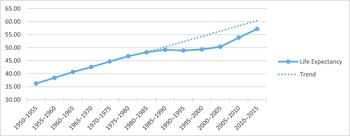
Figure 1 shows estimates of life expectancy in sub-Saharan Africa in 5-year periods from 1950–55 through 2010–15 [United Nations (2015)]. For the first 30 years of the data, life expectancy rose at a constant pace of very slightly more than 0.4 years per year. The following 15 years saw a tremendous slowdown, with life expectancy rising by only 1.1 years in total. As of the 1995–2000 period, life expectancy was 5.0 years below the level predicted by a trend drawn through the data up to 1980–85. Starting in 2000, the growth of life expectancy not only resumed, but exceeded its old pace, to the point that by 2010–15, the gap between actual and trend life expectancy had fallen to 3.2 years.
Life expectancy at birth in sub-Saharan Africa.

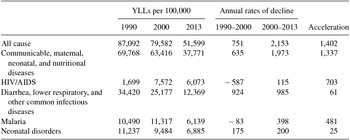
To look more closely at the sources of this variation in the speed of mortality decline, Table 1 uses data from the Global Burden of Disease project [Institute for Health Metrics and Evaluation (2013)]. The top row of the table shows the level of all-cause mortality in the years 1990, 2000, and 2013, expressed in terms of Years of Life Lost (YLLs) per 100,000 people. The rate at which all-cause mortality declined rose from 751 YLLs per year in the period 1990–2000 to 2,153 per year in the period 2000–2013. Loosely speaking that is an “acceleration” in the pace of mortality decline of 1,402 YLLs/year. Subsequent rows show similar data for select sub-components of morality. The acceleration in all-cause mortality decline is almost entirely explained by the acceleration in the decline in communicable, maternal, neonatal, and nutritional diseases (1,337 YLLs/year). This, in turn, largely explained by accelerations in the pace of mortality decline in two specific conditions: HIV/AIDS (703 YLLs/year) and malaria (481 YLLs/year). Together, these two account for 84% of the acceleration in the decline of all-cause mortality YLLs/year. While this calculation gives useful insight into the source of the acceleration in mortality improvement after 2000, it is important to note that the biggest source of mortality decline in both periods was not HIV or malaria, but rather in the category diarrhea, lower respiratory, and other common infectious diseases. This category, which also accounted for a larger number of deaths than HIV or malaria, had a pace of decline that did not change much between the two periods.
Years of life lost in sub-Saharan Africa

The role of HIV/AIDS in driving changes in overall mortality is confirmed by looking at data from individual countries. For sub-Saharan Africa as a whole, the number of HIV related deaths fell by 39% between 2005 and 2013. In Malawi, where AIDS related deaths fell by 51% over the same period (and where the 2005 prevalence of HIV among adults aged 15–49 years was 14.1%), life expectancy rose from 48.3 to 61.5 over the same 8-year period. Other countries with large HIV mortality declines are similarly among those with spectacular improvements in life expectancy.Footnote 1
In considering the co-movements of life expectancy and income, a natural starting place is the Preston curve, the cross-sectional cross-country relationship between the two. Weil (Reference Weil, Cervellati and Sunde2016) examines the change in the Preston curve between 1960 and 2012, expressing the relationship between the two variables in terms of life years per log unit of GDP. In 2012, the slope of the curve (weighted estimate) was that a change of one log unit of GDP per capita was associated with 5.59 years of extra life; or equivalently that a doubling of GDP per capita was associated with an increase in life expectancy of 3.9 years. Comparing 1960 and 2012, the Preston curve has both shifted upward and become flatter. In 1960, the slope was 6.41 life years per log unit of GDP. A country that had 10% of Japan's income in 1960, and saw no income growth subsequently, would be predicted to have a rise in life expectancy of 9.4 years by 2012 (equivalent to 0.18 years per year) due to the movement of the curve. Using the 2012 slope of the curve, a country with income growing at 2% per year would experience life expectancy increases of 0.11 years every year if the Preston curve did not shift.Footnote 2
Of course, the Preston curve is not a structural relationship. In a simple sense, the empirically observed slope results from the interaction of three forces: the effect of health on income; the effect of income on health; and the covariance of other factors that affect health with other factors that affect income [Weil (Reference Weil2015)]. Adding to the complexity of the relationship are the lags in the causal channels just mentioned. For example, improvements in health might be reflected in higher worker productivity, and thus in aggregate income statistics, with lags of a generation. Further, as pointed out by Acemoglu and Johnson (Reference Acemoglu and Johnson2007) and by Ashraf, Lester, and Weil (Reference Ashraf, Lester and Weil2008), the Preston curve relationship mixes effects from worker productivity with changes in the dependency ratio that result from higher child survival.Footnote 3
It is notable that the gyrations in mortality in sub-Saharan Africa discussed above were mostly not themselves the product of economic events, and neither were they likely the product of shocks that would have also directly affected income growth. In the case of HIV, the timing of the outbreak of the epidemic is well explained by non-economic factors (which is not to say that the low level of public health infrastructure was not a contributor to the success of the disease). Similarly, the control of HIV was not a result of economic improvements, but rather resulted from explicit public health efforts combined with technological advances. In the case of malaria, the primary drivers of disease control were once again an intense focus of international efforts on control of the disease (for example, the founding of the The Global Fund to Fight AIDS, Tuberculosis, and Malaria in 2002) along with the development of new technologies, such as artemisinin-based combination therapies and improved bednets [Ashraf, Fink, and Weil (Reference Ashraf, Fink, Weil, Edwards, Johnson and Weil2016)].
In the rest of this essay, I ask how large an effect of health on growth our current understanding would lead us to expect to see in light of the recent changes in mortality. One could think of this as a starting point for a more formal statistical investigation, using these largely exogenous health shocks to identify the structural effect of health on income, along the lines of Acemoglu and Johnson (Reference Acemoglu and Johnson2007).Footnote 4 I do not go down that path here both because the data are still coming in, and because this is supposed to be only a short essay.
To be concrete, I want to follow-up on the view expressed by the World Health Organization's Commision on Macroeconomics and Health (2001) which was published at almost exactly the inflection point in the mortality series:
Improving the health and longevity of the poor is an end in itself, a fundamental goal of economic development. But it is also a means to achieving the other development goals relating to poverty reduction. The linkages of health to poverty reduction and to long-term economic growth are powerful, much stronger than is generally understood. The burden of disease in some low-income regions, especially sub-Saharan Africa, stands as a stark barrier to economic growth and therefore must be addressed frontally and centrally in any comprehensive development strategy.
I start with the case of malaria, which was an early focus of the literature on health and growth. The most famous paper in this line is Gallup and Sachs (Reference Gallup and Sachs2001). This paper has been criticized in terms of identification, but it still remains a touchstone, especially in more policy-oriented circles.
Gallup and Sachs estimate a “conditional convergence” regression in which the growth of GDP per capita is the dependent variable, and the key right-hand side variables are the log of initial GDP per capita and an index of falciparum malaria that runs from 0 to 1. Additional controls include measures of geography, quality of institutions, schooling, and life expectancy (to control for other diseases). The coefficient on the malaria index is −1.3, implying that completely eliminating the disease in a country where it had been at its maximum value would raise growth by 1.3% per year.Footnote 5 Applying this coefficient to recent African experience: The death rate from malaria among populations at risk for malaria in Africa fell 66% between 2000 and 2015, while the incidence rate fell 42% over the same period.Footnote 6 Arguably, the latter is more relevant for economic growth, at least in the short run. Among sub-Saharan African countries, the malaria index that Gallup and Sachs used generally had values that ran from 0.75 to 1.0. Applying a 42% reduction to the lower of these values and using the Gallup–Sachs coefficient, we would expect annual growth to have risen by 0.41 percentage points in response to the observed decline in malaria. Given that the reduction in malaria mortality was phased in over a period of 15 years, one would expect to see an increase in output per capita of perhaps three percentage points by the end of this period due to the malaria reduction.Footnote 7 In specific countries, the predicted effect would be larger, since there has been a good deal of heterogeneity in the effectiveness of anti-malarial campaigns, as well as the pre-existing burden of the disease. These effects should be large enough to be picked up in aggregate data. My guess, however, is that one would not find them. This is in part because I suspect that the Gallup–Sachs estimates are simply too large to be credible, but also because, as stressed by Ashraf, Lester, and Weil (Reference Ashraf, Lester and Weil2008), many of the positive effects of malaria reduction on output would take decades to appear. In particular, an important effect of malaria is in reducing human capital both directly, and by inducing parents to follow a quantity rather than quality strategy in their production of children.
I now turn to the broader measure of life expectancy. Regressions of economic growth on life expectancy suffer from severe identification problems. As discussed in Weil (2008, Reference Weil2014), there have been attempts to solve these problems using various instruments. Weil (2008) presents an alternative approach of trying to identify the structural effect of life expectancy on steady-state income by starting with well-identified microeconomic estimates of the effects specific health shocks on individual income. Ashraf, Lester, and Weil translate Weil's original estimates into a more usable form for my current purposes. They find that a rise in life expectancy at birth from 40 to 60 years would raise human capital per worker by 15%, or roughly 0.75% per year of life expectancy. Recall that at the height of the health slowdown in Africa, life expectancy was about 5 years below its long-run trend. This estimate suggests that such a deficit would correspond to human capital per worker being 3.75 percentage points below the level that would otherwise obtain.
Unlike the Gallup–Sachs estimates, however, these are steady state effects. In the short run, the effect would be diminished for two reasons. The first is because, as mentioned above, much of the benefit of better health runs through children getting more human capital, and this benefit is only realized as these treated children replace the existing labor force. Second, for the usual Solow model reasons, a rise in human capital does not instantly translate one-for-one into higher output; it takes time the corresponding physical capital accumulation to take place. In the simulation of Ashraf Lester, and Weil, only about ⅓ of the long run effect of a health improvement on GDP per worker has been realized 15 years after a shock to health.
Ashraf, Lester, and Weil embed this human capital effect into a broader model which allows for effects of better health beyond worker productivity. The most quantitatively important of these run through population age structure. Lower mortality is associated with higher child survival in the short run; only over time does fertility adjust. This means that lower mortality raises the child dependency ratio and lowers income per capita in the short run even as income per worker is rising. In their analysis, in the case of a generalized reduction in mortality, output per capita is below the baseline level for the first 30 years after the shock.
The analysis of Ashraf, Lester, and Weil (as well as Acemoglu and Johnson) suggest that the first-order effect of reducing mortality should be a significant increase in the net rate of reproduction and the child dependency ratio, possibly followed by a reduction in fertility. Such an effect would be especially pronounced in the case of a reduction in malaria mortality, which is concentrated among the very young. This is something that should be visible in the data now or in the near future – and will probably be easier to find than an effect on income per capita.
The story of health in sub-Saharan Africa is one of steady, long-run improvement which was temporarily halted by HIV/AIDS, and which has recently resumed with renewed vigor. Health improvements like this, achieved with great effort on the part of individuals, governments, and NGOs, are rightfully celebrated as remarkable human achievements. But the prospects for finding in the data a surge in economic growth resulting from the recent speed-up in health improvement in sub-Saharan Africa are not very good. Economists differ in their estimates of how large the structural effect of health on income is, with many estimates being relatively small. Further, taking seriously the delays built into many plausible causal channels would lead one to expect that any economic effects that are detectable will not appear for several decades.
If there is to be a Sub Saharan economic miracle, its source will have to be something other than improved health.