Introduction
Tracheostomy is an important surgical procedure for children who require prolonged mechanical ventilation, experience recurrent extubation failure, need long‑term airway protection, or have difficulty with effective secretion clearance.Reference Roberts, Powell and Begbie1–Reference Campisi and Forte4 Advances in paediatric intensive care, neonatal intensive care, and cardiac surgery have shifted the indications for tracheostomy from traditional infectious or anatomical upper airway obstruction towards prolonged ventilatory support, failure to wean from ventilation, cardiopulmonary disease, neurological disorders, and complex chronic conditions.Reference Roberts, Powell and Begbie1–Reference Campisi and Forte4
Although most patients can be extubated early after paediatric cardiac surgery, a small subgroup develops prolonged dependence on mechanical ventilation or recurrent extubation failure. These complications may be associated with residual cardiac lesions, myocardial dysfunction, pulmonary hypertension, low cardiac output, diaphragmatic or vocal cord paralysis, airway anomalies, genetic syndromes, sepsis, renal failure, the need for extracorporeal membrane oxygenation, and greater surgical complexity. Reference Hoskote, Cohen, Goldman and Shekerdemian5–Reference Challapudi, Natarajan and Aggarwal8 Thus, the need for tracheostomy after cardiac surgery often reflects both the severity of the patient’s clinical condition and the complexity of the postoperative course.
Tracheostomy after paediatric cardiac surgery is uncommon, with reported rates of approximately 0.2–2.7%. Reference Hoskote, Cohen, Goldman and Shekerdemian5,Reference Mastropietro, Benneyworth and Turrentine9 Patients requiring tracheostomy have prolonged ICU stays, longer durations of mechanical ventilation, and higher overall mortality rates. Reference Cotts, Hirsch, Thorne and Gajarski6,Reference Mastropietro, Benneyworth and Turrentine9–Reference Johnson, Marino, Klugman and Shamszad11 However, this higher mortality appears to be more closely related to the underlying cardiac pathology, associated anomalies, and prolonged critical illness than to tracheostomy‑related complications. Reference Ortmann, Manimtim and Lachica12–Reference Çiçek and Özdemir14 In general, tracheostomy may be regarded as a supportive strategy that provides more secure airway control, facilitates secretion clearance, reduces sedation requirements, improves patient comfort, and supports gradual weaning from mechanical ventilation. Reference Hoskote, Cohen, Goldman and Shekerdemian5,Reference Saygı, Öztürk and Özden7,Reference Day, Cross, Crossland, Powell and Simpson15
This study was conducted to identify clinical and perioperative factors associated with the need for tracheostomy after paediatric cardiac surgery. Clinical characteristics according to survival status were also evaluated descriptively. Finally, we evaluated the role of tracheostomy as a supportive intervention during prolonged postoperative respiratory management.
Materials and methods
This retrospective, single‑centre study was conducted in the Department of Paediatric Cardiovascular Surgery at Yeni Yüzyıl University Gaziosmanpaşa Hospital between 2019 and 2025. Approval for the study was obtained from the relevant ethics committee (approval number 2025/346).
All patients who underwent paediatric cardiac surgery during the study period were retrospectively reviewed. The study group included patients who underwent tracheostomy during postoperative intensive care because of prolonged mechanical ventilation, recurrent extubation failure, or the need for a secure long‑term airway. Patients who did not undergo tracheostomy constituted the general paediatric cardiac surgery cohort and were included in comparative analyses to identify clinical and perioperative factors associated with the need for tracheostomy.
At our institution, tracheostomy is generally considered after approximately 7–10 days of prolonged mechanical ventilation when the patient is not clinically or haemodynamically suitable for extubation, after one or more failed extubation attempts, or in the presence of persistent excessive airway secretions or known laryngotracheal pathology. The timing of tracheostomy is individualised according to the patient’s overall clinical condition and postoperative course. Flexible bronchoscopy is performed before tracheostomy to assess the airway. The final decision is made through multidisciplinary assessment involving paediatric anaesthesia, paediatric cardiology, paediatric surgery, and paediatric cardiovascular surgery. All tracheostomies in this cohort were performed using a conventional open surgical technique.
Data on demographic characteristics, age, cardiac diagnosis, single‑ventricle or biventricular physiology, surgical procedure, use of cardiopulmonary bypass, aortic cross‑clamp duration, need for haemofiltration, extracorporeal membrane oxygenation support, presence of an open sternum or delayed sternal closure, bronchoscopy findings, associated anomalies, timing of tracheostomy, total duration of mechanical ventilation, extubation and reintubation attempts, intensive care and hospital course, survival status, decannulation, and discharge with home mechanical ventilation were obtained from patient files and electronic medical records. Total duration of mechanical ventilation was defined as the cumulative duration of mechanical ventilation during hospitalisation, rather than the duration of ventilation before or after tracheostomy alone.
Among patients who required extracorporeal membrane oxygenation, all received central veno‑arterial extracorporeal membrane oxygenation support. Tracheostomy was not performed during extracorporeal membrane oxygenation support in any patient and was undertaken only after extracorporeal membrane oxygenation had been discontinued.
Tracheostomy‑related safety outcomes were also assessed. Recorded major complications included bleeding during or after the procedure, major airway complications related to the tracheostomy cannula, pneumothorax, tracheal injury, the need for urgent surgical revision, and tracheostomy‑related mortality. Minor complications, including local wound infection, granulation tissue, accidental decannulation, and clinically significant cannula obstruction, were also specifically evaluated. Overall mortality was defined as deaths related to the underlying cardiac disease and postoperative critical illness, whereas deaths directly attributable to tracheostomy were analysed separately.
Statistical analyses were performed using Python. The pandas, SciPy, and statsmodels packages were used for data management and statistical analysis. Categorical variables are presented as numbers and percentages, whereas continuous variables are presented as means ± standard deviations or medians and ranges, according to their distribution. Between‑group comparisons were performed using the chi‑square test or Fisher’s exact test for categorical variables and Student’s t test or the Mann–Whitney U test for continuous variables, as appropriate. Logistic regression analysis was used to evaluate factors associated with the need for tracheostomy. Given the small number of tracheostomy events, the multivariable model was intentionally restricted. Age < 1 year, haemofiltration requirement, cardiopulmonary bypass duration, and aortic cross‑clamp duration were selected a priori on the basis of clinical relevance and the availability of sufficiently complete data, rather than solely on univariable p values. Cardiopulmonary bypass and aortic cross‑clamp durations were modelled per 30‑minute increase. Results are presented as odds ratios, 95% confidence intervals, and p values. A p value < 0.05 was considered to indicate significance.
Results
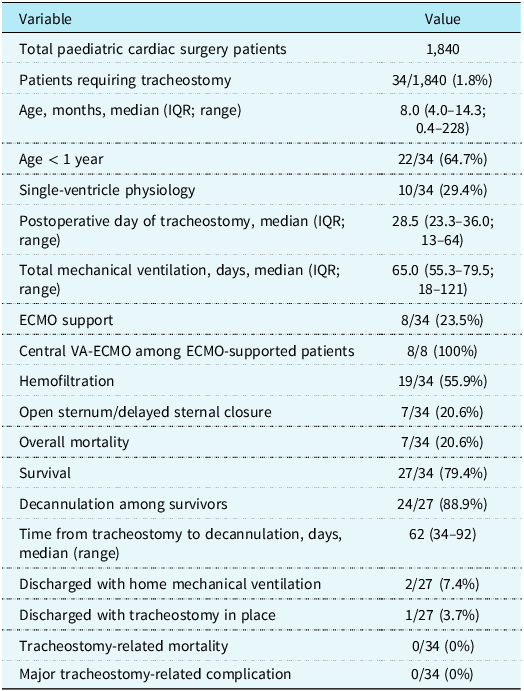
A total of 1,840 paediatric cardiac surgery patients were included in the study. Tracheostomy was performed in 34 patients during postoperative intensive care, corresponding to a tracheostomy rate of 1.8%. Most patients who underwent tracheostomy were younger than 1 year, and approximately one‑third had single‑ventricle physiology. The general characteristics and clinical outcomes of the tracheostomy group are presented in Table 1.
General characteristics and outcomes of tracheostomized patients

Table 1. Long description
The table presents data on 34 pediatric cardiac surgery patients who required tracheostomy. It includes variables such as total patients, age distribution, single-ventricle physiology, postoperative day of tracheostomy, mechanical ventilation duration, ECMO support, hemofiltration, open sternum/delayed sternal closure, overall mortality, survival, decannulation among survivors, time from tracheostomy to decannulation, discharge status, tracheostomy-related mortality, and major tracheostomy-related complications. The table has 16 rows and 2 columns. Column headers are Variable and Value. Row 1: Total pediatric cardiac surgery patients, 1,840. Row 2: Patients requiring tracheostomy, 34/1,840 (1.8 percent). Row 3: Age, months, median (interquartile range; range), 8.0 (4.0-14.3; 0.4-228). Row 4: Age less than 1 year, 22/34 (64.7 percent). Row 5: Single-ventricle physiology, 10/34 (29.4 percent). Row 6: Postoperative day of tracheostomy, median (interquartile range; range), 28.5 (23.3-36.0; 13-64). Row 7: Total mechanical ventilation, days, median (interquartile range; range), 65.0 (55.3-79.5; 18-121). Row 8: ECMO support, 8/34 (23.5 percent). Row 9: Central VA-ECMO among ECMO-supported patients, 8/8 (100 percent). Row 10: Hemofiltration, 19/34 (55.9 percent). Row 11: Open sternum/delayed sternal closure, 7/34 (20.6 percent). Row 12: Overall mortality, 7/34 (20.6 percent). Row 13: Survival, 27/34 (79.4 percent). Row 14: Decannulation among survivors, 24/27 (88.9 percent). Row 15: Time from tracheostomy to decannulation, days, median (range), 62 (34-92). Row 16: Discharged with home mechanical ventilation, 2/27 (7.4 percent). Row 17: Discharged with tracheostomy in place, 1/27 (3.7 percent). Row 18: Tracheostomy-related mortality, 0/34 (0 percent). Row 19: Major tracheostomy-related complication, 0/34 (0 percent).
ECMO = extracorporeal membrane oxygenation; IQR = interquartile range; VA = veno-arterial.
Note: Data are presented as n/N (%) unless otherwise indicated. Decannulation and discharge outcomes are reported among survivors. Time to decannulation was calculated from the date of tracheostomy. All ECMO-supported patients received central veno-arterial (VA) ECMO.
Tracheostomy was performed at a median of 28.5 days postoperatively (interquartile range, 23.3–36.0; range, 13–64 days). The median total duration of mechanical ventilation during hospitalisation was 65 days (interquartile range, 55.3–79.5; range, 18–121 days). Thirty of the 34 patients (88.2%) had at least one documented extubation/reintubation episode before tracheostomy, whereas four patients (11.8%) had no documented extubation attempt. Among the 30 patients with documented attempts, one, two, three, and four extubation/reintubation episodes occurred before tracheostomy in 10, 14, 5, and 1 patients, respectively. Extracorporeal membrane oxygenation support was required in eight patients (23.5%), haemofiltration in 19 (55.9%), and an open sternum or delayed sternal closure in seven (20.6%). All eight patients who required extracorporeal membrane oxygenation received central veno‑arterial‑extracorporeal membrane oxygenation, and tracheostomy was performed after extracorporeal membrane oxygenation discontinuation in all cases. Detailed patient‑level clinical data are presented in Supplementary Table S1.
The overall mortality rate was 20.6% (7/34). No deaths were directly attributable to tracheostomy, and no major tracheostomy‑related complications were observed. One patient developed a local wound infection, which resolved with daily wound care. Minimal granulation tissue developed in two patients and was treated with silver nitrate cauterisation. No accidental decannulation or cannula obstruction requiring intervention occurred. Among the 27 survivors, 24 (88.9%) underwent decannulation at a median of 62 days after tracheostomy (range, 34–92 days). Two patients were discharged with home mechanical ventilation, and one was discharged with a tracheostomy in place.
Bronchoscopy identified tracheomalacia in three patients and subglottic stenosis in two. Three patients had diaphragmatic elevation secondary to phrenic nerve paralysis (two unilateral and one bilateral). All underwent diaphragmatic plication before tracheostomy. In the patient with bilateral paralysis, right-sided plication was followed by left-sided plication 6 days later; however, extubation could not be achieved, and tracheostomy was subsequently performed. This patient was decannulated 69 days after tracheostomy. Of the three patients with diaphragmatic paralysis, one died and the other two were successfully decannulated. No vocal cord paralysis was identified. One patient had CHARGE syndrome and one had Down syndrome. The patient with CHARGE syndrome also had tracheomalacia and was discharged with home mechanical ventilation.
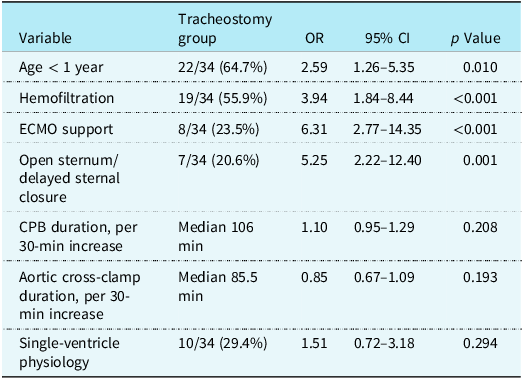
Age younger than 1 year and haemofiltration were independently associated with the need for tracheostomy in the multivariable logistic regression analysis. Age < 1 year was associated with higher odds of tracheostomy (odds ratio, 2.59; 95% confidence interval, 1.26–5.35; p = 0.010), as was haemofiltration (odds ratio, 3.94; 95% confidence interval, 1.84–8.44; p < 0.001). Although haemofiltration remained associated with tracheostomy after adjustment, this finding likely reflects greater postoperative illness severity rather than an independent clinical predictor. Cardiopulmonary bypass duration (odds ratio, 1.10; 95% confidence interval, 0.95–1.29; p = 0.208) and aortic cross-clamp duration (odds ratio, 0.85; 95% confidence interval, 0.67–1.09; p = 0.193), each modelled per 30-minute increase, were not independently associated with the need for tracheostomy.
In the univariable analyses, extracorporeal membrane oxygenation support (odds ratio, 6.31; 95% confidence interval, 2.77–14.35; p < 0.001) and an open sternum/delayed sternal closure (odds ratio, 5.25; 95% confidence interval, 2.22–12.40; p = 0.001) were associated with the need for tracheostomy. Single‑ventricle physiology was not significantly associated with tracheostomy (odds ratio, 1.51; 95% confidence interval, 0.72–3.18; p = 0.294). The results of these analyses are presented in Table 2 and Supplementary Table S2.
Clinical and perioperative factors associated with tracheostomy requirement after paediatric cardiac surgery

Table 2. Long description
A table with 8 rows and 5 columns comparing clinical and perioperative factors associated with tracheostomy requirement after pediatric cardiac surgery. The columns are labeled Variable, Tracheostomy group, OR, 95% CI, and p Value. The rows list different variables such as Age < 1 year, Hemofiltration, ECMO support, Open sternum/delayed sternal closure, CPB duration per 30-min increase, Aortic cross-damp duration per 30-min increase, and Single-ventricle physiology. Each row provides specific data points for the Tracheostomy group, OR, 95% CI, and p Value.
CI = confidence interval; CPB = cardiopulmonary bypass; ECMO = extracorporeal membrane oxygenation; OR = odds ratio.
Note: Data are presented as n/N (%) unless otherwise indicated. CPB and aortic cross-clamp durations are presented as odds ratios per 30-minute increase. Age < 1 year, hemofiltration, CPB duration, and aortic cross-clamp duration were evaluated in the multivariable logistic regression model. ECMO support, open sternum/delayed sternal closure, and single-ventricle physiology are presented as univariable effect estimates because of the limited number of tracheostomy events. A p value < 0.05 was considered statistically significant.
Given the small number of deaths (n = 7), mortality-related findings were considered descriptive and hypothesis-generating only. Selected clinical characteristics according to survival status are presented in Supplementary Table S3. These findings were not used to draw conclusions regarding factors associated with mortality.
Discussion
In this single‑centre study, tracheostomy was infrequently required after paediatric cardiac surgery and was predominantly used in children with prolonged and complex postoperative recovery. Our findings support the view that the need for tracheostomy in this population is more closely associated with overall disease severity and postoperative cardiopulmonary morbidity than with an isolated airway disorder. Importantly, no deaths were directly attributable to tracheostomy, and no major procedure‑related complications were observed.
The reported incidence of tracheostomy after paediatric cardiac surgery ranges from approximately 0.2% to 2.7%. Reference Hoskote, Cohen, Goldman and Shekerdemian5,Reference Mastropietro, Benneyworth and Turrentine9 Previous single‑centre studies have reported rates of 1.3–2.7%, with tracheostomy generally performed after several weeks of mechanical ventilation. Reference Hoskote, Cohen, Goldman and Shekerdemian5–Reference Saygı, Öztürk and Özden7 Hoskote et al. reported that cardiac failure, tracheobronchomalacia, and diaphragmatic paralysis frequently accompanied the need for tracheostomy, whereas Challapudi et al. identified ventilator‑dependent respiratory failure and tracheomalacia as common indications. Reference Hoskote, Cohen, Goldman and Shekerdemian5,Reference Challapudi, Natarajan and Aggarwal8 Thus, our tracheostomy rate of 1.8% and median timing of 28.5 postoperative days are consistent with previously reported ranges.
Younger age was independently associated with the need for tracheostomy in our cohort. Haemofiltration was also independently associated with tracheostomy; however, this association likely reflects greater postoperative illness severity rather than an independent clinical predictor. Similarly, the associations of extracorporeal membrane oxygenation support and open sternum/delayed sternal closure observed in univariable analyses probably reflect the severity and complexity of the postoperative course. Because only 34 patients required tracheostomy, the number of variables that could be reliably evaluated in multivariable analysis was limited, and these associations should therefore be interpreted cautiously.
Single‑ventricle physiology was present in approximately 30% of the tracheostomy cohort. Although it was not significantly associated with the need for tracheostomy in our analysis, this physiology may contribute to a more complicated postoperative respiratory course. Previous studies have likewise demonstrated worse outcomes in selected children with single‑ventricle physiology or systemic‑to‑pulmonary shunts. Reference Benneyworth, Shao and Cristea10,Reference Ortmann, Manimtim and Lachica12 Thus, the absence of a significant association in our cohort should not be interpreted as evidence that cardiac physiology lacks clinical relevance, particularly given the limited number of tracheostomy events.
Phrenic nerve injury represents another important potential contributor to prolonged ventilation after congenital cardiac surgery. Three patients who underwent tracheostomy in our cohort had diaphragmatic elevation secondary to phrenic nerve paralysis, including two with unilateral and one with bilateral paralysis. All underwent diaphragmatic plication before the subsequent decision to proceed with tracheostomy. In the entire cardiac surgical cohort, phrenic nerve paralysis was identified in 18 of 1,840 patients (0.97%). This finding suggests that diaphragmatic dysfunction contributed to prolonged respiratory support in a small subgroup, although it did not alone explain the subsequent need for tracheostomy. Tracheomalacia and subglottic stenosis were identified in a small number of patients, whereas no vocal cord paralysis was observed. In most other patients, recurrent extubation failure occurred in the context of cardiac complexity, prolonged ventilation, respiratory infection, and secretion burden, without a single structural airway abnormality accounting for the clinical course.
Extracorporeal membrane oxygenation warrants particular consideration because it reflects severe postoperative illness and may also increase procedural bleeding risk. All extracorporeal membrane oxygenation-supported patients in our tracheostomy cohort received central veno‑arterial-extracorporeal membrane oxygenation, and tracheostomy was not performed during extracorporeal membrane oxygenation support; all procedures were undertaken after extracorporeal membrane oxygenation discontinuation. Accordingly, the increased bleeding risk associated with tracheostomy during active extracorporeal membrane oxygenation support does not directly apply to our cohort. Large cardiac surgical datasets have likewise identified extracorporeal membrane oxygenation and other markers of postoperative severity as important predictors of adverse outcomes. Reference Mastropietro, Benneyworth and Turrentine9–Reference Johnson, Marino, Klugman and Shamszad11
The overall mortality observed among children who underwent tracheostomy should also be interpreted in the context of underlying disease severity. Contemporary congenital heart surgery series and national database analyses have similarly shown that tracheostomy is associated with prolonged hospitalisation, high resource utilisation, and increased in‑hospital mortality. Reference Costello, Emerson and Shu16,Reference Maxwell and McMillan17 Paediatric tracheostomy studies have also demonstrated that overall mortality substantially exceeds mortality directly attributable to the tracheostomy procedure itself. Reference Roberts, Powell and Begbie1–Reference Campisi and Forte4,Reference Funamura, Yuen and Kawai18,Reference Davidson, Jacob and Brown19 In our cohort, no deaths were directly related to tracheostomy. Minor complications were limited to one local wound infection that resolved with daily wound care and minimal granulation tissue in two patients treated with silver nitrate cauterisation. No accidental decannulation or cannula obstruction requiring intervention was observed. Thus, the rate of procedure‑related complications was low in this cohort; however, the small number of procedures precludes broad conclusions regarding safety.
The high frequency of documented extubation/reintubation episodes before tracheostomy further illustrates the prolonged and challenging respiratory course of these patients. At least one such episode was documented in 30 of 34 patients (88.2%). Recurrent extubation failure frequently coincided with prolonged mechanical ventilation; however, the proportion of patients with documented extubation/reintubation episodes should not be interpreted as indicating that recurrent extubation failure was the sole indication for tracheostomy in 88.2% of patients.
One notable finding was the high decannulation rate among survivors. Twenty‑four of the 27 survivors were ultimately decannulated, at a median of 62 days after tracheostomy. This rate is higher than those reported in several previous paediatric and congenital cardiac series, in which decannulation rates have generally been substantially lower. Reference Roberts, Powell and Begbie1,Reference Sachdev, Chaudhari and Singh3,Reference Puchi, Lavin, Eltayeb and Billings13,Reference Çiçek and Özdemir14,Reference Costello, Emerson and Shu16 Costello et al. reported prolonged ventilator dependence after tracheostomy in children following congenital heart surgery. Reference Costello, Emerson and Shu16 However, direct comparisons with these studies require caution because institutional thresholds for tracheostomy, patient selection, underlying cardiac disease, and discharge practices differ substantially.
An important characteristic of our cohort may help explain the high decannulation rate. Thirty-two of the 34 patients who underwent tracheostomy were international patients, and many families preferred not to return to their home countries with a tracheostomy in place. Consequently, some clinically stable patients remained in hospital-based accommodation and under follow-up until decannulation could be achieved. This institutional discharge practice likely contributed to the unusually high decannulation rate in our cohort and limits direct comparison with centres where children are routinely discharged home with a tracheostomy or long-term ventilatory support. Two survivors in our cohort were discharged with home mechanical ventilation, whereas one was discharged with a tracheostomy in place.
Thus, the high decannulation rate should not be interpreted as evidence that tracheostomy facilitated ventilator weaning or improved outcomes. In the absence of a comparable control group of similarly ill patients managed without tracheostomy, it is not possible to determine whether these patients would ultimately have been successfully weaned without the procedure. Our findings instead suggest that, within our institutional practice, tracheostomy served as temporary supportive airway management in selected children during prolonged postoperative recovery. This distinction is particularly important because the retrospective design does not permit causal conclusions regarding the effects of tracheostomy on ventilation duration, sedation requirements, length of stay, or survival.
The optimal timing of tracheostomy after paediatric cardiac surgery remains uncertain. Haemodynamic instability, bleeding risk, infection, organ dysfunction, the possibility of respiratory recovery, and family preferences may all delay decision‑making. Reference Saygı, Öztürk and Özden7,Reference Johnson, Marino, Klugman and Shamszad11 Our institutional approach is individualised and multidisciplinary, with timing determined by the clinical course rather than by a fixed postoperative day. Although tracheostomy is generally considered after 7–10 days of prolonged ventilation, the procedure may occur considerably later depending on clinical stability, extubation attempts, secretion burden, airway findings, and the anticipated course of recovery. Day et al. similarly described tracheostomy as a supportive management option in selected children with complex cardiac disease. Reference Day, Cross, Crossland, Powell and Simpson15 Thus, the median postoperative timing of 28.5 days in our cohort reflects a selective approach and does not represent an institutional policy of early tracheostomy.
This study has several limitations. Its retrospective, single‑centre design limits generalisability, and the small number of tracheostomy events restricts statistical power and the number of variables that can be included in multivariable analyses. Mortality analyses are particularly limited by the occurrence of only seven deaths, resulting in wide confidence intervals and requiring cautious, exploratory interpretation. We did not perform propensity matching or compare sedation duration, ventilator duration, or other outcomes with those of a matched non‑tracheostomy cohort; thus, no causal effect of tracheostomy on these outcomes can be inferred. Although extubation/reintubation episodes could be retrieved from patient records, prolonged mechanical ventilation, recurrent extubation failure, and the need for a secure long‑term airway were not prospectively recorded as mutually exclusive primary indications. Thus, reliable percentages for each individual primary indication could not be determined retrospectively. Long‑term quality of life, neurodevelopmental outcomes, and hospital readmissions were also beyond the scope of this study.
Conclusions
Tracheostomy was infrequently required after paediatric cardiac surgery and was primarily used as supportive airway management in selected patients with prolonged and complex postoperative recovery. The need for tracheostomy appeared to reflect patient-related factors and the overall severity of postoperative illness rather than an isolated airway abnormality.
Supplementary material
The supplementary material for this article can be found at https://doi.org/10.1017/S1047951126124482.
Data availability statement
The data supporting the findings of this study are available from the corresponding author upon reasonable request.
Acknowledgements
Use of Artificial Intelligence Tools: During the preparation of this manuscript, ChatGPT by OpenAI was used in June 2026 for language editing, formatting support, and drafting assistance. The tool was not used as an author and was not used to make clinical interpretations independently. The authors critically reviewed and verified all content, data, statistical analyses, interpretations, and references, and take full responsibility for the final version of the manuscript.
Financial support
No funding was received for this study.
Author contributions
Mustafa Okumuş: study conception, study design, data interpretation, manuscript drafting, and critical revision. Dilek Suzan: data collection, clinical interpretation, and manuscript review. Volkan Yazıcıoğlu: data collection, clinical interpretation, and manuscript review. İsmail Balaban: clinical interpretation and manuscript review. Hakan Kilercik: perioperative data interpretation and manuscript review.Özgür Yıldırım: study supervision, surgical data interpretation, and critical revision of the manuscript.
Competing interests
The authors declare no conflicts of interest.
Ethical standard
This study was approved by the relevant ethics committee with approval number 2025/346.