Introduction
Depression is a pervasive and prevalent mental disorder, affecting approximately 350 million people, with major depressive disorder accounting for 8.2% of the total worldwide years lived with disability (YLDs) (Ferrari et al. Reference Ferrari, Charlson, Norman, Patten, Freedman, Murray, Vos and Whiteford2013). Researchers have extensively explored the prevalence, correlates, and clinical outcomes of depression and its subtypes, but have conducted far less research on depression with psychotic experiences (PEs) in the general population. PEs are attenuated forms of psychotic symptoms which do not reach the clinical threshold for a psychosis diagnosis. This condition is common in the general population (prevalence 7.2% according to a systematic review) (Linscott & van Os, Reference Linscott and van Os2013), and may present an underlying susceptibility for psychotic disorders such as schizophrenia (Werbeloff et al. Reference Werbeloff, Drukker, Dohrenwend, Levav, Yoffe, van Os, Davidson and Weiser2012). Depression and PEs may co-occur due to shared genetic factors (Varghese et al. Reference Varghese, Saha, Scott, Chan and McGrath2011a ), underlying social factors such as childhood adversities (Varghese et al. Reference Varghese, Scott, Welham, Bor, Najman, O'Callaghan, Williams and McGrath2011b ), or impaired cognitive, social and emotional functioning (Weiser et al. Reference Weiser, van Os and Davidson2005). Furthermore, depression and PEs may mutually influence each other leading to the maintenance and/or exacerbation of both conditions. For example, depression may increase the likelihood of having a more negative appraisal of PEs, which in turn may further aggravate depression or increase levels of stress and anxiety (Yung et al. Reference Yung, Buckby, Cosgrave, Killackey, Baker, Cotton and McGorry2007). This may lead to biological alterations resulting in exacerbation and persistence of PEs (Yung et al. Reference Yung, Buckby, Cosgrave, Killackey, Baker, Cotton and McGorry2007).
Recent studies have shown that co-morbid depression and PEs in the general population is associated with a myriad of adverse health outcomes when compared to depression alone. Specifically, among adolescents and young adults in Munich, Germany, depression (and anxiety) with PEs was associated with higher odds for poorer course of mental illness and substance use as well as greater health service use, when compared to anxiety/depression without PEs (Wigman et al. Reference Wigman, van Nierop, Vollebergh, Lieb, Beesdo-Baum, Wittchen and van Os2012). Furthermore, our previous community-based study using data on adults aged ⩾18 years from 44 low- and middle-income countries (LMICs) showed that co-morbid depression and PEs is related to significant declines in health status in the domains of cognition, interpersonal activities, and sleep/energy, compared to depression alone (Koyanagi et al. Reference Koyanagi, Oh, Stickley, Haro and DeVylder2016a ).
An abundance of literature has demonstrated that both depression (Thase, Reference Thase2016) and PEs (Saha et al. Reference Saha, Scott, Varghese and McGrath2011a ; Moreno et al. Reference Moreno, Nuevo, Chatterji, Verdes, Arango and Ayuso-Mateos2013; Oh & DeVylder, Reference Oh and DeVylder2015) are associated with considerable chronic physical health burden. The interest in chronic physical health conditions is critical, as these may be the leading contributors to the premature mortality in individuals with depression (Walker et al. Reference Walker, McGee and Druss2015) and PEs (Sharifi et al. Reference Sharifi, Eaton, Wu, Roth, Burchett and Mojtabai2015). However, surprisingly, a paucity of literature has considered the chronic physical health co-morbidity among people with co-existing depression and PEs. Although one large multi-country study examined the association between PEs and chronic physical conditions, it only adjusted for age, sex, country-income level, and country, and did not take other non-psychotic mental disorders into account (Moreno et al. Reference Moreno, Nuevo, Chatterji, Verdes, Arango and Ayuso-Mateos2013). Furthermore, while single-country studies from Western settings on PEs and physical health conditions did adjust for non-psychotic mental disorders, estimates of risks specific to individuals with co-morbid depression and PEs were not provided (Saha et al. Reference Saha, Scott, Varghese and McGrath2011a ; Oh & DeVylder, Reference Oh and DeVylder2015).
Given the scarcity of studies on the risk for adverse health outcomes of co-morbid depression and PEs (especially physical health conditions), the lack of data on the prevalence and correlates of co-existing depression and PEs at the national level, and the large disease burden attributable to mental disorders as well as the rapid increase in non-communicable diseases in LMICs (Beaglehole et al. Reference Beaglehole, Bonita, Horton, Adams, Alleyne, Asaria, Baugh, Bekedam, Billo, Casswell, Cecchini, Colagiuri, Colagiuri, Collins, Ebrahim, Engelgau, Galea, Gaziano, Geneau, Haines, Hospedales, Jha, Keeling, Leeder, Lincoln, McKee, Mackay, Magnusson, Moodie, Mwatsama, Nishtar, Norrving, Patterson, Piot, Ralston, Rani, Reddy, Sassi, Sheron, Stuckler, Suh, Torode, Varghese and Watt2011; Murray et al. Reference Murray2012), the aims of the current study were: (a) to assess the prevalence and correlates of co-morbid depression and PEs among adults aged ⩾18 years in 47 LMICs using predominantly nationally-representative data from more than 2 00 000 individuals; and (b) to examine its association with chronic physical conditions (chronic back pain, edentulism, arthritis, angina, asthma, diabetes).
Method
The survey
The World Health Survey (WHS) was a cross-sectional survey carried out in 70 countries in 2002–2004 with the aim of strengthening national capacity to monitor health outcomes. Survey details are available elsewhere (http://www.who.int/healthinfo/survey/en/). Briefly, single-stage random sampling and stratified multi-stage random cluster sampling was conducted in 10 and 60 countries respectively. Eligible participants were those with a valid home address and aged ⩾18 years. One individual was randomly chosen from the household with the use of Kish tables. The questionnaire was subject to standard translation procedures to ensure comparability between countries. Face-to-face interviews and telephone interviews were conducted by trained interviewers. The individual response rate (ratio of completed interviews among selected respondents after excluding ineligible respondents from the denominator) ranged from 63% (Israel) to 99% (Philippines) (Moussavi et al. Reference Moussavi, Chatterji, Verdes, Tandon, Patel and Ustun2007), with the overall individual response rate being 98.5% (Nuevo et al. Reference Nuevo, Chatterji, Verdes, Naidoo, Arango and Ayuso-Mateos2012). To adjust for non-response, sampling weights were generated using the population distribution as reported by the United Nations Statistical Division. Ethical approval for the survey was provided by ethical boards at each study site. All participants gave their informed consent.
Variables
Chronic medical conditions
A total of six chronic medical conditions were assessed. The diagnosis of arthritis, asthma, and diabetes was based solely on self-reported lifetime diagnosis. Those who had either or both a self-reported diagnosis of angina or a symptom-based angina diagnosis based on the Rose questionnaire (Rose, Reference Rose1962) were considered to have angina. Chronic back pain referred to a back pain (including disc problems) occurring every day during the last 30 days. Those who had lost all their natural teeth based on self-report were considered to have edentulism.
Depression
Past 12-month depression was based on the presence, duration, and persistence of depressive symptoms. Algorithms based on the DSM-IV (APA, 1994) used in previous WHS publications were employed (Cifuentes et al. Reference Cifuentes, Sembajwe, Tak, Gore, Kriebel and Punnett2008; Loerbroks et al. Reference Loerbroks, Herr, Subramanian and Bosch2012). Respondents were first asked if they experienced any of the following five depressive symptoms over the past 12 months: (a) A period lasting several days when you felt sad, empty or depressed? (b) A period lasting several days when you lost interest in most things you usually enjoy such as hobbies, personal relationships or work? (c) A period lasting several days when you have been feeling your energy level decreased or that you were tired all the time? (d) Did you lose your appetite? (e) Did you notice any slowing down in your thinking?’ Those who answered ‘Yes’ to at least four of the questions were considered to have possible depression. Among those with possible depression, individuals who further responded ‘Yes’ to both of the following questions were classified as having depression: (a) Was this period for more than 2 weeks? (b) Was this period most of the day, nearly every day?
PEs
Positive psychotic symptoms were measured using items from the CIDI 3.0 (Kessler & Ustun, Reference Kessler and Ustun2004). This psychosis module has been validated with clinician ratings (Cooper et al. Reference Cooper, Peters and Andrews1998). The hallucinations question excluded experiences that took place in the context of sleep or substance use. Specifically, respondents could respond ‘yes’ or ‘no’ to the following questions:
During the last 12 months, have you experienced:
-
(a) ‘A feeling something strange and unexplainable was going on that other people would find hard to believe?’ (delusional mood)
-
(b) ‘A feeling that people were too interested in you or there was a plot to harm you?’ (delusions of reference and persecution)
-
(c) ‘A feeling that your thoughts were being directly interfered or controlled by another person, or your mind was being taken over by strange forces?’ (delusions of control)
-
(d) ‘An experience of seeing visions or hearing voices that others could not see or hear when you were not half asleep, dreaming or under the influence of alcohol or drugs?’ (hallucinations)
Individuals who endorsed at least one of the four above-mentioned psychotic symptoms were considered to have PEs.
Smoking and alcohol consumption
Smoking was assessed using the question: ‘Do you currently smoke any tobacco products such as cigarettes, cigars, or pipes?’ with the answer options being ‘daily’, ‘yes, but not daily’, or ‘no, not at all’. This variable was dichotomized into those who smoked regardless of frequency (i.e. daily or not daily) (current smokers) and those who do not smoke. Alcohol consumption was assessed by first asking the question ‘Have you ever consumed a drink that contains alcohol (such as beer, wine, etc.)?’ Respondents who replied ‘no’ were considered lifetime abstainers. Respondents who replied affirmatively were asked how many standard drinks of any alcoholic beverage they had on each day of the past 7 days. Females who reported consuming at least four drinks, and males who reported consuming at least five drinks, on 1 or 2 days in the past 7 days were considered infrequent heavy drinkers, and respondents who drank these amounts at least 3 days in the past 7 days were considered frequent heavy drinkers. All other respondents, apart from lifetime abstainers, were considered non-heavy drinkers (WHO, 2002; Hosseinpoor et al. Reference Hosseinpoor, Bergen, Kunst, Harper, Guthold, Rekve, d'Espaignet, Naidoo and Chatterji2012).
Anxiety
The question ‘Overall in the past 30 days, how much of a problem did you have with worry or anxiety’ was used to assess anxiety. The answer options were none, mild, moderate, severe, and extreme. In accordance with previous WHS publications, those who answered severe and extreme were considered to have anxiety (Wong et al. Reference Wong, Hunter Rowe, Douwes and Senthilselvan2013; Koyanagi et al. Reference Koyanagi, Oh, Stickley, Haro and DeVylder2016a ).
Sociodemographic variables
Information on age, sex, setting (rural or urban), marital status (married/cohabiting, never married, separated/divorced/widowed), education (no formal education, primary education, secondary or high school completed, or tertiary education completed), and wealth were assessed. Principal component analysis based on 15–20 assets was conducted to establish country-wise wealth quintiles.
Statistical analysis
Publically available data of the WHS included 69 countries. The data were nationally-representative for all countries with the exception of China, Comoros, the Republic of Congo, Ivory Coast, India, and Russia. We excluded 10 countries (Austria, Belgium, Denmark, Germany, Greece, Guatemala, Italy, The Netherlands, Slovenia, UK) as they lacked sampling information. A further nine countries (Finland, France, Ireland, Israel, Luxembourg, Norway, Portugal, Sweden, Turkey) were deleted as no information on psychotic symptoms was available. Moreover, the remaining two high-income countries (Spain and United Arab Emirates) were also deleted, as the focus of this study was on LMICs, while Morocco was also omitted due to lack of information on anxiety. Thus, a total of 47 countries, of which 21 and 26 were low-income and middle-income countries, respectively, at the time of the survey (2003) according to the World Bank, were included in the final sample.
The statistical analysis was performed with Stata 14.1 (Stata Corp LP, USA). For all analyses, individuals with a self-reported lifetime diagnosis of psychotic disorder such as schizophrenia (n = 2395) were omitted so that the estimates obtained are not confounded by psychotic disorders (Wigman et al. Reference Wigman, van Nierop, Vollebergh, Lieb, Beesdo-Baum, Wittchen and van Os2012; Koyanagi et al. Reference Koyanagi, Oh, Stickley, Haro and DeVylder2016a ). We calculated the country-wise age- and sex-adjusted prevalence of depression with at least one psychotic symptom (delusional mood, delusions of reference and persecution, delusions of control, or hallucinations) among 2 01 337 individuals for whom data was available. The United Nations population pyramid for 2010 was used to calculate the age- and sex-adjusted estimates. In line with previous publications on co-morbid depression and PEs (Wigman et al. Reference Wigman, van Nierop, Vollebergh, Lieb, Beesdo-Baum, Wittchen and van Os2012; Koyanagi et al. Reference Koyanagi, Oh, Stickley, Haro and DeVylder2016a ), we further characterized the study sample by a three-category variable: (a) no depression and no PEs (control) (n = 1 70 237); (b) depression without PEs (n = 6991); and (c) depression with PEs (n = 4313). Individuals with PEs only (n = 19 796) were omitted from this analysis to specifically focus on the significance of PEs in the context of depression. χ² tests and one-way ANOVA (or Student's t tests) were used to test the difference in sample characteristics for categorical and continuous (age) variables respectively. In order to assess the association between depression alone or depression with PEs (exposure variable), and the six chronic conditions (outcome variables), we conducted multivariable logistic regression analysis while adjusting for age (continuous variable), sex, setting, marital status, education, wealth, anxiety, and country. Adjustment for country was done by including dummy variables in the models, as in previous WHS publications (Nuevo et al. Reference Nuevo, Chatterji, Verdes, Naidoo, Arango and Ayuso-Mateos2012; Moreno et al. Reference Moreno, Nuevo, Chatterji, Verdes, Arango and Ayuso-Mateos2013). We did not adjust for smoking and alcohol consumption for this analysis as they may be mediators in the association between depression/PEs and physical health conditions. The sample weighting and the complex study design were taken into account in all analyses. Results from the logistic regression models are presented as odds ratios (ORs) with 95% confidence intervals (CIs). The level of statistical significance was set at p < 0.05.
Ethical standards
The authors assert that all procedures contributing to this work comply with the ethical standards of the relevant national and institutional committees on human experimentation and with the Helsinki Declaration of 1975, as revised in 2008.
Results
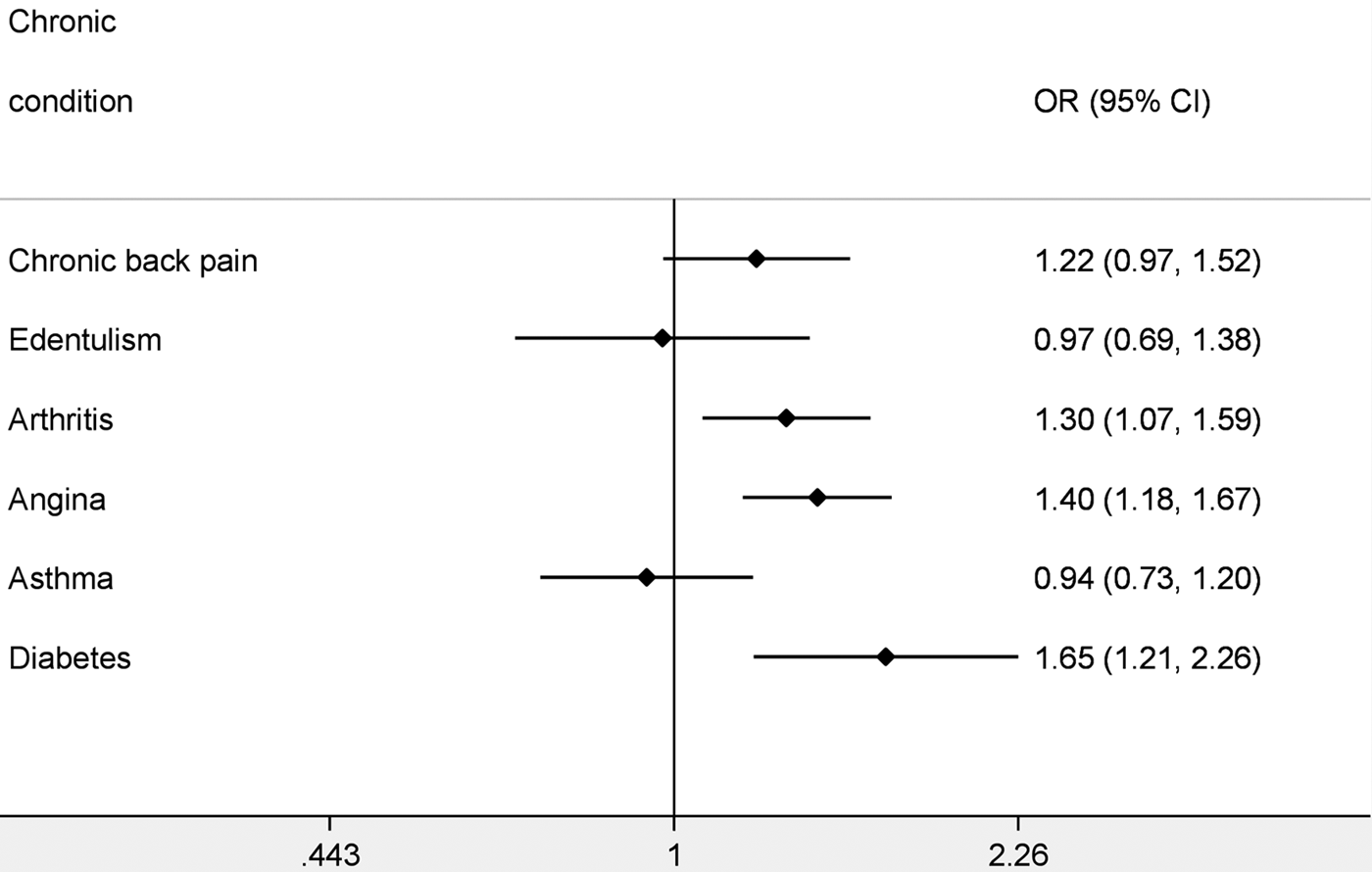
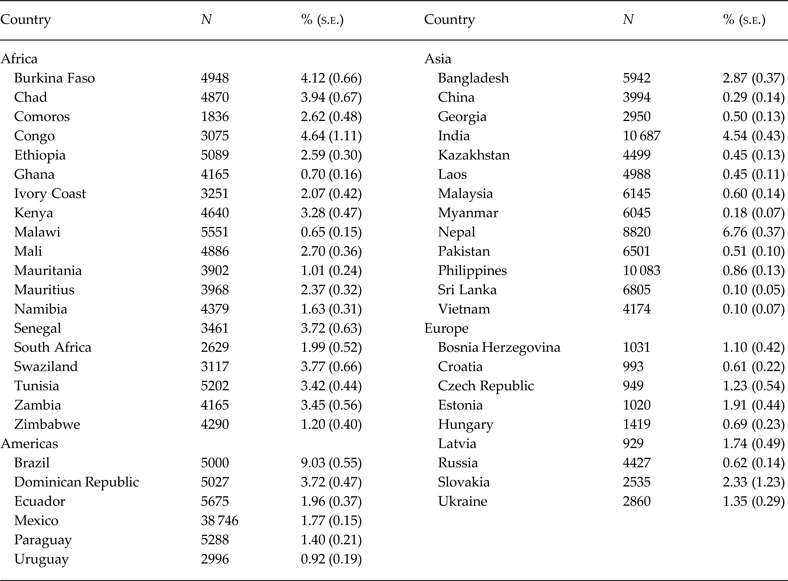
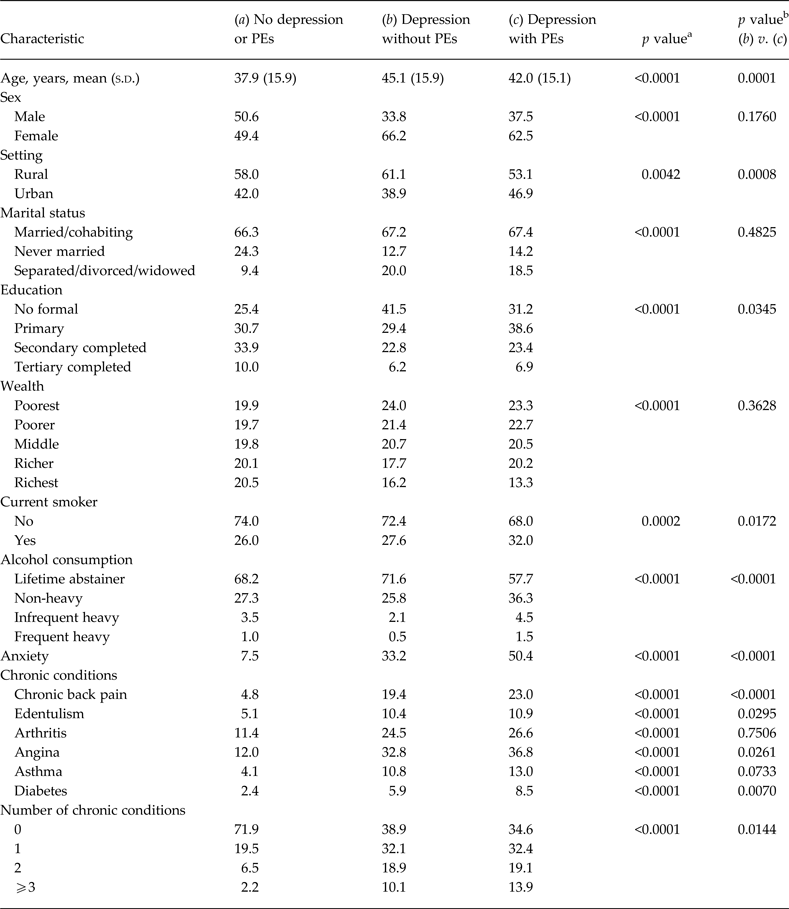
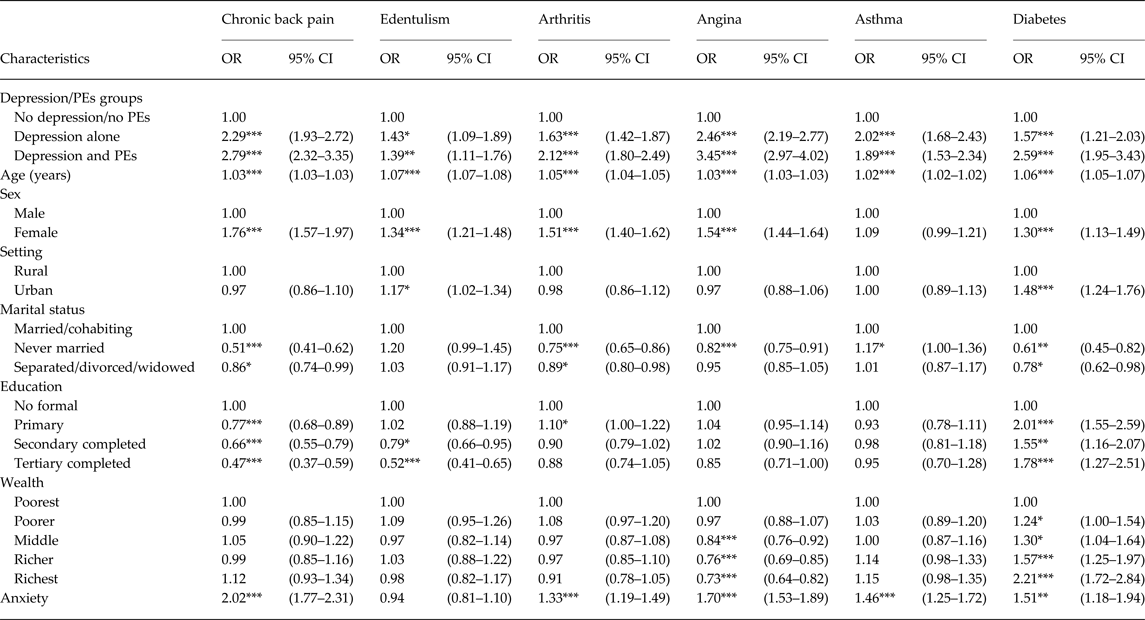
The mean age of the overall sample (i.e. including individuals with PEs alone) was 38.3 (s.d. = 16.0) years with 50.8% being female, while the crude past 12-month prevalence (95% CI) of PEs, depression, and co-morbid depression/PEs were 13.7% (95% CI 13.2–14.2), 6.4% (95% CI 6.1–6.7), and 2.5% (2.3–2.7%), respectively. The age- and sex- adjusted past 12-month prevalence of depression with PEs ranged from 0.1% (Sri Lanka, Vietnam) to 9.03% (Brazil) with prevalence of >4% also being observed in Nepal (6.76%), Congo (4.64%), India (4.54%), and Burkina Faso (4.12%) (Table 1, Fig. 1). The sample characteristics by different combinations of depression and PEs are illustrated in Table 2. Compared to those with depression alone, individuals with depression and PEs were significantly more likely to be younger, urban residents, have primary education (v. no formal), engage in current smoking and alcohol consumption, and suffer from anxiety, chronic back pain, edentulism, angina, and diabetes, as well as a higher number of physical health conditions. The association between depression/PEs groups and physical health conditions estimated by multivariable logistic regression is shown in Table 3. Compared to those with no depression or PEs, significantly elevated odds for all chronic physical conditions were observed for depression alone [edentulism (OR 1.43, 95% CI 1.09–1.89) to angina (OR 2.46, 95% CI 2.19–2.77)] and co-morbid depression/PEs [edentulism (OR 1.39, 95% CI 1.11–1.76) to angina (OR 3.45, 95% CI 2.97–4.02)]. The OR was higher for co-morbid depression/PEs compared to depression alone for chronic back pain, arthritis, angina, and diabetes. In order to assess whether this difference is statistically significant, we also conducted the same analysis but changing the reference category to depression alone. The ORs (co-morbid depression/PEs v. depression only) obtained were: chronic back pain 1.22 (95% CI 0.97–1.52, p = 0.0830); edentulism 0.97 (95% CI 0.69–1.38, p = 0.8781); arthritis 1.30 (95% CI 1.07–1.59, p = 0.0086); angina 1.40 (95% CI 1.18–1.67, p = 0.0002); asthma 0.94 (95% CI 0.73–1.20, p = 0.6131); and diabetes 1.65 (95% CI 1.21–2.26, p = 0.0017) (Fig. 2).
Age- and sex-adjusted prevalence of depression with psychotic experiences in 47 countries. All age- and sex-adjusted estimates were calculated using the United Nations population pyramids for 2010.

Associations between physical health conditions and co-morbid depression and psychotic experiences (v. depression alone) estimated by multivariable logistic regression. Models are adjusted for age, sex, setting, marital status, education, wealth, anxiety, and country. OR, Odds ratio; CI, confidence interval.

Age- and sex-adjusted prevalence of depression with psychotic experiences by country

s.e., Standard error.
Data are unweighted N and weighted %.
The N is the total sample size including individuals with a psychosis diagnosis.
Psychotic experiences referred to either one of: delusional mood, delusions of reference and persecution, delusions of control, or hallucinations.
All age- and sex-adjusted estimates were calculated using the United Nations population pyramids for 2010.
Sample characteristics by different combinations of depression and psychotic experiences (PEs)

s.d., Standard deviation.
Estimates are based on weighted sample.
a Difference in sample characteristics by the three groups of different combinations of depression and PEs. One-way ANOVA and χ2 tests were used for continuous and categorical variables respectively.
b Pairwise comparison among those with depression with and without PEs. Student's t tests and χ2 tests were used for continuous and categorical variables respectively.
Associations between depression/psychotic experiences (PEs) groups and physical health conditions estimated by multivariable logistic regression

OR, Odds ratio; CI, confidence interval.
Models are adjusted for all variables in the respective column and country.
*p < 0.05, **p < 0.01, ***p < 0.001.
Discussion
Main findings
Our study showed that the overall crude prevalence of past-12 month co-morbid depression/PEs in 47 LMICs is notable (2.5%) with the highest age- and sex-adjusted prevalence being observed in Brazil (9.0%), Nepal (6.8%), Congo (4.6%), India (4.5%), and Burkina Faso (4.1%). Compared to those with depression alone, younger age, urban residency, current smoking, alcohol consumption, and anxiety were more common in co-morbid depression/PEs. Although depression, regardless of the presence of PEs, was associated with higher odds for all chronic physical conditions, the odds were significantly higher for co-morbid depression/PEs than depression alone for arthritis, angina, and diabetes. Our results reinforce the notion that co-morbid depression/PEs is associated with adverse health outcomes.
Prevalence of co-existing depression/PEs
In our study, the overall prevalence of co-existing depression/PEs in the past 12 months was 2.5%. The lowest rates were observed in mostly Asian countries [e.g. Sri Lanka (0.10%), Vietnam (0.10%), Myanmar (0.18%), China (0.29%), Kazakhstan (0.45%), Laos (0.45%), Georgia (0.50%)], while the highest rates were observed in Brazil (9.03%), Nepal (6.76%), Congo (4.64%), India (4.54%), and Burkina Faso (4.12%). While there are no previous studies which are totally comparable, the prevalence of depression with psychotic ‘features’ was reported to be between 0.2% and 0.6% in the general adult population in Western settings (Johnson et al. Reference Johnson, Horwath and Weissman1991; Ohayon & Schatzberg, Reference Ohayon and Schatzberg2002). However, since psychotic ‘features’ refer to DSM diagnosable symptoms, in contrast to psychotic symptoms which include the broader continuum of self-reported psychosis-like phenomena, the lower overall prevalence observed in these studies is probably a reflection of the greater psychotic symptom severity.
Correlates of co-morbid depression/PEs
In our study, younger age, urban residency, education, anxiety, smoking, and alcohol consumption were significantly associated with co-morbid depression/PEs compared to depression alone with no significant differences for sex, marital status, and wealth. Some of these findings concur with previous community-based studies of similar nature but not all. For example, among adolescents and young adults in Germany, younger age and male sex were associated with co-morbid depression/PEs while urbanicity was not (Wigman et al. Reference Wigman, van Nierop, Vollebergh, Lieb, Beesdo-Baum, Wittchen and van Os2012). Furthermore, depression with psychotic ‘features’ was associated with female sex, younger age, and marital status (separated/divorced) in the European adult population (Ohayon & Schatzberg, Reference Ohayon and Schatzberg2002), while in the adult population in the United States, depression with psychotic ‘features’ was related with female sex, lower socioeconomic status, and co-morbid mental health conditions (obsessive-compulsive disorder, somatization disorder, simple phobia) with no significant differences for marital status, age, and alcohol or drug abuse and dependence (Johnson et al. Reference Johnson, Horwath and Weissman1991). These varying findings between studies may have been due to differences in settings, age groups, and severity of psychotic symptoms. The finding that urbanicity was associated with co-morbid depression/PEs in adults is novel, and may reflect the increased risk for schizophrenia onset reported to be associated with urban upbringing (Padhy et al. Reference Padhy, Sarkar, Davuluri and Patra2014) and affective disturbance with PEs (Krabbendam et al. Reference Krabbendam, Myin-Germeys, Hanssen, de Graaf, Vollebergh, Bak and van Os2005).
Association of co-morbid depression/PEs with chronic physical conditions
In our study, co-occurring depression/PEs was associated with significantly higher odds for arthritis, angina, and diabetes beyond that of depression alone. The reason why only these three conditions were more likely to be associated with co-morbid depression/PEs than others is unknown but particularly for angina and diabetes, this may be related to unhealthy health behaviors (Kouidrat et al. Reference Kouidrat, Amad, Lalau and Loas2014). For example, in our study, smoking and alcohol consumption were more common among those with co-morbid depression/PEs than depression alone. Furthermore, disordered eating has been related to PEs even after adjustment for non-psychotic mental disorders (including depression) (Koyanagi et al. Reference Koyanagi, Stickley and Haro2016b ). Alternatively, psychotic symptoms have been associated with psychological distress regardless of depression (Saha et al. Reference Saha, Scott, Varghese and McGrath2011b ), and this may be an important factor in the associations observed. Compared to other conditions, there are some reasons to believe that arthritis, angina, and diabetes may cause more distress. For example, while arthritis and chronic back pain are both painful conditions, arthritis was based on a lifetime diagnosis whereas chronic back pain was based on self-reported pain in the past 30 days with no information on severity. In settings where access to medical facilities is limited, diagnoses based solely on self-report such as arthritis may represent particularly severe cases as people may not seek medical help until the condition is critical. Furthermore, given that asthma is a condition that often remits, the fact that our definition for asthma was based on a lifetime diagnosis may mean that symptoms are were not currently present for some individuals. In contrast, arthritis, angina, and diabetes usually do not remit and may cause substantial disability and distress due to their chronic nature and symptoms, which may be aggravated especially in LMICs given that treatment options may be limited. The US study reported increased risks for medical hospitalizations in the past year in depression with psychotic ‘features’ but not outpatients visits (Johnson et al. Reference Johnson, Horwath and Weissman1991). This may be mirroring our findings where only severe medical conditions might be associated with depression with psychotic ‘features’ or PEs, possibly due to increased risk for psychological distress. Next, given that trauma has been linked to co-morbid depression/PEs (Wigman et al. Reference Wigman, van Nierop, Vollebergh, Lieb, Beesdo-Baum, Wittchen and van Os2012), and that stress can lead to impaired hypothalamic-pituitary-adrenal (HPA) axis functioning, which in turn has been associated with increased risk for PEs (Thompson et al. Reference Thompson, Phillips, Komesaroff, Yuen, Wood, Pantelis, Velakoulis, Yung and McGorry2007) as well as diabetes, cardiovascular diseases (Rosmond & Bjorntorp, Reference Rosmond and Bjorntorp2000), and arthritis (Muscatell & Eisenberger, Reference Muscatell and Eisenberger2012), this may be a shared underlying factor. Furthermore, in our previous study, co-existing depression/PEs was associated with interviewer-rated or observable mental health problems (Koyanagi et al. Reference Koyanagi, Oh, Stickley, Haro and DeVylder2016a ). Given that there may be a particularly high level of stigma attached to mental illnesses in LMICs (Alonso et al. Reference Alonso, Buron, Bruffaerts, He, Posada-Villa, Lepine, Angermeyer, Levinson, de Girolamo, Tachimori, Mneimneh, Medina-Mora, Ormel, Scott, Gureje, Haro, Gluzman, Lee, Vilagut, Kessler and Von Korff2008), inequality in access to healthcare [resulting in under-detection of risk factors (e.g. hypercholesterolemia, hypertension) of more serious health conditions, and/or suboptimal treatment for the physical health conditions] for those with co-morbid depression/PEs may also underlie our findings (De Hert et al. Reference De Hert, Cohen, Bobes, Cetkovich-Bakmas, Leucht, Ndetei, Newcomer, Uwakwe, Asai, Moller, Gautam, Detraux and Correll2011a , Reference De Hert, Correll, Bobes, Cetkovich-Bakmas, Cohen, Asai, Detraux, Gautam, Moller, Ndetei, Newcomer, Uwakwe and Leucht b ). Next, sleep problems, which have been associated with co-morbid depression/PEs, may also be implicated (Koyanagi et al. Reference Koyanagi, Garin, Olaya, Ayuso-Mateos, Chatterji, Leonardi, Koskinen, Tobiasz-Adamczyk and Haro2014, Reference Koyanagi, Oh, Stickley, Haro and DeVylder2016a ). Finally, it is also possible that PEs in the context of depression are a reflection of more severe psychopathology. For example, previous studies have shown that higher numbers of mental disorder subtypes (i.e. depressive disorder, anxiety disorder, post-traumatic stress disorder, substance use disorder) are associated with PEs in a dose-dependent fashion (DeVylder et al. Reference DeVylder, Burnette and Yang2014), while depression/PEs may also be a marker of more severe depression (Saha et al. Reference Saha, Scott, Varghese and McGrath2012; Koyanagi et al. Reference Koyanagi, Oh, Stickley, Haro and DeVylder2016a ). As more severe psychopathology has also been associated with higher risks for chronic physical conditions (Scott et al. Reference Scott, Lim, Al-Hamzawi, Alonso, Bruffaerts, Caldas-de-Almeida, Florescu, de Girolamo, Hu, de Jonge, Kawakami, Medina-Mora, Moskalewicz, Navarro-Mateu, O'Neill, Piazza, Posada-Villa, Torres and Kessler2016), this may also explain the link between depression/PEs and chronic physical conditions observed in our study.
Strengths and limitations
To the best of our knowledge, our study is the first study to provide information on the prevalence and correlates of co-existing depression and PEs at the national level, while it is also the first study to assess the excess risk for chronic physical conditions associated with this condition. The strength of the study is the large sample size including predominantly nationally representative data from diverse settings. The results should nevertheless be interpreted in the light of several potential limitations. First, since the data used in our study were based on self-report, reporting bias may have influenced responses (e.g. social desirability, recall). For example, social desirability may, at least partially, account for the differences in the prevalence of some variables used in this study (e.g. PEs; DeVylder & Hilimire, Reference DeVylder and Hilimire2015). Furthermore, medical conditions based solely on self-reported diagnosis (arthritis, asthma, diabetes) may be under-diagnosed where access to healthcare facilities is limited. Second, we did not have information on all types of psychotic symptoms or details on the exact nature of the PEs. In particular, it would have been desirable to have information on the latter as it is possible that some questions on PEs were misinterpreted by the respondent, or that they were reflections of ‘normal’ experiences in some circumstances or cultures. Third, institutionalized individuals were not included in the survey, limiting generalizability. Next, the WHS countries were not randomly selected to represent all LMICs. Thus, the results of our studies may not be generalizable to all LMICs. Finally, causality cannot be inferred due to the cross-sectional nature of the data.
Conclusion
In conclusion, the prevalence of co-morbid depression and PEs might not be negligible in many LMICs. Although depression was associated with higher odds for chronic back pain, edentulism, arthritis, angina, asthma, and diabetes, the co-existence of depression and PEs was associated with a higher odds beyond that of depression alone only for angina, arthritis, and diabetes. Given the increasing evidence that depression with PEs maybe a depression subtype associated with adverse health outcomes, while PEs and depression may mutually act to sustain and aggravate each other, our study suggests that when depression/PEs or a chronic condition (e.g. arthritis, angina, diabetes) is detected, screening for the other may be important. Future studies examining the reasons for the increased risk for co-morbid depression/PEs for some chronic conditions but not others may shed light on the significance and etiology of co-existing depression/PEs.
Acknowledgements
A.K.’s work was supported by the Miguel Servet contract financed by the CP13/00150 and PI15/00862 projects, integrated into the National R + D + I and funded by the ISCIII – General Branch Evaluation and Promotion of Health Research – and the European Regional Development Fund (ERDF-FEDER). B.S. received funding from the National Institute for Health Research Collaboration for Leadership in Applied Health Research & Care Funding scheme. These funders had no role in: design and conduct of the study; collection, management, analysis, and interpretation of the data; and preparation, review, or approval of the manuscript.
Declaration of Interest
None.