Introduction
Tree holes are among the most abundant phytotelmata (i.e., plant-held waters; Kitching, Reference Kitching2000) in many tropical and temperate forests. A variety of macro-organisms use these natural cavities as larval habitat and many species develop exclusively in these sites. Since they are main container larval environments for many pathogen vectors, especially mosquitoes (Diptera: Culicidae), tree holes may be medically and economically important habitats (Yanoviak, Reference Yanoviak2001). Aedes Meigen mosquitoes that transmit both dengue, chikungunya and zika viruses are known to use tree holes as larval habitat in India (Selvan et al., Reference Selvan, Jebanesan and Reetha2016) and in tropical rainforests of Nigeria, Africa (Anosike et al., Reference Anosike, Nwoke, Okere, Oku, Asor, Emmy-Egbe and Adimike2007). Aedes aegypti L., the main global vector of dengue and urban yellow fever (Gubler, Reference Gubler2004) is usually linked to artificial containers, but immature stages have also been collected from tree holes in different parts of the world (Yadav et al., Reference Yadav, Sharma and Chand1997; Marquetti et al., Reference Marquetti, Suárez, Bisset and Leyva2005; Anosike et al., Reference Anosike, Nwoke, Okere, Oku, Asor, Emmy-Egbe and Adimike2007; Hribar & Whiteside, Reference Hribar and Whiteside2010) including recently in Argentina, Salta Province (Mangudo et al., Reference Mangudo, Aparicio and Gleiser2011, Reference Mangudo, Aparicio and Gleiser2015). Aedes triseriatus (Say) is a common North American tree hole mosquito, which is regularly found cohabiting with predatory larvae of Toxorynchites rutilus (Coquillett) in the southern USA (Lounibos et al., Reference Lounibos, Nishimura and Escher1993), and was also reported competing with the invasive species Aedes albopictus (Skuse) (Lounibos et al., Reference Lounibos, O'Meara, Escher, Nishimura, Cutwa, Nelson, Campos and Juliano2001). Species of Haemagogus Williston are of great interest in South America because of their role in sylvatic yellow fever transmission and some species of Sabethes Robineau-Desvoidy are known to harbour and transmit this and other arboviruses (Degallier et al., Reference Degallier, Travassos Da Rosa, Vasconcelos, Travassos Da Rosa, Rodrigues, Sa Filho and Travassos Da Rosa1992). Even though early researches recorded and attempted to control the vectors or suspected vectors of yellow fever in tree holes (and other phytotelmata), still little is known about their bionomics.
Mosquito species diversity may indirectly alter transmission risk, for example by limiting mosquito abundance (including vector abundance) since any factor that reduces vector abundance is expected to decrease the entomological risk of disease transmission (Chaves et al., Reference Chaves, Hamer, Walker, Brown, Ruiz and Kitron2011). Moreover, as more species cohabit, more interspecific interactions between vector and non-vector species are possible, which may affect vector capacity. It has been shown for example, that an increase in larval competition between Ae. aegypti and Ae. albopictus enhanced the proportion of the latter that transmits dengue virus (Alto et al., Reference Alto, Lounibos, Mores and Reiskind2008). In other studies it was observed that the presence of Ae. albopictus reduced the survival of Ae. triseriatus larvae (vector of La Crosse virus in the USA), but in turn, from the surviving larvae emerged bigger female mosquitoes that were more given to develop disseminated virus infections, thus affecting the pathogen transmission risk (Bevins, Reference Bevins2008).
Culicids are being found in micro-ecological habitats differing from their known ecological habitats, such as the collection of Anopheles gambiae ss (Omlin et al., Reference Omlin, Carlson, Ogbunugafor and Hassanali2007) and An. funestus, Giles typically found in ground ponds, in tree holes in Nigeria, Africa (Anosike et al., Reference Anosike, Nwoke, Okere, Oku, Asor, Emmy-Egbe and Adimike2007). The presence of sylvan species in urban areas may be relevant if these species are or become involved in arbovirus transmission. We recently found larvae and pupae of Sabethes purpureus (Theobald) in tree holes both in urban and forest environments in Orán, Salta Province (Argentina). Although this species is commonly assumed to be mostly restricted to the forest habitat, a higher proportion of tree holes was positive in the urban compared with the forest environment (Mangudo et al., Reference Mangudo, Aparicio and Gleiser2014).
The aims of this study were to further characterize the mosquito fauna developing in tree holes in the Yungas rainforests of Salta, Argentina, and to assess whether species composition and diversity were similar between urban (San Ramón de la Nueva Orán city) and adjacent forested areas. This region is located within an area of high biological diversity (Malizia et al., Reference Malizia, Pacheco, Blundo and Brown2012; Szumik et al., Reference Szumik, Aagesen, Casagranda, Arzamendia, Baldo, Claps, Cuezzo, Díaz Gómez, Di Giacomo, Giraudo, Goloboff, Gramajo, Kopuchian, Kretzschmar, Lizarralde, Molina, Mollerach, Navarro, Nomdedeu, Panizza, Pereyra, Sandoval, Scrocchi and Zuloaga2012), combined with epidemiological potential due to the presence of Ae. aegypti, the occurrence of dengue outbreaks and the recent introduction of Chikungunya virus (Pan American Health Organization, 2017). Moreover, several provincial departments of Salta within Yungas rainforest, including Oran, are considered as potential risk areas for Yellow Fever by the World Health Organization (WHO, 2014). They harbour a cebus monkey (Cebus capella) potentially capable of supporting YF infection. These characteristics make the region an interesting model to study tree hole culicid communities and eventually their relation to the epidemiology of mosquito-borne diseases.
Materials and methods
Study area
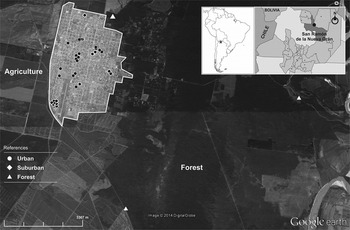
San Ramon de la Nueva Orán, hereafter Orán, is a city in northwest Argentina (23°08′S, 64°20′W, elevation 337 m.a.s.l.; fig. 1). Covering an area of 20 km2, it is the second largest urban centre of Salta Province with a population of approximately 82,000 (INDEC, 2010). Orán is located within the Pedemontane rain-forest floor of the Yungas, where jungles of Calycophyllum multiflorum Griseb (Rubiales: Rubiaceae) and Phyllostylon rhamnoides (Poisoon) Taub. (Urticales: Ulmaceae) and vines predominate (Brown et al., Reference Brown, Grau, Malizia, Grau, Kappelle and Brown2001). The area has been subjected to changes related to human activities (mainly urbanization, industrial development, agriculture and forestry). The climate is subtropical, with an average summer temperature of 27.7°C and winter temperature of 16.4°C. The mean annual rainfall is 1000 mm, occurring mostly during the warmer months (October–April).
Location of study area and tree holes that harboured culicid larvae and/or pupae at least once, on sidewalks and parks in urban areas (black figures) in the city of San Ramón de la Nueva Orán and within a square area (50 × 50 m2) at three Yungas forest sites (white figures) located at 0.5 km to the northeast, 7 km to the east and 4 km to the southeast from the urban border, Salta Province, Argentina.

The city is characterized by a densely built central area where houses with small or no front yards predominate and there are few low buildings. Suburban areas have a lower building density with bigger gardens, more trees and are closer to the border with the seminatural region. Native Yungas forest remains to the east, northeast and southeast of the city, while the western and southern regions are mostly agricultural (INTA, Reference Arroyo2004).
Tree hole selection
Tree holes were inspected in 1213 trees in the main forested areas of the city, including parks, sidewalks and areas within the graveyard and the sports centre, as described in Mangudo et al. (Reference Mangudo, Aparicio and Gleiser2014). Briefly, trees were examined to assess whether they bore holes up to 2 m above the ground that could hold water. Additionally, trees were inspected within a square area (50 × 50 m2) at three Yungas forest sites located at 0.5 km to the northeast, 7 km to the east and 4 km to the southeast from the urban border. The forested areas were connected to downtown by rural paths. Each tree was assigned to one of three habitat categories according to its location and urbanization degree: urban (central area of the city, with a mean density of 81 homes ha−1, and at least 40% built surface (including roads)), suburban area (peripheral area of the city, with a mean density of 23 homes per ha and 20% or less built surface) and forest (out of the city, without buildings). Tree species and the presence or absence of water-holding holes, as well as location of trees with holes (Garmin global positioning system, Garmin eTrex Legend, Olathe, KS) were recorded.
Entomological sampling
Sixty three (5%) of the trees examined had 69 holes that held water. Tree holes types included pans formed as branch intersection and rot holes (Mangudo et al., Reference Mangudo, Aparicio and Gleiser2015). The presence and volume of water and number of immature stages (larvae and/or pupae) in each of these tree holes was recorded approximately once a month from January to April of 2011 and from January to March of 2012 and 2013. The time frames comprise the season when rainfall is most likely to flood the tree holes, based on previous (informal) observations, the capability to retain water could not be sustained during the winter dry months. The average monthly rainfall of the sampling season was 135 ± 13 mm. Within a given month, inspecting all water-holding tree holes took three to five consecutive days. At a sampling date all water content was removed from the tree hole using a siphon bottle, and thus the larvae found during the following sampling date belonged to new cohorts (Mangudo et al., Reference Mangudo, Aparicio and Gleiser2014, Reference Mangudo, Aparicio and Gleiser2015). Water contents were examined on site in a white plastic tray to separate potential predators and specimens were transported to the laboratory for further processing. Larvae of the 1st, 2nd and 3rd instars and pupae were reared either to the 4th instar or to adult emergence. Taxonomic determinations were based on morphological characteristics of 4th instar larvae and/or adults, using Darsie (Reference Darsie1985) and Forattini (Reference Forattini1996, Reference Forattini2002) keys and species descriptions. Abbreviations for mosquito genera and subgenera are those proposed by Reinert (Reference Reinert2009).
Data analysis
The set of Culicidae collected in a tree hole on a sampling date was considered as a sample. To assess completeness of the mosquito inventory, the sample coverage C, i.e. the total probability of occurrence of the species observed in the reference sample (Chao & Shen, Reference Chao and Shen2010; Chao & Jost, Reference Chao and Jost2012), was estimated for the community from each habitat category considering the pooled samples from a habitat. Since mosquitoes lay their eggs in batches, and thus larvae of a species are usually clumped in space, abundance-based rarefaction may underestimate species richness. Thus, instead of species frequencies, incidences (i.e. the number of positive samples for a species) were considered for these analyses as recommended by Gotelli & Chao (Reference Gotelli, Chao and Levin2013).
To compare overall species richness of the three habitats, a species accumulation curve was estimated for each habitat using sample interpolation (rarefaction) and extrapolation (to less than twice the number of samples recorded in a site) from the total number of samples collected on each habitat, using the multinomial model (Colwell et al., Reference Colwell, Chao, Gotelli, Lin, Mao, Chazdon and Longino2012) provided by EstimateS software (Colwell, Reference Colwell2013) (i.e. the expected number of species represented in m samples, given a reference sample). The option to randomize samples with replacement was selected, whose advantage is that the variance of the estimators is unconditional to the accumulation of samples.
Species diversity per tree hole and sampling date was estimated as the observed number of species (richness, S; diversity of order zero) and computing the effective number of species (or diversity of order one; see, for example, Jost, Reference Jost2006).
 $${}_{}^1 D = {\rm exp}\left( { - \mathop \sum \limits_{i = 1}^S p_i\ln p_i\;} \right),$$
where p i (importance value) = n i /N, N = total abundance of all species, n i = abundance of species i, and ln() the natural logarithm.
Generalized linear mixed models (GLMM) (Infostat; Di Rienzo et al., Reference Di Rienzo, Casanoves, Balzarini, Gonzalez, Tablada and Robledo2014) were used to assess if mosquito diversity per tree hole significantly differed between habitats. Dependent variables were the effective number of species and richness per tree hole per sampling date (assuming a Poisson distribution), fixed effect was habitat (urban, suburban and forest) and random effects were month and tree hole. To evaluate if diversity was significantly different between tree hole type (branch intersection and rot hole) and habitat GLMM (Infostat; Di Rienzo et al., Reference Di Rienzo, Casanoves, Balzarini, Gonzalez, Tablada and Robledo2014) were also used; tree hole was the random effect.
To assess if there were differences in species composition between habitats (urban, suburban and forest) a non-parametric multivariate analysis of variance (PERMANOVA) with 10,000 permutations based on Bray–Curtis distances was used. The total of specimens from each species collected in each tree hole per sampling date (data transformed to ln(n + 1)) was considered a sample. To determine which species contributed more to dissimilarity among tree holes for those pairs of habitats that showed significant differences on previous analysis, a SIMPER method (similarity percentage) was used; it is available in Past software (Hammer et al., Reference Hammer, Harper and Ryan2001).
Since no significant differences were found in species composition between urban and suburban habitats, those data were regrouped in a ‘city’ category in order to explore if associations of pairs of species were similar in comparison with the forest. Significance of species associations (C AB) were analysed using Cole's C7 index (1949) by 2 × 2 contingency tables and χ2 (Hurlbert, Reference Hurlbert1969). At each sampling date, all water content (and larvae + pupae) was extracted from the tree hole, therefore immature found on two consecutive sampling dates belong to different cohorts due to instalment hatching from different flood events or colonization events. Only those dates when both species of a pair were present were considered in order to reduce seasonal segregation effects; furthermore, from this data pool, species detected on less than five different trees were excluded from the analysis to reduce samples dependence on site.
Finally, Spearman r S non-parametric correlation was used to assess if abundance and species diversity were related with water volume. For all tests, a P-value < 0.05 was considered to represent significant differences. Throughout the text, the results are presented as the mean plus/minus the standard error.
Results
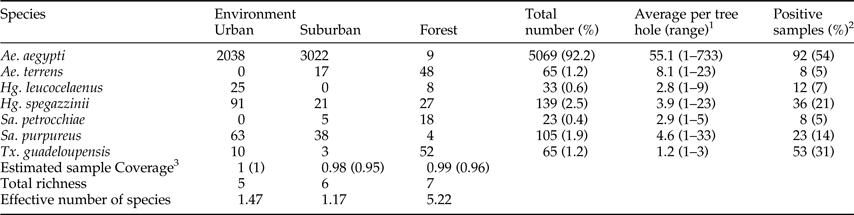
We collected 5498 immature culicids in 26 species of trees from a total of 170 samples, belonging to seven species from five genera, in descending order of abundance: Ae. aegypti, Haemagogus spegazzinii Brèthes, Sa. purpureus, Toxorhynchites guadeloupensis Dyar and Knab, Aedes terrens (Walker), Haemagogus leucocelaenus Dyar & Shannon and Sabethes petrocchiae (Shannon and Del Ponte) (table 1). In urban and suburban environments, Ae. aegypti was the most frequent species, no specimen of Ae. terrens or Sa. petrocchiae were detected in urban tree holes, while Hg. leucocelaenus was not found in the suburban samples. All species were found in the forest, although Ae. aegypti occurrence was an exceptional event in this habitat, in a tree hole within its flight dispersal range from the city border (Mangudo et al., Reference Mangudo, Aparicio and Gleiser2015).
Mosquito species collected (total number of specimens) in tree holes in urban and suburban environments of San Ramón de la Nueva Orán and adjacent forested areas, Salta Province, Argentina.

1 Average number per tree hole.
2 Samples indicate total number of tree holes and sampling dates positive for Culicidae.
3 Sample coverage C and rare species coverage in parenthesis.
Sampling efficiency (estimated sample coverage) was estimated to be 0.98 or higher for each habitat, while rare species coverage was 0.95 or higher for all habitats (table 1). Using the method of Shen et al. (Reference Shen, Chao and Lin2002), less than one additional species was predicted in a further survey of 100 samples from urban (0 ± 0), suburban (0.3 ± 0.5) or forest (0.4 ± 0.7) habitats. Taken together, the results of the present study indicate that the samples obtained provide adequate representation of the species diversity at all three habitats.
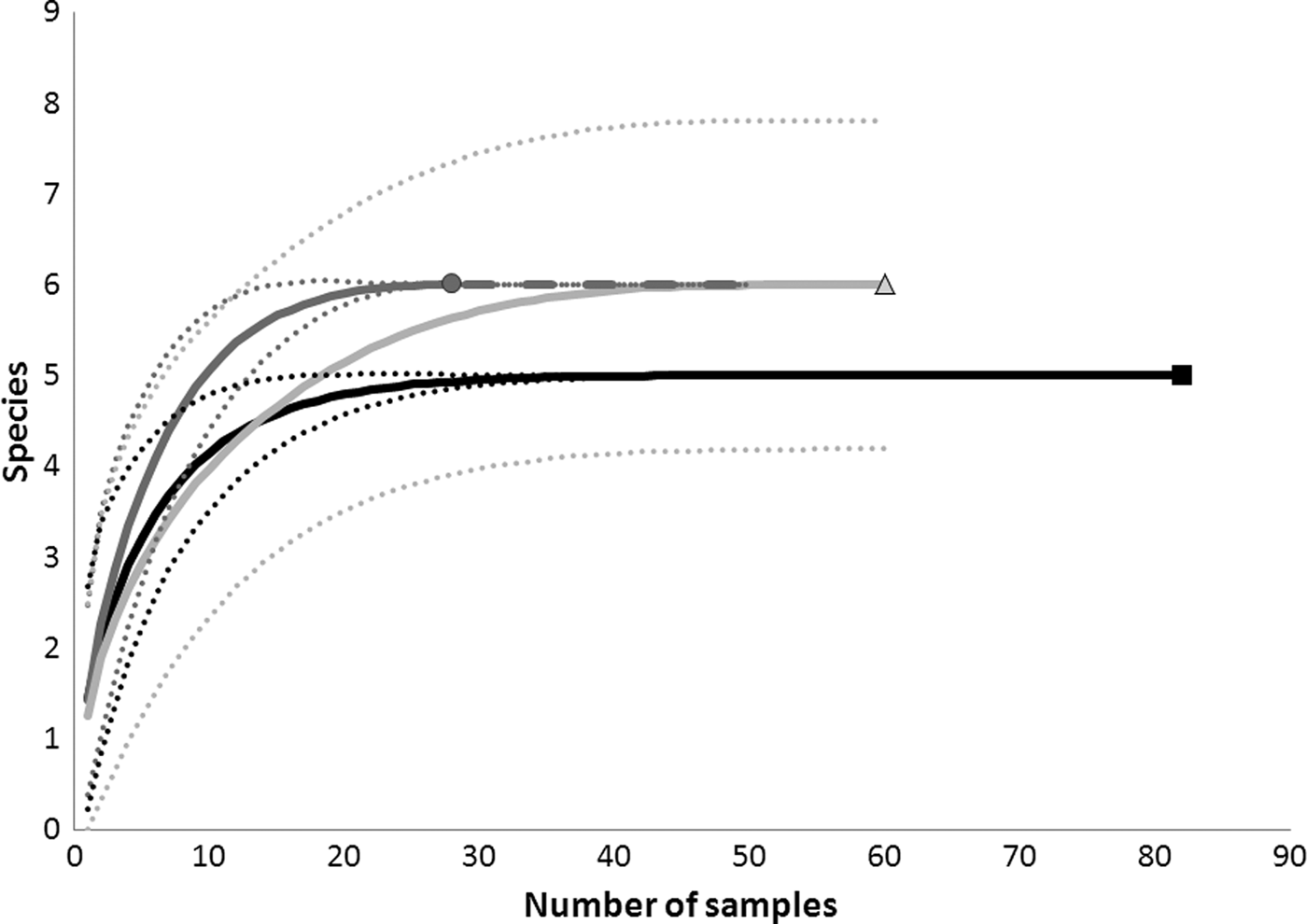
Results of rarefaction–extrapolation curves were compared among the three habitats considering 50 samples, which was less than the double of the smaller number of samples collected in any of the three habitats (following Colwell's rules; Colwell et al., Reference Colwell, Chao, Gotelli, Lin, Mao, Chazdon and Longino2012) (fig. 2). The 95% unconditional confidence intervals of urban and suburban tree holes did not overlap, indicating that mosquito richness in urban habitat was significantly lower than in the suburban habitat. On the other hand, the confidence intervals of forest richness fully overlapped with those of urban and suburban habitats. Following the conservative rule of overlapping intervals proposed by Colwell et al. (Reference Colwell, Chao, Gotelli, Lin, Mao, Chazdon and Longino2012), we inferred the overall richness did not significantly differ between the forest and urban habitats or between forest and suburban habitats. However, when considering the species relative abundances, the effective number of species of forest was 3.6 and 4.5 times higher than the urban and suburban environments, respectively (table 1).
Species accumulation curves obtained using sample rarefaction and extrapolations (continued lines) from the total number of samples collected on each habitat (urban in black and square, suburban in dark grey and circle and forest in light grey and triangle) in San Ramón de la Nueva Orán, Salta Province, from a multinomial model, with 95% unconditional confidence intervals (CI 95%) (dotted lines) (based on Colwell et al., Reference Colwell, Chao, Gotelli, Lin, Mao, Chazdon and Longino2012).

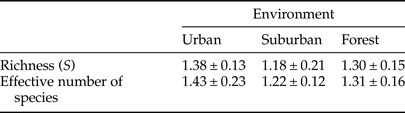
The richness (S) per tree hole (sample), on the other hand, was relatively low (one species in 72% of the samples, and up to four species in the remaining 28%) and no significant effect of habitat type on this variable was detected (P = 0.72). Consistently, the effective number of species per tree hole was also low (ranging from 1.22 to 1.43 species) and did not differ among habitats (P = 0.69) (table 2). Significant correlations between diversity and water volume were not detected either (Spearman r S = 0.10, P = 0.17). On the other hand, there was a positive and significant correlation between larval abundance and water volume (Spearman r S = 0.36, P < 0.0001). Mean water volume recorded was 239.8 ± 46.4 ml and ranged from 10 to 3450 ml.
Average mosquito species diversity (richness and effective number of species (expression 1)) per tree hole in urban and suburban environments in the city of San Ramón de la Nueva Orán and adjacent forested areas, Salta Province, Argentina. Mean ± standard errors are shown.

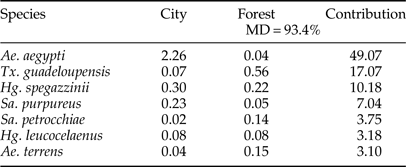
Significant differences in species composition among habitats were found with PERMANOVA (F = 37.83; P = 0.0001), being the forest different from urban and suburban environments (P = 0.0001); tree holes from urban and suburban environments did not differ significantly (P = 0.33) in their species composition. The SIMPER analysis indicated that differences among tree holes in the city (grouping urban and suburban tree holes) and forest were mainly due to the higher abundance of Ae. aegypti (contributing 49.07% to the dissimilarity) and to a lower abundance of Tx. guadeloupensis (contributing 17.07%) in the city tree holes (table 3).
Mean abundances (ln(n + 1)) per tree hole and percentage contribution to the dissimilarity between city (urban and suburban) and forest (according to SIMPER analysis) of mosquito species collected in tree holes, in the city of San Ramón de la Nueva Orán and adjacent forested areas, Salta Province.

MD, Mean dissimilarity.
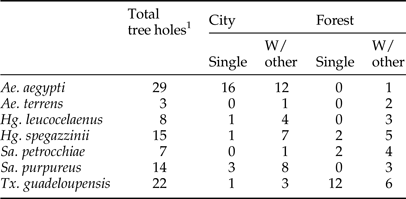
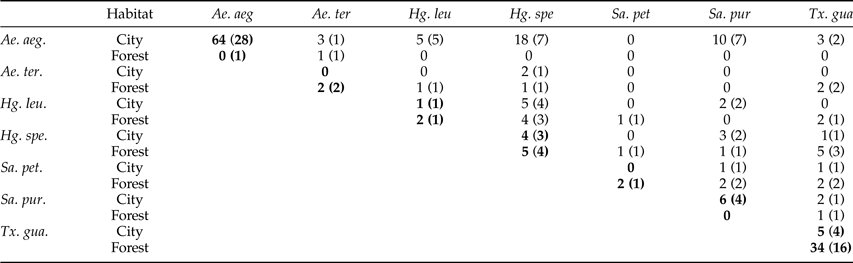
In the urban environment, in approximately half the tree holes Ae. aegypti was always collected as a single species (table 4). A similar pattern was observed for Tx. guadaloupensis in the forest. In contrast, in most trees holes Hg. leucocelaenus, Hg spegazzinii and Sa. purpureus were collected at least once coexisting with other species. Table 5 shows the number of samples each pair of species was collected together. Based on the C7 coefficient of association of Cole (Reference Cole1949), positive significant associations were detected between Ae. aegypti–Hg. leucocelaenus (0.23 ± 0.09; coefficient of association ± standard error), Ae. aegypti–Hg. spegazzinii (0.15 ± 0.05) and Hg. spegazzinii–Hg. leucocelaenus (0.53 ± 0.14 in the city and 0.48 ± 0.16 in the forest). Although Tx. gusdeloupensis was less frequently found coexisting with other species (table 5), the coefficients that could be assessed were not significant (−0.24 ± 0.36 with Ae. aegypti; −0.05 ± 0.29 with Hg. spegazzinii).
Number of tree holes where each species was found per habitat.

Single: number of tree holes where the species was never found coexisting with another species. W/other: Number of trees where the species was found at least once coexisting with other (one or more) species.
1 Number of tree holes that were positive at least once for a given species.
Number of samples where two species were collected together.

Number in parenthesis indicates number of tree holes those samples came from.
In bold single species occurrences.
Ae. aeg, Aedes aegypti; Ae. ter, Aedes terrens; Hg. leu, Haemagogus leucocelaenus; Hg. spe, Haemagogus spegazzinii; Sa. pet, Sabethes petrocchiae; Sa. pur, Sabethes purpureus; Tx. gua, Toxorynchites guadeloupensis.
Discussion and conclusions
There is a growing interest in studying mosquito communities because of the potential influence of species diversity on pathogen cycles and transmission. In the present study, Ae. aegypti was widely detected in tree holes throughout the city and was even predominant over other culicids collected during the three years long research, being found positively associated with Hg. leucocelaenus and Hg. spegazzinii. The presence of Ae. aegypti in tree holes may be relevant especially in cities such as Orán, where small outbreaks of dengue are common and high densities of this vector increase the risk of large epidemics as the one observed in 2009 which affected 18 provinces and about 26,000 people (Torres, Reference Torres2010) or in 2016 with more than 76,900 cases (Ministerio de Salud, 2016). As has already been discussed in Mangudo et al. (Reference Mangudo, Aparicio and Gleiser2015), our only record of Ae. aegypti in the forest was made in a partially disturbed natural area, close to the urban border (300 m), and occasionally visited by people through a rural path connecting with the city. Thus, Ae. aegypti occurs in close association with human populations and despite the availability of larval habitats, it does not seem to establish in the forest.
Urbanization is one of the most severe land uses, causing significant changes in the environment, creating a mosaic of patches with different types of coverage (Alberti & Marzluff, Reference Alberti and Marzluff2004). In Brazil, mosquito species richness and diversity increased from lower to higher forest cover and was highest in sites with highest diversity and number of larval habitats (Correa et al., Reference Correa, Gleiser, Leite, Fagundes, Gil-Santana, Mello, Gredilha and Alencar2014). Similarly, in Kenya, Africa, a significantly lower mean number of mosquito species per sample was recorded in a peridomestic zone compared with two forested habitats (Lounibos, Reference Lounibos1981). In the present study, we observed lower global species richness in the urban compared with the suburban environment. However, although the total number of species observed in the forest was higher than in the city, there were no significant differences in richness in the forest compared with urban and suburban environments, which may be related to the sporadic occurrence of Ae. aegypti and Sa. purpureus in the forest. On the other hand, there was a higher effective number of species in the forest compared with the urban or suburban sites, explained by the higher abundance and dominance of Ae. aegypti in the city compared with the forest tree holes. The higher richness we found in the suburban habitats compared with urban, a transition area between the urban and forest environments, may reflect the fact that some culicid species adapted to wild or human environments could find in the suburban sites intermediate conditions they tolerate. Alternatively, species from wild areas could be spilling over to the suburban areas, which could act as a sink habitat. These diversity patterns were also found in other systems. For example, Tóthmérész et al. (Reference Tóthmérész, Máthé, Balázs and Magura2011) studied diversity of carabid beetles along a rural–urban gradient representing increasing human disturbance. They found that the total number of carabid species was significantly higher in the suburban area followed by the rural area and was the lowest in the urban area. Their results did not support what they expected, that is, an increase in disturbance would monotonically decrease diversity. The overall impact of urbanization is different on different species; it depends for example on species habitat affinities (forest specialists or generalists) (Tóthmérész et al., Reference Tóthmérész, Máthé, Balázs and Magura2011).
When assessing local (sample) species richness or diversity, i.e. per tree hole and date, no significant differences were detected on richness or relative abundances (expressed as effective number of species). This could be due to the low number of species that coexists in the same tree hole in a given date, which typically ranged from one to three species.
We found significant differences on species composition between tree holes located in forested environments and urban or suburban tree holes. These differences were mainly due to relative abundances and/or frequencies of Ae. aegypti and Tx. guadeloupensis (table 4), being the former more abundant in urban and suburban environments (and almost absent from the forest) and the latter more frequent in the forest.
The genus Toxorhynchites includes mostly tropical mosquitoes; species of Toxorhynchites are usually found more frequently and in higher abundances in vegetated zones (Corbet, Reference Corbet1964; Lounibos, Reference Lounibos1981). However, it must be noted that in Orán the urban specimens were collected from tree holes located both in the centre and in the western border of the city (3 and 5 km approximately from the forest, respectively), and no specimens were obtained from urban tree holes closer to the eastern forested region. Thus, finding these larvae and pupae in tree holes in the city would more likely indicate the species actually dwelling in this urban environment, instead of sporadic occurrence from forest dispersing individuals.
The predatory genus Toxorhynchites is of particular interest within tree hole mosquitoes as it exploits a different niche than most other tree hole mosquitoes (which are browsers and filter feeders) (Srivastava, Reference Srivastava2005). In the present study, both in the forest and in city areas Tx. guadaloupensis was most frequently collected as a single species (67% of the samples). All members of the genus Toxorhynchites are obligate predators (Lounibos, Reference Lounibos1981) and since the other culicid species are potential prey for Tx. guadeloupensis, these results may be a direct consequence of predation. On the other hand, they could be in some extent the result of oviposition preferences, since the oviposition behaviour of adult mosquitoes is responsible for the spatial occurrence of larvae (Lounibos, Reference Lounibos1981). Further studies are needed to confirm these hypotheses.
Some studies related the presence of Toxorhynchites with more diverse mosquito communities in forested environments (Corbet, Reference Corbet1964). Probably, this predator contributes to prey coexistence by lowering their densities and alleviating their interspecific competition (Mogi & Yong, Reference Mogi and Yong1992) or by selective feeding on prey species (Bradshaw & Holzapfel, Reference Bradshaw and Holzapfel1983). However, a study in Kenya showed higher abundances of Tx. brevipalpis Theobald in ecotonal and forested zones, which yielded the highest species richness values, but found no significant correlation between number of prey species per sample and the presence of the predator (Lounibos, Reference Lounibos1979). Consistently, in our study Tx. guadeloupensis was found only in 28% of the samples holding more than two species. Moreover, the effects of Toxorhynchites on potential prey diversity observed in some studies have been opposed and could partially depend on phytotelmata species. The presence of Tx. haemorrhoidalis (Fabricius) significantly reduced the mean number of taxa of potential prey in Heliconia spp., but no significant effect on taxon richness was observed among bamboo samples containing this predator (Lounibos et al., Reference Lounibos, Frank, Machado-Allison, Ocanto and Navarro1987). Even though at tree hole level community diversity (estimated as richness or effective number of species) was similar, there were overall differences in species composition between urbanised environments (urban and suburban) and the forest; whether diversity patterns in tree holes in this region may be related to the presence of Tx. guadeloupensis is not clear. Besides affecting species diversity, predators such as Toxorhynchites that feed on vector mosquitoes may influence on their abundances and indirectly in their vector capacity (Lounibos & Campos, Reference Lounibos and Campos2002). We can speculate that the negative association (albeit non-significant) between Tx. guadeloupensis and Ae. aegypti could indicate (at least in tree holes) that the first species may exercise partial control over the second. However, effects of predators on mosquito and their consequences for populations and for mosquito-borne disease are not fully understood (Juliano, Reference Juliano2009).
In a previous-related work on Sa. purpureus, a species considered sylvatic and whose larval habitats are poorly known, we extended its known geographic distribution (Mangudo et al., Reference Mangudo, Aparicio and Gleiser2014). Finding this species in Orán region, and particularly in urban environments, is interesting for many reasons. On the one hand, the species has been collected in essentially sylvatic biotopes (Guimarães et al., Reference Guimarães, Macedo Lopes, Pinto de Mello and Alencar2003; Cardoso et al., Reference Cardoso, Corseuil and Barata2005; D'Oria et al., Reference D'Oria, Martí and Rossi2010) and in forest patches within urban settings (Reis et al., Reference Reis, Muller and Marcondes2010), suggesting that it was mostly restricted to the forest habitat. The fact that larvae and pupae were collected from water-holding tree holes, both in the urban and suburban environments, suggests that in Orán immature stages of Sa. purpureus complete their development in these larval habitats, and thus environmental conditions are adequate for this species to breed within an urban landscape; or its niche breadth could be wider than the assumed.
Consistently with the fact that positive associations between species are relatively frequent among non-predatory mosquitoes in container habitat such as tree holes (Sota et al., Reference Sota, Mogi and Hayamizu1994), significant associations detected in this study were positive. We found both Hg. leucocelaenus and Hg. spegazzinii positively associated with Ae. aegypti in the city. H. leucocelaenus was positively associated with Hg. spegazzinii regardless of the habitat where the tree hole was located. In contrast, in tree holes in a sylvan habitat in Chaco Province, Argentina, Hg. spegazzinii showed the lowest values of temporal niche superposition with Hg. leucocelaenus (Stein et al., Reference Stein, Ludueña-Almeida, Willener and Almirón2011). In the Atlantic forest of Rio de Janeiro, Brazil, Hg. leucocelaenus did not show significant associations with other species ovipositing at similar heights, but rather tree height segregation was considered a strategy to reduce interspecific competition (Alencar et al., Reference Alencar, Mello, Gil-Santana, Guimarães, Almeida and Gleiser2016). Instalment hatching (i.e., variable egg hatch in response to flooding), a bet-hedging strategy that allows some larvae to complete development in transient environments, may temporally segregate species within a tree hole (Lounibos, Reference Lounibos1981). However, significant positive associations were detected between Aedes and Haemagogus species showing this behaviour (Lounibos, Reference Lounibos1981; Alencar et al., Reference Alencar, Gleiser, Morone, Mello, Silva, Serra-Freire and Guimarães2014) suggesting that resource competition may not be a limiting factor in this community. Since Aedes mainly exhibit shredding or collecting-filtering feeding mode, while Haemagogus are collector-gatherers (Merritt et al., Reference Merritt, Dadd and Walker1992), food resource partitioning may explain coexistence.
Haemagogus species have great interest due to their role on sylvan yellow fever transmission in South America; particularly Hg. spegazzinii has been collected mainly from tree holes in high abundances in forested areas in Brazil and northeast of Argentina, becoming relevant as potential vector of sylvan yellow fever in the region (Stein et al., Reference Stein, Ludueña-Almeida, Willener and Almirón2011). H. leucocelaenus is considered a secondary yellow fever vector in some regions (Monath, Reference Monath and Monath1988); however its role as the main yellow fever vector was confirmed in southern Brazil (Cardoso et al., Reference Cardoso, Almeida, Santos, Fonseca, Sallum, Noll, Monteiro, Cruz, Carvalho, Pinto, Castro, Nunes Neto, Segura and Vasconcelos2010). The arboviruses Wyeomyia, Ilhéus, Maguari, Tucunduba and Una virus have also been isolated from this species (Karabatsos, Reference Karabatsos1985; Hervé et al., Reference Hervé, Dégallier, Travassos da Rosa, Pinheiro and Sá1986). H. leucocelaenus was suspected of transmission in outbreaks in Bolivia and Argentina (Monath, Reference Monath and Monath1988) and has received attention due to its increasing medical importance (Forattini & Gomes, Reference Forattini and Gomes1988). As of December 2016, Argentina formally requested WHO that the International travel and health (ITH) text on that country should be changed to state that yellow fever vaccination is recommended only for travellers to the provinces of Corrientes and Misiones (http://www.who.int/ith/yellow-fever-risk-mapping/3rd-GRYF-meeting-report.pdf?ua=1). However, the current 2017 outbreak of Yellow fever in neighbouring Brazil has expanded to areas not considered as with risk. It is speculated that changes in viral proteins may be involved in this unusual event, as they may impact the capacity of viral infection in vertebrate and/or invertebrate hosts (Bonaldo et al., Reference Bonaldo, Gómez, Santos, Abreu, Ferreira-de-Brito, Miranda, Castro and Lourenço-de-Oliveira2017). Hence, the relevance of the present record of immature stages in tree holes in Oran city and adjacent forested areas.
Regarding tree hole features that may influence mosquito fauna, we found that the number of culicid individuals in tree holes in Orán was significantly and positively correlated to water volume, as has been described for tree holes in Panama (Yanoviak, Reference Yanoviak1999). Since water volume contained in a tree hole can be used as a measure of its size (Yanoviak, Reference Yanoviak1999), larger water volume would indicate larger tree holes; and probably larger tree holes are less prone to dehydration, retaining water longer then harbouring bigger mosquito communities. Several studies had shown positive correlations of species richness and/or abundance with tree hole volume (Lounibos, Reference Lounibos1981; Sota et al., Reference Sota, Mogi and Hayamizu1994). Tree holes contain relatively few mosquito species on average (usually less than three) and Srivastava (Reference Srivastava2005) suggested that this would be not because of competitive exclusion (i.e. saturation) but rather due to the high rate of drought disturbance in the system. This could be one reason why tree holes in Orán harboured low (less than two) average number of culicid species per sample both in forest and urban areas, since as they were small could be more prone to dehydration. Our results agree with average local (tree hole level) species richness values recorded in other studies; Lounibos (Reference Lounibos1981) reported similar mean number of tree hole mosquito species per sample in two African forests (1.6 to 2.4, excluding root buttresses, not considered in our study) and in a survey in southwestern Japan, the median number of species per tree hole was two (Sota et al., Reference Sota, Mogi and Hayamizu1994).
Culicids productivity from tree holes is usually low compared with artificial containers such as used tires (Burkot et al., Reference Burkot, Handzel, Schmaedick, Tufa, Roberts and Graves2007), ranging from one to less than 20 larvae (Anosike et al., Reference Anosike, Nwoke, Okere, Oku, Asor, Emmy-Egbe and Adimike2007; Burkot et al., Reference Burkot, Handzel, Schmaedick, Tufa, Roberts and Graves2007; Mangudo et al., Reference Mangudo, Aparicio and Gleiser2011). Even though average numbers of most species collected were low, considerably higher average numbers of Ae. aegypti immature per tree hole were detected in Orán (55 ± 13, ranging from 1 to 733) (more details in Mangudo et al., Reference Mangudo, Aparicio and Gleiser2015), highlighting the relevance of these larval habitats as dengue vector production sources. The combined presence of Ae. aegypti, Haemagogus and Sabethes in the urban environment indicates a potential risk of the study area of yellow fever and dengue epidemics and other arboviral diseases.
Acknowledgements
This project was partially funded by SECYT Universidad Nacional de Córdoba, grants PICT 2014-2476 and 2014-2492, CONICET grants PIP 114-2011-00334, PIP 112-2013-0100315 and CIUNSA grant 2140. Carolina Mangudo holds a postdoctoral scholarship from CONICET. Raquel M. Gleiser and J. P. Aparicio are career members of CONICET-Argentina. We acknowledge comments from LP Lounibos that helped improve a previous version of this manuscript. We would like to thank Alejandro Barbeito for the design of fig. 1.