1 Introduction
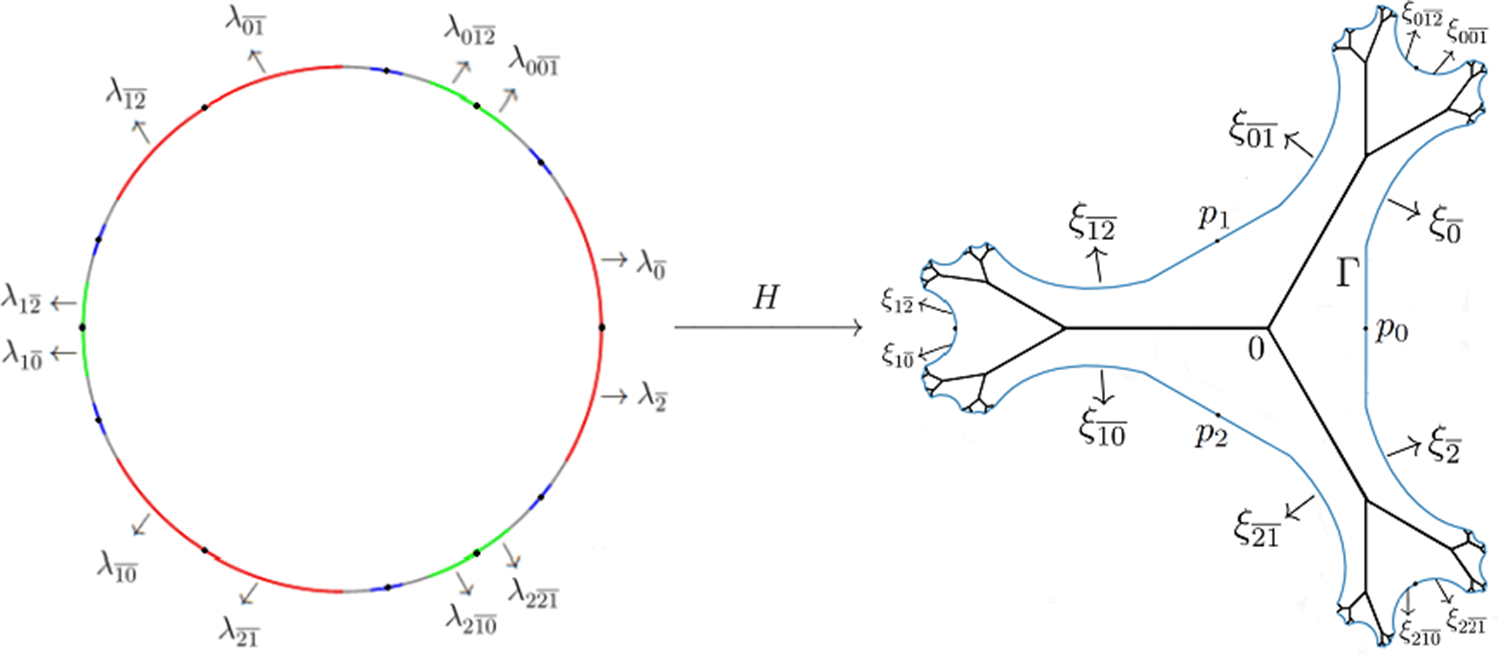
Holomorphic dynamics has been extensively studied in the past forty years. In the early 1990s, people started to extend the idea of the dynamics of holomorphic mappings to non-holomorphic ones. Among all of these, the anti-holomorphic family
 $p_c(z)=\bar {z}^2+c$
and the harmonic family
 $f_\alpha (z)=z^2+\alpha \bar {z}$
attract the most interest, for instance, see [Reference Alexander, Hunt, Kan and Yorke1–Reference Dávalos, Mendez and Sienra4, Reference Gómez and López de Medrano6–Reference Winters16], and this is by no means a complete list.
We pay attention to the harmonic family
 $f_\alpha $
, since the sets of critical points and critical values of this family are both Jordan curves. It is well known that the orbits of the critical points play a pivotal role in complex dynamics. This implies the dynamics of
 $f_\alpha $
is substantially different from classical holomorphic ones. As the most elementary evidence, the non-holomorphic nature of
 $f_\alpha $
makes the number of the pre-images of a point two or four, depending on its relative position to the Jordan curve of critical values. Hence, in the light of previous works mentioned above, it is reasonable to believe that
 $f_\alpha $
exhibits rich dynamical behaviors with a lot of potential challenges in the study.
In this paper, we focus on the dynamics of
 $f_\alpha (z)=z^2+\alpha \bar {z}$
with
 $\alpha $
being real and Julia sets being trees. Before we state the main results, let us first introduce some terminologies. As in holomorphic dynamics, we define the Fatou set of
 $f_\alpha $
,
 $F(f_\alpha )$
, to be the set on which
 $\{f_\alpha ^n\}$
is equicontinuous, and the Julia set,
 $J(f_\alpha )$
, its complement. We say z is an escaping point of
 $f_\alpha $
if
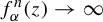 $f_\alpha ^{n}(z) \rightarrow \infty $
as
 $n \rightarrow \infty $
. Let
 $E(f_\alpha )$
denote the set of escaping points. Its complement is called the filled-in Julia set
 $K(f_\alpha )$
. It is clear that
 $K(f_\alpha )$
consists of all the points whose forward orbits are bounded and
 $J(f_\alpha ) \subseteq K(f_\alpha )$
.
We say a compact connected subset
 $T\subseteq \mathbb {C}$
is a finite tree if it contains a finite subset V such that
 $T\setminus V$
has finitely many connected components and every component is homeomorphic to
 $(0,1)$
, and moreover, it has no subset homeomorphic to a circle. Each point of V is called a node and each component of
 $T\setminus V$
is called an edge. Let
 $T_1$
and
 $T_2$
be two finite trees with
 $V_1$
and
 $V_2$
being the sets of nodes, respectively. We say
 $T_1$
is a subtree of
 $T_2$
if
 $T_1\subset T_2$
and
 $V_1\subset V_2$
. A sequence of finite trees
 $\{T_n\}_{n\geq 1}$
is called increasing if
 $T_n$
is a subtree of
 $T_{n+1}$
for all
 $n\geq 1$
.
Definition 1.1. We say a locally connected compact set T is an infinite tree if T is the closure of the union of an increasing sequence of finite trees
 $\{T_n\}_{n\geq 1}$
, and moreover, there is no subset of T homeomorphic to a circle.
The node and edge of an infinite tree are defined to be the unions of nodes and edges of all the finite subtrees, respectively. For
 $n\geq 3$
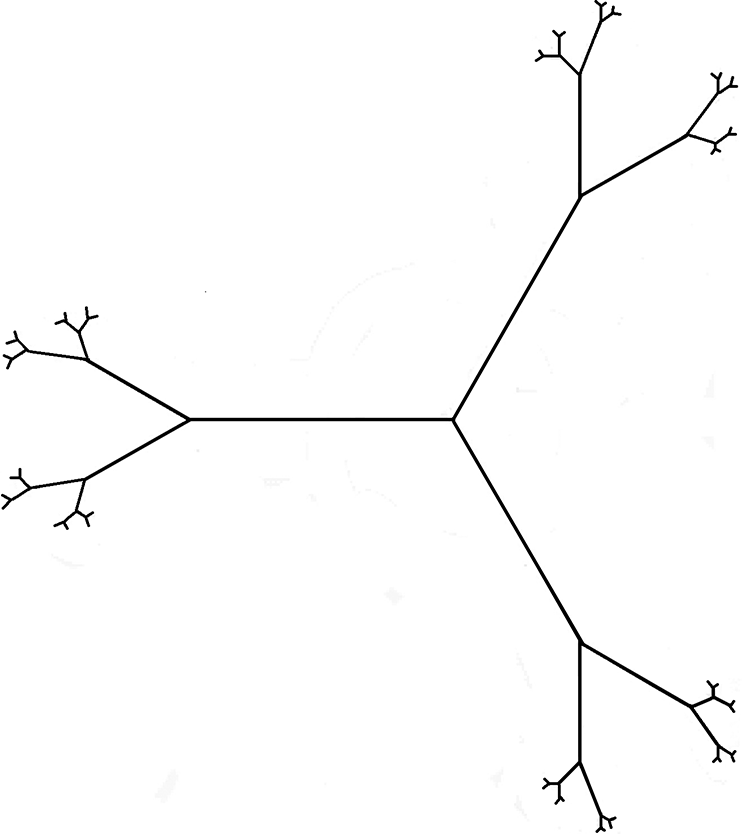
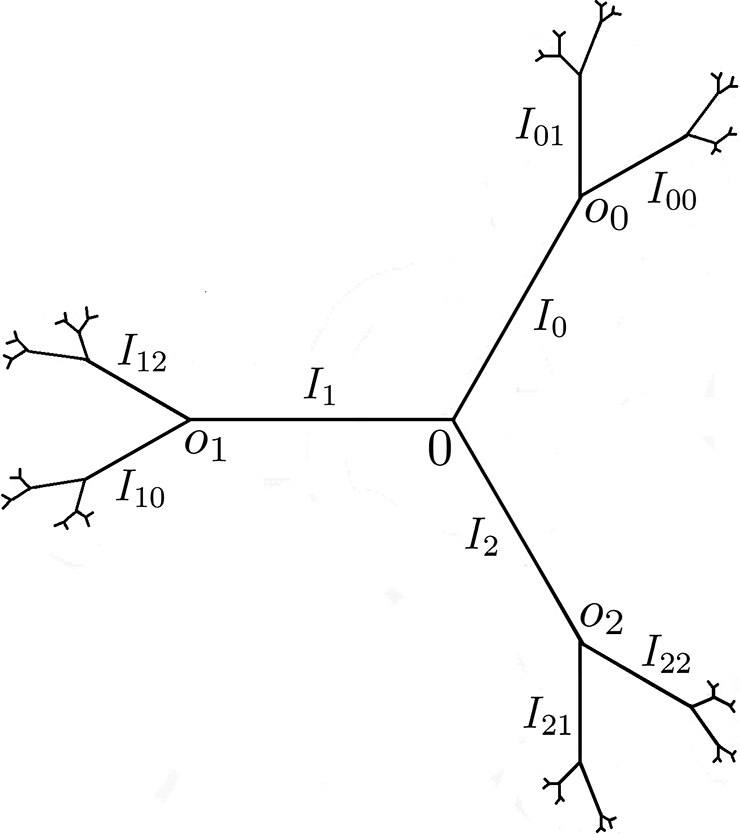
, we say a finite or infinite tree is n-regular if every node adjoins n edges. See Figure 1 for an example. Both finite trees and infinite trees are called trees.
A 3-regular infinite tree.

Theorem 1.2.
 $J(f_{\alpha })$
is not a tree for all
 $\alpha \in \mathbb {R}\setminus [1,4]$
.
Let
 $\alpha \in [1, 4]$
and
 $I = [-\alpha , 0]$
. Let
 $\omega = e^{2 \pi \mathbf {i} /3}$
and
 $Y = I \cup \omega I \cup \omega ^2 I$
, where
 $\omega I$
and
 $\omega ^2 I$
denote respectively the straight segments
 $[-\omega \alpha , 0]$
and
 $[-\omega ^2\alpha , 0]$
. We will see that
 $f_\alpha (\omega ^{k} I)\subseteq \omega ^{2k} I$
for
 $k=0,1,2$
and the dynamics of
 $f_{\alpha }$
on Y is essentially conjugate to a quadratic polynomial on an interval (cf. Lemmas 4.1 and 2.6). Let
 $$ \begin{align}S = \bigcup_{n=0}^{\infty}f_\alpha^{-n}(Y).\end{align} $$
Then, S is
 $f_\alpha $
-invariant and thus
 $\overline {S} \subseteq K(f_\alpha )$
. In [Reference Sienra15], G. Sienra proved that for
 $\alpha \in [1,4]$
,
 $K(f_\alpha )$
is connected and asked if
 $ K(f_\alpha ) = \overline {S}$
is true. The next result gives a positive answer to this question.
Theorem 1.3. Let
 $\alpha \in [1,4]$
. Then,
 $J(f_\alpha )$
is a 3-regular infinite tree. Moreover, we have
 $J(f_\alpha )= K(f_\alpha )=\overline {S}$
.
It follows from the proof of Theorem 1.3 that
 $\overline {S} \setminus S$
is a Cantor set on which
 $f_\alpha $
is conjugate to a subshift of finite type with the transition matrix
 $$ \begin{align} M=\begin{pmatrix} 1 & 1 & 0\\ 1 & 0 & 1\\ 0 & 1 & 1\\ \end{pmatrix}. \end{align} $$
This, together with the construction of S, describes the dynamics of
 $f_{\alpha }$
on
 $J(f_\alpha )$
. As a subsequence, we have the following corollary.
Corollary 1.4. For
 $\alpha \in [1,4]$
, the topological entropy of
 $f_\alpha : J(f_\alpha ) \to J(f_\alpha )$
is
 $\ln 2$
.
We would like to mention the fact that for
 $\alpha =-2$
, the topological entropy on the Julia set is
 $2\ln 2$
[Reference Dávalos, Mendez and Sienra4]. An interesting question is whether the topological entropy depends continuously on
 $\alpha \in \mathbb {R}$
and takes values in
 $[\ln 2,2\ln 2]$
.
However, it follows by Theorem 1.3 that the Fatou set is equal to the escaping set. Nevertheless, compared with quadratic polynomials whose Julia sets are connected, the situation here is much more complicated. It is well known that in the quadratic polynomial case, the connectedness of the Julia set implies the boundedness of the critical orbits and the map is conjugate to the square map on the whole escaping set, while in our case, although the Julia set is an infinite tree (connected), there are escaping critical orbits. Moreover, we will show that there is a Jordan curve
 $\Gamma $
which plays an important role: it divides the escaping set into two parts, on which
 $f_\alpha $
exhibits quite different dynamics. In the following, we briefly summarize the escaping dynamical behaviors of
 $f_\alpha $
on the Fatou set (for more details, see §§5 and 6).
Theorem 1.5. There is a Jordan curve
 $\Gamma \subseteq \mathbb {C}$
in which
 $J(f_\alpha )$
is inscribed exactly at the set
 $\overline {S}\setminus S$
such that:
-
(1) in the set
 $\Gamma \setminus (\overline {S}\setminus S)$
, points escape along
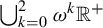
$\bigcup _{k=0}^2\omega ^k\mathbb {R}^+$
;
-
(2) in the exterior of
$\Gamma $
,
$f_\alpha $
is conjugate to the square map on the exterior of the unit disk with countably many straight segments deleted; and -
(3) in the interior of
$\Gamma $
,
$f_\alpha $
is coded by a shift map and eventually maps the corresponding points to the exterior of
$\Gamma $
.



The organization of the paper is as follows. In §2, we describe the mapping properties of
 $f_\alpha $
with
 $\alpha \in \mathbb {R}$
. As a consequence, we prove Theorem 1.2. In §3, we prove several technical lemmas whose proofs are elementary, but which are key ingredients in the analysis of the escaping dynamics. In §4, we prove that
 $\overline {S}$
is a 3-regular infinite tree and introduce symbolic dynamics on
 $\overline {S}$
by which we prove that the topological entropy on
 $\overline {S}$
is
 $\log 2$
. In §5, the construction of the Jordan curve
 $\Gamma $
mentioned above is presented. In §6, we prove that points in
 $\mathbb {C}\setminus \overline {S}$
are escaping by showing different dynamical behaviors on the exterior and interior of
 $\Gamma $
. This finishes the proofs of Theorem 1.3, Corollary 1.4, and Theorem 1.5.
2 Mapping properties
For
 $z \in \mathbb {C}$
, let
 $\mathcal {O}(z) = \{f_\alpha ^n(z): n\geq 0\}$
. The following symmetry properties can be easily deduced by a simple calculation.
Lemma 2.1. Let
 $z\in \mathbb {C}$
and
 $k\in \mathbb {Z}$
. Then,
 $f_\alpha (z)=\overline {f_\alpha (\overline {z})}$
,
 $f_\alpha (z)=\omega ^k f_\alpha (\omega ^k z)$
, and
 $f_\alpha ^2(z)=\omega ^k f_\alpha ^2(\omega ^{-k} z)$
. As a consequence,
 $$ \begin{align*}\mathcal{O}(\omega^k z)=\{\omega^k z,\omega^{-k}f_\alpha(z),\omega^k f_\alpha^2(z),\omega^{-k}f_\alpha^3(z),\ldots\}.\end{align*} $$
In particular,
 $z\in E(f_\alpha )$
if and only if
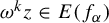 $\omega ^k z\in E(f_\alpha )$
.
Proof. The first assertion is obvious. For the second assertion,
 $$ \begin{align*} \omega^k f_\alpha(\omega^k z)=\omega^{k}(\omega^{2k}z^2+\omega^{-k} \alpha\overline{z})=f_\alpha(z), \end{align*} $$
and hence,
 $$ \begin{align*} \omega^k f_\alpha^2(\omega^{-k} z)=\omega^k f_\alpha(\omega^k(\omega^{-k} f_\alpha(\omega^{-k} z)))= f_\alpha(\omega^{-k} f_\alpha(\omega^{-k} z))=f_\alpha^2(z). \\[-37pt] \end{align*} $$
A point
 $z\in \mathbb {C}$
is called a critical point of
 $f_\alpha $
if its Jacobian determinant at z is equal to zero. Denote by
 $\mathcal {C}$
the set of critical points and
 $\mathcal {V}$
the set of critical values. By a simple calculation, the Jacobian determinant of
 $f_\alpha $
vanishes at
 $|\alpha |e^{\mathrm{i}\theta }/2$
,
 $0\leq \theta <2\pi $
. Then,
 $$ \begin{align} \mathcal{C}=\mathcal{C}_{\alpha}:=\{|\alpha|e^{\mathrm{i}\theta}/2: 0\leq \theta <2\pi\}.\end{align} $$
Let
 $$ \begin{align} \mathcal{V}_{\alpha}(\theta)=f_{\alpha}(|\alpha|e^{\mathrm{i}\theta}/2) =|\alpha|^2e^{2\mathrm{i}\theta}/4+|\alpha|\alpha e^{-\mathrm{i}\theta}/2, \quad 0\leq \theta <2\pi. \end{align} $$
Then,
 $$ \begin{align} \mathcal{V}=\mathcal{V}_{\alpha}:=\{\mathcal{V}_{\alpha}(\theta):0\leq \theta <2\pi\}. \end{align} $$
The set
 $\mathcal {V}$
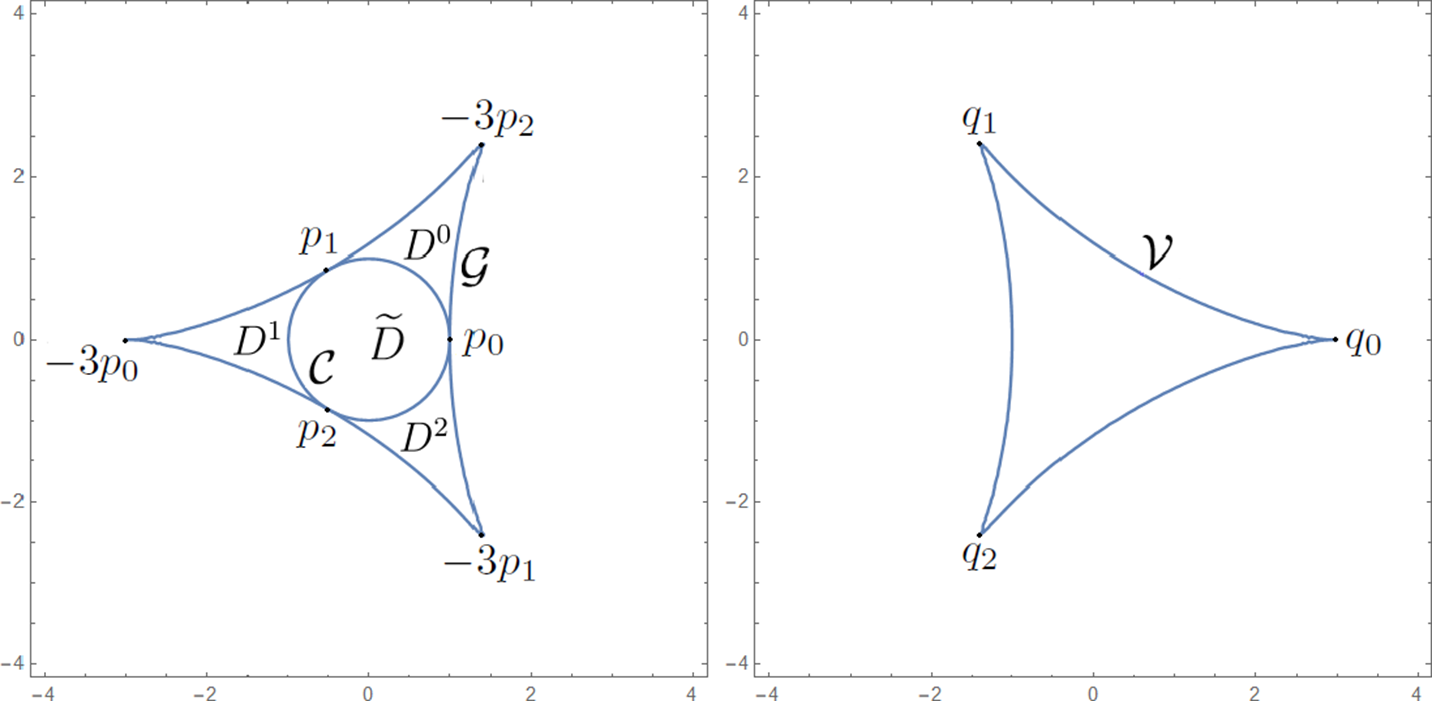
is a curved triangle which has been intensively studied in the literature [Reference Dávalos3, Reference Delgado, Garrido, Romero, Rovella and Vilamajó5]. See Figure 2. Denote by
 $\mathrm {Int}(\gamma )$
and
 $\mathrm {Ext}(\gamma )$
respectively the bounded and unbounded domains enclosed by a set
 $\gamma $
that separates the plane into two domains. For a set
 $A\subseteq \mathbb {C}$
, let
 ${A^*=\{z:\bar {z}\in A\}}$
. In the following, we summarize the properties of
 $\mathcal {V}$
which will be used later.
The mapping properties of
 $f_2$
.

Lemma 2.2. (Cf. [Reference Dávalos3, Reference Delgado, Garrido, Romero, Rovella and Vilamajó5])
The following properties hold.
-
(1) For every
$\alpha \in \mathbb {R}$
,
$\mathcal {V}$
is a Jordan curve with
$$ \begin{align*} \omega\mathcal{V}=\mathcal{V}=\mathcal{V}^*.\end{align*} $$
-
(2) For
$\alpha>0$
, with the increase of
$\arg (\mathcal {V}_{\alpha }(\theta ))$
in
$[0,\pi /3]$
,
$\mathrm {Re}(\mathcal {V}_{\alpha }(\theta ))$
and
$|\mathcal {V}_{\alpha }(\theta )|$
strictly decrease and
$\mathrm { Im}(\mathcal {V}_{\alpha }(\theta ))$
strictly increases. -
(3) For
$\alpha <0$
,
$\mathcal {V}_{\alpha }(\theta )=\mathcal {V}_{-\alpha }(\theta -\pi )$
for any
$0\leq \theta <2\pi $
. -
(4) Let
$\alpha _1,\alpha _2\in \mathbb {R}$
with
$|\alpha _1|>|\alpha _2|$
. Then,
$\mathrm {Int}(\mathcal {V}_{\alpha _1})\supset \mathrm {Int}(\mathcal {V}_{\alpha _2})$
.







For
 $\alpha \in \mathbb {R}$
and
 $0\leq \theta <2\pi $
, set
 $$ \begin{align} \mathcal{G}_{\alpha}(\theta) = \begin{cases} \mathcal{V}_{\sqrt{-2\alpha}}(\theta) , & \alpha\leq0, \\ -\mathcal{V}_{\sqrt{2\alpha}}(\theta-\pi), & \alpha>0, \end{cases} \end{align} $$
and
 $$ \begin{align*}\mathcal{G}=\mathcal{G}_{\alpha}:=\{\mathcal{G}_{\alpha}(\theta):0\leq \theta <2\pi\}.\end{align*} $$
Let
 $$ \begin{align*}p_k=\omega^k\alpha/2\in \mathcal{C}\quad \text{and}\quad q_k=f_\alpha(p_k)\in \mathcal{V}.\end{align*} $$
Lemma 2.3. (Cf. [Reference Dávalos3, Reference Delgado, Garrido, Romero, Rovella and Vilamajó5])
The following assertions hold.
-
(I) The pre-images of
$\mathcal {V}$
are the Jordan curves
$\mathcal {C}$
and
$\mathcal {G}$
, with
$\mathcal {C}$
being inscribed in
$\mathcal {G}$
at
$\{ p_0,p_1,p_2\}$
. Then, the region
$\mathrm {Int}(\mathcal {G})$
is divided by the Jordan curve
$\mathcal {C}$
into four sub-domains
$\widetilde {D}=\mathrm {Int}(\mathcal {C})$
and
$D^k$
,
$k=0,1,2$
, see Figure 2. -
(II) For
$w\in \overline {\mathrm {Int}(\mathcal {V})}$
,
$f_{\alpha }^{-1}(w)$
consists of four points, say
$z_0,z_1,z_2$
, and
$z_3$
. Moreover:-
(1) if
$w\in \mathrm {Int}(\mathcal {V})$
, then
$z_k\in D^k$
for
$k=0,1,2$
and
$z_3\in \widetilde {D}$
; -
(2) if
$w=q_k\in \mathcal {V}$
for
$k=0,1,2$
, then
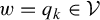
$z_0=z_1=z_2=p_{2k}\in \mathcal {C}\cap \mathcal {G}$
and
$z_3=-3p_{2k}\in \mathcal {G}$
; and -
(3) if
$w\in \mathcal {V}\setminus \{q_0,q_1,q_2\}$
, then
$z_0=z_1\in \mathcal {C}\setminus \{p_0,p_1,p_2\}$
and
$z_2,z_3\in \mathcal {G}\setminus (\bigcup _{k=0}^2\{p_k,-3 p_k\})$
.
-
-
(III) For
$w\in \mathrm {Ext}(\mathcal {V})$
, the pre-images
$f_\alpha ^{-1}(w)$
consist of two points, say
$z_0$
and
$z_1$
, with
$z_0,z_1\in \mathrm {Ext}(\mathcal {G})$
.











For
 $w_1,w_2\in \mathbb {C}$
, denote by
 $[w_1,w_2]$
the straight segment with two endpoints
 $w_1$
and
 $w_2$
. For
 $z_0,z_1,z_2,z_3\in \mathbb {C}$
, denote by
 $[z_0;z_1,z_2,z_3]$
the union of
 $[z_0,z_1]$
,
 $[z_0,z_2]$
, and
 $[z_0,z_3]$
. Define
 $$ \begin{align*} \Sigma=[0;q_0,q_1,q_2]. \end{align*} $$
Note that
 $\cup q_k$
are the three vertices of
 $\mathcal {V}$
and that
 $\mathrm {Int}(\mathcal {V})$
is divided by
 $\Sigma $
into three parts
 $V_0,V_1$
, and
 $V_2$
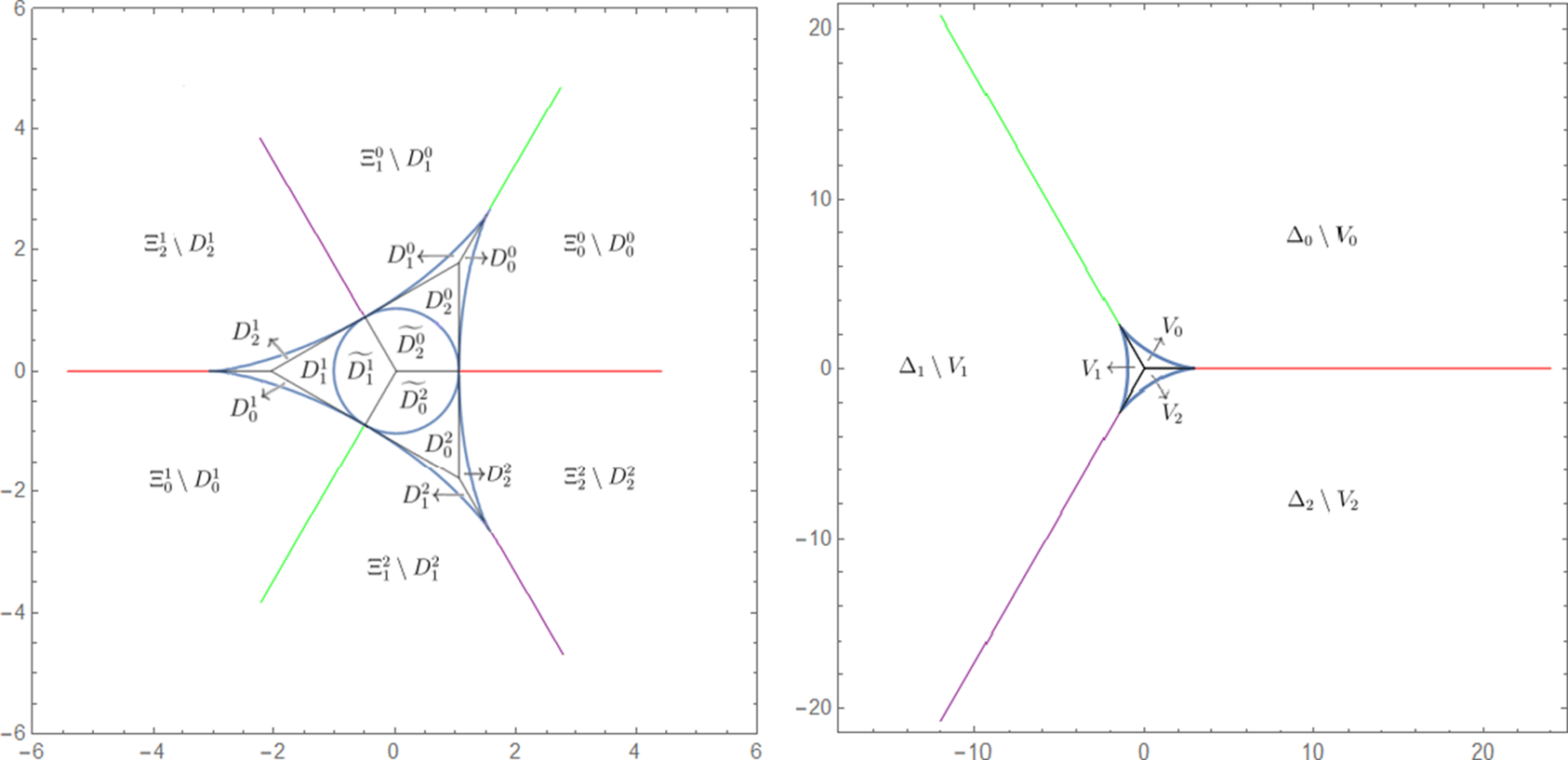
(see Figure 3).
The finer mapping properties of
 $f_2$
.

By Lemma 2.3,
 $\Sigma $
has exactly four pre-images
 $\sigma ^0,\sigma ^1,\sigma ^2$
, and
 $\widetilde {\sigma }$
, which, except the three endpoints, belong to
 $D^0$
,
 $D^1$
,
 $D^2$
, and
 $\widetilde {D}$
, respectively. For
 $k=0,1,2$
, let
 $o_k=\omega ^{k+1/2}\alpha $
. Note that
 $f_\alpha ^{-1}(0)=\{0, o_0, o_1, o_2\}$
. By a direct calculation, it follows that
 $\widetilde {\sigma }=[0;p_0,p_1,p_2]$
and
 $$ \begin{align*} \sigma^0=[o_0;p_0,p_1,-3p_2],\quad\sigma^1=\omega\sigma^0 \quad and \quad \sigma^2=\omega^2\sigma^0. \end{align*} $$
Then, for
 $j=0,1,2$
,
 $D^j$
is divided by
 $\sigma ^j$
into
 $D_0^j,D_1^j$
, and
 $D_2^j$
with
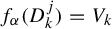 $f_\alpha (D_k^j)=V_k$
, and
 $\widetilde {D}$
is divided by
 $\widetilde {\sigma }$
into
 $\widetilde {D_0^2},\widetilde {D_1^1}$
, and
 $\widetilde {D_2^0}$
with
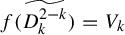 $f(\widetilde {D_k^{2-k}})=V_k$
,
 $k=0,1,2$
.
For
 $i=0,1,2$
, let
 $$ \begin{align*} \Delta_i=\{z: |\!\arg(z)-(2i+1)\pi/3|\leq \pi/3\}. \end{align*} $$
Then,
 $\Delta _0$
,
 $\Delta _1$
, and
 $\Delta _2$
induce a partition of
 $\mathbb {C}$
, whose split rays are
 $\omega ^0\mathbb {R}^+$
,
 $\omega ^1\mathbb {R}^+$
, and
 $\omega ^2\mathbb {R}^+$
. Let
 $\Omega _0$
be the interior of the equilateral triangle with vertices
 $o_0, o_1$
, and
 $o_2$
. We divided
 $\mathbb {C\setminus }\Omega _0$
into six sectors by
 $\bigcup _{i=0}^2\omega ^{i}\mathbb {R}$
and denote the closure of the sector containing
 $D_k^j$
by
 $\Xi _k^j$
for any
 $j,k=0,1,2$
with
 $j+k\neq 2$
. See Figure 3 for a sketch.
Lemma 2.4. For any
 $j,k=0,1,2$
with
 $j+k\neq 2$
, the map
 $f_{\alpha }:\Xi _k^j\rightarrow \Delta _k$
is a homeomorphism.
Proof. For simplicity, we only need to prove the case where
 $k=0$
, since the other cases can be derived by Lemma 2.1. To see that
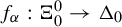 $f_{\alpha }:\Xi _0^0\rightarrow \Delta _0$
and
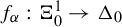 $f_{\alpha }:\Xi _0^1\rightarrow \Delta _0$
are homeomorphisms, we first divide
 $\Delta _0$
into two parts by
 $\mathcal {V}$
, and accordingly divide
 $\Xi _0^0$
and
 $\Xi _0^1$
into two parts by
 $\mathcal {G}$
, respectively. Note that for any
 $i=0,1,2$
,
 $$ \begin{align*} f_\alpha:\omega^i(p_0,+\infty)\rightarrow \omega^{2i}(q_0,+\infty)\quad \text{and}\quad f_\alpha:\omega^i(-\infty,-3p_0)\rightarrow \omega^{2i}(q_0,+\infty) \end{align*} $$
are homeomorphisms. Combining with the mapping properties of
 $f_\alpha $
mentioned above, it is easy to see that
 $$ \begin{align*}f_\alpha:\overline{D_0^0}\rightarrow \overline{V_0}\quad \text{and} \quad f_\alpha:\overline{D_0^1}\rightarrow \overline{V_0}\end{align*} $$
are homeomorphisms, and
 $$ \begin{align*}f_\alpha:\Xi_0^0\setminus \overline{D_0^0}\rightarrow \Delta_0\setminus \overline{V_0}\quad \text{and}\quad f_\alpha:\Xi_0^1\setminus\overline{ D_0^1}\rightarrow \Delta_0\setminus \overline{V_0}\end{align*} $$
are homeomorphisms. This finishes the proof of the lemma.
For any
 $k=0,1,2$
, let
 $z\in \Delta _k$
. It follows from Lemma 2.4 that we can define the branch of
 $f_{\alpha }^{-1}(z)$
which belongs to
 $\Xi _k^j$
by
 $f_{\alpha ,j}^{-1}(z)$
for any
 $j=0,1,2$
with
 $j+k\neq 2$
. Note that
 $\Xi ^j_k\subset \Delta _j$
. This means that we can define the branch of
 $f_\alpha ^{-n}(z)$
with
 $n\geq 1$
in general. For
 $n\geq 1$
, we call
 $\underline {s}_n=s_1s_2\cdots s_n$
,
 $s_i\in \{0,1,2\}$
, an admissible block if
 $s_i+s_{i+1}\neq 2$
for all i (if
 $n=\infty $
, we call
 $\underline {s}=s_1s_2\cdots $
an admissible sequence). Define the branch of
 $f_\alpha ^{-n}(z)$
by
 $$ \begin{align*} f^{-n}_{\alpha,\underline{s}_n}(z):=f^{-1}_{\alpha,s_1}\circ f^{-1}_{\alpha,s_2}\circ\cdots\circ f^{-1}_{\alpha,s_n}(z)\end{align*} $$
if
 $\underline {s}_n k$
is an admissible block. In addition, we would like to mention that for points in
 $\bigcup _{i=0}^2\omega ^i\mathbb {R}^+$
, the above notation is not unique. If
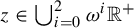 $z\in \bigcup _{i=0}^2\omega ^i\mathbb {R}^+$
or
 $f_{\alpha ,j}^{-1}(z)\in \bigcup _{i=0}^2\omega ^i\mathbb {R}^+$
, we can always choose some proper k and j such that
 $j+k\neq 2$
in a natural way according to the context.
Corollary 2.5. Let
 $j=0,1,2$
and
 $A_0 \subseteq \Delta _j$
. If
 $s_1s_2\cdots s_nj$
is an admissible block with
 $n\geq 1$
, we define
 $A_{i+1}=f_{\alpha ,s_{n-i}}^{-1}(A_i)$
inductively for
 $0\leq i\leq n-1$
. Then,
 ${f_\alpha :A_{i+1}\rightarrow A_i}$
is a homeomorphism for all
 $0\leq i\leq n-1$
.
Proof. This follows from Lemma 2.4 and the argument mentioned above.
Lemma 2.6. (Cf. [Reference Sienra15])
The mapping
 $f_\alpha |_{\mathbb {R}}$
is conjugate to
 $x \mapsto x^{2}-\alpha ^2/4+\alpha /2$
by
 $x\mapsto x-\alpha /2$
. In particular, for
 $\alpha \in [1,4]$
,
 $f_\alpha |_{\mathbb {R}}$
is conjugate to
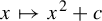 $x \mapsto x^{2}+c$
with
 $c\in [-2,1/4]$
and
 $K(f_\alpha )\cap \mathbb {R}=[-\alpha , 0]$
.
Proof of Theorem 1.2
Assume that the Julia set
 $J(f_\alpha )$
is a tree. The proof is by contradiction and is divided into three cases.
Case 1:
 $\alpha \in \mathbb {R}\setminus [-2,4]$
. According to Lemma 2.6, it follows that the mapping
 $f_\alpha |_{\mathbb {R}}$
is conjugate to
 $x \mapsto x^{2}+c$
with
 $c \in (-\infty ,-2]$
. Hence,
 $K(f_{\alpha })\cap \mathbb {R}$
is a Cantor set. Since
 $J(f_\alpha )$
is a tree, there is a Jordan arc
 $\gamma $
contained in
 $J(f_\alpha )$
connecting two distinct points in
 $K(f_{\alpha })\cap \mathbb {R}$
. However, Lemma 2.1 implies that the symmetric image of
 $\gamma $
about the real axis
 $\gamma ^*$
is also contained in
 $J(f_\alpha )$
. Since
 $K(f_{\alpha })\cap \mathbb {R}$
is a Cantor set, we have
 $\gamma \neq \gamma ^*$
. For otherwise,
 $\gamma =\gamma ^*$
would be a straight segment contained in
 $K(f_{\alpha })\cap \mathbb {R}$
, which is impossible. Since
 $\gamma \neq \gamma ^*$
,
 $\gamma \cup \gamma ^*$
must contain a subset homeomorphic to a circle. This is a contradiction.
Case 2:
 $\alpha \in [-2,-1]$
. Note that
 $|\alpha |\leq |\sqrt {-2\alpha }|$
. From (2.4) and the last assertion of Lemma 2.2, we get
 $$ \begin{align*}\mathrm{Int}(\mathcal{V}_{\alpha})\subseteq\mathrm{Int}(\mathcal{V}_{\sqrt{-2\alpha}})=\mathrm{ Int}(\mathcal{G}_{\alpha}).\end{align*} $$
Since
 $\mathrm {Int}(\mathcal {V}_{\alpha })=f_{\alpha }(\mathrm {Int}(\mathcal {G}_{\alpha }))$
by Lemma 2.3, we have
 $\mathrm {Int}(\mathcal {G}_{\alpha }) \subseteq K(f_{\alpha })$
. Hence,
 $K(f_{\alpha })$
has interior points. This, together with the fact that
 $\partial K(f_{\alpha })\subseteq J(f_{\alpha })$
and
 $J(f_{\alpha })$
is locally connected, implies that
 $\partial K(f_{\alpha })$
contains a subset homeomorphic to a circle. This is a contradiction.
Case 3:
 $\alpha \in (-1,1)$
. In this case, since the origin is an attracting fixed point,
 $K(f_{\alpha })$
has interior points. The same argument as in Case 2 will lead to a contradiction.
3 Some technical lemmas
From now on, we restrict our discussion to the case where
 $\alpha \in [1,4]$
. Let
 $$ \begin{align*}\Delta_k^\sharp=\{z: |\!\arg(z)-2k\pi/3|\leq \pi/3\}, \quad k=0,1,2.\end{align*} $$
Then,
 $\Delta _0^\sharp $
,
 $\Delta _1^\sharp $
, and
 $\Delta _2^\sharp $
induce a partition of
 $\mathbb {C}$
, whose split rays are
 $\omega ^0\mathbb {R}^-$
,
 $\omega ^1\mathbb {R}^-$
, and
 $\omega ^2\mathbb {R}^-$
. For a set A and
 $\varepsilon>0$
, let
 $U(A,\varepsilon )=\{z:|z-w|<\varepsilon \quad \text {for\ some } w\in A\}$
.
Lemma 3.1. For any
 $k=0,1,2$
and
 $z_k\in \overline {U(0,\alpha )} \cap \Delta _k^\sharp $
, we have
 $$ \begin{align*}|\!\arg(f_\alpha(z_k))+2k\pi/3|\leq|\!\arg(z_k)-2k\pi/3|.\end{align*} $$
Moreover, the equality holds if and only if
 $z_k\in (Y\cup \omega ^{1/2} Y)\cap \Delta _k^\sharp .$
Proof. We first prove the first assertion with
 $k=0$
. Suppose
 $z_0=r e^{\mathrm{i}\theta }\in \overline {U(0,\alpha )}\cap \Delta _0^\sharp $
. Then,
 $$ \begin{align*}\arg(f_\alpha(z_0))=\arg(r^2 e^{2\mathrm{i}\theta}+\alpha re^{-\mathrm{i}\theta}).\end{align*} $$
It follows that for
 $0<\theta <\pi /3$
,
 $$ \begin{align*}-\theta<\arg(f_\alpha(z_0))\leq \arg(\alpha re^{2\mathrm{i}\theta}+\alpha re^{-\mathrm{i}\theta})=\theta/2,\end{align*} $$
and similarly for
 $-\pi /3<\theta <0$
,
 $$ \begin{align*}\theta/2\leq\arg(f_\alpha(z_0))< -\theta.\end{align*} $$
This proves that
 $$ \begin{align} |\!\arg(f_\alpha(z_0))|<|\!\arg(z_0)|. \end{align} $$
Let
 $k\in \{0,1,2\}$
. For any point
 $z_k\in \overline {U(0,\alpha )}\cap \Delta _k^\sharp $
, we can assume
 $z_k=\omega ^k z_0$
for
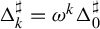 ${\Delta _k^\sharp =\omega ^k\Delta _0^\sharp }$
. Then, according to Lemma 2.1,
 $$ \begin{align*}f_\alpha(z_k)=f_\alpha(\omega^k z_0)=\omega^{-k}f_\alpha(z_0).\end{align*} $$
This implies that
 $$ \begin{align*}|\!\arg(f_\alpha(z_k))+2k\pi/3|=|\!\arg(\omega^{-k}f_\alpha(z_0))+2k\pi/3|=|\!\arg(f_\alpha(z_0))|.\end{align*} $$
In addition, we also have
 $$ \begin{align*}|\!\arg(z_k)-2k\pi/3|=|\!\arg(\omega^kz_0)-2k\pi/3|=|\!\arg(z_0)|.\end{align*} $$
Therefore, it follows by (3.1) that the first assertion holds.
The second assertion can be derived by the fact that if
 $z_k\in (Y\cup \omega ^{1/2} Y)\cap \Delta _k^\sharp $
, then
 $\arg (f_\alpha (z_k))=-\arg (z_k)$
.
Let
 $$ \begin{align*}A_{2\alpha}=\{z:|z|>2\alpha\} \end{align*} $$
and
 $$ \begin{align*}E_{\pi/6}=\bigcup_{k=0}^2\{z:|\!\arg(z)-2k\pi/3|\leq\pi/6\}\setminus\{0\}.\end{align*} $$
Lemma 3.2. The following assertions hold.
-
(1)
$f_\alpha (A_{2\alpha })\subseteq A_{2\alpha }$
and
$A_{2\alpha }\subseteq E(f_\alpha )$
. -
(2)
$f_\alpha (E_{\pi /6})\subseteq E_{\pi /6}\cup A_{2\alpha }$
and
$E_{\pi /6} \subseteq E(f_\alpha )$
.




Proof. Let
 $r>0$
and
 $\theta \in [0,2\pi )$
. For
 $z=re^{\mathrm {i}\theta }$
, we have
 $f_\alpha (z)=z^2+\alpha \bar {z}=r^2e^{2\mathrm {i}\theta }+\alpha re^{-\mathrm {i}\theta }$
. Then,
 $$ \begin{align} |f_\alpha(z)|^2&=(r^2e^{2\mathrm{i}\theta}+\alpha re^{-\mathrm{i}\theta})(r^2e^{-2\mathrm{i}\theta}+\alpha re^{\mathrm{i}\theta})\notag\\ &= r^2(r^2+2\alpha r\cos3\theta+\alpha^2). \end{align} $$
Suppose
 $z\in A_{2\alpha }$
. By (3.2),
 $|f_\alpha (z)|^2\geq r^2(r-\alpha )^2$
and, thus,
 $$ \begin{align} |f_\alpha(z)|\geq r(r-\alpha). \end{align} $$
This implies that
 $|f_\alpha (z)|>\alpha r\geq r>2\alpha $
, which means
 $$ \begin{align*}f_\alpha(A_{2\alpha})\subseteq A_{2\alpha}.\end{align*} $$
Since
 $r-\alpha>\alpha \geq 1$
, it follows from (3.3) that
 $|f_\alpha ^n(z)|\rightarrow +\infty $
as
 $n\rightarrow +\infty $
. That is,
 $$ \begin{align} A_{2\alpha} \subseteq E(f_\alpha).\end{align} $$
This proves the first assertion of the lemma.
For
 $k=0,1,2$
, let
 $$ \begin{align*}E_{\pi/6}^k=E_{\pi/6}\cap\Delta_k^\sharp.\end{align*} $$
To prove the second assertion of the lemma, it suffices to prove that
 $$ \begin{align}f_\alpha(E_{\pi/6}^0)\subseteq E_{\pi/6}^0\cup A_{2\alpha}\quad \text{and}\quad E_{\pi/6}^0 \subseteq E(f_\alpha).\end{align} $$
In fact, since
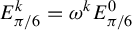 $E_{\pi /6}^k=\omega ^k E_{\pi /6}^0$
with
 $k=1,2$
, it follows from (3.5) and Lemma 2.1 that
 $$ \begin{align*}f_\alpha(E_{\pi/6}^k)=\omega^{-k} f_\alpha(E_{\pi/6}^0)\subseteq E_{\pi/6}^{-k}\cup A_{2\alpha}\quad \text{and}\quad E_{\pi/6}^k \subseteq E(f_\alpha).\end{align*} $$
Now, let us prove (3.5). Note that for
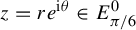 $z=re^{\mathrm {i}\theta }\in E_{\pi /6}^0$
, according to (3.2) and
 ${0\leq \cos (3\theta )\leq 1}$
, we can get that
 $$ \begin{align} |f_\alpha(z)|\geq r\sqrt{r^2+\alpha^2}>\alpha r. \end{align} $$
For an interval
 $B\subseteq \mathbb {R}^+$
, define
 $$ \begin{align*}E(B):=\{z=re^{\mathrm{i}\theta}:z\in E_{\pi/6}^0\; \text{and}\; r\in B\}.\end{align*} $$
Then, we divide
 $E_{\pi /6}^0$
into three parts:
 $E(0,\alpha ]$
,
 $E(\alpha ,\sqrt {3}\alpha )$
, and
 $E[\sqrt {3}\alpha ,+\infty )$
.
For the case where
 $z\in E(0,\alpha ]$
, it follows from Lemma 3.1 that
 $$ \begin{align}f_\alpha(E(0,\alpha])\subseteq E_{\pi/6}^0.\end{align} $$
For the case where
 $z=re^{\mathrm {i}\theta }\in E(\alpha ,\sqrt {3}\alpha )$
, according to Lemma 2.1, we only need to analyze the case where
 $0\leq \theta \leq \pi /6$
. Note that by a simple calculation,
 $$ \begin{align} \tan(\arg(f_\alpha(z)))=\frac{r\sin(2\theta)-\alpha\sin(\theta)}{r\cos(2\theta)+\alpha\cos(\theta)}. \end{align} $$
Thus, the numerator and the denominator are both positive in this case. Since
 $$ \begin{align*}\frac{d}{d\theta}(r\sin(2\theta)-\alpha\sin(\theta))=2r\cos(2\theta)-\alpha\cos(\theta) \geq r-\alpha \geq 0,\end{align*} $$
the numerator is increasing with respect to
 $\theta $
. However, it is obvious that the denominator
 $r\cos (2\theta )+\alpha \cos (\theta )$
is decreasing with respect to
 $\theta $
. This implies that
 $\tan (\arg (f_\alpha (z)))$
, and hence
 $\arg (f_\alpha (z))$
, is increasing with respect into
 $\theta $
. Furthermore, by writing (3.8) as
 $$ \begin{align*}\tan(\arg(f_\alpha(z)))=\tan(2\theta)-\frac{\alpha\cos(\theta)\tan(2\theta)+\alpha\sin(\theta)}{r\cos(2\theta)+\alpha\cos(\theta)},\end{align*} $$
it is clear that
 $\arg (f_\alpha (z))$
is also increasing with respect to r in this case. Thus, the infimum of the argument of
 $f_\alpha (z)$
is
 $0$
, which is reached at
 $\theta =0$
, and the maximum argument of
 $f_\alpha (z)$
is
 $\pi /6$
, which is reached at
 $\theta =\pi /6$
and
 $r=\sqrt {3}\alpha $
. This proves
 $$ \begin{align}f_\alpha(E(\alpha,\sqrt{3}\alpha))\subseteq E_{\pi/6}^0.\end{align} $$
For the case where
 $z\in E[\sqrt {3}\alpha ,+\infty )$
, the first inequality of (3.6) implies that
 ${|f_\alpha (z)|\geq 2\sqrt {3}\alpha ^2}$
. This proves
 $$ \begin{align}f_\alpha(E[\sqrt{3}\alpha,+\infty))\subseteq A_{2\alpha}.\end{align} $$
Combining with (3.7), (3.9), and (3.10), we finish the proof of the first conclusion of (3.5).
For the second conclusion of (3.5), it follows from (3.10) and (3.4) that
 $$ \begin{align}E[\sqrt{3}\alpha,+\infty)\subseteq E(f_\alpha).\end{align} $$
To prove
 $E(0,\sqrt {3}\alpha )\subseteq E(f_\alpha )$
, let
 $z\in E(0,\sqrt {3}\alpha )$
. Note that
 $\mathcal {O}(z)\nsubseteq E(0,\sqrt {3}\alpha )$
. For otherwise, we may get a contradiction by (3.6). Let
 $n\geq 1$
be the first integer such that
 $f_\alpha ^n(z)\notin E(0,\sqrt {3}\alpha )$
. By (3.7) and (3.9), we have
 $$ \begin{align*}f_\alpha^n(z)\in E[\sqrt{3}\alpha,+\infty).\end{align*} $$
Combining with (3.11), we get
 $z\in E(f_\alpha )$
. This finishes the proof of the second conclusion of (3.5). The proof of the lemma has been completed.
Recall that
 $\Omega _0$
is the interior of the equilateral triangle with vertices
 $o_0, o_1$
, and
 $o_2$
. For
 $k=0,1,2$
, let
 $$ \begin{align}Q_k=(\overline{U(0,\alpha)}\setminus (\Omega_0\cup\{o_0,o_1,o_2\}))\cap \Delta_k^\sharp.\end{align} $$
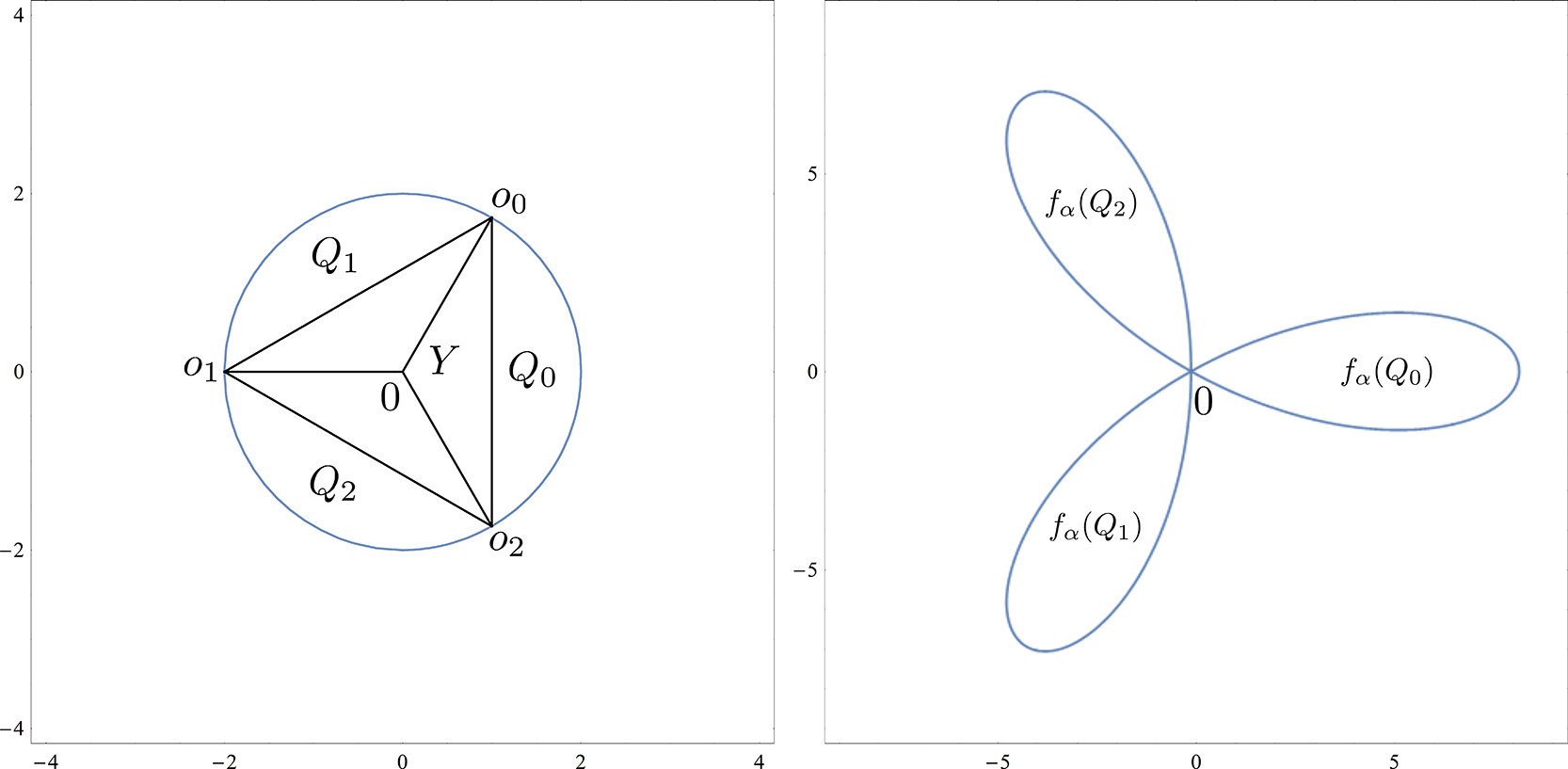
See Figure 4 for a sketch.
For
 $\alpha =2$
, the region
 $Q_k$
and its images
 $f_{2}(Q_k)$
.

Lemma 3.3.
 $f_\alpha (Q_k)\subseteq E_{\pi /6}$
,
 $k=0,1,2$
. In addition, as
 $\alpha e^{\mathrm{i}\theta }$
runs anticlockwise from
 $o_2$
to
 $o_0$
, from
 $o_0$
to
 $o_1$
, or from
 $o_1$
to
 $o_2$
,
 $\arg ((f_\alpha (\alpha e^{\mathrm{i}\theta }))$
is increasing with respect to
 $\theta $
.
Proof. For the second assertion, we can first prove that for
 $\theta _0\in (-\pi /3,\pi /3)$
,
 $$ \begin{align*} \arg(f_\alpha(\alpha e^{\mathrm{i}\theta_0}))=\arg(\alpha^2 e^{2\mathrm{i}\theta_0}+\alpha^2 e^{-\mathrm{i}\theta_0})=\theta_0/2.\end{align*} $$
For
 $\theta _k=2k\pi /3+\theta _0\in ((2k-1)\pi /3,(2k+1)\pi /3)$
, it follows from Lemma 2.1 that
 $$ \begin{align*} \arg(f_\alpha(\alpha e^{\mathrm{i}\theta_k}))=\arg(f_\alpha(\alpha e^{\mathrm{i}\theta_0}))-2k\pi/3=\theta_0/2-2k\pi/3=\theta_k/2-k\pi.\end{align*} $$
This proves the second assertion.
For the first assertion, note that for
 $|\theta |<\pi /3$
, we have
 $|\!\arg (f_\alpha (\alpha e^{\mathrm{i}\theta }))|<\pi /6$
. It follows from Lemma 2.4 that for
 $z_0\in Q_0$
,
 $$ \begin{align} |\!\arg(f_\alpha(z_0))|<\pi/6. \end{align} $$
Since
 $Q_k=\omega ^k Q_0$
, we assume
 $z_k=\omega ^k z_0\in Q_k$
for
 $k=1,2$
. Combining with Lemma 2.1 and (3.13), we can get
 $$ \begin{align*} |\!\arg(f_\alpha(z_k))+2k\pi/3|=|\!\arg(\omega^{-k}f_\alpha(z_0))+2k\pi/3|=|\!\arg(f_\alpha(z_0))|<\pi/6. \end{align*} $$
This proves the first assertion.
Note that (2.2) implies that with the increase of
 $\alpha $
,
 $\mathcal {V}$
strictly increases with respect to
 $\partial \Omega _0$
. By an elementary analysis,
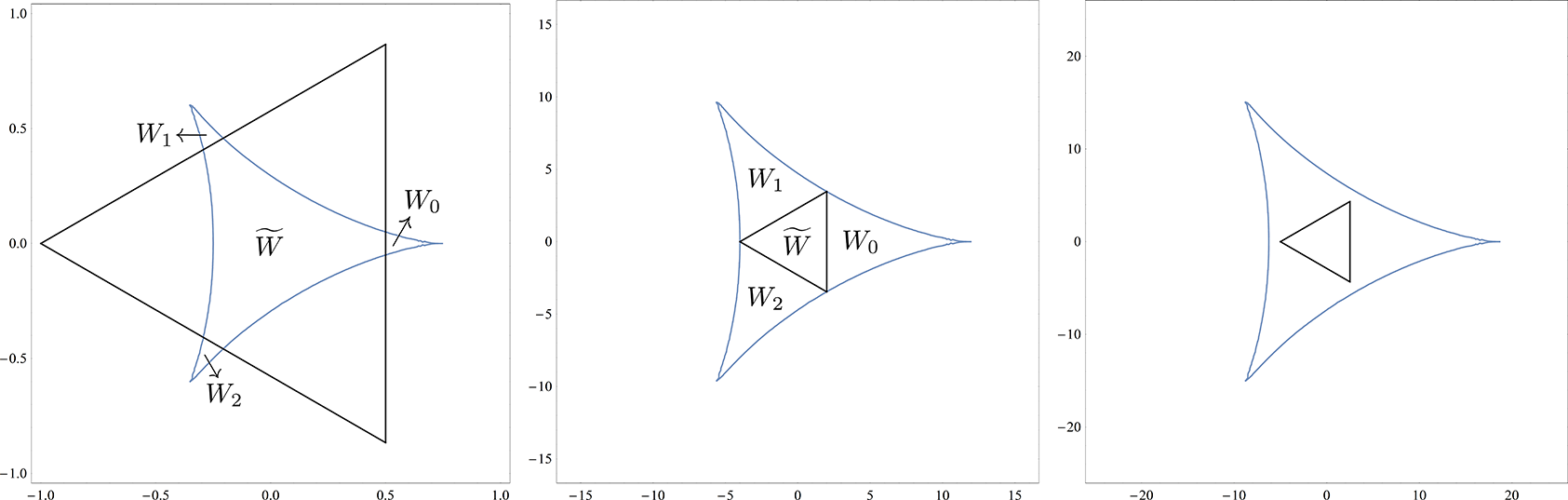
 $\overline {\mathrm {Int}(\mathcal {V})}$
will be divided into four closed sets by
 $\partial \Omega _0$
for
 ${\alpha \in [1,4]}$
, see Figure 5 (we leave the proof to the readers). For
 $k=0,1,2$
, let
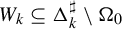 ${W_k\subseteq \Delta _k^\sharp \setminus \Omega _0}$
and
 $\widetilde {W}\subseteq \overline {\Omega _0}$
be these four closed sets.
By drawing
 $\mathcal {V}$
in blue and
 $\partial \Omega _0$
in black, we show the position relationship between
 $\mathcal {V}$
and
 $\partial \Omega _0$
with
 $\alpha =1,4,5$
.

Lemma 3.4. For
 $k=0,1,2$
,
 $f_\alpha (W_k)\subseteq E_{\pi /6}$
.
Proof. By a similar argument as the proof of Lemma 3.3, it suffices to prove that
 $f_\alpha (W_0)\subseteq E_{\pi /6}$
. Combining with the second assertion of Lemmas 2.2 and 2.4, we can get that
 $f_\alpha $
is a homeomorphism on
 $\mathrm {Int}(W_0)$
. Therefore, we only need to prove that
 $f_\alpha (\partial W_0)\subseteq E_{\pi /6}$
.
By the mapping properties of
 $f_\alpha $
, it is easy to check that
 $$ \begin{align*}\arg(f_\alpha(z))=0 \quad \text{for } z\in\partial W_0\cap\partial\Omega_0.\end{align*} $$
According to Lemma 2.1, what we are left to prove is that
 $$ \begin{align} -\pi/6<\arg(f_\alpha(z))<0 \quad \text{for } z\in\partial W_0\setminus \partial\Omega_0 \quad \text{and} \quad \mathrm{Im}(z)>0. \end{align} $$
Suppose
 $w=\alpha e^{\mathrm{i}\theta }/2\in \mathcal {C}$
with
 $\theta \in (0,\pi /3)$
. Then,
 $$ \begin{align*} f_\alpha^2(w)&=w^4+2\alpha w^2\overline{w}+(\alpha^2+\alpha)\overline{w}^2+\alpha^2 w\\\notag &=\frac{\alpha^3}{16}[(\alpha e^{4\mathrm{i}\theta}+4e^{\mathrm{i}\theta})+4(\alpha+1)(e^{-2\mathrm{i}\theta}+e^{\mathrm{i}\theta})].\notag \end{align*} $$
Note that for
 $\alpha \in [1,4]$
, we have
 $$ \begin{align*}\theta<\arg((\alpha e^{4\mathrm{i}\theta}+4e^{\mathrm{i}\theta}))\leq 5\theta/2 \quad \text{and} \quad \arg(4(\alpha+1)(e^{-2\mathrm{i}\theta}+e^{\mathrm{i}\theta}))=-\theta/2.\end{align*} $$
Therefore,
 $$ \begin{align}\arg(f_\alpha^2(w))>-\theta/2>-\pi/6.\end{align} $$
Since
 $f_\alpha ^{-1}(\mathbb {R})=\mathbb {R}\cup \{z:\mathrm {Re}(z)=\alpha /2\}$
, it follows by the second assertion of Lemma 2.2 that
 $$ \begin{align*}\mathrm{Im}(f_\alpha^2(w))>0 \quad \text{or}\quad \mathrm{Im}(f_\alpha^2(w))<0 \quad \text{uniformly\, for } f_\alpha(w)\in\partial W_0\setminus \partial\Omega_0.\end{align*} $$
While for
 $w_0=\alpha e^{\pi \mathrm {i}/6}/2$
, we have
 $$ \begin{align*}\mathrm{Im}(f_\alpha^2(w_0))=(-3\sqrt{3}/2+2)\alpha+4-2\sqrt{3}\leq 6-7\sqrt{3}/2<0.\end{align*} $$
This means
 $\arg (f_\alpha ^2(w_0))<0$
and, hence,
 $$ \begin{align} \arg(f_\alpha^2(w))<0 \quad \text{for }f_\alpha(w)\in\partial W_0\setminus \partial\Omega_0. \end{align} $$
Combining with (3.15) and (3.16), we get (3.14). Therefore,
 $f_\alpha (\partial W_0)\subseteq E_{\pi /6}$
and this finishes the proof of the lemma.
Recall that
 $I = [-\alpha , 0]$
and
 $Y = I \cup \omega I \cup \omega ^2 I$
.
Lemma 3.5. We have
 $\Omega _0\setminus Y\subseteq E(f_\alpha )$
.
Proof. Let
 $z\in \Omega _0\setminus Y$
. Since
 $f_\alpha (\widetilde {W})\subseteq \overline {\mathrm {Int}(\mathcal {V})}$
, we can get
 $$ \begin{align} f_\alpha^2(z)\in \bigg(\bigcup_{i=0}^2 f_\alpha(W_i)\bigg)\cup \overline{\mathrm{Int}(\mathcal{V})}\subseteq \bigg[\bigg(\bigcup_{i=0}^2 f_\alpha(W_i)\bigg)\cup \bigg(\bigcup_{i=0}^2 W_i\bigg)\bigg]\cup \widetilde{W}. \end{align} $$
Note that Lemmas 3.4 and 3.2 imply
 $$ \begin{align} \bigg(\bigcup_{i=0}^2 f_\alpha(W_i)\bigg)\cup \bigg(\bigcup_{i=0}^2 W_i\bigg)\subseteq E(f_\alpha). \end{align} $$
Therefore, if
 $f_\alpha ^2(z)\in (\bigcup _{i=0}^2 f_\alpha (W_i))\cup (\bigcup _{i=0}^2 W_i)$
, then
 $z\in E(f_\alpha )$
. Otherwise, if
 $f_\alpha ^2(z)\in \widetilde {W}$
, we will prove
 $z\in E(f_\alpha )$
by the following claim: there is a smallest integer
 $N>1$
such that
 $$ \begin{align} f_\alpha^{2N}(z)\notin \widetilde{W}. \end{align} $$
We prove the claim by contradiction. Suppose that
 $$ \begin{align*}f_\alpha^{2n}(z)\in \widetilde{W}\subseteq\overline{\Omega_0}\end{align*} $$
for any integer
 $n>0$
. Then, we have
 $$ \begin{align*} f_\alpha^{2n+1}(z)\in f_\alpha(\widetilde{W})\subseteq\overline{\mathrm{Int}(\mathcal{V})}=\bigg(\bigcup_{i=0}^2 W_i\bigg)\cup\widetilde{W}. \end{align*} $$
Combining with (3.18) and
 $z\notin E(f_\alpha )$
, it follows that
 $$ \begin{align*}f_\alpha^{2n+1}(z)\in\widetilde{W}\subseteq\overline{\Omega_0}\end{align*} $$
for all
 $n{\kern-1pt}\geq{\kern-1pt} 0$
. Hence,
 $\mathcal {O}(z){\kern-1pt}\subseteq{\kern-1pt} \overline {\Omega _0}$
. However, Lemma 3.1 implies that there is an integer
 ${n>0}$
such that
 $f_\alpha ^n(z)\in E_{\pi /6}$
. This means
 $z\in E(f_\alpha )$
by Lemma 3.2, which is a contradiction.
According to (3.19), we get that
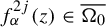 $f_\alpha ^{2j}(z)\in \overline {\Omega _0}$
for any
 $j=0,1,\ldots ,N-1$
. However, since
 $f_\alpha $
is a two-to-one mapping from Y to
 $f_\alpha (Y)$
, it follows from the mapping property of
 $f_\alpha $
that
 $$ \begin{align*} f^{-1}_{\alpha}(Y)\cap\overline{\Omega_0}=Y. \end{align*} $$
Therefore,
 $$ \begin{align} f_\alpha^{2(N-1)}(z)\in \overline{\Omega_0}\setminus Y. \end{align} $$
Note that (3.17) also holds for points in
 $\overline {\Omega _0}\setminus Y$
. Then, it follows by (3.20) and (3.17) that
 $$ \begin{align*} f_\alpha^{2N}(z)=f_\alpha^{2}(f_\alpha^{2(N-1)}(z))\in \bigg[\bigg(\bigcup_{i=0}^2 f_\alpha(W_i)\bigg)\cup \bigg(\bigcup_{i=0}^2 W_i\bigg)\bigg]\cup \widetilde{W}. \end{align*} $$
However, by (3.19) and (3.18), we can get that
 $$ \begin{align*} f_\alpha^{2N}(z)\in \bigg(\bigcup_{i=0}^2 f_\alpha(W_i)\bigg)\cup \bigg(\bigcup_{i=0}^2 W_i\bigg)\subseteq E(f_\alpha).\end{align*} $$
That is,
 $z\in E(f_\alpha )$
. This completes the proof of the lemma.
4 An infinite tree
In this section, we are devoted to prove that the closure of the set S defined in (1.1) is a 3-regular infinite tree and introduce symbolic dynamics on it by which we prove that the topological entropy on
 $\overline {S}$
is
 $\log 2$
.
Lemma 4.1. For
 $k=0,1,2$
,
 $f_\alpha (\omega ^{k} I)\subseteq \omega ^{2k} I$
. In particular,
 $f_\alpha (Y)\subseteq Y$
.
Proof. According to Lemma 2.6, it follows that
 $f_\alpha (I) \subseteq I$
. Hence, by Lemma 2.1,
 $$ \begin{align*}f_\alpha(\omega^{k} I) = \omega^{-k} f_\alpha(I) \subseteq \omega^{2k} I.\\[-37pt] \end{align*} $$
We first explain that
 $$ \begin{align*}T_n:=\bigcup_{i=0}^{n-1} f_{\alpha}^{-i}(Y),\quad n\geq1,\end{align*} $$
is an increasing sequence of finite trees and introduce the symbolic dynamics on it (see Figure 6). The reader may also refer to [Reference Sienra15, p. 49].
An increasing sequence of finite trees of
 $f_1$
.

It is clear that
 $T_1=Y$
is a finite tree. To show
 $T_2$
is a finite tree, let us denote
 $\omega ^{-1} I,I$
, and
 $\omega I$
by
 $I_0, I_1$
, and
 $I_2$
, respectively. Note that by Lemma 4.1 and the mapping properties of
 $f_\alpha $
, it follows that
 $$ \begin{align*}f_\alpha^{-1}(I_{k})\cap\overline{\Omega_0}\subseteq Y\text{,}\quad k=0,1,2.\end{align*} $$
Let
 $I_{00}=f_{\alpha ,0}^{-1}(I_{0})$
and
 $I_{10}=f_{\alpha ,1}^{-1}(I_{0})$
. Since the origin is the endpoint of each
 $I_k$
and
 $f_\alpha ^{-1}(0)=\{0,o_0,o_1,o_2\}$
, we get
 $I_{00}$
is attached to
 $I_0$
at
 $o_0$
and lies on the same side as
 $D_0^0$
, and
 $I_{10}$
is attached to
 $I_1$
at
 $o_1$
and lies on the same side as
 $D_0^1$
. Similarly, let
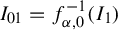 $I_{01}=f_{\alpha ,0}^{-1}(I_{1})$
and
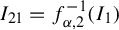 $I_{21}=f_{\alpha ,2}^{-1}(I_{1})$
. Then,
 $I_{01}$
is attached to
 $I_0$
at
 $o_0$
and lies on the same side as
 $D_1^0$
, and
 $I_{21}$
is attached to
 $I_{2}$
at
 $o_2$
and lies on the same side as
 $D_1^2$
. Moreover, let
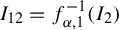 $I_{12}=f_{\alpha ,1}^{-1}(I_{2})$
and
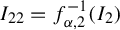 $I_{22}=f_{\alpha ,2}^{-1}(I_{2})$
. Then,
 $I_{12}$
is attached to
 $I_{1}$
at
 $o_1$
and lies on the same side as
 $D_2^1$
, and
 $I_{22}$
is attached to
 $I_{2}$
at
 $o_2$
and lies on the same side as
 $D_2^2$
.
Note that
 $$ \begin{align*}I_{0}\cap I_{00}=I_{0}\cap I_{01}=I_{00}\cap I_{01}=o_0,\end{align*} $$
 $$ \begin{align*}I_{1}\cap I_{10}=I_{1}\cap I_{12}=I_{10}\cap I_{12}=o_1,\end{align*} $$
and
 $$ \begin{align*}I_{2}\cap I_{21}=I_{2}\cap I_{22}=I_{21}\cap I_{22}=o_2.\end{align*} $$
It follows that
 $$ \begin{align*}T_2=T_1\cup(I_{00}\cup I_{01}\cup I_{10}\cup I_{12}\cup I_{21}\cup I_{22})\end{align*} $$
is a finite tree such that
 $T_1$
is a subtree of
 $T_2$
.
To continue this process, now we suppose that for
 $n\geq 2$
,
 $$ \begin{align*}T_n=T_{n-1}\cup\Big(\bigcup I_{\underline{s}_n}\Big)\end{align*} $$
is a finite tree, where the second union is taken over all the admissible blocks of length n. Let
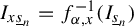 $I_{x\underline {s}_n}=f^{-1}_{\alpha ,x}(I_{\underline {s}_n})$
and
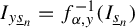 $I_{y\underline {s}_n}=f^{-1}_{\alpha ,y}(I_{\underline {s}_n})$
with
 $x\underline {s}_n$
and
 $y\underline {s}_n$
admissible. Since
 $I_{x\underline {s}_n}$
and
 $I_{y\underline {s}_n}$
are attached to
 $I_{x\underline {s}_{n-1}}$
and
 $I_{y\underline {s}_{n-1}}$
, respectively, it is easy to check that
 $$ \begin{align*}T_{n+1}=T_{n}\cup\Big(\bigcup I_{\underline{s}_{n+1}}\Big)\end{align*} $$
is a finite tree, where the second union is taken over all the admissible blocks of length
 $n+1$
. Therefore, by induction, it follows that
 $T_n$
is an increasing sequence of finite trees and we set
 $$ \begin{align*}S:=\bigcup_{n=1}^{\infty} T_n.\end{align*} $$
Let
 $\underline {s}=s_1s_2\cdots $
be an admissible sequence. For any
 $n\geq 1$
, define
 $$ \begin{align*}\underline{s}_n=s_1s_2\cdots s_n \quad \text{and} \quad \underline{s}^n=s_{n}s_{n+1}\cdots. \end{align*} $$
Then,
 $\underline {s}_n$
is an admissible block and
 $\underline {s}^n$
is an admissible sequence. Denote by
 $o_{\underline {s}_n}$
the common endpoint of
 $I_{\underline {s}_n}$
and
 $I_{\underline {s}_{n+1}}$
(set
 $o_{\underline {s}_0}=0$
). Note that
 $f_{\alpha }^n(o_{\underline {s}_n})=0$
. Let
 $$ \begin{align*}\zeta_{\underline{s}^n}=\mathop{\bigcup}\limits_{m\geq n} I_{\underline{s}_{m}} \quad \text{and} \quad \zeta_{\underline{s}}^\infty=\mathop{\bigcap}\limits_{n\geq 0}\overline{\zeta_{\underline{s}^n}}.\end{align*} $$
Lemma 4.2. One has
 $S\setminus Y=(\bigcup \zeta _{\underline {s}^2})\setminus \{o_0,o_1,o_2\}\subseteq \mathbb {C}\setminus \overline {U(0,\alpha )}$
, where the union is taken over all the admissible sequence
 $\underline {s}$
.
Proof. According to Lemmas 3.3 and 3.2, we can get
 $f_\alpha (\bigcup Q_k)\subseteq E_{\pi /6}\subseteq E(f_\alpha )$
. This means
 $\bigcup Q_k\subseteq E(f_\alpha )$
. Since
 $(\bigcup Q_k)\cup \{o_0,o_1,o_2\}=\overline {\bigcup Q_k}$
by (3.12), this proves that for any admissible sequence
 $\underline {s}$
, we have
 $$ \begin{align*}(\zeta_{\underline{s}^2}\setminus\{o_0,o_1,o_2\})\cap \Big(\overline{\bigcup Q_k}\Big)=\emptyset.\end{align*} $$
Note that
 $\mathbb {C}\setminus \overline {\bigcup Q_k}$
has two components
 $\Omega _0$
and
 $\mathbb {C}\setminus \overline {U(0,\alpha )}$
. Since
 $\zeta _{\underline {s}^2}\setminus \{o_0,o_1,o_2\}$
is connected, it follows that
 $$ \begin{align*}\text{either } \zeta_{\underline{s}^2}\setminus\{o_0,o_1,o_2\}\subseteq\Omega_0 \quad \text{or}\quad \zeta_{\underline{s}^2}\setminus\{o_0,o_1,o_2\}\subseteq \mathbb{C}\setminus \overline{U(0,\alpha)}.\end{align*} $$
However, by the construction of
 $T_2$
,
 $I_{\underline {s}_2}$
must intersect some
 $D^i_j$
with
 $i+j\neq 2$
(see Figure 3 for an illustration). Therefore,
 $I_{\underline {s}_2}\setminus \{o_0,o_1,o_2\}\nsubseteq \Omega _0$
. Hence,
 $\zeta _{\underline {s}^2}\setminus \{o_0,o_1,o_2\}\subseteq \mathbb {C}\setminus \overline {U(0,\alpha )}$
.
Lemma 4.3. There is a
 $\delta _0>0$
, such that
 $$ \begin{align*}\cup\zeta_{\underline{s}^3}\subseteq \mathbb{C}\setminus \overline{U(0,\alpha+\delta_0)},\end{align*} $$
where the union is taken over all the admissible sequence
 $\underline {s}$
.
Proof. We prove the lemma by contradiction. Assume that for any
 $\delta>0$
, there is a point
 $z_0$
such that
 $$ \begin{align} z_0\in \zeta_{\underline{s}^3}\cap \overline{U(0,\alpha+\delta)}. \end{align} $$
Since
 $\zeta _{\underline {s}^3}\subseteq \zeta _{\underline {s}^2}\setminus \{o_0,o_1,o_2\}$
, by Lemma 4.2, we have
 $$ \begin{align} z_0\in \zeta_{\underline{s}^2}\setminus\{o_0,o_1,o_2\}\subseteq\mathbb{C}\setminus \overline{U(0,\alpha)}. \end{align} $$
Combining with (4.1) and (4.2), it follows that
 $$ \begin{align*} z_0\in \overline{U(0,\alpha+\delta)}\setminus \overline{U(0,\alpha)} \subseteq U(\partial U(0,\alpha),2\delta). \end{align*} $$
Then, by the continuity of
 $f_{\alpha }$
, we get that
 $$ \begin{align}f_{\alpha}(z_0)\in U(f_{\alpha}(\partial U(0,\alpha)),\varepsilon)\end{align} $$
for some
 $\varepsilon>0$
small enough depending only on
 $\delta $
.
Now, we claim that
 $$ \begin{align} f_{\alpha}(z_0)\in E_{\pi/6}\cup U(0,\alpha). \end{align} $$
Let us get a contradiction by assuming (4.4). If
 $f_{\alpha }(z_0)\in E_{\pi /6}$
, we get
 $f_{\alpha }(z_0)\in E(f_{\alpha })$
by Lemma 3.2. However, since
 $z_0\in \zeta _{\underline {s}^3}$
, this is impossible. If
 $f_{\alpha }(z_0)\in U(0,\alpha )$
, since
 $f_{\alpha }(z_0)\in (S\setminus Y)\cup \{o_0,o_1,o_2\}$
, we can get
 $$ \begin{align*}U(0,\alpha)\cap((S\setminus Y)\cup\{o_0,o_1,o_2\})\neq\emptyset.\end{align*} $$
This contradicts with Lemma 4.2.
To prove (4.4), it follows by (4.3) that we only need to prove
 $$ \begin{align} U(f_{\alpha}(\partial U(0,\alpha)),\varepsilon)\subseteq E_{\pi/6}\cup U(0,\alpha)\end{align} $$
for
 $\varepsilon>0$
small enough. Since
 $\{o_0,o_1,o_2\}\subseteq f_{\alpha }^{-1}(0)$
, there is an open
 $\eta $
-neighborhood of
 $\{o_0,o_1,o_2\}$
, say V, which is mapped into
 $U(0,\alpha )$
. However, it follows by Lemma 3.3 that
 $\partial U(0,\alpha )\setminus V$
is mapped into the interior of
 $E_{\pi /6}$
. This means there is an open neighborhood W of
 $\partial U(0,\alpha )\setminus V$
which is mapped into
 $E_{\pi /6}$
. Then, (4.5) holds since
 $V\cup W$
contains some neighborhood of
 $\partial U(0,\alpha )$
.
Lemma 4.4. For any admissible sequence
 $\underline {s}$
, the Euclid length of
 $\zeta _{\underline {s}^n}$
converges to zero uniformly as
 $n\rightarrow \infty $
. In particular,
 $\zeta _{\underline {s}}^{\infty }$
is a singleton.
Proof. By Lemma 4.3,
 $\zeta _{\underline {s}^3}\subseteq \mathbb {C}\setminus \overline {U(0,\alpha +\delta _0)}$
for any admissible sequence
 $\underline {s}$
. However, for any
 $z\in \mathbb {C}\setminus \overline {U(0,\alpha +\delta _0)}$
and
 $1\leq \alpha \leq 4$
, we have
 $$ \begin{align} |df_\alpha|=|2z\,dz+\alpha \,d\bar{z}|\geq|2z||dz|-\alpha|d\bar{z}|\geq(\alpha+2\delta_0)|dz|\geq(1+2\delta_0)|dz|. \end{align} $$
Note that by setting
 $\underline {s}=s_1s_2\cdots s_m\cdots $
, we have
 $$ \begin{align} I_{s_{m-1}s_m}=f_\alpha(I_{s_{m-2}s_{m-1}s_m})=\cdots= f_\alpha^{m-2}(I_{s_1s_2\cdots s_m}).\end{align} $$
Combining with (4.6) and (4.7), this implies that the length of
 $I_{\underline {s}_{m}}$
tends to zero uniformly at the rate of exponential growth as
 $m\rightarrow \infty $
. Then, the lemma follows by the definition of
 $\zeta _{\underline {s}^n}$
.
Let
 $S^{\infty }:=\{\zeta _{\underline {s}}^\infty :\underline {s}\;\text { is an admissible sequence}\}.$
Lemma 4.5. It holds that
 $\overline {S}=S^{\infty }\sqcup S$
, where
 $\sqcup $
means disjoint union.
Proof. Let us first prove that
 $\overline {S}=S^{\infty }\cup S$
. It is clear that
 $S^{\infty }\cup S\subseteq \overline {S}$
. To show
 $\overline {S}\subseteq S^{\infty }\cup S$
, it suffices to prove that for any
 $z_0\in \overline {S}\setminus S$
, we have
 $z_0\in S^{\infty }$
. Since S is dense in
 $\overline {S}$
, we can find a sequence
 $z_n\in S$
such that
 $z_n\rightarrow z_0$
. Furthermore, we suppose
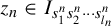 $z_n\in I_{s_1^ns_2^n\cdots s_{l_n}^n}$
, where
 $s_1^ns_2^n\cdots s_{l_n}^n$
is an admissible block of length
 $l_n>0$
. If the sequence
 $l_n$
is bounded by a constant
 $N>1$
, then
 $z_n\in T_N$
for all
 $n\geq 1$
. Since
 $T_N$
is compact, it follows that
 $z_0\in T_N\subseteq S$
, which is a contradiction. Otherwise, by taking a subsequence of
 $z_n$
if necessary, we may assume
 $l_n\rightarrow \infty $
monotonically.
Recall that
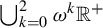 $\bigcup _{k=0}^2\omega ^k\mathbb {R}^+$
separates the plane into three sectors
 $\Delta _k$
with
 $I_k\subseteq \Delta _k$
,
 $k=0,1,2$
. Since
 $\bigcup _{k=0}^2\omega ^k\mathbb {R}^+\subseteq E(f_\alpha )$
and
 $z_0\neq 0$
, it follows that, if there is some
 $k\in \{0,1,2\}$
so that
 $\{s_1^n\}$
contains infinitely many k, then
 $z_0$
belongs to the interior of
 $\Delta _k$
. This implies there is exactly one
 $k\in \{0,1,2\}$
, denoted as
 $k_1$
, which appears in
 $\{s_1^n\}$
infinitely many times. Note that
 $f_\alpha (z_n)\rightarrow f_\alpha (z_0)$
,
 $f_\alpha (z_n)\in I_{s_2^n\cdots s_{l_n}^n}$
, and
 $f_\alpha (z_0)\neq 0$
. Using the same argument as above, there is exactly one
 $k\in \{0,1,2\}$
, denoted as
 $k_2$
, which appears in
 $\{s_2^n\}$
infinitely many times. In this way, we get an admissible sequence
 $\underline {k}=k_1k_2\cdots $
. By Lemma 4.4, we must have
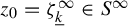 $z_0=\zeta _{\underline {k}}^{\infty }\in S^\infty $
.
Now, let us prove the union is disjoint. The proof is by contradiction. Assume
 $\zeta _{\underline {s}}^{\infty }\in S$
for some admissible sequence
 $\underline {s}$
. Then,
 $\zeta _{\underline {s}}^{\infty }\in I_{t_1\cdots t_n}$
for some admissible block
 $t_1\cdots t_n$
. This implies that
 $f_{\alpha }^{n-1}(\zeta _{\underline {s}}^{\infty })\in I_{t_n}$
. However,
 $$ \begin{align*}f_{\alpha}^{n-1}(\zeta_{\underline{s}}^{\infty})\in S^{\infty}\subseteq \mathbb{C}\setminus \overline{U(0,\alpha)}\end{align*} $$
by Lemma 4.3. This is a contradiction since
 $I_{t_n}\cap (\mathbb {C}\setminus \overline {U(0,\alpha )})=\emptyset $
.
For an admissible block
 $\underline {s}_{n}$
with
 $n\geq 1$
, define
 $$ \begin{align*}S_{\underline{s}_{n}}=\{\zeta_{\underline{t}^{n}}:\underline{t}\;\text{ is\ an\ admissible\ sequence\ and\ } \underline{t}_{n}=\underline{s}_{n}\}.\end{align*} $$
Note that the set
 $S_{\underline {s}_{n}}$
is path connected whose unique endpoint lying in S is
 $o_{\underline {s}_{n-1}}$
.
Lemma 4.6. For any admissible block
 $\underline {s}_n$
with
 $n\geq 0$
, there are three distinguishable rays
 $\gamma _0,\gamma _1$
, and
 $\gamma _2$
in the escaping set landing at
 $o_{\underline {s}_n}$
such that:
-
(1)
$f_{\alpha }^{n}:\gamma _k\rightarrow \omega ^k\mathbb {R}^+$
is a homeomorphism for
$k=0,1,2$
; and -
(2)
$\overline {S_{\underline {s}_{n}x}}$
,
$\overline {S_{\underline {s}_{n}y}}$
, and
$\overline {S\setminus (S_{\underline {s}_{n}x}\cup S_{\underline {s}_{n}y})}$
are respectively contained in three distinct sectors separated by
$\gamma _0,\gamma _1$
, and
$\gamma _2$
, where
$\underline {s}_{n}x\neq \underline {s}_{n}y$
denote two admissible blocks.






Proof. Note that for the definition of
 $f_{\alpha ,k}^{-1}$
, the choice of the equality is artificial and can be changed at will, since
 $f_\alpha (\omega ^k\mathbb {R}^+)=\omega ^{2k}\mathbb {R}^+$
for
 $k=0,1,2$
. This implies that
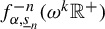 $f_{\alpha ,\underline {s}_{n}}^{-n}(\omega ^k\mathbb {R}^+)$
is well defined. So, we take
 $\gamma _k=f_{\alpha ,\underline {s}_{n}}^{-n}(\omega ^k\mathbb {R}^+)$
and the lemma holds by Corollary 2.5.
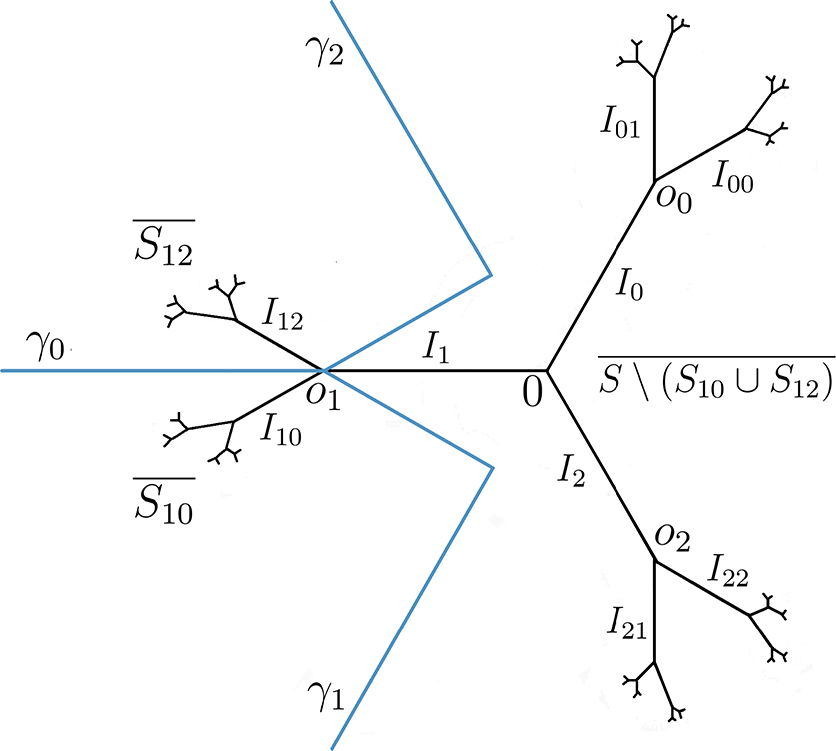
A special case of Lemma 4.6 is illustrated in Figure 7.
For the map
 $f_1$
and
 ${\underline{s}}{}_{1}=1 $
, the sets
 ${\overline{S_{10}}} $
,
 ${\overline {S_{12}}}$
, and
 ${\overline {S\setminus (S_{10}\cup S_{12})}}$
are respectively contained in three distinct sectors separated by
 ${\gamma _{0}},{\gamma _{1}}$
, and
 ${\gamma _{2}}$
.

Lemma 4.7. For any two distinct admissible sequences
 $\underline {s}$
and
 $\underline {t}$
, we have
 $\zeta _{\underline {s}}^{\infty }\neq \zeta _{\underline {t}}^{\infty }$
. Moreover, there is no loop in
 $\overline {S}$
.
Proof. The proof of the first assertion is by contradiction. Assume there are two distinct admissible sequences
 $\underline {s}$
and
 $\underline {t}$
such that
 $\zeta _{\underline {s}}^{\infty }=\zeta _{\underline {t}}^{\infty }$
. Let
 $n>0$
be the largest integer such that
 $\underline {s}_{n-1}=\underline {t}_{n-1}.$
Then,
 $\zeta _{\underline {s}^{n}}\cup \zeta _{\underline {t}^{n}}\cup \zeta _{\underline {s}}^{\infty }$
is a Jordan curve containing the point
 $o_{\underline {s}_{n-1}}$
. By Lemma 4.5, this implies that
 $$ \begin{align*}\Upsilon=f_{\alpha}^{n-1}(\zeta_{\underline{s}^{n}}\cup \zeta_{\underline{t}^{n}}\cup \zeta_{\underline{s}}^{\infty})\end{align*} $$
is a Jordan curve, which contains the origin and therefore contains two of the
 $I_0,I_1$
, and
 $I_2$
. It follows that
 $\Upsilon $
must intersect
 $\bigcup _{k=0}^2\omega ^k\mathbb {R}^+\subseteq E(f_\alpha )$
, which is a contradiction.
The proof of the second assertion is also by contradiction. Assume there is a loop
 ${\Upsilon \subseteq \overline {S}}$
. It is clear that
 $\Upsilon \cap S^\infty \neq \emptyset $
. We claim that
 $\Upsilon \cap S^\infty $
contains at least two points. For otherwise, since
 $\Upsilon $
is a Jordan curve, we would have two distinct admissible sequences
 $\underline {s}$
and
 $\underline {t}$
such that
 $\zeta _{\underline {s}}^{\infty }=\zeta _{\underline {t}}^{\infty }\in \Upsilon \cap S^\infty $
. This contradicts with the first assertion. By the claim, let
 $\zeta _{\underline {s}}^{\infty }\neq \zeta _{\underline {t}}^{\infty }\in \Upsilon $
and
 $n>0$
be the largest integer such that
 $\underline {s}_{n-1}=\underline {t}_{n-1}.$
Then, by Lemma 4.6,
 $\zeta _{\underline {s}}^{\infty }$
and
 $\zeta _{\underline {t}}^{\infty }$
are contained in distinct sectors separated by the three escaping rays landing at
 $o_{\underline {s}_{n-1}}$
. This contradicts with the fact that
 $\Upsilon $
is a Jordan curve. The second assertion has been proved.
Lemma 4.8. The set
 $\overline {S}$
is locally connected.
Proof. By Lemma 4.2, we know that
 $S\cap U(0,\alpha )=Y\setminus \{o_0,o_1,o_2\}$
. This proves the local connectivity of
 $\overline {S}$
on
 $Y\setminus \{o_0,o_1,o_2\}$
. For any
 $z\in (S\setminus Y)\cup \{o_0,o_1,o_2\}$
, we can get that there is a smallest integer
 $n>0$
, such that
 $f_{\alpha }^{n}(z)\in Y\setminus \{o_0,o_1,o_2\}$
. Since
 $\{z,f_\alpha (z),\ldots ,f_{\alpha }^{n-1}(z)\}\subseteq \mathbb {C}\setminus U(0,\alpha )$
and
 $\mathcal {C}\subseteq \overline {U(0,\alpha /2)}$
, this implies that
 $f_\alpha ^{n}$
is a homeomorphism in some neighborhood of z. Therefore, this implies the local connectivity of
 $\overline {S}$
on
 $(S\setminus Y)\cup \{o_0,o_1,o_2\}$
and hence, on S.
For any admissible sequence
 $\underline {s}$
, let us prove the local connectivity of
 $\overline {S}$
at
 $\zeta _{\underline {s}}^{\infty }\in S^{\infty }$
. From Lemma 4.6, we can obtain a sequence neighborhood of
 $\zeta _{\underline {s}}^{\infty }$
, say
 $U_{\underline {s}_{n}}$
, with
 $ U_{\underline {s}_{n}}\cap \overline {S}=\overline {S_{\underline {s}_{n}}}\setminus \{o_{\underline {s}_{n-1}}\}.$
According to Lemma 4.4, the diameter of
 $S_{\underline {s}_{n}}$
converges to zero as
 $n\rightarrow \infty $
. This proves the local connectivity of
 $\overline {S}$
at
 $\zeta _{\underline {s}}^{\infty }.$
The proof of the lemma is finished.
Lemma 4.9. For
 $\alpha \in [1,4]$
,
 $\overline {S}$
is a 3-regular infinite tree.
In the following, by equipping on
 $\overline {S}\setminus S$
the induced Euclidean metric d, we will show that
 $f_\alpha $
is conjugate to a subshift of finite type with the transition matrix M defined in (1.2) on
 $\overline {S} \setminus S$
.
Let
 $\Sigma _3=\{0,1,2\}^{\mathbb {N}}$
be the symbol space with
 $3$
symbols and
 $\underline {s}=s_{1}s_{2}s_{3}\cdots $
be an element in
 $\Sigma _3$
. The shift map
 $\sigma : \Sigma _3 \rightarrow \Sigma _3$
is defined as
 $$ \begin{align*} \sigma(\underline{s})=s_{2}s_{3}\cdots. \end{align*} $$
Let
 $\Sigma _3^\infty $
be the subspace of
 $\Sigma _3$
consisting of all admissible elements. It follows that the transition matrix of
 $\Sigma _3^\infty $
is the matrix M defined in (1.2). For
 $\underline {s}=s_{1}s_{2}\cdots $
and
 $\underline {t}=t_{1}t_{2}\cdots $
in
 $\Sigma _3$
, if we equip a metric
 $\rho $
on
 $\Sigma _3$
with
 $$ \begin{align*} \rho(s, t)=\sum_{n=1}^{\infty} \frac{\delta(s_{n}, t_{n})}{2^{n}} \quad \text{where } \delta(k, l)=\begin{cases} 1 & \text { if } k \neq l, \\ 0 & \text { if } k=l, \end{cases} \end{align*} $$
then
 $(\Sigma _3, \rho )$
becomes a compact metric space. Note that the shift map
 $\sigma $
is continuous with respect to the metric
 $\rho $
.
Lemma 4.10. For
 $\alpha \in [1,4]$
,
 $\overline {S} \setminus S$
is a Cantor set on which
 $f_\alpha $
is topologically conjugate to a subshift of finite type with the transition matrix M defined in (1.2). In particular, the topological entropy of
 $f_\alpha $
on
 $\overline {S}$
is
 $\ln 2$
.
Proof. We first define the bijection
 $$ \begin{align*}\varphi:\Sigma_3^\infty\rightarrow \overline{S}\setminus S,\;\underline{s}\mapsto\zeta_{\underline{s}}^{\infty}.\end{align*} $$
This implies that
 $f_\alpha \circ \varphi (\underline {s})=\varphi \circ \sigma (\underline {s})$
. Suppose
 $\underline {s_n}\in \Sigma _3^\infty $
is a sequence with
 $\underline {s_n}\rightarrow \underline {s}$
. It follows that for any
 $n>0$
, there is an integer
 $k(n)>0$
such that
 $(\underline {s_n})_{k(n)}=\underline {s}_{k(n)}$
and
 $k(n)\rightarrow \infty $
as
 $n\rightarrow \infty $
. Moreover, Lemma 4.4 implies that for
 $\varepsilon>0$
, we can get an integer
 $N>0$
such that for any
 $n\geq N$
,
 $$ \begin{align*}d(o_{(\underline{s_n})_{k(n)}},\zeta_{\underline{s_n}}^\infty)<\varepsilon/2 \quad \text{and} \quad d(o_{\underline{s}_{k(n)}},\zeta_{\underline{s}}^\infty)<\varepsilon/2.\end{align*} $$
Hence, for
 $n\geq N$
,
 $$ \begin{align*} d(\zeta_{\underline{s_n}}^{\infty},\zeta_{\underline{s}}^{\infty}) \leq d(\zeta_{\underline{s_n}}^{\infty},o_{(\underline{s_n})_{k(n)}}) +d(o_{(\underline{s_n})_{k(n)}},o_{\underline{s}_{k(n)}}) +d(o_{\underline{s}_{k(n)}},\zeta_{\underline{s}}^{\infty})<\varepsilon. \end{align*} $$
This proves that
 $\varphi $
is continuous, so
 $\varphi $
is a homeomorphism. Therefore, the space
 $(\overline {S}\setminus S, d)$
is topologically conjugate to the space
 $(\Sigma _3^\infty , \rho )$
.
Then, we show that the topological entropy of
 $f_{\alpha }$
on
 $\overline {S}$
equals to
 $\ln 2$
. On one hand, since
 $S = \bigcup _{n=0}^{\infty }f_\alpha ^{-n}(Y)$
, it follows from Lemmas 2.6 and 2.1 that the topological entropy of
 $f_\alpha $
on S is no more than
 $\ln 2$
. On the other hand, according to (1.2), we get that the topological entropy of
 $f_\alpha $
on
 $\overline {S}\setminus S $
is equal to
 $\ln 2$
. In all, this proves that the topological entropy of
 $f_\alpha $
on
 $\overline {S}$
is
 $\ln 2$
.
So far, we have proved the assertions of Theorem 1.3 and Corollary 1.4 with
 $J(f_\alpha )$
being replaced by
 $\overline {S}$
. We end this section by recalling the question posed in [Reference Sienra15] as to whether
 $K(f_\alpha )$
is exactly equal to
 $\overline {S}$
. It can be inferred from our following results that the answer to this question is affirmative.
5 A Jordan curve
In this section, we are devoted to prove that the set
 $\Gamma $
defined below is a Jordan curve (see Figure 9 for a sketch). We begin this section by defining a piece of
 $\Gamma $
. For
 $k\geq 1$
, denote by
 $0_k$
the block of the digital
 $0$
with length k. Let
 $$ \begin{align*} J_{0_2}=(p_0,p_{0_2}] \quad \text{where } p_{0_2}=f_{\alpha,0}^{-1}(p_0)\in\partial\Omega_0.\end{align*} $$
Note that by a direct calculation, we get
 $\mathrm {Re}(p_{0_2})=\alpha /2=\mathrm {Re}(o_{0})$
and
 $0<\mathrm {Im}(p_{0_2})<\mathrm { Im}(o_{0})$
. Hence,
 $J_{0_2}\subseteq U(0,\alpha )$
.
For
 $n\geq 1$
, let
 $$ \begin{align*} J_{0_{n+2}}=f^{-n}_{\alpha,0_{n}}(J_{0_2}) \quad \text{and} \quad p_{0_{n+2}}=f^{-n}_{\alpha,0_{n}}(p_{0_2}). \end{align*} $$
Denote
 $s_1s_2\cdots $
by
 $\overline {s_1s_2\cdots s_m}$
if there is an
 $m>0$
such that
 $s_i=s_{i+m}$
for any
 $i>0$
. Then, we define
 $$ \begin{align*} \xi_{\overline{0}}=\mathop{\bigcup}\limits_{m\geq2} J_{0_m}. \end{align*} $$
Lemma 5.1. The set
 $\xi _{\overline {0}}$
is path connected, non-self-intersecting, and contained in
 $\mathbb {C}\setminus \Omega _0$
.
Proof. By the definition of
 $f^{-n}_{\alpha ,0_{n}}$
, it is obvious that
 $J_{0_{n}}\subseteq \mathbb {C}\setminus \Omega _0$
for all
 $n\geq 2$
. That is,
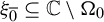 $\xi _{\overline {0}}\subseteq \mathbb {C}\setminus \Omega _0$
. Since
 $J_{0_{n}}$
is path connected by Corollary 2.5, and
 $p_{0_{n}}$
is the common endpoint of
 $J_{0_{n}}$
and
 $J_{0_{n+1}}$
, this proves
 $\xi _{\overline {0}}$
is path connected. Now, let us prove that
 $\xi _{\overline {0}}$
is non-self-intersecting. On one hand, by Corollary 2.5, it is obvious that
 $J_{0_{n}}$
is non-self-intersecting for every
 $n\geq 2$
. On the other hand, suppose that there are two integers i and j with
 $i>j>1$
such that
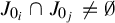 $J_{0_{i}}\cap J_{0_{j}}\neq \emptyset $
. Then, we can get
 ${J_{0_{i-j+2}}\cap J_{0_2}\neq \emptyset }$
. Since
 $f_\alpha (J_{0_2})\subseteq \mathbb {R}^+$
and
 $f_\alpha (\mathbb {R}^+)=\mathbb {R}^+$
, it follows that
 $J_{0_{m}}\cap \mathbb {R}^+\neq \emptyset $
for all
 $2\leq m\leq i-j+1$
. However, by noting that
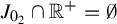 $J_{0_2}\cap \mathbb {R}^+=\emptyset $
, we can obtain
 $$ \begin{align*}J_{0_3}\cap \mathbb{R}^+=\emptyset \quad \text{and} \quad J_{0_{2}}\cap J_{0_{3}}=\emptyset.\end{align*} $$
The first equality implies that we must have
 $i=j+1$
. Then, combining with the second equality and Corollary 2.5, it follows that
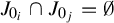 $J_{0_{i}}\cap J_{0_{j}}=\emptyset $
, which is a contradiction. This implies
 $\xi _{\overline {0}}$
is non-self-intersecting.
According to Lemma 5.1, we can parameterize
 $\xi _{\overline {0}}$
as a continuous curve
 $\xi _{\overline {0}}(t)$
(
 ${0<t<1}$
) with
 $\xi _{\overline {0}}(t)\rightarrow p_0$
as
 $t\rightarrow 1$
. Then, the set
 $$ \begin{align*} A_{\overline{0}}=\mathop{\bigcap}\limits_{t>0}\overline{\xi_{\overline{0}}((0,t))} \end{align*} $$
is called the accumulation set of
 $\xi _{\overline {0}}$
. If
 $A_{\overline {0}}$
is a singleton, then we say
 $\xi _{\overline {0}}$
is landing; otherwise, we say
 $\xi _{\overline {0}}$
is non-landing.
Denote by
 $Y_k$
the interior of
 $(\mathbb {C}\setminus \Sigma )\cap \Delta _k^\sharp $
. Let
 $$ \begin{align*} l=\{\mathrm{Re}(o_0)+\mathbf{i}y:y>\mathrm{Im}(o_0)\} \quad \text{and} \quad l^*=\{\mathrm{ Re}(o_2)+\mathbf{i}y:y<\mathrm{Im}(o_2)\}.\end{align*} $$
Then,
 $$ \begin{align*}f_{\alpha}(\omega^k l)=f_{\alpha}(\omega^k l^*)=\omega^{2k}\mathbb{R}^- \quad \text{for } k=0,1,2.\end{align*} $$
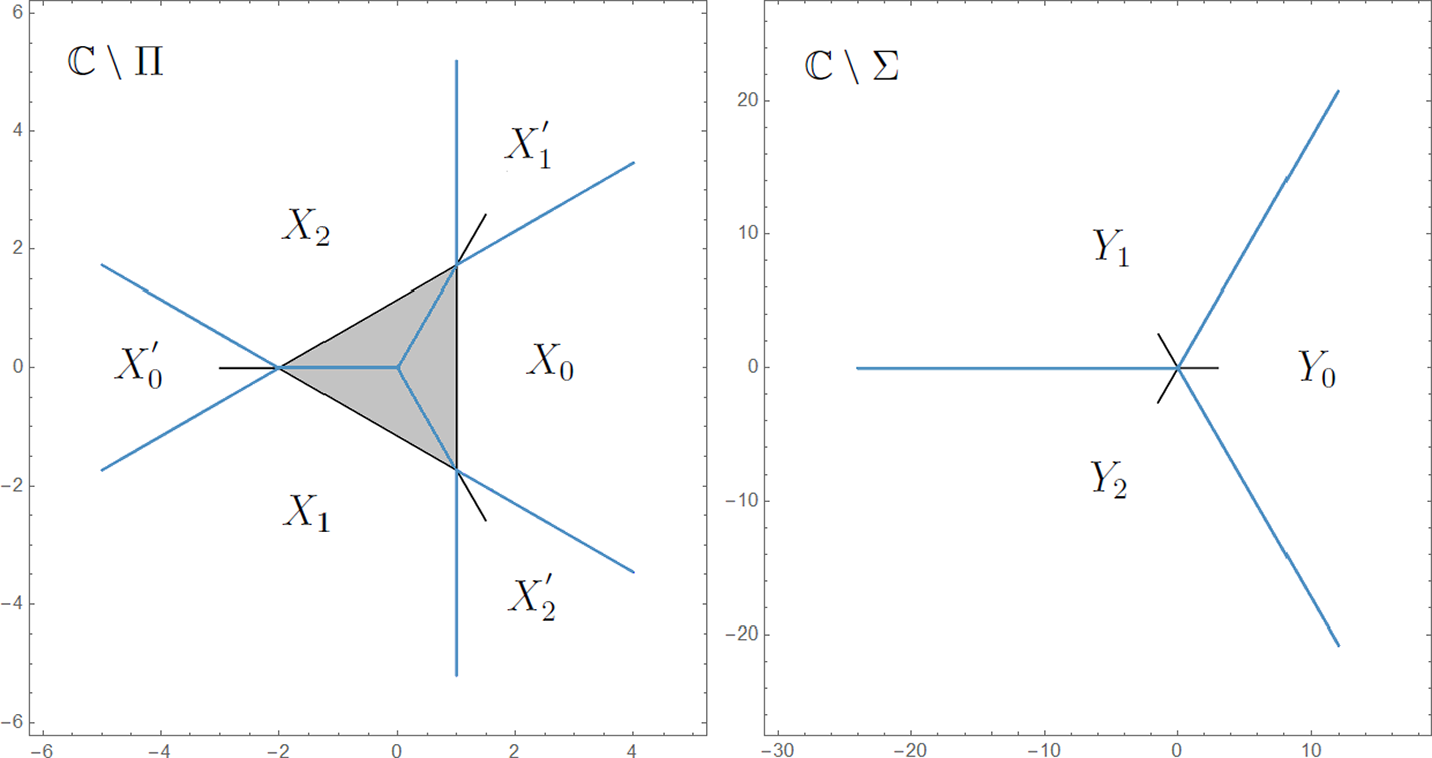
We denote the pre-images of
 $Y_k$
in
 $\mathbb {C}\setminus \Omega _0$
by
 $X_k$
and
 $X_k'$
with
 $X_k\subset \Delta _{2k}^\sharp $
and
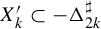 ${X_k'\subset -\Delta _{2k}^\sharp }$
. See Figure 8 for a sketch. Note that
 $f_\alpha :X_k\rightarrow Y_k$
and
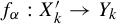 $f_\alpha :X_k'\rightarrow Y_k$
are all homeomorphisms for any
 $k=0,1,2$
.
The finer mapping properties of
 $f_2$
.

Lemma 5.2. The set
 $\xi _{\overline {0}}$
is landing at the point
 $\zeta _{\overline {0}}^{\infty }$
.
Proof. Note that
 $$ \begin{align*}\overline{U(0,\alpha)}=\Omega_0\cup\Big(\bigcup o_k\Big)\cup\Big(\bigcup Q_k\Big).\end{align*} $$
On one hand, from Lemma 5.1, we know that
 $$ \begin{align*}A_{\overline{0}}\cap\Omega_0=\emptyset.\end{align*} $$
Moreover, since
 $f_{\alpha }(A_{\overline {0}})\subseteq A_{\overline {0}}$
and
 $f_\alpha (o_k)=0\in \Omega _0$
for
 $k=0,1,2$
, it follow that
 $$ \begin{align*}A_{\overline{0}}\cap\Big(\bigcup o_k\Big)=\emptyset.\end{align*} $$
On the other hand, to prove
 $$ \begin{align}A_{\overline{0}}\cap\Big(\bigcup Q_k\Big)=\emptyset,\end{align} $$
we first claim that
 $|z|\leq 2\alpha $
for any
 $z\in A_{\overline {0}}$
. For otherwise, there must be a point
 ${w\in \xi _{\overline {0}}}$
such that
 $|w|> 2\alpha $
. According to the first assertion of Lemma 3.2, it follows that
 $|f_\alpha ^{n}(w)|> 2\alpha $
for all
 $n\geq 0$
. While from
 $w\in \xi _{\overline {0}}$
, we can also obtain that there is an integer
 $m\geq 0$
such that
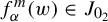 $f_\alpha ^m(w)\in J_{0_2}$
. This is a contradiction. Therefore,
 $A_{\overline {0}}$
is compact in the complex plane. Moreover, since
 $f_{\alpha }(A_{\overline {0}})\subseteq A_{\overline {0}}$
, this yields
 $A_{\overline {0}}\cap E(f_{\alpha })=\emptyset .$
However, combining with Lemmas 3.3 and 3.2, we know that
 $\cup Q_k\subseteq E(f_{\alpha })$
. Therefore, we get (5.1) holds. In all, we have obtained that
 $$ \begin{align*}A_{\overline{0}}\cap\overline{U(0,\alpha)}=\emptyset.\end{align*} $$
Since the set
 $A_{\overline {0}}$
is closed, it follows that there is a
 $\delta _1>0$
such that
 $A_{\overline {0}}$
is contained in
 $\mathbb {C}\setminus \overline {U(0,\alpha +2\delta _1)}$
. This proves that
 $\xi _{\overline {0}}(t)$
for every
 $t>0$
small enough is contained in
 $\mathbb {C}\setminus \overline {U(0,\alpha +\delta _1)},$
so is
 $J_{0_m}$
for every integer
 $m\geq K$
with
 $K>0$
large enough. The subsequent proof is similar with Lemma 4.4. Note that for any
 $z\in \mathbb {C}\setminus \overline {U(0,\alpha +\delta _1)}$
and
 $1\leq \alpha \leq 4$
, we can get that
 $$ \begin{align*} |df_\alpha|=|2z\,dz+\alpha \,d\bar{z}|\geq|2z||dz|-\alpha|d\bar{z}|\geq(\alpha+2\delta_1)|dz|\geq(1+2\delta_1)|dz|. \end{align*} $$
It follows by
 $f_{\alpha }^{m-K}(J_{0_{m}})=J_{0_{K}}$
that the Euclidean length of
 $J_{0_{m}}$
goes towards zero at the rate of exponential growth as
 $m\rightarrow \infty $
. Then, the Euclidean length of
 $\overline {\bigcup _{n\geq m}J_{0_{n}}}$
goes towards zero as
 $m\rightarrow \infty $
. Hence, the set
 $$ \begin{align*} A_{\overline{0}}=\mathop{\bigcap}\limits_{t>0}\overline{\xi_{\overline{0}}((0,t))} =\mathop{\bigcap}\limits_{m\geq K}\overline{\mathop{\bigcup}\limits_{n\geq m}J_{0_{n}}} \end{align*} $$
is a singleton. That is,
 $\xi _{\overline {0}}$
is landing.
To prove
 $A_{\overline {0}}=\zeta _{\overline {0}}^{\infty }$
, we first note that
 $A_{\overline {0}}$
is a fixed point of
 $f_\alpha $
. Since
 $J_{0_2}\subseteq \overline {X_0}\subseteq \overline {Y_0}$
and
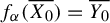 $f_\alpha (\overline {X_0})=\overline {Y_0}$
by the mapping properties of
 $f_\alpha $
(see Figure 8), it follows that
 $$ \begin{align*} \xi_{\overline{0}}\cup A_{\overline{0}}\subseteq\overline{X_0}.\end{align*} $$
Moreover, we claim that
 $$ \begin{align*}(\xi_{\overline{0}}\cup A_{\overline{0}})\cap \mathbb{R}^+=\emptyset.\end{align*} $$
For otherwise, there must be a point
 $w\in \xi _{\overline {0}}\cup A_{\overline {0}}$
such that
 $|f_\alpha ^{n+1}(w)|>|f_\alpha ^n(w)|$
for all
 $n\geq 0$
. However, this will lead to a contradiction since if
 $w\in \xi _{\overline {0}}$
, we can get that there is an integer
 $m\geq 0$
such that
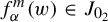 $f_\alpha ^m(w)\in J_{0_2}$
and if
 $w\in A_{\overline {0}}$
, we can get that
 $w=A_{\overline {0}}$
is the fixed point of
 $f_{\alpha }$
.
However, recall that
 $$ \begin{align*}\zeta_{0_n}=\mathop{\bigcup}\limits_{m\geq n} I_{0_m} \quad \text{and} \quad \zeta_{\overline{0}}^\infty=\mathop{\bigcap}\limits_{n\geq 0}\overline{\zeta_{0_n}}.\end{align*} $$
Moreover, it follows from the mapping properties of
 $f_\alpha $
that
 $I_{0_2}\subseteq \overline {X_0}$
. Hence, by the same argument as above, we can also get
 $$ \begin{align*}\zeta_{0_2}\cup\zeta^{\infty}_{\overline{0}}\in\overline{X_0} \quad \text{and} \quad (\zeta_{0_2}\cup\zeta^{\infty}_{\overline{0}})\cap\mathbb{R}^+=\emptyset.\end{align*} $$
Note that it is easy to check that the only fixed points of
 $f_{\alpha }$
not lying in
 $\mathbb {R}$
are
 $\zeta ^{\infty }_{\overline {0}}$
and
 $\zeta ^{\infty }_{\overline {2}}$
, which are conjugated to each other about the real axis. Therefore, since both
 $J_{0_2}$
and
 $I_{0_2}$
lie in the upper half-plane, it follows that
 $A_{\overline {0}}=\zeta ^{\infty }_{\overline {0}}$
.
Since Lemma 5.2 implies
 $\overline {\xi _{\overline {0}}}$
is a Jordan arc, we call
 $\overline {\xi _{\overline {0}}}$
a piece of a Jordan curve
 $\Gamma $
. Recall that
 $A^*=\{z:\bar {z}\in A\}$
for a set
 $A\subseteq \mathbb {C}$
. Let
 $$ \begin{align*}\Sigma^0_3=\{\overline{0},\overline{12},\overline{21},\overline{2},\overline{01},\overline{10}\}\end{align*} $$
be the set of all the six admissible sequences of the form
 $\overline {xy}$
. Then, we define
 $$ \begin{align}\xi_{\overline{12}}=\omega \xi_{\overline{0}}\text{,}\quad \xi_{\overline{21}}=\omega^2 \xi_{\overline{0}}\text{,}\quad \xi_{\overline{2}}=\xi_{\overline{0}}^*\text{,}\quad \xi_{\overline{01}}=\omega \xi_{\overline{0}}^* \quad \text{and} \quad \xi_{\overline{10}}=\omega^2 \xi_{\overline{0}}^*.\end{align} $$
Since Lemmas 5.2 and 5.1 hold for
 $\xi _{\overline {xy}}$
which is landing at the point
 $\zeta ^{\infty }_{\overline {xy}}$
, we can define six pieces of
 $\Gamma $
by the Jordan arcs
 $\overline {\xi _{\overline {xy}}}$
.
In general, let
 $n\geq 1$
be an integer. Recall that
 $\Sigma _3^\infty $
denotes the set of all admissible sequences. Let
 $\underline {s}(n)\in \Sigma _3^\infty $
with
 $\underline {s}(n)=s_1s_2\cdots s_n\overline {xy}$
(here, we allow
 $\sigma ^i(\underline {s}(n))=\overline {xy}$
or
 $\sigma ^i(\underline {s}(n))=\overline {yx}$
for some
 $1\leq i\leq n-1$
) and
 $$ \begin{align} \Sigma^n_3=\{\underline{s}(n): \text{for any } \underline{s}(n)=s_1s_2\cdots s_n\overline{xy}\in\Sigma_3^\infty\}. \end{align} $$
We would like to emphasize that
 $\Sigma ^{n-1}_3\subset \Sigma ^n_3$
for any
 $n\geq 1$
. In the following, we sometimes denote
 $\underline {s}(n)$
by
 $\underline {s}$
for simplicity, but meanwhile, we will point out that
 $\underline {s}\in \Sigma ^n_3$
or
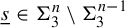 $\underline {s}\in \Sigma ^n_3\setminus \Sigma ^{n-1}_3$
to avoid confusion. Since
 $\xi _{\underline {s}}$
is landing at
 $\zeta _{\underline {s}}^\infty $
for any
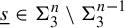 $\underline {s}\in \Sigma ^n_3\setminus \Sigma ^{n-1}_3$
, we define all the other pieces of
 $\Gamma $
, say
 $\overline {\xi _{\underline {s}}}$
, by
 $$ \begin{align}\xi_{\underline{s}}=f_{\alpha, \underline{s}_n}^{-n}(\xi_{\overline{xy}})\subseteq \mathbb{C}\setminus \Omega_0.\end{align} $$
Lemma 5.3. For any
 $n\geq 1$
, let
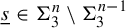 $\underline {s}\in \Sigma ^n_3\setminus \Sigma ^{n-1}_3$
. Then, there is a
 $\delta _2>0$
such that
 $$ \begin{align*}\overline{\xi_{\underline{s}}}\subseteq\mathbb{C}\setminus \overline{U(0,\alpha+\delta_2)}.\end{align*} $$
In particular, the Euclid length of
 $\overline {\xi _{\underline {s}}}$
converges to zero uniformly as
 $n\rightarrow \infty $
.
Proof. The strategy of the proof is similar as the proof in Lemma 5.2. Note that
 $$ \begin{align*}\overline{U(0,\alpha)}=\Omega_0\cup\Big(\bigcup o_k\Big)\cup\Big(\bigcup Q_k\Big).\end{align*} $$
First, we have known from (5.4) that
 $$ \begin{align}\overline{\xi_{\underline{s}}}\cap\Omega_0=\emptyset.\end{align} $$
Second, since
 $f_\alpha (\overline {\xi _{\underline {s}}})=\overline {\xi _{\sigma (\underline {s})}}$
and
 $f_\alpha (o_k)=0$
for
 $k=0,1,2$
, it follows by (5.4) again that
 $$ \begin{align}\overline{\xi_{\underline{s}}}\cap\Big(\bigcup o_k\Big)=\emptyset.\end{align} $$
Finally, to show that
 $$ \begin{align}\overline{\xi_{\underline{s}}}\cap\Big(\bigcup Q_k\Big)=\emptyset\end{align} $$
holds, we divide the proof into two cases.
Case 1: Suppose
 $n=1$
and
 $\underline {s}=s_1\overline {xy}\in \Sigma ^1_3\setminus \Sigma ^{0}_3$
. Since by the mapping properties of
 $f_\alpha $
we have
 $J_{0_2}\subseteq \overline {X_0}\subseteq \overline {Y_0}$
and
 $f_\alpha (\overline {X_0})=\overline {Y_0}$
(see Figure 8), it follows that
 $\overline {\xi _{\overline {0}}}\subseteq \overline {X_0}$
. Then, according to (5.2), we get
 $$ \begin{align*}\overline{\xi_{\overline{xy}}}\subseteq \overline{X_k}\subseteq \overline{Y_l}\end{align*} $$
for some
 $k,l=0,1,2$
. By noting that
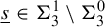 $\underline {s}\in \Sigma ^1_3\setminus \Sigma ^{0}_3$
, this implies that
 $\overline {\xi _{\underline {s}}}\subseteq \overline {X^{\prime }_l}$
. Since
 ${\overline {X^{\prime }_l}\cap (\bigcup Q_k)=\emptyset }$
, we get that (5.7) holds for the case
 $n=1$
.
Case 2: Suppose
 $n>1$
. Then, Lemma 3.3 implies that to prove (5.7), it suffices to prove
 $$ \begin{align}\overline{\xi_{\sigma(\underline{s})}}\cap E_{\pi/6}=\emptyset.\end{align} $$
Now, let us prove (5.8) by contradiction. Assume there is a point
 $z_0\in \overline {\xi _{\sigma (\underline {s})}}\cap E_{\pi /6}$
. Then, on one hand, by Lemma 3.2, there is an
 $l\geq 0$
such that
 $$ \begin{align}\{z_0,f_\alpha(z_0),\ldots, f_\alpha^l(z_0)\}\subseteq E_{\pi/6} \quad \text{and} \quad \{f_\alpha^{l+1}(z_0),f_\alpha^{l+2}(z_0),\ldots\}\subseteq A_{2\alpha}.\end{align} $$
On the other hand, by Case 1, we also have
 $$ \begin{align*}f_\alpha^{n-2}(z_0)\in \overline{\xi_{\sigma^{n-1}(\underline{s})}}\subseteq\overline{X^{\prime}_k}\end{align*} $$
for some
 $k=0,1,2$
. Since
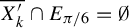 $\overline {X^{\prime }_k}\cap E_{\pi /6}=\emptyset $
, (5.9) implies that
 $$ \begin{align}\{f_\alpha^{n-2}(z_0),f_\alpha^{n-1}(z_0),\ldots\}\subseteq A_{2\alpha}.\end{align} $$
Note that
 $f_\alpha ^{n-1}(z_0)\in \overline {\xi _{\sigma ^{n}(\underline {s})}}=\overline {\xi _{\overline {xy}}}$
and
 $\zeta ^{\infty }_{\overline {xy}}=f^2_{\alpha }(\zeta ^{\infty }_{\overline {xy}})\notin A_{2\alpha }$
by Lemma 3.2. It follows that
 $f_\alpha ^{n-1}(z_0)\in \xi _{\overline {xy}}.$
By the construction (5.2) and Lemma 2.1, we can get that
 $$ \begin{align*}f_\alpha^{n-1+m}(z_0)\in \bigcup_{k=0}^2 \omega^k(\overline{J_{0_2}\cup J_{0_2}^*})\subseteq U(0,\alpha)\end{align*} $$
for some
 $m\geq 0$
. This contradicts with (5.10). Hence, the proof of (5.8) and (5.7) is finished.
Combining with (5.5)–(5.7), it follows that
 $$ \begin{align*}\overline{\xi_{\underline{s}}}\cap\overline{U(0,\alpha)}=\emptyset.\end{align*} $$
Since the set
 $\overline {\xi _{\underline {s}}}$
is closed, the first assertion of the lemma holds. The second assertion holds by a similar argument as the proof of Lemma 4.4.
For
 $n\geq 0$
, let
 $$ \begin{align*} \Gamma_n=\{\overline{\xi_{\underline{s}}}\setminus \zeta_{\underline{s}}^\infty: \text{if } n=0,\text{ then } \underline{s}\in \Sigma^0_3\text{ and if } n\geq1,\text{ then } \underline{s}\in \Sigma^n_3\setminus \Sigma^{n-1}_3\}. \end{align*} $$
Then, the desired Jordan curve mentioned above is defined by
 $$ \begin{align*}\Gamma:=\overline{\bigcup_{n\geq0} \Gamma_n}.\end{align*} $$
Lemma 5.4. We have
 $\Gamma =(\bigcup \Gamma _n)\sqcup S^\infty $
.
Proof. Let
 $\Gamma ^\infty =\Gamma \setminus (\bigcup \Gamma _n)$
. It suffices to prove that
 $\Gamma ^\infty =S^\infty .$
Set
 $$ \begin{align*}R^{\infty}=\overline{\bigcup f_{\alpha,\underline{s}_n}^{-n}(\zeta^{\infty}_{\overline{xy}})},\end{align*} $$
where the union is taken over all
 $n\geq 0$
and all
 $\underline {s}=\underline {s}_n \overline {xy}\in \Sigma ^n_3\setminus \Sigma ^{n-1}_3$
. By Lemma 4.10, we get that
 $$ \begin{align*}R^\infty=\{\zeta^{\infty}_{\underline{t}}:\text{ for any } \underline{t}\in\Sigma^\infty_3\}=S^\infty.\end{align*} $$
Now, we prove that
 $\Gamma ^\infty =R^{\infty }.$
On one hand, for
 $z\in \Gamma ^{\infty }$
, there is a sequence
 ${z_n\in \bigcup \Gamma _n}$
such that
 $z_n\rightarrow z$
. Suppose that
 $z_n$
belongs to
 $\xi _{\underline {s_n}}$
for some
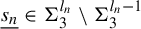 $\underline {s_n}\in \Sigma ^{l_n}_3\setminus \Sigma ^{l_n-1}_3$
with
 $l_n>0$
. If there is a subsequence of n, say
 $n_k$
, such that
 $l_{n_k}\rightarrow \infty $
as
 $n\rightarrow \infty $
, then by Lemma 5.3, we get that
 $z_{n_k}\rightarrow z$
is equivalent to
 $\zeta ^{\infty }_{\underline {s_{n_k}}}\rightarrow z$
. This means
 $z\in R^{\infty }$
. Otherwise, if the sequence
 $l_{n}$
is bounded, then there is a subsequence of n, say
 $n_k$
, such that
 $\underline {s_{n_k}}=\underline {s_{n_1}}$
for all
 $k\geq 1$
. By the definition of
 $\Gamma ^\infty $
, this implies that
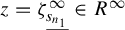 $z=\zeta ^{\infty }_{\underline {s_{n_1}}}\in R^{\infty }$
. In all, we get that
 ${\Gamma ^{\infty }\subseteq R^{\infty }}$
. On the other hand, it is obvious that
 $R^{\infty }\subseteq \Gamma $
. Since
 $R^{\infty }\cap E(f_\alpha )=\emptyset $
while
 $\bigcup \Gamma _n\subseteq E(f_\alpha )$
by Lemma 6.1, it follows that
 $R^{\infty }\subseteq \Gamma ^{\infty }$
. The proof of the lemma is finished.
Let
 $\mathbb {S}$
denote the unit circle. Before we construct a homeomorphism H from
 $\mathbb {S}$
to
 $\Gamma $
, let us first make some preparations. For
 $\underline {s},\underline {t}\in \Sigma _3^\infty $
with
 $\underline {s}=s_1s_2\cdots $
and
 $\underline {t}=t_1t_2\cdots $
, let
 $j>0$
be the smallest integer such that
 $s_j\neq t_j$
. Then, we say
 $\underline {s}\lhd \underline {t}$
if
 $s_j<t_j$
for
 $s_{j-1}=t_{j-1}\neq 1$
or
 $s_j>t_j$
for
 $s_{j-1}=t_{j-1}=1$
(note that in the case
 $j=1$
, we set
 $s_0=t_0=\emptyset \neq 1$
). Recall that
 $\Sigma ^n_3$
is defined in (5.3). For
 $\underline {s^{\prime }}(n),\underline {s^{\prime \prime }}(n)\in \Sigma ^n_3$
(respectively
 $\Sigma ^\infty _3$
), we say
 $\{\underline {s^{\prime }}(n)\lhd \underline {s^{\prime \prime }}(n)\}_{\Sigma ^n_3}$
(respectively
 $\{\underline {s^{\prime }}(n)\lhd \underline {s^{\prime \prime }}(n)\}_{\Sigma ^\infty _3}$
) if
 $\underline {s^{\prime }}(n)\lhd \underline {s^{\prime \prime }}(n)$
and for any
 $\underline {s}\in \Sigma ^n_3$
(respectively
 $\Sigma ^\infty _3$
), either
 $\underline {s}\lhd \underline {s^{\prime }}(n)$
or
 $ \underline {s^{\prime \prime }}(n)\lhd \underline {s}$
. Note that this notation can also be extended naturally to the application of several elements in
 $\Sigma _3^\infty $
.
Lemma 5.5. For any
 $n\geq 0$
, let
 $\underline {s^{\prime }}(n),\underline {s^{\prime \prime }}(n)\in \Sigma ^n_3$
with
 $\{\underline {s^{\prime }}(n)\lhd \underline {s^{\prime \prime }}(n)\}_{\Sigma ^n_3}$
. Suppose that
 $\underline {s^{\prime }}(n)=s_1^{\prime }s_2^{\prime }\cdots s_n^{\prime }\overline {x^{\prime }y^{\prime }}$
, and
 $\underline {s^{\prime \prime }}(n)=s_1^{\prime \prime }s_2^{\prime \prime }\cdots s_{n}^{\prime \prime }\overline {x^{\prime \prime }y^{\prime \prime }}$
(
 $\overline {x^{\prime }y^{\prime }}=s_{n+1}^{\prime }s_{n+2}^{\prime }\cdots $
and
 $\overline {x^{\prime \prime }y^{\prime \prime }}=s_{n+1}^{\prime \prime }s_{n+2}^{\prime \prime }\cdots $
). Let
 $l\in [0,n+1]$
be the largest integer such that
 $s_1^{\prime }s_2^{\prime }\cdots s_l^{\prime }=s_1^{\prime \prime }s_2^{\prime \prime }\cdots s_{l}^{\prime \prime }$
. Then, one of the following two statements holds.
-
(1) Suppose
$l\in [0,n]$
. Then, if
$l=0$
, we have
$\underline {s^{\prime }}(n),\underline {s^{\prime \prime }}(n)\in \Sigma ^0_3$
; and if
$l>0$
, we have
$\underline {s^{\prime }}(n),\underline {s^{\prime \prime }}(n)\in \Sigma ^l_3\setminus \Sigma ^{l-1}_3$
. Moreover,
$x^{\prime }\equiv x^{\prime \prime }-1\;(\mathrm {mod}\ 3)$
and
$y^{\prime }\equiv y^{\prime \prime }-1\;(\mathrm{mod}\ 3)$
. In addition,
$\{\underline {s^{\prime }}(n)\lhd \underline {s^{\prime \prime }}(n)\}_{\Sigma ^\infty _3}$
. -
(2) Suppose
$l=n+1$
. Then, if
$l=1$
, we have
$\underline {s^{\prime }}(n),\underline {s^{\prime \prime }}(n)\in \Sigma ^{0}_3$
; and if
$l>1$
, we have either
$\underline {s^{\prime }}(n)\in \Sigma ^{n-1}_3$
,
$\underline {s^{\prime \prime }}(n)\in \Sigma ^n_3\setminus \Sigma ^{n-1}_3$
or
$\underline {s^{\prime }}(n)\in \Sigma ^n_3\setminus \Sigma ^{n-1}_3$
,
$\underline {s^{\prime \prime }}(n)\in \Sigma ^{n-1}_3$
. Moreover,
$y^{\prime }\equiv y^{\prime \prime }-1\;(\mathrm {mod}\ 3)$
. In addition, there are exactly two elements
${\underline {t^{\prime }}(n+1)}$
,
$\underline {t^{\prime \prime }}(n+1)\in \Sigma ^{n+1}_3\setminus \Sigma ^n_3$
such that where
$$ \begin{align*}\{\underline{s^{\prime}}(n)\lhd\underline{t^{\prime}}(n+1)\lhd\underline{t^{\prime\prime}}(n+1)\lhd\underline{s^{\prime\prime}}(n)\}_{\Sigma^{n+1}_3},\end{align*} $$
$\underline {t^{\prime }}(n+1)=s_1s_2\cdots s_nx^{\prime }\overline {y^{\prime }z^{\prime }}$
with
$z^{\prime }\equiv x^{\prime }+1\;(\mathrm{mod}\ 3)$
and
$\underline {t^{\prime \prime }}(n+1)=s_1s_2\cdots s_nx^{\prime \prime }\overline {y^{\prime \prime }z^{\prime \prime }}$
with
$z^{\prime \prime }\equiv x^{\prime \prime }-1\;(\mathrm{mod}\ 3)$
.












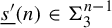






Proof. For the first assertion, let
 $\Sigma ^{n,k}_3$
,
 $k=0,1,2$
, be the subset of
 $\Sigma ^n_3$
with
 $s_1=k$
. Let
 $\underline {s}_{\min }^k(n)\in \Sigma ^{n,k}_3$
be the element such that
 $\underline {s}_{\min }^k(n)\lhd \underline {s}(n)$
for any
 $\underline {s}(n)\in \Sigma ^{n,k}_3$
and
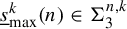 $\underline {s}_{\max }^k(n)\in \Sigma ^{n,k}_3$
be the element such that
 $\underline {s}(n)\lhd \underline {s}_{\max }^k(n)$
for any
 $\underline {s}(n)\in \Sigma ^{n,k}_3$
. Since
 $0\leq l\leq n$
, we claim that
 $$ \begin{align} \underline{s}^{\prime}(n)=s_1^{\prime}s_2^{\prime}\cdots s_{l}^{\prime}\underline{s}^{s_{l+1}^{\prime}}_{\max}(n-l)\quad \text{and} \quad\underline{s}^{\prime\prime}(n)=s_1^{\prime\prime}s_2^{\prime\prime}\cdots s_{l}^{\prime\prime}\underline{s}^{s_{l+1}^{\prime\prime}}_{\min}(n-l). \end{align} $$
In fact, only if the form of
 $\underline {s}^{\prime }(n)$
and
 $\underline {s}^{\prime \prime }(n)$
are defined by (5.11), we have
 $\{\underline {s^{\prime }}(n)\lhd \underline {s^{\prime \prime }}(n)\}_{\Sigma ^n_3}$
(this can be checked easily by contradiction; we leave the proof to the readers). However, for any
 $m\geq 0$
,
 $$ \begin{align*}\underline{s}_{\max}^0(m)=\overline{01},\quad\underline{s}_{\max}^1(m)=\overline{10},\quad\underline{s}_{\max}^2(m)=\overline{2}\end{align*} $$
and
 $$ \begin{align*}\underline{s}_{\min}^0(m)=\overline{0},\quad\underline{s}_{\min}^1(m)=\overline{12},\quad\underline{s}_{\min}^2(m)=\overline{21}.\end{align*} $$
This, combined with (5.11), proves
 $\underline {s^{\prime }}(n),\underline {s^{\prime \prime }}(n)\in \Sigma ^l_3$
.
Then, we divide the proof of the first assertion into two cases.
Case 1: Suppose
 $l=0$
. Then,
 $\underline {s^{\prime }}(n),\underline {s^{\prime \prime }}(n)\in \Sigma ^0_3$
. Since
 $\Sigma ^0_3=\{\overline {0},\overline {12},\overline {21},\overline {2},\overline {01},\overline {10}\}$
, the relationship
 $\{\underline {s^{\prime }}(n)\lhd \underline {s^{\prime \prime }}(n)\}_{\Sigma ^n_3}$
is equivalent to:
-
(a)
$\underline {s^{\prime }}(n)=\overline {01}$
and
$\underline {s^{\prime \prime }}(n)=\overline {12}$
; or -
(b)
$\underline {s^{\prime }}(n)=\overline {10}$
and
$\underline {s^{\prime }}(n)=\overline {21}$
.


In both cases, these imply that
 $x^{\prime }\equiv x^{\prime \prime }-1\;(\text {mod } 3)$
,
 $y^{\prime }\equiv y^{\prime \prime }-1\;(\text {mod } 3)$
, and that
 $\{\underline {s^{\prime }}(n)\lhd \underline {s^{\prime \prime }}(n)\}_{\Sigma ^\infty _3}$
.
Case 2: Suppose
 $l\in [1,n]$
. For the rest of the proof, we need the following claim:
 $$ \begin{align} \text{if } l>0,\text{ then } \underline{s^{\prime}}(n)\lhd\underline{s^{\prime\prime}}(n)\text{ is equivalent to } s_{l+1}^{\prime}\equiv s_{l+1}^{\prime\prime}-1\;(\text{mod } 3). \end{align} $$
In fact,
 $\underline {s^{\prime }}(n)\lhd \underline {s^{\prime \prime }}(n)$
only consists of the following three cases: if
 $s_l^{\prime }=s_l^{\prime \prime }=0$
, then
 $s_{l+1}^{\prime }=0$
and
 $s_{l+1}^{\prime \prime }=1$
; if
 $s_l^{\prime }=s_l^{\prime \prime }=1$
, then
 $s_{l+1}^{\prime }=2$
and
 $s_{l+1}^{\prime \prime }=0$
; otherwise, if
 $s_l^{\prime }=s_l^{\prime \prime }=2$
, then
 $s_{l+1}^{\prime }=1$
and
 $s_{l+1}^{\prime \prime }=2$
. In all, we have
 $s_{l+1}^{\prime }\equiv s_{l+1}^{\prime \prime }-1\;(\text {mod } 3)$
.
Since
 $\{\underline {s^{\prime }}(n)\lhd \underline {s^{\prime \prime }}(n)\}_{\Sigma ^l_3}$
, it follows from (5.12) that the following hold.
-
(a) If
$s^{\prime }_{l}=0$
, then
$s^{\prime }_{l+1}=0$
and
$s^{\prime \prime }_{l+1}=1$
. Therefore,
$\underline {s}^{s_{l+1}^{\prime }}_{\max }(n-l)=\overline {01}$
and
$\underline {s}^{s_{l+1}^{\prime \prime }}_{\min } (n-l)=\overline {12}$
. -
(b) If
$s^{\prime }_{l}{\kern-1pt}={\kern-1pt}1$
, then
$s^{\prime }_{l+1}{\kern-1pt}={\kern-1pt}2$
and
$s^{\prime \prime }_{l+1}{\kern-1pt}={\kern-1pt}0$
. Therefore,
$\underline {s}^{s_{l+1}^{\prime }}_{\max }(n{\kern-1pt}-{\kern-1pt}l){\kern-1pt}={\kern-1pt}\overline {2}$
and
$\underline {s}^{s_{l+1}^{\prime \prime }}_{\min }(n{\kern-1pt}-{\kern-1pt}l)=\overline {0}$
. -
(c) If
$s^{\prime }_{l}=2$
, then
$s^{\prime }_{l+1}=1$
and
$s^{\prime \prime }_{l+1}=2$
. Therefore,
$\underline {s}^{s_{l+1}^{\prime }}_{\max }(n-l)=\overline {10}$
and
$\underline {s}^{s_{l+1}^{\prime \prime }}_{\min } (n-l)=\overline {21}$
.


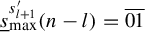
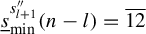


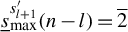
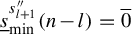


In all cases, these imply that
 $\underline {s^{\prime }}(n),\underline {s^{\prime \prime }}(n)\in \Sigma ^l_3\setminus \Sigma ^{l-1}_3$
, and moreover,
 $x^{\prime }\equiv x^{\prime \prime }-1\;(\text {mod } 3)$
and
 $y^{\prime }\equiv y^{\prime \prime }-1\;(\text {mod } 3)$
. In addition, since we have shown above that
 $\underline {s}_{\max }^k(m)$
and
 $\underline {s}_{\min }^k(m)$
are independent of m for any
 $m\geq 0$
, it follows that
 $\{\underline {s^{\prime }}(n)\lhd \underline {s^{\prime \prime }}(n)\}_{\Sigma ^\infty _3}$
.
For the second assertion,
 $\underline {s^{\prime }}(n),\underline {s^{\prime \prime }}(n)\in \Sigma ^{0}_3$
is obvious if
 $l=1$
. For the case where
 $l>1$
, let us prove that either
 $\underline {s^{\prime }}(n)\in \Sigma ^{n-1}_3$
,
 $\underline {s^{\prime \prime }}(n)\in \Sigma ^n_3\setminus \Sigma ^{n-1}_3$
or
 $\underline {s^{\prime }}(n)\in \Sigma ^n_3\setminus \Sigma ^{n-1}_3$
,
 $\underline {s^{\prime \prime }}(n)\in \Sigma ^{n-1}_3$
by contradiction. On one hand, we assume that
 $\underline {s^{\prime }}(n),\underline {s^{\prime \prime }}(n)\in \Sigma ^{n-1}_3$
. Since
 $l=n+1$
, this implies that
 $\underline {s^{\prime }}(n)=\underline {s^{\prime \prime }}(n)$
. This contradicts to
 $\{\underline {s^{\prime }}(n)\lhd \underline {s^{\prime \prime }}(n)\}_{\Sigma ^n_3}$
. On the other hand, we assume that
 $\underline {s^{\prime }}(n),\underline {s^{\prime \prime }}(n)\in \Sigma ^{n}_3\setminus \Sigma ^{n-1}_3$
. It follows from
 $l=n+1$
that
 $s_{n}^{\prime }=s_{n}^{\prime \prime }$
,
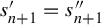 $s_{n+1}^{\prime }=s_{n+1}^{\prime \prime }$
, and
 $s_{n+2}^{\prime }\neq s_{n+2}^{\prime \prime }$
. To get a contradiction, it suffices to prove that
 $s_n^{\prime }=s_{n+2}^{\prime }$
or
 $s_n^{\prime \prime }=s_{n+2}^{\prime \prime }$
. In fact, if
 $s_n^{\prime }\neq s_{n+2}^{\prime }$
and
 $s_n^{\prime \prime }\neq s_{n+2}^{\prime \prime }$
, then
 $s_n^{\prime }$
,
 $s_{n+2}^{\prime }$
, and
 $s_{n+2}^{\prime \prime }$
will be three different integers. However,
 $s_{n+1}^{\prime }+s_{n}^{\prime }\neq 2$
,
 $s_{n+1}^{\prime }+s_{n+2}^{\prime }\neq 2$
, and
 $s_{n+1}^{\prime }+s_{n+2}^{\prime \prime }\neq 2$
, which is a contradiction.
Moreover, the claim (5.12) shows that
 $y^{\prime }\equiv y^{\prime \prime }-1\;(\text {mod } 3)$
. In addition, since
 ${\underline {t^{\prime }}(n{\kern-1pt}+{\kern-1pt}1){\kern-1pt}={\kern-1pt}s_1s_2\cdots s_nx^{\prime }\overline {y^{\prime }z^{\prime }}}$
with
 $z^{\prime }{\kern-1pt}\equiv{\kern-1pt} x^{\prime }+1\;(\text {mod } 3)$
and
 $\underline {t^{\prime \prime }}(n+1){\kern-1pt}={\kern-1pt}s_1s_2\cdots s_nx^{\prime \prime }\overline {y^{\prime \prime }z^{\prime \prime }}$
with
 $z^{\prime \prime }\equiv x^{\prime \prime }-1\;(\text {mod } 3)$
, this implies
 $\underline {t^{\prime }}(n+1),\underline {t^{\prime \prime }}(n+1)\in \Sigma ^{n+1}_3\setminus \Sigma ^n_3$
. Meanwhile, the claim (5.12) also shows that
 $$ \begin{align*}\underline{s^{\prime}}(n)\lhd\underline{t^{\prime}}(n+1)\lhd\underline{t^{\prime\prime}}(n+1)\lhd\underline{s^{\prime\prime}}(n).\end{align*} $$
However, since the first
 $(n+1)$
numbers of these admissible blocks are the same, there are only four elements in
 $\Sigma ^{n+1}_3$
with this property. Hence,
 $$ \begin{align*}\{\underline{s^{\prime}}(n)\lhd\underline{t^{\prime}}(n+1)\lhd\underline{t^{\prime\prime}}(n+1)\lhd\underline{s^{\prime\prime}}(n)\}_{\Sigma^{n+1}_3}.\\[-39pt] \end{align*} $$
Lemma 5.6. The set
 $\Gamma $
is a Jordan curve.
The construction of the homeomorphism H.

Proof. First of all, we would like to mention that the notation in Lemma 5.5 will be used without extra explanation in this proof.
Part I: divide
 $\mathbb {S}$
into several pieces inductively to match all the pieces of
 $\Gamma $
(see Figure 9 for a sketch). Specifically, we will define
 $\unicode{x3bb} _{\underline {s}}$
for any
 $\underline {s}\in \bigcup _{k\geq 0}\Sigma ^k_3$
inductively. For the case where
 $k=0$
, we first define
 $\unicode{x3bb} _{\underline {s}(0)}$
for any
 $\underline {s}(0)\in \Sigma ^0_3$
. Set

Similarly to (5.2), we set

Note that
 $\Sigma ^0_3=\{\overline {0},\overline {12},\overline {21},\overline {2},\overline {01},\overline {10}\}$
and for any
 $\underline {s^{\prime }}(0), \underline {s^{\prime \prime }}(0)\in \Sigma ^0_3$
with
 $\{\underline {s^{\prime }}(0)\lhd \underline {s^{\prime \prime }}(0)\}_{\Sigma ^0_3}$
, one of the following statements holds:
-
• if
$l=0$
, then
$\unicode{x3bb} _{\underline {s^{\prime }}(0)}$
and
$\unicode{x3bb} _{\underline {s^{\prime \prime }}(0)}$
have a common endpoint; -
• if
$l=1$
, then
$\unicode{x3bb} _{\underline {s^{\prime }}(0)}\cap \unicode{x3bb} _{\underline {s^{\prime \prime }}(0)}=\emptyset $
.


For the case where
 $k=n\geq 0$
, suppose that
 $\unicode{x3bb} _{\underline {s}(n)}$
has been defined for any
 $\underline {s}(n)\in \Sigma ^n_3$
with the property that for any
 $\underline {s^{\prime }}(n), \underline {s^{\prime \prime }}(n)\in \Sigma ^n_3$
with
 $\{\underline {s^{\prime }}(n)\lhd \underline {s^{\prime \prime }}(n)\}_{\Sigma ^n_3}$
, one of the following statements holds:
-
• if
$l\in [0,n]$
, then
$\unicode{x3bb} _{\underline {s^{\prime }}(n)}$
and
$\unicode{x3bb} _{\underline {s^{\prime \prime }}(n)}$
have a common endpoint; -
• if
$l=n+1$
, then
$\unicode{x3bb} _{\underline {s^{\prime }}(n)}\cap \unicode{x3bb} _{\underline {s^{\prime \prime }}(n)}=\emptyset $
.


Then, for the case where
 $k=n+1$
, we define
 $\unicode{x3bb} _{\underline {s}(n+1)}$
for any
 $\underline {s}(n+1)\in \Sigma ^{n+1}_3$
as follows. Note that
 $\Sigma ^{n}_3\subset \Sigma ^{n+1}_3$
for any
 $n\geq 0$
. The argument is divided into two cases.
Case A: Suppose
 $l\in [0,n]$
. It follows from Lemma 5.5 that
 $\{\underline {s^{\prime }}(n)\lhd \underline {s^{\prime \prime }}(n)\}_{\Sigma ^\infty _3}$
. In particular,
 $\{\underline {s^{\prime }}(n)\lhd \underline {s^{\prime \prime }}(n)\}_{\Sigma ^{n+1}_3}$
. Set
 $\underline {s^{\prime }}(n+1)=\underline {s^{\prime }}(n)$
and
 $\underline {s^{\prime \prime }}(n+1)=\underline {s^{\prime \prime }}(n)$
. Then
 $\{\underline {s^{\prime }}(n+1)\lhd \underline {s^{\prime \prime }}(n+1)\}_{\Sigma ^{n+1}_3}$
. Define

Case B: Suppose
 $l=n+1$
. It follows from Lemma 5.5 that there are exactly two elements
 $\underline {t^{\prime }}(n+1),\underline {t^{\prime \prime }}(n+1)\in \Sigma ^{n+1}_3\setminus \Sigma ^n_3$
such that
 $$ \begin{align*}\{\underline{s^{\prime}}(n)\lhd\underline{t^{\prime}}(n+1)\lhd\underline{t^{\prime\prime}}(n+1)\lhd\underline{s^{\prime\prime}}(n)\}_{\Sigma^{n+1}_3}.\end{align*} $$
We first define
 $\unicode{x3bb} _{\underline {s^{\prime }}(n+1)}$
and
 $\unicode{x3bb} _{\underline {s^{\prime \prime }}(n+1)}$
as (5.13). Then, we define
 $\unicode{x3bb} _{\underline {t^{\prime }}(n+1)}$
and
 $\unicode{x3bb} _{\underline {t^{\prime \prime }}(n+1)}$
as follows. Since
 $\unicode{x3bb} _{\underline {s^{\prime }}(n+1)}\cap \unicode{x3bb} _{\underline {s^{\prime \prime }}(n+1)}=\emptyset $
, we divide the middle one-third of the shorter component between
 $\unicode{x3bb} _{\underline {s^{\prime }}(n+1)}$
and
 $\unicode{x3bb} _{\underline {s^{\prime \prime }}(n+1)}$
into two parts with the same length. One part of it is defined to be
 $\unicode{x3bb} _{\underline {t^{\prime }}(n+1)}$
and the other part is defined to be
 $\unicode{x3bb} _{\underline {t^{\prime \prime }}(n+1)}$
such that
 $\unicode{x3bb} _{\underline {s^{\prime }}(n)},\unicode{x3bb} _{\underline {t}^{\prime }(n+1)},\unicode{x3bb} _{\underline {t}^{\prime \prime }(n+1)},\unicode{x3bb} _{\underline {s^{\prime \prime }}(n)}$
are ordered in the counter-clockwise direction in
 $\mathbb {S}$
.
Now, let us check that for any
 $\underline {s^{\prime }}(n+1), \underline {s^{\prime \prime }}(n+1)\in \Sigma ^{n+1}_3$
with
 $\{\underline {s^{\prime }}(n+1)\lhd \underline {s^{\prime \prime }}(n+1)\}_{\Sigma ^{n+1}_3}$
, one of the following statements holds:
-
• if
$l\in [0,n+1]$
, then
$\unicode{x3bb} _{\underline {s^{\prime }}(n+1)}$
and
$\unicode{x3bb} _{\underline {s^{\prime \prime }}(n+1)}$
have a common endpoint; -
• if
$l=n+2$
, then
$\unicode{x3bb} _{\underline {s^{\prime }}(n+1)}\cap \unicode{x3bb} _{\underline {s^{\prime \prime }}(n+1)}=\emptyset $
.


On one hand, suppose
 $l\in [0,n+1]$
. According to Lemma 5.5, if
 $l\in [0,n]$
, it corresponds to
 $\{\underline {s^{\prime }}(n+1)\lhd \underline {s^{\prime \prime }}(n+1)\}_{\Sigma ^{n+1}_3}$
in Case A; otherwise, if
 $l=n+1$
, it corresponds to
 $\{\underline {t^{\prime }}(n+1)\lhd \underline {t^{\prime \prime }}(n+1)\}_{\Sigma ^{n+1}_3}$
in Case B. In both cases, they have a common endpoint by the construction. On the other hand, suppose
 $l=n+2$
. According to Lemma 5.5, it corresponds to
 $\{\underline {s^{\prime }}(n+1)\lhd \underline {t^{\prime }}(n+1)\}_{\Sigma ^{n+1}_3}$
in Case A and
 $\{\underline {t^{\prime \prime }}(n+1)\lhd \underline {s^{\prime \prime }}(n+1)\}_{\Sigma ^{n+1}_3}$
in Case B. In both cases, the intersections of them are empty. This finishes the definition of
 $\unicode{x3bb} _{\underline {s}}$
for all
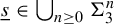 $\underline {s}\in \bigcup _{n\geq 0}\Sigma ^n_3$
. Note that according to Lemma 5.5, the above construction makes the order ‘
 $\lhd $
’ of
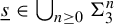 $\underline {s}\in \bigcup _{n\geq 0}\Sigma ^n_3$
correspond to the anticlockwise order of
 $\unicode{x3bb} _{\underline {s}}\in \mathbb {S}$
. See Figure 9 for a sketch.
In addition, for
 $n\geq 0$
, let

Note that the above sets are mutually disjoint and dense in
 $\mathbb {S}$
, and hence, induces a partition of
 $\mathbb {S}$
. In fact, for a set
 $A\subseteq \mathbb {S}$
, denote by
 $\mathrm {Length}(A)$
the Euclidean length of A. Note that
 $\mathrm {Length}(\Lambda _0)=\pi $
and
 $\mathrm {Length}(\Lambda _1)=\pi /3$
. Moreover, we have
 $$ \begin{align*}\mathrm{Length}(\Lambda_{n+1})=2\cdot \mathrm{Length}(\Lambda_{n})/3\end{align*} $$
for any
 $n\geq 1$
, since the components of
 $\Lambda _{n+1}$
are twice the number of components of
 $\Lambda _n$
, while each component of
 $\Lambda _{n+1}$
is one-third the length of a component of
 $\Lambda _n$
. Hence, it follows that
 $$ \begin{align*} \sum_{n=0}^\infty \mathrm{Length}(\Lambda_{n})=\pi+\pi/3+2\pi/9+4\pi/27+\cdots=2\pi. \end{align*} $$
Part II: the construction of the homeomorphism H. For any
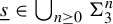 $\underline {s}\in \bigcup _{n\geq 0}\Sigma ^n_3$
, define H from
 $\unicode{x3bb} _{\underline {s}}$
to
 $\overline {\xi _{\underline {s}}}$
to be a homeomorphism such that by choosing a suitable orientation, H becomes a homeomorphism from
 $\bigcup _{n\geq 0}\Lambda _{n}$
to
 $\bigcup _{n\geq 0}\overline {\Gamma _n}$
. It is worth pointing out that we have only proved that H is continuous on one side of every endpoint of
 $\bigcup _{n\geq 0}\Lambda _n$
. The continuity of H on the other side of these points can be derived by a similar argument as points in
 $\mathbb {S}\setminus \big(\bigcup _{n\geq 0}\Lambda _{n}\big)$
(see the last paragraph of the proof).
Let
 $z\in \mathbb {S}\setminus \big(\bigcup _{n\geq 0}\Lambda _{n}\big)$
. We claim that z corresponds to a unique
 $\underline {s}=s_1s_2\cdots $
with
 $\underline {s}\in \Sigma _3^\infty \setminus \big(\bigcup _{n\geq 0}\Sigma ^n_3\big)$
such that

On one hand, since the set
 $\bigcup _{n\geq 0}\Lambda _n$
is dense in
 $\mathbb {S}$
, it follows from the construction of
 $\bigcup _{n\geq 0}\Lambda _{n}$
that
 $z=\lim_{n\rightarrow \infty }\unicode{x3bb} _{\underline {s_n}}$
, where
 $\underline {s_n}\in \Sigma ^{n}_3$
is unique with

Note that the uniqueness of
 $\underline {s_n}$
is guaranteed by the construction of
 $\bigcup _{n\geq 0}\Lambda _{n}$
where the point z can never belong to the middle one-third of the shorter component between two adjacent arcs
 $\unicode{x3bb} _{\underline {s^{\prime }}(n)},\unicode{x3bb} _{\underline {s^{\prime \prime }}(n)}$
with
 $\{\underline {s^{\prime }}(n)\lhd \underline {s^{\prime \prime }}(n)\}_{\Sigma ^{n}_3}$
. Furthermore, it follows from (5.15) that for
 $n\geq 1$
, we can get either
 $\underline {s_n}=\underline {s_{n-1}}$
or
 $$ \begin{align} \underline{s_{n-1}}\in\Sigma^{n-1}_3,{\quad} \underline{s_n}\in\Sigma^{n}_3\setminus\Sigma^{n-1}_3\quad \text{and}\quad\{\underline{s_{n-1}}\lhd\underline{s_n}\}_{\Sigma^{n}_3}\;(\text{or } \;\{\underline{s_n}\lhd\underline{s_{n-1}}\}_{\Sigma^{n}_3}). \end{align} $$
If
 $\underline {s_n}=\underline {s_{n-1}}$
, it is obvious that we can take
 $\underline {s}(n-1 )=\underline {s_{n-1}}$
and
 $\underline {s}(n)=\underline {s_n}$
. Otherwise, if (5.16) holds, it follows from Lemma 5.5 that
 $l=n+1$
. This also means that we can take
 $\underline {s}(n-1 )=\underline {s_{n-1}}$
and
 $\underline {s}(n)=\underline {s_n}$
. In both cases, these allow us to define
 $\underline {s}=s_1s_2\cdots $
with
 $\underline {s}(n)=s_1s_2\cdots s_n\overline {s_{n+1}s_{n+2}}$
. In addition, the uniformity of the convergence is guaranteed by (5.15) and the construction of
 $\bigcup _{n\geq 0}\Lambda _{n}$
. This proves (5.14).
On the other hand, before we prove that
 $\underline {s}$
is unique, we first prove that if
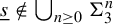 $\underline {s}\notin \bigcup _{n\geq 0}\Sigma ^n_3$
, there is a subsequence
 $m_j>0$
with
 $m_j\rightarrow \infty $
as
 $j\rightarrow \infty $
such that for any
 $i>0$
, we have
 $$ \begin{align}\underline{s}(m_j)\lhd\cdots\lhd\underline{s}(m_{j+2i})\lhd\cdots\lhd\underline{s}\lhd\cdots\lhd\underline{s}(m_{j+2i+1})\lhd\cdots\lhd\underline{s}(m_{j+1}).\end{align} $$
For otherwise, we would get, without loss of generality, that
 $$ \begin{align*} \underline{s}(m-1)\lhd\underline{s}(m)\quad \text{or}\quad\underline{s}(m-1)=\underline{s}(m)\end{align*} $$
for any
 $m>0$
large enough. By (5.12), this implies that
 $$ \begin{align} s_{m}\equiv s_{m+2}-1\;(\text{mod } 3)\quad \text{or} \quad s_{m}=s_{m+2} \end{align} $$
for any
 $m>0$
large enough. Suppose
 $s_{m_0}\equiv s_{m_0+2}-1\;(\text {mod } 3)$
for some
 $m_0>0$
large enough. Since
 $s_{m_0+1}+s_{m_0+2}\not \equiv 2\;(\text {mod } 3)$
, we can get that
 $s_{m_0}+s_{m_0+1}\not \equiv 1\;(\text {mod } 3)$
. Then, it follows from
 $s_{m_0}+s_{m_0+1}\not \equiv 2\;(\text {mod } 3)$
that
 $s_{m_0}+s_{m_0+1}\equiv 0\;(\text {mod } 3)$
. Therefore,
 $$ \begin{align} s_{m_0+1}\equiv- s_{m_0}\equiv 1-s_{m_0+2}\;(\text{mod } 3). \end{align} $$
Since
 $s_{m_0+2}+s_{m_0+3}\not \equiv 2\;(\text {mod } 3)$
, we get from (5.19) that
 $$ \begin{align*}s_{m_0+1}\not\equiv s_{m_0+3}-1\;(\text{mod } 3).\end{align*} $$
Hence, according to (5.18), we obtain that
 $$ \begin{align}s_{m_0+1}=s_{m_0+3}.\end{align} $$
In general, suppose that (5.19) and (5.20) hold if we replace
 $m_0$
by
 $m(\geq m_0)$
. Then, we will show that (5.19) and (5.20) also hold if we replace
 $m_0$
by
 $m+1$
. On one hand, combining with (5.19) and (5.20) by replacing
 $m_0$
with m, we get
 $$ \begin{align} s_{m+2}\equiv 1-s_{m+1}\equiv 1-s_{m+3}\;(\text{mod } 3). \end{align} $$
On the other hand, since
 $s_{m+3}+s_{m+4}\not \equiv 2\;(\text {mod } 3)$
, we get from (5.21) that
 $$ \begin{align*}s_{m+2}\not\equiv s_{m+4}-1\;(\text{mod } 3).\end{align*} $$
Then, according to (5.18), we obtain that
 $$ \begin{align}s_{m+2}=s_{m+4}.\end{align} $$
Therefore, it follows from (5.21) and (5.22) that
 $s_{m}=s_{m+2}$
holds inductively for all
 $m\geq m_0+1$
. This implies that
 $s_{m}\equiv s_{m+2}-1\;(\text {mod } 3)$
can happen at most once for
 $m>0$
large enough. According to (5.18), we have
 $s_{m}=s_{m+2}$
for any
 $m>0$
large enough. This means that
 $s_{m}s_{m+1}\cdots \in \Sigma ^0_3$
. That is,
 $\underline {s}\in \bigcup _{n\geq 0}\Sigma ^n_3$
, which is a contradiction. The proof of (5.17) is finished.
To prove
 $\underline {s}$
is unique, we assume by contradiction that the point z corresponds to
 $\underline {s}^1,\underline {s}^2\in \Sigma _3^\infty \setminus (\bigcup _{n\geq 0}\Sigma ^n_3)$
with
 $\underline {s^{1}}\neq \underline {s^{2}}$
, which both satisfy (5.14). For
 $k=1,2$
, set
 $\underline {s^{k}}=s_1^{k}s_2^{k}\cdots s_m^{k}\cdots $
. Without loss of generality, we assume that
 $\underline {s^{1}}\lhd \underline {s^{2}}$
. Suppose
 $l\geq 0$
is the largest integer such that
 $s_1^{1}s_2^{1}\cdots s_l^{1}=s_1^{2}s_2^{2}\cdots s_{l}^{2}$
. Combining with (5.17) and the construction of
 $\bigcup _{n\geq 0}\Lambda _{n}$
, we can get that z belongs to the shorter component between
 $\unicode{x3bb} _{\underline {s^k}(m_j^k)}$
and
 $\unicode{x3bb} _{\underline {s^{k}}(m_{j+1}^k)}$
for
 $m_j^k>l$
large enough. However, it follows from
 $\underline {s^{1}}\lhd \underline {s^{2}}$
that
 $$ \begin{align*}\underline{s^1}(m_j^1)\lhd \underline{s^1}(m_{j+1}^1)\lhd\underline{s^{2}}(m_j^2)\lhd \underline{s^{2}}(m_{j+1}^2).\end{align*} $$
Then, by the construction of
 $\bigcup _{n\geq 0}\Lambda _{n}$
, we get that
 $\unicode{x3bb} _{\underline {s^1}(m_j^1)}, \unicode{x3bb} _{\underline {s^1}(m_{j+1}^1)}, \unicode{x3bb} _{\underline {s^{2}}(m_j^2)}$
, and
 $\unicode{x3bb} _{\underline {s^{2}}(m_{j+1}^2)}$
lie in
 $\mathbb {S}$
with the anticlockwise order, which is a contradiction. The proof of the claim is finished.
By the claim, we define
 $$ \begin{align*} \begin{split} H:\mathbb{S}\setminus \bigg(\bigcup_{n\geq0}\Lambda_{n}\bigg)&\rightarrow \Gamma\setminus\bigg(\bigcup_{n\geq0}\overline{\Gamma_n}\bigg)\\ z \quad &\mapsto \quad \zeta^\infty_{\underline{s}}. \end{split} \end{align*} $$
The injectivity of H is guaranteed by (5.14). To prove H is surjective, by Lemma 4.10, it suffices to show that for any
 $\underline {s}\in \Sigma _3^\infty \setminus (\bigcup _{n\geq 0}\Sigma ^n_3)$
, there is a
 $z\in \mathbb {S}\setminus (\bigcup _{n\geq 0}\Lambda _{n})$
such that
 $H(z)=\zeta ^\infty _{\underline {s}}$
. By setting
 $\underline {s}=s_1s_2\cdots $
, it follows from the construction of
 $\bigcup _{n\geq 0}\Lambda _{n}$
that
 $\lim_{n\rightarrow \infty }\unicode{x3bb} _{\underline {s}(n)}$
is well defined, where
 $\underline {s}(n)=s_1s_2\cdots s_n\overline {s_{n+1}s_{n+2}}$
. Therefore, we define
 $z=\lim_{n\rightarrow \infty }\unicode{x3bb} _{\underline {s}(n)}$
and then
 $H(z)=\zeta ^\infty _{\underline {s}}$
. This proves that the map H is a bijection from
 $\mathbb {S}\setminus (\bigcup _{n\geq 0}\Lambda _{n})$
to
 $\Gamma \setminus (\bigcup _{n\geq 0}\overline {\Gamma _n})$
. Hence, we have proved that H is a bijection from
 $\mathbb {S}$
to
 $\Gamma $
.
To prove that H is continuous on
 $\mathbb {S}\setminus (\bigcup _{n\geq 0}\Lambda _{n})$
, we first prove that
 $$ \begin{align} \text{for any } z_n\rightarrow z \; \text{with } z_n\in \bigcup_{n\geq0} \Lambda_{n},\quad H(z_n)\rightarrow\zeta^\infty_{\underline{s}}\quad \text{ as } n\rightarrow\infty.\end{align} $$
Let
 $z_n\in \unicode{x3bb} _{\underline {s_n}}$
with
 $\underline {s_n}=s_1^n s_2^n\cdots s_{l_{n}}^n\overline {x^ny^n}\in \Sigma _3^{l_n}\setminus \Sigma _3^{l_n-1}$
. Combining with
 $H(z_n)\in \overline {\xi _{\underline {s_n}}}$
and Lemma 5.3, we get
 $$ \begin{align} d(H(z_n),\zeta^\infty_{\underline{s_n}})\rightarrow 0 \quad\text{as } n\rightarrow\infty. \end{align} $$
Since
 $z=\lim_{n\rightarrow \infty }\unicode{x3bb} _{\underline {s}(n)}$
and
 $z=\lim_{n\rightarrow \infty }z_n$
, we obtain that
 $d(z_n,\unicode{x3bb} _{\underline {s}(n)})\rightarrow 0$
as
 $n\rightarrow \infty $
. It follows from the construction of
 $\bigcup _{n\geq 0}\Lambda _{n}$
that for any
 $n\geq 0$
, there is an
 $i_n$
such that
 $$ \begin{align*} i_n\leq l_n\text{,}\; i_n\rightarrow\infty\quad \text{as } n\rightarrow\infty \quad \text{and} \quad s_1^n s_2^n\cdots s_{i_n}^n=s_1s_2\cdots s_{i_n}. \end{align*} $$
Then, according to Lemma 4.10, we can get that
 $$ \begin{align}\zeta^\infty_{\underline{s_n}}\rightarrow\zeta^\infty_{\underline{s}} \quad\text{as } n\rightarrow\infty. \end{align} $$
Therefore, combining with (5.24) and (5.25), we obtain
 $$ \begin{align*}H(z_n)\rightarrow\zeta^\infty_{\underline{s}}\quad\text{as } n\rightarrow\infty.\end{align*} $$
This proves (5.23). Now, we suppose that
 $z_n\rightarrow z$
with
 $z_n\in \mathbb {S}$
. Let
 $z_{n_l}$
be the subsequence of
 $z_n$
such that
 $\{z_{n_l}\}\subseteq \mathbb {S}\setminus (\bigcup _{n\geq 0}\Lambda _{n})$
and
 $\{z_n\}\setminus \{z_{n_l}\}\subseteq \bigcup _{n\geq 0}\Lambda _{n}$
. If
 $\{z_{n_l}\}$
is finite, then it follows from (5.23) that
 $H(z_n)\rightarrow \zeta ^\infty _{\underline {s}}$
as
 $n\rightarrow \infty $
. If
 $\{z_{n_l}\}$
is infinite, then according to the claim,
 $z_{n_l}$
corresponds to a unique
 $\underline {t_{n_l}}\in \Sigma _3^\infty \setminus (\bigcup _{n\geq 0}\Sigma ^n_3)$
. Combining with the construction of H and Lemma 4.10, we get

By taking
 $w_{n_l}=H^{-1}(\zeta ^{\infty }_{\underline {t_{n_l}}(l)})\in \unicode{x3bb} _{\underline {t_{n_l}}(l)}$
, we set
 $$ \begin{align*}y_n= \begin{cases} z_n, &n\notin\{n_l\},\cr w_n, &n\in\{n_l\}. \end{cases} \end{align*} $$
Note that
 $\{y_n\}\in \bigcup _{n\geq 0} \Lambda _{n}$
and
 $y_n\rightarrow z$
as
 $n\rightarrow \infty $
, since it follows from the claim that
 $d(z_{n_l},w_{n_l})\rightarrow 0$
as
 $l\rightarrow \infty $
. This means that (5.23) holds for
 $\{y_n\}$
. Therefore, according to (5.26), we get
 $H(z_n)\rightarrow \zeta ^\infty _{\underline {s}}$
as
 $n\rightarrow \infty $
. Thus, H is continuous on
 $\mathbb {S}\setminus (\bigcup _{n\geq 0}\Lambda _{n})$
. This finishes the proof of the lemma.
6 Dynamics on
$\mathbb {C}\setminus \overline {S}$

In this section, we are devoted to study the dynamics of
 $f_\alpha $
on
 $\mathbb {C}\setminus \overline {S}$
. It turns out that the Jordan curve
 $\Gamma $
, which we have constructed in the previous section, will therein play an important role. Later, we can see that
 $f_\alpha $
exhibits different dynamics on the exterior and interior of
 $\Gamma $
. Before this, we first note the following lemma.
Lemma 6.1. Points in
 $\bigcup _{n\geq 0}\Gamma _n=\Gamma \setminus S^{\infty }$
escape along
 $\bigcup _{k=0}^2\omega ^k\mathbb {R}^+$
.
Proof. Since
 $f_\alpha (J_{0_2})\in \mathbb {R}^+$
, this yields that
 $\xi _{\overline {0}}$
escapes along
 $\mathbb {R}^+$
. Then, it follows by Lemma 2.1 that
 $\xi _{\overline {xy}}$
escapes along
 $\bigcup _{k=0}^2\omega ^k\mathbb {R}^+$
for any
 $\overline {xy}\in \Sigma _3^0$
. Hence, the lemma holds by the construction of
 $\Gamma _n$
.
6.1 Dynamics on the exterior of
$\Gamma $

In this subsection, we will show that the dynamics of
 $f_\alpha $
on
 $\mathrm {Ext}(\Gamma )$
is conjugate to the square map
 $\Theta :z\mapsto z^2$
on the exterior of the unit disk with countably many straight segments deleted, which implies
 $\mathrm { Ext}(\Gamma )\subseteq E(f_\alpha )$
.
Lemma 6.2. There is a homeomorphism
 $\psi $
defined in some neighborhood of infinity such that:
-
(1)
$\Theta (\psi (z))=\psi (f_\alpha (z))$
; and -
(2)
$\psi (z)=\overline {\psi (\overline {z})}$
and for
$k\in \mathbb {Z}$
,
$\psi (z)=\omega ^{-k} \psi (\omega ^k z)$
.


Proof. Set
 $$ \begin{align*} \psi_n=\Theta^{-n}\circ f_\alpha^{n}=z\biggl(1+\frac{\alpha}{2}\frac{\bar{z}}{z^2}+\cdots\biggr), \end{align*} $$
where the expression on the right provides an explicit choice of the
 $2^n$
th root. Note that
 $\psi _n(z)=\overline {\psi _n(\overline {z})}$
and for
 $k\in \mathbb {Z}$
,
 $\psi _n(z)=\omega ^{-k} \psi _n(\omega ^k z)$
. It is not hard to show in the traditional way that
 $f_\alpha $
is conjugate to
 $\Theta $
near
 $\infty $
through the homeomorphism
 ${\psi (z)=\lim _{n}\psi _n(z)}$
which satisfies condition (2).
For
 $r> 1$
, let
 $$ \begin{align*}K_r = \bigcup_{k=0}^2 \omega^{k}[1,r]\quad \text{and}\quad L_r = \bigcup_{n\ge0} \Theta^{-n}(K_r).\end{align*} $$
The set
 $L_r$
consists of countably many radial segments attached to the unit circle from the outside. Note that
 $\overline {L_r}=L_r\sqcup \mathbb {S}$
.
Lemma 6.3. The map
 $\psi $
defined in Lemma 6.2 can be extended to a homeomorphism
 $\Psi $
from
 $\mathrm {Ext}(\Gamma )$
onto
 $\mathrm { Ext}(\overline {L_{r_0}})$
for some
 $r_0>1$
, which satisfies
 $$ \begin{align} \Theta(\Psi(z))=\Psi(f_\alpha(z)). \end{align} $$
Proof. Note that according to Lemma 6.2, the equation
 $$ \begin{align*}\Theta(\psi(z))=\psi(f_\alpha(z))\end{align*} $$
allows us to extend the map
 $\psi ^{-1}$
homeomorphically along the ray starting at infinity in the radial direction only until the image of
 $\psi ^{-1}$
meets an nth pre-image of a critical point of
 $f_\alpha $
for any
 $n\geq 0$
. This leads to the corresponding extension of
 $\psi $
, denoted by
 $\Psi $
, such that (6.1) holds.
Now, we claim that the extension of
 $\psi ^{-1}$
meets the critical points of
 $f_\alpha $
if and only if the arguments of the stretching rays starting at infinity are
 $0,2\pi /3$
and
 $4\pi /3$
. In fact, on one hand, it follows from Lemma 6.2 that for any
 $k=0,1,2$
,
 $\Psi $
maps
 $\omega ^k(p_0,+\infty )$
to
 $\omega ^{k} (r_0,+\infty )$
for some
 $r_0>1$
. For
 $k=0,1,2$
, since
 $p_k\in \mathcal {C}$
whose argument is
 $2k\pi /3$
, this proves one direction of the claim. On the other hand, according to (6.1), the map
 $\Psi $
can be further extended continuously to
 $\Gamma _0$
(denote it by
 $\Psi ^*$
) which satisfies that
 $\Psi ^*(\overline {\Gamma _0})=K_{r_0}.$
Moreover,
 $\Psi ^*$
can be extended continuously once again to
 $\Gamma $
(denote it by
 $\Psi ^{**}$
) such that
 $$ \begin{align}\Psi^{**}(\Gamma)=\overline{L_{r_0}}.\end{align} $$
Since
 $\Gamma $
is a Jordan curve by Lemma 5.6 and
 $\mathcal {C}\subseteq \overline {\mathrm {Int}(\Gamma )}$
with
 $\mathcal {C}\cap \Gamma =\{p_0,p_1,p_2\}$
, this proves the other direction of the claim.
By the claim and (6.1), we get that
 $\Psi ^{-1}$
is a homeomorphism defined on
 $\mathrm {Ext}(\overline {L_{r_0}})$
. Since no stretching ray of
 $\Theta $
accumulates to
 $L_{r_0}$
except at its endpoints outside
 $\mathbb {S}$
and
 $\mathbb {S}\setminus L_{r_0}$
, it follows from (6.2) that no stretching ray of
 $f_\alpha $
accumulates to
 $\bigcup _{n\geq 0}\Gamma _n$
except at
 $\bigcup _{k=0}^2 \bigcup _{m=0}^\infty f_\alpha ^{-m}(p_k)$
and
 $S^{\infty }$
accordingly. By (6.2), we get that
 $\Psi ^{-1}(\mathrm {Ext}(\overline {L_{r_0}}))=\mathrm {Ext}(\Gamma )$
. The proof of the lemma is finished.
Corollary 6.4. It follows that
 $\mathrm {Ext}(\Gamma )\subseteq E(f_\alpha )$
.
Proof. The proof is straightforward by Lemma 6.3.
6.2 Dynamics on the interior of
$\Gamma $

In this subsection, our aim is to show how points in
 $\mathrm {Int}(\Gamma )\setminus \overline {S}$
escape. It turns out that
 $f_\alpha $
is coded by a shift map and eventually maps the corresponding points to the exterior of
 $\Gamma $
.
Define
 $$ \begin{align} \Omega=\{z:\mathcal{O}(z)\cap \Omega_0\neq\emptyset\}. \end{align} $$
Lemma 6.5. The equality
 $\Gamma =\partial \Omega $
holds.
Proof. For
 $n\geq 0$
, let
 $\Omega _n=\{z:f_\alpha ^n(z)\in \Omega _0\}$
. Then,
 $\Omega =\bigcup _n\Omega _{n}$
. Note that
 $\Omega _n$
and
 $\Omega $
are all open sets. Since
 $\partial \Omega =\partial (\bigcup _n\Omega _{n})\subseteq \overline {\bigcup _n \partial \Omega _{n}}$
, we can get
 $$ \begin{align} \partial \Omega=\partial \Omega\cap\bigg(\overline{\bigcup_n \partial \Omega_{n}}\bigg)=\overline{\partial \Omega\cap\bigg(\bigcup_n \partial \Omega_{n}}\bigg)=\overline{\bigcup_n (\partial \Omega_{n}\cap \partial \Omega)}. \end{align} $$
We first prove that
 $$ \begin{align}\partial \Omega_{0}\cap \partial \Omega=\bigcup_{k=0}^2 \omega^k(\overline{J_{0_2}\cup J_{0_2}^*}).\end{align} $$
According to Lemma 2.1, we only need to prove that
 $$ \begin{align*}\partial \Omega_{0}\cap \partial \Omega\cap\Delta_0^\sharp=\overline{J_{0_2}\cup J_{0_2}^*}. \end{align*} $$
Let
 $z_0\in \overline {J_{0_2}\cup J_{0_2}^*}$
. Since
 $\mathrm {Im} f_\alpha (z_0)=0$
and
 $f_\alpha $
is a real and increasing function on
 $\mathbb {R}^+$
, this implies that
 $f_\alpha ^4(z_0)\geq f_\alpha ^3(p_0)>2\alpha .$
Let
 $U(z_0)$
be a neighborhood of
 $z_0$
which is small enough. Then, we can take a point
 $z_1\in U(z_0)\cap \{z:\mathrm {Re}(z)>\alpha /2\}$
such that
 $\mathcal {O}(z_1)\cap \Omega _0=\emptyset $
by Lemma 3.2. It follows from the continuity of
 $f_\alpha $
that
 $z_1\notin \Omega $
. However, it is obvious that there is a point
 $z_2\in U(z_0)$
such that
 $z_2\in \Omega _0$
. This implies
 ${z_0\in \partial \Omega _{0}\cap \partial \Omega \cap \Delta _0^\sharp ,}$
and hence,
 $\partial \Omega _{0}\cap \partial \Omega \cap \Delta _0^\sharp \supseteq \overline {J_{0_2}\cup J_{0_2}^*}.$
Set
 $$ \begin{align*}L=(\partial \Omega_{0}\cap\Delta_0^\sharp)\setminus (\overline{J_{0_2}\cup J_{0_2}^*})=[o_0,p_{0_2})\cup[o_0,p_{0_2})^*.\end{align*} $$
Since
 $f_\alpha (L)=[0,p_0)\subseteq \Omega _0\subseteq \Omega ,$
this yields
 $L\cap \partial \Omega =\emptyset $
. Therefore,
 $\partial \Omega _{0}\cap \partial \Omega \cap \Delta _0^\sharp =\overline {J_{0_2}\cup J_{0_2}^*}$
and (6.5) holds.
Then, we prove that
 $$ \begin{align} \partial \Omega_{n+1}\cap \partial \Omega=(f_\alpha^{-1}(\partial \Omega_{n}\cap \partial \Omega))\cap (\mathbb{C}\setminus \Omega_0) \quad \text{ for \ all } n\geq0. \end{align} $$
On one hand, suppose
 $z\in (f_\alpha ^{-1}(\partial \Omega _{n}\cap \partial \Omega ))\cap (\mathbb {C}\setminus \Omega _0)$
. Then,
 $f_\alpha (z)\in \partial \Omega _{n}\cap \partial \Omega $
. By the definition of
 $\partial \Omega _{n}$
and
 $\partial \Omega $
, we can get that for any
 $U(f_\alpha (z),\varepsilon )$
with
 $\varepsilon>0$
, there are two points
 $w_1,w_2\in U(f_\alpha (z),\varepsilon )$
such that
 $w_1\in \Omega _{n}$
and
 $w_2\notin \Omega $
. Let
 $U(z)$
be the component of the pre-image of
 $U(f_\alpha (z),\varepsilon )$
which contains z. Take
 $$ \begin{align*}z_1=f_\alpha^{-1}(w_1)\cap U(z) \quad \text{and} \quad z_2=f_\alpha^{-1}(w_2)\cap U(z).\end{align*} $$
By noting that
 $\Omega _{n+1}=f_\alpha ^{-1}(\Omega _{n})$
, we get that
 $z_1\in \Omega _{n+1}$
for any
 $\varepsilon>0$
. Now, we claim that there is a sequence
 $\varepsilon _n$
tending to zero such that for
 $\varepsilon =\varepsilon _n$
, we have
 $z_2\notin \Omega $
. The proof of the claim is by contradiction. Assume that
 $z_2\in \Omega $
for any
 $\varepsilon>0$
. Since
 ${f_\alpha (z_2)=w_2\notin \Omega }$
, we must have
 $z_2\in \Omega _0$
. This implies that
 $z\in \overline {\Omega _0}$
, so
 $z\in \partial \Omega _0$
. Then, it follows from
 $f_\alpha (z)\in \partial \Omega $
and
 $f_\alpha (\partial \Omega _0)\subseteq \bigcup _{k=0}^2\omega ^k\mathbb {R}^+$
that
 $$ \begin{align*} f_\alpha(z)\in\partial \Omega\cap\bigg(\bigcup_{k=0}^2\omega^k\mathbb{R}^+\bigg). \end{align*} $$
However, since
 $|f_\alpha |$
is increasing on
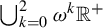 $\bigcup _{k=0}^2\omega ^k\mathbb {R}^+$
and
 $(\bigcup _{k=0}^2\omega ^k(0,p_k))\subseteq \Omega _0$
, we can respectively get
 $$ \begin{align*}\partial \Omega\cap\bigg(\bigcup_{k=0}^2\omega^k(p_k,+\infty)\bigg)=\emptyset \quad \text{and} \quad \partial \Omega\cap\bigg(\bigcup_{k=0}^2\omega^k(0,p_k)\bigg)=\emptyset.\end{align*} $$
Hence,
 $f_\alpha (z)=p_k$
for some
 $k=0,1,2$
. While, in this case, if we take
 $w_2=p_k+\omega ^k\varepsilon /2\notin \Omega $
, then
 $z_2\in \omega ^{2k}(\overline {J_{0_2}\cup J_{0_2}^*})$
by the mapping properties of
 $f_\alpha $
. This contradicts with
 $z_2\in \Omega _0$
. Therefore, we can get
 $z\in \partial \Omega _{n+1}\cap \partial \Omega $
.
On the other hand, let
 $z\in \partial \Omega _{n+1}\cap \partial \Omega $
. By the definition of
 $\partial \Omega _{n+1}$
and
 $\partial \Omega $
, we can get that for any
 $U(z,\varepsilon )$
with
 $\varepsilon>0$
, there are two points
 $z_1,z_2\in U(z,\varepsilon )$
such that
 $z_1\in \Omega _{n+1}$
and
 $z_2\notin \Omega $
. Let
 $w_1=f_\alpha (z_1)$
and
 $w_2=f_\alpha (z_2)$
. Obviously,
 $w_1\in \Omega _n$
and
 $w_2\notin \Omega $
. This implies
 $f_\alpha (z)\in \partial \Omega _{n}\cap \partial \Omega $
, that is,
 $z\in f_\alpha ^{-1}(\partial \Omega _{n}\cap \partial \Omega )$
. Moreover, it follows from
 $z_2\notin \Omega $
that
 $z\in \mathbb {C}\setminus \Omega _0$
. Hence,
 $z\in (f_\alpha ^{-1}(\partial \Omega _{n}\cap \partial \Omega ))\cap (\mathbb {C}\setminus \Omega _0)$
. The proof of (6.6) is finished.
According to the construction of
 $\Gamma _n$
and (6.5)–(6.6), we get that
 $$ \begin{align*}\bigcup_{n\geq0}\Gamma_n=\bigcup_{n\geq0}(\partial \Omega_{n}\cap \partial \Omega).\end{align*} $$
Then, it follows by (6.4) that
 $$ \begin{align*}\Gamma=\overline{\bigcup_{n\geq0}\Gamma_n}=\partial\Omega. \\[-47pt] \end{align*} $$
It follows from Lemma 6.5 that
 $\mathrm {Int}(\Gamma )=\Omega $
. To describe the finer mapping property of
 $f_\alpha $
in
 $\mathrm {Int}(\Gamma )$
, let
 $$ \begin{align*}U_{k}=\Omega_0\cap\Delta_k\quad \text{for } k=0,1,2.\end{align*} $$
For any
 $n\geq 2$
and
 $\underline {s}_{n}=s_1s_2\cdots s_n$
admissible, we define
 $$ \begin{align*}U_{\underline{s}_{n}}=f^{1-n}_{\alpha, \underline{s}_{n-1}}(U_{s_{n}}).\end{align*} $$
Then, according to Corollary 2.5, all the maps
 $$ \begin{align*} U_{\underline{s}_n} \stackrel{f_{\alpha} }{\longrightarrow} U_{\sigma(\underline{s}_n) } \quad \text{for } \: n \ge 2\end{align*} $$
are homeomorphisms. As a consequence, the sets
 $U_{\underline {s}_n}$
, with
 $n\geq 1$
and
 $\underline {s}_n$
admissible, form a dynamical partition of
 $\mathrm {Int}(\Gamma )$
.
Corollary 6.6. It follows that
 $\mathrm {Int}(\Gamma )\setminus S\subseteq E(f_\alpha )$
.
Proof. By Lemma 6.5 and the definition of
 $\Omega $
, we can get that every point
 $z\in \mathrm {Int}(\Gamma )$
will ultimately map to
 $\Omega _0$
by
 $f_\alpha ^m$
for some
 $m\geq 0$
. In addition, since
 $S\cap E(f_\alpha )=\emptyset $
, it follows from Lemma 3.5 that
 $\mathrm { Int}(\Gamma )\setminus S\subseteq E(f_\alpha )$
.
Proof of Theorem 1.3
Combining with Lemma 6.1, Corollaries 6.4 and 6.6, we get that
 $\mathbb {C}\setminus \overline {S}\subseteq E(f_\alpha )$
. Since
 $\overline {S}\subseteq K(f_\alpha )$
, this implies that
 $E(f_\alpha )=\mathbb {C}\setminus \overline {S}$
and
 $K(f_\alpha )=\overline {S}$
. Moreover, by Lemma 4.9, we can also get that
 $F(f_\alpha )=\mathbb {C}\setminus \overline {S}$
and
 $J(f_\alpha )=\overline {S}$
. This proves Theorem 1.3.
In the end, combining with Theorem 1.3 and Lemma 4.10, we can get that Corollary 1.4 holds. Moreover, Theorem 1.5 can be derived by Theorem 1.3, Lemma 5.6, and the lemmas of escaping dynamical behaviors (see Lemmas 6.1, 6.3, 6.5, and 3.5).
Acknowledgements
This work is supported by the Fundamental Research Funds for the Central Universities (Grant No. 2019kfyXJJS135), the National Natural Science Foundation of China (Grant Nos. 11901219 and 12171276), and the Research and Innovation Program for Postgraduates in Jiangsu Province (Grant No. KYCX20_0018).