Adulteration and ingredient substitution are being increasingly practiced and evidenced by several incident reports involving food. Various adulteration malpractices are sometimes observed in milk and dairy products, all of which are illegal as regulations stipulate that milk should not contain any foreign substances (Brasil, 2018). Different foodstuffs are frequently subjected to adulteration with the aims of increasing the volume, controlling contamination and disguising spoilage. Adulteration is a matter of great concern for both regulatory agencies and consumers (Medina et al., Reference Medina, Pereira, Silva, Perestrelo and Câmara2019). The use of chemical food preservatives is a common and allowed practice in many types of food. These substances reduce spoilage, acting as antimicrobials due to growth inhibition of microorganisms (Mota et al., Reference Mota, Ferreira, Cunha, Beatriz and Oliveira2003). These preservatives reduce the likelihood of undesired changes, besides controlling freshness, flavor, texture and appearance (Amirpour et al., Reference Amirpour, Arman, Yolmeh, Azam and Moradi-Khatoonabadi2015; Carocho et al., Reference Carocho, Morales and Ferreira2015). Benzoic acid and sorbic acid, along with their salts, serve as prime examples of preservatives and are extensively employed in different food products. In Brazil, using preservatives is prohibited in milk (Brasil, 2018).
The Brazilian Manual of Official Methods for the Analysis of Animal-Origin Foods indicates the use of high-performance liquid chromatography (HPLC) for preservative detection in fluid milk, powdered milk, yogurt, fermented milk and cheese samples (Brasil, 2022). Separation by chromatography is an efficient technique and can be applied to complex food matrices, as well as being widely employed for the detection of foreign substances (Zhang et al., Reference Zhang, Zhang, Dediu and Victor2011). HPLC allows the simultaneous measurement of various compounds in a single analysis, being a great tool for complex matrices involving milk, as it can identify and quantify several molecules. Thus, this is an essential tool for determining the authenticity of milk and dairy products (Kamal and Karoui, Reference Kamal and Karoui2015). Regarding analytical techniques for the separation, identification, and quantitation of sample components, HPLC stands out as one of the best available tools and is widely used in food adulteration cases (Tsimidou et al., Reference Tsimidou, Ordoudi, Nenadis, Mourtzinos, Wakley, Hassall, Caballero, Finglas and Toldra2016). It is important to note that the currently employed official method demands a long analysis time and incurs high expense. Moreover, it requires large volumes and a wide range of reagents, which must be discarded afterward (ISO 9231, 2008). For this reason, the present study aimed to develop and validate a new simplified method for extraction and detection of sodium benzoate and potassium sorbate in milk, employing HPLC with photodiode array detector in the ultraviolet (UV) range (HPLC-PDA).
Material and methods
Samples and reagents
The raw milk samples used in this study were obtained from the Londrina State University teaching and research farm. They were collected within a 24-h window preceding the analysis and maintained at a temperature of 4°C during collection. Potential interfering substances were considered in the study, such as various acid solutions (lactic, acetic, ascorbic, citric, and malic).
Phosphate buffer was prepared using 3.0 g of anhydrous monobasic sodium phosphate of analytical grade. The reagent was dissolved in 900 ml of ultrapure water, and the pH was adjusted to 4.0. Sodium benzoate (25.00 mg) and potassium sorbate (25.00 mg) were precisely weighed using an analytical balance and transferred to a 25 ml volumetric flask. The contents were initially dissolved in ultrapure water and subsequently adjusted to the final volume. Subsequently, aliquots of the stock solution were transferred to 100 ml flasks and diluted with the mobile phase (acetonitrile: phosphate buffer 12:88, v/v) to prepare the standard solutions at concentrations of 0.10, 0.50, 1.00, 2.50, 5.00, 7.50, 10.00, 25.00, 50.00 and 100.00 mg/l for use in plotting the analytical calibration curves.
Extraction process
For the extraction of preservatives, a milk sample was diluted in acetonitrile at a 1:1 (v/v) ratio. Then, the mixture was centrifuged at 10 000 rpm (G force: 480 G) for 10 min, and the resulting supernatant was filtered through a 0.22 μm polytetrafluoroethylene (PTFE) filter membrane and stored in 2.0 ml amber colored vials. The sample was then stored in a refrigerator at approximately 4°C for subsequent use on different days.
Equipment and chromatographic conditions
Determination and quantification of the extracted preservatives was accomplished by employing a high-performance liquid chromatography (HPLC) apparatus (Shimadzu, Kyoto, Japan), composed of a LC-20AT pump, with a gradient manager system and degasser DGU-20A, and an automatic injector SIL-20AC with a 70 vials sampler. The column used was the C18 – Luna (250 mm × 4.6 mm, 5.0 μm, Phenomenex, California, USA), kept at 40°C in a CTO-20A oven. Detection was conducted utilizing the photodiode array detector in the UV – PDA, with the modules controlled by the CBM-20A controller, operated through the LC-Solution software (Version 1.21). The mobile phase consisted of 12% (v/v) acetonitrile and 88% (v/v) phosphate buffer, with a flow rate of 1.0 ml/min and a runtime of 25 min per sample. Each sample was injected with a 10.0 μl volume. The maximum wavelengths selected for the determination of sodium benzoate and potassium sorbate were 225 and 255 nm, respectively (Gören et al., Reference Gören, Bilsel, Simsek, Bilsel, Akçadag, Topal and Ozgen2015).
Validation parameters
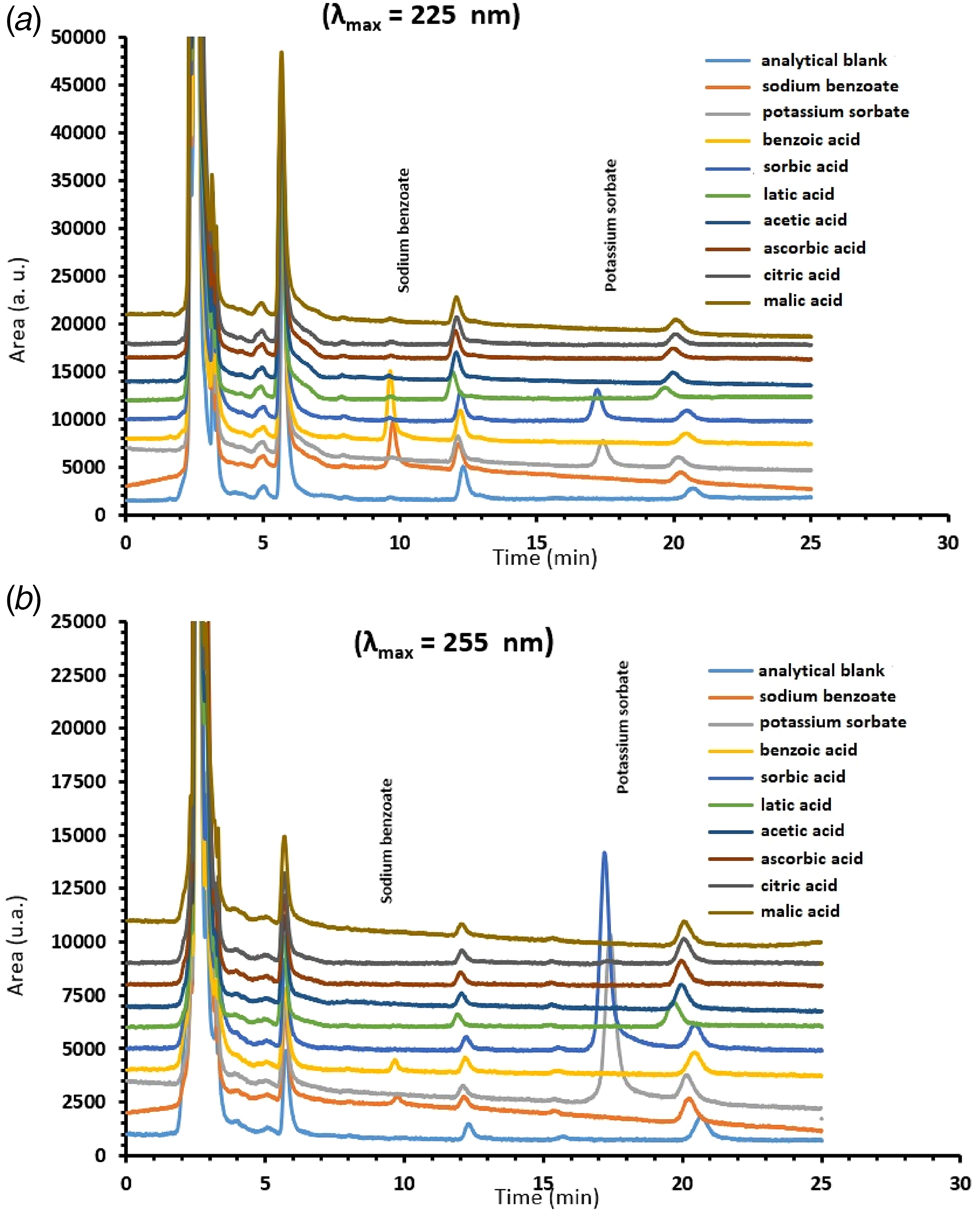
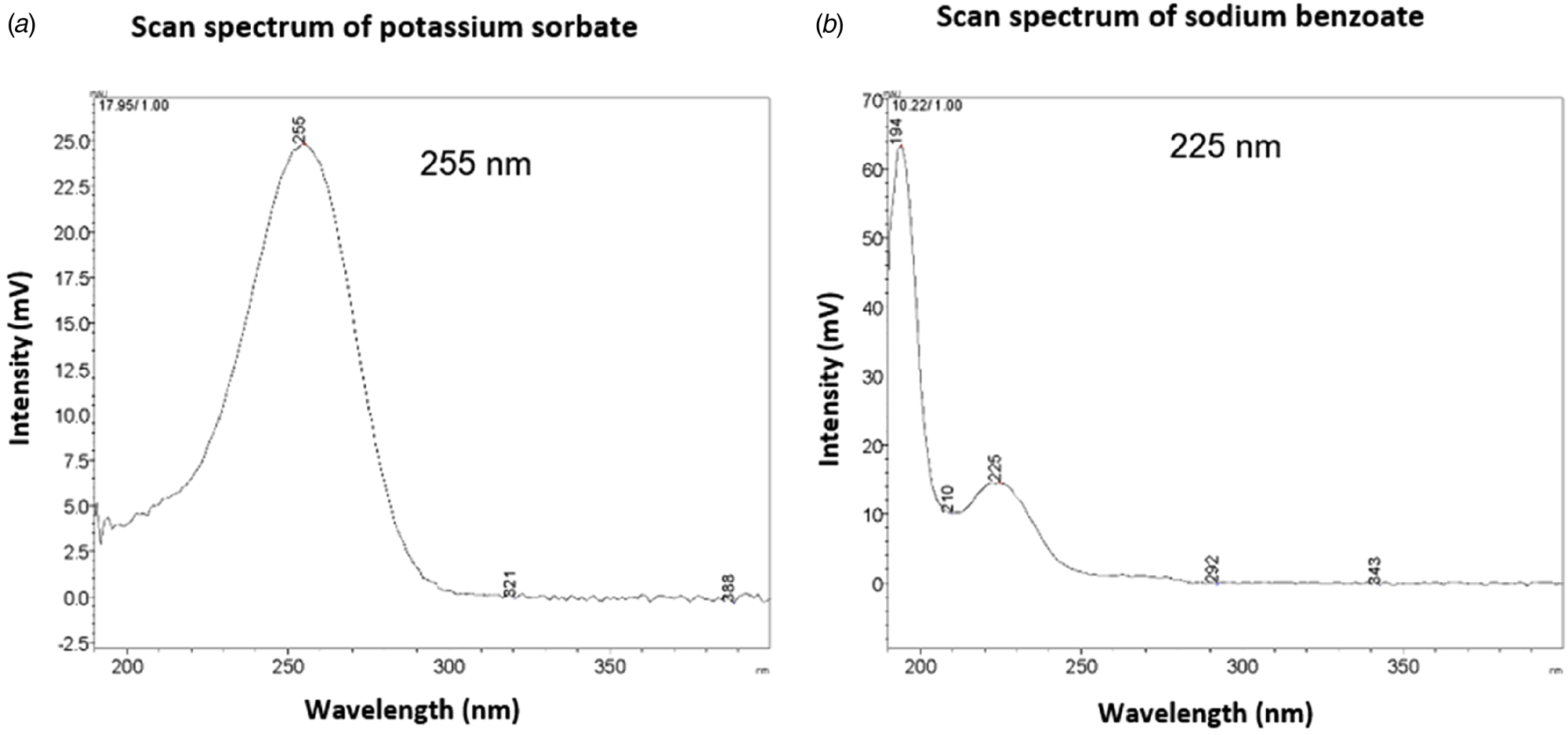
The chromatographic method (HPLC-PDA) was validated according to the criteria outlined by the International Conference on Harmonization (ICH, 2018). The validation process encompassed the evaluation of parameters including selectivity and specificity, linearity and range, intra-assay and intermediate precision, accuracy, detection limit and quantitation limit. The selectivity and specificity were initially demonstrated through the overlapping chromatograms illustrated in Figs 1 and 2. These chromatograms were generated using a raw milk sample as the analytical blank, without the addition of preservative standard solutions. Additionally, two samples of raw milk were analyzed: one supplemented with sodium benzoate and the other with potassium sorbate, both at a concentration of 5.0 mg/l. The absorbance spectra were measured at their respective maximum wavelengths of 225 and 255 nm. To assess selectivity, potential interfering analytes were also examined. These included lactic and acetic acids produced by bacteria naturally present in milk, as well as ascorbic, citric and malic acids, each at a concentration of 10.0 mg/l.
Selectivity and specificity of the HPLC-PDA chromatographic method for the detection of sodium benzoate and potassium sorbate in milk, using raw milk without preservative standard solutions as analytical blank, and with the addition of other possible interfering substances (such as lactic, acetic, ascorbic, citric, and malic acids), at the maximum absorbance wavelengths (a) 225 nm and (b) 255 nm.

Scan spectrum of (a) sodium benzoate with wavelength λmax = 225 nm and (b) potassium sorbate with wavelength λmax = 255 nm.

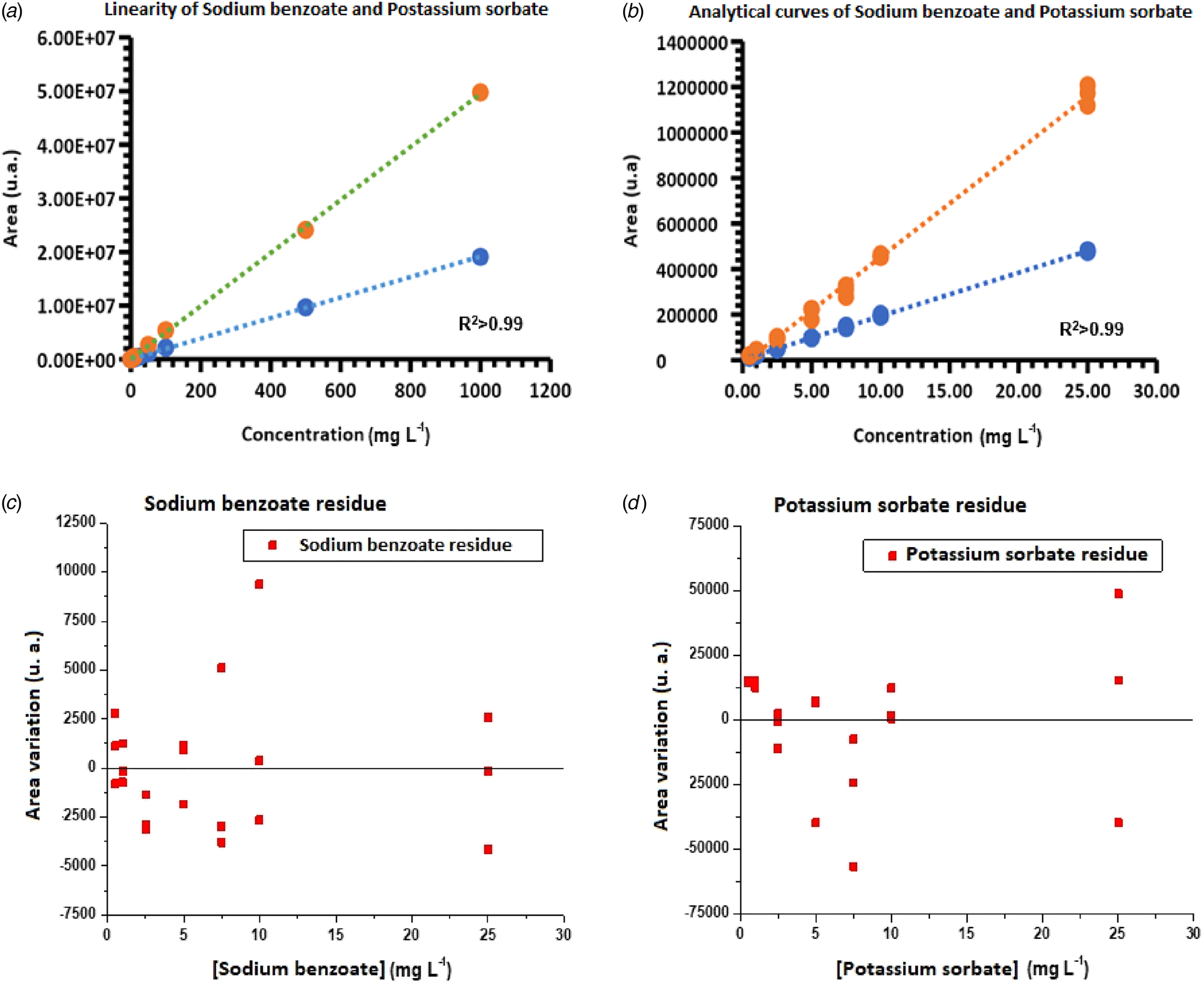
Linearity was verified by constructing analytical curves within the range of 0.10–1000.00 mg/l, at their respective maximum wavelengths of 255 and 225 nm. This process was carried out in triplicate for the preservatives sodium benzoate and potassium sorbate. The linear working range was defined at concentrations of 0.50, 1.00, 2.50, 5.00, 7.50, 10.00 and 25.00 mg/l for both preservatives. The analytical curves for both preservatives, as shown in Fig. 3 (a and b) were constructed using linear models (area vs. concentration), and were expressed concatenated, with the equations expressed as follows (Equations 1 and 2).
 $$[ {{\rm benzoate}} ] ( {{\rm mg\;}\,{\rm l}^{ \hbox{-} 1}} ) {\rm} = \displaystyle{{( {{\rm Area}} ) \hbox{-}{\rm 2342, \;2}} \over { 19089}}{\rm \;}$$
 $$[ {{\rm sorbate}} ] ( {{\rm mg\;}{\rm l}^{ \hbox{-} 1}} ) {\rm} = \displaystyle{{( {{\rm Area}} ) {\rm} + {\rm 17958\;}} \over { 47051}}$$
(a) Linearity and (b) analytical curves and working range of the novel method for standards of preservatives sodium benzoate and potassium sorbate in raw milk. (c) Sodium benzoate residue chart and (d) potassium sorbate residue chart.

Intra-assay precision was assessed by measuring the repeatability of six successive injections of a raw milk sample. Meanwhile, intermediate precision was evaluated on two different days for sodium benzoate and potassium sorbate (at concentrations of 1.00, 7.50 and 25.00 mg/l).
Accuracy was determined according to a recovery experiment conducted in triplicate (n = 3), which involved the addition of the preservative standards directly into the milk matrix, before and after the extraction process. Concentrations added after extraction were considered as 100% recovery. Three concentration levels of sodium benzoate and potassium sorbate (1.00, 10.00 and 25.00 mg/l) were added, representing low (R1), medium (R2), and high levels (R3), respectively.
The detection and quantitation limits were calculated based on the relationship between the standard deviation of the intercept of the analytical curve and its slope, utilizing the multiplicative factor recommended by the ICH, according to Equations 3 and 4.
 $$DL = \displaystyle{{SD_0 \times \;3} \over {SC}}\;\;$$
 $$\;\;QL = \displaystyle{{SD_0 \times \;10} \over {SC}}$$
In which:
SC is the slope of the curve.
SD0 is the standard deviation of the intercept with y-axis of the three analytical curves constructed in triplicate.
Robustness was evaluated by examining the ability of the method to endure variations in the mobile phase ratio and temperature. Different ratios of acetonitrile and phosphate buffer at pH 4.0 were used to vary the concentration of the mobile phase. The mobile phase composition was adjusted by ±1%, and the column temperature by ±1.0°C. Considering the chromatogram instabilities resulting from fluctuations in the pH of the phosphate buffer, an additional investigation was conducted to determine the optimal pH value for the mobile phase. The pH value of the phosphate buffer was set at 3.0, 3.5, 4.0, 4.5, 5.0, 5.5 and 6.0 (online Supplementary Fig. S1).
Results
Specificity and selectivity
The overlap of the chromatograms (Figs 1a, 1b and 2a and 2b) indicates that the chromatographic method was efficient in the separation of sodium benzoate (λmax = 225 nm) and potassium sorbate (λmax = 255 nm), with a retention time (RT) of 9.81 and 17.37 min, respectively. During the analysis of potential interfering substances, it was observed that the only analytes sharing the same retention times were their protonated forms, which are their respective acids (benzoic acid and sorbic acid), that possess anions in common. In contrast, for lactic acid, acetic acid, ascorbic acid, citric acid and malic acid, the method did not exhibit significant signals at this concentration (10.0 mg/l).
Linearity
Analyzing Equations 1 and 2 and Fig. 3a and 3b, the analytical method was considered linear from 0.10 to 1000.00 mg/l, including the chosen working range. The value of the coefficient of determination R 2 > 0.99 demonstrates that the results are directly proportional to the concentration of analytes in the samples, within a specified range, indicating the linearity of the method. It can be observed that the residuals for both analytes (Fig. 3c and 3d) exhibited random distribution around the analytical curve, showing no trends.
Precision
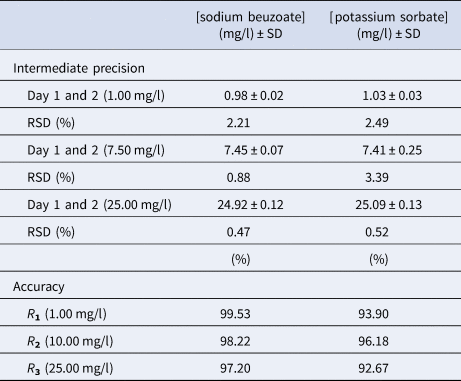
Results of intra-assay and intermediate precision are presented in Table 1. Values of relative standard deviation (RSD) were lower than 5.0%, indicating the precision of the method, and concordance among the results in a short period of time, according to the ICH (International Conference on Harmonization, 2018).
Parameters for validation of the novel method involving the extraction and determination by HPLC-PDA of preservatives sodium benzoate and potassium sorbate from coagulants used in cheese manufacturing (n = 3)

RSD, Relative Standard Deviation; R 1, recovery at low level; R 2, medium; R 3, high; SD, Standard Deviation.
Accuracy
The recovery of the analytes ranged from approximately 92.67 to 99.53% (Table 1), demonstrating the accuracy of the method, considering that this parameter can range from 80 to 120%, according to the ICH (ICH, 2018).
Detection and quantitation limits
The detection and quantitation limits for sodium benzoate and potassium sorbate, calculated respectively by Equations 3 and 4, considering the analytical curves for benzoate (area = 19 089⋅[benzoate] – 2342.2) and sorbate (area = 47 051⋅[sorbate] – 17 958.0), resulted in 0.204 and 0.618 mg/l for sodium benzoate and 0.108 and 0.328 mg/l for potassium sorbate.
Robustness
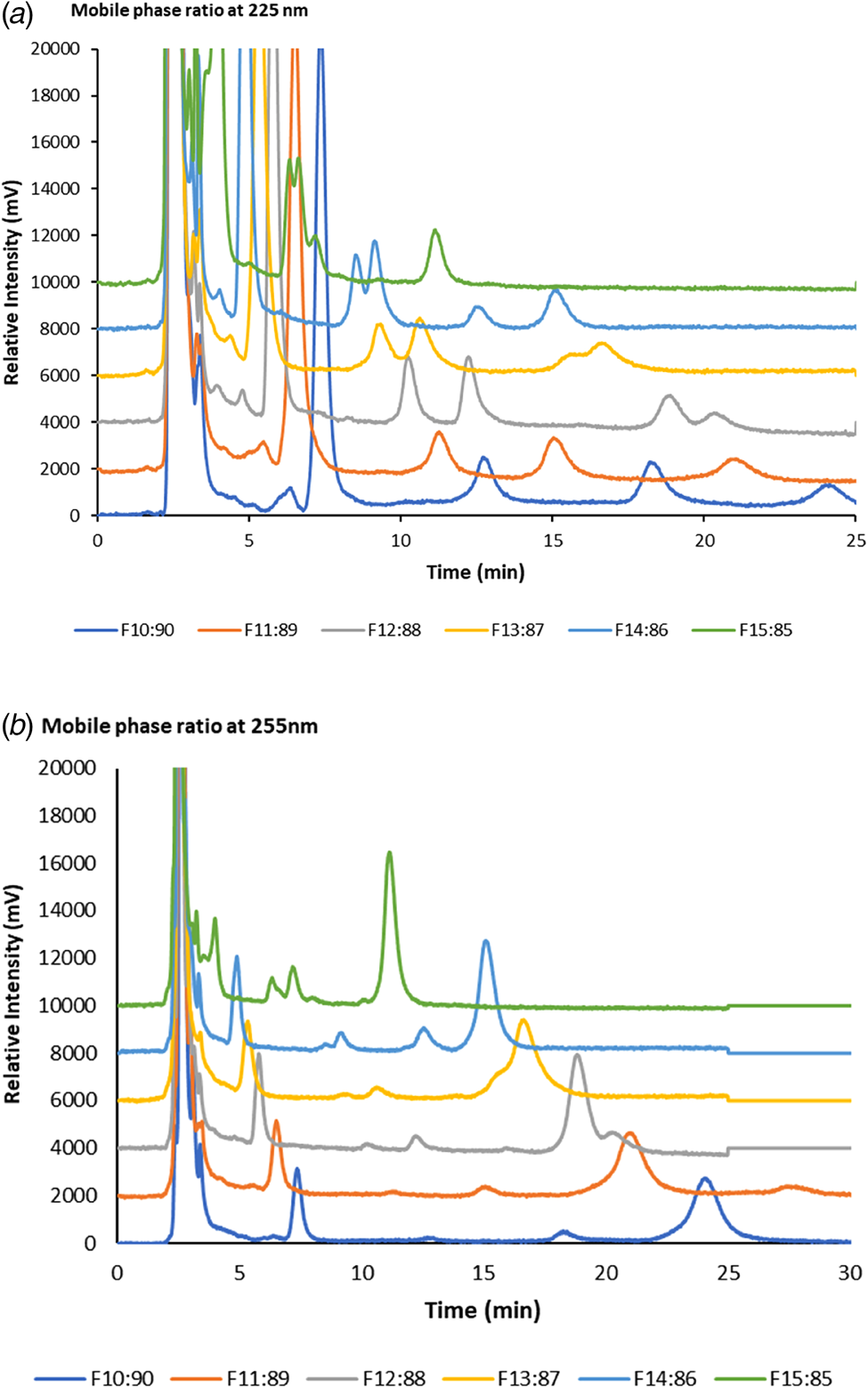
The retention time for both analytes exhibited variations of approximately 11.0% in response to the modifications in mobile phase ratios. Temperature fluctuations, on the other hand, induced variations of less than 1.80% (online Supplementary Fig. S2). Concerning the peak area, the variations obtained were <5.50% for the modifications of mobile phase ratios, and <1.85% for the oven temperature. None of the variations in the analyzed parameters rendered the method unviable. However, ratios lower than 11:89 resulted in peak asymmetry and reduced peak area compared to the 12:88 ratio. At ratios exceeding 13:87 there was convergence of the two standards employed, indicating the onset of coelution either between each other or with other compounds present in milk. Consequently, the method can be considered robust in situations of mobile phase ratio variations within ± 1% (Fig. 4a and 4b) and temperature fluctuations within ± 1.0°C, demonstrating its capacity to withstand minor variations in these analytical parameters.
Chromatograms of the novel method evaluating the robustness by varying different ratios in the composition of the mobile phase (Acetonitrile (ACN):Phosphate buffer (PB) at pH 4.0) for a milk sample with sodium benzoate and potassium sorbate standards, both at concentration of 5.00 mg/l at a wavelength of 225 nm (a), at 255 nm (b).

pH study
In the method development process, an investigation into the pH of the mobile phase became imperative, as significant changes in analyte retention times were observed across varying pH ranges. The primary objective of this study was to determine the optimal pH value for the proposed method, with a focus on achieving the highest resolution between the peaks of the preservatives sodium benzoate and potassium sorbate at a concentration of 5.00 mg/l. The pH study indicated that at values below 4.0 the analytes coeluted with an unidentified peak in the matrix itself, which could be observed with each analytical blank. The same pattern was observed at pH 4.5, in which sorbate presented a coelution with a second unidentified peak. The best result with good separation (resolution >2) was detected at pH 4.0, the one selected to be applied in the study (online Supplementary Fig. S1).
Discussion
The guidelines established by the International Organization for Standardization (ISO 9231, 2008) define the official method for detecting benzoic acid, benzoates, sorbic acid and sorbates in milk and dairy products using HPLC (Brasil, 2022). This cited method requires a variety of reagents in large quantities, as well as a long execution time for the sample extraction process. In contrast, the new method proposed in this study uses acetonitrile as a single reagent and requires significantly less time for execution.
Gören et al. (Reference Gören, Bilsel, Simsek, Bilsel, Akçadag, Topal and Ozgen2015) highlighted the efficiency of HPLC in their analysis of preservatives in food and beverages. These authors applied the same wavelengths used in the present study (225 and 255 nm), and their mobile phase consisted of ammonium acetate buffer (pH 4.2) and acetonitrile (72:28 v/v) (Gören et al., Reference Gören, Bilsel, Simsek, Bilsel, Akçadag, Topal and Ozgen2015). Pylypiw and Grether (Reference Pylypiw and Grether2000) performed a study employing HPLC-PDA to detect the same preservatives (sodium benzoate and potassium sorbate) in several types of food and beverages (apple juice, cranberry juice, grape juice, peanut butter and soy sauce, among others). They used ammonium acetate buffer and acetonitrile (90:10 v/v) as the mobile phase, with the optimal pH at 4.2. In the sample preparation, they used the mobile phase as a solvent, filtering through a 0.45 μm nylon membrane. Enhanced sensitivity was obtained in this method by employing the maximum wavelengths of 225 and 255 nm for sodium benzoate and potassium sorbate, respectively, with recovery values ranging from 82 and 96% and detection limits of 10.0 mg/l for both analytes, which means a value over 10 times higher than was achieved in the novel method proposed in the present study (Pylypiw and Grether, Reference Pylypiw and Grether2000).
The novel method offers enhanced simplicity and ease in test execution, besides lower cost when compared to the official method (ISO 9231, 2008). A direct comparison of the two methods is presented in online Supplementary Chart S1. Sample preparation no longer necessitates heating, it uses acetonitrile as the single reagent for the extraction process (minimizing the disposal of various reagents) and facilitates easy handling. The novel method also requires less total execution time, taking 37 min vs. 70 min for the official method, considering the extraction and sample run steps. Additionally, the proposed method achieves superior quantitation limits, these being 8 and 15 times lower for sodium benzoate and potassium sorbate, respectively, in comparison to the official method. These findings reveal greater sensitivity of the proposed method, enabling precise quantitation even in samples containing low amounts of the target analytes.
In conclusion, the novel validated HPLC-PDA method demonstrated selectivity and specificity, effectively enabling the separation and simultaneous detection of sodium benzoate and potassium sorbate within experimentally adulterated milk samples, at the respective maximum wavelengths of 225 and 255 nm. The technique works with low detection and quantitation limits, and shows good accuracy with high recovery rates. Additionally, the sample preparation process is simple and fast, and it is a more environmentally friendly approach, leading to reduced waste disposal. All of these characteristics simplify and optimize the method. The overall time investment for each analysis, including both sample preparation and chromatographic run, amounts to approximately 37 min, and is, therefore, suitable for routine analysis.
Supplementary material
The supplementary material for this article can be found at https://doi.org/10.1017/S0022029925000044
Acknowledgments
The authors thank the Laboratório de Apoio à Pesquisa Agropecuária (LAPA/UEL), Laboratório de Inspeção de Produtos de Origem Animal (LIPOA/UEL), Coordenação de Aperfeiçoamento de Pessoal de Nível Superior (CAPES), and the Instituto Nacional de Ciência e Tecnologia para a Cadeia Produtiva do Leite (INCT – Leite).