An increasing emphasis has been placed on decreasing resource utilisation while improving quality. We have reported excellent survival in patients with tetralogy of Fallot, pulmonary atresia, and major aortopulmonary collateralsReference Bauser-Heaton, Borquez and Han 1 using a protocolised approach,Reference Malhotra and Hanley 2 but these patients continue to use resources in excess of patients with other CHD lesions, owing to their risk for prolonged mechanical ventilation, ICU stay, and total hospital length of stay.Reference Asija, Hanley and Roth 3 , Reference Asija, Koth and Velasquez 4 With this in mind, it is well known that one of the primary barriers to transitioning patients from inpatient to outpatient care is the inability to safely and effectively feed and swallow. Patients with CHD are at particular risk for failure to thriveReference Irving, Medoff-Cooper and Stouffer 5 , Reference Trabulsi, Irving and Papas 6 owing to increased energy expenditure and poor oral feeding.Reference Sables-Baus, Kaufman, Cook and da Cruz 7 Maurer et alReference Maurer, Latal, Geissmann, Knirsch, Bauersfeld and Balmer 8 identified an association between the performance of multiple cardiac surgeries and the use of a feeding tube to achieve adequate weight gain. Gillespie et alReference Gillespie, Kuijpers and Van Rossem 9 directly linked the use of a feeding tube with longer ICU length of stay. Feeding problems in patients with CHD have been associated with worse neurologic outcomes.Reference Medoff-Cooper, Irving and Hanlon 10 Several studies have explored risk factors for feeding tube use in patients with single-ventricle physiology.Reference El-Sayed Ahmed, Alfares and Hynes 11 , Reference Di Maria, Glatz and Ravishankar 12 Given the extensive nature of surgical intervention in patients with this lesion, the need for a feeding tube may be a common requirement; this has not been investigated in patients with tetralogy of Fallot, pulmonary atresia, and major aortopulmonary collaterals undergoing unifocalisation surgery. Children presenting for this surgery frequently have heart failure and are therefore weak, have underlying genetic abnormalities presenting with oropharyngeal difficulties, and have prolonged mechanical ventilation, which leads to interruption of oral feeding and vocal cord injuries.
The goal of this study was to determine risk factors for use of a feeding tube in populations with tetralogy of Fallot, pulmonary atresia, and major aortopulmonary collaterals.
We hypothesised that patients using a feeding tube at the time of discharge would be more likely to be younger and have 22q11 deletion syndrome.
Materials and methods
Patients
The cohort was established by interrogating the Stanford tetralogy of Fallot, pulmonary atresia, and major aortopulmonary collaterals REDCap database for patients undergoing unifocalisation surgery between January 2010 and June 2016. We excluded patients with pre-existing feeding tubes and those <90 days of age. Neonates under 90 days undergoing unifocalisation surgery are likely to have multiple risk factors for tube feeding at the time of discharge, including the lack of establishment of good oral feeding and preoperative dependence on a feeding tube owing to illness severity. Only the first surgery at Lucile Packard Children's Hospital during the study period was included for each patient.
Patients underwent one of three categories of surgery: bilateral complete unifocalisation and complete intra-cardiac repair with ventricular septal defect closure and right ventricle to pulmonary artery conduit placement, revision unifocalisation with prior ventricular septal defect closure, or unifocalisation without intra-cardiac repair with placement of an aortopulmonary shunt.
During the study period, the intensive care team determined the need for swallow evaluation based on the patient’s clinical status and vocal quality postoperatively. Patients with good vocal quality after extubation were allowed to feed by mouth; if there was concern for dysphagia or aspiration based on difficulty with oral feeding or poor voice quality, the child was referred for formal feeding and swallowing evaluation by a swallowing therapist. We considered a duration of mechanical ventilation >5 days to be prolonged, as has been previously used in studies from our centre in this population,Reference Asija, Hanley and Roth 3 as it was the median duration of mechanical ventilation. The institutional review board at Stanford University approved this study.
Data collection
Demographic data were collected, including age, gender, weight, and length. Clinical data were collected including cardiopulmonary bypass time, duration of mechanical ventilation, right-to-left ventricular pressure ratio after surgery, 22q11 deletion status, and type of surgery – single-stage unifocalisation with intra-cardiac repair and ventricular septal defect closure, complete unifocalisation without intra-cardiac repair, and revision unifocalisation with history of intra-cardiac repair. Patients were separated into two groups: those who were discharged with exclusively oral feeding regimens (oral) and those who used a feeding tube for any percentage of nutritional support at time of discharge.
Data analysis
Patients who remained feeding solely orally were compared with those who were discharged with a feeding tube. Groups were compared using Wilcoxon rank sum and Fisher’s exact tests, as appropriate. Data are reported as count (%) or median (25th–75th percentiles). All collected variables were compared between the two cohorts in univariable analysis to evaluate for association with feeding tube use at the time of discharge. We performed a logistic regression model including all variables with a univariable significant level with p<0.15.
All statistical testing was conducted using SPSS version 23.0 (IBM SPSS Statistics, Armonk, New York, United States of America). A p value <0.05 was considered statistically significant.
Results
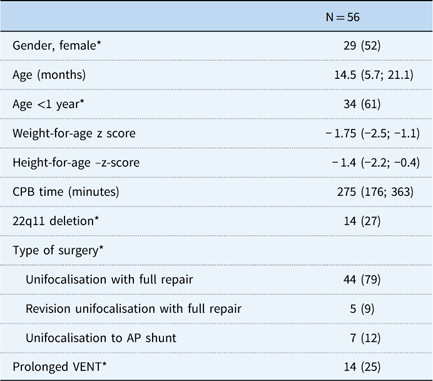
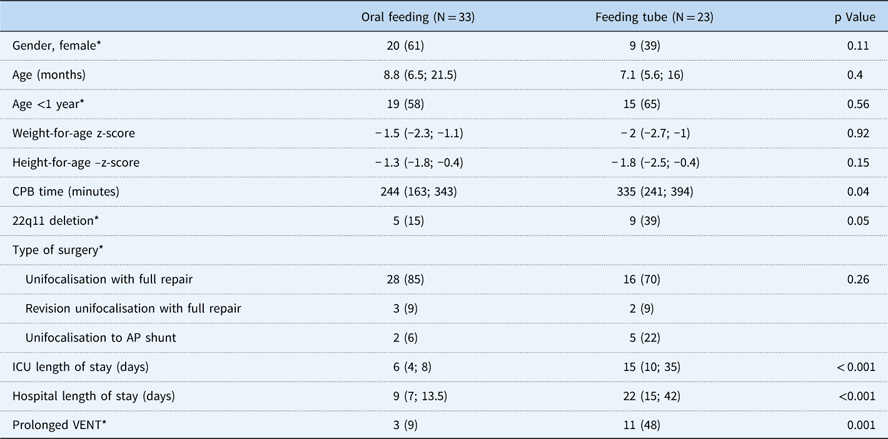
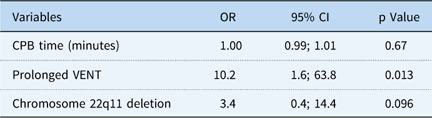
A total of 56 patients met the inclusion criteria. Among them, 33 patients were feeding orally without supplementation via a feeding tube at the time of discharge, whereas 23 were using a feeding tube for nutrition. Summary statistics for the study patients may be found in Table 1. Age and surgical type were not statistically associated with increased risk for feeding tube use (Table 2). A chromosome 22q11 deletion was associated with feeding tube use (22q11 deletion in 39 versus 15%, p=0.05, Table 2). Median cardiopulmonary bypass time in the feeding tube group was longer (335 versus 244 minutes, p=0.04) (Table 2). Prolonged duration of mechanical ventilation was associated with feeding tube use (48 versus 9%, p=0.001) (Table 2). Feeding tube use was associated with longer ICU and hospital length of stay (15 versus 6, p<0.001 and 22 versus 9, p<0.001, Table 2). On multi-variable analysis, prolonged duration of mechanical ventilation was the only variable associated with feeding tube use (odds ratio 10.2, 95% confidence intervals 1.6; 63.8, Table 3).
Description of the sample population.

AP=aortopulmonary; CPB=cardiopulmonary bypass; VENT=duration of mechanical ventilation
* n (%)
Comparison of patients with and without a feeding tube at hospital discharge.

CPB=cardiopulmonary bypass; VENT=duration of mechanical ventilation
* n (%)
Multi-variable logistic regression for discharge with a feeding tube.

CI=confidence intervals; CPB=cardiopulmonary bypass; OR=odds ratio; VENT=duration of mechanical ventilation
Four patients required extracorporeal membrane oxygenation in the postoperative period: three of whom were discharged with a feeding tube and one was not. Moreover, 10 patients required a cardiac reintervention: seven from the feeding tube group and three from the orally feeding group; eight patients required reintubation after initial extubation: four from the feeding tube group and four from the orally feeding group. Given the low numbers seen for these complications, additional analysis was not completed.
Discussion
There are several reasons that patients orally feeding before surgery may use feeding tubes after congenital heart surgery. Oral-pharyngeal dysphasia and vocal cord immobility following surgery and the associated aspiration risk are common causes.Reference Dewan, Cephus, Owczarzak and Ocampo 13 In addition, patients presenting for congenital heart surgery may be malnourished owing to unfavourable cardiac physiology, having increased metabolic demand with inadequate caloric intake. Such deconditioning becomes worse after enduring extensive surgery and postoperative recovery, and patients with borderline oral nutrition before surgery may receive supplemental nutrition for catch-up growth postoperatively. Piggott et alReference Piggott, Babb and Yong 14 investigated factors associated with need for a gastrostomy tube after stage 1 palliation for hypoplastic left heart syndrome and found that while duration of sedative infusion was associated with the need for a gastrostomy tube duration of mechanical ventilation was not.
We found that prolonged duration of mechanical ventilation is a risk factor for feeding tube use at the time of hospital discharge in patients with tetralogy of Fallot, pulmonary atresia, and major aortopulmonary collaterals undergoing unifocalisation surgery. Patients undergoing unifocalisation surgery are at a particularly high risk for prolonged duration of mechanical ventilation owing to extensive distal dissection and inflammation due to long cardiopulmonary bypass times leading to the respiratory complications associated with this operation.Reference Asija, Hanley and Roth 3 Comparatively, the average duration of mechanical ventilation is shorter after surgery for other congenital heart lesions: tetralogy of Fallot, 2 days;Reference van Dongen, Glansdorp and Mildner 15 ventricular septal defect, 1–2 days;Reference Aydemir, Harmandar and Karaci 16 and complete atrioventricular canal defect, 2–3 daysReference Harmandar, Aydemir and Karaci 17 . Prolonged intubation and concurrent absence of oral feeding often leads to global weakness, oropharyngeal oedema, and temporary loss of oral motor function. Patients with prolonged duration of mechanical ventilation may also have a higher risk for tracheal aspiration of feeds and dysphagia after extubation secondary to laryngeal oedema, muscle deconditioning, and associated poor oral motor control.Reference Tolep, Getch and Criner 18 Prolonged exposure to sedative medications to maintain safe endotracheal tube position in active patients may also contribute to such deconditioning.
To our knowledge, no studies comparing route of feeding after unifocalisation to other cardiac surgeries have been published. The postoperative courseReference Asija, Hanley and Roth 3 and long-term outcomesReference Bauser-Heaton, Borquez and Han 1 for these patients have been explored in previous studies. Children undergoing unifocalisation surgery undergo extensive pulmonary dissection to achieve the lowest possible right-to-left ventricular pressure ratio so that the ventricular septal defect can be closed.Reference Malhotra and Hanley 2 In our experience, these patients use significant respiratory support in the postoperative period, and in this study we have established that prolonged mechanical ventilation is associated with being discharged with a feeding tube.
Although 22q11 deletion syndrome was not independently associated with the use of a feeding tube at the time of hospital discharge in this study, these patients are known to have worse short- and long-term outcomes after unifocalisation surgery and may be at greater risk for prolonged duration of mechanical ventilation at baseline.Reference Bauser-Heaton, Borquez and Han 1 , Reference Carotti, Albanese and Filippelli 19 Feeding difficulties are common in patients with 22q11 deletion syndromeReference Lima, Folling, Eiklid, Natvig and Abrahamsen 20 , Reference Ryan, Goodship and Wilson 21 at least partly owing to palatal abnormalities and dysphagia.Reference Eicher, McDonald-Mcginn, Fox, Driscoll, Emanuel and Zackai 22 Patients with 22q11 deletion syndrome may be more likely to have preoperative feeding tubes and therefore would not have been included in the study cohort.
Our finding that prolonged mechanical ventilation is independently associated with the presence of a feeding tube at the time of discharge provides a postoperative marker for practitioners to follow in order to establish a safe and developmentally appropriate feeding plan after unifocalisation. Enteral feeding via a feeding tube may be instituted earlier. Early institution of enteral nutrition and an algorithmic approach to post-extubation feeding and swallowing evaluation may reduce hospital stay and is the subject of ongoing investigation at this institution. There is ample evidence that postoperative feeding via an enteric tube is effective in its ability to provide adequate nutrition for recovery in patients with complex CHD, and Newcombe et al have shown that using a standard postoperative nutritional pathway has led to improved outcomes.Reference Rosen, Schneider and Bao 23 – Reference Newcombe and Fry-Bowers 25
Limitations
This study is limited by its retrospective design; therefore, we can only identify associations with our outcome and are unable to establish a cause and effect. Our goal was to understand possible risk factors for feeding tube use at time of discharge to allow for early institution of feeding tubes in high-risk populations to reduce hospital length of stay. There was no clinical protocol for the evaluation of aspiration during the period of the study; those referred for feeding and vocal cord evaluation may have had a more complicated intra-operative and postoperative course and risk for feeding problems.
Second, our data reflect the experience of a single centre treating a large number of patients with tetralogy of Fallot, pulmonary atresia, and major aortopulmonary collaterals. As such, our findings may not be generalisable to centres with different management approaches.
Conclusion
Prolonged mechanical ventilation is an independent risk factor for feeding tube use at the time of hospital discharge in patients with tetralogy of Fallot, pulmonary atresia, and major aortopulmonary collaterals undergoing unifocalisation surgery. Patients undergoing unifocalisation surgery are at risk for prolonged postoperative respiratory failure, and anticipation of feeding problems may reduce hospital length of stay. It is possible that improved nutritional status before surgery may reduce deconditioning associated with prolonged intubation and should be the focus of preoperative algorithms. A standardised approach to post-extubation feeding and swallowing evaluation may also help reduce hospital stay.
Acknowledgements
None.
Financial Support
This research received no specific grant from any funding agency or from commercial or not-for-profit sectors.
Conflicts of Interest
None.