This study examines the role of linguistic experience in the perception and hemispheric processing of Japanese pitch accent by native Japanese listeners and two groups of nonnative listeners differing in their native language (L1) backgrounds with linguistic pitch: Mandarin Chinese and English.
BACKGROUND
Speech prosody functions at various linguistic domains (Baum & Pell, Reference Baum and Pell1999; Van Lancker, Reference Van Lancker1980). At the lexical level, prosodic features can be superimposed on monosyllabic words to make phonemic contrasts (e.g., lexical tone), or on multisyllabic words to make phonemic (e.g., pitch accent) or grammatical (e.g., stress) contrasts. At the sentential level, they can be used as linguistic intonation to indicate sentence type (e.g., questions versus statements; Sadock & Zwicky, Reference Sadock, Zwicky and Shopen1985). Prosodic features can also be realized in the paralinguistic domain, such as emotional intonation used to express happiness or anger. Thus, the perception and processing of linguistic prosody may involve multiple and hierarchical stages of acoustic, lexical, and sentential analysis (Cutler & Clifton, Reference Cutler, Clifton, Brown and Hagoort1999; Gandour, Dzemidzic et al., Reference Gandour, Dzemidzic, Wong, Lowe, Tong and Hsieh2003).
Previous studies have revealed complex hemispheric processing patterns for linguistic prosody, in that native prosodic processing may involve right hemisphere dominanceFootnote 1 (Grimshaw, Kwasny, Covell, & Johnson, Reference Grimshaw, Kwasny, Covell and Johnson2003; Zatorre & Samson, Reference Zatorre and Samson1991), left hemisphere dominance (Arciuli & Slowiaczek, Reference Arciuli and Slowiaczek2007; Gandour et al., Reference Gandour, Wong, Lowe, Dzemidzic, Satthamnuwing and Tong2002), or no hemisphere dominance (Gandour, Wong, et al., Reference Wang, Sereno, Jongman and Hirsch2003; Mitchell & Crow, Reference Mitchell and Crow2005). Research has since attempted to investigate the factors affecting the complex hemispheric processing of linguistic prosody.
Theoretical accounts
Linguistic function has been proposed to account for hemispheric asymmetry in the perception of prosody, as different linguistic features may carry different levels of functional load (e.g., Van Lancker, Reference Van Lancker1980). Functional load refers to the extent of contrastivity between linguistic units (e.g., distinctive features, phonemic opposition), as well as a measure of the number of minimal pairs for a given contrast, gauging the frequency with which two features contrast (King, Reference King1967; Surendran & Niyogi, Reference Surendran, Niyogi and Thomsen2006). Based on this definition, lexical tone has a higher functional load than pitch accent, because all words in a tone language are contrastive for tone, whereas only approximately 20% of word pairs contrast for pitch accent (e.g., in Japanese; Pierrehumbert & Beckman, Reference Pierrehumbert and Beckman1988). Likewise, tone also has a higher functional load than lexical stress, because stress is used to make grammatical contrasts and thus is less lexically contrastive (Cutler, Reference Cutler1986; Hallé, Chang, & Best, Reference Hallé, Chang and Best2004). In contrast, the functional load of intonation is low as it is typically used at a more global level to indicate sentence types or emotional expressions (Cruttenden, Reference Cruttenden1997). In terms of hemispheric processing, a prosodic feature carrying high functional load (e.g., tone) tends to be lateralized in the left hemisphere, whereas a feature with low linguistic use (e.g., emotional intonation) tends to be lateralized in the right hemisphere. Those features falling somewhere in the middle of the linguistic functional hierarchy (e.g., pitch accent or stress) may involve a lesser degree of hemispheric dominance (Van Lancker, Reference Van Lancker1980).
Aside from the linguistic function, acoustic features, such as the temporal frame length of a prosodic unit, may determine the lateralization pattern of prosodic processing (e.g., Poeppel, Reference Poeppel2001, Reference Poeppel2003). According to this hypothesis, speech prosodic units over a shorter temporal domain (e.g., tone) tend to be left lateralized, whereas those with a longer temporal domain (e.g., sentential intonation) tend to call for greater right hemisphere participation. Presumably this is because the former mostly involves analytical processing of local information, whereas the latter involves a more holistic processing of global information (Bever, Reference Bever1975). Likewise, hemispheric processing of pitch may also be affected by relative frequency, with the left hemisphere biased for high-frequency information and the right hemisphere biased for low-frequency information (Ivry & Lebby, Reference Ivry and Lebby1993).
Moreover, the functional and acoustic aspects may complementarily account for lateralization patterns (Zatorre & Gandour, Reference Zatorre and Gandour2008). For instance, although tone and pitch accent are functionally similar (i.e., both used to make lexical distinctions), tone may involve a greater degree of left hemisphere processing than pitch accent due to its shorter temporal frame length. In contrast, although pitch accent and stress are used in comparable temporal domains, the processing of pitch accent may be more left lateralized than that of stress due to its higher functional load. Research has shown that linguistic and acoustic cues both contribute to the neural mechanisms underlying prosodic processing. Particularly, although shared neural substrates can be involved for different linguistic tasks depending on the amount and kind of acoustic cues available, competition between different linguistic domains may result in cortical competition (Zhao et al., Reference Zhao, Shu, Zhang, Wang, Gong and Li2008). For example, it has been found that although the perception of speech rhythm and intonation involved certain shared neural mechanisms due to their common acoustic properties, different brain regions were selectively more responsive to specific acoustic features as a function of listeners' linguistic experience (Zhang, Shu, Zhou, Wang, & Li, Reference Zhang, Shu, Zhou, Wang and Li2010).
Native processing
Empirical findings have not been consistent with respect to how these theoretical accounts are supported. In general, a left hemisphere superiority has been revealed in the native processing of tone in Mandarin (Klein, Zatorre, Milner, & Zhao, Reference Klein, Zatorre, Milner and Zhao2001; Wang, Sereno, & Jongman, Reference Wang, Sereno and Jongman2001; Wang, Sereno, Jongman, & Hirsch, Reference Wang, Sereno, Jongman and Hirsch2003) and Thai (Gandour, Dzemidzic, et al., Reference Gandour, Dzemidzic, Wong, Lowe, Tong and Hsieh2003; Van Lancker & Fromkin, Reference Van Lancker and Fromkin1973). Left hemisphere dominance has also been found in prosodic processing over a multisyllabic domain, such as Norwegian tone (Berker & Reinvange, Reference Berker and Reinvang2007; Moen, Reference Moen1993; Moen & Sundet, Reference Moen and Sundet1996) and English stress (Arciuli & Slowiaczek, Reference Arciuli and Slowiaczek2007; Baum, Reference Baum2002; Shah & Baum, Reference Shah and Baum2006). However, the native processing of Japanese pitch accent has shown noncompatible patterns. Using near-infrared spectroscopy, Sato, Sogabe, and Mazuka (Reference Sato, Sogabe and Mazuka2007) showed a left hemisphere dominance. In contrast, a magnetoencephalography study (Hayashi et al., Reference Hayashi, Imaizumi, Mori, Niimi, Ueno and Kiritani2001) revealed a significant negativity in the bilateral temporal cortices, when incorrect identification of a pitch accent prevents proper semantic comprehension. Likewise, findings on sentence-level prosodic features have been mixed. Although emotional intonation has revealed a right hemisphere dominance (Chernigovskaya et al., Reference Chernigovskaya, Svetozarova, Tokareva, Tret'yakov, Ozerskii and Strel'nikov2000), the processing of linguistic intonation has demonstrated left hemisphere (Chernigovskaya et al., Reference Chernigovskaya, Svetozarova, Tokareva, Tret'yakov, Ozerskii and Strel'nikov2000), right hemisphere (Shipley-Brown, Dingwall, Berlin, Yeni-Komshian, & Gordon-Salant, Reference Shipley-Brown, Dingwall, Berlin, Yeni-Komshian and Gordon-Salant1988), or bilateral mechanisms (Gandour, Dzemindzic, et al., Reference Gandour, Dzemidzic, Wong, Lowe, Tong and Hsieh2003; Pihan, Tabert, Assuras, & Borod, Reference Pihan, Tabert, Assuras and Borod2008).
Nonnative processing
Research on nonnative processing has further addressed the extent to which linguistic and acoustic aspects of prosodic features influence hemispheric dominance. It has been found that nonnative listeners, such as English listeners of Thai or Mandarin, process tone bilaterally (Van Lancker & Fromkin, Reference Van Lancker and Fromkin1973; Wang et al., Reference Wang, Sereno and Jongman2001), as they may focus more on subtle acoustic differences rather than distinguishing phonemic tone categories (Kaan, Wayland, Bao, & Barkley, Reference Kaan, Wayland, Bao and Barkley2007). Furthermore, these patterns retain even for nonnative listeners with tonal L1s, such as Mandarin listeners of Thai or Norwegian listeners of Mandarin, indicating that nonnative listeners do not process tone in a nativelike manner (i.e., left lateralized) despite their L1 experience with linguistic tone, presumably because the specific tone contrasts in the target language are not linguistically meaningful in their L1 (Gandour et al., Reference Gandour, Wong, Lowe, Dzemidzic, Satthamnuwing and Tong2002; Wang, Behne, Jongman, & Sereno, Reference Wang, Behne, Jongman and Sereno2004). Likewise, native and nonnative intonation processing has also revealed different patterns. For example, the processing of intonation in Mandarin was bilateral for native Mandarin listeners but predominantly in the right hemisphere for English listeners (Gandour, Dzemidzic, et al., Reference Gandour, Dzemidzic, Wong, Lowe, Tong and Hsieh2003).
Thus, it appears that nonnative listeners deviate from the native patterns with a lesser degree of left hemisphere processing, with the nature of deviation influenced by nonnative listeners' experience with their native and target prosody. Nevertheless, like the natives, nonnative listeners also show more left hemisphere involvement when processing prosody with a shorter temporal domain (e.g., tone) while exhibiting more right hemisphere activation in the processing of prosody with a longer temporal domain (e.g., intonation), pointing to the role of universal temporal acoustic factors on prosodic processing.
Taken together, the native and nonnative patterns show that the higher the functional load a prosodic feature carries or the shorter the temporal domain it is realized on, the more involvement of the left hemisphere. However, the lateralization of those prosodic patterns realized at an intermediate level along the functional and temporal scales, such as pitch accent, have been inconsistent (e.g., Hayashi et al., Reference Hayashi, Imaizumi, Mori, Niimi, Ueno and Kiritani2001; Sato et al., Reference Sato, Sogabe and Mazuka2007). Furthermore, research has not examined nonnative hemispheric processing of pitch accent. Thus, the current investigation into native and nonnative pitch accent processing contributes to the overall picture of prosodic processing, given that the temporal domain on which pitch accent is realized as well as its functional load falls between the parameters of tone and intonation.
PITCH ACCENT PATTERNS
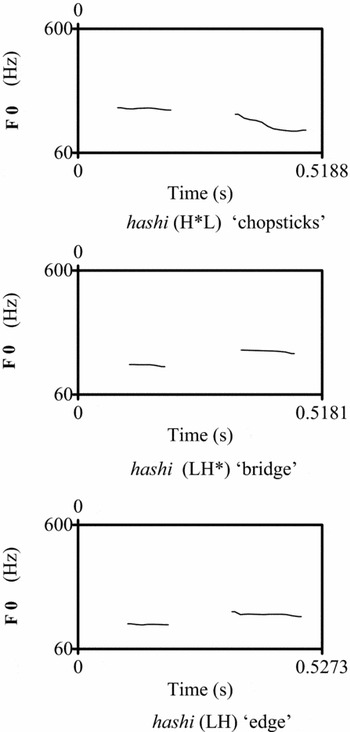
Pitch accent in Japanese is realized at a domain with at least two syllables to differentiate word meanings. Occurrence of high (H) or low (L) pitch as well as that of the accent (*) is predictable for unaccented and accented words. For an unaccented word, the first syllable has a low pitch, whereas the remaining syllables have a high pitch. For an accented word, one syllable is marked for accent. If the accent falls on the first syllable, the syllable has a high pitch and all the following syllables have a low pitch. If the accent falls on the second or later syllable, the first syllable has a low pitch and the syllables from the second until the accented one all have a high pitch (Kitahara, Reference Kitahara2001; Sugiyama, Reference Sugiyama2006). Disyllabic words, therefore, have three pitch accent patterns: accented H*L, LH* patterns, and unaccented LH pattern, as shown in Figure 1.
The fundamental frequency (F 0) contours of the three pitch accent patterns high–accent–low (H*L), LH*, and LH, exemplified by the syllable hashi.

THE CURRENT STUDY
In the current study, pitch accent processing patterns are compared between native listeners of Japanese and two nonnative groups: Mandarin listeners whose L1 uses pitch (tone) with a higher functional load than pitch accent, and English listeners with the functional use of pitch in their L1 (e.g., stress) being lower than pitch accent. Thus, the gradation of functional use of pitch in these L1s provides a useful testing ground to examine the effect of linguistic experience on pitch accent processing.
To assess hemispheric processing patterns, this study employs the dichotic listening paradigm, in which different stimuli in a pair are simultaneously presented to the left ear and the right ear (Kimura, Reference Kimura1961, Reference Kimura1967; Wang et al., Reference Wang, Sereno and Jongman2001). During dichotic stimulation, a stimulus presented to the right ear can be more effectively processed in the left hemisphere than in the right hemisphere (and vice versa), because the information conveyed by the contralateral auditory pathways typically suppresses that by the ipsilateral pathways (Gazzaniga, Reference Gazzaniga1984, p. 97). Consequently, a right ear advantage (REA) indicating left hemisphere dominance is often found in association with the processing of linguistic stimuli (e.g., Bryden & Murray, Reference Bryden and Murray1985; Dwyer, Blumstein, & Ryalls, Reference Dwyer, Blumstein and Ryalls1982). Thus in this study, an REA would be expected if pitch accent were processed predominantly in the left hemisphere as linguistic information.
Based on the previous findings of native and nonnative prosodic processing (e.g., Gandour et al., Reference Gandour, Wong, Lowe, Dzemidzic, Satthamnuwing and Tong2002; Gandour, Ddzemidzic, et al., Reference Gandour, Dzemidzic, Wong, Lowe, Tong and Hsieh2003; Wang et al., Reference Wang, Behne, Jongman and Sereno2004), we hypothesize the following: (a) for pitch accent processing by native Japanese listeners, we expect a lesser degree of left hemisphere dominance as compared to native processing of lexical tone because pitch accent has a lower functional load and larger temporal frame length than tone; (b) compared to the native Japanese patterns, Mandarin listeners are expected to show an even lesser degree of left hemisphere dominance or bilateral processing as nonnative pitch contrasts are involved. However, compared to the English listeners, the Mandarin group may reveal a greater degree of left hemisphere involvement because of their experience with tone; and (c) English listeners are expected to demonstrate bilateral or even predominantly right hemisphere processing due to their lack of experience with phonemic pitch contrast with a higher functional load. Comparing across these native groups, the differences and commonalities in the processing patterns may reflect the extent to which linguistic and acoustic factors contribute to pitch accent processing.
METHOD
Participants
A total of 48 young adults participated in this experiment, including 16 native Japanese listeners (6 males, 10 females; mean age = 25 years, range = 19–46), 16 native Mandarin listeners (5 males, 11 females; mean age = 25 years, range = 20–33), and 16 native English listeners (7 males, 9 females; mean age = 25 years, range = 18–43). A one-factor analysis of variance (ANOVA) showed no significant difference in age variation for the three groups, F (2, 45) = .009, p = .991. The Japanese listeners had no tone language experience. The Mandarin and English listeners had no knowledge of Japanese or other pitch accent languages, and the latter group had no previous background with tone languages. Two participants in the Mandarin group reported speaking another tone language (Taiwanese or Cantonese), and the rest reported having no tone language background other than Mandarin. All participants were right-handed based on the Edinburgh Handedness Inventory (Oldfield, Reference Oldfield1971) that they were required to complete prior to testing. None of the participants had any formal linguistic or musical training (i.e., less than 6 years' musical training; see Wong, Skoe, Russo, Dees, & Kraus, Reference Wong, Skoe, Russo, Dees and Kraus2007). All reported normal speech and hearing. Participants were paid for their participation.
Stimuli
The testing stimuli included a total of 21 Japanese disyllabic words, consisting seven minimal triplets: three pitch accent patterns (H*L, LH*, LH) × seven syllables (aki, hana, kaki, nami, take, tama, yuki). Nine additional words (three from an additional triplet and six from three minimal pairs) were used as practice stimuli. All the words are commonly used in Japanese. Eighteen of them were adapted from Sugiyama (Reference Sugiyama2006) as they had been selected due to a relatively high familiarity rate determined by a computerized dictionary (Amano & Kondo, Reference Amano and Kondo1999). The remaining 12 words were rated as high frequency by an online Japanese dictionary, Denshi Jisho (http://www.jisho.org/).
A female linguistically trained native speaker of Tokyo Japanese (aged 32) recorded four repetitions of all 30 words in a sound-attenuated recording booth in the Language and Brain Lab at Simon Fraser University, using Presonus Digital Audio 24 B27/96K Firewire Recording Interface and a Shure KSM 109 microphone. Each word was recorded followed by a monosyllabic particle, including が (-ga), を (-o), に (-ni), と (-to), and の (-no). This was to provide a phrasal context for the native speaker to naturally and accurately produce the distinctions among the pitch accent patterns, especially those between the accented and unaccented patterns (Maniwa, Reference Maniwa2002).
Forty-two dichotic pairs (7 triplets × 6 pairing patterns) were created such that in each pair, the two words had the same segmental components but differed only in the pitch accent pattern, for example, H*L and LH* pairs such as hana (H*L) “a female name” and hana (LH*) “flower,” or LH* and LH pairs such as hana (LH*) “flower” and hana (LH) “nose.” These dichotic pairs were constructed and edited using Audacity 1.2.6 where one word in each pair was imported into the left channel and the other into the right channel. Each pair was normalized for intensity using Sound Forge 6.0 (Sonic Foundry, Inc., Madison, WI). The dichotic pairs were also selected (from the four repetitions) to have similar length, with the durational difference between each pair being under 10% (the just noticeable difference; Lehiste, Reference Lehiste1970). The duration of the stimuli ranged from 444 to 581 ms (average = 533 ms).
Procedure
The experiment was conducted in a sound-attenuated perception booth in the Language and Brain Lab at Simon Fraser University, including three sections that were created and run separately on E-prime 1.0 (Psychology Software Tools, Inc., Sharpsburg, PA): a familiarization task, an identification test, and a dichotic listening test.
Following oral instructions, participants were familiarized for approximately 10 min with the three different pitch accent patterns using nine words, including one triplet and three pairs not used in the dichotic test. They were asked to identify these binaurally presented training stimuli and were given feedback for each response. After the familiarization section, the listeners took the identification test, which lasted 5 min, to ensure that they were able to distinguish and identify the three pitch accent patterns in the subsequent dichotic test. The participants were requested to identify the pitch accent patterns for 21 disyllabic words (3 pitch accent patterns × 7 disyllables), which were used in the dichotic test. These words were presented binaurally with no feedback given after each response. These 48 participants whose response accuracy was higher than 60% (well above the chance level, 33%) continued on and took the dichotic listening test.
The dichotic listening test procedures were modeled after similar previous studies (e.g., Wang et al., Reference Wang, Sereno and Jongman2001, Reference Wang, Behne, Jongman and Sereno2004) using the two-response paradigm (Millay, Roeser, & Godfrey, Reference Millay, Roeser and Godfrey1977). The stimuli were randomized into four blocks (i.e., four repetitions), with 42 dichotic pairs in each block, resulting in 168 trials in total. Each pair was presented to the participants with one word in the left ear and the other in the right ear simultaneously. The participants were asked to identify both stimuli. To eliminate channel effects, the participants were requested to reverse the headphones across blocks, and thus headphone channels were counterbalanced. In addition, to avoid response order bias within participants, right ear and left ear responses were counterbalanced after two blocks. There were two versions of the dichotic listening test to further avoid order bias between participants: half of the participants in each group were asked to respond to the stimulus in their left ear first followed by that in their right ear, and then respond to the stimulus in their right ear first followed by that in their left ear, whereas for the other half of the participants, the order was reversed. The dichotic test for each participant lasted approximately 30 min.
RESULTS
Perceptual accuracy
Listeners' percent correct identification of pitch accent was analyzed using a four-factor repeated-measures ANOVA with group (Japanese, Mandarin, English) as the between-subjects variable, and ear (left, right), pitch accent pattern (H*L, LH*, LH) and syllable (aki, hana, kaki, nami, take, tama, yuki) as the within-subjects variables.
For the main effects, first, a marginally significant ear difference was obtained, F (1, 45) = 4.05, p = .05, with slightly greater identification accuracy in the left ear (55%) than in the right ear (53%), indicating a negligible left ear advantage (i.e., less-lateralized or bilateral processing). Moreover, a group difference did not reach significance, F (2, 45) = 1.61, p = .211. However, a significant effect was observed for pitch accent pattern, F (2, 90) = 26.89, p < .0001, with Bonferroni post hoc analyses indicating that the H*L pattern (66%) was more accurately identified than the LH* (50%, p < .0001) and LH (47%, p < .0001) patterns across groups, but there was no difference between the latter two pitch accent patterns (p = 1). The results also showed a significant main effect of syllable, F (6, 270) = 4.51, p < .0001, with Bonferroni post hoc analyses showing that pitch accent on syllable aki (50%) was more poorly identified than on the other syllables (take: 56%, p = .002; hana: 56%, p = .003; tama: 56%, p = .023; kaki: 53%; yuki: 54%; name: 53%).
Moreover, the results revealed significant interactions of ear and pitch accent pattern, F (4, 90) = 11.78, p < .0001, group and syllable, F (12, 270) = 2.24, p = .011, as well as group, pitch accent pattern, and syllable, F (24, 540) = 1.99, p = .004. No other significant interactions involving the main factor of ear or group were observed. Thus, further analyses were performed on the basis of the exhibited significant interactions between the independent variables.
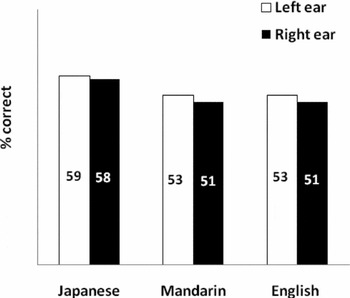
Ear effect and native group. Because no significant interaction was obtained for ear and group, F (2, 45) = .359, p = .7, or ear, group and pitch accent, F (4, 90) = 1.33, p = .265, or ear, group, pitch accent, and syllable, F (24, 540) = .98, p = .496, no further analysis was performed for each of these interactions. These results revealed that the three groups did not differ in ear advantage in the perception of pitch accent (Figure 2).
The percentage of correct identification in the left ear and right ear for Japanese, Mandarin. and English listeners.

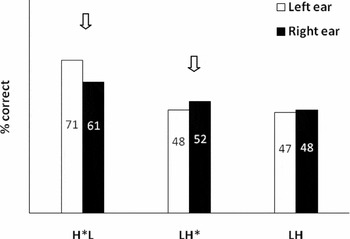
Ear effect and pitch accent pattern. Based on the significant interaction of ear and pitch accent pattern reported above, sets of one-factor repeated-measures ANOVAs were conducted to investigate ear effect on the processing of each pitch accent pattern. The results showed a significant effect of ear for the H*L pattern, F (1, 45) = 20.27, p < .0001, with the perception in the left ear (71%) being more accurate than in the right ear (61%) across groups. In contrast, for the LH* pattern, the perception in the right ear (52%) was significantly more accurate than that in the left ear (48%), F (1, 45) = 4.61, p = .037. For LH, no difference in ear advantage was observed, F (1, 45) = .58, p = .45. Figure 3 illustrates the patterns of ear advantage for each pitch accent pattern. Furthermore, one-factor repeated-measures ANOVAs were performed for each ear using pitch accent pattern as the within-subjects factor. This analysis indicated significant effects of pitch accent pattern for the left ear, F (2, 94) = 42.14, p < .0001, and the right ear, F (2, 94) = 6.81, p = .002. Consistent with the across-ear results, the post hoc tests (Bonferroni adjusted) further showed that H*L was more accurately perceived than LH* and LH for both the left ear (H*L 71% > LH* 48%, p < .0001; H*L 71% > LH 47%, p < .0001) and the right ear (H*L 61% > LH* 52%, p = .02; H*L 61% > LH 48%, p = .003), whereas no difference between the LH* and LH patterns was found (left ear: p = 1; right ear: p = .944).
The percentage of correct identification in the left ear and right ear for the high–accent–low (H*L), LH*, and LH patterns across native groups. The arrow (⇩) indicates statistical significance at p < .05.

Syllable effect and native group. To further analyze the above-reported main effect and interactions involving syllable, sets of one-factor ANOVAs were conducted for each group using syllable as the within-subjects factor. The results showed that the syllable effect existed only in the Japanese group, F (6, 90) = 7, p < .0001, with aki (51%) being more poorly identified than the other syllables (name: 56%; yuki: 59%; kaki: 59%; tama: 61%; hana: 62%; particularly take: 65%, p < .001). More detailed analysis with the Japanese group revealed consistent patterns across pitch accent patterns.
Distribution of ear preference
In addition to mean perceptual accuracy, data were also examined in terms of frequency, that is, the number of listeners showing each of the three different types of ear preference: left ear advantage (LEA), REA, or no ear advantage (NEA). This was performed using Pearson's chi-square (χ2) analysis. A three-way contingency table was created in SPSS (SPSS Inc., Chicago, IL) with ear preference as the column variable, pitch accent pattern as the row variable, and native group as the layer variable.
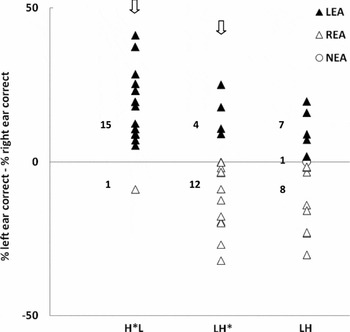
The results indicated a significant association between pitch accent pattern and the number of listeners showing LEA, REA, or NEA only for the English group, χ2 (4) = 18.32, p = .001, but not the Japanese, χ2 (4) = 4.85, p = .303, or Mandarin group, χ2 (4) = 3.18, p = .528. Thus, further analysis was performed to examine only the English group's distribution of ear preference in the processing of individual pitch accent patterns. As illustrated in Figure 4, for the H*L pattern, more English listeners showed LEA (15) than those showing REA (1), χ2 (1) = 12.25, p < .0001. In contrast, for the LH* pattern, the REA listeners (12) outnumbered the LEA listeners (4), χ2 (1) = 4, p = .046. No English listeners exhibited NEA for these two pitch accent patterns. For the LH pattern, there was no significant difference in the distribution of ear preference, χ2 (2) = 5.38, p = .068.
The number of listeners showing left ear advantage (LEA▲), right ear advantage (REA△), or no ear advantage (NEA○) for the English group (n = 16) in the perception of the high–accent–low (H*L), LH*, and LH patterns. The numbers indicate the occurrences of left ear advantage (LEA; above the zero-crossing line), right ear advantage (REA; below the zero-crossing line), and no ear advantage (NEA; at the zero-crossing line). The arrow (⇩) indicates statistical significance at p < .05.

DISCUSSION
The ear preference analyses of the perceptual accuracy data indicate that all three groups tended to be less lateralized in the overall processing across three pitch accent patterns. Despite this general pattern, the results for individual pitch accent patterns varied, showing an LEA (i.e., right hemisphere dominance) for the H*L pattern, a REA (i.e., left hemisphere dominance) for the LH* pattern and NEA (i.e., no hemisphere dominance) for the LH pattern. In addition, a comparison of the pitch accent patterns across ears showed that the native and nonnative groups all identified the H*L pattern more accurately than the other two patterns. However, group difference was observed with the distribution of ear preference analysis. That is, only the English group, but not the Japanese or Mandarin group, demonstrated that the number of listeners for each hemispheric dominance pattern differed as a function of pitch accent patterns. Specifically, more English listeners showed right hemisphere dominance when processing the H*L pattern, whereas more of them showed left hemisphere dominance for the LH* pattern. In the following discussion, these results are interpreted in relation to the proposed hypotheses for the native and nonnative listeners in terms of how the acoustic properties of the target prosody interacting with linguistic functions and experience affect lateralization of Japanese pitch accent.
Native processing
Overall results. That the native Japanese listeners showed a lesser degree of lateralization in processing overall pitch accent patterns differs from previous native linguistic tone processing findings, which have shown a strong and consistent left hemisphere dominance (e.g., Gandour et al., Reference Gandour, Wong, Lowe, Dzemidzic, Satthamnuwing and Tong2002; Wang et al., Reference Wang, Sereno and Jongman2001). This finding is consistent with Hayashi et al. (Reference Hayashi, Imaizumi, Mori, Niimi, Ueno and Kiritani2001), claiming that the results of bilateral processing for pitch accent was presumably due to its lighter linguistic functional use compared to tone.
The results support the linguistic functional hypothesis (Gandour, Dzemidzic, et al., Reference Gandour, Dzemidzic, Wong, Lowe, Tong and Hsieh2003; Van Lancker, Reference Van Lancker1980), which predicts a lesser degree of left-hemisphere dominance for those linguistic contrasts with a lower functional load. In this case, Japanese pitch accent has a lower functional load than tone, because pitch accent is less widely used (Pierrehumbert & Beckman, Reference Pierrehumbert and Beckman1988) compared to tone, which is contrastive on every word in tone languages (Chao, Reference Chao1948). Furthermore, these results may be accounted for by the acoustic hypothesis (Poeppel, Reference Poeppel2001, Reference Poeppel2003), in that pitch accent superimposed on disyllabic words has a larger temporal frame length compared to tone, which is typically superimposed on monosyllables. As the hypothesis posited, those linguistic domains with a longer temporal frame length tend to be processed more holistically and are thus less left lateralized, whereas those with a shorter temporal frame involve a greater degree of analytic processing which is primarily a left-hemisphere property (Bever, Reference Bever1975; Gandour, Dzemidzic, et al., Reference Gandour, Dzemidzic, Wong, Lowe, Tong and Hsieh2003; Poeppel, Reference Poeppel2003).
However, the current results were inconsistent with Sato et al. (Reference Sato, Sogabe and Mazuka2007), finding a left-hemisphere specialization for native Japanese processing of pitch accent patterns H*L and LH*. This discrepancy may be explained by the different levels of task difficulty. Whereas only the H*L and LH* patterns were tested in Sato et al. (Reference Sato, Sogabe and Mazuka2007), the current study included all three patterns, especially the confusable pair LH* and LH, consequently increasing the task difficulty. Previous research has shown greater engagement of the right hemisphere with an increase in task difficulty (Aasland & Baum, Reference Aasland and Baum2003). Thus, pitch accent processing may have involved greater right-hemisphere activities compared to that in Sato et al. (Reference Sato, Sogabe and Mazuka2007).
Individual pitch accent patterns. Despite the lack of significant ear preference across pitch accent patterns, individual pitch accent pattern analysis did reveal different tendencies of lateralization: right hemisphere dominance for H*L, whereas left hemisphere dominance for LH* and no hemisphere dominance for LH. Given that the pitch accent triplets or pairs in the current study were selected to be of comparable frequency of use and they were all at the same level of contrastivity (i.e., the pitch accent level), it is unlikely that linguistic function played a role in these different processing patterns. On the other hand, previous findings on the acoustic processing of pitch patterns may lend some support to account for the different patterns. For example, Ivry and Lebby (Reference Ivry and Lebby1993) suggest that the left hemisphere is biased for processing (relatively) higher frequency information, whereas the right hemisphere is biased for processing lower frequency information. In addition, Walsh (Reference Walsh, Dickey and Tunstall1996) showed that the perception of pitch accent could not be accurately determined until the second syllable, indicating a prominent role of the ending frequency. In the case of pitch accent patterns, H*L ends with a lower frequency, whereas LH* and LH end with a higher frequency. Thus, it is speculated that when focusing on the second syllable, H*L (ending with L) was more right hemisphere-biased than LH* and LH (ending with H).
Moreover, the degree of stimulus perceptual confusion may have influenced the lateralization of individual pitch accent patterns. The across-ears results showed that LH* and LH were more poorly perceived than H*L. As previously revealed, due to their subtle acoustic distinctions in F0 maximum (Sugito, Reference Sugito and Sugito1983; Vance, Reference Vance1995), LH* and LH are difficult to distinguish and thus poorly perceived (Maniwa, Reference Maniwa2002; Sugiyama, Reference Sugiyama2006). In terms of hemispheric processing, it has been found from tone studies that poorly perceived tones tend to show a greater degree of left hemisphere involvement (Wang et al., Reference Wang, Behne, Jongman and Sereno2004). The current results consistently revealed this pattern, with LH* and LH involving more left-hemisphere processing than H*L.
Although further research may be necessary to test these speculations, the current results of different processing for individual pitch accent patterns suggest that future studies should not just treat a linguistic property (such as pitch accent or tone) as a single entity. Individual patterns within the same linguistic domain may involve different processing patterns due to their acoustic differences (e.g., H*L vs. LH* pitch accent patterns, or falling tone vs. rising tone).
Syllable effect. The perceptual accuracy rate across ears for each syllable indicated that the syllable aki was more poorly identified than the other syllables by the Japanese listeners. This may be because the familiarity ratings for the words with the aki syllable were relatively lower than other words (Amano & Kondo, Reference Amano and Kondo1999; Sekiguchi, Reference Sekiguchi2006). Thus, the lower accuracy rate for the pitch accent processing of the aki words might result from a lower level of familiarity with aki. That this syllable effect was shown only in the Japanese group was conceivable, because none of these words were meaningful for the nonnative listeners and were thus devoid of any familiarity effect.
Nonnative processing
Overall results. The accuracy data revealed that both the Mandarin and English listeners showed a less-lateralized pattern when processing Japanese pitch accent across the three patterns, just as the native Japanese group did. These results are consistent with the previous findings of nonnative tone processing in that nonnative prosodic features are not processed as linguistically significant contrasts typically specialized in the left hemisphere (Gandour et al., Reference Gandour, Wong, Lowe, Dzemidzic, Satthamnuwing and Tong2002; Van Lancker & Fromkin, Reference Van Lancker and Fromkin1973; Wang et al., Reference Wang, Sereno and Jongman2001, Reference Wang, Behne, Jongman and Sereno2004).
The current results of similar native and nonnative patterns also suggest the involvement of acoustic processing for native and nonnative listeners alike, with a larger temporal domain resulting in a lesser degree of left hemisphere involvement (Bever, Reference Bever1975; Gandour, Dzemidzdic, et al., Reference Gandour, Dzemidzic, Wong, Lowe, Tong and Hsieh2003; Poeppel, Reference Poeppel2003). These common patterns across the native and nonnative groups suggest that the perception of pitch accent may involve more acoustic processing than linguistic processing. Previous studies argued that in the processing of speech, listeners may integrate different levels of acoustic and linguistic cues depending on cue availability and stimulus properties (Zhang et al., Reference Zhang, Shu, Zhou, Wang and Li2010; Zhao et al., Reference Zhao, Shu, Zhang, Wang, Gong and Li2008). For example, although cortical competition may occur as a function of the competition of information from different linguistic (and nonlinguistic) domains (Zhao et al., Reference Zhao, Shu, Zhang, Wang, Gong and Li2008), cortical overlap may reflect common processing of acoustic properties associated with different linguistic dimensions (Zhang et al., Reference Zhang, Shu, Zhou, Wang and Li2010). In the current study, that the listeners with different language backgrounds showed common patterns may indicate a lesser degree of linguistic influence. Because of the low linguistic contrastivity (functional load) for pitch accent, its processing was conceivably more associated with the subtle acoustic properties, resulting in similar processing patterns for native and nonnatives.
Group-specific patterns. Despite these common patterns across groups, group-specific patterns were also evident. From the distribution of ear preference data, ear effect for individual pitch accent patterns was only found for the English group, with more right-hemisphere-biased listeners for the H*L pattern, whereas more left-hemisphere-biased ones for LH*. These patterns were consistent with the common patterns across groups from the perceptual accuracy results. That more English listeners' processing patterns were sensitive to pitch pattern difference indicates that the perception of Japanese pitch accent involved even greater degree of acoustic rather than linguistic processing for the English listeners, compared to the Japanese and Mandarin listeners. These different processing patterns may be accounted for by the influence of the nonnative listeners' prior prosodic experience, as the degree of functional load of linguistic prosody in English was lower than in Japanese or Mandarin (Van Lancker, Reference Van Lancker1980).
GENERAL DISCUSSION
The theoretical framework of this research addresses a long-deliberated issue in speech processing, regarding the extent to which speech processing is influenced by higher level linguistic-specific circuits, or reflecting lower level encoding of physical properties (Gandour et al., Reference Gandour, Tong, Wong, Talavage, Dzemidzic and Xu2004; Poeppel, Reference Poeppel2003; Zatorre & Gandour, Reference Zatorre and Gandour2008). The current findings from the native and nonnative groups suggest combined effects of linguistic representations and acoustic sensitivities on the processing of linguistic prosody.
In terms of linguistic function, the results support the previous finding of an experience-dependent processing of prosody, where prosody with a lower functional load involves a lesser degree of left hemisphere dominance (Gandour, Dzemidzic, et al., Reference Gandour, Dzemidzic, Wong, Lowe, Tong and Hsieh2003; Van Lancker, Reference Van Lancker1980). That the native processing of Japanese pitch accent was overall less lateralized could be attributed to the low functional use of pitch accent in Japanese (compared to tone). Likewise, linguistic functional load may differentially affect nonnative processing patterns. As discussed earlier, listeners whose L1 (e.g., English) prosody has a lower functional load than that of the target prosody tend to rely more on acoustic cues in the processing of the target prosody than those from a language (e.g., Mandarin) with a greater functional use of prosody. These native and nonnative patterns consistently suggest that prosodic processing is altered by linguistic experience as indexed by the weight of functional load.
In contrast, acoustic properties such as the temporal frame length are also found to influence hemispheric processing, with a prosodic feature over a longer temporal domain being more right-hemisphere lateralized, whereas one over a shorter domain more left-hemisphere dominant (e.g., Poeppel, Reference Poeppel2003). Following this account, the current Japanese listeners' overall less-lateralized processing could be due to the (longer) disyllabic context in which pitch accent appears (compared to the monosyllabic context for tone). These results echo the previous findings of a left-hemisphere preference for monosyllabic tone processing, whereas a right-hemisphere dominance for intonations imposed on trisyllabic sentences (Gandour et al., Reference Gandour, Wong, Dzemidzic, Lowe, Tong and Li2003). It is thus conceivable that pitch accent was overall less lateralized as its temporal frame length falls in between tone and intonation. Moreover, the contribution of acoustic aspects in pitch accent processing has also been revealed with the nonnatives, particularly the English group who demonstrated greater sensitivity to the acoustic differences among the pitch accent patterns.
The current results suggest that the processing of pitch accent for the native and nonnative listeners alike may have involved more acoustic than linguistic processing. First, the relatively low functional load of pitch accent in Japanese may have forced them to rely more on acoustic information, given that the linguistic cues are not prominent (Zhao et al., Reference Zhao, Shu, Zhang, Wang, Gong and Li2008). Moreover, the different laterality patterns for individual pitch accents as revealed by the perceptual accuracy data indicates that both native and nonnative processing may have been sensitive to subtle acoustic properties (Ivry & Lebby, Reference Ivry and Lebby1993).
Taken as a whole, this study, along with the previous ones (e.g., Gandour et al., Reference Gandour, Tong, Wong, Talavage, Dzemidzic and Xu2004; Gandour, Dzemidzic, et al., Reference Gandour, Dzemidzic, Wong, Lowe, Tong and Hsieh2003; Gandour, Wong, et al., Reference Gandour, Wong, Dzemidzic, Lowe, Tong and Li2003), suggests that processing of speech prosody does not just involve a single process, a single linguistic or physical domain, or a particular hemisphere, but may rather be the integration of multiple levels and processes.
CONCLUDING REMARKS
The current study supports the prevalent hypothesis on the combined linguistic and acoustic effects on prosodic processing (Zatorre & Gandour, Reference Zatorre and Gandour2008). For further research to examine the interactions of functional load and acoustic properties in prosodic processing, a comparison of nonnative processing of stress and pitch accent could be informative. The disyllabic pitch accent and stress may have the same temporal domain, but different levels of functional load. Thus, comparing the native and nonnative processing of pitch accent and stress, along with the previous findings on nonnative tone and intonation processing, can shed light on our understanding of the interaction of linguistic and acoustic aspects in hemispheric processing of prosodic features. Moreover, different processing patterns of individual pitch accent patterns imply that future studies of hemispheric processing of a linguistic property should involve a more detailed examination of different patterns of the property, for example, to separately analyze rising versus falling tones for tone processing, or H*L versus LH* for pitch accent patterns. Because individual patterns of prosody may not be processed in the same way, the acoustic processing involving individual linguistic patterns needs to be taken into account. Furthermore, this research with naive nonnative listeners of pitch accent provides a foundation for further studies on the role of linguistic experience on the processing of pitch accent with learners of Japanese or bilinguals examining the extent to which the processing patterns differ as a function of proficiency in Japanese.
Thus, to converge evidence in unraveling the neural processing of linguistic prosody, future studies should take into account different acoustic and linguistic domains, different levels of linguistic properties, as well as listeners with diversified language proficiency levels and backgrounds.
ACKNOWLEDGMENTS
All three authors made equal contributions to this study. This research was supported by a Discovery Research grant (312457–2006) from the Natural Sciences and Engineering Research Council of Canada (NSERC). We acknowledge Amalia Dray for her contribution to the pilot study of this research, and Angela Cooper, Andrea Lalic, Tia Rad, Yasuko Sakurai, and Rebecca Simms from Simon Fraser University for their assistance. We thank Allard Jongman, Dawn Behne, Kenneth de Jong, Kenneth Hugdahl, Nancy Hedberg, and Yukiko Sugiyama for their feedback and discussions. Special thanks to Lihui Zhao at Harvard University for assistance in statistical analysis. Thanks also to an Associate Editor and the two anonymous reviewers for their comments and suggestions. Portions of this research were published in the Proceedings of the 2008 Canadian Acoustical Association Annual Conference and presented at the 2008 Canadian Acoustical Association Annual Conference in Vancouver, the 156th Acoustical Society of America Meeting in Miami, and the 2th International Conference on East Asian Linguistics in Vancouver.